

Sample Category Title
USD/JPY Daily Outlook
Daily Pivots: (S1) 129.14; (P) 130.04; (R1) 130.77; More...
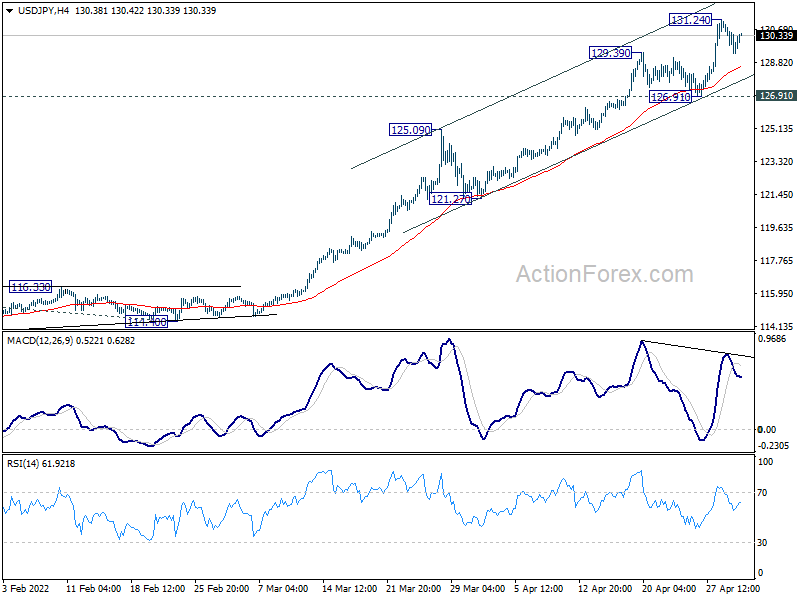
Intraday bias in USD/JPY remains neutral for consolidation below 131.24 Outlook stays bullish with 126.91 support intact. Break of 131.24 will resume recent up trend to 261.8% projection of 109.11 to 116.34 from 114.40 at 133.26. However, considering bearish divergence condition in 4 hour MACD, break of 126.91 will confirm short term topping and turn bias back to the downside for a correction.
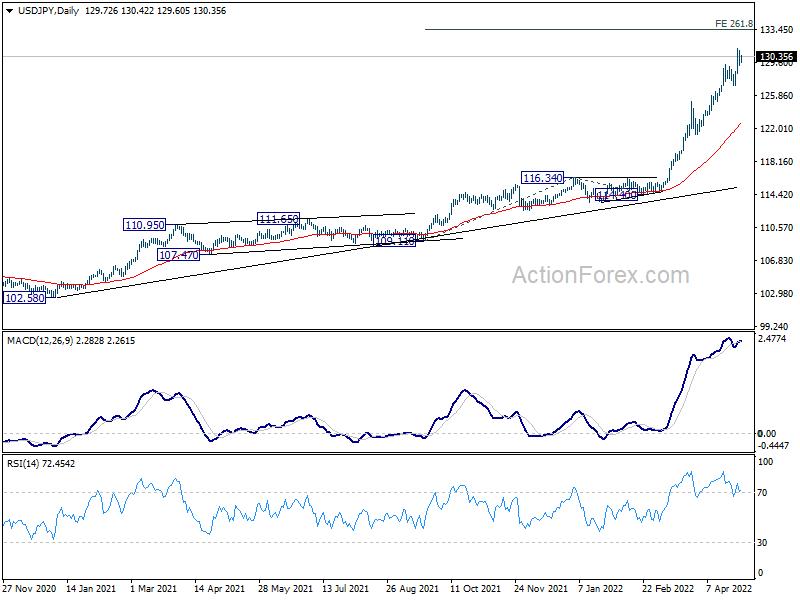
In the bigger picture, current rally is seen as part of the long term up trend form 75.56 (2011 low). Sustained trading above 61.8% projection of 75.56 (2011 low) to 125.85 (2015 high) from 98.97 at 130.04 will pave the way to 100% projection at 149.26, which is close to 147.68 (1998 high). For now, this will remain the favored case as long as 121.27 support holds.
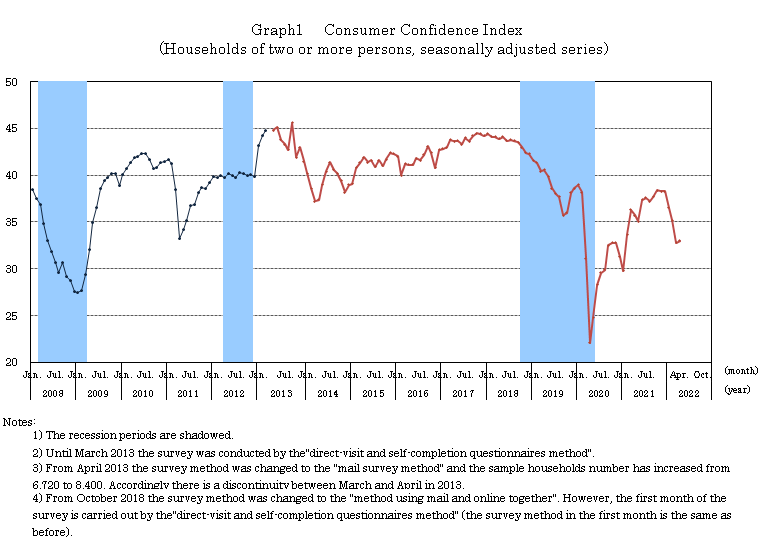
Japan consumer confidence ticked up to 33.0 in Apr
Japan consumer confidence index rose slightly by 0.2 pts to 33.0 in April, missed expectation of 33.9. Overall livelihood dropped -0.1 to 31.2. Income growth dropped -0.6 to 36.8. Employment rose 1.3 to 36.1. Willingness to buy durable goods dropped -0.1 to 27.7.
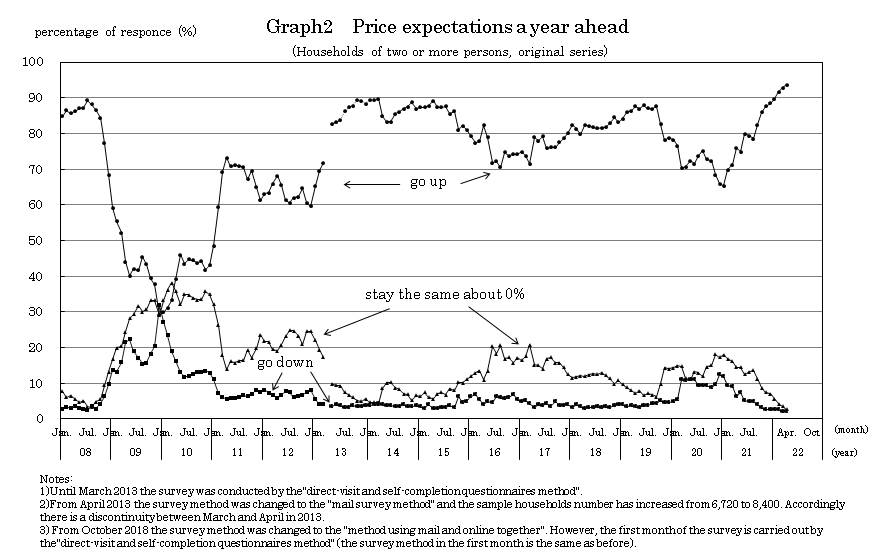
93.7% of respondents expect prices to go up a year ahead, up 0.9%. 2.7% expect prices to stay the same, down -0.8%. 2.1% expect prices to go down, up 0.1%.
USD/CHF Daily Outlook
Daily Pivots: (S1) 0.9692; (P) 0.9714; (R1) 0.9758; More....
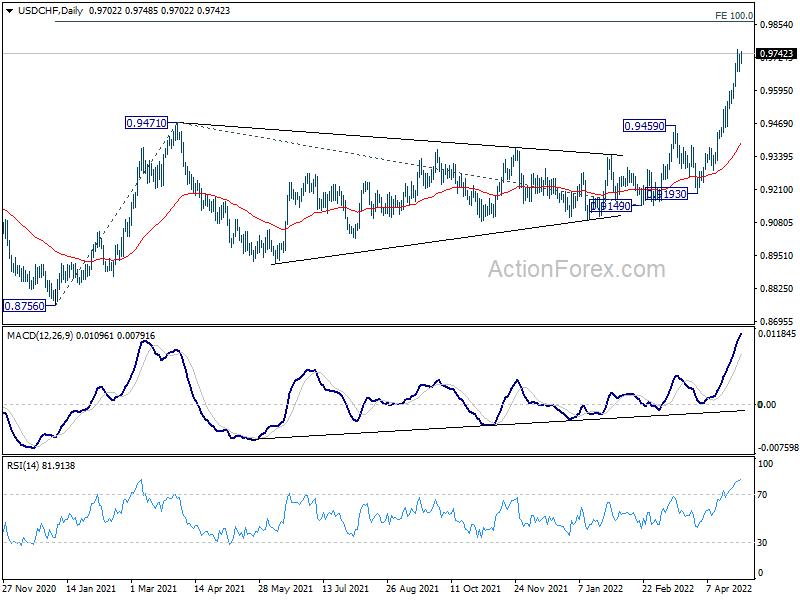
Intraday bias in USD/CHF remains neutral for consolidation below 0.9758 temporary top. Deeper retreat could be seen, but downside should be contained well above 0.9459 support to bring another rally. On the upside, break of 0.9758 will resume larger rise to next medium term projection level at 0.9864.
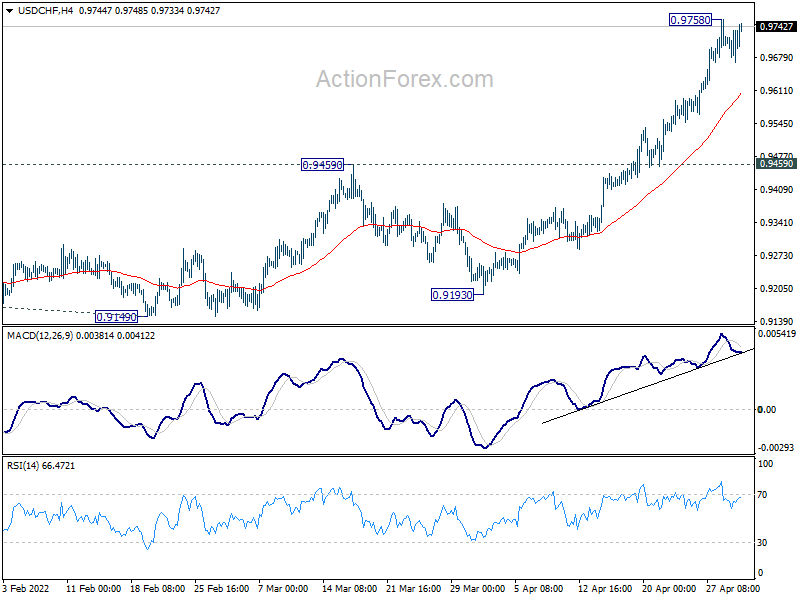
In the bigger picture, down trend from 1.0342 (2016 high) should have completed with three waves down to 0.8756 (2021 low) already. Rise from 0.8756 is likely a medium term up trend of its own. Next target is 100% projection of 0.8756 to 0.9471 from 0.9149 at 0.9864. This will now remain the favored case as long as 0.9459 resistance turned support holds.
A Busy Week With RBA, Fed, BoE, and NFP, Dollar Starts Firm
Dollar rises broadly again today but Asian session is a bit quiet with China and Hong Kong on holiday. Selling mainly concentrates on Aussie and Kiwi, with both breaking through last week's lows. But Euro and Yen are not too far away. Sterling and Canadian are mixed for now. Three central banks will hike interest rates this week and lots of important economic data are featured. Let's fasten our seat belts.
Technically, Dollar pairs will be the focuses today. Levels to watch include 1.0470 temporary low in EUR/USD, 0.8579 temporary top in USD/CHF, 131.24 in USD/JPY and 1.2879 in USD/CAD. Firm break of these levels together should confirm resumption of broad based rally in Dollar.
In Asia, at the time of writing, Nikkei is down -0.09%. Japan 10-year JGB yield is up 0.0145 at 0.234. Singapore Strait Times is up 0.65%.
ECB de Guindos: July rate hike is possible but not likely
In an interview published on Sunday, ECB Vice President Luis de Guindos reiterated that ECB decided to end asset purchases in Q3. "In my opinion, there's no reason why this shouldn't happen in July," he said.
As for rate hike, "it could be months, weeks or days" after ending the asset purchases. "July is possible, but that's not to say it's likely," he added.
After the first hike, "we are driven by data, not by markets. Markets can sometimes be wrong. Within the Governing Council we haven't discussed any predetermined path for rate rises."
Japan PMI manufacturing finalized at 53.5, war and China weigh on confidence
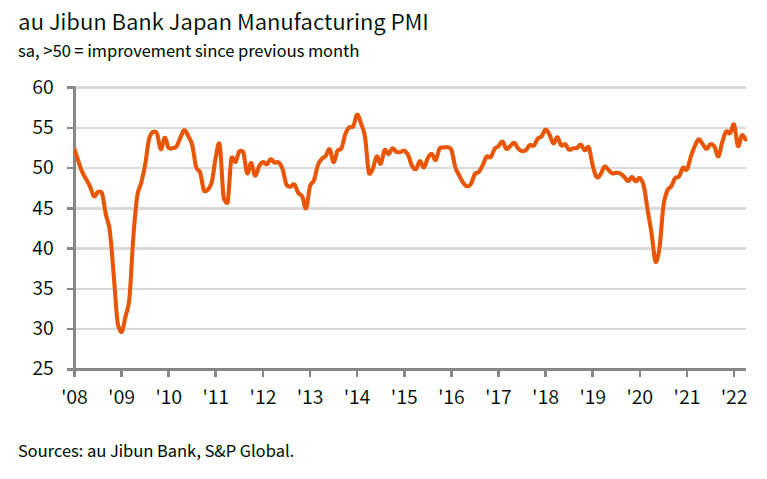
Japan PMI Manufacturing was finalized at 53.5 in April, down from March's 54.1. Au Jibun Bank said growth in output levels was unchanged as new orders expansion slowed. Factory gate charges were in record rise amid accelerating input prices. Business optimism dipped to lowest since July 2020.
Usamah Bhatti, Economist at S&P Global, said: "Domestic demand was a key driver of growth... but the reintroduction of lockdown restrictions in China hindered international demand. These measures coupled with the fallout from war in Ukraine continued to disrupt supply chains across the sector.
"Delivery delays and price rises remained a dampener... Sharply rising cost burdens pushed Japanese manufacturers to raise selling prices to the greatest extent in the survey history.
"Though still optimistic, Japanese goods producers were increasingly wary of the continued impact of price and supply pressures, and also the impact of the war and extended lockdowns in China. As a result, confidence dipped to the weakest since July 2020."
NZD/USD extends down trend, pressing MT channel support
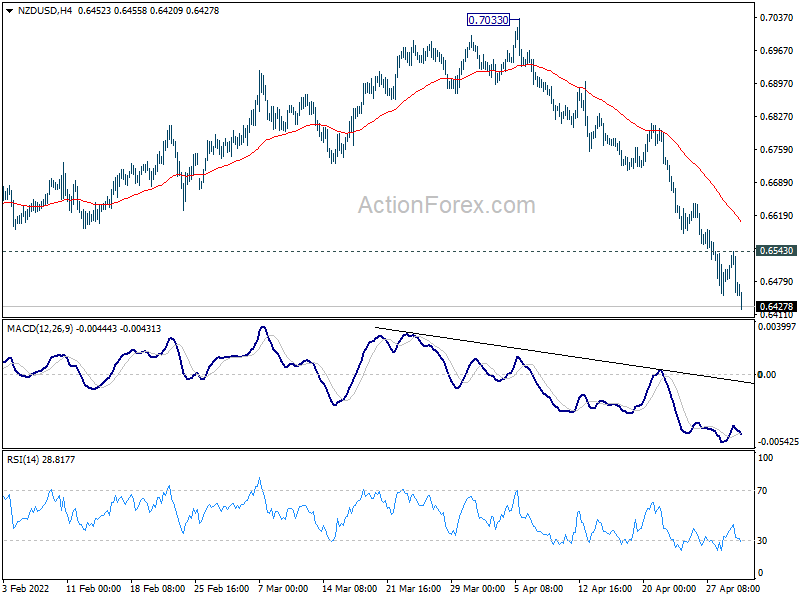
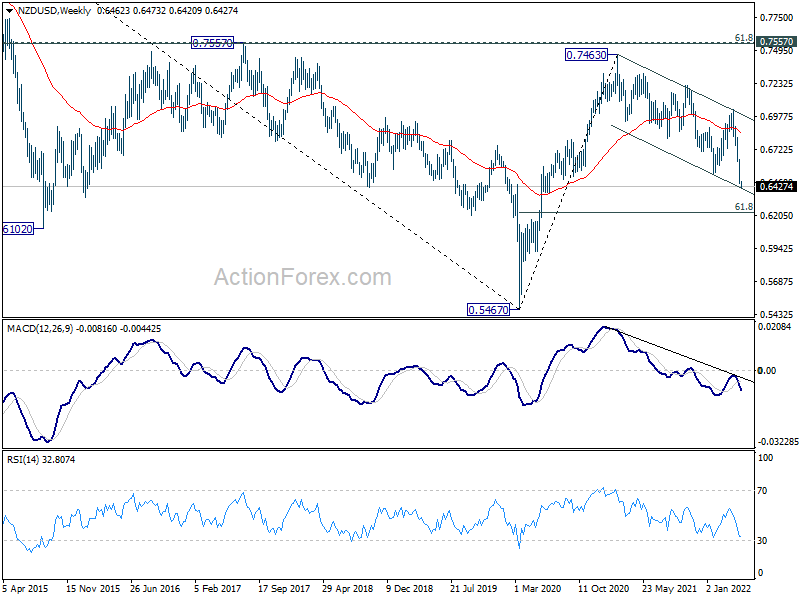
NZD/USD's decline resumes today and hit as low as 0.6420 so far. The weakness in Kiwi is mainly due to external factors, rather than domestic ones. The economy remains strong while RBNZ is expected to continue with its tightening cycle. But the pace of rate hike would likely be outpaced by Fed's. Additionally, concerns over China's slowdown on lockdowns, and general risk-off sentiment are weighing on New Zealand Dollar too.
Immediate focus is now on medium term channel support (now at 0.6430). Sustained break there could prompt further downside acceleration to 61.8% projection of 0.5467 (2020 low) to 0.7463 (2021 high) at 0.6229. Nevertheless, break of 0.6543 minor resistance would be an initial sign of stabilization, and turn bias to the upside for rebound first.
RBA, Fed and BoE to hike; ISMs and NFP watched too
Three central banks will meet this week, including RBA, Fed and BoE. All are expected to raise interest rates. For both RBA and BoE, the focuses will also be on the new economic projections, which should provide an updated path of monetary policies. As for Fed, a 50bps hike is a done deal. The question is whether Fed would hike even more in June by 75bps as priced in by the markets. Fed Chair Jerome Powell is unlikely to drop many hints on that.
It's also extremely busy on economic data front. In particular, US will release ISMs and non-farm payroll report. Comments from Fed officials after NFP could be the guidance of the June hike. Other data to watch include employment data from New Zealand and Canada. Here are some highlights for the week:
- Monday: Australia AiG manufacturing; Japan PMI manufacturing final, consumer confidence; Germany retail sales; Swiss SECO consumer climate, PMI manufacturing; Eurozone PMI manufacturing final; US ISM manufacturing, construction spending.
- Tuesday: RBA rate decision; Germany unemployment; UK PMI manufacturing; Eurozone PPI, unemployment rate; US factory orders.
- Wednesday: Australia AiG construction, retail sales; New Zealand employment; Germany trade balance; Eurozone PMI services final, retail sales; UK M4 money supply, mortgage approvals; US ADP employment, trade balance, ISM services, FOMC rate decision; Canada trade balance.
- Thursday: Australia trade balance, building approvals; China Caixin PMI services; Swiss CPI; Germany factor orders; UK PMI services final, BoE rate decision. US jobless claims, non-farm productivity.
- Friday: Australia AiG services; Japan Tokyo CPI, monetary base; Swiss unemployment rate, foreign currency reserves; Germany industrial production; UK PMI construction; Canada employment, Ivey PMI; US non-farm payrolls.
USD/CHF Daily Outlook
Daily Pivots: (S1) 0.9692; (P) 0.9714; (R1) 0.9758; More....
Intraday bias in USD/CHF remains neutral for consolidation below 0.9758 temporary top. Deeper retreat could be seen, but downside should be contained well above 0.9459 support to bring another rally. On the upside, break of 0.9758 will resume larger rise to next medium term projection level at 0.9864.
In the bigger picture, down trend from 1.0342 (2016 high) should have completed with three waves down to 0.8756 (2021 low) already. Rise from 0.8756 is likely a medium term up trend of its own. Next target is 100% projection of 0.8756 to 0.9471 from 0.9149 at 0.9864. This will now remain the favored case as long as 0.9459 resistance turned support holds.
Economic Indicators Update
| GMT | Ccy | Events | Actual | Forecast | Previous | Revised |
|---|---|---|---|---|---|---|
| 22:30 | AUD | AiG Performance of Mfg Index Apr | 58.5 | 55.7 | ||
| 00:30 | JPY | Manufacturing PMI Apr F | 53.5 | 53.4 | 53.4 | |
| 05:00 | JPY | Consumer Confidence Index Apr | 33.9 | 32.8 | ||
| 06:00 | EUR | Germany Retail Sales M/M Mar | 0.30% | 0.30% | ||
| 07:00 | CHF | SECO Consumer Climate Q2 | -15 | -4 | ||
| 07:30 | CHF | Manufacturing PMI Apr | 60.2 | 64 | ||
| 07:45 | EUR | Italy Manufacturing PMI Apr | 55.1 | 55.8 | ||
| 07:50 | EUR | France Manufacturing PMI Apr F | 55.4 | 55.4 | ||
| 07:55 | EUR | Germany Manufacturing PMI Apr F | 54.1 | 54.1 | ||
| 08:00 | EUR | Unemployment Mar | 8.40% | 8.50% | ||
| 08:00 | EUR | Eurozone Manufacturing PMI Apr F | 55.3 | 55.3 | ||
| 09:00 | EUR | Eurozone Economic Sentiment Indicator Apr | 108 | 108.5 | ||
| 09:00 | EUR | Eurozone Services Sentiment Apr | 14.2 | 14.4 | ||
| 09:00 | EUR | Eurozone Industrial Confidence Apr | 9.5 | 10.4 | ||
| 09:00 | EUR | Eurozone Consumer Confidence Apr F | -16.9 | -16.9 | ||
| 13:30 | CAD | Manufacturing PMI Apr | 57.9 | 58.9 | ||
| 13:45 | USD | Manufacturing PMI Apr F | 59.7 | 59.7 | ||
| 14:00 | USD | ISM Manufacturing PMI Apr | 57.5 | 57.1 | ||
| 14:00 | USD | ISM Manufacturing Prices Paid Apr | 88.2 | 87.1 | ||
| 14:00 | USD | ISM Manufacturing Employment Index Apr | 56.3 | |||
| 14:00 | USD | Construction Spending M/M Mar | 0.80% | 0.50% |
NZD/USD extends down trend, pressing MT channel support
NZD/USD's decline resumes today and hit as low as 0.6420 so far. The weakness in Kiwi is mainly due to external factors, rather than domestic ones. The economy remains strong while RBNZ is expected to continue with its tightening cycle. But the pace of rate hike would likely be outpaced by Fed's. Additionally, concerns over China's slowdown on lockdowns, and general risk-off sentiment are weighing on New Zealand Dollar too.
Immediate focus is now on medium term channel support (now at 0.6430). Sustained break there could prompt further downside acceleration to 61.8% projection of 0.5467 (2020 low) to 0.7463 (2021 high) at 0.6229. Nevertheless, break of 0.6543 minor resistance would be an initial sign of stabilization, and turn bias to the upside for rebound first.
Japan PMI manufacturing finalized at 53.5, war and China weigh on confidence
Japan PMI Manufacturing was finalized at 53.5 in April, down from March's 54.1. Au Jibun Bank said growth in output levels was unchanged as new orders expansion slowed. Factory gate charges were in record rise amid accelerating input prices. Business optimism dipped to lowest since July 2020.
Usamah Bhatti, Economist at S&P Global, said: "Domestic demand was a key driver of growth... but the reintroduction of lockdown restrictions in China hindered international demand. These measures coupled with the fallout from war in Ukraine continued to disrupt supply chains across the sector.
"Delivery delays and price rises remained a dampener... Sharply rising cost burdens pushed Japanese manufacturers to raise selling prices to the greatest extent in the survey history.
"Though still optimistic, Japanese goods producers were increasingly wary of the continued impact of price and supply pressures, and also the impact of the war and extended lockdowns in China. As a result, confidence dipped to the weakest since July 2020."
ECB de Guindos: July rate hike is possible but not likely
In an interview published on Sunday, ECB Vice President Luis de Guindos reiterated that ECB decided to end asset purchases in Q3. "In my opinion, there's no reason why this shouldn't happen in July," he said.
As for rate hike, "it could be months, weeks or days" after ending the asset purchases. "July is possible, but that's not to say it's likely," he added.
After the first hike, "we are driven by data, not by markets. Markets can sometimes be wrong. Within the Governing Council we haven't discussed any predetermined path for rate rises."
EUR/USD Could Struggle To Recover Above 1.0650
Key Highlights
- EUR/USD tumbled below 1.0650 and 1.0550.
- It traded to a new multi-month low below 1.0480.
- GBP/USD fell sharply and tested 1.2440, while USD/JPY jumped above 131.00.
- The US ISM Manufacturing Index could increase from 57.1 to 58.0 in April 2022.
EUR/USD Technical Analysis
The Euro gained bearish momentum after it broke the 1.0750 support against the US Dollar. EUR/USD traded below the 1.0650 support to enter a bearish zone.
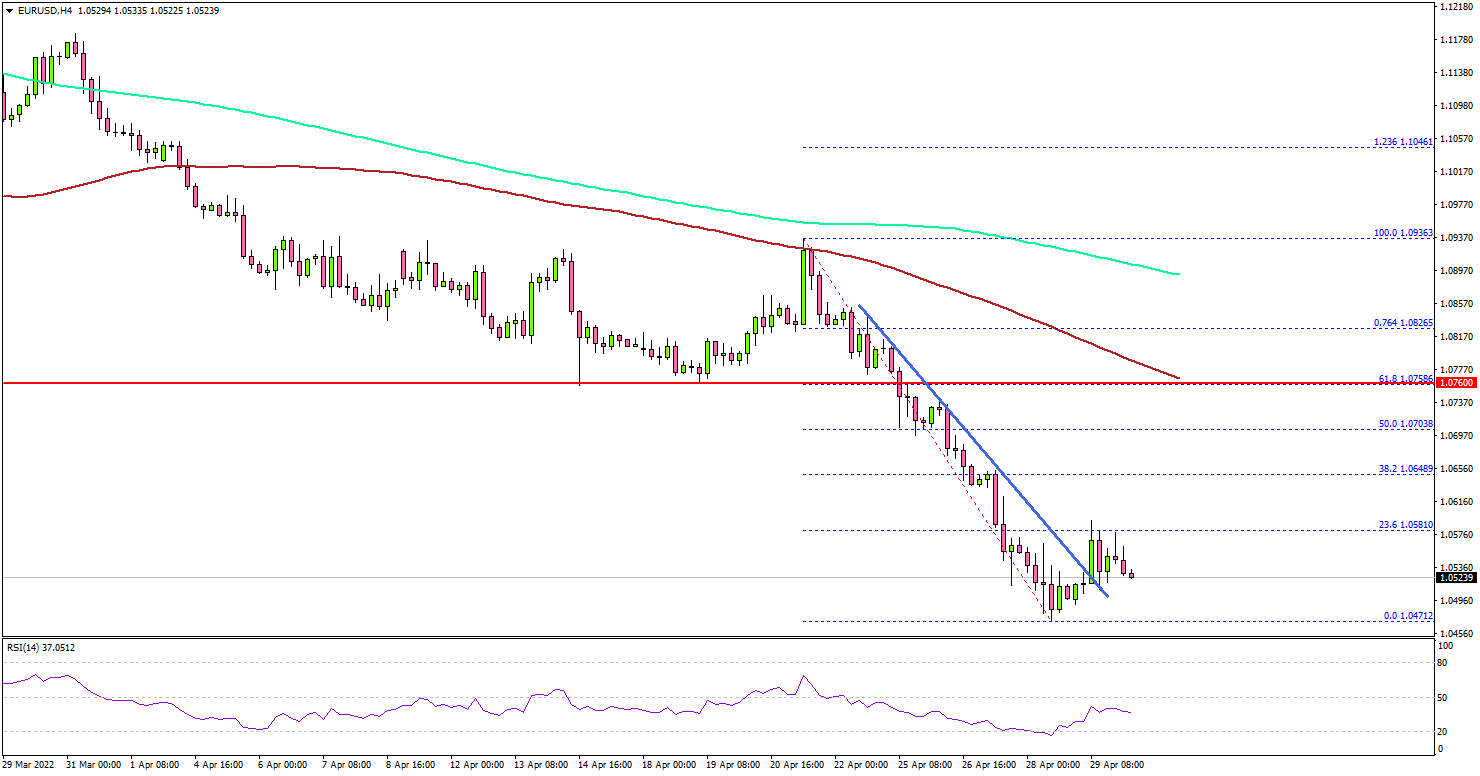
Looking at the 4-hours chart, the pair tumbled below the 1.0600 level. It even settled below 1.0600, the 200 simple moving average (green, 4-hours), and the 100 simple moving average (red, 4-hours).
Finally, there was a spike below the 1.0500 level and the pair traded to a new multi-month low at 1.0471. It is now correcting losses above the 1.0500 level. There was a move above a steep bearish trend line at 1.0525 on the same chart.
An immediate resistance is near the 1.0650 level. It is near the 38.2% Fib retracement level of the key decline from the 1.0936 swing high to 1.0471 low.
The next major resistance is seen near the 1.0700 level or the 50% Fib retracement level of the key decline from the 1.0936 swing high to 1.0471 low, above which the pair could start a steady increase.
If not, there is a risk of more losses below 1.0500. The next major support is near the 1.0475 level. Any more losses may perhaps open the doors for a move towards the 1.0420 support zone.
Looking at GBP/USD, the pair gained bearish momentum below the 1.2750 support and even spiked below 1.2500.
Economic Releases
- Euro Zone Consumer Confidence for April 2022 – Forecast -16.9, versus -16.9 previous.
- US ISM Manufacturing Index for April 2022 – Forecast 58.0, versus 57.1 previous.
Eco Data 5/2/22
[php_everywhere instance="1"]
Forex and Cryptocurrencies Forecast
EUR/USD: Euro Updates Five-Year Low, We Are Waiting for the Fed (FOMC) Meeting
The DXY index that measures the US dollar against a basket of six other major currencies updated its 20-year high on Thursday, April 28. The reason for this growth is still the same, and we have repeatedly written about it: the Fed began to tighten its monetary policy earlier than other major central banks. It is expected that the FOMC (Federal Open Market Committee) may raise the key interest rate by 0.5% at the next meeting on May 4. This is the minimum. For example, James Bullard, the head of the Federal Reserve Bank of St. Louis, did not rule out that the rate could be raised by 0.75% straight away.
Other national regulators are moving much more slowly (or not at all) amid the US Fed's hawkish activity. Their economies are showing weaker recovery from the crisis caused by the COVID-19 pandemic, and this does not allow central banks to quickly curtail monetary programs incentives (QE) and increase borrowing costs.
Of course, this applies to the European Union as well, which also suffers additional economic losses caused by the sanctions imposed on Russia due to the military invasion of Ukraine. Recall that the dependence of the EU countries on Russian energy resources is very high.
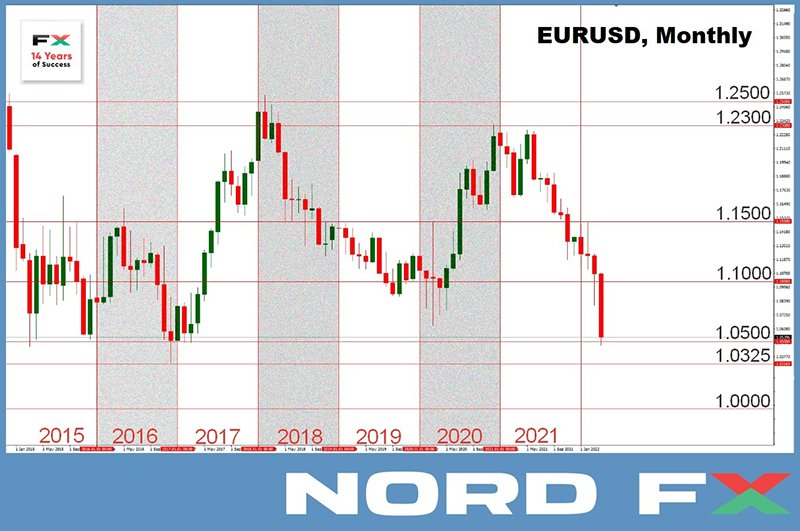
Against this background, the dollar continued to push the European currency, and the EUR/USD pair rewrote the five-year low, falling to 1.0470 on April 28. Thus, the losses of the European currency has exceeded 700 points in April alone. There was a slight rebound at the very end of the five-day period and a finish at the level of 1.0545.
The level of 1.0500 plays the role of a support, which may lead to a reduction in the volume of short positions and, as a result, to a fairly strong correction to the north. If this does not happen, then the next target for the bears will be the 2016 low of 1.0325. It is possible that we will see the parity of the euro and the dollar 1:1 soon. However, much depends on what happens to the interest rate at the US Federal Reserve meeting on May 4, and what will be said by the management of this regulator at the subsequent press conference.
At the time of writing, analysts' votes are almost evenly divided. 35% are confident that the dollar will continue to strengthen, 30% have the opposite opinion, the remaining 35% have taken a wait-and-see attitude. Not surprisingly, with the current dynamics of the pair, 100% of the trend indicators and oscillators on D1 are colored red, although 25% of the latter give signals of the pair being oversold. The nearest support is located at 1.0500, followed by the April 28 low of 1.0470, and the bears' further goals for EUR/USD are described above. The nearest resistance zone is 1.0550-1.0600, 1.0750-1.0800, 1.0830-1.0860, 1.0900-1.0935 and 1.1000.
As for the coming week, in addition to event No. 1, the Fed meeting, the calendar includes the release of data on retail sales in Germany and business activity in US manufacturing sector (ISM) on Monday, May 02. ECB President Christine Lagarde is expected to speak the next day. We will find out the volume of retail sales in the European Union as a whole on Wednesday, May 04. The ADP report on US private sector employment will be published on this day as well. Another portion of data from the US labor market will arrive on Friday, May 06, including such an important indicator as the number of new jobs outside the agricultural sector (NFP).
GBP/USD: The Pound Updates its Two-Year Low, We Are Waiting for the Meeting of the Bank of England
We stated in the previous review that the bulls' battle for 1.3000 is lost. Answering the question whether there will be a counteroffensive, the majority of experts (65%) answered that no, there won't be, and the pound will continue to fall. This forecast turned out to be absolutely correct, and despite the oversold signals, the GBP/USD pair reached a local bottom at 1.2410 on Thursday, April 28. The last time it was at this level was in June 2020. As for the last chord of the week, it sounded in the 1.2575 zone.
Next week will see not only the meeting of the US Federal Reserve, but also that of the Bank of England. According to forecasts, the regulator of the United Kingdom may raise the interest rate from 0.75% to 1.0%. However, since its meeting will be held on May 5, that is, a day later than the Fed, the nine members of the MPC (Monetary Policy Committee) of the Bank will have time to adjust their position depending on the decision of their overseas colleagues.
In the meantime, the vast majority of experts (70%) remain neutral ahead of both meetings. 15% of them have taken the liberty of predicting a further weakening of the British pound, the same amount expects the pair to correct to the north. There is still a total advantage of the red ones among the indicators on D1: 100% among both trend indicators and oscillators. The immediate target of the bears is to overcome the support at 1.2500, further targets for the pair's decline are located at the levels of 1.2400, 1.2250, 1.2075 and 1.2000. As for the bulls, if they manage to seize the initiative, they will face resistance in the zones of 1.2600, 1.2700-1.2750, 1.2800-1.2835 and 1.2975-1.3000.
Regarding the release of statistics on the economy of the United Kingdom, the PMI (Purchasing Managers Index) in the manufacturing sector will be published on Tuesday, May 3. The Composite PMI and the PMI in the services sector will be announced the next day, a little ahead of the Bank of England meeting. The publication of PMI in the UK construction sector on Friday 06 May will complete the picture of business activity.
USD/JPY: The Yen Updates a 20-Year low. What else to expect?
A new anti-record for the Japanese currency was fixed at 131.25 yen per dollar. The USD/JPY pair made a correction to the south in the first half of the week: up to the level of 126.92. But then, following the meeting of the Bank of Japan, we witnessed a new rally of 433 points. This was followed by a rather powerful bounce by 190 points and a finish at 129.75.
Some experts expected that the Japanese regulator might step back a bit from its ultra-soft monetary policy. Moreover, before that, various government officials had talked a lot about the fact that Japanese households are unhappy with the surge in inflation, and that, given the actions of the US Federal Reserve, it would be time to adjust their monetary policy. But the Bank of Japan remained true to itself, leaving the negative interest rate (-0.1%) unchanged and declaring its readiness to buy an unlimited number of bonds each session as needed.
According to many analysts, the Central Bank will maintain its soft monetary policy unchanged throughout 2022, and will also maintain massive incentives, perhaps at least until fiscal year 2023.
The yen was further hit by rising US 10-year Treasury yields, which rose 48 bp to 2.83% in April alone, widening the gap with similar Japanese securities. And here is the result: if the pound fell to a two-year low, the euro - to a five-year low, the yen fell to the lowest values in the last twenty years!
35% of experts vote for the fact that the bulls will storm new heights, 50% have taken the opposite position. The remaining 15% are neutral, waiting for the May meeting of the Fed. Among trend indicators and oscillators on D1, 100% are looking north, but among oscillators, 15% signal that the pair is overbought.
The nearest support is located at 129.00-129.40, followed by 127.80-128.00, 127.45, 126.30-126.75 zone and levels 126.00 and 125.00. Resistances are located at the levels of 130.00-130.35 and 131.00-131.25. An attempt to designate the subsequent targets of the bulls will rather be like fortune telling. The only thing that can be assumed is that they will set the January 01, 2002 high of 135.19 as their goal. If the pair's growth rate is maintained, it can reach this height as early as in June.
No important information regarding the state of the Japanese economy is expected to be released this week. Traders also need to keep in mind the two upcoming holidays: Japan celebrates Constitution Day on Tuesday, May 03, and the Greenery Day on Wednesday May 04.
CRYPTOCURRENCIES: Trends, Forecasts and Hollywood
Bitcoin has been moving along the Pivot Point around $40,000 throughout 2022, trying to either reach $50,000 or fall to $30,000. The fight between bulls and bears continued last week as well. Looking at the chart of the BTC/USD pair, it is clear that the bears have had a clear advantage over the past five weeks. Bulls, of course, are making attempts to turn the tide, but no success is yet to be seen.
At the time of writing, Friday evening, April 29, the total crypto market capitalization is still below the important psychological level of $2 trillion: at $1.752 trillion ($1.850 trillion a week ago). The Crypto Fear & Greed Index has slightly worsened its readings: it has dropped from 26 to 23 points and has returned from the Fear zone to the Extreme Fear zone. The BTC/USD pair is trading around $38,700.
The correlation of the flagship cryptocurrency with stock indices such as the S&P500 and Nasdaq Composite is still very strong. The correction in US tech companies began late last year, and many of the industry's stocks are currently trading 50-70% below their highs. Investors, anticipating a sharp rise in interest rates by the Fed, switched to the US dollar, losing their appetite for risk assets, which hit the stock and cryptocurrency markets. The high risk of stagflation in many developed countries, the new coronavirus outbreak in China, the escalation of the armed conflict between Russia and Ukraine, and other processes affecting the global economy do not add optimism. So, there are many chances for bitcoin to go down to $30,000 per coin.
According to trader and analyst Tony Weiss, the main cryptocurrency has broken support levels, so the risks of another big fall are high. The coin needs to hold around $39,500 for this not to happen.
Cryptocurrency trader nicknamed Kaleo also believes that bitcoin has not yet reached the level that can be considered a bottom with confidence. According to him, the cryptocurrency is preparing to retest the lows last seen in mid-2021. (Recall that the BTC/USD pair found a bottom at $29.066 on June 22, 2021). Bitcoin is currently inside a big wedge pattern and according to Kaleo, it will be broken in the coming weeks, with the asset itself expected to fall by about 28%. In addition, the expert warned that even if we see a bounce above $41,000, it will not change the situation much.
Analyst Kevin Swenson has suggested a way to accurately predict trend reversals. According to him, it is necessary to monitor the weekly volume of bitcoins on the Coinbase crypto exchange. This indicator has correctly pointed for Swenson to the price peaks and bottom of bitcoin since 2017. Swenson noted that investors need to see a significant increase in volume after the correction to be completely sure of a bottom: "There is a small chance that large volumes will be observed when the rate bounces. It takes time to form a bullish trend. The bulls work together to raise the price, while the bear is usually alone."
But, despite the current bearish trend, not everything is so sad. The price of bitcoin may reach $65,185 by the end of 2022. This forecast was given by financial experts interviewed by Finder. According to them, bitcoin will cost $179,280 on December 31, 2025, and $420,240 at the end of 2030. More than two-thirds of those surveyed believe that now is the time to buy the first cryptocurrency. Only 9% were in favor of exiting the asset.
87% of respondents included ethereum in the list of the most effective cryptocurrencies. Bitcoin was in second place with 71%. Half of the experts believe that bitcoin will be eventually displaced from the position of the most popular cryptocurrency by a more advanced blockchain, 38% are sure that digital gold will stay on the throne.
Recall that giving a long-term forecast, the head of ARK Invest, Katherine Wood, and CEO of MicroStrategy, Michael Saylor, expressed the opinion that the flagship cryptocurrency will definitely reach the price mark of $1 million. According to them, this will happen closer to 2030.
The same figure of $1 million was voiced by another specialist, Jason Pizzino last week, who explained under what conditions the coin will reach this mark. To do this, firstly, the flagship cryptocurrency needs to get rid from the dependence on the Nasdaq index. If this dependence continues, bitcoin and ethereum will lose value. In addition, it is important for bitcoin to stop associating itself with the blockchain. This cryptocurrency must be more like gold than part of the technology sector in order to become a global reserve asset.
Pizzino emphasized that the growth in the value of the flagship cryptocurrency by 25 times looks fantastic at the moment. However, the asset price increased 22 times between December 2018 and November 2021, so nothing is impossible in such a rally.
Chainalysis experts indirectly confirmed Jason Pizzino's bullish sentiment. According to them, crypto investors earned $162.7 billion in 2021, which is 400% more than in the previous year, 2020 ($32.5 billion). This happened because the prices of the two main cryptocurrencies, bitcoin and ethereum, rose to record levels. At $76.3 billion, ethereum outperformed bitcoin, which brought in $74.7 billion to investors. American investors earned the most, making a profit of $47 billion, which is more than their colleagues from the UK, Germany, Japan and China. By comparison, British savers earned "only" $8.2 billion.
And at the end of the review, some news from the world ... of books and movies. Firstly, the film company Scott Free Productions intends to film the book The Infinite Machine, dedicated to ethereum and Vitalik Buterin. It was written by Camilla Russo, a well-known journalist in the crypto industry. The movie will be co-produced by such a Hollywood luminary as Ridley Scott, known for his work on the blockbusters Alien, Gladiator, Blade Runner and The Martian.
Another newsmaker of the week was former stockbroker Jordan Belfort. Recall that this American entrepreneur pleaded guilty to stock market fraud and stock scams in 1999, for which he served 22 months in prison. He published a memoir in 2007, The Wolf of Wall Street, which was adapted into a film of the same name in 2013. And now this financial "wolf" admitted that he himself was recently robbed of about $300,000 worth of crypto assets. He saw the transfer of funds, but could not cancel the transaction. The irony of fate...