Sample Category Title
WTI crude oil heading back through 100 on China worries
Oil prices drop notably today on worries over China's economy. Data released over the weekend showed PMIs hitting the lowest level since February 2020 due to lockdowns. The economy is on the verge of contraction in Q2 as situation is unlikely to improve any time soon. Meanwhile, Libya also temporary resume operation at a terminal, adding to global supply.
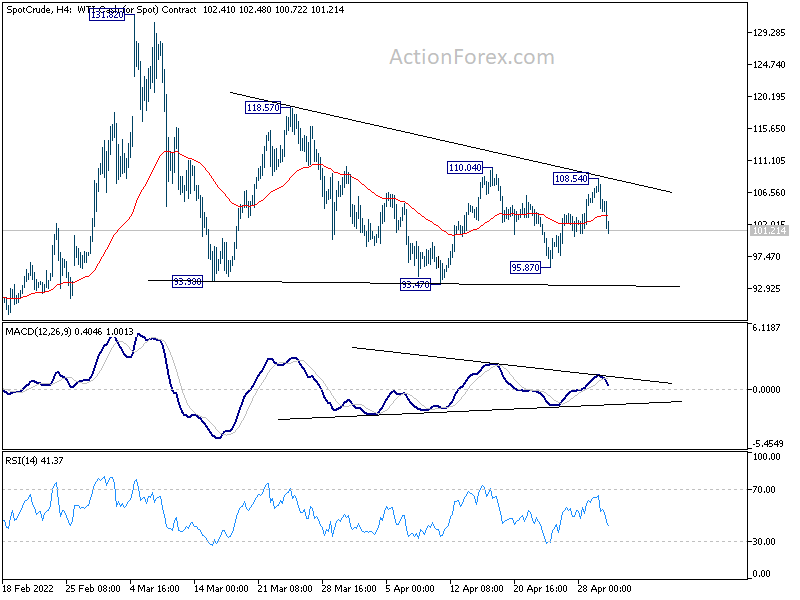
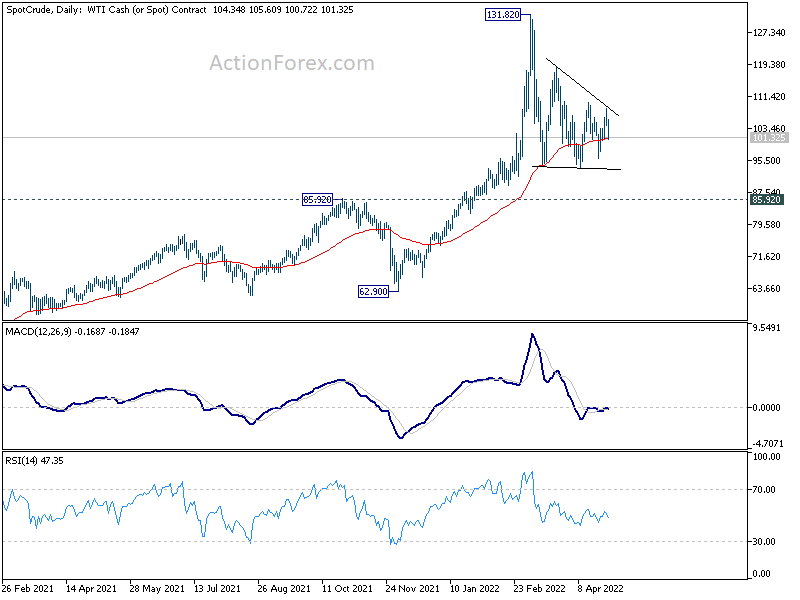
WTI should have finished the rebound form 95.87 and it's now heading back through 100 handle, towards 95.87 support. But overall, it's seen as developing another falling leg inside the medium term triangle corrective pattern that started back in 131.82. Downside should be contained by 93.47 support. Larger up trend is still expected to resume at a later stage. The bigger question is whether the final rally of the up trend would ended as a failure fifth that couldn't even pass through 131.82 high.
Bank of England Preview: Another Rate Hike and Active QT
BoE: High inflation vs. weaker growth outlook
In line with consensus and market pricing, we expect the Bank of England (BoE) to hike the Bank Rate by another 25bp to 1.00% but focus is definitely much more on forward guidance than the rate hike itself.
Just like with other central banks there is a discrepancy between what the Bank of England communicates and what markets are pricing. Bank of England surprised markets in March by sending a much more dovish signal with no one voting for a 50bp rate hike (markets were pricing in a probability of that ahead of the meeting) and Cunliffe voting for an unchanged Bank Rate. The BoE also changed its forward guidance by stating that "some further modest tightening in monetary policy might be appropriate in the coming months" vs. "some further modest tightening in monetary policy is likely to be appropriate", so definitely more dovish.
It is one of the key meetings with updated projections. Given the hawkish market pricing we expect the BoE to continue forecasting inflation below 2% three years from now, which was one reason for the more cautious forward guidance at the March meeting.
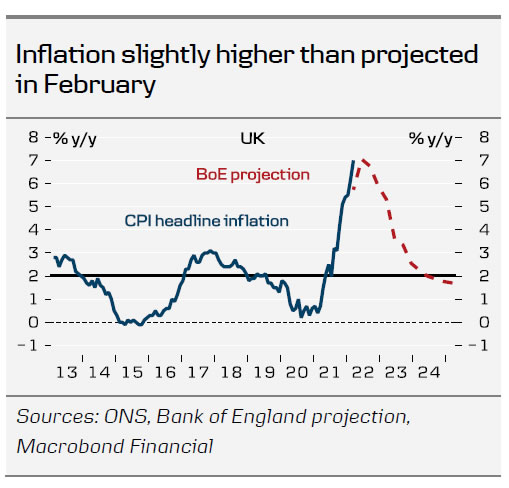
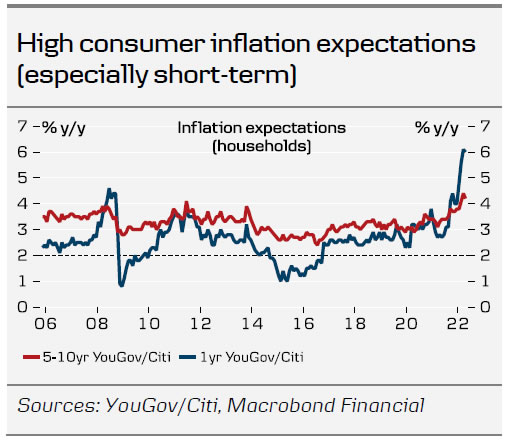
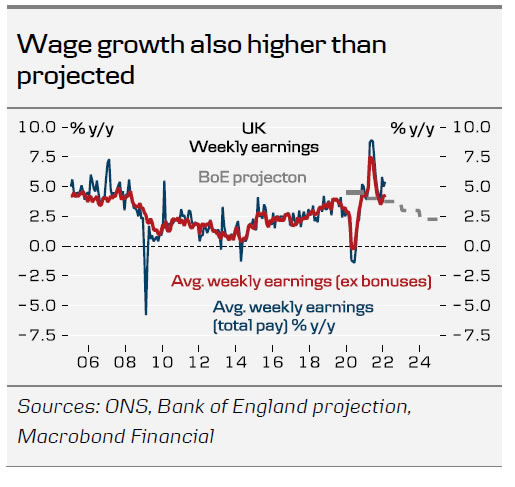
We expect the Bank of England to stick to its more dovish signals, although higher-than-projected inflation and rising inflation expectations increase the probability of the BoE turning more hawkish once again. The Bank of England sounds concerned about the growth outlook and the BoE projected a rise in the unemployment rate eventually in the February 2022 Monetary Policy Report. If we are right, however, about the BoE sticking to its dovish signals, it is likely to weigh on GBP given the hawkish market pricing. Markets are pricing in a total of 150bp for the rest of the year (so basically a 25bp rate hike at each of the remaining meetings with risks skewed towards a 50bp rate hike at one of the upcoming meetings). Our Bank of England call is two additional rate hikes (August and November) but see risks skewed towards more rate hikes.
The Bank of England said that it will start considering selling gilts directly to markets (active QT) when the Bank Rate reaches 1%, so we are likely to hear more about this at the meeting. The Bank of England already announced that it will no longer re-invest maturing gilts. We expect selling will be modest given central banks' general fear of financial market implications. There is also the question about the timing. At the February meeting, the BoE announced that it will "initiate a programme of corporate bond sales to be completed no earlier than towards the end of 2023", which suggests some caution about outright selling of bonds. We expect active gilts selling to start in Q4 22 or Q1 23.
We are still of the view that EUR/GBP will trade around 0.84 this year. On the one hand, GBP usually benefits when USD performs but on the other hand GBP is no longer supported as much by relative rates and things may turn around if ECB turns more hawkish and/or BoE remains more cautious than what markets are pricing in. GBP/USD has declined a lot recently and we think the cross can move further down over the coming year.
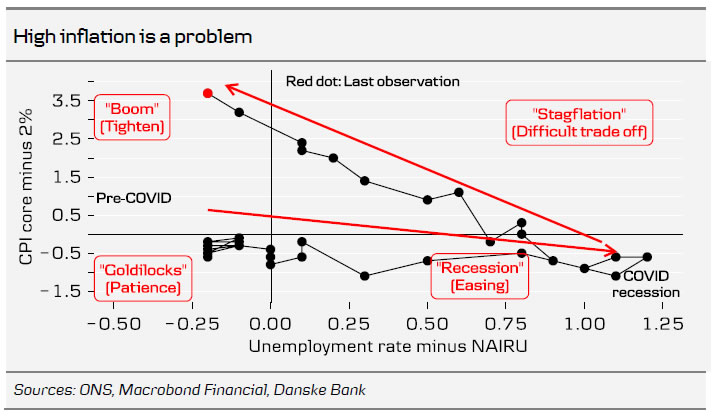
Our Bank of England call summarised
We expect the Bank of England to hike the Bank Rate by another 25bp at the May meeting, taking the Bank Rate to 1.00%. We expect two additional rate hikes this year (August and November) while markets are pricing in a total of 150bp for the remainder of the year (including a rate hike in May). We see risks skewed towards more aggressive rate hikes but Bank of England seems more cautious than previously due to the weaker growth outlook.
We expect the Bank of England to announce “active QT” (selling government bonds to markets) as communicated earlier. We believe active QT will start in either Q4 22 or Q1 23.
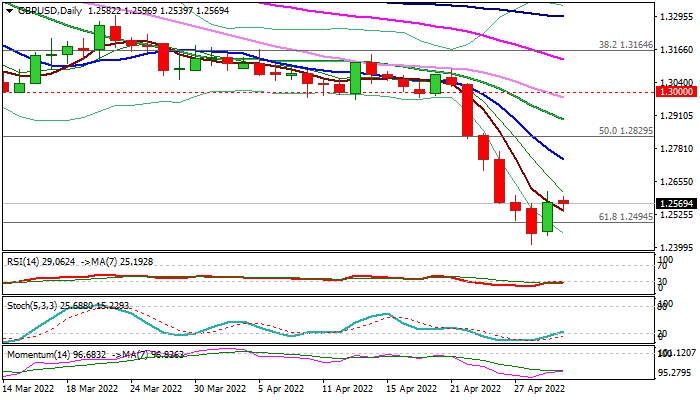
GBP/USD Outlook: Bears Pause above Key Fibo Support, Awaiting BoE Policy Decision for Fresh Signals
Larger bears are pausing above new multi-month low, after sterling fell 4.3% in April, suffering the biggest monthly loss since June 2016.
Sterling bounced after failing to register weekly and monthly close below cracked pivotal Fibo support at 1.2494 (61.8% of 1.1409/1.4249), due to oversold conditions and expectations for fresh signals from the Bank of England’s policy meeting this week.
Technical studies are in full bearish setup on daily chart, with oversold indicators suggesting a pause in the latest steep fall, however more hawkish than expected BoE could spark stronger recovery.
The central bank is expected to raise rate by 25 basis points to 1%, with hawkish outlook for the coming months, to be supportive for pound.
On the other side, traders remain cautious, as the central bank is stuck between high inflation and weak economic growth prospects, that may soften the central bank’s tone and put sterling under fresh pressure.
Expect signals on clear break of 1.2494 Fibo level that would risk fresh acceleration towards targets at 1.2251 (29 June 2020 trough) and 1.2080 (Fibo 76.4%).
Conversely, bullish acceleration through falling 10DMA (1.2737) would sideline downside risk and signal stronger recovery.
Res: 1.2614; 1.2697; 1.2737; 1.2829.
Sup: 1.2539; 1.2494; 1.2400; 1.2359.
GBPJPY Wave Analysis
- GBPCAD reversed from support zone
- Likely to rise to resistance level 164.65
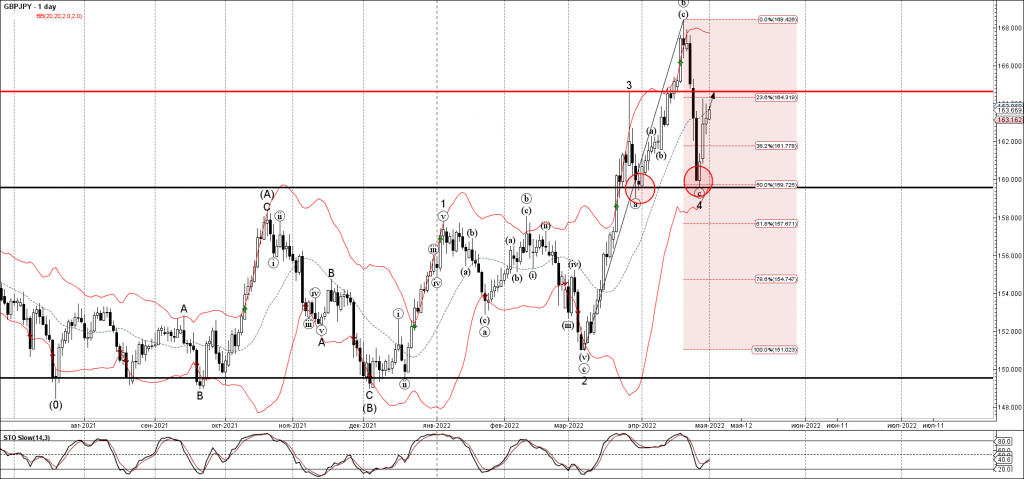
GBPJPY currency pair recently reversed up strongly from the support level 159.60 (low of wave (a) from last month), standing near the lower daily Bollinger Band and the 50% Fibonacci correction of the upward impulse from March.
The upward reversal from this support area started the active short-term impulse wave 5.
Given the clear daily uptrend – GBPJPY can be expected to rise further toward the next resistance level 164.65.
GBPCAD Wave Analysis
- GBPCAD reversed from support zone
- Likely to rise to resistance level 1.6500
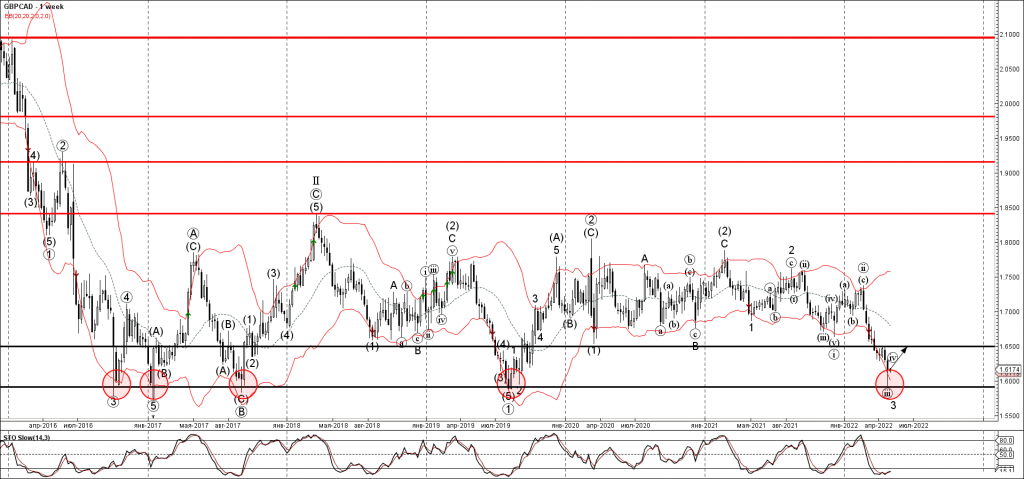
GBPCAD currency pair recently reversed up sharply from the support area located between the key support level 1.5910 (which has been reversing the pair from the end of 2016) and the lower weekly Bollinger Band.
The upward reversal from this support area started the active short-term correction (iv).
Given the oversold weekly Stochastic – GBPCAD can be expected to rise further toward the next resistance level 1.6500.
Bitcoin Undecided on a Scenario for May
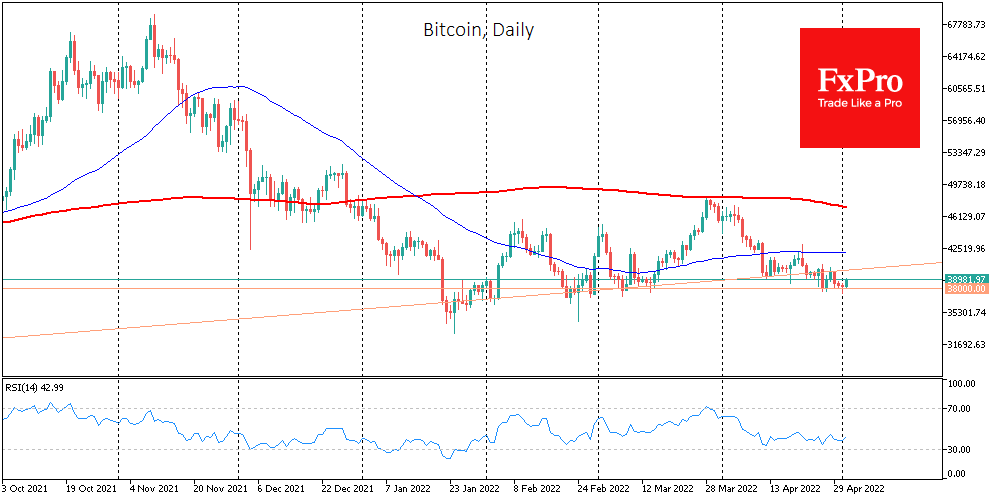
Bitcoin is down 3% over the past week, ending it at around $38.K. Ethereum lost 4.4%, while other leading altcoins in the top 10 fell from 4% (Binance Coin) to 14.7% (XRP).
The total capitalisation of the crypto market, according to CoinGecko, fell 4.6% over the week to $1.75 trillion. The Bitcoin Dominance Index rose by one percentage point to 42.2% over the same period due to weakness in altcoins.
For the week, the cryptocurrency fear and greed index fell by 2 points to 22 (“extreme fear”). The index rose to 28 points on Monday and moved into “fear” status.
Bitcoin has declined over the past four weeks amid weakening US stock indices. On Friday, Amazon and Google shares suffered their most significant falls since 2008, dragging down the tech-rich Nasdaq Index. It lost 12.7% in April, its most considerable dip since 2008.
Bitcoin fell 16.2% over April, offsetting the previous two-month rise and falling short of seasonal trends. This is the worst performance in a given month of the year in trading history since 2011.
In terms of seasonality, May is considered a relative success for BTC. Over the past 11 years, bitcoin has ended the month up seven times and down four times. The average rise was 27%, and the average decline was 16%. Under these scenarios, the estimated average range for BTC at the end of May is between $32K and $48K.
A more local view of the dynamics of the first cryptocurrency indicates an ongoing struggle around the $38K mark. This struggle will decide which of the above levels the price will be closer to at the end of the month.
The Swiss National Bank’s (SNB) management believes it is inadvisable to invest in bitcoin and hold it as reserves for the regulator. The US Department of Labor has raised concerns about an initiative by US investment firm Fidelity to allow its customers to put a portion of retirement accounts in bitcoin.
Aussie Stable ahead of RBA Decision
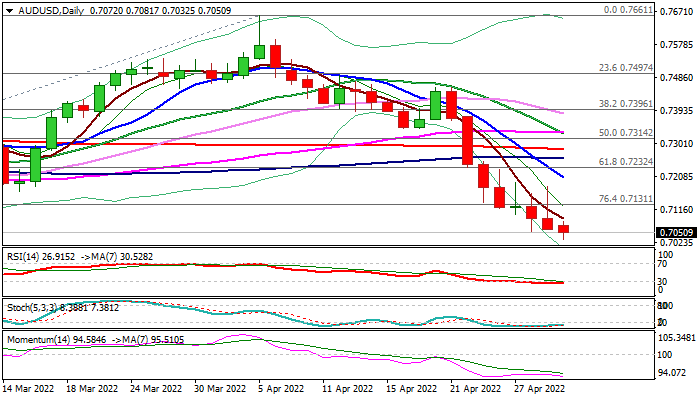
It was another tough week for the Australian dollar, as AUD/USD fell 2.53%. In the European session, AUD/USD is trading quietly at 0.7046.
All eyes on RBA
The RBA will be in the spotlight, as it holds its policy meeting on Tuesday. This meeting is live, as it’s unclear what policy makers have planned. There’s little doubt that the RBA is poised to embark on a rate-hike cycle, keeping in sync with the Federal Reserve and other major central banks.
The uncertainty lies in whether the Bank will raise now, and if so, by how much. Inflation continues to spiral, hitting 5.1% in the first quarter. RBA Governor Lowe has long insisted that he would not raise rates until wage growth rose in order to ensure that inflation was not transitory. Well, wage growth is accelerating and nobody is using the T-word when describing inflation. With a robust labour market, the conditions are right for changing gears and moving away from the bank’s loose monetary policy.
A rate hike of 0.40% would be called for, but there is the issue of the federal election later this month. The RBA does not want to deliver an oversize rate hike in the middle of an election campaign, but at the same time needs to send a message to the markets that it is determined to contain inflation – standing on the sidelines would risk credibility. The compromise (which is the consensus) is that the RBA will raise rates, but only by 0.15%, with a further hike at the June meeting. A small hike will not send inflation on its heels by any stretch, but will send a slightly hawkish message, as this would be the first rate hike since 2011.
With the Federal Reserve widely expected to raise rates by a half-point at its meeting on Wednesday, the Aussie could find itself under pressure this week, as it struggles to remain above the symbolic 0.70-line.
AUD/USD Technical
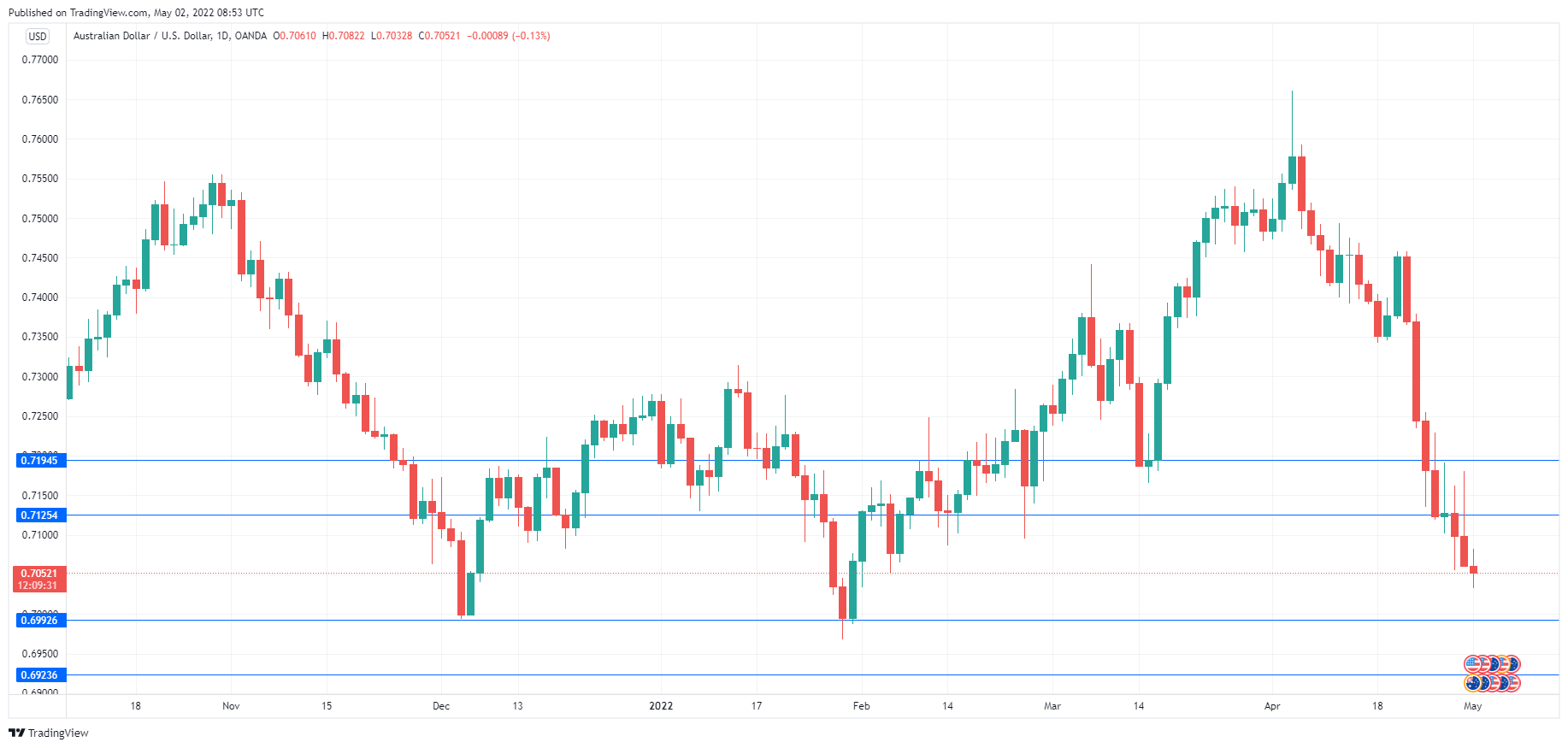
- There is support at 0.6992 and 0.6923
- AUD/USD has resistance at 0.7125 and 0.7194
AUD/USD Outlook: Aussie Remains in Red after April’s 5.6% fall, Tuesday’s RBA in Focus
The AUDUSD started trading in May in negative mode and extended to new lowest since Jan 2020 in early Monday, despite holiday-thinned Asian markets.
Nears remain fully in play after 5.6% drop in April, the biggest monthly loss since May 2013, as risk sensitive Aussie remains under pressure from risk aversion and strong rise of its US counterpart.
Bearish daily techs support the action for final push towards psychological 0.70 support and another key level at 0.6967 (2022 low, posted on Jan 28, but oversold conditions warn that bulls may face headwinds on approach to these levels.
Traders also focus on tomorrow’s RBA policy meeting, with expectations that the central bank will raise interest rate by 15 basis points to 0.25%, although some economists say that scenario of staying on hold or going for more aggressive 40 basis points hike, wouldn’t be a big surprise.
However, markets will pay more attention to the following RBA’s statement, to get more information on the central bank’s plans about the monetary policy in the near future, with stronger signals about more aggressive approach, to probably lift the Aussie dollar, although rallies should be limited due to overall negative environment.
Res: 0.7089; 0.7131; 0.7179; 0.7205.
Sup: 0.7032; 0.7000; 0.6986; 0.6967.
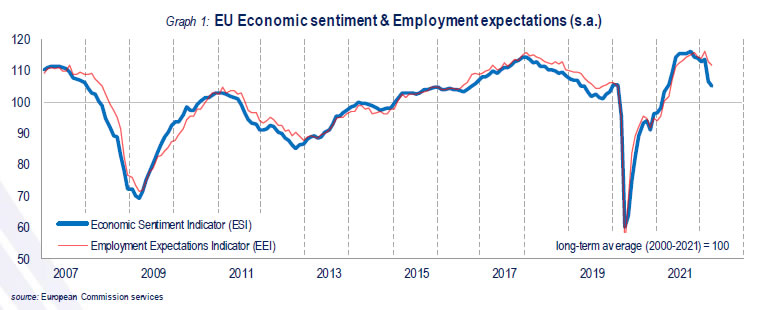
Eurozone economic sentiment dropped to 105, employment expectation dropped to 112.4
Eurozone Economic Sentiment Indicator dropped from 106.7 to 105.0 in April. Industry confidence dropped from 9.0 to 7.9. Services confidence ticked down from 13.6 to 13.5. Consumer confidence dropped from -21.6 to -22.0. Retail trade confidence dropped from -2.4 to -4.3. Construction confidence rose from 8.9 to 7.1. Employment Expectation Indicator dropped from 113.5 to 112.4.
EU Economic Sentiment dropped from 106.6 to 104.9. Amongst the largest EU economies, the ESI fell markedly in Spain (-4.5) and to a lesser extent in France (-1.4). Confidence remained broadly stable in Germany (-0.1), the Netherlands (-0.1) and Poland (+0.3), while it improved in Italy (+1.3). Employment Expectation Indicator dropped from 112.7 to 111.7.
US Dollar Index Outlook: Bulls Taking a Breather Under New Multi-Year High
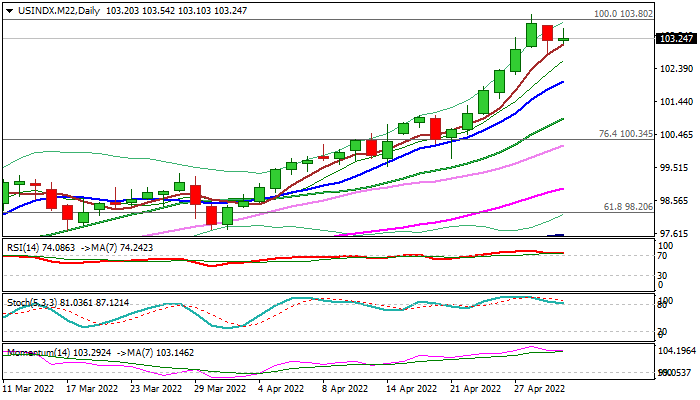
The dollar is consolidating just under new 20-year high, posted after a brief probe above former tops of 2017/2020 (103.80) and maintain firm bullish tone.
The greenback remains well supported by a number of technical and fundamental factors, which suggest that the currency could rise further.
A massive bullish monthly candle (April’s rally was the biggest monthly rise since Oct 2008) is expected to strongly underpin the action, along with bullish studies on larger timeframes).
On the other side, the dollar is supported by safe-haven buying on rising geopolitical and economic uncertainty, as well as hawkish tones from the US Federal Reserve, which signal multiple rate hikes until the end of the year, in attempts to put raging inflation (at the highest in 40 years) under control.
Meanwhile, the price action may stay on hold and possibly adjust further, as studies are overbought and traders may collect profits after 6.6% advance in March /April, while bulls face headwinds at key 103.80 barriers, after April’s rally failed to register a monthly close above these levels.
However, dips are expected to be shallow in current conditions of escalating geopolitical tensions and warning about global economic activity slowdown and offer better opportunities to re-join strong bullish market.
Rising 10DMA (102.02) should ideally contain and guard ascending 20DMA (100.95) and pivotal psychological 100 support, loss of which would put bulls on hold.
Res: 103.80; 103.93; 104.36; 104.65.
Sup: 102.79; 102.02; 101.50; 101.01.