

Sample Category Title
Japanese Yen Stable Around 130, Fed Hike Ahead
It was a dismal week for the Japanese yen, as USD/JPY climbed for an eighth successive week. In the European session, USD/JPY is trading quietly at the symbolic 130 level.
Fed expected to hike by 0.50%
Japanese markets are closed for a holiday on Tuesday and Wednesday, but it will likely be a busy mid-week for the yen, as the Federal Reserve holds a key policy meeting on Wednesday. The Fed is virtually certain to raise rates by 0.50% at the meeting, but there is still an air of anticipation in the air, even though the oversize rate increase has been priced in.
First, the Fed hasn’t raised rates by 0.50% in 20 years, so such a move would certainly be a monumental event. A large hike sends a strong message to the markets that the Fed is determined to push inflation back down to its 2% target, and is looking to raise rates to a neutral level of 2.5% and then slow the pace of tightening. The challenge for the Fed is to raise rates without stalling the economy. Investors are already looking ahead to the June and July meetings, which are also likely to feature 0.50% hikes. Some analysts are projecting 0.75% hikes at future meetings, an event we haven’t since 1994. The fact that a super-super hike of 0.75% is being bandied around shows how far the Fed has fallen behind in the inflation curve, as it plays a desperate game of catch-up.
With the Fed showing an aggressive tightening mode, the outlook for the dollar is positive, and I expect the yen to remain under strong pressure. USD/JPY has broken above the 130 line much more quickly than expected, and with US yields on a strong upswing, the US/Japan rate differential continues to widen, as the BoJ is fiercely defending its yield curve control.
USD/JPY Technical
- USD/JPY has broken below support at 129.89. Next, there is support at 1.2807
- There is resistance at 1.3122 and 1.3304
Sunset Market Commentary
Markets
An awful close on WS Friday and a new batch of negative data on China economic growth (composite PMI and non-manufacturing PMI both tumbling further into contraction territory to 42,7 and 41.9 respectively) were a bad omen for sentiment at the start of the new trading week. Investors in risky assets also still ponder additional headwinds for growth due to further mutual retaliatory sanctions between Russia and Europe. European equities opened with losses of 1.0%+. A reportedly Nordic driven-driven (short-lived) flash crash didn’t help to calm nerves. Neither were EC confidence data. Economic confidence (combination of consumer & business confidence) declined further from a downwardly revised 106.7 to 105, the lowest level since March last year. Business sentiment series eased but still showed some resilience. However consumers clearly are unsettled by persistent uncertainty on the war in Ukraine and inflation eroding purchasing power (-22.0 from -16.9 ). European equities maintained a downside bias with the EuroStoxx currently losing about 2.0%. US futures initially tried to regain a few ticks after Friday’s sell-off, but cash markets open marginally in red. The risk-off/fear for some kind of a stagflationary context again hardly caused any safe haven bid for core European bonds. The German curve steepens, with the 2-y declining 2 bps but the 10-y/30-y still rising marginally (2.1/2.8bps). European swap rates simply continue their uptrend, with the 10-y setting a new cycle peak near 1.77%! Intra-EMU spreads versus Germany show a mixed picture, but the steepening in the EMU curve clearly doesn’t help LT spreads. Italy again underperforms (10-y, +6 bps vs Germany). At 2.84%, the yield spike at the peak of the corona panic is coming with reach. The US yield curve also bear steepens as expected decisive Fed action raises real yields (10-y real yield again in positive territory at 0.06%). The 2-y rises 1 bp. The 30-y (+5 bps) again surpasses the 3.0% mark. An easing in some cyclical commodities including oil (Brent $103.51 p/b) or copper for now hasn’t any meaningful impact on the trend dynamics in core interest rate markets.Moves in the major FX cross rates were rather guarded today. The DXY USD-index regains part of Friday’s correction. At 103.50, the cycle top of 103.93 is again within reach. USD/JPY tries to regain the 130 barrier. EUR/USD struggles not to fall back below the 1.05 handle, with last week’s low (1.0472) last intermediate support ahead of the 1.0341 2017 low. Sterling still slightly outperforms the euro (EUR/GBP 0.8375) as markets assume that the BoE can’t afford to stay on the sidelines despite the cost of living crisis eroding growth and consumer spending. The risk-off also weakens the CE currencies (EUR/CZK 24.68; EUR/HUF 380.4, EUR/PLN 4.691) even as the CNB and the NBP are expected to continue their anti-inflation crusade later this week. News Headlines
The Ukrainian central bank urged Kiev to rely on other sources of finance to shore up its economy and fund the war. The monetary authority began direct purchases of government bonds after the war erupted late February and added in April 50bn hryvnia (some $1.7bn) to its debt portfolio. This brings the tally to 70bn so far. For now, printing money is justified and used to finance “critical” government needs only, deputy governor Nikolaychuk said. But he added that once signals of overheating, including soaring inflation, emerge, it will be a signal to stop. The central bank lifeline turned out to be the third most important source of funding, after war bonds and IMF loans.Japanese institutional investors are offloading US Treasuries by the billions. Over the past three months (until the week of April 22), they sold about $55bn, Japanese data showed last week. That amount is expected to grow in the coming weeks/months: extreme divergent US/Japanese monetary policy has sent the yen into the abyss (USD/JPY 130.07 today). The sharp spike in volatility causes currency-hedging to become so expensive that it dents the appeal of higher US nominal yields. The effective yield today is about as high as one year ago, even with the US yields surged ever since. Combined with the unusual high amount of uncertainty about inflation as well as the historic pace of Fed tightening, it may keep US bond buyers in Japan sidelined for a little while longer.
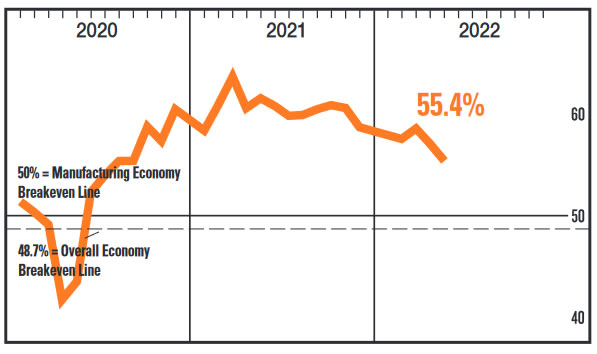
US ISM manufacturing dropped to 55.4, concern about Asian partners’ ability to deliver reliably
US ISM Manufacturing PMI dropped from 57.1 to 55.4 in April, below expectation of 57.5. Looking at some details, new orders dropped from 53.8 to 53.5. Production dropped from 54.5 to 53.6. Employment dropped quite notably from 56.3 to 50.9. Supplier deliveries rose further from 65.4 to 67.2. Prices also dropped from 87.2 to 84.6.
ISM said: "Manufacturing performed well for the 23rd straight month, with demand registering slower month-over-month growth (likely due to extended lead times and decades-high material price increases) and consumption softening (due to labor force constraints). Overseas partners are experiencing COVID-19 impacts, creating a near-term headwind for the U.S. manufacturing community. Fifteen percent of panelists' general comments expressed concern about their Asian partners' ability to deliver reliably in the summer months, up from 5 percent in March."
"The past relationship between the Manufacturing PMI® and the overall economy indicates that the Manufacturing PMI® for April (55.4 percent) corresponds to a 2.3-percent increase in real gross domestic product (GDP) on an annualized basis."
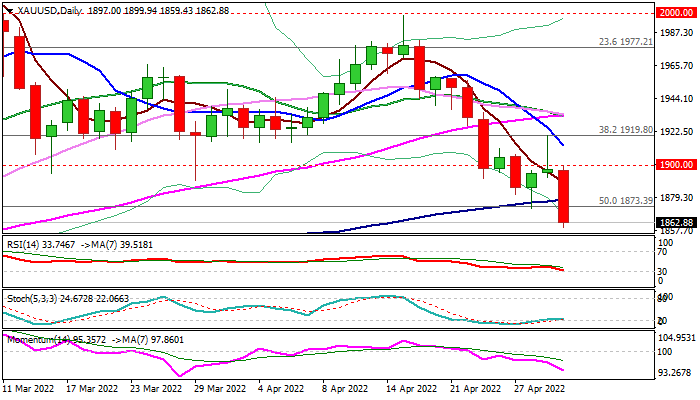
XAU/USD Outlook: Gold Falls Further on Robust Sollar
Spot gold accelerated lower, losing 1.9% in Asian and European trading on Monday, after directionless movements last Friday and Thursday.
Fresh weakness hit 2 ½ month low on break of supports at $1876/73 (100DMA / 50% retracement of $1676/$2070 upleg).
April’s marginal close below $1900 level generated negative signal, adding to negative structure, as the metal is pressured by robust dollar and expectations for aggressive Fed’s action in coming months, in attempts to put soaring inflation under control that sidelines gold’s appeal as a hedge against inflation.
Rising negative momentum and most of daily moving averages being in strong bearish configuration, add to weakening technical picture, although the yellow metal is mainly driven by a set of fundamental factors.
Bears look for close below $1873 Fibo level to open way towards pivotal levels at $1833/26 (200DMA / Fibo 61.8% of $1676/$2070).
Break of these supports and round-figure $1800 level, would push the price into the lower side of larger $2074/$1676 consolidation range that would increase bearish pressure and make the downside more vulnerable.
Res: 1873; 1877; 1890; 1900.
Sup: 1844; 1833; 1826; 1820.
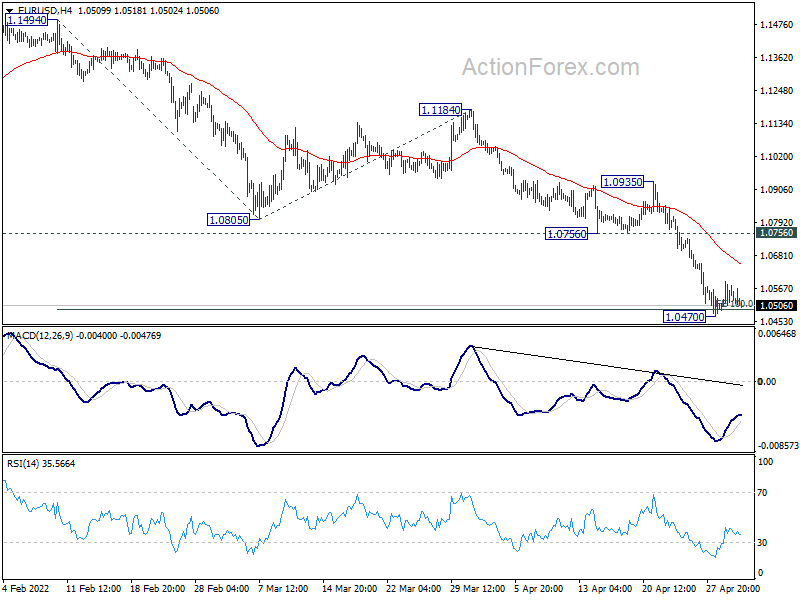
EUR/USD Mid-Day Outlook
Daily Pivots: (S1) 1.0495; (P) 1.0544 (R1) 1.0596; More...
EUR/USD is staying in consolidation from 1.0470 and intraday bias remains neutral. Upside of recovery should be limited by 1.0756 support turned resistance to bring fall resumption. Break of 1.0470 will target 161.8% projection of 1.1494 to 1.0805 from 1.1184 at 1.0069.
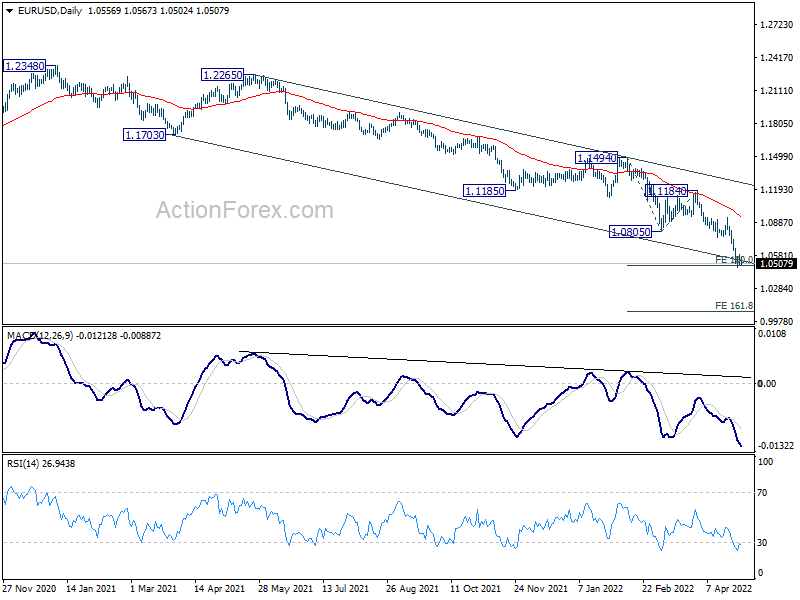
In the bigger picture, the decline from 1.2348 (2021 high) is expected to continue as long as 1.1185 support turned resistance holds. The break of 1.0635 (2020 low) now raises the chance that it's resuming long term down trend from 1.6039 (2008 high). Retest of 1.0339 (2017 low) low should be seen next. Decisive break there will confirm this bearish case.
GBP/USD Mid-Day Outlook
Daily Pivots: (S1) 1.2480; (P) 1.2547; (R1) 1.2647; More...
Intraday bias in GBP/USD remains neutral for the moment. Consolidation from 1.2410 could extend further. But upside of recovery should be limited below 1.2999 support turned resistance. On the downside, break of 1.2410 will target 161.8% projection of 1.3641 to 1.2999 from 1.3297 at 1.2258.

In the bigger picture, rise from 1.1409 (2020 low) has completed at 1.4248, ahead of 1.4376 long term resistance (2018 high). Based on current momentum, fall from 1.4248 is probably the start of a long term down trend. The break of 61.8% retracement of 2.1161 to 1.1409 at 1.2493 is affirming this bearish case too. For now, deeper decline would be seen as long as 1.3158 support turned resistance holds. Next target is 1.1409 low.

USD/CHF Mid-Day Outlook
Daily Pivots: (S1) 0.9692; (P) 0.9714; (R1) 0.9758; More....
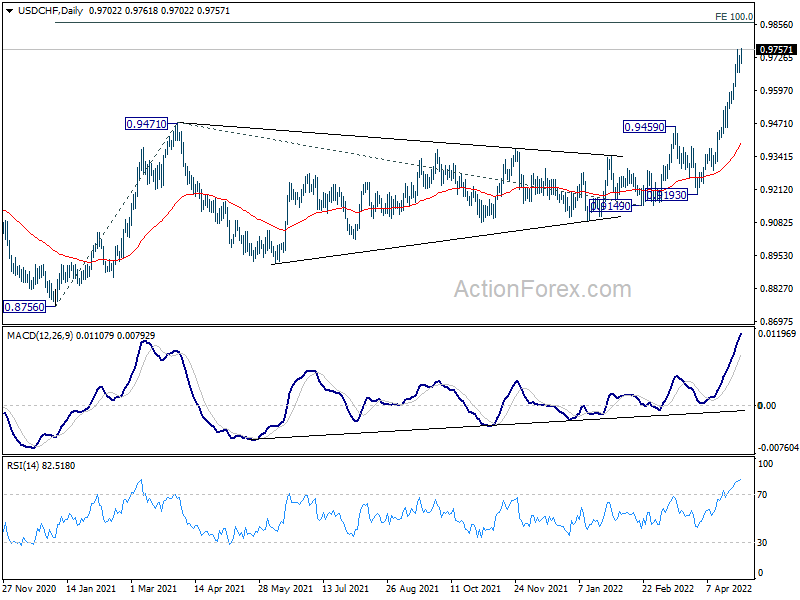
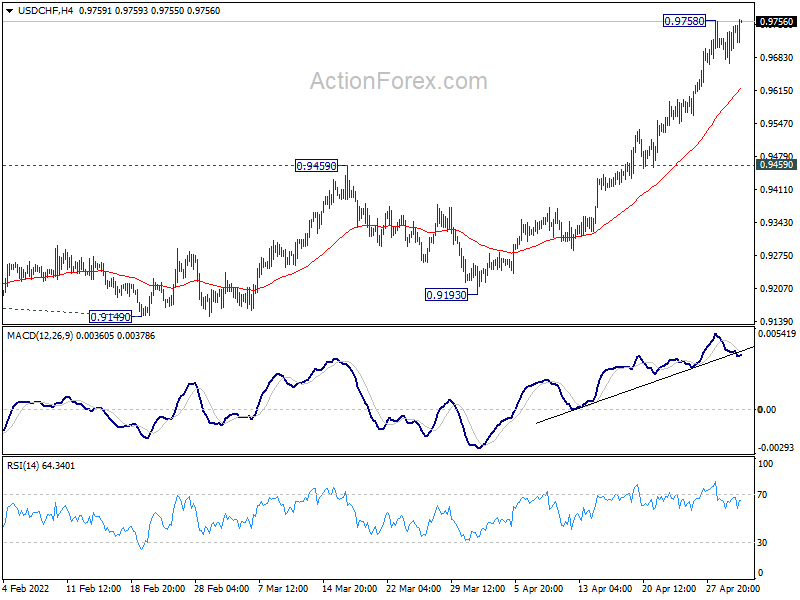
Intraday bias in USD/CHF is back on the upside with break of 0.9758 temporary top. Current rally should target next medium term projection level at 0.9864. On the downside, however, break of 0.9669 minor support should indicate short term bottoming, and turn bias back to the downside for deeper pull back.
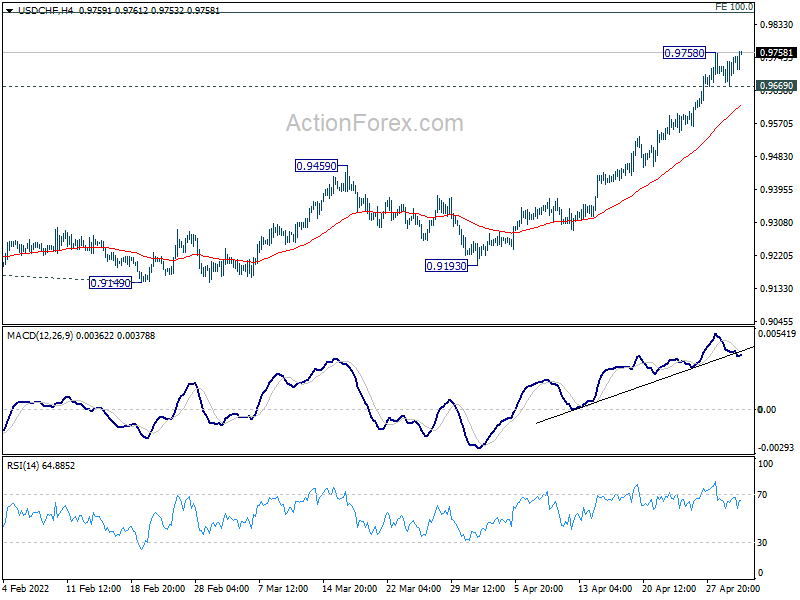
In the bigger picture, down trend from 1.0342 (2016 high) should have completed with three waves down to 0.8756 (2021 low) already. Rise from 0.8756 is likely a medium term up trend of its own. Next target is 100% projection of 0.8756 to 0.9471 from 0.9149 at 0.9864. This will now remain the favored case as long as 0.9459 resistance turned support holds.
USD/JPY Mid-Day Outlook
Daily Pivots: (S1) 129.14; (P) 130.04; (R1) 130.77; More...
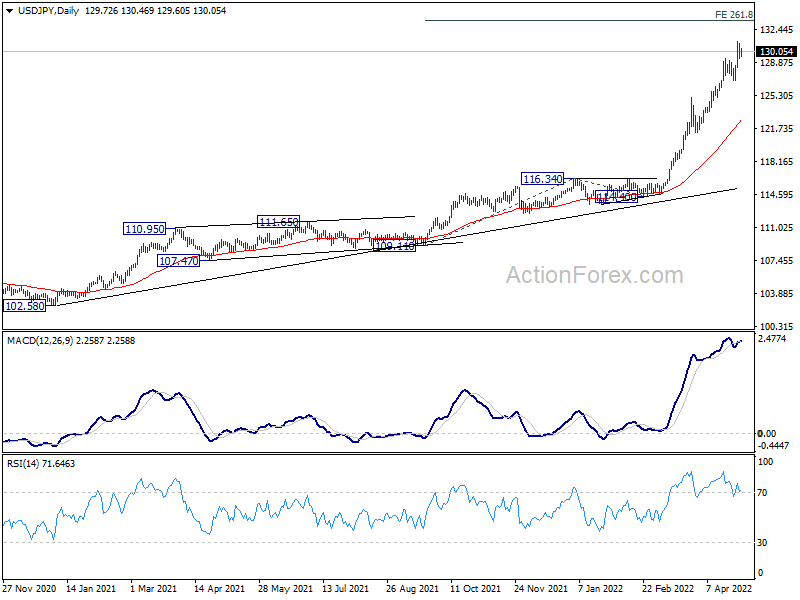
USD/JPY is still bounded in consolidation from 131.24 and intraday bias remains neutral first. Near term outlook remains bullish with 126.91 support intact. Break of 131.24 will resume recent up trend to 261.8% projection of 109.11 to 116.34 from 114.40 at 133.26. However, considering bearish divergence condition in 4 hour MACD, break of 126.91 will confirm short term topping and turn bias back to the downside for a correction.
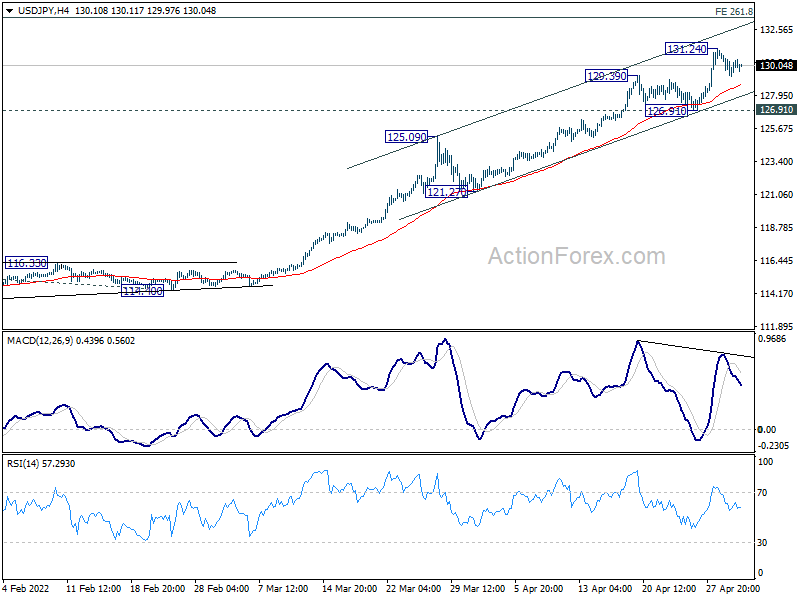
In the bigger picture, current rally is seen as part of the long term up trend form 75.56 (2011 low). Sustained trading above 61.8% projection of 75.56 (2011 low) to 125.85 (2015 high) from 98.97 at 130.04 will pave the way to 100% projection at 149.26, which is close to 147.68 (1998 high). For now, this will remain the favored case as long as 121.27 support holds.
USD/CAD Mid-Day Outlook
Daily Pivots: (S1) 1.2765; (P) 1.2813; (R1) 1.2907; More...
USD/CAD's rally from 1.2401 resumes by breaking through 1.2879 temporary top. Intraday bias is back on the upside for 1.3022 fibonacci level next. Decisive break there will carry larger bullish implications. In any case, outlook will stay cautiously bullish as long as 1.2717 support intact, in case of another retreat.
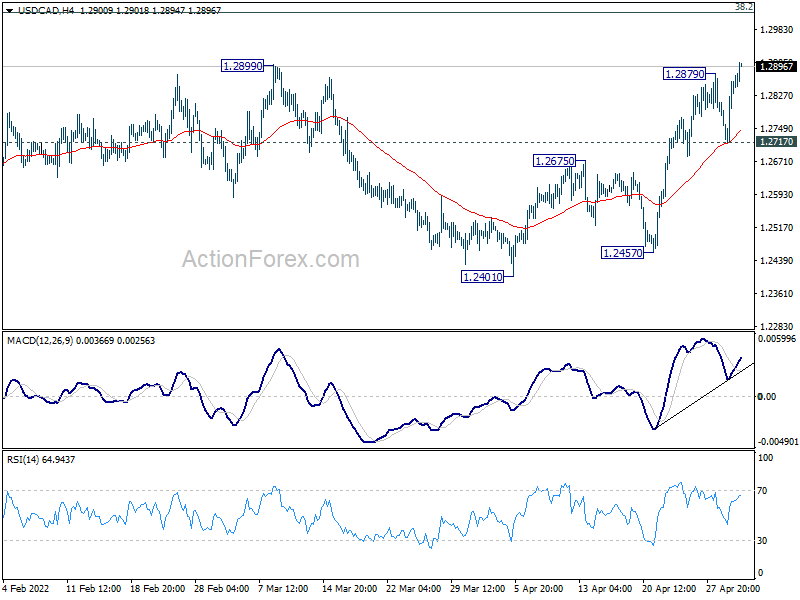
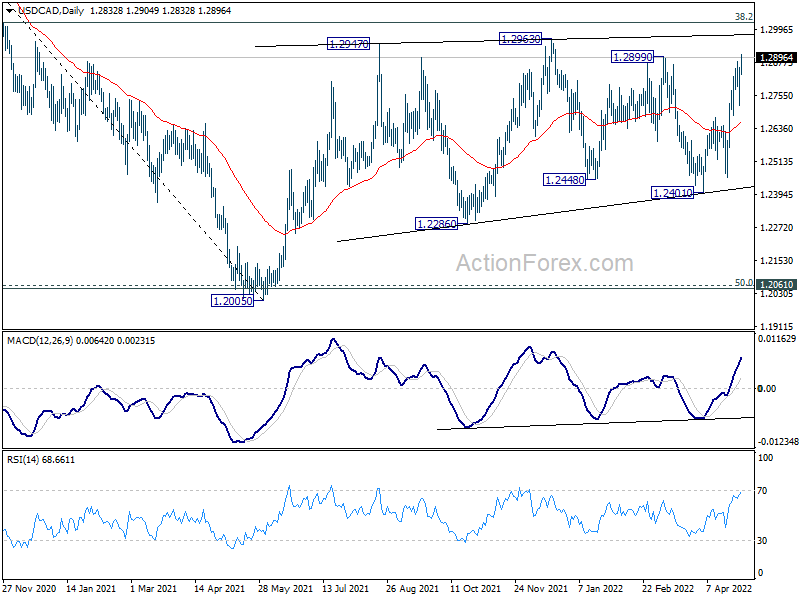
In the bigger picture, focus stays on 38.2% retracement of 1.4667 (2020 high) to 1.2005 (2021 low) at 1.3022. Sustained break there should confirm that the down trend from 1.4667 has completed after defending 1.2061 long term cluster support. Further rise would then be seen towards 61.8% retracement at 1.3650. However, rejection by 1.3022 will maintain medium term bearishness. Break of 1.2005 will resume the down trend from 1.4667 and that carries larger bearish implications too.
Dollar Staying Firm in Quiet Markets, Canadian Dollar Lower With Oil Price
Dollar remains the firmer one today, in quiet markets, as traders are awaiting Fed's rate hike, and forward guidance later in the week. Yen's trading tone is so far positive, as risk markets lack buyers. Commodity currencies are weak together with Euro and Sterling. Aussie is the relatively steadier one as markets await tomorrow's RBA hike. Canadian Dollar and also turning weak, as dragged down by falling oil price. But Kiwi is still the worst performer.
Technically, Dollar's broad-based rally is making some progress. USD/CAD has taken out 1.2879 temporary top. USD/CHF also takes out 0.9758 temporary top too. Now, focus is on 1.0470 temporary low in EUR/USD and 131.24 temporary top in USD/JPY. Break of these two levels should confirm underlying strength of the greenback.
In Europe, at the time of writing, DAX is down -1.07%. CAC is down -1.84%. Germany 10-year yield is down -0.0021 at 0.942. UK is on bank holiday. Earlier in Asia, Nikkei dropped -0.11%. Japan 10-year JGB yield rose 0.011 to 0.230. Singapore Strait Times rose 0.65%. Hong Kong and China were on holiday.
WTI crude oil heading back through 100 on China worries
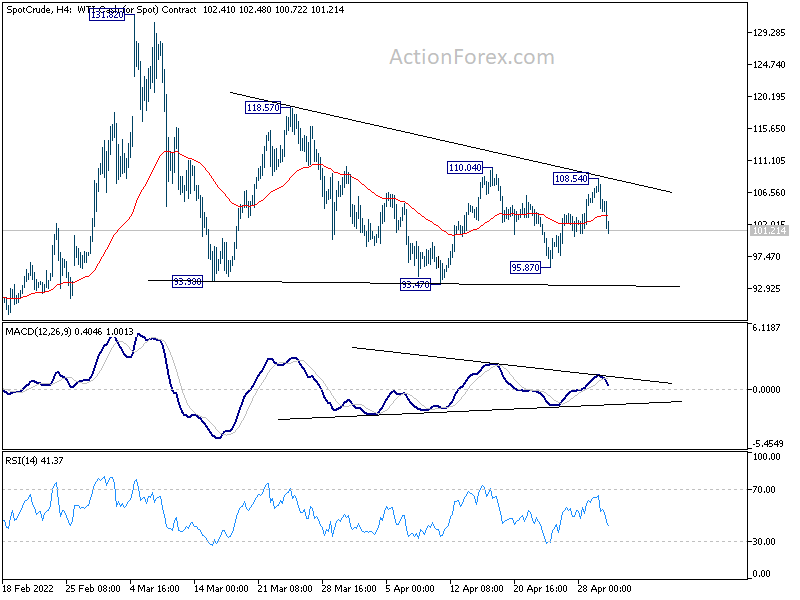
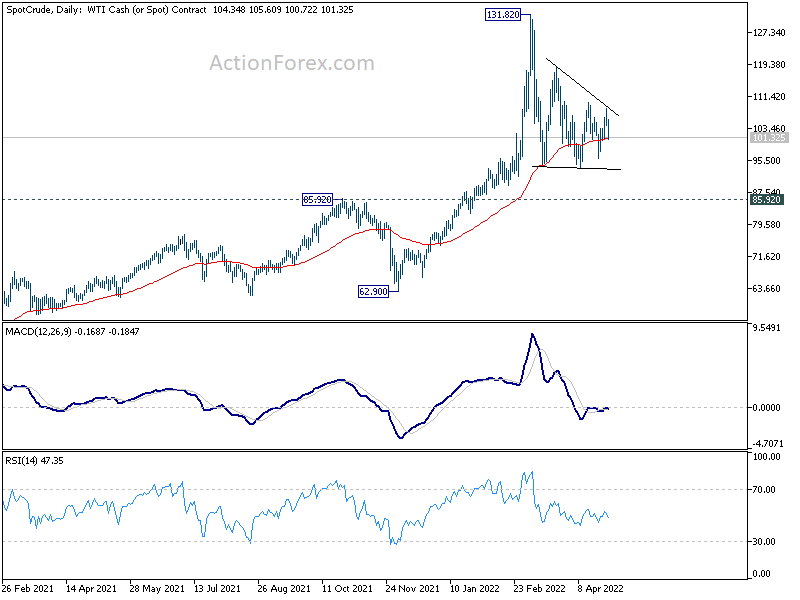
Oil prices drop notably today on worries over China's economy. Data released over the weekend showed PMIs hitting the lowest level since February 2020 due to lockdowns. The economy is on the verge of contraction in Q2 as situation is unlikely to improve any time soon. Meanwhile, Libya also temporary resume operation at a terminal, adding to global supply.
WTI should have finished the rebound form 95.87 and it's now heading back through 100 handle, towards 95.87 support. But overall, it's seen as developing another falling leg inside the medium term triangle corrective pattern that started back in 131.82. Downside should be contained by 93.47 support. Larger up trend is still expected to resume at a later stage. The bigger question is whether the final rally of the up trend would ended as a failure fifth that couldn't even pass through 131.82 high.
Eurozone economic sentiment dropped to 105, employment expectation dropped to 112.4
Eurozone Economic Sentiment Indicator dropped from 106.7 to 105.0 in April. Industry confidence dropped from 9.0 to 7.9. Services confidence ticked down from 13.6 to 13.5. Consumer confidence dropped from -21.6 to -22.0. Retail trade confidence dropped from -2.4 to -4.3. Construction confidence rose from 8.9 to 7.1. Employment Expectation Indicator dropped from 113.5 to 112.4.
EU Economic Sentiment dropped from 106.6 to 104.9. Amongst the largest EU economies, the ESI fell markedly in Spain (-4.5) and to a lesser extent in France (-1.4). Confidence remained broadly stable in Germany (-0.1), the Netherlands (-0.1) and Poland (+0.3), while it improved in Italy (+1.3). Employment Expectation Indicator dropped from 112.7 to 111.7.
Eurozone PMI manufacturing finalized at 55.5, output came to a near standstill
Eurozone PMI Manufacturing was finalized at 55.5 in April, a 15-month low, and down from March's 55.5. Output index was finalized at 50.7, a 22-month low, down from March's 53.1.
Looking at some member states, PMI manufacturing of the Netherlands rose to 2-month high at 59.9. France rose to 2-month high at 55.. Austria dropped to 15-month low at 57.9. Germany dropped to 20-month low at 54.6. Italy dropped to 16-month low at 54.5. Spain dropped to 14-month low at 53.3.
Chris Williamson, Chief Business Economist at S&P Global said: "Manufacturing output came to a near standstill across the eurozone in April, with production merely edging higher at the slowest rate since June 2020. Companies not only reported that ongoing problems with component shortages were aggravated by the Ukraine war and new lockdowns in China, but that rising prices and growing uncertainty about the economic outlook were also hitting demand."
Germany PMI Manufacturing was finalized at 54.6 in April, a 20-month low, down from March's 56.9. S&P Global said supply disruption and weaker demand weighed on output. Soaring costs drove unprecedented rise in prices charged. Goods producers remained pessimistic about the outlook.
France PMI Manufacturing was finalized at 55.7 in April, up from March's 54.7. S&P Global said manufacturing output growth was constrained by war in Ukraine. There were reports of automotive sector weakness, while supply issues persisted. Output price inflation accelerated to series high.
Swiss SECO consumer climate dropped to -27 in Q2, marked weakening of sentiment
Swiss SECO consumer climate dropped sharply from -4 to -27 in Q2, well below expectation of -15. That's was the biggest decline since the onset of the pandemic, and the reading was below long-term average of -5. Looking at some details, the expected economic development index dropped from 21 to -31. Expected financial situation dropped from -3 to -25. Major purchases index dropped further from -23 to -31.
SECO said: "The survey from April shows a marked weakening of consumer sentiment. In particular, consumers' outlook for the general economic situation has turned far more pessimistic. Households are feeling the strain as prices continue to rise. Meanwhile, the situation on the labour market is again being viewed as more positive. "
Japan PMI manufacturing finalized at 53.5, war and China weigh on confidence
Japan PMI Manufacturing was finalized at 53.5 in April, down from March's 54.1. Au Jibun Bank said growth in output levels was unchanged as new orders expansion slowed. Factory gate charges were in record rise amid accelerating input prices. Business optimism dipped to lowest since July 2020.
Usamah Bhatti, Economist at S&P Global, said: "Domestic demand was a key driver of growth... but the reintroduction of lockdown restrictions in China hindered international demand. These measures coupled with the fallout from war in Ukraine continued to disrupt supply chains across the sector.
"Delivery delays and price rises remained a dampener... Sharply rising cost burdens pushed Japanese manufacturers to raise selling prices to the greatest extent in the survey history.
"Though still optimistic, Japanese goods producers were increasingly wary of the continued impact of price and supply pressures, and also the impact of the war and extended lockdowns in China. As a result, confidence dipped to the weakest since July 2020."
Japan consumer confidence ticked up to 33.0 in Apr
Japan consumer confidence index rose slightly by 0.2 pts to 33.0 in April, missed expectation of 33.9. Overall livelihood dropped -0.1 to 31.2. Income growth dropped -0.6 to 36.8. Employment rose 1.3 to 36.1. Willingness to buy durable goods dropped -0.1 to 27.7.
93.7% of respondents expect prices to go up a year ahead, up 0.9%. 2.7% expect prices to stay the same, down -0.8%. 2.1% expect prices to go down, up 0.1%.
USD/CAD Mid-Day Outlook
Daily Pivots: (S1) 1.2765; (P) 1.2813; (R1) 1.2907; More...
USD/CAD's rally from 1.2401 resumes by breaking through 1.2879 temporary top. Intraday bias is back on the upside for 1.3022 fibonacci level next. Decisive break there will carry larger bullish implications. In any case, outlook will stay cautiously bullish as long as 1.2717 support intact, in case of another retreat.
In the bigger picture, focus stays on 38.2% retracement of 1.4667 (2020 high) to 1.2005 (2021 low) at 1.3022. Sustained break there should confirm that the down trend from 1.4667 has completed after defending 1.2061 long term cluster support. Further rise would then be seen towards 61.8% retracement at 1.3650. However, rejection by 1.3022 will maintain medium term bearishness. Break of 1.2005 will resume the down trend from 1.4667 and that carries larger bearish implications too.
Economic Indicators Update
| GMT | Ccy | Events | Actual | Forecast | Previous | Revised |
|---|---|---|---|---|---|---|
| 22:30 | AUD | AiG Performance of Mfg Index Apr | 58.5 | 55.7 | ||
| 00:30 | JPY | Manufacturing PMI Apr F | 53.5 | 53.4 | 53.4 | |
| 05:00 | JPY | Consumer Confidence Index Apr | 33 | 33.9 | 32.8 | |
| 06:00 | EUR | Germany Retail Sales M/M Mar | -0.10% | 0.30% | 0.30% | |
| 07:00 | CHF | SECO Consumer Climate Q2 | -27 | -15 | -4 | |
| 07:30 | CHF | Manufacturing PMI Apr | 62.5 | 60.2 | 64 | |
| 07:45 | EUR | Italy Manufacturing PMI Apr | 54.5 | 55.1 | 55.8 | |
| 07:50 | EUR | France Manufacturing PMI Apr F | 55.7 | 55.4 | 55.4 | |
| 07:55 | EUR | Germany Manufacturing PMI Apr F | 54.6 | 54.1 | 54.1 | |
| 08:00 | EUR | Eurozone Manufacturing PMI Apr F | 55.5 | 55.3 | 55.3 | |
| 09:00 | EUR | Eurozone Economic Sentiment Indicator Apr | 105 | 108 | 108.5 | 106.7 |
| 09:00 | EUR | Eurozone Services Sentiment Apr | 13.5 | 14.2 | 14.4 | 13.6 |
| 09:00 | EUR | Eurozone Industrial Confidence Apr | 7.9 | 9.5 | 10.4 | 9.0 |
| 09:00 | EUR | Eurozone Consumer Confidence Apr F | -22.0 | -16.9 | -16.9 | -21.6 |
| 13:30 | CAD | Manufacturing PMI Apr | 57.9 | 58.9 | ||
| 13:45 | USD | Manufacturing PMI Apr F | 59.7 | 59.7 | ||
| 14:00 | USD | ISM Manufacturing PMI Apr | 57.5 | 57.1 | ||
| 14:00 | USD | ISM Manufacturing Prices Paid Apr | 88.2 | 87.1 | ||
| 14:00 | USD | ISM Manufacturing Employment Index Apr | 56.3 | |||
| 14:00 | USD | Construction Spending M/M Mar | 0.80% | 0.50% |