

Sample Category Title
Daily Technical Analysis
EUR/USD
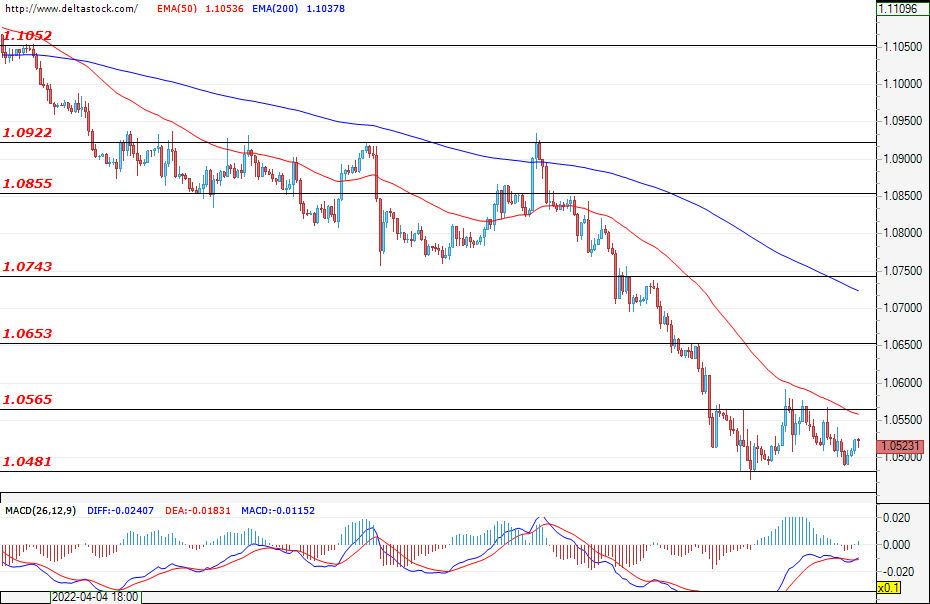
During yesterday's trading session, the currency pair did not undergo drastic changes and we witnessed a slight decline, which the bulls limited above the key support level at 1.0481. With a possible predominance of the buyers and a successful breach of the first resistance at 1.0565, it is possible to witness an attack on the next significant level at 1.0653. Today, there is no planned economic news and statements that are expected to affect the move of the currency pair, so the main driving force remains the complicated economic situation.
USD/JPY
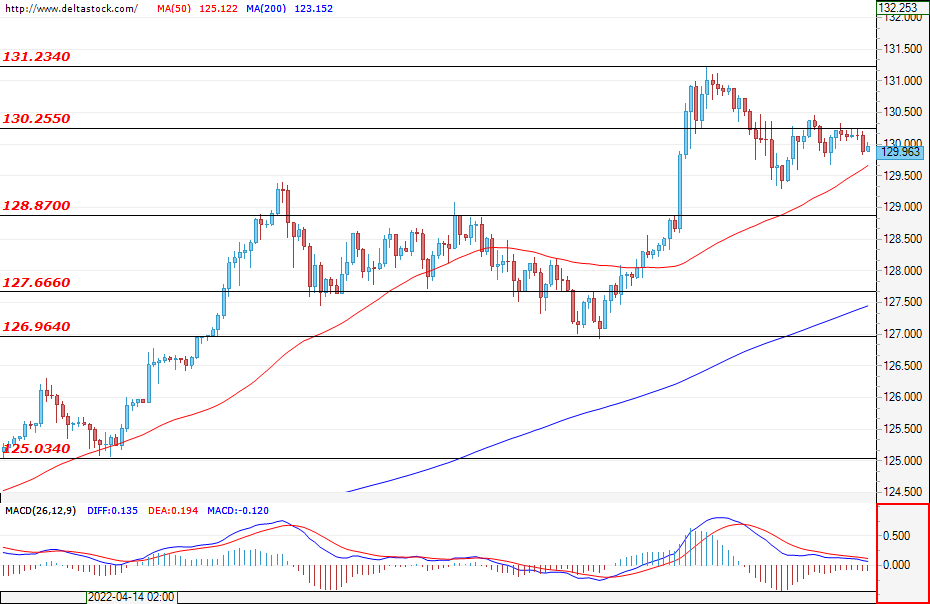
With the Ninja, we saw a slight decline, which remained limited above the support level at 128.87. A short correction followed, with the price consolidating just below the resistance level at 130.25 at the time of writing. A possible bull predominance and a breach of the mentioned resistance would strengthen the positive sentiment of the investors. On the other hand, if the bears manage to establish themselves on the market, then their first significant support would be the level at 128.87.
GBP/USD
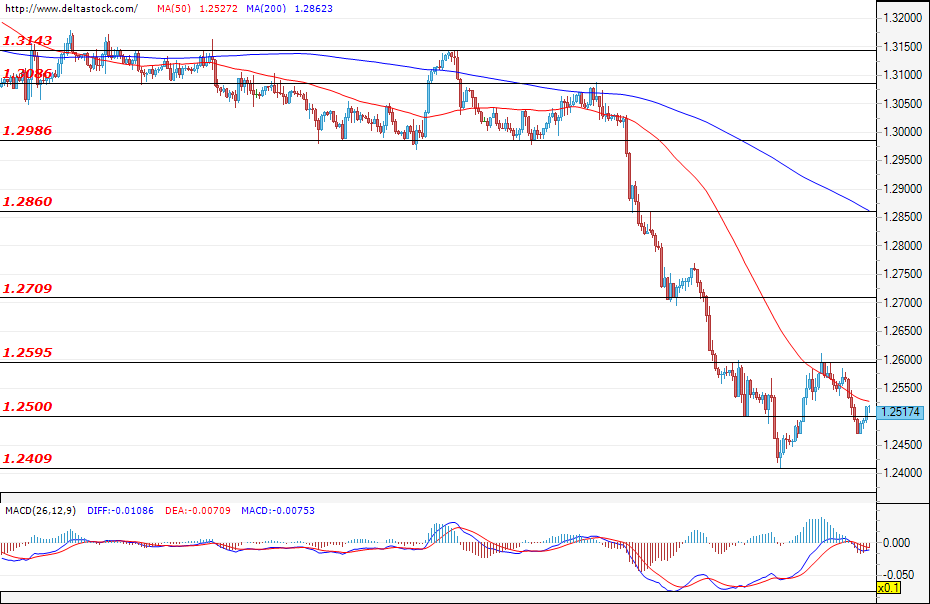
Yesterday started promising for the bulls, and during the early hours of the trading session, they managed to overcome the first resistance at 1.2500. Subsequently, their hopes for further growth were overshadowed by the failure to breach the key resistance at 1.2600 and the subsequent decline towards 1.2500 – a level that already plays the role of support. Therefore, the most likely scenario for today is for a consolidation around the current level.
EUGERMANY40
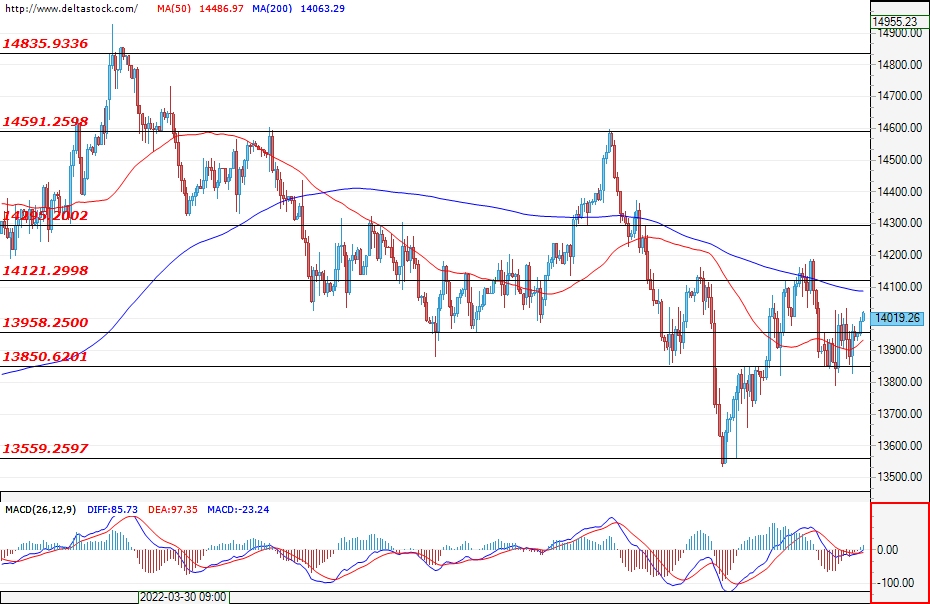
During the previous trading session, the German index failed to breach the resistance at 14120, followed by a decline towards the support zone at 13850. Since the beginning of today's session, we see a bull predominance and the current breach of the resistance at 13958 has not yet been confirmed. A confirmation of the breach could lead to an attack on the next important resistance at 14120. The unemployment change data for Germany (today; 07:55 GMT) could lead to increased volatility for the index.
US30
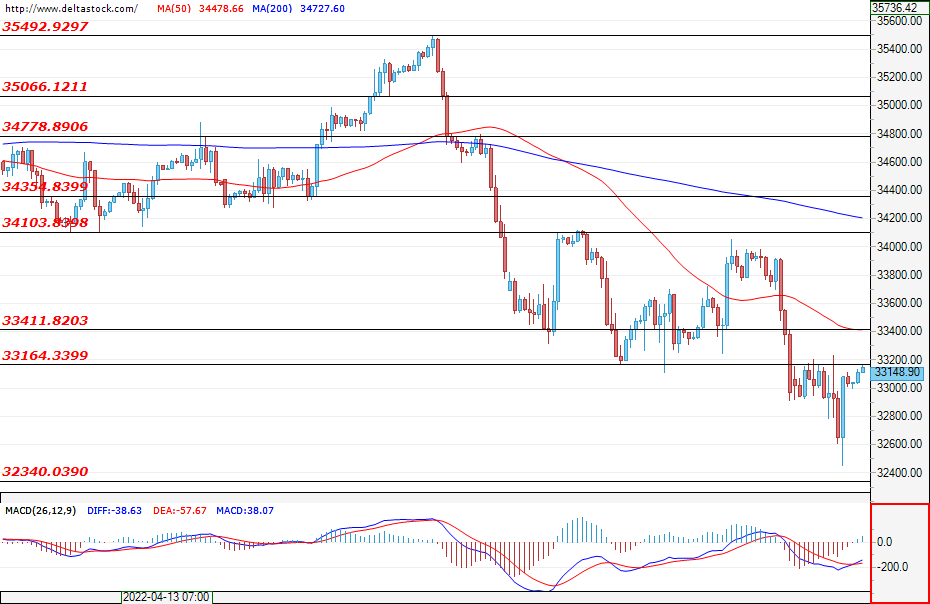
With the American blue chips, we've been observing a bear market since last week. During today's session, the price of the index consolidated below the resistance level at 33164. If the bears want to establish full control over the market, then they must first breach the support at 32340. The first key resistance lies at 34103, but the sentiment is still mostly negative as the ten-year U.S. treasury yields exceeded 3% for the first time since 2018 and traders prepare for the Fed to raise the interest rates.
The US Currency Clearly Remains in Pole Position
Markets
Markets yesterday had to cope with multiple, divergent pieces of news both on inflation and growth. Most data still suggested that the former is becoming an ever bigger hurdle for the second. Chinese data are flagging that strict corona measures cause the second largest economy to be a drag rather an a motor for world growth as it will add both to supply chain disruptions annex higher prices and hamper demand at the same time.
EC confidence declined faster than expected from 106.7 to 105. The supply/industry related subseries were not too bad, but the European consumer clearly fears the war in Ukraine to spark a protracted cost of living crisis (-22.0 from -16.9).
US eco data of late were resilient but the April manufacturing ISM (55.4 from 57.1 vs 57.6 expected) shows that prices/supply issues are still abundant, but demand shows tentative signs of easing, too. Initially, all this led to outright risk-off, especially on European indices. The EuroStoxx50 lost 1.85%. US indices after a hesitant start finally rebounded (Dow +0.26%, Nasdaq + 1.63%).
US yields didn’t change course despite uncertainty on growth, rising between 4.7/4.9 bps (5-y/10y) and 1.7 bps (2-y). The decomposition of the move in the 10-y yields was striking. The US 10-y real yield jumped more than 15 bps to 0.14%, partially compensated by a decline in inflation expectations (-11 bps). Two days before the Fed decision, market confidence is high that Fed rate hikes and QT will do the job.
The German yield curve also steepened with the 2-y yield easing 1.9 bps and the 30-y rising 4.8 bps. There was a slight easing in EMU inflation expectations, too. However, 10-y EMU inflation swaps now moved above their US counterparts (3.08% vs 3.0%), illustrating the loss of confidence in the ECB’s mandate to anchor inflation at its 2.0% target over the policy horizon, or even far beyond.
The DXY USD index reversed Friday’s correction (close 103.74) but didn’t break last week’s top. EUR/USD still struggles to avoid a break below 1.05. Sterling initially outperformed the euro, but a late session setback even caused EUR/GBP to close north of 0.84.
This morning Japanese and main Chinese markets are closed. Later today US JOLTS job openings, German and EMU labour market data are interesting but no market mover. Investors will mainly count down to tomorrow’s Fed decision, unless some unexpected news from the Ukraine conflict were to interfere. We keep a close eye whether the US real yield will extend its journey further into positive territory. In more constructive risk sentiment, this shouldn’t immediately translate into a further acceleration of the dollar. That said, the US currency clearly remains in pole position. At the same time, it will be difficult for EUR/USD to avoid a return to the 1.0341 correction low, unless the ECB decisively steps up its anti-inflation commitment.
News Headlines
The Reserve Bank of Australia completed a Riksbank-style sudden policy U-turn by lifting its policy rate this morning from 0.1% to 0.35%. More rate hikes are coming to ensure a return of inflation towards target. The RBA also decided to no longer reinvest proceeds of maturing government bonds. The Australian economy has proven to be resilient and inflation has picked up more quickly, and to a higher level, than was expected. There is also evidence that wages growth is picking up, a key factor for the RBA to start a tightening cycle. Australian GDP growth is forecast to remain strong at 4.25% this year and 2% next. A further rise in inflation is expected short term (6% headline; 4% core), before moderating towards 3% (upper tolerance band) by mid-2024. AUD/USD (0.71) bounces away from the danger/support zone in the low 0.70-area. The AUD swaps curve bear flattens with yields rising by 2.7 bps (30-yr) to 13.5 bps (2-yr). Australian markets discount another 250 cumulative bps of rate hikes this year.
Bitcoin Lies at the Bottom
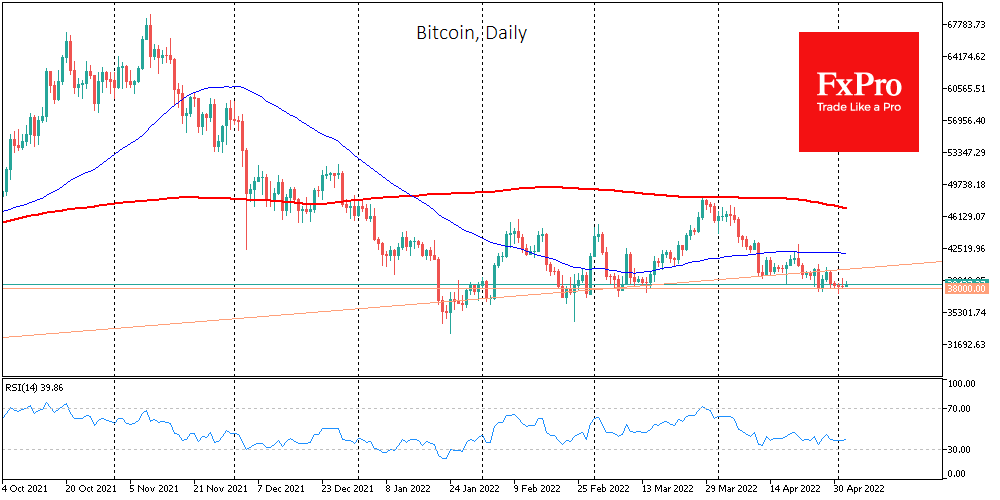
Bitcoin rose 0.6% on Monday, ending the day near $38.4K, cruising at arm’s length from the $38K level for the past five days. Ethereum has settled near $2800, losing 0.5% over the past 24 hours. Other altcoins in the top 10 have shown mixed dynamics, ranging from a decline of 1.9% (Solana) to a rise of 1.5% (Terra).
Total crypto market capitalisation, according to CoinMarketCap, declined 0.7% overnight to $1.74 trillion. Bitcoin’s dominance index added 0.2% to 42.1%.
The cryptocurrency Fear and Greed Index was down 1 point to 27 by Tuesday and remains in “fear” mode.
Since late March, the bears have been intensifying from $39K, forming a sequence of lower highs. At the same time, the basis in the form of support at $38K generally remains untouched.
The crypto market seems to have laid at the bottom, missing the momentum of the US indices growth at the close of trading, indicating a high supply of coins for sale and reluctance to take active actions in anticipation of the Fed’s decision on Wednesday. But there may be another lower bottom if the FOMC reaction to the Fed leads to a stock market sell-off.
According to Santiment, large investors have been aggressively buying Ethereum and Binance Coin over the past two weeks, which could signify an impending trend reversal.
JPMorgan Chase CEO Jamie Dimon said that cryptocurrencies offer advantages over fiat currencies in some respects, such as fast transaction times for payments. However, Dimon still recommends caution when investing in crypto assets.
According to Coin ATM Radar, the global bitcoin ATM installation rate declined for the fourth consecutive month in April.
Meanwhile, Solana’s blockchain went down for seven hours to carry out transactions due to a surge in operations that the network could not cope with.
Billionaire Mark Cuban suggested using DOGE to fight spam on Twitter, which Elon Musk recently bought out.
10Y UST Yields above 3% ahead of FOMC – More to Come
Market movers today
On an otherwise quiet day on the data front, markets will keep an eye on Russia headlines, after discussions about a phased-in EU embargo on Russian oil are intensifying.
In the euro area, the unemployment figures for April will reveal whether there have been any adverse spill-overs to the labour markets since Russia's invasion of Ukraine.
Ahead of the FOMC decision tomorrow, JOLTS jobs openings and quits will give more insights about the tightness of the US labour market during March.
The 60 second overview
Flash crash: According to Bloomberg a trading error at a London trading desk at Citigroup was behind the sudden drop in Swedish stocks of 8% that immediately spread to the other Nordic and European bourses yesterday. Note that markets very quickly normalised and the OMC Stockholm 30 Index closed down by 1.9% in line with other European indices.
10Y UST reach 3%: Yesterday, the psychologically important 3%-level was breached for the first time since 2018 as 10Y UST yields rose as much as 7.5bp. The move comes ahead of the FOMC meeting tomorrow where the Fed is widely expected to hike rates by 50bp and to officially announce that the balance sheet reduction (QT) will start next month with a USD 95bn cap every month. For more see Fed Research: Preview - 50bp rate hike published 28 April. The rise in nominal yields was driven by a 17bp jump in real yields to above zero (0.15%) for the first time since the pandemic started. Hence, 10Y break-evens fell more than 10bp during the session now standing at 2.83%. It was trading as high as 3.04% Friday afternoon. The big market moves yesterday shows that the market is slowly starting to price that the Fed will be able to keep inflation and inflation expectations in control through a higher real-yield. The latter is a clear tightening of financial conditions. We still see upside for UST yields from the current level. For more see Yield Outlook published 26 April.
US ISM fall back: The ISM manufacturing index declined more than anticipated in April falling 1.7 points to 55.4. New orders remained broadly unchanged (53.5 vs 53.8) but a sharp fall in the employment index from 56.3 to 50.9 was seen. Price pressure remains very high though "prices paid" eases slightly to 84.6 from 87.1. All in all the ISM index supported the market-unfriendly notion of "stagflation" - that is high inflation and weaker growth.
RBA: The Reserve Bank of Australia hiked rates by 25bp to 0.35% in its meeting this morning, a slightly larger hike compared to consensus expectation of 15bp. It also confirmed further rate hikes over the coming meetings, but did not yet specify plans for faster hiking pace. Tight labor market conditions are expected to lead to clear uptick in wages, and underlying inflation is projected to moderate towards RBA's target range of 2-3% only by mid-2024. RBA noted that it does not plan to reinvest maturing bond holdings from the QE program, which ended in February, but so far it refrains from actively selling bond holdings. AUD/USD rose moderately following the decision, but AUD is unlikely to gain much long-lasting support in an environment where global and not least Chinese growth risks are rising.
Equities: Equities in different directions, as US rebounded from Friday's markets and Europe was in catch-up. Sector performance reversed, with tech rebounding and defensives like consumer staples underperforming. However, overall sector performance is becoming less thematic with sectors such as real estate (bond sensitive) and materials (inflation winner) underperforming at the same time. S&P500 0.6%, Nasdaq 1.6%, Dow 0.3% and Russell 2000 1%. Futures point to another green opening today.
FI: A choppy Monday trading session without particular news driven events (and UK out) ended with a continuation of the recent trends in the past weeks, namely yields higher and spreads wider. 10Y Germany ended 3bp higher at 0.97% thereby approaching the 1% mark. Italy was yet again under pressure as spreads widened 5bp in the 10y point vs Germany. It is a rather quiet day on the data front today, as we await tomorrows Fed decision.
FX: EUR/GBP continues to range-trade around 0.84 as expected - we expect the BoE to stick to its more cautious language, which, if we are right, is likely to support EUR/GBP. Looking ahead we maintain a negative stance on the NOK.
Credit: With UK out there was no trading in CDS indices yesterday. Cash bonds, however, followed equities in red, with HY bonds closing the day 4bp wider and IG 1bp wider.
Dow Jones 30 Struggles for Support
The Dow Jones 30 recoups losses as traders take profit ahead of the FOMC. A break below 33300 forced bulls to bail out and suggests that the liquidation phase is yet to end.
The demand zone around 32700 from March’s rebound is a critical level to test buyers’ resolve. An oversold RSI has attracted bargain hunters, but the rebound will need to clear 33900 before a bullish reversal could materialize.
Failing that, February’s lows around 32300 would be the support of last resort before a deeper correction towards 31000.

USD/CHF Hits 2-Year High
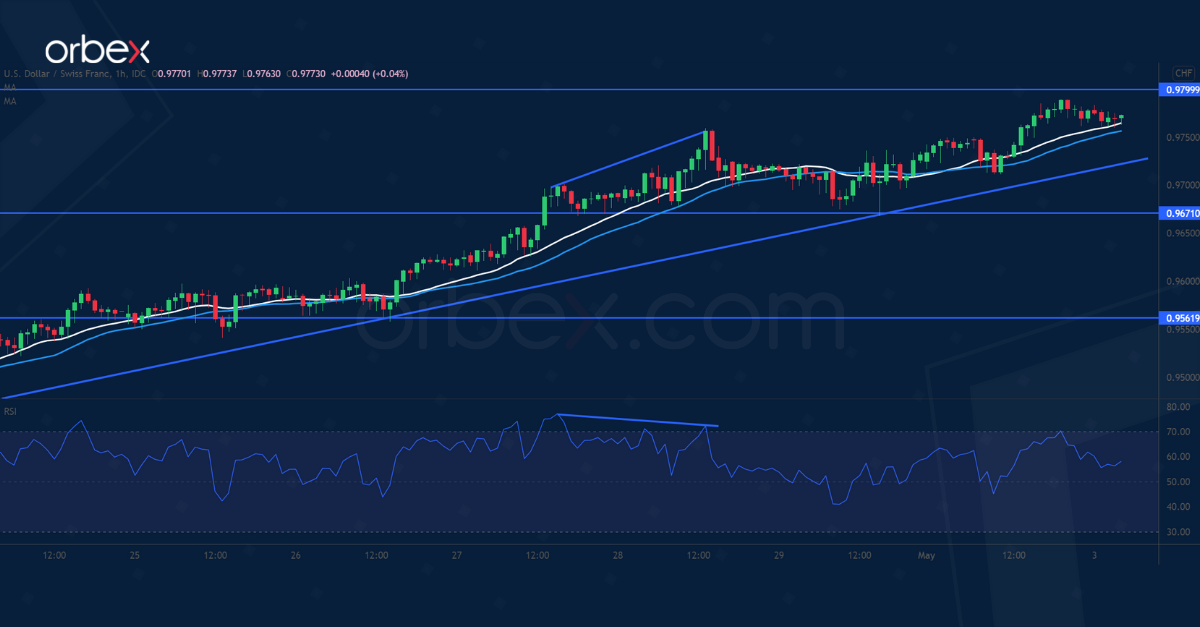
The US dollar rallies ahead of an expected Fed rate hike this week. The pair is grinding a rising trendline and is about to reach a two-year high at 0.9800.
The RSI has ventured into the overbought area on the daily time frame. Meanwhile, the indicator’s bearish divergence suggests a loss of momentum in the parabolic ascent. The pair could be due for a pullback for the bulls to catch their breath.
The demand zone between the trendline and 0.9670 from the latest consolidation is a key area to gauge short-term buying interest.
EUR/USD Sees Further Downside
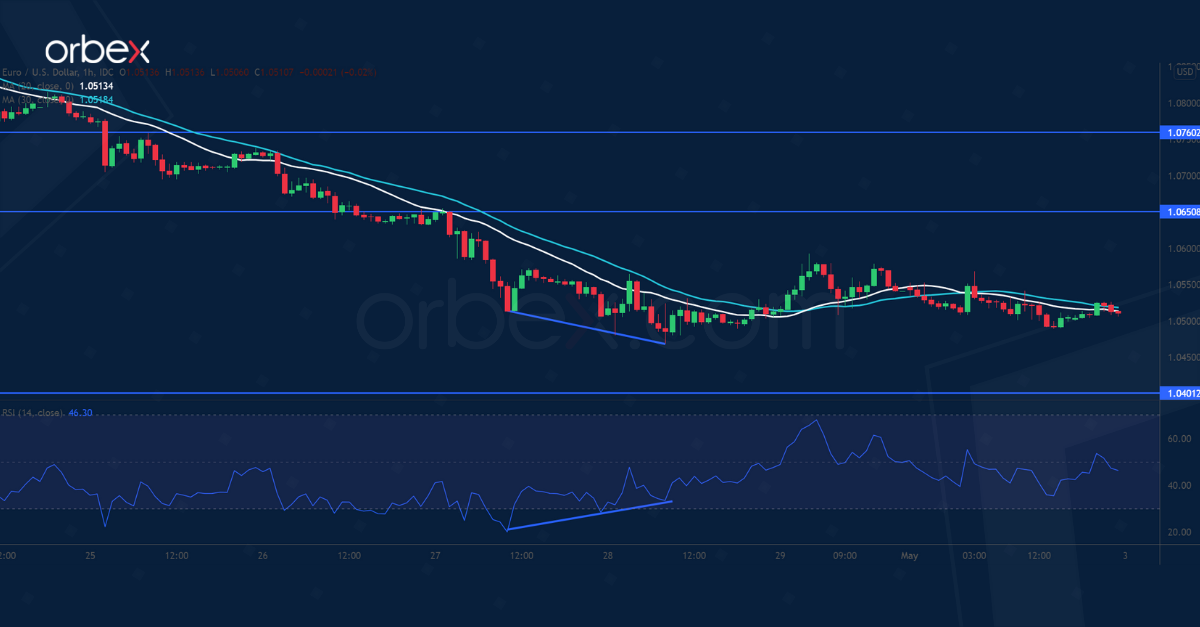
The euro continues to weaken over growth concerns in the eurozone amid the war in Ukraine. A tentative break below 1.0500 further put the euro under pressure.
A lack of rebound suggests that the bears are confident enough to hold onto their chips, while the bulls stay on the sidelines. A bullish RSI divergence shows a slowdown in the sell-off.
However, only a rally above 1.0650 could ease the selling pressure and help turn sentiment around. Otherwise, 1.0400 from January 2017 would be the next stop.
AUD/USD Daily Report
Daily Pivots: (S1) 0.7027; (P) 0.7055; (R1) 0.7079; More...
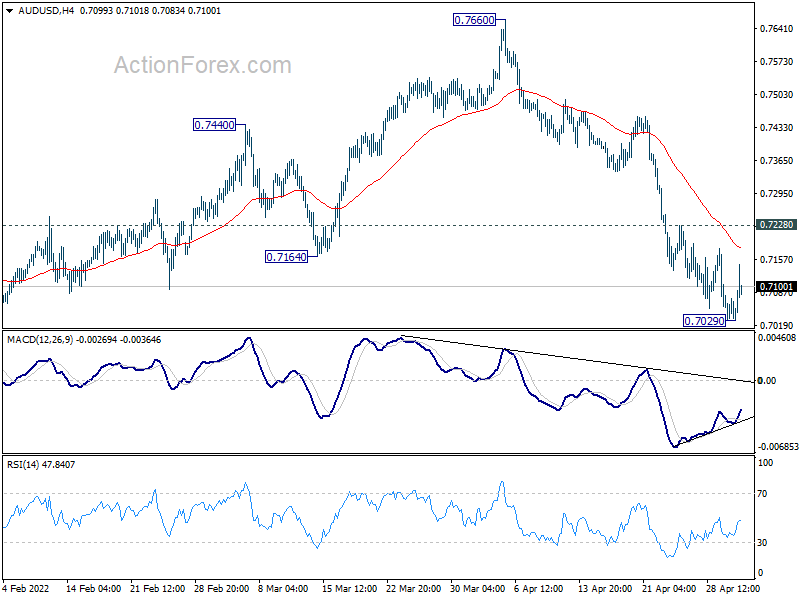
Intraday bias in AUD/USD is turned neutral first with current recovery. But further decline is expected as long as 0.7228 minor resistance holds. As noted before, fall from 0.7660 is seen as the third leg of the larger correction from 0.8006. Below 0.7029 will target 0.6966 low first. Firm break there will confirm this bearish case and target 0.6756 medium term fibonacci level next. Nevertheless, considering bullish convergence condition in 4 hour MACD, break of 0.7228 should indicate short term bottoming, and turn bias back to the upside for stronger rebound.
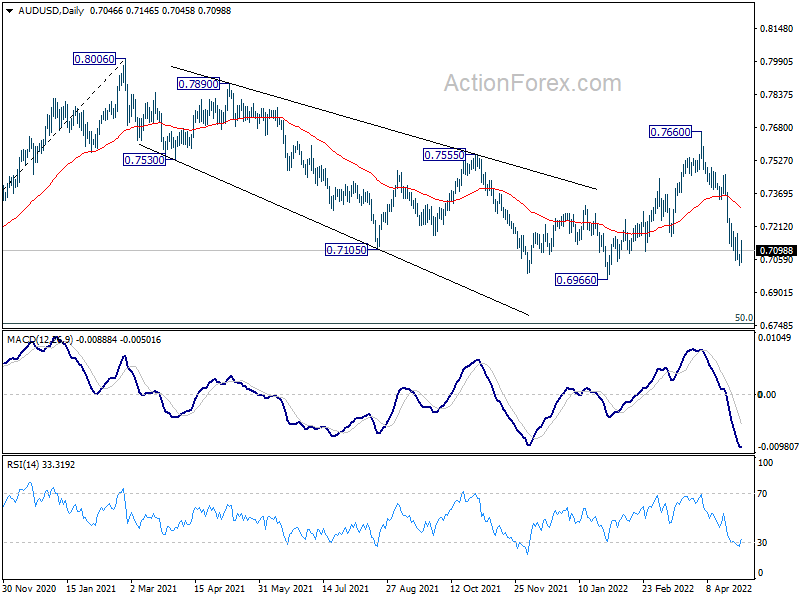
In the bigger picture, price actions from 0.8006 are seen as a corrective pattern to rise from 0.5506 (2020 low). Fall from 0.7660 should be the third leg of this pattern. Break of 0.6966 will target 50% retracement of 0.5506 to 0.8006 at 0.6756. On the upside, break of 0.7660 will revive that case that the correction has already completed at 0.6966.
Aussie Jumps after RBA Rate Hike, But Lacks Follow Through Buying
Australian Dollar rebounds broadly after the larger than expected rate hike by RBA, and takes up New Zealand Dollar too. But there is no clear follow through buying yet. Swiss Franc is currently the weakest one for the day, followed by Dollar and Yen. Apparently, overall development suggests steady risk sentiment, but that may not last long. Euro and Sterling are mixed, together with Canadian.
Technically, for Aussie to confirm its underlying strength, some levels need to be taken out with conviction. The levels include 0.7228 minor resistance in AUD/USD, and 1.4682 minor support in EUR/AUD. Otherwise, overall tone in Aussie will remain bearish and selloff could come back any time soon. In particular, Aussie would be back in disadvantage if US 10-year yield could break through 3% decisively, and Germany 10-year yield could power through 1%.
In Asia, at the time of writing, Hong Kong HSI is up 0.12%. Singapore Strait Times is up 0.65%. Japan and China are on holiday. Overnight, DOW rose 0.26%. S&P 500 rose 0.57%. NASDAQ rose 1.63%. 10-year yield rose 0.109 to close at 2.996, after breaching 3% to 3.002.
RBA hikes by 25bps to 0.35%, more to come
RBA raises cash rate target by 25bps to 0.35% today, larger than expectation of 15bps to 0.25%. The interest rate on Exchange Settlement balances is also lifted by 25bps to 0.25%. In the forward guidance, RBA said it's committed to "ensure that inflation in Australia returns to target over time". That will "require a further lift in interest rates over the period ahead".
In the accompanying statement, RBA said the economy has "proven to be resilient and inflation has picked up more quickly, and to a higher level, than was expected" while "wages growth is picking up". It's appropriate to start the process of normalizing monetary conditions."
Unemployment rate is expected to decline to around 3.5% by early 2023, hitting the lowest level in almost 50 years. GDP is projected to grow by 4.25% over 2022 and 2% over 2023. Headline expected to rise further from current 5.1% to 5% this year. Underlying inflation is also expected to rise from current 3.7% to 4.75%. By mid-2024, headlines and underlying inflation are projected to have moderated back to around 3%, with assumption of further rate hikes.
AUD/NZD breaches 2020 high after RBA rate hike
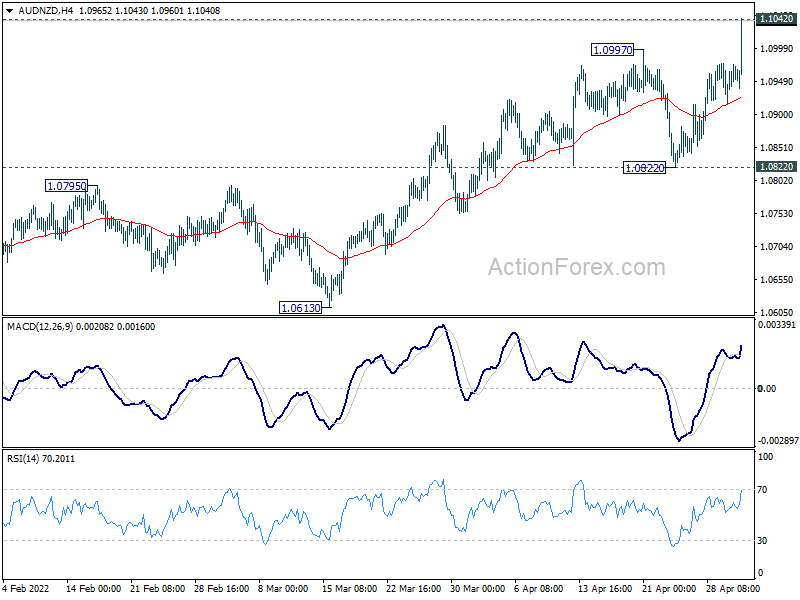
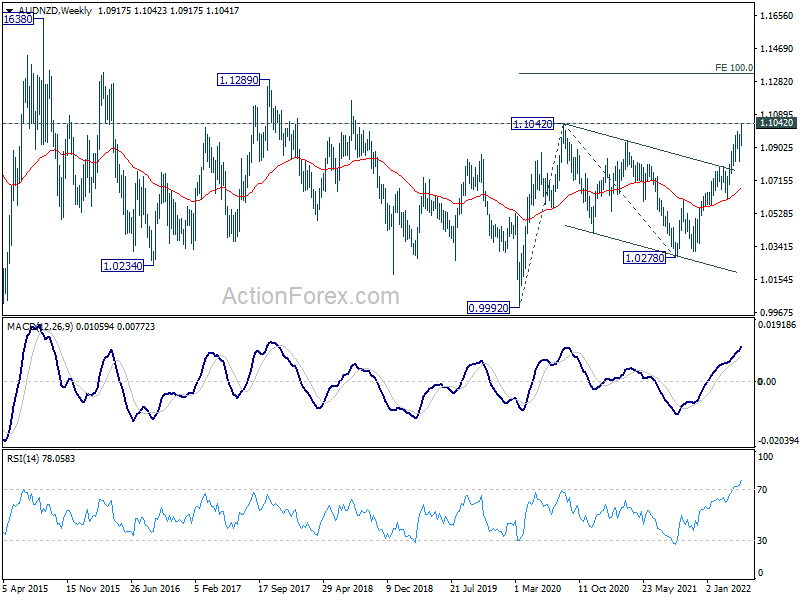
AUD/NZD rises sharply after the larger than expected rate hike by RBA, and breach a key resistance level at 1.1042 (2020 high). Decisive break of this level would be a significant medium term development and should confirm resumption of whole up trend from 0.9992 (2020 low). That should set the stage for further rise to 100% projection of 0.9992 to 1.1042 from 1.0278 at 1.1328, which is slightly above 1.1289 (2017 high). In any case, outlook will stay bullish as long as 1.0822 support holds.
Gold resume decline, heading to 1817 first
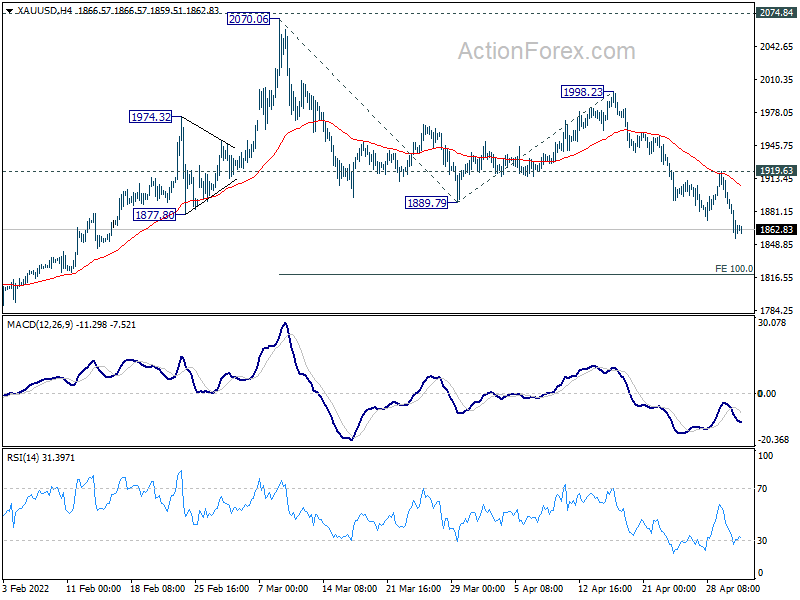
Gold dropped notably this week on the back of strong Dollar. Rising treasury yield, with 10-year yield breaching 3% handle for the first time since 2018, also weigh on the precious metals.
Gold's fall from 1998.23 resumed after slightly stronger than expected recovery last week. Such fall is seen as the third leg of the decline from 2070.06, and should target 100% projection of 2070.06 to 1889.79 from 1998.23 at 1817.86 next. In any case, more downside is expected for the near term as long as 1919.63 resistance holds.
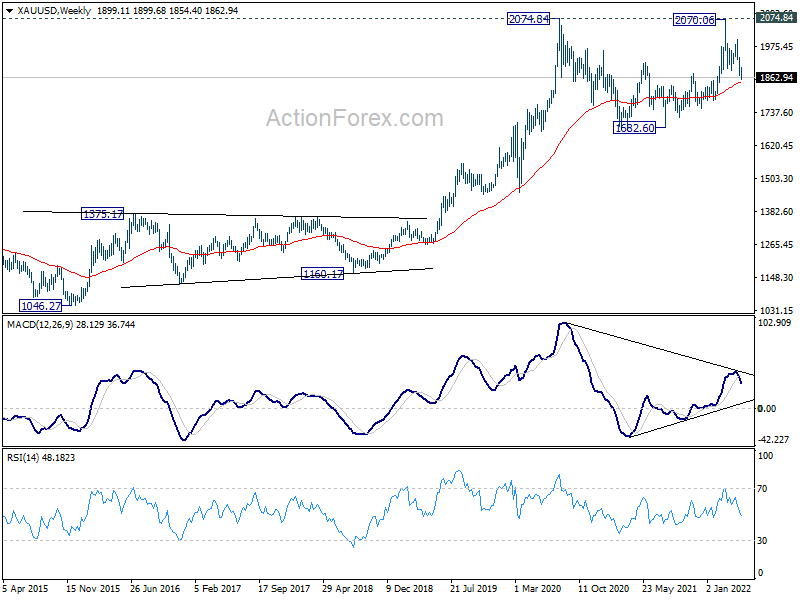
Also, such decline is seen as the third leg of the corrective pattern from 2074.84 (2020 high). Sustained trading below 55 week EMA (now at 1843.71) would pave the way back to 1682.60 support, where is should finish the pattern and bring long term up trend resumption.
Looking ahead
Germany unemployment, Eurozone unemployment and PPI, UK PMI manufacturing final will be featured in European session. US will release factory orders later in the day.
AUD/USD Daily Report
Daily Pivots: (S1) 0.7027; (P) 0.7055; (R1) 0.7079; More...
Intraday bias in AUD/USD is turned neutral first with current recovery. But further decline is expected as long as 0.7228 minor resistance holds. As noted before, fall from 0.7660 is seen as the third leg of the larger correction from 0.8006. Below 0.7029 will target 0.6966 low first. Firm break there will confirm this bearish case and target 0.6756 medium term fibonacci level next. Nevertheless, considering bullish convergence condition in 4 hour MACD, break of 0.7228 should indicate short term bottoming, and turn bias back to the upside for stronger rebound.
In the bigger picture, price actions from 0.8006 are seen as a corrective pattern to rise from 0.5506 (2020 low). Fall from 0.7660 should be the third leg of this pattern. Break of 0.6966 will target 50% retracement of 0.5506 to 0.8006 at 0.6756. On the upside, break of 0.7660 will revive that case that the correction has already completed at 0.6966.
Economic Indicators Update
| GMT | Ccy | Events | Actual | Forecast | Previous | Revised |
|---|---|---|---|---|---|---|
| 22:45 | NZD | Building Permits M/M Mar | 5.80% | 10.50% | 12.20% | |
| 04:30 | AUD | RBA Interest Rate Decision | 0.35% | 0.25% | 0.10% | |
| 07:55 | EUR | Germany Unemployment Change Apr | -15K | -18K | ||
| 07:55 | EUR | Germany Unemployment Rate Apr | 5.00% | 5.00% | ||
| 08:30 | GBP | Manufacturing PMI Apr F | 55.3 | 55.3 | ||
| 09:00 | EUR | Eurozone Unemployment Rate Mar | 6.80% | 6.80% | ||
| 09:00 | EUR | Eurozone PPI M/M Mar | 4.90% | 1.10% | ||
| 09:00 | EUR | Eurozone PPI Y/Y Mar | 36.30% | 31.40% | ||
| 14:00 | USD | Factory Orders M/M Mar | 1.20% | -0.50% |
AUD/NZD breaches 2020 high after RBA rate hike
AUD/NZD rises sharply after the larger than expected rate hike by RBA, and breach a key resistance level at 1.1042 (2020 high). Decisive break of this level would be a significant medium term development and should confirm resumption of whole up trend from 0.9992 (2020 low). That should set the stage for further rise to 100% projection of 0.9992 to 1.1042 from 1.0278 at 1.1328, which is slightly above 1.1289 (2017 high). In any case, outlook will stay bullish as long as 1.0822 support holds.