Sample Category Title
Week Ahead – Fed and BoE Rate Hikes on the Horizon; Will RBA Join in?
The Federal Reserve and Bank of England are both expected to raise interest rates in the upcoming week, though the former will likely do so by a larger increment. However, it’s much more of a puzzle what the Reserve Bank of Australia will do as pressure is mounting on the central bank to get the rate hike ball rolling in May rather than in June. It will also be a busy week for jobs data as apart from the all-important US nonfarm payrolls report, Canada and New Zealand will also publish their employment numbers. OPEC holds its monthly meeting too next week but is not anticipated to pump more oil even as European leaders ponder whether to block the import of Russian oil.
Fed to begin front-loading rate hikes
As the US dollar scales multi-year highs against its rivals, traders will have their hands full next week with a barrage of data accompanying the crucial FOMC meeting. The ISM manufacturing PMI will kick things off on Monday but is unlikely to be a threat to USD bulls as it’s forecast to edge up from 57.1 to 58.0 in April. March factory orders will follow on Tuesday and on Wednesday, the JOLTS job openings and ADP employment reports are due, along with the ISM non-manufacturing PMI. Like the manufacturing sector, the services part of the US economy is not expected to display any signs of slowdown just yet as the non-manufacturing PMI is projected to improve to 59.0.
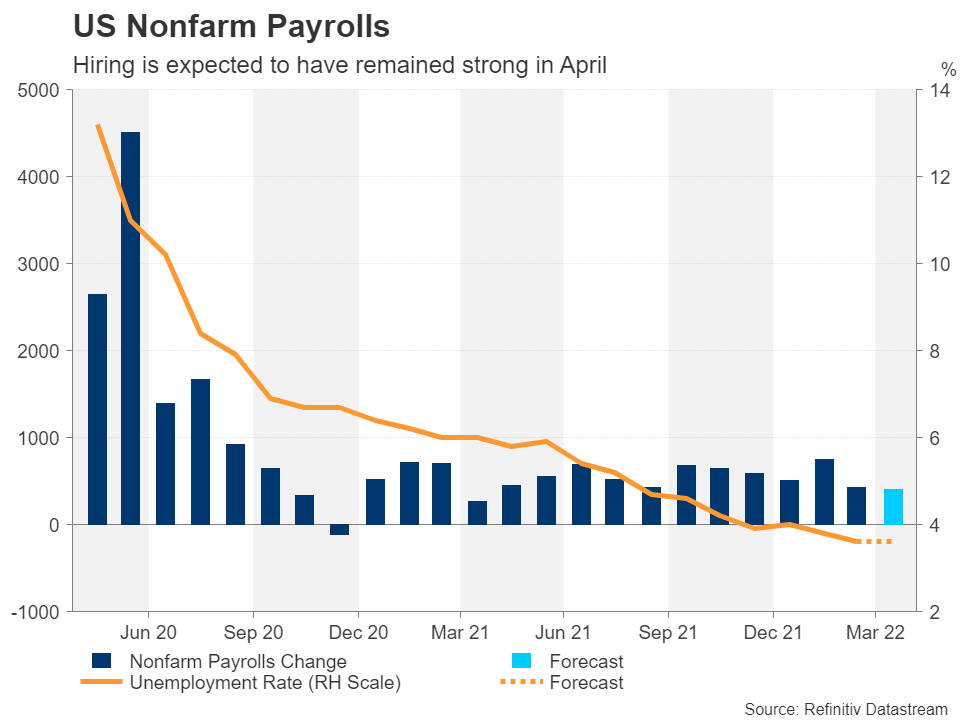
On Friday, the latest payrolls figures are not anticipated to cause any worries either. Nonfarm payrolls are expected to grow by a solid 400k in April, though the unemployment rate is predicted to hold steady at 3.6%. Average hourly earnings are forecast to rise by 0.4% month-on-month.
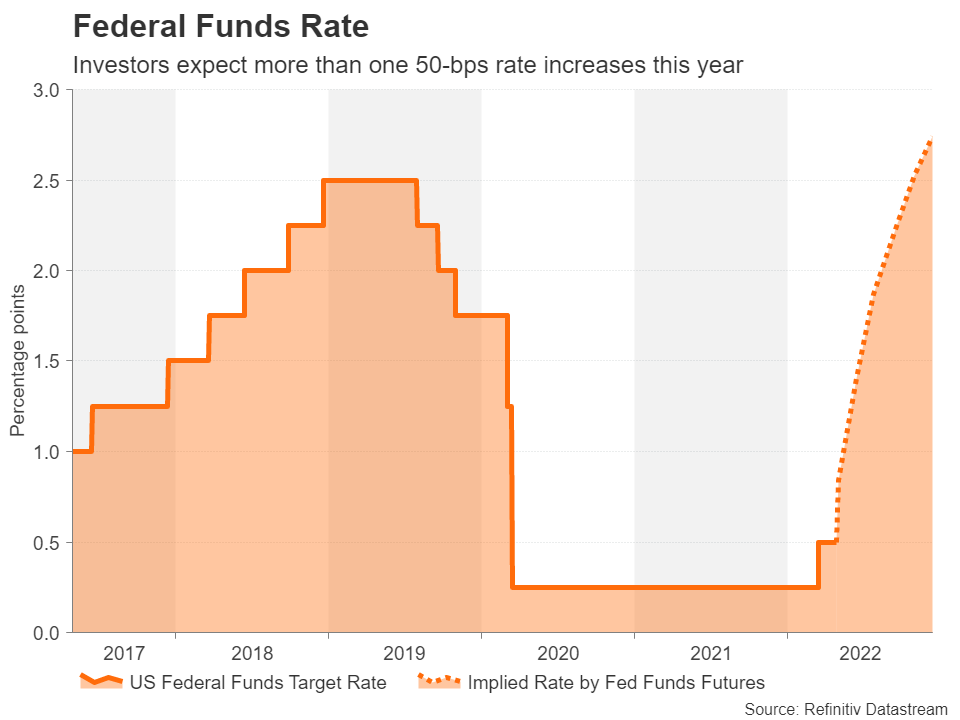
But the main spotlight will be on the Fed, which is almost certain to announce a 50-basis-point rate hike on Wednesday. The hefty move looks set to be the first of many in this cycle and Chair Powell has not been pushing back on the markets’ hawkish expectations.
Powell will probably reinforce the view that the Fed needs to get to neutral rates “expeditiously”, but investors are also awaiting the decision on shrinking the balance sheet. The minutes of the last meeting flagged a $95 billion a month reduction plan and this will likely be confirmed on Wednesday.
If the Fed maintains its hawkish rhetoric and barring any shock weaknesses in the forthcoming data, the dollar is well placed to extend its bullish streak next week.
BoE to lift rates again, but will it accelerate QT?
The Bank of England has become a lot less hawkish of late, as it frets about the impact of higher prices on consumer spending – the main driver of the British economy. The shift has been dramatic, with one MPC member even voting to keep rates on hold in March. Only in the previous meeting in February, the dissenting votes were by those opting to hike rates by a bigger 50 basis points.
Last meeting’s dissenter – Jon Cunliffe – is again expected to vote against a rate hike as the other eight members vote in favour for a 25-bps increase. This would push the Bank Rate up to 1% - the level set by the BoE for initiating the active sale of UK government bonds.
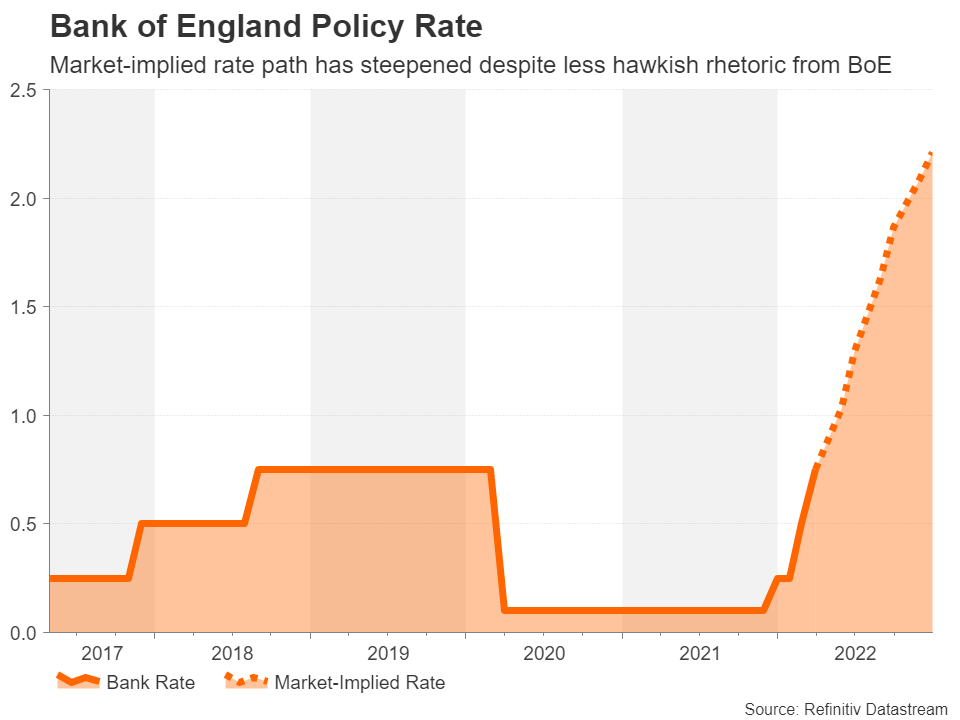
The BoE decided in February to stop reinvesting in maturing bonds but it’s unclear if policymakers are ready to speed things up by the outright sale of gilts. The recent deterioration in both the UK and global growth outlook has cast doubt on the need to tighten policy so aggressively. Moreover, Governor Andrew Bailey had previously signalled that the 1% threshold would not be an automatic trigger.
Thus, it’s possible the BoE will put off a decision to begin selling gilts for later in the year, potentially adding more pain to the beleaguered pound, which has slumped to near two-year lows against the dollar, as investors turn more pessimistic on the UK economy. However, sterling might find some support from potential upward revisions to the Bank’s inflation forecasts in its May Monetary Policy Report that will be published the same day.
Will the RBA take the plunge at May meeting?
Inflation in Australia jumped to a hotter-than-expected 5.1% in the March quarter, sparking talk that the Reserve Bank of Australia will not delay a hike any further and raise the cash rate by 15 bps at the May meeting on Tuesday to contain price pressures.
The speculation has provided the Australian dollar with some support against the surging US currency, but the risks from the meeting are symmetric as a rate rise would surprise some, while no change would disappoint others. Australians go to the polls on May 21 to vote for a new government so lifting borrowing costs in May would be politically sensitive for the RBA.
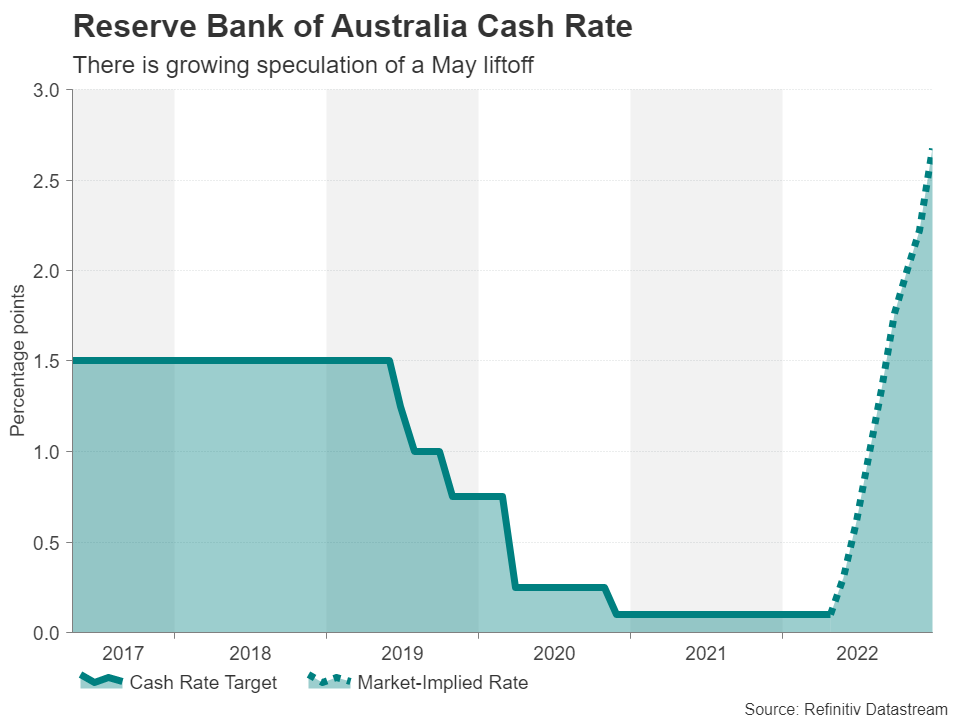
In the bigger picture, however, the timing has only short-term implications for the aussie and the bigger question is whether the RBA will be able to hike as many times as futures markets have priced in for the whole of 2022. The quarterly Monetary Policy Statement on Friday might provide some clues on the pace of future tightening.
Up until recently, Australia’s growth outlook had not been severely dented by the Russia-Ukraine conflict. In fact, the broad-based rally in commodities had boosted its economic prospects. But things have changed after the latest lockdowns in China, as the longer they drag on, the more heavily they will weigh on demand for resources exports by Australia. This puts quite a bit of focus on China’s manufacturing PMIs for April that are due over the weekend.
Loonie and kiwi hoping for jobs boost
Both the Bank of Canada and Reserve Bank of New Zealand raised rates by 50 bps at their last meetings, but this was unable to put a floor under the local dollars versus their US counterpart. The US dollar’s reserve currency status as well as expectations that the American economy is better placed to withstand the economic turmoil generated by the Ukraine war has taken the shine off pretty much all the other majors.
Canada releases its employment report for April on Friday and another strong reading is probable as it’s too soon for any effect from either higher rates or the heightened geopolitical tensions to filter through.
In New Zealand, the first quarter might have gotten off to a challenging start due to Omicron but the subsequent easing in virus restrictions means that the labour market overall likely remained tight during the period.
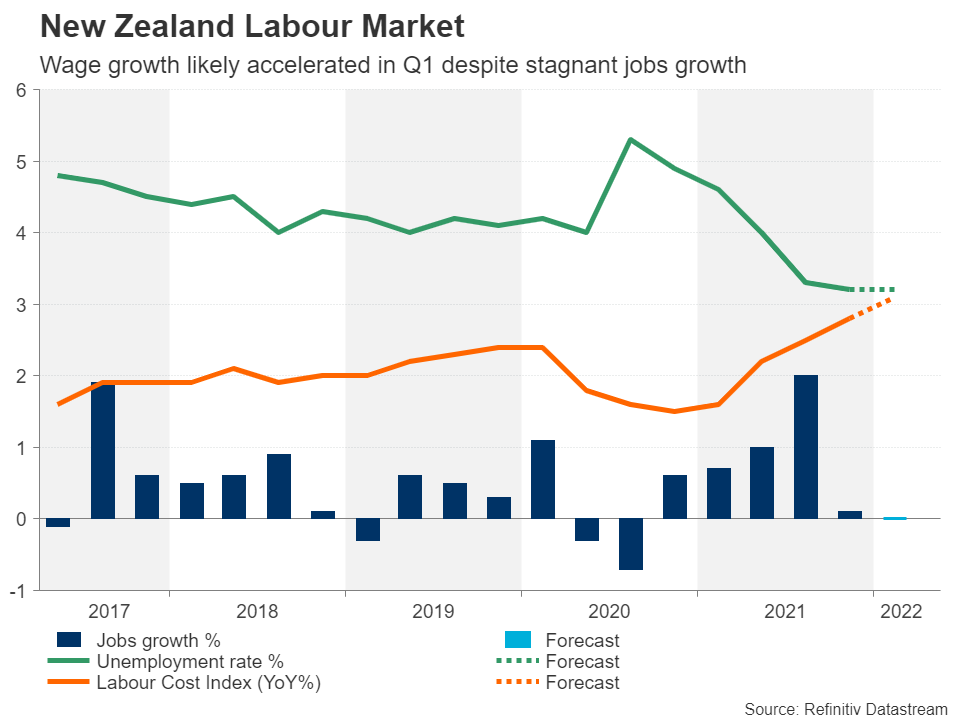
With both central banks flagging further hefty rate increases ahead on the back of soaring inflation, the jobs figures are not anticipated to materially alter the policy outlook, so unless there are any major surprises, such as stronger wage growth, the Canadian and New Zealand dollars’ best chance of a rebound is a pullback in the greenback.
Still, the loonie might be able to find some comfort from OPEC’s scheduled meeting on Thursday. The oil cartel and its non-OPEC partners are not expected to succumb to pressure to increase output at a higher pace than the current plan of 400,000 bpd each month even as prices remain elevated above $100 a barrel.
Weekly Focus – Chinese Growth Worries and Russian Gas Cuts Rail Markets
The Russian-Ukrainian war entered its third month, without any signs that the conflict will be resolved any time soon. After failing to capture Kyiv, Russian forces are focussing their attacks on the Donbass region in the Southeast and with the 9 May Victory Day approaching, we think Russia is likely to step up their offensive against Ukraine (read more in Research Russia-Ukraine - Several signals point to an escalation in the war in Ukraine as Victory Day looms, 26 April).
Global growth concerns have again hit the market mood. Assets that tend to trade closely in tandem with the cyclical outlook have performed poorly and market volatility has increased. News that Russia halted gas deliveries to Poland and Bulgaria after they failed to make payments in Ruble did nothing to turn around sour risk sentiment and sent oil and gas prices higher. Market concerns have been amplified by another COVID-19 outbreak in Beijing, which could trigger a shut-down of the city similar to Shanghai, putting further pressure on global supply chains. Amid broad USD strength, CNY has seen the sharpest weekly decline since 2015, EUR/USD fell to the lowest level since 2017 and USD/JPY moved higher after Bank of Japan stuck to its dovish policy and yield curve cap.
The combination of higher energy prices and a weaker growth outlook put central banks in a tough spot. Yet Riksbank felt no need to wait and hiked its repo rate by 25bp already in April and we look for further rate increases in June, September and November this year (see Flash comment Riksbank, 28 April). In line with recent comments from Governing Council members, we now expect a first 25bp hike from ECB already in July, followed by continued hikes in September, December and March, taking the deposit rate back to 0.5% in Q1 23 (see more in Reading the Markets EUR, 28 April).
Incumbent French President Emmanuel Macron secured another five-year term. His re-election bodes well for further EU integration, but he is also facing increasing economic and political headwinds. With only 59% of voters endorsing him for a second term, he has to govern a divided country and the weaker mandate could make it challenging to push ahead with ambitious reforms of the pension, health and education systems. To what degree Macron can implement his plans will depend on parliamentary elections held in June.
Chinese Covid-19 developments will remain in focus next week, while a further decline in Chinese PMIs from already low levels seems likely due to the Shanghai lockdown. A busy week awaits markets also in the US, where the FOMC meeting on Wednesday is the highlight. We expect the Federal Reserve to hike the target range by 50bp, a view shared by consensus and market pricing, and signal that further 50bp rate hikes are looming this year (read more in Fed Preview, 28 April). The US jobs report released on Friday will be interesting in that respect. We expect the job market continued to tighten in April, with an increase in nonfarm payrolls of ~400k and possibly a further drop in the unemployment rate to 3.5%. On Thursday, we expect Bank of England to hike the Bank Rate to 1.00% from 0.75%, but stick to its softer guidance on the hiking pace from last time. In the euro area, focus will remain on further potential cuts to Russian energy supplies, as the EU is working on another sanctions package that might include an oil embargo. An emergency meeting among EU energy ministers is scheduled for Monday.
Sunset Market Commentary
Markets
Today’s economic calendar put Europe in the spotlights. First quarter economic growth as expected slowed from 0.3% to 0.2% q/q, in part thanks to Germany that was able to avoid a recession with a 0.2% expansion. Year-over-year, Europe’s economy grew 5%. Details from France and Belgium gave some minor insights into the composition. French consumer spending declined while capital formation provided some counterweight. A sectoral divide by the National Bank of Belgium showed the services sector leading (meagre) growth over there. Growth going forward, however, is what matters. One element central to that is sky high inflation that’s eroding purchasing power. And the April reading published today suggests no huge turnaround is in the making. Headline inflation may have stabilized at a record 7.5% y/y (0.6% m/m) as widely expected but core inflation accelerated more than foreseen, from 2.9% to 3.5% y/y (3.2% expected). This reveals how broad-based price pressures have become. Services inflation for example rose to 3.3%, equaling the previous EMU record in 2002. European yields rose in response, adding more than 7 bps at the front end of the curve. Both the 2y (0.98%) and the 10y European swap yield (1.7%) surpassed the previous cycle/multiyear top. Once again, the move higher was driven by inflation expectations with markets ramping up the pressure on the ECB to finally act. The 10y inflation swap hit a new record high of 3.12%. US yields were initially lured higher by the EU until a batch of economic data (income, spending) provided them their own reasons for exploring new intraday highs. PCE inflation (6.6% headline, 5.2% core) was no big surprise after yesterday’s string of data. The closely watched (by the Fed) employment cost index rose a more-than-expected 1.4%, up from 1% in 2021Q4. It definitely caught markets’ eye just days ahead of the Fed policy meeting (May 4). US yields rise 8.3 bps to 12.8 bps in a textbook bear flattener. Money markets again fully price in four consecutive 50 bps moves, starting next week.
The dollar took a breather nevertheless. One can’t blame the US currency after such a surge over the previous days. The trade-weighted DXY “retreated” from 103.62 to 103.22. EUR/USD tried to capitalize in early dealings but realized that’s useless unless it gets unconditional backing from the ECB. The cross is filling bids near 1.053, barely up from this morning’s 1.05. Sterling is better bid, both against the USD and the euro. GBP/USD rebounded from the 1.25 big figure to 1.254. For comparison purposes: end last week, cable was still trading above 1.30. EUR/GBP declines back below 0.84 to find support around 0.838 (Nov 21 lows). Next week will be a pivotal one for sterling too. The Bank of England meets and will have new forecasts to share. The BoE is walking a tightrope between fighting inflation and an escalation cost-of-living crisis deteriorating the outlook. News Headlines
The Bank of Russia cut its key policy rate by 300 bps from 17% to 14%. Markets expected a smaller cut to 15%. With price and financial stability risks no longer on the rise, conditions have allowed to cut the key policy rate, according to the central bank. If the economy and inflation develop as expected, the Bank of Russia sees more room for additional interest rate cuts this year. The key rate is forecast to average 12.5-14% this year, 9-11% next year and 6%-8% in 2024. Annual inflation is forecast to hit 18%-23% this year, before slowing down to 5%-7% next year and return to the (inflation) target of 4% in 2024. Russian GDP is expected to shrink by 8% to 10% this year, mainly due to supply-side factors. Interestingly, the policy statement doesn’t mention the war at all.
Polish inflation accelerated once more in April, rising by 2% M/M from 11% Y/Y to 12.3% Y/Y (vs 11.4% expected). Food prices were the main culprit, jumping by 4.2% M/M. However, core inflation rose above 8% Y/Y as well, sending a strong signal to the National Bank of Poland to extend its aggressive tightening cycle. We pencil in another 100 bps rate hike next week. The Polish zloty initially gained from EUR/PLN 4.70 towards 4.65 before returning some of those gains. In another CE data release, Czech GDP grew by 0.7% Q/Q in Q1 (4.6% Y/Y). Details aren’t available yet.
Full Steam ahead for Canada’s Economy in February
The Canadian economy surged ahead 1.1% month/month (m/m) in February, beating Statistics Canada's flash estimate of 0.8%. The flash estimate for March also points to a strong gain of 0.5% m/m
February's increase in activity was broad, with output expanding in 16 of 20 industries. The goods-producing sector rose 1.5% m/m, while the service-producing sector rose 0.9% m/m.
The reopening from the Omicron wave caused the accommodation and food services sector to rebound 15.1% on the month. Food services and drinking places and accommodation services were up 17.6% and 8.8% m/m, respectively.
Construction saw another jump (2.7% m/m) this month, with residential building construction rising 3.7%. Transportation and warehousing climbed by 3.1% on the month, led by a 9.1% rise in rail and a 7.7% rise in air transport.
Key Implications
All aboard the Canada bandwagon. With all the talk of how high inflation and rising interest rates will slow growth, today's GDP report reinforces the view that the momentum in Canada's economy is unrelenting.
The upgrade to the February print and the strong flash estimate for March point to annualized growth of 5.6% for Q1. Compared to our neighbor to the south and our global peers, Canada is clearly outperforming.
The Bank of Canada won't need anymore convincing that another 50 basis point hike is needed at its meeting on June 1st. This has the Canada 2-year and 10-year yields jumping this morning, reaching 2.65% and 2.89%. With Canadian yields narrowing the gap relative to U.S. Treasuries, the loonie has appreciated over half a percent. Go Canada!
US: Personal Income and Spending Surprise to the Upside
Personal income was up 0.5% month-on-month (m/m) in March, a notch higher than the consensus estimate (+0.4% m/m). February growth was revised up to +0.7% m/m from +0.5% m/m reported earlier.
Strong growth in compensation of employees (+0.5% m/m) remains the biggest driver, with both private and government sector wages rising. Proprietors' income also came in strong at 0.8% m/m. Personal income receipts on assets (+0.4% m/m) and government social benefits (0.3% m/m) were also positive, led by personal interest income and Medicare/Medicaid, respectively.
Removing the effect of price changes and taxes, real personal disposable income declined by 0.4% m/m in March, but February's decline of 0.2% m/m was revised to a positive reading of 0.1% m/m.
Nominal personal spending rose by 1.1% m/m in March, well above the consensus estimate (+0.6% m/m). This is on the back of a much stronger February print, which was revised to +0.6% m/m vs. +0.2% m/m reported in the preliminary estimate.
- Goods spending was up by 1.1% m/m from upwardly revised growth of 0.3% in February (originally -1.0% m/m). Higher prices of gasoline and other energy goods primed growth in non-durables (+2.5%m/m), while durables were in the red this time, dropping 1.0%m/m on the back of an upwardly revised February's reading.
- Services spending rose by 1.1% m/m, while the February reading was adjusted down to 0.8%m/m (originally +0.9% m/m). The gains were broad-based and led by “other” services (which includes international travel).
In real terms, spending was up 0.2% m/m, stronger than expected by the market (-0.1% m/m). Real goods spending was behind the drag with a decline of 0.5% (both durables and non-durables declined in real terms). Real services spending was up 0.6% m/m for the second months in the row.
The PCE price deflator rose by 0.9% m/m in March (as expected), which translated into 6.6% in year-over-year (y/y) terms (vs 6.7% expected). Excluding food and energy, core PCE inflation was up 0.3% m/m (as expected) and 5.2% y/y (vs. 5.3% expected).
The personal saving rate remained below its pre-pandemic average of 7.5% with a reading of 6.2%, indicating that consumers continue to tap into a pool of excess saving accumulated during the two years of the pandemic.
Key Implications
In contrast to yesterday's headline GDP reading, nothing spells "recession" in today's release. Quite the opposite – at 2.7% quarter-on-quarter (annualized) real growth in personal expenditures was higher than our expectations for 2.4%. As expected, spending is also increasingly transitioning away from goods in favor of services. Notably, outlays on services have now fully recovered to its pre-pandemic level in real terms. We expect consumer spending growth to track a similar pace in the second quarter, with the services sector doing most of the heavy lifting.
Another reason for optimism is broad-based strength in income, which points to strong fundamentals that can support consumption going forward. Keeping in mind that households are armed with backup power of excess saving. The fact that higher income growth has not resulted in exuberant goods spending (in real terms) suggests that consumers remained level-headed to not front run their purchases on an expectation of persistently higher prices.
Surely, inflation remained hot, yet softer-than-expected year-on-year readings are very welcome. The Fed has more work to do to keep consumers convinced that inflation won't run away. Federal Reserve Chairman Jerome Powell has essentially committed to a 50 basis point hike in May, and he may need to telegraph his readiness to do just as much in June to keep this conviction intact.
GBPUSD Regains Some Footing above $1.25 after Nosedive
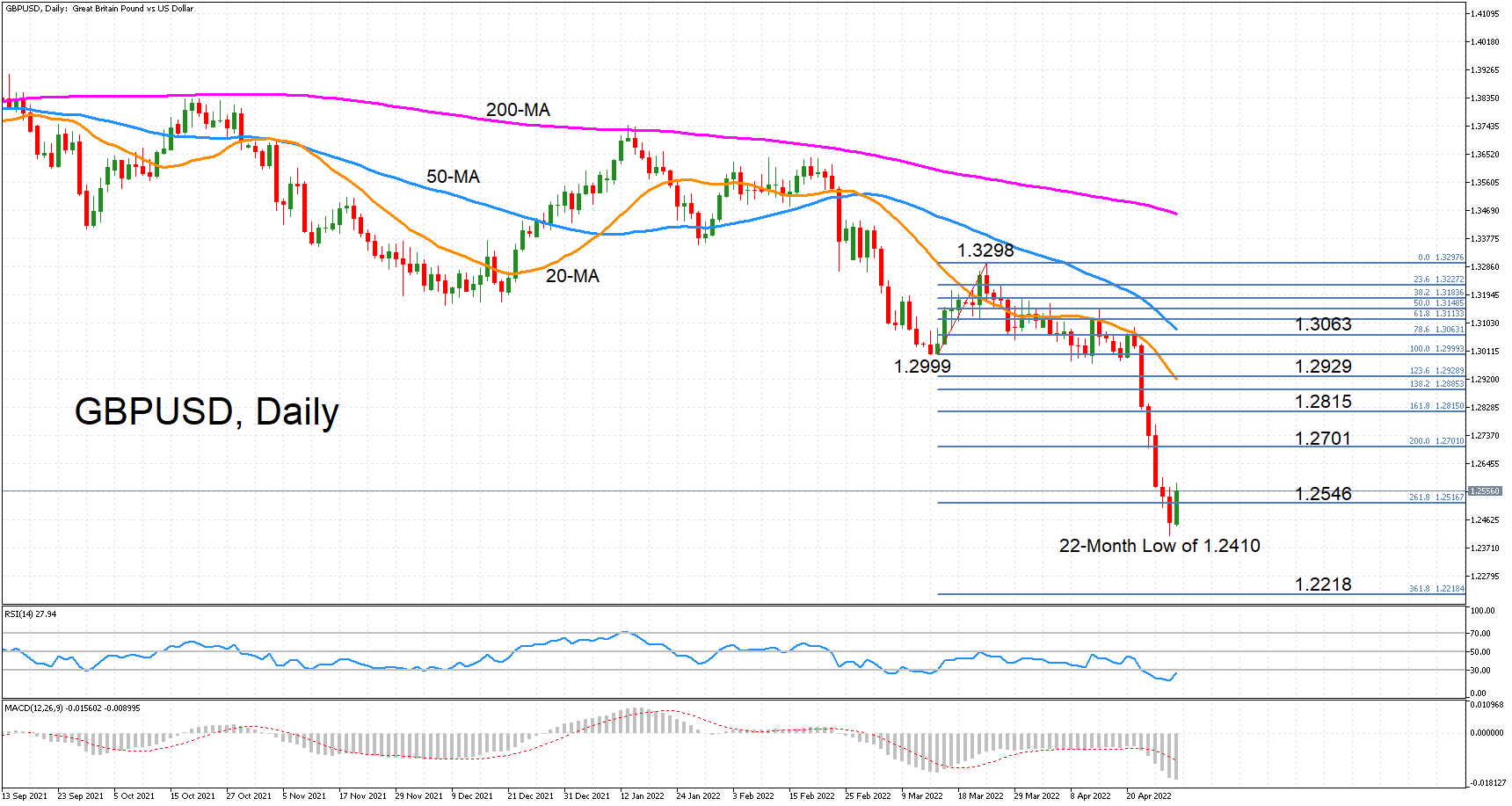
GBPUSD has steadied around 1.2550 and is attempting a rebound after plunging to a 22-month low of 1.2410 on Thursday. The RSI has reversed higher but has yet to exit the oversold zone, while the MACD histogram remains deep in negative territory below its red signal line, underlining the ongoing bearish risks in the near term.
If today’s bounce back gathers additional steam, the bulls could next target the 200% Fibonacci extension of the March upleg at 1.2701. The 161.8% Fibonacci extension of 1.2815 is another potential resistance area. But for a more sustained positive momentum, the price would need to recover above the 20-day moving average, which is currently just below the 123.6% Fibonacci of 1.2929.
However, a resumption of the selloff is more than likely at this point, and should the pair drop below yesterday’s 22-month trough, attention would turn to the 1.22 region, which contains the 361.8% Fibonacci of 1.2218.
To sum up, a climb above the 20-day MA would eliminate the negative pressures, switching the short-term bias to neutral, whereas a fresh tumble towards 1.22 would reinforce the bearish longer-term outlook.
Can Gold Stabilise after the Recent Plunge?
It's been another wild ride in the markets this week but indices are on course to end it roughly where they started.
There has been a lot to digest this week, not least from companies themselves, with big tech the focus on the earnings front. We're continuing to see some decent reports, albeit with the odd blip along the way.
Amazon was the latest to catch Wall Street off guard, reporting its first loss since 2015 amid a multitude of challenges facing the company. There were the usual strong points to the report, like the cloud and advertising businesses - although the latter did fall a little short of expectations - but like many others, the company is struggling to adjust to post-pandemic life having scaled up massively over the last couple of years.
There is a feeling that investors have had one eye on the Fed meeting next week which may be why we haven't seen a big sustainable move either way. The dollar has pared gains today but it has been flying this week and it's hard to see a strong case for that to reverse in any significant way. I can't imagine the Fed is going to tone down its hawkish rhetoric next week.
The EU response to Russia cutting off gas supplies to Poland and Bulgaria hasn't been as unified as we've seen in recent months. There's been a desperate scramble to work out which companies can comply with sanctions while keeping the gas flowing, something the Kremlin will be delighted to be witnessing.
Higher energy prices are a major driver of inflation in the euro area and that is unlikely to change any time soon. Inflation hit a new record high of 7.5% in April, while the core measure hit 3.5%, beating expectations. That's going to increase the pressure on the ECB to tighten this year even if it appears to be peaking. The market is pricing in multiple rate hikes this year, something the central bank has pushed back against. The meeting at the start of June is now huge. No room for ambiguity from Christine Lagarde this time.
Oil edges higher as EU moves closer to a Russian oil embargo
It seems the EU is moving closer to an oil embargo which some may argue is overdue in light of Russia's aggression in Ukraine. Naturally, the devil will be in the detail but the moves we're seeing in crude prices suggest the small print won't live up to the headlines. A phasing approach while still positive just won't cut it. But this is the bind the EU has left itself in after years of allowing itself to become so dependent on Russia.
Ultimately, the oil market remains in consolidation and the range is being squeezed which could make for an interesting few weeks. A breakout from this choppy range could be quite explosive and despite the impact that Chinese lockdowns are having, the risks remain tilted to the upside. Especially if the EU manages to deliver on an immediate embargo.
Can gold stabilise after the recent plunge?
It's been an awful couple of weeks for gold since coming close to breaking above $2,000 for the first time in over a month. The dollar rally has been relentless and it's been a real drag on the yellow metal. Which begs the question, is anything going to stop the dollar in the near term? And if not, what does that mean for gold.
Gold will continue to see safe haven and inflation hedge appeal so I don't see the recent rate of decline continuing, even if the dollar remains strong. That said, there isn't much of a bullish case for the yellow metal if the dollar continues to tear higher. Can it stabilise around these levels? It's doing a good job at the moment, albeit strongly aided by a small dollar correction.
USD/JPY Mid-Day Outlook
Daily Pivots: (S1) 129.04; (P) 130.14; (R1) 131.95; More...
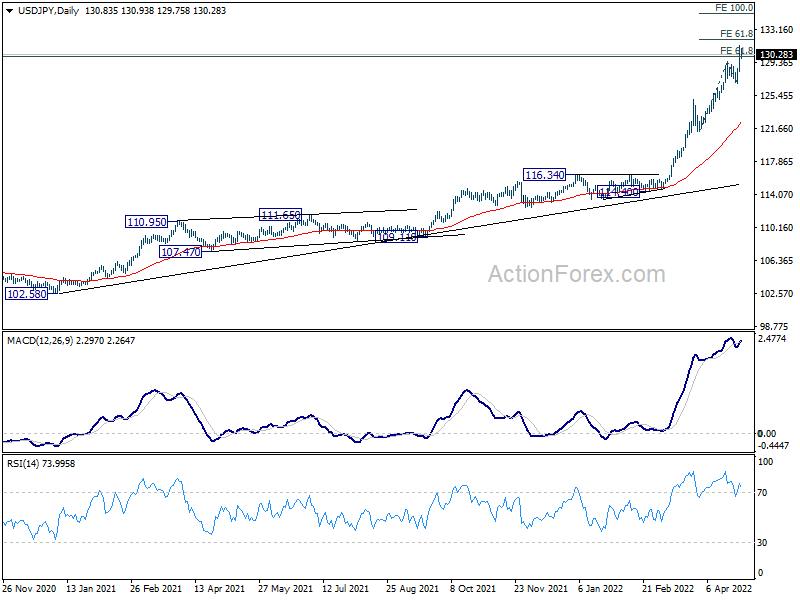
Intraday bias in USD/JPY is turned neutral for consolidations. Outlook stays bullish as long as 126.91 support holds. Above 131.24 will target 61.8% projection of 121.27 to 129.39 from 126.91 at 131.92. Firm break there will pave the way to 100% projection at 135.03.
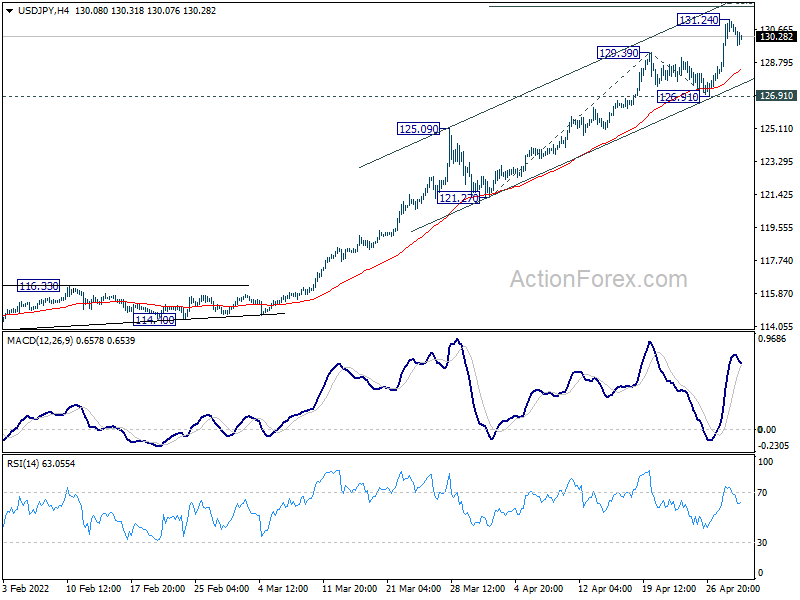
In the bigger picture, current rally is seen as part of the long term up trend form 75.56 (2011 low). Sustained trading above 61.8% projection of 75.56 (2011 low) to 125.85 (2015 high) from 98.97 at 130.04 will pave the way to 100% project at 149.26, which is close to 147.68 (1998 high). For now, this will remain the favored case as long as 121.27 support holds.
USD/CHF Mid-Day Outlook
Daily Pivots: (S1) 0.9675; (P) 0.9717; (R1) 0.9761; More....
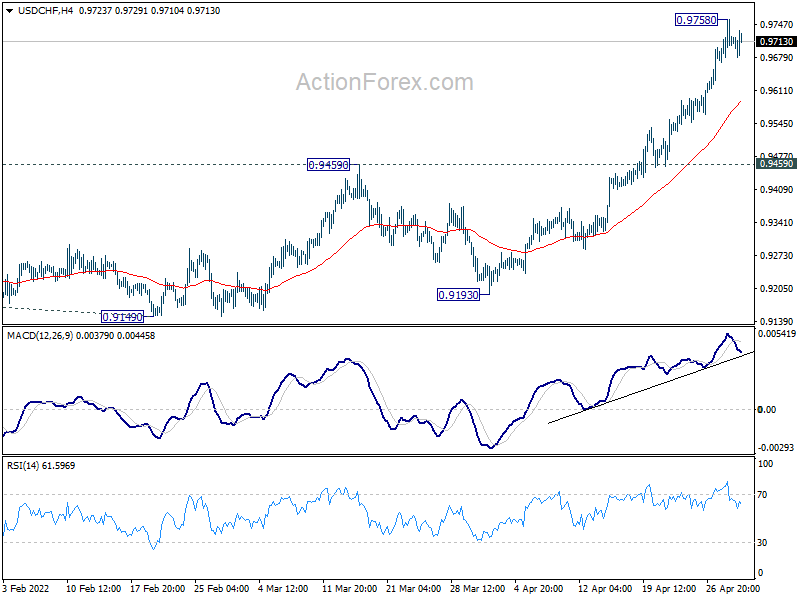
A temporary top is formed at 0.9578 in USD/CHF and intraday bias is turned neutral for consolidation. Downside of retreat should be contained above 0.9459 resistance turned support to bring another rally. On the upside, above 0.9758 will resume larger rise to next medium term projection level at 0.9864.
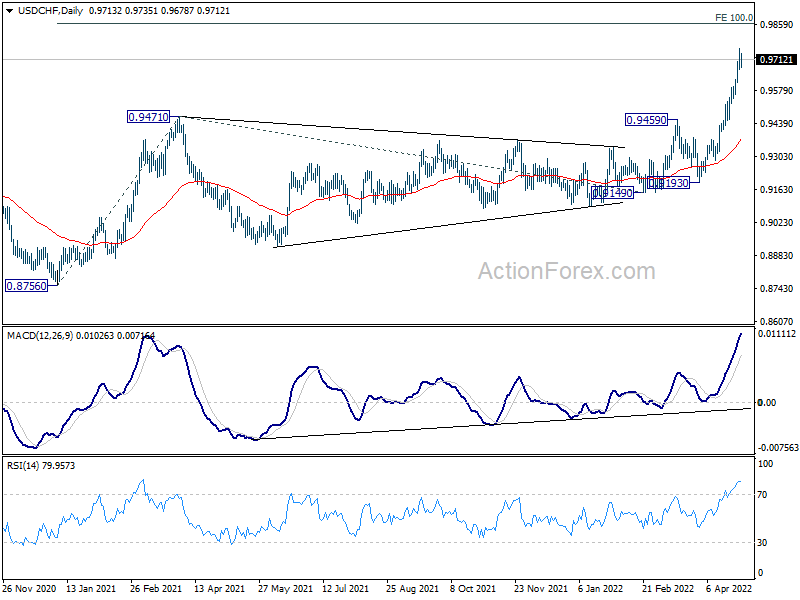
In the bigger picture, down trend from 1.0342 (2016 high) should have completed with three waves down to 0.8756 (2021 low) already. Rise from 0.8756 is likely a medium term up trend of its own. Next target is 100% projection of 0.8756 to 0.9471 from 0.9149 at 0.9864. This will now remain the favored case as long as 0.9459 resistance turned support holds.
GBP/USD Mid-Day Outlook
Daily Pivots: (S1) 1.2392; (P) 1.2481; (R1) 1.2549; More...
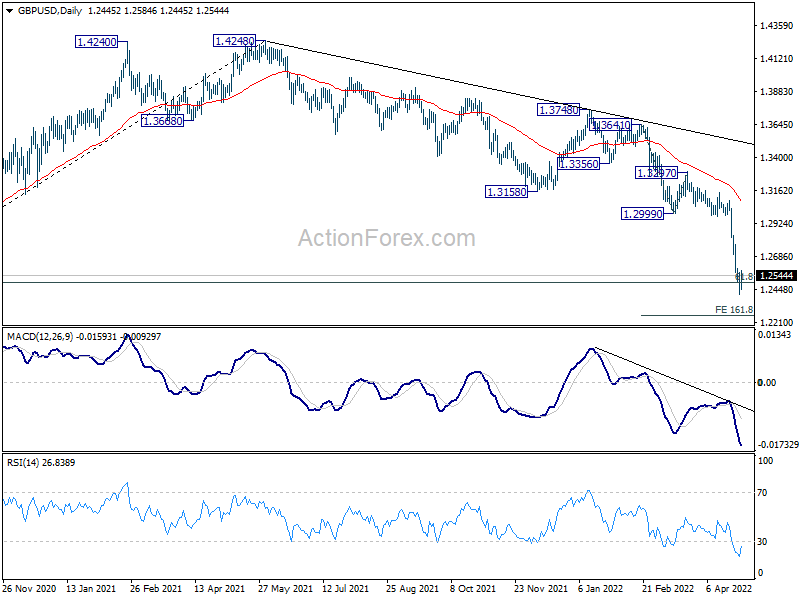
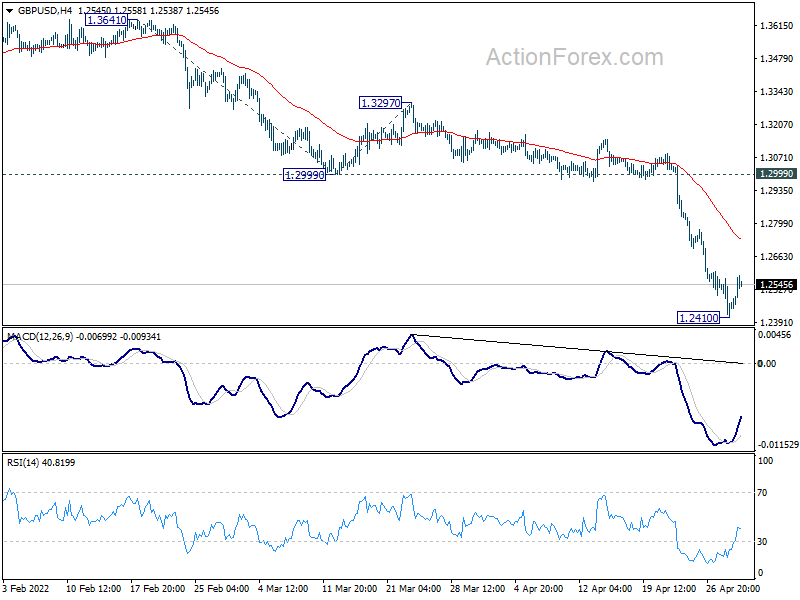
A temporary low is formed at 1.2410 with current recovery. Intraday bias in GBP/USD is turned neutral for some consolidations first. Upside of recovery should be limited below 1.2999 support turned resistance to bring another fall. On the downside, break of 1.2410 will target 161.8% projection of 1.3641 to 1.2999 from 1.3297 at 1.2258.
In the bigger picture, rise from 1.1409 (2020 low) has completed at 1.4248, ahead of 1.4376 long term resistance (2018 high). Based on current momentum, fall from 1.4248 is probably the start of a long term down trend. The break of 61.8% retracement of 2.1161 to 1.1409 at 1.2493 is affirming this bearish case too. For now, deeper decline would be seen as long as 1.3158 support turned resistance holds. Next target is 1.1409 low.