

Sample Category Title
AUD/USD Pair Entered a Bearish Zone Below the $0.7400 Support
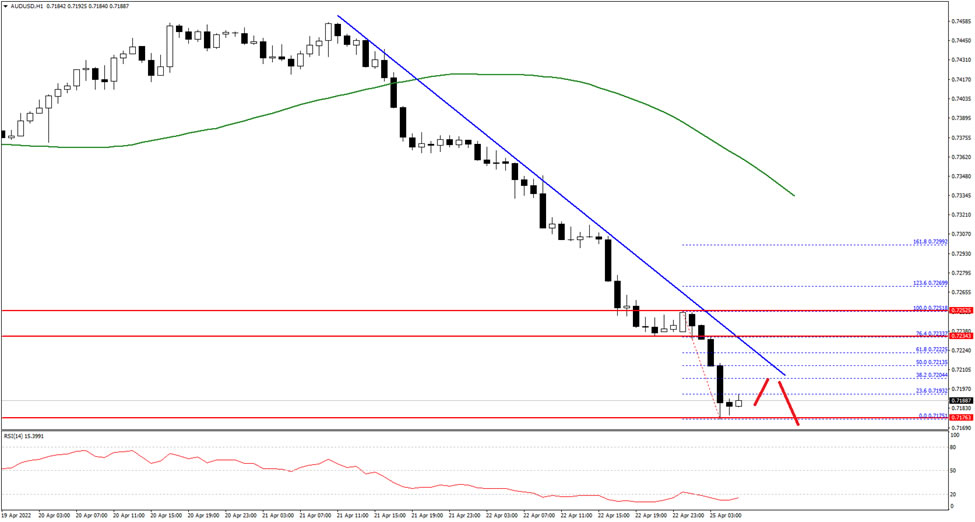
The Aussie Dollar started a fresh decline from well above the 0.7450 level against the US Dollar. The AUD/USD pair traded below the 0.7400 support to enter a bearish zone.
The pair even traded below the 0.7300 level and the 50 hourly simple moving average. It traded as low as 0.7175 and is currently consolidating losses. It is facing hurdle near a key trend line at 0.7200 on the hourly chart. The next key resistance on the upside is near the 0.7230 level.
If there is an upside break above the 0.7230 level, the pair could rise steadily towards the 0.7270 level in the near term. Any more gains could send the pair towards 0.7300 on FXOpen.
An immediate support on the downside is near the 0.7175 level. The next key support is near the 0.7150 level. A downside break below the 0.7150 support could lead the pair towards the 0.7065 support.
Euro Retreats as Emmanuel Macron Beats Le Pen in France
American equities dropped sharply on Friday as concerns about the Federal Reserve escalated. The Dow Jones and S&P 500 indices had one of the worst days this year after Jerome Powell warned that the bank will continue its aggressive rate hike policy. This will involve more rate hikes and even quantitative tightening. Investors are also worried about margin pressure as the ongoing earnings season continued. Data compiled by FactSet showed that 20% of all companies have published. Of these firms, 79% have reported a positive EPS surprise while 69% have published a positive revenue surprise. The 12-month forward PE ratio of the S&P 500 has moved to 18.6.
The British pound retreated to the lowest level since 2020 over concerns about the next actions of the Bank of England. Investors believe that the BOE will pause its rate hikes and embrace a more dovish tone considering that the economy is slowing. This was evidenced by the fact that consumer confidence has crashed to the lowest level since 2008. According to Gfk, confidence crashed minus 7 points to -38 in April as concerns about inflation rose. Further data showed that revealed that retail sales crashed hard in March.
The euro declined on Monday morning as investors focused on the outcome of the French election. Results between Marine Le Pen and Emmanuel Macron showed that the incumbent took a strong lead. He won 58% of the total vote even as voter turnout remained weak. He also becomes the first French president to be reelected in 20 years. Therefore, this means fears of France being led by a far-right leader. As a result, analysts expect that status quo in Europe will continue. The key data to watch will be the latest German current assessment and business climate data. Their impact on the euro will be relatively minimal.
NAS100
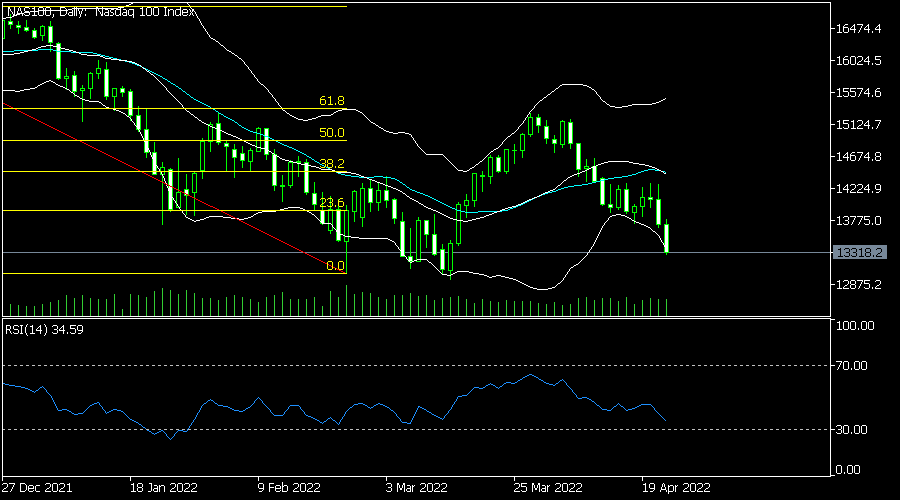
The Nasdaq 100 index declined sharply over concerns about rising interest rates. It dropped to a low of $13,318, which was the lowest level since March 21st. It has moved to the lower side of the Bollinger Bands and below the 23.6% Fibonacci retracement level. It has also moved below the 23.6% Fibonacci retracement level and while the Relative Strength Index (RSI) has pointed downwards. Therefore, the index will likely keep falling in the near term.
GBPUSD
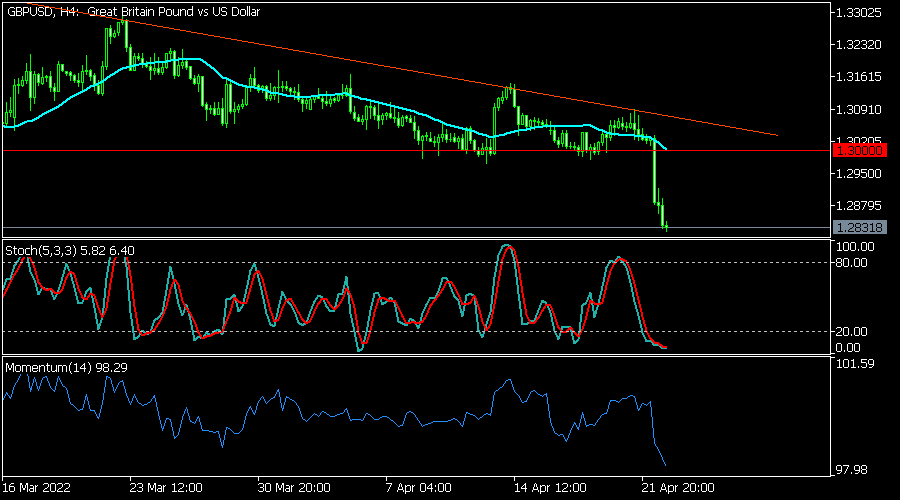
The GBPUSD pair continued the bearish trend after the weak economic data from the UK. The pair is trading at 1.2831, which is significantly lower than the key resistance at 1.300. On the four-hour chart, it moved below the descending triangle pattern. It has also moved below the 25-day and 50-day moving averages while the Stochastic oscillator and the momentum have pointed lower. The pair will likely have a relief rally today.
EURUSD
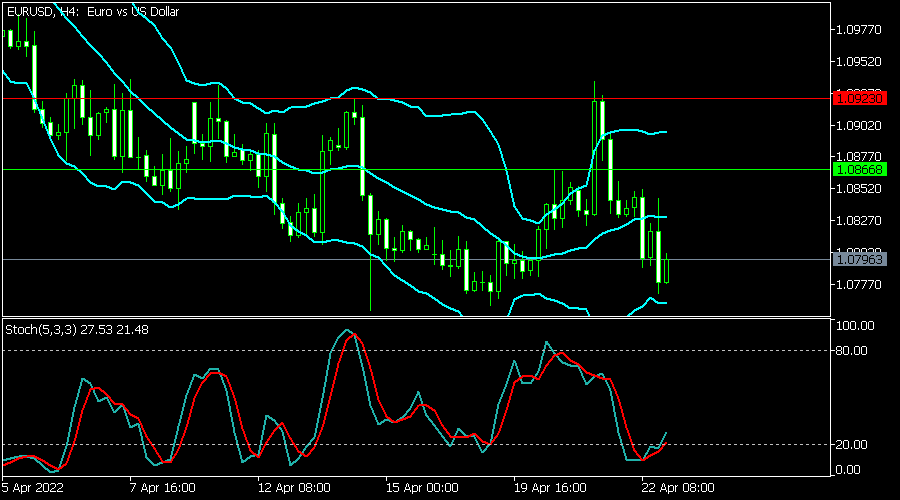
The EURUSD pair remained under pressure as investors reflected on the French election. It is trading at 1.0796, which is between the middle and lower lines of the Bollinger Bands while the Stochastic oscillator has moved above the oversold level. The pair is also below the 25-day moving average. The pair will likely remain in this range today.
EURUSD Tests Crucial 1.0750 Support as Bearish Bias Intensifies
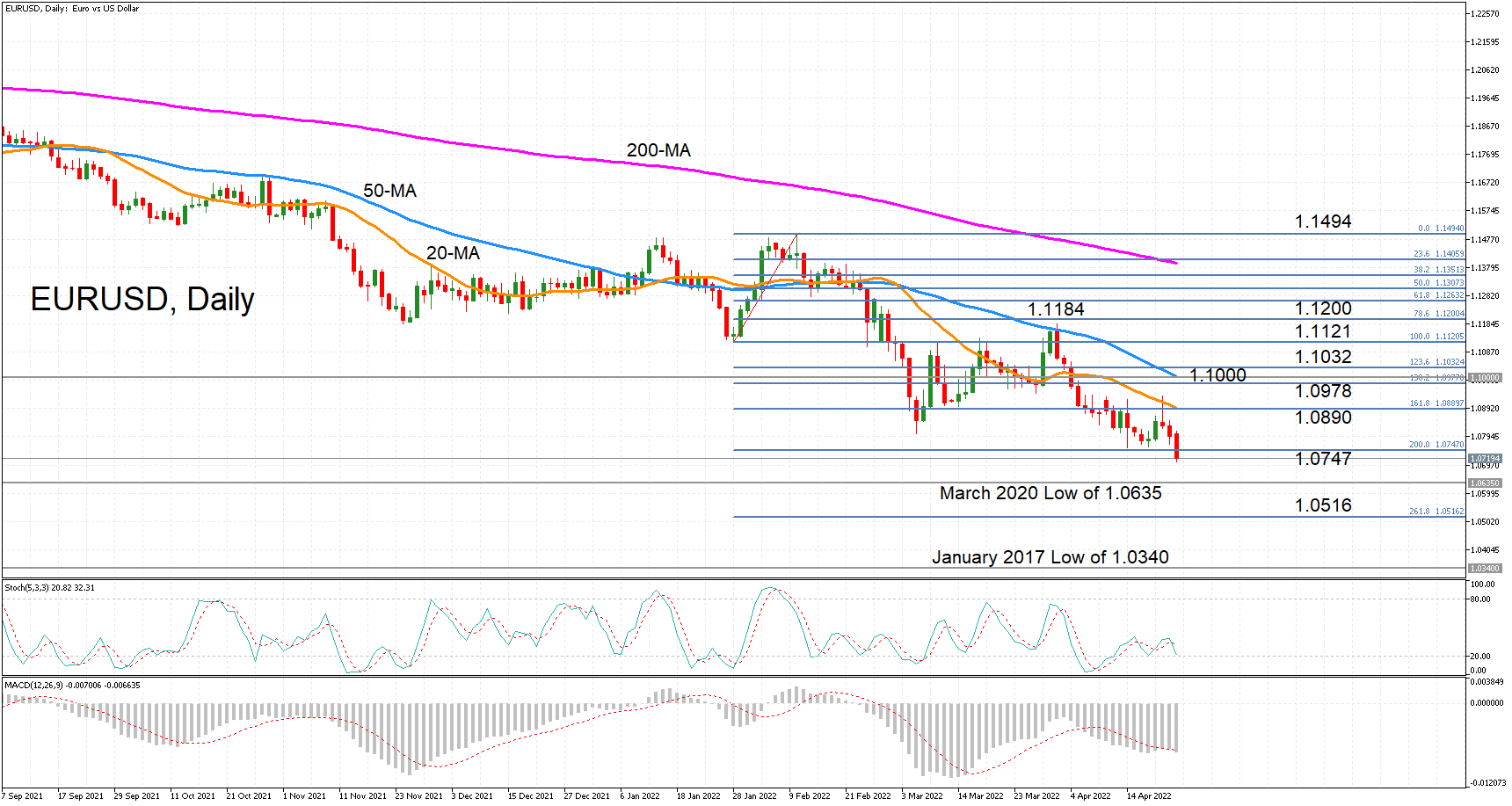
EURUSD had steadied just above the 1.0750 support level over the past few days when selling pressure eased a little, but the bears are driving the price back down again at the start of the new trading week. The pair has slipped below the 200% Fibonacci extension of the January-February upleg at 1.0747 as the momentum oscillators are deteriorating.
The %K line of the stochastic oscillator has dipped below the slower moving %D line and is about to cross into oversold territory. The MACD histogram is in the process of intersecting its red signal line, reversing back down after a slight improvement in recent days.
Should the bearish bias increase further, the next key support could come from the 1.0635 level, which is the March 2020 trough. Further down is the 261.8% Fibonacci extension of 1.0516. Breaking this barrier too would open the way for the January 2017 low of 1.0340.
In the event of a turnaround, EURUSD would first need to fight resistance at the 161.8% Fibonacci of 1.0890, which is also where the 20-day moving average (MA) is currently located. Climbing above this point would strengthen any positive momentum, but there’s likely to be another battle in the 1.10 region of the 50-day MA, which is surrounded by the 123.6% and 138.2% Fibonacci extensions.
However, for any meaningful rebound, the bulls would need to aim for the March peak of 1.1184. Otherwise, the bearish outlook in the longer run is not about to change anytime soon, while in the short term, the negative bias is deepening.
Macron Re-elected, German ifo Index in Focus Today
Market movers today
We kick off the week with German ifo business survey for April this morning. The forward-looking expectations index took a big hit in March, and consensus looks for a small further decline in April.
During the week focus will not least be on the Riksbank meeting on Thursday, where a first repo rate hike is in play.
On the global front this week we get Euro inflation for April on Friday, where we look for a new high in the headline index above 8% y/y. US GDP for Q1 released on Thursday is expected to drop to 1.0% q/q AR from 6.9% q/q AR in Q4 2021. Focus will also continue to be on the development of the
Shanghai and Beijing covid outbreaks.
The Fed has entered the black-out period so we will get no further communication ahead of the May 4 FOMC meeting where a 50bp hike is widely expected.
The 60 second overview
French election: Emmanuel Macron won the run-off against Marine Le Pen, making him the first incumbent president to win re-election in France since Jacques Chirac 20 years ago. However, during his second term Macron is facing increasing headwinds, both from the economy and political fragmentation. With only 58.5% of voters endorsing him for a second term (compared to 66% in 2017), he has to govern a divided country and the weaker mandate could make it challenging for Macron to push ahead with his ambitious reforms of the pension, health and education systems. To what degree he can implement his plans will depend on parliamentary elections held on 12 and 19 June. Should his party and allies fail to get a majority in the National Assembly, this could pave way for a 'cohabitation' government (in which President and PM hail from different parties), which will make addressing fiscal vulnerabilities and structural challenges more difficult in our view.
Market round-up: Stocks dropped sharply on Friday as S&P500 shed 2.8% with the risk-off move weighing on US bond yields this morning. Oil prices have dropped from USD107 per barrel on Friday to USD 103.7 this morning. EUR/USD is broadly flat from Friday.
China covid outbreak: Symptomatic cases seem to be trending lower in Shanghai with an average of 2000 in the past two days down from a peak around 3,500. Deaths have been rising and hit 51 on Sunday. The strict lockdown continues this week. Vice-premier Sun Chunlan said Shanghai had to be resolute, because a prolonged battle against the virus could exhaust social resources. Beijing is also in focus now as 14 symptomatic cases were detected yesterday after the authorities said the virus had been spreading undetected in the city for about a week. It fuels concern that Beijing could be next to see a widespread lockdown.
ECB: The President of ECB Christine Lagarde said on Sunday that while both Europe and the US are struggling to contain inflation they are also "facing different beasts". Lagarde said 50% of the increase in Eurozone inflation stemmed from a surge in energy costs and that "If I raise interest rates today, it is not going to bring the price of energy down".
Equities: Equity markets were very negative on Friday with both the European and US cash session ending at day lows. The sell-off was rather broad based across sectors while value made another day of outperformance vs. growth. Valuation of long duration stocks continue to adjust lower despite short-term earnings outlook holding up relatively well. Growth stocks are the worst performing style bet year to date with an underperformance vs. value of 15%. Uncertainty crept higher on Friday with VIX moving close to 30. In US Dow -2.8%, S&P 500 -2.8%), Nasdaq -2.6%) and Russell 2000 -2.6%.
The negative sentiment has carried over to Asia this morning with all indices lower led by China and new Covid challenges. This time around centred on Beijing. European futures down 1-2% this morning while US futures are down 0-1%.
FI: Following re-election of Emmanuel Macron as president of France, we expect the 10Y OAT-Bund spread to move 40bp as Macron's election will keep the focus on more European integration. We still think that ECB is too aggressively priced especially in 2023 and there is value in buying e.g. 2Y-3Y Germany and France given the massive roll-down.
FX: EUR/USD initially bounced 50 pips on the French election result before falling somewhat back again; overall a fairly modest move compared to the embedded risk of option market pricing. Otherwise, last week ended in a broad setback to high-beta currencies with notably AUD, GBP, NZD, CAD and NOK all trading poorly vs the USD. CNH has weakened considerably over the past week.
Credit: The high level of uncertainty led to a negative session in credit markets on Friday, closing the week with with Itraxx main 3.1bp wider at 81.9bp, while Xover was 11.4bp wider at 387.5bp.
Nordic macro
No key releases today but highlight of the week will be the Riksbank meeting on Thursday.
GBP/JPY Daily Outlook
Daily Pivots: (S1) 164.02; (P) 165.81; (R1) 166.81; More...
GBP/JPY's retreat from 168.40 extends lower today but stays above 159.02 support. Intraday bias remains neutral first and outlook stays bullish. On the upside, break of 168.40 will resume larger up trend. However, firm break of 159.02 will dampen this bullish case and bring deeper pull back.
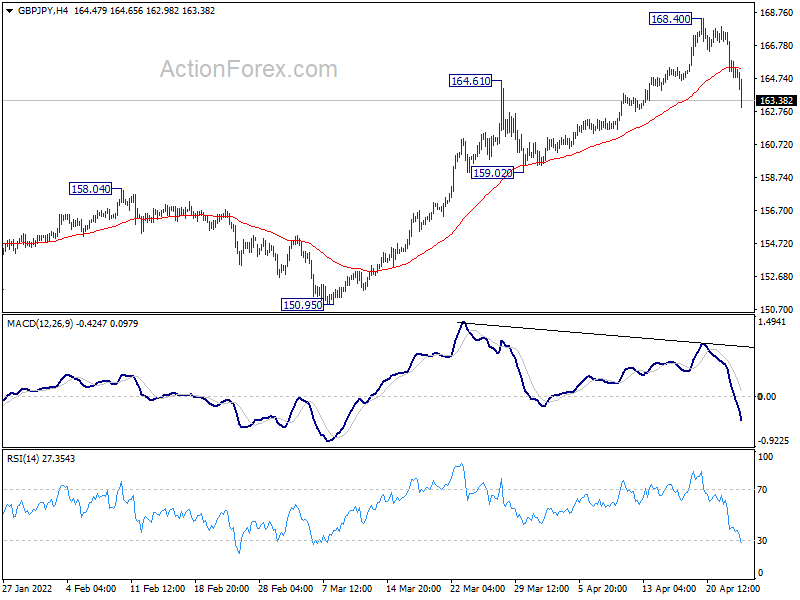
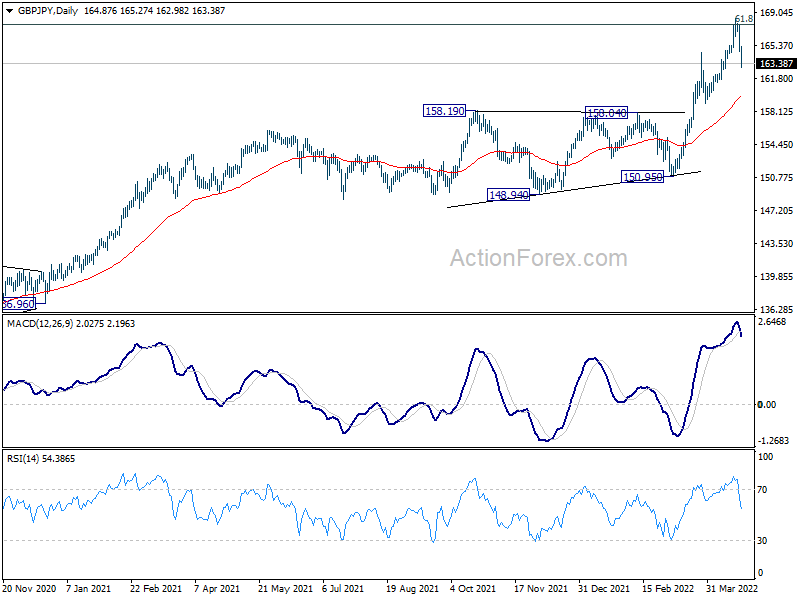
In the bigger picture, up trend from 123.94 (2020 low) is still in progress. Sustained break of 61.8% retracement of 195.86 (2015 high) to 122.75 (2016 low) at 167.93 will be a long term bullish signal, and could pave the way back to 195.86 high. This will now remain the favored case as long as 150.95 support holds, even in case of deep pull back.
EUR/JPY Daily Outlook
Daily Pivots: (S1) 138.24; (P) 138.87; (R1) 139.47; More....
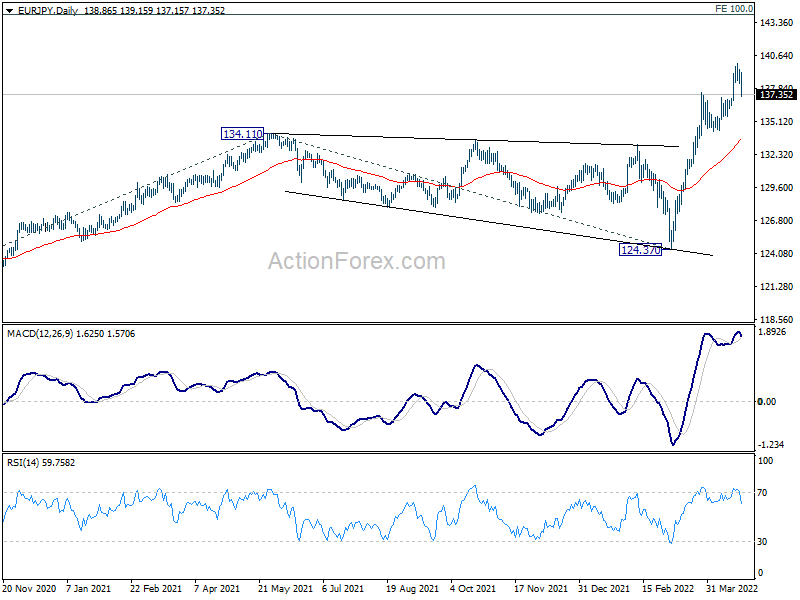
EUR/JPY's retreat from 139.99 continues today but stays well above 134.33 support. Intraday bias remains neutral for the moment, and outlook remains bullish too. On the upside, break of 139.99 will resume larger up trend to 144.06 projection level next. However, sustained break of 134.33 will dampen this bullish case and bring deeper pull back.
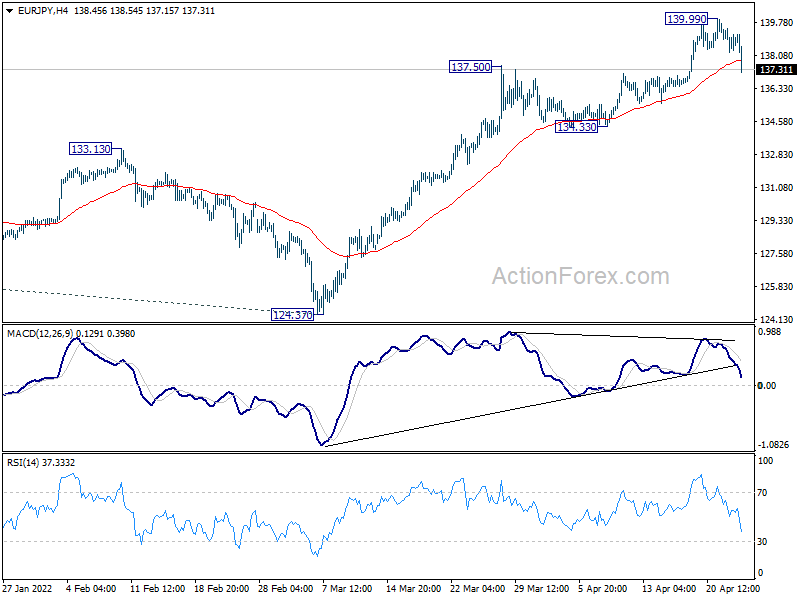
In the bigger picture, up trend from 114.42 (2020 low) is in progress. Such rise is seen as the third leg of the pattern from 109.30 (2016 low). Next target will be 100% projection of 114.42 to 134.11 from 124.37 at 144.06. In any case, outlook will now remain bullish as long as 124.37 support holds, in case of deep pull back.
EUR/GBP Daily Outlook
Daily Pivots: (S1) 0.8345; (P) 0.8381; (R1) 0.8449; More...
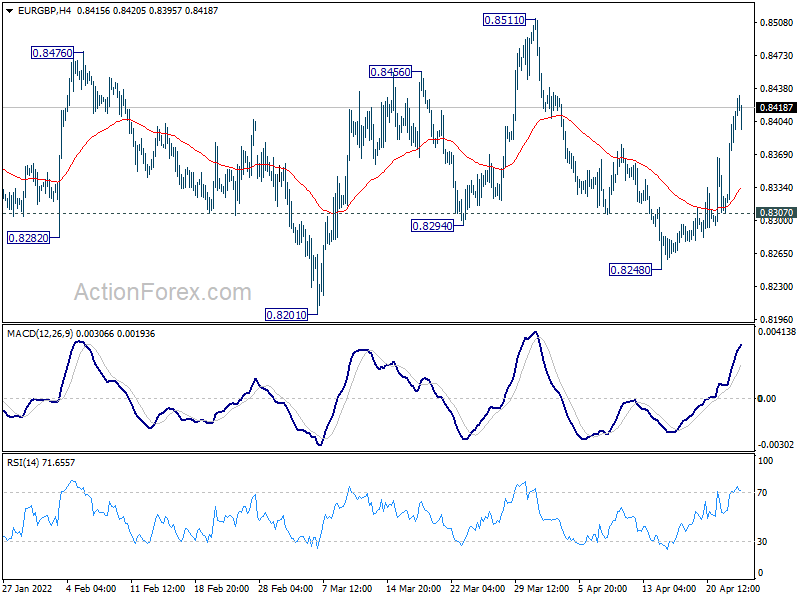
Intraday bias in EUR/GBP remains on the upside at this point. Further rally should be seen to 0.8511 resistance first. Further break of 0.8511 will reaffirm that 0.8201 is a medium term bottom, and target 0.8697 medium term fibonacci level next. On the downside, below 0.8307 will turn bias back to the downside for 0.8248 support instead.
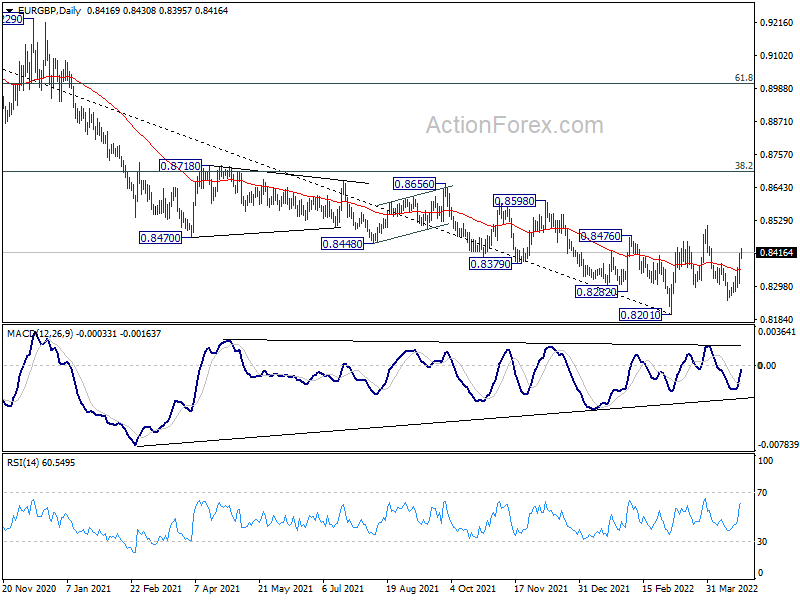
In the bigger picture, a medium term bottom could be in place at 0.8201, on bullish convergence condition in daily and weekly MACD. Rise from there could either be a correction to the down trend from 0.9499 (2020 high), or a medium term up trend itself. In either case, further rise should be seen to 38.2% retracement of 0.9499 to 0.8201 at 0.8697. Sustained break there will target 61.8% retracement at 0.9003.
EUR/AUD Daily Outlook
Daily Pivots: (S1) 1.4759; (P) 1.4837; (R1) 1.4990; More...
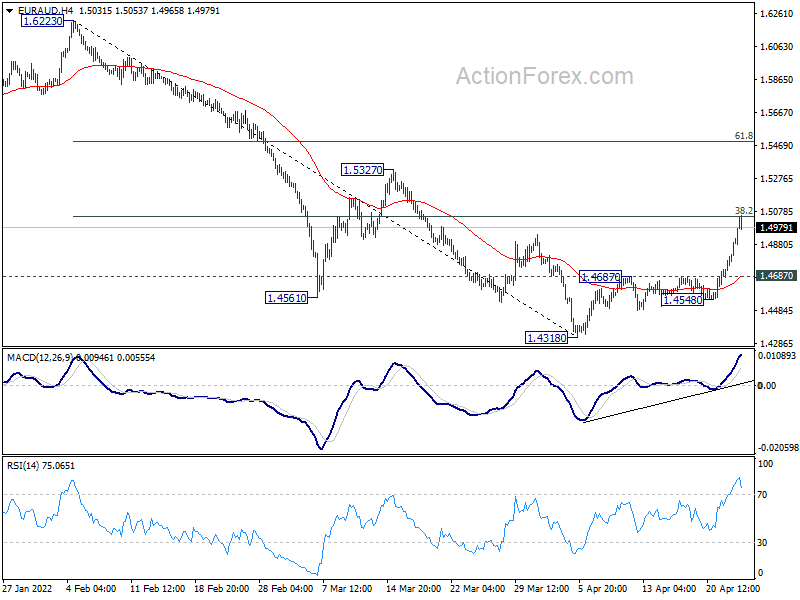
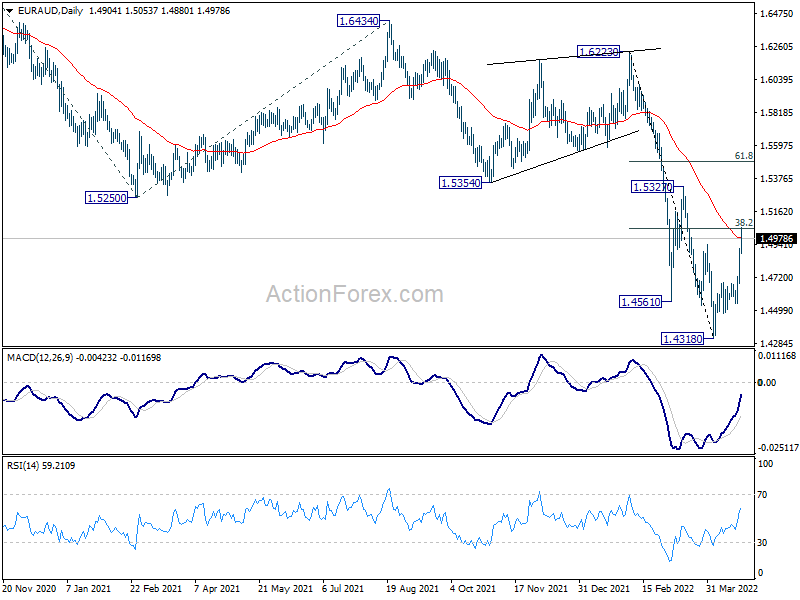
EUR/AUD's rally continues today and hit 38.2% retracement of 1.6223 to 1.4318 at 1.5046 already. Intraday bias stays on the upside for the moment. Sustained break of 1.5046 will target 61.8% retracement at 1.5495. On the downside, below 1.4687 minor support will turn bias back to the downside for retesting 1.4318 instead.
In the bigger picture, fall from 1.9799 is seen as a long term impulsive move. Next target is 61.8% projection of 1.9799 to 1.5250 from 1.6434 at 1.3623, which is close to 1.3624 long term support (2017 low). Some support could be seen there to bring interim rebound. But overall, break of 1.5354 support turned resistance is needed to be the first sign of medium term bottoming. Otherwise, outlook will stay bearish in case of recovery.
EUR/CHF Daily Outlook
Daily Pivots: (S1) 1.0311; (P) 1.0331; (R1) 1.0355; More....
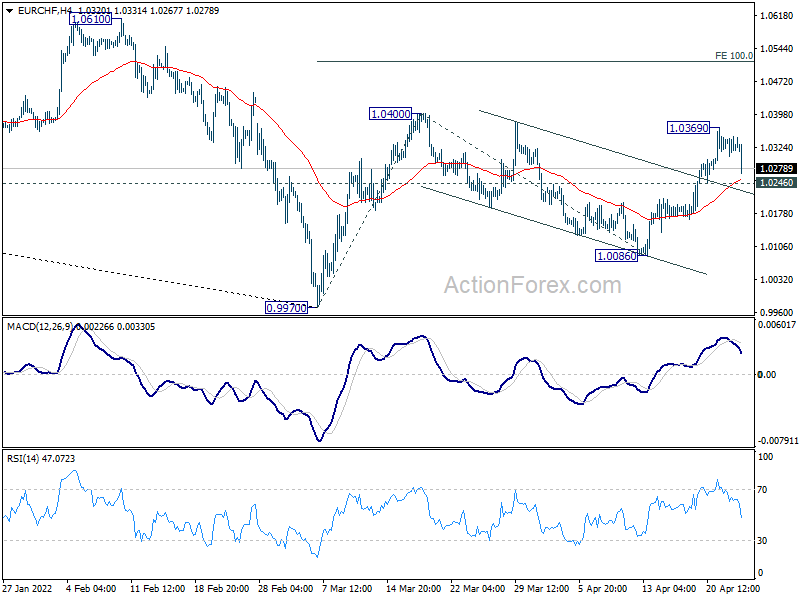
EUR/CHF drops notably today but stays above 1.0246 minor support. Intraday bias remains neutral first and further rise is still mildly in favor. On the upside, firm break of 1.0400 will resume the rally from 0.9970 to 100% projection of 0.9970 to 1.0400 from 1.0086 at 1.0516. On the downside, break of 1.0246 minor support will dampen this bullish view and turn bias back to the downside for 1.0086 support instead.
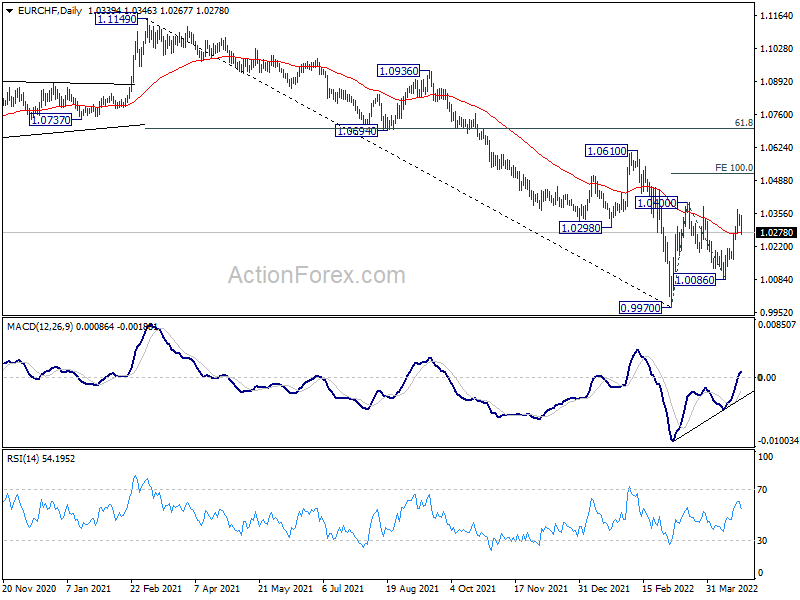
In the bigger picture, long term down trend from 1.2004 (2018 high) is still in progress. Next target is 100% projection of 1.2004 to 1.0505 to 1.1149 at 0.9650. In any case, sustained break of 1.0505 support turned resistance (2020 low) is needed to be the first sign of medium term bottoming. Otherwise, outlook will remain bearish.
Risk Aversion Remains name of the Game as China’s Worsening Covid-Situation
Markets
The second half of last week was marked by a hawkish market repositioning with regard to the timing and the number of future ECB rate hikes. Several ECB governors broke ranks with President Lagarde’s official communication following the April policy meeting. Lagarde supposedly asked them to wait at least a week before doing so. The governors all named the July meeting, our favorite, as potential lift-off date.
The 3-month Euribor forward curve bear steepened between now and end 2023 with yields rising 25 bps from the Sep2022 contract onwards. A 15 bps July rate hike is now discounted. Dec2022 and Dec2023 contracts trade at 0.6% and at 1.76% respectively. The money market is thus shifting towards consecutive policy rate hikes at every meeting in H2 2022 (#4) with the expected policy rate peak evolving towards 2%.
The German yield curve extended its bear flattening move with yield changes ranging between flat (30-yr) and +8.8 bps (2-yr). The German 10-yr yield set a new recovery high at 0.98% and closes in on resistance at 1.06% (2015 top). Interestingly, during the second half of last week the German 10y real yield added 15 bps (approaching -2% again) while inflation expectations declined by 5 bps (steadying just above 3%). Speeches by ECB governors continue to serve as wildcards for trading this week.
EUR/USD failed to profit from these developments as US markets repositioned in a hawkish fashion as well – contrary to the EU with the blessing of Fed Chair Powell. The fierce bond sell-off spilled into correcting stock markets (-2.5% in Europe and the US) and handed the greenback the benefit of the haven asset.
The trade-weighted dollar finally set a new recovery top above 101. EUR/USD slid back below the 1.08-handle. Sterling was Friday’s underperformer amongst G4 FX with risk aversion and dismal UK eco data hurting GBP. EUR/GBP gained a big figure from 0.8316 to 0.8411. Risk aversion remains name of the game this morning as China’s worsening Covid-situation takes the shine off French President Macron’s presidential re-election. China now locked down some areas of Beijing sparking additional growth worries. The Chinese yuan extends a catastrophic run which started after last week’s disappointing Q1 growth data. USD/CNY surged from 6.37 to 6.55 since. It’s the weakest level for the yuan in almost a year. The 2021 USD/CNY high stands at 6.58. The dollar remains in pole position in general in Asian dealings. Core bonds correct higher. Commodity prices cede around 2% with iron ore (-8.5%) underperforming.
oday’s eco calendar is uninspiring with German Ifo business sentiment and Belgian business confidence the highlights. The Belgian debt agency aims to raise €2.8-3.8bn via its regular monthly OLO auction. OLO’s 81 (0.8% Jun2027), 94 (0.35% Jun2032) and 95 (1.4% Jun2053) are on offer. The Q4 earnings season gets in full swing after a weak start. Other highlights include US consumer confidence (tomorrow), Q1 GDP data (Thursday), PCE deflators and EMU April CPI numbers (Friday).
News Headline
Parliamentary elections in Slovenia turned out in a surprisingly strong victory for newcomer Robert Golob and his Freedom Movement. Winning about 34% of the votes, he defeated the Democratic Party of nationalist Janez Jansa (24%). Jansa became prime minister for a third time in 2020 but his tenure was tainted by two years of weekly protests. His position after Sunday’s elections now hangs in the balance. Golob is expected to form a government with one or both of the smaller parties, the Social Democrats and the Left. Germany will borrow an additional €40bn this year to soften the blow coming from the war and soaring energy prices on companies and consumers. Total new debt for 2022 will thus amount to almost €140bn. But taking into account the off-budget fund worth €100bn to finance military spending in the next few years, overall new borrowing will most likely exceed that €140bn. Borrowing in 2023, when the debt brake is scheduled to be in place again, should tank to less than €10bn. The Bundesbank last week proposed to raise annual borrowing limits under those debt brake rules saying it would “continue to ensure solid state finances and the requirements would be consistent with European fiscal rules”.