Sample Category Title
First Move in RBA’s Tightening Cycle Now Likely to be 40 Basis Points in June
Following an expected substantial lift in underlying inflation for the March quarter and a fall in the unemployment rate from 4% to 3.8% in April we expect the RBA will decide to lift the cash rate by 40 basis points at its Board meeting on June7.
Inflation and the Labour Market
Yesterday we released our forecast for the March quarter Consumer Price Index. This Report is due to print on April 27.
We have lifted our forecast for underlying inflation in the quarter from 0.9% to 1.2%.
At 1.2% the annual rate will be 3.4%. That represents an increase in the annual rate from 2.6% in the December quarter and from 2.1% in the September quarter.
An increase in the annual rate of 0.8 ppt's over one quarter and 1.3 ppt's over two quarters is matched only by 2007/08 in recent times.
In 2007, annual underlying inflation increased from 2.8% in the June quarter and 2.9% in the September quarter to 3.6% in the December quarter (and 4.2% in the March quarter).
Following the news on the December quarter inflation the RBA responded with 25 basis point rate hikes in both February and March 2008 bringing the rate to 7.25% (significantly above neutral).
That was despite it being quite clear to markets that the world was on the brink of a major financial crisis, (later in 2008 and early 2009 the RBA was obliged to cut the cash rate back to 3% from 7.25%).
This episode just emphasises the sensitivity of the RBA to large movements in underlying inflation.
It is now generally accepted that the RBA will begin the tightening cycle on June 7.
Because the current cash rate is an unusual 10 basis points we had expected that the first move would be 15 basis points to restore the cash rate to 25 basis points.
However, given our expectations of a rapid further increase in underlying inflation and a forecast fall in the unemployment rate for April (to print on May 19) to a 48 year low of 3.8% we expect the Board will decide on a bolder initial lift in the cash rate.
We accept that there is a risk that the Board would be concerned about such a large move at the beginning of the cycle with implications for Confidence.
A possibility might be for a more cautious 25 basis point lift in June to be followed by the 40 basis point move in July.
However, we anticipate that market and media expectations will shift towards a 40 basis point move over the next six weeks and the anticipated shock to confidence will be contained.
This decision will be in the context of the Federal Reserve Open Market Committee (FOMC) having lifted the federal funds rate by 50 basis points on May 4 and the certain prospect of a further 50 basis point increase at the June FOMC meeting which is scheduled for the week after the RBA's June Board meeting.
Both the Bank of Canada (April 13) and the Reserve Bank of New Zealand (April 13) have recently opted for 50 basis point increases in their policy rates.
The April Board Minutes
On April 12 the minutes of the Reserve Bank Board meeting for April noted" Central banks in many advanced economies, including the United States, had responded to higher inflation by increasing interest rates from their historically low levels and had signalled that further increases were likely."
This quote was significant because it figured at the beginning of the key section in the minutes "Considerations for monetary policy".
In the minutes of earlier meetings this key "considerations" section only covered issues around the Australian economy. As noted in his speeches, in the last few years the Governor saw Australia's position as being quite different to other developed economies.
Including reference to the actions of other central banks in such a prominent position in the minutes indicates the Board is now taking a more global approach in responding to Australia's surging inflation rate.
Market Pricing
Markets are currently priced for the cash rate to reach around 40–45 basis points by the June meeting.
At present that is made up of around 10 basis points at the May meeting and a further 30 points at the June meeting.
Our "golden rule" for tracking central banks is that their guidance beyond three months is dependent on their forecasts. If you have a different set of forecasts to the central bank then when your forecasts prove to be correct the central bank will have to respond in a way that will be consistent with the conditions and contrary to their current guidance.
It was that thinking that prompted us to be "very early leavers" from the "no hike till 2024 "Club in June last year; and the "no hike till 2023" Club in January this year.
But when the Bank is giving very near-term guidance then we listen intently.
The minutes noted that "Over coming months, important additional evidence will be available on both inflation and labour costs". The labour cost information will be available on May 18 (Wage Price Index) and May 19 (April Employment Report).
That guidance is sufficient for us to accept that the RBA will wait until June for the first move.
At the May 3 meeting we expect the Board will adopt a clear tightening bias in anticipation of a move in June.
That should be sufficient to encourage the market to maintain its expectation that, despite steady policy in May, the cash rate will reach 40–50 basis points at the June meeting.
Our research shows that the RBA is influenced by market pricing near the time of a Board meeting. If the market persists with a 40 basis point expectation it is unlikely that the Board would persist with a 15 basis points move.
The Profile of the full Cycle-Terminal Rate is Unchanged at 2% We expect that the RBA will "bring forward" the tightening to accelerate the unwinding of the emergency cuts in 2020 (65 basis points) given that the emergency has passed; inflation is rising rapidly and the unemployment rate has reached 48 year lows. We do not envisage a higher terminal rate in the cycle.
That stays at 2% and is still timed for mid-2023 (May rather than June).
It is interesting that, at this stage, the RBA may have a similar target in mind. In the April Financial Stability Review a centre piece of the Review was a scenario analysis of the sensitivity of household balance sheets to a 200 basis point lift in the variable mortgage rate.
Under our previous scenario of a 15 basis point lift in June we expected 25 basis point increases to follow in July and August, with a pause in September to be followed by two more increases of 25 basis points in both October and November. With the exception of the larger increase in June the rest of the profile remains in place with the rate by November reaching 1.5% rather than 1.25%.
The expected pause in December also remains with two 25 basis point hikes in February and May.
Compared to the previous profile the cash rate reaches 1.5% by year's end, up from 1.25%, while there are only two increases of 25 basis points in February and May compared to the three increases in the previous profile.
How dependent is this profile on the Inflation Report?
We always endeavour to provide readers with internally consistent forecasts.
The lift in the inflation forecast is consistent with a more decisive response from the RBA.
Recognition in the minutes of the actions of other central banks also had an impact on this change of view.
As discussed above, the Bank might respond with a 25 basis point move in June to be followed by a 40 basis point move in July.
That strategy is a genuine possibility but does not represent the better policy option.
USD/JPY Uptrend Intact Despite Overbought Readings
Key Highlights
- USD/JPY rallied further above 128.00 and traded to a new multi-year high.
- A crucial bullish trend line is in place with support near 127.75 on the 4-hours chart.
- EUR/USD failed to surpass 1.0920, and GBP/USD struggled below 1.3100.
- Gold price might correct lower towards $1,920.
USD/JPY Technical Analysis
The US Dollar remained in a strong uptrend above 125.00 against the Canadian Dollar. USD/JPY traded to a new 20-year high and even climbed above 128.50.
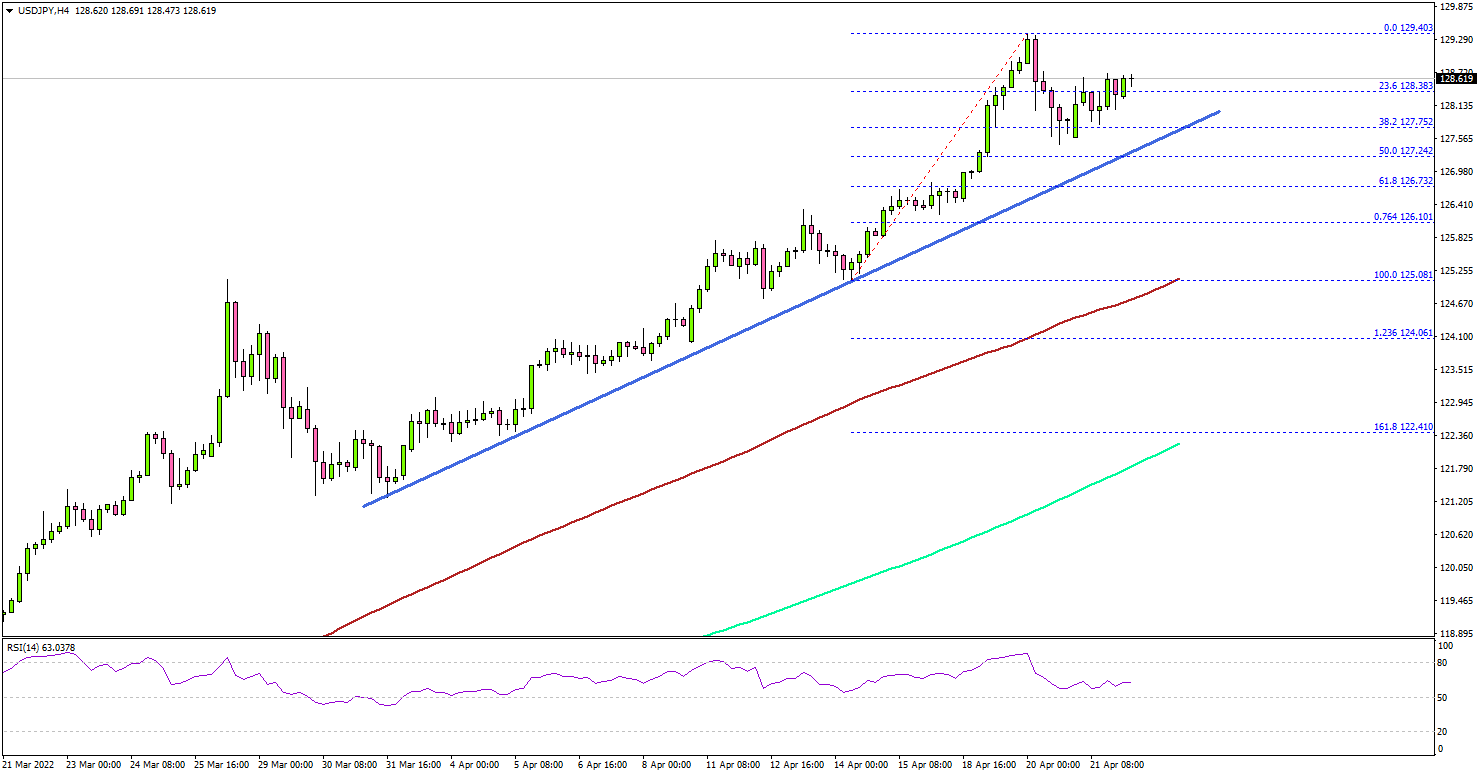
Looking at the 4-hours chart, the pair settled above the 128.00 level, the 200 simple moving average (green, 4-hours), and the 100 simple moving average (red, 4-hours).
A high was formed near 129.40 before there was a downside correction. The pair declined below the 128.00 level. However, the bulls were active near the 127.50 level. There is also a crucial bullish trend line in place with support near 127.75 on the same chart.
The pair is now rising and might climb above 128.80. The next major resistance is seen near the 129.40 level, above which the pair could rise towards 130.00.
If there is a downside correction, the USD/JPY pair might test the trend line or 127.60. The next major support is near the 127.20 level. Any more losses may perhaps open the doors for a move towards the 126.00 level.
Looking at EUR/USD, the pair attempted an upside break above the 1.0900 and 1.0920 resistance levels, but failed to gain pace. Similarly, GBP/USD failed to clear the 1.3080 and 1.3100 resistance levels.
Economic Releases
- UK Retail Sales for March 2022 (YoY) - Forecast +2.8%, versus +7% previous.
- UK Retail Sales for March 2022 (MoM) - Forecast -0.3%, versus -0.3% previous.
Silver Wave Analysis
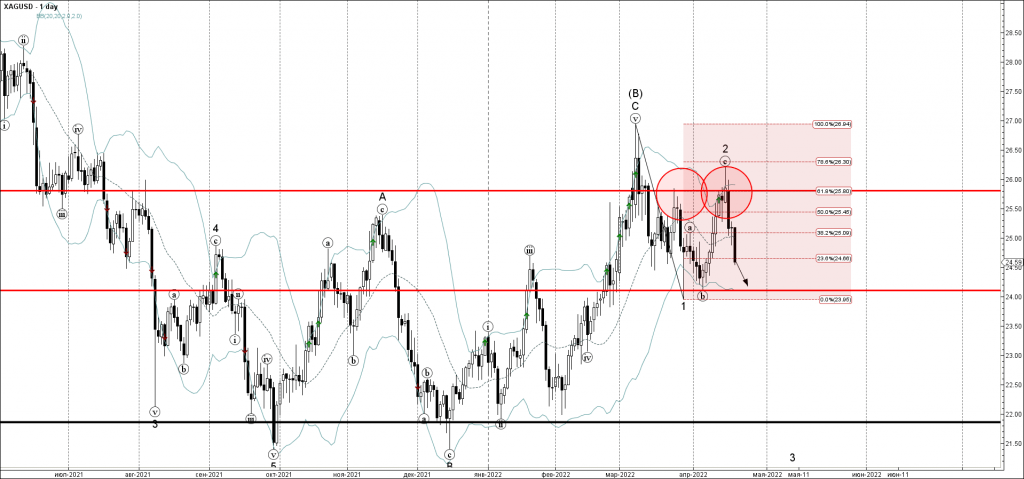
- Silver falling minor impulse wave 3
- Likely to reach support level 24.10
Silver continues to fall inside the minor impulse wave 3, which started earlier from the resistance level 25.8 (previous reversal high from March) – strengthened by the upper daily Bollinger Band.
The active impulse wave 3 belongs to the higher-order impulse wave (C) from the start of last month.
Silver can be expected to fall further toward the next support level 24.10 (which stopped the previous waves 1 and (b)).
Eco Data 4/22/22
[php_everywhere instance="1"]
It Will Take More than Words to Lift EUR/USD
Forex traders have suddenly become woke to the possibility of an end to ECB QE and interest rate hikes this year. As a result, EUR/USD, after two consecutive weeks of declines, has found a bit of support as traders return from their Easter break this week. Considering that market participants glossed over more hawkish tones from last week’s April ECB meeting, this recent positive shift in sentiment toward EUR/USD looks abrupt and possibly only temporary.
Prior to today’s ECB speakers talking up the prospects of a quick end to asset purchases and interest rate hikes by year end, traders had not fully bought into such an assessment. The ECB must not only contend with high inflation, but also war in the Ukraine, signs of slowing activity in the euro area. Add in aggressive Fed hiking expectations and there are certainly enough reasons to still dissuade big EUR/USD long positions.
The bigger picture technical setup adds to the apprehension that the recent move in EUR/USD marks the begging of a reversal in the currency pair’s fortunes. Last week, the EUR/USD slipped below a symmetrical triangle pattern that has been long in the making. This week’s retest of the pattern, with support now turned resistance, isn’t out of character for the forex market. Likewise, a rising wedge pattern sits behind the last leg lower in EUR/USD, which points to downside continuation.
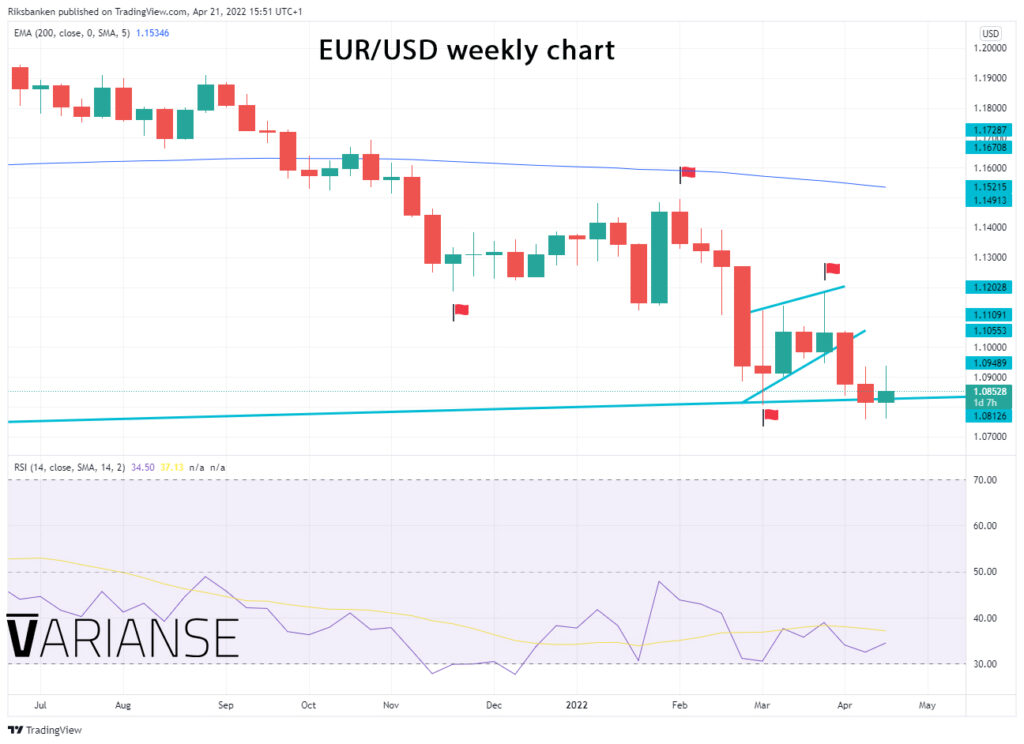
That said, these are undeniably testing times for the EUR/USD. Should EUR/USD resist dipping lower from recent levels, there is a possibility for the currency to stabilise at higher levels. A break above the 1.11849 last swing high, for instance, would be the first step in attracting EUR/USD buyers. Getting to that state, however, will most likely take more than just words from the ECB given the current market setup.
Sunset Market Commentary
Markets
Kazaks from Latvia and Nagel from Germany yesterday, Wunsch (Belgium) and de Guindos (Spain) today. ECB hawks were sent to do the heavy lifting, ie prepare financial markets for imminent policy normalization. Before the European open, Wunsch said that policy rates could turn positive this year. ECB vice-governor de Guindos shortly after made the case for starting the upward rate cycle already in July. They both spoke in the conditional form (unless “really bad news”, “depending on the data”) but markets see right through this politically correct talk. The transcript of Lagarde’s speech at the IMF spring meetings tonight held a more balanced tone. The key takeaway though is that she sees further inflation pressure from supply bottlenecks. This implies an almost certain upgrade to the inflation outlook in the June forecasts. Certainly keep an eye at the panel discussion later tonight for some fireside comments as well as her keynote speech at the renowned Peterson Institute for International Economics tomorrow. German/European 2-y yields rise 9-12 bps, erasing in one day the minor correction lower of the past few days. The long end outperforms, adding less than 3 bps. A slightly weaker final EMU HICP outcome for March (headline 7.4% and core 2.9% instead of the preliminary 7.5% and 3%) only temporarily cut the upward intraday momentum short, thanks to an “unknown ECB source”. The source told financial media company Econostream that some policymakers including Holzmann will push for a 50 bps deposit rate hike accompanied by a 25 bps hike in the refinancing rate (now 0%) to narrow the corridor in one move. An ECB this bold would only fit the general central bank trend. US bond yields add 4.4-7 bps in a bear flattener. The euro benefited from increasingly concrete interest rate support. EUR/USD jumped beyond 1.09 but fell short of testing first intermediate resistance around 1.0954. The currency pair is currently trading in the high 1.08 area, up from 1.085. EUR/GBP extended gains beyond 0.83 but is off intraday highs. Bank of England’s Catherine Mann signaled more tightening is in the pipeline, citing evidence of inflation spreading to price strategies. UK Gilt yields surged more than 10 bps at the short end, shrugging off the idea of a cautious tightening to preserve fading economic growth. The BoE’s governor, Bailey, is due to speak later today. Low-yielding and safe haven currencies including the yen and Swiss franc face a double whammy having their aforementioned features playing out against them (stocks up 1.4% in Europe and 1.6% for the Nasdaq on WS). EUR/JPY tested 140 for the first time since 2015, EUR/CHF rose to well above 1.03(4).
News Headlines
Quite some Polish eco data were published today. Most data surprised on the upside and the global picture still gives a nihil obstat for the National bank of Poland to continue its tightening cycle. Consumer confidence improved slightly from -39.0 to -37.2, but stays near the post-corona-low. Indictors on current conditions remained very weak or even deteriorated further, but series measuring expectations for the 12 months ahead improved. Industrial output jumped a bigger than expected 18.2% M/M and 17.3% Y/Y, with all subsectors contributing to growth. March PPI inflation accelerated further to 4.9% M/M and 20.0% Y/Y (from 16.1% ), suggesting ongoing pipeline inflation. Labour market data were strong too. Employment rose 0.2% M/M and 2.4% Y/Y (from 2.2%). Average gross wages also beat market expectations rising 7.2% M/M and 12.4% Y/Y (from 11.7% Y/Y), an indication that inflationary pressures are further filtering through into the broader economy. The PLN 2-y swap rate rose 11 bps to 6.62%, with most of the move occurring after the data release. The zloty strengthened from a level of EUR/PLN 4.28+ to currently 4.2525, but most of this move already took place before the data release.
Belgian consumer confidence in April recovered somewhat after dropping sharply in March, rising from -16 to -14. Belgium consumers were less pessimistic on the economic situation and in their expectations regarding their personal financial situation even as it stays near an all-time low. Consumers also intend to save slightly more. On the negative side, consumers fear a further rise in unemployment over the next 12 months.
BoE Mann: Monetary policy needs to keep inflation expectations anchored
BoE MPC member Catherine Mann said in a speech that the key topics for her for the May meeting was on "how much and when the expected consumption drag (from high energy inflation) materialises". And, "whether we start to see any indication of price forecast revisions in the DMP survey".
"If they do, this potentially would short-circuit the expectations-formation process underpinning the domestic inflation ratchet, which has been my central concern", she added.
However, "should the impact on aggregate demand of the energy price shock end-up being more modest than currently foreseen, should wage and price expectations and outcomes remain as strong as they currently are, and should financial markets return to being copacetic on private credit and duration risk, a reassessment of the pace of tightening would be warranted.
"Monetary policy needs to keep inflation expectations anchored; by doing so now, less tightening will be required later, when demand may still be weak", she added.
USD/JPY Mid-Day Outlook
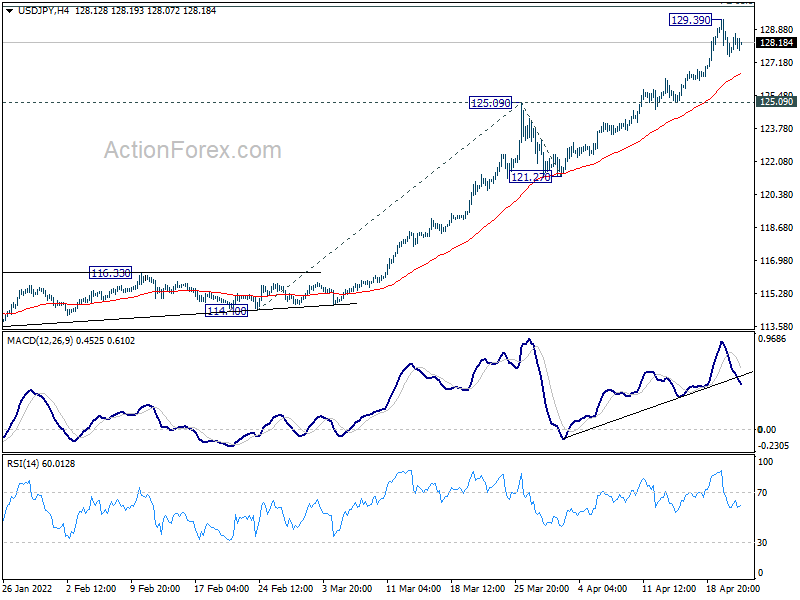
Daily Pivots: (S1) 127.09; (P) 128.24; (R1) 129.03; More...
USD/JPY is staying in consolidation from 129.39 and intraday bias remains neutral first. Deeper retreat cannot be ruled out but downside should be contained above 125.09 resistance turned support to bring another rally. On the upside, above 129.39 will resume larger up trend to 130.04 long term projection level next.
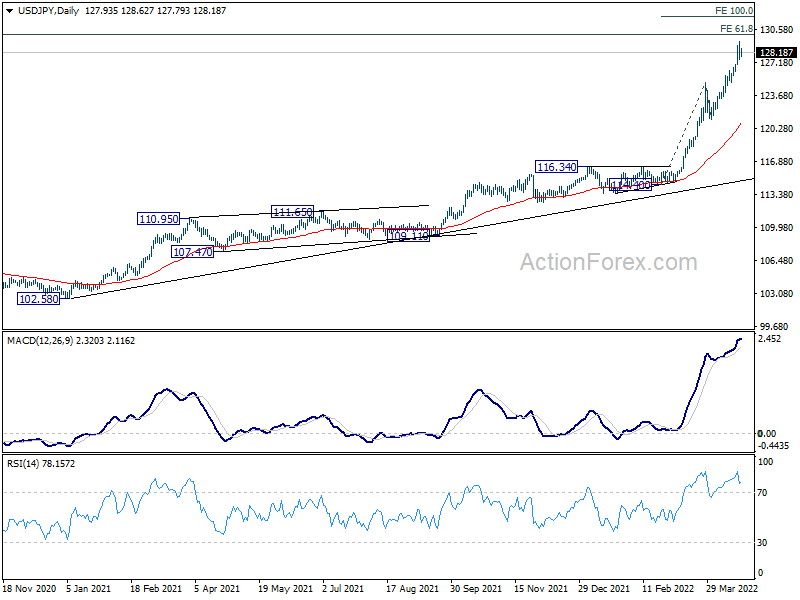
In the bigger picture, the break of 125.85 resistance (2015 high) suggests that whole up trend from 75.56 (2011 low) is resuming. Further rise should be seen to 61.8% projection of 75.56 (2011 low) to 125.85 (2015 high) from 98.97 at 130.04. Sustained break there wave the way to 147.68 (1998 high). For now, this will remain the favored case as long as 121.27 support holds.
USD/CHF Mid-Day Outlook
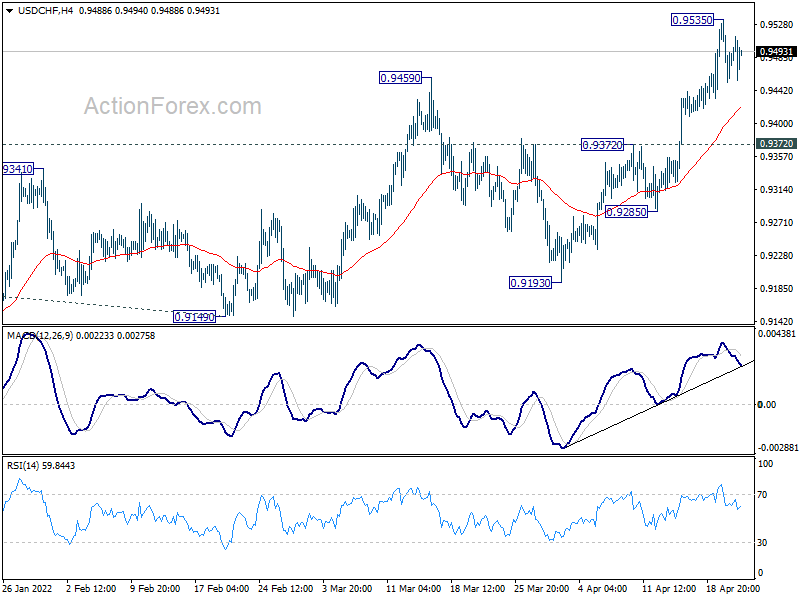
Daily Pivots: (S1) 0.9447; (P) 0.9492; (R1) 0.9528; More....
USD/CHF is staying in consolidation from 0.9535 and intraday bias remains neutral. Deeper retreat could be seen but downside should be contained by 0.9372 resistance turned support to bring another rally. On the upside, above 0.9535 will turn bias back to the upside and target 0.9591 medium term projection level.
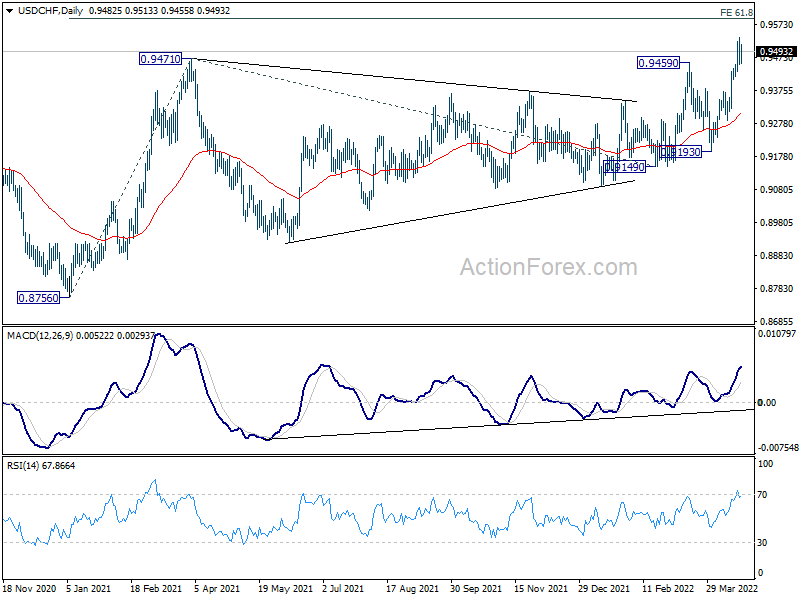
In the bigger picture, down trend from 1.0342 (2016 high) could have completed with three waves down to 0.8756 (2021 low) already. Rise from 0.8756 is likely a medium term up trend of its own. Next target is 61.8% projection of 0.8756 to 0.9471 from 0.9149 at 0.9591. Sustained break there will pave the way to 100% projection at 0.9864. This will now remain the favored case as long as 0.9149 support holds.
GBP/USD Mid-Day Outlook
Daily Pivots: (S1) 1.3017; (P) 1.3044; (R1) 1.3096; More...
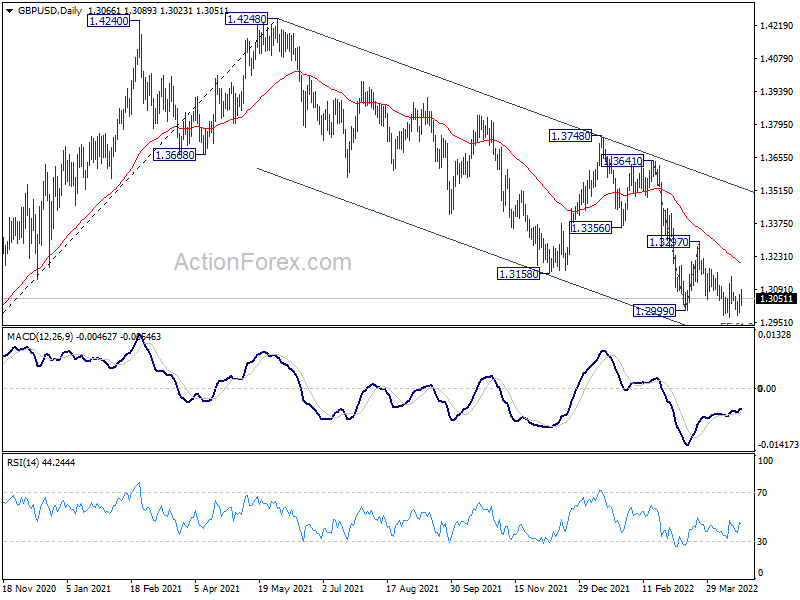
Intraday bias in GBP/USD remains neutral as consolidation from 1.2971 is still extending. Outlook is unchanged that further fall is expected with 1.3165 resistance intact. On the downside, break of 1.2971 will resume larger down trend from 1.4248. Next target is 61.8% projection of 1.3641 to 1.2999 from 1.3297 at 1.2900. On the upside, firm break of 1.3165 will confirm short term bottoming, and turn bias back to the upside for 1.3297 resistance and above.
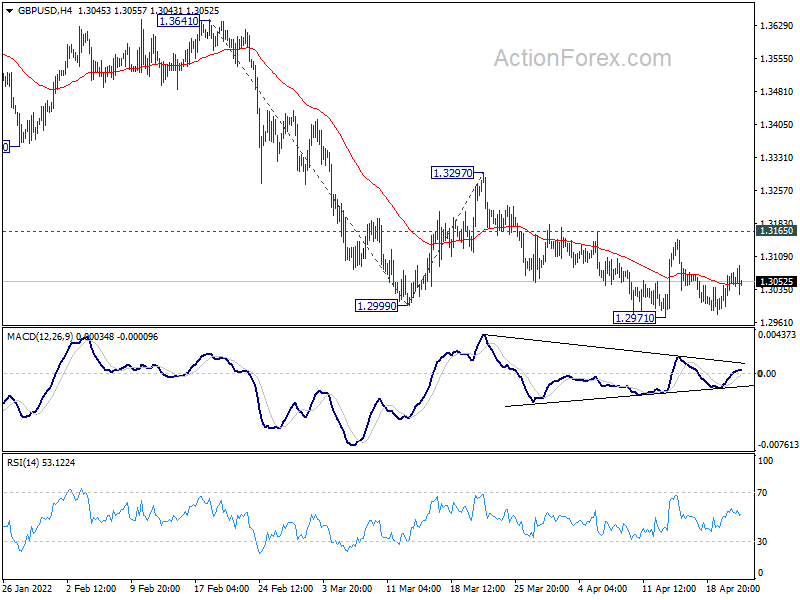
In the bigger picture, rise from 1.1409 (2020 low) has completed at 1.4248. Decline from 1.4248 could still be a corrective move, or it could be the start of a long term down trend. In either case, deeper decline would be seen back to 61.8% retracement of 2.1161 to 1.1409 at 1.2493. In any case, break of 1.3748 resistance is needed confirm completion of the fall from 1.4248, or outlook will stay bearish.