Sample Category Title
Eurozone CPI finalized at 7.4% yoy in Mar, EU at 7.8% yoy
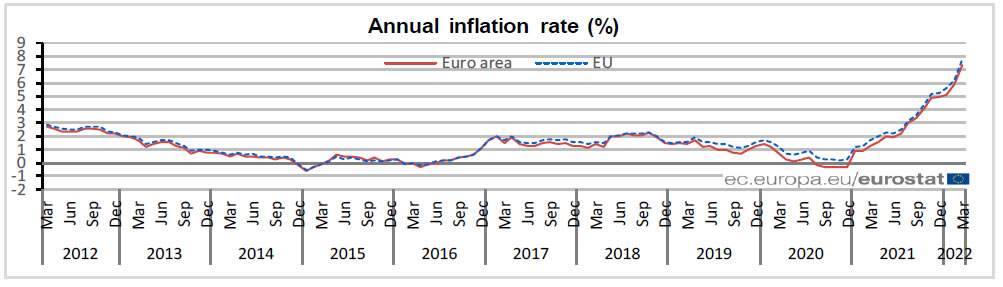
Eurozone CPI was finalized at 7.4% yoy in March, up from February's 5.9% yoy. The highest contribution to the annual euro area inflation rate came from energy (+4.36%), followed by services (+1.12%), food, alcohol & tobacco (+1.07%) and non-energy industrial goods (+0.90%).
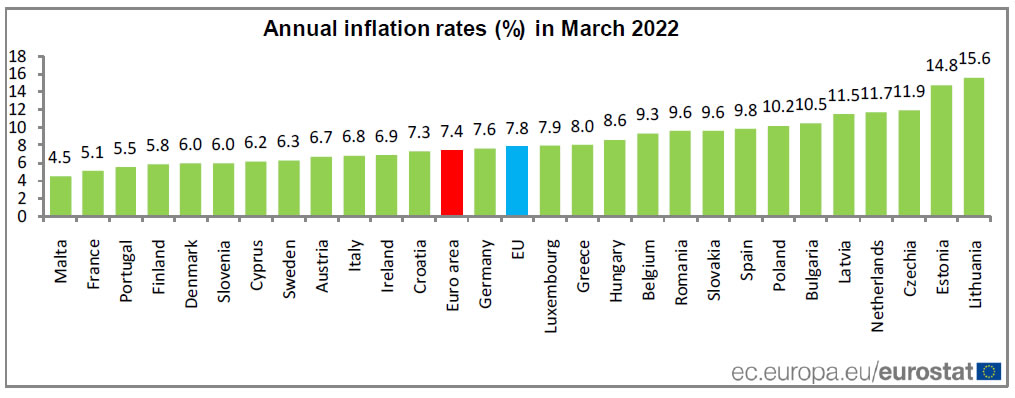
EU CPI was finalized at 7.8% yoy, up from February's 6.2% yoy. The lowest annual rates were registered in Malta (4.5%), France (5.1%) and Portugal (5.5%). The highest annual rates were recorded in Lithuania (15.6%), Estonia (14.8%) and Czechia (11.9%). Compared with February, annual inflation fell in two Member States and rose in twenty-five.
EURUSD: Recovery Looks for More Positive Signals on Break of Pivotal Barrier
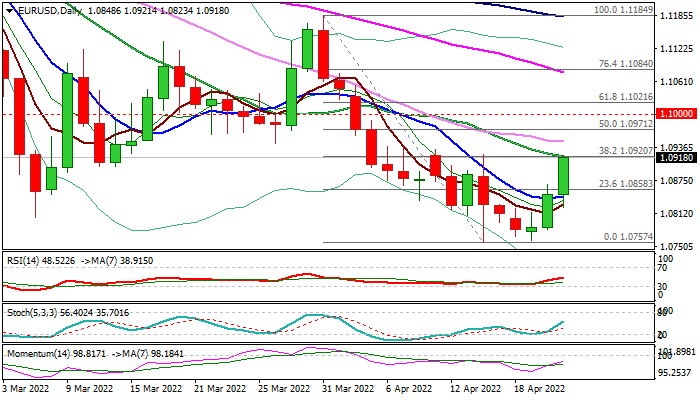
Recovery from new two-year low extends into third straight day and pressuring pivotal Fibo barrier at 1.0920 (38.2% of 1.1184/1.0757 bear-leg, reinforced by 20DMA).
Wednesday’s close above 10DMA (1.0845) generated initial bullish signal which looks for confirmation on clear break of 1.0920 that would open way for test of key obstacles at 1.0971/1.1000 (50% retracement / psychological).
Daily techs show14-d momentum heading north but still deeply in negative territory, while MA’s are in mixed setup, lacking clear direction signal.
Traders look for more signals from EU inflation data, which is expected to rise to a record high in March and speeches from the heads of ECB, Fed and BoE, due later today.
Res: 1.0931; 1.0948; 1.0971; 1.1000
Sup: 1.0867; 1.0845; 1.0806; 1.0757
ECB de Guindos: July is possible for first hike
ECB Vice President Luis de Guindos said in an interview, the consequences of invasion of Ukraine are "quite clear", as higher inflation and lower growth. That should be reflected in in June outlook.
He sees "no reason why we should not discontinue our APP programme in July". But the timing for the first rate hike will depend on the economic projections. "Nothing has been decided so far," he said.
"From today's perspective, July is possible and September, or later, is also possible. We will look at the data and only then decide," he added. Then, the rate hike cycle will "depend on the data" and the "evolution of inflation.
ECB Wunsch: July rate hike is a scenario to consider
ECB Governing Council member Pierre Wunsch said, "without any really bad news coming from that front, hiking by the end of this year to zero or slightly positive territory for me would be a no brainer."
Also, Wunsch doesn't rule out ending the asset purchases in June, and raise interest rate in July. "It's going to of course depend on data," he said. "If we have another inflation surprise, it's certainly a scenario that I would consider."
"There are of course situations where if the shock is very big on the real economy, we would feel more comfortable looking through the inflation development," he said. But "we're still in a situation where we're supportive in terms of monetary policy. Real rates are today very, very negative. So the beginning of the normalization process should be relatively independent of the real economy."
"We're still talking about normalization, but I wouldn't exclude that at some point, if we have second-round effects, wages going up, that monetary policy would have to become restrictive," he said. "What's priced in by the markets today to me is on the low side of what might be required to get inflation under control."
GBPJPY Hangs Near 6-Year Highs; Are the Bulls Done?
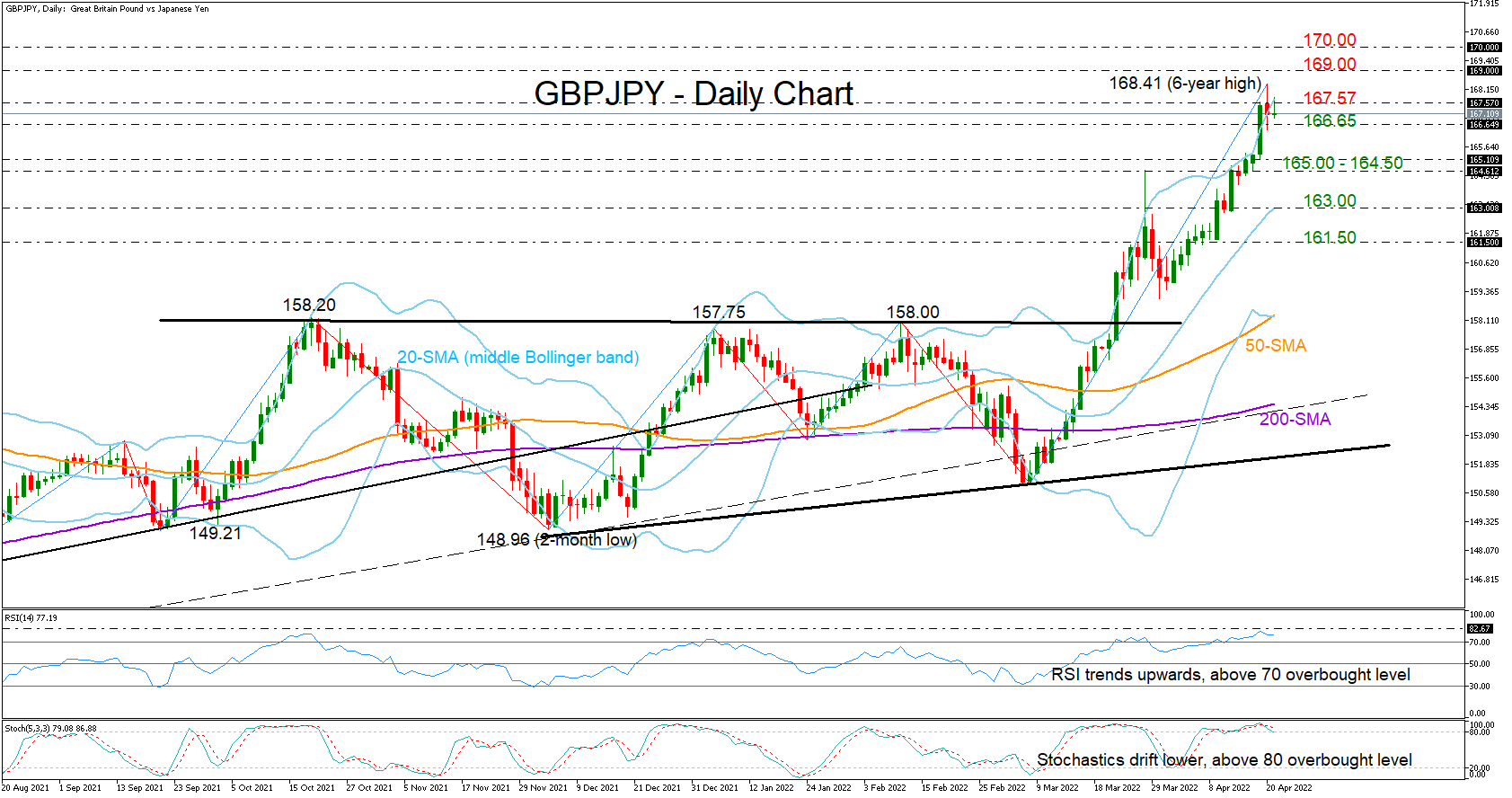
GBPJPY eased off after its exciting rally paused at a new six-year high of 168.41 on Wednesday, but the price continued to trade around its recent highs early on Thursday, feeding optimism that the bull run has not peaked yet.
From a technical perspective, a downside correction could be nearing as the price has already completed two daily sessions above the upper Bollinger band, while the RSI and the Stochastics have been hovering above their overbought levels for almost two weeks now. Yet, with the RSI currently preserving a clear uptrend above 70 and the latter holding above 80 despite its latest pullback, there is hope for another bullish breakout before a new bearish phase starts.
The question now is how far the price could fly if the bulls find the required momentum to close above 167.57. Well, if that turns out to be the case, traders may initially target the 169.00 level, which is the 261.8% Fibonacci extension of the 158.00 – 150.96 downleg, and then the psychological mark of 170.00. Should buyers appear even more energetic, the next obstacle could be the 175.00 number, which had been a key barrier to upside and downside movements during the 2013 – 2016 period.
On the downside, a break below 166.65, where the supportive 20-period simple moving average (SMA) is positioned in the four-hour chart, could activate firmer selling pressures towards 165.00 – 164.50 area. Lower, the middle Bollinger band at 163.00 may cancel any deceleration to 161.50.
Overall, GBPJPY looks to be in a cautiously bullish situation, where a step above 167.57 could add more fuel to the rally, whereas a slide below 166.65 could generate additional losses.
The Greenback Lost Against All Major Peers
Markets
Economic data during yesterday’s trading day was limited to US housing data (see below). The Fed’s Beige Book held all the anecdotical evidence one could have expected: a tight labour market and strong inflationary pressures. Districts saw the economy still growing at a moderate pace but mentioned that geopolitics were clouding the outlook.
Turning to markets, European stocks had a good run. The EuroStoxx50 rose 1.7%. Wall Street ended mixed with the Nasdaq underperforming (-1.22%) on some individual slip-ups (Netflix, woops). Core bonds corrected higher after a rocky session on Tuesday. US Treasuries outperformed in a bull flattening move. Yields slid 1.6 bps in the 2y to 12.9 bps in the 20y tenor with bonds in the latter bucket profiting from a very strong auction. The $16bn reopening was awarded at 3.095% compared to a 3.125% WI yield. Indirect bidders’ share jumped to 75.9%, highlighting very high (foreign) demand. Bid-to-cover was a record 2.80.
European swap yields eased between 7 and 9 bps in the 10-30y segment. Declines at the front-end stayed limited to 2-3 bps and were even less intraday after ECB’s Kazaks and especially German heavyweight Nagel both suggested a rate hike is possible as soon as July. Their comments supported EUR/USD (finished at 1.085, up from 1.078) to some extent, but the bulk of the move came on the account of the dollar.
The greenback lost against all major peers, including the ailing Japanese yen. USD/JPY snapped a 13-day winning streak to close at 127.86, down from 128.91. Cable (GBP/USD) rebounded from the 1.30 support area to 1.3068. The euro did keep the upper hand against sterling, rising back above 0.83 but without strong conviction. Among the smaller currencies, the Canadian loonie and Swedish krone stand out. Both gained as higher-than-expected inflation in Canada paved the way for more double-sized hikes by the BoC while Riksbank governor Inges turning the April meeting into a live one. Asian dealings are pretty quiet. Stock markets trade mixed with Japan (+1.3%) and China (-2%) marking both ends of the spectrum. Core bond yields already recoup some of yesterday’s losses. The US adds 4-5 bps.
On currency markets, the Japanese yen and Swiss frank trade on the back foot. Japan’s Finance Minister Suzuki’s verbal interventions, including those this morning, have less effect by the day.
EUR/USD rebounded intraday to trade near yesterday’s closing levels after Belgian ECB governor Wunsch joined the hawkish parade led by Nagel and Kazaks. He said policy rates could turn positive this year. The kiwi dollar trades a tad lower after inflation rose but by less than expected (see below).
The eco calendar contains US weekly jobless claims and European consumser confidence (April). However, after the recent string of hawkish ECB speeches, we’re very keen to what president Lagarde has to say. Together with Fed chair Powell she takes part in an IMF panel on the global economy tonight. Tomorrow she’ll give a keynote speech at the Peterson Institute for International Economics (PIIE) where she will undoubtedly dive into monetary policy. A clear and concrete hint towards a more rapid normalization will definitely be noticed, both by rates and the euro. EUR/USD returning above 1.0954 would ease some of the immediate downward pressure but the first high-profile reference is located at 1.1121.
Also keep an eye at sterling today. The PIIE also invited Bank of England governor Bailey to touch upon economic and monetary policy tonight. Will he still hold the line of a cautious normalization approach with inflation having run at a consensus-beating 7% in March?
News Headlines
Inflation in New-Zealand in the first quarter accelerated to 1.8% Q/Q and 6.9% Y/Y (was 1.4% Q/Q and 5.9% Y/Y in Q4 2021), reaching the highest level since the second quarter of 1990. The RBNZ aims to keep inflation within a 1.0%-3.0% target range. Inflation excluding food, fuel and energy prices rose 5.9% Y/Y from 5.4%. Even as inflation was visible in a broad range of product groups, the Y/Y measure was slightly below market expectations for a 7.0%+ figure (headline). Last week, the RBNZ frontloaded policy tightening, raising its policy rate by bigger than expected 50 bps to 1.5%. Today’s inflation data suggest that further tightening is needed. Markets still see a 80% probability of the RBNZ continuing with a 50 bps rate hike at the May 25 meeting. The 2-y yield eased 4 bps to 3.10%. The Kiwi dollar in a first reaction also lost modest ground slipping below the NZD/USD 0.68+ handle. However, the move doesn’t go far (currently 0.6790). US existing home sales in March dropped by 2.7% M/M, the second consecutive decline after an strong monthly decline of 8.6% M/M in February. The decline brought the SAAR of sales to 5.77m, the lowest level since June 2020. However, other parts of the report showed that the market remains tight with median price of an existing home rising 15 % Y/Y to a record high of $375 300. Inventories rose modestly but remain tight and houses mostly only remain on the market only for a brief period of time. Even so, going forward higher mortgage yields might come in play. Mortgage applications for the week ending 15 April declined another 5.0%, the sixth consecutive negative reading.
Daily Technical Analysis
EUR/USD
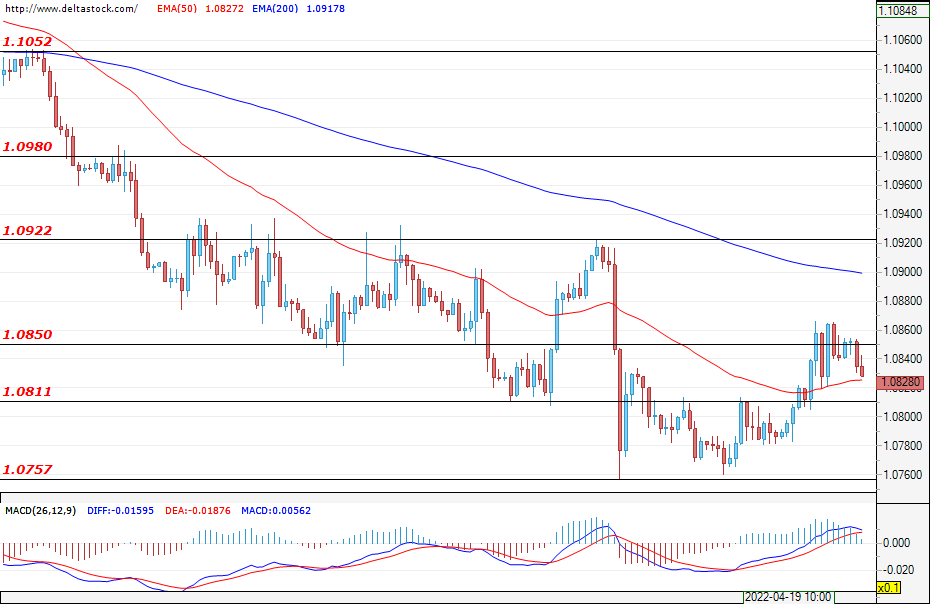
The bears managed to limit the recovery of the single European currency against the U.S. dollar to around the resistance level at 1.0850. The subsequent sell-off is possible to deepen further, with the first support zone being the level at 1.0811. The sentiment remains negative and a successful breach of the local minimum at 1.0757 could give the bears enough momentum to attack the next level at around 1.0640. Today, investors will focus on the announcement of the consumer price index data for the eurozone (09:00 GMT), as well as on the initial jobless claims data for the U.S. (12:30 GMT), with increased volatility expected around both events.
USD/JPY
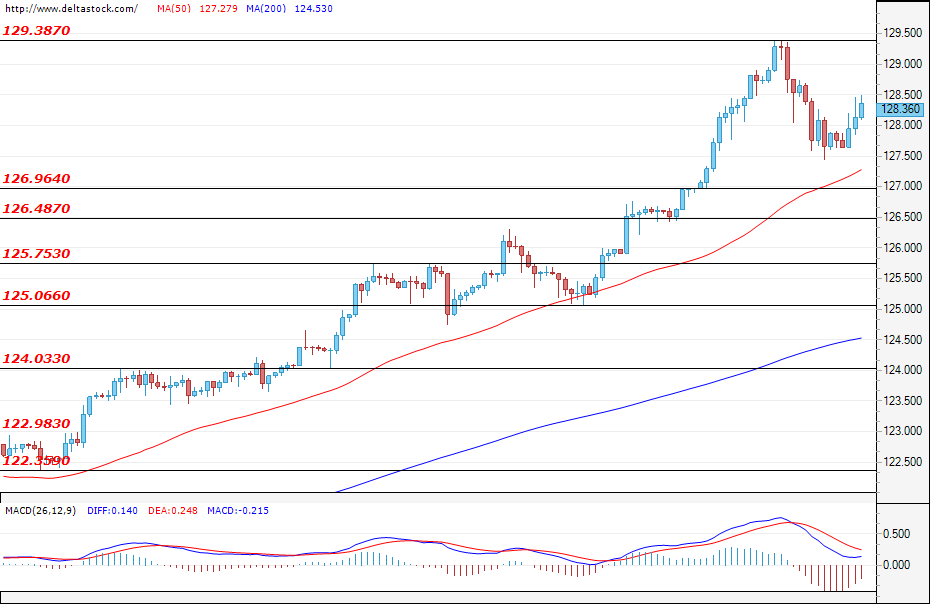
After reaching the local high at 129.40, the currency pair entered a corrective phase as the bears managed to lead the price towards 127.50. At the time of writing, the appreciation of the dollar against the Japanese yen is gaining steam yet again, with the currency pair trading at around 128.50. Sentiments at the moment remain positive – for another attack on the main resistance at 129.40.
GBP/USD
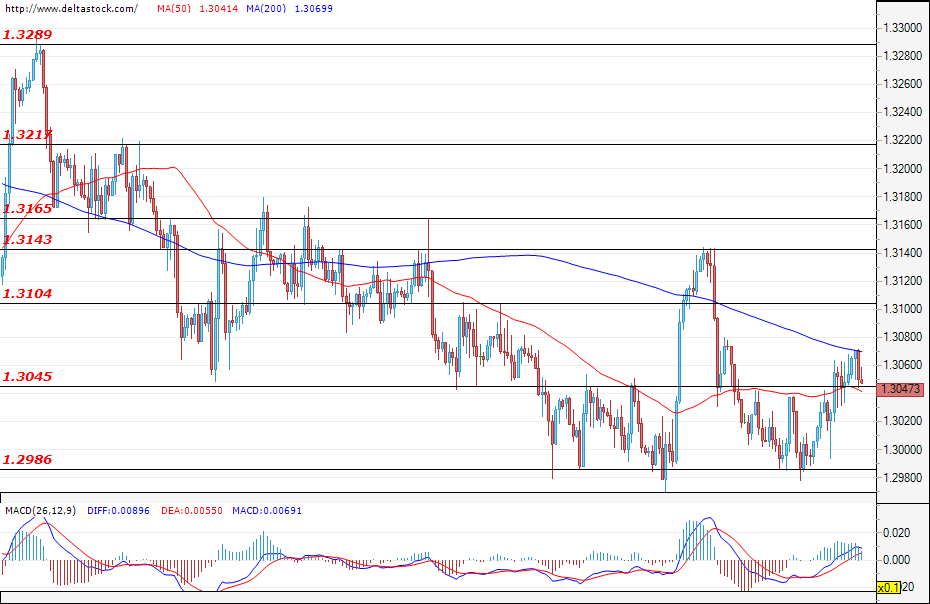
After the bulls managed to limit the sell-off at the 1.2986 support zone, a price appreciation followed suit. At the beginning of the last trading session, the currency pair broke the resistance at 1.3045, after which throughout the day we observed a consolidation just above this level. Since the beginning of today's trading session, however, the bears have regained control, with the most likely scenario being a breach of 1.3045, which is already playing the role of the first important support. A successful breach of the mentioned support could lead towards a deepening of the sell-off and another test of the main support at 1.2986.
EUGERMANY40
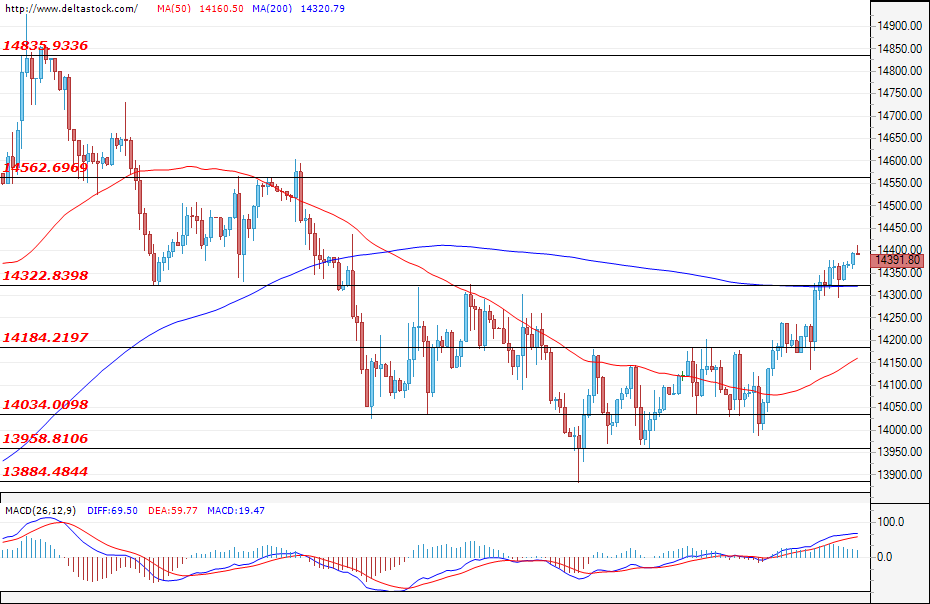
The recovery of the German index continued, marking two consecutive days of gains after the bulls managed to breach through the 14184 resistance zone, thus disrupting the range movement. This gave the necessary impetus to the current rally. During the last trading session, the bulls also managed to overcome the zone at 14322. For now, the most likely scenario is for a consolidation around the current levels, while investors will look forward to the announcement of the inflation data for the eurozone (today; 09:00 GMT), which could seriously shake up the forecasts for the recovery of the index, but could also predetermine its future movement.
US30
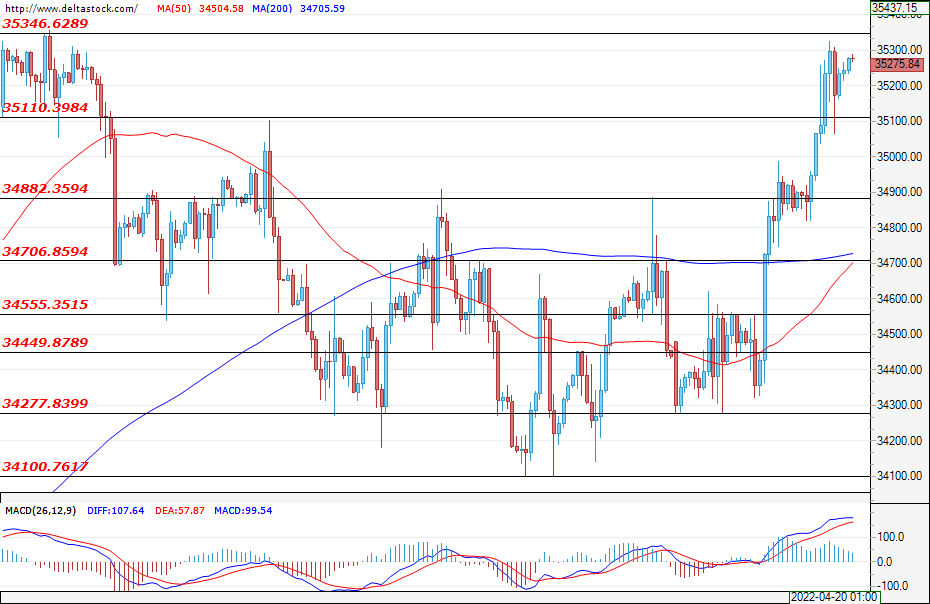
The U.S. blue-chip stock index continues to gain positions, finding itself just below the local high at 35346 at the time of writing – a level that is also playing the role of the main resistance for the bulls. A successful breach will solidify the positive sentiment and would take the trade towards the next significant level at 35850. On the other hand, a failed breach of 35346 could give the bears the necessary incentive to gain a foothold in the market and incite a new sell-off. The initial jobless claims data for the U.S. later today (12:30 GMT), together with the statement by FED chairman Jerome Powell (17:00 GMT), could determine the future of the index and so investors will follow the events with keen interest.
Sharp Re-pricing in Bond Markets Yesterday
Market movers today
Another quiet day in terms of economic data releases. This morning, we will get business confidence indicators from Norway, Denmark and France.
The US jobless claims data are quite important, as we get an indication of whether the US labour market has taken a hit from what has happened to the world economy over the past two months.
We also receive final euro area HICP inflation data.
Tonight the Bank of England Governor Andrew Bailey, ECB President Christine Lagarde and Federal Reserve Chairman Jerome Powell will be speaking.
The 60 second overview
Market sentiment remains volatile. Risk markets caught between recession concerns, speculations regarding 'peak inflation', disappointing growth in China, and the tail risk of an escalation of the war in Ukraine. In the anticipation of aggressive Fed tightening, the US 10-year real yield briefly visited positive territory on Wednesday. Same time, the 'peak inflation' debate seems to be intensifying, and rates markets underwent sharp repricing on Wednesday with long bond yields falling.
Russia-Ukraine: The battle over the besieged South-eastern capital of Mariupol continues after Ukraine refused to surrender by yesterday's deadline. A top ally of President Putin said Russian army would seize the last stronghold of Ukrainian resistance in the city, the Azovstal steel plant, on Thursday. Around 1,000 civilians have been told to keep shelter in the premises and efforts to evacuate have largely failed. Securing control over Mariupol would mark a key victory for Russia after it has shifted the focus of its military operations to the East and South of Ukraine. Taking over Mariupol would enable a land bridge for Russia from the Donbass region to Crimea. Ukraine has said they are ready for a 'special round of negotiations' to protect civilians in Mariupol. Meanwhile, yesterday, Russia test-launched a new nuclear-capable intercontinental ballistic missile, which according to Putin would make Russia's enemies 'stop and think' (see Reuters).
Global food crisis: The World Bank President, David Malpass, warned yesterday that the food crisis triggered by Russia's invasion on Ukraine is causing a 'human catastrophe' (see BBC). He said food prices could increase by 37% and that impacts will be magnified for the world's poor who will struggle to make ends meet. According to a UN food price index, food prices are at their highest since the records began 60 years ago. Mr. Malpass also warned of a looming debt crisis in developing markets on the back of pandemic-induced increases in overall debt levels and a slow and uneven economic recovery. Some developing countries will eventually need a debt restructuring but coordination on debt relief has become ever more cumbersome as a result from a more fragmented debtor base.
Equities: Equities were mostly higher, but in a choppy US session. Defensives beat cyclicals, and value outperformed growth although yields ticked lower. Lately, the moves in yields have not resulted in the usual equity response, being outperformance of banks and value cyclicals vs growth/defensives/quality. In fact, it has resulted in the opposite: Tuesday saw higher yields and growth outperforming. Yesterday saw lower yields (especially in Europe) and banks outperforming. A reason behind this disconnect is that yields are not been rising due to macro, but monetary policy repricing and stagflation fears. Dow closed 0.7% and Russell 2000 0.4% but S&P 500 -0.1%and Nasdaq -1.2%.
FI: Russia is edging closer to a default on its foreign debt after Credit Derivatives Determination committee stated that the payment in Rubles on April 4 on two USD-denominated bonds was a potential default and that Russia had until May 4 to pay investors in USD in order to avoid default. The estimate for total outstanding amount of credit default swaps on Russia is estimated to be USD 40bn (compared to an estimate of USD 8bn on Lehman back in 2008).
Yesterday, global bond yields declined significantly after having reached multi-year highs in US and Germany. The curves flattened from the long end as 30Y US Treasury yields fell some 13bp, while 10Y Treasuries fell 12bp. Part of this move was driven by the solid 20Y US Treasury bond auction where the bid-to-cover was the highest since the re-introduction of the 20Y benchmark back in 2020.
FX: EUR/SEK continued to move lower yesterday and the cross is now trading in 10.24 after Stefan Ingves' interview in the Swedish newspaper Dagens Industri. USD/CNY has moved significantly higher, partly explained by rising US yields. Elevated oil volatility has not spilled-over to oil-FX to the same extent.
Credit: Mirroring the more positive sentiment, credit markets went along with tightening in CDS indices on Wednesday. iTraxx Main closed the day 1.8bp lower at 78.1bp, while Xover was 8.7bp lower at 371.8bp.
Nordic macro
The Finnish Parliament started its debate on applying a NATO membership yesterday. Overall, it is starting to look quite certain Finland will apply for a membership in near future as most MPs are now in favour of applying. After the parliamentary debate, discussions will continue in parliamentary committees, which is expected to take some weeks. The final decision to apply will be made by the President and the Prime Minister both of whom are yet to reveal their exact thoughts on the matter (their support is likely though). The decision is expected in spring. Officially, if Finland decided to pursue a NATO membership, the Finnish heads of government should express their willingness to join, and thereafter, NATO would (most likely) invite Finland to join. Broad-based parliamentary support on the matter remains important since the treaty on accession eventually needs to be ratified in the Finnish parliament.
Those Who Can and Those Who Can’t Pass Inflation on to Customers
Netflix dived more than 35% at yesterday’s trading session, as the unexpected announcement that the company lost 200’000 subscribers in the first quarter and lose 2 million more didn’t please investors although the latest quarterly revenue hit a record of $7.9 billion, up by $2.4 billion compared to the pre-pandemic levels.
Even though the selloff of 35% seems gigantic, we already witnessed 20-30% fall or jump after the big tech results; the size of reaction hints at how prices are ballooned due to the cheap liquidity and easy financial conditions of the pandemic months and raises a couple of eyebrows regarding the potential losses for other tech companies on the back of soft earnings announcements for the weeks to come.
Plus, the macroeconomic conditions are not favourable for tech companies this year, with the Federal Reserve (Fe) expected to raise the interest rates relatively rapidly to tame inflation and start shrinking the size of its huge balance sheet by relatively big chunks.
Although we haven’t seen a shocking migration from tech to value names, the tech companies that have shaky future earnings, and that can’t pass inflation on to their customers will likely suffer more than their peers.
P&G, for example, said that consumers have so far shrugged off inflation, which drove, in Q1, the biggest sales gain for P&G products in two decades.
Tesla surprises
Tesla rallied more than 5% post-market on the back of strong quarterly results, after the company reported better-than-expected results. Unlike Netflix, Tesla clients didn’t walk away due to higher car prices; Tesla could pass on the higher costs, due to rising raw material prices and the supply chain crisis, on to its customers. And if Tesla didn’t rally more than 5%, it’s because the company warned that their ‘factories have been running below capacity for several quarters and that the supply chain became the main limiting factor and is likely to continue through the rest of 2022’. Still, Elon Musk thinks that Tesla could post a 60% delivery growth this year, and 50% growth in deliveries for the years to come.
Overall
Zooming out, besides Netflix which weighed heavily on Nasdaq and pulled the index more than 1% lower yesterday, most US stocks rose.
US and European futures trade in the positive before the European open, yet the escalating tensions with Russia could hit the sentiment, as Russia test-fired a new intercontinental missile that could carry multiple nuclear warheads.
In commodities, the positive pressure in oil prices is fading, but the buyers pile in approaching the $100pb level, as the supply side problems weigh heavier than the demand side easing.
In the FX, the US dollar softened yesterday, and the softer greenback pushed the EURUSD above the 1.0850 mark. Final inflation read due this morning should confirm a rise in the Eurozone inflation to 7.5% in March and revive the European Central Bank (ECB) doves, but the clear divergence between a more hawkish Fed and the relatively dovish ECB hints that a further depreciation of the euro against the greenback is not impossible and we could see the pair advance toward parity sometime this year. Investors will be listening to Fed Chair Powell, ECB President Lagarde and the BoE Chief Bailey speaking today.
UK Oil Bounces Off Support
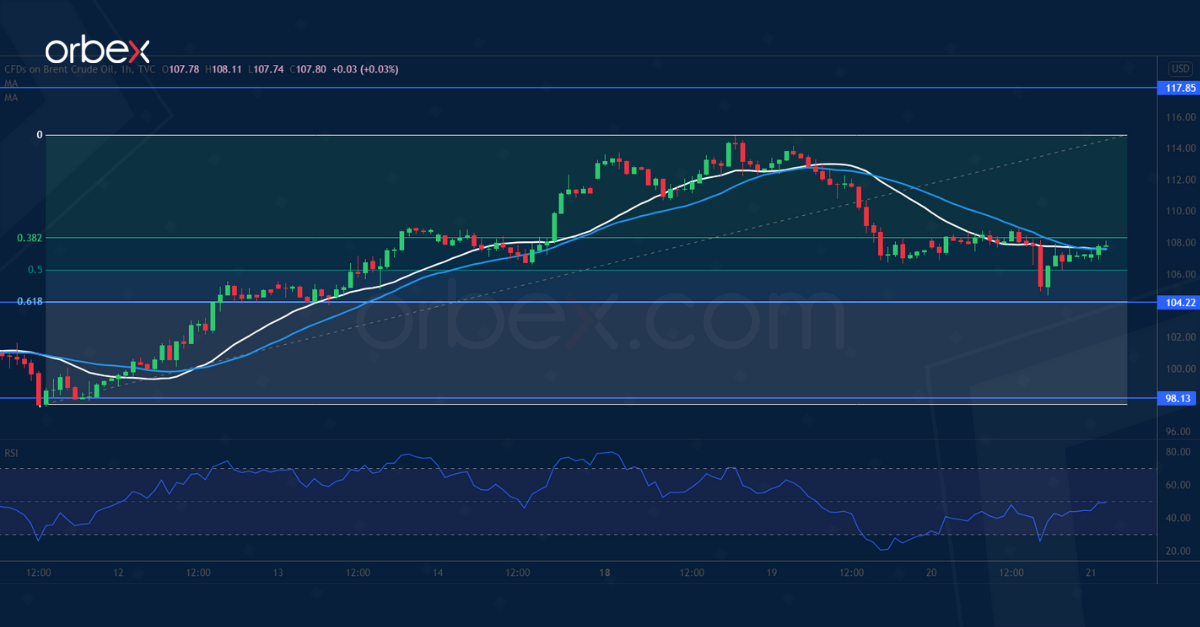
Brent crude finds support from a surprise drawdown in inventories. On the daily chart, the price is taking a breather in a flag-shaped pattern after a parabolic ascent.
The uptrend can remain intact as long as the support of 98.00 stays still. A tentative break above 114.50 has prompted short-term sellers to cover.
The latest pullback saw bids at the 61.8% (104.20) Fibonacci retracement level while the RSI recovers to the neutrality area. A break above 117.80 could extend the rally towards 127.00.