Sample Category Title
GBP/USD Daily Outlook
Daily Pivots: (S1) 1.3017; (P) 1.3044; (R1) 1.3096; More...
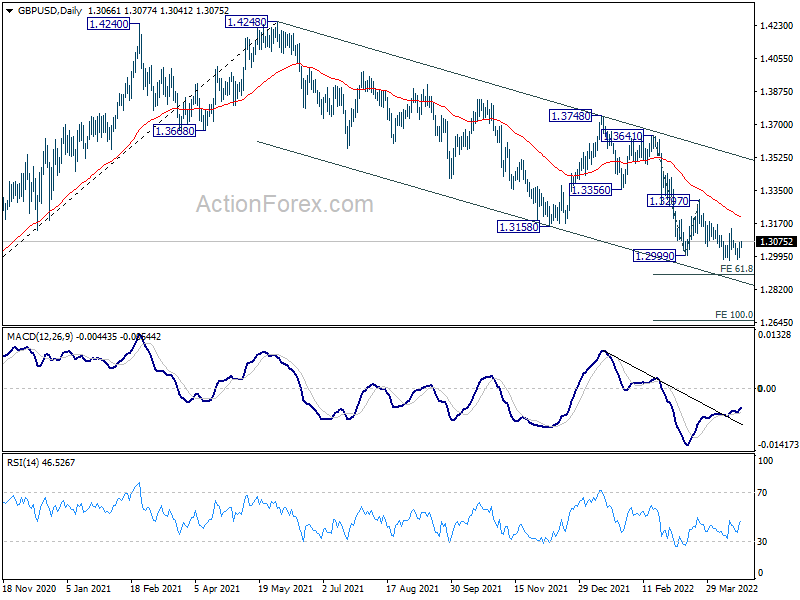
GBP/USD is still staying in consolidation from 1.2971 and intraday bias remains neutral at this point. Outlook is unchanged that further fall is expected with 1.3165 resistance intact. On the downside, break of 1.2971 will resume larger down trend from 1.4248. Next target is 61.8% projection of 1.3641 to 1.2999 from 1.3297 at 1.2900. On the upside, firm break of 1.3165 will confirm short term bottoming, and turn bias back to the upside for 1.3297 resistance and above.
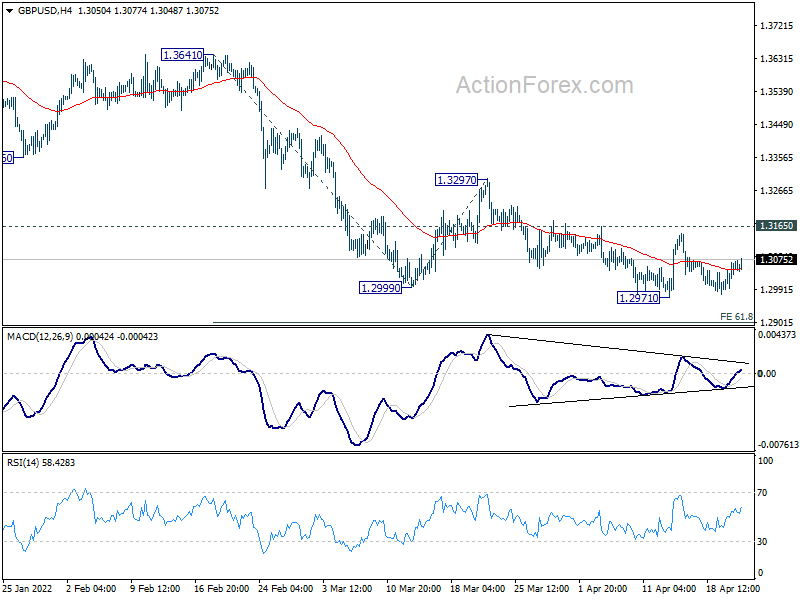
In the bigger picture, rise from 1.1409 (2020 low) has completed at 1.4248. Decline from 1.4248 could still be a corrective move, or it could be the start of a long term down trend. In either case, deeper decline would be seen back to 61.8% retracement of 2.1161 to 1.1409 at 1.2493. In any case, break of 1.3748 resistance is needed confirm completion of the fall from 1.4248, or outlook will stay bearish.
USD/CHF Daily Outlook
Daily Pivots: (S1) 0.9447; (P) 0.9492; (R1) 0.9528; More....
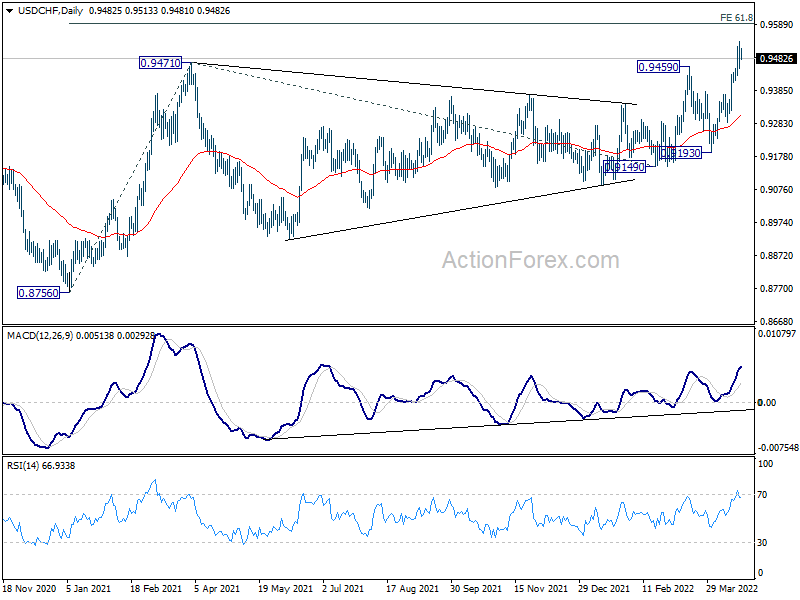
Intraday bias in USD/CHF remains neutral for consolidation below 0.9535. Downside of retreat retreat should be contained by 0.9372 resistance turned support to bring another rally. On the upside, above 0.9535 will turn bias back to the upside and target 0.9591 medium term projection level.
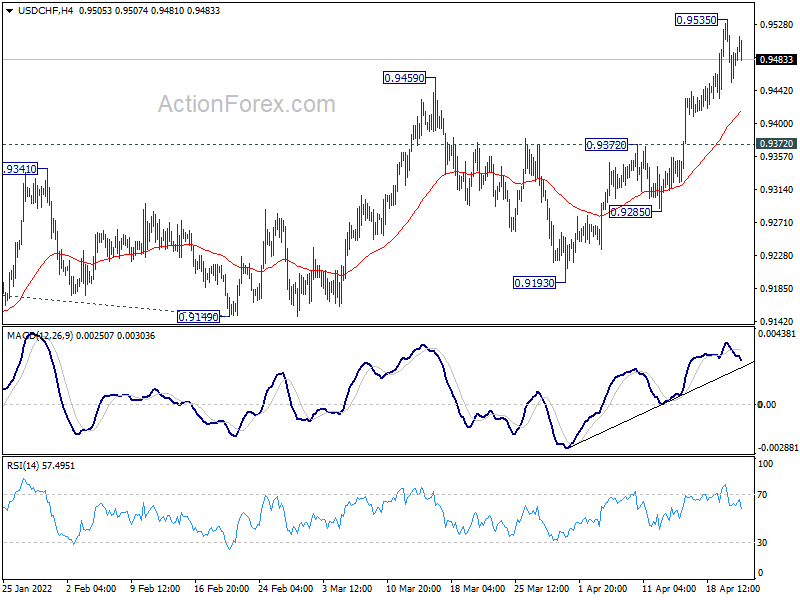
In the bigger picture, down trend from 1.0342 (2016 high) could have completed with three waves down to 0.8756 (2021 low) already. Rise from 0.8756 is likely a medium term up trend of its own. Next target is 61.8% projection of 0.8756 to 0.9471 from 0.9149 at 0.9591. Sustained break there will pave the way to 100% projection at 0.9864. This will now remain the favored case as long as 0.9149 support holds.
USD/JPY Daily Outlook
Daily Pivots: (S1) 127.09; (P) 128.24; (R1) 129.03; More...
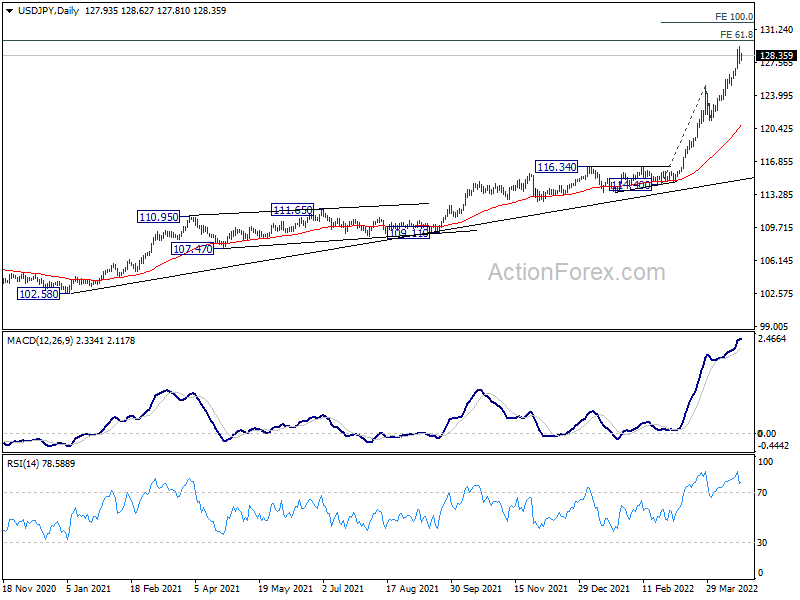
Intraday bias in USD/JPY remains neutral for the moment. Consolidation from 129.39 temporary top is extending and deeper retreat cannot be ruled out. But downside should be contained above 125.09 resistance turned support to bring another rally. On the upside, above 129.39 will resume larger up trend to 130.04 long term projection level next.
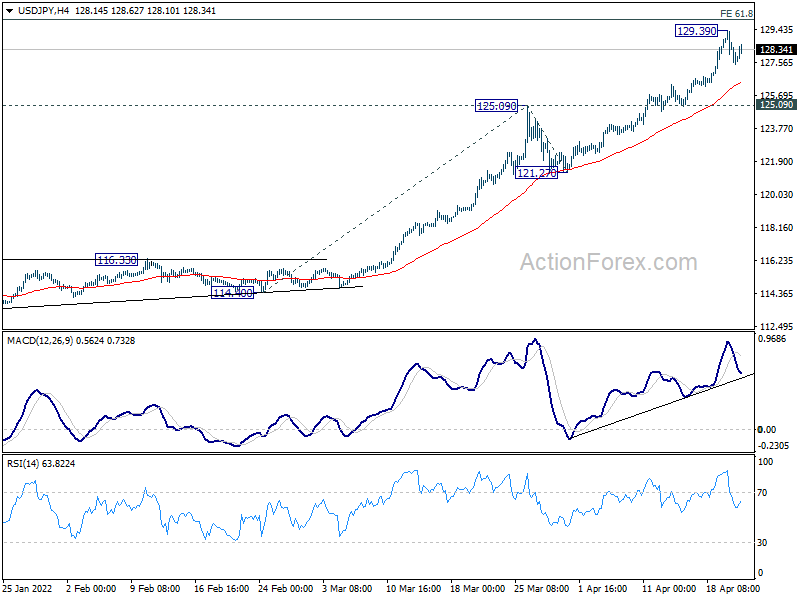
In the bigger picture, the break of 125.85 resistance (2015 high) suggests that whole up trend from 75.56 (2011 low) is resuming. Further rise should be seen to 61.8% projection of 75.56 (2011 low) to 125.85 (2015 high) from 98.97 at 130.04. Sustained break there wave the way to 147.68 (1998 high). For now, this will remain the favored case as long as 121.27 support holds.
JPY Turning Weaker Again, CAD Staying Strong
Inflation data were the main drivers in the forex markets in the past 12 hours. New Zealand Dollar turned slightly weaker after Q1 CPI came in lower than expected, despite surging to 30-year high. On the other hand, Canadian Dollar remains supported by the stronger than expected CPI readings released overnight. Dollar's retreat appears to be relatively brief in general, as it's regaining some ground against European majors. Yen also turned weaker in very tight range, as it's now in consolidations.
For now, Loonie is the strongest one for the week, followed by Aussie and then Kiwi. Yen remains the worst, followed by Swiss Franc and then Sterling. Dollar and Euro are mixed.
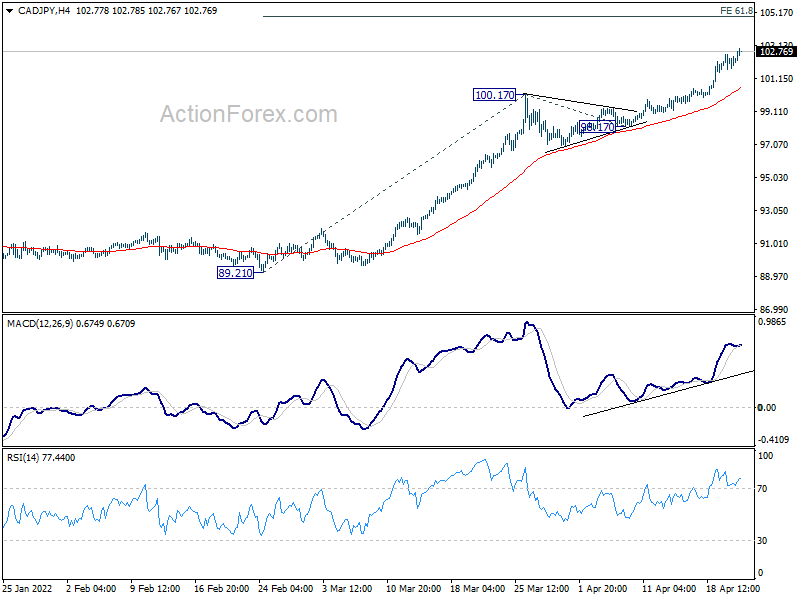
Technically, EUR/CAD's down trend resumed already by breaking through 1.3541 temporary low. GBP/CAD also breaks through 1.6292 temporary low too. At the same time, CAD/JPY is extending recent up trend and edged higher to 102.93. It's on track to 61.8% projection of 89.21 to 100.17 from 98.17 at 104.94.
In Asia, at the time of writing, Nikkei is up 1.05%. Hong Kong HSI is down -1.74%. China Shanghai SSE is down -1.60%. Singapore Strait Times is up 0.46%. Japan 10-year JGB yield is down -0.0004 at 0.254. Overnight, DOW rose 0.71%. S&P 500 dropped -0.06%. NASDAQ dropped -1.22%. 10-year yield dropped -0.073 to 2.840.
Fed Daly busy thinking about three things - inflation, inflation, inflation
San Francisco Fed President Mary Daly said yesterday that " an expeditious march to neutral by the end of the year as a prudent path." And it's the "top priority" to move "purposefully to a more neutral stance that does not stimulate the economy"
"The case for a 50 basis-point adjustment is now complete," she said after the speech. "The economy is resilient; it can handle these adjustments." And, she's "busy thinking about are three things: inflation, inflation, inflation."
Nevertheless she also emphasized, ,"if we ease on the brakes by methodically removing accommodation and regularly assessing how much more is needed, we have a good chance of transitioning smoothly and gliding the economy to its long-run sustainable path," she said.
As for the economy, she said, recession is one word, but it describes a whole range of outcomes. It can be a couple of quarters of a tiny bit below zero. That's a very different beast than something like the financial crisis or the Volcker disinflation period."
"That's not something that I'm forecasting or something I think would derail the long-run expansion," she added.
BoJ starts four day unlimited bond purchases to defend yield cap
BoJ announced yesterday another round of bond purchases to defend the 10-year JGB yield cap at 0.25%. It will carry out unlimited purchases through auctions on April 21, 22, 25, and 26, with 0.25% fixed-rate applied.
"Given recent yield movements on longer-ended notes, we have announced a consecutive unlimited fixed-rate purchase of bonds to achieve our policy to guide the 10-year yield around 0%," the BoJ said in a statement.
Under the yield curve control framework, BoJ intends to keep 10-year JGB yield at 0%, with allowance to move up and down 0.25%.
IMF: Yen's move driven by fundamentals
Sanjaya Panth, deputy director of the IMF's Asia and Pacific Department, said Yen's depreciation is "driven by fundamentals.
"Economic policymaking should continue to look at fundamentals. We don't see any reason to change economic policy because what's happening right now reflects fundamentals."
"As you know, a weak yen hasn't been bad for Japan," Panth said. "At the same time, it does affect households. It's a little bit of a mixed bag,"
"Japan is in a very different situation compared with other advanced countries who have begun tightening monetary policy," he said. "We do not see any need to change the accommodative monetary policy stance."
NZ CPI rose to 6.9% yoy in Q1, highest since 1990
New Zealand CPI rose 1.8% qoq in Q1, below expectation of 2.0% qoq. For the 12-month period, CPI accelerated from 5.9% yoy to 6.9% yoy, below expectation of 7.1% yoy. That's nonetheless still the highest annual rate since June 1990 quarter.
StatsNZ said: "The main driver for the 6.9 percent annual inflation to the March 2022 quarter was the housing and household utilities group, influenced by rising prices for construction and rentals for housing."
"Construction firms have been experiencing many supply-chain issues, higher labour costs, and also higher demand, which have pushed up the cost of building a new house," senior prices manager Aaron Beck said.
Looking ahead
Eurozone CPI final is the main feature in European session. Later in the day, US will release jobless claims and Philly Fed survey.
USD/JPY Daily Outlook
Daily Pivots: (S1) 127.09; (P) 128.24; (R1) 129.03; More...
Intraday bias in USD/JPY remains neutral for the moment. Consolidation from 129.39 temporary top is extending and deeper retreat cannot be ruled out. But downside should be contained above 125.09 resistance turned support to bring another rally. On the upside, above 129.39 will resume larger up trend to 130.04 long term projection level next.
In the bigger picture, the break of 125.85 resistance (2015 high) suggests that whole up trend from 75.56 (2011 low) is resuming. Further rise should be seen to 61.8% projection of 75.56 (2011 low) to 125.85 (2015 high) from 98.97 at 130.04. Sustained break there wave the way to 147.68 (1998 high). For now, this will remain the favored case as long as 121.27 support holds.
Economic Indicators Update
| GMT | Ccy | Events | Actual | Forecast | Previous | Revised |
|---|---|---|---|---|---|---|
| 22:45 | NZD | CPI Q/Q Q1 | 1.80% | 2.00% | 1.40% | |
| 22:45 | NZD | CPI Y/Y Q1 | 6.90% | 7.10% | 5.90% | |
| 09:00 | EUR | Eurozone CPI Core Y/Y Mar F | 3.00% | 3.00% | ||
| 09:00 | EUR | Eurozone CPI Y/Y Mar F | 7.50% | 7.50% | ||
| 12:30 | USD | Initial Jobless Claims (Apr 15) | 177K | 185K | ||
| 12:30 | USD | Philadelphia Fed Manufacturing Survey Apr | 20.9 | 27.4 | ||
| 14:00 | EUR | Eurozone Consumer Confidence Apr P | -20 | -19 | ||
| 14:30 | USD | Natural Gas Storage | 40B | 15B |
Technical Outlook and Review
DXY:
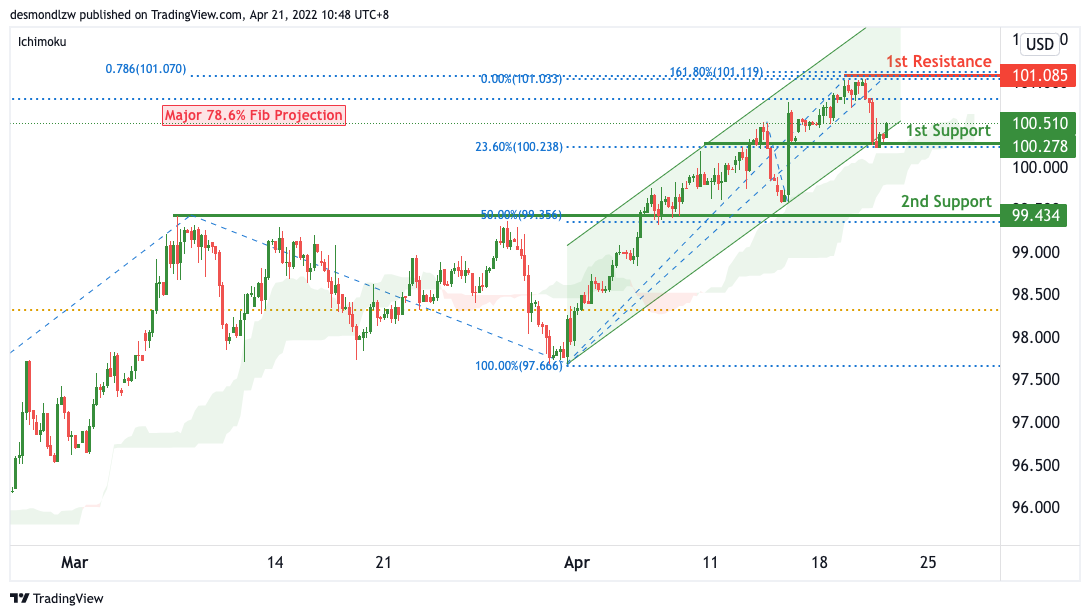
On the H4, with price moving above the ichimoku cloud, we have a bullish bias that price will rise to our 1st resistance of 101.085 in line with the swing high resistance, 161.8% Fibonacci extension and 78.6% Fibonacci projection from our 1st support of 100.278 in line with the 23.6% Fibonacci retracement. Alternatively, price may break 1st support and head for 2nd support at 99.434 in line with the 50% Fibonacci retracement. Our bullish bias is further supported by how price is expected to respect our ascending channel.
Areas of consideration:
- H4 time frame, 1st resistance at 101.085
- H4 time frame, 1st support at 100.278
- H4 time frame, 2nd support at 99.434
XAU/USD (GOLD):
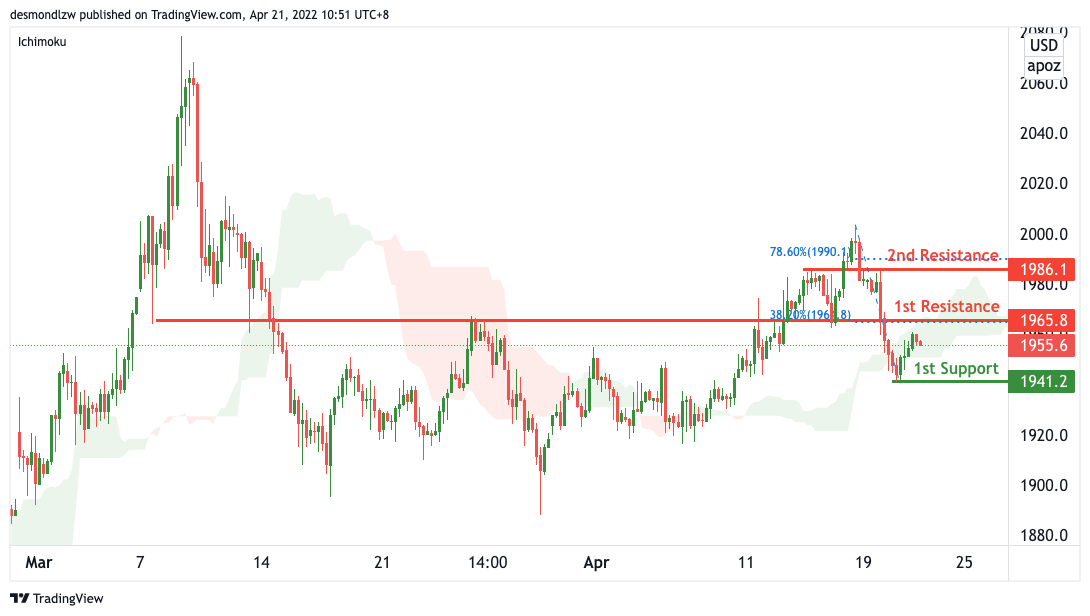
We are expecting price to potentially dip from 1st resistance level of 1965.8 which is line with 38.2% Fibonacci retracement, along with a graphical pullback resistance towards the 1st support level of 1941.2 in line with a horizontal swing low support. Otherwise, price might break the 1st resistance level and head towards the 2nd resistance level of 1986.1
Areas of consideration:
- H4 time frame, 1st Resistance at 1965.8
- H4 time frame, 2nd Resistance at 1986.1
- H4 time frame, 1st Support at 1941.2
GBP/USD:
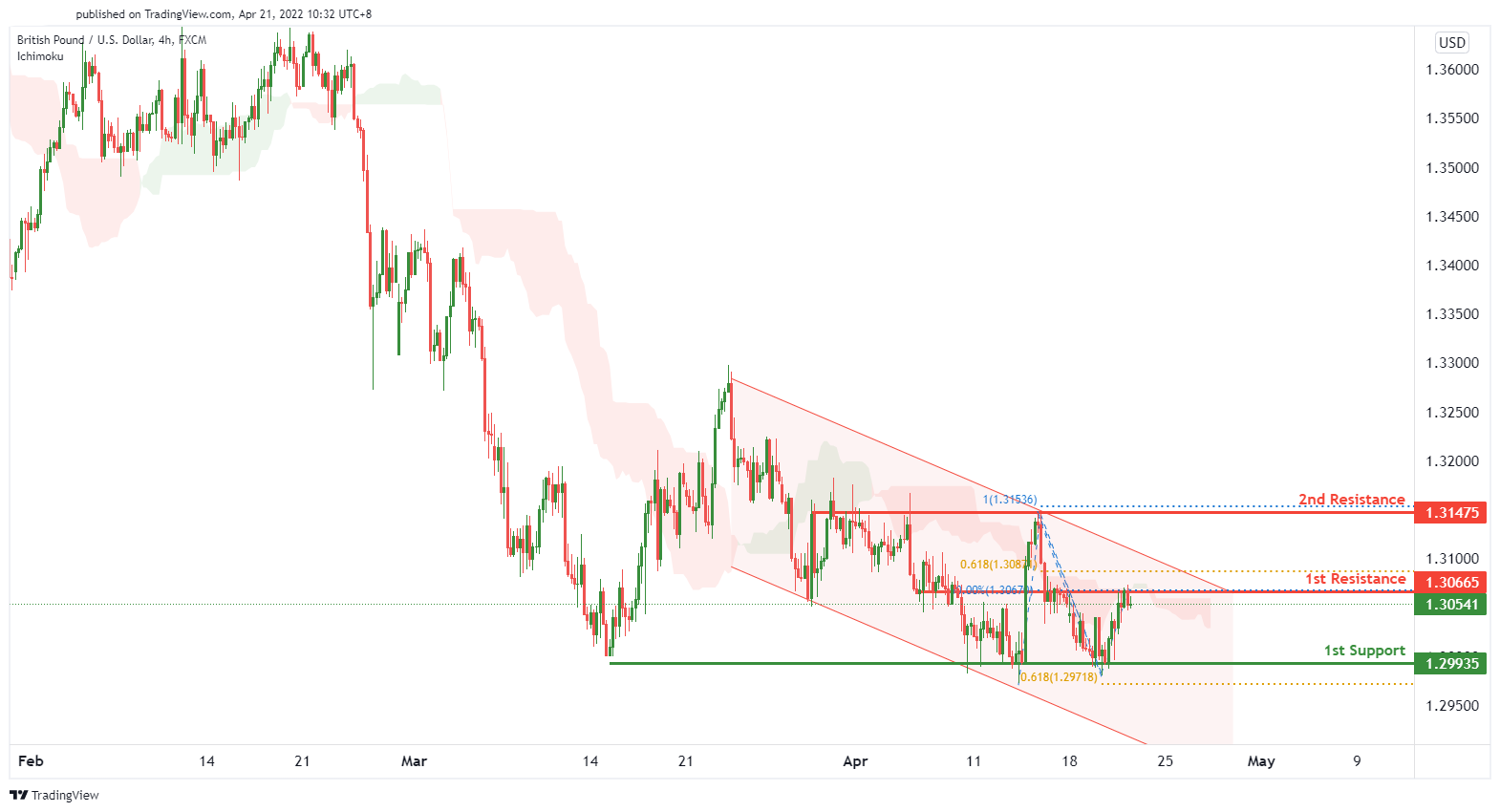
On the H4 timeframe, we are seeing price is abiding by the descending channel and is on a bearish momentum. As price is trading below the Ichimoku cloud, it can potentially reverse from the 1st resistance level of 1.30665 in line with 50% fibonacci retracement and 61.8% Fibonacci projection towards the 1st support level of 1.29935 which is in line with 61.8% Fibonacci projection. Otherwise, price might break through the 1st resistance level and head towards the 2nd resistance level of 1.31475which is in line with 100% Fibonacci projection .
Areas of consideration:
- H4 1st resistance at 1.30665
- H4 2nd resistance at 1.31475
- H4 1st support at 1.29935
USD/CHF:
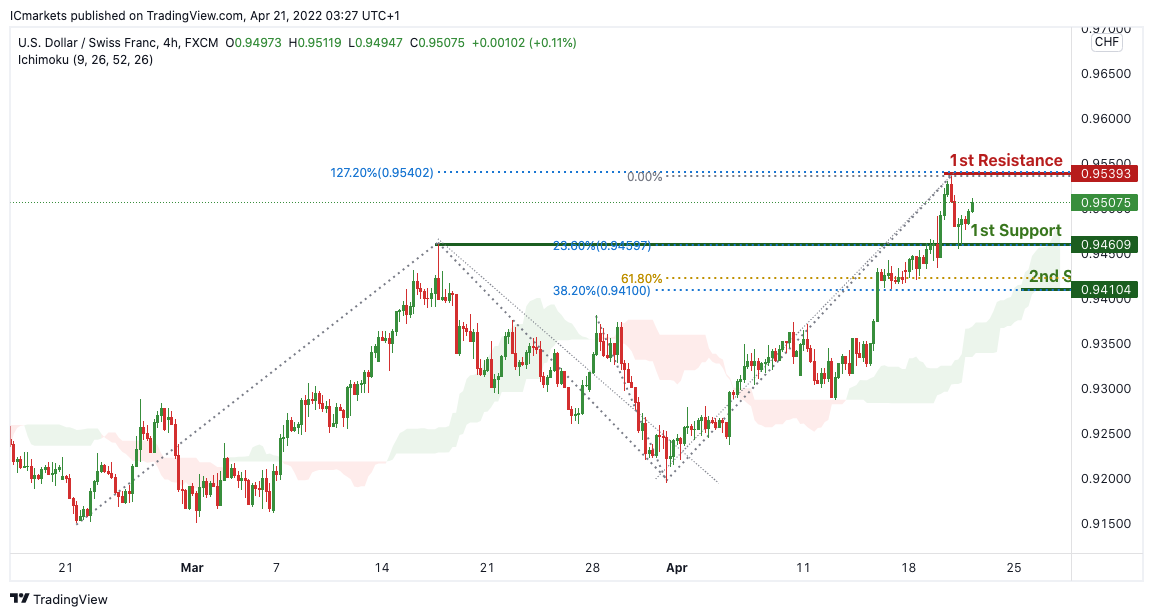
On the H4, with price moving above the ichimoku cloud, we have a bullish bias that price will rise to our 1st resistance of 0.95393 in line with the swing high resistance, 127.2% Fibonacci extension from our 1st support of 0.94609 in line with the 23.6% Fibonacci retracement. Alternatively, price may break 1st support and head for 2nd support at 0.94104 in line with the 38.2 and 61.8% Fibonacci retracement.
Areas of consideration
- 1st support level at 0.94609
- 1st resistance level at 0.95393
EUR/USD :
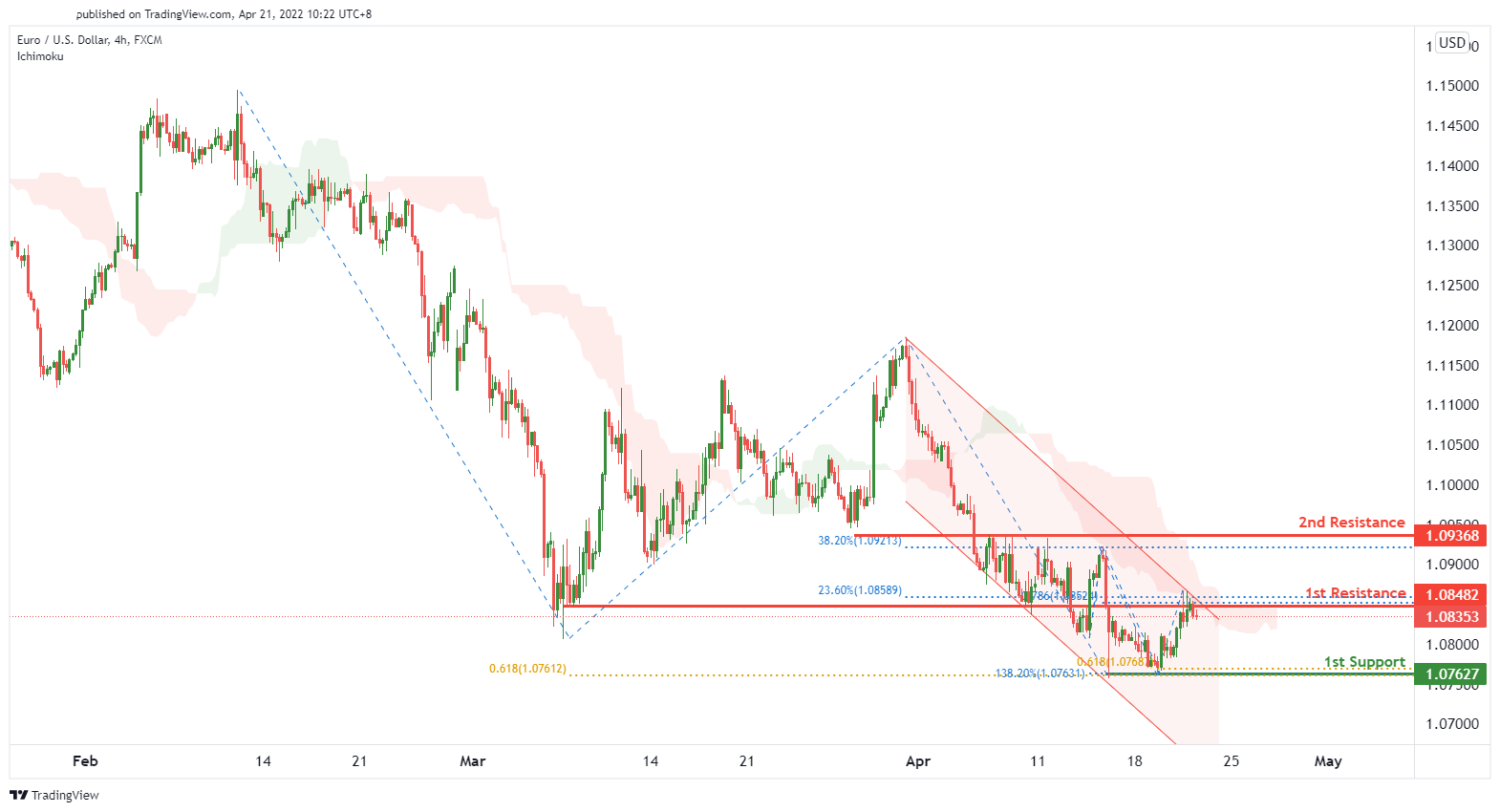
On the H4 timeframe, we are seeing price is abiding by the descending channel and is on a bearish momentum. Price can potentially reverse from the 1st resistance level of 1.08482 which is in line with 23.6% Fibonacci retracement and 78.6% Fibonacci projection towards the 1st support level of 1.07627 which is in line with 61.8% Fibonacci retracement, 61.8% Fibonacci projection and 138.2% Fibonacci extension. Our bearish bias is further supported by price being pushed down by Ichimoku cloud. Otherwise, price might break through the 1st resistance level and head to 2nd resistance level which is in line with 38.2% Fibonacci retracement.
Areas of consideration :
- H4 1st resistance at 1.08482
- H4 2nd resistance at 1.09368
- H4 1st support at 1.07627
USD/JPY:
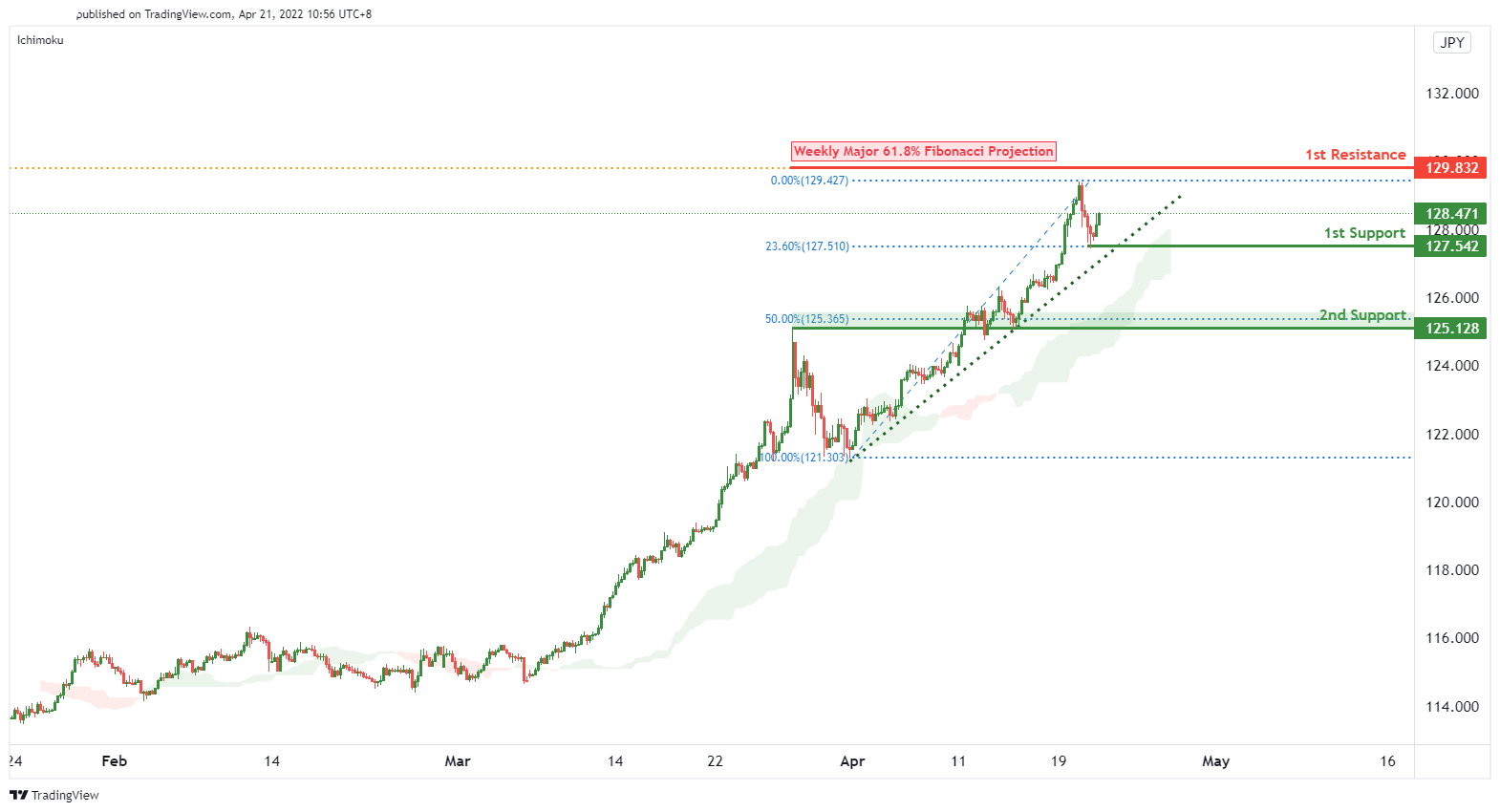
Price is abiding by the ascending trendline and is on a bullish momentum. We expect price to have a rise from 1st support level of 127.542 in line with 23.6% Fibonacci retracement towards the 1st resistance level of 129.832 in line with previous horizontal swing high. If price breaks through the 1st support level, it will trigger a dip towards the 2nd support level of 125.128 which is in line with 50% Fibonacci retracement.
Areas of consideration:
- H4 time frame, 1st resistance at 129.832
- H4 time frame, 1st support at 127.542
- H4 time frame, 2nd support at 125.128
AUD/USD:
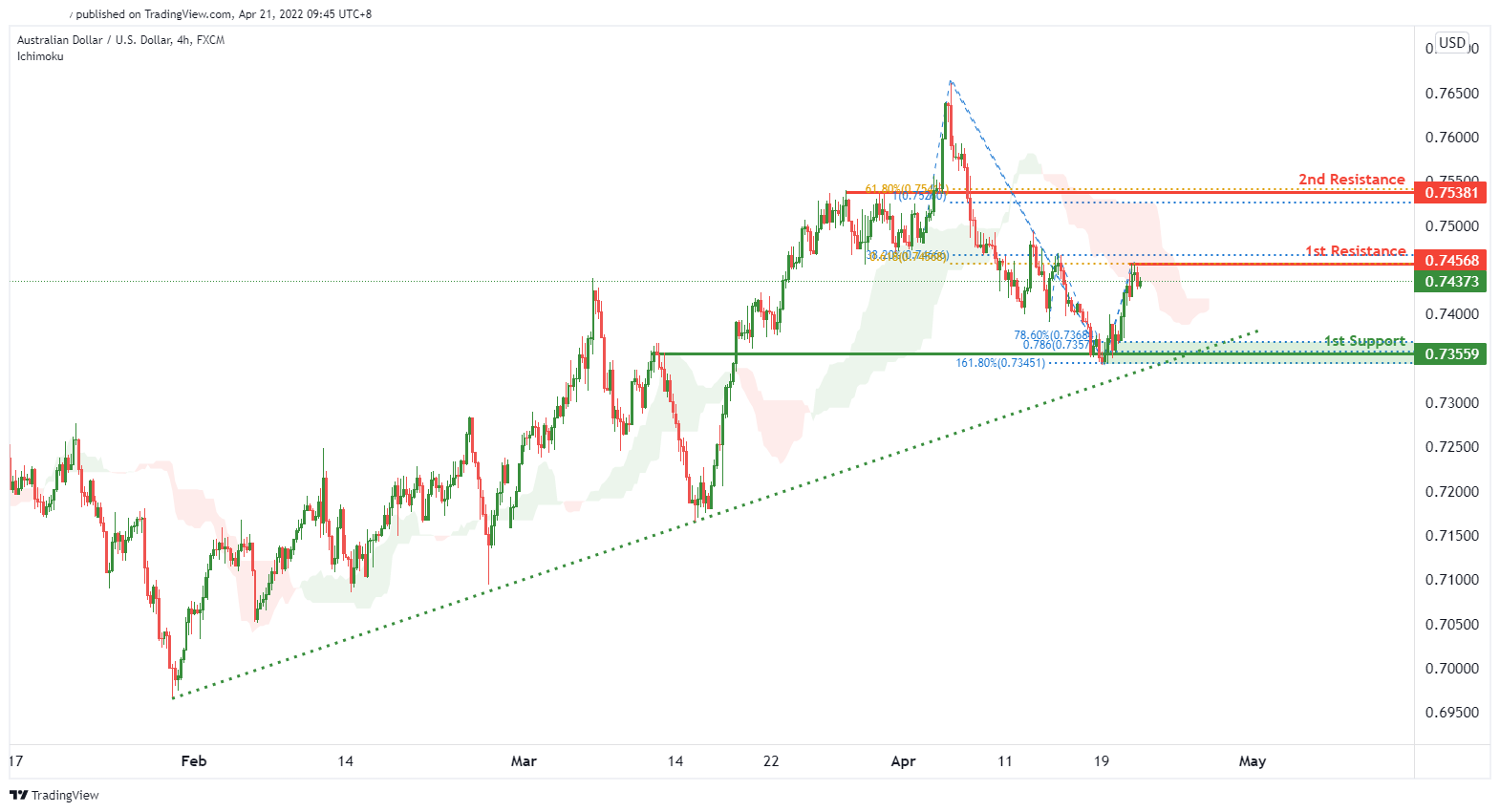
On the H4 timeframe, price is dropping towards the ascending trendline. We see the potential for a bearish reversal from 1st resistance of 0.74568 in line with 38.2% Fibonacci retracement and 61.8% Fibonacci projection towards the 1st support level of 0.73559 in line with78.6% Fibonacci projection, 161.8% Fibonacci extension and 78.6% Fibonacci retracement. Our bearish bias is further supported by price being pushed down by Ichimoku cloud. However, there is a probability that price might break through the 1st resistance level to rise up towards 2nd resistance level of 0.75381 in line with 61.8% Fibonacci retracement and 100% Fibonacci projection.
Areas of consideration
- H4 1st resistance at 0.74568
- H4 2nd resistance at 0.75381
- H4 1st support at 0.73559
NZD/USD:
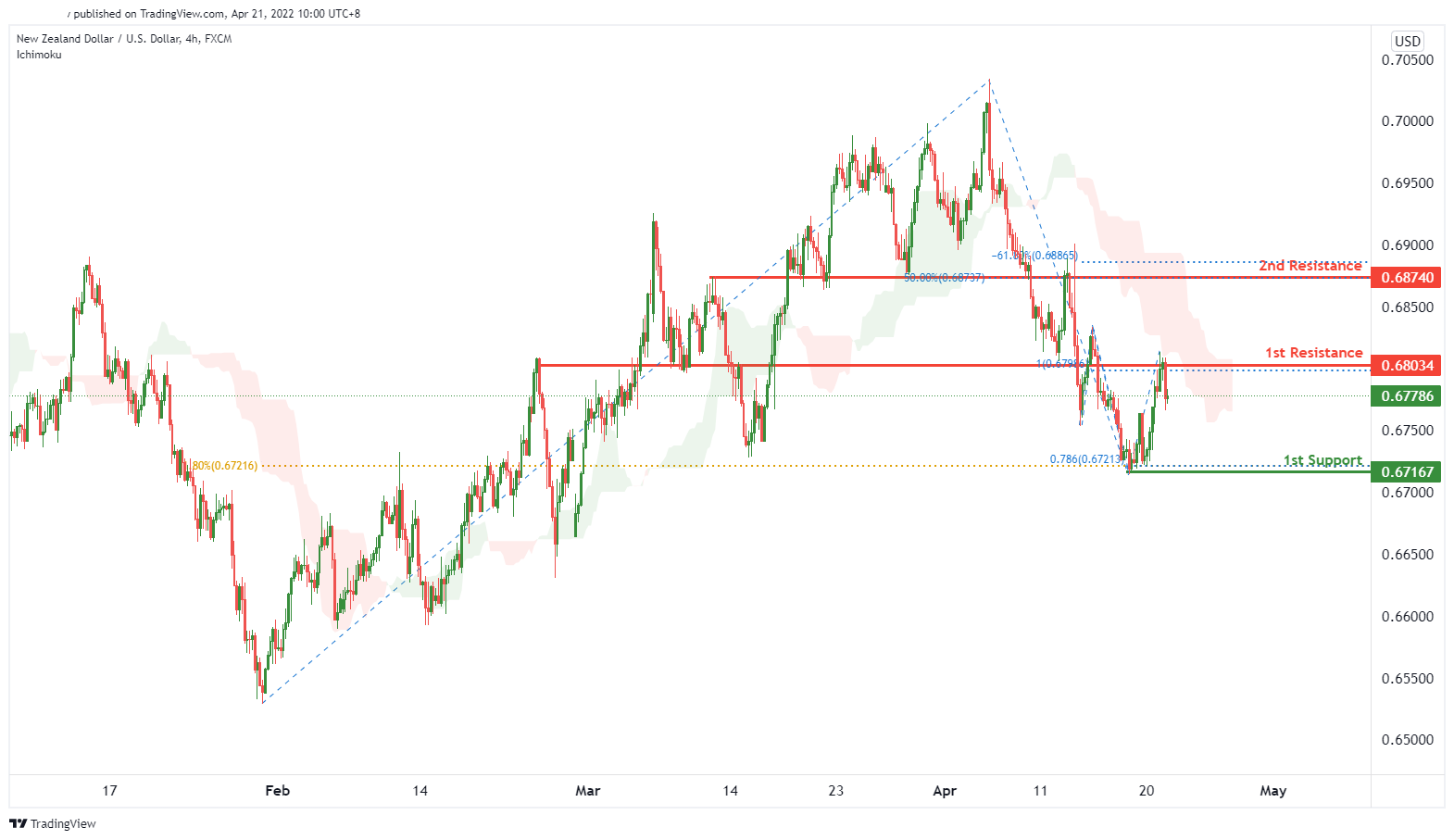
On the H4, we see the potential for a bearish reversal from 1st resistance of 0.68034 in line with 100% Fibonacci projection towards the 1st support level of 0.67167 in line with78.6% Fibonacci projection and 61.8% Fibonacci retracement. Our bearish bias is further supported by price being pushed down by Ichimoku cloud. However, there is a probability that price might break through the 1st resistance level to rise up towards 2nd resistance level of 0.68740 in line with 50% Fibonacci retracement and -61.8% Fibonacci expansion.
Areas of consideration:
- H4 time frame, 1st support at 0.67167
- H4 time frame, 1st resistance at 0.68034
- H4 time frame, 2nd resistance at 0.68740
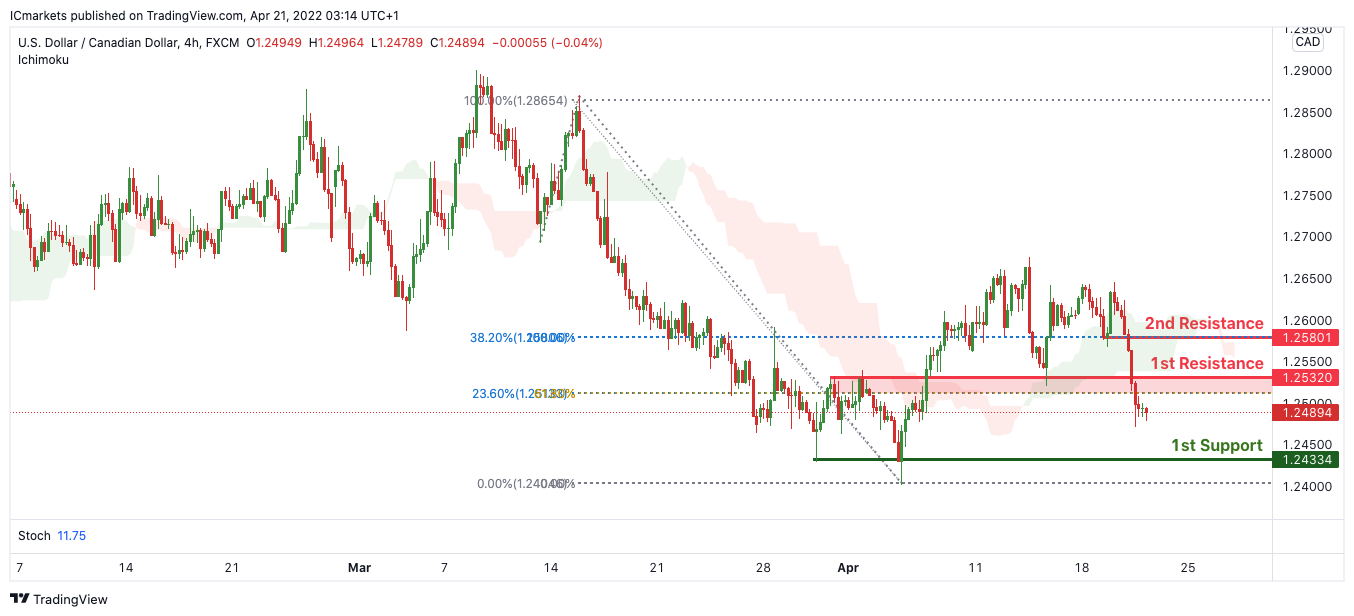
USD/CAD:
Price is abiding by the descending trendline. We are expecting a bearish dip to occur from 1st resistance level of 1.25320 in line with 23.6% Fibonacci retracement and 61.8% Fibonacci projection towards the 1st support level of 1.24334 in line with horizontal swing low support. Alternatively, price might break through the key resistance level and rise to the 2nd resistance level of 1.25801 in line with 38.2% Fibonacci retracement.
Areas of consideration:
- H4 time frame, 1st resistance at 1.25320
- H4 time frame, 1st support at 1.24334
OIL:
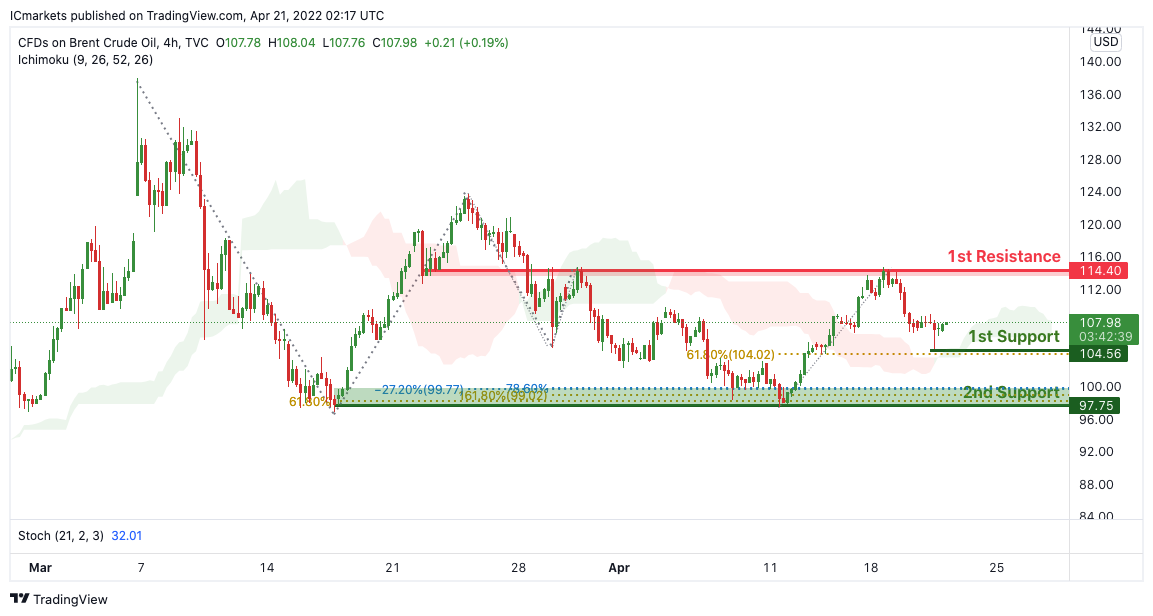
On the H4, with price moving above the ichimoku cloud, we have a bullish bias that price will rise to our 1st resistance of 114.40 in line with the horizontal overlap resistance from our 1st support of 104.56 in line with the 61.8% Fibonacci retracement. Alternatively, price may break 1st support and head for 2nd support at 97.75 in line with the 61.8% Fibonacci retracement, -27.2% Fibonacci expansion, 161.8% Fibonacci extension and horizontal swing low support.
Areas of consideration:
- H4 time frame, 1st resistance of 114.40
- H4 time frame, 1st support of 104.56
- H4 time frame, 2nd support of 97.75
Dow Jones Industrial Average:
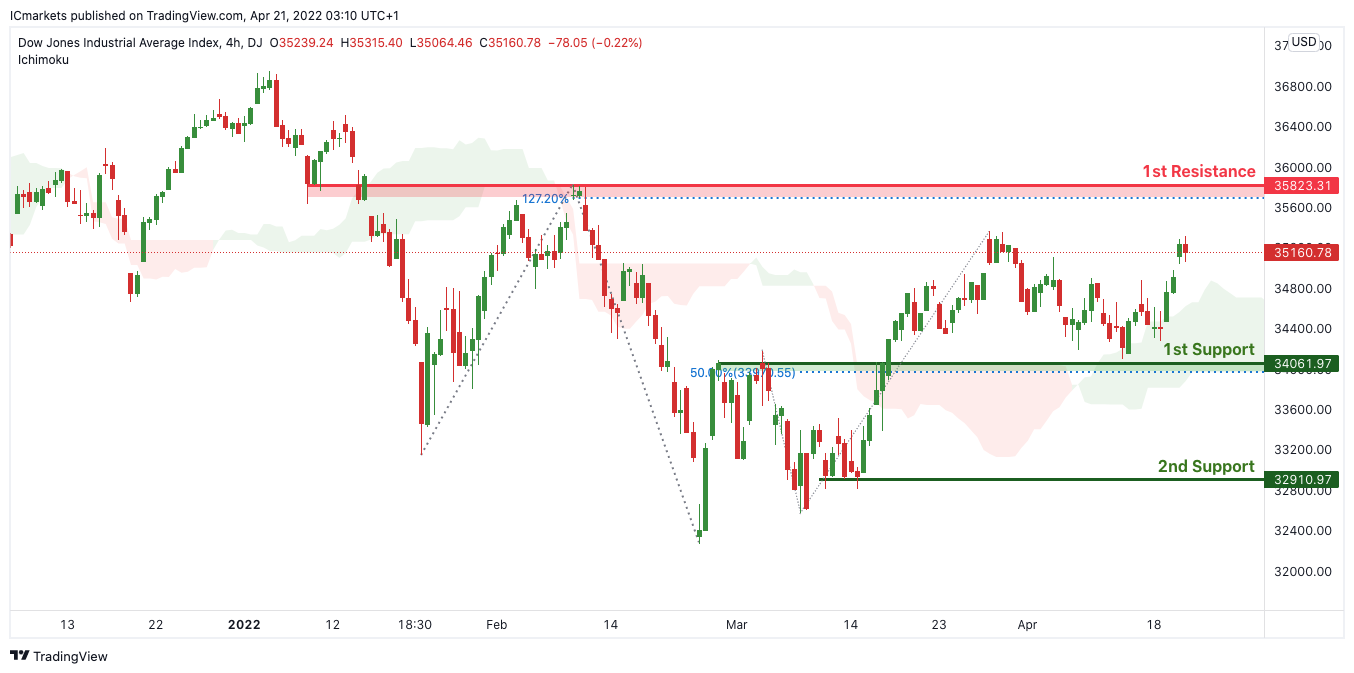
On the H4, with price moving above the ichimoku cloud, we have a bullish bias that price will rise to our 1st resistance of 35823 in line with the pullback resistance, 127.2% Fibonacci extension from our 1st support of 34061 in line with the 50% Fibonacci retracement. Alternatively, price may break 1st support and head for 2nd support at 32910 in line with the swing low support.
Areas of consideration :
- H4 time frame, 1st resistance at 35823
- H4 time frame, 1st support at 34061
- H4 time frame, 2nd support at 32910
NZ CPI rose to 6.9% yoy in Q1, highest since 1990
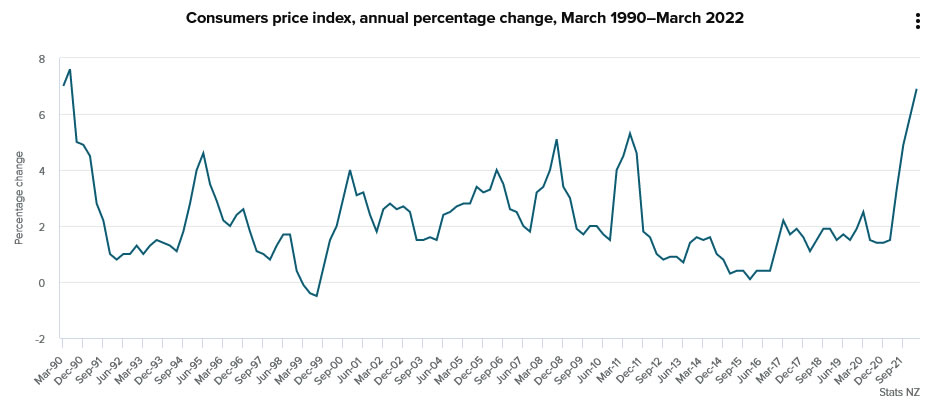
New Zealand CPI rose 1.8% qoq in Q1, below expectation of 2.0% qoq. For the 12-month period, CPI accelerated from 5.9% yoy to 6.9% yoy, below expectation of 7.1% yoy. That's nonetheless still the highest annual rate since June 1990 quarter.
StatsNZ said: "The main driver for the 6.9 percent annual inflation to the March 2022 quarter was the housing and household utilities group, influenced by rising prices for construction and rentals for housing."
"Construction firms have been experiencing many supply-chain issues, higher labour costs, and also higher demand, which have pushed up the cost of building a new house," senior prices manager Aaron Beck said.
IMF: Yen’s move driven by fundamentals
Sanjaya Panth, deputy director of the IMF's Asia and Pacific Department, said Yen's depreciation is "driven by fundamentals.
"Economic policymaking should continue to look at fundamentals. We don't see any reason to change economic policy because what's happening right now reflects fundamentals."
"As you know, a weak yen hasn't been bad for Japan," Panth said. "At the same time, it does affect households. It's a little bit of a mixed bag."
"Japan is in a very different situation compared with other advanced countries who have begun tightening monetary policy," he said. "We do not see any need to change the accommodative monetary policy stance."
BoJ starts four day unlimited bond purchases to defend yield cap
BoJ announced yesterday another round of bond purchases to defend the 10-year JGB yield cap at 0.25%. It will carry out unlimited purchases through auctions on April 21, 22, 25, and 26, with 0.25% fixed-rate applied.
"Given recent yield movements on longer-ended notes, we have announced a consecutive unlimited fixed-rate purchase of bonds to achieve our policy to guide the 10-year yield around 0%," the BoJ said in a statement.
Under the yield curve control framework, BoJ intends to keep 10-year JGB yield at 0%, with allowance to move up and down 0.25%.
Fed Daly busy thinking about three things – inflation, inflation, inflation
San Francisco Fed President Mary Daly said yesterday that " an expeditious march to neutral by the end of the year as a prudent path." And it's the "top priority" to move "purposefully to a more neutral stance that does not stimulate the economy"
"The case for a 50 basis-point adjustment is now complete," she said after the speech. "The economy is resilient; it can handle these adjustments." And, she's "busy thinking about are three things: inflation, inflation, inflation."
Nevertheless she also emphasized, ,"if we ease on the brakes by methodically removing accommodation and regularly assessing how much more is needed, we have a good chance of transitioning smoothly and gliding the economy to its long-run sustainable path," she said.
As for the economy, she said, recession is one word, but it describes a whole range of outcomes. It can be a couple of quarters of a tiny bit below zero. That's a very different beast than something like the financial crisis or the Volcker disinflation period."
"That's not something that I'm forecasting or something I think would derail the long-run expansion," she added.
NZ CPI Review: The Misery Index
- Consumer prices rose 1.8% in the March quarter. Coming on top of the large price increases we saw last year, that took the annual inflation rate to a three decade high of 6.9% (up from 5.9% at the end of last year).
- Today's result was just a touch softer than our own forecast and market expectations. Even so, we're still left with a picture of strong and widespread inflation pressures, which are squeezing households' purchasing power.
- Inflation is being boosted by global factors, like high fuel prices. However, domestically sourced inflation is also running hot, with firmness in domestic demand and growing upward pressure on wages.
- Today's result supports our expectations for a series of further rate hikes from the RBNZ over the coming months.
Consumer prices continued to charge higher in the early part of the years, rising by 1.8% in the March quarter. Coming on top of the large price increases we saw last year, that took the annual inflation rate to a three decade high of 6.9% (up from 5.9% at the end of last year).
The March quarter inflation figures were a touch lower than our forecast for a 1.9% rise and the average market forecast. However, the surprise was small, falling well within the range of analysts' expectations.
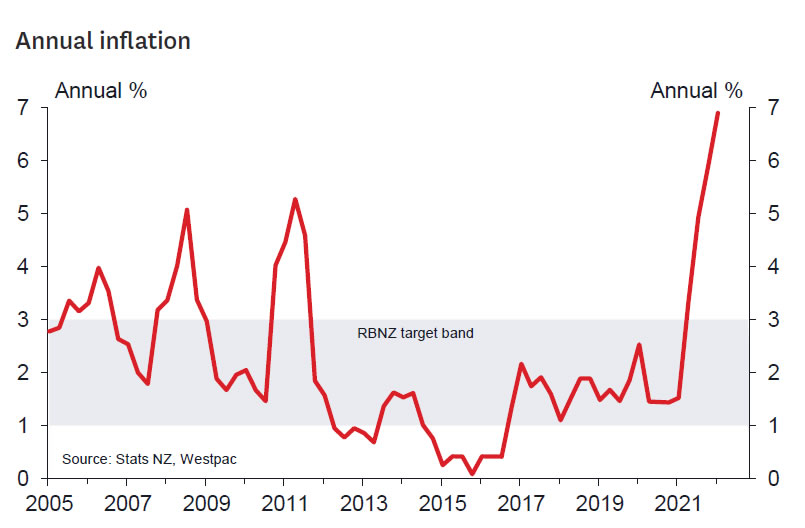
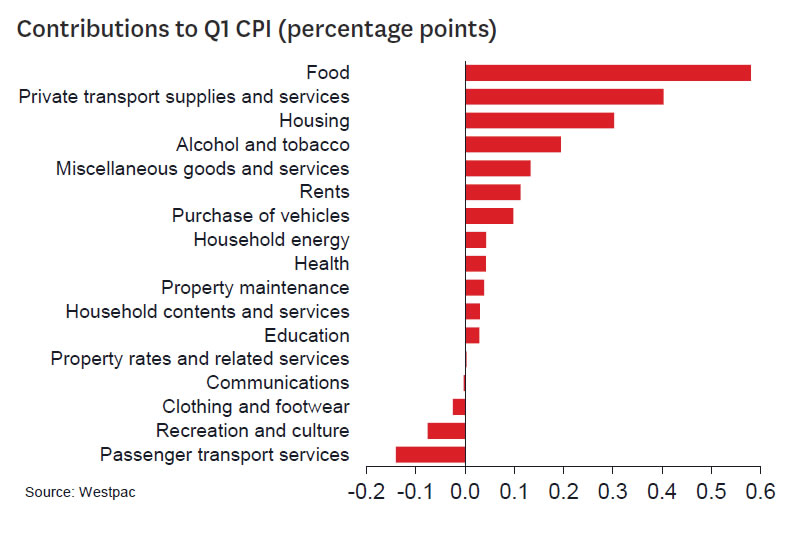
Much of the sharp rise in consumer prices in recent months has been due to large increases in the prices of food and petrol. However, the high level of inflation isn't just due to a few specific items. Price pressures are bubbling over in every corner of the economy.
In part that's due to global factors including ongoing disruptions to supply chains and high transport costs. Those pressures were reflected in the 8.5% annual rise in tradables prices (which mainly relates to the prices of imported goods).
At the same time, domestic inflation pressures are also running hot, with non-tradables inflation rising to 6% over the past year. New Zealand businesses have been reporting sharp increases in operating costs. That includes mounting upward pressure on wages as businesses struggle to attract and retain staff.
Compounding those cost pressures has been strong domestic demand in some key parts of the local economy. That's given businesses in sectors like construction greater scope to pass on cost increases into output prices, rather than taking a hit on margins.
The combination of those demand and supply pressures has resulted in strong and widespread price increases across the New Zealand economy. That was reflected in the suite of core inflation measures released by Stats NZ today, which smooth through quarter-to-quarter swings in prices and track the underlying trend in inflation. In fact, excluding food and energy costs, consumer prices are still up 5.9% over the past 12 months.
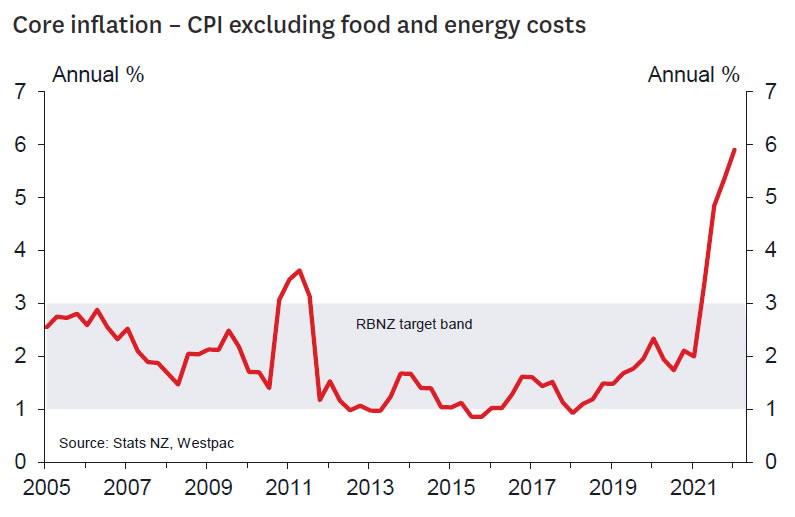
Given the prevalence of price and cost pressures, we expect inflation will remain elevated for some time yet. However, it's looking likely that the March quarter will prove to be the peak in the current inflation upswing. Over the past year we saw a rapid increase in cost pressures, including a doubling in international oil prices. We also saw large increases in the prices for a wide range of consumer goods and productive inputs as the global economy emerged from the initial Covid outbreak. Now, although inflation pressures are still rampant, much of those earlier very large increases in operating costs have already been passed into output prices. Consistent with that, the March quarter saw smaller than expected increases in the prices for a number of household durable items, such as appliances.
The March quarter also saw a more moderate (albeit still large) rise in construction costs after sizeable gains over the past year. This will be worth keeping a close eye on over the coming months. Rising construction costs have been a key driver of overall inflation over the past year. However, interest rates have been pushing higher and the housing market has turned down. Those factors are likely to be a drag on new construction activity over the coming year.
What does today's result mean for the RBNZ?
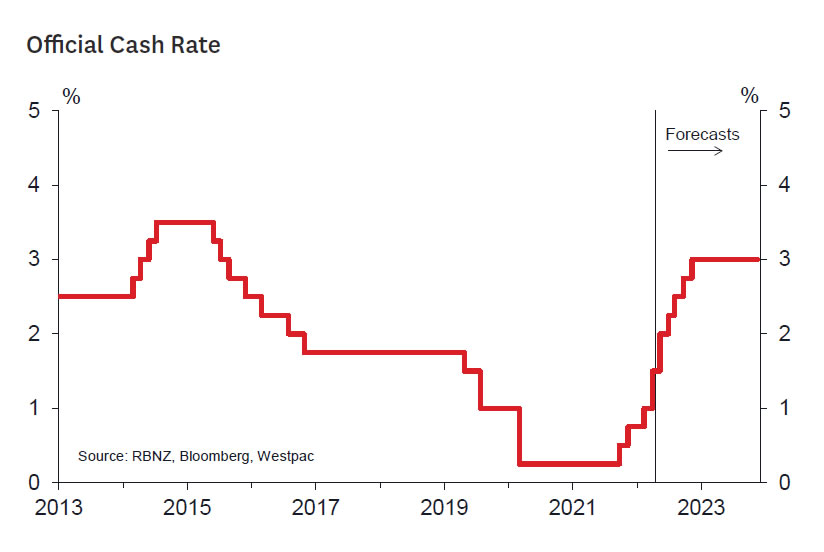
While a touch softer than we expected, today's result supports our expectations for a series of further rate hikes from the RBNZ over the coming months. We're forecasting a 50bp rise in the OCR at the RBNZ's May policy meeting, followed by 25bp increases at every meeting in the back half of the year.
Inflation is expected to remain above the RBNZ's target band through the remainder of 2022. And although much of that is due to overseas cost pressures, the domestic inflation picture has also heated up.
Crucially for the RBNZ, both households and businesses are expecting that inflation will remain strong for some time yet. That's a big concern for the central bank, as if that spills over into wage and price setting decisions, the strength in inflation could be sustained for even longer. That would mean that even larger interest rate increases are needed to rein the inflation monster in. On this front, it's notable that we're already seeing growing upwards pressure on wage claims.
Concerns about inflation expectations saw the RBNZ swing into action at its recent policy meeting with a 50bp increase in the cash rate. Today's strong inflation result will have done nothing to alleviate those concerns.
A closer look at the numbers.
The March quarter saw particularly large price increases in a number of areas.
The biggest contributor to the strong March quarter inflation result was food prices, which rose by 3.1% over the March quarter. That's the largest quarterly rise in more than a decade. Recent months have seen strong increases in the prices of fresh produce and meat, as well as larger than usual increases in the prices of many groceries.
The past three months also saw further large increases in housing costs. Much of that was related to the cost of purchasing a newly built home, which rose by 3.5% in the March quarter. That followed similarly large increases in recent quarters, with construction costs up a massive 18% over the past year.
Adding to the pressure on housing costs, rents have been rising rapidly, with an increase of around 1.1% in the March quarter.
Petrol prices have also risen strongly in recent months as the conflict in Ukraine has intensified. That saw local pump prices hitting record highs in March. And while the reduction in fuel taxes may have blunted some of the pain, prices over the March quarter as a whole were still around 9% higher than at the end of 2021. That's also adding to inflation more generally due to the related rise in transport and operating costs.
Finally, March quarter inflation was also boosted by the annual increase in tobacco excise taxes. That saw the prices for cigarettes and tobacco rising by 4.2%.
Providing a partial offset to the strong rises in other prices, domestic airfares fell 19% following the country's shift out of the Delta lockdown in late 2021. Both domestic and international airfares are likely to remain volatile for some time as travel patterns continue to adjust to changes in health restrictions.