

Sample Category Title
Eco Data 4/14/22
[php_everywhere instance="1"]
A 50-Point Rate Hike Has Not Saved NZD, CAD from a Sell-off
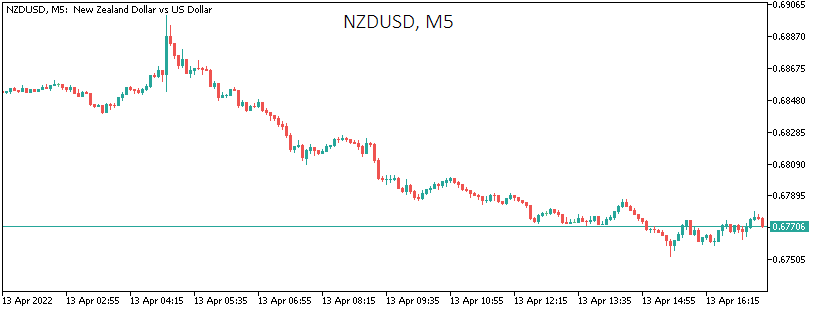
Today the central banks of Canada and New Zealand raised their key rates by 50 points at once. New Zealand was not expected to rise sharply, but that did not save the NZD from the ensuing sell-off.
A heavy downturn followed a predictable initial surge of 0.5%. The NZDUSD lost 2% from its intraday peak, pulling back to 0.6760.
Minutes ago, the Bank of Canada raised its rate by 50 points to 1.0% and announced the start of quantitative tightening from the end of April. But once again, we did not see CAD strengthening: after sharp swings right after the announcement, USDCAD remains near its highest levels since March 17th.
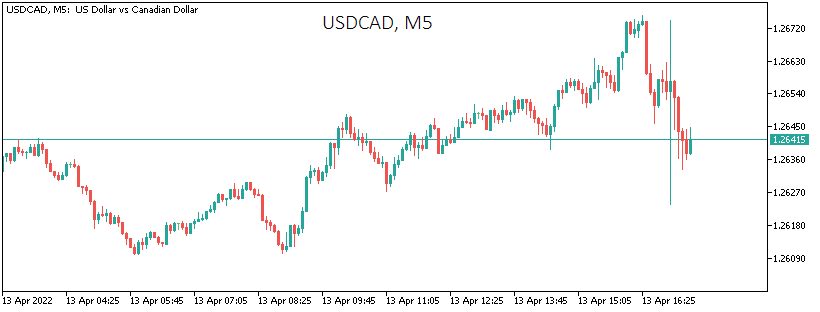
Judging by the reaction, the market is betting that the Fed will act even more aggressively by raising the rate by 50 points and announcing the start of active selling of securities from the balance sheet. On Thursday, there will be an ECB meeting from which no active rate action should be expected. By that logic, the euro is on the edge of a precipice, and the central bank might not have the strength to keep the euro from falling into it.
Bank of Canada Raises Rates by 0.50%
Canadian dollar yawns after rate hike
The Bank of Canada was expected to come out flying, and it certainly didn’t disappoint as it increased interest rates by 50-basis points. This was the second hike in two months after the central bank had kept rates at an ultra-low 0.25% for close to two years. New Zealand’s central bank increased rates by 50 basis points earlier today, and the Bank of Canada has become the first in the G-7 to implement “super-size” hikes of 0.50%. This marks the first time the BoC has implemented a 0.50% rate since May 2000. In addition, the BoC announced that it will begin shrinking its balance sheet, a process known as quantitatve tightening, at the end of April.
The dramatic news hasn’t had any impact on the Canadian dollar so far, which is unchanged on the day. USD/CAD was rising ahead of the announcement but has since given up all of those gains. That could change, depending on the reaction to Governor Macklem’s press conference.
The BoC has clearly come out swinging in a determined effort to stamp out red-hot inflation. Many market players will be grumbling “it’s about time”, as the Bank fell far on the inflation curve, with Macklem insisting that inflation would ease on its own. This is not how things unfolded, with inflation hitting 30-year highs, and the Bank is now playing catch-up.
The BoC embarked on its rate-hike cycle in March, and the markets expect a lot more tightening, with expectations that rates could be as high as 3% in 12 months’ time. The challenge for Macklem & Co. is to pilot the economy to a ‘soft landing’, whereby inflation is lowered without choking of growth. If the BoC is overly aggressive with its rate hikes, the result could be a recession.
Canada’s labour market is in excellent shape, and Friday’s solid employment report may have helped the BoC opt for a 0.50% rate hike. The economy added a respectable 72.5 thousand new jobs in March, and the unemployment rate fell to 5.3%, down from 5.5%.
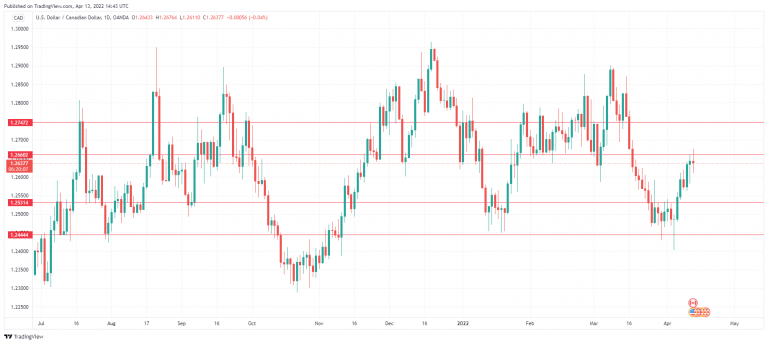
USD/CAD Technical
- USD/CAD broke above resistance at 1.2660 in the European session before retreating. Above, there is resistance at 1.2747
- There is support at 1.2531 and 1.2444
BoC Macklem: Impact of invasion of Ukraine likely to be small
In the post meeting press conference, BoC Governor Tiff Macklem said, the impact of the invasion of Ukraine on Canadian economic is "likely to be small" for two reasons. Firstly, "our economic links to Ukraine and Russia are very limited". Secondly, "while the war has reduced global growth overall, it has increased the demand and prices for commodities we produce and export, such as oil, potash and wheat."
He also said Canadians should expect interest rates to "continue to rise toward more normal settings". BoC estimates the neutral interest rate to be "between 2% and 3%". After today's rate hike, policy rate at 1% is "still well below neutral" and "below the pre-pandemic policy rate of 1.75%".
Full press conference statement here.
https://www.youtube.com/watch?v=MP07AI0NX5s
Bank of Canada Hikes Policy Rate to 1%, Starts QT
The Bank of Canada (BoC) raised the overnight rate to 1% and stated that it will start Quantitative Tightening (QT). This means that it will allow maturing government bond holdings to run off its balance sheet.
On the economic outlook, the Bank noted that "growth is strong and the economy is moving into excess demand. Labour markets are tight, and wage growth is back to its pre-pandemic pace and rising."
Its growth forecast remains solid, as the Bank believes "Canada’s economy will grow by 4¼% this year before slowing to 3¼% in 2023 and 2¼% in 2024. Robust business investment, labour productivity growth and higher immigration will add to the economy’s productive capacity, while higher interest rates should moderate growth in domestic demand."
On inflation, it stated that "CPI inflation is now expected to average almost 6% in the first half of 2022 and remain well above the control range throughout this year."
Key Implications
Bam! The BoC stepped up with a widely expected acceleration in its tightening cycle. With inflation pushing towards 6%, the labour market at full employment, and output pushing on capacity constraints, the Bank needed aggressive action. By raising the policy rate by 50 basis points for the first time in 22 years, the BoC is setting the pace for more aggressive moves in the coming months.
Our expectation is for the BoC to execute on another 50 basis point hike on June 1st and get the policy rate to 2% by year end. With the Bank's initiation of QT alongside higher policy rates, government bond yields should remain at current elevated levels.
EUR/USD: Bears Slow ahead of Key Support, Awaiting ECB’s Verdict on Thursday
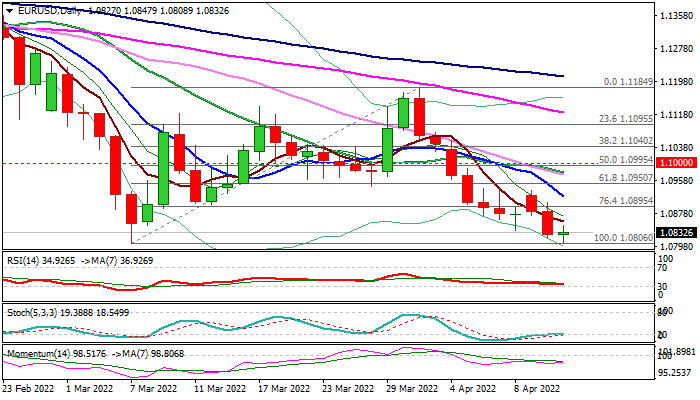
The Euro is trading at a reduced speed and just ticks above key support at 1.0806 (Mar 7 low) on Wednesday, as bears slow on headwinds from 1.0806 and ahead of tomorrow’s ECB policy meeting.
The bear-leg from 1.1184 (Mar 31 high) remains intact and looks for renewed probe through 1.0806 pivot (where larger downtrend stalled last month), break of which would signal bearish continuation and expose key longer-term support at 1.0635 (Mar 2020 low).
Bearish studies and daily and weekly chart support the action, but traders await the decision of the European Central Bank to get fresh direction signal.
Hawkish tone from President Lagarde would lift the Euro and sideline immediate downside risk, however, the single currency faces another risk from French presidential election, as two candidates go to the second round, with main fears of President Macron losing the election that would further undermine EU unity, already dented by rejection of Germany, Hungary and Slovakia to vote for embargo on Russia’s oil and natural gas.
Res: 1.0859; 1.0895; 1.0918; 1.0950
Sup: 1.0806; 1.0766; 1.0716; 1.0661
Yen Falls Apart, How Likely is FX Intervention?
The Japanese yen has been demolished lately, thanks to the Bank of Japan’s reluctance to join the global tightening party. There are growing whispers that Japanese authorities are about to intervene in the FX market, but this doesn’t seem like a realistic option yet.
Bulldozed
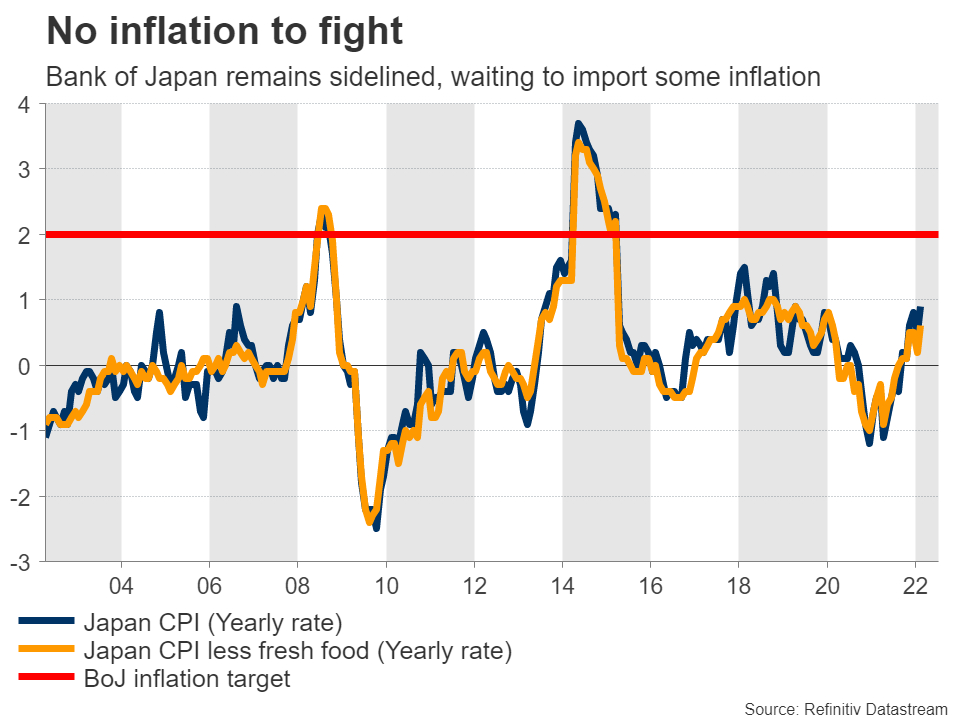
The yen has taken a heavy beating lately. Central banks around the world are raising interest rates to combat inflation, yet the Bank of Japan refuses to play this game. That’s because there isn’t much inflation to fight. The yearly CPI rate remains under 1%, defying the global inflationary storm.
In fact, if it wasn’t for the chaos in supply chains and roaring commodity prices, Japan would probably still be trapped in deflation. The BoJ knows this, so it is happy to lag behind every other central bank. With any luck, they might manage to import some inflation from abroad and hopefully break the deflationary mindset that’s tormented Japan for decades now.
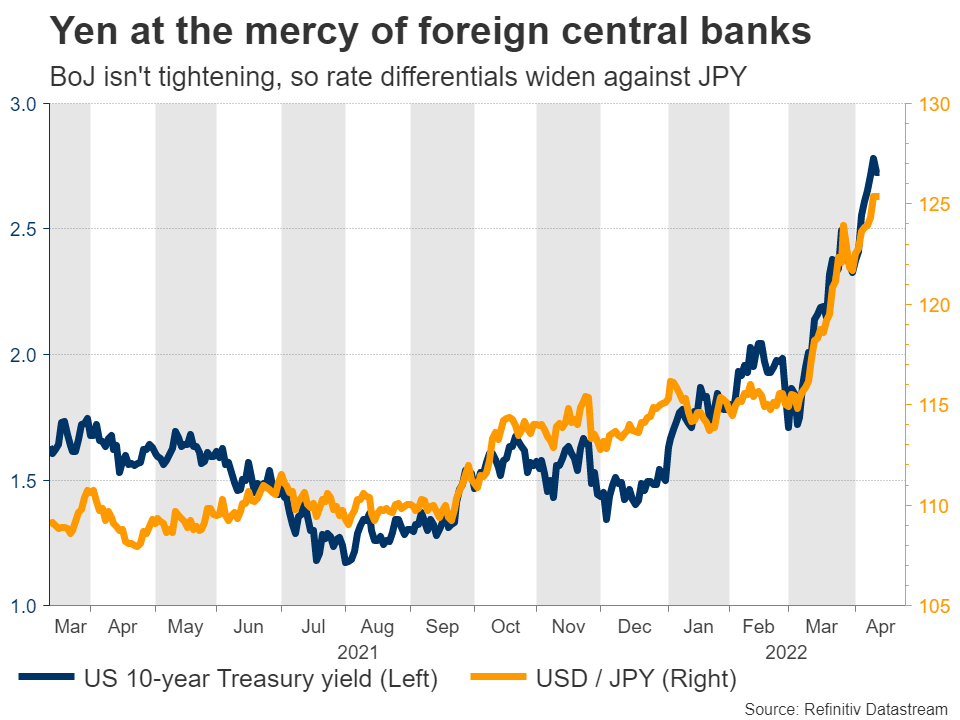
But for that to happen, the yen needs to suffer. Not only has the BoJ stayed away from signaling rate increases, it has doubled down on its yield curve control strategy, which keeps a ceiling on Japanese yields. This means that whenever foreign yields edge higher, rate differentials automatically widen against the yen since domestic yields cannot join the rally.
This dynamic has been on full display lately, with the yen losing 9% of its value against the US dollar so far this year. The nation’s reliance on imported energy and commodity products hasn’t helped either.
Intervention conditions not met
In a nutshell, the situation isn’t bad enough to warrant FX intervention yet. Past cases of intervention were typically coordinated with Europe and the US, calibrated to prevent excessive appreciation in the yen.
Now that the yen is falling, it’s questionable whether the Europeans and the Americans would play along. They would be weakening their own currencies for the yen to strengthen, exacerbating inflationary pressures in their own economies.
That’s highly unlikely, as the drop in the yen has been orchestrated by the BoJ and could help boost the export-oriented Japanese economy. So if there is intervention, it will likely be Japan doing it solo, burning through its FX reserves.
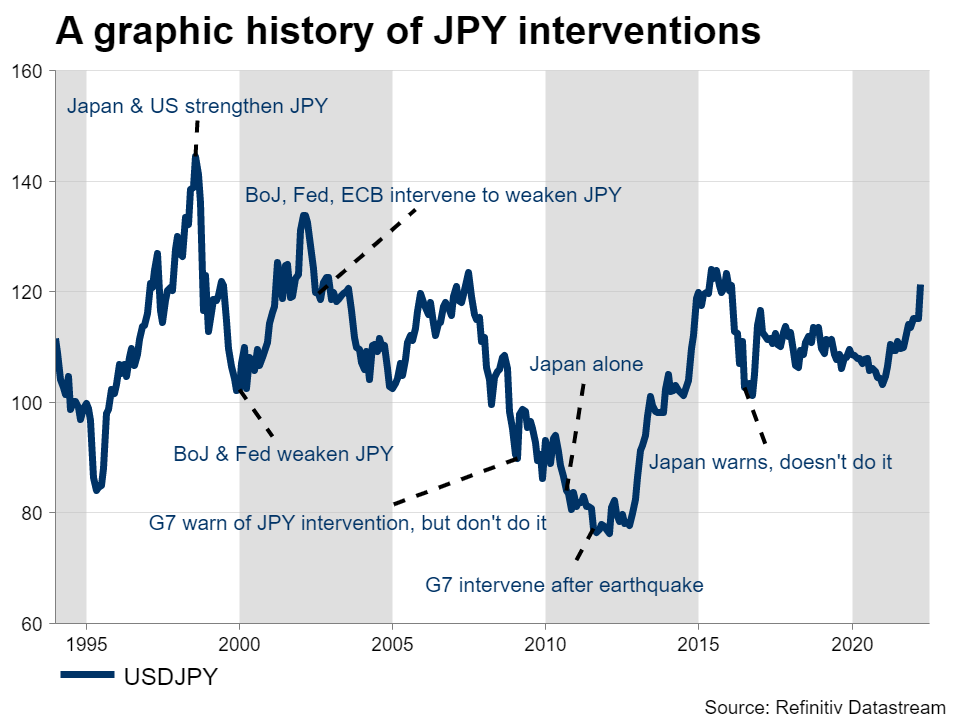
It seems that the ‘line in the sand’ is the 130 level against the US dollar. Several reports suggest the probability of intervention would rise dramatically if the yen crosses that level, although the speed of the move will also be crucial. A slow grind lower is not worrisome - a violent drop is.
The clearest sign that intervention is imminent would be Japanese authorities describing the yen’s moves as “one-sided” and “disorderly”. If that doesn’t do the trick, then expect to see ‘leaked reports’ that the BoJ is calling big interbank dealers to check yen quotes. These jawboning techniques are usually enough to stop market momentum without the need for action.
The final step would be a formal intervention warning from the finance minister. We are nowhere close to this stage.
What else can stop the bleeding?
One way to halt the yen’s downfall would be a ceasefire in Ukraine. Good news on the war would help cool commodity prices and by extension calm inflationary pressures, leading market participants to dial back their bets for aggressive rate increases by foreign central banks.
Money markets are currently pricing in another nine quarter-point rate increases from the Fed this year. If suddenly it seems like inflation is peaking, this number could be slashed down and US yields could fall back, sparking a relief rally in the battered yen.
Similarly, if China abandons its ‘zero covid’ policy, there would be less concern about distressed supply chains keeping inflation elevated, which may also lead investors to unwind some rate hike bets. Another way would be an implosion in global equity markets that sparks safe-haven demand for the yen.
Any of these events may be sufficient for a relief rally, but not a trend reversal.
Trend depends on BoJ
For a trend reversal, the Bank of Japan needs to turn the ship around and signal that it will tighten policy. Until that happens, the overall outlook for the yen remains negative.
The first step in the normalization process would be to widen the range in which Japanese yields are allowed to trade, essentially raising the ceiling. With the economy improving and inflation finally gathering some force, this can happen as early as this summer.
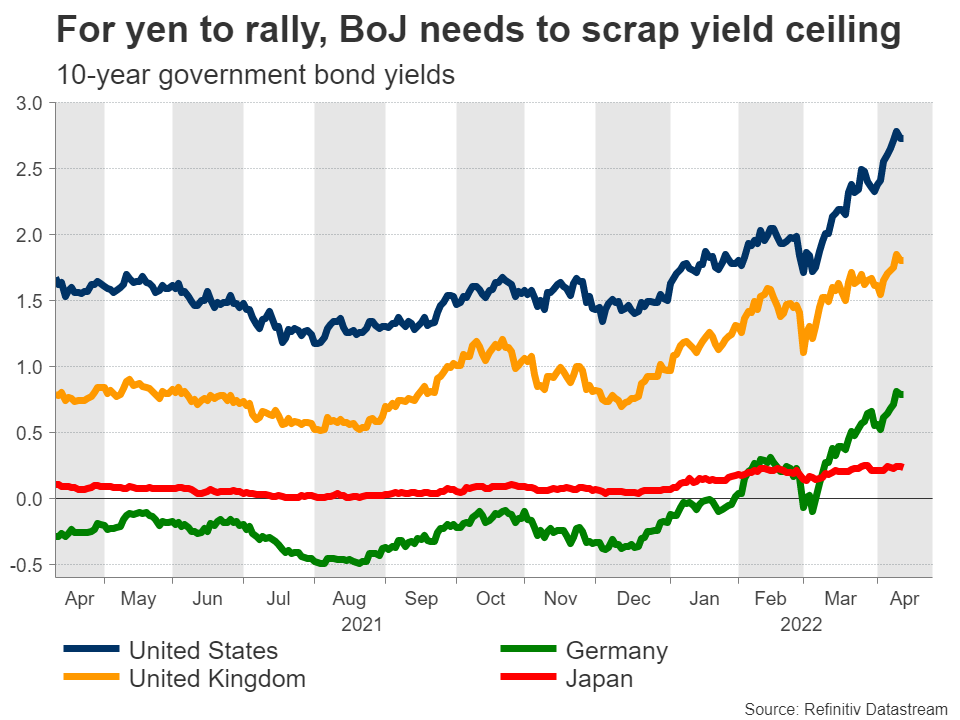
The next step would be to abandon yield curve control entirely and signal that higher rates are on the horizon. This is probably a story for year-end or early next year, but if it also coincides with ‘peak inflation’ in foreign economies, there might be a stunning reversal in the yen.
Until then, any recovery attempts could remain relatively shallow.
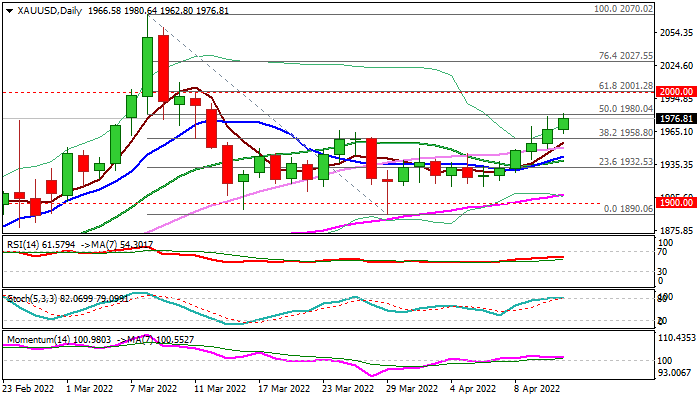
XAU/USD Outlook: Fresh Acceleration Higher Signals End of Month-Long Range
Spot gold extends advance into a fifth straight day and hit the highest in four weeks on Wednesday.
Fresh strength emerges above the month-long range, signaling that metal’s price is establishing in a fresh direction, after holding in directionless mode since mid-March.
The yellow metal is becoming again interesting for investors, as safe-haven asset, as well as a hedge against inflation.
Soaring inflation in a number of developed economies, as the war in Ukraine caused energy and commodity prices to rally, fading risk appetite on growing uncertainty and expected slower growth that boosts fears about recession, boost demand for the metal and lift the price.
Bulls cracked important barrier at $1980 (50% retracement of $2070/$1890) on Wednesday, with sustained break here to open way for renewed attack at psychological $2000 level (also Fibo 61.8% of $2070/$1890).
The action is supported by rising and thickening daily cloud and a higher base that has formed at $1900 zone on a weekly chart, also underpin the action.
Daily studies are mixed and suggest bulls may face headwinds on approach to $2000 pivot, but firmly bullish weekly techs point to strong underlying uptrend and signal limited dips (ideally to be contained by daily cloud top at $1952) could precede fresh acceleration higher and repeated probe above $2000, after early March rally peaked at $2070 but failed to hold gains that resulted in a pullback to $1900 zone.
Res: 1980; 1990; 2000; 2009.
Sup: 1966; 1958; 1949; 1942.
Sunset Market Commentary
Markets
We’ve started the day with UK March inflation numbers spiking to a 30-yr high of 7% Y/Y, with the peak not yet in place. The unexpected fresh acceleration strengthens market thinking that the Bank of England won’t be able to pause its tightening cycle this year to avoid amplifying the developing cost-of-living crisis. A May 5 25 bps rate hike is fully discounted with more and more investors betting on a larger 50 bps move as global central banks following the Central-European example of stepping up the tightening cycle. The Reserve Bank of New Zealand this morning provided the latest evidence by lifting the policy rate from 1% to 1.5%. UK Gilts underperform US Treasuries and German Bunds. The UK yield curve bear steepens today with yields adding 1.7 bps (2-yr) to 3.6 bps (20-yr). Sterling showed no immediate response, but EUR/GBP is drifting south in lockstep with EUR/USD going into tomorrow’s ECB meeting. The pair trades around 0.8315 with first intermediate support around 0.8308/0.8296. Today’s eco calendar had little more to offer apart from -surprise, surprise – an acceleration of US producer prices in March (1.4% M/M and 11.2% Y/Y). Yesterday’s general market trends in Europe/US just continued in these setting. Especially US Treasuries gain some additional relieve (at the front end) in a move that started after the March US CPI release. The US yield curve bull steepens with yields dropping by 11.6 bps (3-yr) to 0.9 bps (30-yr). German yield lose around 0.5 bps to 1.5 bps across the curve. Brent crude’s leap towards $107/b (from <$100/b yesterday morning) has no significant impact on bond markets. EUR/USD remains in the defensive despite this relative yield development as investors don’t want to be wrongfooted by ECB’s Lagarde tomorrow. The pair drifts towards the 1.0806 YTD low. The Japanese yen is probably today’s biggest victim from the higher oil price. USD/JPY moved beyond the 2015 high of 125.86 to trade above 126 for the first time since 2002. It prompted a verbal intervention from Japanese FM Suzuki who said that sudden moves in the FX rates are very problematic which the government will watch with great care. JPY wasn’t really impressed by this intervention hint. News Headlines
Leading German economic institutes in a collective assessment on the economy downwardly revised their growth forecast for the country to 2.7% this year from 4.8% in the autumn of last year. The downward revision was mainly due to the impact of the war in Ukraine. However, also a more negative development of the pandemic during the winter than previously expected caused a ‘lower starting’ point for this year’s growth. GDP growth is expected to accelerate to 3.1% next year up from 1.9% previously. Inflation this year is expected at 6.1% with prices rising another 2.8% next year. These forecasts assume that gas supply from Russia will continue and that there will be no further economic escalation related to the conflict. In a scenario of a complete stop of Russian gas deliveries, the institutes see economic growth slowing to 1.9% this year and an economic contraction of 2.2% next year. Such a stop would cost the German economy a cumulative loss of €220bn over 2022 and 2023 combined.
According to a news topic at a state-run Television reported by Bloomberg the Chinese state council reiterated its commitment to use monetary policy tools including a reduction in the Reserve Requirement Ratio (RRR) in order to step up financial support to the economy, in particular industries and small business that are hit hard by the pandemic. This commitment of economic support comes as the economic outlook for Chinese growth worsens as lockdowns measures were put in place in several important economic centra including in Shanghai. This economic setback was also visible in the Chinese trade data this morning. Imports in March unexpectedly declined (-0.1% Y/Y in USD terms). The decline might both be due to logistic/transport disruptions because of the COVID lockdowns as well as the result of a slowdown in domestic demand.
BoC hikes by 50bps, starts QT, maintains tightening bias
BoC raises overnight rate by 50bps to 1.00% as widely expected. The Bank Rate and deposit rate are increased to 1.25% and 1.00% respectively. Additionally, BoC announced to end the asset reinvestment phase and starts quantitative tightening, effect April 25.
BoC also maintains tightening bias, and said, "with the economy moving into excess demand and inflation persisting well above target, the Governing Council judges that interest rates will need to rise further." The timing and pace of further rate hikes will be guided by ongoing assessment of the economy.
In the Monetary Policy Report, BoC projects the Canadian economy to growth by 4.25% in 2022, then slow to 3.25% in 2023 and then 2.25% in 2024. CPI inflation is projected to average almost 6% in H1 2022, and remain "well above the control range through this year". CPI is then expected to ease to 2.25% in H2 of 2023, and return to 2% target in 2024. But "there is an increasing risk that expectation s of elevated inflation could become entrenched.