Sample Category Title
The Correction on US Yields Didn’t Hurt the Dollar
Markets
Yesterday’s US CPI caused investors to take a step backward and assess the standing uptrend in US/global yields. Both the headline CPI (1.2% M/M and 8.5% Y/Y) and core (0.3% M/M and 6.5% Y/Y) reached the highest levels since 1981/1982, but contrary to previous months, there was no upside surprise. Core inflation even rose less than expected. The jury is still out whether this marked some kind of peak. Even if so, a more important question is whether this will be start of a real and protracted slowdown (decline in M/M dynamics).
Whatever, after touching cycle peaks for yields at maturities longer than 5 year earlier, US bonds were caught in a ‘profit taking short-squeeze’. The US yield curve steepened with the 2-y/5-y easing 9.2/9.5 bps, the 10-y lost 5.9 bps. The 30-y still gained marginally (+0.1 bp). Markets now will look out for further Fed communication on frontloading of policy normalization. We don’t expect any change of the (hawkish) tone yet.
EMU markets showed a similar steepening move (German 2-y -5.3 bps, 30-y + 1.9 bps), but the correction was more modest as investors were looking forward to the assessment at the ECB meeting tomorrow.
The easing in the bond sell-off initially propelled US equities. However, headlines from Russian president Putin that talks with Ukraine were ‘at a dead end’ dampened optimism. Major US indices closed about 0.3% lower.
The correction on US yields didn’t hurt the dollar. On the contrary: DXY closed north of 100 for the first time since May 2020. EUR/USD immediately after the US CPI release touched the 1.09 area, but the move lacked momentum and persistent uncertainty on the war in Ukraine/Putin comments didn’t help. EUR/USD closed at 1.0828, within reach of the YTD low of 1.0806. USD/JPY also closed little changed at 125.38.
This morning, the pause in the US yield rally also gives some breathing room for Asia. Equity markets mostly trade in positive territory with Japan outperforming. The dollar remains well bid. USD/JPY (125.60) is again with reach of the 2015 top (125.86).
Later today, the calendar contains the US PPI (headline expected to rise to 10.6%). However, we doubt this report will change markets’ assessment after yesterday’s CPI release.
On interest rate markets, we look out whether yesterday’s correction as further to go. The picture/trend especially for LT yields both in the US and Europe hasn’t changed in any profound way. Especially in Europe, an ongoing rise in inflation expectations supports yields at longer maturities.
On FX markets question is whether EUR/USD can avoid a return/break of the 1.0806 YTD low. Probably a convincing anti-inflation message from Lagarde an Co is needed to ‘save’ the euro.
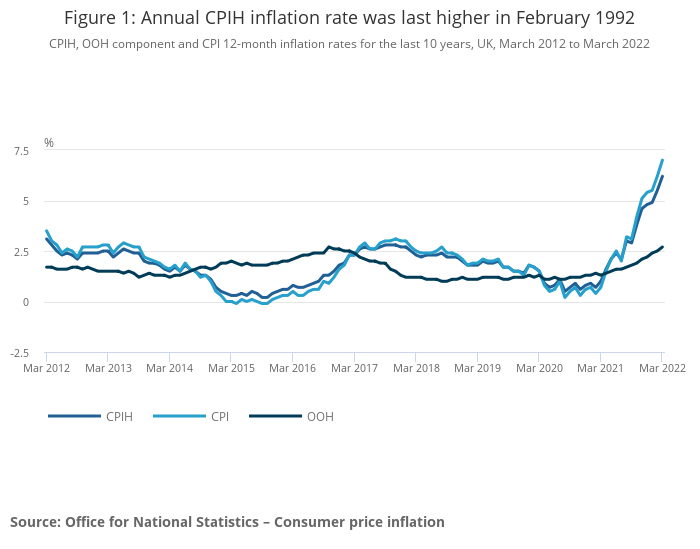
his morning, both UK core (5.7% Y/Y) and headline CPI (7.0% y/y) surprised on the upside. It questions recent soft BoE speak. Even so, sterling hardly gains in a first reaction (EUR/GBP 0.8330).
News Headlines
Fed Bullard: Getting to neutral isn’t going to be enough
St Louis Fed President James Bullard said in an FT interview, there's "a bit of a fantasy" in current policy in centrals banks to think thank inflation could be brought down by moving interest rate to neutral.
"Neutral is not putting downward pressure on inflation. It's just ceasing to put upward pressure on inflation," he said. "We have to put downward pressure on the component of inflation that we think is persistent."
"Getting to neutral isn't going to be enough it doesn't look like, because while some of the inflation may moderate naturally . . . there will be a component of it which won't," he added.
Bullard also warned that this week's CPI report just " underscores the urgency that the Fed is behind the curve and needs to get moving."
"If markets and households get the idea that the Fed's not going to do the right thing and not going to keep inflation under control, then you have to gain credibility by actually doing things that show them that you are serious," he said.
UK CPI jumped to 7% in Mar, highest since 1992
UK CPI rose 1.1% mom in March, above expectation of 0.7% mom. For the 12-month period, CPI accelerated from 6.2% yoy to 7.0% yoy, above expectation of 6.7% yoy. That's the highest rate in the historic modeeled series since March 1992, when it stood at 7.1% yoy. RPI rose 1.0% mom, 9.0% yoy, versus expectation of 0.9% mom, 8.8% yoy.
Also released, PPI input came in at 5.2% mom, 19.2% yoy, above expectation of 0.5% mom, 13.4% yoy. PPI output rose 2.0% mom, 11.9% yoy, above expectation of 0.7% mom, 10.2% yoy. CCPI output core rose 2.0% mom, 12.0% yoy, above expectation of 0.9% mom, 10.6% yoy.
FTSE 100 Seeks Support
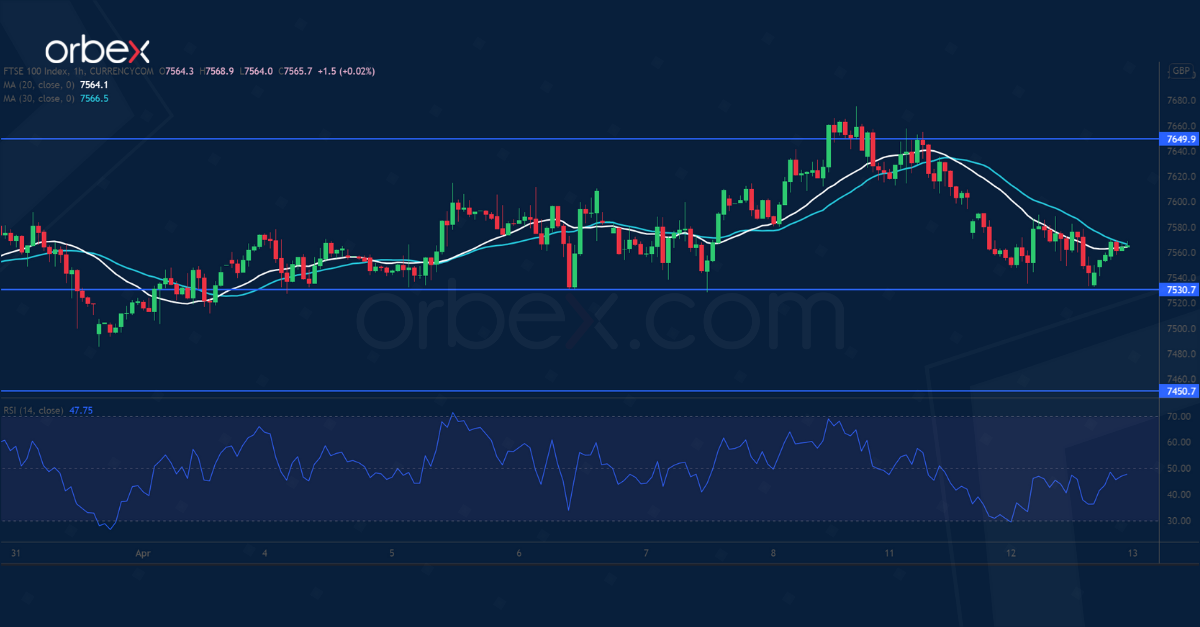
The FTSE 100 struggles as UK consumer confidence wanes amid geopolitical uncertainty. The index has met stiff selling pressure near the recent peak (7690).
A combination of profit-taking and fresh selling weighs on price action. Nonetheless, sentiment remains upbeat. And a bullish MA cross on the daily chart suggests strong impetus in the latest recovery.
7530 is fresh support and 7450 is the second line of defense in case of a deeper retreat. The bulls need to clear 7650 before they could regain the upper hand in the short term.
XAU/USD Bounces Higher
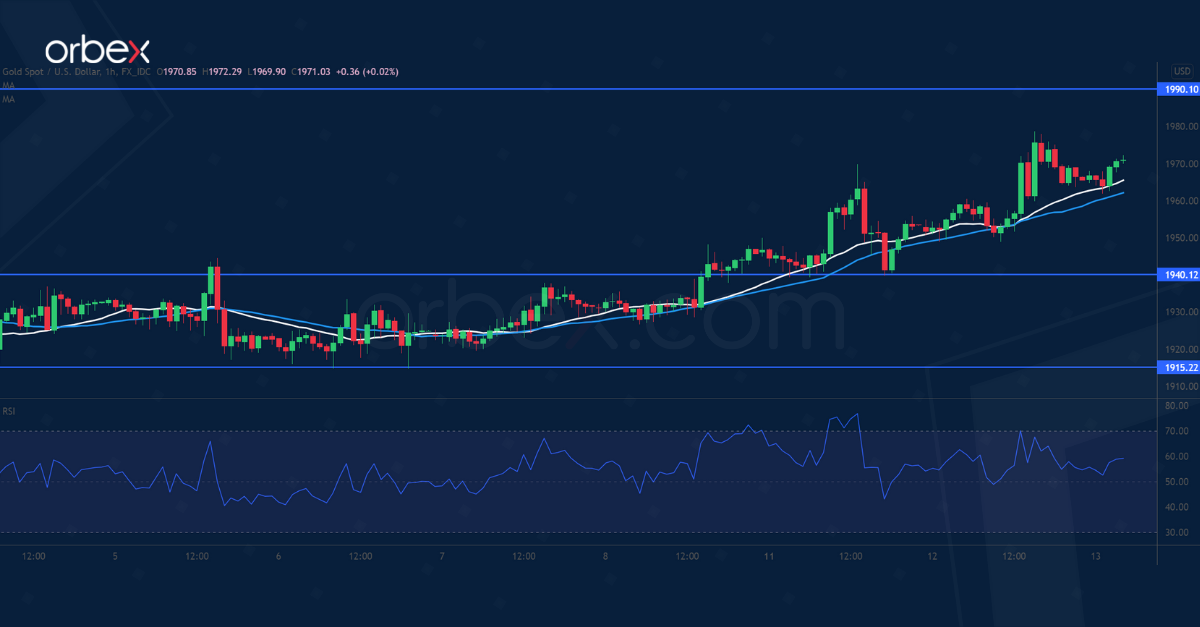
Gold rallied after US inflation in March came out less than market participants had expected. The metal’s medium-term uptrend is still intact as long as the price is above the major support at 1895.
The recent consolidation could be an opportunity for the bulls to accumulate. A break above 1965 prompted some sellers to cover. This could also pave the way for a bullish reversal.
1990 is the next hurdle and its breach may send bullion to the March high at 2070. 1940 is the immediate support in case of a pullback.
NZD/USD Tests Resistance
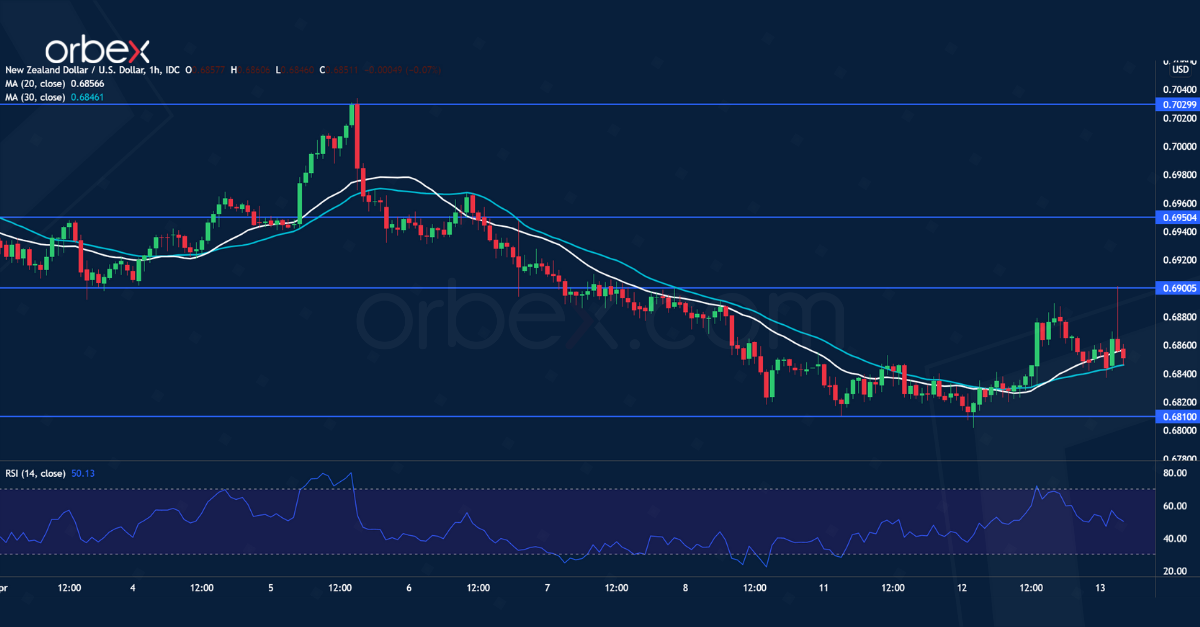
The New Zealand dollar bounced back after the RBNZ raised its interest rates by 50bp. The pair came under pressure after hitting resistance near the psychological level of 0.7000.
The kiwi then saw bids at 0.6810 near the base of a previous bullish breakout. A rally above the support-turned-resistance at 0.6900 may turn sentiment around. The next hurdle will be 0.6950.
A fall below 0.6810 could trigger a sell-off towards the daily support at 0.6740. And that is an important level safeguarding the March rebound.
Crude Oil Jumps above $100pb, Putin Rubs His Hands
US equity investors jumped on an emotional roller-coaster following the release of the inflation data in the US yesterday. The data came in at 8.5% for March, in line with expectations. This was the highest jump since 1981, and the straight 13th month read above the Federal Reserve’s (Fed) 2% policy target.
Yet, the core inflation, which filters out the impact of volatile food and energy prices, came in at lowest since September, giving some hope to investors that inflation may soon hit a high and start easing, hence get the Fed to move less hurriedly for raising the interest rates. Perhaps a wishful thinking that helped the US equities gap higher at the open, but couldn’t cement gains as all three major US indices ended the session in the negative.
US equity futures are in the positive at the time of writing, hinting at a minor rebound at today’s session, but the high energy prices, the pandemic and the war, combined with the Fed’s tied hands can’t do much to boost the investor mood. Only hope is earnings, but…
…the expectations for the bank earnings are soft this quarter. The net income for the six biggest American banks is expected to fall about 35% from a year ago, also including the major deceleration in activity in March due to the war in Ukraine and the loss due to exiting operations in Russia.
JP Morgan will announce its Q1 earnings today, and the CEO Dimon warned that the bank could lose about $1 billion on its Russia exposure. JP Morgan has been trading lower since last October despite the hawkish shift in Fed expectations. Worries that the economic slowdown could result in lower trading activity, and lower loan growth, and jeopardize the gains from higher interest margins weigh on the sector.
Banks, listed among the favourite reflation trades, haven’t proved to be resilient to the rising yields.
US’ gas tweak
Because gas prices drive more than the half of the monthly rise in inflation, US government is also rolling up its sleeves to ease the pressure at the pump. The US announced yesterday that it will allow the sale of gas with higher ethanol content – which sells with some 15% discount compared with the regular gas, to reduce the US dependence on foreign gas. But first, they need to change the anti-pollution rules as the gas with ethanol is dirtier. It looks like the worry of inflation is worse than the worry for climate change.
Crude oil made a sharp U-turn yesterday, and rebounded more than 6% as the dip-buyers piled in after the price of a barrel slipped below the $93 mark earlier this week and consolidates near the $100pb level at the time I am talking. The fact that Putin wants to continue the war in Ukraine is pointed as the major reason behind the sharp rebound. The recent rebound in oil prices come as a confirmation that the latest relief was nothing more than a temporary correction and the overall trend remains comfortably positive.
One’s misfortune is other’s happiness
But one country’s misfortune is another country’s happiness. The rally in oil prices help Russia reach a record surplus in its current account, along with the fact that the sanctions weighed on imports and triggered circa 270% capital outflows compared to a year ago.
The Institute of International Finance projects that Russia will post a record $250 billion this year, which could make up for a major part of the central bank reserves that have been frozen by the Western sanctions. It doesn’t mean that the Russian economy will do fine, as the living standards will be deteriorating heavily for households, but the regular and resilient money inflow from oil and gas sales will continue financing the war in Ukraine. So, the European ban on Russian coal, which represents about less than 5% of the money paid to Russia, won’t do much unless Europe takes the difficult step to ban oil and gas imports from Russia. For now, the EU prefers sending arms.
Fixed Income Rally
Market movers today
Today Bank of Canada is set to hike policy rates for the second time in the cycle and announce a passive roll-off of its balance sheet likely beginning in May. Consensus and markets are leaning towards a 50bp hike but we cannot rule out another 25bp hike even if recent inflation surprises and labour market data do suggest that Bank of Canada - like neighbouring Fed - has fallen behind the curve.
Today is a quiet day in terms of economic data releases. Note that there are no Danske Morning Mail tomorrow and Friday due to Easter. Tomorrow, the key event is the ECB meeting, where we expect Lagarde to put a September rate hike into play.
This morning, UK CPI inflation is due out. We expect another increase, which supports the case for more rate hikes.
In Sweden, the small Prospera inflation expectations survey is due out, which is an important input for the timing of Riksbank rate hikes.
The 60 second overview
US FI rally: It was a choppy trading session yesterday where notably the US treasuries dropped 10bp on the US CPI release as markets focused on the 0.3% mom increase 'only', rather than the 8.5% headline figure. The EGBs followed suit, but only by 4bp, accelerating the yield decline initiated by a further deterioration in the German ZEW figure released earlier on the day. By the end of the trading session we were left with a bullish steepening of the EGB curves. The long end of the curve has recorded some very volatile trading sessions. The 10s30s EUR swap started Monday morning close to -24bp, but now stands at 18.5bp.
RBNZ: In line with our expectation, the Reserve Bank of New Zealand (RBNZ) hiked its official cash rate by 50bp in its meeting overnight. RBNZ was worried that the ongoing global inflationary pressures would increasingly feed into higher long-term inflation expectations amid fast domestic inflation and tight labor market. While RBNZ did acknowledge the rising economic risks, it also noted that despite the earlier rate hikes, the current level of the cash rate is still considered stimulatory and thus it was willing to accelerate the process of moving towards neutral. This is in line with our general view that global financial conditions still need to be tightened further. While consensus was expecting only a 25bp hike, a 50bp move was largely priced in the markets ahead of the meeting, and the initial rally in NZD faded quickly.
Equities: Equities lower again yesterday but in a bit more rollercoaster session where both US and Europe were in green during the day. Better performance in cyclicals yesterday and also small cap holding up better as yields finally took a pause on back of the US CPI number. VIX a tad lower as well. Asian stocks are higher this morning with relative strong gains in both Japan and South Korea. US futures are higher while European once are lower this morning.
FI: It was a choppy trading session yesterday where notably the US treasuries dropped 10bp on the US CPI release.
FX: The US CPI induced setback to USD proved short-lived with the DXY index posting new highs and EUR/USD reaching new lows just north of 1.08 at close. Both EUR/NOK and EUR/SEK price action was dominated by EUR-weakness brought by another rise in energy prices. GBP/USD keeps testing the 1.30-mark.
Credit: Having trended wider over the past week, iTraxx Main held steady at 78bp yesterday. Meanwhile, iTraxx Xover was slightly tigher by 6bp to 370bp. Despite the Easter week, there was some activity in the primary market yesterday, with UK power company SSE printing a EUR1bn hybrid, though demand did not seem overwhelming indicating that the market is still challenging.
EUR/USD Daily Outlook
Daily Pivots: (S1) 1.0797; (P) 1.0850 (R1) 1.0880; More...
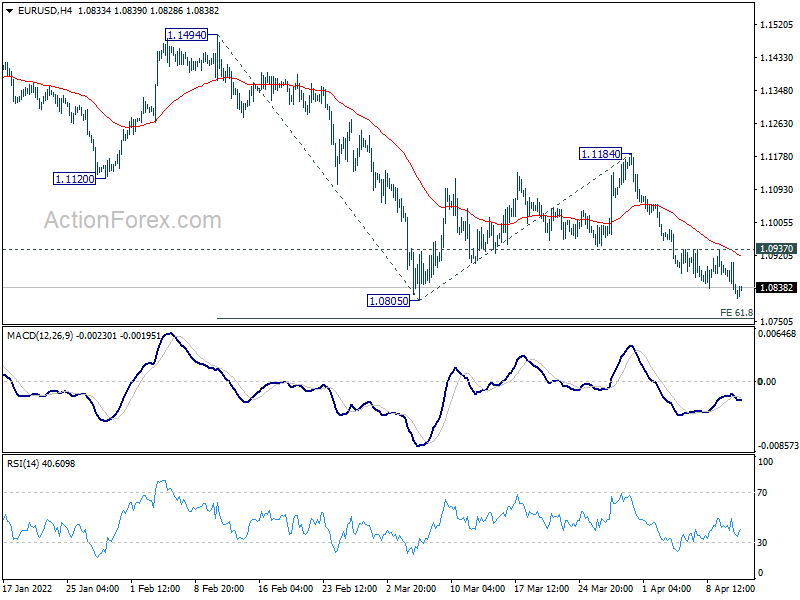
Intraday bias in EUR/USD stays neutral with focus on 1.0805 low. Decisive break there will resume larger down trend to 61.8% projection of 1.1494 to 1.0805 from 1.1184 at 1.0758, and then 100% projection at 1.0495. On the upside, however, break of 1.0937 minor resistances will extend the consolidation pattern from 1.0805 with another rising leg.
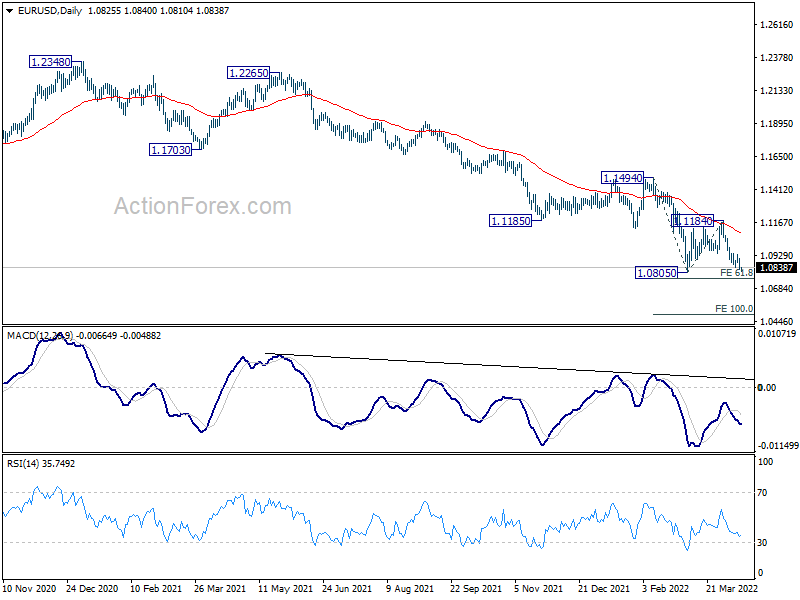
In the bigger picture, the decline from 1.2348 (2021 high) is expected to continue as long as 1.1494 resistance holds. Firm break of 1.0635 (2020 low) will raise the chance of long term down trend resumption and target a retest on 1.0339 (2017 low) next. Nevertheless, break of 1.1494 will maintain medium term neutral outlook, and extending term range trading first.
GBP/USD Daily Outlook
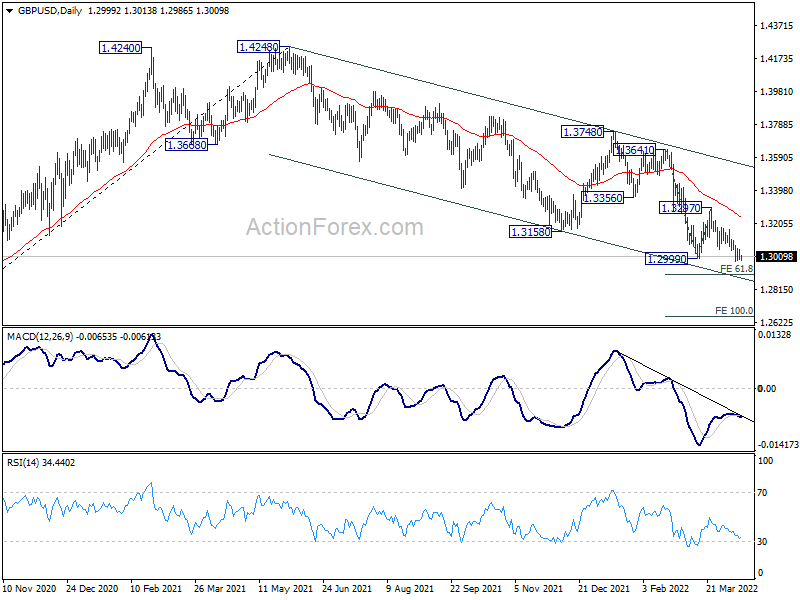
Daily Pivots: (S1) 1.2979; (P) 1.3017; (R1) 1.3039; More...
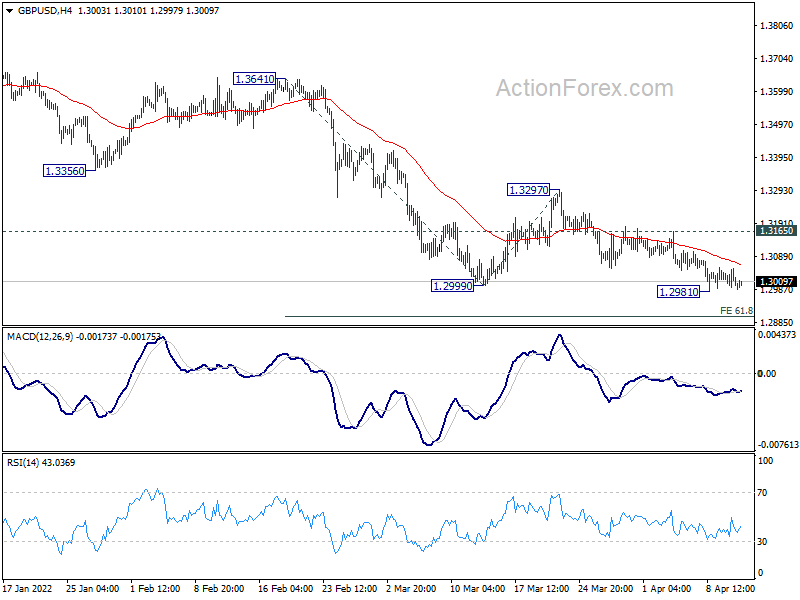
Intraday bias in GBP/USD remains neutral for some consolidations, but outlook stays bearish as long as 1.3165 resistance holds. Break of 1.2981 will resume larger down trend to 61.8% projection of 1.3641 to 1.2999 from 1.3297 at 1.2900.
In the bigger picture, rise from 1.1409 (2020 low) has completed at 1.4248. Decline from 1.4248 could still be a corrective move, or it could be the start of a long term down trend. In either case, deeper decline would be seen back to 61.8% retracement of 2.1161 to 1.1409 at 1.2493. In any case, break of 1.3748 resistance is needed confirm completion of the fall from 1.4248, or outlook will stay bearish.