Sample Category Title
BoC hikes by 50bps, starts QT, maintains tightening bias
BoC raises overnight rate by 50bps to 1.00% as widely expected. The Bank Rate and deposit rate are increased to 1.25% and 1.00% respectively. Additionally, BoC announced to end the asset reinvestment phase and starts quantitative tightening, effect April 25.
BoC also maintains tightening bias, and said, "with the economy moving into excess demand and inflation persisting well above target, the Governing Council judges that interest rates will need to rise further." The timing and pace of further rate hikes will be guided by ongoing assessment of the economy.
In the Monetary Policy Report, BoC projects the Canadian economy to growth by 4.25% in 2022, then slow to 3.25% in 2023 and then 2.25% in 2024. CPI inflation is projected to average almost 6% in H1 2022, and remain "well above the control range through this year". CPI is then expected to ease to 2.25% in H2 of 2023, and return to 2% target in 2024. But "there is an increasing risk that expectation s of elevated inflation could become entrenched.
(BOC) Bank of Canada increases policy interest rate by 50 basis points, begins quantitative tightening
The Bank of Canada today increased its target for the overnight rate to 1%, with the Bank Rate at 1¼% and the deposit rate at 1%. The Bank is also ending reinvestment and will begin quantitative tightening (QT), effective April 25. Maturing Government of Canada bonds on the Bank's balance sheet will no longer be replaced and, as a result, the size of the balance sheet will decline over time.
Russia's ongoing invasion of Ukraine is causing unimaginable human suffering and new economic uncertainty. Price spikes in oil, natural gas and other commodities are adding to inflation around the world. Supply disruptions resulting from the war are also exacerbating ongoing supply constraints and weighing on activity. These factors are the primary drivers of a substantial upward revision to the Bank's outlook for inflation in Canada.
The war in Ukraine is disrupting the global recovery, just as most economies are emerging from the impact of the Omicron variant of COVID-19. European countries are more directly impacted by confidence effects and supply dislocations caused by the war. China's economy is facing new COVID outbreaks and an ongoing correction in its property market. In the United States, domestic demand remains very strong and the US Federal Reserve has clearly indicated its resolve to use its monetary policy tools to control inflation. As policy stimulus is withdrawn, US growth is expected to moderate to a pace more in line with potential growth. Global financial conditions have tightened and volatility has increased. The Bank now forecasts global growth of about 3½% this year, 2½% in 2023 and 3¼% in 2024.
In Canada, growth is strong and the economy is moving into excess demand. Labour markets are tight, and wage growth is back to its pre-pandemic pace and rising. Businesses increasingly report they are having difficulty meeting demand, and are able to pass on higher input costs by increasing prices. While the COVID-19 virus continues to mutate and circulate, high rates of vaccination have reduced its health and economic impacts. Growth looks to have been stronger in the first quarter than projected in January and is likely to pick up in the second quarter. Consumer spending is strengthening with the lifting of pandemic containment measures. Exports and business investment will continue to recover, supported by strong foreign demand and high commodity prices. Housing market activity, which has been exceptionally high, is expected to moderate.
The Bank forecasts that Canada's economy will grow by 4¼% this year before slowing to 3¼% in 2023 and 2¼% in 2024. Robust business investment, labour productivity growth and higher immigration will add to the economy's productive capacity, while higher interest rates should moderate growth in domestic demand.
CPI inflation in Canada is 5.7%, above the Bank's forecast in its January Monetary Policy Report (MPR). Inflation is being driven by rising energy and food prices and supply disruptions, in combination with strong global and domestic demand. Core measures of inflation have all moved higher as price pressures broaden. CPI inflation is now expected to average almost 6% in the first half of 2022 and remain well above the control range throughout this year. It is then expected to ease to about 2½% in the second half of 2023 and return to the 2% target in 2024. There is an increasing risk that expectations of elevated inflation could become entrenched. The Bank will use its monetary policy tools to return inflation to target and keep inflation expectations well-anchored.
With the economy moving into excess demand and inflation persisting well above target, the Governing Council judges that interest rates will need to rise further. The policy interest rate is the Bank's primary monetary policy instrument, and quantitative tightening will complement increases in the policy rate. The timing and pace of further increases in the policy rate will be guided by the Bank's ongoing assessment of the economy and its commitment to achieving the 2% inflation target.
Information note
The next scheduled date for announcing the overnight rate target is June 1, 2022. The Bank will publish its next full outlook for the economy and inflation, including risks to the projection, in the MPR on July 13, 2022.
A market notice providing operational details for QT will be published this morning on the Bank's web site.
EUR/USD Mid-Day Outlook
Daily Pivots: (S1) 1.0797; (P) 1.0850 (R1) 1.0880; More...
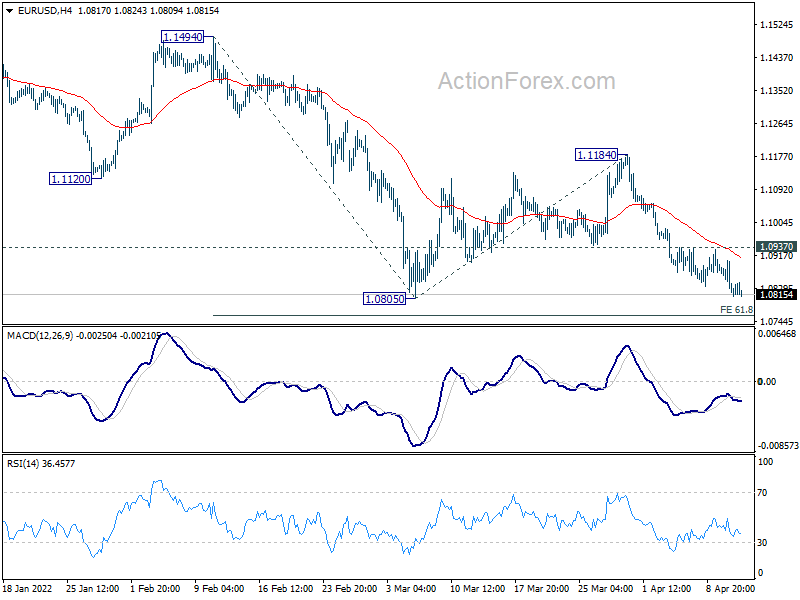
Focus stays on 1.0805 low in EUR/USD. Decisive break there will resume larger down trend to 61.8% projection of 1.1494 to 1.0805 from 1.1184 at 1.0758, and then 100% projection at 1.0495. On the upside, however, break of 1.0937 minor resistances will extend the consolidation pattern from 1.0805 with another rising leg.
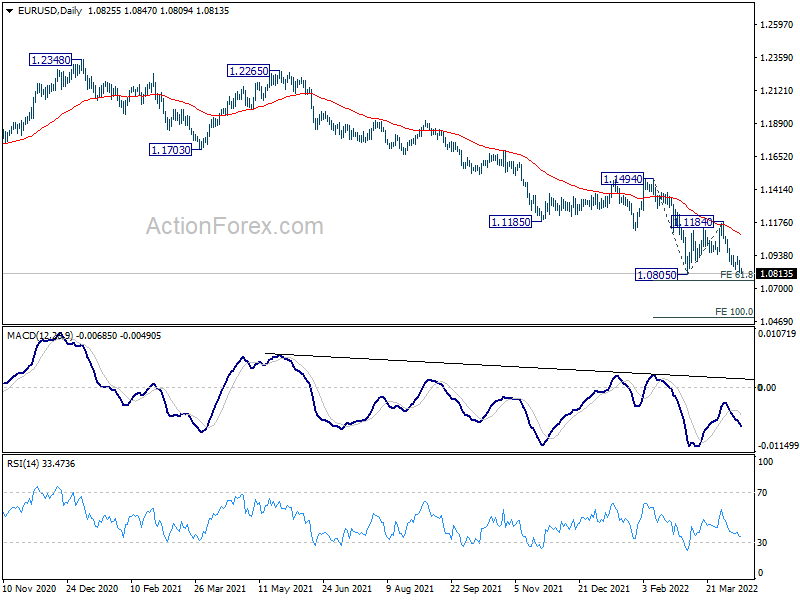
In the bigger picture, the decline from 1.2348 (2021 high) is expected to continue as long as 1.1494 resistance holds. Firm break of 1.0635 (2020 low) will raise the chance of long term down trend resumption and target a retest on 1.0339 (2017 low) next. Nevertheless, break of 1.1494 will maintain medium term neutral outlook, and extending term range trading first.
GBP/USD Mid-Day Outlook
Daily Pivots: (S1) 1.2979; (P) 1.3017; (R1) 1.3039; More...
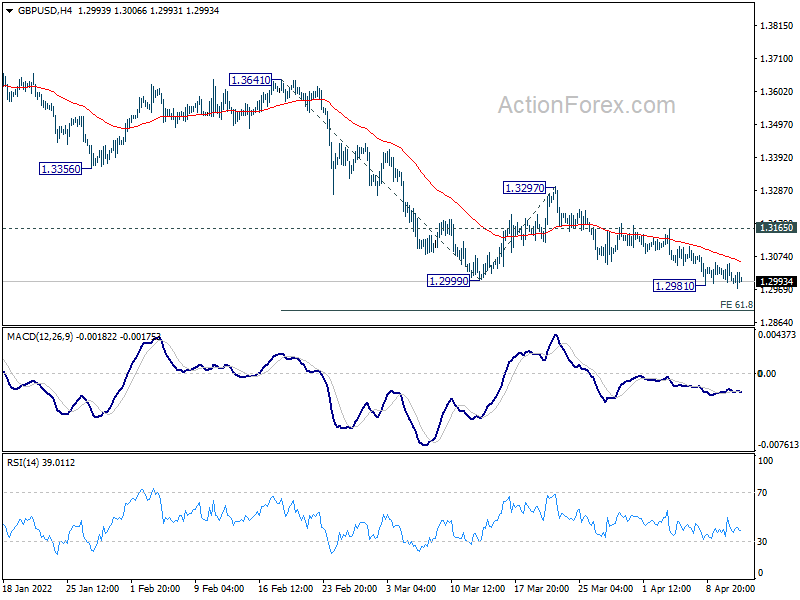
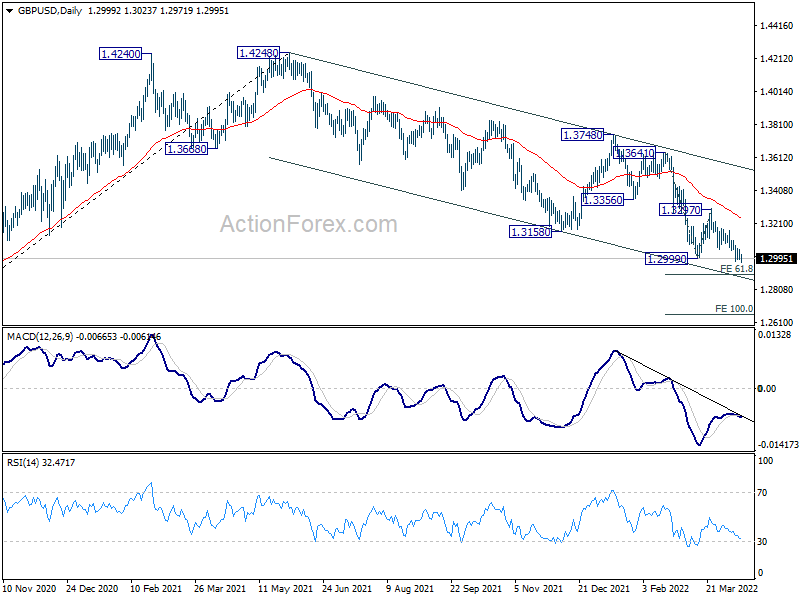
GBP/USD's fall resumes after brief consolidation. Intraday bias is back on the downside. Current down trend should target 61.8% projection of 1.3641 to 1.2999 from 1.3297 at 1.2900. On the upside, break of 1.3165 resistance is needed to indicate short term bottoming. Otherwise, outlook will remain bearish in case of recovery.
In the bigger picture, rise from 1.1409 (2020 low) has completed at 1.4248. Decline from 1.4248 could still be a corrective move, or it could be the start of a long term down trend. In either case, deeper decline would be seen back to 61.8% retracement of 2.1161 to 1.1409 at 1.2493. In any case, break of 1.3748 resistance is needed confirm completion of the fall from 1.4248, or outlook will stay bearish.
USD/CHF Mid-Day Outlook
Daily Pivots: (S1) 0.9295; (P) 0.9320; (R1) 0.9353; More....
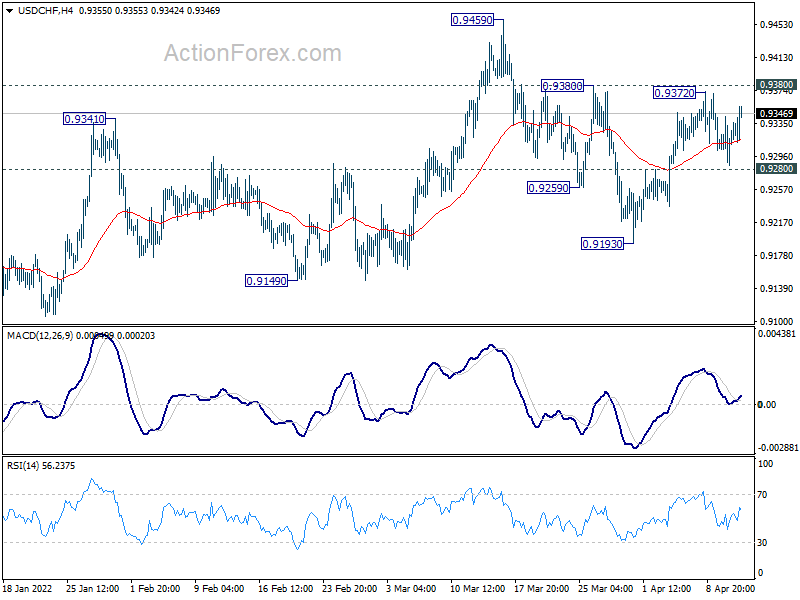
Range trading continues in USD/CHF and intraday bias remains neutral. On the upside, firm break of 0.9380 should confirm that fall from 0.9459 has completed with three wave down to 0.9193. Such development will revive near term bullishness and turn bias back to the upside for 0.9459 and then 0.9471 resistance. On the downside, below 0.9280 minor support will turn bias to the downside for 0.9193 support next.
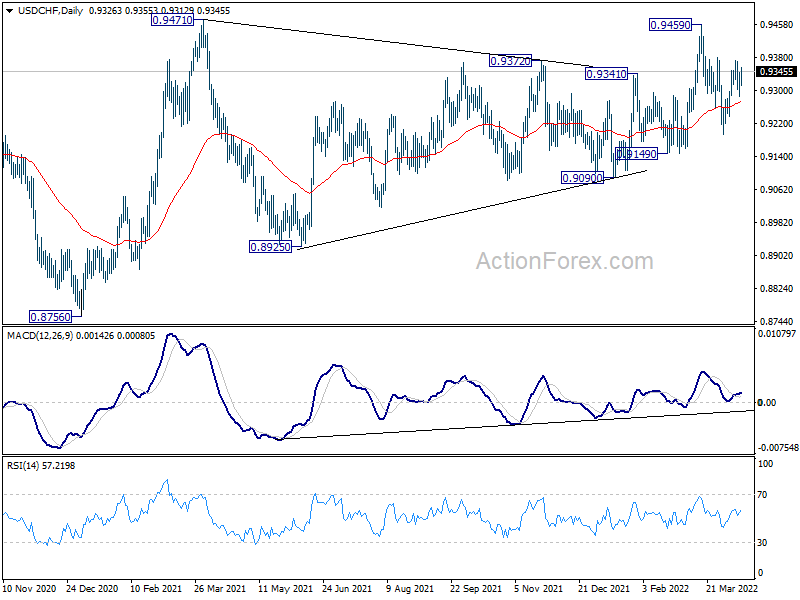
In the bigger picture, medium term outlook will be neutral at best as long as 0.9471 resistance holds. Larger down trend could still extend through 0.8756 (2021 low). However, firm break of 0.9471 will argue that whole down trend form 1.0342 (2016 high), has completed with waves down to 0.8756. A medium term up trend should be set up to target 1.0237/0342 resistance zone.
USD/JPY Mid-Day Outlook
Daily Pivots: (S1) 124.86; (P) 125.31; (R1) 125.85; More...
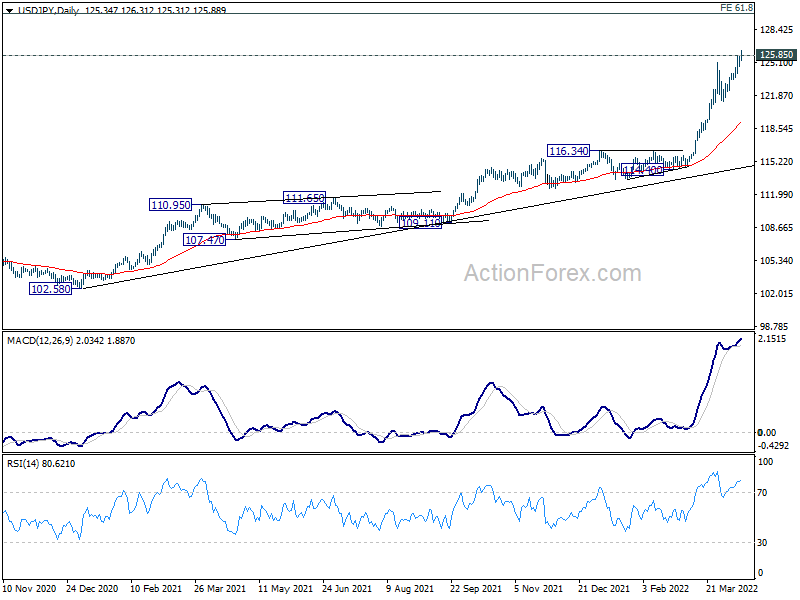
USD/JPY's rally resumed after brief retreat and intraday bias is back on the upside. Focus stays on 125.85 long term resistance. Sustained break there will carry larger bullish implication and target 130.04 long term projection level next. On the downside, break of 124.75 minor support will turn bias to the downside for pull back to 4 hour 55 EMA (now at 123.99) and possibly below.
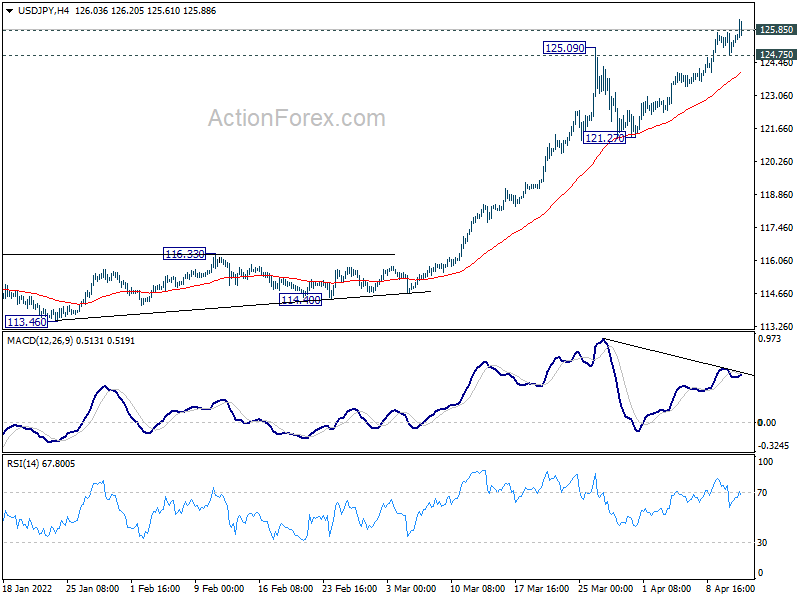
In the bigger picture, up trend from 98.97 (2016 low) is in progress for retesting 125.85 (2015 high). Sustained break there will confirm long term up trend resumption. Next target will be 61.8% projection of 75.56 (2011 low) to 125.85 (2015 high) from 98.97 at 130.04. This will now remain the favored case as long as 116.34 resistance turned support holds.
Dollar Broadly Firm after Record PPI, But Lacks Momentum Against Yen
Dollar is trading broadly higher today, with help by upside breakout against Yen. The greenback on remains firm after record PPI reading. Sterling is currently the second strongest, followed by Euro. On the other hand, New Zealand Dollar is trading as the worst performing, even after RBNZ's 50bps hike. Kiwi followed by Aussie and and then Yen. Canadian Dollar is mixed, awaiting BoC rate hike.
Technically, a focus remains on USD/JPY which is struggling to clear 125.85 long term resistance, despite breaching it. The pair may need some help from other Yen crosses to give it a lift. To be more specific, EUR/JPY and GBP/JPY will need to break through 137.50 and 164.61 resistance respectively to help secure upside momentum in USD/JPY.
In Europe, at the time of writing, FTSE is down -0.08%. DAX is down -1.08%. CAC is down -0.79%. Germany 10-year yield is up 0.021 at 0.812. Earlier in Asia, Nikkei rose 1.93%. Hong Kong HSI rose 0.26%. China Shanghai SSE dropped -0.82%. Singapore Strait Times rose 0.36%. Japan 10-year JGB yield dropped -0.0043 to 0.244, still below BoJ's 0.25% cap.
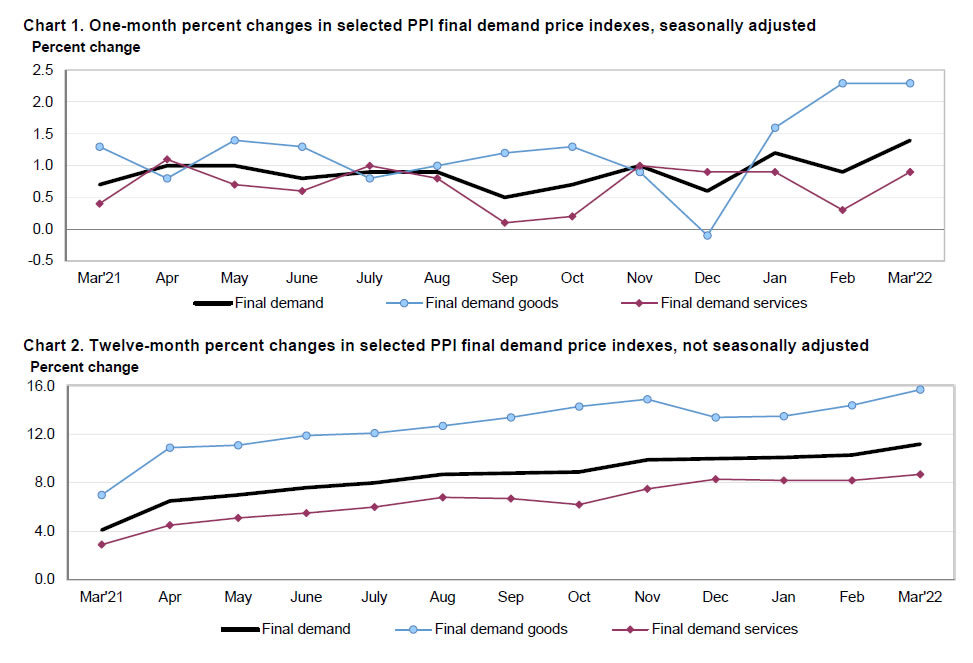
US PPI rose 1.4% mom, 11.2% yoy in Mar, record 12-month increase
US PPI for final demand rose 1.4% mom in March, above expectation of 1.1% mom. For the 12-month period, PPI accelerated to 11.2% yoy, up from 10.2% yoy, above expectation of 10.5% yoy. That's also the largest increase since the 12-month data were first calculated in November 2010.
PPI for final demand goods rose 2.3% mom while PPI for final demand services rose 0.9% mom. PPI final demand less goods, energy and trade services rose 0.9% mom, fastest since January 2021. For the 12 months, PPI for final demand less foods, energy and trade services rose 7.0% yoy.
Fed Bullard: Getting to neutral isn't going to be enough
St Louis Fed President said in an FT interview, there's "a bit of a fantasy" in current policy in centrals banks to think thank inflation could be brought down by moving interest rate to neutral.
"Neutral is not putting downward pressure on inflation. It's just ceasing to put upward pressure on inflation," he said. "We have to put downward pressure on the component of inflation that we think is persistent."
"Getting to neutral isn't going to be enough it doesn't look like, because while some of the inflation may moderate naturally . . . there will be a component of it which won't," he added.
Bullard also warned that this week's CPI report just " underscores the urgency that the Fed is behind the curve and needs to get moving."
"If markets and households get the idea that the Fed's not going to do the right thing and not going to keep inflation under control, then you have to gain credibility by actually doing things that show them that you are serious," he said.
German economists warn of GDP contraction and record inflation in case of Russian energy ban
In the Joint Economic Forecast, Germany's government advisors warned of a contraction in the economy next year in case of a full halt in Russian natural gas imports. Inflation could also be pushed further the post-war record.
In the baseline scenarios, GDP is estimated to grow 2.7% in 2022 (revised down from fall report's 4.8%), and 3.1% in 2023 (revised up from 1.9%). Inflation is forecast to hit 6.1% in 2022, highest number in 40 years, then slow to 2.8% in 2023.
However, in case of a Russian energy supply stop, GDP would growth only 1.9% in 2022, and then contract -2.2% in 2023. Inflation will rise further to 7.3% in 2022, a record-high in post-war Germany, then slow to 5% in 2023.
"If gas supplies were to be cut off, the German economy would undergo a sharp recession. In terms of economic policy, it would then be important to support marketable production structures without halting structural change. This change will accelerate for gas-intensive industries even without a boycott, as dependence on Russian supplies, which have been available at favorable prices up to now, is to be overcome quickly anyway,"Stefan Kooths, vice president of the Kiel Institute for the World Economy said.
"Policymakers should be careful not to provide poorly targeted transfers to cushion high energy prices. If such support schemes are handed out on a wide front, it will further drive up inflation and undermine the important signaling effect of higher energy prices. This in turn exacerbates the problems of low-income households and increases overall economic costs."
UK CPI jumped to 7% in Mar, highest since 1992
UK CPI rose 1.1% mom in March, above expectation of 0.7% mom. For the 12-month period, CPI accelerated from 6.2% yoy to 7.0% yoy, above expectation of 6.7% yoy. That's the highest rate in the historic modelled series since March 1992, when it stood at 7.1% yoy. RPI rose 1.0% mom, 9.0% yoy, versus expectation of 0.9% mom, 8.8% yoy.
Also released, PPI input came in at 5.2% mom, 19.2% yoy, above expectation of 0.5% mom, 13.4% yoy. PPI output rose 2.0% mom, 11.9% yoy, above expectation of 0.7% mom, 10.2% yoy. CCPI output core rose 2.0% mom, 12.0% yoy, above expectation of 0.9% mom, 10.6% yoy.
BoJ Kuroda to underpin recovery by patiently sustaining current powerful monetary easing
BoJ Governor Haruhiko Kuroda said in a speech today that the economy was expected to pick up on improvement in consumption and robust overseas demand. "The outlook, however, remains highly uncertain due to the impact of the pandemic, as well as developments regarding Ukraine and the impact on commodity prices," he warned.
Additionally, "recent rising inflation, driven by higher import costs, weighs on Japan's economy by reducing households' real income and corporate profits," Kuroda said. "BOJ will underpin economy's recovery from pandemic by patiently sustaining current powerful monetary easing."
RBNZ hikes by 50bps to 1.50%, path of least regret
RBNZ raises Official Cash Rate by 50bps to 1.50%, larger than expectation of a 25bps hike. That's also the biggest rate increase in 22 years.
It said in the statement that "moving the OCR to a more neutral stance sooner will reduce the risks of rising inflation expectations. A larger move now also provides more policy flexibility ahead in light of the highly uncertain global economic environment."
Also, "the Committee agreed that their policy 'path of least regret' is to increase the OCR by more now, rather than later, to head off rising inflation expectations and minimise any unnecessary volatility in output, interest rates, and the exchange rate in the future."
Australia Westpac consumer sentiment dropped to 95.8, on interest rate, inflation and war
Australia Westpac consumer sentiment index dropped -0.9% to 95.8 in April, down from March's 96.6. That's the lowest level since September 2020. Westpac said "concerns around interest rates and inflation were starting to weigh on confidence... compounded by Russia's invasion of Ukraine, an associated spike in petrol prices, and severe weather events."
Westpac expects RBA to raise interest rate at June meeting, after reviewing data releases "over coming months". Once the tightening cycle starts, Westpac expects a series of rate hikes in most months in 2022, with a pause in September. Further rate hikes can be expected in first half of 2023 and the cash rate would peak at around 2% by June next year.
USD/JPY Mid-Day Outlook
Daily Pivots: (S1) 124.86; (P) 125.31; (R1) 125.85; More...
USD/JPY's rally resumed after brief retreat and intraday bias is back on the upside. Focus stays on 125.85 long term resistance. Sustained break there will carry larger bullish implication and target 130.04 long term projection level next. On the downside, break of 124.75 minor support will turn bias to the downside for pull back to 4 hour 55 EMA (now at 123.99) and possibly below.
In the bigger picture, up trend from 98.97 (2016 low) is in progress for retesting 125.85 (2015 high). Sustained break there will confirm long term up trend resumption. Next target will be 61.8% projection of 75.56 (2011 low) to 125.85 (2015 high) from 98.97 at 130.04. This will now remain the favored case as long as 116.34 resistance turned support holds.
Economic Indicators Update
| GMT | Ccy | Events | Actual | Forecast | Previous | Revised |
|---|---|---|---|---|---|---|
| 23:50 | JPY | Money Supply M2+CD Y/Y Mar | 3.50% | 3.60% | 3.60% | |
| 23:50 | JPY | Machinery Orders M/M Feb | -9.80% | -1.50% | -2.00% | |
| 00:30 | AUD | Westpac Consumer Confidence Apr | -0.90% | -4.20% | ||
| 02:00 | NZD | RBNZ Interest Rate Decision | 1.50% | 1.25% | 1.00% | |
| 02:00 | CNY | Trade Balance (USD) Feb | 47.38B | 20.5B | 116.0B | |
| 02:00 | CNY | Exports (USD) Y/Y Feb | 14.70% | 13.00% | 16.30% | |
| 02:00 | CNY | Imports (USD) Y/Y Feb | -0.10% | 8.00% | 15.50% | |
| 02:00 | CNY | Trade Balance (CNY) Feb | 300.58B | 131B | 739B | |
| 02:00 | CNY | Exports (CNY) Y/Y Feb | 12.90% | 18.20% | 13.60% | |
| 02:00 | CNY | Imports (CNY) Y/Y Feb | -1.70% | 11.40% | 12.90% | |
| 06:00 | GBP | CPI M/M Mar | 1.10% | 0.70% | 0.80% | |
| 06:00 | GBP | CPI Y/Y Mar | 7.00% | 6.70% | 6.20% | |
| 06:00 | GBP | Core CPI Y/Y Mar | 5.70% | 5.40% | 5.20% | |
| 06:00 | GBP | RPI M/M Mar | 1.00% | 0.90% | 0.80% | |
| 06:00 | GBP | RPI Y/Y Mar | 9.00% | 8.80% | 8.20% | |
| 06:00 | GBP | PPI Input M/M Mar | 5.20% | 0.50% | 1.40% | |
| 06:00 | GBP | PPI Input Y/Y Mar | 19.20% | 13.40% | 14.70% | |
| 06:00 | GBP | PPI Output M/M Mar | 2.00% | 0.70% | 0.80% | |
| 06:00 | GBP | PPI Output Y/Y Mar | 11.90% | 10.20% | 10.10% | |
| 06:00 | GBP | PPI Core Output M/M Mar | 2.00% | 0.90% | 0.70% | |
| 06:00 | GBP | PPI Core Output Y/Y Mar | 12.00% | 10.60% | 9.90% | |
| 08:00 | EUR | Italy Industrial Output M/M Feb | 4.00% | 1.50% | -3.40% | |
| 12:30 | USD | PPI M/M Mar | 1.40% | 1.10% | 0.80% | 0.90% |
| 12:30 | USD | PPI Y/Y Mar | 11.20% | 10.50% | 10.00% | 10.30% |
| 12:30 | USD | PPI Core M/M Mar | 1.00% | 0.40% | 0.20% | 0.40% |
| 12:30 | USD | PPI Core Y/Y Mar | 9.20% | 7.90% | 8.40% | 8.70% |
| 14:00 | CAD | BoC Interest Rate Decision | 1.00% | 0.50% | ||
| 14:30 | USD | Crude Oil Inventories | 1.1M | 2.4M |
US PPI rose 1.4% mom, 11.2% yoy in Mar, record 12-month increase
US PPI for final demand rose 1.4% mom in March, above expectation of 1.1% mom. For the 12-month period, PPI accelerated to 11.2% yoy, up from 10.2% yoy, above expectation of 10.5% yoy. That's also the largest increase since the 12-month data were first calculated in November 2010.
PPI for final demand goods rose 2.3% mom while PPI for final demand services rose 0.9% mom. PPI final demand less goods, energy and trade services rose 0.9% mom, fastest since January 2021. For the 12 months, PPI for final demand less foods, energy and trade services rose 7.0% yoy.
Pound Reacts to Rising Inflation Like EM Currency
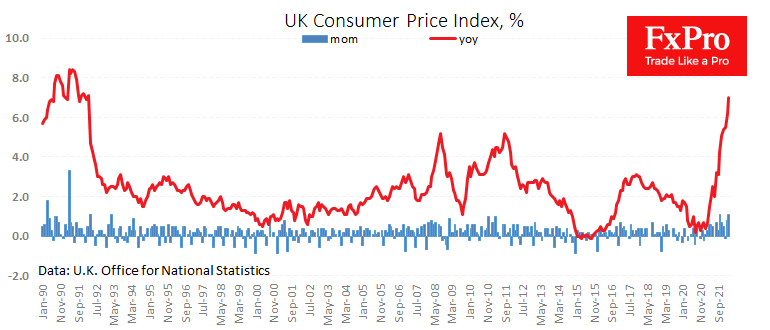
Inflation in the UK is developing an acceleration stronger than expected. Estimates for March marked a 1.1% CPI gain for the month, above the 0.8% a month earlier and rebutting analysts’ hopes that the monthly price growth would slow to 0.7%. The year-over-year inflation rate has accelerated from 6.2% to 7.0%.
As in most of Europe, leading inflation indicators show that pressure will only increase in the coming months. Output producer prices rose by 2% in March, the most significant jump since May 2008. Producer input prices jumped by 5.2% in just one month. In the more than 40-year history of this indicator, there has only been one such jump – in November 1979. At that time, we also saw a comparable annual increase of 19.2% for Input and 11.9% for Output Producer Price Indices.
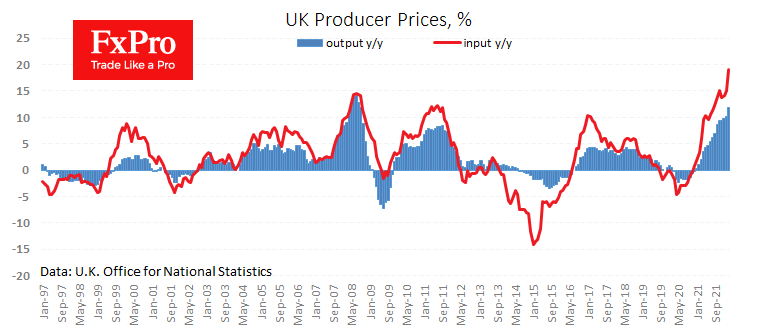
Such a jump in producer prices sets up that the pressure on consumer prices will not abruptly ease in April and May.
Just like an emerging market currency, the British pound reacted to the above-expected price hike by falling. In response to inflation, the weakening of the currency shows concern about whether the central bank can get prices under control before their rise destroys a sizable chunk of the pound’s purchasing power.
In recent days, Fed officials have been increasingly open to promoting that FOMC can suppress inflation only via pressing growth. This approach is helping the dollar locally.
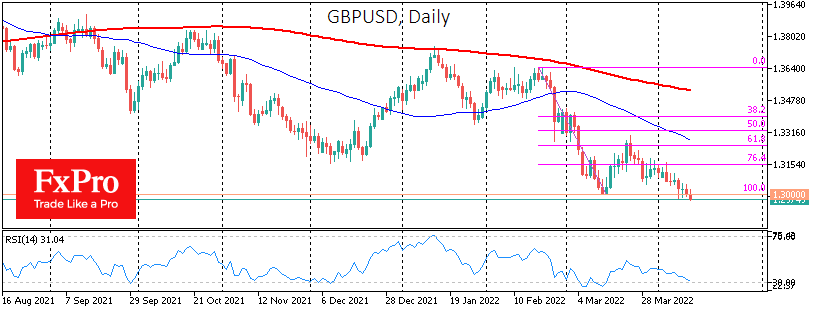
If the Bank of England adopts this rhetoric, the pound may be able to swim against the current. But until then, a systematic sell-off in the GBPUSD from the peaks near 1.4270, reached exactly three weeks ago, is conspicuous. The cable has fallen below 1.3000, renewing 17-month lows and consolidating below the psychologically crucial circular level.
Gold Sustains One-Week Bullish Bearing Despite Minor Recoil
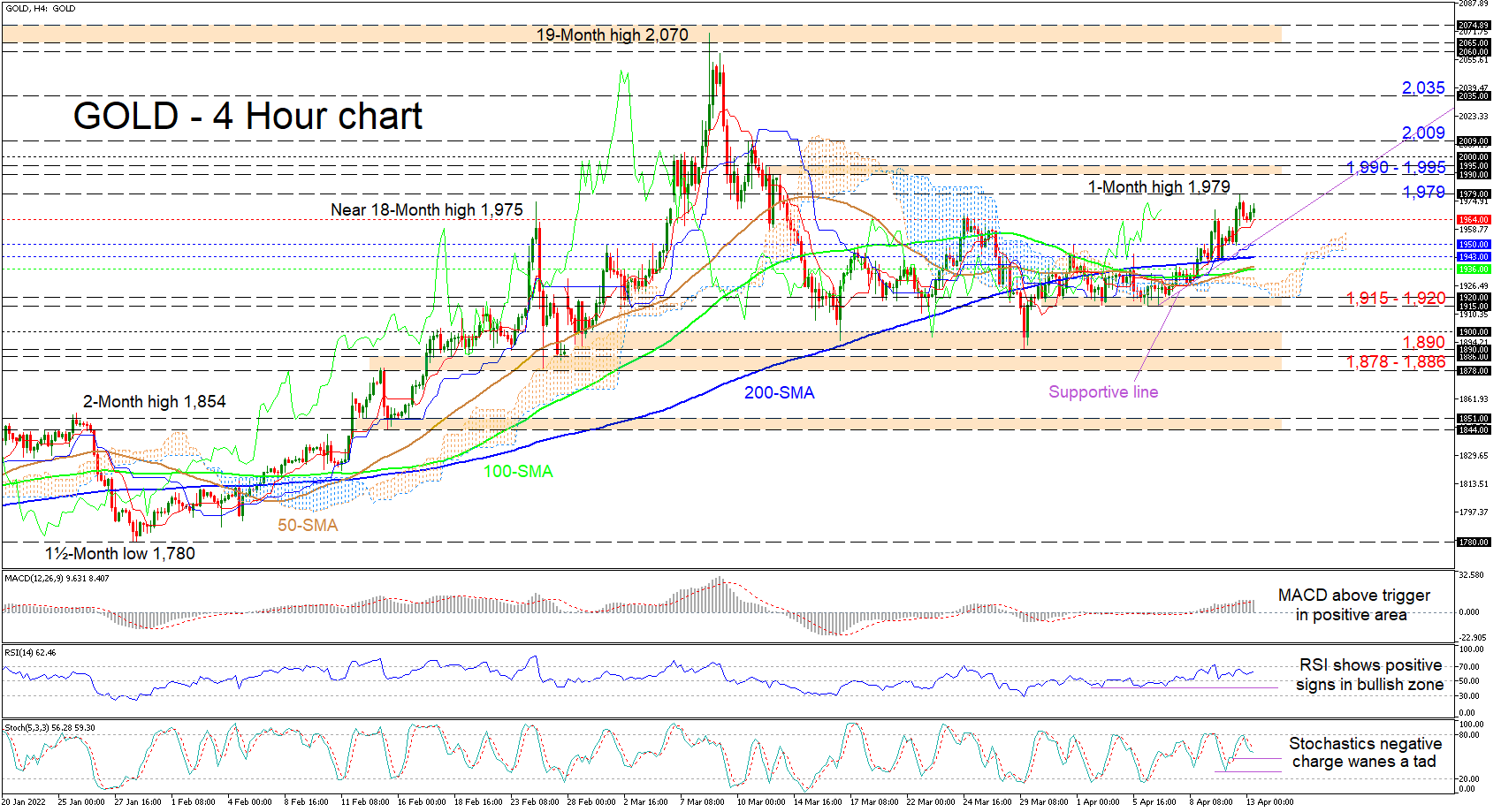
Gold’s latest positive incline is finding assistance from the climbing Ichimoku lines after finally being able to shake off the one-month sideways market, which the commodity adopted from the second half of March. The recent upturn in the slopes of the 50-and 100-period simple moving averages (SMAs) has now aligned with the 200-period SMA that continues to sponsor the broader uptrend.
The ascending Ichimoku lines are indicating positive forces are intact, while the short-term oscillators are conveying mixed messages in directional momentum. The MACD has stabilized above its red trigger line in the positive region, while the RSI is regaining ground in the bullish zone. The stochastic oscillator is now reflecting some fading in its negative charge and may start to promote upside price action.
If the Ichimoku lines continue to keep the price buoyed, bullish friction could originate from the nearby 1,979 barrier. If persistent upside pressures conquer the 1,990-1,995 resistance band too, which was formed by the highs from the first half of March, and overrun the adjacent 2,000 psychological mark, buyers could then gain confidence to challenge the March 10 peak of 2,009. Additional progress in the precious metal may subsequently pilot the price towards the 2,035 resistance.
Otherwise, if positive impetus fades, initial support could arise from the red Tenkan-sen line at 1,964. Further ebbing in the price of the yellow metal may test a potential supportive trendline pulled from the 1,915 low ahead of the blue Kijun-sen line at 1,950. From here, should the support region between the 200-period SMA at 1,943 and the 100-period SMA at 1,936 fail to defend positive developments, sellers may begin to enhance their advantage. Moreover, a dive in the price past the cloud and the 1,915-1,920 base could encourage sellers to target the 1,890-1,900 key support foundation.
Summarizing, Gold’s bigger positive structure is being defended by the border of 1,878-1,886 and the 1,890-1,900 support foundation. The commodity could maintain its climb should the Ichimoku lines continue to champion more gains. For the positive outlook to deteriorate, the price would need to sink below the supportive line and the SMAs.