

Sample Category Title
Euro Rebounds Ahead of ECB, Dollar Follows Yields Lower
Dollar dropped notably overnight together with pull back in benchmark treasury yield. The selling of the greenback continued in Asian session today. Even the weak Yen is recovering against Dollar, but it's still, for now, the worst performing one for the week. On the other hand, European majors are making a comeback, with Sterling leading Euro and Swiss Franc higher. Commodity currencies are mixed for now.
Technically, Euro will be the main focus for today. For EUR/USD break of 1.0937 will bring stronger recovery, possibly towards 1.1184 resistance. Break of 0.8379 in EUR/GBP will bring stronger rebound back to 0.8511 resistance. Meanwhile, break of 137.49 resistance in EUR/JPY will resume larger up trend.
In Asia, Nikkei closed up 1.22%. Hong Kong HSI is up 0.92%. China Shanghai SSE is up 1.53%. Singapore Strait Times is down -0.04%. Japan 10-year JGB yield is down -0.0012 at 0.239. Overnight, DOW rose 1.01%. S&p 500 rose 1.12%. NASDAQ rose 2.03%. 10-year yield dropped -0.038 to 2.687.
Fed Waller: It's a good time to do aggressive actions
Federal Reserve Governor Christopher Waller said in a CNBC interview that preferred a "front-loading approach" on tightening. So, "a 50-basis-point hike in May would be consistent with that, and possibly more in June and July."
"I think we're going to deal with inflation. We've laid out our plans," he said. "We're in a position where the economy's strong, so this is a good time to do aggressive actions because the economy can take it."
"I think we want to get above neutral certainly by the latter half of the year, and we need to get closer to neutral as soon as possible," Waller added.
Australia employment rose 17.9k in Mar, unemployment rate unchanged at 4%
Australia employment grew 17.9k in March, below expectation of 30.0k. Full-time jobs rose 20.5k while part-time jobs dropped -2.7k. Unemployment rate was unchanged at 4.0%, above expectation of 3.9%. Participation rate was unchanged at 66.4%. Monthly hours worked dropped -0.6% mom.
Bjorn Jarvis, head of labour statistics at the ABS, said: "With employment increasing by 18,000 people and unemployment falling by 12,000, the unemployment rate decreased slightly in March, though remained at 4.0 per cent in rounded terms.
"4.0 per cent is the lowest the unemployment rate has been in the monthly survey. Lower rates were seen in the series before November 1974, when the survey was quarterly."
New Zealand BNZ manufacturing rose to 53.8
New Zealand BNZ Performance of Manufacturing Index rose slightly from 53.6 to 53.8 in March. Production dropped from 51.7 to 50.9. Employment rose from 52.0 to 52.4. New orders rose from 58.6 to 61.0. Finished stocks rose from 50.2 to 53.5. Deliveries dropped from 53.1 to 51.9.
BNZ Senior Economist, Doug Steel stated that "Omicron's impact may not be as harsh as the first 2020 COVID lockdown or last year's Delta lockdown, but it's there. Production has struggled, with the index slipping to 50.9 in March and a bit further below its long-term average."
ECB to turn more hawkish, EUR/CHF recovering
ECB is widely expected to keep monetary policy unchanged today. But with inflation at a record high of 7.5%, the central bank is also expected to sing a more hawkish tune. There should be an announcement to put a firm end date to the asset purchase program. Interest rate hike will only come "some time" after ending the purchases.
There are talks that putting an end date to asset purchases in June would open up the possibility of a rate hike in September, followed by another in December. But President Christine Lagarde will certainly continue to sound non-committal, but emphasize the importance of graduality, optionality and flexibility for the policy path ahead.
Here are some previews on ECB:
- ECB Preview: Policy Under a Cloud of Uncertainties
- ECB Preview: No Policy Adjustments Expected
- ECB 'Half Measures' Unlikely to Stop Euro's Bleeding
- ECB Preview – Lagarde to Bring September into Play – We Revise Our ECB Call
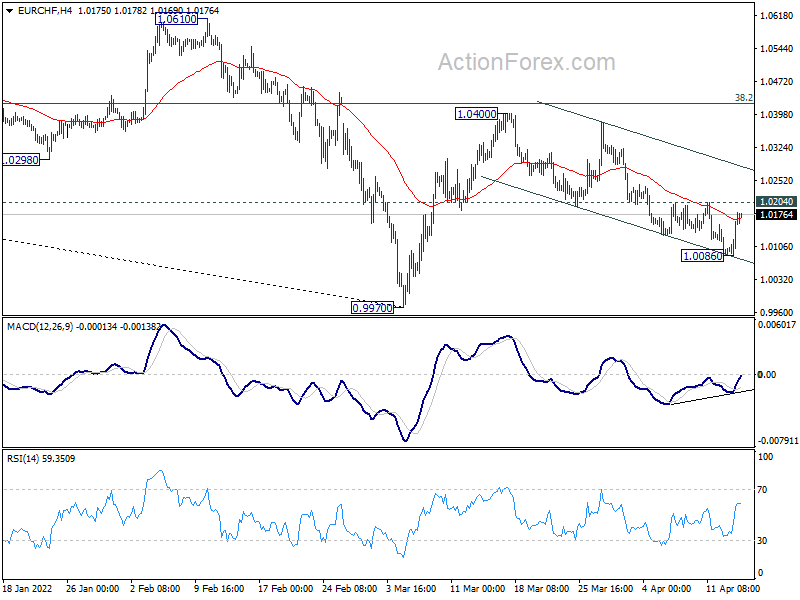
EUR/CHF's reaction to ECB decision and press conference is worth some attention. So far, the decline from 1.0400 is not impulsive looking. The cross has also started to lose downside momentum as seen in 4 hour MACD. A break above 1.0204 minor resistance today will suggest that such pull back is finished. More importantly, in this case, rebound from 0.9970 is likely ready to resume through 1.0400. That, if happens, could give Euro a helping hand elsewhere.
On the data front
US data is on the spotlight today, with retail sales, jobless claims, import price, U of Michigan consumer sentiment and business sentiment featured. Canada will release manufacturing sales and wholesale sales.
EUR/USD Daily Outlook
Daily Pivots: (S1) 1.0836; (P) 1.0865 (R1) 1.0921; More...
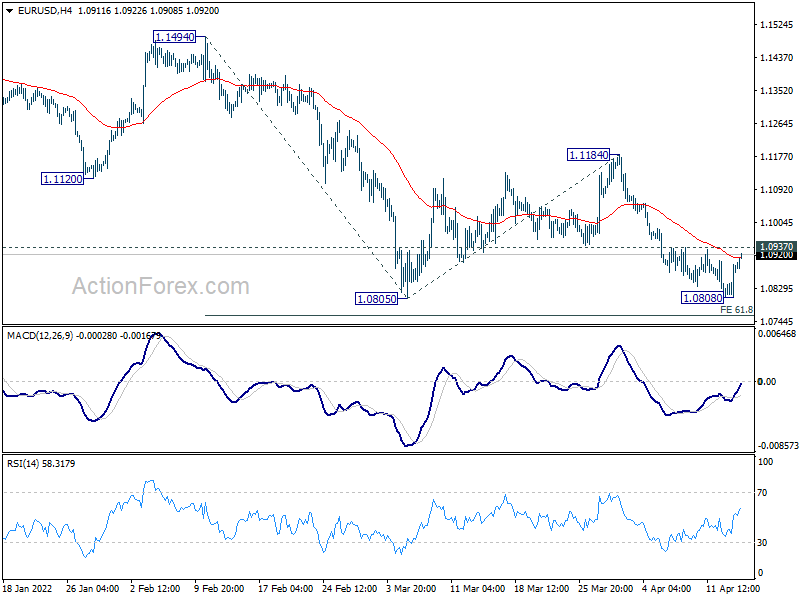
Intraday bias in EUR/USD remains neutral for the moment. On the upside, break of 1.0937 minor resistance will extend the consolidation pattern from 1.0805 with another rising leg. Intraday bias will be back on the upside for stronger rebound. But overall outlook will stay bearish as long as 1.1184 resistance holds. On the downside, sustained break of 1.0805 low will resume larger down trend to 61.8% projection of 1.1494 to 1.0805 from 1.1184 at 1.0758, and then 100% projection at 1.0495.
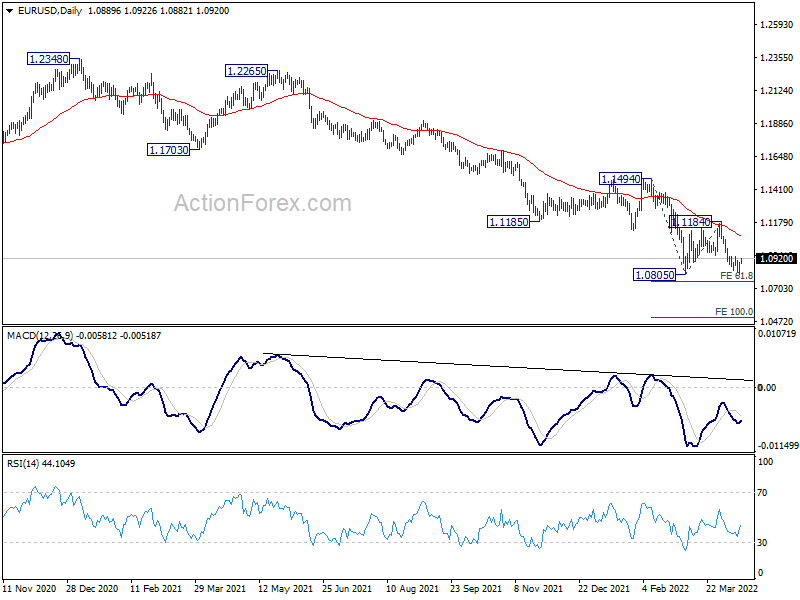
In the bigger picture, the decline from 1.2348 (2021 high) is expected to continue as long as 1.1494 resistance holds. Firm break of 1.0635 (2020 low) will raise the chance of long term down trend resumption and target a retest on 1.0339 (2017 low) next. Nevertheless, break of 1.1494 will maintain medium term neutral outlook, and extending term range trading first.
Economic Indicators Update
| GMT | Ccy | Events | Actual | Forecast | Previous | Revised |
|---|---|---|---|---|---|---|
| 21:30 | NZD | BusinessNZ Manufacturing Index Mar | 53.8 | 53.6 | ||
| 23:01 | GBP | RICS Housing Price Balance Mar | 74% | 78% | 79% | |
| 01:00 | AUD | Consumer Inflation Expectations Apr | 5.20% | 4.90% | ||
| 01:30 | AUD | Employment Change Mar | 17.9K | 30.0K | 77.4K | |
| 01:30 | AUD | Unemployment Rate Mar | 4.00% | 3.90% | 4.00% | |
| 06:30 | CHF | Producer and Import Prices M/M Mar | 0.80% | 0.00% | 0.40% | |
| 06:30 | CHF | Producer and Import Prices Y/Y Mar | 6.10% | 4.90% | 5.80% | |
| 11:45 | EUR | ECB Interest Rate Decision | 0.00% | 0.00% | ||
| 12:30 | EUR | ECB Press Conference | ||||
| 12:30 | CAD | Manufacturing Sales M/M Feb | 0.00% | 0.60% | ||
| 12:30 | CAD | Wholesale Sales M/M Feb | 0.70% | 4.20% | ||
| 12:30 | USD | Initial Jobless Claims (Apr 8) | 175K | 166K | ||
| 12:30 | USD | Retail Sales M/M Mar | 0.60% | 0.30% | ||
| 12:30 | USD | Retail Sales ex Autos M/M Mar | 0.70% | 0.20% | ||
| 12:30 | USD | Import Price Index M/M Mar | 2.30% | 1.40% | ||
| 14:00 | USD | Michigan Consumer Sentiment Index Apr P | 58.8 | 59.4 | ||
| 14:00 | USD | Business Inventories Feb | 1.00% | 1.10% | ||
| 14:30 | USD | Natural Gas Storage | 15B | -33B |
ECB Must Act, Now
A big week for the global central banks
The Reserve Bank of New Zealand and the Bank of Canada both raised their interest rates by 50bp this week. For both banks, this was the biggest hike in more than two decades, as the policymakers stepped on the gas to fight back the soaring inflation.
The latest policy decisions from the G7 central banks cement the idea that the Federal Reserve (Fed) will announce at least a 50-bp hike in its next meeting, and increase the pressure of a concrete rate action from the European Central Bank (ECB).
Activity on the fed funds futures assess an almost 90% probability for a 50bp hike in May, completed with a $95 billion Quantitative Tightening to make sure that inflation tops near the actual 8.5%.
Yesterday’s data showed that the US producer prices jumped by more than 11% in March, the highest since 2010, but the US indices rebounded on the belief that we could be approaching a peak in the actual higher inflation cycle as the pandemic-related distortions begin to fade, and the comparison to the depressed pandemic months will be replaced by the months of decent spike energy prices. So the base effect should play an important role in the coming months’ reads. Though inflation will certainly remain at significantly higher levels of 4-5%.
Inflation, inflation
Inflation in Britain hit 7% in March on the back of soaring food and energy prices and is seen to advance to 9% as soon as next month, while inflation in Europe hit unusually high levels as well, with the German inflation advancing to 7.6% in March.
The rising inflation will certainly lead to heated discussions at the heart of the European Central Bank’s committee at today’s policy meeting. The ECB plans to end the asset purchases by Q3 and hike the rates soon after.
But the ECB doesn’t have the option to wait until the last quarter to hike rates; it must raise the interest rates by end of summer, the latest, even though inflation is caused by supply side problems that can’t be effectively addressed with restricting demand.
If the ECB doesn’t act, the tighter monetary policy from other major central banks will send the value of euro crushing, which would add an additional pressure on inflation.
The EURUSD rebounded past the 1.09 level after trading close to the 1.08 support yesterday. A reasonably hawkish ECB could send the EURUSD above the 1.10 mark sustainably, but a soft response from the ECB will likely send the single currency below the 1.08 as the bears will be targeting the 1.05 level next.
And if the ECB insists ending the bond purchases in Q3 and hiking the rates by the end of the year, then we shall see the euro fall to parity against the US dollar this year.
China and Turkey swim against the tide
The overall trend is tighter central bank policies and higher rates, but two countries defy the laws of gravity.
China is expected to cut its key policy rate for the second time this year on Friday to give support to its economy that is ravaged by an unrealistic zero Covid policy. The People’s Bank of China will likely cut the reserve requirement ratio as well to increase the amount of cash in circulation.
The Central Bank of Turkey, on the other hand, is headed toward more uncertainty. According to the latest unofficial data, inflation in Turkey advanced to more than 142% in March, but the central bank is not expected to raise its interest rate that stands at 14%. It’s a time bomb.
For now, Turkey compensates the saving accounts in accordance with the loss of value in USD terms, and it costs the country an arm, of course, to keep the dollar-lira rate steady. The cost of conducting such an irrational policy is so high that the country is thinking of issuing a ‘super bond’ to finance the messy policy.
Technical Outlook and Review
DXY:
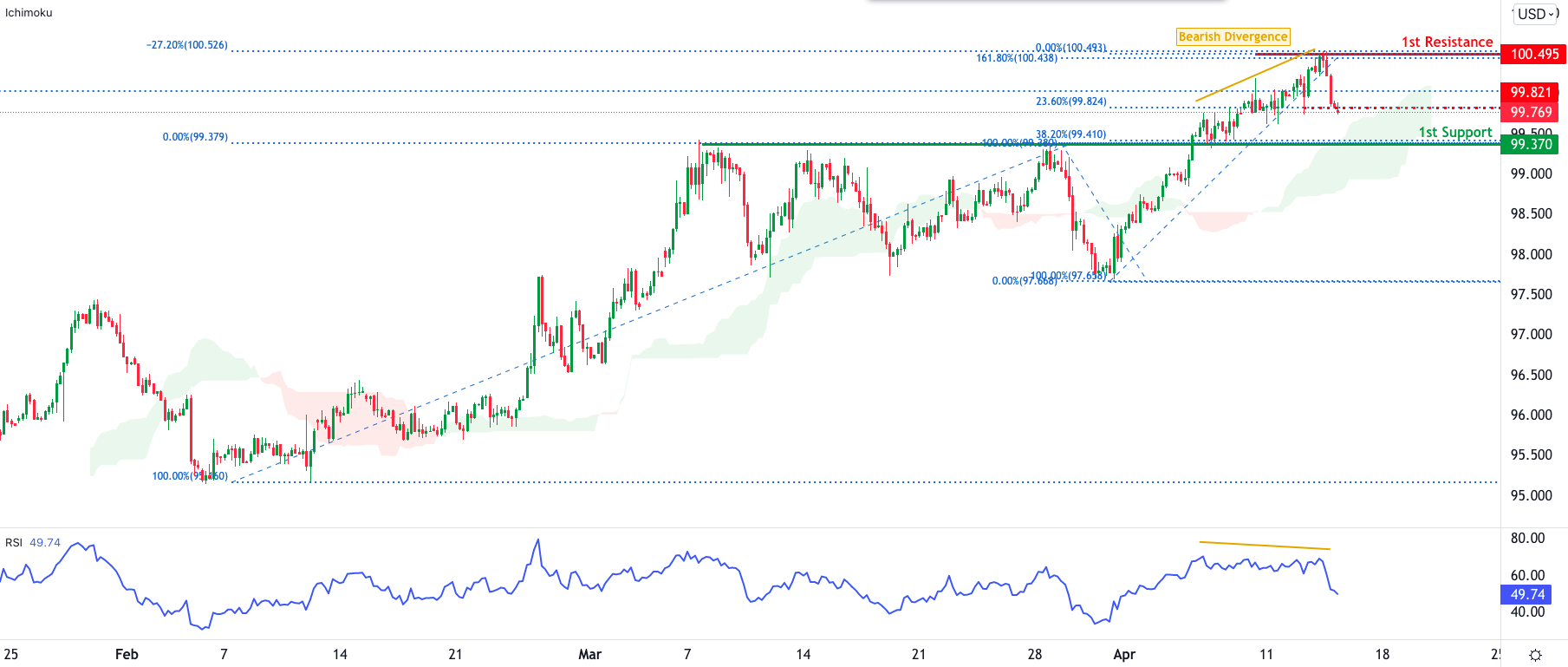
Price has reversed off major 1st resistance highlighted yesterday at 100.49. This was aided by the Fibonacci confluence area along with a strong bearish divergence. We’re seeing price break a 23.6% fibonacci retracement which is the first sign of a potential further drop to major 1st support at 99.37 which is a strong pullback support area that lines up with the Ichimoku cloud support.
Areas of consideration:
- H4 time frame, 1st resistance at 100.49
- H4 time frame, intermediate resistance at 99.82
- H4 time frame, 1st support at 99.37
XAU/USD (GOLD):
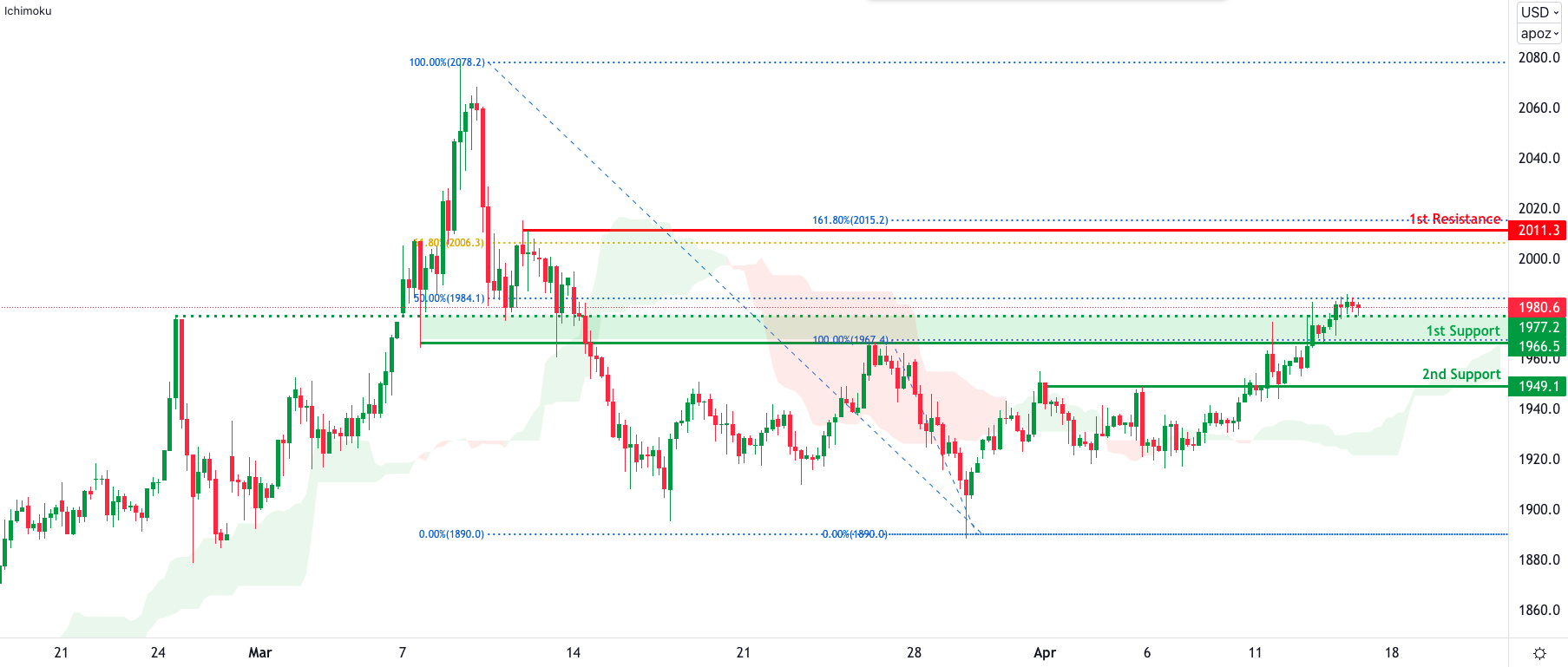
Price has broken out of the 1st resistance area turning it into a strong 1st support area above 1966. There is a risk level at 1984 which is a 50% Fibonacci retracement of the entire move – price needs to break this level to trigger a further rise up to potentially 1st resistance at 2011. It is currently aided by the bullish ichimoku cloud below it suggesting that there is bullish momentum.
Areas of consideration:
- H4 time frame, 1st Resistance at 2011.3
- H4 time frame, 1st Support at 1966.5
- H4 time frame, 2nd Support at 1949.1
GBP/USD:
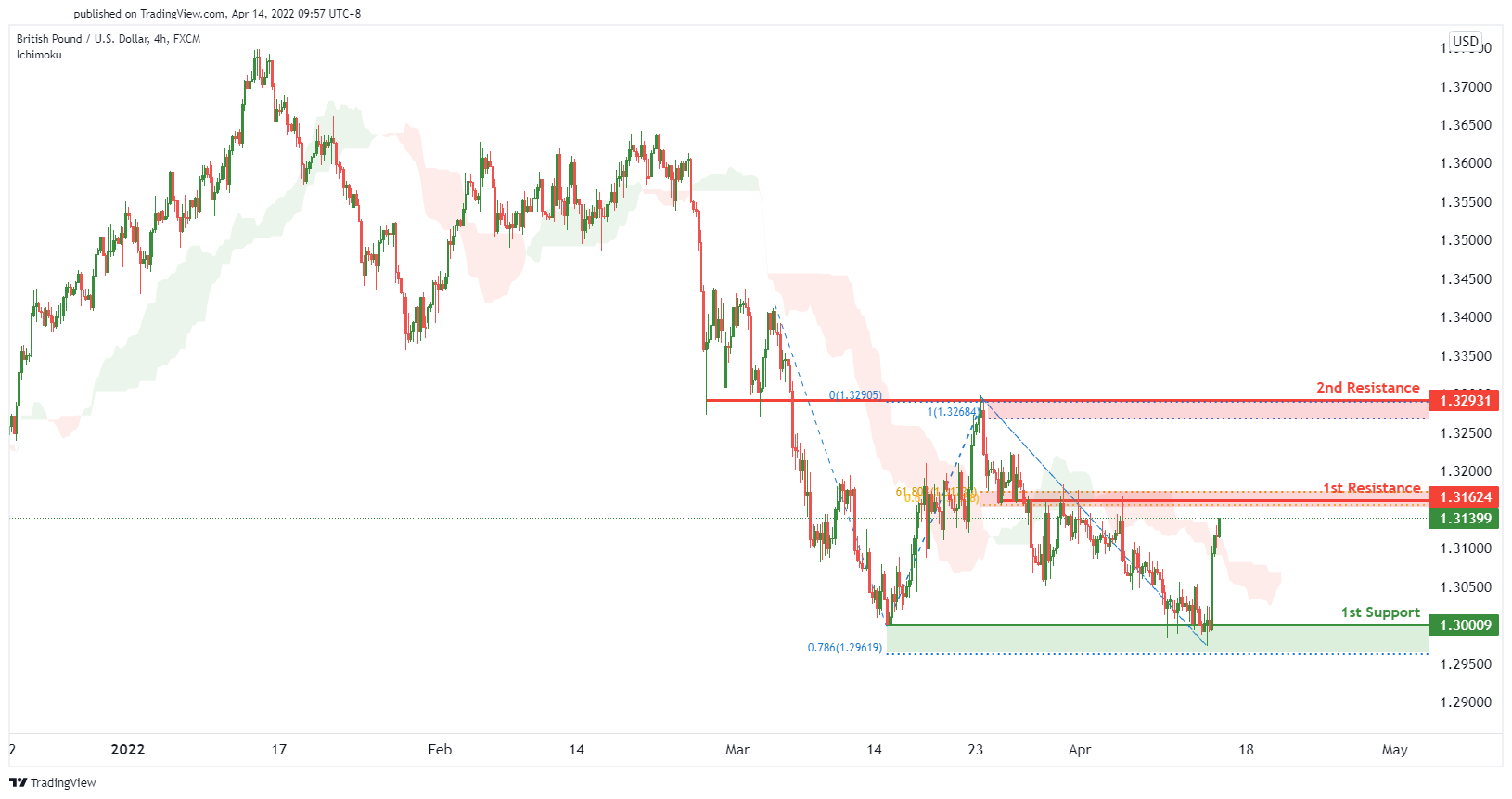
On the H4 timeframe, we expect to see a potential for bearish reversal from 1st resistance level of 1.31624 in line with and 61.8% retracement and 61.8% Fibonacci projection towards the 2nd support level of 1.30009 in line with 78.6% Fibonacci projection. Our bearish bias is supported by price trading below the Ichimoku cloud indicator.
Areas of consideration:
- H4 1st resistance at 1.31624
- H4 2nd resistance at 1.32931
- H4 1st support at 1.30009
USD/CHF:
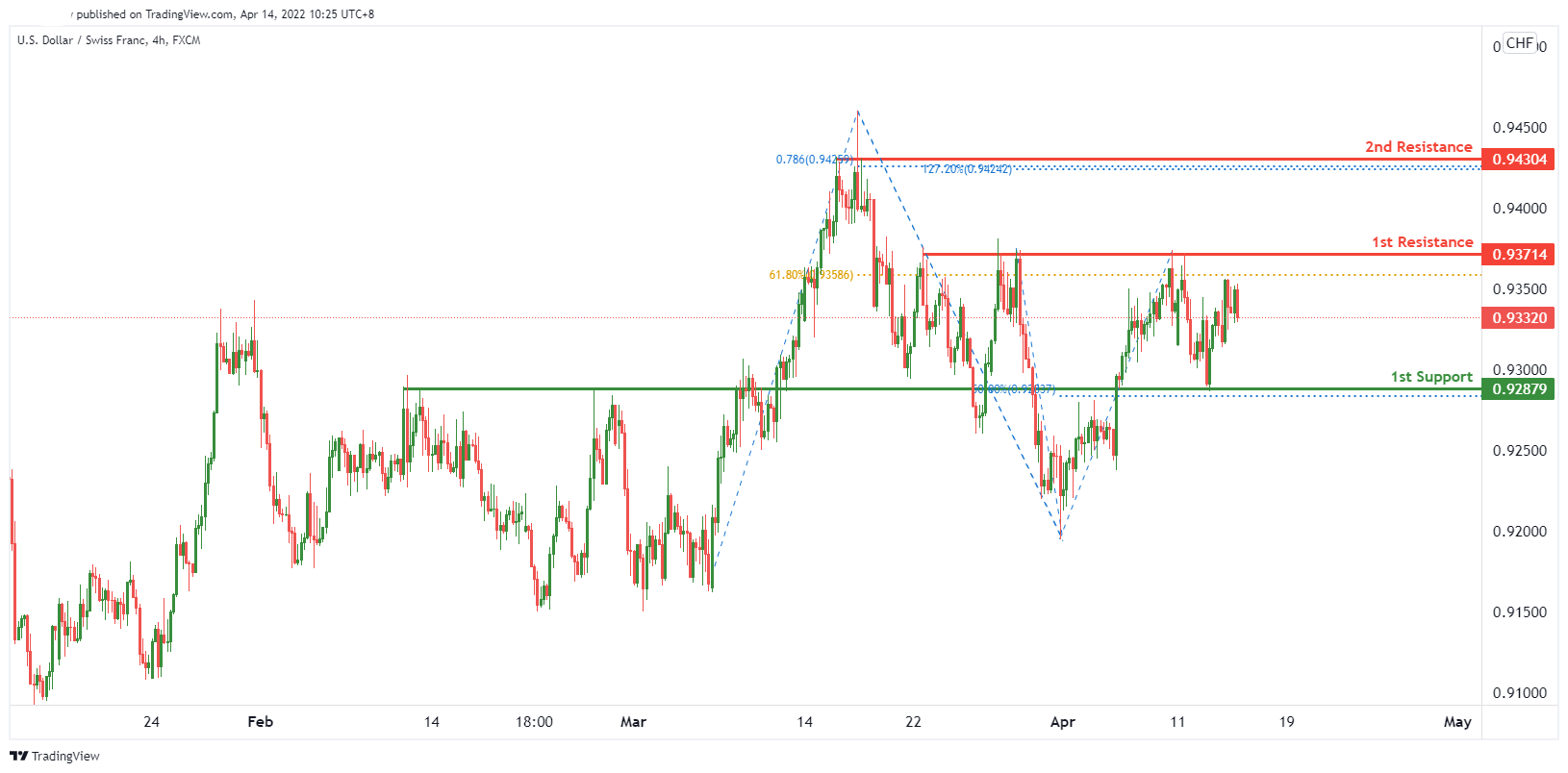
On the H4, we see the potential for bearish reversal from our 1st resistance at 0.93714 in line with 61.8% FIbonacci retracement towards our 1st support at 0.92879 which is in line with 50% Fibonacci retracement. Alternatively, price might break through the key resistance level and head towards the 2nd resistance level of 0.94304 which lines up with 78.6% Fibonacci projection and 127.2% Fibonacci extension.
Areas of consideration
- 1st support level at 0.92879
- 1st resistance level at 0.93714
- 2nd resistance level at 0.94304
EUR/USD :
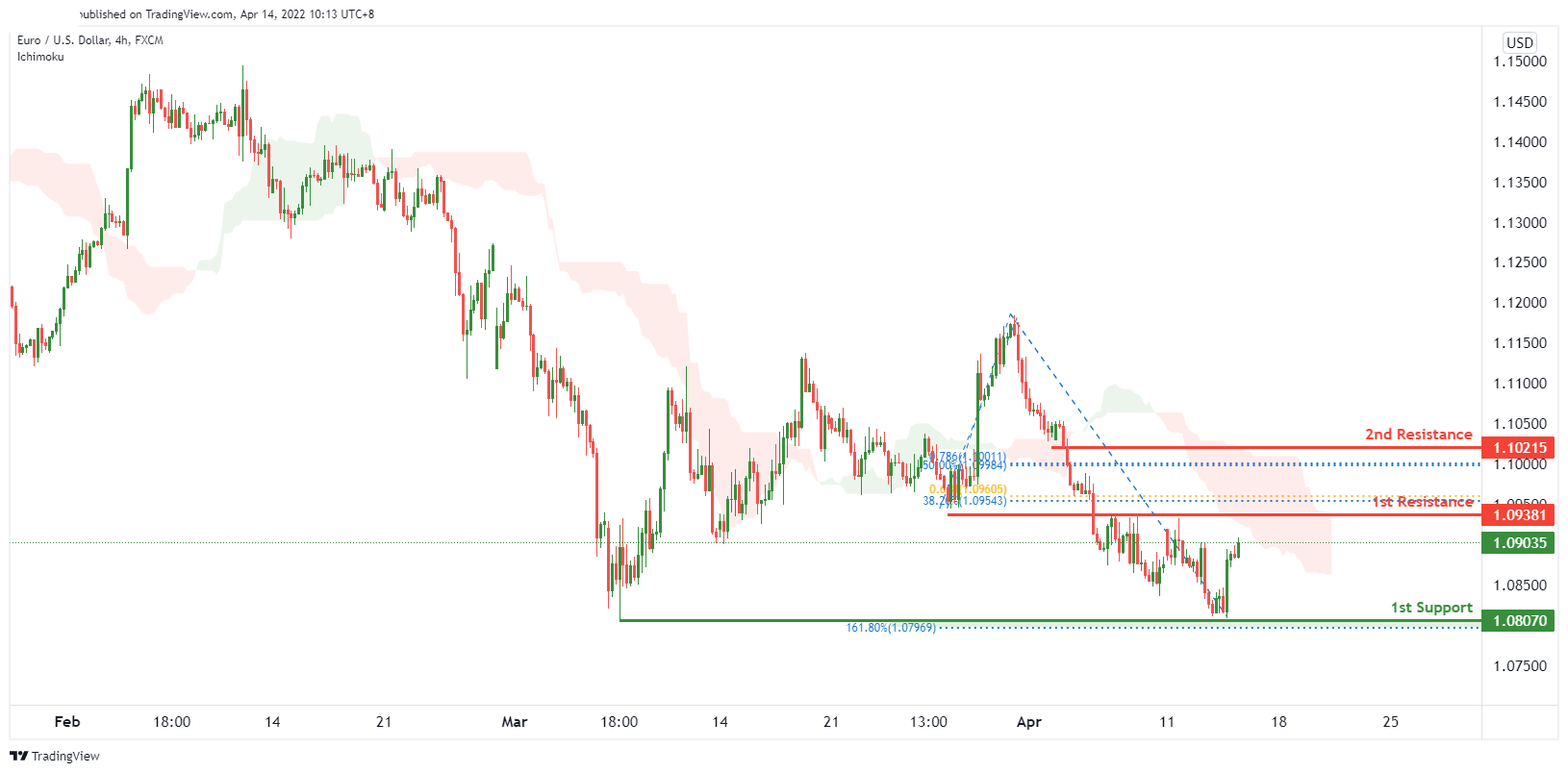
On the H4 timeframe, price is near a key pivot. We see the potential for a bearish reversal from our 1st resistance level of 1.09381 in line with 38.2% Fibonacci retracement and 61.8% Fibonacci projection towards our 1st support level of 1.08070 in line with 161.8% Fibonacci extension. Our bearish bias is supported by price trading below the Ichimoku cloud indicator.
Areas of consideration :
- H4 1st resistance at 1.09381
- H4 2nd resistance at 1.10215
- H4 1st support at 1.08070
USD/JPY:
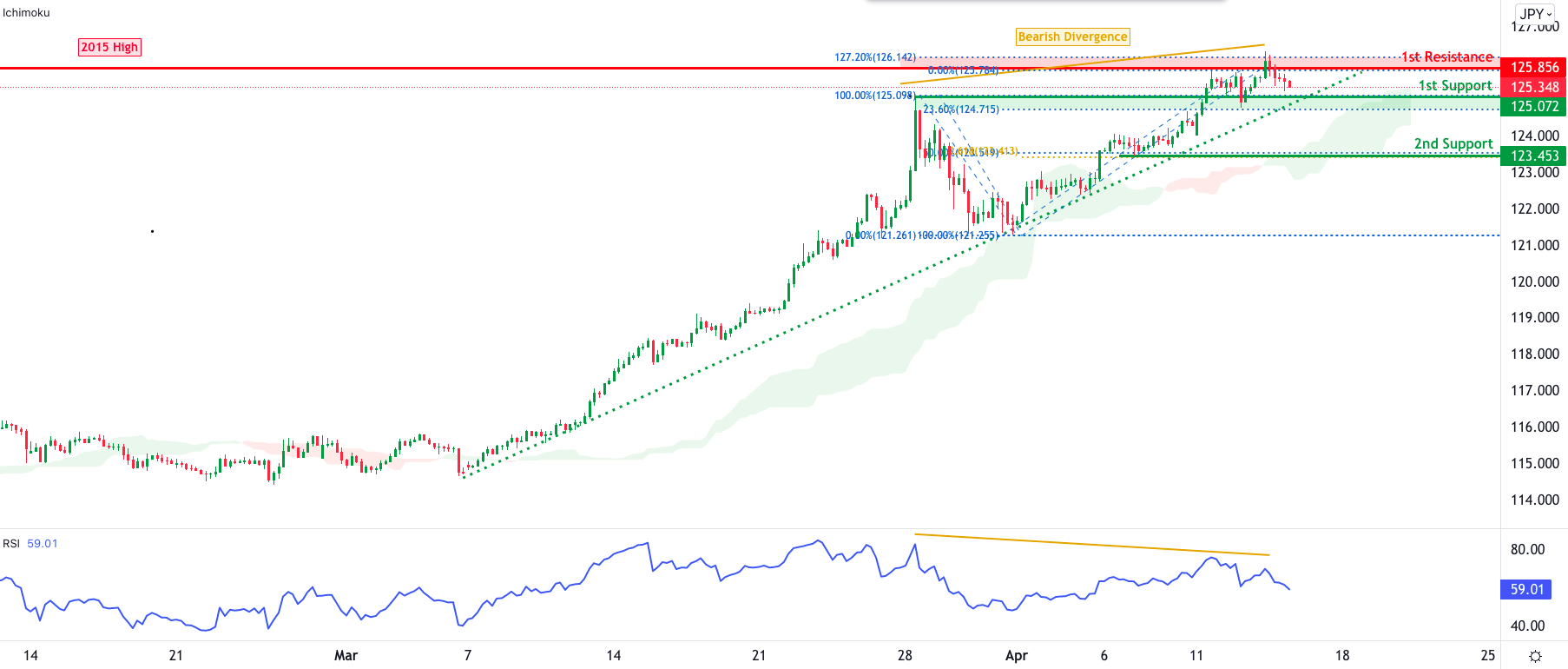
Price has reversed off 1st resistance identified at 125.85 area yesterday. However, it is approaching the ascending support and pullback support level at 125.07. Price will likely be squeezed between these 2 major levels. If price breaks the 1st support at 125.07, it’s likely to see a strong drop to 123.45 support level which is a 50% Fibonacci retracement and 61.8% Fibonacci projection. It is worth noting that there’s a strong bearish divergence against RSI suggesting that we might see a big bearish reversal.
Areas of consideration:
- H4 time frame, 1st resistance at 125.85
- H4 time frame, 1st support at 125.07
- H4 time frame, 2nd support at 123.45
AUD/USD:
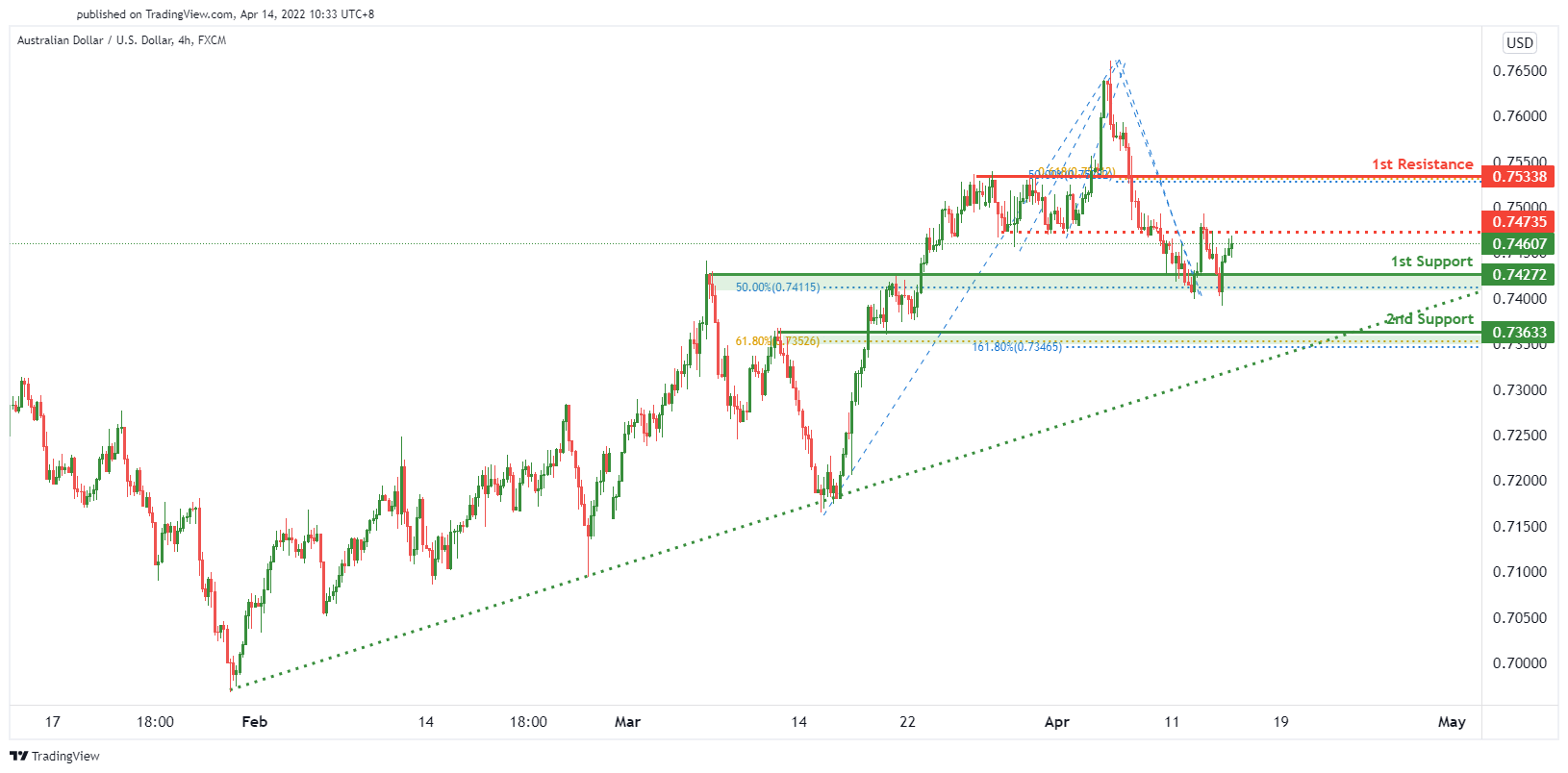
On the H4 timeframe, we see the potential for a bullish continuation from our 1st support level at 0.74272 in line with 50% Fibonacci retracement towards our 1st resistance level at 0.75338 in line with 50% Fibonacci retracement and 61.8% Fibonacci projection. Alternatively, if price break through the key support level, price might drop to to the 2nd support level of 0.73633 in line with 61.8% Fibonacci retracement and 161.8% Fibonacci extension.
Areas of consideration
- H4 1st resistance at 0.75338
- H4 1st support at 0.74272
- H4 2nd support at 0.73633
NZD/USD:
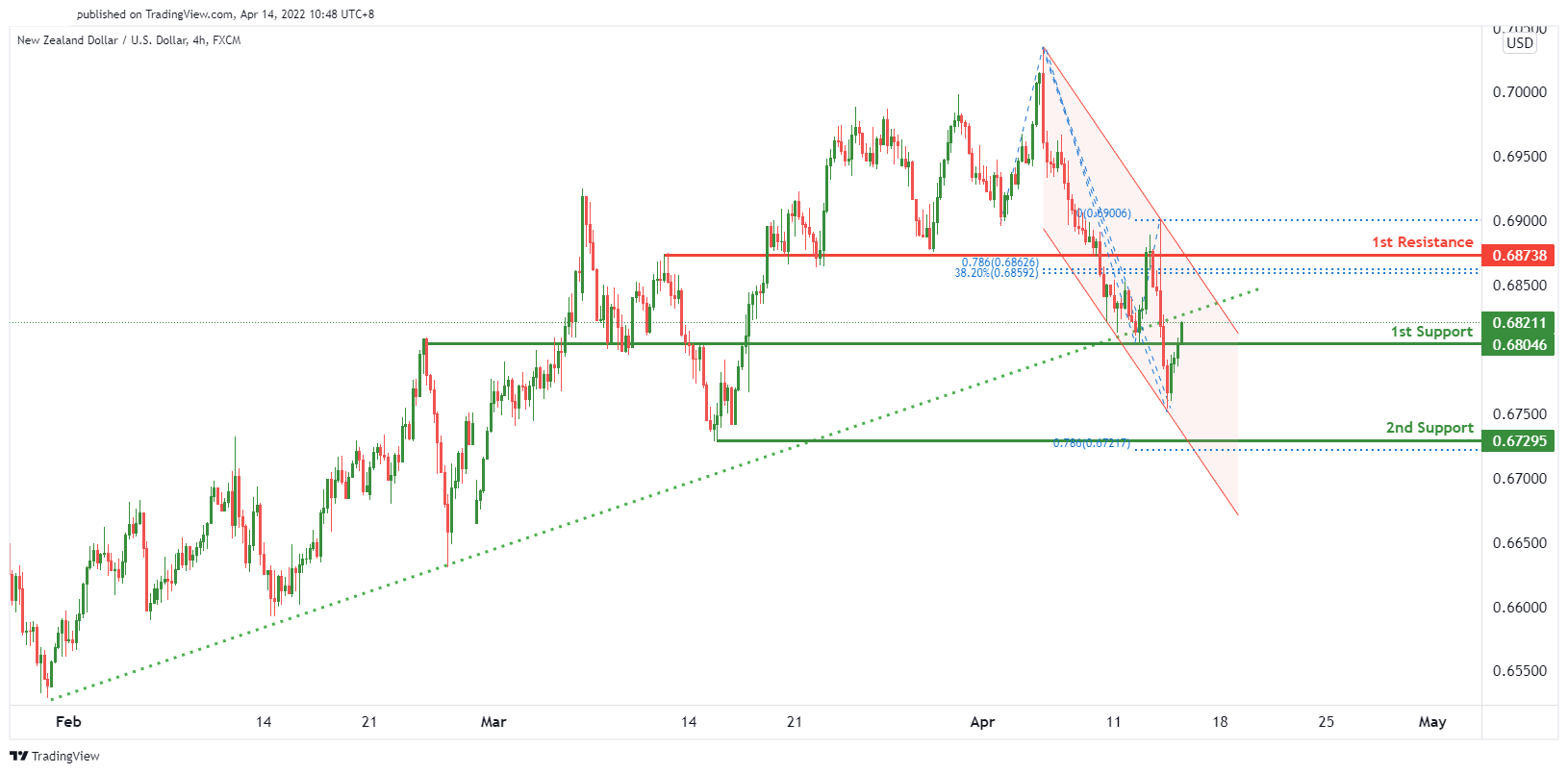
On the H4, we expect to see a potential for a bullish continuation from our 1st support of 0.68046 in line with key graphical overlap support towards our 1st resistance level at 0.69853 in line with the 78.6% Fibonacci retracement and 61.8% Fibonacci projection. Alternatively, if price breaks through the key support level, it might drop towards the 2nd support level of 0.67295 in line with 78.6% Fibonacci projection.
Areas of consideration:
- H4 time frame, 1st support at 0.68046
- 01H4 time frame, 2nd support at 0.67295
- H4 time frame, 1st resistance at 0.68738
USD/CAD:
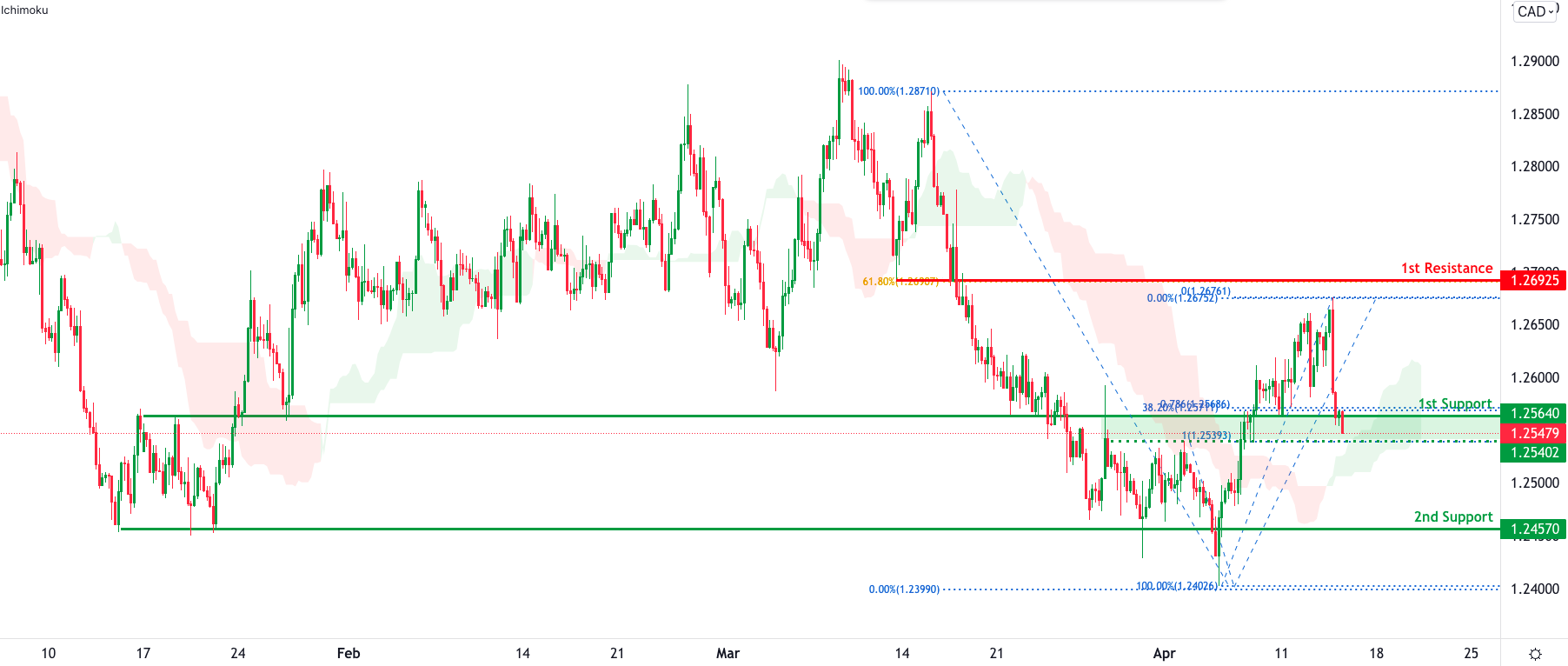
Price is testing a major 1st support area at 1.2564 and breaking this 1st support would potentially trigger a bigger move down to 2nd support at 1.2457 area which has seen prices bounce off multiple times in the pasrt. It is worth noting that there’s an Ichimoku cloud support right where price is above the 1.2540 area.
Areas of consideration:
- H4 time frame, 1st resistance at 1.2692
- H4 time frame, 1st support at 1.2564
- H4 time frame, 2nd support at 1.2457
OIL:
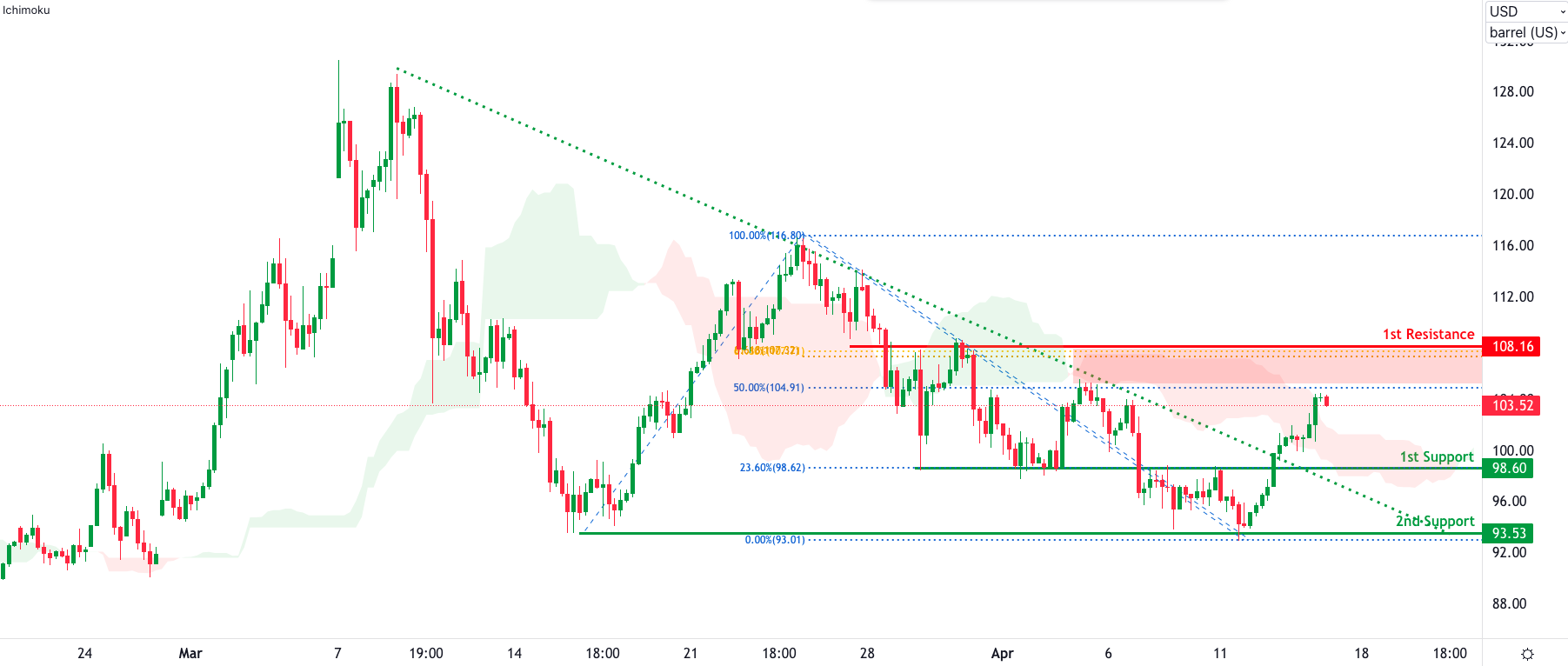
Oil has risen to the 1st resistance we highlighted yesterday. Today we’re seeing it hover slightly below the resistance area of 105 to 108 which is a 50% – 61.8% Fibonacci retracement area. It is also testing the Ichimoku cloud resistance area. Breaking above this level would suggest prices could rise to test the 108.16 level.
1st Support is down at 98.60 which is a strong overlap support level.
Areas of consideration:
- H4 time frame, 1st resistance of 108.16
- H4 time frame, 1st support of 98.60
- H4 time frame, 2nd support at 93.53
Dow Jones Industrial Average:
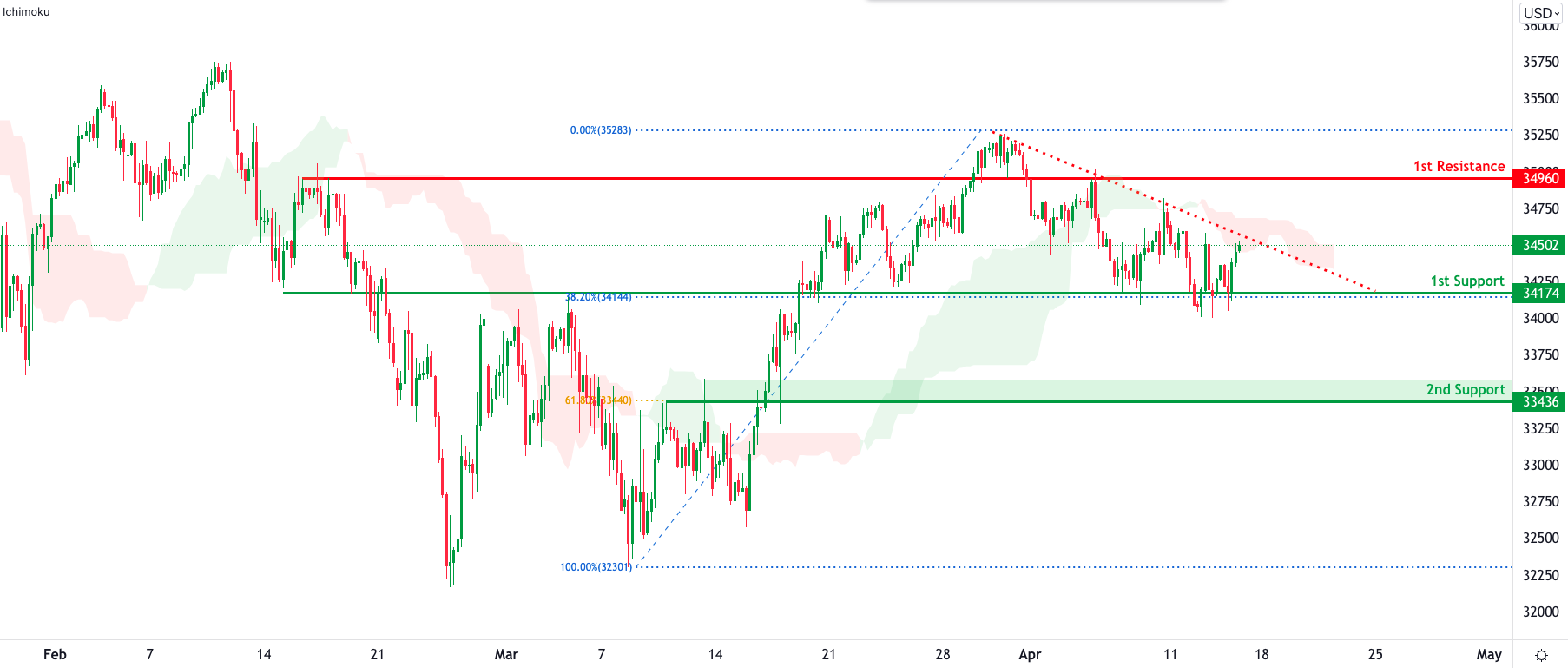
Price has bounced above the 1st support we highlighted yesterday at 34174. We can see that it is testing the descending resistance line once again and is also testing the bearish Ichimoku cloud resistance. Price is likely to be squeezed further down and a break of the 34174 area should trigger a bigger move down to 33436 level which is a pullback support along with a 61.8% Fibonacci retracement.
Areas of consideration :
- H4 time frame, 1st resistance at 34960
- H4 time frame, 1st support at 34174
- H4 time frame, 2nd support at 33436
ECB to turn more hawkish, EUR/CHF recovering
ECB is widely expected to keep monetary policy unchanged today. But with inflation at a record high of 7.5%, the central bank is also expected to sing a more hawkish tune. There should be an announcement to put a firm end date to the asset purchase program. Interest rate hike will only come "some time" after ending the purchases.
There are talks that putting an end date to asset purchases in June would open up the possibility of a rate hike in September, followed by another in December. But President Christine Lagarde will certainly continue to sound non-committal, but emphasize the importance of graduality, optionality and flexibility for the policy path ahead.
Here are some previews on ECB:
- ECB Preview: Policy Under a Cloud of Uncertainties
- ECB Preview: No Policy Adjustments Expected
- ECB 'Half Measures' Unlikely to Stop Euro's Bleeding
- ECB Preview – Lagarde to Bring September into Play – We Revise Our ECB Call
EUR/CHF's reaction to ECB decision and press conference is worth some attention. So far, the decline from 1.0400 is not impulsive looking. The cross has also started to lose downside momentum as seen in 4 hour MACD. A break above 1.0204 minor resistance today will suggest that such pull back is finished. More importantly, in this case, rebound from 0.9970 is likely ready to resume through 1.0400. That, if happens, could give Euro a helping hand elsewhere.
Australia employment rose 17.9k in Mar, unemployment rate unchanged at 4%
Australia employment grew 17.9k in March, below expectation of 30.0k. Full-time jobs rose 20.5k while part-time jobs dropped -2.7k. Unemployment rate was unchanged at 4.0%, above expectation of 3.9%. Participation rate was unchanged at 66.4%. Monthly hours worked dropped -0.6% mom.
Bjorn Jarvis, head of labour statistics at the ABS, said: "With employment increasing by 18,000 people and unemployment falling by 12,000, the unemployment rate decreased slightly in March, though remained at 4.0 per cent in rounded terms.
"4.0 per cent is the lowest the unemployment rate has been in the monthly survey. Lower rates were seen in the series before November 1974, when the survey was quarterly."


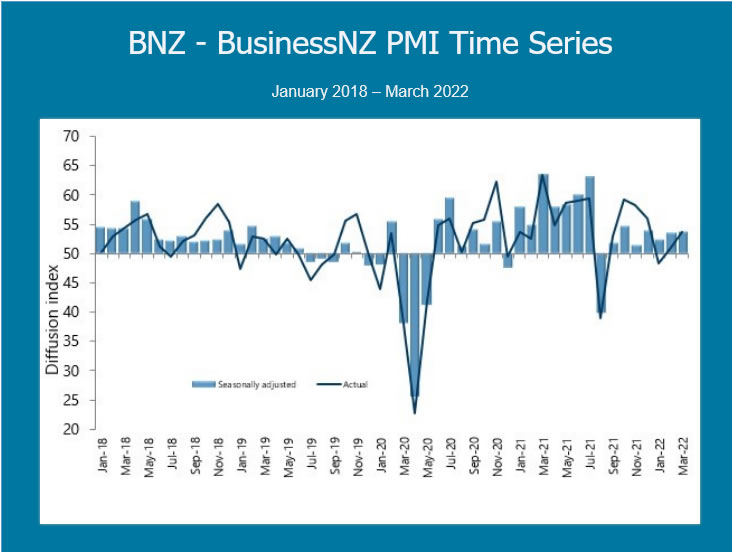
New Zealand BNZ manufacturing rose to 53.8
New Zealand BNZ Performance of Manufacturing Index rose slightly from 53.6 to 53.8 in March. Production dropped from 51.7 to 50.9. Employment rose from 52.0 to 52.4. New orders rose from 58.6 to 61.0. Finished stocks rose from 50.2 to 53.5. Deliveries dropped from 53.1 to 51.9.
BNZ Senior Economist, Doug Steel stated that "Omicron's impact may not be as harsh as the first 2020 COVID lockdown or last year's Delta lockdown, but it's there. Production has struggled, with the index slipping to 50.9 in March and a bit further below its long-term average."
Fed Waller: It’s a good time to do aggressive actions
Federal Reserve Governor Christopher Waller said in a CNBC interview that preferred a "front-loading approach" on tightening. So, "a 50-basis-point hike in May would be consistent with that, and possibly more in June and July."
"I think we're going to deal with inflation. We've laid out our plans," he said. "We're in a position where the economy's strong, so this is a good time to do aggressive actions because the economy can take it."
"I think we want to get above neutral certainly by the latter half of the year, and we need to get closer to neutral as soon as possible," Waller added.
Gold Wave Analysis
- Gold broke resistance level 1960.00
- Likely to rise to resistance level 2000.00
Gold recently broke the resistance level 1960.00 (which stopped the previous corrective wave A at the end of March).
The breakout of the resistance level 1960.00 coincided with the breakout of the 38.2% Fibonacci correction of the previous downward wave (A).
Gold can be expected to rise toward the next round resistance level 2000.00 (target for the completion of the active wave C).
GBPCHF Wave Analysis
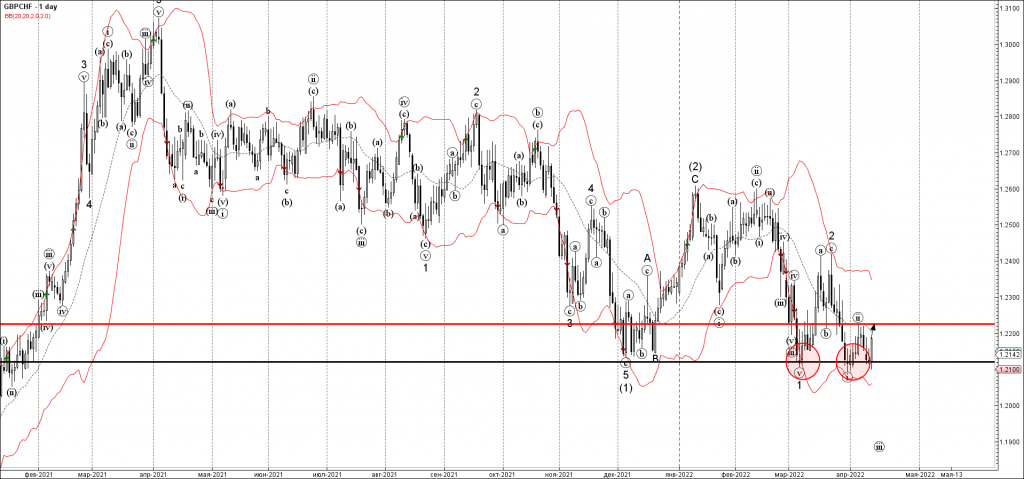
- GBPCHF reversed from support level 1.2120
- Likely to rise to resistance level 1.2225
GBPCHF currency pair earlier reversed up sharply from the pivotal support level 1.2120 (which stopped the previous minor impulse wave 1 at the start of March).
The upward reversal from the support level 1.2120 stopped the previous impulse waves (iii), 3 and (3).
Given the strength of the support level 1.2120 – GBPCHF currency pair can be expected to rise toward the next resistance level 1.2225 (top of the previous correction (ii)).
GBP/USD: Can the BoE Keep Pace with the Fed?
The Bank of England (BoE) already faced a tough decision at its next meeting on 5 May. How to quell inflation without scuppering the UK economy? GDP, employment, and inflation data this week just made the BoE’s job a whole lot harder. That’s potential bad news for GBP/USD, which rode high on a hawkish BoE at the turn of this year. Meanwhile, the US Federal Reserve is now steadfast in its commitment to raise interest rates in the face of high inflation.
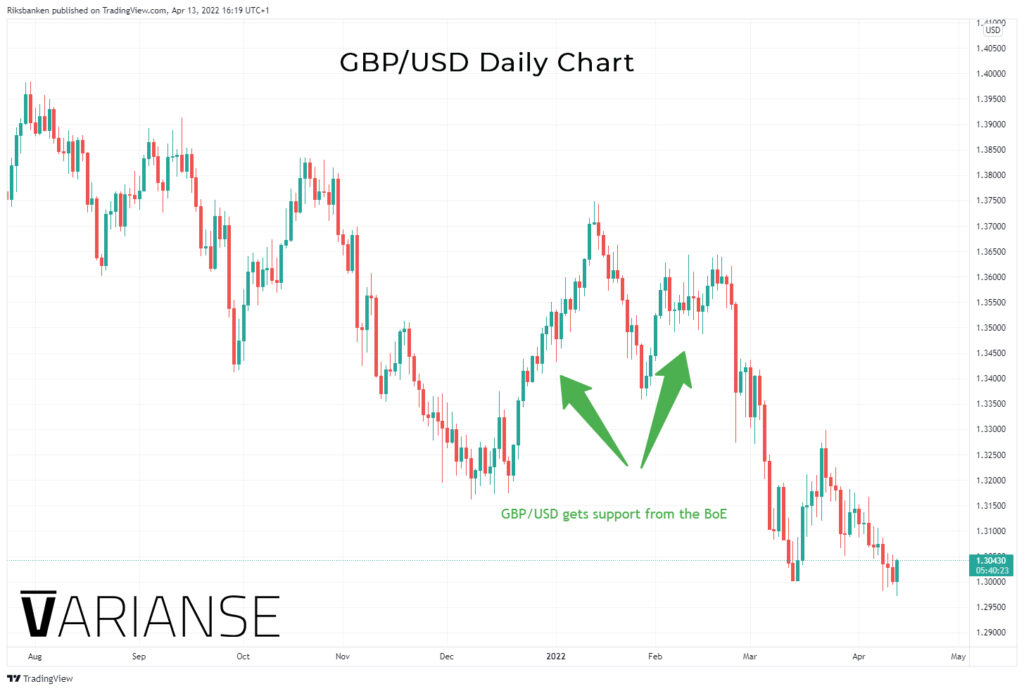
Everything was different prior to the BoE’s March meeting. One of the first major central banks to begin raising interest rates in December of last year, the BoE was expected to keep better pace with the Fed in terms of policy tightening. A 15 bps points rise in December, followed by a 25 bps in February and March. Voting patterns in February pointed to the prospect of 50 bps clips at one stage, before a more cautious BoE in March brought down future expectations of interest rate hikes.
In that context, the Bank of England (BoE) would have found Wednesday’s March UK CPI report unsettling. Headline CPI accelerated to 7% y/y - its highest rate since 1992 – up from an already eye-watering 6.2% y/y in February. Worse still for the BoE, inflation for the full quarter stood at 6.2% y/y, well above the 5.7% y/y forecasted in the BoE’s February Monetary Policy Report and the implied estimate of 5.8% in the March Monetary Policy Summary. Higher energy prices due to war in the Ukraine has certainly been a key factor behind rising inflation.
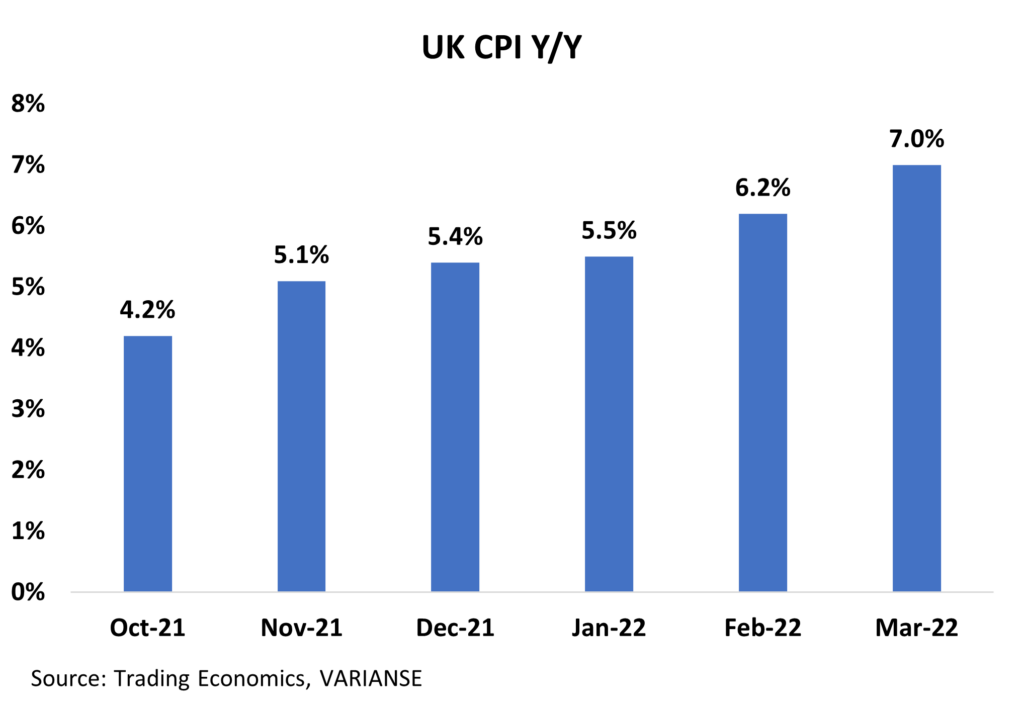
Revisiting the counterfactual on inflation had there been no war, however, doesn’t make the BoE’s job any easier going forward. UK core CPI, which excludes energy, food, alcohol, and tobacco also accelerated for a sixth consecutive month to 5.7% y/y in March. The February UK Labour Market Report also indicated a further fall in employment and a rise in headline wage growth. These are all signs that underlying inflation pressures may be on the rise.
At the same time, February UK GDP data released showed a sharp deceleration in economic activity in March with the prospect of flat growth moving into Q2, according to National Institute of Economic and Social Research (NIESR). Evidence of slowing growth and a persistent but uncertain inflation outlook, pose a serious challenge for the BoE and its capacity to keep pace with the US Federal Reserve in terms of tightening policy. Ceteris paribus, this means downside pressure on GBP/USD could persist.