Sample Category Title
ECB to conclude asset purchases in Q3, keeps rates unchanged
ECB announced that the Asset Purchase Program "should be concluded in the third quarter. Monthly net purchases under the APP will continue to be EUR 40B in April, EUR 30B in May and EUR 20B in June. The calibration of net purchases for Q3 will be data-dependent and depend on the outlook.
Interest rates are held unchanged with main refinancing rate, marginal lending facility rate and deposit rate at 0.00%, 0.25% and -0.50% respectively. Adjustments to rates will take place "some time" after ending the APP and will be "gradual".
(ECB) Monetary policy decisions
Russia's aggression in Ukraine is causing enormous suffering. It is also affecting the economy, in Europe and beyond. The conflict and the associated uncertainty are weighing heavily on the confidence of businesses and consumers. Trade disruptions are leading to new shortages of materials and inputs. Surging energy and commodity prices are reducing demand and holding back production. How the economy develops will crucially depend on how the conflict evolves, on the impact of current sanctions and on possible further measures. At the same time, economic activity is still being supported by the reopening of the economy after the crisis phase of the pandemic. Inflation has increased significantly and will remain high over the coming months, mainly because of the sharp rise in energy costs. Inflation pressures have intensified across many sectors.
At today's meeting the Governing Council judged that the incoming data since its last meeting reinforce its expectation that net asset purchases under its asset purchase programme should be concluded in the third quarter. Looking ahead, the ECB's monetary policy will depend on the incoming data and the Governing Council's evolving assessment of the outlook. In the current conditions of high uncertainty, the Governing Council will maintain optionality, gradualism and flexibility in the conduct of monetary policy. The Governing Council will take whatever action is needed to fulfil the ECB's mandate to pursue price stability and to contribute to safeguarding financial stability.
Asset purchase programme (APP)
Monthly net purchases under the APP will amount to €40 billion in April, €30 billion in May and €20 billion in June. At today's meeting the Governing Council judged that the incoming data since its last meeting reinforce its expectation that net asset purchases under the APP should be concluded in the third quarter. The calibration of net purchases for the third quarter will be data-dependent and reflect the Governing Council's evolving assessment of the outlook.
The Governing Council also intends to continue reinvesting, in full, the principal payments from maturing securities purchased under the APP for an extended period of time past the date when it starts raising the key ECB interest rates and, in any case, for as long as necessary to maintain favourable liquidity conditions and an ample degree of monetary accommodation.
Key ECB interest rates
The interest rate on the main refinancing operations and the interest rates on the marginal lending facility and the deposit facility will remain unchanged at 0.00%, 0.25% and -0.50% respectively.
Any adjustments to the key ECB interest rates will take place some time after the end of the Governing Council's net purchases under the APP and will be gradual. The path for the key ECB interest rates will continue to be determined by the Governing Council's forward guidance and by its strategic commitment to stabilise inflation at 2% over the medium term. Accordingly, the Governing Council expects the key ECB interest rates to remain at their present levels until it sees inflation reaching 2% well ahead of the end of its projection horizon and durably for the rest of the projection horizon, and it judges that realised progress in underlying inflation is sufficiently advanced to be consistent with inflation stabilising at 2% over the medium term.
Pandemic emergency purchase programme (PEPP)
The Governing Council intends to reinvest the principal payments from maturing securities purchased under the PEPP until at least the end of 2024. In any case, the future roll-off of the PEPP portfolio will be managed to avoid interference with the appropriate monetary policy stance.
In the event of renewed market fragmentation related to the pandemic, PEPP reinvestments can be adjusted flexibly across time, asset classes and jurisdictions at any time. This could include purchasing bonds issued by the Hellenic Republic over and above rollovers of redemptions in order to avoid an interruption of purchases in that jurisdiction, which could impair the transmission of monetary policy to the Greek economy while it is still recovering from the fallout from the pandemic. Net purchases under the PEPP could also be resumed, if necessary, to counter negative shocks related to the pandemic.
Refinancing operations
The Governing Council will continue to monitor bank funding conditions and ensure that the maturing of operations under the third series of targeted longer-term refinancing operations (TLTRO III) does not hamper the smooth transmission of its monetary policy. The Governing Council will also regularly assess how targeted lending operations are contributing to its monetary policy stance. As announced, it expects the special conditions applicable under TLTRO III to end in June this year. The Governing Council will also assess the appropriate calibration of its two-tier system for reserve remuneration so that the negative interest rate policy does not limit banks' intermediation capacity in an environment of ample excess liquidity.
***
The Governing Council stands ready to adjust all of its instruments within its mandate, incorporating flexibility if warranted, to ensure that inflation stabilises at its 2% target over the medium term. The pandemic has shown that, under stressed conditions, flexibility in the design and conduct of asset purchases has helped to counter the impaired transmission of monetary policy and made the Governing Council's efforts to achieve its goal more effective. Within the Governing Council's mandate, under stressed conditions, flexibility will remain an element of monetary policy whenever threats to monetary policy transmission jeopardise the attainment of price stability.
The President of the ECB will comment on the considerations underlying these decisions at a press conference starting at 14:30 CET today.
Is BTC about to Soar above $100,000?
Bitcoin rose 4.3% on Wednesday to end the day around $41,300, Ethereum added 4% to reach 3100, and both remain near those levels early Thursday. The leading altcoins from the top ten have risen in price over the past day from 0.7% (Binance Coin) to 5.4% (Avalanche).
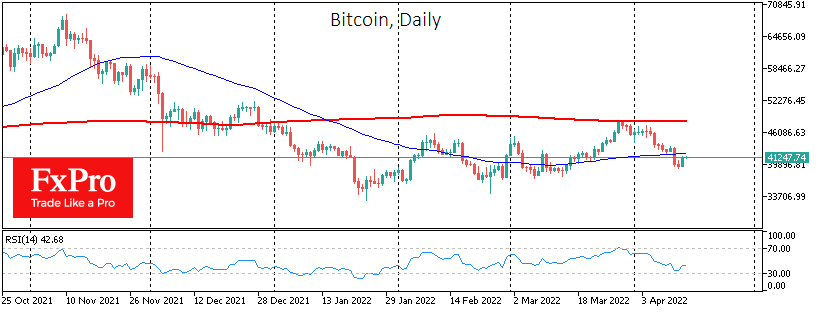
According to CoinMarketCap, the total capitalization of the crypto market has grown over the past 24 hours by 2.3% per day, to $1.92 trillion. The Bitcoin Dominance Index rose 0.3% to 41.0%.
Cryptocurrency index of fear and greed added to Thursday added 3 more points to 28 and moved into a state of “fear”.
Bitcoin was in demand in the US session amid a rebound in stock indices and a decline in the US dollar. The US currency began to correct downwards after a 9-day growth, which contributed to the revival of all risky assets.
Alex Mashinsky, CEO of the Celsius Network crypto-lending platform, said that Bitcoin will soar above $100,000 as early as 2022 because of capital flight from the stock market to cryptocurrencies. According to him, bitcoin began to behave as a protective asset against the backdrop of a deterioration in the general situation in the world.
Crypto lending platform Nexo has announced the release of the world’s first credit card secured in cryptocurrency based on the Mastercard payment system. The card will allow you to spend funds without having to sell crypto assets. They will be used as collateral to secure the loan.
According to IntoTheBlock, the number of long-term investors in the Shiba Inu token has grown 20 times since the beginning of the year. However, hodlers hold only 5% of the total capitalization of the meme token.
Gold and Dollar Take a Breather, But Rally Hardly Over
The Dollar is correcting on Thursday morning, losing around 1% from Wednesday’s peak, when the dollar index rose to its highest since May 2020. It has caught our attention that Gold and the Dollar have been moving in tandem since the start of the year. A historically rare and short-lived combination that has only intensified recently. Gold and the Dollar have risen back-to-back over the past week, having retreated somewhat from local highs yesterday.
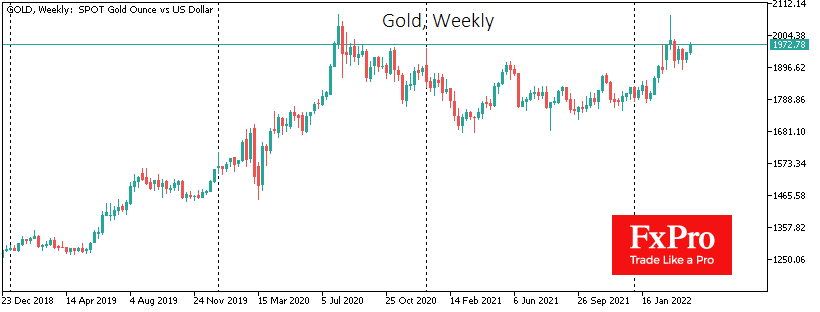
The correlation between the Dollar and Gold is easily explained by the flight of investors away from the conflict. The pull into Gold is more like a knee-jerk reflex. Much of it is speculation that investors will buy Gold as protection against inflation, financial system weakness or geopolitical instability.
However, it is worth realising that the alternative to traditional finance now is not Gold, but cryptocurrencies, which have no storage costs and are better shareable and transferable.
In modern finance, Gold often gets a role of a commodity asset. In other words, we could see this correlation break down as early as the next few days.
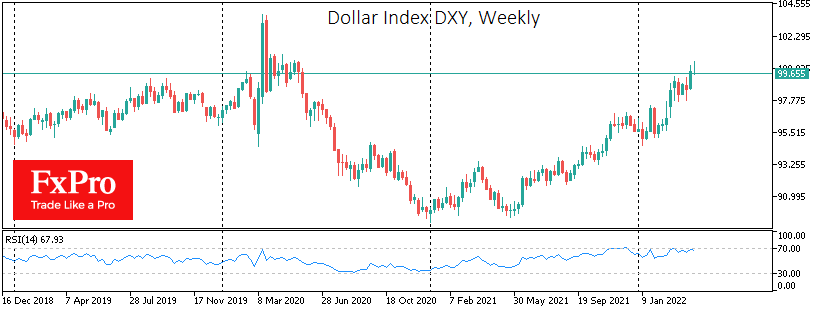
And from the fundamental point of view, the chances are higher that the dollar offensive might be renewed in the coming days. On Wednesday and Thursday, we see typical profit-taking before the long weekend after the rally. Behind the Dollar are expectations of extremely hawkish moves by the Fed, as FOMC members are fuelling the idea of a one-time 50-point rate hike in early May and are not ruling out one or two more such moves at subsequent meetings. So far, the economy has allowed the screws to tighten and is even “begging for it”.
At the same time, we should not forget that markets, especially the currency markets, are a waiting game. The Dollar climbed so high on a wave of extreme expectations. Their easing has the potential to trigger a reversal.
The dollar index hit bottom at the end of May last year. And we wouldn’t be surprised if, at the end of the May 4 meeting or after the next employment release on May 6, the Dollar hits the ceiling, as investors will gradually lock in profits and roll back expectations. The Dollar’s reversal may push Gold prices to new historic highs above $2100 by the end of this quarter and exceeds $2500 before this year ends.
USD/JPY Outlook: Bulls Lose Traction in Pre-holiday Trading
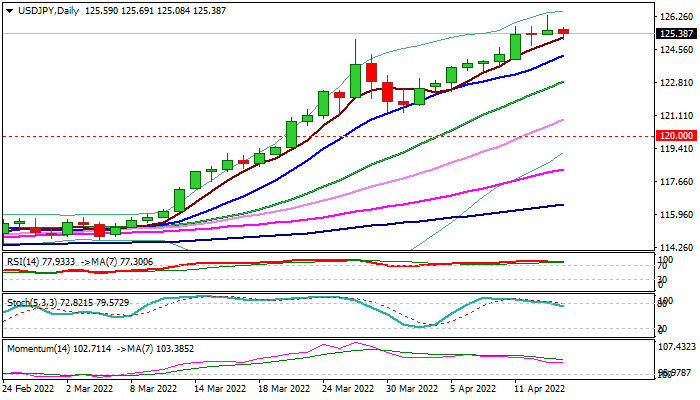
The USDJPY stands at the back foot on Thursday, but still with limited downside, after Wednesday’s shooting start indicated that bulls might be running out of steam.
Traders reduced pace ahead of Easter holiday, which usually causes lower volumes, with price adjustment seen as the main scenario so far.
Daily tech show fading bullish momentum and south-heading stochastic after reversing from overbought territory that adds to signals of consolidative/corrective phase, while weekly studies are also overbought, as the pair is on track for the sixth consecutive bullish weekly close, but so far without clearer signals of reversal.
Weaker US yields weigh on dollar today, however underlying uptrend is intact, with mild pullback likely to precede fresh push higher, as the greenback remains inflated by global uncertainty.
Initial support lays at 124.76 (Tuesday’s low) followed by more significant rising 10 DMA (124.25) and 20DMA (122.88) which should contain deeper dips and keep larger bulls in play.
Only extension and close below 121.27 (Mar 31 through) would sideline bulls and signal deeper correction.
Res: 125.69; 126.00; 126.31; 126.55.
Sup: 125.08; 124.76; 124.25; 123.79.
GBP/USD Outlook: Bullish Engulfing Generates Initial Reversal Signal
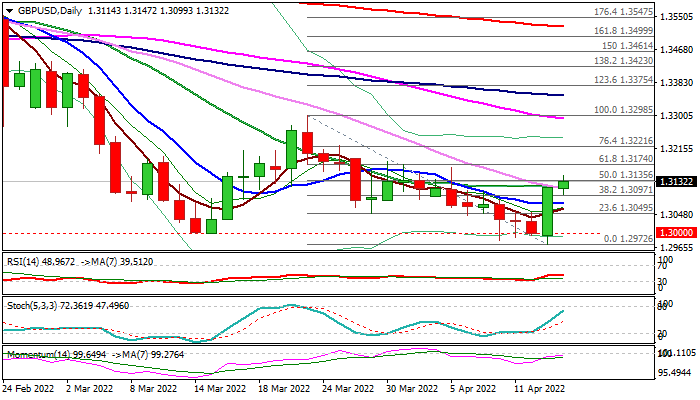
Cable keeps positive tone in European trading on Thursday, following almost 1% advance on Wednesday (the biggest one-day gains since 9 July 2021).
Repeated failures to clearly breakthrough 1.30 support resulted in strong bounce that generates of initial signal of a double-bottom formation on daily chart, although stronger advance is still needed to give more evidence of a pattern formation.
Wednesday’s bullish engulfing and today’s extension above 50% retracement of 1.3298/1.2972 bear-leg marks initial reversal signal, which looks for confirmation on close above 1.3135 (50% retracement) to expose next key levels at 1.3174 and 1.3221 (Fibo 61.8%/Fibo 76.4% respectively).
Daily studies are improving, but still lacking clearer direction signal as 14-d momentum continues to head north and approach the centreline which separates negative from positive territory and MA’s are mixed.
Near-term bias is expected to remain with bulls if the pair registers repeated close above 1.3097 (Fibo 38.2% of 3298/1.2972), while failure here and return below 10DMA (1.3075) would revive bears.
Res: 1.3147; 1.3174; 1.3221; 1.3273.
Sup: 1.3097; 1.3075; 1.3049; 1.3000.
Euro Edges up ahead of ECB Meeting
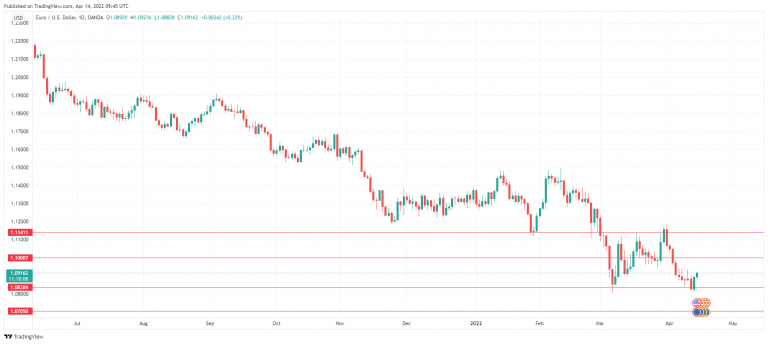
The euro has posted slight gains ahead of today’s ECB policy meeting and is trading at 1.0916 in the European session.
ECB expected to maintain rates
We are seeing central banks respond to spiralling inflation with tighter policy. On Tuesday, both the Reserve Bank of New Zealand and the Bank of Canada implemented super-size increases of 0.50%, although the Canadian and New Zealand dollars moved in different directions after the moves. The ECB holds its policy meeting later today and is expected to maintain rates, even though, in the words of ECB President Lagarde, this will put the ECB “out of sync” with the Federal Reserve.
The eurozone has not been immune from rising inflation, which has galvanized the Fed and BoE into increasing rates. Earlier this week German CPI for March rose to 7.3% YoY, up from 5.1% gain in February. Eurozone inflation also accelerating, but the Ukraine war has caused plenty of uncertainty and turbulence in the markets, which has dampened any expectations of any tightening by the ECB in the short term. Western European nations could impose additional sanctions on Moscow, but such a move would also hurt growth in the eurozone and complicate things for ECB policymakers.
Investors will be keeping a keen eye on the rate statement and Lagarde’s press conference. Will the central bank hint that rate increases could be coming later in the third or fourth quarters? Or will the Bank send a message that it is not prepared to tighten policy while a war is raging in the eurozone’s backyard? If the ECB wants to send out a hawkish message even though it is maintaining rates, it could announce that it may raise rates as QE is scaled back. This would be a shift in guidance and could boost the euro, as the current stance is that the Bank will not raise rates prior to winding up QE.
EUR/USD Technical
- There is resistance at 1.1008 and 1.1141
- 1.0838 is a monthly support level. Below, there is support at 1.0705
EURUSD Attempts to Recover ahead of ECB Decision
American equities jumped as investors cheered the start of the earnings season. Companies that published their results in the season’s first day delivered mixed earnings. Blackrock was among the biggest winners as its net income jumped to $1.46 billion, up by 18% from a year earlier. This happened as the company’s inflows jumped by $114 billion. JP Morgan Chase’ revenue rose to $31.59 billion while its adjusted earnings rose to $2.76. Bed Bath & Beyond, on the other hand, said that its revenue dropped by 22% to $2.05 billion. The top companies that will publish their results today are UnitedHealth, Rent the Runway, State Street, Wells Fargo, PNC, Morgan Stanley, and Goldman Sachs.
The price of crude oil rose modestly after the latest report by the International Energy Agency (IEA). The Paris-based agency said that its forecast for fuel consumption will be 99.4 million barrels per day. This was a slight decline from the previous estimate of 99.7 million barrels per day. The agency said that plans by countries like the United States, UK, and Germany to release 240 million barrels of oil from their reserves will help to contain the deficit. The statement came two days after Vitol announced that it will stop trading Russia-origin crude by end of the year.
The Canadian dollar rose sharply against the US dollar after the latest decision by the Bank of Canada (BOC). As was widely expected, the bank decided to hike its benchmark interest rate by 0.50% in a bid to rein in high inflation. The bank also announced that it will start a process known as quantitative tightening (QT) that will involve selling bonds it accumulated during the pandemic. It will not replace the maturing government bonds. The statement came on the same day that the RBNZ also boosted rates. Later today, the Turkish and European central banks will publish their decisions.
USDCAD
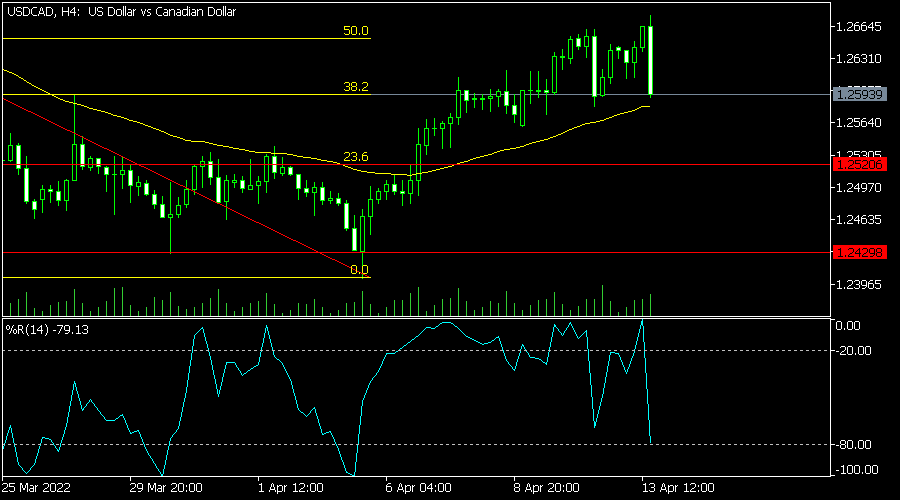
The USDCAD pair declined sharply after the BOC published its interest rate decision. It moved to a low of 1.2590, which was the lowest level since Monday. The price was also lower than the intraday high of 1.2677. On the four-hour chart, the pair moved to the 38.2% Fibonacci retracement level while the Williams %R moved to the oversold level. Therefore, the pair will likely drop and retest the support at 1.2520.
EURUSD
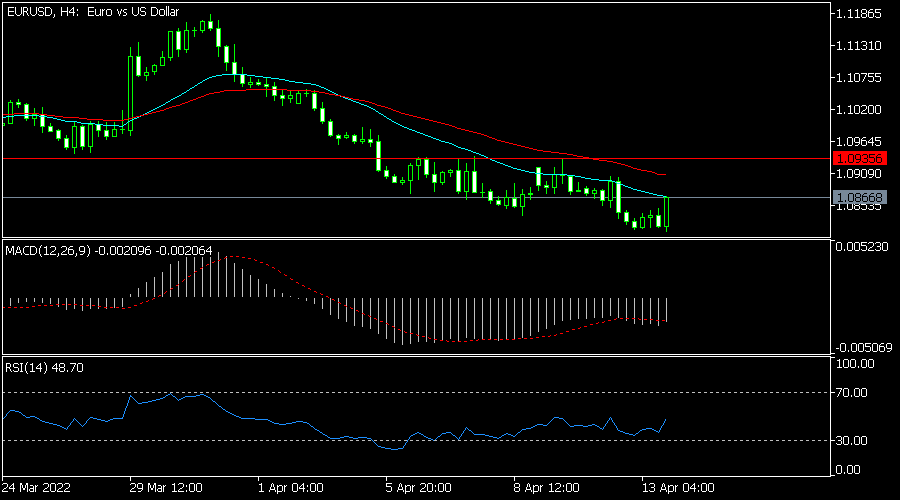
The EURUSD pair tilted upwards as investors waited for today’s ECB decision. The pair rose to a high of 1.0866, which was slightly higher than this week’s low of 1.0810. On the four-hour chart, the pair remains below the short and longer moving averages. The MACD has moved below the neutral level while the Relative Strength Index (RSI) has tilted upwards. Therefore, the pair will likely keep rising ahead of the ECB decision.
XBRUSD
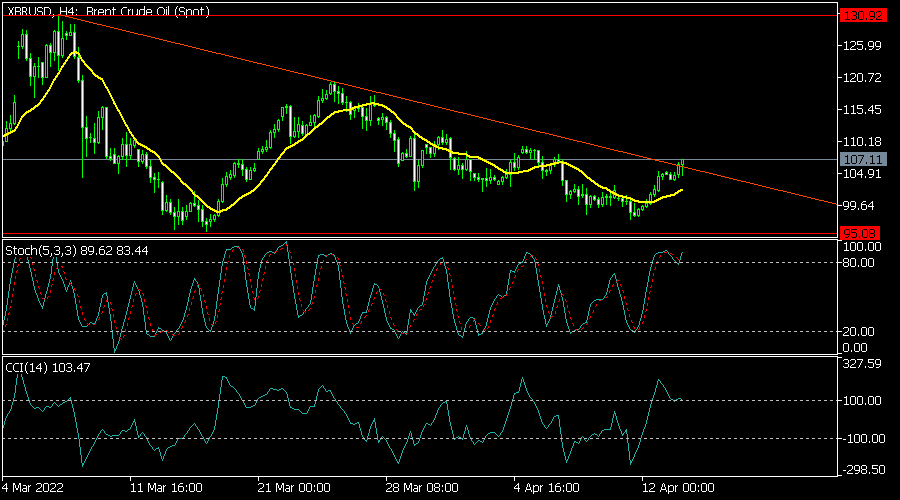
The XBRUSD pair rose to an intraday high of 106.87 after the report by IEA. On the four-hour chart, the pair managed to move above the upper side of the descending trendline. It also moved slightly above the 25-day and 50-day moving averages while oscillators have been rising. Therefore, the pair will likely resume the bearish trend because of the descending triangle pattern.
GBPCAD Creeps Up, Eyeing the Falling 200 MA
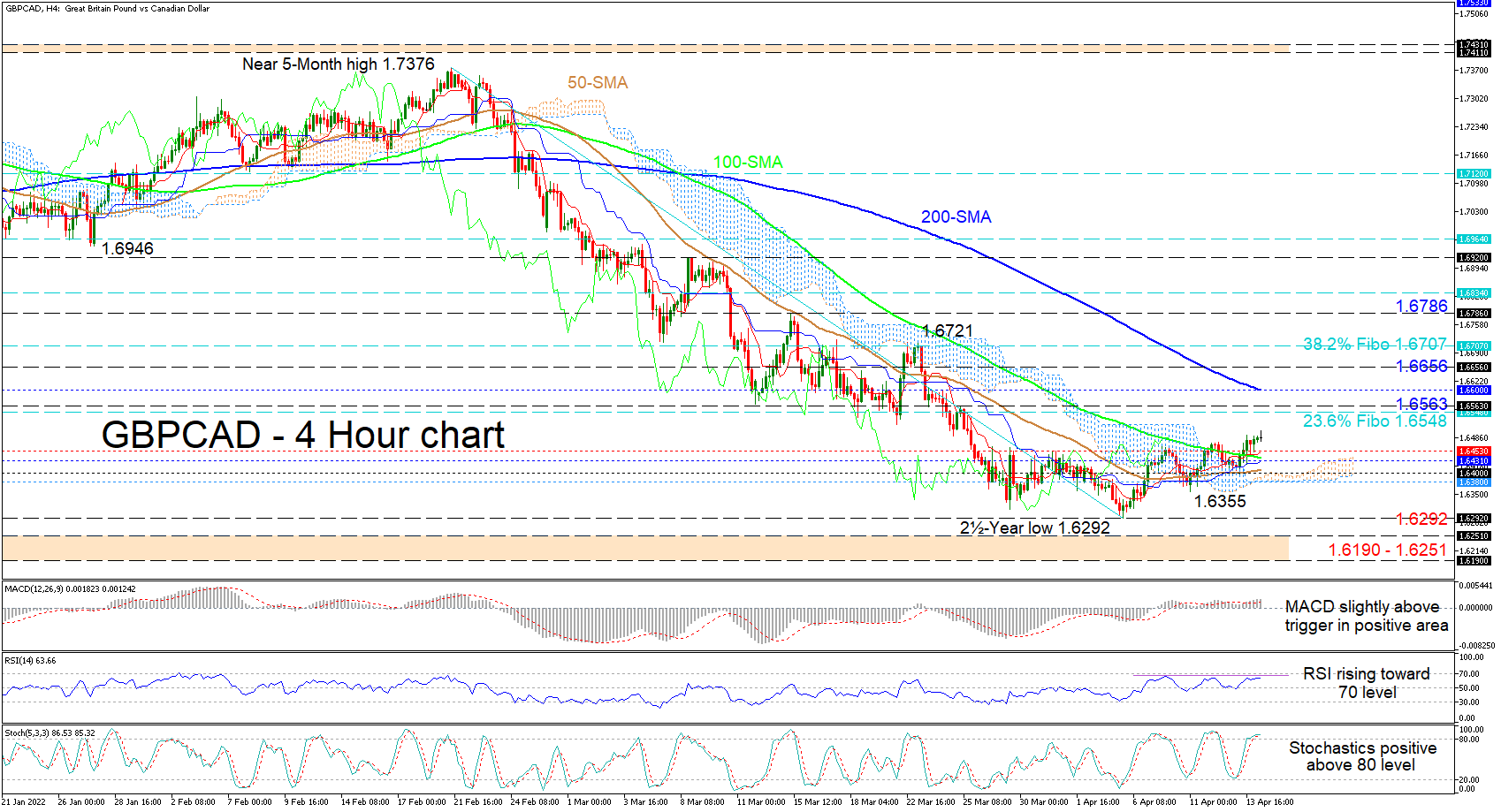
GBPCAD is sustaining its moderate bullish strides from the recently recorded two-and-a-half-year low of 1.6292, which has now steered the price over the Ichimoku cloud and the 50- and 100-period simple moving averages (SMAs). The unwavering bearish 200-period SMA continues to promote the downtrend. Meanwhile, the softened decline of the 100-period SMA, along with the gradual incline in the 50-period SMA, suggests the price may hike towards the 1.6548 level, which is the 23.6% Fibonacci retracement level of the down leg from 1.7376 until 1.6292.
The improving Ichimoku lines imply that positive forces are active, while the short-term oscillators hint that positive momentum is looking feeble. The MACD is holding a tad above its red trigger line in the positive region. However, the positive charge of the stochastic oscillator is softening in the overbought section, while the RSI is struggling to reach the 70 level.
If negative price action intensifies, a fortified support zone from the red Tenkan-sen line at 1.6453 until the 1.6400 handle may prove difficult to dive past. If sellers overpower this critical section, the cloud’s floor at 1.6380 and the adjacent 1.6355 low could then be challenged. Moving lower, the pair may attempt to revisit the near 30-month low of 1.6292. Should the pair rekindle the downtrend, the 1.6190-1.6251 support boundary stretching back to the troughs from the first half of October 2019 could draw attention.
On the other hand, if the pair maintains its upward bearing, resistance could commence at the 23.6% Fibo of 1.6548 and the March 25 high of 1.6563 before a more profound positive retracement confronts the descending 200-period SMA at 1.6600. If the 200-period SMA fails to curb additional advances in the pair, the price may test the 1.6656 barrier prior to aiming for the 38.2% Fibo of 1.6707. If the pair overruns the 1.6721 high too, the bulls could then be encouraged to target the 1.6786 border.
Summarizing, GBPCAD is exhibiting a positive vibe as the price is improving above the cloud and the 50- and 100-period SMAs. However, should the price remain beneath the 23.6% Fibo of 1.6548 and the 1.6563 high, risks to the downside may linger.
AUDUSD Stuck Below 20-SMA; Short-Term Outlook Still Fragile
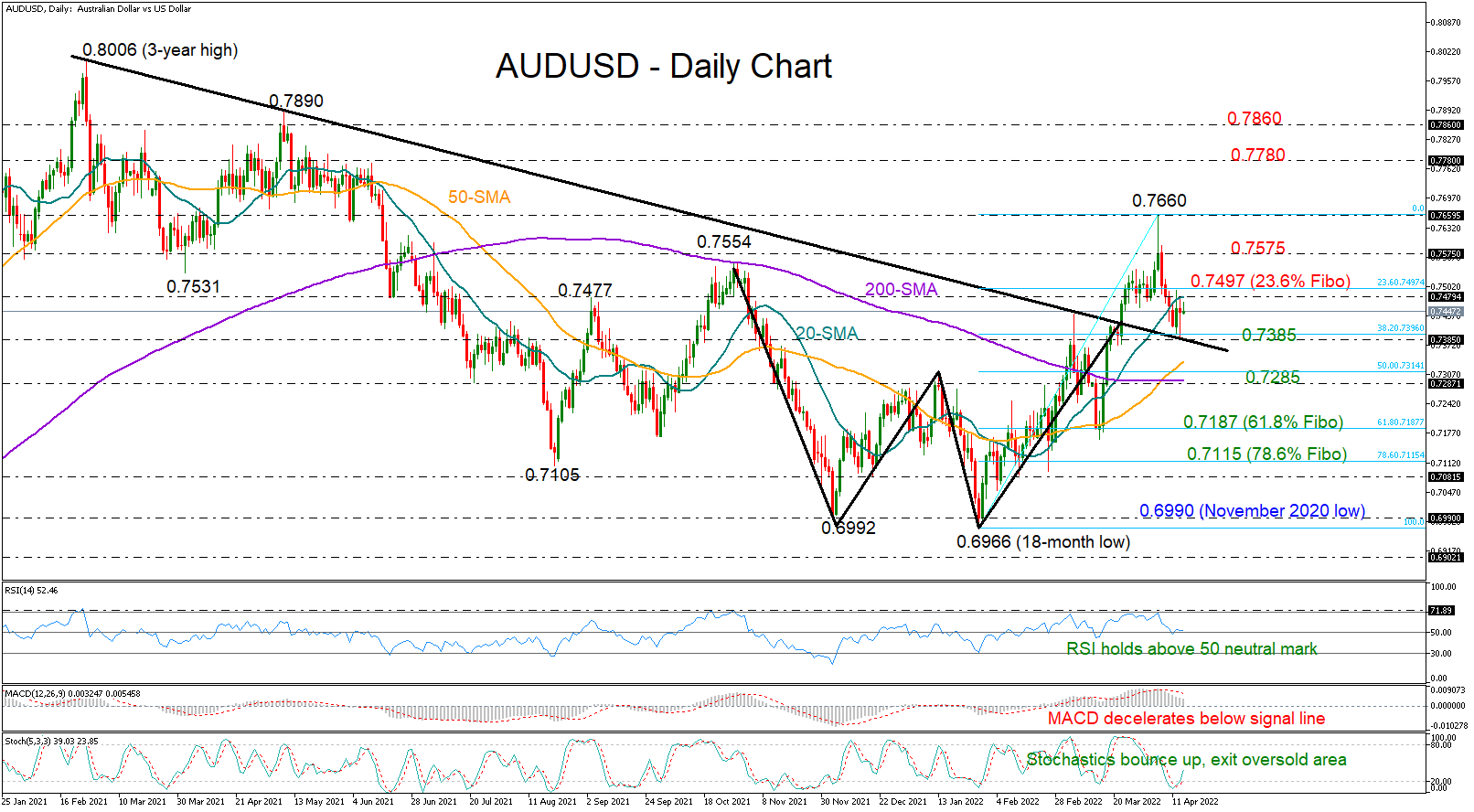
AUDUSD recouped most of Wednesday’s losses to stay within the 0.7400 zone after stepping on the resistance-turned-support trendline. Despite that, bullish actions were limited as the 20-day simple moving average (SMA) prevented any increases above 0.7480.
This line continues to block the way higher so far on Thursday, questioning the upside reversal in the RSI and the Stochastics. The MACD remains negatively charged below its red signal line, feeding some caution as well. As regards the market trend, however, the golden cross between the 50- and the 200-day SMAs is preserving optimism that the short-term positive pattern following the completion of a bullish double bottom structure around 0.6992 could gain extra legs.
For now, a decisive move above 0.7480 and, more importantly, an extension above the 23.6% Fibonacci retracement of the 0.6966 – 0.7660 upleg at 0.7497 is required to boost the price towards last week’s barrier of 0.7575. The previous peak at 0.7660 could be the next target, with the bulls likely aiming to upgrade the short-term positive outlook above that bar and drive the price towards 0.7780.
In the negative scenario, where the 20-day SMA fortifies selling tendencies, the spotlight will shift back to the trendline and the 0.7385 level. The 38.2% Fibonacci is in the neighborhood too. Hence, any violation at this point could confirm additional declines towards the 200-day SMA at 0.7287, unless the 50-day SMA manages to add strong footing beforehand at 0.7336. Should the bears persist, the door would open for the 61.8% Fibonacci of 0.7187.
In brief, despite its latest bounce in AUDUSD, negative risks continue to linger in the background. A continuation above 0.7497 could reduce skepticism, while a drop below 0.7385 could enhance selling appetite.