Sample Category Title
Euro Ready to Go Off the Cliff
Today’s meeting did not satisfy the expectation that the ECB could lend a helping hand to the euro by keeping it from plunging off a cliff. Europe has refused to accelerate monetary policy normalisation as most G7 countries have.
Currency market dynamics are always a comparison of relative strength. With a bigger blow to the economy from the events in Ukraine and no less of a problem with inflation, the single currency risks remain under pressure due to a rapidly widening gap in interest rates in the euro area and beyond.
The European Central Bank kept key interest rates unchanged and noted that the asset purchase programme would be scaled back and completed in the third quarter. Market participants expected these announcements.
The focus of market participants was on comments about further plans. And they are relatively mild, considering the external environment. The Fed is preparing the ground for a 50-point rate hike and the start of QE. The Bank of Canada and RBNZ already did so yesterday. The Bank of England and the Bank of Korea have returned rates to pre-pandemic levels.
In the meantime, the ECB is putting out a very sluggish plan: complete purchases in the third quarter, only then start to raise rates, and it will reinvest payments “long after the start” of tightening.
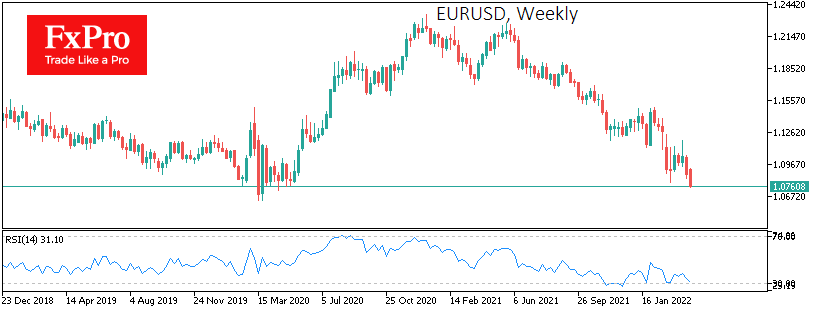
The EURUSD is hovering below 1.0800 on the two-year low. But the euro has an increased chance of being sent into free fall. Much like the Japanese currency, which reached 20-year lows against the Dollar earlier today, the Bank of Japan is still not convinced that deflation has been defeated.
The same can be said for the EURGBP pair, which has returned to levels below 0.8300 this week and is trading at arm’s length from 6-year lows.
GBPJPY Wave Analysis
- GBPJPY reversed from key round resistance level 164.65
- Likely to fall to support level 163.00
GBPJPY today recently reversed down from the key resistance level 164.65 (previous monthly high from March) – coinciding with the upper daily Bollinger Band.
The downward reversal from the resistance level 164.65 stopped the previous impulse wave (i).
Given the strength of the resistance level 164.65 and the overbought daily Stochastic – GBPJPY can be expected to fall toward the next support level 163.00.
CHFJPY Wave Analysis
- Reversed from resistance level 134.60
- Likely to fall to support level 132.00
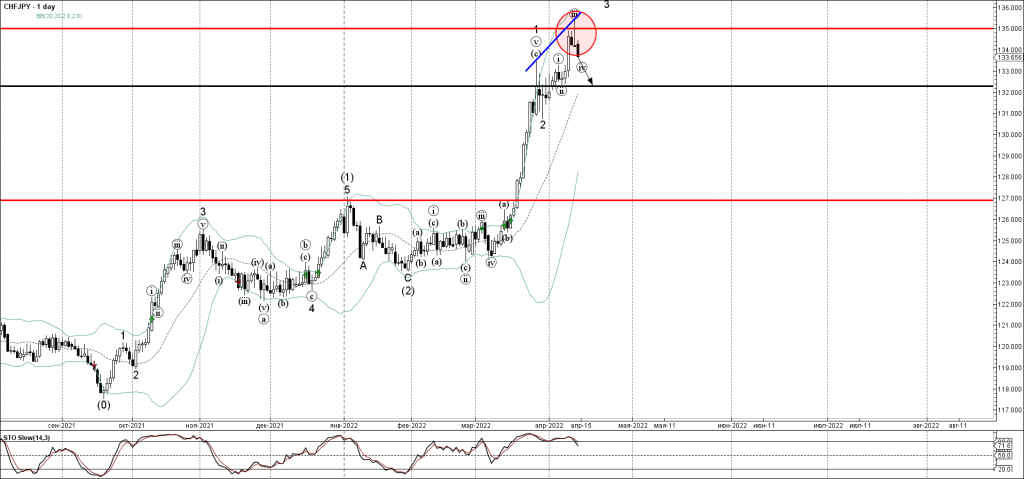
CHFJPY currency pair recently reversed down from the key round resistance level 134.60 (previous multi-month high from 2015) – standing near the upper daily and weekly Bollinger Bands.
The downward reversal from the resistance level 134.60 created the daily candlesticks reversal pattern Shooting Star.
Given the strength of the resistance level 134.60 and the clear bearish divergence on the daily Stochastic – CHFJPY can be expected to fall toward the next support level 132.00 (low of wave (ii)).
ECBs Unhelpful Ambiguity
European stocks are edging higher ahead of the long bank holiday weekend, ending the week not far from where they started as investors mull the latest policy decisions, inflation data and earnings.
There’s been a number of interest rate hikes this week, some more expected than others, while the ECB has instead opted for the usual cocktail of unhelpful ambiguity. Anyone hoping for a hawkish hint ahead of its next meeting and forecasts will no doubt be very disappointed, albeit not surprised.
It was, of course, very kind of President Lagarde to clear up a few things. For example, net asset purchases will end in the third quarter – yes, while other central banks are engaging in fear-induced rate hikes and quantitative tightening, the ECB is gradually winding down QE – and the conclusion of the process could come early or late in the quarter.
Following the conclusion of its asset purchases, the ECB will start raising rates some time after. What constitutes some time? That could be anything from a week to several months. I hope that’s cleared everything up. Don’t we all feel much wiser for having followed that press conference?
I understand the ECB is extremely hesitant to guide the market in the absence of up-to-date economic projections but days like today just make me wish they’d stick to quarterly meetings. There is nothing of substance to take away from today’s meeting and I can’t help but think the market remains far too ambitious in its interest rate expectations this year for a central bank that still thinks bond purchases are warranted.
Of course, its situation is far more uncertain than others, given its proximity and higher exposure to the war in Ukraine, while wage inflation remains far more muted than elsewhere. But it’s clearly not learned the lessons from other central banks and may be forced somewhere down the line to drastically change its stance. Whether that will be this year, I’m not convinced.
Bitcoin heading for further pain?
An encouraging rebound in bitcoin on Wednesday was short-lived, with the cryptocurrency once again in the red on Thursday. It appears to have struggled around the midpoint of Monday’s sell-off which could be viewed as a bearish signal. I’m not sure I’ll read too much into that but it’s certainly lost all breakout momentum in recent weeks. It continues to trade more broadly in its 2022 recovery channel and recent price action suggests it could be heading for another move towards the lows. That’s around 10% from the current price and a break below here could be a very bearish development.
Sunset Market Commentary
Markets
Today’s ECB policy statement very much resembled the one from March, especially when it comes to future monetary policy. From a market point of view, it resembled it even too much, with both the euro and short-term European yields losing out in a first reaction as they (and we) anticipated more urgency when it comes to policy normalization in light of worsening inflation dynamics. ECB Lagarde stressed the only subtle difference, namely that the governing council reinforced its judgement that net asset purchases should end in Q3. The ECB holds dearly to its sequencing principle of first ending net asset purchases and next implementing rate hikes. The official wording is “some time after”. At first, Lagarde repeated last month’s response that this implies optionality, gradualism and flexibility. Later, in a potential slip of the tongue she said that in practice it could mean anything ranging from a week (!) to several months. This still leaves all meetings starting from July open for a potential rate lift-off. Turning to the economic and inflationary assessment, Lagarde emphasized the abnormal brief period (5 weeks) in between meetings. The war on Ukraine is nevertheless having a clear impact. Growth remained weak in Q1 with little improvement expected on the horizon. There was a special reference to the rising cost of living costs with future risks to the growth outlook tilted to the downside. Higher energy prices are the main culprit for the unexpected surge in March inflation, though the ECB noted a sharp rise in food prices and a more widespread inflation level overall (pandemic-related bottlenecks, demand-driven and energy prices filtering through production processes). Wage growth remains muted overall. In an interesting twist, the ECB refers to longer-term inflation expectations derived from financial markets as “largely standing around 2%”. Judge for yourself: 5y5y fwd EMU inflation swap at 2.34% (highest since 2013) and 10y EMU inflation swap at 3% (record high). It does warrant close monitoring according to Lagarde. Inflation risks remain tilted to the upside. We interpret the market response as a vote of no-confidence in ECB policy. European yield curves steepen. The very front end cedes around 3 bps, lacking firmer guidance on a first hike, while the very long end rises by up to 10 bps as inflation expectations spiral further out of control. The combination is a deadly combo for a currency with EUR/USD sliding below the previous YTD low of 1.0806. The next technical reference in case of a confirmed break is the 2020 low at 1.0636. The weaker currency… you guessed it… worsens the ECB’s inflation headache. US yields gain 6 to 7 bps across the curve today following a 2-day correction, giving the dollar some new momentum as well. The trade-weighted greenback is back above 100.
News Headlines
The Turkish central bankkept policy rates steady at 14%. The status quo was expected and comes even as inflation soared beyond 61% y/y. Producer prices hitting well in the triple digits suggest more pipeline-price pressures. The view of the CBRT is unaltered in that current inflation is largely driven by external effects (energy, geopolitics and strong negative supply (chain) shocks). These effects should fade eventually. Instead of jacking up policy rates – the lowest in the world when adjusted for inflation – it rather wishes to further support liraization with measures that include FX sales by state banks. The Turkish lira was unaffected by today’s decision, trading around the EUR/TRY 16 pivot in the aftermath.
Swedish inflation quickened more than expected in March. Headline inflation rose 1.8% m/m to a 33-year high of 6% y/y. The central bank’s preferred CPI gauge with a fixed interest rate (CPIF) sped up to an even higher 6.1% y/y (1.7% m/m). Excluding energy, prices rose 4.1% y/y, up from 3.4% in February. The numbers raise pressure on the Riksbank, which only recently started preparing markets for a monetary shift. Governor Ingves said in March that rates would probably have to be raised sooner than in the year 2024 forecasted in February. It marked the start of a sharp rise in Swedish money markets and short-term swap yields. That move continues today. The 2y swap yield (+6 bps) hits a new cycle high. The krone strengthened vs the euro to EUR/SEK 10.29.
ETHUSD rebounds after 50-SMA rejects decline; bias bearish
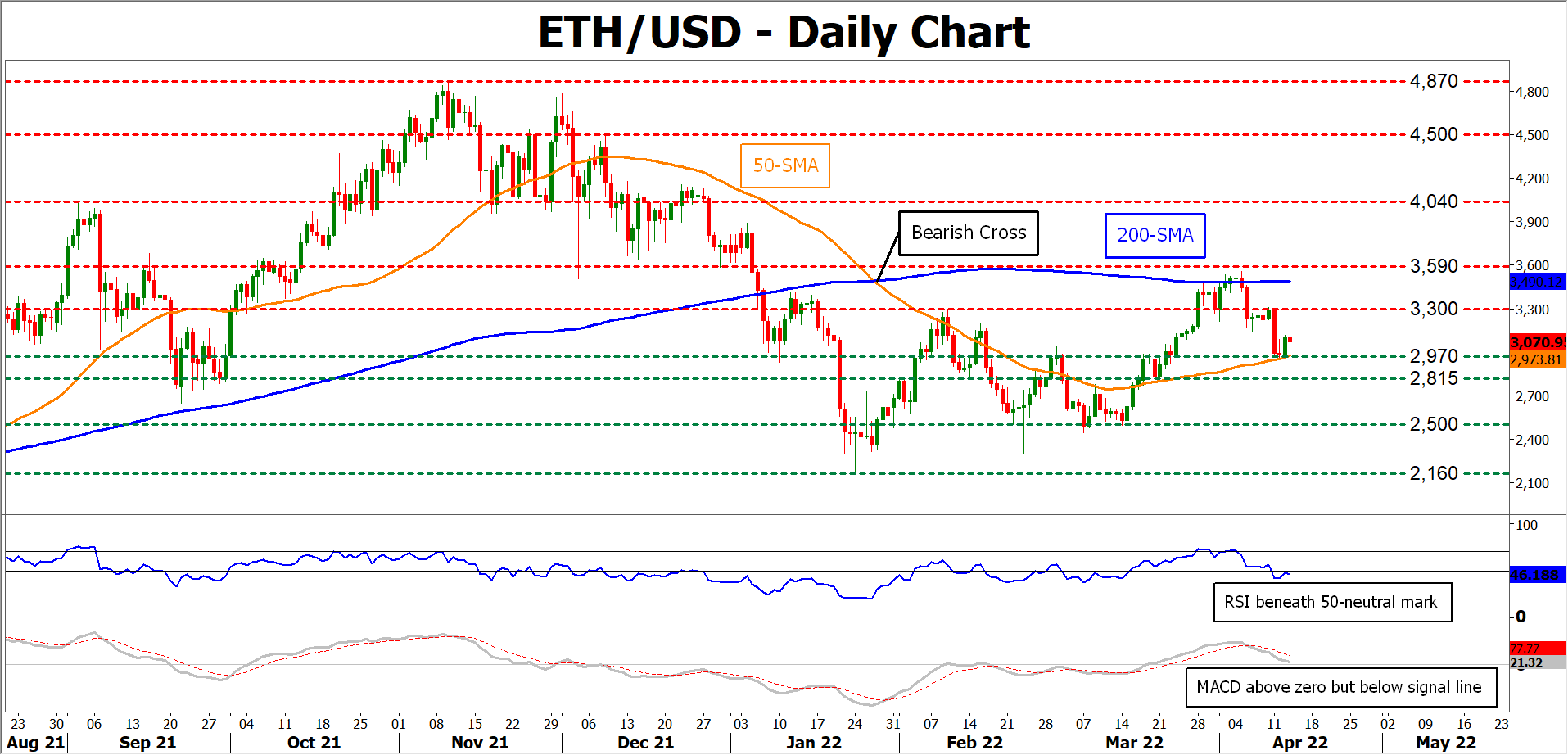
ETHUSD (Ethereum) has been experiencing a downside correction after its short-term uptrend stalled at the 3,590 region last week. Although the 50-day simple moving average (SMA) paused the price's recent pullback, it seems like the cryptocurrency lacks the necessary momentum to push higher.
The short-term oscillators reflect that bearish forces retain control. The MACD histogram is currently below its red signal line but above zero, while the RSI is hovering beneath its 50-neutral threshold.
Should negative momentum intensify further, the price could challenge the 2,970 region, which overlaps with the 50-day SMA. Piercing through this level, the bears might aim for 2,815 before the spotlight turns to the March strong support region of 2,500. Failing to halt there, further downside moves could reverse at the 2,160 hurdle, which is the lowest price level observed in 2022.
On the flipside, if bullish forces emerge and regain the upper hand, immediate resistance could be met at the 3,300 barricade. Crossing above this region, the price may test its recent reversion point of 3,590 before it ascends towards the September peak of 4,040. A jump above the latter obstacle could turn the spotlight to 4,500.
Overall, even though ETHUSD’s 50-SMA capped its downside move, the cryptocurrency's technical picture remains negative. Therefore, a dive beneath the 2,970 region could promote a sustained downtrend, while a clear break above the 3,590 ceiling might signal the resumption of the short-term upside trajectory.
US: Retail Sales Advance in March, Finish the First Quarter on a Strong Note
Retail sales continued to make progress with an increase of 0.5% month-on-month (m/m), just a notch below the consensus estimate for an increase of 0.6%. February's reading was revised up to 0.8% m/m from 0.3% m/m reported earlier. This makes March's showing stronger than the headline appears.
Sales at autos & parts dealers declined by 1.9% m/m but February's estimate was revised up to 1.5% vs. 0.8% reported earlier. The decline affected both auto dealers and automotive parts & tire stores, where sales dropped by 2.1% m/m and 0.3% m/m, respectively. Excluding autos, retail sales were up 1.1% m/m.
With higher prices at the pump, it's no wonder that sales at gasoline stations were also up by 8.9% m/m. Building materials retailers also saw a gain of 0.5% m/m in March.
Sales in the "control group,", which exclude the above categories and are used in calculating personal consumption expenditures (and GDP), were down by 0.1% m/m. February's sales were revised to a stronger -0.9% m/m from the advance reading of -1.2% m/m.
- Within the group, the biggest drag was reported by non-store retailers where sales declined by 6.4%. The only other category in the red was health & personal care stores with a marginal decline in sales of 0.3% m/m.
- The rest of the categories reported gains with department stores (+5.4% m/m) leading the pack, followed by sporting goods, hobby, book & music stores (+3.3% m/m), clothing & accessory stores (+2.6% m/m), and food services & drinking places (+1.0% m/m). . February's reading for food services & drinking places was revised up from 2.5% to 3.0% m/m.
Key Implications
Three months of advancement bring quarterly growth to a solid +4.2% rate– slightly higher than we penciled in our forecast. Gains were concentrated in "going out" categories – a pattern consistent with a strong reopening, pointing to a potential boost to services spending (not covered in the retail sales report).
If a cure for high prices is high prices, then consumers got their fair share of medicine in March. Our estimate of real retail sales (using the CPI) points to a decrease in real spending of 0.7% month-on-month. Where we could match inflation and sales by category, the greatest price impact was at gas stations where sales declined by 8.0% in real terms, pointing to consumers becoming weary of rising gas prices. The monthly decline of 2.1% in real sales at auto dealers likely reflects the continuous shortage of supply, rather than softness in demand.
Still, demand remains solid enough for the Fed to stop hedging its bets and tighten monetary policy more aggressively in May. From the FOMC meeting minutes released last week, it was clear that some participants preferred a larger hike in March but were deterred by the tightening in financial market conditions. With financial markets more settled and inflation hot, this could be an opportune moment for the Fed to raise the federal funds rate by 50 basis points.
Fed Williams: Make sense to move expeditiously towards more-normal levels of rate
New York Fed President John Williams told Bloomberg TV that a 50bps rate hike in May is a "reasonable option" because the "federal funds rate is very low". He added, "we do need to move policy back to more neutral levels."
"We need to really focus on bringing inflation down to our 2% longer-run goal, and to do that over the next few years. So, that is the number-one focus, and I say that because the economy is strong," Williams said. "So I do think from a monetary policy point of view, it does make sense for us to move expeditiously towards more-normal levels of the federal funds rate."
"I think the economy can withstand real interest rates at neutral or a bit above," he said. "We've seen a dramatic, significant movement in yields and financial conditions over the past several months and that's already positioning policy well to get supply and demand back into balance."
USD/JPY Mid-Day Outlook
Daily Pivots: (S1) 125.23; (P) 125.78; (R1) 126.20; More...
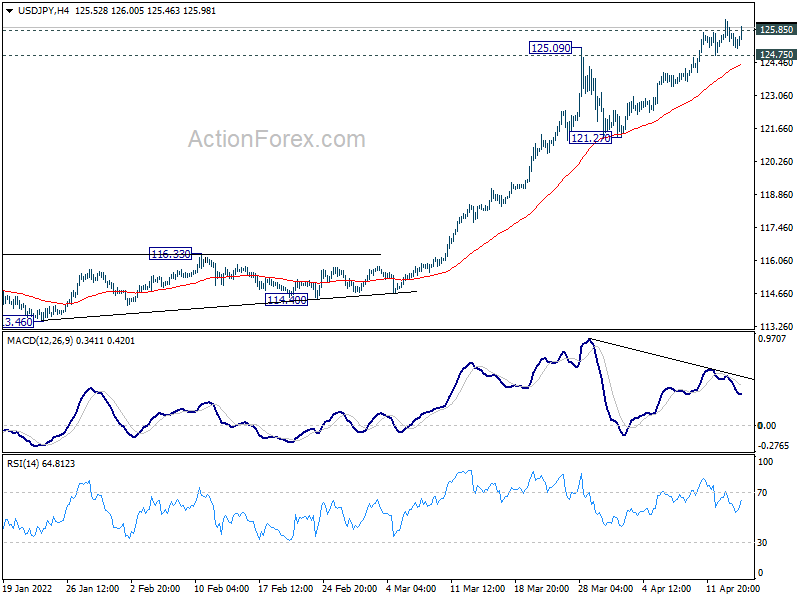
Intraday bias in USD/JPY remains neutral for the moment but further rise is expected with 124.75 support holds. On the upside, sustained break of 125.85 will carry larger bullish implication and target 130.04 long term projection level next. On the downside, break of 124.75 minor support will turn bias to the downside for pull back to 4 hour 55 EMA (now at 124.28) and possibly below.
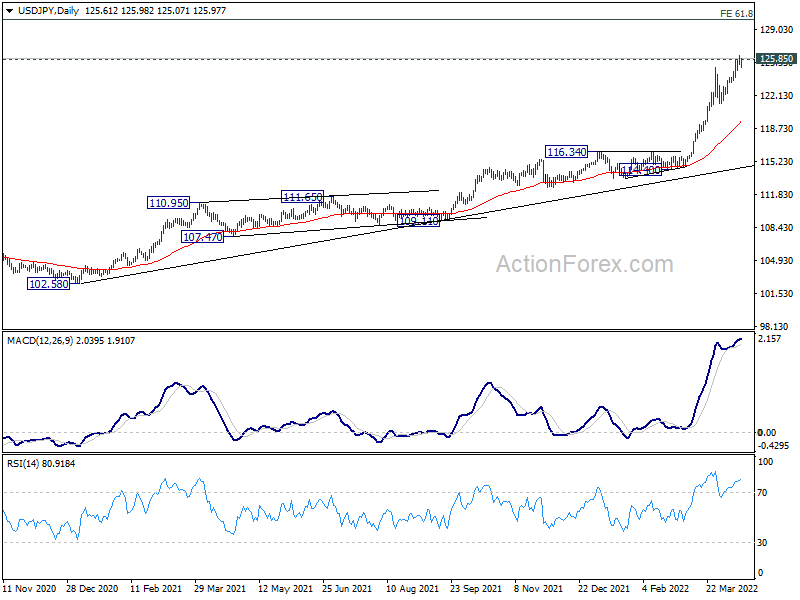
In the bigger picture, up trend from 98.97 (2016 low) is in progress for retesting 125.85 (2015 high). Sustained break there will confirm long term up trend resumption. Next target will be 61.8% projection of 75.56 (2011 low) to 125.85 (2015 high) from 98.97 at 130.04. This will now remain the favored case as long as 116.34 resistance turned support holds.
USD/CHF Mid-Day Outlook
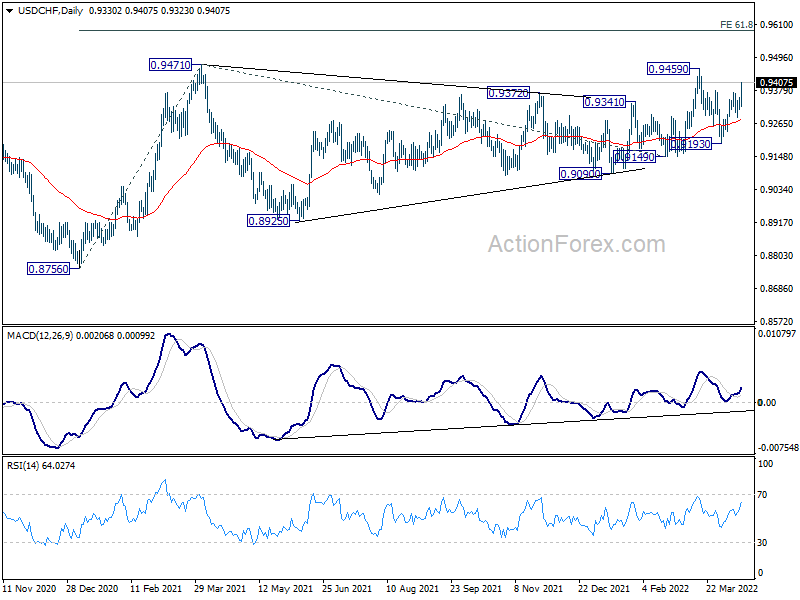
Daily Pivots: (S1) 0.9322; (P) 0.9340; (R1) 0.9365; More....
USD/CHF's strong rally and break of 0.9380 resistance suggests that correction from 0.9459 has completed with three waves down to 0.9193. Intraday bias is back on the upside for 0.9459 resistance first. Break there should resume larger rise from 0.8756 to 61.8% projection of 0.8756 to 0.9471 from 0.9149 at 0.9591. For now, further rise will remain in favor as long as 0.9258 support holds, in case of retreat.
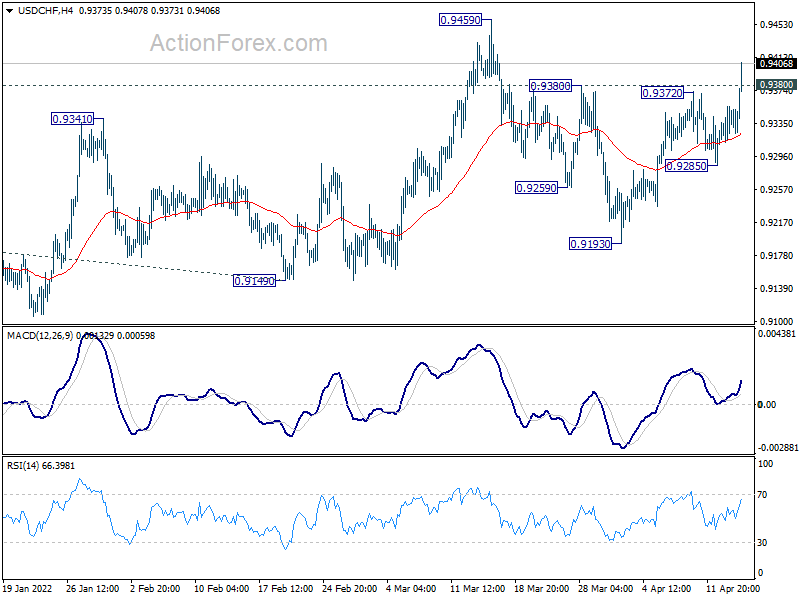
In the bigger picture, medium term outlook will be neutral at best as long as 0.9471 resistance holds. Larger down trend could still extend through 0.8756 (2021 low). However, firm break of 0.9471 will argue that whole down trend form 1.0342 (2016 high), has completed with waves down to 0.8756. A medium term up trend should be set up to target 1.0237/0342 resistance zone.