Sample Category Title
USD/JPY Mid-Day Outlook
Daily Pivots: (S1) 125.23; (P) 125.78; (R1) 126.20; More...
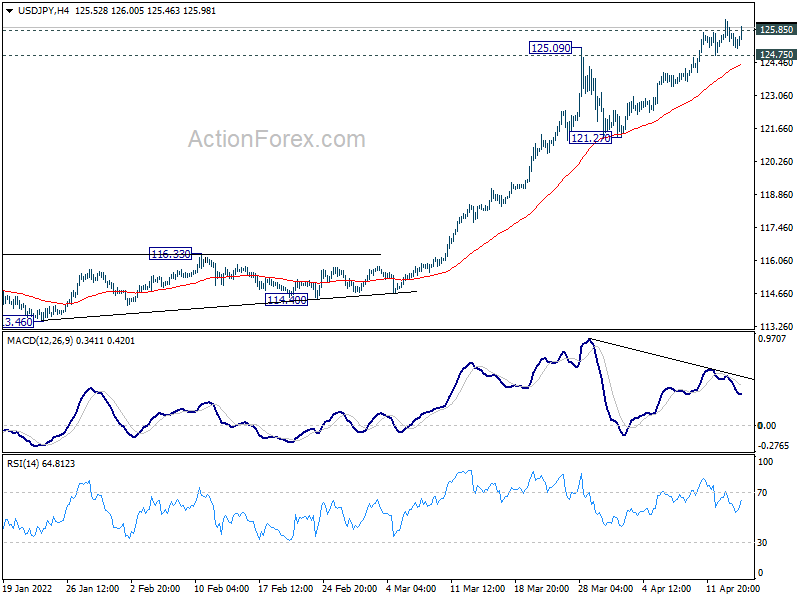
Intraday bias in USD/JPY remains neutral for the moment but further rise is expected with 124.75 support holds. On the upside, sustained break of 125.85 will carry larger bullish implication and target 130.04 long term projection level next. On the downside, break of 124.75 minor support will turn bias to the downside for pull back to 4 hour 55 EMA (now at 124.28) and possibly below.
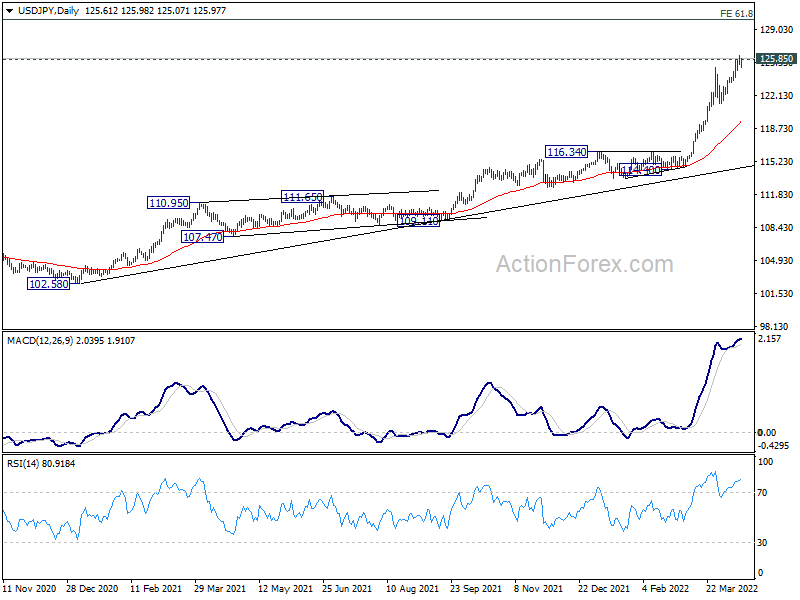
In the bigger picture, up trend from 98.97 (2016 low) is in progress for retesting 125.85 (2015 high). Sustained break there will confirm long term up trend resumption. Next target will be 61.8% projection of 75.56 (2011 low) to 125.85 (2015 high) from 98.97 at 130.04. This will now remain the favored case as long as 116.34 resistance turned support holds.
USD/CHF Mid-Day Outlook
Daily Pivots: (S1) 0.9322; (P) 0.9340; (R1) 0.9365; More....
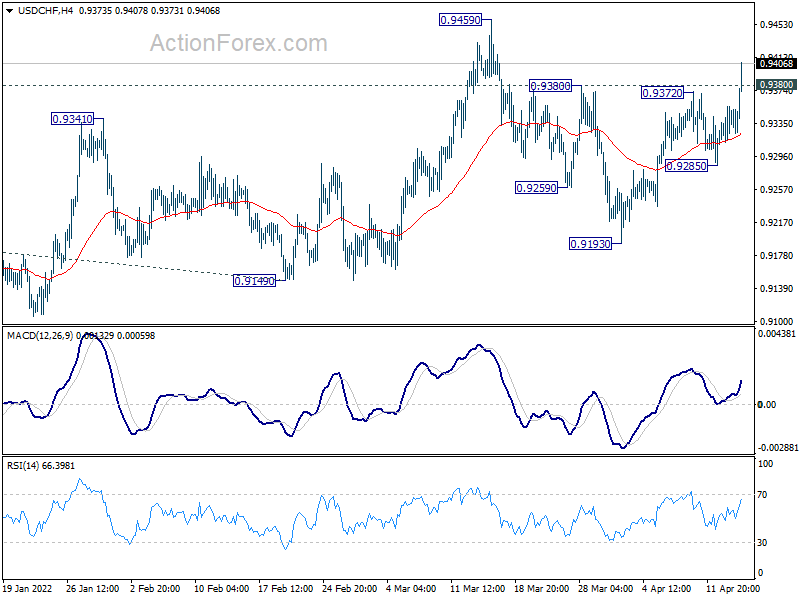
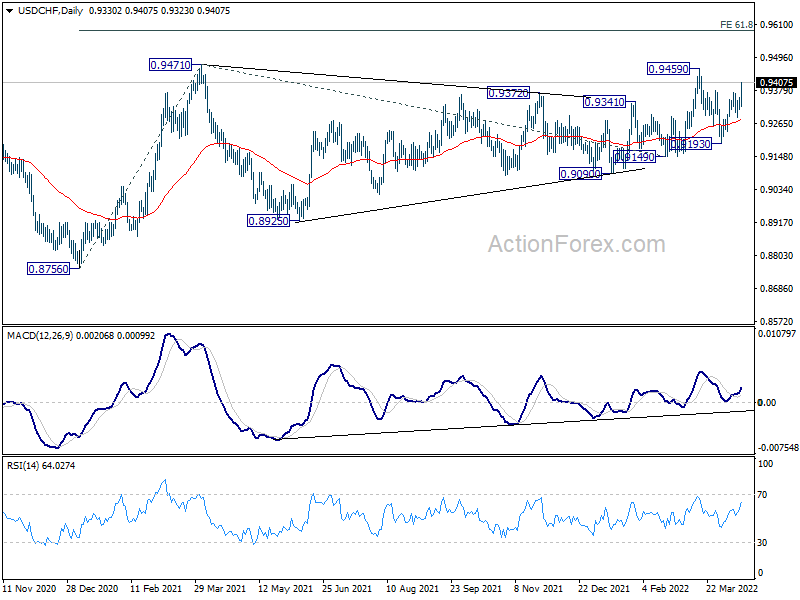
USD/CHF's strong rally and break of 0.9380 resistance suggests that correction from 0.9459 has completed with three waves down to 0.9193. Intraday bias is back on the upside for 0.9459 resistance first. Break there should resume larger rise from 0.8756 to 61.8% projection of 0.8756 to 0.9471 from 0.9149 at 0.9591. For now, further rise will remain in favor as long as 0.9258 support holds, in case of retreat.
In the bigger picture, medium term outlook will be neutral at best as long as 0.9471 resistance holds. Larger down trend could still extend through 0.8756 (2021 low). However, firm break of 0.9471 will argue that whole down trend form 1.0342 (2016 high), has completed with waves down to 0.8756. A medium term up trend should be set up to target 1.0237/0342 resistance zone.
GBP/USD Mid-Day Outlook
Daily Pivots: (S1) 1.3021; (P) 1.3069; (R1) 1.3165; More...
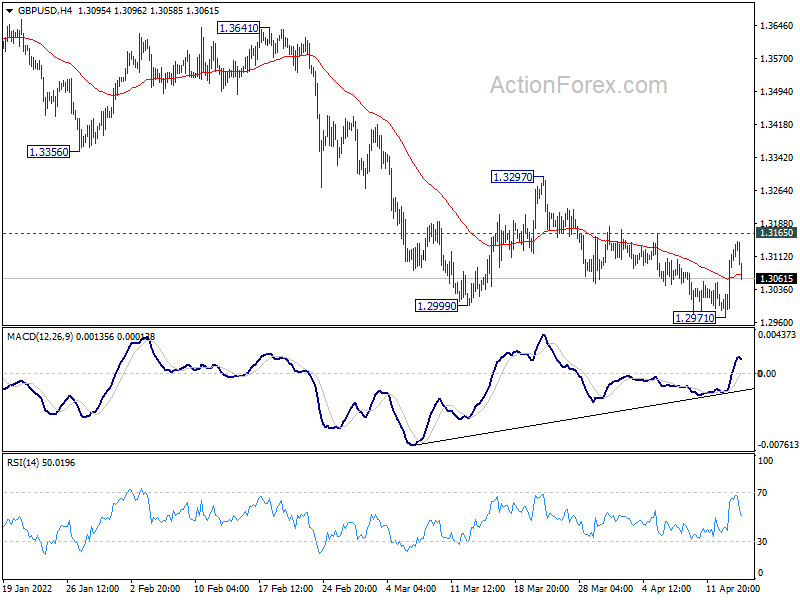
Intraday bias in GBP/USD remains neutral for the moment. Another fall will remain in favor as long as 1.3165 resistance holds. Break of 1.2971 will resume larger down trend from 1.4248. However, firm break of 1.3165 will confirm short term bottoming, and turn bias back to the upside for 1.3297 resistance and above.
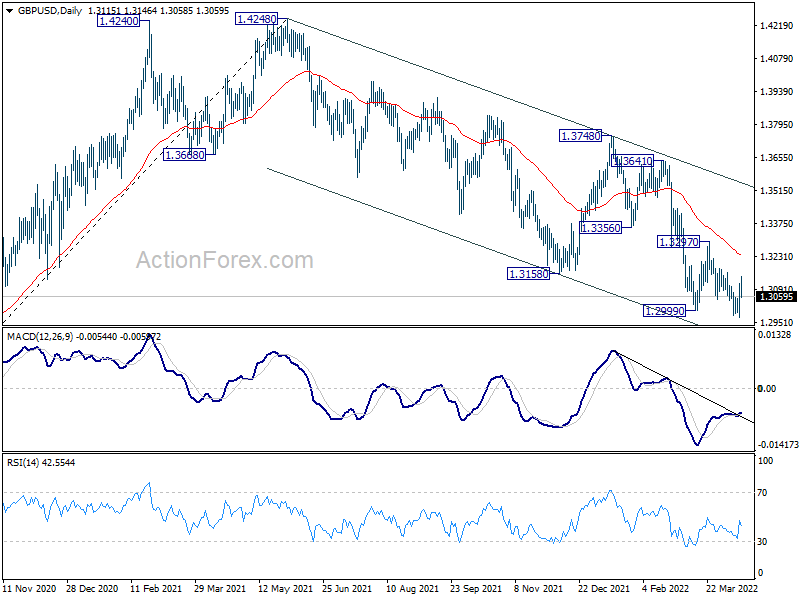
In the bigger picture, rise from 1.1409 (2020 low) has completed at 1.4248. Decline from 1.4248 could still be a corrective move, or it could be the start of a long term down trend. In either case, deeper decline would be seen back to 61.8% retracement of 2.1161 to 1.1409 at 1.2493. In any case, break of 1.3748 resistance is needed confirm completion of the fall from 1.4248, or outlook will stay bearish.
EUR/USD Mid-Day Outlook
Daily Pivots: (S1) 1.0836; (P) 1.0865 (R1) 1.0921; More...
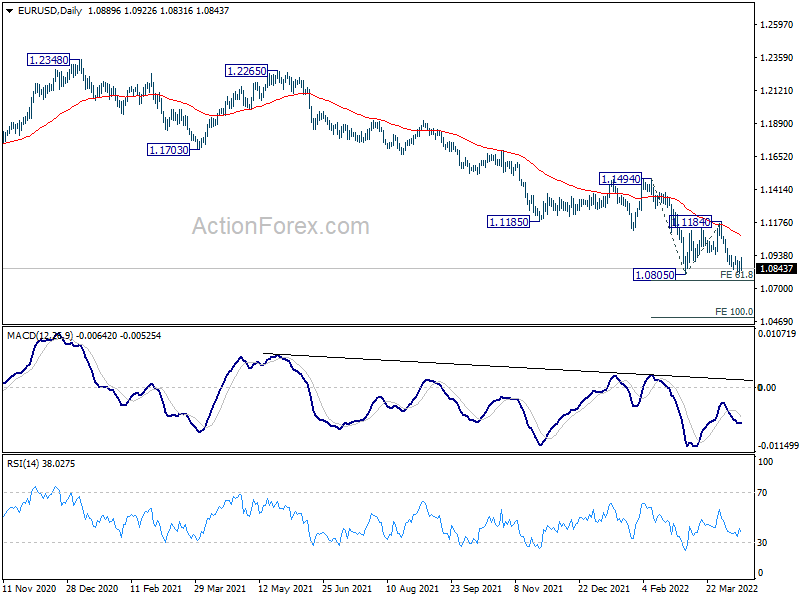
EUR/USD retreats sharply after failing to break through 1.0937 minor resistance. Intraday bias remains neutral first. On the downside, sustained break of 1.0805 low will resume larger down trend to 61.8% projection of 1.1494 to 1.0805 from 1.1184 at 1.0758, and then 100% projection at 1.0495. On the upside, break of 1.0937 minor resistance will extend the consolidation pattern from 1.0805 with another rising leg. Intraday bias will be back on the upside for stronger rebound. But overall outlook will stay bearish as long as 1.1184 resistance holds.
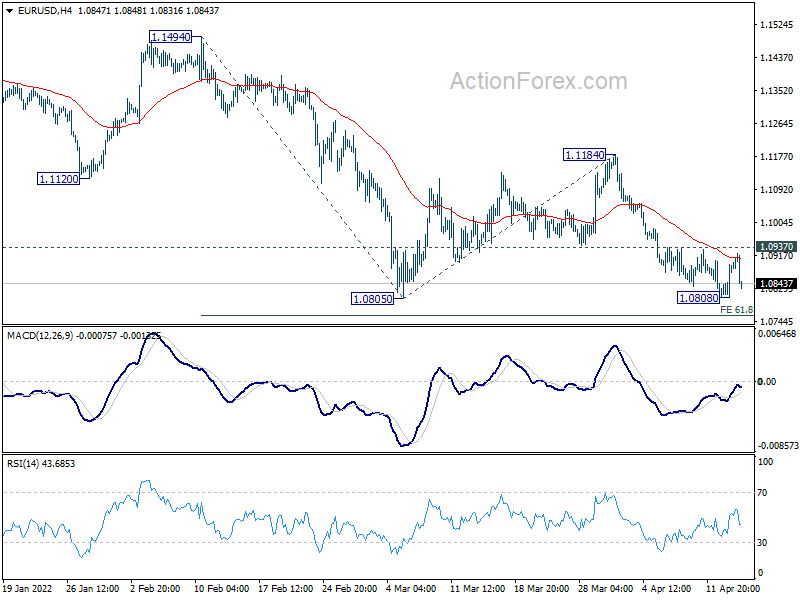
In the bigger picture, the decline from 1.2348 (2021 high) is expected to continue as long as 1.1494 resistance holds. Firm break of 1.0635 (2020 low) will raise the chance of long term down trend resumption and target a retest on 1.0339 (2017 low) next. Nevertheless, break of 1.1494 will maintain medium term neutral outlook, and extending term range trading first.
Euro Knocked Down after ECB, Dollar Striking Back
Euro is knocked down in early US session after ECB left interest rates unchanged. The central bank leaves the option to continue the asset purchases program after June, even though it will be concluded in Q3. The announcement disappoints some Euro traders who are eager for more hawkish tone. At the time of writing, Aussie is still the worst performing one for the day, followed by Swiss Franc and Euro. Kiwi is the strongest one but Yen and Dollar are also striking back.
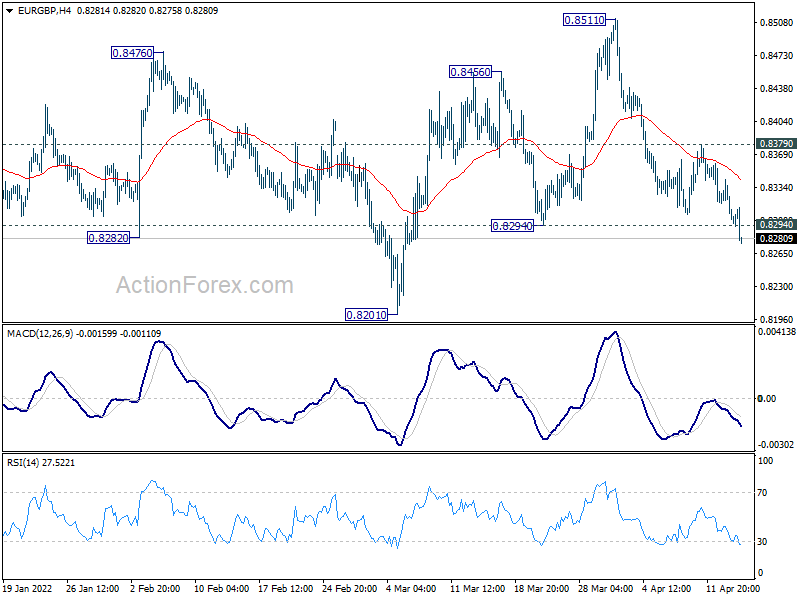
Technically, EUR/GBP's break of 0.8294 support suggests that whole rebound from 0.8201 has completed as a three-wave correction at 0.8511. The development revives medium term bearishness and deeper decline could be seen through 0.8201 low for down trend resumption. Immediate focus will now be on whether EUR/USD would drop through 1.0808 temporary low too.
In Europe, at the time of writing, FTSE is up 0.21%. DAX is up 0.62%. CAC is up 0.61%. Germany 10-year yield is up 0.027 at 0.793. Earlier in Asia, Nikkei rose 1.22%. Hong Kong HSI rose 0.67%. China Shanghai SSE rose 1.22%. Singapore Strait Times dropped -0.19%. Japan 10-year JGB yield rose 0.0028 to 0.243.
US retail sales rose 0.5% mom in Mar, ex-auto sales up 1.1% mom
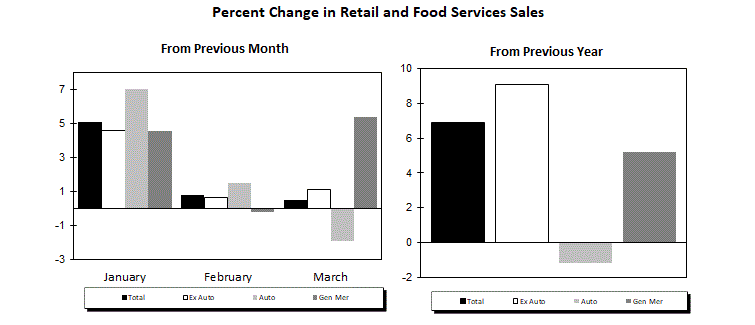
US retail sales rose 0.5% mom to USD 665.7B in March, slightly below expectation of 0.5% mom. Ex-auto sales rose 1.1% mom, above expectation of 0.7% mom. Ex-gasoline sales dropped -0.3% mom. Ex-auto, ex-gasoline sales rose 0.2% mom.
Total sales for January through March period were up 12.9% yoy.
US initial claims rose to 185k, continuing claims dropped to 1.475m
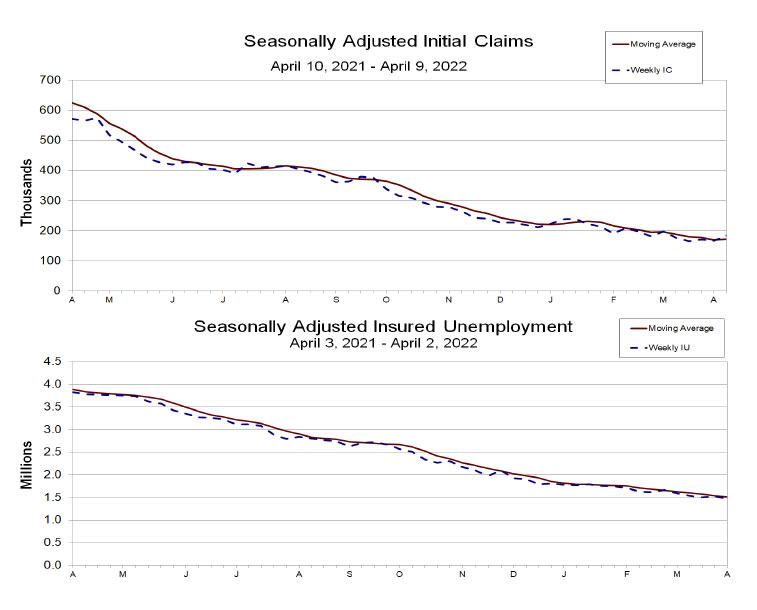
US initial jobless claims rose 18k to 185k in the week ending April 9, above expectation of 175k. Four-week moving average of initial claims rose 2k to 172k.
Continuing claims dropped -48k to 1475k in the week ending April 2. Four-week moving average of continuing claims dropped -30k to 1512k.
ECB to conclude asset purchases in Q3, keeps rates unchanged
ECB announced that the Asset Purchase Program "should be concluded in the third quarter. Monthly net purchases under the APP will continue to be EUR 40B in April, EUR 30B in May and EUR 20B in June. The calibration of net purchases for Q3 will be data-dependent and depend on the outlook.
Interest rates are held unchanged with main refinancing rate, marginal lending facility rate and deposit rate at 0.00%, 0.25% and -0.50% respectively. Adjustments to rates will take place "some time" after ending the APP and will be "gradual".
Australia employment rose 17.9k in Mar, unemployment rate unchanged at 4%
Australia employment grew 17.9k in March, below expectation of 30.0k. Full-time jobs rose 20.5k while part-time jobs dropped -2.7k. Unemployment rate was unchanged at 4.0%, above expectation of 3.9%. Participation rate was unchanged at 66.4%. Monthly hours worked dropped -0.6% mom.
Bjorn Jarvis, head of labour statistics at the ABS, said: "With employment increasing by 18,000 people and unemployment falling by 12,000, the unemployment rate decreased slightly in March, though remained at 4.0 per cent in rounded terms.
"4.0 per cent is the lowest the unemployment rate has been in the monthly survey. Lower rates were seen in the series before November 1974, when the survey was quarterly."
New Zealand BNZ manufacturing rose to 53.8
New Zealand BNZ Performance of Manufacturing Index rose slightly from 53.6 to 53.8 in March. Production dropped from 51.7 to 50.9. Employment rose from 52.0 to 52.4. New orders rose from 58.6 to 61.0. Finished stocks rose from 50.2 to 53.5. Deliveries dropped from 53.1 to 51.9.
BNZ Senior Economist, Doug Steel stated that "Omicron's impact may not be as harsh as the first 2020 COVID lockdown or last year's Delta lockdown, but it's there. Production has struggled, with the index slipping to 50.9 in March and a bit further below its long-term average."
EUR/USD Mid-Day Outlook
Daily Pivots: (S1) 1.0836; (P) 1.0865 (R1) 1.0921; More...
EUR/USD retreats sharply after failing to break through 1.0937 minor resistance. Intraday bias remains neutral first. On the downside, sustained break of 1.0805 low will resume larger down trend to 61.8% projection of 1.1494 to 1.0805 from 1.1184 at 1.0758, and then 100% projection at 1.0495. On the upside, break of 1.0937 minor resistance will extend the consolidation pattern from 1.0805 with another rising leg. Intraday bias will be back on the upside for stronger rebound. But overall outlook will stay bearish as long as 1.1184 resistance holds.
In the bigger picture, the decline from 1.2348 (2021 high) is expected to continue as long as 1.1494 resistance holds. Firm break of 1.0635 (2020 low) will raise the chance of long term down trend resumption and target a retest on 1.0339 (2017 low) next. Nevertheless, break of 1.1494 will maintain medium term neutral outlook, and extending term range trading first.
Economic Indicators Update
| GMT | Ccy | Events | Actual | Forecast | Previous | Revised |
|---|---|---|---|---|---|---|
| 21:30 | NZD | BusinessNZ Manufacturing Index Mar | 53.8 | 53.6 | ||
| 23:01 | GBP | RICS Housing Price Balance Mar | 74% | 78% | 79% | |
| 01:00 | AUD | Consumer Inflation Expectations Apr | 5.20% | 4.90% | ||
| 01:30 | AUD | Employment Change Mar | 17.9K | 30.0K | 77.4K | |
| 01:30 | AUD | Unemployment Rate Mar | 4.00% | 3.90% | 4.00% | |
| 06:30 | CHF | Producer and Import Prices M/M Mar | 0.80% | 0.00% | 0.40% | |
| 06:30 | CHF | Producer and Import Prices Y/Y Mar | 6.10% | 4.90% | 5.80% | |
| 11:45 | EUR | ECB Interest Rate Decision | 0.00% | 0.00% | 0.00% | |
| 12:30 | EUR | ECB Press Conference | ||||
| 12:30 | CAD | Manufacturing Sales M/M Feb | 4.20% | 0.00% | 0.60% | |
| 12:30 | CAD | Wholesale Sales M/M Feb | -0.40% | 0.70% | 4.20% | |
| 12:30 | USD | Initial Jobless Claims (Apr 8) | 185K | 175K | 166K | |
| 12:30 | USD | Retail Sales M/M Mar | 0.50% | 0.60% | 0.30% | 0.80% |
| 12:30 | USD | Retail Sales ex Autos M/M Mar | 1.10% | 0.70% | 0.20% | 0.60% |
| 12:30 | USD | Import Price Index M/M Mar | 2.60% | 2.30% | 1.40% | 1.60% |
| 14:00 | USD | Michigan Consumer Sentiment Index Apr P | 58.8 | 59.4 | ||
| 14:00 | USD | Business Inventories Feb | 1.00% | 1.10% | ||
| 14:30 | USD | Natural Gas Storage | 15B | -33B |
(ECB) Introductory Statement to the Press Conference
Christine Lagarde, President of the ECB,
Luis de Guindos, Vice-President of the ECB
Frankfurt am Main, 14 April 2022
Good afternoon, the Vice-President and I welcome you to our press conference.
Russia's aggression towards Ukraine is causing enormous suffering. It is also affecting the economy, in Europe and beyond. The conflict and the associated uncertainty are weighing heavily on the confidence of businesses and consumers. Trade disruptions are leading to new shortages of materials and inputs. Surging energy and commodity prices are reducing demand and holding back production. How the economy develops will crucially depend on how the conflict evolves, on the impact of current sanctions and on possible further measures. At the same time, economic activity is still being supported by the reopening of the economy after the crisis phase of the pandemic. Inflation has increased significantly and will remain high over the coming months, mainly because of the sharp rise in energy costs. Inflation pressures have intensified across many sectors.
At today's meeting we judged that the incoming data since our last meeting reinforce our expectation that net asset purchases under our asset purchase programme (APP) should be concluded in the third quarter. Looking ahead, our monetary policy will depend on the incoming data and our evolving assessment of the outlook. In the current conditions of high uncertainty, we will maintain optionality, gradualism and flexibility in the conduct of monetary policy. The Governing Council will take whatever action is needed to fulfil the ECB's mandate to pursue price stability and to contribute to safeguarding financial stability.
I will now outline in more detail how we see the economy and inflation developing, and will then explain our assessment of financial and monetary conditions.
Economic activity
The euro area economy grew by 0.3 per cent in the final quarter of 2021. It is estimated that growth remained weak during the first quarter of 2022, largely owing to pandemic-related restrictions.
Several factors point to slow growth also in the period ahead. The war is already weighing on the confidence of businesses and consumers, including through the uncertainty it brings. With energy and commodity prices rising sharply, households are facing a higher cost of living and firms are confronted with higher production costs. The war has created new bottlenecks, while a new set of pandemic measures in Asia is contributing to supply chain difficulties. Some sectors face growing difficulties in sourcing their inputs, which is disrupting production. However, there are also offsetting factors underpinning the ongoing recovery, such as compensatory fiscal measures and the possibility for households to draw on savings they accumulated during the pandemic. Moreover, the reopening of those sectors most affected by the pandemic and a strong labour market with more people in jobs will continue to support incomes and spending.
Fiscal and monetary policy support remains critical, especially in this difficult geopolitical situation. In addition, the successful implementation of the investment and reform plans under the Next Generation EU programme will accelerate the energy and green transitions. This should help enhance long-term growth and resilience in the euro area.
Inflation
Inflation increased to 7.5 per cent in March, from 5.9 per cent in February. Energy prices were driven higher after the outbreak of the war and now stand 45 per cent above their level one year ago. They continue to be the main reason for the high rate of inflation. Market-based indicators suggest that energy prices will stay high in the near term but will then moderate to some extent. Food prices have also increased sharply. This is due to elevated transportation and production costs, notably the higher price of fertilisers, which are in part related to the war in Ukraine.
Price rises have become more widespread. Energy costs are pushing up prices across many sectors. Supply bottlenecks and the normalisation of demand as the economy reopens also continue to put upward pressure on prices. Measures of underlying inflation have risen to levels above two per cent in recent months. It is uncertain how persistent the rise in these indicators will be, given the role of temporary pandemic-related factors and the indirect effects of higher energy prices.
The labour market continues to improve, with unemployment having fallen to a historical low of 6.8 per cent in February. Job postings across many sectors still signal robust demand for labour, yet wage growth remains muted overall. Over time the return of the economy to full capacity should support faster growth in wages. While various measures of longer-term inflation expectations derived from financial markets and from expert surveys largely stand at around two per cent, initial signs of above-target revisions in those measures warrant close monitoring.
Risk assessment
The downside risks to the growth outlook have increased substantially as a result of the war in Ukraine. While risks relating to the pandemic have declined, the war may have an even stronger effect on economic sentiment and could further worsen supply-side constraints. Persistently high energy costs, together with a loss of confidence, could drag down demand and restrain consumption and investment more than expected.
The upside risks surrounding the inflation outlook have also intensified, especially in the near term. The risks to the medium-term inflation outlook include above-target moves in inflation expectations, higher than anticipated wage rises and a durable worsening of supply-side conditions. However, if demand were to weaken over the medium term, it would lower pressure on prices.
Financial and monetary conditions
Financial markets have been highly volatile since the war began and financial sanctions were imposed. Market interest rates have increased in response to the changing outlook for monetary policy, the macroeconomic environment and inflation dynamics. Bank funding costs have continued to increase. At the same time, so far there have been no severe strains in money markets, nor liquidity shortages in the euro area banking system.
Although remaining at low levels, bank lending rates for firms and households have started to reflect the increase in market interest rates. Lending to households is holding up, especially for house purchases. Lending flows to firms have stabilised.
Our most recent bank lending survey reports that credit standards for loans to firms and for housing loans tightened overall in the first quarter of the year, as lenders are becoming more concerned about the risks facing their customers in an uncertain environment. Credit standards are expected to tighten further in the coming months, as banks factor in the adverse economic impact of Russia's aggression towards Ukraine and higher energy prices.
Conclusion
Summing up, the war in Ukraine is severely affecting the euro area economy and has significantly increased uncertainty. The impact of the war on the economy will depend on how the conflict evolves, on the effect of current sanctions and on possible further measures. Inflation has increased significantly and will remain high over the coming months, mainly because of the sharp rise in energy costs. We are very attentive to the current uncertainties and are closely monitoring the incoming data in relation to their implications for the medium-term inflation outlook. The calibration of our policies will remain data-dependent and reflect our evolving assessment of the outlook. We stand ready to adjust all of our instruments within our mandate, incorporating flexibility if warranted, to ensure that inflation stabilises at our two per cent target over the medium term.
We are now ready to take your questions.
US retail sales rose 0.5% mom in Mar, ex-auto sales up 1.1% mom
US retail sales rose 0.5% mom to USD 665.7B in March, slightly below expectation of 0.5% mom. Ex-auto sales rose 1.1% mom, above expectation of 0.7% mom. Ex-gasoline sales dropped -0.3% mom. Ex-auto, ex-gasoline sales rose 0.2% mom.
Total sales for January through March period were up 12.9% yoy.
US initial claims rose to 185k, continuing claims dropped to 1.475m
US initial jobless claims rose 18k to 185k in the week ending April 9, above expectation of 175k. Four-week moving average of initial claims rose 2k to 172k.
Continuing claims dropped -48k to 1475k in the week ending April 2. Four-week moving average of continuing claims dropped -30k to 1512k.
ECB press conference live stream
https://www.youtube.com/watch?v=URG4k05tiAY
AUDJPY Advances Take a Breather above Moving Averages
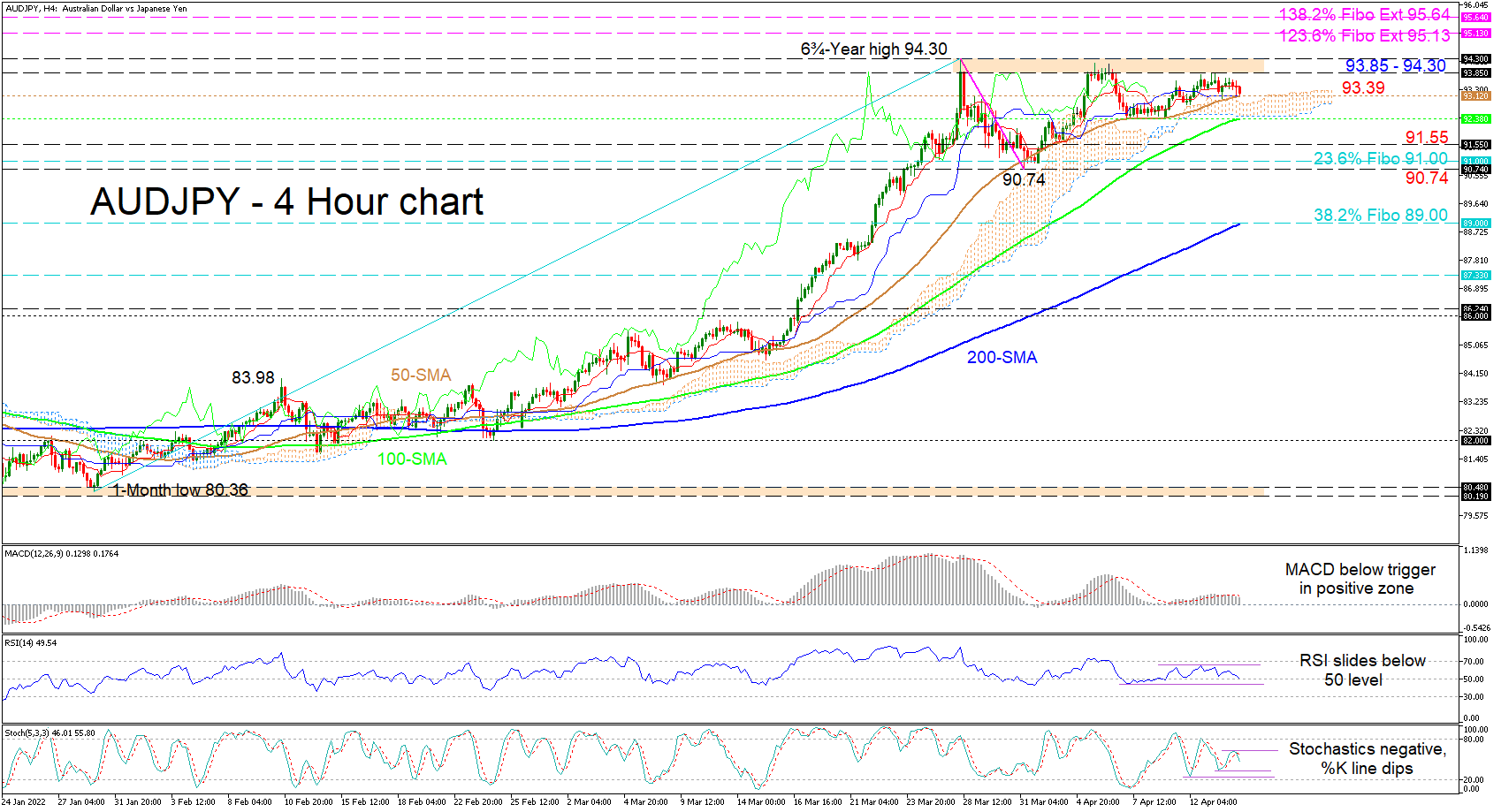
AUDJPY is tiptoeing beneath the established 93.85-94.30 resistance barricade that has muted positive developments ever since the pair corrected to the 91.00 level, which is the 23.6% Fibonacci retracement level of the 80.36-94.30 up leg. Nonetheless, the bullish simple moving averages (SMAs) continue to defend the two-and-a-half-month uptrend from 80.36, which is finding some difficulty in reigniting upside momentum beyond the 6¾-year high.
Currently, the neutral Ichimoku lines are suggesting that positive driving forces have dried up, while the short-term oscillators are reflecting a mild increase in negative momentum. The MACD, north of the zero threshold, is gliding underneath its red trigger line, while the falling RSI has just pierced below the 50 level. Moreover, the negative charge in the stochastic oscillator has returned, promoting bearish moves in the pair. However, the fact that price volatility is subdued as the price is weighing on the 50-period SMA, hints that downward moves lack credibility for now.
In the negative scenario, sellers face an immediate reinforced support section between the 50- and 100-period SMAs at 93.12 and 92.38 respectively. If this region that encapsulates the Ichimoku cloud fails to provide buyers with renewed positive traction, the price may then sink towards the 91.55 low before the bears target a support base highlighted by the 23.6% Fibo of 91.00, and the 90.74 trough from March 31. A deeper retreat in the pair could strengthen negative tendencies, setting the premise for a price drop towards the 38.2% Fibo of 89.00, where the rising 200-period SMA currently resides.
Alternatively, if the price lifts off the 50-period SMA at 93.12 and over the red Tenkan-sen line at 93.39, buyers could rechallenge the 93.85-94.30 critical resistance boundary. In the event the pair navigates successfully beyond the multi-year high of 94.30, the bulls could then pilot for the 95.13 and the 95.64 barriers, which happen to be the 123.6% and the 138.2% Fibonacci extension levels of the price correction from 94.30 until the 90.74 trough.
Summarizing, AUDJPY is sustaining a neutral-to-bullish bias north of the 50- and 100-period SMAs, the cloud, and the 23.6% Fibo of 91.00. That said, a dive in the price below the March 31 trough of 90.74 could accelerate the pair’s downward trajectory.