

Sample Category Title
Eco Data 4/18/22
[php_everywhere instance="1"]
Summary 4/18 – 4/22
Monday, Apr 18, 2022
[php_everywhere instance="1"]
Tuesday, Apr 19, 2022
[php_everywhere instance="2"]
Wednesday, Apr 20, 2022
[php_everywhere instance="3"]
Thursday, Apr 21, 2022
[php_everywhere instance="4"]
Friday, Apr 22, 2022
[php_everywhere instance="5"]
Weekly Economic & Financial Commentary: Foreign Central Banks Shifting into Tightening Mode
Summary
United States: Inflation Hits Hard in March
- This week's U.S. economic data were led by the largest monthly increase in the Consumer Price Index (CPI) since September 2005. The squeeze on households' from skyrocketing prices for necessities is very real and was evident in this week's retail sales data. However, underneath the surface there are signs that pandemic-related inflation is beginning to ease.
- Next week: Housing Starts (Tue), Existing Home Sales (Wed), Leading Economic Index (Thu)
International: U.K. Inflation Soars While Growth Slows
- Recent economic data from the United Kingdom reflected the global trend of higher inflation and slowing growth. The U.K.'s March CPI data release showed inflation pressures surged even higher last month. Headline CPI Inflation is now at a 30-year high, quickening more than expected to 7% year-over-year.
- Next week: China GDP (Mon), South Africa CPI (Wed), Eurozone PMIs (Fri)
Interest Rate Watch: Foreign Central Banks Shifting into Tightening Mode
- Not only did the Bank of Canada hike rates by 50 bps this week, but some other foreign central banks have also taken their policy rates higher in recent weeks. We expect that the Federal Reserve will tighten policy more than most other major central banks, with the possible exception of the Bank of Canada, which should continue to support the value of the U.S. dollar against most major foreign currencies.
Topic of the Week: Factors to Consider for a Net Zero Carbon Economy
- If corporations are to achieve net zero greenhouse gas emissions by 2050, there will be many economic impacts. Our recent report contextualizes the current state of greenhouse gas emissions and considers the larger economic implications of a transition to a net zero carbon future.
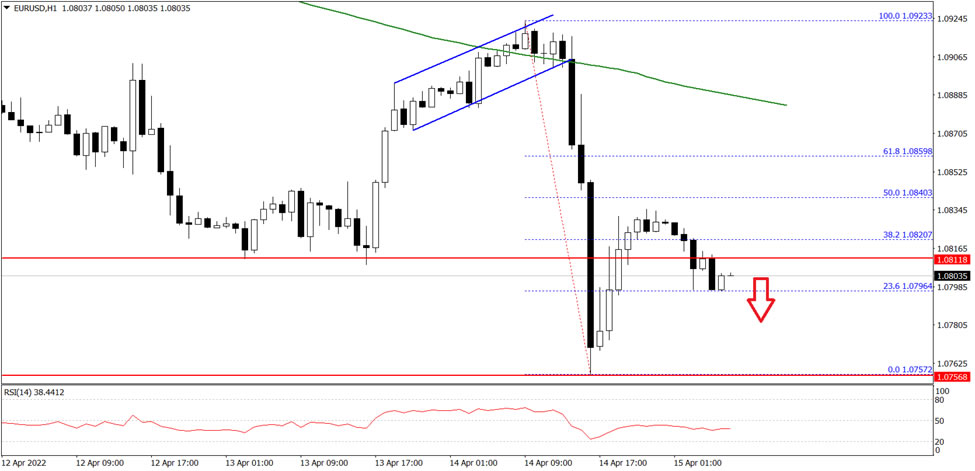
EUR/USD Pair Moved into a Bearish Zone Below $1.0880
The Euro started a fresh decline from the 1.0925 resistance zone against the US Dollar. The EUR/USD pair declined below the 1.0880 level to move into a bearish zone.
The price even traded below the 1.0800 level and the 50 hourly simple moving average. It traded as low as 1.0757 and is currently consolidating losses. An immediate support is near the 1.0780 level.
The next key support is near 1.0765 on FXOpen, below the pair could decline towards the 1.0720 level in the near term. Any more losses might send the pair towards the 1.0680 level.
On the upside, the pair might struggle near 1.0840. The next major resistance is near the 1.0850 level. A break above the 1.0840 and 1.0850 resistance levels could start a decent increase towards the 1.0900 level in the near term.
Canadian March Inflation to Breach 6%
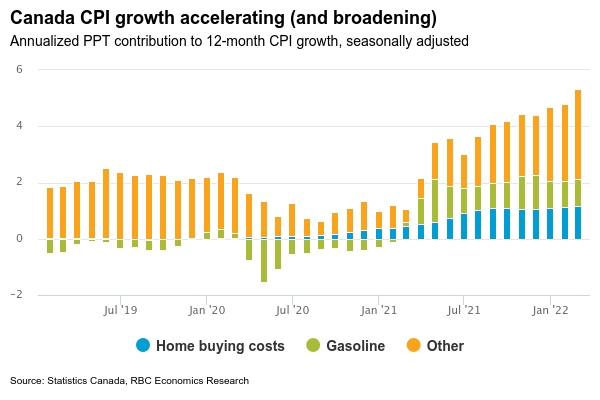
Next week’s Canadian CPI report is expected to show a further acceleration to 6% in March. That would top the 5.7% February reading that was already the highest since 1991. Soaring gasoline prices are expected to account for almost a quarter of the increase—and half of the price rise from February as energy surged higher on the Russian invasion of Ukraine. Home buying costs (realtor and broker fees, etc) have accounted for another 20% of the increase. With housing markets still running hot, these are also expected to have moved higher again in March.
Price pressures are continuing to broaden out. The war in Ukraine has added to global supply chain disruptions and input price growth. And consumer demand has risen sharply alongside the strongest labour market in decades—with those consumers continuing to hold exceptionally large savings accumulated during the pandemic. Compared to pre-pandemic levels, about two-thirds of the CPI basket is now growing at a rate above the Bank of Canada’s 2% inflation target.
The BoC’s newly-minted forecast shows inflation averaging 5.3% in 2022—more than 1 percentage point higher than its previous forecast in January. With labour markets also looking exceptionally strong, there’s no reason for interest rates to still be at emergency low levels. The BoC already hiked the overnight rate by 75 basis points over the last month and a half—including the 50 bp hike on March 13th. We look for another 100 bps worth of increases to bring the rate to 2.0% by October.
Week ahead data watch:
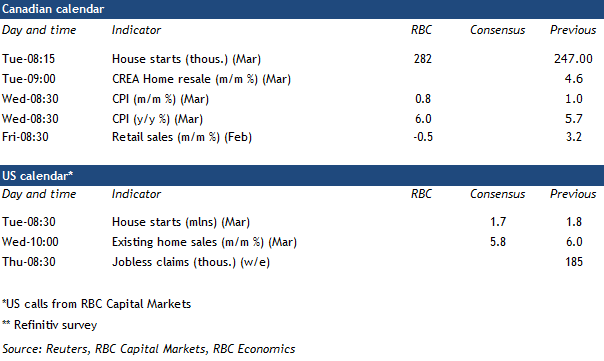
- The preliminary estimate of February Canadian retail sales was down 0.5% after a solid 3.2% gain in January. With consumers showing strong demand for goods during the pandemic, and prices higher, retail sales will still be more than 12% above pre-COVID levels.
- We expect Canadian housing starts to rise to 282k on very strong recent permit issuance in February.
- Canadian home resale markets likely remained exceptionally tight in March. Local real estate board data showed heated activity in the month, and though prices continued to grow and inventories very low there are early signs of moderation in some larger markets.
The Weekly Bottom Line: Inflation Surge Continues
U.S. Highlights
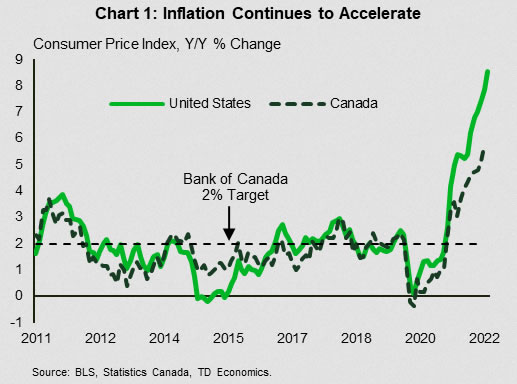
- Overall inflation as measured by the CPI accelerated to 8.5% year-over-year (y/y) in March, marking yet another multi-decade high. Core inflation, which excludes food and energy, ticked up a tenth of a percentage point to 6.5% y/y.
- Small business confidence continued to trend lower in March as the share of businesses expecting an improvement in the economy fell to an all-time low. Meanwhile, inflation has vaulted into being perceived as the top business problem.
- Retail sales rose 0.5% month-to-month (m/m) in March - broadly in line with market expectations. Excluding volatile categories, sales in the ‘control group’ (used in calculating personal consumption expenditures) fell 0.1% on the month.
Canadian Highlights
- The Bank of Canada raised rates an aggressive 50 basis points this week. The Bank also announced that it will begin “quantitative tightening” (QT) effective April 25th.
- The Canadian CPI is expected to surge past the 6% mark when the numbers are released next week. With price pressures mounting and the labour market being tight, we anticipate the Bank raise rates by another 50 basis point in June.
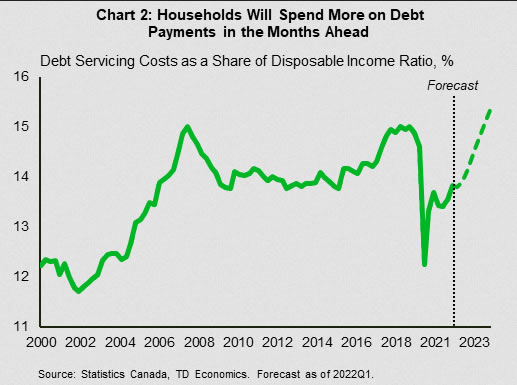
- Higher interest rates will tame Canadians’ appetite for credit, but they will also lead to higher debt payments for existing borrowers. Debt servicing costs are expected to rise briskly over the next two years (report).
U.S. - Inflation Surge Continues
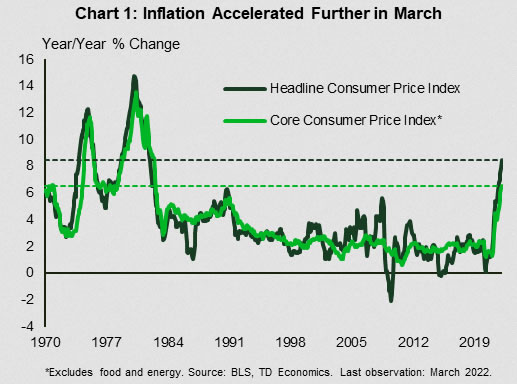
Inflation remained top of mind this week with the Consumer Price Index (CPI) report reminding us once again that price pressures accelerated in March. Overall inflation rose both in month-to-month (+1.2% m/m) and year-over-year (y/y) terms, with the latter reaching 8.5% in March – a new multi-decade high. Energy, especially, and food, to a lesser degree, both contributed to the acceleration. Still, even when excluding these more volatile categories, core inflation (up only a tenth of a percentage point to 6.5% y/y) was at the highest level since the early 1980s (Chart 1). Adding to the evidence that price pressures continued to build through March, supplier prices also rose sharply last month, accelerating to 11.2% y/y – an all-time high for the data stretching back to 2010.
Inflation worries were echoed in the National Federation of Independent Business (NFIB) small business report. Business confidence continued to trend lower, falling to 93.2 in March – the lowest level since 2016 excluding the temporary drop at the start of the pandemic. Businesses were the most pessimistic they have ever been regarding an improvement in the economy ahead from current levels (albeit the bar to improve on the post-pandemic rebound pace is very high). Yet perhaps the most striking aspect of the report is the fact that inflation concerns, barely a factor as the start of last year, have risen sharply, overtaking ‘quality of labor’ concerns recently (Chart 2). This shift suggests that managing inflation’s impact is now the top priority, while securing talent amidst a tightening labor market playing an important second fiddle.
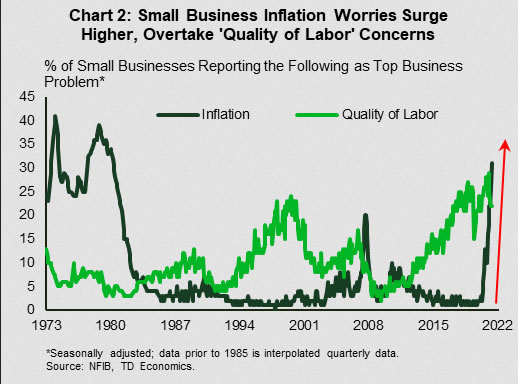
Small business job openings remain plentiful, despite trending lower since peaking in September. Meanwhile, businesses continue to raise wages and plan more increases ahead, with both of these sub-indicators in the NFIB survey ticking higher last month. A growing share of businesses are also passing on the added costs to consumers by raising prices. A net 72% are doing so – a record high in the survey’s almost 50-year history. All these factors, together with the potential for more supply-chain disruptions due to the war in Ukraine, and shutdowns in China, suggest that inflation will continue to run hot in the near-term.
Tilting to retail sales, a 0.5% gain in March and a bulky upgrade to the month prior were positive developments. Gains in March also appeared to be skewed toward “going out” categories – a pattern consistent with the reopening of the economy. A sharp drop in non-store sales (a proxy for online sales) further bolsters this point. Digging deeper, however, the picture is less rosy. Sales in the control group, which exclude volatile categories and are used in calculating personal consumption expenditures, were down 0.1% m/m. Meanwhile, when adjusting headline figures by CPI, the data points a decline in the ‘real’ sales estimate both in monthly and year-on-year terms.
All told, with inflation running hot and still no major cracks in the economic armor, the Fed will need to follow through with the speedy removal of monetary stimulus to try and rein in inflation. Interest-sensitive sectors, such as housing, which is already showing some signs of cooling (see here), are first on the list to feel the pinch from the higher rate environment.
Canada - The Punch Bowl Has Left the Building
It is said that central banks should take away the punch bowl just as the party is heating up. After waiting until Canada's economic party was in full swing before starting to tighten policy, the Bank of Canada's (BoC) raised rates an aggressive 50 basis points in its announcement this week – the monetary punch bowl has left the building.
The Bank also announced that it will begin "quantitative tightening" (QT) effective April 25th. This means it will allow its holdings of Government of Canada bonds to mature, which will shrink the size of its balance sheet over time. This is another channel via which monetary policy will be turning more restrictive, as QT will add some upward pressure to bond yields. Five-year Government of Canada bond yields recently surpassed 2018 highs, and are now at the highest level since 2011.
By raising the policy rate by 50 basis points for the first time in 22 years, the BoC reaffirmed its commitment to tame runaway inflation, but also sets up the pace for more aggressive moves. Indeed, the statement accompanying the decision was hawkish. The bank sounded upbeat on the Canadian economic outlook, noting that "the economy is moving into excess demand" and that tight labour market is leading to an acceleration in wage growth.
Even with risks to global growth stemming from the war in Ukraine and lockdowns in China, the Bank was expecting Canadian economic growth to remain robust, with real GDP expanding by 4.2% this year – just a touch slower than 4.6% pace seen last year – and by 3.2% in 2023.
At the same time, the Bank revised up its outlook on inflation, stating that "CPI inflation is now expected to average almost 6% in the first half of 2022 and remain well above the control range throughout this year." U.S. inflation hit 8.5% year-over-year in March, and the Canadian CPI is expected to surge past 6% mark when the numbers are released next week (Chart 1). With price pressures continuing to mount, the labour market at full employment, and the need to cool domestic demand as well as the housing market, the Bank will be staying firm on rate hikes. We anticipate another 50 basis point increase on June 1st, with the policy rate hitting 2% by year end.
Higher interest rates will tame Canadians' appetite for credit, cooling household debt growth. However, they will also lead to higher debt payments for existing borrowers (report). Debt servicing costs are expected to rise briskly over the next two years, hitting their pre-pandemic peak by the end of 2023 (Chart 2). The Bank of Canada does not appear to be worried, with discussion of household debt missing from the monetary policy report. Perhaps it is right not to be concerned for now. As long as the Bank can stage a soft landing and job growth persists, most borrowers should be able to accommodate higher interest rates and remain current on their debt obligations.
Week Ahead -The Bond Market Selloff Continues
The bond market selloff did not ease up heading into the long holiday weekend and traders will have to soon decide if they decide to sell in May and go away. The upcoming week is filled with another round of earnings, major economic data out of China, a French debate, and a wrath of commentary from finance ministers and central bankers at the IMF/World Bank spring meetings.
US
After a long weekend, Wall Street is ready to dive back into earnings season. The second week of earnings will provide a better picture of which companies are quickly passing on their higher costs. This week we will learn more about how confident the airlines are with travel demand, how supply chain issues are impacting IBM, Tesla, and Procter & Gamble.
Economic data releases for the week will focus on manufacturing activity, housing data, and the flash PMI readings for April. The US economy is still on solid-footing, so expectations across a wide range of economic data is expected to moderate.
Fed speak for the week contains appearances from Bullard, Evans, Daly, and Chair Powell. With the Fed firmly committed to an aggressive start with the tightening of monetary policy, traders will look for clues to see which members are growing concerned about economic growth and if that could lead to less aggressive Fed tightening bets for later in the year.
EU
A shortened week next week as a result of the long bank holiday weekend. The data mostly consists of tier two and three releases, with the only exceptions being the flash PMIs on Friday. Final CPI data will be of interest on Thursday but any shock and awe will likely have come from the flash readings. And with the ECB taking its time to wrap up bond-buying and start raising rates, it would take something quite substantial to rock the boat. We’ll hear from Christine Lagarde next Friday but if the press conference is anything to go by, it’s not one to look forward to.
The war in Ukraine remains front and centre though, with progress appearing to have stalled in negotiations. Commodity prices remain high as the West continues to explore further sanctions. Pressure will continue to ramp up to ban oil and gas as Russia commits further atrocities but it will continue to face resistance from Germany in particular due to the economic consequences at home of such a move.
UK
Another shortened week for the UK with retail sales and PMIs the highlights next Friday. BoE Governor Bailey will speak on Thursday which will be interesting given the latest inflation data. The cooling of the hawkish rhetoric may well be dropped shortly after it was adopted.
Fines to Johnson and Sunak may have created some political instability a couple of months ago but that’s not looking likely now.
Russia
The invasion of Ukraine remains the focus as far as Russia is concerned, with sanctions continuing to come from the West in response to the atrocities it’s committing.
Central bank head Elvira Nabiulina speaks at the Duma on Thursday. They have started unwinding their rate hikes recently as the currency has stabilised.
South Africa
CPI inflation data on Wednesday is the only notable release next week. It remains at the upper end of its 3-6% range as the SARB continues to raise rates to pull it lower.
Turkey
The CBRT left interest rates at 14% on Thursday while blaming everything except its policy decisions for the surge in inflation to 61%. The monetary policy review continues. No major events or data next week.
China
China releases a flurry of data in the coming week but markets will be watching the evolution of China’s Covid-19 situation as the Shanghai lockdowns drag on. That has held back equities this week and an escalation will be a strong headwind next week if it worsens.
With a slowing economy in mind, markets are also expecting stimulus measures to appear finally. A RRR cut could come as soon as Friday, or anytime next week. The next MLF matures tomorrow and we could see the 1-year rate trimmed. Failing that, China announces its 1 and 5-year Loan Prime Rate decisions on Wednesday and a 1-year cut could be a possibility. Any of these will provide a short-term boost to local equity markets.
On Monday, China releases GDP, industrial production, retail sales and industrial Capacity. All of this data has downside risks and soft data will weigh on local equities and potentially weaken the Yuan. USD/CNY and USD/CNH are approaching medium-term resistance levels, a move higher through 6.4000 will signal more Yuan losses ahead.
India
The Reserve Bank of India laid the groundwork for tightening monetary policy this week, but buoyant global stock markets and a weaker US dollar at the end of the week have sheltered equities and the INR from negative fallout. India is on holiday today and Friday of this week.
India releases WPI for food, fuel and manufacturing on Monday. All have upside risks that could see markets pricing in the RBI tightening policy sooner. Expect headwinds for local equities while the INR remains at the mercy of the US Dollar direction on international markets.
Instability in Pakistan following a change of government could have negative spillovers into India’s asset markets.
Australia
Australia is on holiday on Monday and equities have been content to follow Wall Street’s direction, while the AUD has held stead will commodity prices and a slightly hawkish change in the language of the RBA.
Australia releases Retail Sales on Thursday and PMIs on Friday. Both have downside risks that could weigh on local markets. Conversely, higher numbers would increase the tightening pressure on the RBA.
The federal election was announced for May this week, but as yet, the probable change of government is being discounted by local markets.
New Zealand
New Zealand is closed on Monday. The NZD is ending the week under pressure as the RBNZ hiked rates by 0.50%, but left its terminal guidance unchanged. Services PMI on Tuesday and inflation on Thursday have upside risks and could spark more selling of NZD as the RBNZ gets perceived as being ever further behind the inflation curve.
A sagging property market and rampant cost of living increases are increasing political pressure on the government in New Zealand, limiting gains by equities and the NZD.
Japan
USD/JPY remains very near recent highs as the US/Japan rate differential remains elevated. Further moves higher by US yields next week could push USD/JPY to near 128.00. Equities are tracking US markets for now.
The only data this week is inflation on Tuesday which should contain no upside shocks, much like the past 25 years.
Singapore
The MAS has tightened monetary policy by recentering the NEER band and increasing the appreciation slope. That has led SGD into the end of the week. Singapore releases non-oil exports on Monday and weak numbers will raise fears that the MAS is hiking into a slowing economy, a negative for local equity markets.
Markets
Energy
Oil prices are a little higher on Thursday after rallying strongly the previous two days. The flirtation below $100 didn’t last long as the slight lifting of restrictions in China partly removed one key downside risk for prices. With the IEA reserve release priced in, that leaves the risks heavily tilted to the upside as OPEC remains committed to its key ally and unable to hit the quotas its been set anyway.
That could leave Brent prices ranging between $100 and $120 for now, with WTI more like $95-115. There’s no shortage of risks to that though and this remains an incredibly headline-driven market. The prospect of Finland and Sweden joining the NATO alliance is unlikely to ease tensions between Russia and the West which could further spill over into the oil market.
Gold
It would appear gold isn’t going to extend its winning run to seven days ahead of the long weekend. It’s trading a little lower on Thursday after running into some resistance around $1,980. The yellow metal continues to show momentum which may suggest a run at $2,000 is on the cards. At a time of such aggressive tightening, it’s unclear whether it’s a fear of inflation, the economy or risk that’s driving the move, perhaps all of the above. But there’s no shortage of demand at the moment.
Bitcoin
An encouraging rebound in bitcoin on Wednesday was short-lived, with the cryptocurrency once again in the red on Thursday. It appears to have struggled around the midpoint of Monday’s sell-off which could be viewed as a bearish signal. I’m not sure I’ll read too much into that but it’s certainly lost all breakout momentum in recent weeks. It continues to trade more broadly in its 2022 recovery channel and recent price action suggests it could be heading for another move towards the lows. That’s around 10% from the current price and a break below here could be a very bearish development.
Monday, April 18
Economic Data/Events:
- China quarterly GDP and March Industrial production, retail sales and other key indicators
- Easter Monday: UK and most of European financial markets are closed
- IMF/World Bank spring meeting begins
- Fed’s Bullard speaks
- Spain Trade
- Canada existing home sales, housing starts
- India wholesale prices
Tuesday, April 19
Economic Data/Events:
- US housing starts
- G-20 finance ministers, central bankers meet at IMF/World Bank spring meetings
- Fed’s Evans speaks
- IMF releases World Economic outlook
- Japan industrial production
- Mexico international reserves
Wednesday, April 20
Economic Data/Events:
- US existing home sales
- Fed’s Beige Book is released
- Fed’s Daly and Evans speak at separate events
- French presidential debate
- Canada CPI
- South Africa CPI
- Japan Trade
- Italy Trade
- China loan prime rates
- Eurozone new car registrations, industrial production
- EIA crude oil inventory report
Thursday, April 21
Economic Data/Events:
- US initial jobless claims, Leading index
- Eurozone CPI
- New Zealand CPI
- Fed Chair Powell and ECB’s Lagarde speak at event hosted by IMF
- Eurozone consumer confidence
Friday, April 22
Economic Data/Events:
- US Flash PMI readings
- European Flash PMIs: Eurozone, France, Germany, U.K.
- UK PM Johnson to visit India
- BOE’s Bailey to speak on IMF panel
- Japan CPI
- Canada retail sales
Sovereign Rating Updates:
- United Kingdom (S&P)
- United Kingdom (Moody’s)
USD/JPY Hits New Multi-Year High, 130 Next?
Key Highlights
- USD/JPY started a fresh surge and traded above 125.00.
- A major bullish trend line is forming with support near 125.75 on the 4-hours chart.
- It traded to a new multi-year high at 126.59 and might continue to rise.
- EUR/USD extended decline and spiked below 1.1800.
USD/JPY Technical Analysis
The US Dollar formed a strong base above the 121.20 level against the Japanese Yen. USD/JPY started a strong surge above the 123.50 and 125.00 resistance levels to move into a positive zone.
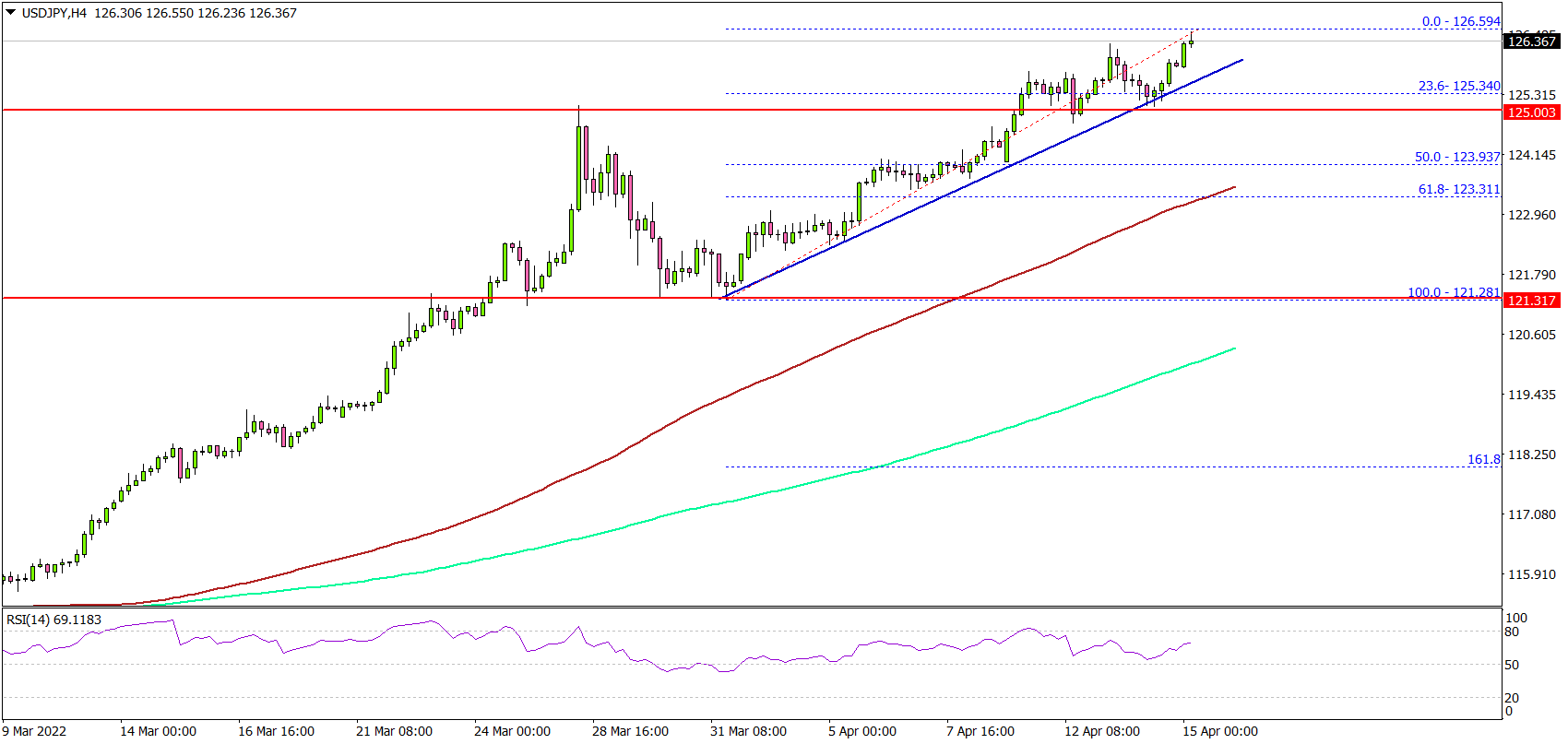
Looking at the 4-hours chart, the pair even settled above the 125.00 level, the 200 simple moving average (green, 4-hours), and the 100 simple moving average (red, 4-hours).
The bulls pumped the pair above the 126.00 level and traded to a new multi-year high at 126.59. It is now showing positive signs and might continue to rise above 126.80. The next major resistance is near the 128.00 level, above which it could rally towards the 130.00 level.
If there is a downside correction, the pair might find support near the 126.00 zone. There is also a major bullish trend line forming with support near 125.75 on the same chart.
The next major support is near the 125.00 level. A downside break below the 125.00 support level might send the pair towards the 123.50 support level or the 100 simple moving average (red, 4-hours).
Looking at EUR/USD, the pair extended decline below the key 1.0800 support zone. If the bears remain in action, the pair could decline towards the 1.0750 level.
Economic Releases
- US Industrial Production for March 2022 (MoM) – Forecast 0.4%, versus 0.5% previous.
Oil Outlook: Is $100 per Barrel Becoming the New Average for WTI?
WTI prices moved mostly sideways in the past week and ended the session somewhat negative. However, a very different story unfolds so far in the current week, where Oil prices remain positive after two consecutive upwards sessions on Tuesday and Wednesday. The move creates further interest in the Oil market and traders may find it challenging to list the headlines starting with the most important. This report will bring to light the key fundamentals currently driving Oil prices along with a brief technical analysis for WTI.
In the past days the weekly Oil market data somewhat failed to impress traders. Starting with the previous Friday, the Baker Hughes Oil rig count saw active Oil rigs in the US jumping from 533 to 546 with no major price reaction. On Tuesday the 12th of April the American Petroleum Institute indicated a big surplus of 7.76M barrels. This was API’s largest surplus so far in 2022 and despite the news being rather bearish for Oil prices, did not create the volatility expected leaving prices somewhat at par. A different story was observed upon release of the weekly Energy Information Administration’s (EIA) Crude Oil Inventories figure, which showed a huge surplus of 9.4M barrels. WTI dropped approximately $1.20 displaying a rather minor reaction despite the surplus being the largest under the EIA so far in 2022. The market’s limited reaction to the releases tends to imply traders are currently concerned with other more important subjects.
On a different note, the International Energy Agency (IEA) through its April report provided some interesting and important information. According to the report the impact of the Russian war in Ukraine remains a great source of uncertainty for the energy sector. Russian Oil supply which has already been decreased, is forecasted to drop even further looking forward due to the widening customer-driven embargo. European countries have already reduced their Russian Oil supply and may reduce it further in May, while Russian exports to China have been steady as mobility restriction and lockdowns seem to limit Oil demand. The only country that has been positive in terms of continuing and even uplifting trade relations with Russia is India. India has actively pursued Russian oil possibly taking advantage of Russia’s need for a significant Oil customer but also possibly to improved price bargains. Russian Oil exports to India are forecasted to have increased in 2022 and could continue to increase in the near future.
Furthermore, the OPEC April 2022 report was also released in the past days providing further insights and forecasts on the current fundamentals of the Oil market. According to the OPEC report, World Oil demand has increased so far in 2022 and is expected to increase further in the US and the biggest countries in Europe including the UK. Referring to China, it was noted that even though recent lockdowns seem to interfere, the largest Oil consuming country in the world is forecasted to maintain and possibly increase its Oil demand in the year ahead.
As a conclusion, Oil demand is expected to increase for the largest economies of the world backed by solid economic growth seen so far in the most developed economies. Yet as supply concerns connected to the war in Eastern Europe continue to loom, fears over an increase of the barrel price persist. Finally, Russia’s Oil trade with China could come under pressure in the following months as leader countries tighten their stance towards Russia.
Technical Analysis
WTI H4
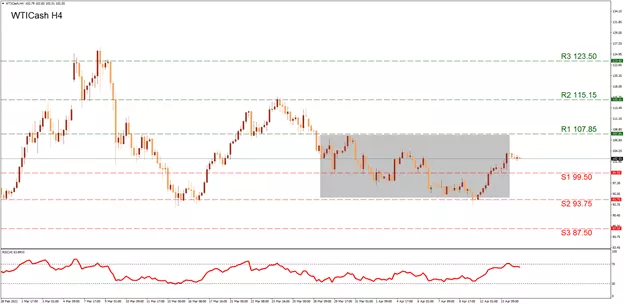
WTI is currently trading nearby $102.80 which is close to our (S1) 99.50 support level. Thus, in a downtrend scenario we consider the (S1) 99.50 support the most probable first test for the price action. If the downtrend is stronger, a move to the (S2) 93.75 barrier is also imminent. Please note the (S2) is the lowest level WTI has dropped to since mid-March and was tested for the last time on the 11th of April. A possible breach below the (S2) could confirm WTI is moving in a downtrend and may be heading to the (S3) 87.50 hurdle. In the opposite direction, a possible upward move could send the price action to the (R1) 107.85 resistance level which was last tested at the end of March and displayed solidity. Yet in an extreme bullish scenario we may see traders shifting their attention to the (R2) 115.15 line which is currently a monthly high price for WTI. If traders are looking for a more prolonged buying strategy we could also point to the (R3) 123.50 resistance which is the 2022 high price and was tested in March. The RSI Indicator below our chart has reached the 70 level in the most recent sessions yet has moved just below it, possibly signaling some stabilization for now. In our opinion, WTI continues to move in a sideways motion within the range highlighted with grey on our chart, between (R1) 107.85 resistance and the (S2) 93.75 barrier. This range has been used since the end of March and a breach outside this can signal a change in the current trend.
Eco Data 4/15/22
[php_everywhere instance="1"]