

Sample Category Title
Yen Selloff Intensifies Again, Canadian Dollar Outperforms
Selloff in the Japan Yen continued this week and intensified in Asian session today. The move came as global benchmark treasury yields powered up, including those in the US, Germany and UK. For now, commodity currencies are the stronger ones for, followed closely by Dollar. European majors are generally weak.
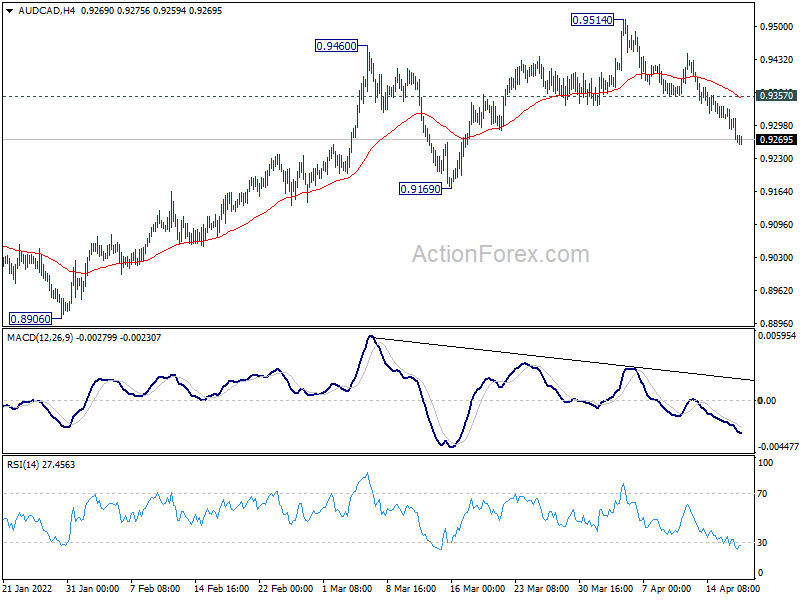
Technically, Canadian Dollar appears to be leading the race for now, with help from WTI crude oil which is staying at around 108. In particular, AUD/CAD is extending the decline from 0.9514. Further fall is expected as long as 0.9357 support turned resistance holds, for 0.9169 support. Reactions from there would decide while whole rebound from 0.8906 has completed too. At the same time, attention will be on whether USD/CAD would break through 1.2519 minor support to confirm underlying strength of CAD, for the near term at least.
In Asia, at the time of writing, Nikkei is up 0.60%. Hong Kong HSI is down -1.89%. China Shanghai SSE is up 0.12%. Singapore Strait Times is up 0.57%. Japan 10-year JGB yield is up 0.0021 at 0.247. Overnight, DOW dropped -0.11%. S&P 500 dropped -0.02%. NASDAQ dropped -0.14%. 10-year yield rose 0.034 to 2.862.
US 10-year yield hit three-month high, 3% next
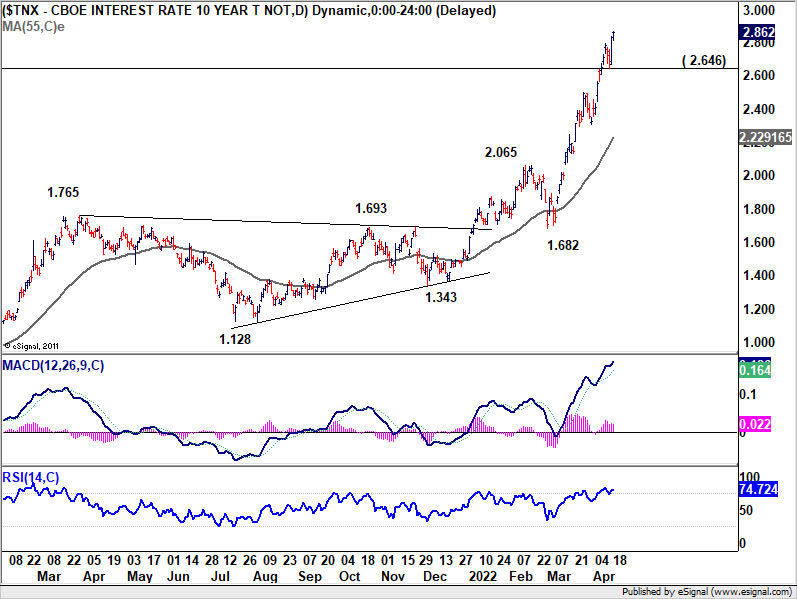
US 10-year yield surged to as high as 2.868 overnight, highest since late 2018, before closing at 2.862. The up trend continued in anticipation of more rate hike from Fed, as well as the start of balance sheet runoff ahead. The development in yields provided additional selling pressure on Yen, with BoJ's cap on 10-year JGB yield at 0.25%.
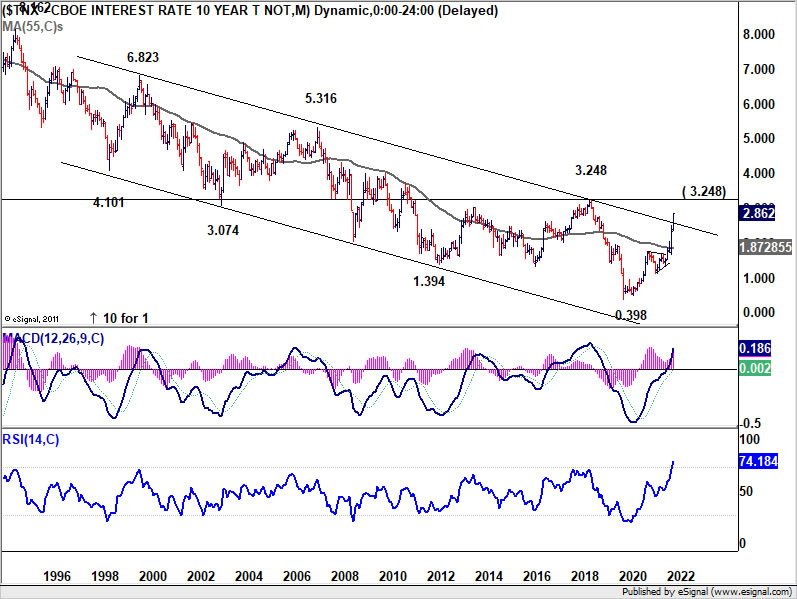
Technically, further rise is expected in TNX as long as 2.646 support holds. Next target is 3% handle. Meanwhile, it should be reiterated that TNX could be considered successfully taking out multi-decade falling channel resistance decisively. Next key hurdle is 3.248 resistance (2018 high). If TNX could surge pass this resistance with power, it would really mark the start of a "new era".
Fed Bullard wants rates above neutral in Q3
St. Louis Fed President James Bullard said yesterday, "we want to get to neutral expeditiously, I guess is the word of the day. I've even said we want to get above neutral as early as the third quarter and try to put further downward pressure on inflation at that point."
As for the May FOMC meeting, "more than 50 basis points is not my base case at this point," he said. "I wouldn't rule it out, but it is not my base case here."
Bullard also reiterated that he would like to see interest rate at 3.50% by the end of the year. "You can't do it all at once, but I think it behooves us to get to that level by the end of the year," he said.
RBA minutes; Developments have brought forward liking timing of rate hike
In the minutes of April 5 meeting, RBA said, inflation in Australia had "picked up" and a "further increase was expected" with measures of underlying inflation in the March quarter expected to be above 3%. Wages growth had "picked up" too but "had been below rates likely to be consistent with inflation being sustainably at the target." These developments have "brought forward the likely timing of the first increase in interest rates. "
"Over coming months, important additional evidence will be available on both inflation and the evolution of labour costs. Consistent with its announced framework, the Board agreed that it would be appropriate to assess this evidence and other incoming information as it sets policy to support full employment in Australia and inflation outcomes consistent with the target."
RBNZ Orr: It's more about hiking sooner rather than more
RBNZ Governor Adrian Orr said in an IMF event, "we've been acting reasonably aggressively to tighten monetary conditions. We've provided strong forward guidance that we expect to be doing more rate rises over coming quarters."
But he also noted, "that was more about doing it sooner rather than believing we have to do more," he said. "It's just getting on with it so people can understand what we are about." Back in February, RBNZ projected that OCR would peak at 3.25% at the end of 2023.
Raising rates too high and "you really run the risk of having a sharper than needed slowdown in economic activity," he said. "On the other hand, if you go too slow its inflation expectations that will get away from us."
"At the moment, the balance of risks as far as the monetary policy committee is concerned is very much weighted to constraining those inflation expectations in the medium term," he said. "We know the long-term cost of letting inflation expectations get away."
Looking ahead
The economic calendar is empty in European session. Canada housing starts and foreign securities purchases, US housing starts and building permits will be featured later in the day.
GBP/JPY Daily Outlook
Daily Pivots: (S1) 164.78; (P) 165.10; (R1) 165.56; More...
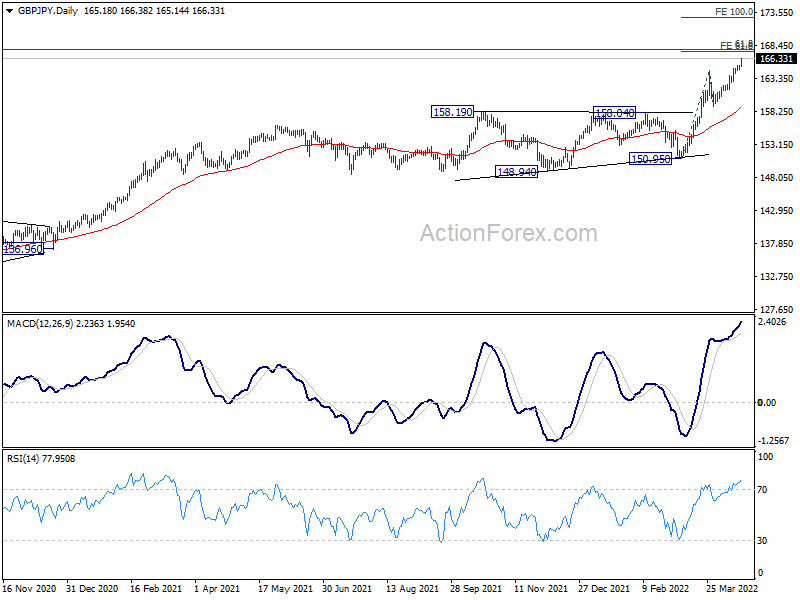
GBP/JPY's up trend continues today and hits as high as 166.38 so far. Intraday bias remains on the upside for 61.8% projection of 150.96 to 164.61 from 159.02 at 167.46 (which is close to 167.93 long term fibonacci level). Break will pave the way to 100% projection at 172.68. On the downside, below 164.61 minor support will turn intraday bias neutral and bring consolidations first, before staging another rally.
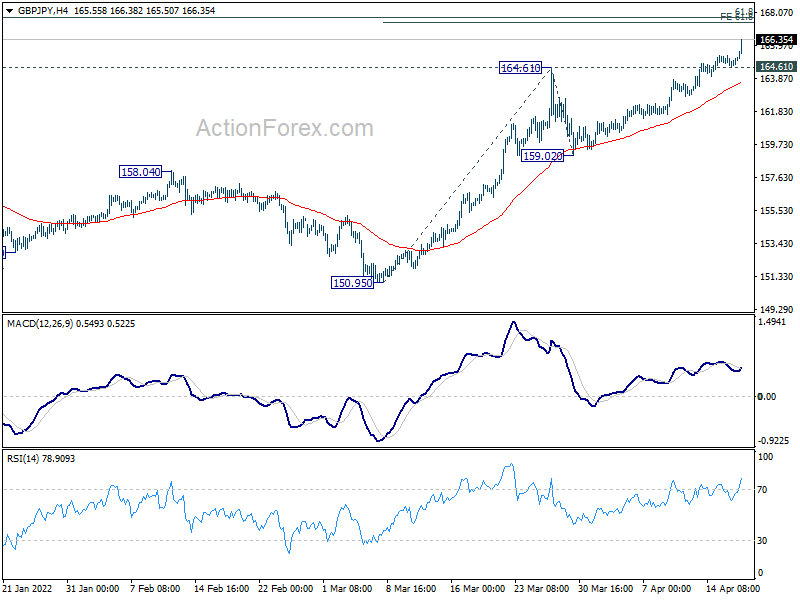
In the bigger picture, up trend from 123.94 (2020 low) is still in progress, and notable support from 55 week EMA affirms medium term bullishness. Next target is 61.8% retracement of 195.86 (2015 high) to 122.75 (2016 low) at 167.93. Sustained break there will be a long term bullish signal, and could pave the way back to 195.86. This will now remain the favored case as long as 150.95 support holds.
Economic Indicators Update
| GMT | Ccy | Events | Actual | Forecast | Previous | Revised |
|---|---|---|---|---|---|---|
| 22:30 | NZD | Business NZ PSI Mar | 51.6 | 48.6 | 48.9 | |
| 01:30 | AUD | RBA Meeting Minutes | ||||
| 04:30 | JPY | Industrial Production M/M Feb | 0.10% | 0.10% | ||
| 12:15 | CAD | Housing Starts Y/Y Mar | 249K | 247K | ||
| 12:30 | USD | Building Permits Mar | 1.83M | 1.86M | ||
| 12:30 | USD | Housing Starts Mar | 1.74M | 1.77M | ||
| 12:30 | CAD | Foreign Securities Purchases (CAD) Feb | 13.49B |
US 10-year yield hit three-month high, 3% next
US 10-year yield surged to as high as 2.868 overnight, highest since late 2018, before closing at 2.862. The up trend continued in anticipation of more rate hike from Fed, as well as the start of balance sheet runoff ahead. The development in yields provided additional selling pressure on Yen, with BoJ's cap on 10-year JGB yield at 0.25%.
Technically, further rise is expected in TNX as long as 2.646 support holds. Next target is 3% handle. Meanwhile, it should be reiterated that TNX could be considered successfully taking out multi-decade falling channel resistance decisively. Next key hurdle is 3.248 resistance (2018 high). If TNX could surge pass this resistance with power, it would really mark the start of a "new era".
RBA minutes; Developments have brought forward liking timing of rate hike
In the minutes of April 5 meeting, RBA said, inflation in Australia had "picked up" and a "further increase was expected" with measures of underlying inflation in the March quarter expected to be above 3%. Wages growth had "picked up" too but "had been below rates likely to be consistent with inflation being sustainably at the target." These developments have "brought forward the likely timing of the first increase in interest rates. "
"Over coming months, important additional evidence will be available on both inflation and the evolution of labour costs. Consistent with its announced framework, the Board agreed that it would be appropriate to assess this evidence and other incoming information as it sets policy to support full employment in Australia and inflation outcomes consistent with the target."
RBNZ Orr: It’s more about hiking sooner rather than more
RBNZ Governor Adrian Orr said in an IMF event, "we've been acting reasonably aggressively to tighten monetary conditions. We've provided strong forward guidance that we expect to be doing more rate rises over coming quarters."
But he also noted, "that was more about doing it sooner rather than believing we have to do more," he said. "It's just getting on with it so people can understand what we are about." Back in February, RBNZ projected that OCR would peak at 3.25% at the end of 2023.
Raising rates too high and "you really run the risk of having a sharper than needed slowdown in economic activity," he said. "On the other hand, if you go too slow its inflation expectations that will get away from us."
"At the moment, the balance of risks as far as the monetary policy committee is concerned is very much weighted to constraining those inflation expectations in the medium term," he said. "We know the long-term cost of letting inflation expectations get away."
Fed Bullard wants rates above neutral in Q3
St. Louis Fed President James Bullard said yesterday, "we want to get to neutral expeditiously, I guess is the word of the day. I've even said we want to get above neutral as early as the third quarter and try to put further downward pressure on inflation at that point."
As for the May FOMC meeting, "more than 50 basis points is not my base case at this point," he said. "I wouldn't rule it out, but it is not my base case here."
Bullard also reiterated that he would like to see interest rate at 3.50% by the end of the year. "You can't do it all at once, but I think it behooves us to get to that level by the end of the year," he said.
(RBA) Minutes of the Monetary Policy Meeting of the Reserve Bank Board
Hybrid – 5 April 2022
Members participating
Philip Lowe (Governor and Chair), Michele Bullock (Deputy Governor), Mark Barnaba AM, Wendy Craik AM, Ian Harper AO, Carolyn Hewson AO, Steven Kennedy PSM, Carol Schwartz AO, Alison Watkins AM
Others participating
Luci Ellis (Assistant Governor, Economic), Christopher Kent (Assistant Governor, Financial Markets), Jonathan Kearns (Head, Financial Stability Department)
Anthony Dickman (Secretary), Penelope Smith (Deputy Secretary)
Bradley Jones (Head, Economic Analysis Department), Marion Kohler (Head, Domestic Markets Department), Andrea Brischetto (Deputy Head, Domestic Markets Department)
International economic developments
Members commenced their discussion of international economic developments by noting that Russia's invasion of Ukraine had contributed to high and volatile commodity prices at a time of strong demand as the global economy recovered from the COVID-19 pandemic. This would further boost global inflation in the period ahead. The related increase in uncertainty and fall in real incomes would weigh on economic activity in some regions, particularly commodity-importing countries in Europe, where growth forecasts for 2022 had been revised downwards to the greatest extent. For commodity-exporting countries, previous episodes where supply shocks had contributed to rising commodity prices suggested that the boost to incomes is likely, for the most part, to be saved; accordingly, the net result would most likely be an overall drag on global growth. More broadly, members agreed that the longer-term geopolitical and economic consequences of the war in Ukraine are likely to be material, but difficult to predict.
The effect of the invasion of Ukraine on commodities markets had been most pronounced in energy, reflecting Russia's role as a significant supplier of natural gas, crude oil and coal. Higher energy prices had raised costs for transport, electricity, base metals and other energy-intensive production. In addition, the invasion had disrupted global food supplies as Russia and Ukraine are significant producers of wheat and vegetable oils. Fertiliser prices had also risen sharply, which could reduce crop yields internationally if farmers respond by curtailing the use of fertiliser.
Members also noted that iron ore and metallurgical coal prices had increased over recent months. This was mainly because steel production in China had strengthened as authorities eased restrictions on production. The Chinese authorities were also expected to ease fiscal settings over the course of the year in support of the GDP growth target for 2022.
Members noted that global supply chains had remained strained overall. Global shipping costs had increased further after stabilising earlier in the year, and semiconductor prices had also picked up again. In China, the imposition of COVID-19 containment measures in some cities in response to recent virus outbreaks had the potential to exacerbate global supply chain disruptions. Supply chain pressures had eased in some other areas, as seen in the rebound in vehicle production and decline in surveyed delivery times. Labour supply disruptions in advanced economies had also eased after outbreaks of the Omicron variant earlier in the year.
Members observed that consumer price inflation had continued to rise to multi-year highs in many economies, with Japan and China notable exceptions. Further increases were expected in the period ahead in response to the direct and indirect effects of higher commodity prices. As a result, a number of central banks had revised their inflation forecasts upwards by 1½–2 percentage points since earlier in the year. While core inflation had generally remained below headline rates, it too was at multi-decade highs in many countries. Members agreed that persistent increases in food and energy prices were adding to cost-of-living pressures in a number of countries and had contributed to a notable decline in consumer confidence despite strong labour market conditions.
Nominal wages growth had remained mixed across advanced economies, despite low and falling unemployment rates. The US labour market had appeared particularly tight given the reduction in labour supply since the onset of the pandemic, and the number of job vacancies had far exceeded the number of people classified as unemployed. The upswing in inflation had resulted in average real wages contracting at their fastest pace in many years. Given the outlook for inflation in many advanced economies, it was considered unlikely that growth in real wages would turn positive for some time. A key uncertainty over the medium-term related to how higher nominal wages would respond to higher inflation and the decline in real purchasing power.
Members agreed that the combination of high inflation, declining real wages, rising interest rates and falling consumer sentiment had clouded the near-term outlook for global growth. While measures of consumption and business conditions in advanced economies had been resilient to the Omicron outbreak, global growth forecasts had been revised downwards notably since the invasion of Ukraine. Members agreed that policy trade-offs had become more complex in economies facing a negative terms of trade shock and where inflation was already high; this included the euro area and the United Kingdom, where increases in energy prices had been significant. The Russian economy was expected to contract severely because of sanctions imposed following the invasion of Ukraine. While policy rates and longer-term interest rates had increased globally in response to higher inflation, a number of governments in advanced and emerging market economies had announced measures to support households' purchasing power through the period of near-term uncertainty and rising cost-of-living pressures.
Domestic economic developments
Turning to domestic economic conditions, members observed that the Australian economy had been resilient in the face of global and domestic supply shocks, including the war in Ukraine, the Omicron outbreak and the floods along Australia's east coast. Policy settings remained supportive of the recovery and national income had been substantially boosted by the large increases in commodity prices; it was likely that the terms of trade would exceed previous highs. Overall, the growth outlook remained positive for this year and next. At the same time, rising prices were impinging on households' spending power and the floods had been very disruptive for many communities.
Members noted that the labour market had tightened further in the first quarter of the year, with leading indicators pointing to strong ongoing demand for labour. In February, unemployment had declined to 4 per cent, around its lowest rate in five decades, and other measures of labour market spare capacity had declined to levels previously observed in 2008. Job vacancies and advertisements had been at high levels, and information from the Bank's liaison program had indicated that firms planned to expand headcount in the period ahead. While the Omicron variant had disrupted labour supply in the March quarter, there was scope for average hours worked to increase over time, particularly among full-time employees, as the labour market continues to tighten.
Recent information remained consistent with a further but gradual increase in aggregate wages growth. Reports from the Bank's liaison program suggested that private sector wages growth had continued to pick up in the March quarter. This shift had been mostly evident in individual pay arrangements; wage increases provided in enterprise bargaining agreements had reportedly remained around the subdued rates seen in late 2021. Broader measures of labour costs had been expected to increase at a faster pace than base wages in the period ahead. Nevertheless, members noted that uncertainty about the behaviour of labour costs at historically low levels of unemployment remains.
Members discussed the direct and second-round effects of the recent increase in fuel, food and other commodity prices; these would result in a further lift in inflation over coming quarters. As a result, non-labour input cost pressures were thought likely to persist for longer than previously expected. Information from the Bank's liaison program indicated that many firms had either increased selling prices over recent months or anticipated increasing prices in the months ahead. However, there was uncertainty about whether these price adjustments had represented a one-off shift in the level of prices or the start of a period of ongoing price increases. The outcome would depend on a range of factors, including the speed of the resolution of various supply-side issues, developments in global energy markets and the evolution of overall labour costs. While inflationary pressures had increased in Australia, members observed that inflation had remained significantly lower than in many other countries.
Timely indicators suggested that household spending had been resilient in the March quarter. Increased opportunities for discretionary spending were expected to support household consumption in coming quarters, though as experienced elsewhere, higher fuel prices were weighing on consumer sentiment and posed a downside risk to spending and activity in the near term. The effects of rising food and fuel costs were expected to fall unevenly across households. Lower-income households spend relatively more on food and fuel and have relatively limited buffers of savings, so they were considered more likely to respond to higher prices by forgoing other expenditure. The Australian Government budget included additional transfer payments, including to low-income households, to help address cost-of-living pressures. In addition, higher-than-expected commodity prices had supported a partial recycling of higher tax revenues back into the economy. Fiscal support, alongside insurance payouts, was also expected to provide some assistance to households and communities affected by the floods.
Members noted that shortages of materials and labour across the country had contributed to delays and rising costs in the construction industry. This had affected activity in both residential and non-residential sectors. Widespread rainfall along the east coast and absenteeism due to the Omicron outbreak were expected to have weighed further on construction activity in the March quarter and early in the June quarter. A large pipeline of residential construction activity and public infrastructure projects remains. Areas affected by the floods would add to the pipeline of construction work, and additional infrastructure projects had also been announced in the Australian Government budget. However, the rollout of past commitments had been constrained by industry bottlenecks and there were risks of further delays owing to capacity constraints. Members noted that limited availability of skilled labour was one factor constraining the capacity of firms in the resources industry to undertake new capital works.
International financial markets
Government bond yields had risen significantly in line with higher inflation expectations and a further rise in the expected paths of central bank policy rates in many advanced economies. This reflected the persistence of inflation pressures and the additional effect of the invasion of Ukraine on commodity prices.
Members observed that many central banks in advanced economies expected a further increase in near-term inflation and had indicated the need for faster removal of accommodative policy settings than had been anticipated. As expected, a number of central banks in advanced economies had raised their policy rates in March, including the US Federal Reserve. Central banks in all advanced economies had ended the purchasing phases of their pandemic-related quantitative easing programs.
Private sector financial conditions had tightened, but remained favourable overall. Major equity markets were generally below their levels at the start of the year, despite having recovered to pre-invasion levels in most markets outside Europe. The Australian equity market had been supported by the positive effect of higher commodity prices on energy stocks. Globally, conditions in corporate bond markets had become somewhat less accommodative and money market credit spreads had widened a little.
Members noted that currencies of commodity-exporting countries, including the Australian dollar, had generally appreciated over the preceding month. The US dollar had also appreciated on a trade-weighted basis. The Japanese yen had depreciated noticeably, with the Bank of Japan having emphasised the need to maintain stimulatory monetary policy (including its yield curve control) to generate a sustained rise in inflation.
Financial conditions had tightened to varying degrees in most emerging market economies, especially those that are net importers of commodities. Sanctions had affected Russia's financial markets substantially. In China, equity markets had declined, including in response to rising numbers of COVID-19 cases and concerns about slowing output growth.
Domestic financial markets
Australian government bond yields had also risen noticeably since the previous meeting. Real yields had risen to be positive at the 10-year horizon for the first time since early 2020. Bond market measures of inflation expectations were consistent with the view that inflationary pressures associated with supply-side issues were likely to wane over the longer term; inflation compensation for 10-year Australian Government Securities was around the mid-point of the Bank's target range for inflation.
Money market rates beyond the very near term had increased, largely due to a further rise in policy rate expectations. Members noted that market pricing implied that market participants expected the cash rate to increase to around 1¾ per cent by the end of 2022, with the first rate rise expected by the middle of the year.
Banks' overall funding costs had remained around historical lows, but elements of these costs were rising. Outstanding lending rates had also remained low, though rates on new fixed-rate loans had been increasing since late 2021.
Total credit growth had remained high at 8½ per cent on a six-month-ended annualised basis, the highest growth rate since the late 2000s. Growth in business credit had remained strong in early 2022, as had demand for housing finance.
Members discussed the operation of monetary policy in the current environment of abundant exchange settlement (ES) balances, which was a result of the monetary policy measures implemented in response to the pandemic. As expected, this had led to the cash rate trading at a margin above the rate of remuneration on ES balances but below the cash rate target. In the absence of other developments, the level of ES balances would decline as the pandemic-related policy measures unwound, but this would take some years. Members noted that it would be possible to reduce ES balances more quickly, so that banks had more need to trade ES balances and the cash rate would return to trading at the target. However, it would be difficult to judge the level of ES balances required to achieve this outcome, and attempting to do so over a short period of time risked creating volatility in financial markets. Further, this was not necessary for the effective implementation of monetary policy.
Accordingly, members agreed that monetary policy would continue to be set in an environment of high ES balances for some time. They acknowledged that this meant the cash rate was likely to remain a little below the cash rate target. In light of this, members agreed that it remained appropriate to continue to set and communicate both the interest rate on ES balances and the cash rate target in policy announcements. Members noted the benefit of the cash rate target as a well-understood feature of monetary policy communication and an anchor for the cash rate. Members also agreed to maintain the current margin of 10 basis points between the interest rate on ES balances and the cash rate target, but noted this would be subject to periodic review, as the appropriate margin could change over time as market conditions evolve.
Financial stability
Members were briefed on the Bank's regular half-yearly assessment of financial stability risks.
Financial systems had continued to function well over the preceding six-month period, with further outbreaks of COVID-19 having had little enduring effect on financial institutions and markets.
The significant increase in inflation in many economies and expectations of earlier central bank tightening had caused market interest rates to rise in the period since late 2021. As a result, some financial asset prices had declined. These price falls had been orderly. Members noted that there had not been any notable declines in residential or commercial property prices.
To date, financial markets had been resilient to the effects of Russia's invasion of Ukraine. There had been large falls in Russian asset prices, with many foreign investors essentially writing off the value of Russian investments. However, globally, banks' direct exposures to Russia and Ukraine were small. Members noted that the increased volatility in commodity markets had increased risks for investors with leveraged positions, including through derivatives. This was highlighted by a decision by the London Metal Exchange to suspend trading in nickel futures and unwind trades where there would have been large margin calls and liquidity pressures for market participants. The greater use of central counterparties had, however, reduced the likelihood of spillovers from market stress.
Policy interest rates in major economies were expected to remain below inflation, and below rates that had historically been needed to reduce inflation. This raised the possibility that higher policy interest rates could be needed to return inflation to central banks' targets. In turn, higher policy rates and higher inflation raised the potential for significant increases in long-term interest rates from low levels. Higher interest rates would increase debt-servicing burdens for borrowers, which raised the risk of a deterioration in loan performance. The risks from high indebtedness had been underscored by the substantial increase in stress among Chinese property developers. The majority of large listed property developers had either defaulted on debt or had seen their debt trade at interest rates exceeding 50 per cent. These conditions would make it difficult for property developers to refinance their debt. However, financial stress had not yet spread to other parts of the financial system.
Substantially higher interest rates, or an increase in risk aversion, could also result in concurrent price falls for a range of financial and real estate assets, including housing prices, which were at high levels, having increased significantly since mid-2020 in many countries albeit with recent signs of moderation in some jurisdictions. Large increases in global interest rates were also seen to be a risk to some emerging market economies with weaker economic fundamentals because this combination had led to sharp capital outflows in the past.
While some risks were elevated, banks in advanced economies remained resilient. Profitability had increased, partly because of growth in investment banking activity and lending. Regulators had increased capital requirements in several countries. Cyber and operational risks for financial institutions were judged to be high, particularly given the invasion of Ukraine and the central role of the financial system in the application of sanctions on Russia.
In Australia, financial stability risks had broadly been driven by the same factors as internationally, but financial institutions, households and businesses were, for the most part, judged to be highly resilient.
Households' balance sheets had strengthened over the previous two years. Aggregate household asset holdings had increased substantially given strong growth in housing prices and increased saving. Household credit had been growing faster than household incomes, although the ratio of aggregate household debt to income remained within its range over the preceding decade. The financial resilience of most households had also increased. Members noted that strong growth in housing prices had reduced the share of borrowers with negative equity to very low levels. High savings had also increased the financial buffers that households had built up. For households with an owner-occupier variable rate mortgage, the median excess payment buffer had increased to an equivalent of 21 months of required payments, up from 10 months at the beginning of the pandemic. However, around one-quarter of these borrowers had excess payment buffers of less than three months and some of these borrowers had not increased their buffers over this period. The rate of excess payments being made, and banks' assessments of borrowers' ability to service their loans at higher interest rates, meant that most borrowers were unlikely to be stressed by higher interest rates.
Most businesses also were financially resilient. Aggregate leverage of corporations had declined, reflecting both a decrease in total debt and an increase in the value of total assets. The liquidity of non-financial corporations had continued to increase, with cash holdings as a share of total assets up to around 15 per cent. However, revenue had not recovered from the pandemic for some businesses and some had been running down their cash buffers.
The Australian financial system continued to support the economic expansion. Banks' profits remained strong, supported by buoyant credit growth and low funding costs. Profits had decreased recently as net interest margins narrowed given strong competition in the banking sector, refinancing to lower rates and increased holdings of liquid assets. Better-than-expected economic conditions had contributed to a decline in non-performing loans; together, these factors had enabled banks to unwind most of the higher provisions held over the period since the onset of the pandemic. Accumulated profits had seen the major banks' capital ratios remain high and well above minimum regulatory requirements, even though banks had been undertaking share buybacks.
Considerations for monetary policy
In considering the policy decision, members noted that inflation had increased sharply in many parts of the world because of ongoing supply-side problems, Russia's invasion of Ukraine and strong global demand as economies recovered from the pandemic.
Central banks in many advanced economies, including the United States, had responded to higher inflation by increasing interest rates from their historically low levels and had signalled that further increases were likely. Bond yields had risen and expectations of future policy interest rates had increased. Members observed that, while market pricing implied a swift increase in policy rates over the near term, expectations were for rates to peak at levels that were low in a historical context.
The Australian economy had remained resilient and spending was picking up following the setback caused by the outbreak of the Omicron variant. Macroeconomic policy settings and higher commodity prices had supported the economic outlook. Household and business balance sheets were generally in good shape, there was a large pipeline of construction work to be completed and a recovery in business investment was expected. Higher commodity prices had also been reflected in an appreciation of the Australian dollar, which was around the levels of a year earlier in trade-weighted terms.
The strength of the Australian economy was evident in the labour market. Unemployment and underemployment rates were at their lowest levels in many years and forward-looking indicators of labour demand remained strong. The Bank's central forecast was for the unemployment rate to fall to below 4 per cent in the current year and to remain below 4 per cent in the subsequent year.
Wages growth had picked up, but at the aggregate level was only around the relatively low levels prevailing prior to the onset of the pandemic. Members observed, however, that there were some areas where larger wage increases had been recorded. Given the tightness of the labour market, a further strengthening of aggregate wages growth and broader measures of labour costs was expected. The pick-up was still expected to be only gradual, although there was uncertainty about the behaviour of wages at historically low levels of the unemployment rate.
Inflation in Australia had increased, but was still lower than in many other countries. Members noted that higher prices for petrol and other commodities would result in a further lift in inflation over coming quarters. An updated set of Bank forecasts will be published in May. The speed of the resolution of the various global supply-side issues, developments in global energy markets and the evolution of overall labour costs were key sources of uncertainty about the inflation outlook.
Housing prices had risen strongly over the preceding year, although prices in some housing markets had eased more recently. Members observed that high rates of household saving meant many households had built substantial buffers, though some households had only limited buffers. Members continued to emphasise the importance of maintaining lending standards and borrowers maintaining adequate buffers while interest rates were low.
Turning to the policy decision, members agreed that financial conditions in Australia remained highly accommodative. Interest rates remained at very low levels, although some fixed rates on new housing and business lending had risen recently. Members noted that the Board's policies during the pandemic had supported progress towards the objectives of full employment and inflation consistent with the target. Members also noted that, for some time, the Board had been communicating that it wanted to see evidence that inflation is sustainably within the 2 to 3 per cent target range before increasing interest rates. It had also been communicating that this was likely to require a faster rate of wages growth than had been experienced over previous years.
Inflation had picked up and a further increase was expected, with measures of underlying inflation in the March quarter expected to be above 3 per cent. Wages growth had also picked up but, in aggregate terms, had been below rates likely to be consistent with inflation being sustainably at the target. These developments have brought forward the likely timing of the first increase in interest rates. Over coming months, important additional evidence will be available on both inflation and the evolution of labour costs. Consistent with its announced framework, the Board agreed that it would be appropriate to assess this evidence and other incoming information as it sets policy to support full employment in Australia and inflation outcomes consistent with the target.
The decision
The Board decided to maintain the cash rate target at 10 basis points and the interest rate on Exchange Settlement balances at zero per cent.
RBA’s Scenario Analysis is a Helpful Tool for Terminal Rate Debate
Now that it is generally accepted that the RBA tightening cycle will begin in June, with a series of consecutive hikes, interest is firmly targeted at the likely peak in rates in the cycle. The steady 4% unemployment rate that has just been reported for March will take some pressure off the markets' push for a hike in May.
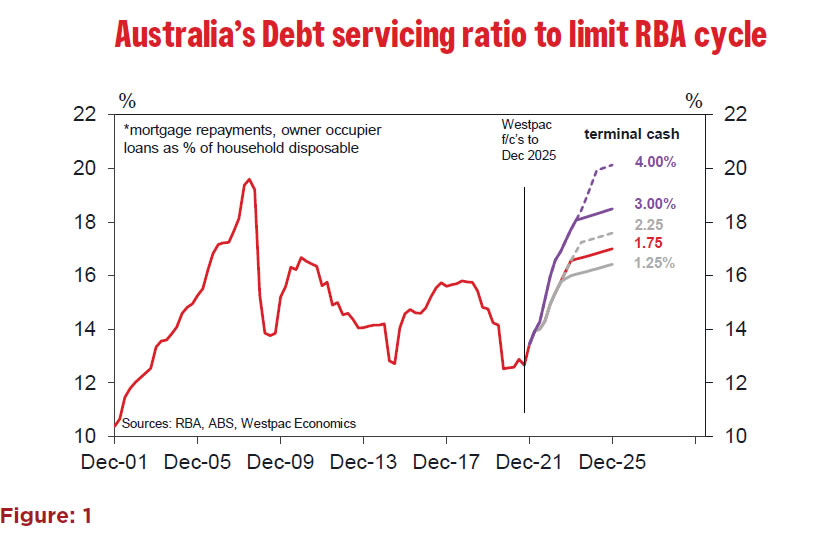
We revised our profile last week to bring forward the timing of the peak to June 2023 (from November) and lift it from 1.75% to 2.0%.
That is a long way from the 3.4% currently priced into the market and the "theoretical" 3.5% associated with 1% real and 2.5% inflation that is often favoured by central banks.
The lower nominal terminal rate which we, and others, favour relies upon the household sector being quite sensitive to rising rates due to their high levels of household debt.
We estimate that a terminal rate of 2% would see that debt servicing ratio settle above the ratios of the two previous cycles. Note that the "cycle" in 2017/18 was not driven by a rising RBA cash rate rather the banks' responses to macro prudential tightening policies. (Figure 1).
There are significant uncertainties with this methodology.
- Are we taking adequate account of the evolving mix between fi xed and fl oating mortgages in this cycle?
- Is an "average" concept the right approach when change can be triggered by the marginal players?
- Perhaps every cycle is diff erent and it is more reliable to use the "compass" of an equilibrium "real rate" unless you are modelling the feedback eff ects from policy changes to the overall economy, including households, using some form of macro econometric model.
- How will the undeniable build up in the buff ers associated with the household savings rate averaging 17% in 2020 and 2021 aff ect the sensitivity of the household sector to higher rates?
These are all formidable questions.
Last week the Reserve Bank released its latest Financial Stability Review.
The Review included a detailed analysis of the Bank's Securitisation data base. This data base covers detailed data on all securitisations of mortgages that have been implemented by banks and non banks. It does not cover the vast majority of mortgages which the banks do not choose to securitise and hold directly on their balance sheets.
Nevertheless, it is the most comprehensive publicly available record of the profile of mortgages in the Australian market.
Some important facts that we learn from the data base are that:
- The current stock of mortgages is 60% variable rate and 40% fixed rate. The fixed rate share has doubled since the pandemic when the RBA pushed 3 year bond rates down to 0.1% through its Yield Curve Control policy- allowing banks to offer 2–3 fixed rate mortgages at around 2%.
- Two thirds of fixed rate mortgages will need to be rolled over by end 2023.
- Mortgage borrowers have been accumulating their share of the lift in excess savings in their mortgage offset accounts; with the lift in mortgage offset balances being 2.5% of disposable income over 2020 and 2021 compared to around 1% in earlier years. As a result, the median excess payment buffer is 21 months – up from 10 months prior to the pandemic.
- Mortgage borrowers have also been increasing their repayments above the minimum level. We saw 65 basis points of RBA rate cuts in 2020 and savings increased over 2020 and 2021.
- Rising house prices and increased repayments mean that only 5% of loans have an LVR (loan to valuation ratio) of more than 75% compared to nearly 25% at the beginning of 2020.
The data base lends itself to scenario analysis. The chosen scenario was a 200 basis point increase in the variable mortgage rate.
Under that scenario 40% of borrowers would face no increase in average monthly payments over the past year; 20% would see a lift up to 20%; 25% would see an increase up to 40%; and 20% would see an increase above 40%. (Figure 2)
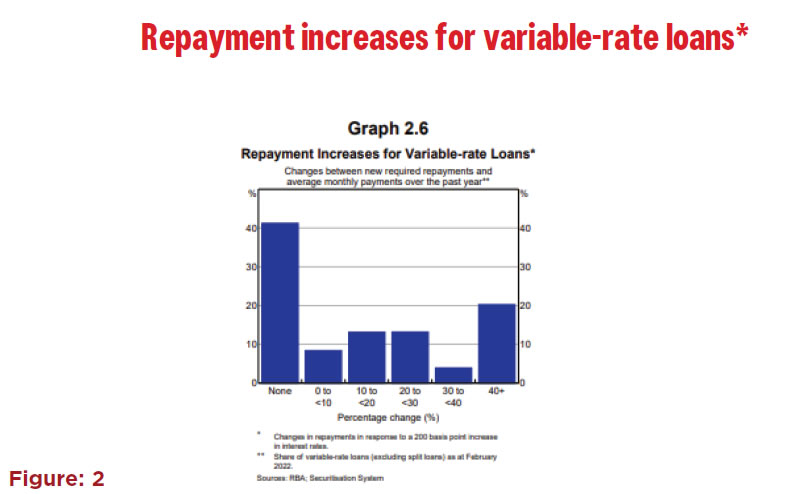
Impacts on the economy are likely to reflect the responses of those borrowers who are hardest hit by the rate increases – the scenario analysis points to 20% of borrowers facing a 40%+ increase in repayments.
This scenario applies an immediate increase in the variable mortgage rate of 200 basis points whereas our central case is that the increase will be introduced over the 12 months beginning in June this year.
With the repayments over the last year being inflated by the high savings rate the actual proportional increase in repayments over the "normal" schedule will be higher.
Repayments include both principal and interest whereas the rate change will only affect the interest payments so the proportional increase in payments will be significantly less than the proportional increase in the actual rate.
The scenario analysis results for fixed rate borrowers assumes that the borrowers move to floating rate at roll over date. (Figure 3)
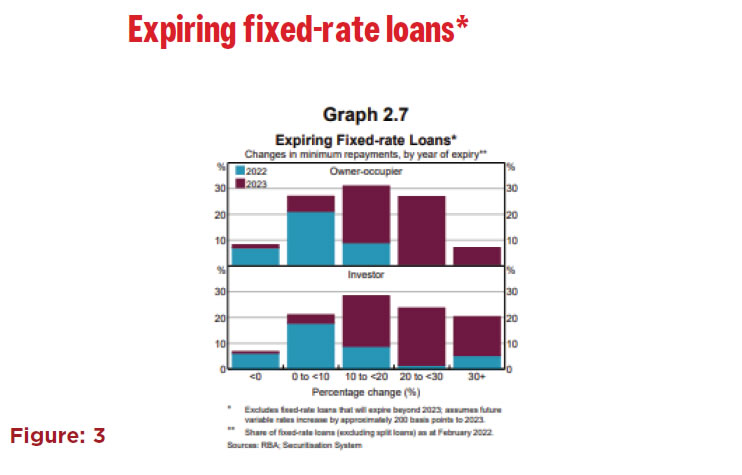
For owner occupiers 65% would see a lift in repayments of less than 20% with around 50% for investors.
Of the remaining borrowers less than 10% (owner occupiers) would see an increase above 30% while 20% of investors would see the increase above 30%.
As discussed, the surge in fixed rate lending through 2020 and 2021 at an average of 2.4% during 2020 and 2021 saw fixed rate loans lift from 20% to 40% of the stock of loans.
Two thirds of fixed rate loans are set to mature by end 2023 and many of these would have been 2–3 year loans written at that 2.4% average during 2020 and 2021. Under the scenario analysis the loans roll over into floating rate loans at a loan rate of around 5.5% (reflecting the 2% lift in the standard variable rate).
With this in mind the results of the scenario analysis are surprisingly benign.
Perhaps the bulk of the 2.4% fixed rate loans mature after 2023. We are not expecting the RBA to be cutting rates in the 2024– 2025 period so the impact on the low cost fixed rate loans (which may represent the bulk of the one third of loans still to mature) would be delayed until 2024 and 2025.
As discussed in the introduction the data base does not cover the bulk of mortgages that are held directly on bank balance sheets. That observation that two thirds of fixed rate loans mature by end 2023 is important – a more front loaded profile of low rate borrowers transitioning to higher rates in 2023 would exacerbate the impact of higher rates in 2023. Only one major who has released that proportion of maturing fixed rates in their recent results and their number seems to line up quite closely with that two thirds estimate for the securitised portfolio.
Conclusion
This scenario analysis highlights the sensitivity of some borrowers to the 2% rate increase. But because it is a static analysis there is no consideration of the feedback effects on the wider economy to the borrowers.
The advantage of looking at earlier periods of rising rates is that the results capture those feedback loops.
The Review notes another RBA study which also simulates a 200 basis point increase in interest rates from current levels which would lower real housing prices by around 15% from current levels. With inflation running at the 2.5% RBA target over the simulation period that would imply a 10% reduction in nominal house prices over that two year period.
The scenario analysis is not built to assess the feedback effects of falling house prices on borrowers' behaviour.
But the historical analysis will only provide limited insights into the big issue here which is how the accumulated buffers affect the behaviour of borrowers when rates are rising.
For example, concerns about falling house prices and rising rates might prompt borrowers to seek to preserve the buffers by cutting back on other expenditure.
And we do not know whether those buffers will be available to those borrowers in the vulnerable groups – 20% of variable rate borrowers will face a 40% lift in average repayments; the cohort of fixed rate borrowers who will move from a 2% fixed rate to 5.5% variable and the requirement to pay down principal and interest.
The RBA concludes "although the estimated increases in repayments are sizable for some borrowers it should be manageable for most."
The ultimate terminal rate in this cycle will be determined by the availability of the buffers for those who need them most and the overall behaviour of those facing "sizeable" increases.
Because the static scenario analysis does not address so many of these issues we should treat it only as a helpful input into the discussion around the terminal rate rather than a definitive assessment.
We are comfortable to continue with the dynamic, historical approach which does at least take into account the feedback effects experienced in earlier cycles.
But with no historical precedents or any way of modelling the impact of the "buffers" there is considerable uncertainty about how the economy will evolve once the standard variable mortgage rate starts to rise.
GBP/USD Vulnerable to a Drop Below 1.3000
Key Highlights
- GBP/USD is struggling to clear the 1.3150 resistance zone.
- A crucial bearish trend line is forming with resistance near 1.3120 on the 4-hours chart.
- EUR/USD is still trading in a bearish zone below 1.0920.
- Gold price extended gains, and oil price could gain pace above $110.
GBP/USD Technical Analysis
The British Pound started another decline after it failed to clear 1.3150 against the US Dollar. GBP/USD traded below the 1.3100 level to move into a negative zone.
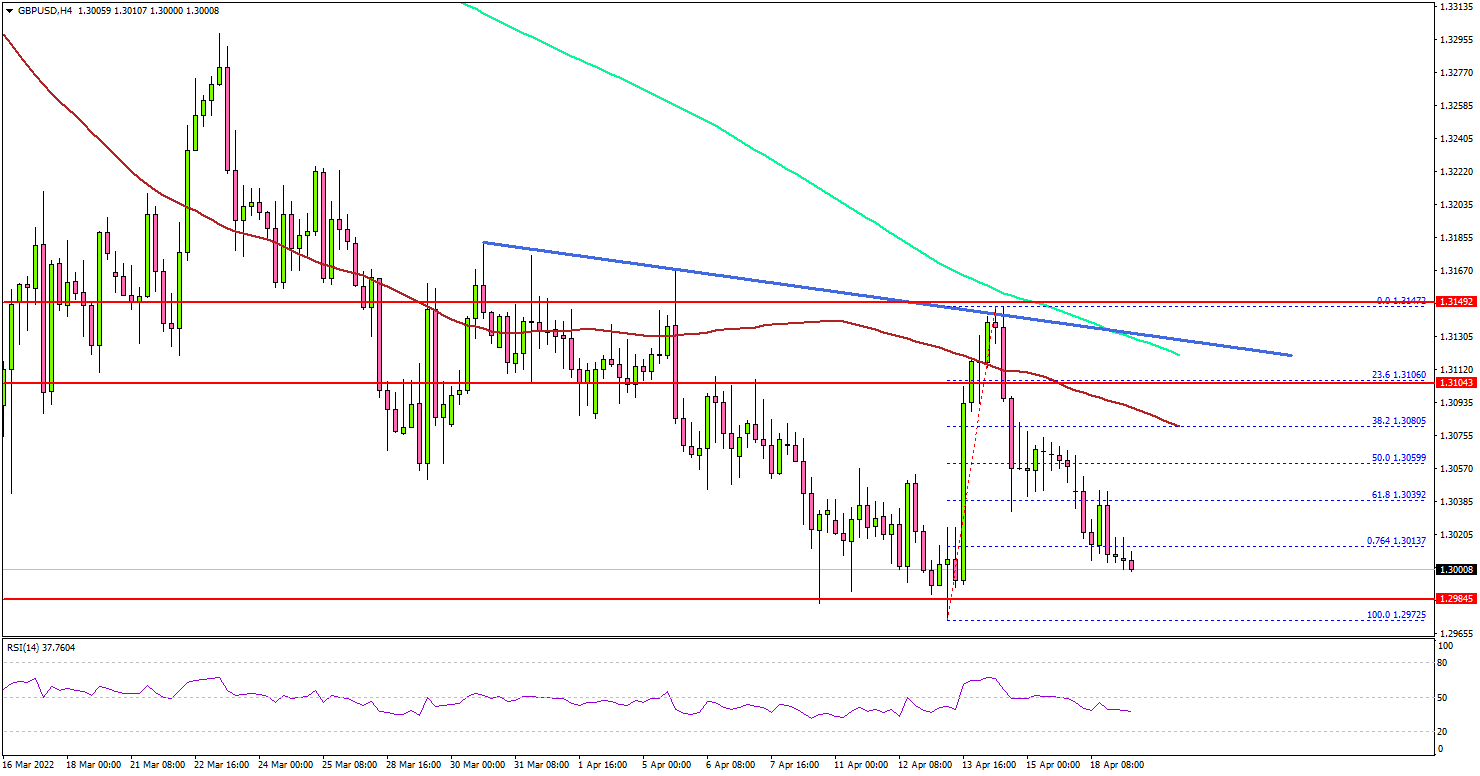
Looking at the 4-hours chart, the pair even traded below the 1.3050 level. There was a move below the 50% Fib retracement level of the upward move from the 1.2972 swing low to 1.3147 high.
It settled well below the 200 simple moving average (green, 4-hours), and the 100 simple moving average (red, 4-hours). There is also a crucial bearish trend line forming with resistance near 1.3120 on the same chart.
The next major resistance is near the 1.3150 level, above which it could start a steady increase. A clear move above the 1.3150 level could push GBP/USD above 1.3200.
The next major resistance is seen near the 1.3250 level. An initial support on the downside is near the 1.3000 level. The next major support is near the 1.2980 level. A downside break below the 1.2980 support level might accelerate losses.
The next major support is near the 1.2950 level. Any more losses may perhaps open the doors for a move towards the 1.2820 level.
Looking at EUR/USD, the pair extended decline towards the 1.0750 and is currently consolidating losses below key hurdles.
Economic Releases
- US Housing Starts for March 2022 (MoM) – Forecast 1.738M, versus 1.769M previous.
- US Building Permits for March 2022 (MoM) – Forecast 1.820M, versus 1.865M previous.
Eco Data 4/19/22
[php_everywhere instance="1"]
Gold Rises on High Inflation and Uncertainty over Ukraine; Psychological $2000 Level Under Increased Pressure
Spot gold rose nearly 1% on Monday, climbing to the highest in over one month and pressuring key barriers at $2000/$2001 (psychological / Fibo 61.8% of $2070/$1890 correction).
Growing concerns about surging inflation and economic impact from the war in Ukraine, prompted investors into safety, as the yellow metal is a safe-haven asset and also used as a hedge against inflation.
Fresh acceleration higher emerges after a brief pause on Friday, with break of $1980 (50% retracement) confirming a higher base at $1890 zone (lows of the pullback from $2070 peak (2022 peak, posted in March).
Metal’s price is expected to rise further on flow of negative news, as the conflict in Ukraine has so far showed no signs of easing that further darkens global economic outlook and continue to boost risk aversion.
Technical studies on daily chart show rising positive momentum, with the action being supported by thickening daily cloud and Tenkan-sen / Kijun-sen bull-cross, however, bulls are expected to feel a headwinds from $2000 zone and likely to consolidate before resuming.
Dips should be contained by the top of daily Ichimoku cloud ($1958) to keep bulls intact, with eventual break of $2000 pivot to expose targets at $2027 (Fibo 76.4%) and $2058 (March 9 high), which guard key obstacles at $2070/$2074 (2022/2020 record highs).
Res: 2000; 2001; 2009; 2020
Sup: 1980; 1966; 1958; 1952
