Sample Category Title
AUD/JPY resumes up trend, NZD/JPY to follow?
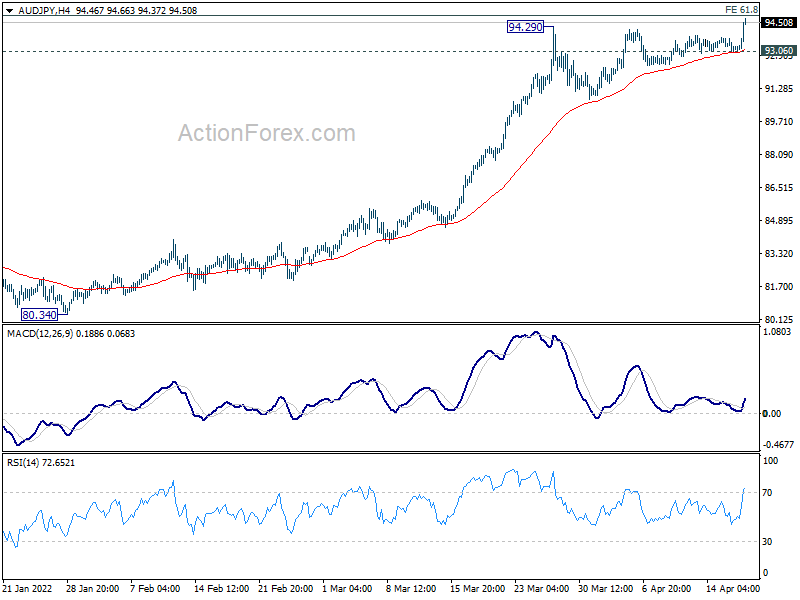
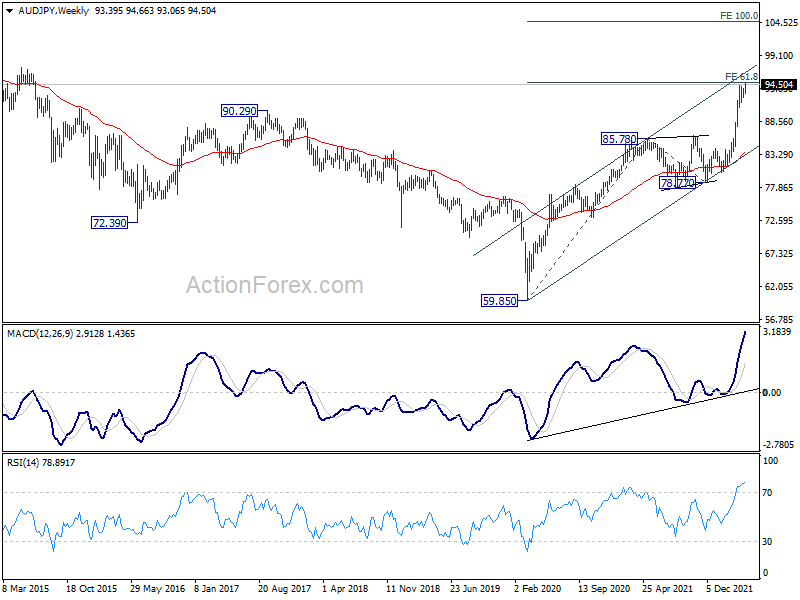
AUD/JPY's up trend finally resumes today by breaking 94.29 near term resistance. Immediate focus is now on 61.8% projection of 59.85 (2020 low) to 85.78 from 78.77 at 94.79. Sustained break there could prompt upside acceleration, for next medium term target at 100% projection at 104.70, which is close to 105.42 (2013 high). However, break of 93.06 support will suggest rejection by 94.79 and bring deeper correction, back towards 55 day EMA (now at 88.55).
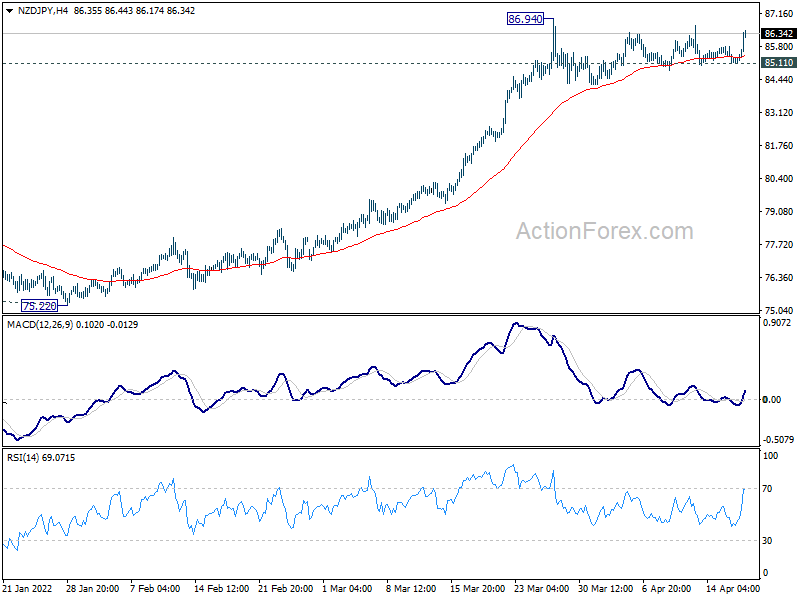
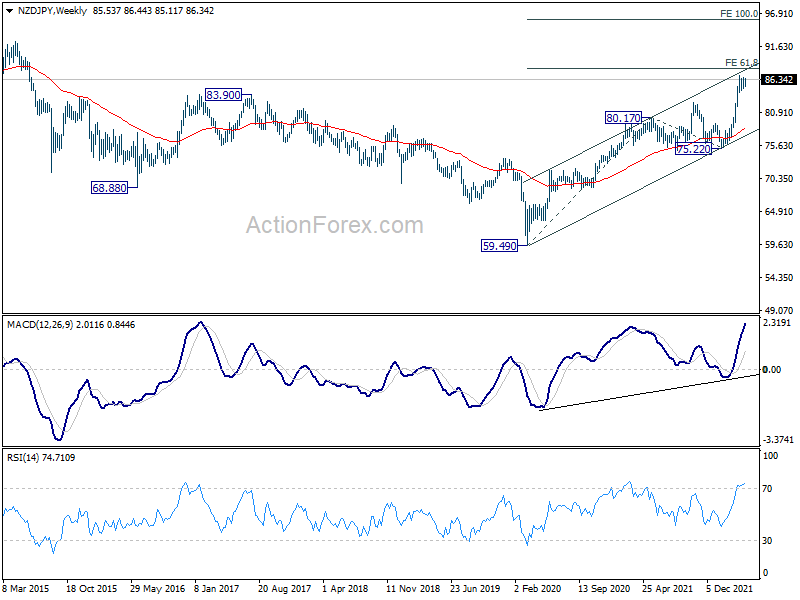
NZD/JPY is lagging behind and it's still staying below 86.94 resistance. The next move will probably need from help from AUD/JPY. Break of 86.94 in NZD/JPY (following break of 94.79 in AUD/JPY) will resume larger up trend through 61.8% projection of 59.49 to 80.17 from 75.22 at 88.00. However, break of 85.11 (following AUD/JPY's break of 93.06) will bring deeper pull back towards 55 day EMA (now at 82.09).
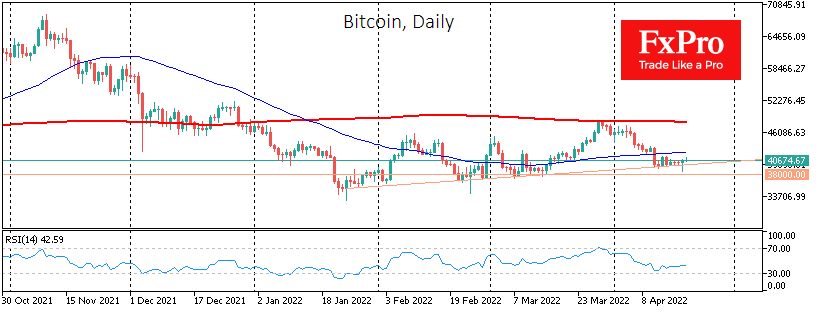
Buyers Claw at Bitcoin
Bitcoin returned to growth territory with a powerful surge at Monday’s close, above the all-important $40K key level. A desperate attempt to hold on to the uptrend line from January resulted in a temporary success.
Over the past 24 hours, we have seen a 5% jump to $40.8K. Ethereum adds 4.5% in 24 hours, trading above $3040. Other leading altcoins from the top ten are adding between 3.5% (Dogecoin) and 18% (Terra). Total crypto market capitalisation, according to CoinMarketCap, rose 4.6% overnight to $1.89 trillion. Bitcoin’s dominance index added 0.3 p.p. to 41.0%.
The cryptocurrency Fear and Greed Index declined Tuesday, adding 3 points to 27 and moving into “fear” territory.
Yesterday, the formal trigger for bitcoin buying was reverting US stock indices in the New York trading session to the upside. However, what is striking is that cryptocurrencies were many times more optimistic about this change in trend, suggesting demand has been waiting to surge into the market.
Also noteworthy is the increased amplitude of growth in the hottest cryptocurrencies (Solana, Terra, Avalanche), gaining more than bitcoin. The buying wave has not yet spread to the entire market, evidenced by bitcoin’s rising share.
As the market as a whole, Cryptocurrencies are a system of communicating vessels on several levels. Bitcoin fills the demand first, followed by the first round of popular coins, followed by a wave of buying of smaller projects. The further away from the centre, the lower the liquidity, but the higher the sensitivity to sentiment. NTFs in this scheme are illiquid, where demand has not yet reached.
The NFT market is about to burst because of rising interest rates, believes Nassim Taleb, American economist and author of Black Swan. Previously, he has been critical of bitcoin, calling it “entertainment for losers”.
According to Blockchain.com, fees on the bitcoin network have fallen to their lowest since June 2020. The average transaction processing fee now costs a user just over $1. The number of Lightning Network users has grown 800 times in a year, to 80 million, Arcane Research estimated. Lightning is designed to solve the problem of reducing high transaction fees.
PBoC Steps in as Chinese Economy Slows
Market movers today
Today, the IMF releases its latest take on the global economy also known as the World Economic Outlook. We are looking forward to reading the IMF's assessment of the impact of the Russian invasion, Western sanctions and rising commodity prices on the global economy and inflation.
Besides that the calendar is relatively thin this week. On Friday, preliminary PMIs for April are due out. We are also still monitoring the Russian invasion of Ukraine. Also keep an eye on Fed speeches ahead of the next meeting in early May.
The 60 second overview
China: We had several key figures out of China on Monday. Q1 GDP growth surprised on the upside with 4.8% yoy but both retail sales and unemployment figures indicate slowing in March as COVID curbs hit activity. Retail sales declined 3.5% yoy and the unemployment rate rose to 5.8%, both significantly worse than expected. On top of that the housing market keeps slowing as annual house price increases declined to 1.5% from 2% in February. The Peoples Bank of China is stepping in to cushion the slowdown and announced a cut in the reserve requirement ratio on Friday among other things. Asian stock markets reacted to the Chinese numbers with a decline this morning.
Yen: In Japan, FM Suzuki repeated Bank of Japan (BoJ) governor Kuroda's worry about sharp yen moves this morning as a perfect storm of increasing global yields and high energy prices is weighing heavily on the yen. USD/JPY hit a 20-year low this morning. Stepping in to support the yen is at odds with the BoJ's easy monetary policy and we expect it will take a further yen slide for Tokyo to step in.
Russia: The Bank of Russia looks set to continue to cut its key interest rate following the cut to 17% on 8 April, despite accelerating inflation. Central Bank Governor Elvira Nabiullina hinted at this on Monday as she aims "to increase the availability of credit for the economy".
ECB: On Thursday, the ECB was in no rush to tighten.
Equities: US equities were directionless on Monday and the sector performance quite even, but with a slight preference for growth cyclicals. Reflation winners, as materials and energy, continued to outperform. S&P500 unchanged (-0.5% for the week), Dow -0.1%, Nasdaq -0.1% and Russell 2000 -0.7%. Similar setting last week, with value cyclicals and energy outperforming while expensive defensives stocks (for instance, health care) have underperformed.
FI: Thursday's ECB meeting ended with a significant bullish steepening of the EUR curve amid mild spread widening despite Lagarde signalling that no new bond buying is around the corner.
FX: EUR/USD moved sharply lower after the ECB meeting and is now trading below 1.08. EUR/GBP declined below 0.83. Oil has risen from USD104/barrel to now USD113/barrel.
Credit: The cautious sentiment in credit markets continued with Itraxx main closing the recent session unchanged at 78.8bp, while Xover tightened 3.3bp, closing the session at 374.8bp.
Are US Earnings Resilient to Inflation, War and COVID-19?
Week started quietly on Monday, as many European markets were closed for the Easter holiday. Trading volumes were slim, and the US indices swung between slim gains and losses following a bearish session on Friday which sent the S&P500 1.20% down and Nasdaq more than 2% lower, to a fresh one-month low.
Inflation worries, the hawkish Federal Reserve (Fed) expectations, the intensifying war in Eastern Ukraine and rising energy prices weigh on appetite, while better-than-expected earnings from big US banks, including the Bank of America, Morgan Stanley and Citigroup, hint that the US earnings season could be a positive surprise and confirm that the US economy is resilient to higher inflation, higher energy prices, war disruptions and the Chinese lockdown.
Earnings from big US technology companies should help determining the short-term direction in US equities. Johnson & Johnson, IBM and Netflix will go to the earnings confessional today. Procter & Gamble, Tesla and United Airlines are due to report earnings on Wednesday, Snap, Dow, American Airlines and Philip Morris International on Thursday and American Express on Friday.
Gold up, Bitcoin down
Risk appetite remains slim, and the rising geopolitical tensions increase appetite in safe haven assets. Gold rallied to the $2000 per ounce on Monday, despite the positive pressure on US yields – which increase the opportunity cost of holding the non-interest-bearing gold. The worsening tensions in Ukraine could enhance capital inflows toward the yellow metal in the short run and help the bulls clear the $2000 offers.
Bitcoin, on the other hand, remains under a decent selling pressure and trades near the $40K mark as the cryptocurrency moves parallel to risk assets, and more precisely to technology stocks right now. Appetite in cryptocurrencies is limited due to the rising inflation that boosts the expectations of a tighter Fed policy and a possible recession.
Oil rises on Ukraine tensions, Libyan unrest
Crude oil flirted with the $100pb mark on Monday on rising tensions in Eastern Ukraine, and unrest in Libya.
Libya closed its biggest oil field – which can pump up to 300’000 per day, due to protests and warned of further disruption. A nearby facility which could pump 65’000 barrels per day was closed for the same reason. Overall, the Libyan oil production fell by more than half a million barrels per day, and the National Oil Corporation declared force majeur and suspended exports.
The Libyan unrest intensifies the energy crisis, as the European lawmakers warn that paying the Russian oil and gas in rubles would violate the sanctions and could force the European countries to stop buying energy from Russia.
As such, risks in crude oil remain tilted to the upside although growth in drilling permits for new wells in the US Permian basin, which is the most prolific US oilfield, could signal a future production surge by allowing a horizontal drilling. But that production may not hit the market before 2023.
GER 40 Seeks Support
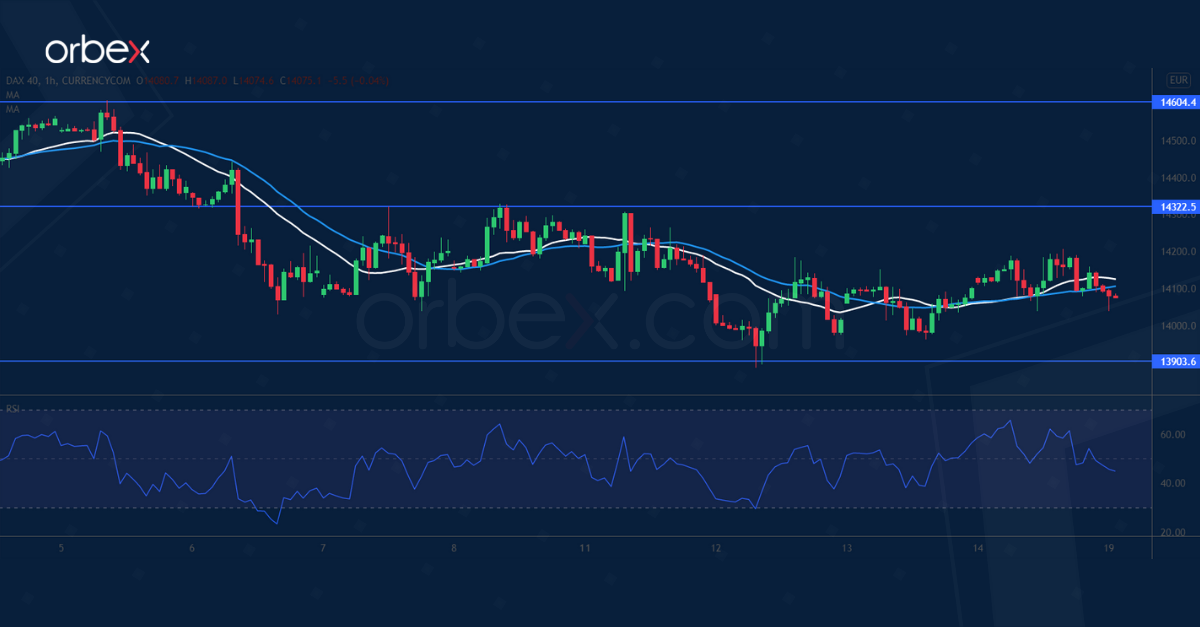
The Dax 40 retreats as risk appetite remains subdued across equity markets. The index is still under pressure after it struggled to hold above the psychological level of 14000.
The current pennant may turn out to be another distribution phase. Additionally, a break below 13900 would make the index vulnerable to a new round of sell-off.
13600 would be the next support. The bulls need to push above 14320 in order to turn the cautious mood around. Then 14600 will be the final hurdle before an extended recovery could materialize.
AUD/USD Breaks Support
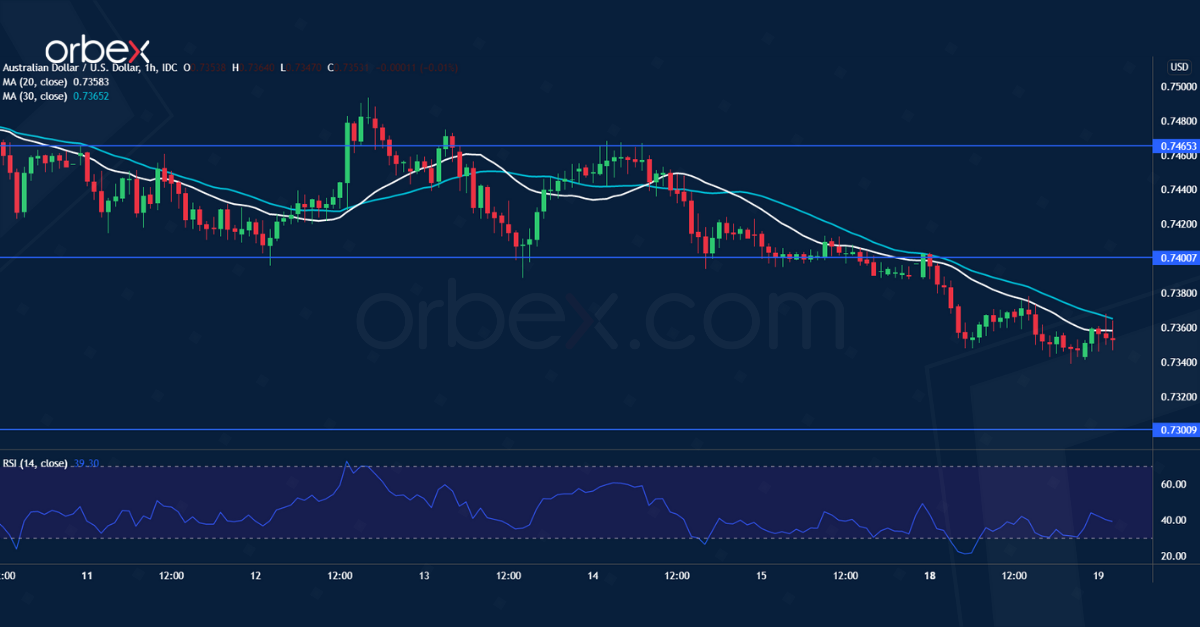
The Australian dollar remains under pressure after dovish RBA minutes. A fall below the demand zone between 0.7380 and 0.7400, which sits on the 30-day moving average, has put the bulls further on the defensive.
As the short-term prospect turns bearish, depressed offers compound the lack of bids, driving the Aussie even lower. 0.7300 would be the next target.
As the RSI recovers into the neutral area, the pair may face stiff selling pressure around the support-turned-resistance at 0.7400.
GBP/USD Tests Critical Floor
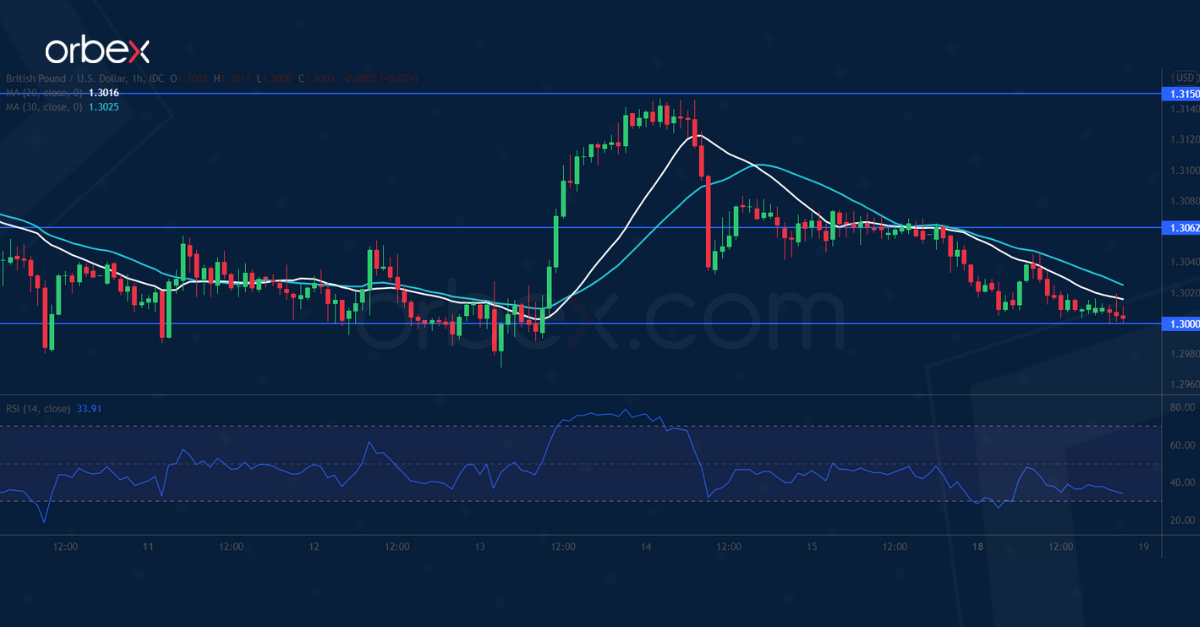
The US dollar continues upward as markets wager a 50 bp Fed hike next month. The pound’s latest rally came to a halt in the supply zone around 1.3150 which coincides with the 30-day moving average.
As the pair gives up its recent gains, the bears still retain control of the direction and seem to be ready to double down at rebounds. A drop below 1.3000 would attract momentum selling and push the pair to November 2020’s lows near 1.2860.
The RSI’s oversold situation may cause a temporary bounce towards 1.3060.
EUR/USD Daily Outlook
Daily Pivots: (S1) 1.0760; (P) 1.0791 (R1) 1.0812; More...
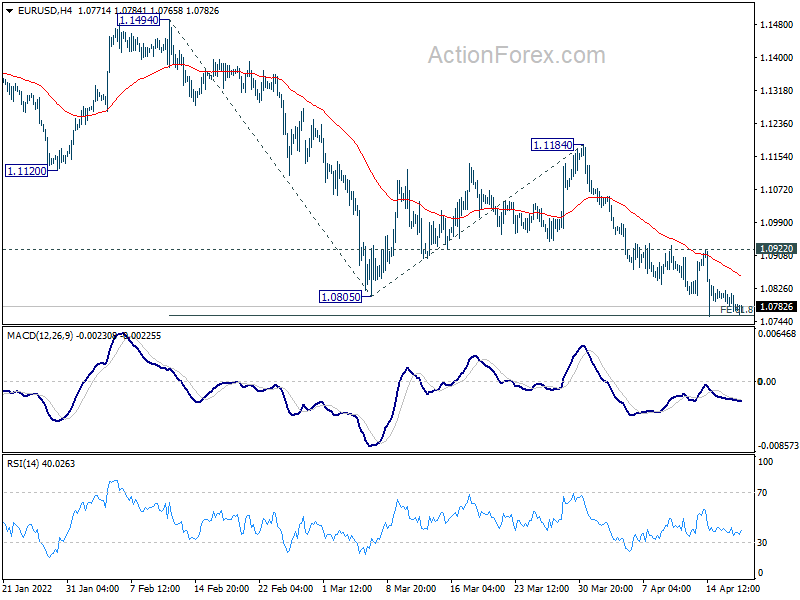
EUR/USD's decline resumed after brief recovery and intraday bias is back on the downside. Firm break of 61.8% projection of 1.1494 to 1.0805 from 1.1184 at 1.0758 will pave the way to 100% projection at 1.0495. On the upside, break of 1.0922 resistance is needed to indicate short term bottoming. Otherwise, outlook will remain bearish in case of recovery.
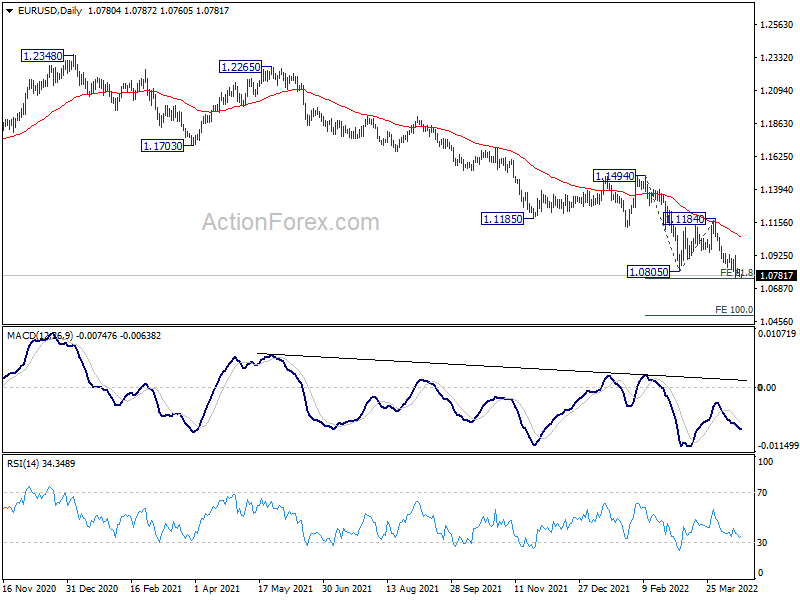
In the bigger picture, the decline from 1.2348 (2021 high) is expected to continue as long as 1.1494 resistance holds. Firm break of 1.0635 (2020 low) will raise the chance of long term down trend resumption and target a retest on 1.0339 (2017 low) next. Nevertheless, break of 1.1494 will maintain medium term neutral outlook, and extending term range trading first.
GBP/USD Daily Outlook
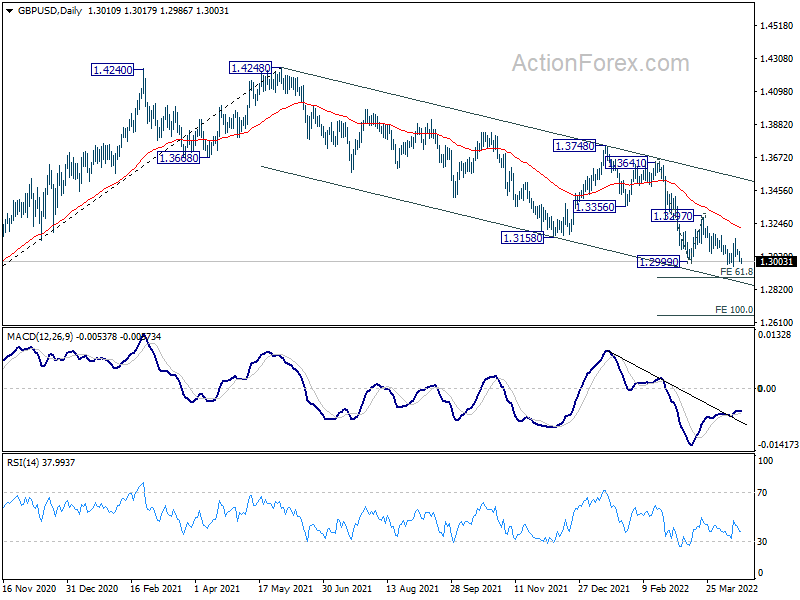
Daily Pivots: (S1) 1.2989; (P) 1.3027; (R1) 1.3049; More...
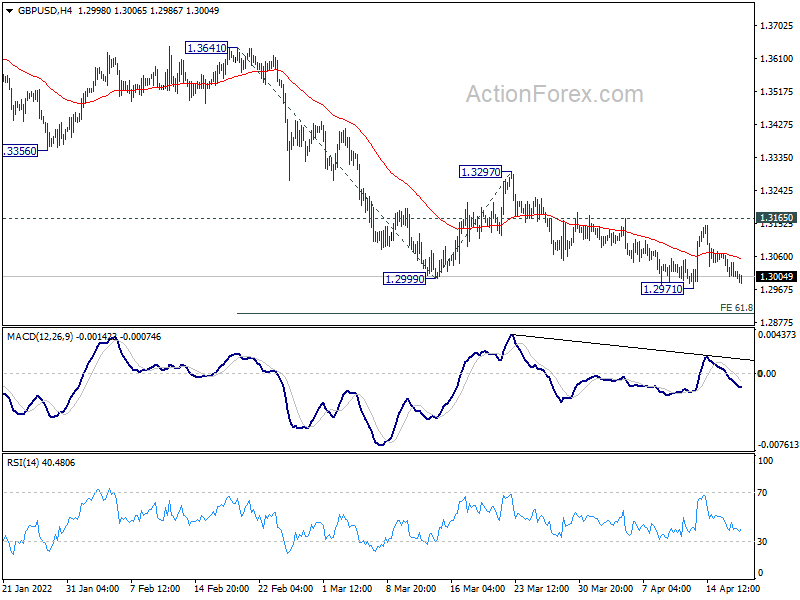
Intraday bias in GBP/USD remains neutral and further decline is expected with 1.3165 resistance intact. On the downside, break of will resume larger down trend from 1.4248. Next target is 61.8% projection of 1.3641 to 1.2999 from 1.3297 at 1.2900. On the upside, firm break of 1.3165 will confirm short term bottoming, and turn bias back to the upside for 1.3297 resistance and above.
In the bigger picture, rise from 1.1409 (2020 low) has completed at 1.4248. Decline from 1.4248 could still be a corrective move, or it could be the start of a long term down trend. In either case, deeper decline would be seen back to 61.8% retracement of 2.1161 to 1.1409 at 1.2493. In any case, break of 1.3748 resistance is needed confirm completion of the fall from 1.4248, or outlook will stay bearish.
USD/CHF Daily Outlook
Daily Pivots: (S1) 0.9425; (P) 0.9440; (R1) 0.9460; More....
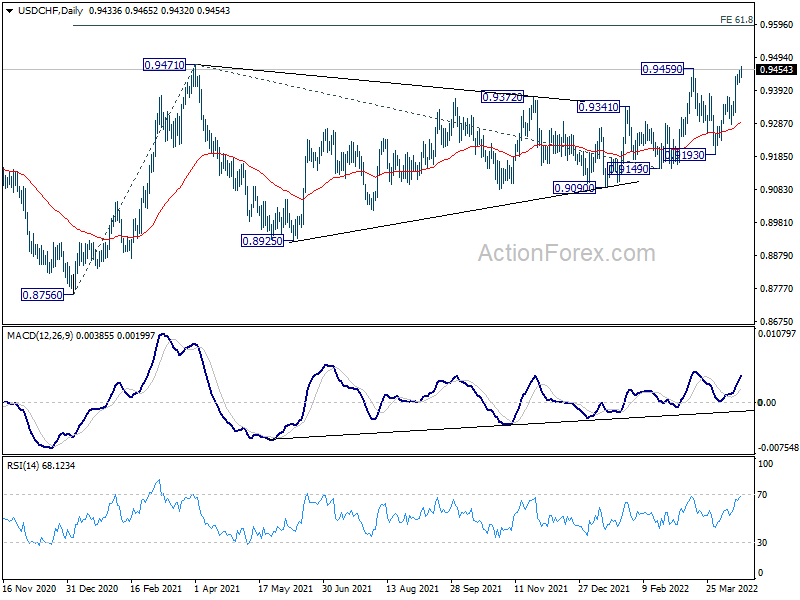
Intraday bias in USD/CHF remains on the upside and breach of 0.9459 resistance suggests resumption of whole rise form 0.9149. Further rise should be seen to 61.8% projection of 0.8756 to 0.9471 from 0.9149 at 0.9591. On the downside, below 0.9408 minor support will delay the bullish case and turn intraday bias neutral first.
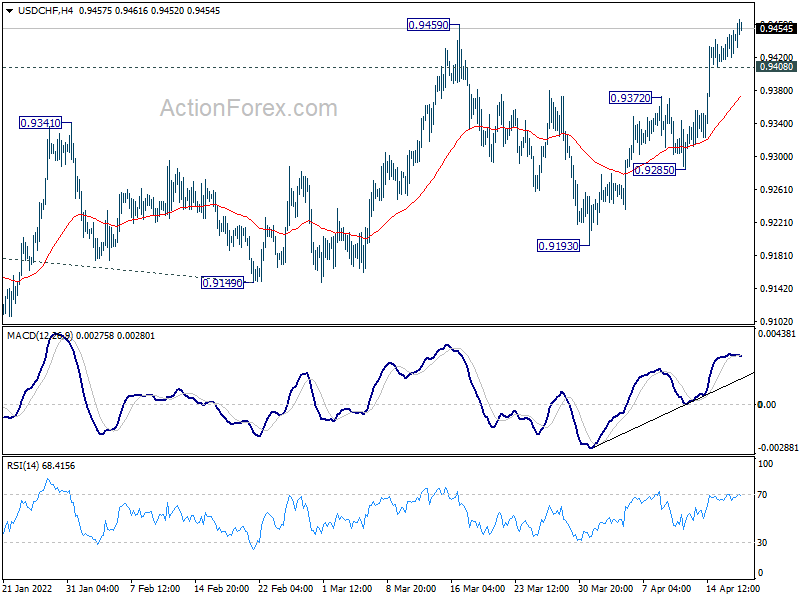
In the bigger picture, medium term outlook will be neutral at best as long as 0.9471 resistance holds. Larger down trend could still extend through 0.8756 (2021 low). However, firm break of 0.9471 will argue that whole down trend form 1.0342 (2016 high), has completed with three waves down to 0.8756. A medium term up trend should be set up to target 1.0237/0342 resistance zone.