

Sample Category Title
European PMIs: Is a Recession Coming for the Euro?
The Eurozone economy is losing power. A recession has become a real possibility and the upcoming PMI business surveys on Friday will tell investors exactly how high that risk is. The French TV debate between Macron and Le Pen on Wednesday could also be crucial for the euro, which remains under heavy pressure.
Losing steam
The invasion of Ukraine was a game-changer for the European economy. Energy and food prices went berserk in the aftermath, raising the cost of living for consumers. That ultimately means people have less money to spend on everything else, which is bad news for economic growth.
Then there’s the slowdown in China to consider. With major Chinese cities going into lockdown, demand for European exports has started to fade, dealing a second blow to the economy.
The third and final strike comes from the European Central Bank itself. Inflation continues to spiral upwards, so the central bank has its hands tied. It needs to raise interest rates to cool inflationary pressures, even if that means dampening growth further.
PMI disappointment?
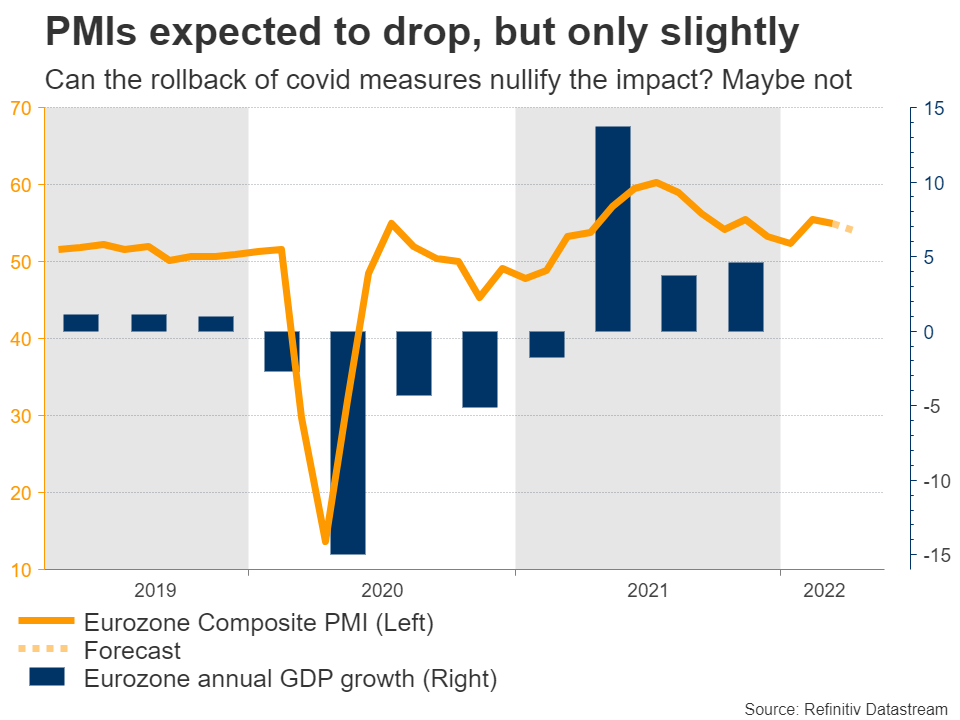
Economists expect the PMIs to take a hit in April, but only slightly. The composite index for the Eurozone, which blends the manufacturing and service sectors, is forecast to decline to 53.9 from 54.9 previously. Any number above 50 signals expansion in the economy.
The logic seems to be that the continued rollback of covid measures across Europe helped nullify the impact for businesses - that’s what happened back in March. However, this might be a miscalculation.
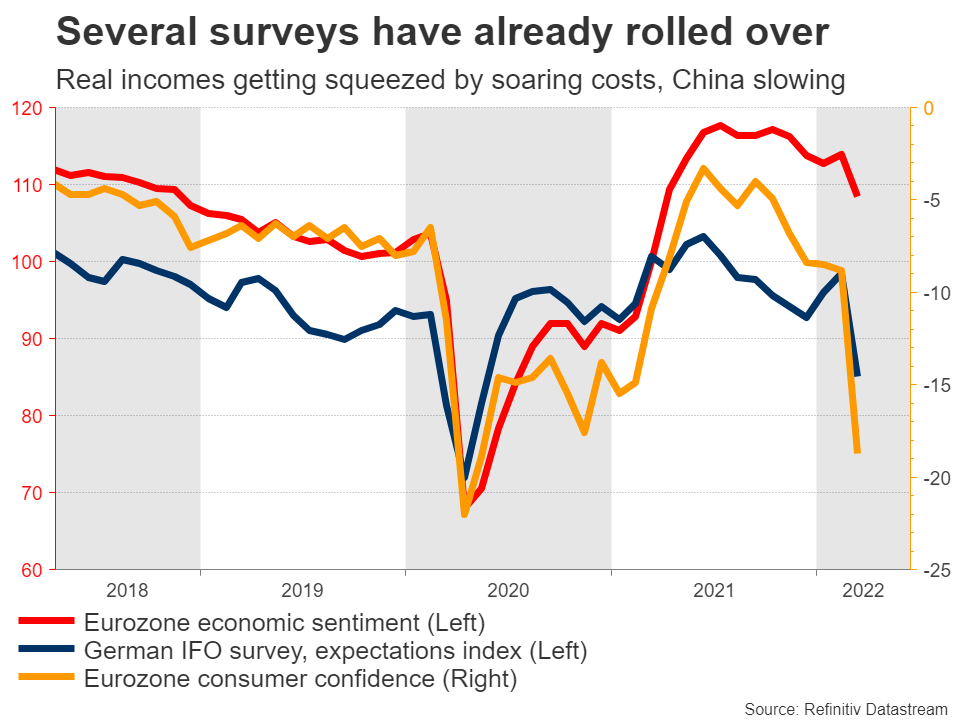
The war continues to drag on, energy prices keep pushing higher, many companies are complaining that supply chain problems have worsened, and the hit on demand will be clearer by now. Several surveys have already rolled over and the PMIs could follow suit.
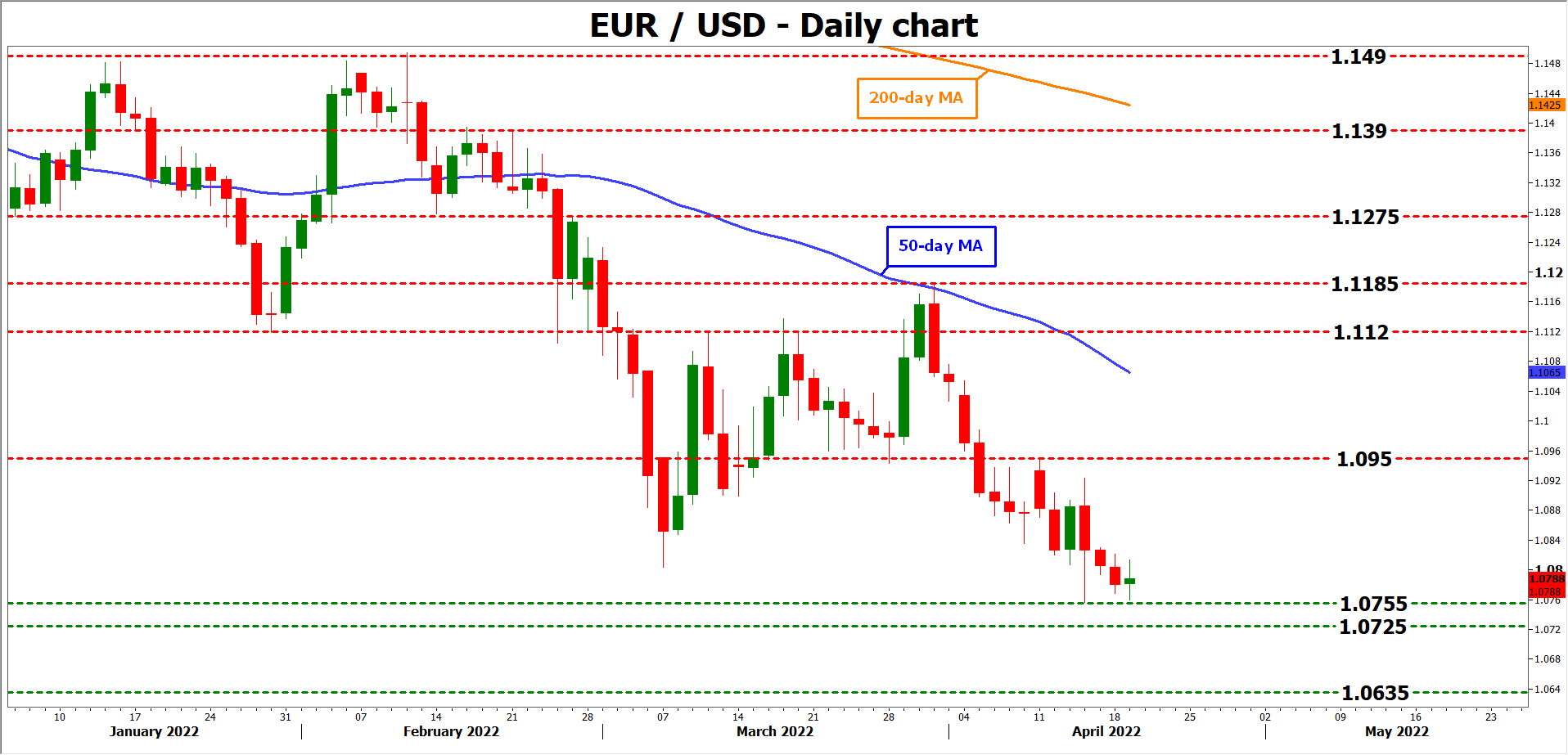
Adding everything up, there is scope for worse-than-expected numbers on Friday. In that case, euro/dollar could head lower for another test of the 1.0755 zone. A break would solidify the downtrend, turning the spotlight towards 1.0725 next.
French election another risk
The French presidential TV debate on Wednesday will also be crucial ahead of the second round of voting on Sunday. Opinion polls are running at 53% for Macron against 47% for Le Pen, so the race is tight and the debate could make a real difference.
Le Pen doesn’t want to take France out of the European Union or the euro anymore, but her new policies would essentially paralyze the bloc from the inside. She wants to slash contributions to the EU budget, tighten immigration laws, and she would almost certainly block any further economic integration steps like Eurobonds - policies that Macron championed.
Therefore, if opinion polls tighten any further after the debate, that could keep the euro under pressure heading into the weekend as investors ramp up hedging. Of course, the opposite is true as well - a strong performance by Macron like back in 2017 could spark a relief rally in the euro. In that case, euro/dollar could encounter initial resistance around the 1.0950 region.
In the bigger picture, it’s just difficult to be optimistic about the euro until the outlook for economic growth improves. Any relief rallies could remain relatively shallow until there is some good news around Ukraine that helps cool energy prices down.
Can UK PMI and Retail Sales Data Lift Pound Before Next BoE Decision?
The latest flash PMI and retail sales figures for the UK are due on Friday at 06:00 GMT and 08:30 GMT, respectively. These will be the last batch of major indicators before the Bank of England’s policy decision on May 5 so investors will be gauging them to get a sense of policymakers’ thinking on further rate hikes this year. Worries about slowing growth amid the cost of living crisis have been weighing on sterling since Russia’s invasion of Ukraine. Can the numbers lift the British currency out of the doldrums?
End of Covid rules is boosting services
Recent data out of the United Kingdom have been mixed. GDP grew a mere 0.1% month-on-month in February, but the survey data have been a lot more upbeat. The dominant services sector is still benefiting from the lifting of all virus curbs while the labour market continues to tighten. These effects were probably enough to sustain economic momentum in the early parts of April.
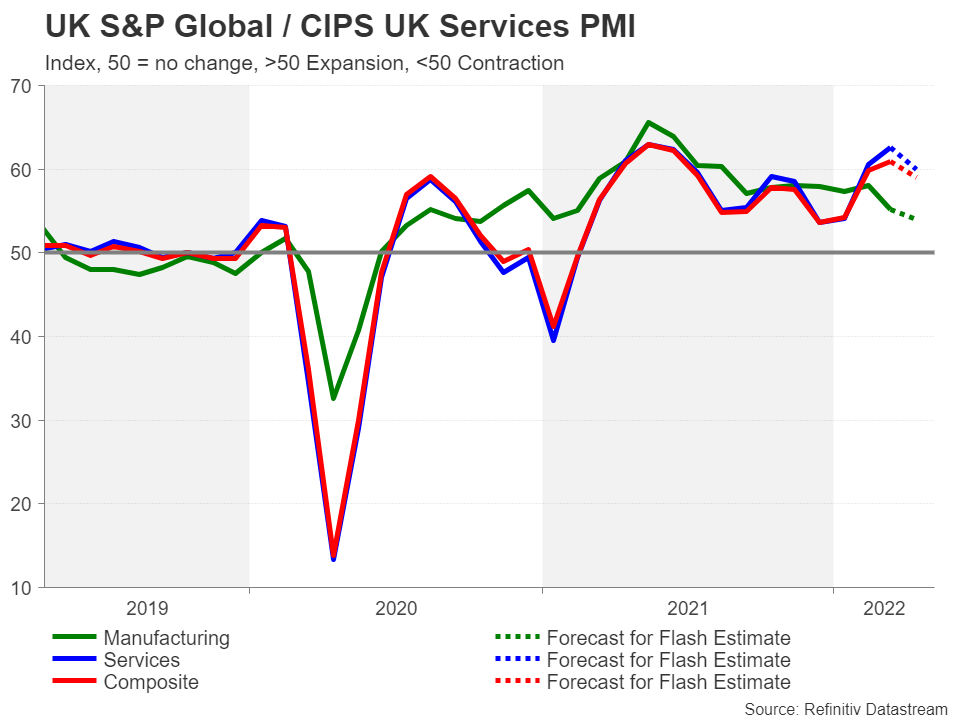
The services PMI is expected to moderate from 62.6 in March to 60.3 in April, remaining comfortably above the 50-neutral level that separates expansion from contraction.
Manufacturers are feeling more gloomy
However, the PMI indices globally are being inflated from record increases in their price components, overstating the true strength in business activity. Moreover, optimism is weakening, not just from the worsening cost pressures, but also from the uncertain outlook due to the heightened geopolitical tensions.
These have already begun to weigh on manufacturing firms, much more so than on services industries. UK manufacturers reported waning demand for consumer goods from both domestic and overseas clients in March and this trend likely accelerated in April. The manufacturing PMI is forecast to decline from 55.2 to 54.0 this month.
The big consumer squeeze is here
Higher food and fuel prices have started to eat into households’ disposable incomes, so consumers are naturally spending less on other goods as inflation hits 30-years highs. The full reopening of the British economy at the end of February has been a further drag on retailers as people have preferred to enjoy going to theatres and restaurants with no restrictions rather than to hit the high street.
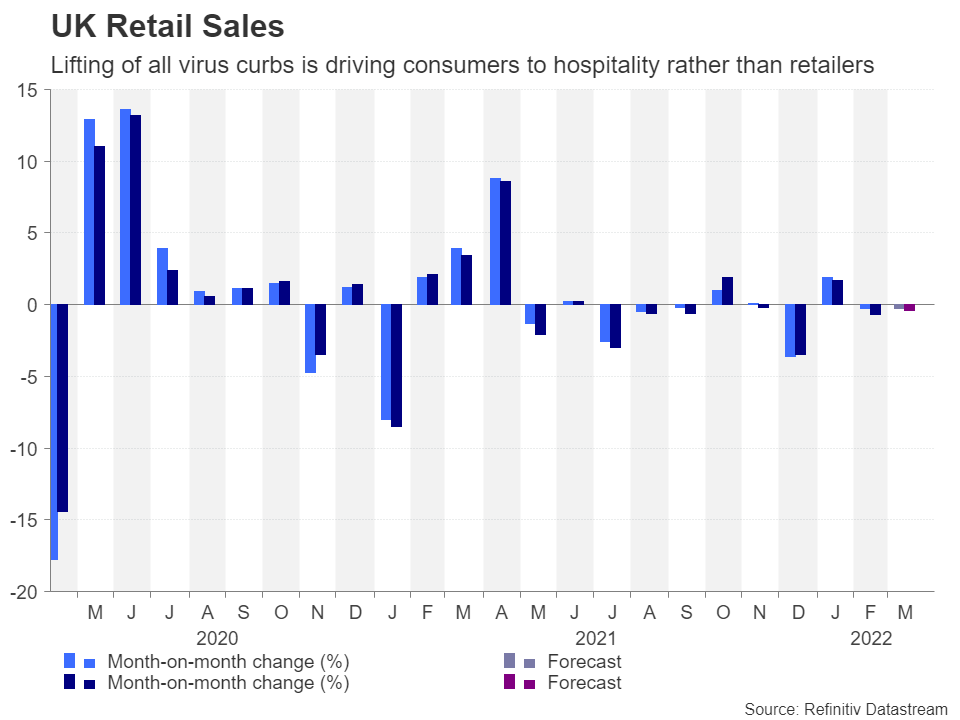
Retail sales are expected to have fallen by 0.3% m/m in March. When excluding fuel sales, the drop is projected to have been slightly bigger at 0.4%. But what is more worrying is that the squeeze on consumers is only just starting. Many UK households will see their electricity and gas bills jump in April after the country’s regulator raised the cap energy firms can charge their customers. Adding to the pain, the national insurance rate went up for many taxpayers at the beginning of April, dealing a double blow to consumers.
BoE has been less hawkish lately
With the war in Ukraine also not looking like it will end anytime soon either, the growth outlook has dimmed significantly in the last few months, prompting the Bank of England to take a more precautionary stance against rapid rate increases. Despite that, expectations for how many times the BoE will have to raise rates by year-end remain elevated, with investors anticipating six additional 25-basis-point hikes on top of the 50 bps already delivered.
But those hawkish bets haven’t done the pound any favours, at least not against the US dollar. Concerns that the UK is headed for a stagflationary environment has been a major dampener on the pound this year. Cable brushed a 17-month low of $1.2970 earlier this month and is struggling to regain a foothold above the $1.30 handle.
Cable is testing $1.30 level again
Should the upcoming releases disappoint, intensifying fears about a slowdown or even a recession, sterling could slip as low as $1.28, which is just below the 161.8% Fibonacci extension of the December-January uptrend.
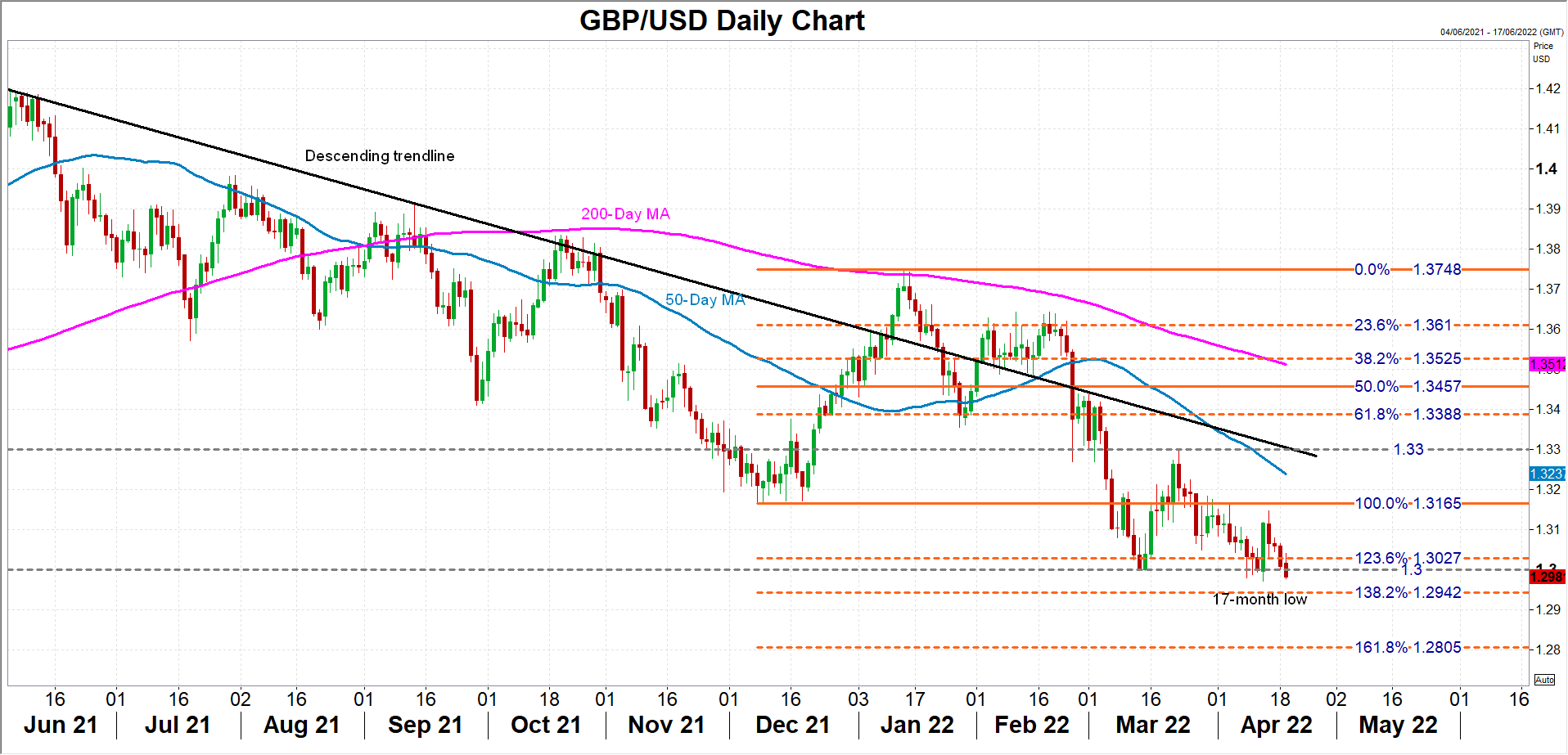
On the other hand, positive surprises in the data could help the pound regain some bullish posture and bring into scope the 50-day moving average at $1.3238.
Nevertheless, the odds of a big upside reversal are low at the moment for cable. A slightly more hawkish-than-expected tone by the BoE at the May meeting could potentially go some way in changing its fortunes around. But as things stand, the pound’s best hope is a de-escalation of the Russia-Ukraine conflict.
Sunset Market Commentary
Markets
European markets after the long weekend resumed trading in a familiar way. Persistent uncertainty on growth in Europe but also in the several Asian countries, combined with inevitable policy tightening to address inflation is raising questions on the valuation of (some) risky assets. Headlines on Russia stepping up their attacks toward the Donbas region didn’t help to provide comfort. European equities are losing up to 0.85% (EuroStoxx50). At the same time, interest rate markets continue to the push the ECB to prioritize inflation whatever the outlook for growth. Thursday’s rather vague ECB communication on when and how fast they will address runaway inflation and unravelling inflation expectations only reinforced markets to do at least their part of the job. The German yield curve again bear steepened with yields rising between 3.5 bps (2-y) and 10 bps (10-y). EMU 10-y inflation swaps are rising further north of the 3.0 % mark (3.05%).The German 10-y is reaching the highest level since July 2015, nearing the key 1.0%/1.06% (peak 2015) area. The 10-y European swap (1.66%) already surpassed comparable references earlier. In this context, it is bit remarkable to seen peripheral spreads narrowing 2 bps for the likes of Italy and Spain and up to 5 bps for Greece. The curve move in the US was different from Europe, but nevertheless quite interesting too. The US curve bear flattened with the 2-y rising an additional 9 bps. The 30-y is printing 4.5 bps higher. Investors apparently learned not to row against comments from hawkish members (Bullard keeping the option open of a 75 bps hike if necessary). US housing starts (1793 k) rising at the fastest pace since 2006 for sure wasn’t an important driver for the rise in US yields. However, it adds to other evidence that several parts of the US economy show resilience both to the consequences of the crisis in Ukraine as well as to the prospect of higher interest rates. Oil is easing slightly intra-day, but at $110 p/b keeps most of its recent rebound. US equities gain 0.2%/0.5%.
Moves in FX markets were more modest but the dollar remains in the driver’s seat. The DXY trade-weighted index tested the next big figure at 101. The combination of a strong dollar and the yen trading in free-fall modus propelled the USD/JPY cross rate to 128.75 area, the highest level since April 2002! Verbal warnings from the Japanese Ministry of finance clearly don’t counterbalance monetary policy divergence. EUR/USD this morning touched a new correction low near 1.0761, but apparently found some support from a further rise in EMU yields. The pair even tries to regain the 1.08 barrier. Sterling also underperforms. Cable is falling below the 1.30 handle. EUR/GBP rebound back north of 0.83(10). The World Bank sharply reducing UK 2022/2023 growth maybe played a role.
News Headlines
The IMF downgraded its growth forecasts for 2022 and 2023 from 4.4% and 3.8% in January to 3.6% and 3.6%. Economic damage from the war in Ukraine contributes to the significant slowdown in global growth in 2022 (from 6.1% in 2021) and adds to inflation. Beyond 2023, global growth is forecast to decline to about 3.3 percent over the medium term. Unusually high uncertainty surrounds the outlook with downside risks dominating: a worsening of the Russian war, an escalation of sanctions on Russia, a sharper-than-anticipated slowdown in China, and a renewed flare-up of the pandemic in case of new Covid-variants. War-induced commodity price increases and broadening price pressures have led to a 2022 inflation projections of 5.7% in advanced economies and 8.7% in emerging market and developing economies, from 3.9% and 5.9% in January. Inflation in both zones is expected to slow to 2.5% and 6.5% respectively in 2023. The IMF cited a rising risk that inflation expectations become unanchored, prompting more aggressive central bank tightening. Worsening supply-demand dynamics could end with a similar outcome.
Bulgarian inflation accelerated by 2.2% M/M in March to 12.4% Y/Y (from 10% in February). It’s the fastest inflation pace since the summer of 2008. Largest M/M price increases were reported in transport (7.9% M/M), food and non-alcoholic beverages (3.3% M/M) and restaurants and hotels (+2.8% M/M).
Japan Can’t Stop Yen Collapse
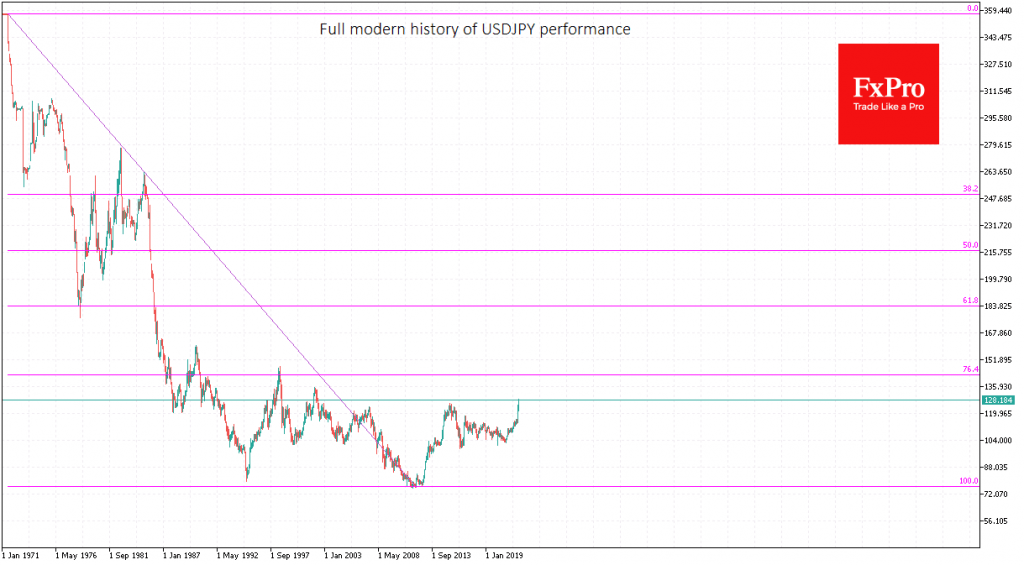
The pressure on the Japanese yen persists in the markets. The USDJPY has been hitting 20-year highs almost daily since last week, rising 11.8% to 128.40 since early March.
Since the beginning of the year, the yield spread between the 10-year US and Japanese bonds has doubled to 2.7%, on the back of rising US performance, which has sharply increased the attractiveness of US long-term bonds. The currency in such an environment works as a shock absorber, returning competitiveness to the economy.
However, in the USDJPY equilibrium exchange rate equation, you also must add the changed reality with the surge in prices of commodities and energy imports in Japan. Capital is leaving the country, taking refuge in the USA or commodity-exporting countries that can now enforce the tighter monetary policy.
A hand-tied Bank of Japan is unlikely to be able to offer anything serious to reverse the yen. It’s also not in the interests of the country’s finance ministry, which could use a weaker yen to deflate its enormous government debt.
This opens the yen up for further declines, potentially into the region of 140 per dollar, where the exchange rate was last seen during the Asian debt crisis, and even earlier, in the early 1990s, when the world last experienced a similarly high rate of consumer inflation.
USD/JPY Mid-Day Outlook
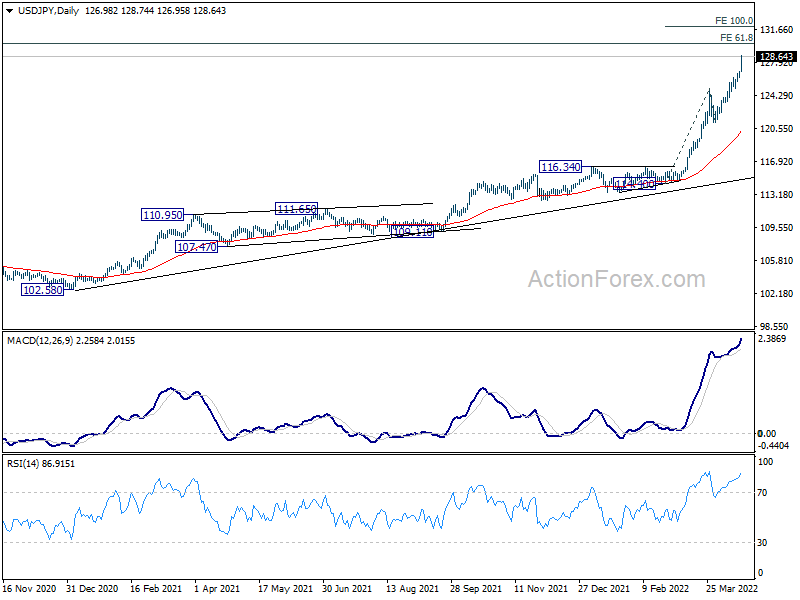
Daily Pivots: (S1) 126.50; (P) 126.75; (R1) 127.25; More...
Intraday bias in USD/JPY remains on the upside at his point. Current up trend should target 130.04 long term projection level next. On the downside, below 126.78 minor support will turn intraday bias neutral and bring consolidations. But downside of retreat should be contained by 125.09 resistance turned support to bring another rally.
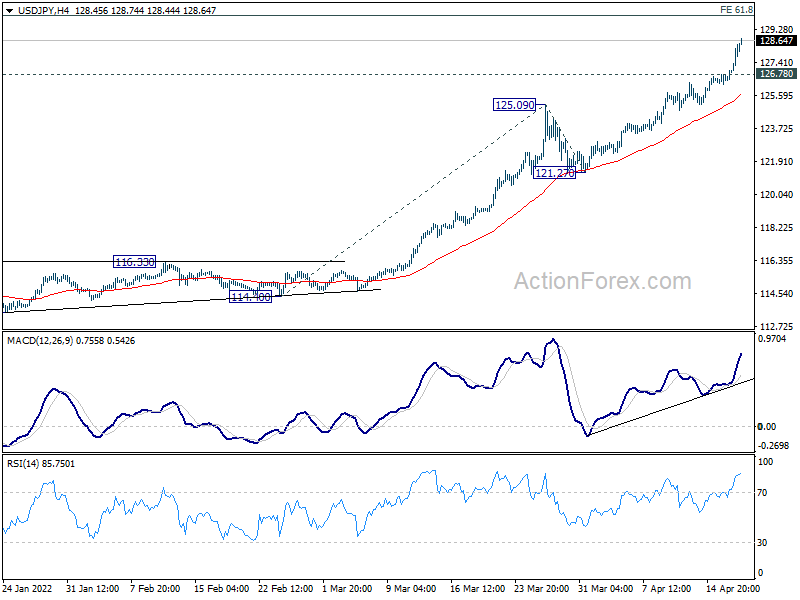
In the bigger picture, the break of 125.85 resistance (2015 high) suggests that whole up trend from 75.56 (2011 low) is resuming. Further rise should be seen to 61.8% projection of 75.56 (2011 low) to 125.85 (2015 high) from 98.97 at 130.04. Sustained break there wave the way to 147.68 (1998 high). For now, this will remain the favored case as long as 121.27 support holds.
USD/CHF Mid-Day Outlook
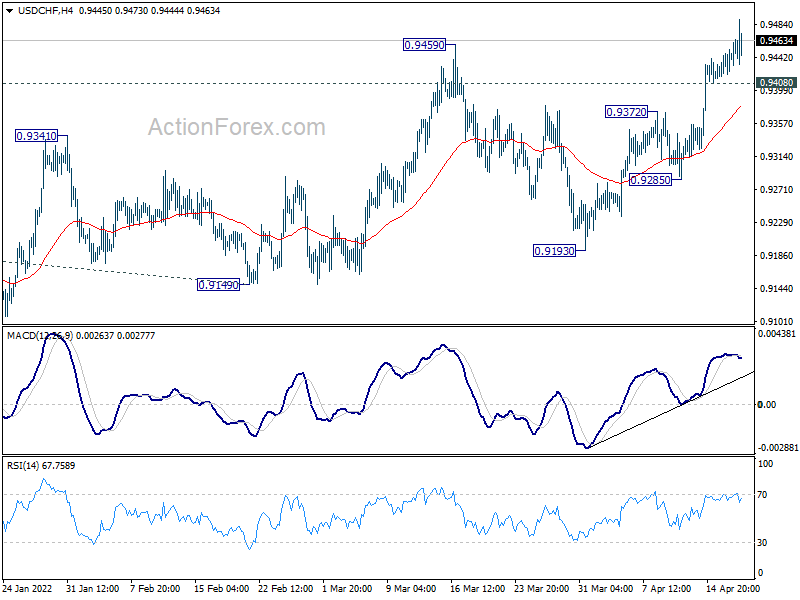
Daily Pivots: (S1) 0.9425; (P) 0.9440; (R1) 0.9460; More....
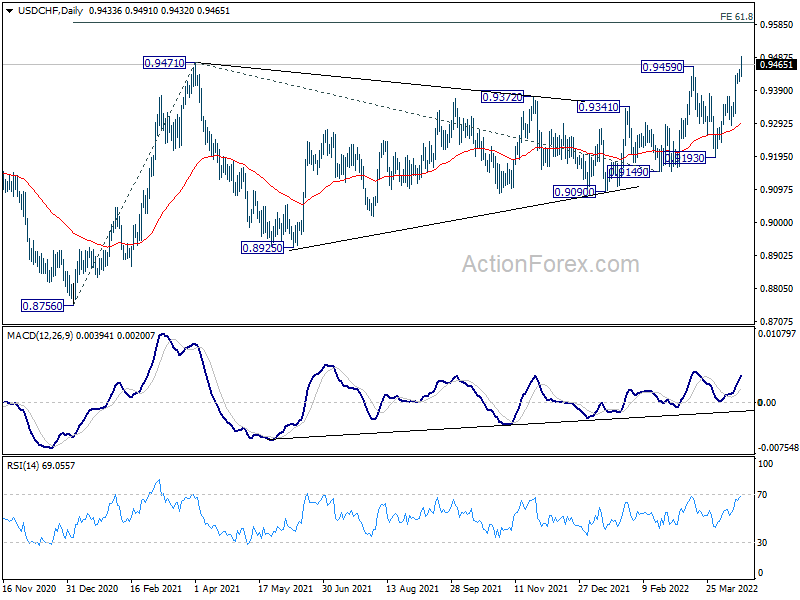
Intraday bias in USD/CHF stays on the upside for the moment. Rise from 0.9149 is resuming and should target 61.8% projection of 0.8756 to 0.9471 from 0.9149 at 0.9591. On the downside, below 0.9408 minor support will delay the bullish case and turn intraday bias neutral first.
In the bigger picture, medium term outlook will be neutral at best as long as 0.9471 resistance holds. Larger down trend could still extend through 0.8756 (2021 low). However, firm break of 0.9471 will argue that whole down trend form 1.0342 (2016 high), has completed with three waves down to 0.8756. A medium term up trend should be set up to target 1.0237/0342 resistance zone.
GBP/USD Mid-Day Outlook
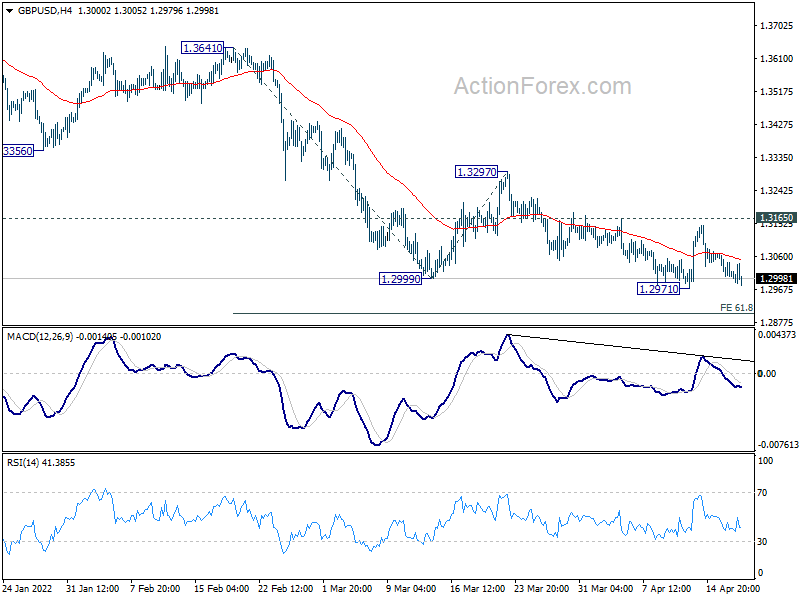
Daily Pivots: (S1) 1.2989; (P) 1.3027; (R1) 1.3049; More...
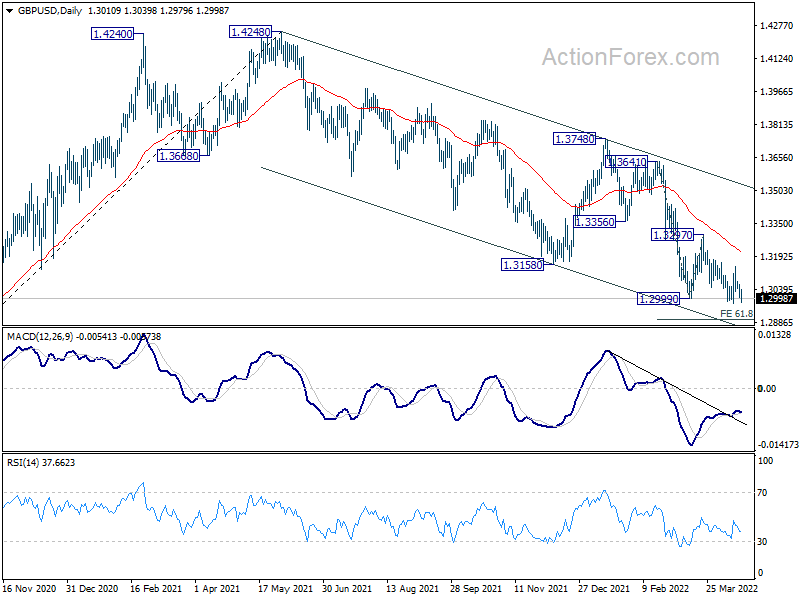
GBP/USD is still bounded in consolidation from 1.2971 and intraday bias remains neutral first. Further decline is expected with 1.3165 resistance intact. On the downside, break of will resume larger down trend from 1.4248. Next target is 61.8% projection of 1.3641 to 1.2999 from 1.3297 at 1.2900. On the upside, firm break of 1.3165 will confirm short term bottoming, and turn bias back to the upside for 1.3297 resistance and above.
In the bigger picture, rise from 1.1409 (2020 low) has completed at 1.4248. Decline from 1.4248 could still be a corrective move, or it could be the start of a long term down trend. In either case, deeper decline would be seen back to 61.8% retracement of 2.1161 to 1.1409 at 1.2493. In any case, break of 1.3748 resistance is needed confirm completion of the fall from 1.4248, or outlook will stay bearish.
EUR/USD Mid-Day Outlook
Daily Pivots: (S1) 1.0760; (P) 1.0791 (R1) 1.0812; More...
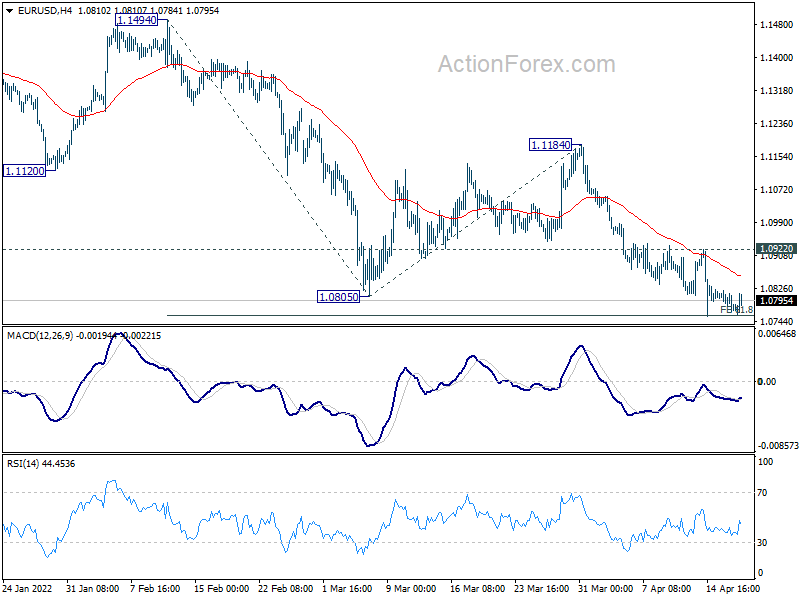
Intraday bias in EUR/USD is turned neutral as it recovers after hitting 61.8% projection of 1.1494 to 1.0805 from 1.1184. Further fall is expected as long as 1.0922 resistance holds. Firm break of 1.0758 will way to 100% projection at 1.0495. However, break of 1.0922 will turn bias back to the upside for stronger rebound towards 1.1184 resistance instead.
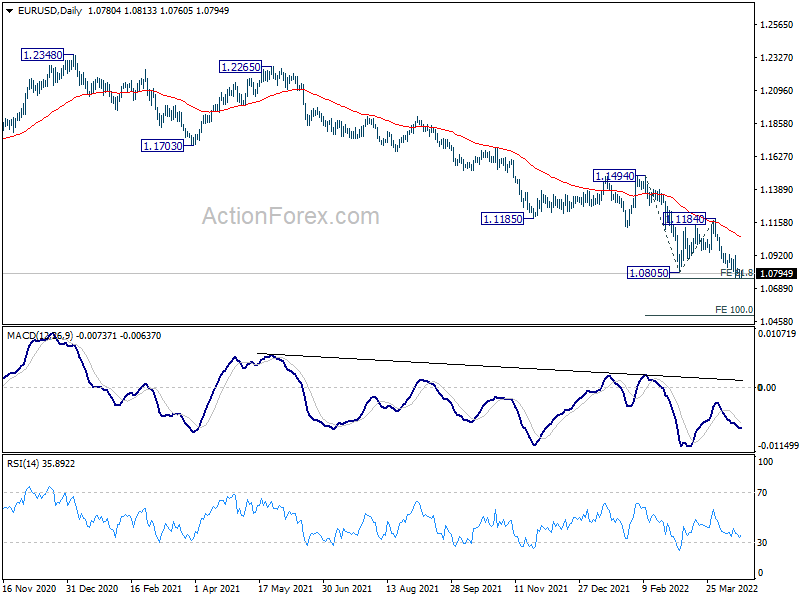
In the bigger picture, the decline from 1.2348 (2021 high) is expected to continue as long as 1.1494 resistance holds. Firm break of 1.0635 (2020 low) will raise the chance of long term down trend resumption and target a retest on 1.0339 (2017 low) next. Nevertheless, break of 1.1494 will maintain medium term neutral outlook, and extending term range trading first.
Yields Rise, Yen Falls, Euro Trying a Rebound
Yen's weakness remains the main theme today as selloff in major global treasuries continue. US 10-year yield breaches 2.9 handle while Germany 10-year yield breaches 0.94. UK 10-year Gilt yield is also heading towards 2% handle. Swiss Franc is following as second weakest together with Canadian Dollar. On the other hand, Aussie and leading the way up, followed by Euro, which is rebounding against Sterling and Franc. Dollar is mixed in between, awaiting the next guidance.
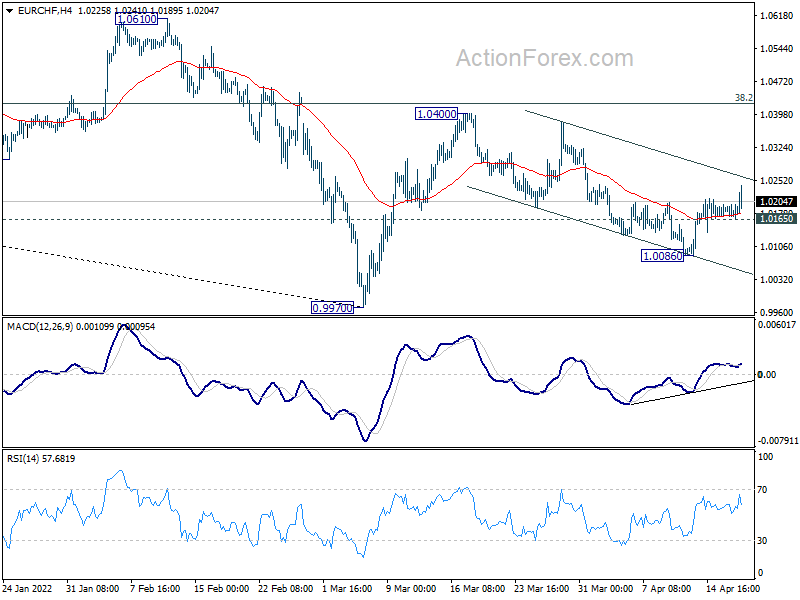
Technically, EUR/CHF's rebound from 1.0086 extended higher today but retreated just ahead of near term falling channel resistance. For now further rise is in favor as long as 1.0165 minor support intact. Break of the channel resistance will set up further rally for 1.0400 resistance. However, break of 1.0165 will indicate rejection by the channel resistance and bring retest of 1.0086. EUR/CHF's next move could be a hint on the sustainability of Euro's rebound.
In Europe, at the time of writing, FTSE is down -0.42%. DAX is down -0.66%. CAC is down -1.16%. Germany 10-year yield is up 0.105 at 0.946. Earlier in Asia, Nikkei rose 0.69%. Hong Kong HSI dropped -2.28%. China Shanghai SSE dropped -0.05%. Singapore Strait Times rose 0.12%. Japan 10-year JGB yield rose 0.0033 to 0.245.
AUD/JPY resumes up trend, NZD/JPY to follow?
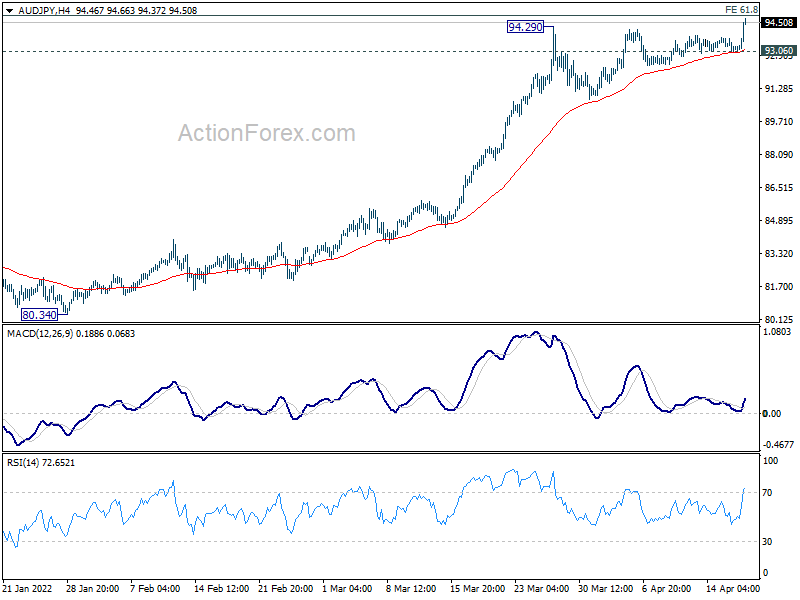
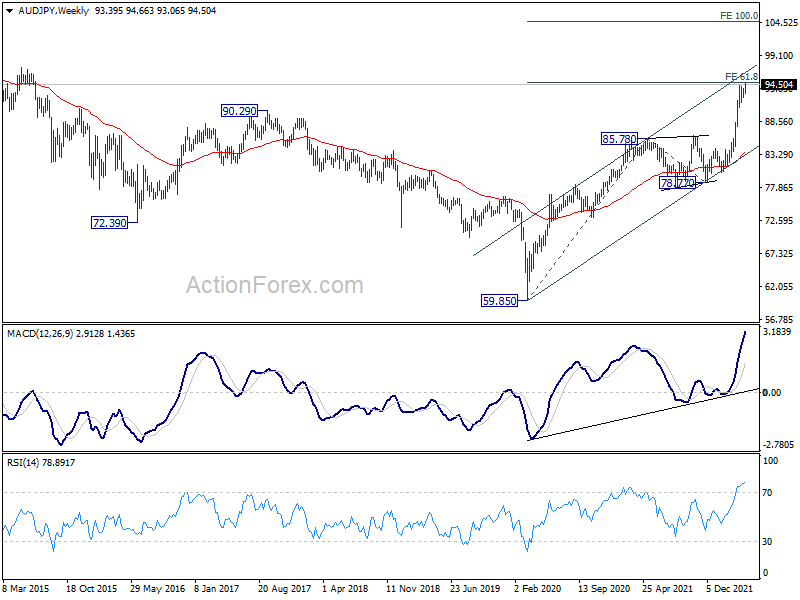
AUD/JPY's up trend finally resumes today by breaking 94.29 near term resistance. Immediate focus is now on 61.8% projection of 59.85 (2020 low) to 85.78 from 78.77 at 94.79. Sustained break there could prompt upside acceleration, for next medium term target at 100% projection at 104.70, which is close to 105.42 (2013 high). However, break of 93.06 support will suggest rejection by 94.79 and bring deeper correction, back towards 55 day EMA (now at 88.55).
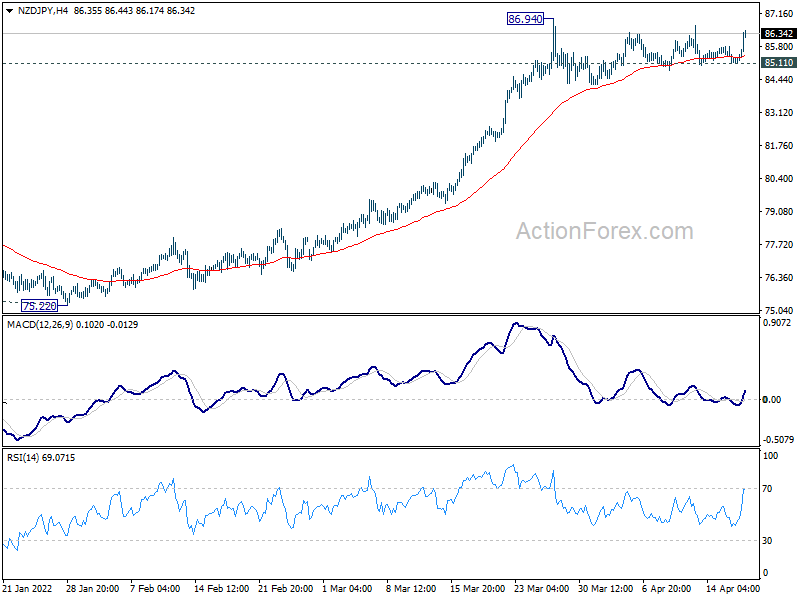
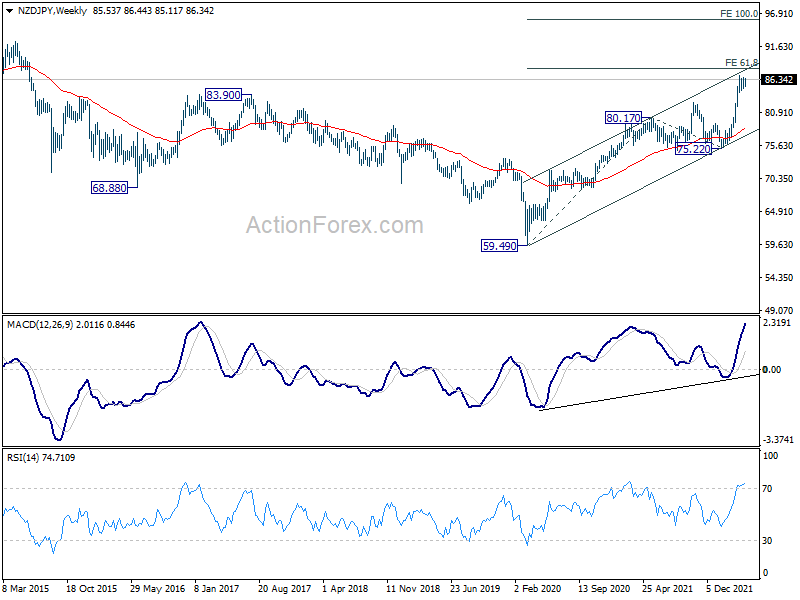
NZD/JPY is lagging behind and it's still staying below 86.94 resistance. The next move will probably need from help from AUD/JPY. Break of 86.94 in NZD/JPY (following break of 94.79 in AUD/JPY) will resume larger up trend through 61.8% projection of 59.49 to 80.17 from 75.22 at 88.00. However, break of 85.11 (following AUD/JPY's break of 93.06) will bring deeper pull back towards 55 day EMA (now at 82.09).
RBA minutes; Developments have brought forward liking timing of rate hike
In the minutes of April 5 meeting, RBA said, inflation in Australia had "picked up" and a "further increase was expected" with measures of underlying inflation in the March quarter expected to be above 3%. Wages growth had "picked up" too but "had been below rates likely to be consistent with inflation being sustainably at the target." These developments have "brought forward the likely timing of the first increase in interest rates. "
"Over coming months, important additional evidence will be available on both inflation and the evolution of labour costs. Consistent with its announced framework, the Board agreed that it would be appropriate to assess this evidence and other incoming information as it sets policy to support full employment in Australia and inflation outcomes consistent with the target."
RBNZ Orr: It's more about hiking sooner rather than more
RBNZ Governor Adrian Orr said in an IMF event, "we've been acting reasonably aggressively to tighten monetary conditions. We've provided strong forward guidance that we expect to be doing more rate rises over coming quarters."
But he also noted, "that was more about doing it sooner rather than believing we have to do more," he said. "It's just getting on with it so people can understand what we are about." Back in February, RBNZ projected that OCR would peak at 3.25% at the end of 2023.
Raising rates too high and "you really run the risk of having a sharper than needed slowdown in economic activity," he said. "On the other hand, if you go too slow its inflation expectations that will get away from us."
"At the moment, the balance of risks as far as the monetary policy committee is concerned is very much weighted to constraining those inflation expectations in the medium term," he said. "We know the long-term cost of letting inflation expectations get away."
EUR/USD Mid-Day Outlook
Daily Pivots: (S1) 1.0760; (P) 1.0791 (R1) 1.0812; More...
Intraday bias in EUR/USD is turned neutral as it recovers after hitting 61.8% projection of 1.1494 to 1.0805 from 1.1184. Further fall is expected as long as 1.0922 resistance holds. Firm break of 1.0758 will way to 100% projection at 1.0495. However, break of 1.0922 will turn bias back to the upside for stronger rebound towards 1.1184 resistance instead.
In the bigger picture, the decline from 1.2348 (2021 high) is expected to continue as long as 1.1494 resistance holds. Firm break of 1.0635 (2020 low) will raise the chance of long term down trend resumption and target a retest on 1.0339 (2017 low) next. Nevertheless, break of 1.1494 will maintain medium term neutral outlook, and extending term range trading first.
Economic Indicators Update
| GMT | Ccy | Events | Actual | Forecast | Previous | Revised |
|---|---|---|---|---|---|---|
| 22:30 | NZD | Business NZ PSI Mar | 51.6 | 48.6 | 48.9 | |
| 01:30 | AUD | RBA Meeting Minutes | ||||
| 04:30 | JPY | Industrial Production M/M Feb | 2.00% | 0.10% | 0.10% | |
| 12:15 | CAD | Housing Starts Y/Y Mar | 246K | 249K | 247K | 250K |
| 12:30 | USD | Building Permits Mar | 1.87M | 1.83M | 1.86M | |
| 12:30 | USD | Housing Starts Mar | 1.79M | 1.74M | 1.77M | |
| 12:30 | CAD | Foreign Securities Purchases (CAD) Feb | 7.44B | 15.23B | 13.49B |
Yen Slides to 128 Against Dollar
The Japanese yen’s downswing has continued full force this week, as the currency can’t find its footing. USD/JPY is trading at 128.40 in Europe, up 1.1% on the day.
Yen closing in on 130
The yen continues its nasty slide, with the currency having fallen for twelve successive sessions against the dollar. USD/JPY has jumped 5.39% in April and shows no signs of slowing down. The lofty 130 level, which has held as resistance since 1998, is likely to fall in the next few months or even earlier.
The driver behind the yen’s downswing is the US/Japan rate differential. US Treasury rates continue to rise, with the 10-year yield currently at 2.90%. Meanwhile, JGB yields aren’t going anywhere, as the BoJ recently demonstrated when it intervened to cap 10-year yields at 0.25%, which has become a line in the sand for the BoJ’s yield curve control.
The BoJ has sufficed, until now, with jawboning about the exchange rate. This was again the strategy today when Governor Kuroda said that the yen’s moves were “somewhat rapid”, while he repeated that a weak yen was beneficial for the Japanese economy. The BoJ is more concerned about boosting inflation and will press ahead with loose monetary policy. That means that the central bank is unlikely to intervene to prop up the ailing yen. That could change, however, if USD/JPY punches above the 130 level.
It’s the opposite story with the Federal Reserve, which is expected to increase rates by 0.50% at its meeting in early May. Fed policymakers have been telegraphing a hawkish stance in the light of spiralling inflation. On Monday, Fed member Bullard, a hawk, said that the Fed rate might need to rise to a “neutral” rate of 3.50% and suggested that a 0.75% hike was a possibility. True, this statement doesn’t reflect Fed policy, but the very suggestion of a 0.75% hike illustrates how sharp a pivot the Fed has taken in recent weeks.
USD/JPY Technical
- USD/JPY continues to climb and break above resistance lines. The pair has broken above resistance at 1.2837. Above, there is resistance at 130.05
- 126.32 is a monthly support line. Next, there is support at 1.2572
