Sample Category Title
NZD Down Despite RBNZ Hike, CAD Awaits BoC
The forex markets trade in tight range in Asian session today. New Zealand Dollar got little support from the RBNZ 50bps rate hike. It's actually trading as the weakest one for the day at the time of writing. As for the week, Swiss Franc is currently the strongest, with help from buying against Euro. Dollar is following as next strongest and then Aussie. On the other hand, Yen is the worst performing as it's recovery remains very weak. Canadian Dollar is also soft, awaiting BoC rate decision.
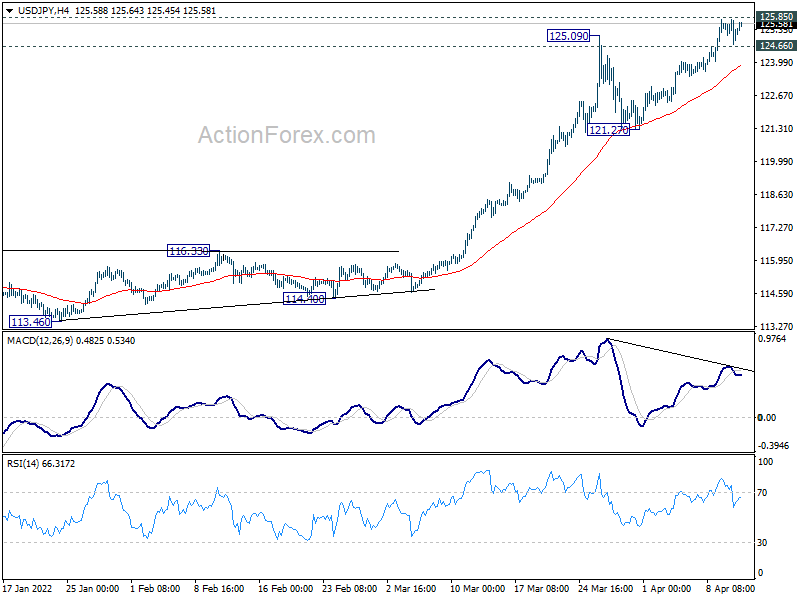
Technically, USD/JPY's retreat is rather shallow so far. Another test on 125.85 long term resistance could be seen today. Clearing of this resistance could prompt accelerated decline in Yen. In that case, EUR/JPY and GBP/JPY could be pushed through 137.50 and 164.61 resistance respectively, even though European majors are soft.
In Asia, at the time of writing, Nikkei is up 1.89%. Hong Kong HSI is up 0.16% China Shanghai SSE is down -0.44%. Singapore Strait Times is up 0.64%. Japan 10-year JGB yield is down -0.0011 at 0.243. Overnight, DOW dropped -0.26%. S&P 500 dropped -0.34%. NASDAQ dropped -0.30%. 10-year yield dropped 0.055 to 2.725.
RBNZ hikes by 50bps to 1.50%, path of least regret
RBNZ raises Official Cash Rate by 50bps to 1.50%, larger than expectation of a 25bps hike. That's also the biggest rate increase in 22 years.
It said in the statement that "moving the OCR to a more neutral stance sooner will reduce the risks of rising inflation expectations. A larger move now also provides more policy flexibility ahead in light of the highly uncertain global economic environment."
Also, "the Committee agreed that their policy 'path of least regret' is to increase the OCR by more now, rather than later, to head off rising inflation expectations and minimise any unnecessary volatility in output, interest rates, and the exchange rate in the future."
NZD/USD gets not much support from RBNZ hike
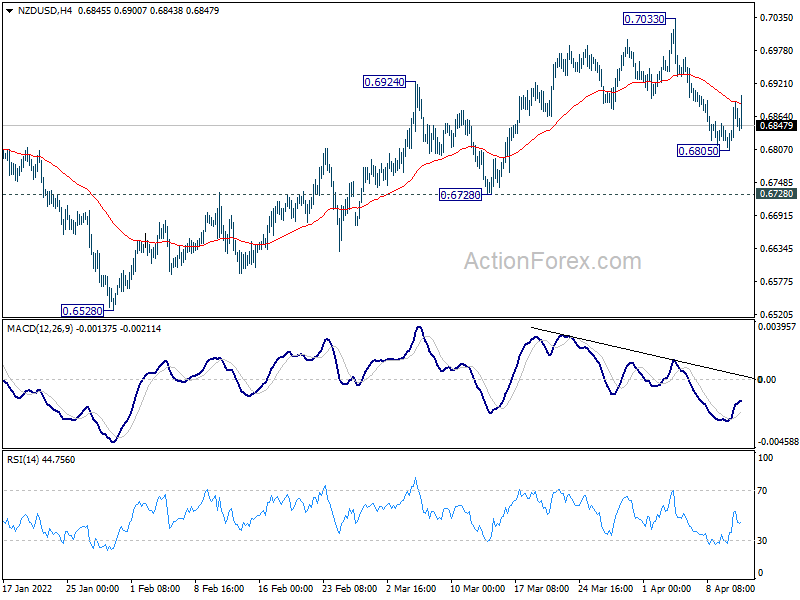
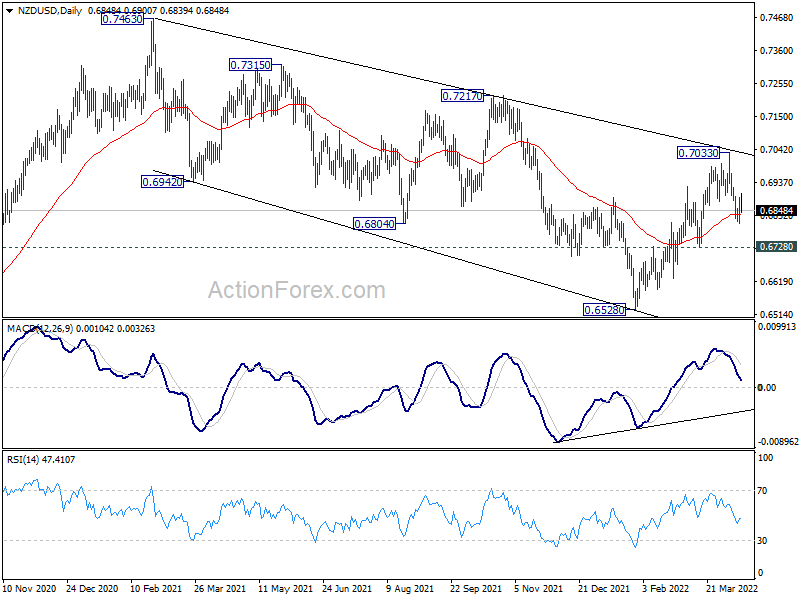
NZD/USD just receive very brief lift from larger than expected RBNZ rate hike. It struggles to break through 4 hour 55 EMA firmly and risk is mildly on the downside. Break of 0.6805 temporary low will resume the fall from 0.7033 to 0.6728 support. Sustained break there will argue that whole rebound from 0.6728 has completed at 0.7033, and bring retest of 0.6528 low.
More importantly, break of 0.6728 support should also confirm rejection by trend line resistance, which in turn suggests that the choppy decline from 0.7463 is still in progress for another fall through 0.6528 low.
Australia Westpac consumer sentiment dropped to 95.8, on interest rate, inflation and war
Australia Westpac consumer sentiment index dropped -0.9% to 95.8 in April, down from March's 96.6. That's the lowest level since September 2020. Westpac said "concerns around interest rates and inflation were starting to weigh on confidence... compounded by Russia's invasion of Ukraine, an associated spike in petrol prices, and severe weather events."
Westpac expects RBA to raise interest rate at June meeting, after reviewing data releases "over coming months". Once the tightening cycle starts, Westpac expects a series of rate hikes in most months in 2022, with a pause in September. Further rate hikes can be expected in first half of 2023 and the cash rate would peak at around 2% by June next year.
Fed Barkin: Best short-term policy path is rapid to neutral
Richmond Fed President Thomas Barkin said yesterday, "the best short-term path for us is to move rapidly to the neutral range and then test whether pandemic-era inflation pressures are easing, and how persistent inflation has become. If necessary, we can move further."
He added that the actions to combat inflation doesn't "necessarily require a hard landing." In fact, "it might help avoid one by convincing individuals and firms that the Fed is committed to our target, thereby cementing inflation expectations."
Barkin also said that the Fed needs to be "crystal clear that a growing economy requires stable prices, and that we will remain committed to addressing inflationary gusts."
BoC to hike 50bps, a look at EUR/CAD
BoC is widely expected to raise interest rate by 50bps to 1.00% today, to curb inflation which was already at a 30-year high. That would be the first half a percentage point hike since May 2000. The tightening cycle will continue for sure, with some expecting to overnight rate hit 2.50% level by the end of the year. Another point to note is BoC would probably start the plan to unwind its balance sheet, and the pace will be closely watched.
Here are some previews:
- BOC Preview: How Much Will the BOC Hike?
- Will the Bank of Canada Opt for a 50-bps Rate Hike at its April Meeting?
- Bank of Canada to Hike Rates for Second Straight Meeting
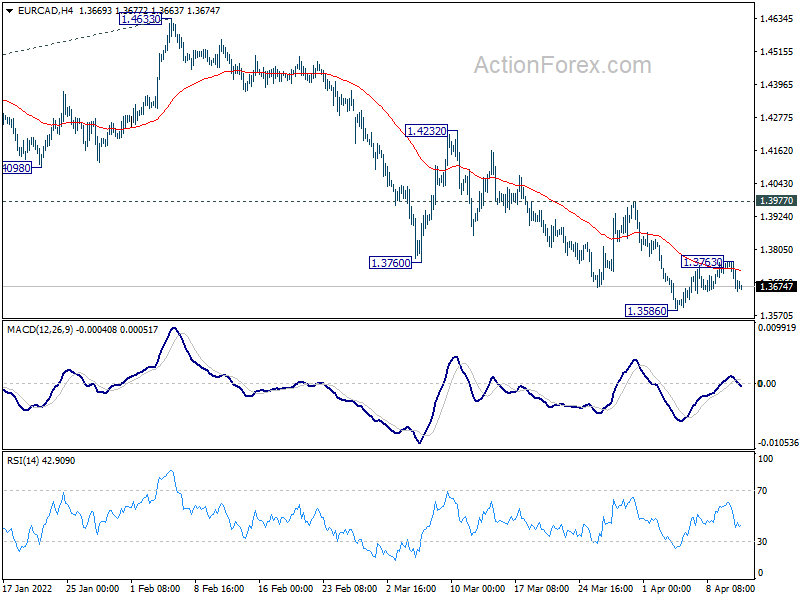
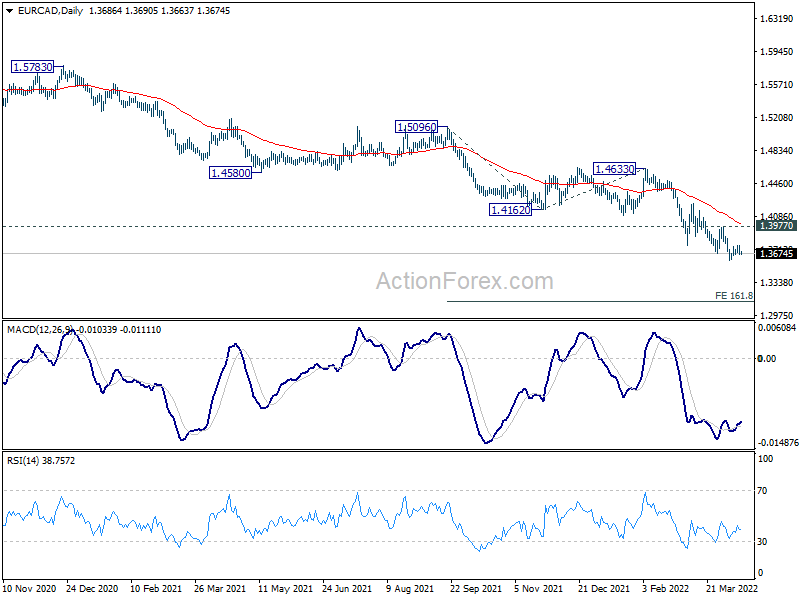
Canadian Dollar is one of the stronger ones for the month, but rally stalled, following the pull back in oil prices. EUR/CAD's recovery from 1.3586 temporary low might have completed at 1.3763, after failing to sustain above 4 hour 55 EMA. 1.3586 low will be back in focus today. Break there will extend larger down trend to 161.8% projection of 1.5096 to 1.4162 from 1.4633 at 1.3122. Meanwhile, break of 1.3763 will extend the recovery. But near term outlook will stay bearish as long as 1.3977 resistance holds.
Elsewhere
Inflation data will be the focuses today too. UK will release CPI and PPI. US will release PPI.
EUR/CHF Daily Outlook
Daily Pivots: (S1) 1.0074; (P) 1.0115; (R1) 1.0141; More....
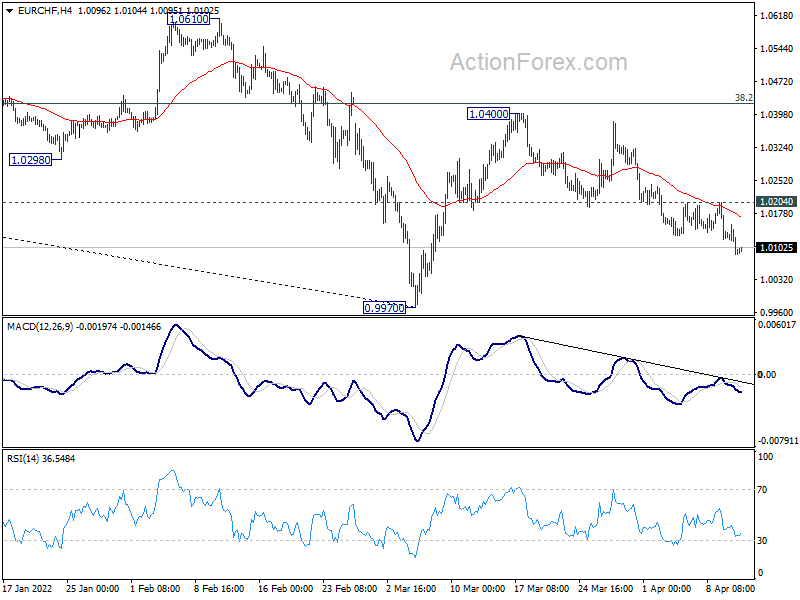
Intraday bias in EUR/CHF remains on the downside as fall from 1.0400 is extending. As noted before, rebound from 0.9970 could have completed already. Deeper fall is now expected to retest 0.9970 low. Decisive break there will resume larger down trend. On the upside, however, break of 1.0204 minor resistance will turn bias back to the upside for 1.0400 resistance instead.
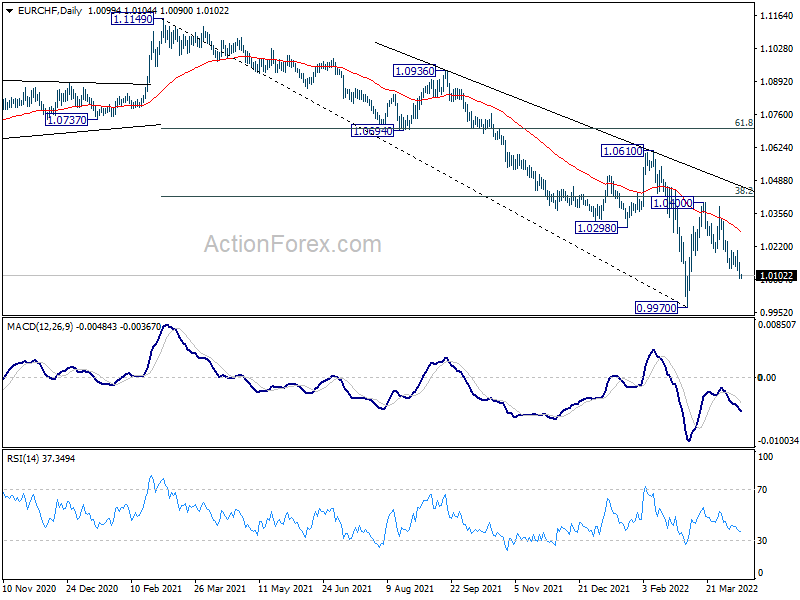
In the bigger picture, long term down trend from 1.2004 (2018 high) is still in progress. Next target is 100% projection of 1.2004 to 1.0505 to 1.1149 at 0.9650. In any case, sustained break of 1.0505 support turned resistance (2020 low) is needed to be the first sign of medium term bottoming. Otherwise, outlook will remain bearish.
Economic Indicators Update
| GMT | Ccy | Events | Actual | Forecast | Previous | Revised |
|---|---|---|---|---|---|---|
| 23:50 | JPY | Money Supply M2+CD Y/Y Mar | 3.50% | 3.60% | 3.60% | |
| 23:50 | JPY | Machinery Orders M/M Feb | -9.80% | -1.50% | -2.00% | |
| 00:30 | AUD | Westpac Consumer Confidence Apr | -0.90% | -4.20% | ||
| 02:00 | NZD | RBNZ Interest Rate Decision | 1.50% | 1.25% | 1.00% | |
| 02:00 | CNY | Trade Balance (USD) Feb | 47.38B | 20.5B | 116.0B | |
| 02:00 | CNY | Exports (USD) Y/Y Feb | 14.70% | 13.00% | 16.30% | |
| 02:00 | CNY | Imports (USD) Y/Y Feb | -0.10% | 8.00% | 15.50% | |
| 02:00 | CNY | Trade Balance (CNY) Feb | 300.58B | 131B | 739B | |
| 02:00 | CNY | Exports (CNY) Y/Y Feb | 12.90% | 18.20% | 13.60% | |
| 02:00 | CNY | Imports (CNY) Y/Y Feb | -1.70% | 11.40% | 12.90% | |
| 06:00 | GBP | CPI M/M Mar | 0.70% | 0.80% | ||
| 06:00 | GBP | CPI Y/Y Mar | 6.70% | 6.20% | ||
| 06:00 | GBP | Core CPI Y/Y Mar | 5.40% | 5.20% | ||
| 06:00 | GBP | RPI M/M Mar | 0.90% | 0.80% | ||
| 06:00 | GBP | RPI Y/Y Mar | 8.80% | 8.20% | ||
| 06:00 | GBP | PPI Input M/M Mar | 0.50% | 1.40% | ||
| 06:00 | GBP | PPI Input Y/Y Mar | 13.40% | 14.70% | ||
| 06:00 | GBP | PPI Output M/M Mar | 0.70% | 0.80% | ||
| 06:00 | GBP | PPI Output Y/Y Mar | 10.20% | 10.10% | ||
| 06:00 | GBP | PPI Core Output M/M Mar | 0.90% | 0.70% | ||
| 06:00 | GBP | PPI Core Output Y/Y Mar | 10.60% | 9.90% | ||
| 08:00 | EUR | Italy Industrial Output M/M Feb | 1.50% | -3.40% | ||
| 12:30 | USD | PPI M/M Mar | 1.10% | 0.80% | ||
| 12:30 | USD | PPI Y/Y Mar | 10.50% | 10.00% | ||
| 12:30 | USD | PPI Core M/M Mar | 0.40% | 0.20% | ||
| 12:30 | USD | PPI Core Y/Y Mar | 7.90% | 8.40% | ||
| 14:00 | CAD | BoC Interest Rate Decision | 1.00% | 0.50% | ||
| 14:30 | USD | Crude Oil Inventories | 2.4M |
BoC to hike 50bps, a look at EUR/CAD
BoC is widely expected to raise interest rate by 50bps to 1.00% today, to curb inflation which was already at a 30-year high. That would be the first half a percentage point hike since May 2000. The tightening cycle will continue for sure, with some expecting to overnight rate hit 2.50% level by the end of the year. Another point to note is BoC would probably start the plan to unwind its balance sheet, and the pace will be closely watched.
Here are some previews:
- BOC Preview: How Much Will the BOC Hike?
- Will the Bank of Canada Opt for a 50-bps Rate Hike at its April Meeting?
- Bank of Canada to Hike Rates for Second Straight Meeting
Canadian Dollar is one of the stronger ones for the month, but rally stalled, following the pull back in oil prices. EUR/CAD's recovery from 1.3586 temporary low might have completed at 1.3763, after failing to sustain above 4 hour 55 EMA. 1.3586 low will be back in focus today. Break there will extend larger down trend to 161.8% projection of 1.5096 to 1.4162 from 1.4633 at 1.3122. Meanwhile, break of 1.3763 will extend the recovery. But near term outlook will stay bearish as long as 1.3977 resistance holds.
NZD/USD gets not much support from RBNZ hike
NZD/USD just receive very brief lift from larger than expected RBNZ rate hike. It struggles to break through 4 hour 55 EMA firmly and risk is mildly on the downside. Break of 0.6805 temporary low will resume the fall from 0.7033 to 0.6728 support. Sustained break there will argue that whole rebound from 0.6728 has completed at 0.7033, and bring retest of 0.6528 low.
More importantly, break of 0.6728 support should also confirm rejection by trend line resistance, which in turn suggests that the choppy decline from 0.7463 is still in progress for another fall through 0.6528 low.
RBNZ hikes by 50bps to 1.50%, path of least regret
RBNZ raises Official Cash Rate by 50bps to 1.50%, larger than expectation of a 25bps hike. That's also the biggest rate increase in 22 years.
It said in the statement that "moving the OCR to a more neutral stance sooner will reduce the risks of rising inflation expectations. A larger move now also provides more policy flexibility ahead in light of the highly uncertain global economic environment."
Also, "the Committee agreed that their policy 'path of least regret' is to increase the OCR by more now, rather than later, to head off rising inflation expectations and minimise any unnecessary volatility in output, interest rates, and the exchange rate in the future."
(RBNZ) Monetary tightening brought forward
The Monetary Policy Committee today increased the Official Cash Rate (OCR) to 1.50 percent. The Committee agreed it is appropriate to continue to tighten monetary conditions at pace to best maintain price stability and support maximum sustainable employment.
The Committee remained comfortable with the outlook for the OCR as outlined in their February Monetary Policy Statement. They agreed that moving the OCR to a more neutral stance sooner will reduce the risks of rising inflation expectations. A larger move now also provides more policy flexibility ahead in light of the highly uncertain global economic environment.
The level of global economic activity continues to generate rising inflation pressures, exacerbated by ongoing supply disruptions in large part driven by COVID-19. The Russian invasion of Ukraine has significantly added to these supply disruptions, causing prices to spike in internationally traded commodities and energy.
However, the pace of global economic activity continues to slow. There is an elevated level of uncertainty created by the persistent impacts of COVID-19, and clear signals that monetary and broader financial conditions will tighten over the course of 2022. Added to this is the high level of geopolitical tension and related economic sanctions on Russia.
In New Zealand, underlying strength remains in the economy, supported by sound balance sheets, continued fiscal support, and strong export earnings. There has been some economic disruption due to the outbreak of Omicron. However, the high vaccination rates across New Zealand are assisting to reduce this disruption.
Heightened global economic uncertainty and inflation are dampening consumer confidence. The rise in mortgage interest rates – amongst other factors – have acted to reduce mortgage demand and house prices. However, economic capacity pressures remain, with a broad range of indicators highlighting domestic capacity constraints and ongoing inflation pressures. Employment is above its maximum sustainable level and labour shortages are impacting many businesses.
The Reserve Bank's core inflation measures are at or above 3 percent. Inflationary pressure is being further accentuated by current high imported energy and commodity prices, which are lifting headline CPI inflation. The Committee will remain focused on ensuring that current high consumer price inflation does not become embedded into longer-term inflation expectations.
Summary Record of Meeting
The Monetary Policy Committee discussed developments affecting the outlook for monetary policy.
It was noted that global consumer price inflation is high, well above most central banks' targets. This general inflation pressure is due to the recent recovery in global demand running up against severe supply shortages and trade disruption. The economic disruption caused by COVID-19 has been exacerbated by rising energy and food prices resulting from the Russian invasion of Ukraine.
The Committee noted that global economic growth is slowing, given supply constraints, consumer price pressures cutting into real incomes, and heightened geopolitical tensions causing investment uncertainty. Central banks globally are also tightening, or looking to tighten, their monetary policy stances over 2022, in an effort to constrain consumer price inflation expectations consistent with their policy targets.
Members observed that financial conditions have tightened in New Zealand, with higher interest rates, a stronger New Zealand dollar exchange rate, and lower asset prices.
It was noted that mortgage interest rates have risen broadly consistent with the outlook for the Official Cash Rate (OCR) in the Reserve Bank's February Monetary Policy Statement. The Committee noted that the higher New Zealand dollar against trading-partner currencies has assisted to partly offset higher import prices for local consumers.
In discussing the underlying influences on higher domestic inflation, the Committee agreed that both international and domestic factors were important.
Headline inflation is rising largely as a result of disrupted supply chains and higher world commodity prices. These higher commodity prices are increasing both imported inflation and also the incomes of some New Zealand exporters. Domestic demand pressures, relative to supply capacity, are also pushing New Zealand's core inflation above the Bank's 1 to 3 percent target range.
Capacity pressures are apparent across a wide range of domestic indicators. In particular labour shortages remain heightened, impinging on domestic economic output. Nominal wages are rising in response to these shortages, as would be expected. However, the increasing cost of living is putting pressure on household budgets. Consumer confidence has been declining as domestic price pressures are outpacing nominal household income growth.
The Committee discussed the outlook for labour supply with the reopening of New Zealand's international border underway. Members agreed that while the medium-term outlook is for ongoing net inward migration, as is the historical norm, this level would take some time to rebuild. Near-term indicators highlight that New Zealanders are currently leaving in larger numbers than visitors are arriving, as the border is opened in stages. The Committee noted that net immigration is assumed to increase only slowly, eventually leading to a gradual easing in skill shortages.
House prices have fallen from their recent high levels. The Committee viewed this as a sign that house prices are moving towards a more sustainable level. Home building intentions remain at record levels, which will assist this adjustment. However, construction activity faces challenges, including access to land, rising building costs, ongoing supply chain bottlenecks, and limited access to labour. The construction sector is operating around peak capacity.
Members noted that inflation is above target and employment is above its maximum sustainable level. As such, the Committee confirmed that further increases in the OCR are needed in order to meet their mandate.
The Committee discussed the pace and extent to which the OCR needs to rise in order to meet their inflation and employment mandate.
Members noted that annual consumer price inflation is expected to peak around 7 percent in the first half of 2022. The risk of more persistent high inflation expectations has increased. The Committee agreed that their policy 'path of least regret' is to increase the OCR by more now, rather than later, to head off rising inflation expectations and minimise any unnecessary volatility in output, interest rates, and the exchange rate in the future. The Committee agreed to a 50 basis point rise in the OCR, consistent with this least regrets analysis.
The Committee noted that the OCR is stimulatory at its current level. Members agreed that a larger rise in the OCR now is consistent with the forward path for interest rates outlined in their February Statement. Members also agreed that this 'stitch in time' approach is consistent with near-term financial market pricing.
On Wednesday 13 April, the Committee reached a consensus to increase the OCR to 1.50 percent.
Australia Westpac consumer sentiment dropped to 95.8, on interest rate, inflation and war
Australia Westpac consumer sentiment index dropped -0.9% to 95.8 in April, down from March's 96.6. That's the lowest level since September 2020. Westpac said "concerns around interest rates and inflation were starting to weigh on confidence... compounded by Russia's invasion of Ukraine, an associated spike in petrol prices, and severe weather events."
Westpac expects RBA to raise interest rate at June meeting, after reviewing data releases "over coming months". Once the tightening cycle starts, Westpac expects a series of rate hikes in most months in 2022, with a pause in September. Further rate hikes can be expected in first half of 2023 and the cash rate would peak at around 2% by June next year.
Fed Barkin: Best short-term policy path is rapid to neutral
Richmond Fed President Thomas Barkin said yesterday, "the best short-term path for us is to move rapidly to the neutral range and then test whether pandemic-era inflation pressures are easing, and how persistent inflation has become. If necessary, we can move further."
He added that the actions to combat inflation doesn't "necessarily require a hard landing." In fact, "it might help avoid one by convincing individuals and firms that the Fed is committed to our target, thereby cementing inflation expectations."
Barkin also said that the Fed needs to be "crystal clear that a growing economy requires stable prices, and that we will remain committed to addressing inflationary gusts."
First Impressions: RBNZ Monetary Policy Review
RBNZ Monetary Policy Review, April 2022
- The Reserve Bank raised the OCR by 50 basis points to 1.50%.
- The increase was larger than the majority of economists (including us) were expecting, but was more in line with what financial markets had priced in.
- The RBNZ reiterated that its key concern is that the current spike in inflation doesn’t become embedded in longer-term price-setting behaviour.
- The Committee noted that the current level of the OCR is still stimulatory, and that further increases will be needed to achieve its mandate.
- However, it indicated that its view on the peak in the OCR is unchanged compared to the February Monetary Policy Statement.
- As such, today’s decision was described as earlier, rather than more, monetary tightening.
Implications
While the RBNZ’s decision was more in line with market pricing on the day, it emphasised that there is a key difference regarding the OCR outlook over the longer term. In recent weeks, financial markets have pushed towards pricing in an ever-higher peak in the OCR for this cycle, now getting towards 4%. In contrast, the RBNZ viewed today’s decision as a “stitch in time saves nine” approach: hiking interest rates earlier will reduce the risk of having to go even higher in the long term. The reasoning is sound; we’re just left wondering why it didn’t hold sway at the February review, with much the same information available.
The RBNZ statement was very much focused on explaining today’s decision rather than providing a signal for upcoming reviews. That said, there was nothing in the statement that explicitly argued against a follow-up 50 basis point hike in May, so we wouldn’t be surprised if the market moves to fully price that in.
We will review our OCR forecasts and update them in our bulletin later today.
Gold Price Starts Fresh Increase above $1,950
Key Highlights
- Gold price started a fresh increase from the $1,920 support.
- A key bullish trend line is forming with support near $1,940 on the 4-hours chart.
- EUR/USD is still below 1.0950, and GBP/USD is consolidating near 1.3000.
- The US CPI increased 8.5% in March 2022 (YoY), up from +7.9%.
Gold Price Technical Analysis
Gold price formed a base above the $1,900 level against the US Dollar. The price settled above the $1,920 level to start a fresh increase.
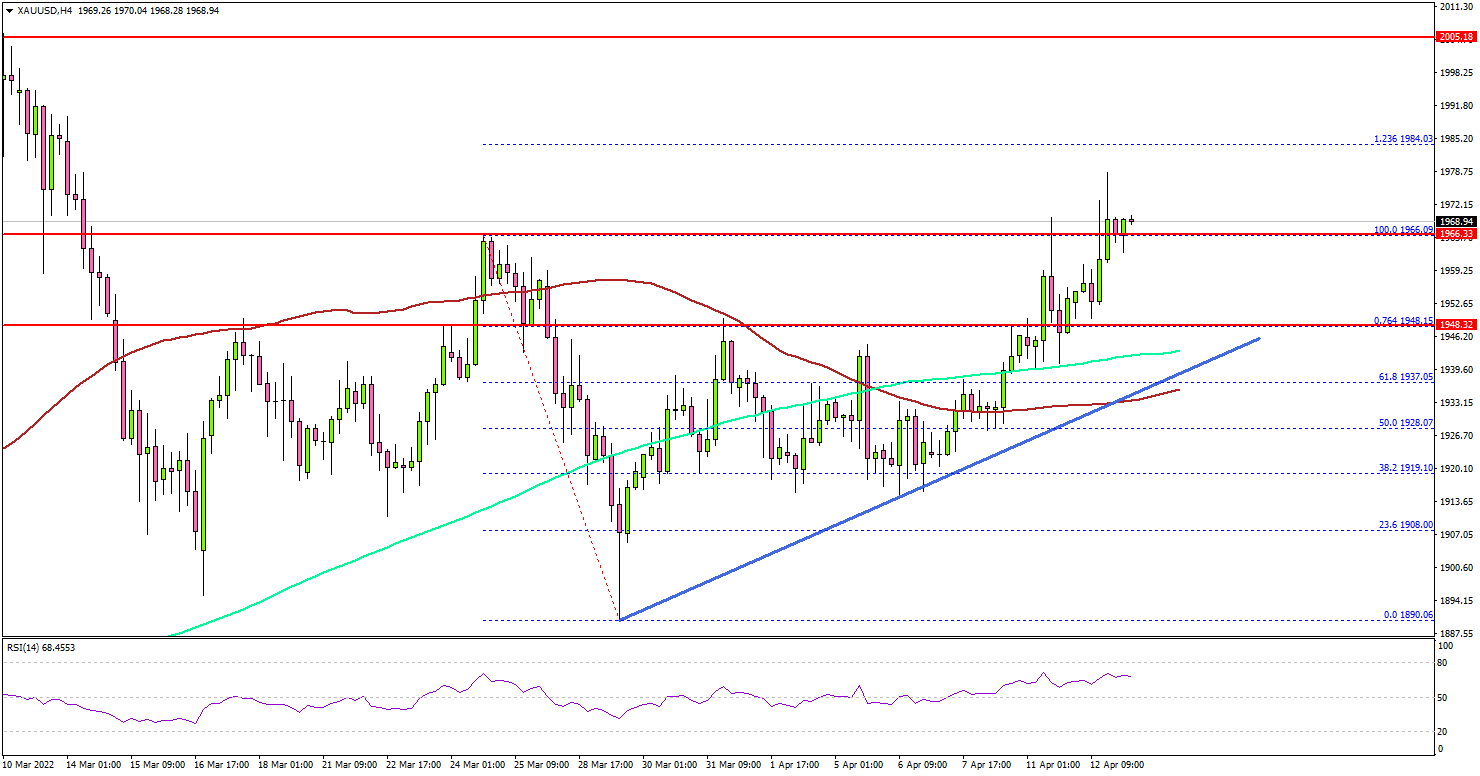
The 4-hours chart of XAU/USD indicates that the price was able to clear a couple of key hurdles near the $1,950 level. There was a proper close above the $1,950 level, the 100 simple moving average (red, 4-hours), and the 200 simple moving average (green, 4-hours).
The price climbed above the 76.4% Fib retracement level of the main decline from the $1,966 swing high to $1,890 low. It even broke the $1,966 swing high.
On the upside, the price might face resistance near $1,984. It is near the 1.236 Fib extension level of the main decline from the $1,966 swing high to $1,890 low. The next key resistance could be $1,992, above which the bulls might aim a move above $2,000.
If there is a downside correction, the price might find support near $1,950. The next major support is near the $1,940 level. There is also a key bullish trend line forming with support near $1,940 on the same chart.
Fundamentally, the US Consumer Price Index for March 2022 was released by the US Bureau of Labor Statistics. The market was looking for an increase of 8.4% in March 2022, compared with the same month a year ago.
The result was in line with the forecast, as the US CPI increased 8.5%, up from 7.9%. Besides, the US Core CPI increased 6.5%, whereas the market was looking for 6.6%.
Looking at EUR/USD, the pair is consolidating losses below the 1.0950 pivot level. Besides, GBP/USD is fighting hard to stay above the 1.3000 level.
Economic Releases to Watch Today
- UK Consumer Price Index for March 2022 (YoY) – Forecast +6.7%, versus +6.2% previous.
- UK Core Consumer Price Index for March 2022 (YoY) – Forecast +5.4%, versus +5.2% previous.
- BoC Interest Rate Decision – Forecast 1%, versus 0.5% previous.
Gold Report: Is this Gold’s Ticket to Higher Grounds?
Gold prices finished positive in the previous week and have ascended to reach a new monthly high in the current, creating further excitement for market participants. Despite Gold’s price remaining nearby familiar levels for the past several weeks, we could say that the recent move higher could be encouraging for further price action to prevail. In this report we aim to bring forth the key fundamentals surrounding the Gold market and a technical perspective of the price action.
Yesterday Monday the 11th, Gold performed its fourth consecutive daily session moving upwards. Along with Gold other precious metals like Palladium where also on the rise with a number of reports pointing to the ongoing war in Ukraine. According to Reuters, during the past Friday Russian platinum and palladium was suspended from trading in London increasing supply bottleneck concerns to the broader market. A disruption of any precious metal supply could elevate economic risks substantially and force traders to trade the risk averse Bullion. Supply bottlenecks have concerned the global economy during the pandemic and have pushed Gold prices to new all-time high levels confirming traders prefer the fast-moving metal during times of unprecedented uncertainty. The Russian war in Ukraine seems to keep traders in an active state allowing us to consider the subject as one of the most important currently for the Gold market.
On a side note, concerns over the trajectory of the US economy seem to be ongoing. Yesterday Federal Reserve Bank of Chicago President Charles Evans stated the Federal Reserve may choose a more aggressive interest rate increase noting specifically a 50-basis points rate hike is a possibility in the upcoming FOMC meeting in May. In the past days, the USD index a measure of the greenback’s strength against other major currencies surged and reached a new 2022 high level. Despite the greenback and Gold prices keeping mostly a negative correlation in play, they have both managed to remain higher in recent sessions. The correlation between Gold and the USD may be questionable currently and, in our opinion, may not be reliable for understanding future price action.
With a rather packed economic calendar for the rest of the week Gold traders could have interesting sessions to work with in the days ahead. On Thursday the 14th of April we get the US Retails Sales rate for March along with the weekly initial jobless claims figure and the very important Preliminary University of Michigan Economic Sentiment for April. On Friday the 15th we get the Industrial production rate for March and in the next week on Tuesday the 19th we get the Housing Starts Number for March.
We end this report by noting that today’s release of the U.S. inflation data could create substantial volatility for the precious metal. Traditionally, higher inflation rates tend to support Gold prices, as bullion has been used as a measure to counter higher good prices. However, caution is advised, and we would suggest that traders keep an open mind as to the actual market reaction. In addition, on Monday inflationary pressures in China were confirmed to be elevated in March possibly adding further to Gold’s upsurge.
Technical Analysis
XAUUSD H4 chart
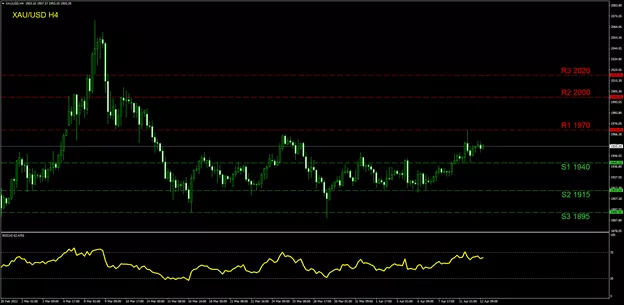
Gold is currently trading between our (R1) 1970 resistance and our (S1) 1940 support level. On Monday a brief upward movement sent the price action reaching the (R1) yet a correction lower was soon carried out. However, the (R1) 1970 line has not been tested since March the 14th making it a strong buying indicator for traders, if the level is to be actually surpassed. In an extended buying trend scenario, traders could also target the (R2) 2000 resistance level or even higher the (R3) 2020 barrier. In the opposite side, a selling scenario could force the price action towards the (S1) 1940 support level which was targeted various times in the past week and was used as both a resistance and a support. Lower the (S2) 1915 support is the lowest level Gold has dropped to in April making it an accurate metric for a selling trend. If the (S2) is breached, the price action could be signaling a change of trend to a selling one making the (S3) 1895 a target. Overall, our personal view is that Gold remains in a sideways motion but due to the recent high it jumped to on Monday, it could also be driven by some bullish tendencies. Besides, the RSI indicator below our chart is currently running across the 63 level, implying some bullish appetite may still be in play.