Sample Category Title
Sunset Market Commentary
Markets
Fed board member and vice-governor to-be Brainard’s speech yesterday still reverberated through financial markets today. She buried her outspoken dovish signature and now carries the hawkish banner high up in the sky. Her comments on the balance sheet (“to shrink at a rapid pace as soon as May”) in particular caught the attention since they come ahead of tonight’s Fed meeting minutes. The blueprint of QT is due in May but governors undoubtedly discussed the matter back in March. Investors will scour the publication for any clues. In the meantime, the bond sell-off simply continues. US yields add 4.1 bps to 9.6 bps in a bear steepener. The US 10y yield surpasses 2.56% resistance with ease and eyes the next reference between 2.75-2.8%. European swap rates hit new cycle highs from the 2y to the 30, rising 2.6 bps at the front end to as much as 7 bps (10y), despite ECB Lane’s balanced (“important not to over- or under-react to inflation”) or Panetta’s dovish comments. The latter said he sees no evidence of second-round effects and that inflation expectations remain anchored. European inflation expectations meanwhile rose to an intraday high of 2.97%. If they close at the current level of 2.91%, a new series high (since 2004) would be set. Peripheral spreads vs. Germany’s 10y yield widen. Italy (+4 bps) and Greece (+5 bps) underperform.
Brainard put the finger on the sore spot in equity markets. A historically aggressive (global) tightening cycle - today’s NBP decision serves as illustration (see below) - brings about a stock sell-off. Main European indices lose almost 3%, WS opens with losses up to 2%. Risk-off induced by higher core bond yields do not help the traditional safe havens on currency markets. The Swiss franc is under pressure after a recent strong performance. EUR/CHF bounces from 1.013 towards 1.02. The Japanese yen also loses out against the euro and the dollar. The euro in general catches a breather, strengthening against most G10 peers. EUR/USD for example reversed course after dropping below 1.09 in Asian dealings to trade at 1.093 currently. It does little to the poor technical picture though. And the minutes still have to be released.
News Headlines
Swedish Riksbank deputy governor Flodén delivered a hawkish speech titled “monetary policy will bring inflation back to target”. To understand the appropriate timing and strength of the central bank’s monetary policy response, they need to consider how robust inflation expectations and wage formation currently are and how economic activity will be affected by recent developments. Flodén emphasizes that the April 28 policy meeting is a live one. It is evident that the Riksbank needs to reassess and substantially adjust its plan for monetary policy. This implies raising the policy rate much earlier than planned. The forward guidance in February suggested a first rate hike in the second half of 2024. Flodén argues that it’s better act rapidly in a gradual way than having to be more forceful if they wait for too long. Swedish money markets are rapidly shifting towards discounting back-to-back 25 bps rate hikes in April and June. Swap yields add 5.2 bps (2-yr) to 10.2 bps (20-yr). The Swedish krona holds the balance with an overall better bid euro today. EUR/SEK remains nevertheless near the lowest levels since mid-January at 10.30.
The National Bank of Poland hiked its policy rate by 100 bps, from 3.5% to 4.5%. It’s the largest rate hike in the current cycle and bigger than markets expected (split between 50 and 75 bps). The Polish economic outlook remains rather solid thanks to favourable domestic conditions and given the modest share of exports to Russia and Ukraine. Inflation (10.9% Y/Y in March) will remain markedly elevated before decreasing in the coming years supported by an appreciating zloty which, in the Council’s assessment, will be consistent with economic fundamentals. The NBP will continue taking all necessary actions in order to ensure macroeconomic and financial stability, including above all to reduce the risk of inflation remaining elevated. The zloty spiked higher immediately after the release (EUR/PLN dipped to 4.56) before returning back to the 4.64 area in anticipation of governor Glapinski’s press conference. The Polish swap curve bear steepens with yields adding 19 bps (2-yr) to 10 bps (20-yr).
EURGBP Buyers Re-Emerge after One-Week Descent
EURGBP is seeing lingering downside risks despite an increase in buying interest around the 0.8327 level, which unfolded slightly below the simple moving averages (SMAs). That said, from the beginning of the year, the broader bearish trend has glided into a trading range that spans from a more than 5½-year low of 0.8202 until the 0.8512 high, and the directionless SMAs are reflecting the prolonged consolidation of the price within these boundaries.
Currently, the falling Ichimoku lines are indicating that the negative forces remain active, while the short-term oscillators are transmitting conflicting signals in directional momentum. The MACD is in the negative zone and below its red trigger line but has moved higher towards it, while the RSI is dipping back down toward its 30 oversold level. Meanwhile, the positively charged stochastic oscillator has yet to reflect any upside weakness, promoting further improvements in the pair.
If the price oversteps the red Tenkan-sen line at 0.8348, tough upside friction could commence at the 200-period SMA at 0.8364 ahead of a resistance band between the 0.8380 inside swing low and the 100-period SMA at 0.8388. Successfully gaining further ground, the bulls may then encounter a fortified resistance section extending from the 0.8400 handle up until the 0.8415 level, which includes the 50-period SMA, the blue Kijun-sen line and the Ichimoku cloud. Beyond this obstacle, the 0.8434-0.8449 resistance region may try to impede buyers from climbing towards the 0.8512 upper limit of the trading range.
Alternatively, if negative pressures intensify again, the initial 0.8315-0.8327 support foundation could attempt to prolong the neutral price path. Failing to succeed, sellers may then eye the 0.8300 hurdle along with the March 23 trough of 0.8294. Should downside forces dominate, the price could then sink towards the 0.8261-0.8271 support border.
Summarizing, EURGBP is exhibiting a bearish vibe within a neutral picture. A break either below 0.8202 or above 0.8512 could deliver a clearer price direction. For now, sellers are aiming for the lower limit of the consolidation and a dive below 0.8294 may strengthen this narrative. Yet, a hike in the price above the cloud may feed upside pressures.
EUR/USD Mid-Day Outlook
Daily Pivots: (S1) 1.0874; (P) 1.0932 (R1) 1.0963; More...
Intraday bias in EUR/USD remains on the downside for retesting 1.0805 low. Firm break there will resume larger down trend from 1.2248. Next target is 61.8% projection of 1.1494 to 1.0805 from 1.1184 at 1.0758, and then 100% projection at 1.0495. On the upside, above 1.0987 minor resistance will mix up the outlook and turn intraday bias neutral again.
In the bigger picture, the decline from 1.2348 (2021 high) is expected to continue as long as 1.1494 resistance holds. Firm break of 1.0635 (2020 low) will raise the chance of long term down trend resumption and target a retest on 1.0339 (2017 low) next. Nevertheless, break of 1.1494 will maintain medium term neutral outlook, and extending term range trading first.
GBP/USD Mid-Day Outlook
Daily Pivots: (S1) 1.3037; (P) 1.3102; (R1) 1.3137; More...
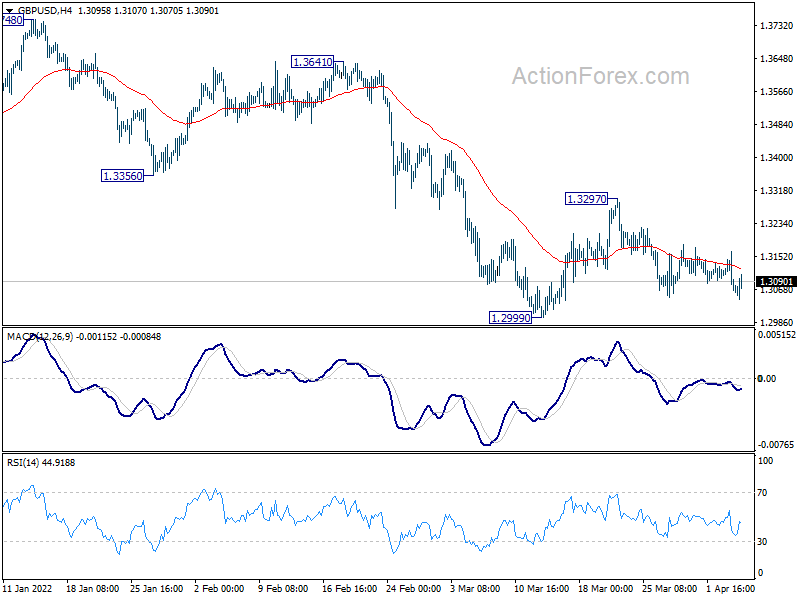
Sideway trading continues in GBP/USD and intraday bias remains neutral for the moment. Further decline is mildly in favor with 1.3297 resistance intact. On the downside, firm break of 1.2999 will resume larger down trend from 1.4248. However, firm break of 1.3297 will turn bias back to the upside for stronger rebound.
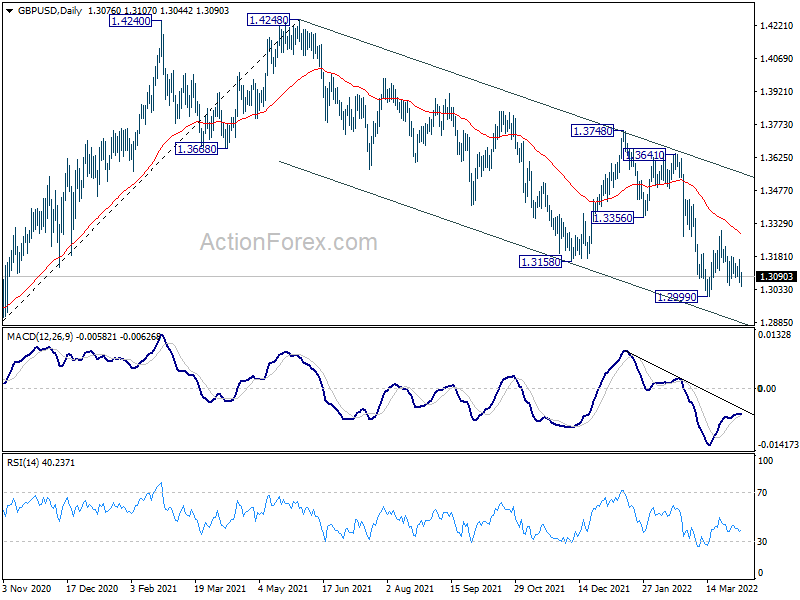
In the bigger picture, current development suggests that the up trend from 1.1409 (2020 low) has completed at 1.4248. Decline from 1.4248 could still be a corrective move, or it could be the start of a long term down trend. In either case, deeper decline would be seen back to 61.8% retracement of 2.1161 to 1.1409 at 1.2493. In any case, break of 1.3748 resistance is needed to indicate medium term bottoming, or outlook will stay bearish.
USD/JPY Mid-Day Outlook
Daily Pivots: (S1) 122.38; (P) 122.66; (R1) 123.06; More...
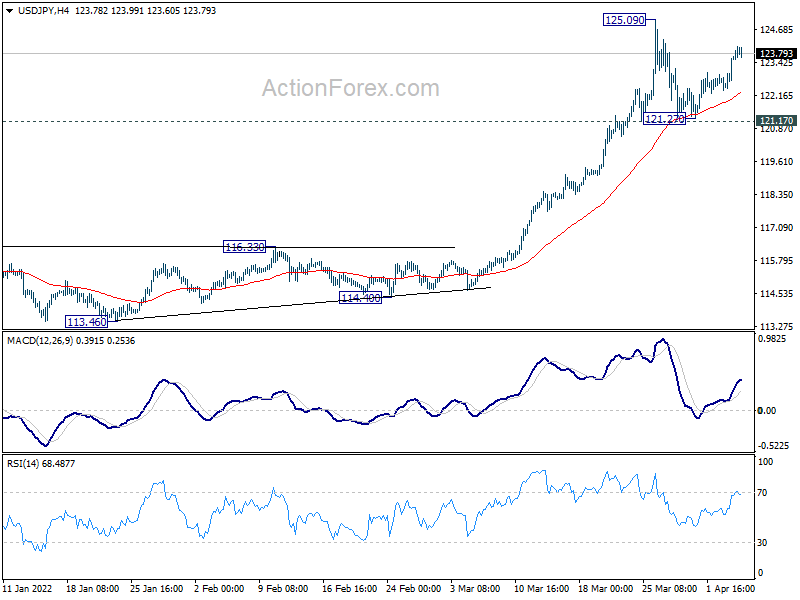
Intraday bias in USD/JPY remains neutral first and consolidation from 125.09 could extend. But outlook remains bullish with 121.17 support intact and further rise is expected. On the upside, break of 125.09 will target 125.85 long term resistance. Firm break pave the way to 130.04 long term projection level. However, break of 121.17 will turn bias back to the downside for deeper pull back.
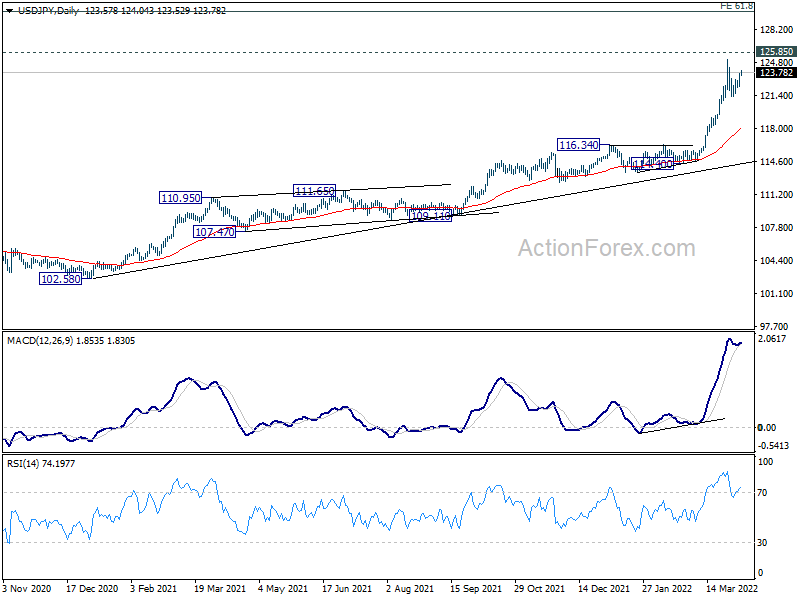
In the bigger picture, up trend from 98.97 (2016 low) in in progress for retesting 125.85 (2015 high). Sustained break there will confirm long term up trend resumption. Next target will be 61.8% projection of 75.56 (2011 low) to 125.85 (2015 high) from 98.97 at 130.04. This will now remain the favored case as long as 116.34 resistance turned support holds.
USD/CHF Mid-Day Outlook
Daily Pivots: (S1) 0.9256; (P) 0.9277; (R1) 0.9316; More....
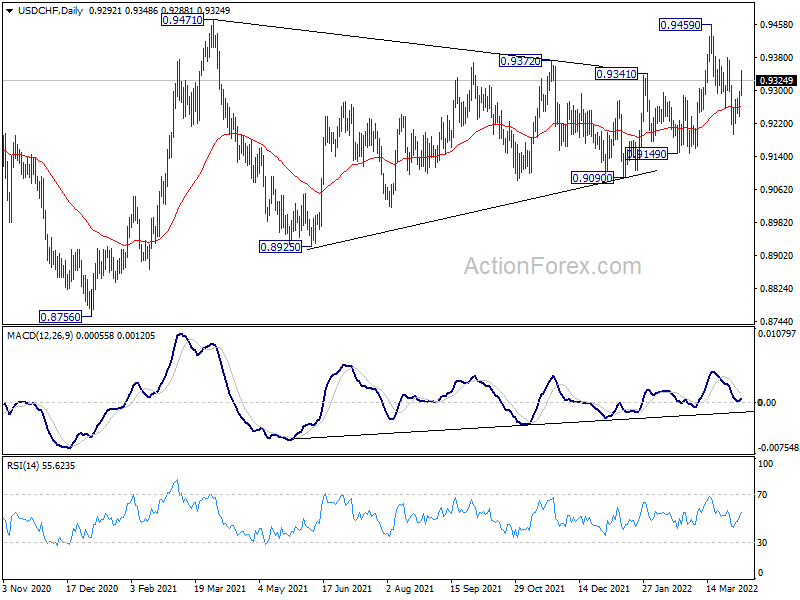
USD/CHF's rebound from 0.9193 extends higher today but stays below 0.9380 resistance. Intraday bias remains neutral first. On the upside, break of 0.9380 will indicate that fall from 0.9459 has completed with three wave down to 0.9193. Such development will revive near term bullishness and turn bias back to the upside for 0.9459 and then 0.9471 resistance. On the downside, however, below 0.9236 will turn bias to the downside for 0.9149 structural support next.
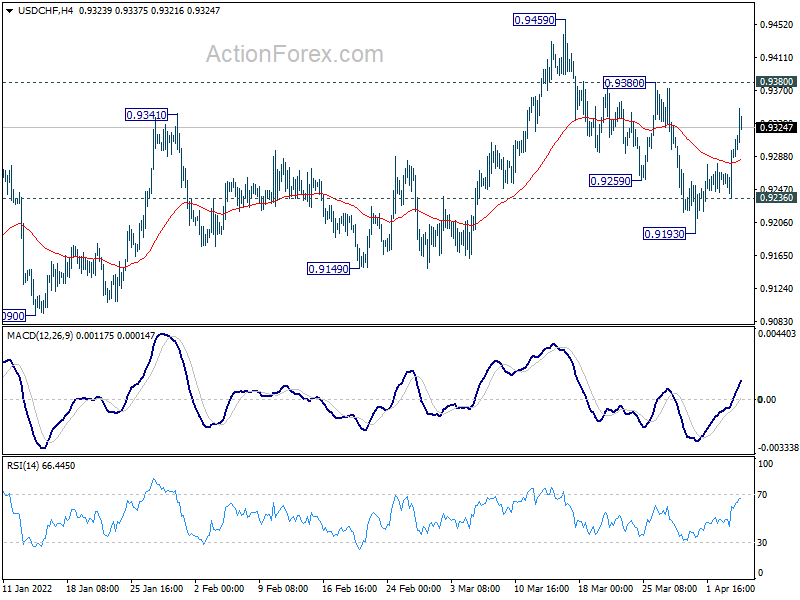
In the bigger picture, medium term outlook will be neutral at best as long as 0.9471 resistance holds. Larger down trend could still extend through 0.8756 (2021 low). However, firm break of 0.9471 will argue that whole down trend form 1.0342 (2016 high), has completed with waves down to 0.8756. A medium term up trend should be set up to target 1.0237/0342 resistance zone.
Swiss Franc Declines, as Dollar and Euro Lost Momentum in Mixed Markets
Swiss Franc falls broadly today as other parts of the markets turned mixed. US treasury yield extends its sharp rally. But the impact on Dollar is some what offset by impressive rally in Germany and UK yields too. Euro recovers mildly but remains the worst performing one for the week, followed by Yen, and then Swiss. Australian Dollar is still the strongest one, followed by Kiwi and Loonie. But Dollar might pick up momentum again if supported by more hawkish comments from Fed policymakers.
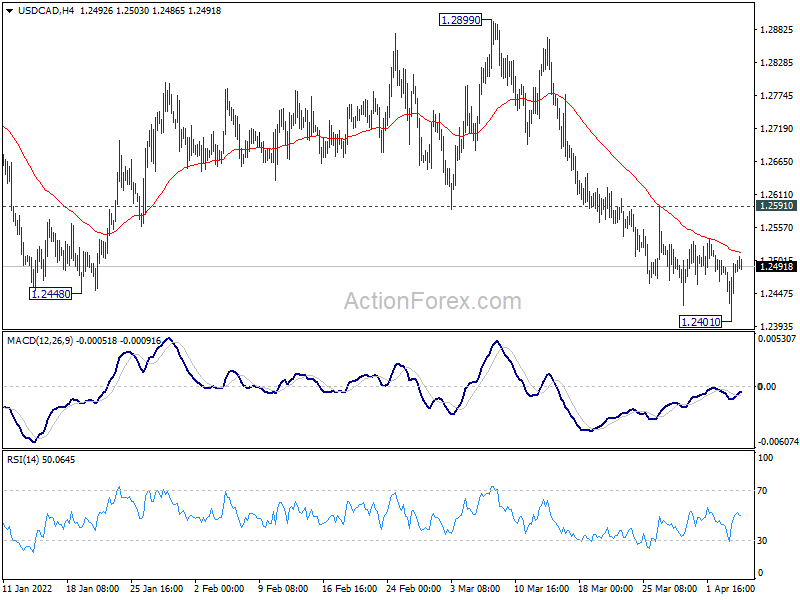
Technically, one focus for the end of the week is on whether Dollar could overpower commodity currencies. For now, as long as 0.7455 minor support in AUD/USD holds, further rise is expected through 0.7660 temporary top. As for USD/CAD, as long as 1.2591 minor resistance holds, deeper decline is expected through 1.2401. However, break of these two levels will argue that Dollar is striking back.
In Europe, at the time of writing, FTSE is down -0.28%. DAX is down -1.89%. CAC is down -1.93%. Germany 10-year yield is up 0.0464 at 0.665. Earlier in Asia, Nikkei dropped -1.58%. Hong Kong HSI dropped -1.87%. China Shanghai SSE rose 0.02%. Singapore Strait Times dropped -0.64%. Japan 10-year JGB yield rose 0.0338 to 0.245.
ECB Panetta: Holding inflation at 2% with high imported inflation could induce domestic deflation
ECB Executive Board member Fabio Panetta said in a speech that the high inflation in Eurozone is "mostly due to global factors – including the increase in the prices of oil, gas and other commodities – over which monetary policy has little leverage." And it "does not fundamentally result from an economy that is running above potential".
Therefore, "asking monetary policy alone to bring down short-term inflation while inflation expectations remain well anchored would be extremely costly". Monetary tightening would not affected imported energy and food prices, but "massively suppress domestic demand to bring down inflation".
"And with the current levels of imported inflation, in order to hold headline inflation to 2%, we would need domestic inflation to be deeply negative. In other words, we would induce domestic deflation," he added.
Panetta suggested that "fiscal policy can help mitigate the challenge of higher inflation by containing the effects of higher energy prices". On the other hand, "Monetary policy will play its role, adjusting policy in line with the medium-term inflation outlook. "
ECB de Guindos: Green energy is a key priority for environment and security
ECB Vice President Luis de Guindos said in a speech, "for the euro area, the financial stability impact of the war has so far been relatively contained." And, "markets have generally been functioning well", with "no dash for cash".
"While both banks and non-banks have been affected – especially the few that have large direct exposures to Russia and Ukraine – the economic fallout has not had a sizeable impact on the EU banking or financial systems as a whole," he added.
But he also noted, "the invasion of Ukraine also demonstrated how vulnerable Europe is due to its high dependency on fossil fuel imports from Russia. Speeding up the green transition is a key priority from this perspective too – not only to address the urgent environmental and climate challenges we face, but also to help increase our energy security and protect the EU economy from energy price spikes."
Eurozone PPI rose 1.1% mom, 31.4% yoy in Feb
Eurozone PPI rose 1.1% mom, 3.1.4% yoy in February, below expectation of 1.3% mom, 31.6% yoy. For the month, industrial producer prices increased by 1.6% for intermediate goods, by 1.3% in the energy sector, by 0.8% for non-durable consumer goods, by 0.6% for durable consumer goods and by 0.3% for capital goods. Prices in total industry excluding energy increased by 0.9%.
EU PPI rose 1.1% mom, 31.1% yoy. The highest monthly increases in industrial producer prices were recorded in Slovakia (+13.6%), Slovenia (+5.7%) and Greece (+4.8%). Decreases were observed in Ireland (-8.1%), Finland (-0.5%), Latvia (-0.3%), and Bulgaria (-0.1%).
UK PMI construction unchanged at 59.1, but optimism tumbled
UK PMI Construction was unchanged at 59.1 in March, better than expectation of 57.3. The latest reading signalled the join-fastest rate of output growth since June 2021. However, business optimism dropped to 17-month low.
Tim Moore, Economics Director at S&P Global: "Escalating fuel, energy and commodity prices led to the fastest rise in costs for six months. Intense inflationary pressures appear to have unnerved some construction companies. Business optimism slipped to its lowest since October 2020 on concerns that clients will cut back spending in response to rising prices and heightened economic uncertainty."
China PMI composite dropped to 43.9, downward pressure aggravated by several factors
China Caixin PMI Services dropped sharply from 50.2 to 42.0 in March, much worse than expectation of 49.9. That's also the worst reading since February 2020. PMI Composite dropped from 50.1 to 43.9, also the worst since February 2020.
Wang Zhe, Senior Economist at Caixin Insight Group said: "At present, China is facing the most severe wave of outbreaks since the beginning of 2020. Uncertainty also increased abroad. The outcome of the war between Russia and Ukraine is uncertain, and the commodity market has convulsed. Several factors have aggravated the downward pressure on China's economy and underscore the risk of stagflation."
USD/CHF Mid-Day Outlook
Daily Pivots: (S1) 0.9256; (P) 0.9277; (R1) 0.9316; More....
USD/CHF's rebound from 0.9193 extends higher today but stays below 0.9380 resistance. Intraday bias remains neutral first. On the upside, break of 0.9380 will indicate that fall from 0.9459 has completed with three wave down to 0.9193. Such development will revive near term bullishness and turn bias back to the upside for 0.9459 and then 0.9471 resistance. On the downside, however, below 0.9236 will turn bias to the downside for 0.9149 structural support next.
In the bigger picture, medium term outlook will be neutral at best as long as 0.9471 resistance holds. Larger down trend could still extend through 0.8756 (2021 low). However, firm break of 0.9471 will argue that whole down trend form 1.0342 (2016 high), has completed with waves down to 0.8756. A medium term up trend should be set up to target 1.0237/0342 resistance zone.
Economic Indicators Update
| GMT | Ccy | Events | Actual | Forecast | Previous | Revised |
|---|---|---|---|---|---|---|
| 01:45 | CNY | Caixin Services PMI Mar | 42 | 49.9 | 50.2 | |
| 06:00 | EUR | Germany Factory Orders M/M Feb | -2.20% | -0.20% | 1.80% | 2.30% |
| 08:30 | GBP | Construction PMI Mar | 59.1 | 57.3 | 59.1 | |
| 09:00 | EUR | Eurozone PPI M/M Feb | 1.10% | 1.30% | 5.20% | |
| 09:00 | EUR | Eurozone PPI Y/Y Feb | 31.40% | 31.60% | 30.60% | |
| 14:00 | CAD | Ivey PMI Mar | 62.3 | 60.6 | ||
| 14:30 | USD | Crude Oil Inventories | -2.9M | -3.4M | ||
| 18:00 | USD | FOMC Minutes |
Aussie Takes a Breath after Wild Ride
The Australian dollar is drifting on Wednesday, after taking quite the ride a day earlier, courtesy of the RBA rate decision.
RBA hawkishness sends Aussie soaring
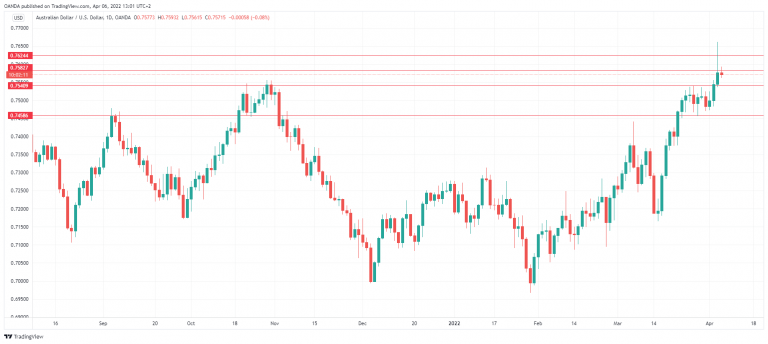
AUD/USD rocketed some 200 points at one stage on Tuesday, in response to the RBA rate statement at its policy meeting. The Bank held rates at an ultra-low 0.10%, where they have been pegged since November 2020. The rate statement was more important for what it didn’t say, as the word “patient” was conspicuously missing. Patience has been a key message from Governor Lowe, who has implored the markets to remain patient over rate hikes, even with rising inflation. Lowe had previously argued that he would not raise rates until wage growth hit 3%, which would indicate that inflation was sustainable. In yesterday’s statement, Lowe appeared to backtrack, noting that he expected wages to rise.
With Lowe changing his dovish tune and hinting at a rate hike soon, the markets pounced and sent AUD/USD soaring. The Aussie did cough up most of those gains, but the brief upswing showed how sensitive the currency is to any perceived hawkishness from the RBA.
Australia has a robust labor market, rising inflation and solid growth. These are all ingredients for a rate hike, but a move may have to be delayed due to a federal election in May. The RBA doesn’t want to make any major moves during an election campaign, leaving June as a likely date for the start of a rate-hike cycle. The markets have priced in an 84% chance of a 0.25% hike in June, and close to a 50% likelihood of a 0.50% hike, with up to seven more increases before the end of the year. With the economy performing well and the RBA on the cusp of a series of rate hikes, I expect the Aussie to resume its upswing in the short term.
AUD/USD Technical
- 0.7582 is a weak resistance line. Above, there is resistance at 0.7682
- There is support at 0.7541 and 0.7458
Dollar Gaining Ground on Fed
The dollar is rising against most of its major rivals on the latest hawkish comments from the Fed. The futures market lays a 77% chance of a 50-point rate hike at the next meeting in a month from 27% a month ago.
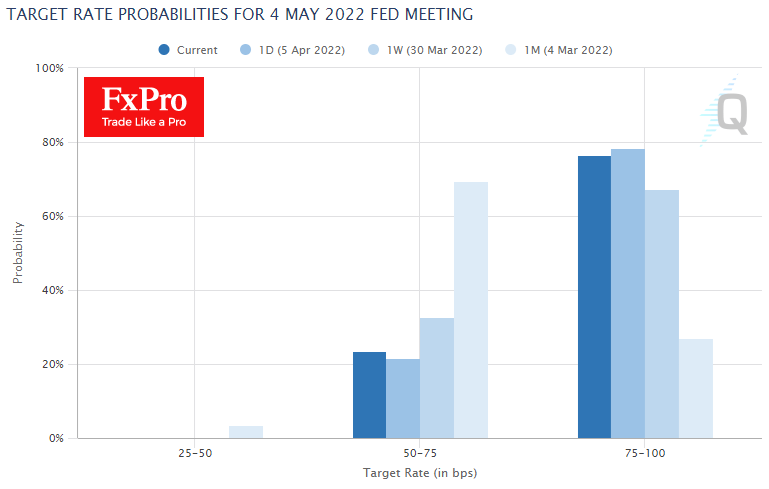
FOMC member Lael Brainard said yesterday that she expects a combination of balance sheet cuts and rate hikes to make Fed policy more neutral later this year. Although no 50-point hike follows directly from those words, markets are paying attention to the tightening of rhetoric rather than the Fed trying to cool the panic around inflation as it did last year.
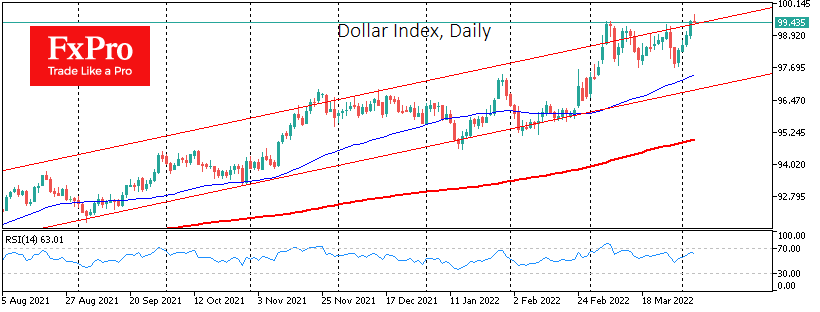
A breeding ground for a new wave of dollar strength is being created in this environment. On Wednesday morning, the dollar index to a basket of FX’s six most popular currencies hit new highs in May 2020, climbing to 99.7. Rising US bond yields in response to a more hawkish Fed tilt feed interest in dollar assets with more attractive yields.
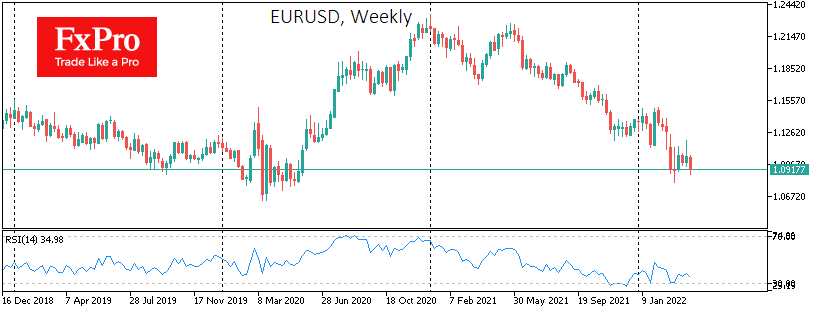
Separately, investors are “voting” for America against Europe because of the economic outlook. The imposition of sanctions, injury to business, and supply chain disruptions are affecting prices and materially shrinking the economy. This situation leads to monetary policy in the Eurozone promising to remain more accommodative for the foreseeable future to maintain growth and reduce the debt servicing costs of governments.
High inflation increases the tolerance of the US Federal Reserve and the Treasury for a rising dollar. Policies now support the competitiveness of US exports, and a stronger dollar will help curb rising import prices.
With such inputs, we should not be surprised if EURUSD rewrites the March lows in the coming days, dropping below 1.0800 and then diving further in search of a bottom until the end of the year with the potential for declines as low as 1.04-1.05.
NZDUSD’s Bullish Tone Persists But Ascent Gets Delayed
NZDUSD’s upside momentum has softened above the simple moving averages (SMAs) after a persisting two-month uptrend spiked toward the upper Bollinger band at 0.7033. The negative slopes of the longer-term 200- and 100-day SMAs have eased, while the upturn in the 50-day SMA and its bullish crossover of the 100-day SMA reaffirms that the near-term uptrend from the 0.6528 trough is strengthening.
The short-term oscillators are conveying that the recent weakness in upside momentum may be short lived. The MACD, in the positive region, has slipped slightly beneath its flattened red trigger line, while the RSI has started to renew a positive bearing in the bullish section. Furthermore, the negative charge of the stochastic oscillator looks shaky as the upturn in the %K line is transmitting messages of growing positive drive.
If the pair recovers from yesterday’s weakness, an initial step above the 0.6979 barrier could push buyers to test the upper Bollinger band at 0.7033 before tackling the 0.7051-0.7080 resistance band linked to the levels from November 2021. Now, should the bulls repower the recent uptrend by piloting beyond the 0.7100 handle too, the pair may then navigate towards the 0.7176 high prior to confronting the 0.7200-0.7241 resistance barricade, which involves highs from June and October 2021.
Otherwise, if bullish drive struggles to improve further, downside constraints may commence from the 200-day SMA at 0.6903 and the mid-Bollinger band ahead of the 0.6862-0.6884 support border, which is reinforced by a tentative uptrend line pulled from the 16-month low of 0.6528. In the event sellers manage to drive the price below this critical section and the diagonal support, the bears could then aim for a zone of support linking the converged 50- and 100-day SMAs around 0.6788 and the lower Bollinger band at 0.6770. From here, pushing lower, the key 0.6727 trough from March 15 may draw focus.
Summarizing, NZDUSD is sustaining a bullish bias above the SMAs, the mid-Bollinger band and the 0.6862-0.6884 minor foundation. That said, a dive in the price past the 0.6727 trough could ramp up worries about negative tendencies.