Sample Category Title
Sunset Market Commentary
Markets
Today, investors still weighed the consequences Fed Chair Powell’s hawkish comments flagging a 50 bps rate hike in May and, why not, maybe also in June. Even after yesterday’s sharp rise in the US and EMU, there was still room for follow-through action. The focus turned from Fed speakers to ECB governors. Their tone evidently is moderate compared to Powell’s harsh talk. Even so, the need to re-anchor inflation expectations/start policy normalization isn’t questioned anymore. The debate between moderates and hawks is about the pace of normalization. ECB’ de Guindos admitted that inflation will probably stay higher for longer and that the ECB should monitor second round effects. Villeroy warned the ECB should not overreact to volatility in energy prices and focus on underlying inflation/medium developments. Even so, he subscribed the need for normalization. His plea for the EU to further extend the radius of the EU recovery fund to address the green transition illustrates that any support to address the fall-out of current crisis should come from fiscal policy, not from central bankers. A similar assessment came from German Fin Min Linder as he said that “the economy can rely on the government to apply its fiscal tools to avoid stagflation". German yields today rise between 6.0 bps (5-y) and 2.0 bps (30-y), the 10-y surpassing the 0.50% barrier. The rise in EMU yields is still almost solely driven by inflation expectations. This might be a sign that markets feel that the ECB still has to solidify its anti-inflationary commitments. The fall-out of higher core yields on peripheral bond remains modest, with spreads trading little changed to even marginally tighter. US yields simply extend yesterday’s ascent rising between 6.5 /8.25 bps across the curve. Fed Bullard’s, dissenter at last week’s Fed meeting, reiterated his call that the Fed acting ‘faster is better’ and that policy quickly needs to be brought to a neutral level. Equities show ‘remarkably resilient’ to the bond market sell-off. US indices are gaining 0.75%/1.5%. The EuroStoxx50 also rises 1.25%. The oil rally is losing momentum (Brent $114.75 p/b) maybe provided some relief.
On FX markets, the dollar still fails to capitalize on an ever widening (ST) interest rate differential. Equity strength maybe provided relief for the euro. Whatever, after declining to the 1.0965 area, EUR/USD currently even trades marginally strong in a daily perspective (1.1035). The yen remains in free-fall. USD/JPY jumped to 120.75. EUR/JPY (133.25) nears the 134.48/134.13 area (2021 peak levels). Markets also continue to question last week’s soft BoE rate hike (yields rebounding 7 bps at the short end). EUR/GBP dropped further to currently trade in the 0.8325 area.
News Headlines
Belgian consumer confidence collapsed in March. The indicator dropped from +1 to -16, the lowest since October 2020, matching the record decline seen at the height of the Covid panic in April 2020. Belgian households assess the economic situation 12 months ahead as the worst on record. They also turn the most pessimistic on their future financial situation amid soaring inflation. Saving intentions weakened significantly for similar reasons. Expectations about the labour market have deteriorated as well but remain relatively robust compared to previous years. In separate Belgian news, the 10y yield today tested the 1% psychological level for the first time early 2018 amid building anticipation on ECB policy normalization. A break above the 1.06/1.07% resistance brings 1.43% as the next high-profile reference on the radar.
The Hungarian central bank (MNB) as expected raised the base rate by 100 bps to 4.4%, double the 50 bps size the MNB started hiking with since the start of the year. The Ukraine war through trade channels, production chain disruptions, rising commodity prices and heightened uncertainty will negatively affect growth. However, the central bank is much more concerned on its impact on inflation. Headline inflation for 2022 is expected between 7.5 and 9.8% and will not reach the 3% target until 2024H1. Risks have increased and remain tilted to the upside. The MNB thus announced the current tightening cycle will last longer and will continue at a larger clip than before (>50 bps). Short-term Hungarian swap yields jump between 20 and 30 bps with a terminal policy rate expected near 8%. The Hungarian forint strengthens vs the euro to EUR/HUF 371.37.
NZD Soars Despite Drop in Confidence
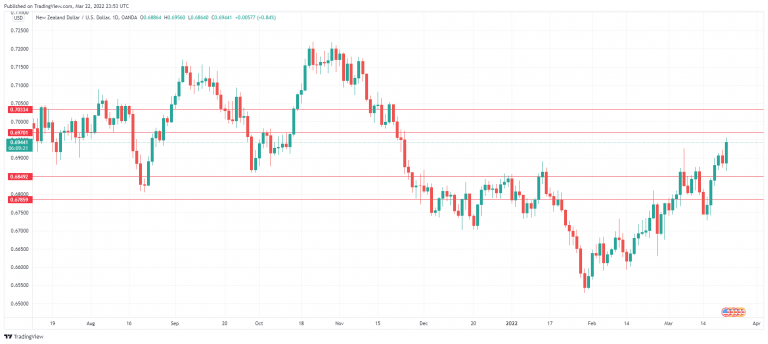
The New Zealand dollar is up sharply on Tuesday. In the North American session, NZD/USD is trading at 0.6943, up 0.83% on the day.
NZ consumer sentiment falls sharply
Westpac Consumer sentiment slowed for a third straight quarter, and the Q1 release showed a sharp drop, falling from 99.1 to 92.1. The 100-level separates optimism from pessimism, so the latest reading, which is the lowest since the global financial crisis of 2008, is certainly a cause for concern.
The survey found that many consumers were seeing a deterioration in their finances. One of the major culprits is, of course, inflation, which surged to 5.9% in December. Wages haven’t nearly kept up, with an increase of about 3.8%. Borrowing costs have increased, which has added to the expenses of consumers, especially for homeowners with a mortgage. Add to this mix concerns over the spike in Omicron cases, and it’s not hard to make a case for an unhappy and pessimistic consumer.
In the US, the trading week started with Fed Chair Powell delivering a hawkish message to the markets. Powell came out swinging, saying that the Fed was prepared to be more aggressive in raising rates if needed. Powell noted that “the labor market is very strong, and inflation is much too strong” and said that the Fed would not hesitate to implement 50-basis point increases at future meetings if necessary. In response to Powell’s hawkish message, US Treasury yields rose on Monday to their highest level since 2019 and the upswing has continued on Tuesday, with the 10-year Treasury yield rising to 2.37%.
The Fed has traditionally adhered to 25-basis point moves, which are intended to minimize affecting market movement. The fact that Powell openly stated that he is open to 50-bp hikes underscores the severity of high inflation. Powell’s comments included a mea culpa, with the Chair acknowledging that Fed policy makers “widely underestimated” how long inflationary pressures would last.
NZD/USD Technical
- NZD/USD is putting pressure on resistance at 0.6974. Above, there is resistance at 0.7033
- There is support at 0.6849 and 0.6786
USD/JPY: It’s the 118 Not 120 Level that Matters
USD/JPY broke above 120 for the first time since 2016 in early Tuesday trading. This latest leg higher comes as the US Federal Reserve doubles down on its commitment to do whatever it takes to combat inflation.
Meanwhile, the Bank of Japan remains steadfast in its commitment to keep interest rates low even as its peers contemplate tightening policy. In truth, this divergence between the two central banks has been playing out for sometime.
USD/JPY has risen by c. 4.71% against the US dollar year to date, making the Japanese yen the worst performing major currency. Even the war-torn EUR/USD, down by 3.2% since the start of last year, has faired better than the Japanese yen versus the US dollar.
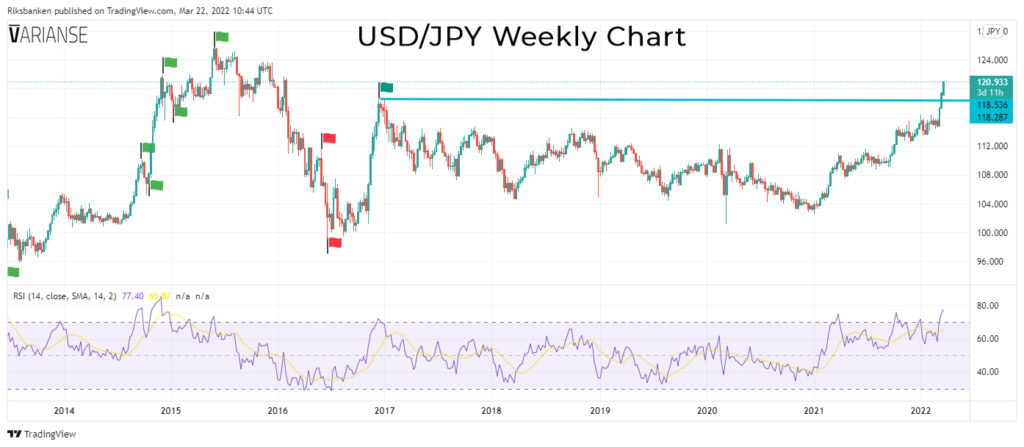
Nevertheless, USD/JPY's latest heights, if sustained, mark a big structural shift in the currency pair. Prior to breaking the above the 118.50 region, once could make a case that the pair was still stuck in a range between the June 2016 swing low of 98.987 and the December 2016 swing high of 118.667. The further price moves away from the latter level leaves less chance of a downside retest and higher probability the pair has entered a longer-term uptrend. To the upside, the 121.50 to 121.75 region looks like the next pivot point for price before reaching 123.00.
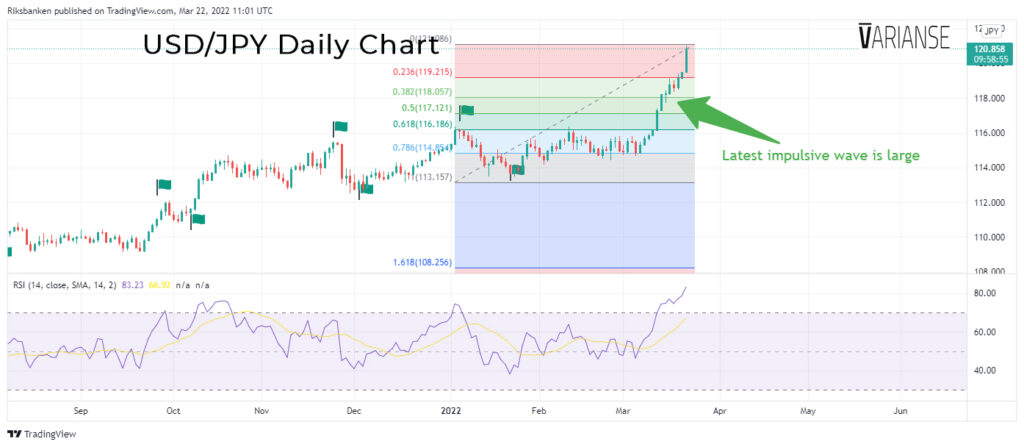
That said, traders who have been late to the party, or even those who have already profited should consider the speed of the latest upswing. The current impulsive move higher already dwarfs the last corrective move lower. Such disharmony in wave patterns could portend a sharp retracement or range-bound conditions ahead, or both. Furthermore, there are also fundamental grounds to consider. First and foremost, in the near term there is only so much scope for the Fed to talk up rate hike expectations.
US 100 Index Rangebound after Upside Move Stalls
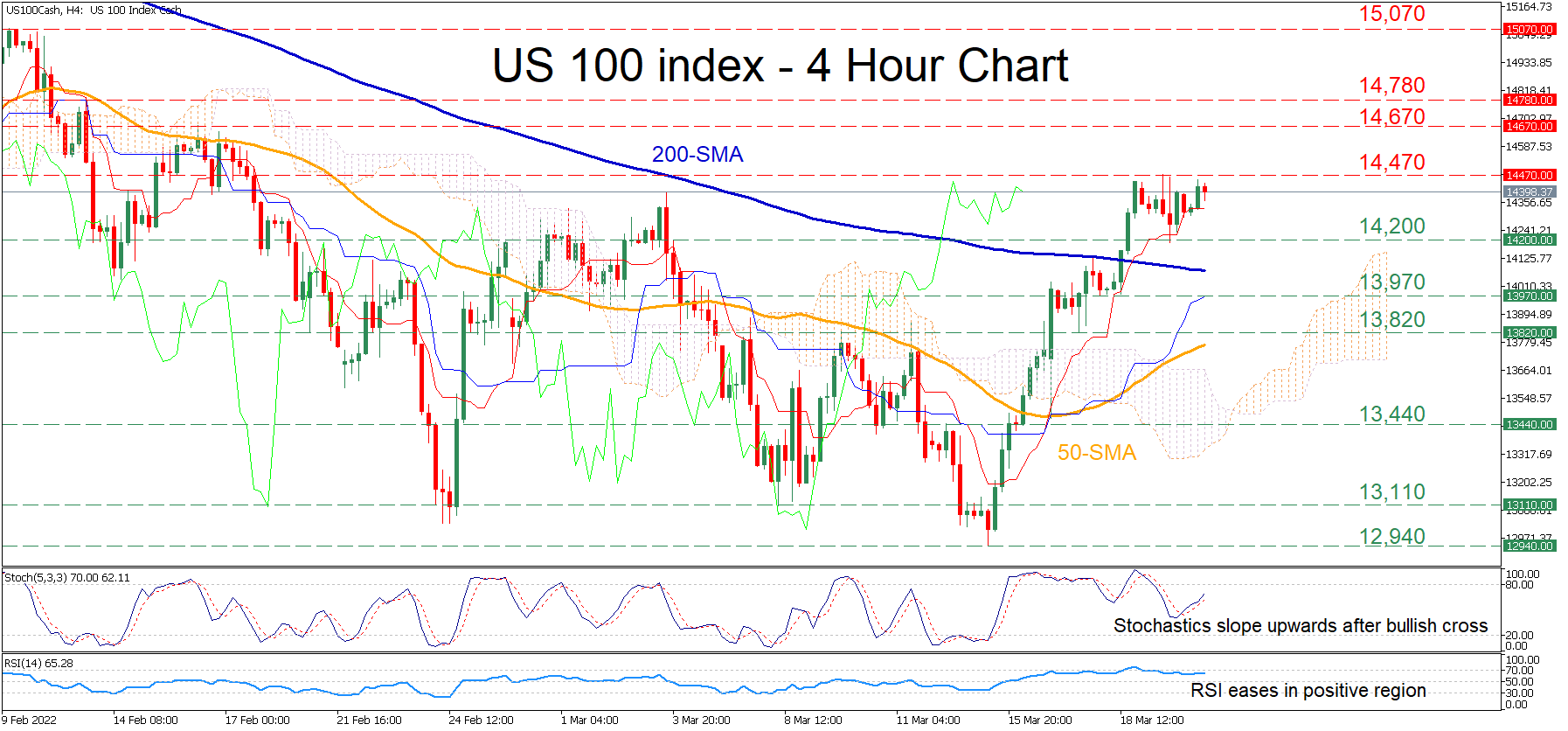
The US 100 stock index (cash) has been recovering on the four-hour chart, managing to erase some of its recent decline. Although the price has been moving sideways in the last few sessions, the ascending 50-period simple moving average (SMA) is closing the gap with the 200-period SMA, where a potential crossover could reinforce the case of a sustained uptrend.
The momentum indicators suggest that bullish forces remain active. The stochastic oscillator is marching higher after posting a bullish cross, while the RSI is hovering above its 50-neutral threshold. Moreover, the price is trading beyond the Ichimoku cloud, endorsing a broader positive short-term picture.
Should the positive momentum intensify, immediate resistance could be encountered at 14,470, which is the upper boundary of the index’s sideways pattern. Crossing above this region, the bulls might target the 14,670 barrier before the price ascends towards the 14,780 resistance region. Piercing through these levels, the spotlight could turn to the February high of 15,070.
On the flipside, if bearish forces regain the upper hand, the index may dip towards its recent low of 14,200. Further downside pressure could send the price to test the 13,970 obstacle. Falling beneath this hurdle, the price decline could halt at 13,820 before the 13,440 barricade appears on the radar.
Overall, the US 100 stock index seems to be consolidating after staging a significant recovery, while near-term risks remain tilted to the upside. Therefore, a clear jump above the 14,470 ceiling could attract further buying interest, signaling the continuation of the recent rebound.
XAU/USD Outlook: Gold Weighed Down by Hawkish Powell, Key Supports at $1900 Zone Eyed
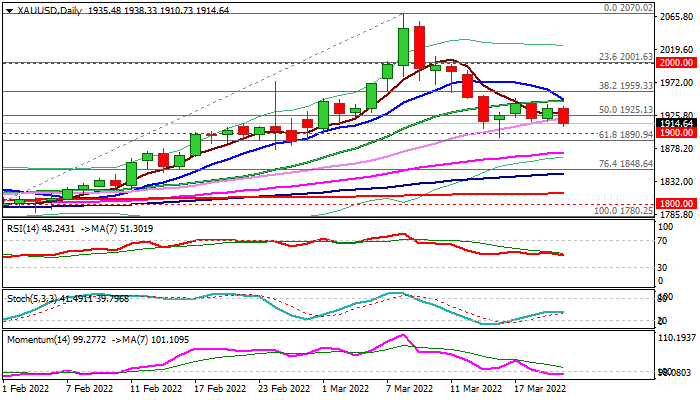
Spot gold stands at the back foot following comments from Fed Chair Powell, which signal hawkish approach in tackling soaring inflation and lifted dollar.
The metal’s price moved towards the lower boundary of the range (($1894/$1949) that extends into fifth day, signaling that expectations of more aggressive approach from the US central bank remain dominant dollar driver, offsetting gold supportive factors from dark outlook about the Ukraine crisis.
Daily studies add to bearish near-term view, as momentum continues to move deeper into negative territory and RSI is heading south below neutrality zone, while daily Tenkan-sen and Kijun-sen formed a bear cross.
Fresh bears may attack again key $1900 zone (psychological/Mar 16 low at $1894/Fibo 61.8% of $1780/$2070 rally at $1890), with clear break here to further weaken near-term structure and signal extension of pullback a multi-month high at $2070.
Rising 55DMA marks next support at $1873, followed by the lower 20-d Bollinger band ($1866), violation of which would unmask Fibo 76.4% level at $1848.
Solid resistance is offered by 20DMA at $1948, which should continue to cap and maintain bearish bias.
Res: 1925; 1940; 1948; 1954.
Sup: 1907; 1900; 1894; 1890.
Yen Slides on Powell, Kuroda Comments
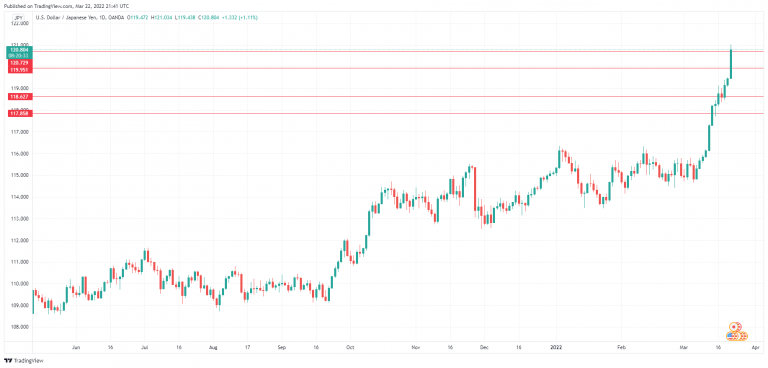
The Japanese yen’s downswing is turning into a rout. USD/JPY has climbed a massive 1.16% today and briefly punched across the 121 line earlier in the day.
Yen’s slide continues
The yen has extended its losses in what has become a miserable March for the currency. USD/JPY has shot up 5.07% this month and has breached the 121 level for the first time since February 2016. The yen took a double-punch on the chin from Fed Chair Powell and BoJ Governor Kuroda, with Powell sending a hawkish message to the markets while Kuroda was dovish.
Fed Chair Powell surprised the markets with an aggressive tone, saying that the Fed could raise rates more aggressively in order to contain inflation if needed. Powell went straight to the point saying, “The labor market is very strong, and inflation is much too strong”. Powell didn’t stop there, as he added that the Fed would not hesitate to implement 50-basis point increases at future meetings if necessary.
Meanwhile, BoJ Governor Kuroda told parliament it was premature for the Bank to debate exiting its loose policy and that it would continue to purchase ETFs as needed. Kuroda said that the Bank needed to “patiently maintain our powerful monetary easing” in the face of rising inflation.
The comments from Powell and Kuroda have widened the US/Japan rate differential and sent the yen tumbling lower. US Treasury yields rose on Monday to their highest level since 2019 and the upswing has continued on Tuesday, with the 10-year Treasury yield rising to 2.34%. With the yen being extremely sensitive to the rate differential, a further rise in US yields will spell more trouble for the yen, which could move towards 123.00 or even 125.00. Japan’s Finance Ministry is monitoring the dropping yen but is unlikely to intervene in the currency markets unless the yen’s movement becomes noticeably disorderly.
USD/JPY Technical
- USD/JPY has broken through resistance at 120.72. Above, there is resistance at 122.04
- There is support at 118.62 and 117.84
GBP/JPY Mid-Day Outlook
Daily Pivots: (S1) 156.63; (P) 157.08; (R1) 157.77; More...
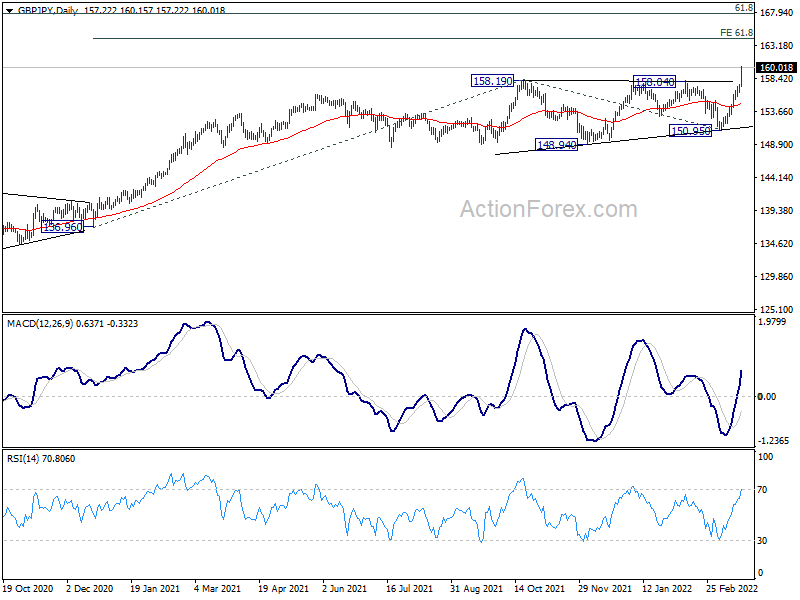
GBP/JPY's firm break of 158.19 resistance confirms resumption of larger up trend from 123.94. Intraday bias stays on the upside. Next target is 61.8% projection of 136.96 to 158.19 from 150.95 at 164.07. On the downside, below 157.48 minor support will turn intraday bias neutral and bring consolidations first, before staging another rally.
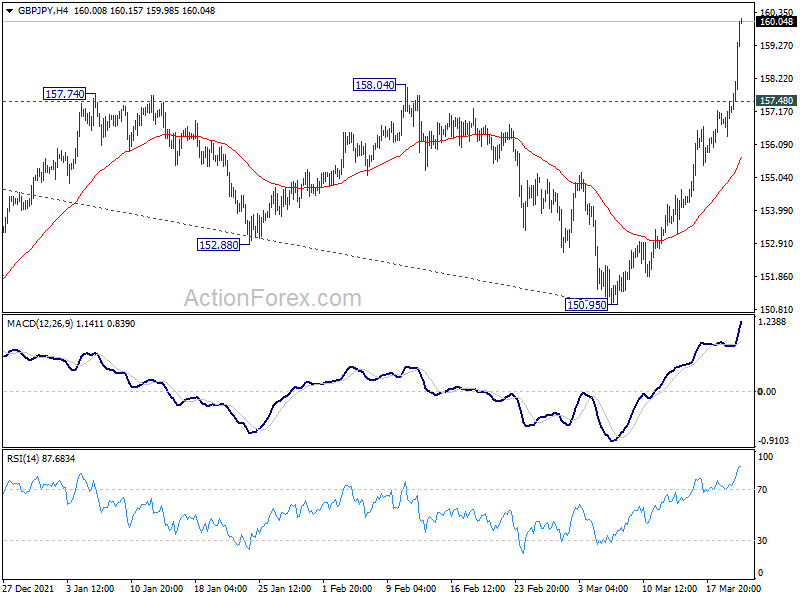
In the bigger picture, up trend from 123.94 (2020 low) should still be in progress, and notable support from 55 week EMA affirms medium term bullishness. Next target is 61.8% retracement of 195.86 to 122.75 at 167.93. This will now remain the favored case as long as 148.94 support holds.
EUR/GBP Mid-Day Outlook
Daily Pivots: (S1) 0.8346; (P) 0.8381; (R1) 0.8401; More...
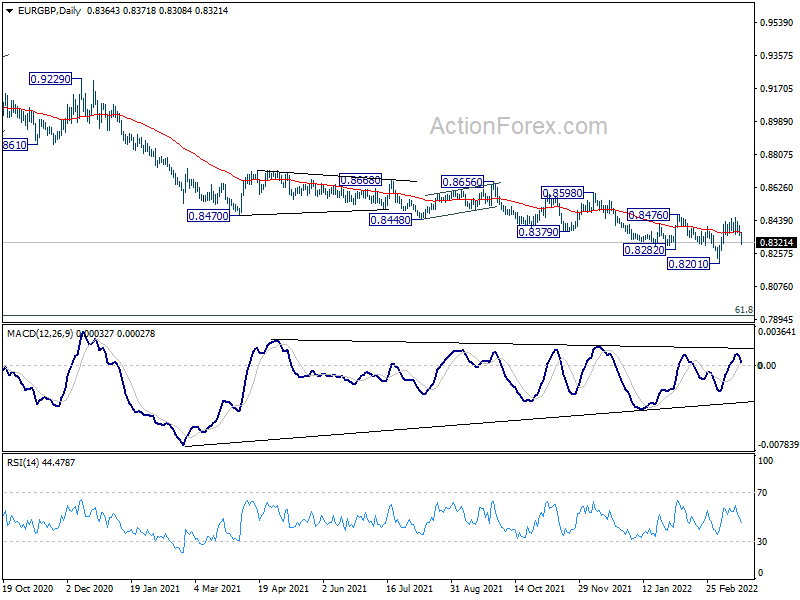
EUR/GBP's break of 0.8358 minor support suggests that rebound from 0.8201 has completed at 0.8456, ahead of 0.8476 resistance. Intraday bias is back on the downside for retesting 0.8201 low. Break there will resume larger down trend. On the upside, firm break of 0.8476 structural resistance will carry larger bullish implication and target 0.8598 resistance next.
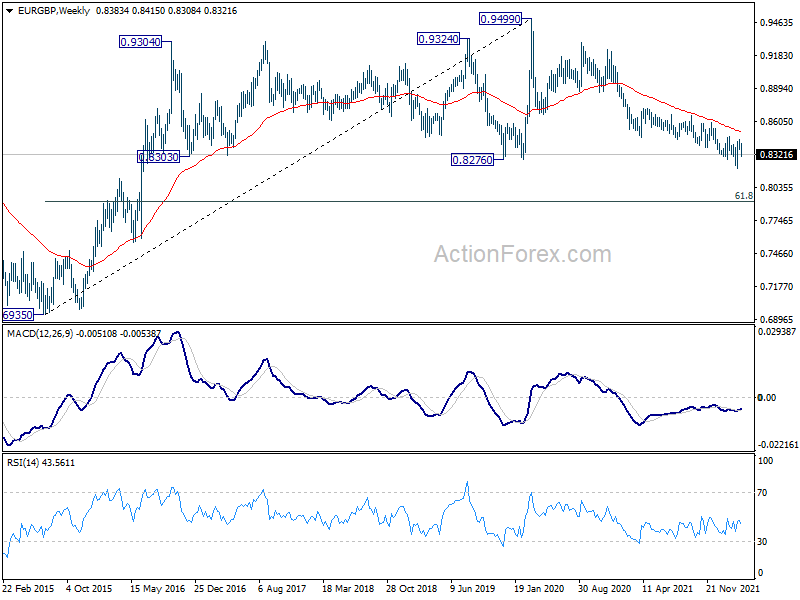
In the bigger picture, the down trend from 0.9499 is expected to continue as long as 0.8476 resistance holds. Sustained trading below 0.8276 support will argue that the whole up trend from 0.6935 (2015 low) has reversed. Deeper fall should be seen to 61.8% retracement of 0.6935 to 0.9499 at 0.7917 next. However, firm break of 0.8476 will indicate medium term bottoming at least. Focus will be back on 55 week EMA (now at 0.8523) for more evidence of bullish reversal.
AUD/USD Mid-Day Report
Daily Pivots: (S1) 0.7374; (P) 0.7400; (R1) 0.7425; More...
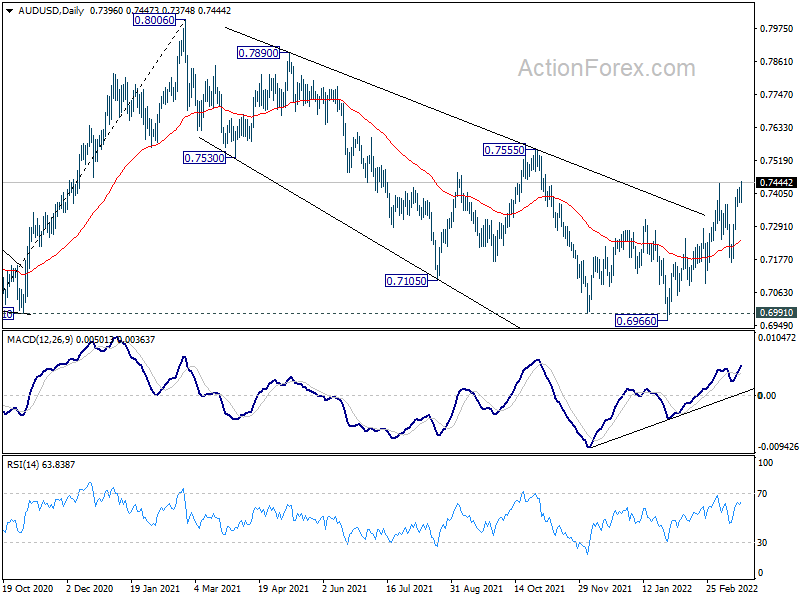
AUD/USD's break of 0.7440 resistance indicates resumption of rebound from 0.6966. Intraday bias is back on the upside for 0.7555 resistance. Decisive break there should confirm that whole corrective decline from 0.8006 has completed at 0.6966. On the downside, below 0.7372 minor support will turn intraday bias neutral again. But overall, further rise is still expected as long as 0.7164 support holds.
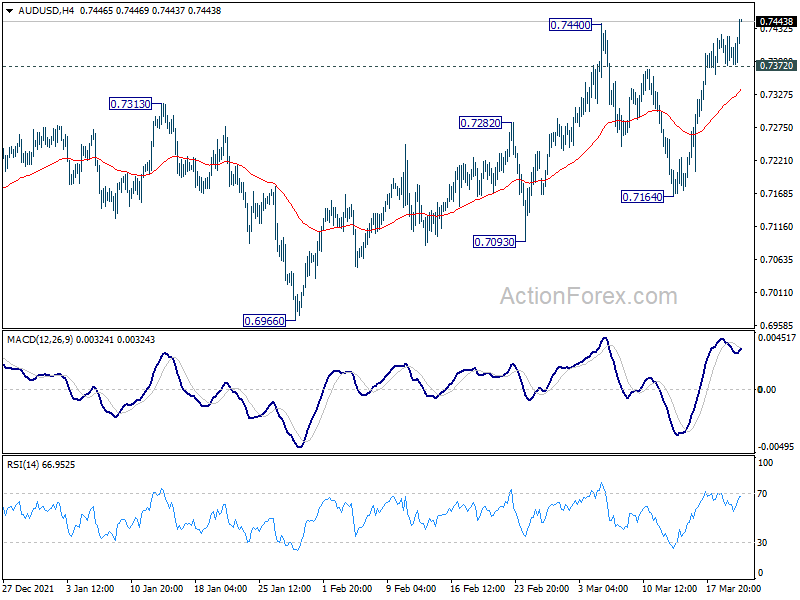
In the bigger picture, focus remains on 0.6991 key structural support. Sustained break there will argue that the whole up trend from 0.5506 might be finished at 0.8006, after rejection by 0.8135 long term resistance. Deeper decline would then be seen back to 61.8% retracement of 0.5506 to 0.8006 at 0.6461. Meanwhile, strong rebound from 0.6991 will retain medium term bullishness. That is, whole up trend from 0.5506 is still in progress for another rise through 0.8006 at a later stage.
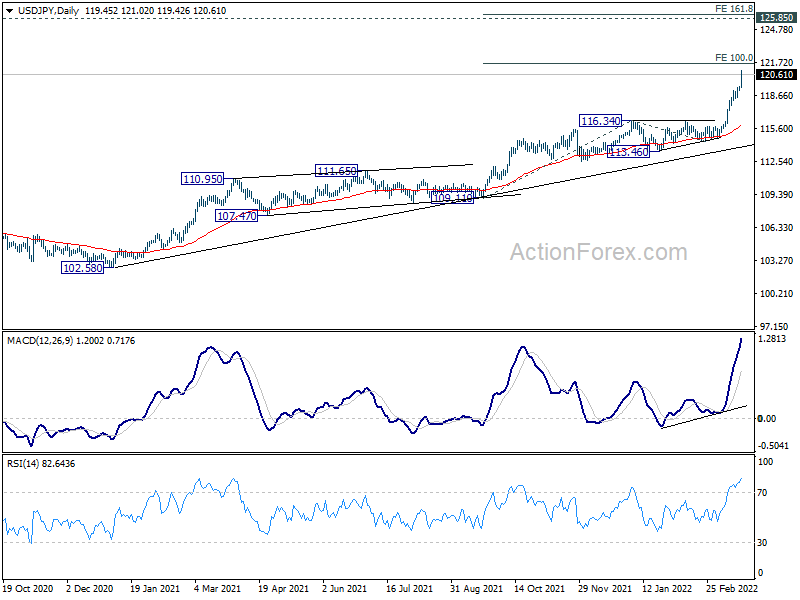
USD/JPY Mid-Day Outlook
Daily Pivots: (S1) 119.21; (P) 119.36; (R1) 119.61; More...
Intraday bias in USD/JPY remains on the upside at this point. Current up trend should target 100% projection of 109.11 to 116.34 from 114.40 at 121.63 next. On the downside, below 119.28 minor support will turn intraday bias neutral and bring consolidation. But downside should be contained well above 116.34 resistance turned support to bring another rally.
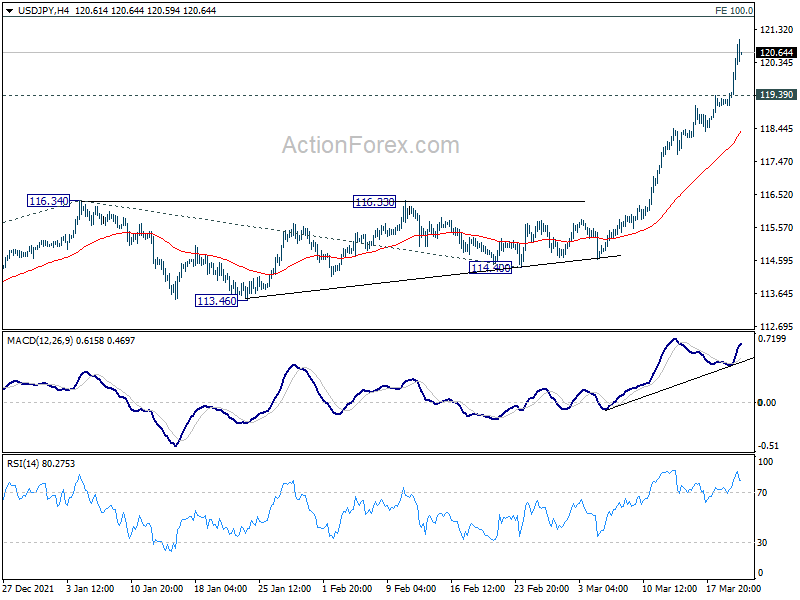
In the bigger picture, the break of 118.65 resistance (2016 high) suggest that up trend from 98.97 (2016 low) is resuming, with rise from 101.18 (2020 low) as the third leg. Medium term outlook will remain bullish as long as 113.46 low. Sustained trading above 118.65 will pave the way to 125.85 (2015 high).