

Sample Category Title
(FED) Federal Reserve Issues FOMC Statement
Indicators of economic activity and employment have continued to strengthen. Job gains have been strong in recent months, and the unemployment rate has declined substantially. Inflation remains elevated, reflecting supply and demand imbalances related to the pandemic, higher energy prices, and broader price pressures.
The invasion of Ukraine by Russia is causing tremendous human and economic hardship. The implications for the U.S. economy are highly uncertain, but in the near term the invasion and related events are likely to create additional upward pressure on inflation and weigh on economic activity.
The Committee seeks to achieve maximum employment and inflation at the rate of 2 percent over the longer run. With appropriate firming in the stance of monetary policy, the Committee expects inflation to return to its 2 percent objective and the labor market to remain strong. In support of these goals, the Committee decided to raise the target range for the federal funds rate to 1/4 to 1/2 percent and anticipates that ongoing increases in the target range will be appropriate. In addition, the Committee expects to begin reducing its holdings of Treasury securities and agency debt and agency mortgage-backed securities at a coming meeting.
In assessing the appropriate stance of monetary policy, the Committee will continue to monitor the implications of incoming information for the economic outlook. The Committee would be prepared to adjust the stance of monetary policy as appropriate if risks emerge that could impede the attainment of the Committee's goals. The Committee's assessments will take into account a wide range of information, including readings on public health, labor market conditions, inflation pressures and inflation expectations, and financial and international developments.
Voting for the monetary policy action were Jerome H. Powell, Chair; John C. Williams, Vice Chair; Michelle W. Bowman; Lael Brainard; Esther L. George; Patrick Harker; Loretta J. Mester; and Christopher J. Waller. Voting against this action was James Bullard, who preferred at this meeting to raise the target range for the federal funds rate by 0.5 percentage point to 1/2 to 3/4 percent. Patrick Harker voted as an alternate member at this meeting.
Yen in the Firing Line as BoJ Set to Stick to Stimulus as Others Exit
The Bank of Japan will round up this week’s central bank decisions on Friday but is unlikely to follow in the footsteps of the Federal Reserve and Bank of England by raising interest rates. Although consumer prices in Japan are soon set to surge on the back of the jump in global energy prices, BoJ Governor Haruhiko Kuroda has signalled this does not change anything on the policy front in Japan. It’s no wonder therefore that the yen is tumbling, particularly against the US dollar, in spite of heightened geopolitical risks, as it’s becoming increasingly difficult for investors to ignore the widening policy divergence.
Inflation only just firing up
The latest inflation data due on Friday is expected to show Japan’s core consumer price index rose by an annual rate of 0.6% in February – a figure that is a far cry from the 5% plus readings in most other advanced economies. However, the subdued picture isn’t anticipated to last much longer as it’s almost certain that the rally in energy and other commodity prices will push up inflation to above the 2% target over the coming months.
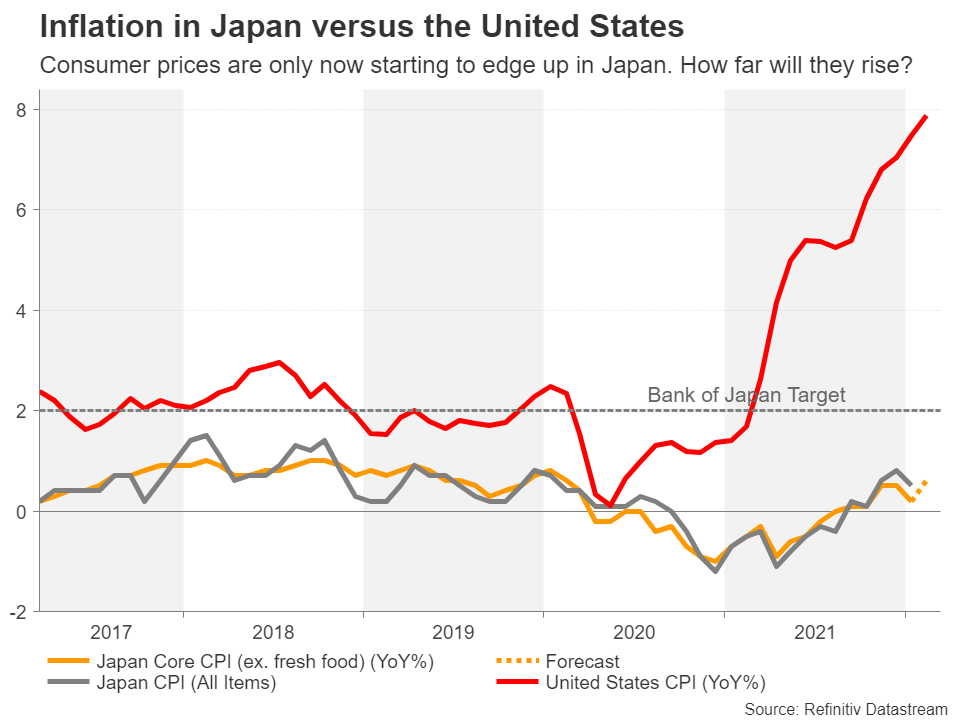
Japan is not only a big net importer of oil and petroleum products, but the country’s manufacturers also rely heavily on imports for most of their raw materials. Hence, the pain on businesses as well as on households is expected to be quite acute and is why the Bank of Japan is more worried about the economic impact of the war in Ukraine than the inflationary effects, especially as GDP has yet to completely recover from the pandemic.
The ‘wrong type’ of inflation
Specifically, Japan is about to be hit by the wrong type of inflation and Kuroda has already ruled out tightening monetary policy solely on the back of cost-push factors. Like his Australian counterpart, Kuroda thinks it’s vital that wage growth rises to 3% so that inflation can meet the Bank’s 2% objective sustainably.
Although there has been some pickup in wage deals lately, employers have mostly been compensating their workers through bonuses rather than increasing regular salary levels. Even in countries such as Britain and the United States where there has been a substantial acceleration in wage growth, real salaries are being depressed by the surge in living costs. Thus, achieving this goal remains quite far off for the Bank.
Will the BoJ have to do a U-turn?
But as the BoJ sticks to the script and keeps policy unchanged on Friday, there are some risks to this stance and policymakers may yet have to perform an embarrassing U-turn like the ECB did recently. For one, with the effect of soaring energy prices yet to fully transpire in fuel bills, it’s hard to predict accurately how high CPI will rise and for how long it will remain elevated thereafter.
The other danger is that the Japanese yen is coming under pressure from both the diverging monetary policy paths of the BoJ with the other major central banks as well as the deterioration in Japan's trade deficit due to the increasing cost of energy and commodity imports. A weaker yen would only worsen the impact of the energy crisis by making imports even more expensive.
Yield curve control might be tweaked
It’s plausible therefore that the BoJ won’t have to wait as long as it’s implying it will before it takes initial steps towards normalizing policy. Those steps could even come at the next meeting in April when the Bank will have updated quarterly projections and there will be more data on how much damage the conflict between Russia and Ukraine is inflicting on the Japanese economy.
The easy option for policymakers to combat a depreciating currency and spiralling inflation is to widen the yield band for 10-year government bonds. As part of its yield curve control policy, the BoJ targets a band of plus or minus 25 basis points around zero. Setting a wider cap would allow the 10-year yield to rise much higher, effectively boosting the yen by narrowing the yield spread with other sovereign bonds.
Dollar eyeing 120 yen
Should Kuroda acknowledge the upside risks to inflation and hint that adjusting the yield target is on the cards, dollar/yen could fall back towards the 117 level. Breaching this support could see the pair revisiting the 116.35 region.
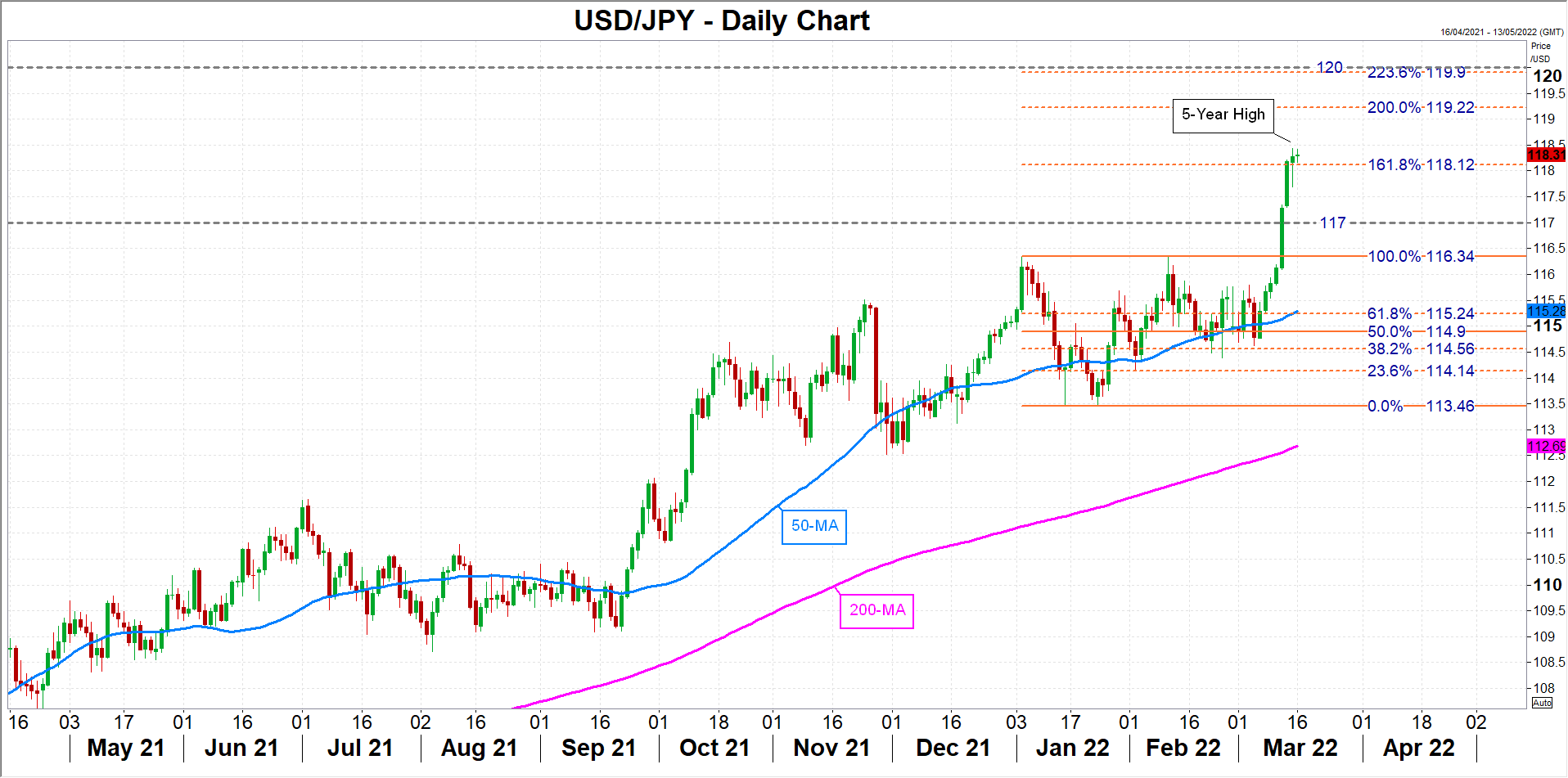
However, if the BoJ reinforces the view that it has not intention of changing policy anytime soon, dollar/yen could extend its recent gains that have lifted it to five-year highs, climbing towards the 200% Fibonacci extension of the January downtrend at 119.22 before aiming for the 120 handle, which lies slightly above the 223.6% Fibonacci.
GBPAUD Outlook Remains Bearish Despite the Recent Rebound
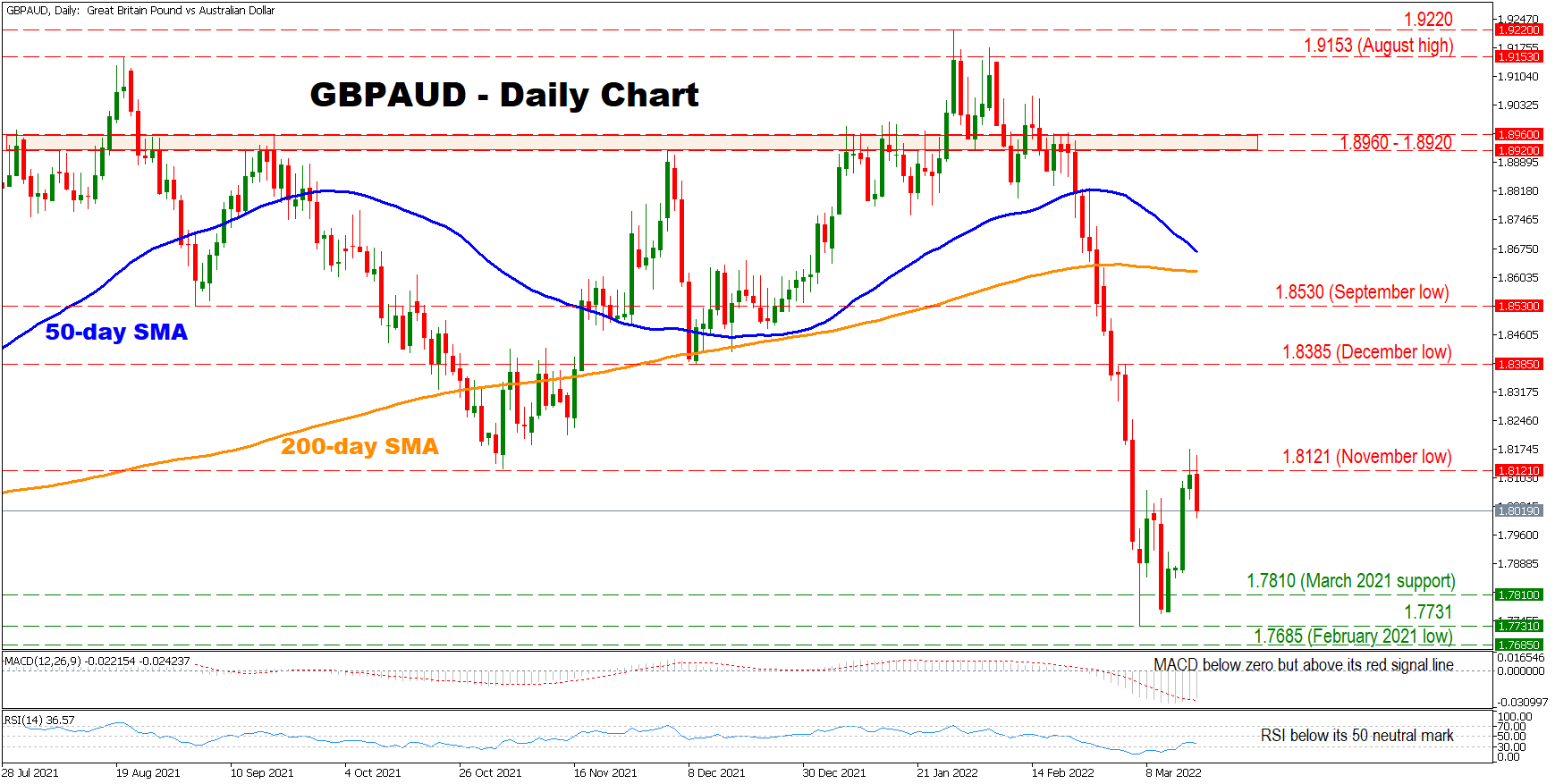
GBPAUD has recorded extreme losses during the past few weeks, reaching a 12-month low at 1.7731. Since then the pair has witnessed a minor rebound as the negative pressures seem to be cooling off. However, the 50-day simple moving average (SMA) looks ready to cross below the 200-day SMA, reinforcing the thesis of a sustained bearish outlook.
Short-term momentum indicators reflect a mixed picture as the RSI is steady below its 50 neutral mark. Nevertheless, the MACD has recently crossed above its red signal line despite being below zero, which indicates that the negative momentum in the price might be fading.
Should the negative pressures persist, initial support might be found at the March 2021 support at 1.7810, before sellers target the 1.7731 hurdle. Crossing below the latter could intensify selling pressures, opening the door towards the February 2021 low of 1.7685.
On the contrary, if the bulls manage to break above the 1.8121 level, the next line of resistance might be the December low at 1.8385. Crossing above this point could then pave the way towards the 1.8530 barrier, before buyers eye the 200-day SMA currently at 1.8617.
In brief, despite the recent uptick of the past few trading sessions, the overall outlook for the pair remains bearish. For sentiment to change, buyers would need to drive the price above the 200-day SMA.
BoE Policy Meeting: Rate Hike Imminent But What’s Next?
The Bank of England (BoE) is largely expected to follow the Fed’s footsteps on Thursday, announcing its third rate hike in a row (12:00 GMT). While the rate decision itself could have a negligible impact on the pound, the central bank’s outlook on future policy steps could trigger the next round of volatility.
BoE to hike rates as inflation expectations soar
The rate hike cycle is already well underway in the UK, with the Bank of England having raised interest rates twice by 25bps so far this year, while a third increase to a pre-pandemic level of 0.75% on Thursday is a done deal according to futures markets. The issue here is that another rate increase could do little to cool inflation towards the central bank’s 2.0% target, even though adjusting borrowing costs is a more effective tool for central banks to balance price swings. But the world is not living in normal times. Following the pandemic’s supply distortions, the unexpected war in the Ukraine and the severe sanctions against Russia could create additional international inflation spillovers not only in the energy sector but also in the food industry and in manufacturing.
Of course, the UK is itself a significant producer of crude and petroleum products and has a diverse range of suppliers beyond Russia, including Norway, the Netherlands, Saudi Arabia and the US, and therefore could manage any energy shortage more efficiently than its European peers. Yet, the same cannot be said for its financial industry, which has a larger exposure to Russian oligarchs, who face new sanctions by the day.
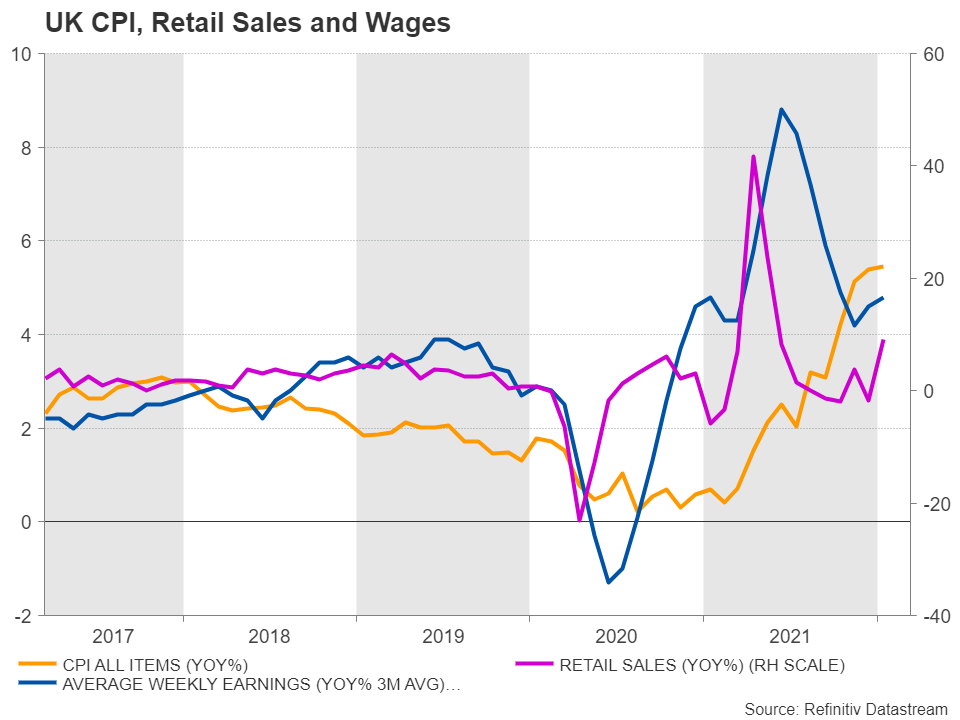
Some investors believe that inflation could peak at 8.0% y/y next month, which is even higher from the latest 30-year high of 5.5% as of February. Hence, the central bank will need to do more to meet its price mandate. Futures markets are pricing approximately 166 basis points of monetary tightening in total for this year, which is equivalent to at least six 25 bps rate increases and there are only six meetings left in the remainder of the year. That suggests there is still room for an aggressive 50 bps rate action, which policymakers avoided during February’s meeting as only four out of nine voted for the larger rate hike.
What to look in the new policy statement
Perhaps the uncertain geopolitical crisis and the risks surrounding the UK’s financial system could once again kill the case for a 50bps rate rise this week, though whether the central bank will ever meet the aggressive rate pricing this year could be challenging to predict. Without Sunak’s additional fiscal support, and with payroll taxes jumping next month for high and middle earners, consumers could face a big squeeze in their living standards, making a recession possibly imminent.
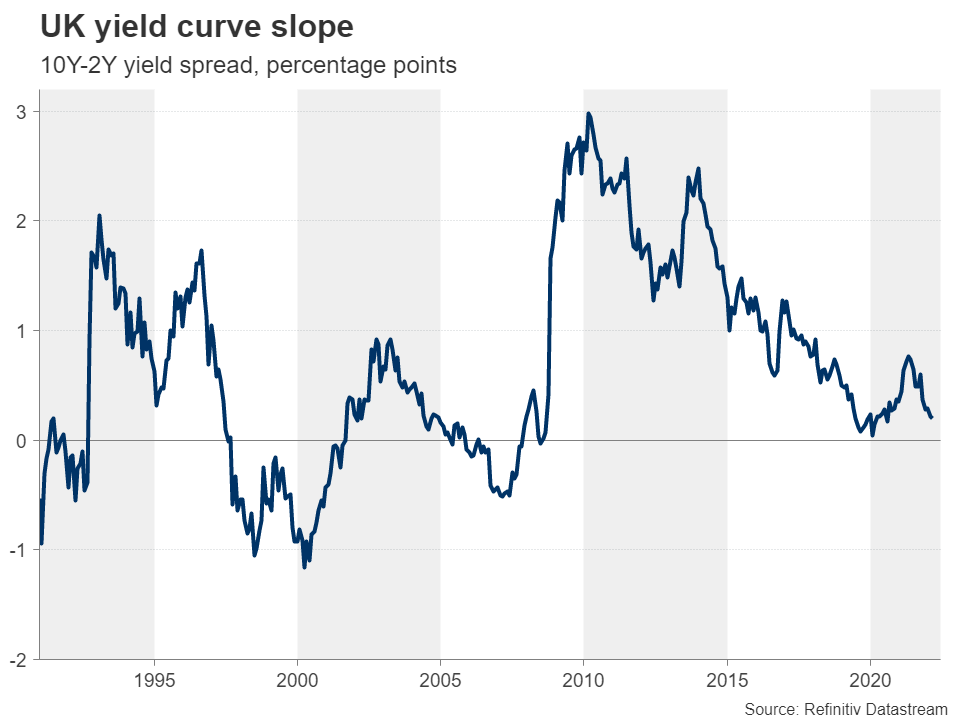
Of course, the central bank could sacrifice some economic growth to fight inflation in the next few months, though the deeper the economic recession becomes, the more feasible it will be for policymakers to push back against the aggressive rate pricing. The negative slope in the 10-year and 2-year government bond yield spread signals that the tightening cycle could be soon nearing an end. Perhaps that will be more clear during the coming months when fresh inflation and GDP data come out, and hopefully the dust in Ukraine settles down. Nevertheless, traders will be eagerly waiting to see if the 50bps camp of policymakers has narrowed this week, and whether policymakers have put greater emphasis on a potential negative financial shock than on inflation. Traders will also be looking for any indications about how willing the central bank is to accompany its rate hike cycle with a gradual balance sheet reduction (quantitative tightening) when rates reach 1.0%.
Pound hopes for a hawkish policy meeting
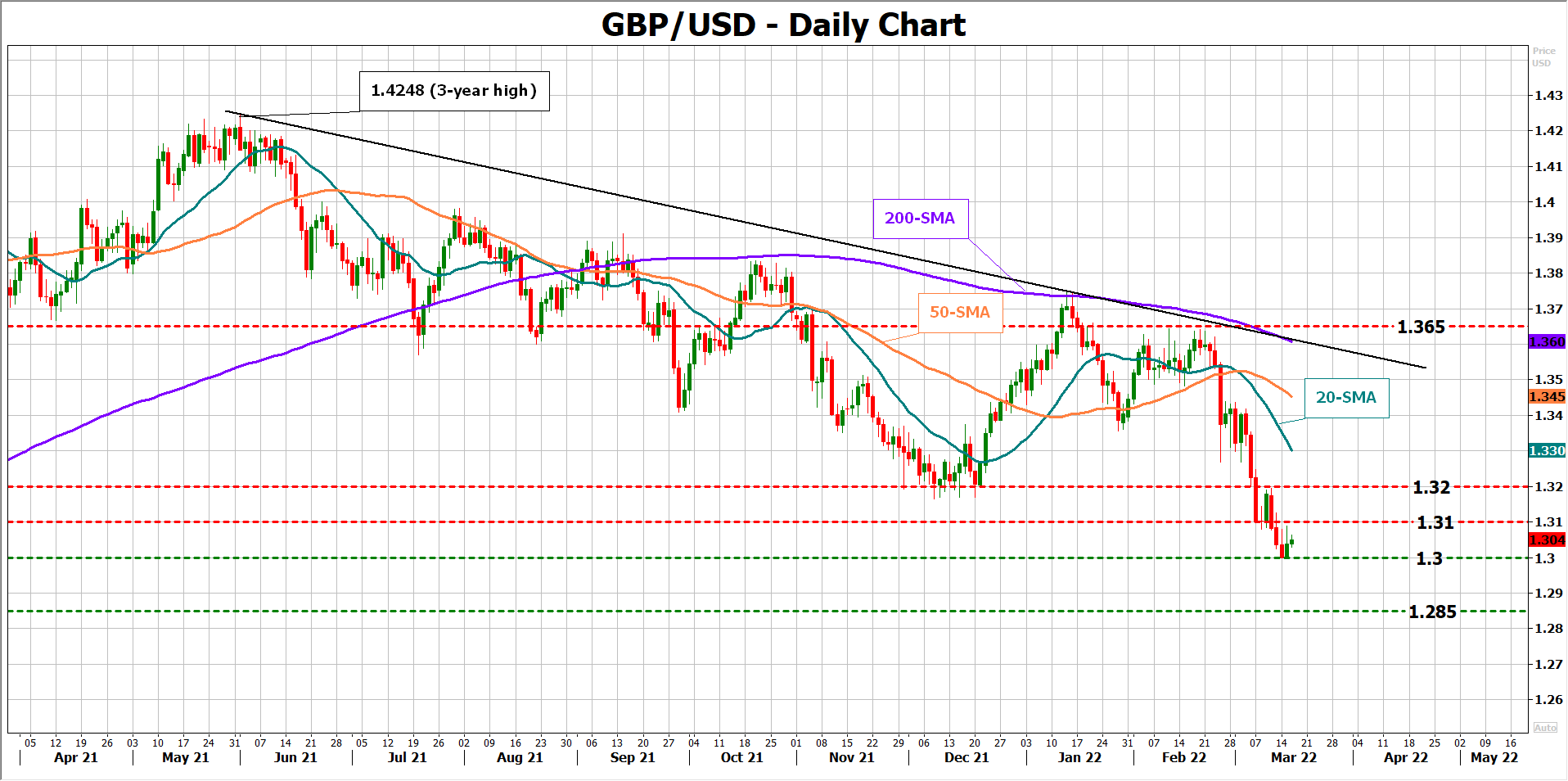
Turning to FX markets, the pound has tumbled by almost 3.0% against the US dollar, erasing December’s rally to mark a 16-month low around the 1.3000 level. A weaker currency could make the inflation situation worse. Therefore, the central bank could preserve some hawkishness to add some floor under the currency. That could occur if it acknowledges the economic jitters from Ukraine but prioritizes its inflation mandate, saying that it will stick to its steady rate hike cycle for now. If that turns out to be the case, pound/dollar will need to climb back above the 1.3100 level to gain more buying traction. The 1.3200 mark could be the next target, though for a medium-term outlook improvement, a sharper rally above 1.3650 is required.
Alternatively, if the BoE raises caution about a deteriorating economic backdrop, signaling a potential slowdown in the tightening path, pound/dollar could slide below 1.3000 to test the 1.2850 support from October 2020. A hawkish FOMC policy decision could also trigger a bearish correction in the pair earlier on Wednesday.
Sunset Market Commentary
Markets
Markets usually tend to stick to the sidelines ahead of important events. That event today is of course the Fed policy meeting. However, there was absolutely no such calm before the storm. Early sentiment was boosted by China’s pledge to stabilize markets in the form of supportive (fiscal and monetary) policies. Chinese bourses surged up to 12%!
Optimism was fueled further in the European session after Kremlin spokesman Peskov saying the Ukrainian proposal to become a neutral country but with its own armed forces “could be viewed as a certain kind of compromise”. The FT later reported “significant progress” was made on a tentative 15-point peace plan that includes a ceasefire and Russian withdrawal if Ukraine declares neutrality and accepts caps on its armed forces.
Equities pop higher with gains in Europe building to 4% and 3% in the US. Core bonds are under selling pressure. German yields advance +4.8 bps (2y) to 5.2 bps in the 10y yield. The latter is testing the 0.40% resistance level, formed by the 76.4% recovery of the 2018-2020 decline. The European 10y swap yield (1.04%, +2 bps) sniffed at resistance of 1.09% (2018 correction highs). US Treasuries outperform and add 1-3 bps across the curve.
US retail sales came in mixed with mostly disappointing figures for the reference month (February) but with material revisions to the January reading. The control group – the most indicative gauge for household consumption in GDP calculations – fell 1.2% m/m after having risen a strong 6.7% in January. Its market impact was understandably limited if not non-existent.
The dollar on FX markets stayed in the defensive ahead of the Fed. Some nervousness may play its part but its most likely the result of the outright risk-on. EUR/USD rose ¾ of a big figure to trade above 1.10 currently. The Japanese yen is being sold as well, especially vis-à-vis the euro. EUR/JPY jumps above 130 for the first time since end February.
The Swedish krone is outperforming major peers after Riksbank governor Ingves as last of the Mohicans threw in the towel. He said the central bank will probably have to raise rates earlier than the 2024 it incorporated in its analyses until now. Ingves didn’t want to rule out the first hike happening in 2022. The Swedish krone soars from EUR/SEK 10.61 to 10.39 in the biggest one-day strengthening move since 2009.• Going into the Fed meeting tonight, we’d like to give you the three main elements to keep a close eye on:
- Policy rate: it is all but certain the central bank will raise policy rates for the first time since 2015. After tonight, the US fed fund target will stand at 0.25%/0.50%, coming from 0%/0.25%.
- Dot plot: the individual policy rate assessment by Fed governors holds valuable information. How many rates can we expect this year, and more in general, over the policy horizon? US money markets have priced in (more than) 7 hikes for this year. We’re also keen to find out whether a majority of governors expect the policy rate to be above the neutral rate – seen at 2.50%. This would imply policy turns restrictive rather than “less accommodative”.
- Balance sheet roll-off: tonight’s meeting may be too soon still for a formal blueprint of the balance sheet roll-off. Powell said these discussions may take “several meetings”. That said, we keep our eyes and ears open for any hints regarding the matter.
News HeadlinesCanadian consumer prices rose by 1% M/M in February from 5.1% Y/Y to 5.7% Y/Y (vs 5.5% expected), the highest level since August 1991. Price increases were broad-based in February, pinching the pocketbooks of Canadians. Excluding gasoline, CPI rose by 4.7% Y/Y from 4.3% Y/Y in January. Details showed the largest yearly increase since May 2009 in food prices (7.4% Y/Y) while shelter costs rose at the fastest pace since 1983 (6.6% Y/Y). Statistics Canada announced that it will update basket weights for goods and services used in calculating CPI, adapting to post-Covid Canadian spending methods. The Canadian dollar didn’t react to today’s data release, but nevertheless ekes out nice gains because of the positive risk environment. USD/CAD drops from 1.2775 to 1.27.
Canadian Dollar Rises as CPI Surges
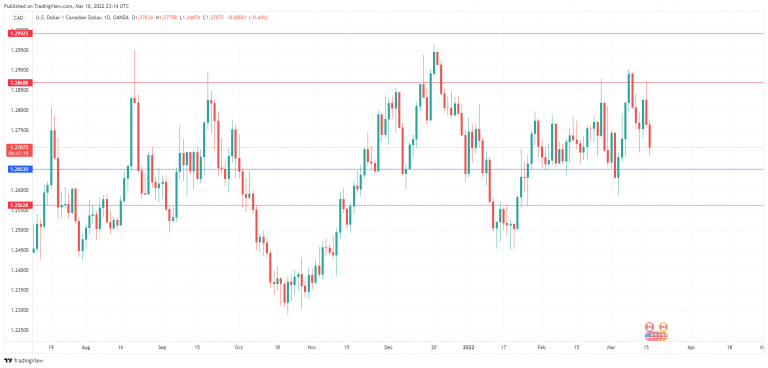
The Canadian dollar has extended its gains into a second day. In the North American session, USD/CAD is trading at 1.2697, down 0.52% on the day.
Canada’s inflation accelerates
Canada’s inflation rate shows no signs of slowing down. Headline inflation rose 5.7% YoY in February, the largest jump since August 1991. This beat the estimate of 5.5% and was higher than the January reading of 5.1%. The Canadian dollar rose on the news, as the surge in inflation bolsters the case for the BoC to continue raising interest rates. Earlier this month, the BoC held off from raising interest rates.
Investors are expecting the Bank of Canada to respond in an aggressive fashion to red-hot inflation. The markets are projecting at least seven rate hikes of 0.25% this year, as the BoC will have to take off the gloves in order to bring inflation down to its target range of one-to-three per cent. The central bank will have to be cautious about the pace of its tightening, however. The CEO of Royal Bank, Dave McKay, has raised concerns the pent-up spending power of consumers could exacerbate inflation without boosting growth, which could lead to stagflation.
The Federal Reserve is widely expected to raise rates by 0.25% at today’s meeting. The Fed has telegraphed its intentions to the markets, but the move is still highly significant, as it marks the first rate increase since 2018. Investors will be combing through the rate statement and the dot plot, as well as Fed Chair Powell’s press conference. In this environment of huge uncertainty, the burning question is what does the Fed have planned next? Today’s move will be a launch for further tightening, but it’s unclear how fast the path to normalization will take. The FOMC is likely to project four hikes in 2022, which is considerably more dovish than the markets, which have priced in seven hikes this year.
USD/CAD Technical
- USD/CAD faces resistance at 1.2835 and 1.2934
- There is support at 1.2612 and 1.2488
US oil inventories rose 4.3m barrels, WTI pull back slows
US commercial crude oil inventories rose 4.3m barrels in the week ending March 100, versus expectation of -1.8m barrels decline. At 451.9m barrels, oil inventories are about -12% below the five year average for this time of year.
Gasoline inventories dropped -3.6m barrels. Distillate rose 0.3m barrels. Propane/propylene dropped -2.2m barrels. Total commercial petroleum inventories dropped -3.6m barrels.
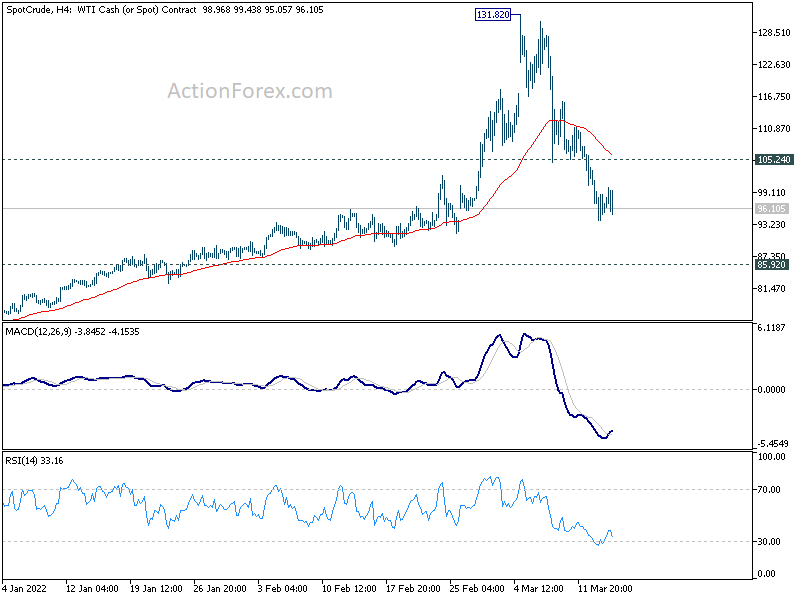
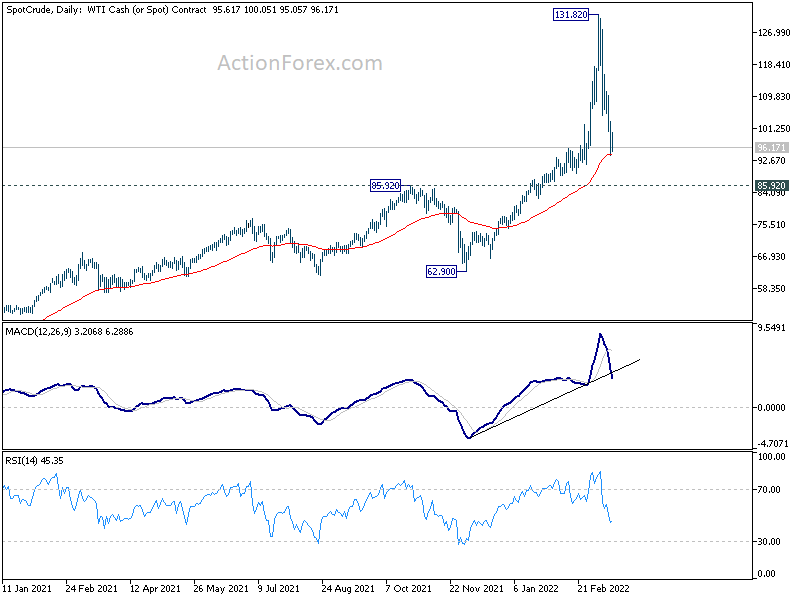
WTI crude oil in hovering in tight range at around 96 after the release. The pull back from 131.82 high was much deeper than expected. But still, it's seen as developing into a corrective pattern for now. Selloff is slowing as it's trying to draw support from 55 day EMA. There is prospect of a rebound from current level. Break of 105.24 minor resistance will indicate that a rebound is underway, back towards 131.82 high.
US: Retail Sales Growth Remains Solid
Retail sales continued to make progress with an increase of 0.3% month-on-month (m/m), just a notch below the consensus estimate for an increase of 0.4%. January's reading was revised up by a more than a full percentage point to 4.9% m/m from 3.8% m/m reported earlier. This makes February's showing stronger than the headline appears.
Sales at autos & parts dealers continued to grow, rising 0.8% m/m even after January's upward revision to 4.6% vs. (5.7% reported earlier). Growth was concentrated in auto dealers, while sales in automotive parts & tire stores declined. Excluding autos, retail sales were up 0.2% m/m.
Sales at gasoline stations were up 5.3% m/m, but most of it is explained by hefty price growth, with gasoline prices up by 6.6% m/m. Building materials retailers saw a gain of 0.9% m/m in February.
Sales in the "control group", which exclude the above categories and are used in calculating personal consumption expenditures (and GDP), were down by 1.2% m/m. However, January's sales were revised to stronger +6.7% m/m from the advance reading of +4.8% m/m.
- Within the group, the biggest contributors to growth were sales at food services & drinking places (+2.5% m/m), miscellaneous stores retailers sporting goods (+1.9% m/m), hobby, book & music stores (+1.7% m/m), clothing & accessory stores (+1.1% m/m).
- The fortunes of non-store retailers reversed this month with a decline of 3.7%, but that's after an upwardly revised gain of 20.6% m/m in January (from +14.5% m/m reported earlier). Another contributor to the decline were health & personal care stores (-1.8% m/m) while all other categories reported marginal losses.
Key Implications
Retail sales continued to grow for the second month even after sizeable revisions in January, setting the first quarter up for another solid gain. Unlike last month, when gains concentrated in ecommerce – consumers' favorite in the time of rising COVID cases, February sales were more diversified, which is a testament to a solid rebound in activity as Omicron waned.
Although sales are reported in nominal terms, we estimate that real sales were actually down by roughly 0.5% month-on-month in February (after a gain of 4.2% m/m in January). Prices had an outsized impact on several categories that saw some of the largest nominal gains during the pandemic. Notably, sales at gas stations and food & beverage stores showed a decline of more than 1% m/m in real terms.
Indeed, we would put the risk of higher inflation on top of the list for future spending growth. We expect price pressures to ease in the second half of the year but recent acceleration of energy and food costs may still have an impact on spending, despite notable progress in employment and sizeable excess savings accumulated during the pandemic. Surely, price growth will take the center stage in the Fed's policy deliberations, which we will report on in a few hours. Stay tuned
Canada: Inflation Hits 5.7% in February, Set to Move Even Higher in March
Consumer price inflation accelerated to 5.7% year-on-year (y/y) in February, up from 5.1% in January, ahead of the consensus forecast for 5.5% and the highest rate in over 30 years.
Energy price growth accelerated to 24.1% (from 23.1% in January), as gasoline price growth hit 32.3% year-on-year (up from 31.7% in January). Food price inflation also moved higher, to 7.4% (from 6.5% in January) – the highest in over decade.
The acceleration in price growth was not just a food and energy story, however. Excluding these categories, inflation was up 3.9% y/y (from 3.4% in January).
Seasonally adjusted, month-on-month prices were up a robust 0.6% for a second straight month. Once again, price growth was broad and swift across categories in February, led by transportation (+1.1%), food (+1.0%), and shelter (+0.6%). Only clothing and footwear pulled back in the month, while price growth was soft for recreation and alcohol and tobacco after strong lifts in January.
All three of the Bank of Canada's core inflation metrics rose in February. CPI-trim rose 0.3 percentage points to 4.3%, CPI-common by 0.2 percentage points to 2.6%, and CPI-median by 0.1 percentage points to 3.5%. At 3.3%, the average of the three measures is the highest since August 1991, the same record as the headline.
Key Implications
Once again inflation has surprised to the upside. The shock is wearing off. The outlook for inflation is clouded by the fog of war. Commodity price volatility has soared in recent weeks. Prices skyrocketed at the outset of the conflict, but have since fallen back. It is difficult to predict with any confidence their path from here, but it will depend in no small part on whether the conflict escalates further or moves toward peaceful resolution.
Even if prices are more staid from here, the impact will be felt in higher inflation in March. Prices are running well ahead of income growth, but with a robust labor market, nominal wage growth is also showing signs of accelerating. That is a good sign for ongoing economic growth but demands attention from a central bank set on guiding inflation back to its 2% target.
Rising commodity prices increase inflation and hurt consumers, but are not necessarily negative for the Canadian economy overall, whose producers benefit from higher prices that are born in part by our trading partners. As such, they should do little to dissuade the Bank of Canada from normalizing monetary policy.
Stocks Rise as Russia’s Stance Softens, Fed in Focus
US stocks are pointing to a strong open as hope of a truce in Ukraine grow, as Beijing pledges more support to the economy and ahead of the Fed rate decision.
US futures
- Dow futures +1.09% at 33924
- S&P futures +1.2% at 4315
- Nasdaq futures +1.71% at 13670
In Europe
- FTSE +1.4% at 7273
- Dax +3.1% at 14353
- Euro Stoxx +3.7% at 3875
Truce hopes build, China brings more stimulus
The US is set to bound higher on the open, adding to solid gains in the previous session as investors grow increasingly optimistic of a diplomatic solution in Ukraine. China pledges more support to the economy and ahead of the Federal Reserve rate decision.
The Kremlin appears to be adopting a softer stance towards Ukraine as the two countries try to find a compromise. Russia would now accept neutrality from Ukraine while allowing it to have its own army, marking a significant shift in position and boosting the chances of a truce being reached.
Chinese ADRs are set for a surge higher on the open as the Chinese central bank and government issued a joint pledge to support the economy and financial markets. The news overshadowed concerns over rising covid cases and fears of delisting in the US.
On the data front, US retail sales rose by a less than expected 0.3%, down from an upwardly revised 4.9% in January and missing the 0.4% forecast.
Fed rate decision
The Fed is expected to raise interest rates by 25 basis points later in the session. This would be the first rate hike since 2018. The market has 100% prices in the hike, so the question is, what comes next – will the Fed prioritise inflation or growth? Any signs that the Fed is adopting a slightly more dovish stance in light of the impact of the Ukraine crisis and Western sanctions, the USD could come under pressure, and stocks could have further to run.
Where next for the Nasdaq?
The Nasdaq is extending its rebound from the 12950 low it reached yesterday. It has retaken its 50 sma and is testing the 100 sma. The RSI is supportive of more gains. A move over the 100 sma exposes 13880 the confluence of the falling trendline resistance and 11th March high. Beyond here, buyers will look for 14000 round number before taking aim at 14400, the March high. On the downside, a move below the 50 SMA at 13470 could negate the near-term uptrend, with support seen at 12950, the 2022 low.

FX markets USD falls, EUR rises, AUD shines
USD is heading lower, tracing yields lower ahead of the Fed rate decision. Falling oil prices are helping to ease inflation fears.
EURUSD is rising amid continued optimism surrounding the Russia, Ukraine cease-fire talks. Progress towards a truce appears to be gathering momentum, boosting the EUR.
AUDUSD the Aussie is rising, outperforming peers, boosted by the improving market mood and on hopes of further stimulus in China. Vice Premier Liu He affirmed that Beijing would bring in more measures to support the Chinese economy.
- GBP/USD +0.4% at 1.3058
- EUR/USD +0.48% at 1.0993
Oil steadies below $100
Oil prices fell 11% over just two days, closing below $100 per barrel for the first time this month. Today prices are holding steady. Hopes of a truce between Russia and Ukraine are helping to ease supply fears.
The price also came under pressure after the International Energy Agency’s monthly report, which showed that it had cut its oil demand forecast for 2022.
Concerns over demand in China are rising as COVID cases spread quickly and 45 million inhabitants are under lockdown restrictions.
The API oil inventory report showed that oil stocks rose by 3.8 million barrels. EIA data is due shortly.
- WTI crude trades +0.2% at $95.26
- Brent trades +0.2% at $98.70
Looking ahead
- 15:30 EIA oil inventory
- 18:00 Fed interest rate decision