

Sample Category Title
Fed is Still Behind the Curve
Market movers today
Markets will continue to digest yesterday's Fed meeting (see below) and watch out for further headlines about a potential ceasefire agreement in Ukraine.
Given high inflation pressures in the economy and rising wage growth, we expect Bank of England to raise policy rates by another 25bp for a third consecutive meeting. Despite the uncertain outlook, markets still envision a rapid pace of tightening this year, with the benchmark rate ending 2022 around 2%.
ECB's Lagarde (10:30 CET), Lane (11:15 CET) and Schnabel (13:45 CET) will speak at today's ECB Watchers Conference. Final HICP figures for February are also due and will give more clues what drove the further rise in core inflation to 2.7%.
After the drop in the Empire Index earlier this week, it will be interesting to see whether today's Philly Fed Index also points to a slowdown in US manufacturing activity in March.
The 60 second overview
Fed: As widely expected, the Federal Reserve hiked the Fed Funds target range by 25 basis points in its meeting last night. The updated 'dot plot' now signals a 25bp hike at every meeting this year, but we still think this is not enough to curb the current broad-based inflationary pressures. Instead, we continue to expect further 175 basis points worth of hikes in 2022, with a 50bp hike in June and announcement on QT in May. Seven of the 16 FOMC members look for at least 175bp worth of hikes this year, while markets price in a total of around 158bp this morning. Powell noted that the war in Ukraine creates uncertainty and additional inflationary pressures. That being said, the Fed is in a situation where it cannot take several factors into account when conducting monetary policy, because inflation is already nearly 8% (the highest in 40 years) and the labour market is "extremely tight", as Powell mentioned. Read our more in-depth take at Fed Research - Review: Fed is still behind the curve despite signalling six further rate hikes, 16 March.
War in Ukraine: While fighting and shelling still continues in Ukraine, yesterday brought some positive signals from the ceasefire negotiations. Russia is said to consider a draft of a peace deal, where Ukraine would maintain its independence and current government, but renounce its push to join NATO and also promise to not host foreign military bases in Ukrainian areas. Markets have seen the developments in the negotiations this week as positive, with equities continuing to rise. There is still considerable uncertainty, though, and for example the implications for the eastern Donbass region and Crimea remain unknown.
Macro: This morning, we published our updated global economic forecasts in Big Picture - Headwinds to the global economy from Ukraine war and Fed tightening, 17 March. The war in Ukraine weighs on growth especially in the Euro Area, but we still expect the global economy to escape a recession. The rising inflation is eroding consumers' purchasing power and thus weighing on growth, and we now see Euro Area GDP growth at 2.5% this year (from 3.8% previously) and 2.8% next year (from 1.9%). Euro Area inflation will continue accelerating in the near-term, with a peak around 8-9% in the coming months. The US economy is better isolated from the crisis, as US generally is a less open economy, and does little direct trading with Russia. We have still taken down our expectation of US growth to 2.8% for 2022 (from 3.5%) and 2.0% for 2023 (from 2.2%), slightly below Fed's median projection released last night. China is walking a fine balance in the Ukraine conflict, and facing further headwinds from the weakening Covid-19 situation. We have thus delayed our expectation of a recovery to H2 this year, and taken down the 2022 GDP forecast to 4.7% (from 5.0%).
Equities: Massive risk-on in equities yesterday kicked off by the "whatever it takes" message from Chinese authorities. Optimism boosted by the neutrality plan to end the war in Ukraine. FOMC meeting gave some intraday setback in US but after digesting the message from Powel, equities took off again and ended at day high. Most beaten sectors in a strong comeback yesterday with consumer cyclicals rising 5%. Best performing sector year to date energy was the only sector lower yesterday. Growth outperformed by 2% value even as yields rose sharply yesterday.
In US Dow +1.6%, S&P 500 +2.2%, Nasdaq +3.8% and Russell 2000 +3.1%. Optimism continuing in Asia this morning driven by Hang Seng, tech and property developers. US futures are flat while European futures are slightly higher this morning.
FI: The European session was range trading with no specific direction reacting to Ukraine headlines while waiting for the FOMC meeting. The clear message from Powell after the 25bp hike yesterday was to tighten financial conditions, with policy rates to be raised above neutral. While Powell suggested a gradual process, the process of tightening could go faster as they remain data dependent, and we could even see balance sheet reduction in May. Rates markets responded with a bearish flattening, with two year US yields up by 9bp to 1.93%, while the 30y point was down by 4bp. With the Fed on course to slow the economy to dampen inflation pressure, curve inversion is in scope. 2s10s USD, 1y fwd swap is already inverted by 22bp (2s10s usd swap is +11bp).
FX: In a V-like price action post Fed's announcement, EUR/USD first declined on higher USD rates but later rebounded on the rally in risk to levels above 1.10. EUR/NOK was little changed while EUR/SEK extended the latest move lower trading below 10.40. USD/JPY temporarily broke 119 but moved back to levels prior to Fed's announcement. EUR/GBP was little changed.
Credit: Due to improving momentum around peace talks between Russia and Ukraine, the credit markets had a strong day yesterday. iTraxx main tightened 5.7bp to 73.4bp while Xover tightened 29.1bp to 347.3bp. We saw similar strong signs from the cash bond market. Also the primary markets revitalised with several new deal announcements.
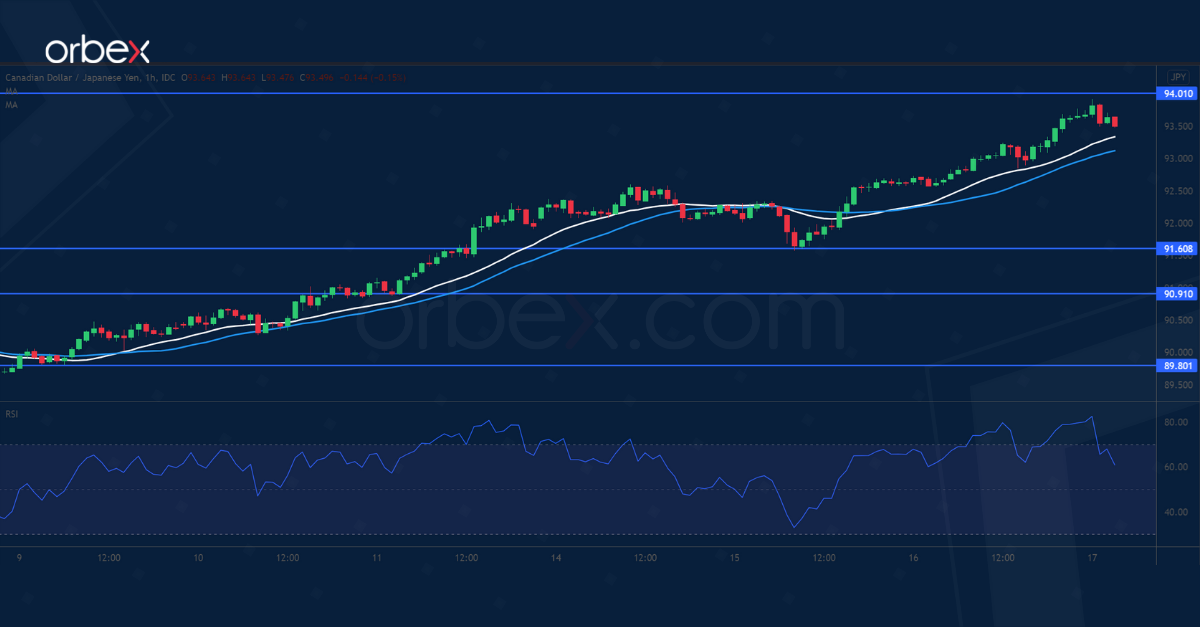
CAD/JPY Breaks Key Resistance
The Canadian dollar shot higher after February’s CPI beat expectations. A break above last October’s high at 93.00 could be an ongoing signal to end a 5-month long consolidation.
The RSI’s double top in the overbought area may temporarily hold the bulls back. As sentiment turns overwhelmingly upbeat, buyers may be eager to jump in at a discounted price.
The supply-turned-demand zone near 91.60 is an important level to safeguard the breakout. The psychological level of 94.00 could see resistance.
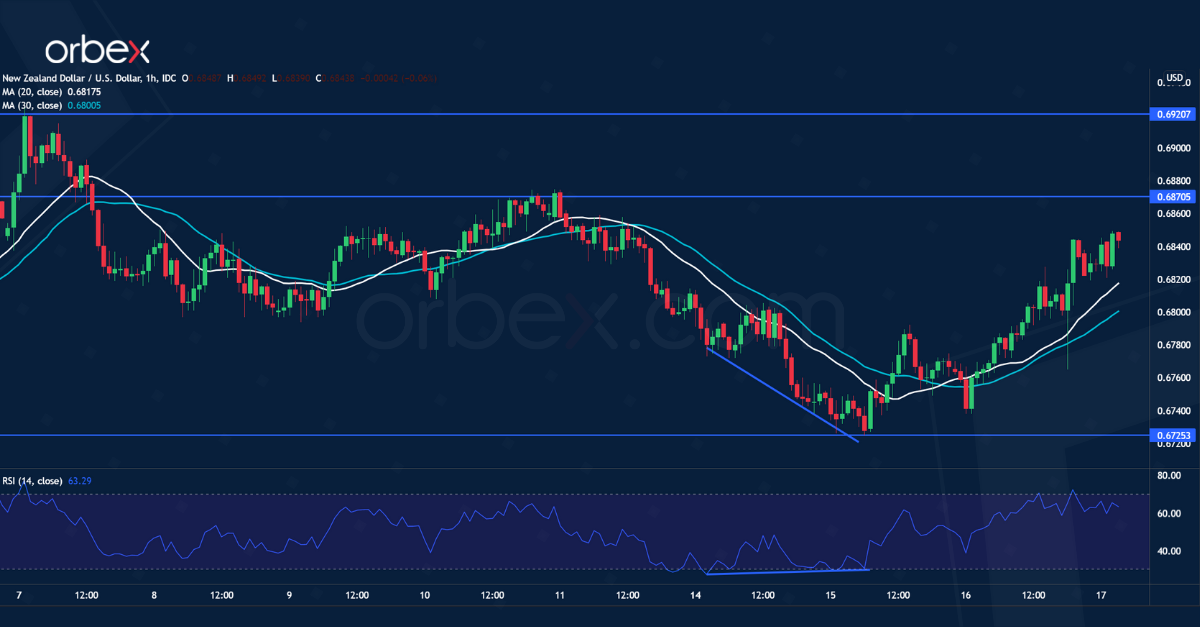
NZD/USD Attempts Rebound
The New Zealand dollar found support from a rebound in commodity prices. The pair saw solid bids in the demand zone around 0.6725 and right over the 30-day moving average.
A bullish RSI divergence showed a deceleration in the pullback, which would have caught buyers’ attention in this congestion area. A close above 0.6800 has prompted short-term sellers to cover and leave the door open for a rebound.
0.6870 is the last major resistance and a bullish breakout could propel the kiwi past the recent peak at 0.6920.
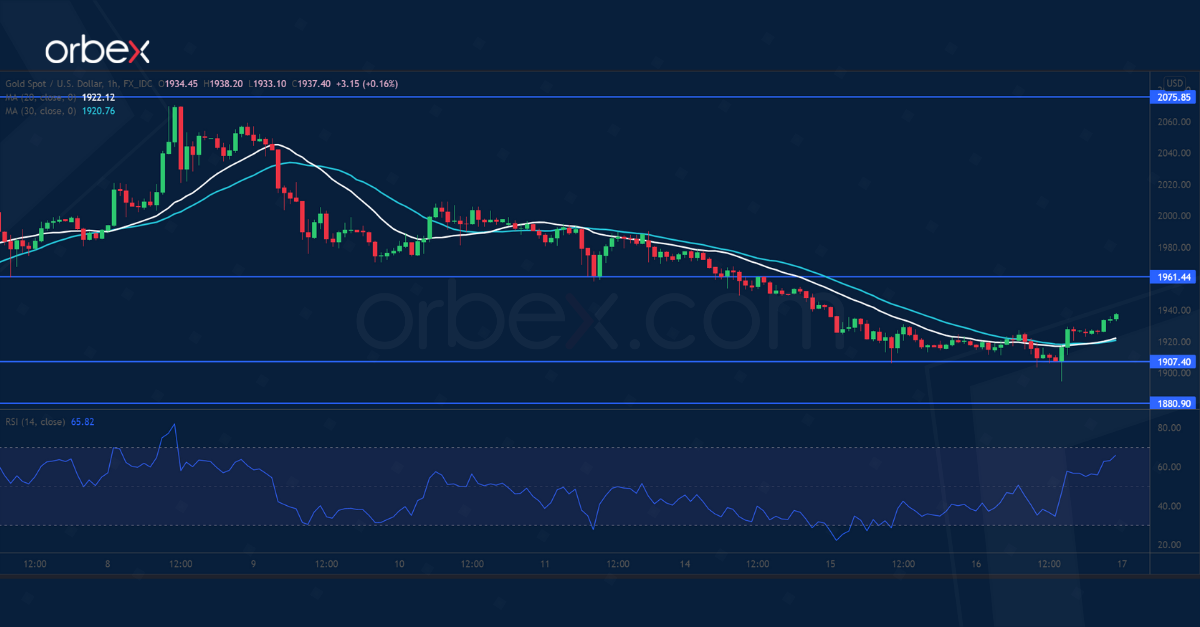
XAU/USD Stabilizes
Gold struggles as the Fed maps out aggressive tightening. The precious metal has given up all its gains from the previous parabolic rise, which suggests a lack of commitment to support the rally.
The price is testing the origin of the bullish breakout at 1907 which coincides with the 30-day moving average. An oversold RSI attracted some buying interest.
1961 is the hurdle ahead before a rebound could materialize. Further down, 1880 is key support on the daily chart and its breach could reverse the course in the weeks to come.
USD/JPY Daily Outlook
Daily Pivots: (S1) 118.25; (P) 118.69; (R1) 119.19; More...
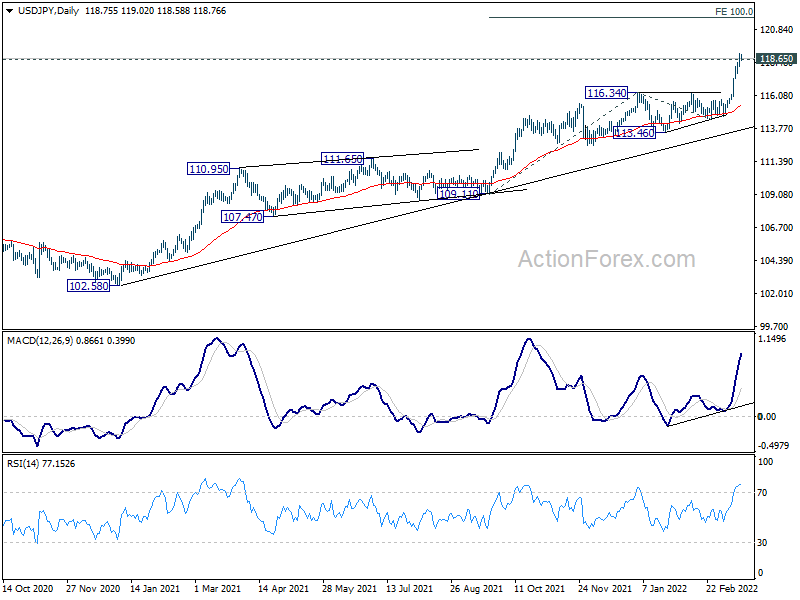
USD/JPY's rally resumed after brief consolidation and hits as high as 119.11 so far. Intraday bias is back on the upside. Next near term target is 100% projection of 109.11 to 116.34 from 114.40 at 121.63. On the downside, break of 117.68 support is now needed to indicate short term topping. Otherwise, outlook will stay bullish in case of retreat.
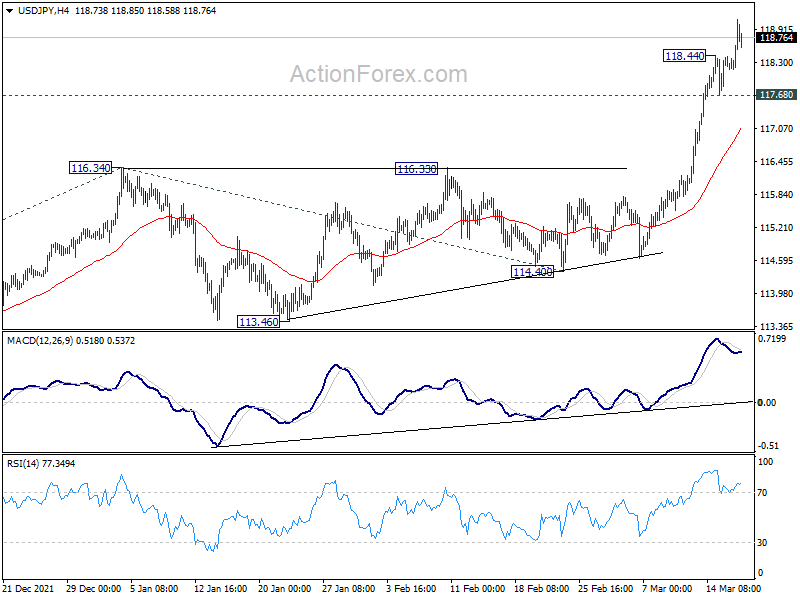
In the bigger picture, no change in the view that rise from 102.58 is the third leg of the up trend from 101.18 (2020 low). Sustained break of 118.65 (2016 high) will pave the way to 125.85 (2015 high) and raise the chance of long term up trend resumption. This will remain the favored case as long as 113.46 support holds, even in case of deep pull back.
Yen Extends Decline as Markets Responded Well to Fed Hike, BoE Next
The financial markets have responded rather well to Fed's rate hike overnight. The close in major US indexes was strong while Asian stocks also follow higher. Yen is clearly pressured and is extending recent decline, following rally in benchmark treasury yields. On the other hand, Australian and Canadian Dollar are strong. Dollar and Euro are mixed for now, together with Sterling, awaiting BoE rate hike.
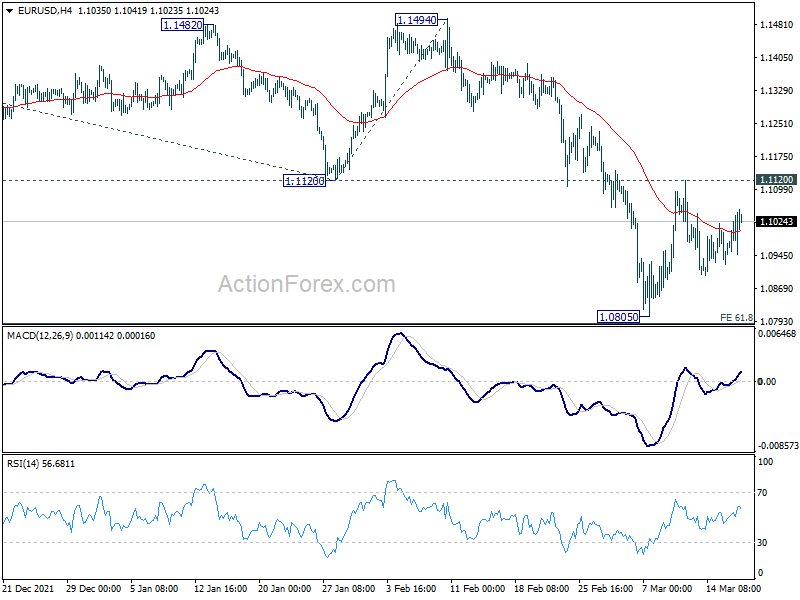
Technically, EUR/USD traders are still refusing to make up their mind as range trading continues. For now, with 1.1120 support turned resistance intact, downside break out through 1.0805 low is expected, for resuming whole down trend from 1.2348. However, strong break of 1.1120 will be an initial sign of bullish trend reversal, and would bring rebound to 1.1494 structural resistance. But for now, it's unlikely to happen either way soon.
In Asia, at the time of writing, Nikkei is up 3.49%. Hong Kong HSI is up 5.86%. China Shanghai SSE is up 2.24%. Singapore Strait Times is up 0.41%. Japan 10-year JGB yield is up 0.0011 at 0.205. Overnight, DOW rose 1.55%. S&P 500 rose 2.24%. NASDAQ rose 3.77%. 10-year yield rose 0.028 to 2.188.
S&P 500 eyes 34179 resistance after post FOMC rebound
Markets responded rather well to Fed's rate hike, statement and new economic projections. In short, Fed raised federal funds rate target by 25bps to 0.25-0.50%. In the updated dot plot, 12 of the FOMC participants expected federal funds rate to reach 1.75-2.00% by then end of 2022, that is, 1.50% above the current level. The end point of current tightening cycle was also raised from 2.1% to 2.8%, and pulled ahead to 2023. Balance sheet runoff could start at a "coming meeting", that is, May.
Suggested readings on Fed
- Fed Still Behind the Curve Despite Signalling Six Further Rate Hikes
- FOMC Hikes Rates 25bps as Expected, But Statement Says More Hikes to Come!
- Fed Chair Powell press conference live stream
- Fed hike 25bps, sees rate at 1.9% by end of 2022, 2.8% by end of 2023
- (FED) Federal Reserve Issues FOMC Statement
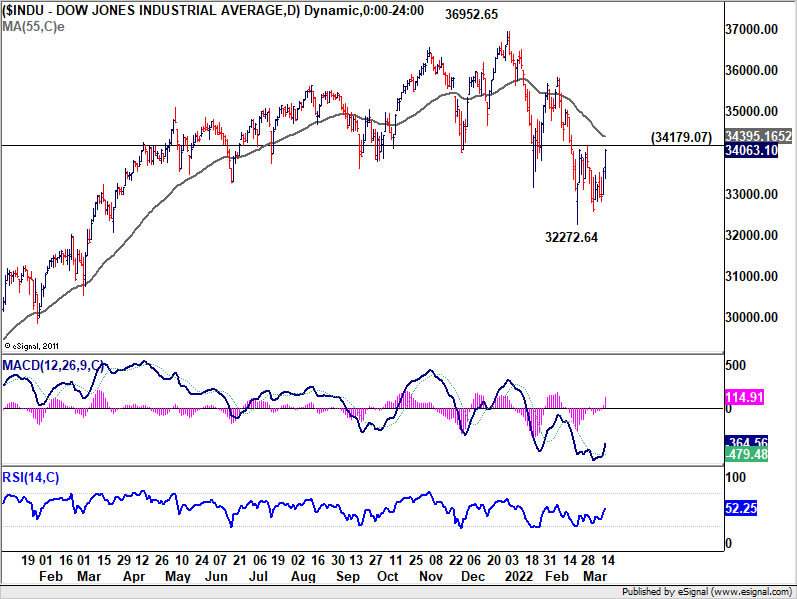
Major stock indexes closed sharply higher overnight. S&P 500 is now having 34179.07 near term resistance in radar. Firm break there will argue that the pull back from 36952.65 has completed with three waves down to 32272.64 already. Stronger rally would then be seen be seen back to retest 36952.65 high.
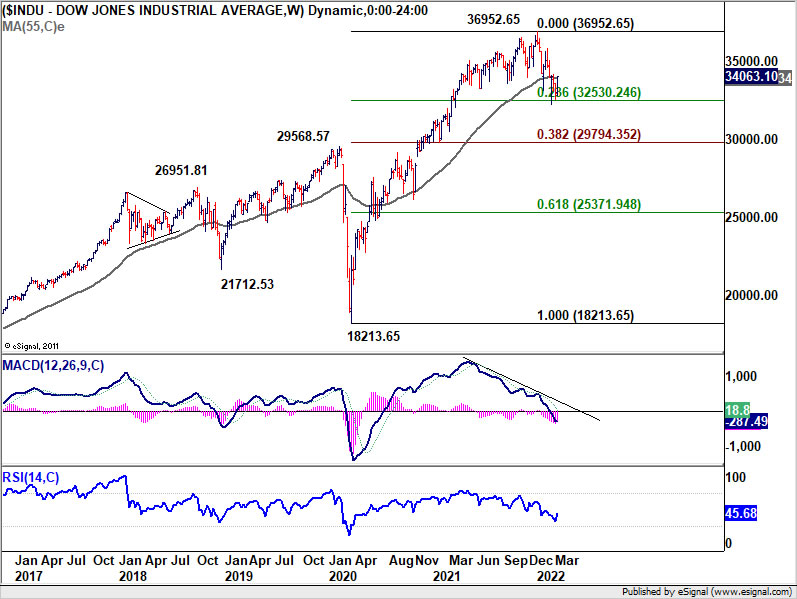
The strong support from 23.6% retracement of 18213.65 to 36952.65 at 32530.24, which is a rather bullish sign from long term perspective. Even though break of 36952.65 high is not expected at the first attempt. The range for consolidation could have been set already.
BoJ Kuroda: Too early to debate specifics on stimulus exit
BoJ Governor Haruhiko Kuroda told the parliament today, "it will take more time to achieve our 2% inflation target in a stable manner, so it's too early to debate specifics on how to exit from easy policy."
Core consumer inflation in Japan is generally expected to climb up in the months ahead, with prospect of hitting the 2% target. But Kuroda talked down the significance of such development. "I don't think Japan is in a condition where inflation stably hits 2%, even when the impact of cellphone fee cuts taper off and energy prices rise further," he said.
Kuroda just reiterated that BoJ will consider stimulus exit when 2% inflation is achieved. And, "in doing so, we will guide monetary policy to ensure markets including those for Japanese government bonds remain stable."
Australia employment rose 77.4k in Feb, unemployment rate dropped to 4%
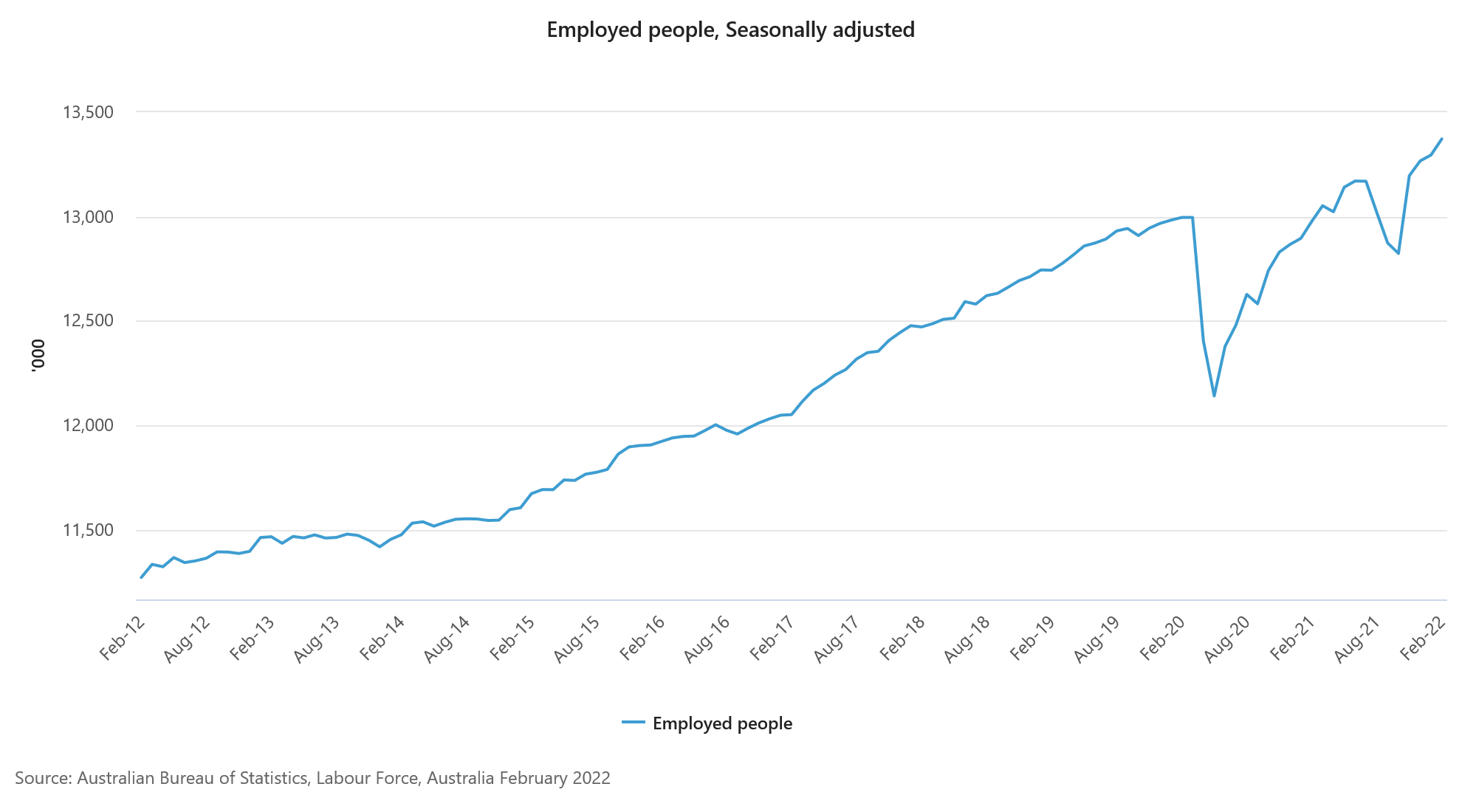
Australia employment grew 77.4k in February, nearly double of expectation of 40.0k. Full-time jobs rose 121.9k while part-time jobs dropped -44.5k. Employment was around 202k above pre-Delta high of June 2021.
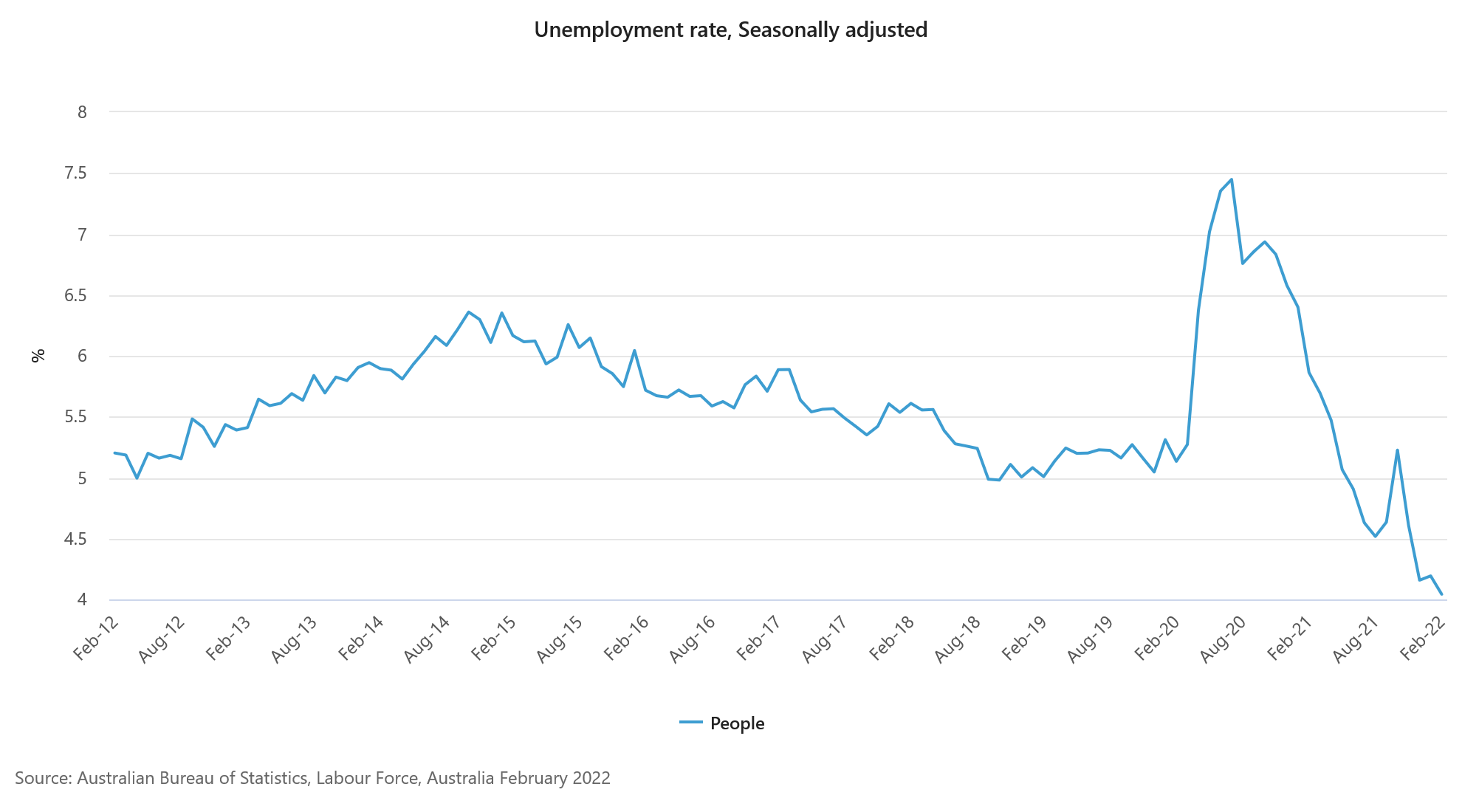
Unemployment rate dropped from 4.2% to 4.0%, better than expectation of 4.1%. That's the lowest level since August 2008. Participation rate rose 0.2% to 66.2%. Monthly hours worked rose 8.9%, or 149m, to 1813m hours.
From New Zealand, GDP grew 3.0% qoq in Q4, below expectation of 3.2% qoq.
AUD/JPY uptrend resumes, follows CAD/JPY
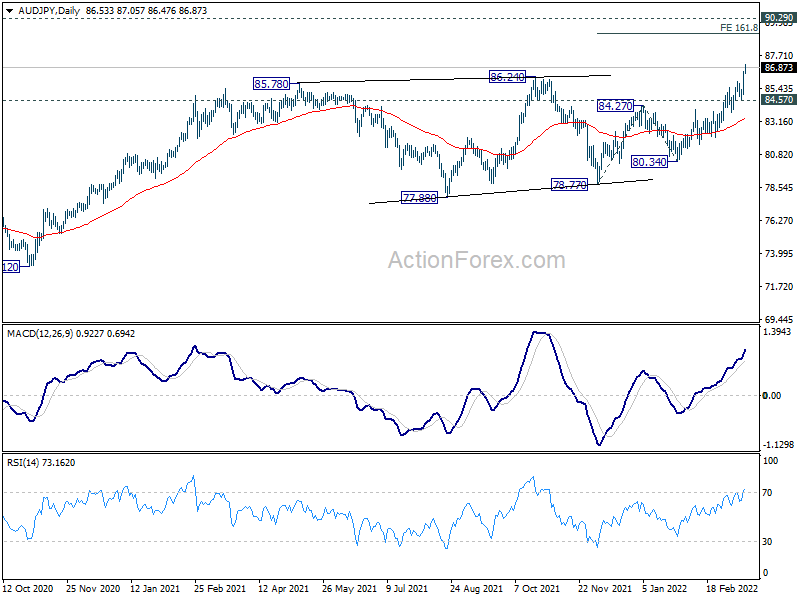
AUD/JPY rises to as high as 87.05 today, following broad based selloff in Yen. The break of 86.24 high confirms resumption of larger up trend from 59.85 (2020 low). The next near term target is 161.8% projection of 78.77 to 84.27 from 80.34 at 89.23, which is close to 90.29 long term resistance.
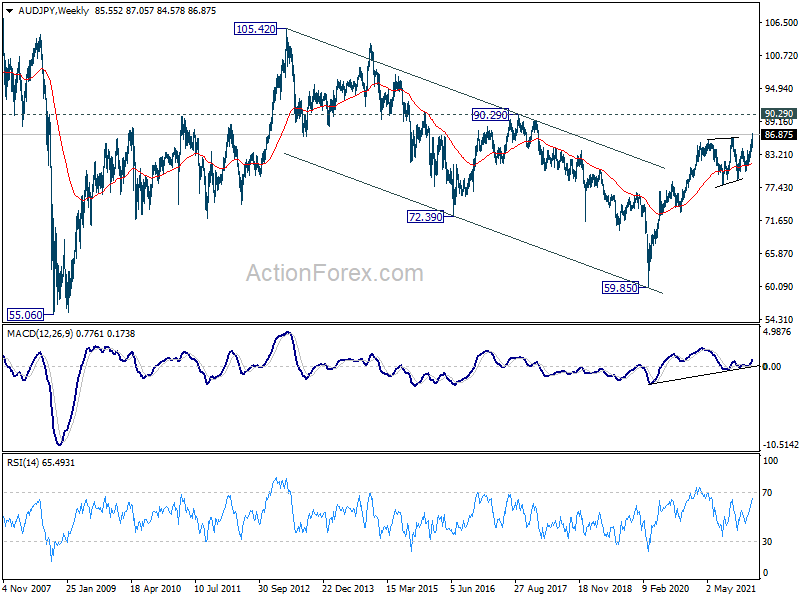
In the bigger picture, the whole down trend from 105.42 (2013 high) has completed with three waves down to 59.85. The support from 55 week EMA was a medium term bullish sign, and argues that AUD/JPY is reversing the whole down trend from 105.42. Sustained break of 90.29 would confirm this case and target 105.42 again.
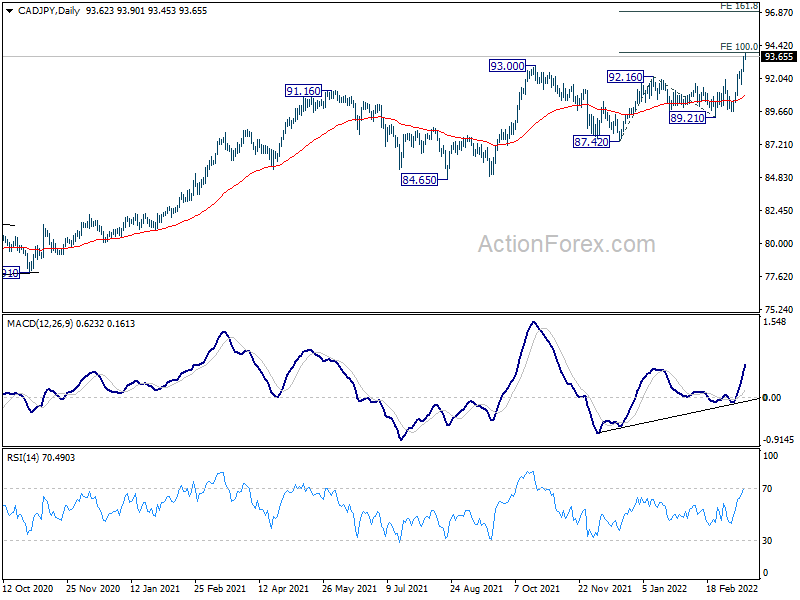
CAD/JPY's picture is similar. It's now extending the up trend from from 73.80, (2020 low). Break of 100% projection of 87.42 to 92.16 from 89.21 at 93.95 should pave the way to 161.8% projection at 96.87 next.
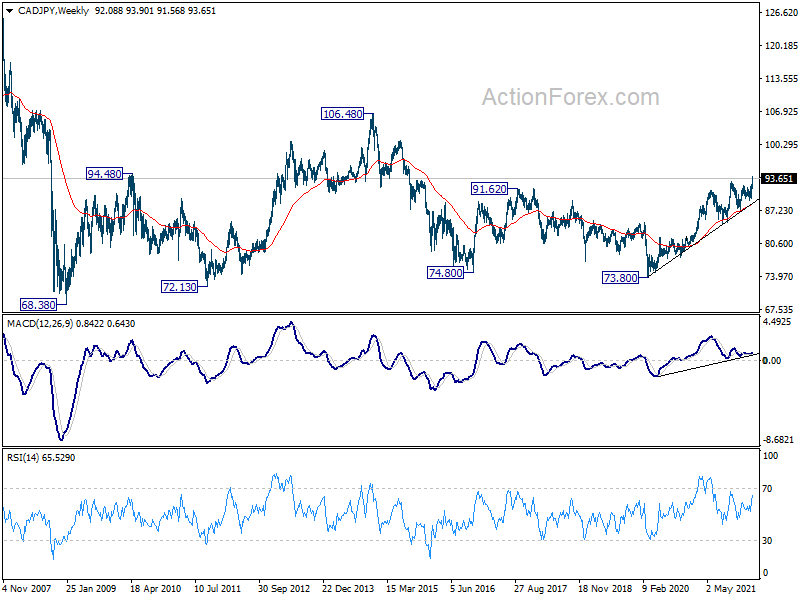
The down trend from 106.38 (2014 high) has completed with three waves down to 73.80. 91.62 key resistance has been taken out already (corresponding to 90.29 in AUD/JPY). Further rally is now expected as long as 89.;21 support holds, towards 106.48 high.
BoE to continue tightening today, GBP/CHF extending rebound
BoE is widely expected to raise the Bank rate again by 25bps to 0.75% today. The main focus is the voting. Last time, a slim majority of five MPC members won the vote and hiked only 25bps. Four members had indeed voted for a 50bps hike.
With Russia invasion of Ukraine, inflation would likely stay higher for longer, and might even peak above BoE's own projection of 7.25% in April. Policy makers are clearly getting more alerted on the outlook and some might push for front-loading the rate hikes. But others could prefer to wait for new economic projections in May before acting more aggressively. The voting would reveal the balance inside MPC.
Here are some previews:
- BoE Policy Meeting: Rate Hike Imminent But What's Next?
- BoE Preview: Another Rate Hike Expected, Emphasis on Flexibility
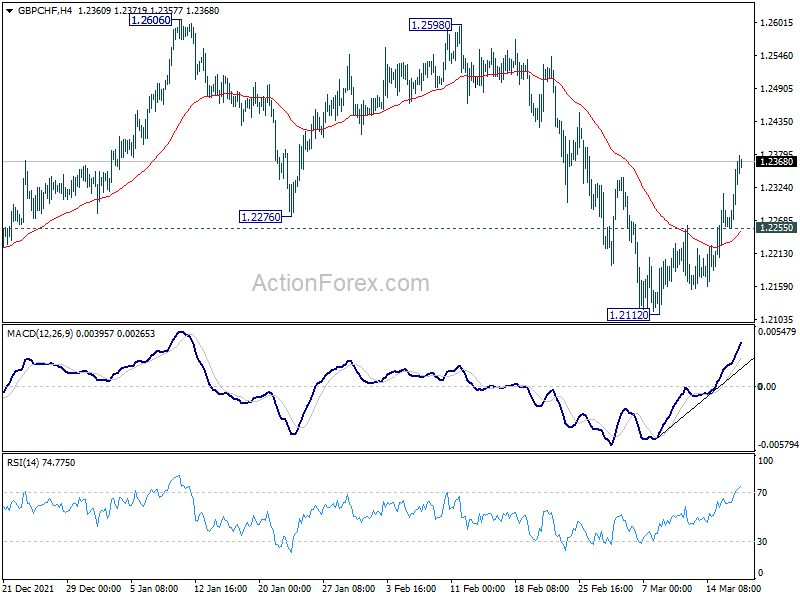
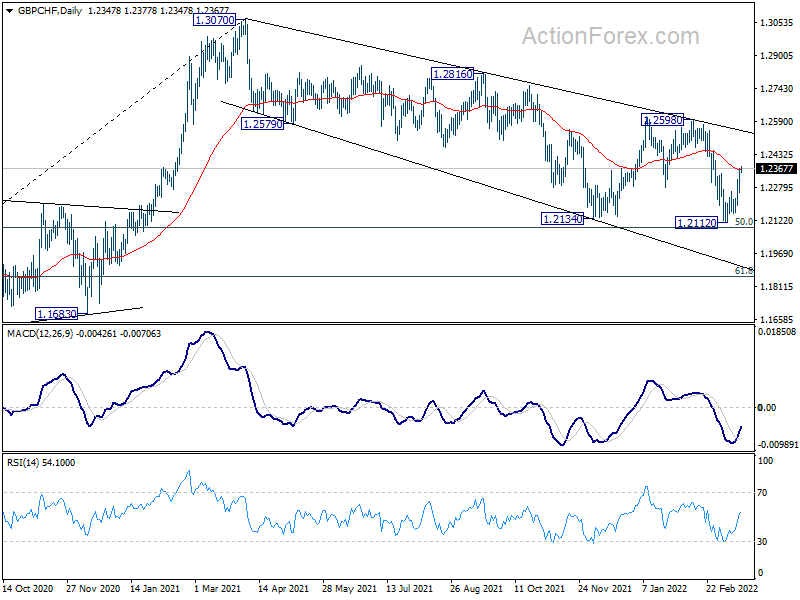
GBP/CHF rebounded quickly after war triggered selloff. A short term bottom is in place at 1.2112 and further rally is expected as long as 1.2255 minor support holds. But a strong break of 1.2598 resistance is needed to confirm completion of the down trend from 1.3070. Otherwise, medium term outlook will be neutral at best, with prospect of another fall through 1.2112.
Elsewhere
Swiss will release trade balance in European session while Eurozone will release CPI final. Later in the day, US will release jobless claims, housing starts and building permits, Philly Fed manufacturing survey and industrial production.
USD/JPY Daily Outlook
Daily Pivots: (S1) 118.25; (P) 118.69; (R1) 119.19; More...
USD/JPY's rally resumed after brief consolidation and hits as high as 119.11 so far. Intraday bias is back on the upside. Next near term target is 100% projection of 109.11 to 116.34 from 114.40 at 121.63. On the downside, break of 117.68 support is now needed to indicate short term topping. Otherwise, outlook will stay bullish in case of retreat.
In the bigger picture, no change in the view that rise from 102.58 is the third leg of the up trend from 101.18 (2020 low). Sustained break of 118.65 (2016 high) will pave the way to 125.85 (2015 high) and raise the chance of long term up trend resumption. This will remain the favored case as long as 113.46 support holds, even in case of deep pull back.
Economic Indicators Update
| GMT | Ccy | Events | Actual | Forecast | Previous | Revised |
|---|---|---|---|---|---|---|
| 21:45 | NZD | GDP Q/Q Q4 | 3.00% | 3.20% | -3.70% | -3.60% |
| 23:50 | JPY | Machinery Orders M/M Jan | -2.00% | -2.20% | 3.60% | 3.10% |
| 00:30 | AUD | Employment Change Feb | 77.4K | 40.0K | 12.9K | 28.3K |
| 00:30 | AUD | Unemployment Rate Feb | 4.00% | 4.10% | 4.20% | |
| 07:00 | CHF | Trade Balance (CHF) Feb | 4.20B | 3.18B | ||
| 10:00 | EUR | Eurozone CPI Y/Y Feb F | 5.80% | 5.80% | ||
| 10:00 | EUR | Eurozone CPI Core Y/Y Feb F | 2.70% | 2.70% | ||
| 12:00 | GBP | BoE Interest Rate Decision | 0.75% | 0.50% | ||
| 12:00 | GBP | MPC Official Bank Rate Votes | 9--0--0 | 9--0--0 | ||
| 12:30 | USD | Initial Jobless Claims (Mar 11) | 221K | 227K | ||
| 12:30 | USD | Housing Starts Feb | 1.70M | 1.64M | ||
| 12:30 | USD | Building Permits Feb | 1.87M | 1.90M | ||
| 12:30 | USD | Philadelphia Fed Manufacturing Survey Mar | 15 | 16 | ||
| 13:15 | USD | Industrial Production M/M Feb | 0.50% | 1.40% | ||
| 14:30 | USD | Natural Gas Storage | -71B | -124B |
BoE to continue tightening today, GBP/CHF extending rebound
BoE is widely expected to raise the Bank rate again by 25bps to 0.75% today. The main focus is the voting. Last time, a slim majority of five MPC members won the vote and hiked only 25bps. Four members had indeed voted for a 50bps hike.
With Russia invasion of Ukraine, inflation would likely stay higher for longer, and might even peak above BoE's own projection of 7.25% in April. Policy makers are clearly getting more alerted on the outlook and some might push for front-loading the rate hikes. But others could prefer to wait for new economic projections in May before acting more aggressively. The voting would reveal the balance inside MPC.
Here are some previews:
- BoE Policy Meeting: Rate Hike Imminent But What's Next?
- BoE Preview: Another Rate Hike Expected, Emphasis on Flexibility
GBP/CHF rebounded quickly after war triggered selloff. A short term bottom is in place at 1.2112 and further rally is expected as long as 1.2255 minor support holds. But a strong break of 1.2598 resistance is needed to confirm completion of the down trend from 1.3070. Otherwise, medium term outlook will be neutral at best, with prospect of another fall through 1.2112.
AUD/JPY uptrend resumes, follows CAD/JPY
AUD/JPY rises to as high as 87.05 today, following broad based selloff in Yen. The break of 86.24 high confirms resumption of larger up trend from 59.85 (2020 low). The next near term target is 161.8% projection of 78.77 to 84.27 from 80.34 at 89.23, which is close to 90.29 long term resistance.
In the bigger picture, the whole down trend from 105.42 (2013 high) has completed with three waves down to 59.85. The support from 55 week EMA was a medium term bullish sign, and argues that AUD/JPY is reversing the whole down trend from 105.42. Sustained break of 90.29 would confirm this case and target 105.42 again.
CAD/JPY's picture is similar. It's now extending the up trend from from 73.80, (2020 low). Break of 100% projection of 87.42 to 92.16 from 89.21 at 93.95 should pave the way to 161.8% projection at 96.87 next.
The down trend from 106.38 (2014 high) has completed with three waves down to 73.80. 91.62 key resistance has been taken out already (corresponding to 90.29 in AUD/JPY). Further rally is now expected as long as 89.;21 support holds, towards 106.48 high.
Australia employment rose 77.4k in Feb, unemployment rate dropped to 4%
Australia employment grew 77.4k in February, nearly double of expectation of 40.0k. Full-time jobs rose 121.9k while part-time jobs dropped -44.5k. Employment was around 202k above pre-Delta high of June 2021.
Unemployment rate dropped from 4.2% to 4.0%, better than expectation of 4.1%. That's the lowest level since August 2008. Participation rate rose 0.2% to 66.2%. Monthly hours worked rose 8.9%, or 149m, to 1813m hours.
BoJ Kuroda: Too early to debate specifics on stimulus exit
BoJ Governor Haruhiko Kuroda told the parliament today, "it will take more time to achieve our 2% inflation target in a stable manner, so it's too early to debate specifics on how to exit from easy policy."
Core consumer inflation in Japan is generally expected to climb up in the months ahead, with prospect of hitting the 2% target. But Kuroda talked down the significance of such development. "I don't think Japan is in a condition where inflation stably hits 2%, even when the impact of cellphone fee cuts taper off and energy prices rise further," he said.
Kuroda just reiterated that BoJ will consider stimulus exit when 2% inflation is achieved. And, "in doing so, we will guide monetary policy to ensure markets including those for Japanese government bonds remain stable."