

Sample Category Title
Sterling Dips after Dovish BoE Hike, Euro Mixed
Sterling dips notably after the dovish rate hike by BoE. Yen is following as second worst for the day, then Dollar. On the other hand, Aussie is leading other commodity currencies higher, support by strong job data. Euro is mixed with Swiss Franc, closely watching developments in Ukraine. In other markets, Gold is attempting a recovery but still kept well below 2000 handle. WTI crude oil is also recovering and it's back above 100 handle.
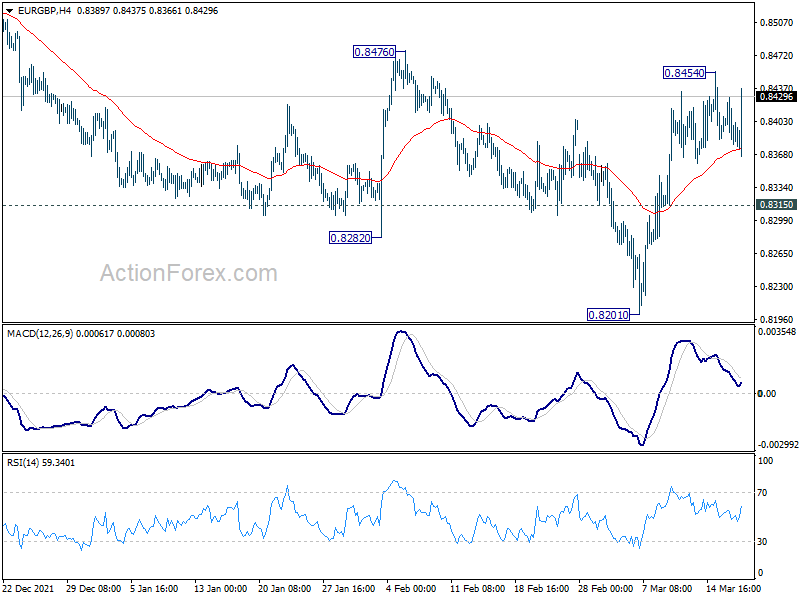
Technically, with the weakness in Euro, focus will be on EUR/GBP. Above 0.8454 temporary top will resume the rebound from 0.8201. Further break of 0.8476 resistance will be the first sign of bullish trend reversal and bring even stronger rise to 0.8598.
In Europe, at the time of writing, FTSE is up 0.44%. DAX is down -1.04%. CAC is down -0.32%. Germany 10-year yield is up 0.009 at 0.401. Earlier in Asia, Nikkei rose 3.46%. Hong Kong HSI rose 7.04%. China Shanghai SSE rose 1.40%. Singapore Strait Times rose 0.97%. Japan 10-year JGB yield dropped -0.0002 to 0.204.
US initial jobless claims dropped to 214k, continuing claims dropped to 1.419m
US initial jobless claims dropped -15k to 214k in the week ending March 12, better than expectation of 221k. Four-week moving average of initial claims dropped -9k to 223k. Continuing claims dropped -71k to 1419k in the week ending march 5, lowest since February 21, 1970. Four-week moving average of continuing claims dropped -42.5k to 1463k, lowest since March 21, 1970.
Housing starts rose to 1.77m annualized rate in February. Building permits dropped to 1.86m. Philly Fed manufacturing survey jumped from 16 to 27.4 in March.
BoE raises bank rate to 0.75%, but Cunliffe voted for no change
BoE raises Bank Rate by 25bps to 0.75% as widely expected. But surprisingly, it was done by a 8-1 vote, with Jon Cunliffe voting for no change at 0.50%. In the statement, BoE said, "some further modest tightening in monetary policy may be appropriate in the coming months, but there are risks on both sides of that judgement depending on how medium-term prospects for inflation evolve."
"The invasion of Ukraine by Russia has led to further large increases in energy and other commodity prices," BoE said. "Global inflationary pressures will strengthen considerably further over coming months, while growth in economies that are net energy importers, including the United Kingdom, is likely to slow."
ECB Lagarde: Inflation to exceed 7% this year in severe scenario
ECB President Christine Lagarde said in a speech the central has given itself some "extra space" in monetary policy by stating that rate hike will come only "some time" after ending net asset purchases.
"This maintains our traditional sequencing logic, but also gives us extra space if needed after we stop purchasing bonds and before we take the next step towards normalization," she said. "This will allow us to test whether the convergence of inflation to our target that we project today is robust to current and potential new shocks,"
Lagarde also said the outbreak of war has " introduced new uncertainty into the outlook", with " the short-term factors pushing up inflation are likely to be amplified." Inflation out hit 5.1% on average hits year, and even exceed 7% in the "severe scenario".
ECB Knot: Normalization the appropriate response with dominant worry in inflation
ECB Governing Council member Klaas Knot said, "At this point, the dominant worry is inflation. That is why normalization of policy, the withdrawal of stimulus is the appropriate policy response."
He expected the asset purchases to end by the end of the year. "That means September should be available (for a rate hike)," Knot said. "Not that I expect rates will have to go up in September."
"A rate hike in the fourth quarter to me still is a realistic expectation… but by no means a certainty, he added.
Eurozone CPI finalized at 5.9% yoy in Feb, EU at 6.2% yoy
Eurozone CPI was finalized at 5.9% yoy in February, up from January's 5.1% yoy. The highest contribution to the annual euro area inflation rate came from energy (+3.12%), followed by services (+1.04%), food, alcohol & tobacco (+0.90%) and non-energy industrial goods (+0.81%).
EU CPI was finalized at 6.2% yoy, up from January's 5.6% yoy. The lowest annual rates were registered in Malta, France (both 4.2%), Portugal, Finland and Sweden (all 4.4%). The highest annual rates were recorded in Lithuania (14.0%), Estonia (11.6%) and Czechia (10.0%). Compared with January, annual inflation fell in two Member States and rose in twenty-five.
BoJ Kuroda: Too early to debate specifics on stimulus exit
BoJ Governor Haruhiko Kuroda told the parliament today, "it will take more time to achieve our 2% inflation target in a stable manner, so it's too early to debate specifics on how to exit from easy policy."
Core consumer inflation in Japan is generally expected to climb up in the months ahead, with prospect of hitting the 2% target. But Kuroda talked down the significance of such development. "I don't think Japan is in a condition where inflation stably hits 2%, even when the impact of cellphone fee cuts taper off and energy prices rise further," he said.
Kuroda just reiterated that BoJ will consider stimulus exit when 2% inflation is achieved. And, "in doing so, we will guide monetary policy to ensure markets including those for Japanese government bonds remain stable."
Australia employment rose 77.4k in Feb, unemployment rate dropped to 4%
Australia employment grew 77.4k in February, nearly double of expectation of 40.0k. Full-time jobs rose 121.9k while part-time jobs dropped -44.5k. Employment was around 202k above pre-Delta high of June 2021.
Unemployment rate dropped from 4.2% to 4.0%, better than expectation of 4.1%. That's the lowest level since August 2008. Participation rate rose 0.2% to 66.2%. Monthly hours worked rose 8.9%, or 149m, to 1813m hours.
From New Zealand, GDP grew 3.0% qoq in Q4, below expectation of 3.2% qoq.
GBP/USD Mid-Day Outlook
Daily Pivots: (S1) 1.3068; (P) 1.3112; (R1) 1.3193; More...
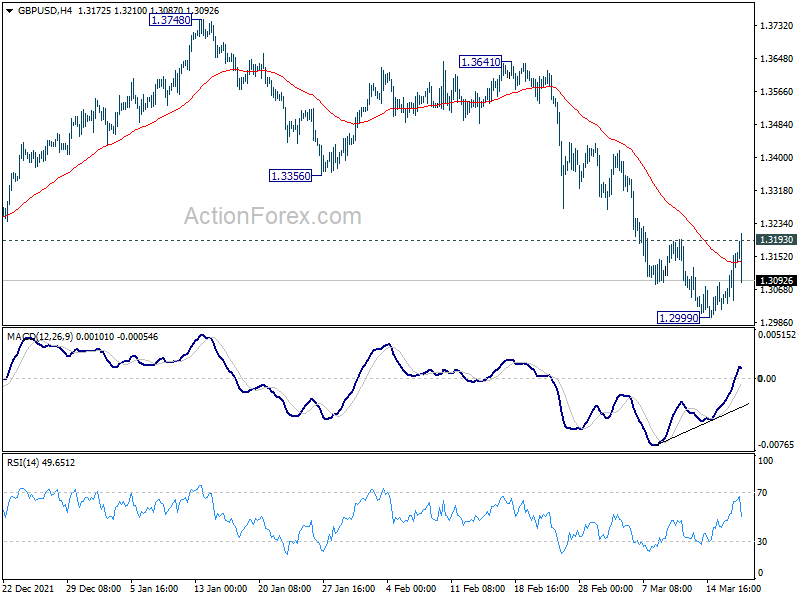
GBP/USD reversed after breaching 1.3193 resistance, but stays above 1.2999 support. Intraday bias remains neutral first and further decline is still in favor. On the downside, break of 1.2999 will resume larger down trend from 1.4248. However, on the upside, firm break of 1.3193 will confirm short term bottoming. Intraday bias will be turned back to the upside for 55 day EMA (now at 1.3374).
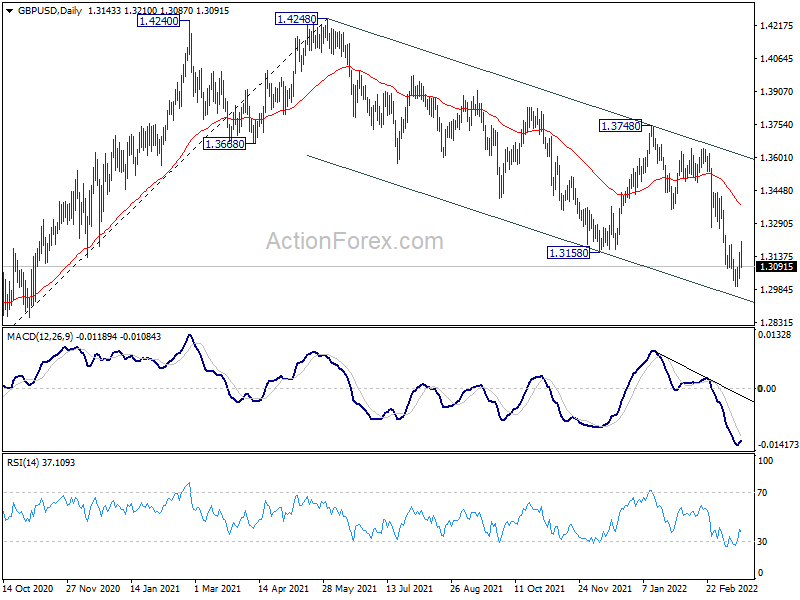
In the bigger picture, current development suggests that the up trend from 1.1409 (2020 low) has completed at 1.4248. Decline from 1.4248 could still be a corrective move, or it could be the start of a long term down trend. In either case, deeper decline would be seen back to 61.8% retracement of 2.1161 to 1.1409 at 1.2493. In any case, break of 1.3748 resistance is needed to indicate medium term bottoming, or outlook will stay bearish.
Economic Indicators Update
| GMT | Ccy | Events | Actual | Forecast | Previous | Revised |
|---|---|---|---|---|---|---|
| 21:45 | NZD | GDP Q/Q Q4 | 3.00% | 3.20% | -3.70% | -3.60% |
| 23:50 | JPY | Machinery Orders M/M Jan | -2.00% | -2.20% | 3.60% | 3.10% |
| 00:30 | AUD | Employment Change Feb | 77.4K | 40.0K | 12.9K | 28.3K |
| 00:30 | AUD | Unemployment Rate Feb | 4.00% | 4.10% | 4.20% | |
| 07:00 | CHF | Trade Balance (CHF) Feb | 5.95B | 4.20B | 3.18B | 3.07B |
| 10:00 | EUR | Eurozone CPI Y/Y Feb F | 5.90% | 5.80% | 5.80% | |
| 10:00 | EUR | Eurozone CPI Core Y/Y Feb F | 2.70% | 2.70% | 2.70% | |
| 12:00 | GBP | BoE Interest Rate Decision | 0.75% | 0.75% | 0.50% | |
| 12:00 | GBP | MPC Official Bank Rate Votes | 8--0--1 | 9--0--0 | 9--0--0 | |
| 12:30 | USD | Initial Jobless Claims (Mar 11) | 214K | 221K | 227K | 229K |
| 12:30 | USD | Housing Starts Feb | 1.77M | 1.70M | 1.64M | 1.66M |
| 12:30 | USD | Building Permits Feb | 1.86M | 1.87M | 1.90M | |
| 12:30 | USD | Philadelphia Fed Manufacturing Survey Mar | 27.4 | 15 | 16 | |
| 13:15 | USD | Industrial Production M/M Feb | 0.50% | 1.40% | ||
| 14:30 | USD | Natural Gas Storage | -71B | -124B |
US initial jobless claims dropped to 214k, continuing claims dropped to 1.419m
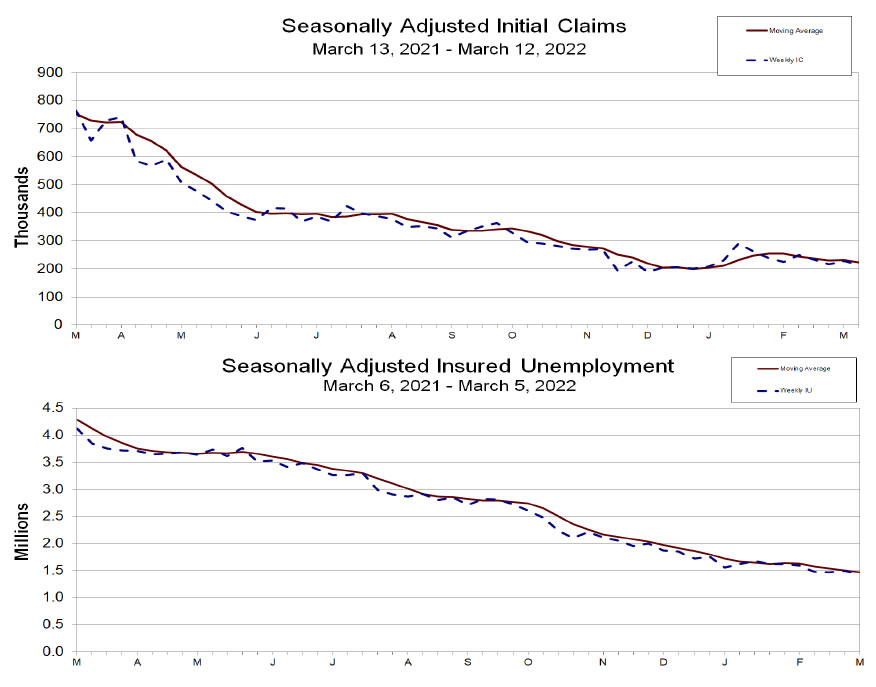
US initial jobless claims dropped -15k to 214k in the week ending March 12, better than expectation of 221k. Four-week moving average of initial claims dropped -9k to 223k.
Continuing claims dropped -71k to 1419k in the week ending March 5, lowest since February 21, 1970. Four-week moving average of continuing claims dropped -42.5k to 1463k, lowest since March 21, 1970.
ECB Knot: Normalization the appropriate response with dominant worry in inflation
ECB Governing Council member Klaas Knot said, "At this point, the dominant worry is inflation. That is why normalization of policy, the withdrawal of stimulus is the appropriate policy response."
He expected the asset purchases to end by the end of the year. "That means September should be available (for a rate hike)," Knot said. "Not that I expect rates will have to go up in September."
"A rate hike in the fourth quarter to me still is a realistic expectation… but by no means a certainty, he added.
BoE raises bank rate to 0.75%, but Cunliffe voted for no change
BoE raises Bank Rate by 25bps to 0.75% as widely expected. But surprisingly, it was done by a 8-1 vote, with Jon Cunliffe voting for no change at 0.50%. In the statement, BoE said, "some further modest tightening in monetary policy may be appropriate in the coming months, but there are risks on both sides of that judgement depending on how medium-term prospects for inflation evolve."
"The invasion of Ukraine by Russia has led to further large increases in energy and other commodity prices," BoE said. "Global inflationary pressures will strengthen considerably further over coming months, while growth in economies that are net energy importers, including the United Kingdom, is likely to slow."
(BOE) Bank Rate increased to 0.75%
The Bank of England condemns Russia's unprovoked invasion and the suffering inflicted on Ukraine. The Bank is working closely with the UK Government to support its response in coordination with international authorities. The Bank's Monetary Policy Committee (MPC) supports this condemnation and welcomes these actions.
The MPC sets monetary policy to meet the 2% inflation target, and in a way that helps to sustain growth and employment. At its meeting ending on 16 March 2022, the MPC voted by a majority of 8-1 to increase Bank Rate by 0.25 percentage points, to 0.75%. One member preferred to maintain Bank Rate at 0.5%.
In the MPC's central projections in the February Monetary Policy Report, published before Russia's invasion of Ukraine, UK GDP growth was expected to slow to subdued rates during the course of this year. This in large part reflected the adverse impact of the previous, already large, increases in global energy and tradable goods prices on UK real aggregate income and spending. As a result, a margin of spare capacity was projected to open up and the unemployment rate to rise to 5% by 2025. CPI inflation was expected to peak at around 7¼% in April 2022. Upward pressures on inflation were expected to dissipate over time and, conditioned on the rising market-implied path for Bank Rate expected at the time of the February Report and the MPC's current forecasting convention for future energy prices, CPI inflation was projected to fall back to a little above the 2% target in two years' time and to below the target by a greater margin in three years.
Developments since the February Report are likely to accentuate both the peak in inflation and the adverse impact on activity by intensifying the squeeze on household incomes.
Regarding inflation, the invasion of Ukraine by Russia has led to further large increases in energy and other commodity prices including food prices. It is also likely to exacerbate global supply chain disruptions, and has increased the uncertainty around the economic outlook significantly. Global inflationary pressures will strengthen considerably further over coming months, while growth in economies that are net energy importers, including the United Kingdom, is likely to slow.
Turning to economic activity, UK GDP in January was stronger than expected in the February Report. Business confidence has held up and labour market activity data have remained robust. Consumer confidence has, however, fallen in response to the squeeze on real household disposable incomes. That impact on real aggregate income is now likely to be materially larger than implied by the projections in the February Report, consistent with a weaker outlook for growth and employment, all else equal.
Twelve-month CPI inflation rose from 5.4% in December to 5.5% in January, which triggered the exchange of open letters between the Governor and the Chancellor of the Exchequer that is being published alongside this monetary policy announcement. Inflation is expected to increase further in coming months, to around 8% in 2022 Q2, and perhaps even higher later this year. The projected overshoot of inflation relative to the 2% target to an increasing extent reflects global energy prices, with some further material contribution from tradable goods prices. Service price inflation has also picked up, although to a lesser extent than other components, with core services prices returning to their pre-Covid trend. Underlying nominal earnings growth is estimated to have remained above pre-pandemic rates, and is still expected to strengthen over the coming year.
If sustained, the latest rise in energy futures prices means that Ofgem's utility price caps could again be substantially higher when they are reset in October 2022. This could temporarily push CPI inflation around the end of this year above the level projected for April, which was previously expected to be the peak. Further out, inflation is expected to fall back materially, as energy prices stop rising and as the squeeze on real incomes and demand puts significant downward pressure on domestically generated inflation. That judgement also reflects that monetary policy will act to ensure that longer-term inflation expectations are well anchored around the 2% target.
The MPC's remit is clear that the inflation target applies at all times, reflecting the primacy of price stability in the UK monetary policy framework. The framework also recognises that there will be occasions when inflation will depart from the target as a result of shocks and disturbances. The economy has recently been subject to a succession of very large shocks. Russia's invasion of Ukraine is another such shock. In particular, should recent movements prove persistent, the very elevated levels of global energy and tradable goods prices, of which the United Kingdom is a net importer, will necessarily weigh further on UK real aggregate income and spending. This is something monetary policy is unable to prevent. The role of monetary policy is to ensure that, as this real economic adjustment occurs, it does so consistent with achieving the 2% inflation target sustainably in the medium term, while minimising undesirable volatility in output.
Given the current tightness of the labour market, continuing signs of robust domestic cost and price pressures, and the risk that those pressures will persist, the Committee judges that an increase in Bank Rate of 0.25 percentage points is warranted at this meeting.
Based on its current assessment of the economic situation, the Committee judges that some further modest tightening in monetary policy may be appropriate in the coming months, but there are risks on both sides of that judgement depending on how medium-term prospects for inflation evolve. The MPC will review developments in the light of incoming data and their implications for medium-term inflation, including the economic implications of recent geopolitical events, as part of its forthcoming forecast round ahead of the May 2022 Monetary Policy Report.
Minutes of the Monetary Policy Committee meeting ending on 16 March 2022
1: The Bank of England condemned Russia's unprovoked invasion and the suffering inflicted on Ukraine. The Bank was working closely with the UK Government to support its response in coordination with international authorities. The Bank's Monetary Policy Committee (MPC) supported this condemnation and welcomed these actions.
2: Before turning to its immediate policy decision, the Committee discussed: the international economy; monetary and financial conditions; demand and output; and supply, costs and prices.
The international economy
3: The global economic outlook had deteriorated significantly following Russia's invasion of Ukraine in late February, and the associated material increase in the prices of energy and raw materials. These price increases would further raise global consumer and producer price inflation in the near term from already high rates, and erode real aggregate income for net commodity-importing countries. Renewed supply chain problems were also likely to emerge as production of, and trade in, important inputs declined, due both to the physical disruption caused by the invasion and the effects of sanctions imposed on Russia.
4: GDP growth in the United States and in the euro area in 2021 Q4 had been broadly in line with expectations in the February Report, and was expected to be slightly stronger in 2022 Q1 than had been anticipated, particularly in the euro area. Euro-area PMIs had picked up sharply in February, indicating that the economic impact of the Omicron Covid variant had been less severe than expected. In the United States, household consumption had rebounded in January, although the rotation from goods to services spending had stalled. Unemployment rates had fallen further in the euro area and the United States at the turn of the year, and wage growth had continued to rise in the United States according to the Federal Reserve Bank of Atlanta's measure.
5: Chinese activity data for January and February combined, including industrial production and retail sales, had been stronger than expected, reflecting a smaller impact from the Omicron Covid variant at that time. Following a rapid pickup in Covid cases in Hong Kong accompanied by a high mortality rate, Covid cases had, however, started rising again in China, and Chinese authorities had continued to react with tight local restrictions in line with the country's current Covid strategy. There had been reports of factories stopping production in response, which could lead to supply disruption and weigh on economic activity.
6: Even prior to the most recent increases in energy prices, consumer price inflation had been high in many economies. Euro-area annual HICP inflation had increased to 5.8% in February, with core inflation at 2.7%. US annual CPI inflation had risen to 7.9% in February, and core inflation to 6.4%. The headline US CPI figure was consistent with annual PCE inflation around 6½%. In the euro area, HICP inflation had been driven in large part by increases in energy prices over recent months, in particular gas prices. Contributions to US CPI inflation had been broad-based across components: within core services, rent and healthcare price rises had contributed particularly strongly, while increases in car and household goods prices had pushed core goods inflation higher.
7: Since the invasion, commodity prices had increased substantially, while exhibiting marked volatility. Russia was a significant exporter of gas, supplying around 40% of the gas used in the euro area, and was also the second largest global crude oil producer. Concerns that gas flows to Europe might be disrupted had led to exceptional volatility in European wholesale gas prices. Those prices had risen sharply following the invasion from already elevated levels in early March, with the Dutch Title Transfer Facility spot price rising to around €240 per MWh, before declining again to around €115 per MWh at the time of the MPC's meeting, around 40% above the average spot price assumed in the February Report. The futures curve six months out was a little below current spot prices. The spot price of Brent crude oil had also been volatile and had increased by around 17% since the February Report, to around $100 per barrel at the time of the MPC's meeting, in part driven by announcements by the US and UK governments that they would curtail oil imports from Russia.
8: Russia and Ukraine were also major producers of other raw materials, and prices of metals and food had risen by around 15 and 20% respectively since the February Report. Russia accounted for a significant proportion of global pig iron, steel, nickel, aluminium and copper exports that were a key input to many production processes. There had been reports of some car manufacturers having to shut European plants because of a lack of inputs from the region. Russia and Ukraine also accounted for almost 30% of the world's wheat exports and Russia supplied 16% of the world's fertiliser. Ukraine was a major producer of neon, which was a key input for the production of semiconductors, potentially leading to renewed supply pressures in this sector.
9: The increases in energy and other raw material prices were expected to boost global consumer price inflation significantly in the near term, directly through fuel, utilities and food prices, and indirectly through firms' costs. Supply chain disruption could also add further upward pressure to goods prices. Given Europe's reliance on Russian gas, and the fragmentation of the global market which meant that US gas prices had not increased materially, the effect was expected to be larger in the euro area and in the United Kingdom. Higher prices would reduce real incomes, exacerbating the policy challenges facing central banks around the world.
10: The Russian economy was expected to be affected significantly by sanctions. Financial sanctions announced shortly after the invasion began had been aimed at hindering trade with Russia, through restricting the ability of some Russian banks to process foreign transactions, particularly in dollars, and through curtailing access of some Russian banks to the SWIFT messaging service, which made it more costly to process transactions. Transactions with the Central Bank of Russia had also been prohibited, restricting its ability to use its international reserves to support the rouble, facilitate cross-border trade and service debt. More recently, the United States had announced a ban on Russian oil imports, the United Kingdom had declared that it would phase out its imports of Russian oil by the end of this year, and the European Union had set out plans to cut its gas use by the end of this year by around two-thirds of its gas imports from Russia in 2021. There had also been a wave of voluntary withdrawals of companies from activities in Russia. This had not only involved high profile consumer-facing firms, but also a broader range of companies supplying goods and services to the Russian business sector and mining companies. In late February, the Central Bank of Russia had raised interest rates from 9.5 to 20%, had ordered exporters to surrender 80% of their foreign exchange receipts, and had restricted the ability of residents to take capital out of the country. The rouble had fallen by around 25% since the start of the invasion. Central and Eastern European currencies had depreciated by 3 to 6%, and the Polish and Hungarian central banks had raised interest rates. Central and Eastern European countries had experienced a significant influx of refugees from Ukraine.
Monetary and financial conditions
11: Since the MPC's previous meeting, indicators of financial market volatility had increased and risky asset prices had fallen, reflecting the expected global impact of Russia's invasion of Ukraine. Advanced economy equity prices had fallen significantly and spreads on corporate bonds had widened. Option-implied distributions of equity prices suggested that these movements reflected increased pricing of downside risks to equity prices, as well as a shift down in central case expectations.
12: Short-term financial market inflation compensation measures had increased across advanced economies, in large part reflecting the impact of the invasion on energy prices. Medium-term measures had also increased over the same period. It was common for these measures to move together, but recent movements in medium-term measures were nevertheless noteworthy, given that oil and gas futures curves were consistent with energy price inflation falling back significantly beyond the near-term horizon.
13: In the United Kingdom, the increases in medium-term inflation compensation measures had taken their levels further above their average of the past decade. As the Committee had discussed previously, interpreting UK medium-term inflation compensation measures was not straightforward. The use of UK inflation markets for hedging large pension liabilities and the uncertain future wedge between consumer price and RPI inflation meant that inflation compensation measures did not provide a direct read of market participants' fundamental views on the inflation outlook. Nevertheless, models that attempted to extract medium-term market expectations for CPI inflation, and intelligence gathered from market contacts, suggested that higher inflation expectations and greater perceived risks of inflation persistence had probably accounted for above-average levels of UK medium-term inflation compensation measures, alongside other factors.
14: The sterling effective exchange rate had fallen by 1.7% since the previous MPC meeting, and to a greater extent against the US dollar.
15: The near-term path for market-implied policy rates in the United States had risen since the MPC's previous meeting, although some of this increase had pre-dated the invasion. The market-implied policy rate in the United States reached a little under 2% by end-2022, around 50 basis points higher than immediately prior to the MPC's February meeting. In the euro area, the near-term market implied path for policy rates had also risen since the MPC's previous meeting. At its meeting on 10 March, the ECB Governing Council had left its key policy interest rates unchanged, but had announced a faster reduction in the pace of net asset purchases.
16: In the United Kingdom, market-implied expectations for the path of Bank Rate over the year ahead had risen, with market pricing consistent with an increase in Bank Rate of 0.25 percentage points, to 0.75%, at this MPC meeting. The market-implied path for Bank Rate now reached around 2% by end-2022, around 70 basis points higher than immediately prior to the MPC's February meeting. The latest Bank of England Market Participants Survey suggested that respondents expected a slightly shallower path for Bank Rate than the market-implied path over the next couple of years, but a greater number of respondents viewed the balance of risks around that path as being skewed to the upside rather than to the downside.
17: Longer-term advanced economy government bond yields had increased since the MPC's previous meeting.
18: UK bank lending rates on mortgages with loan-to-value (LTV) ratios at or below 75% had risen further since the MPC's previous meeting. This was broadly consistent with a lagged response to the increases in risk-free rates since the autumn of 2021. Lending rates on some higher LTV mortgages had also started to increase. However, rates on higher LTV mortgages had, on the whole, remained lower than in autumn 2021, reflecting the normalisation of spreads in this market, which had increased significantly at the start of the pandemic. The subsequent further increases in risk-free rates that had occurred since the February MPC meeting would be expected to feed through to mortgage lending rates in due course. Interest rates on unsecured household borrowing, such as credit cards and personal loans had, as usual, been less sensitive to changes in reference rates.
Demand and output
19: The MPC had been briefed on initial reports from the Bank's Agents and Decision Maker Panel on business sentiment following the invasion of Ukraine by Russia. But there was little evidence available yet on the impact of the invasion on UK economic activity. The squeeze on real post-tax labour income would, nevertheless, be materially larger than expected previously, due to recent commodity price increases.
20: According to the ONS's first quarterly estimate, UK GDP had increased by 1.0% in 2021 Q4, broadly in line with the expectation incorporated into the February Monetary Policy Report projection and close to the level of activity prior to the onset of the pandemic in 2019 Q4. Household consumption and business investment had risen by around 1% on the quarter, with government expenditure growing more strongly than those components. Business investment had remained more than 10% below its pre-Covid level, however.
21: Following a 0.2% decline in December, GDP had risen by 0.8% in January, notably stronger than had been expected at the time of the February Report, and to a level 0.5% higher than in 2019 Q4. Government services output had been stronger than expected, accounted for by health activity including NHS Test and Trace. GDP growth in January had been broad based across the service, manufacturing and construction sectors. Output in consumer-facing services had risen by 1.8%, broadly in line with expectations at the time of the February Report. This was consistent with other higher-frequency indicators and with a very limited economic impact on high-contact sectors from the Omicron Covid variant.
22: Since the Committee's previous meeting, there had been further relaxations, and in some cases removals, of Covid measures announced by the UK Government and Devolved Administrations. Recent high-frequency economic indicators suggested that activity in high-contact sectors was on track to return to its pre-Omicron levels during the first quarter of the year. Data on card spending, restaurant reservations, train journeys and flights had continued to recover strongly over recent weeks.
23: Bank staff now expected GDP to increase by around ¾% in 2022 Q1, stronger than the February Report projection for a flat quarterly outturn. This nowcast assumed that some of the surprising strength in non-Covid related activity in recent months persisted through the quarter.
24: Prior to the invasion in late February, there had already been tentative signs that the squeeze on real disposable incomes was starting to weigh on the household sector. Although aggregate retail sales volumes had risen strongly in January, food sales had fallen to below pre-pandemic levels as food prices had risen. Notably, GfK consumer confidence had declined materially in February, with the weakness most pronounced in the forward-looking personal financial situation component. It was, however, unclear whether that represented downside news relative to the weakness in real incomes and spending that had been factored into the February Report projections. Intelligence from the Bank's Agents suggested that consumer spending had continued to grow at a robust pace. However, contacts were concerned about the outlook for demand over the coming months, due to increasing pressures on households' real disposable incomes.
25: Housing market activity had remained robust, and indicators of house prices had surprised on the upside relative to the February Report projections.
26: Recent indicators of corporate sector sentiment had been somewhat more resilient than consumer confidence, although these had generally been collated prior to the invasion. The IHS Markit/CIPS composite output PMI in February had risen to its highest level since June 2021. There had also been signs in the manufacturing and construction PMIs that supply chain disruptions had eased further. Nevertheless, the latest intelligence from the Bank's Agents suggested that the invasion was expected to exacerbate shortages of some tradable goods and could affect the production plans of some sectors, such as the automotive industry. And on the demand side, early results from the March Decision Maker Panel suggested that around one third of companies viewed the invasion as one of the top three sources of uncertainty for their business, with an average negative impact across all firms of around 3% on sales expectations over the next twelve months.
27: The Chancellor of the Exchequer would present the Spring Statement to Parliament on 23 March, alongside updated Office for Budget Responsibility projections in its Economic and fiscal outlook.
Supply, costs and prices
28: Twelve-month CPI inflation had risen to 5.5% in January, marginally above the February Monetary Policy Report forecast. This release had triggered the exchange of open letters between the Governor and the Chancellor of the Exchequer that was being published alongside these minutes.
29: Taken together, energy and core goods inflation had accounted for over four fifths of the overshoot of CPI inflation relative to the 2% target in January. Food price inflation had strengthened further and accounted for much of the remainder of the overshoot.
30: The Government's Energy Bills Rebate, a package of support for households worth around £9 billion, had been announced after the MPC's February meeting and the completion of the February Report projections. This package included a £150 payment to most households via council tax bills in April, and a £200 credit to households administered via electricity bills from October and repaid over the subsequent five-year period. The ONS's announcements on the treatment of these elements of this package in official consumer price measures were forthcoming.
31: CPI inflation was expected to rise to around 6% in February and March, before rising further, to around 8% in April, and remaining close to that rate for the rest of the quarter. The latter would be around 1 percentage point higher than expected in the February Report. The majority of this news could be attributed to energy prices. This included Ofgem's announcement of slightly higher than expected increases in gas and electricity price caps in April, which were based on wholesale gas and electricity prices that pre-dated Russia's invasion of Ukraine. In addition, recent increases in oil prices associated with the invasion were being reflected in prices of petrol and heating oil. Wholesale gas prices had been exceptionally volatile and the six-month observation window relevant for Ofgem's October utility price cap calculation, which would run from February to the end of July, had only recently opened. If sustained, the latest rise in gas and electricity futures prices would mean that price caps, when reset in October 2022, could be around 35% higher, which would be around 20% higher than had been expected in the February Report.
32: Food price inflation was expected to rise further, from 4.3% in January, reflecting the pass-through of cost increases over recent months. Indicators of cost pressures further down the food supply chain had continued to rise. Following the invasion, agricultural commodity prices had increased sharply, which could put further upward pressure on input costs and food price inflation.
33: Core CPI inflation was expected to rise further, to around 5 to 5½% in 2022 Q2 accounted for largely by increases in core goods price inflation. Core goods inflation was expected to remain above its average during the previous decade. Services price inflation was projected to increase slightly, above recent historical averages. The overall near-term profile for core inflation was slightly higher than the expectation at the time of the February Report. Global supply chain disruptions posed an upside risk to the outlook for core goods price inflation.
34: Survey indicators of cost and price pressures had remained elevated. Both the IHS Markit/CIPS PMI composite input and output price measures had remained close to their historical highs. But these indicators pre-dated Russia's invasion of Ukraine and were likely to understate the consequent cost pressures associated with the invasion. More timely intelligence from the Bank's Agents' contacts suggested that input prices had picked up further since late February, in particular for metals, grain and seed oils.
35: Since the MPC's previous meeting, households' and businesses' inflation expectations had risen further. Both the Bank/Ipsos and the Citi/YouGov surveys had reported a further rise in households' short-term inflation expectations in 2022 Q1. The rise in the latter in March had been particularly pronounced, reaching its highest level since the survey had begun in late 2005. Changes in households' short-term inflation expectations had typically corresponded with changes in spot inflation, especially developments in the prices of frequently purchased items, such as food, fuel and utilities. Medium-term measures of households' inflation expectations had also increased further, though by less than their short-term counterparts. Nevertheless, the Citi/YouGov five-to-ten year ahead measure had matched its previous record high recorded in June 2011.
36: The Decision Maker Panel had reported a further increase in expectations for businesses' year-ahead output price inflation, which had risen to 4.8% in the three months to February, and risen slightly further in the early March data particularly for those respondents who had viewed the invasion as the largest source of uncertainty for their businesses. The expectations of professional forecasters, reported in HM Treasury's February survey, had remained close to the inflation target of 2% at the two- to three-year ahead horizons.
37: The latest labour market indicators had continued to point to a tight and tightening labour market, which, alongside rising inflation, had contributed to strong pay growth.
38: The Labour Force Survey (LFS) unemployment rate had fallen to 3.9% in the three months to January, as had been expected at the time of the February Report. The LFS employment rate had been unchanged, with the inactivity rate rising slightly. Both developments had been broadly consistent with expectations at the time of the February Report. Her Majesty's Revenue and Customs (HMRC) employee payrolls had risen strongly, by a further 275,000 in February, although these initial estimates had tended to be revised down somewhat subsequently.
39: Indicators of labour demand had remained strong. The stock of vacancies in the three months to February had risen to 1.3 million, supplanting the record high set in the preceding three-month period. The REC permanent placements index had remained close to its record high in February. The vacancy-to-unemployment ratio, a measure of labour market tightness, had remained above pre-Covid levels and had reached a new record high level. Intelligence from the Bank's Agents suggested that elevated recruitment difficulties had persisted across most sectors and skill levels. The Agents' contacts had reported high rates of job churn and vacancies, with little improvement in labour availability expected over the next year.
40: Private-sector regular Average Weekly Earnings (AWE) growth had risen to 4.1% in the three months to January on a year earlier, stronger than had been expected in the February Report. Bank staff estimated that workforce compositional effects had started to drag on headline pay growth recently. Adjusted for the mechanical effects of the changes in workforce composition and the Coronavirus Job Retention Scheme, Bank staff estimated that underlying private sector regular pay growth had remained at around 4 to 4½%, above pre-pandemic rates of around 3 to 3½%. The HMRC median of pay growth in February had been 3.7%, also above pre-pandemic rates. Looking ahead, the latest intelligence from the Bank's Agents continued to point to higher pay settlements than a year ago, consistent with the Agents' recent annual pay survey.
The immediate policy decision
41: The MPC sets monetary policy to meet the 2% inflation target, and in a way that helps to sustain growth and employment.
42: In the MPC's central projections in the February Monetary Policy Report, published before Russia's invasion of Ukraine, UK GDP growth had been expected to slow to subdued rates during the course of this year. This had in large part reflected the adverse impact of the previous, already large, increases in global energy and tradable goods prices on UK real aggregate income and spending. As a result, a margin of spare capacity had been projected to open up and the unemployment rate had been expected to rise to 5% by 2025. CPI inflation had been expected to peak at around 7¼% in April 2022. Upward pressures on inflation had been expected to dissipate over time and, conditioned on the rising market-implied path for Bank Rate expected at the time of the February Report and the MPC's current forecasting convention for future energy prices, CPI inflation had been projected to fall back to a little above the 2% target in two years' time and to below the target by a greater margin in three years.
43: The Committee reviewed recent economic news, against the backdrop of Russia's invasion of Ukraine and related developments.
44: Based on available economic data for the period prior to the invasion, UK-weighted global GDP in 2022 Q1 was expected to grow by a little more than had been expected in the February Report, particularly in the euro area. Global consumer price inflation had risen further in February, to 5.8% in the euro area and to 7.9% in the United States.
45: The invasion had led to further large increases in energy and other commodity prices including food prices. It was also likely to exacerbate global supply chain disruptions, and had increased the uncertainty around the economic outlook significantly. Global inflationary pressures would strengthen considerably further over coming months, while growth in many of the United Kingdom's major trading partners, such as the euro area and other economies that were net energy importers, was likely to slow.
46: Gas prices in Europe had risen sharply following the invasion from already elevated levels, before declining again. The spot price of Brent oil had also been volatile and had increased to around $100 per barrel at the time of the MPC's meeting. Prices of metals and food had risen by around 15 and 20% respectively, and by a greater amount for those commodities of which Russia or Ukraine were major exporters.
47: Since the MPC's previous meeting, indicators of financial market volatility had increased and advanced economy risky asset prices had fallen. Longer-term advanced economy government bond yields had increased.
48: In the United Kingdom, market-implied expectations for the path of Bank Rate over the year ahead had risen, with market pricing consistent with an increase in Bank Rate of 0.25 percentage points at this MPC meeting. The market-implied path for Bank Rate now reached around 2% by end-2022.
49: The Government's Energy Bills Rebate had been announced after the MPC's February meeting and the completion of the February Report projections. The ONS's announcements on the treatments of the elements of this package in consumer price statistics were forthcoming. The Chancellor of the Exchequer would present the Spring Statement to Parliament on 23 March, alongside updated Office for Budget Responsibility projections in its Economic and fiscal outlook.
50: The MPC had been briefed on initial reports from the Bank's Agents and Decision Maker Panel on business sentiment following Russia's invasion of Ukraine. But there was little evidence available yet on the impact of the invasion on UK economic activity.
51: UK GDP in January had been stronger than expected in the February Report. Bank staff now expected GDP to increase by around ¾% in 2022 Q1, stronger than the February Report projection for a flat quarterly outturn. Business confidence had held up and labour market activity data had remained robust. The Labour Force Survey unemployment rate had fallen to 3.9% in the three months to January, as expected at the time of the February Report. Her Majesty's Revenue and Customs employee payrolls had risen strongly in February, although these initial estimates had tended to be revised down somewhat subsequently. The vacancy-to-unemployment ratio had risen to another record high, and indicators of recruitment difficulties had remained elevated. Consumer confidence had, however, fallen in response to the squeeze on real household disposable incomes. Developments in the labour market were also likely to lag those in confidence and spending.
52: Due to recent developments, the impact of energy prices on real aggregate income was now likely to be materially larger than implied by the projections in the February Report, consistent with a weaker outlook for growth and employment, all else equal. The extent to which households reacted to the additional weakness in their real incomes by cutting their real spending or by reducing their savings would be important to monitor over coming quarters. The aggregate saving rate had already declined materially from its pandemic-driven peak over recent quarters, although it could fall below its pre-Covid level if some households were to run down the additional stock of savings built up during the pandemic. Developments in energy prices were likely to affect disproportionately households with lower incomes. Those households had not in general seen substantial rises in savings during the pandemic, however, which would limit the extent of any offset from a rundown of savings. It would also be important to monitor the extent to which higher uncertainty led to a reduction in business investment.
53: Underlying nominal earnings growth was estimated to have remained above pre-pandemic rates in the three months to January, and was higher than had been expected in the February Report. The latest intelligence from the Bank's Agents continued to point to higher pay settlements than a year ago, consistent with the Agents' recent annual pay survey.
54: Twelve-month CPI inflation had risen from 5.4% in December to 5.5% in January, which had triggered the exchange of open letters between the Governor and the Chancellor of the Exchequer that was being published alongside these minutes. Inflation was expected to increase further in coming months, to around 8% in 2022 Q2, around 1 percentage point higher than expected in the February Report. The majority of this news could be attributed to energy prices. The projected overshoot of inflation relative to the 2% target to an increasing extent reflected global energy prices, with some further material contribution from tradable goods prices. Service price inflation had also picked up, although to a lesser extent than other components, with the level of core services prices returning to their pre-Covid trend. Survey indicators of cost and price pressures had remained elevated.
55: If sustained, the latest rise in energy futures prices meant that Ofgem's utility price caps could again be substantially higher when they were reset in October 2022. Wholesale prices had, however, been exceptionally volatile and the six-month observation window relevant for the October price cap calculation, which would run from February to the end of July, had only recently opened. Such movements could nevertheless temporarily push CPI inflation around the end of this year above the level projected for April, which had previously been expected to be the peak. Such an outturn could be several percentage points higher than had been expected in the February Report. In addition, continuing global supply chain disruptions posed an upside risk to the outlook for core goods inflation.
56: Further out, inflation was expected to fall back materially, and possibly to a greater extent than had been expected in the February Report, as energy prices stopped rising and as the squeeze on real incomes and demand put significant downward pressure on domestically generated inflation. The recent increase in the market-implied path of Bank Rate would also push down on demand and inflation in the medium term relative to the February Report, all else equal. The judgement that inflation would fall back also reflected that monetary policy would act to ensure that longer-term inflation expectations were well anchored around the 2% target.
57: Since the MPC's previous meeting, financial market, household and business indicators of inflation expectations had risen. Medium-term UK inflation compensation measures in financial markets had increased further above their averages of the past decade. The Citi/YouGov measure of households' five-to-ten year ahead expectations had matched its previous record high level. The Decision Maker Panel had reported a further increase in expectations for businesses' year-ahead output price inflation. Nonetheless, the expectations of professional forecasters, had remained close to the 2% target at the two to three year ahead horizon. Overall, the MPC judged that inflation expectations remained well anchored at present. A risk to the inflation outlook was that wages and prices would not be set in a manner consistent with inflation returning to the 2% target in the medium term. The Committee would continue to monitor measures of inflation expectations very closely.
58: The Committee turned to its immediate policy decision.
59: The MPC's remit was clear that the inflation target applied at all times, reflecting the primacy of price stability in the UK monetary policy framework. The framework also recognised that there would be occasions when inflation would depart from the target as a result of shocks and disturbances. The economy had recently been subject to a succession of very large shocks. Russia's invasion of Ukraine was another such shock. In particular, should recent movements prove persistent, the very elevated levels of global energy and tradable goods prices, of which the United Kingdom was a net importer, would necessarily weigh further on UK real aggregate income and spending. This was something monetary policy was unable to prevent. The role of monetary policy was to ensure that, as this real economic adjustment occurred, it did so consistent with achieving the 2% CPI inflation target sustainably in the medium term, while minimising undesirable volatility in output.
60: Given the current tightness of the labour market, continuing signs of robust domestic cost and price pressures, and the risk that those pressures would persist, most members of the Committee judged that a 0.25 percentage point increase in Bank Rate was warranted at this meeting. UK activity had been somewhat stronger than had been expected at the time of the February Report and there had been indications that the current tightening in the labour market might not reverse direction as quickly as had been expected. The effects of Russia's invasion of Ukraine would likely accentuate both the peak in inflation and the adverse impact on activity by intensifying the squeeze on household incomes. Monetary policy should be tightened at this meeting in order to reduce the risk that recent trends in nominal pay growth, domestic pricing, and inflation expectations strengthened and became embedded, and thereby to help to ensure inflation was at target sustainably in the medium term.
61: For one member of the Committee, it was appropriate to maintain the existing stance of monetary policy at this meeting. This member recognised the risk of second-round effects from a protracted period of high inflation and a tight labour market and that, as a consequence, further policy tightening might be warranted. This member, however, also placed great weight, at this point, on the very material negative impacts of higher commodity prices on real household incomes and activity. These appeared to have been exacerbated by Russia's invasion of Ukraine. The invasion could also increase uncertainty and decrease consumer and business confidence. Such impacts on activity and employment would push against domestic inflationary pressures. For this member, the path of monetary policy would depend upon a fuller assessment than currently possible of the balance between these pressures, especially given current volatility in commodity markets.
62: Based on its current assessment of the economic situation, the Committee judged that some further modest tightening in monetary policy might be appropriate in the coming months, but there were risks on both sides of that judgement depending on how medium-term prospects for inflation evolved. The MPC would review developments in the light of incoming data and their implications for medium-term inflation, including the economic implications of recent geopolitical events, as part of its forthcoming forecast round ahead of the May 2022 Monetary Policy Report.
63: The Chair invited the Committee to vote on the proposition that:
- Bank Rate should be increased by 0.25 percentage points, to 0.75%.
64: Eight members (Andrew Bailey, Ben Broadbent, Jonathan Haskel, Catherine L Mann, Huw Pill, Dave Ramsden, Michael Saunders and Silvana Tenreyro) voted in favour of the proposition. Jon Cunliffe voted against the proposition, preferring to maintain Bank Rate at 0.5%.
Operational considerations
65: As of 16 March 2022, and following the maturity of the March 2022 gilt previously held by the Asset Purchase Facility (APF), the total stock of assets held in the APF was £867 billion, comprising £847 billion of UK government bond purchases and £20 billion of sterling non-financial investment-grade corporate bond purchases.
66: The following members of the Committee were present:
- Andrew Bailey, Chair
- Ben Broadbent
- Jon Cunliffe
- Jonathan Haskel
- Catherine L Mann
- Huw Pill
- Dave Ramsden
- Michael Saunders
- Silvana Tenreyro
- Clare Lombardelli was present as the Treasury representative.
67: As permitted under the Bank of England Act 1998, as amended by the Bank of England and Financial Services Act 2016, Dorothy Thompson was also present on 8 March, and Bradley Fried and Dorothy Thompson were present on 11 March, as observers for the purpose of exercising oversight functions in their roles as members of the Bank's Court of Directors.
ECB Lagarde: Inflation to exceed 7% this year in severe scenario
ECB President Christine Lagarde said in a speech the central has given itself some "extra space" in monetary policy by stating that rate hike will come only "some time" after ending net asset purchases.
"This maintains our traditional sequencing logic, but also gives us extra space if needed after we stop purchasing bonds and before we take the next step towards normalization," she said. "This will allow us to test whether the convergence of inflation to our target that we project today is robust to current and potential new shocks,"
Lagarde also said the outbreak of war has " introduced new uncertainty into the outlook", with " the short-term factors pushing up inflation are likely to be amplified." Inflation out hit 5.1% on average hits year, and even exceed 7% in the "severe scenario".
New Zealand Dollar Flies Despite GDP Miss
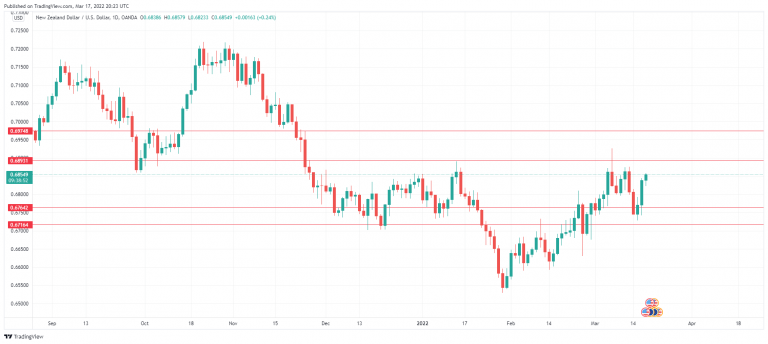
The New Zealand dollar has edged higher on Thursday. NZD/USD is trading at 0.6855, up 0.24% on the day. The pair jumped 0.99% on Tuesday, buoyed by optimism over developments in China and Ukraine.
New Zealand GDP posted a strong 3.0% gain QoQ in the fourth quarter. This fell short of the consensus estimate of 3.2%, but nonetheless marked an impressive turnaround from the -3.6% slide in Q3. The data confirms that the economy rebounded after Covid lockdowns hampered the economy in the third quarter.
The Chinese government has intervened after the meltdown in the country’s stock markets. Beijing announced it planned to boost the economy through monetary and loan policies which would spur growth. The announcement boosted Chinese stock markets on Wednesday, with the Hang Seng soaring 9.1%. The news also sent the New Zealand dollar soaring, as China is New Zealand’s biggest export market.
There was more positive news for the risk-sensitive New Zealand currency, as a peace plan in Ukraine appears to have made significant progress. We’ve seen reports of progress in the negotiations, only to be disappointed, and the fighting has not let up. Still, both Russian and Ukraine officials sound more optimistic about a deal, which has raised risk appetite.
Fed raises rates, revises dot plot
The Federal Reserve did not surprise anyone with its 0.25% hike, the first rise in rates since 2018. What was more of interest to the markets was the FOMC dot plot, which projected another six rate hikes this year. The dot plot also forecasted that rates would rise to around 3% by the end of 2023, sharply higher than the 1.60% estimate in December. Fed Chair Powell said that a taper of the balance sheet could start as early as May. Together with the upcoming rate hikes, this shows that the Fed plans to be aggressive in its tightening.
NZD/USD Technical
- NZD/USD has support at 0.6764 and 0.6716
- There is resistance at 0.6893 and 0.6974
Long-Term Buyers Accumulating Bitcoin Now
Bitcoin is up nearly 4% over the past 24 hours to $41K. Ethereum added 4.7% to $2.75K, while Terra is out of the range, losing 0.6% in 24 hours, and other leading altcoins from the top ten add from 3.5% (XRP) to 9.8% (Avalanche).
According to Glassnode, $1.2 billion worth of bitcoin was withdrawn from the Coinbase crypto exchange in just a week. This is the largest net outflow since July 2017, which signals the mood of investors for long-term storage of the asset.
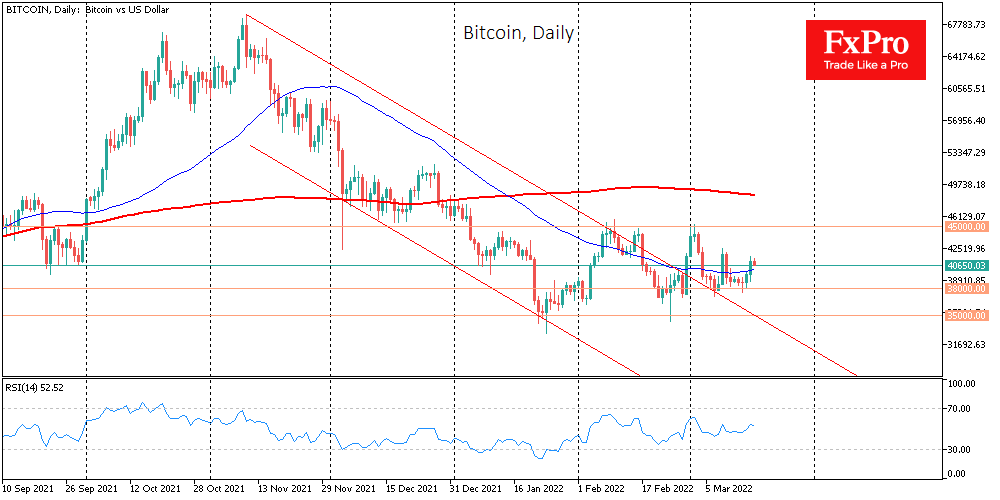
Despite the positive dynamics in recent days, Bitcoin has been trading in a sideways range between $37K and $42K for almost the entire month of March, unable to choose a further direction. Since the last days of February, there has been a solid support line on the declines under $38K. And this is bullish strength, reflecting that long-term buyer interest has migrated from $30K to $38K due to inflation and geopolitical tensions.
Such a migration of the level of interest to long-term buyers fully reflects the price jump, which is the actual depreciation of the value of fiat currencies.
Meanwhile, Instagram will implement NFT in a couple of months, Meta founder Mark Zuckerberg said. Despite the loud statement, it should be noted that all of Zuckerberg’s projects related to digital assets previously failed and did not find wide support from the digital community. The head of Meta has a good sense of trends of social networks, augmented reality or metaverses, and in the latter two, there are more and more fast-growing projects.
Brent Could Settle in the $85-100 Range for a Long Time
The price of oil has stabilised at $93 per barrel for WTI and $95 for Brent, after falling by more than a quarter from March 8th. Buyers’ support came on a correction to levels at the beginning of this month, completely cutting off the speculative upside due to events in Europe and fears of a supply stoppage.
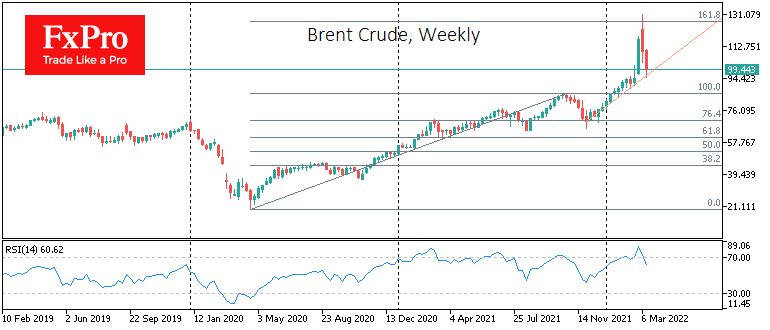
Due to correction over the past week, the price has returned to the uptrend support line formed in December. The market is pricing as if there was no military conflict in Europe and fears of a total oil shortage due to the embargo on Russian oil. Initially, this uptrend had formed on evidence that the omicron strain wave was not followed by lockdowns, so demand continues to rise gradually.
Interestingly, neither a 350% increase in the price per barrel in precisely two years, a 17% fall in commercial reserves over one year, nor the need to compensate for oil from Russia contributes to US production growth.
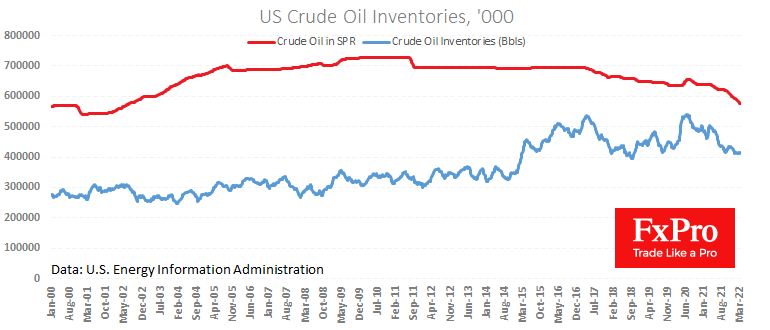
US average daily production has held steady at 11.6m b/d for the last six weeks, which is close to the average over the previous six months.
The observed increase in drilling activity only helps cover the drop in production from depleted fields. However, businesses in the USA remain reluctant to invest in production increases. This is probably due to the ongoing tough ESG agenda, which is holding back investment in an industry that was producing over 13 million BPD in early 2020. Without the coronavirus, it would have reached 14 million BPD by the end of that year.
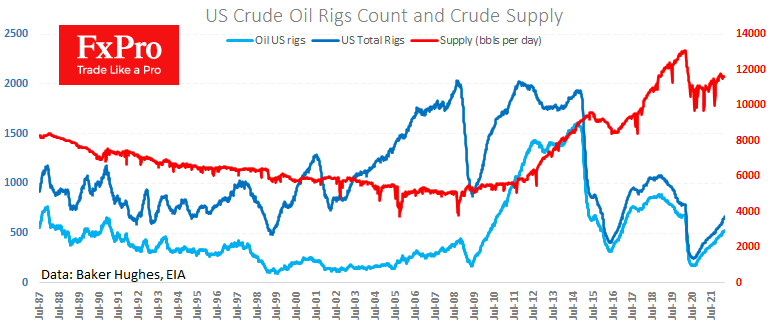
On the other hand, the US and global economies are experiencing an evident shock to energy prices, causing economic growth to slow and oil demand to fall.
This situation sets the oil price in the coming days or weeks to find a balance in the $85-100 range. The lower bound is a multi-year turning point for the price in this range, which has now become a meaningful support level. At the same time, the upper bound is a psychologically crucial round level, the capture of which made the oil market wild in early March.
BoE Set to Follow Fed with 0.25% Hike
Following yesterday’s rate hike by the US Federal Reserve, it is the Bank of England’s turn to tighten its policy. The global economy faces elevated levels of inflation because of various factors, including from surging energy and commodity prices. While the Fed has just started its hiking cycle, the BoE is well on the way, having raised interest rates in its previous two meetings by 25 basis points each time. Another 0.25% hike is expected today, and the decision is likely to be unanimous.
If the above expectations are met, the pound should be able to regain further ground against the dollar, after the greenback fell in reaction to the Fed’s hike last night. The weakness in the dollar observed since last night’s Fed hike suggests the market had already priced in the rate hike and the Fed’s projection of 6 more hikes for this year.
The Bank of England announcement is due at 1200 GMT.
Given the Ukraine situation, I highly doubt the BoE is going to go for a 50 basis point hike at this meeting. It will be interesting to see how much the BoE will push back against expectation of over 6 rate hikes priced in for this year. Just like the Fed, the BoE will be keen to frontload rate hikes to address surging inflation, but then become more concerned in the latter parts of this year about the projection of economic growth. If inflation falls back later on in the year, there won’t be any need to hike rates by 6 or 7 times by year-end as the market is currently expecting.
Source: ThinkMarkets and TradingView.com
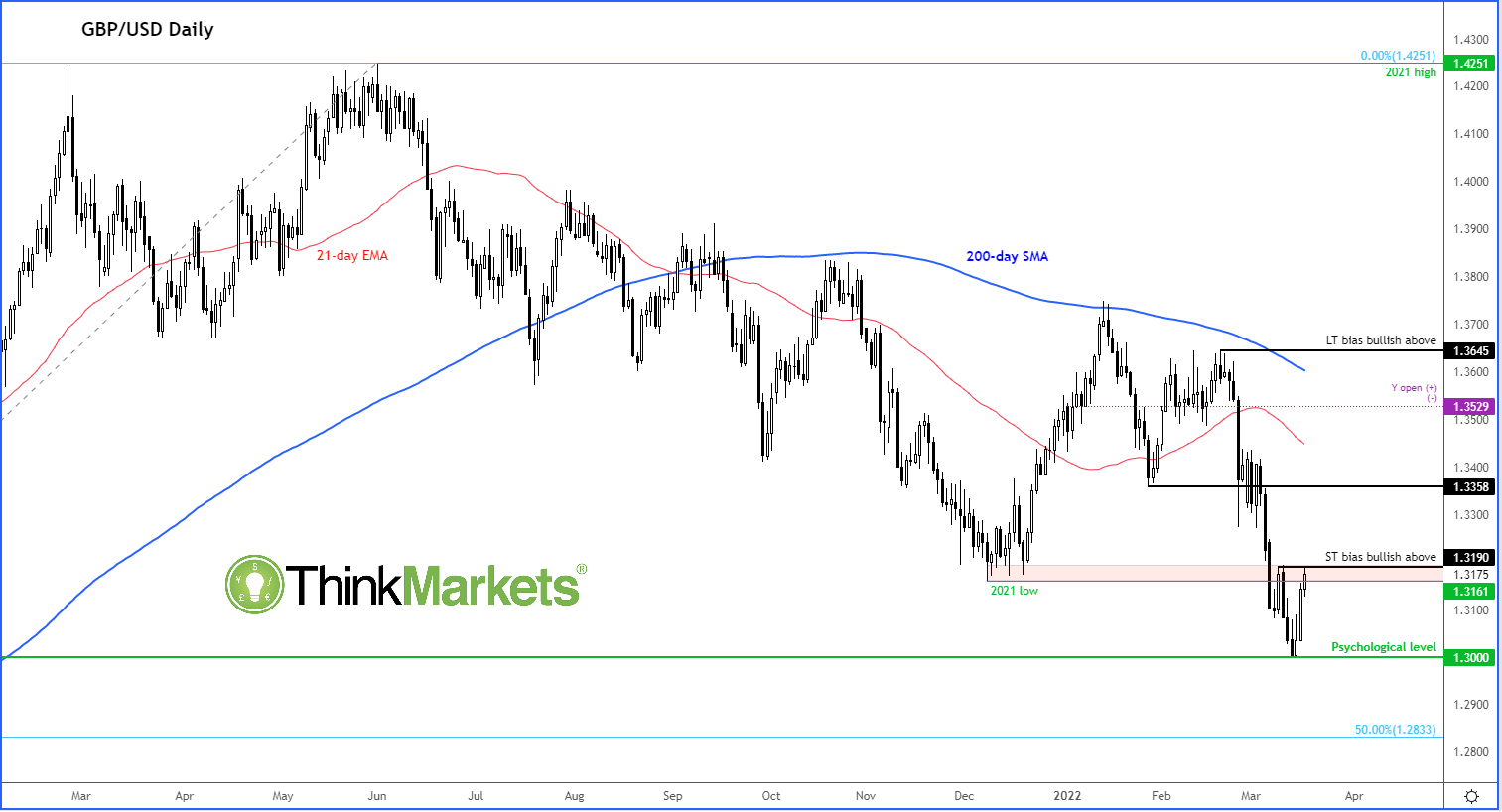
Ahead of the BoE decision, the GBP/USD has rebounded strongly from the psychologically-important 1.30 handle over the last few days. It has risen to rest the next potential resistance zone between 1.3160 (last year’s low) and 1.3190. A decisive break above this zone would tip the balance back in the bulls’ favour, potentially leading to a sharp continuation towards 1.3350. However, if the 1.3160-1.3190 resistance area holds firm, then a revisit of 1.30 cannot be ruled out. This may happen if the BoE is surprisingly more dovish than expected, although it is not my base case scenario.