Sample Category Title
Fed to Announce First of Many Rate Hikes to Come
Market movers today
The highlight for markets today will be the FOMC meeting, where we expect the Fed to hike policy rates by 25bp given the strong inflation pressures, which are likely to be further fuelled by the rise in commodity prices. We had previously expected a 50bp hike, but the uncertainty from the war in Ukraine will make the Fed a tad more cautious in our view.
Earlier today, US retail sales figures for February are also released and higher energy prices could start to have a negative impact on spending.
Ukraine war developments will remain in focus for markets and we look out for headlines from the NATO defence ministers meeting today.
Germany is due to present his 2022 budget and finance planning through 2026. The clouding economic outlook and accelerated expenditure on energy, defence and climate could bring net borrowing above EUR 200bn in 2022.
Two Riksbank speeches (Ingves and Ohlsson) are also on the agenda, which will be interesting in light of the recent inflation upside surprises.
The 60 second overview
Risk sentiment: Overall risk sentiment was positive yesterday, and Asian markets are also clearly up overnight. Ukrainian officials continue to signal cautiously positive progress in the negotiations with Russia, although we still have little concrete information about the topics being discussed. While oil prices have rebounded slightly overnight, with Brent now trading just above USD100/bbl, energy prices have clearly declined over the past days as EU has not signalled joining US and UK with an import ban on Russian energy. Despite EU's ambitions to quickly reduce dependency on Russian natural gas, Germany's largest power supplier warned that a sudden stop to the imports would have dire consequences.
Fed: The key event today will naturally be the FOMC meeting, where consensus and markets are looking for a 25bp hike. Fed will also release its updated economic and rate projections. With oil prices declining from the recent highs, the direct war impact on US economy could be lighter than perhaps initially feared, and markets are now back to pricing in a cumulative 96bp worth of hikes over the next three meetings, which would mean also one 50bp hike either in May or June. Given that US financial conditions overall still remain expansionary, we expect that Fed will have to tighten monetary policy significantly this year to bring down the increasingly broad-based inflation pressure.
Macro: First economic indicators capturing the initial war effect are now starting to get released, yesterday the German ZEW economic sentiment index plunged to -39.3 from 54.3, as 58.9% of respondents now see Germany's economic conditions weakening over the next 6M. While the steep drop indicates a risk of clear downturn in economic activity, the ZEW is still based on analyst assessments, and we will look for the March Flash PMIs next week for a clearer gauge of the impact. In the US, the New York Fed Manufacturing index declined to -11.8 (from 3.1), which is the lowest level since May 2020. Among Nordic countries, especially the Finnish economy stands out as exposed to the crisis, and yesterday we updated our economic forecasts for Finland now calling for 1.7% GDP growth in 2022 (from 2.8%) (see more in Finland Outlook - Eastern headwinds take the speed out of the economy, 15 March).
Equities: Equities were higher yesterday despite the big drop in Chinese tech stocks. With a strong US session yesterday, US outperformed China by 5% in just one day. The optimism was building through day although no big news arrived from Ukraine and macro data were outright weak. However, oil price dropped another 5%, down 20% the last five trading days and hence one of biggest fears from financial markets abating. Just one week ago headlines about oil in 200 and 300 dollars got a lot of attentions and very few were talking about the other side of this, that oil price could drop just like it has been the case with both commodities, agriculture products and the gas price. The move higher in US equities supported by lower oil price and stabilizing yields resulted in tech outperforming energy and hence growth outperforming value. In US Dow +1.8%, S&P 500 +2.1%, Nasdaq +2.9% and Russell 2000 +1.4%. Relief in Asia this morning with all markets higher and Hang Seng leading the advances. However, even with the relief in tech stocks this morning leaves them 65% below the peak a year ago. US futures are flat this morning while European futures in the ballpark of 0.5% higher.
FI: Yesterday, European yields declined as the commodity prices eased. The main event today is the FOMC meeting this evening. We expect a 25bp rate hike rather than a 50bp rate hike given the uncertainty surrounding the war in Ukraine. This has also been indicated by Fed Chairman Powell. We will be looking for comments on the rate path relative to the market pricing and thus how hawkish the Federal Reserve will be relative to market pricing.
FX: After weeks characterised by big inter-day moves in FX the latest sessions have been characterised by more modest close-to-close price action. This is except for offshore USD/RUB, which has completed a 30 figure move lower.
Credit: Yesterday we saw a modest positive risk sentiment in the credit markets. iTraxx main tightened 0.8bp to 79.3bp while Xover tightened 3.2bp to 278.7bp. We saw similar moves in the IG cash space tightening 1bp, whereas the HY market widened slightly.
Nordic macro
Sweden: Two Riksbank speeches on the agenda. First Governor Ingves at 12:00 (local time) and at 14:00 Deputy Governor Ohlsson, both addressing their views on the current economic situation. So far, the Riksbank has taken a relatively relaxed attitude to the run-up in inflation stressing that higher inflation is mainly a matter of energy prices. However with Monday's inflation data that is no longer true, CPIF ex energy jumped to 3.4% in February. The Riksbank usually does not hint about policy shifts in speeches but maybe this time around will be different.
Fed Meets, Oil Rebounds and Russia Risks Default
‘Difficult and vicious’ are the talks between Ukraine and Russia according to the Ukrainian President Zelensky, but there is room for compromise as he also recognized that being part of the EU or NATO is perhaps a faraway dream for Ukraine. Yet, he had already said that, to prevent an invasion when the tensions were escalating a couple of weeks earlier. Therefore the diplomatic efforts are only a slim hope for a resolution.
But the market sentiment is better today. We saw a strong rebound in three major US indices on Tuesday. The S&P 500 gained more than 2%, while Nasdaq jumped close to 3%, as Apple bounced higher from the $150 dip of the day before on news that one of its iPhone suppliers in Shenzhen had to halt production due to the Covid lockdown.
Don’t mistaken: Bad news is bad news
The overall positive mood is put partially on the back of a terrifying Empire State Manufacturing index which dived to -11.80 in March whereas analysts were expecting an improvement from 3 to 7 level. The bad news could’ve acted as ‘good news’ for the market as the weak data may have revived the Fed doves. But the US producer prices hitting 10% in February certainly rules out that explanation as inflation is what matters the most for the Fed policy at the moment.
Therefore, the rebound could be just a short-term positive correction in a comfortably bearish medium term trend.
The dot plot
The Fed starts its newest tightening cycle today, and investors stand ready for a steep tightening to tame the 40-year high infaltion. The ‘dot plot’ will give more clarity on what the US policymakers think about the potential implications of the Ukrainian war on the future of the Fed policy. But there is a chance that we discover a more hawkish FOMC due to the rising inflation that is triggered by the skyrocketing energy and commodity prices, than a dovish outlook because of a slower growth due to the geopolitical tensions. The US 10-year yield is now at the levels it was before the pandemic started.
The US dollar? Tighter Fed policy is, in theory, a booster for the valuation of the greenback and should lead to a further appreciation in the US dollar across the board, but the historical data confirms that the dollar weakened on average 4.1% during the four latest tightening cycles, as a tighter Fed suggests an improving global growth and a greater demand for raw materials and stronger currencies other than the US dollar.
But this time, the Fed isn’t necessarily tightening because the economy is doing well, it’s tightening because there is an urgent need to tame the skyrocketing inflation despite the threat of a slower global growth.
The news from Ukraine will certainly be the major driver of the US dollar in the coming weeks. A diplomatic solution will certainly trigger a rapid downside correction in the dollar despite a more hawkish Fed, while the lack thereof could support a further appreciation of the US dollar.
Oil
US crude dipped to $93 per barrel yesterday than rebounded back above the $98 mark this morning. The Covid lockdown in China, and the news that India bought discounted Russian crude, potentially diminishing the hit to global supplies from import bans in the US, UK, and Canada, have certainly helped, along with the failure to break above the $130 mark after the announcement of the Russian oil ban which triggered a massive cut in long positions.
I expect a solid support near $88/90 per barrel range, including the major 61.8% Fibonacci retracement on December – March rally. Above this level, the price outlook will remain positive, while a break below, will certainly hint at a deeper and more sustainable downside correction. But that’s not my base case due to a globally tight supply. UBS also says that they expect the global oil demand reaching record highs in the second half of the year, and the impact of the latest Chinese lockdown will be limited in the medium run.
Default?
Russia is due to pay $117 million in interest on its dollar-denominated bonds today, and the failure to service debt could lead to a massive $150 billion default next month. Russia has means to pay back the interest, yet they can’t pay in US dollars that they can’t access.
A default could be a blow to the banking stocks due to their exposure to the Russian debt, because the latter was investment grade just a couple of weeks ago. The good news is, though an eventual Russian default will give a shake to the financial markets, it is not a systemic threat to the global economy. Phew.
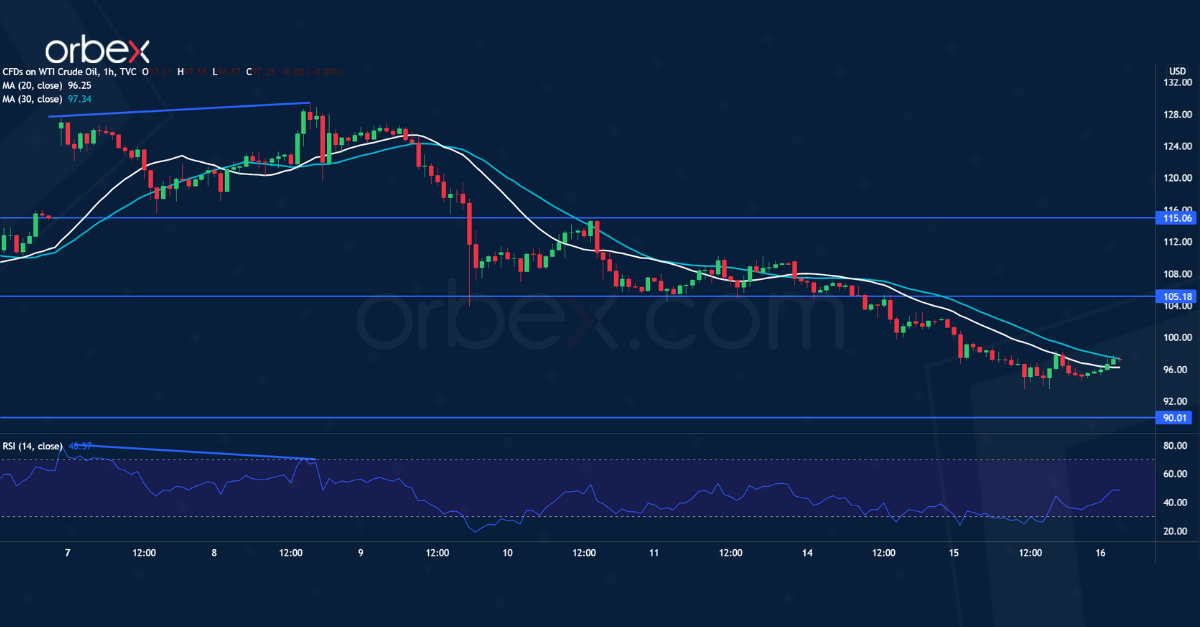
US Oil Drops Towards Key Support
WTI crude falls back over a new round of ceasefire talks between Russia and Ukraine.
Previously, a bearish RSI divergence indicated a loss of momentum as the price went parabolic. Then a steep fall below 107.00 was a sign of liquidation.
Buyers continue to unwind their positions as the price slides back to its pre-war level. The psychological level of 90.00 is an important support on the daily chart. An oversold RSI may attract buying interest in this demand zone. 105.00 is the first resistance before buyers could regain control.
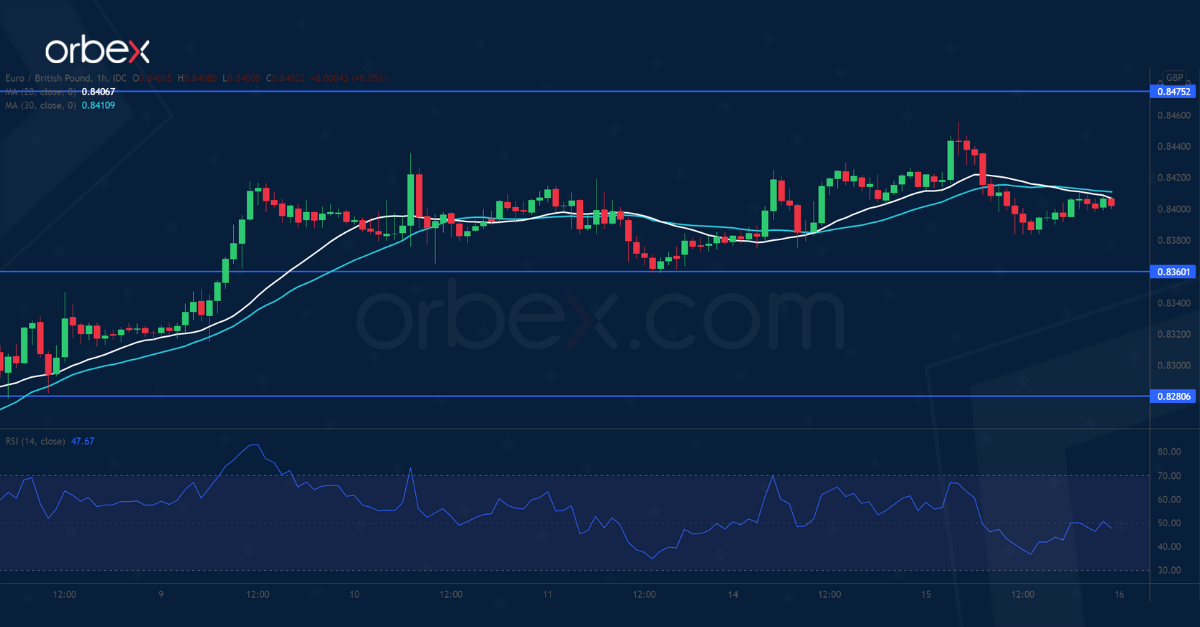
EUR/GBP Tests Key Resistance
The sterling found support after a drop in Britain’s unemployment rate in January. A break above the daily resistance at 0.8400 has prompted sellers to cover, easing the downward pressure.
Sentiment remains downbeat unless buyers push the single currency past 0.8475. In turn, this could pave the way for a reversal in the weeks to come.
Otherwise, the bears might double down and drive the euro back into its downtrend. A fall below 0.8360 would force early bulls to liquidate and trigger a sell-off to 0.8280.
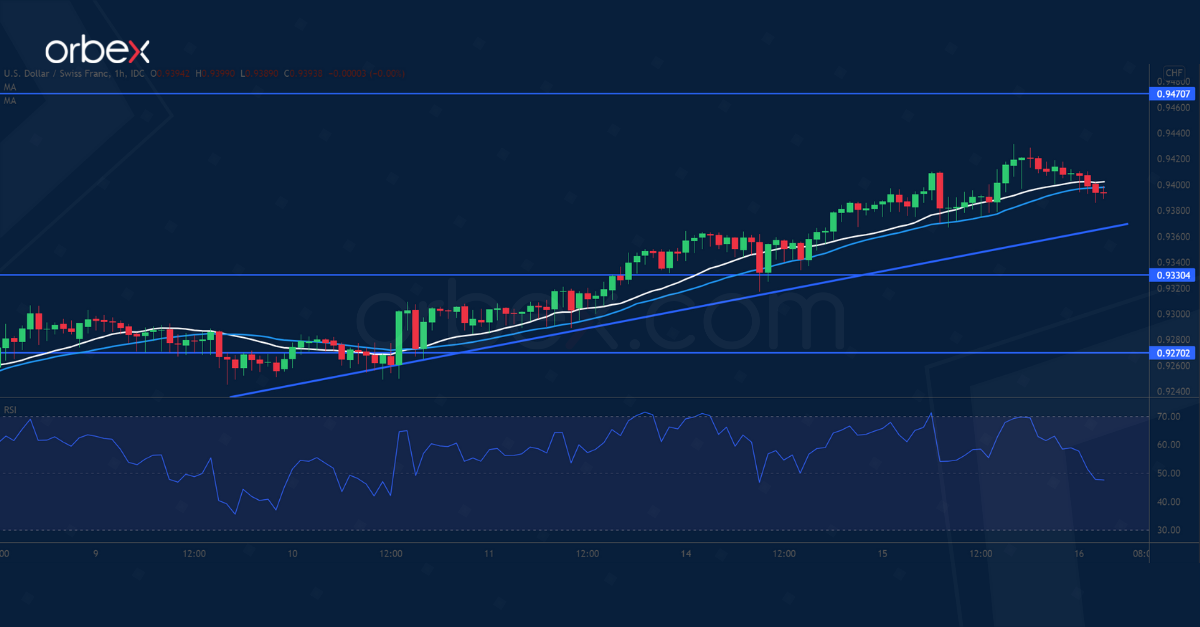
USD/CHF Breaks Major Resistance
The US dollar continues upward as the Fed is set to increase its interest rates by 25bp. The rally sped up after it cleared the daily resistance at 0.9360.
The bullish breakout may have ended a 9-month long consolidation from the daily chart perspective. The rising trendline confirms the optimism and acts as an immediate support.
Solid momentum could propel the greenback to April 2021’s high at 0.9470. Buyers may see a pullback as an opportunity to jump in. 0.9330 is the closest support should this happen.
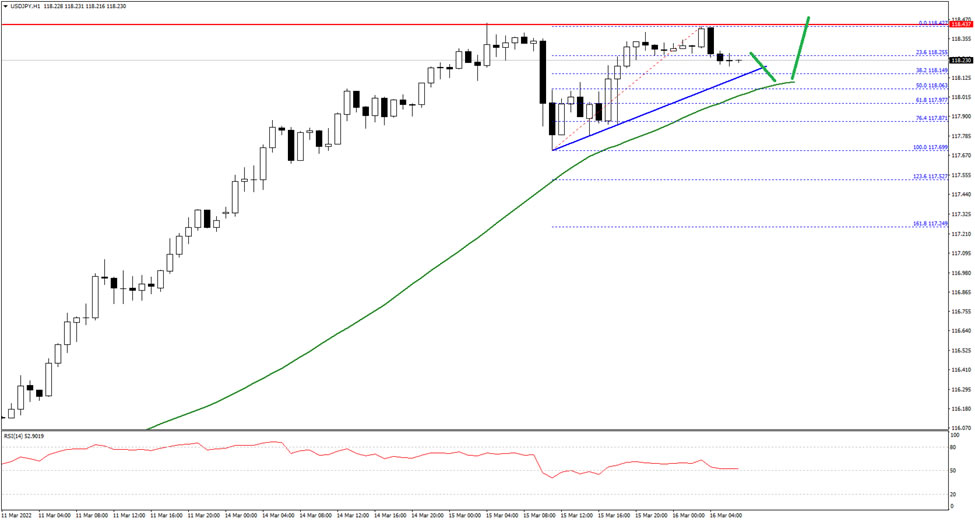
USD/JPY Move into Bullish Zone above $117.50
The US Dollar started a strong upward move above the 116.50 resistance against the Japanese Yen. The USD/JPY pair traded above the 117.50 level to move into a bullish zone.
The pair even traded above 118.00 and settled above the 50 hourly simple moving average. A high is formed near 118.42 and the pair is now consolidating gains. An immediate support is near 118.15 and a connecting bullish trend line on the hourly chart.
The next major support sits near the 118.10 level, below which there is a risk of more downsides. In the stated case, the pair could decline towards the 117.50 level.
On the upside, an immediate resistance is near the 118.40 level. A clear break above the 118.40 resistance could push the price towards 118.80. The next major resistance is near the 119.50 level or 120.00 on FXOpen.
GBP/JPY Daily Outlook
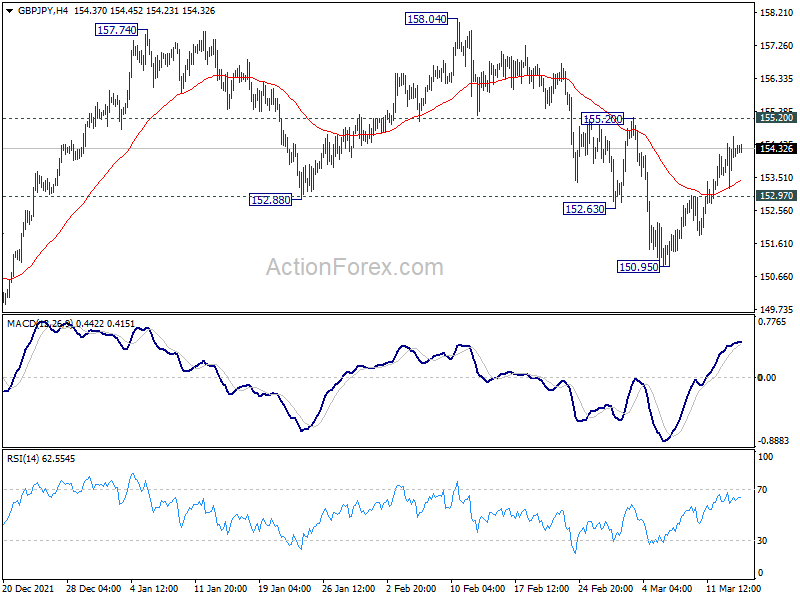
Daily Pivots: (S1) 153.41; (P) 154.05; (R1) 154.86; More...
Intraday bias in GBP/JPY remains neutral and outlook is unchanged. With 155.20 resistance intact, further decline is expected. On the downside, below 152.97 minor support will turn bias back to the downside for 150.95 support first. Break will resume the decline form 158.04, as part of the consolidation from 158.19, to 148.94 support next. However, firm break of 155.20 will bring stronger rise back to 158.04/19 resistance zone.
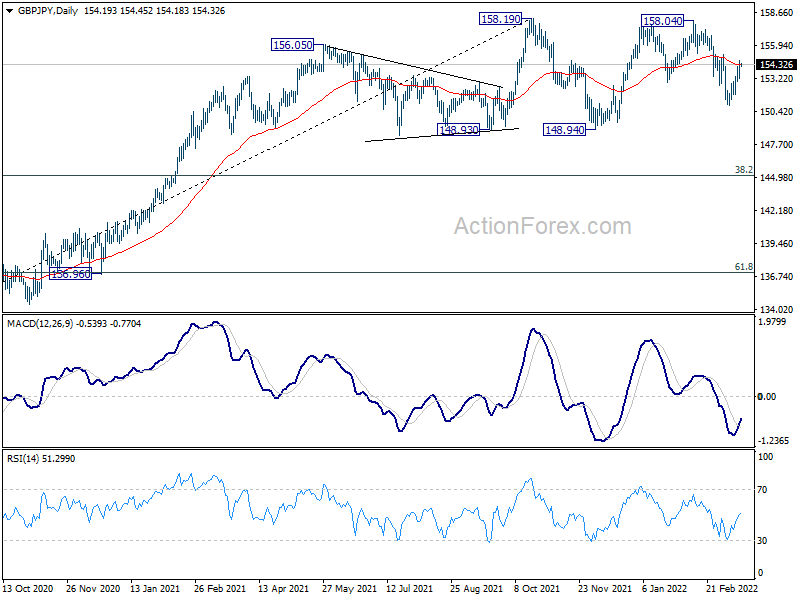
In the bigger picture, price actions from 158.19 are seen as developing into a consolidation pattern to up trend from 123.94 (2020 low). Downside should be contained by 38.2% retracement of 123.94 to 158.19 at 145.10 to bring rebound. Firm break of 158.19 will resume the up trend to long term fibonacci level at 167.93. However, sustained break of 145.10 will raise the chance of trend reversal and target 61.8% retracement at 137.02.
EUR/JPY Daily Outlook
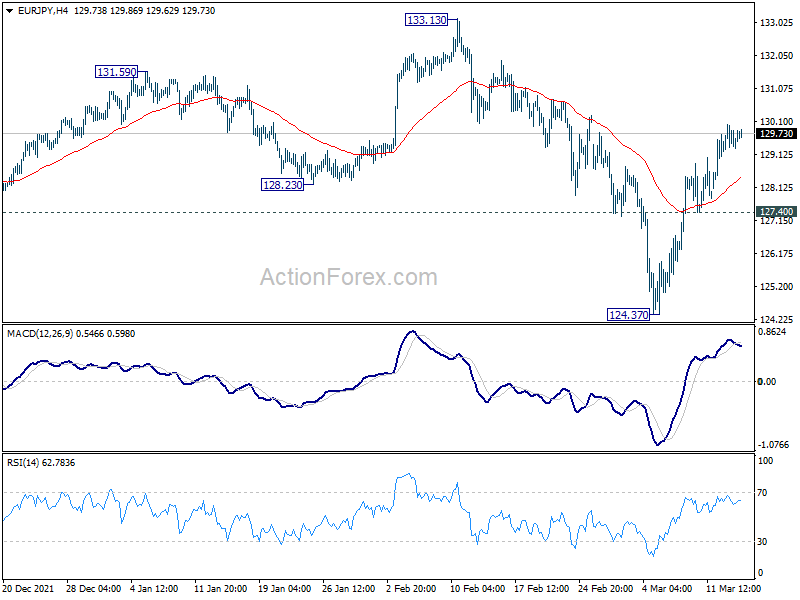
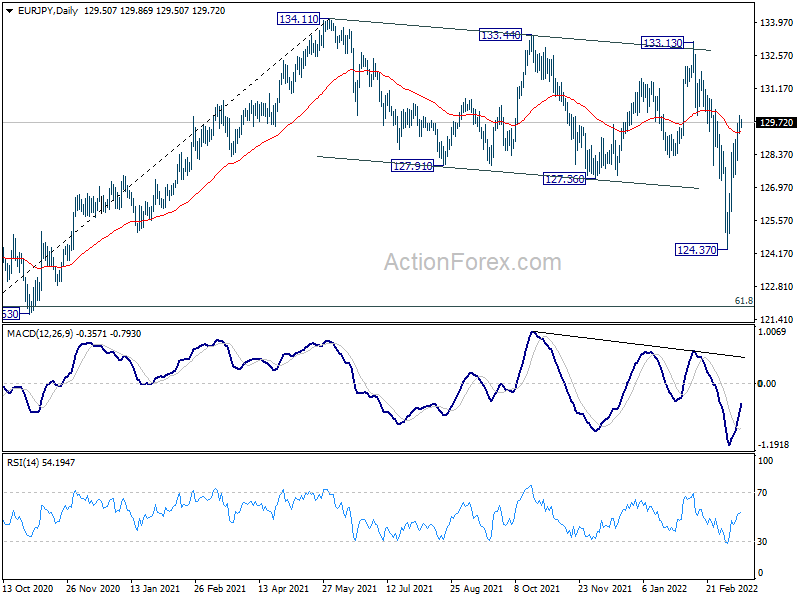
Daily Pivots: (S1) 129.16; (P) 129.60; (R1) 129.91; More....
Intraday bias in EUR/JPY remains mildly on the upside and outlook is unchanged. With break of 55 day EMA, the corrective pattern from 134.11 might have completed at 124.37 already. Further rise should be seen to 133.13/134.11 resistance zone. This will now be the mildly favored case as long as 127.40 minor support holds. Nevertheless, break of 127.40 will bring retest of 124.37 instead.
In the bigger picture, medium term outlook remains neutral for now. Price actions from 134.11 are so far still seen as a corrective pattern. That is, rise from 114.42 (2020 low) is in favor to resume at a later stage. But before that, the corrective pattern from 134.11 could still extend further, sideway or downward. In the latter case, break of of 124.37 will target 61.8% retracement of 114.42 to 134.11 at 121.94.
EUR/GBP Daily Outlook
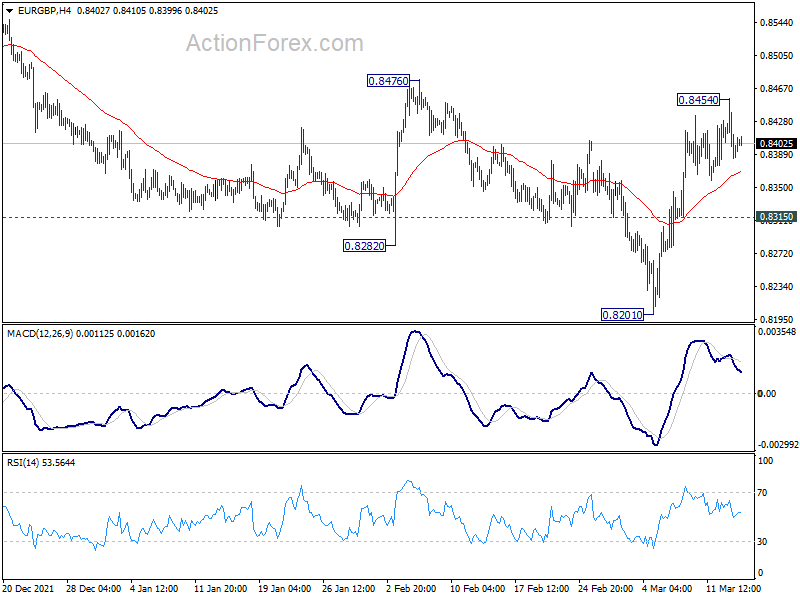
Daily Pivots: (S1) 0.8369; (P) 0.8413; (R1) 0.8439; More...
EUR/GBP edged higher to 0.8454 but quickly retreated. Intraday bias remains neutral first. On the upside, above 0.8454 will target 0.8476 structural resistance first. Firm break there will carry larger bullish implication and target 0.8598 resistance next. On the downside, break of 0.8315 minor support will retain near term bearishness, and bring retest of 0.8201 low.
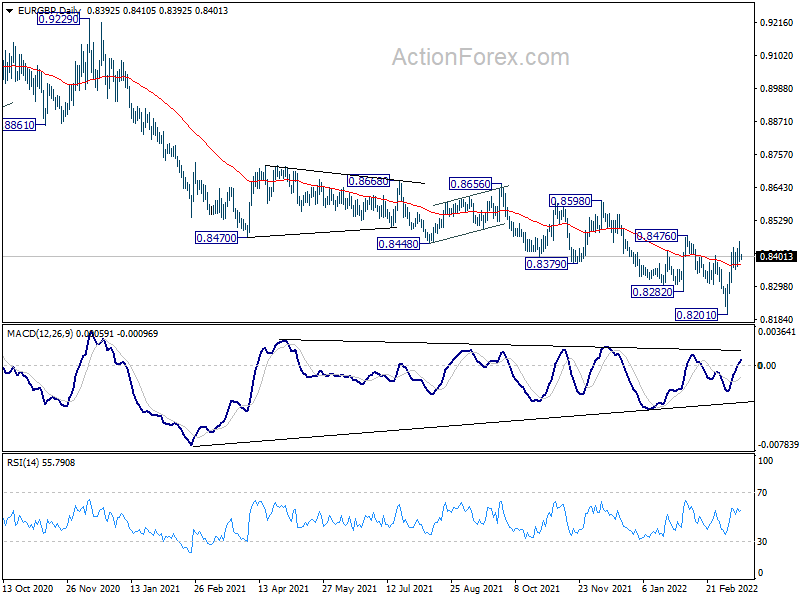
In the bigger picture, the down trend from 0.9499 is expected to continue as long as 0.8476 resistance holds. Sustained trading below 0.8276 support will argue that the whole up trend from 0.6935 (2015 low) has reversed. Deeper fall should be seen to 61.8% retracement of 0.6935 to 0.9499 at 0.7917 next. However, firm break of 0.8476 will indicate medium term bottoming at least. Focus will be back on 55 week EMA (now at 0.8534) for more evidence of bullish reversal.
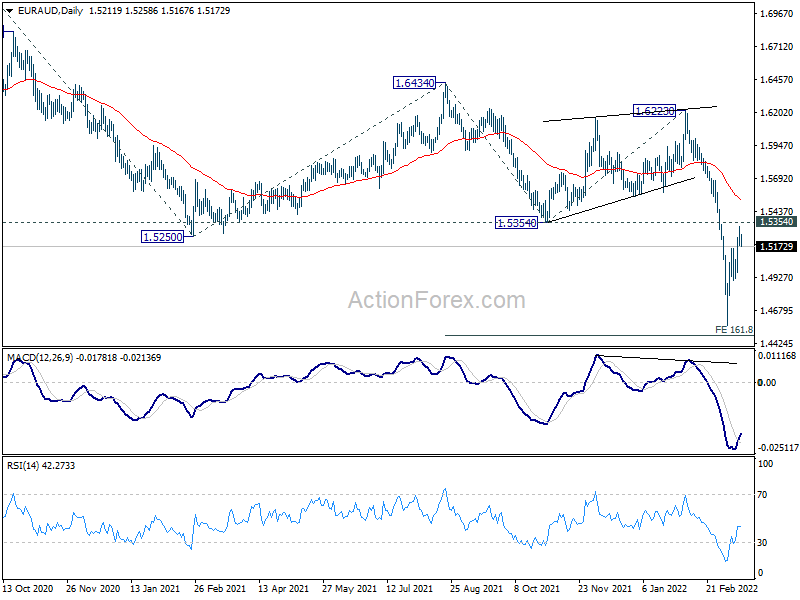
EUR/AUD Daily Outlook
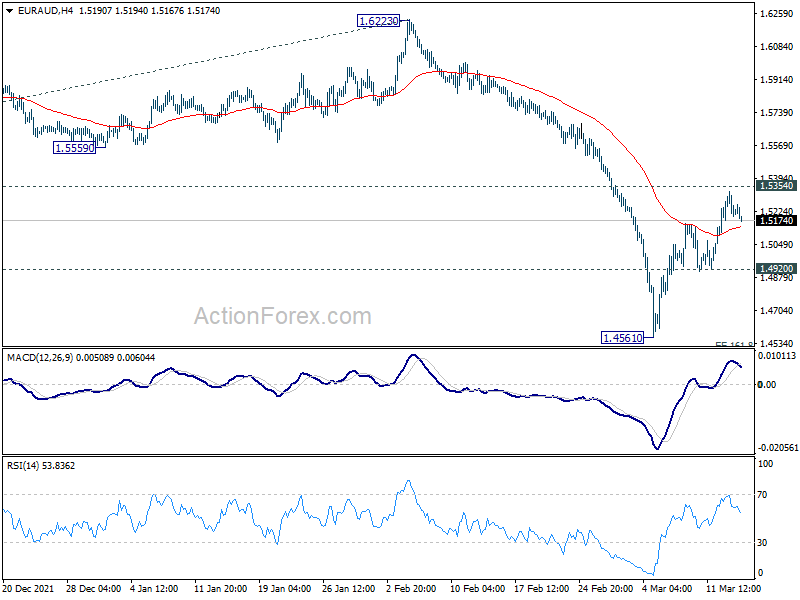
Daily Pivots: (S1) 1.5153; (P) 1.5241; (R1) 1.5304; More...
Intraday bias in EUR/AUD neutral and outlook is unchanged. As long as 1.5354 support turned resistance holds, further decline is still expected. On the downside, break of 1.4920 minor support should resume larger down trend to 161.8% projection of 1.6343 to 1.5354 from 1.6223 at 1.4476. However, sustained break of 1.5354 will bring stronger rise back towards 1.6223 resistance.
In the bigger picture, fall from 1.9799 is seen as a long term impulsive move. Next target is 61.8% projection of 1.9799 to 61.8% projection of 1.9799 to 1.5250 from 1.6434 at 1.3623, which is close to 1.3624 long term support (2017 low). Some support could be seen there to bring interim rebound. But overall, break of 1.5354 support turned resistance is needed to be the first sign of medium term bottoming. Otherwise, outlook will stay bearish in case of recovery.