Sample Category Title
EUR/USD Clings to Multi-Year Lows ahead of the Fed
EUR/USD, despite rebounding late last week, is still clinging to uncomfortably low levels ahead of Wednesday’s Fed interest rate decision.
A textbook symmetrical triangle, thrice tested on either side, is now fully formed on the weekly chart. EUR/USD looks ripe to move big, but the big question is when and in what direction.
If I were a technical purist, I’d say given that price is well past half and closer to two-thirds through the pattern, EUR/USD looks ripe for a big breakout. Traditionally, analysts look to the widest point of the triangle to get a sense of the size of the potential breakout, which in this case is 2,051 pips wide. Any break to the downside could easily see EUR/USD fall below parity.
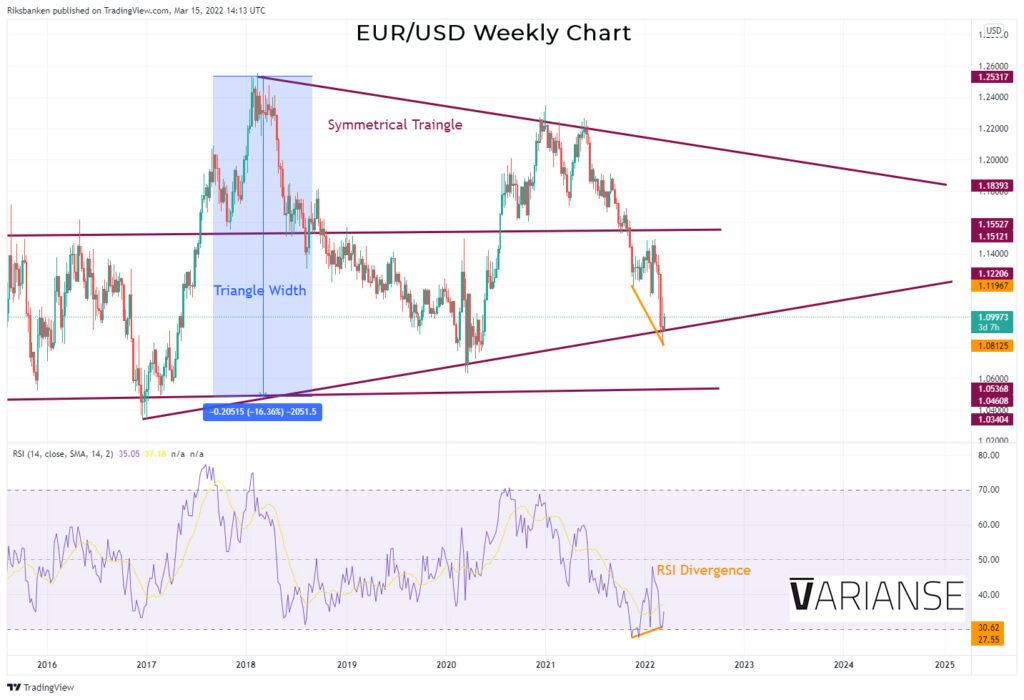
That said, buyers haven’t hesitated to step in and buy EUR/USD between the 1.08 to 1.03 range, including at the depth of the COVID-19 pandemic. Also, price sharply rejected the bottom support of the triangle last week as downside moment shows sign of divergence and the last weekly candle is a definitive hammer. Likewise, already elevated geopolitical risk due to war in the Ukraine has yet to convince markets of parity.
Just how the Fed could shift the calculus around EUR/USD isn’t entirely clear. US interest rate markets are already pricing in substantial amount of interest rate hikes this year. This includes 25 bps on Wednesday. What is much clearer, however, is if EUR/USD doesn’t get up from current levels soon, a bigger fall in EUR/USD begins to look more probable.
Sunset Market Commentary
Markets
Persistent uncertainty on the economic impact of the war in Ukraine combined with country specific themes caused some ‘diffuse price action’ on global markets today. This morning, Chinese equities again faced hefty selling despite solid eco data as markets pondered the impact of further regulation, elevated commodity prices and persistent political and trade tensions with the US. The risk-off initially spilled over to Europe with regional indices, at some point recording losses of 2.5%+. However, selling pressure gradually subsided. European equities currently are losing about 0.50% . US indices are rebounding 1.0%/1.5%. Eco data for sure weren’t the driver for this improvement. The expectations component of German ZEW investor confidence tumbled more sharply than ever before in March, from + 54 to minus 39.3, the biggest drop since the start of the series in 1991. ZEW President Achim Wamback commented that ‘The experts … expect a stagflation in the coming months. The worsened outlook affects practically all sectors of the German economy’ General business conditions of the manufacturing sector as measured by the NY Fed also nosedived to the lowest level since May 2020 (from 3.1 to 11.8). The survey responses were collected at the start of the Russian invasion in Ukraine (between 2 & 9 March). On the positive side of the economic story, pressure on some commodities continues to ease, with brent oil falling below $100/b. US and German yields are correcting lower after yesterday’s steep rise. US yields are ceding between 6 bps (2-y) and 2 bps (30-y). German yields are easing between 4 bps (2 & 5-y) and 1.8 bps (30-y). The move was supported by a limited decline in inflation expectations. At the same time, lingering global uncertainty and technical/tactical repositioning ahead of tomorrow’s Fed decision probably are also in play. Intra-EMU spreads narrowed modestly (Italy -3 bps).
On Fx markets, the decline in the oil price apparently is providing some breathing space to the euro and the yen. EUR/USD briefly surpassed the 1.10 barrier (currently 1.099). The USD/JPY rally finally did run into resistance, with the pair currently hovering around 118. Sterling initially didn’t profit from solid UK labour market data published the morning. EUR/GBP even briefly tested the 0.8455 area. However, sterling later staged a an intraday rebound, both against the euro. EUR/GBP currently trades near 0.841. Cable tested the psychological barrier of 1.30 this morning in Asia but is now changing hands in the 1.3065 area. CE currencies (Czech koruna, forint, zloty) all record modest gains. Polish February inflation eased from 9.4% to 8.5% on government measures/tax cuts to slow prices rises. Still the figure was higher than expected.
News Headlines
The Norwegian central bank published its quarterly regional network survey today. Interviewed contacts indicated that business activity continues to rise and they expect even stronger growth over the next six months. Over half of the interviewees reported capacity constraints, the highest share since autumn 2007. That’s even without taking into account the consequence of the Russian invasion in Ukraine as the survey was conducted early February. Contacts have revised up their estimate for annual wage growth this year from 3.3% in November to 3.7%. The main reason for concern is uncertainty related to capacity constraints and a rapid rise in prices. The NOK benefited from the rather hawkish survey with EUR/NOK dropping from an intraday top around 9.98 to 9.85 currently. The move comes even as oil prices drop below $100/barrel (Brent) for the first time since end February. Norwegian money market expect the Norges Bank to deliver (25 bps) rate hikes at every remaining meeting this year (7). The policy rate currently stands at 0.50%.
The WSJ reports that Saudi Arabia is in active talks with China to price some of its oil sales to China in yuan instead of dollar. Talks accelerated this year because of Saudi unease over the US’s security commitments to defend the kingdom. China buys more than a quarter of all Saudi oil exports. Switching the oil denomination would boost the international appeal of the Chinese currency.
Aussie Stems Slide
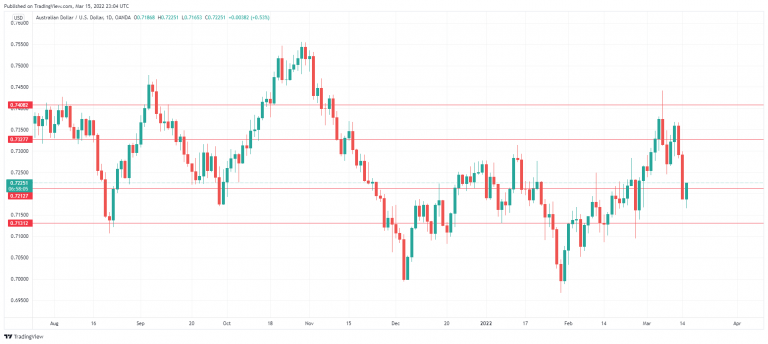
The Australian dollar has finally managed to stem the bleeding on Tuesday, after two days of sharp losses. In the North American session, AUD/USD is trading at 0.7225, up 0.56% on the day.
With the war continuing to rage in Ukraine, markets remain fragile and risk apprehension is high. There have been hints of slight progress in the negotiations between Ukraine and Russia which have given hope that a ceasefire can be reached, but Moscow appears determined to continue the fight, despite facing crippling sanctions from the West.
Has the Lucky Country’s luck run out for the Australian dollar? The currency enjoyed a run of five straight winning weeks, but dropped 1.13% last week and slid 1.44% on Monday before edging higher today. The surge in commodity prices had buoyed the Aussie in recent weeks but the ongoing conflict in Ukraine has sapped risk appetite and is weighing heavily on the risk-sensitive Australian dollar. The markets remain volatile, and we can expect developments in Ukraine to have a strong impact on the direction of the Australian dollar.
Patience, please
Patience was one of the messages that the RBA minutes conveyed, with the central bank saying it would continue to be patient before raising interest rates. RBA members noted that inflation was expected to continue to rise, as supply disruptions persist. However, the minutes noted that the war in Ukraine and the rise in energy prices had “created additional uncertainty about the inflation outlook”.
RBA Governor Lowe has insisted that inflation must remain “sustainably” in the 2%-3% target range. Even though inflation is currently running at a 3.5% clip, Lowe has the luxury of being able to wait until he is convinced that a rate hike is needed to contain inflationary pressures. If inflation continues to accelerate, Lowe will be under strong pressure to raise rates, with a June lift-off a strong possibility.
AUD/USD Technical
- 0.7212 is under pressure as support. Below, there is support at 0.7131
- There is resistance at 0.7327 and 0.7408
EUR/USD Mid-Day Outlook
Daily Pivots: (S1) 1.0896; (P) 1.0945; (R1) 1.0989; More...
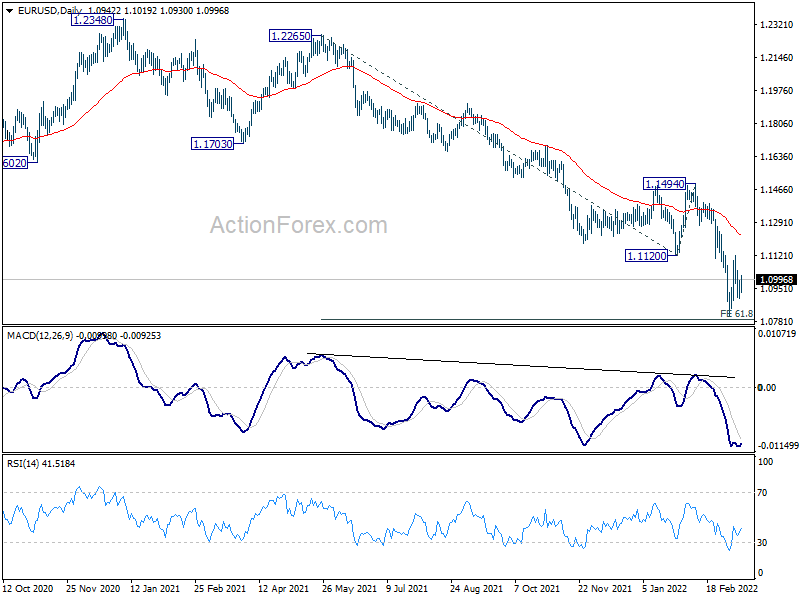
Range trading continues in EUR/USD and intraday bias remains neutral first. As long as 1.1120 support turned resistance holds, larger down trend from 1.1494 is still expected to continue. On the downside, firm break of 61.8% projection of 1.2265 to 1.1120 from 1.1494 at 1.0786 will pave they way to 100% projection at 1.0349 next. However, strong break of 1.1120 will confirm short term bottoming, at least, and bring stronger rebound back towards 1.1494 structural resistance instead.
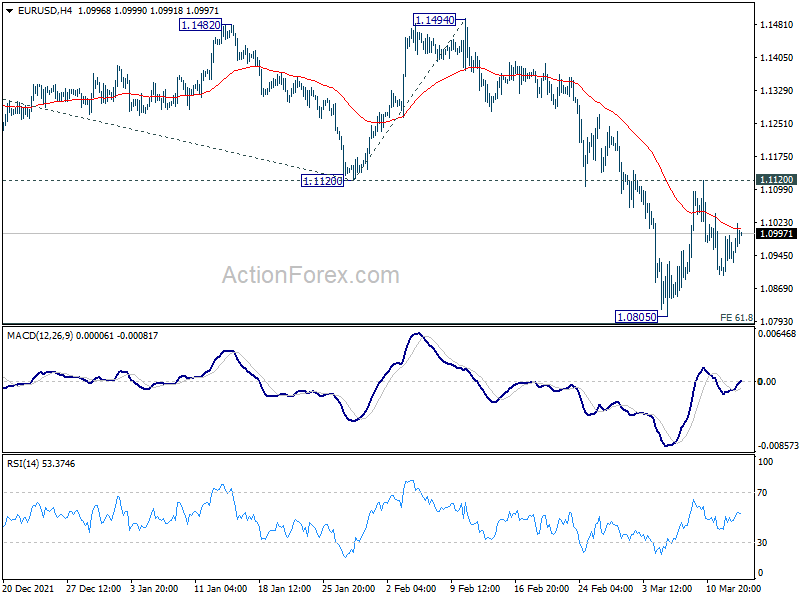
In the bigger picture, the decline from 1.2348 (2021 high) is expected to continue as long as 1.1494 resistance holds. Firm break of 1.0635 (2020 low) will raise the chance of long term down trend resumption and target a retest on 1.0339 (2017 low) next. Nevertheless, break of 1.1494 will maintain medium term neutral outlook, and extend range trading first.
GBP/USD Mid-Day Outlook
Daily Pivots: (S1) 1.2975; (P) 1.3027; (R1) 1.3053; More...
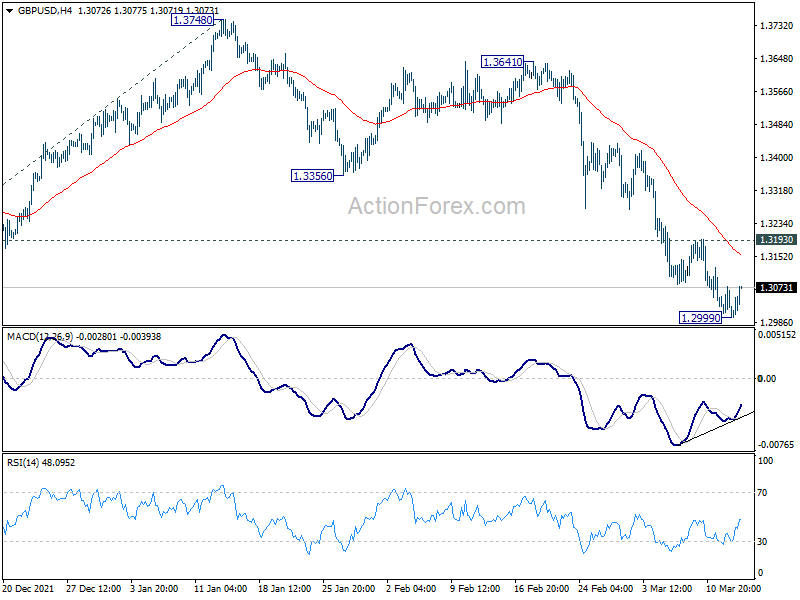
Intraday bias in GBP/USD is turned neutral with 4 hour MACD crossed above signal line. Some consolidations could be seen but further fall is expected with 1.3193 resistance intact. On the downside, below 1.2999 will target 100% projection of 1.4248 to 1.3158 from 1.3748 at 1.2658 next. However, firm break of 1.3193 will indicate short term bottoming, and turn bias back to the upside for stronger rebound.
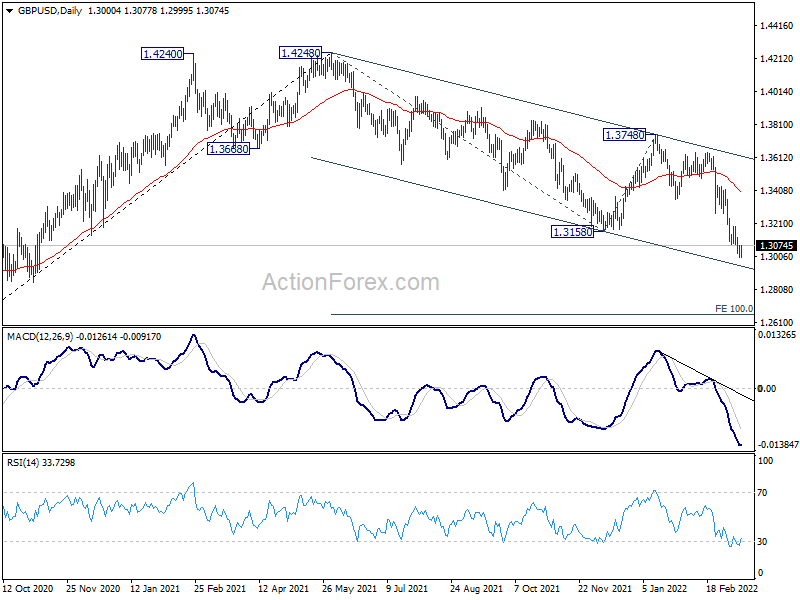
In the bigger picture, current development suggests that the up trend from 1.1409 (2020 low) has completed at 1.4248. Decline from 1.4248 could still be a corrective move, or it could be the start of a long term down trend. In either case, deeper decline would be seen back to 61.8% retracement of 2.1161 to 1.1409 at 1.2493. In any case, break of 1.3748 resistance is needed to indicate medium term bottoming, or outlook will stay bearish.
USD/CHF Mid-Day Outlook
Daily Pivots: (S1) 0.9343; (P) 0.9365; (R1) 0.9409; More....
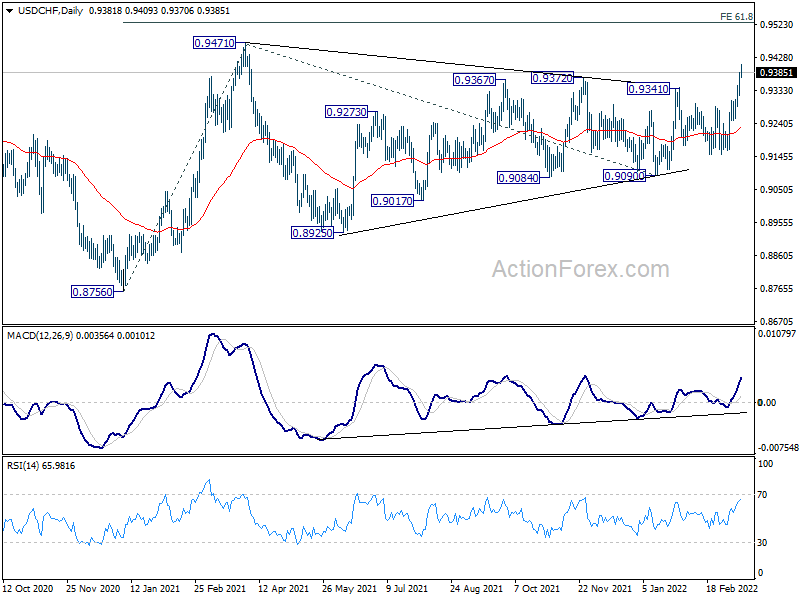
Intraday bias in USD/CHF remains on the upside at this point. Current rally should target 0.9471 resistance first. Break there will resume whole rally from 0.8756 to 61.8% projection of 0.8756 to 0.9471 from 0.9090 at 0.9532. On the downside, break of 0.9318 minor support will turn intraday bias neutral and bring consolidations.
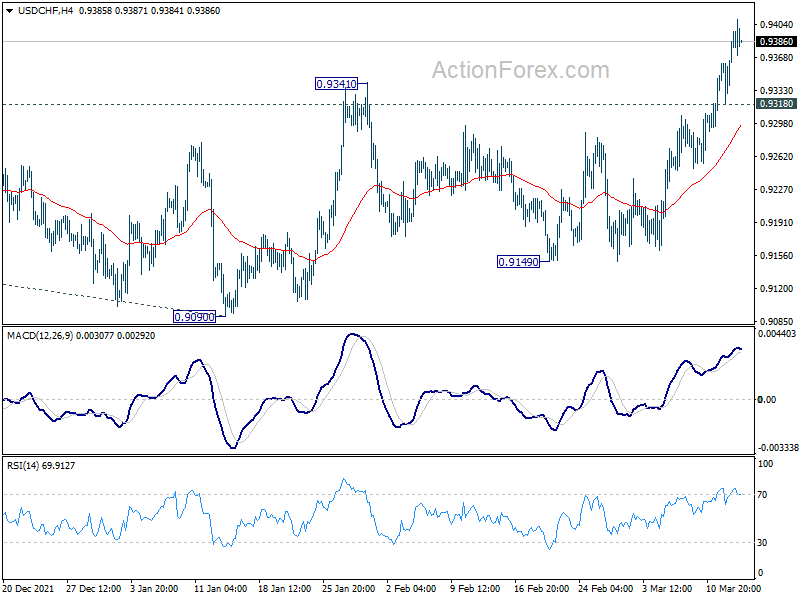
In the bigger picture, medium term outlook will be neutral at best as long as 0.9471 resistance holds. Larger down trend could still extend through 0.8756 (2021 low). However, firm break of 0.9471 will argue that whole down trend form 1.0342 (2016 high), has completed with waves down to 0.8756. A medium term up trend should be set up to target 1.0237/0342 resistance zone.
USD/JPY Mid-Day Outlook
Daily Pivots: (S1) 117.60; (P) 117.91; (R1) 118.52; More...
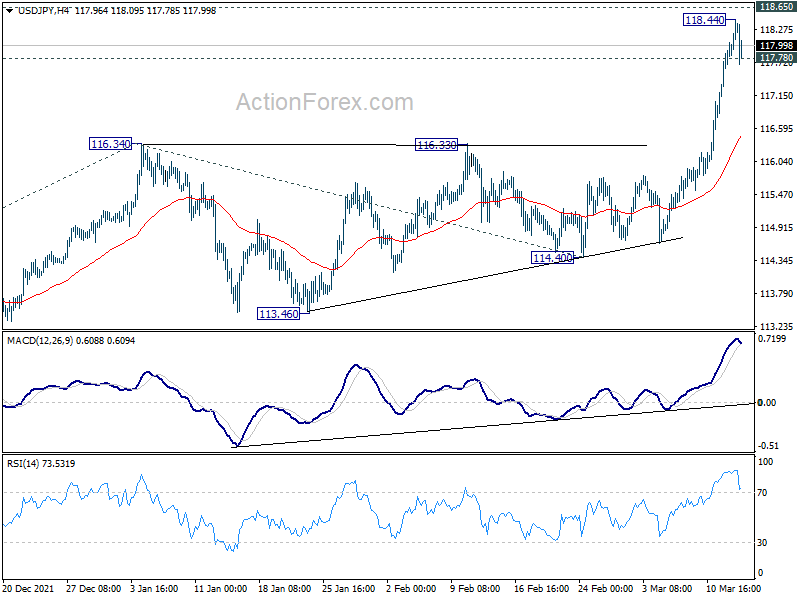
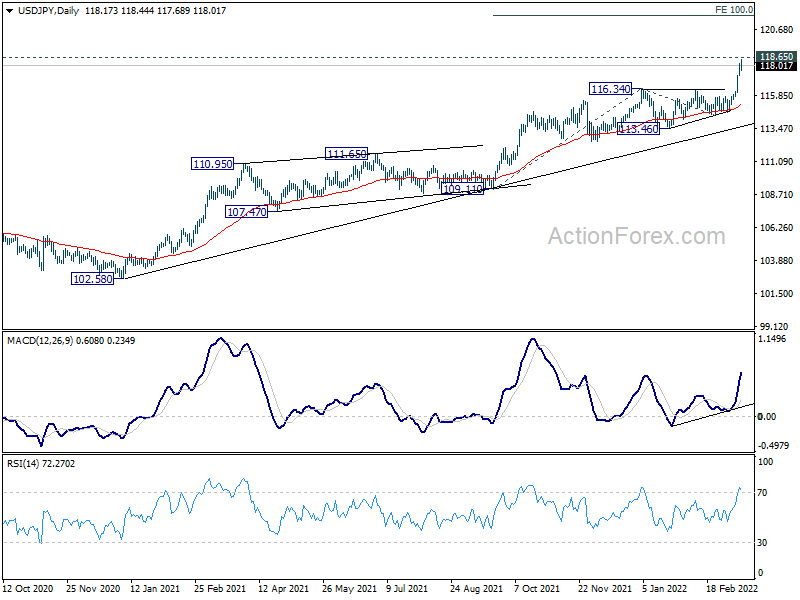
A temporary top is formed at 118.44, ahead of 118.65 long term resistance. Intraday bias is turned neutral for some consolidations first. Downside of retreat should be contained above 116.34 resistance turned support to bring another rally. On the upside, firm break of 118.65 will target 100% projection of 109.11 to 116.34 from 114.40 at 121.63.
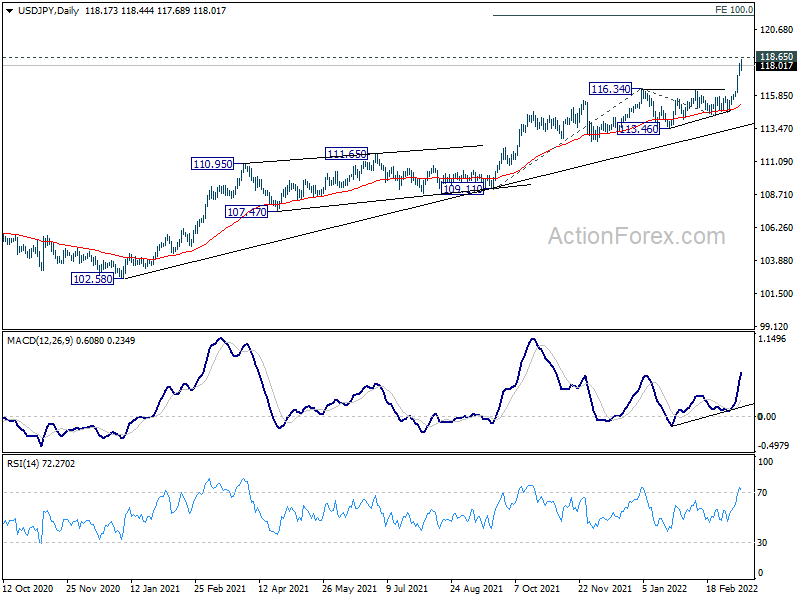
In the bigger picture, no change in the view that rise from 102.58 is the third leg of the up trend from 101.18 (2020 low). Such rally should target a test on 118.65 (2016 high). Sustained break there will pave the way to 125.85 (2015 high) and raise the chance of long term up trend resumption. This will remain the favored case as long as 113.46 support holds.
Yen Decline Exhausted, Euro and Sterling Recover
Euro and Sterling are the relatively stronger ones today, but gains are so far limited. The rallies are still capped by the war uncertainties. Economic data is not really playing a role here, considering the UK job data was solid while German economic sentiment plunged. Meanwhile, Canadian Dollar and Swiss Franc are the softest ones, followed by Dollar. Yen's selling looks exhausted ahead of a key resistance level against the greenback.
Technically, a focus will be on whether Euro and Sterling could real stage a sustainable rebound. EUR/CHF and EUR/JPY are performing well. But EUR/USD is still limited below 1.1120 resistance. For Sterling, GBP/USD is held below 1.3193 resistance, GBP/JPY below 155.20 resistance. These levels need to be broken to confirm a short term turnaround in both currencies.
In Europe, at the time of writing, FTSE is down -0.62%. DAX is down -0.62%. CAC is down -0.64%. Germany 10-year yield is down -0.035 at 0.333. Earlier in Asia, Nikkei rose 0.15%. Hong Kong HSI dropped -5.72%. China Shanghai SSE dropped -4.95%. Singapore Strait Times rose 0.12%. Japan 10-year JGB yield rose 0.0154 at 0.211.
US PPI rose 0.8% mom, 10.0% yoy in Feb
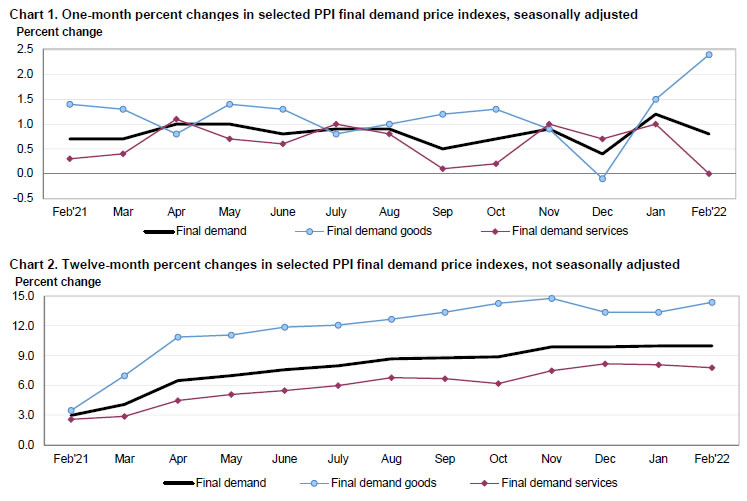
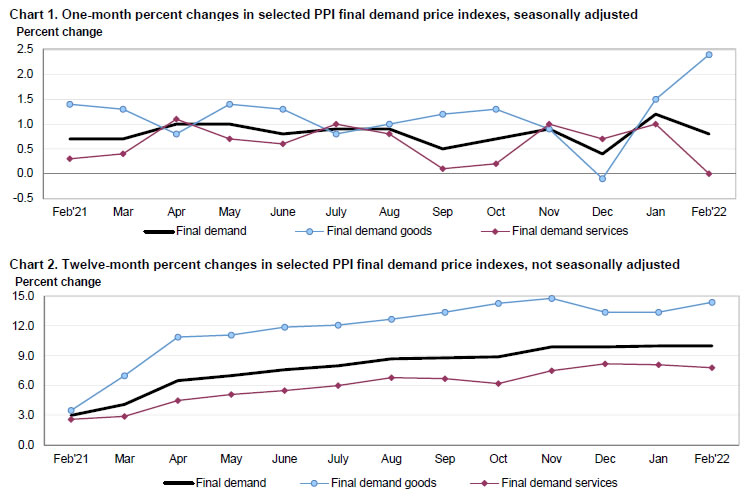
US PPI for final demand rose 0.8% mom in February, below expectation of 1.0% mom. On an unadjusted basis, final demand prices moved up 10.0 yoy for the 12 months ended in February, matched expectations. Prices for final demand goods was up 2.4% mom while prices for final demand services was unchanged.
Empire State Manufacturing index dropped sharply from 3.1 to -11.8 in March, well below expectation of 7.3.
Canada manufacturing sales rose 0.6% mom in Jan
Canada manufacturing sales rose 0.6% mom to CAD 64.8B in January, below expectation of 1.3% mom. That's nonetheless the fourth consecutive month of increase. Sales rose in 14 of 21 industries, led by the petroleum and coal (+6.8%) and wood (+6.5%) product industries. The gain was partially offset by lower sales of motor vehicles (-17.5%).
German ZEW had largest fall on record, expect a stagflation in the coming months
German ZEW Economic Sentiment tumbled sharply from 54.3 to -39.3 in March, well below expectation of 10.3. That -93.6 pts decline was the largest on record, since the survey began in December 1991. That's even worse than the -58.2 pts fall at the beginning of the pandemic. Current Situation Index dropped from -8.1 to -21.4, slightly better than expectation of -22.5.
Eurozone ZEW Economic Sentiment dropped from 48.6 to -38.7, below expectation of 49.3. Current Situation Index dropped 22.5 pts to -21.9.
Inflation expectations indicator stands at jumped sharply from -35.1 to 69.5. 76.5 per cent of the experts expect the inflation rate to increase in the next six months.
"A recession is becoming more and more likely. The war in Ukraine and the sanctions against Russia are significantly dampening the economic outlook for Germany. The collapsing economic expectations are accompanied by an extreme rise in inflation expectations. The experts therefore expect a stagflation in the coming months. The worsened outlook affects practically all sectors of the German economy, but especially the energy-intensive sectors and the financial sector," comments ZEW President Achim Wambach on current expectations.
Eurozone industrial production flat in Jan, EU rose 0.4% mom
Eurozone industrial production rose 0.0% mom in January, below expectation of 0.4% mom. Production of non-durable consumer goods rose by 3.1%, while production of intermediate goods and energy both fell by -0.3%, durable consumer goods by -0.5% and capital goods by -2.4%.
EU industrial production rose 0.4% mom. Among Member States for which data are available, the largest monthly increases were registered in Austria (+6.2%), Czechia (+3.1%) and Poland (+3.0%). The highest decreases were observed in Estonia (-6.1%), Portugal (-5.0%) and Greece (-4.1%).
UK payrolled employees rose 275k in Feb, unemployment rate dropped to 3.9% in Jan
UK number of payrolled employees rose 275k in February. Comparing with prepandemic level in February 2020, number of payrolled employees was up 662k. Claimant count dropped -48.1k, versus expectation of 20.3k rise.
In the three months to January, unemployment rate dropped from 4.1% to 3.9% in the three months to January, better than expectation of 4.0%.
Average earnings including bonus rose 4.8% 3moy in January, above expectation of 4.6%. Average earnings excluding bonus rose 3.8% 3moy, also above expectation of 3.7%.
China industrial production and retail sales growth unexpectedly strong
For the two months of January and February, China industrial production grew 7.5% yoy, well above expectation of 3.9% yoy. That's the fastest pace since June 2021. Retail sales rose 6.7% yoy, also well above expectation of 3.0% yoy, also the fastest since June 2021. Fixed asset investment rose 12.2% yoy, above expectation of 5.0% yoy, highest since July 2021.
Separately, PBoC unexpectedly kept the rate of CNY 200B worth of one-year medium term lending facility (MLF) loans to some financial institutions unchanged at 2.85%. The operation resulted in a net injection of CNY 100B funds to the market. The central bank said it is for "maintaining banking system liquidity reasonably ample".
RBA minutes reiterate patient stance on interest rate
In the minutes of March 1 meeting, RBA reiterated that it will not hike cash rate "until actual inflation is sustainably within the 2 to 3 per cent target band. Now, it was "too early to conclude that" inflation is "sustainably within the target band".
There were "uncertainties about how persistent the pick-up in inflation". Wage growth "remained modest", and "it was likely to be some time before aggregate wages growth would be at a rate consistent with inflation being sustainably at target."
Thus, RBA is "prepared to be patient" on lifting interest rate.
New Zealand BNZ services index rose to 48.6, pain is accumulating
New Zealand BNZ Performance of Services Index rose slightly from 46.0 to 48.6 in February. Activity/sales rose from 44.6 to 50.7. Employment dropped from 47.0 to 45.0. New orders/business rose from 41.2 to 53.6. Stocks/inventories rose from 48.0 to 50.0. Supplier deliveries dropped from 43.4 to 34.4.
BNZ Senior Economist Doug Steel said that "February marks the PSI's seventh consecutive month below the breakeven 50 mark. Pain is accumulating. While there were some overs and unders in the components, all remain below their respective long-term averages."
USD/JPY Mid-Day Outlook
Daily Pivots: (S1) 117.60; (P) 117.91; (R1) 118.52; More...
A temporary top is formed at 118.44, ahead of 118.65 long term resistance. Intraday bias is turned neutral for some consolidations first. Downside of retreat should be contained above 116.34 resistance turned support to bring another rally. On the upside, firm break of 118.65 will target 100% projection of 109.11 to 116.34 from 114.40 at 121.63.
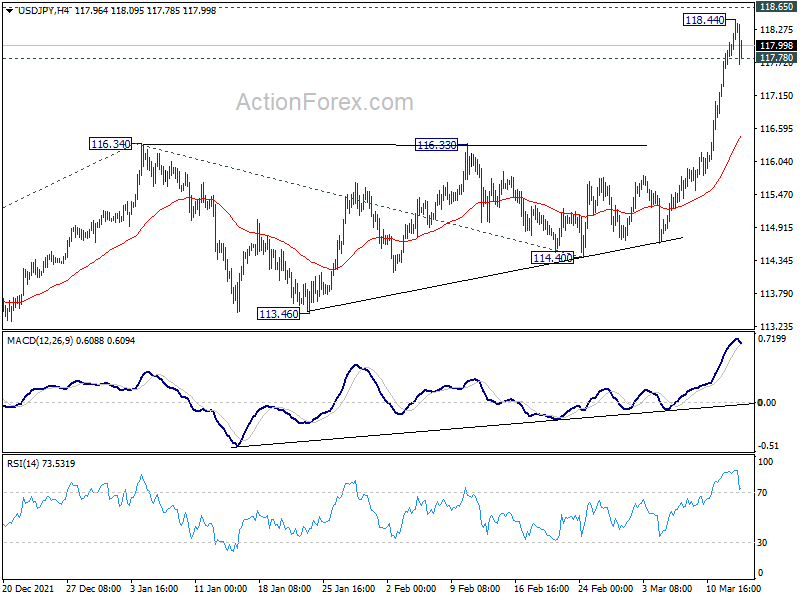
In the bigger picture, no change in the view that rise from 102.58 is the third leg of the up trend from 101.18 (2020 low). Such rally should target a test on 118.65 (2016 high). Sustained break there will pave the way to 125.85 (2015 high) and raise the chance of long term up trend resumption. This will remain the favored case as long as 113.46 support holds.
Economic Indicators Update
| GMT | Ccy | Events | Actual | Forecast | Previous | Revised |
|---|---|---|---|---|---|---|
| 00:30 | AUD | RBA Meeting Minutes | ||||
| 00:30 | AUD | House Price Index Q/Q Q4 | 4.70% | 3.90% | 5.00% | |
| 02:00 | CNY | Retail Sales Y/Y Feb | 6.70% | 3.00% | 1.70% | |
| 02:00 | CNY | Fixed Asset Investment (YTD) Y/Y Feb | 12.20% | 5.00% | 4.90% | |
| 02:00 | CNY | Industrial Production Y/Y Feb | 7.50% | 3.90% | 4.30% | |
| 07:00 | GBP | Claimant Count Change Feb | -48.1K | 20.3K | -31.9K | |
| 07:00 | GBP | ILO Unemployment Rate (3M) Jan | 3.90% | 4.00% | 4.10% | |
| 07:00 | GBP | Average Earnings Including Bonus 3M/Y Jan | 4.80% | 4.60% | 4.30% | |
| 07:00 | GBP | Average Earnings Excluding Bonus 3M/Y Jan | 3.80% | 3.70% | 3.70% | |
| 07:30 | CHF | Producer and Import Prices M/M Feb | 0.40% | 0.40% | 0.60% | |
| 07:30 | CHF | Producer and Import Prices Y/Y Feb | 5.80% | 5.10% | 5.40% | |
| 10:00 | EUR | Eurozone Industrial Production M/M Jan | 0.00% | 0.40% | 1.20% | 1.30% |
| 10:00 | EUR | Germany ZEW Economic Sentiment Mar | -39.3 | 10.3 | 54.3 | |
| 10:00 | EUR | Germany ZEW Current Situation Mar | -21.4 | -22.5 | -8.1 | |
| 10:00 | EUR | Eurozone ZEW Economic Sentiment Mar | -38.7 | 49.3 | 48.6 | |
| 12:15 | CAD | Housing Starts Y/Y Feb | 247K | 235K | 231K | 230K |
| 12:30 | CAD | Manufacturing Sales M/M Jan | 0.60% | 1.30% | 0.70% | |
| 12:30 | USD | Empire State Manufacturing Index Mar | -11.8 | 7.3 | 3.1 | |
| 12:30 | USD | PPI M/M Feb | 0.80% | 1.00% | 1.00% | |
| 12:30 | USD | PPI Y/Y Feb | 10.00% | 10.00% | 9.70% | |
| 12:30 | USD | PPI Core M/M Feb | 0.20% | 0.60% | 0.80% | |
| 12:30 | USD | PPI Core Y/Y Feb | 8.40% | 8.10% | 8.30% |
Canada manufacturing sales rose 0.6% mom in Jan
Canada manufacturing sales rose 0.6% mom to CAD 64.8B in January, below expectation of 1.3% mom. That's nonetheless the fourth consecutive month of increase. Sales rose in 14 of 21 industries, led by the petroleum and coal (+6.8%) and wood (+6.5%) product industries. The gain was partially offset by lower sales of motor vehicles (-17.5%).
US PPI rose 0.8% mom, 10.0% yoy in Feb
US PPI for final demand rose 0.8% mom in February, below expectation of 1.0% mom. On an unadjusted basis, final demand prices moved up 10.0 yoy for the 12 months ended in February, matched expectations.
Prices for final demand goods was up 2.4% mom while prices for final demand services was unchanged.