

Sample Category Title
AUD/USD Weekly Outlook
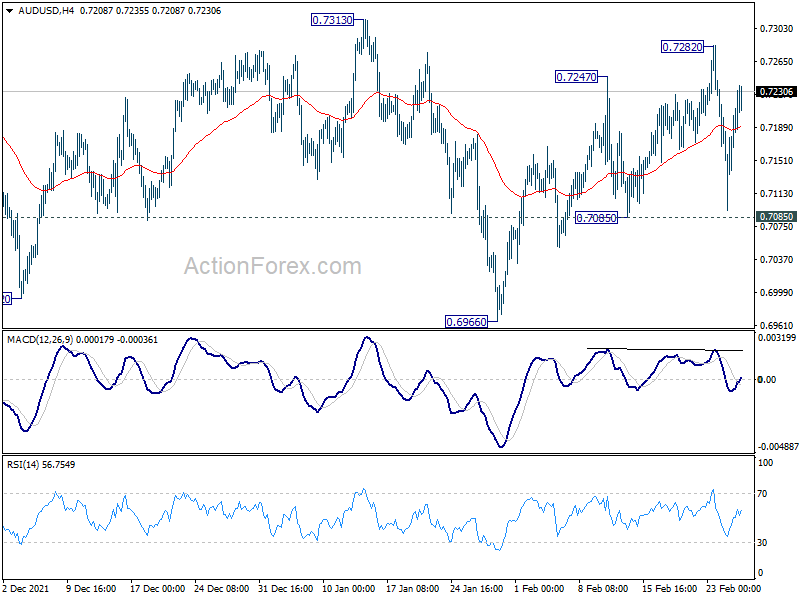
AUD/USD rose to 0.7282 last week but retreated sharply then. Overall, it's staying above 0.7085 support and further rise is in favor. Initial bias is neutral this week first. On the upside, decisive break of 0.7313 resistance will argue that correction from 0.8006 has completed at 0.6966, after hitting 0.6991 key support. Outlook will be turned bullish for 0.7555 resistance next. However, break of 0.7085 support will retain near term bearishness and bring retest of 0.6966 low.
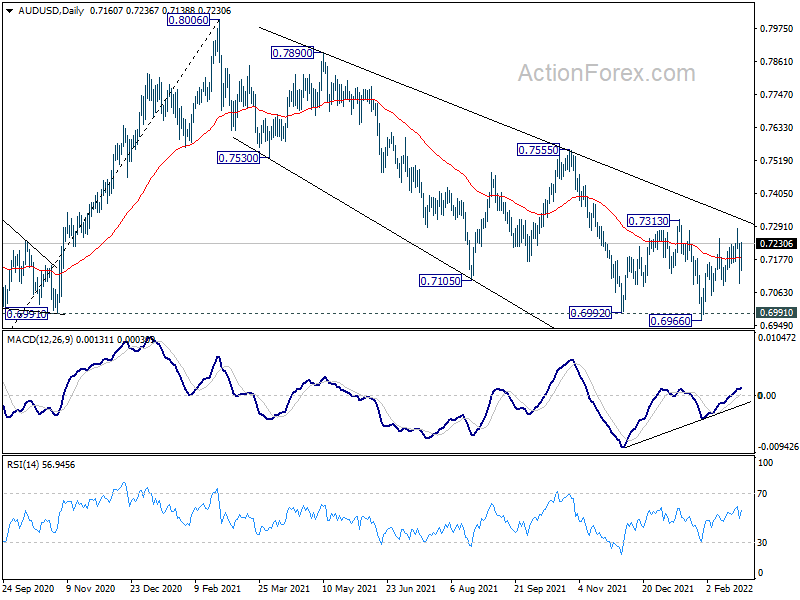
In the bigger picture, focus remains on 0.6991 key structural support. Sustained break there will argue that the whole up trend from 0.5506 might be finished at 0.8006, after rejection by 0.8135 long term resistance. Deeper decline would then be seen back to 61.8% retracement of 0.5506 to 0.8006 at 0.6461. Meanwhile, strong rebound from 0.6991 will retain medium term bullishness. That is, whole up trend from 0.5506 is still in progress.
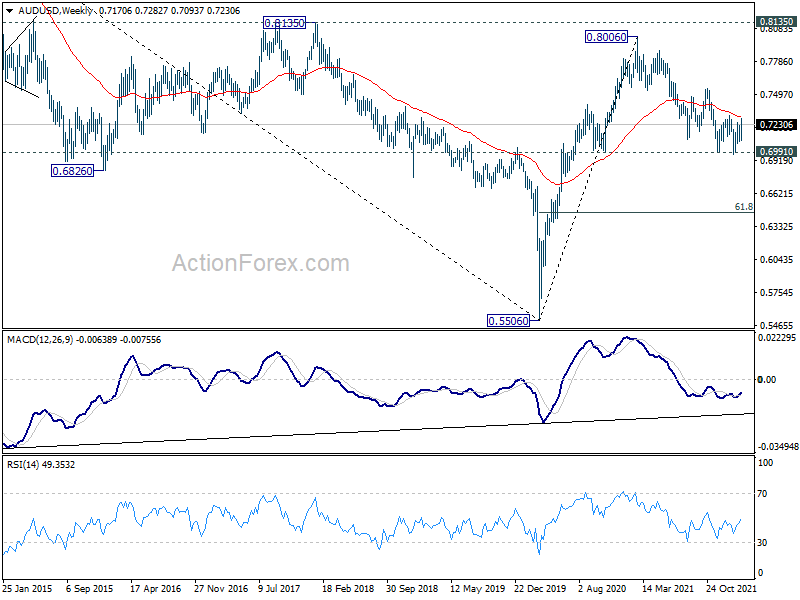
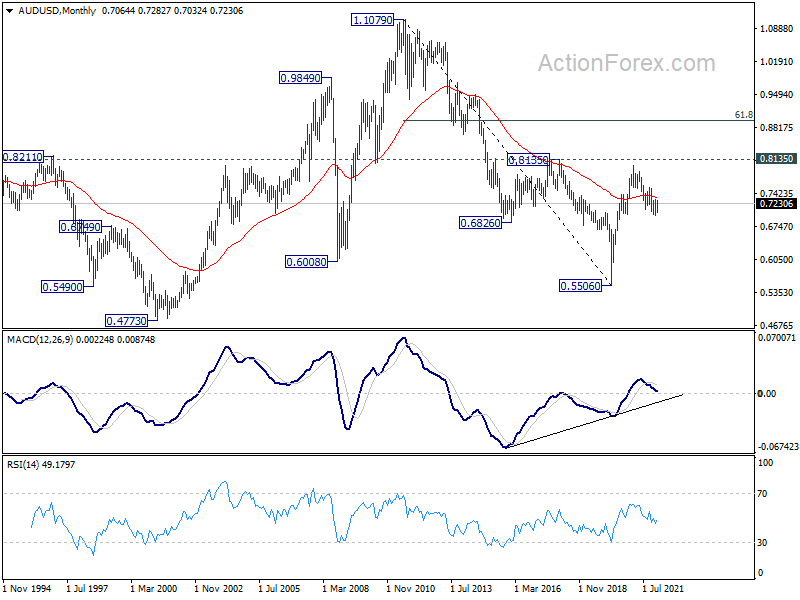
In the longer term picture, focus remains on 0.8135 structural resistance. Decisive break there will argue that rise from 0.5506 is developing into a long term up trend that reverses whole down trend from 1.1079 (2011 high). However, rejection by 0.8135 will keep long term outlook neutral at best.
USD/CAD Weekly Outlook
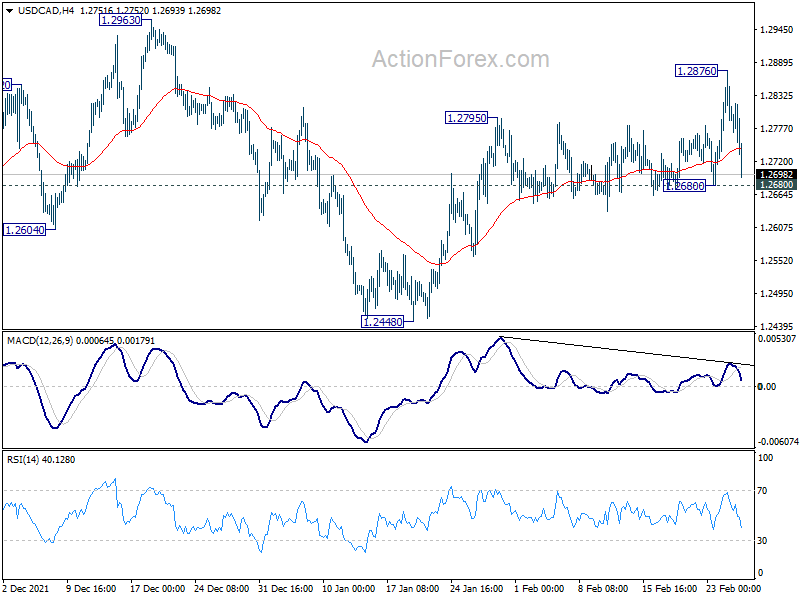
USD/CAD's rebound from 1.2448 resumed and surged to 1.2876, but retreated sharply since then. Initial bias is neutral this week first, but further rise will remain in favor as long as 1.2680 support holds. Break of 1.2876 will resume the rise to 1.2963 resistance. On the downside, however, break of 1.2680 will turn bias back to the downside for 1.2448 support instead.
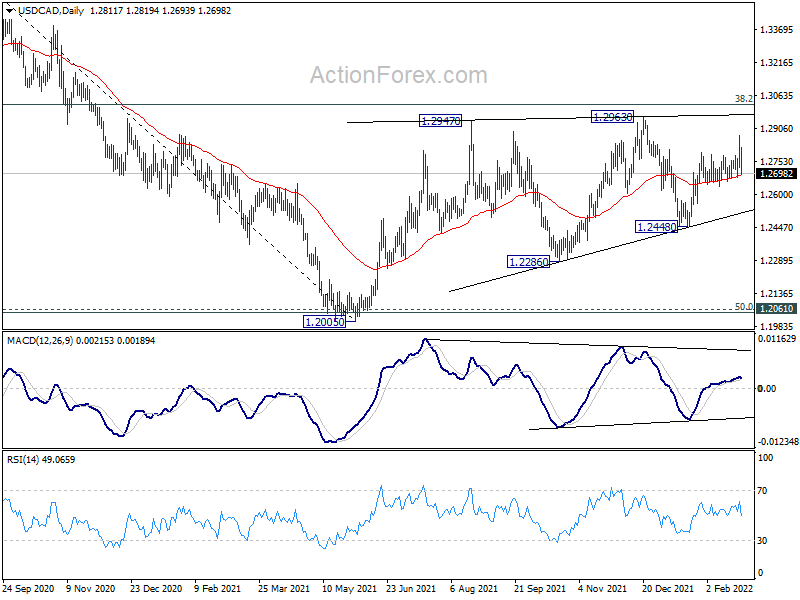
In the bigger picture, focus stays on 38.2% retracement of 1.4667 (2020 high) to 1.2005 (2021 low) at 1.3022. Sustained break there should confirm that the down trend from 1.4667 has completed after defending 1.2061 long term cluster support. Further rise would then be seen towards 61.8% retracement at 1.3650. However, rejection by 1.3022 will maintain medium term bearishness. Break of 1.2005 will resume the down trend from 1.4667 and that carries larger bearish implications too.
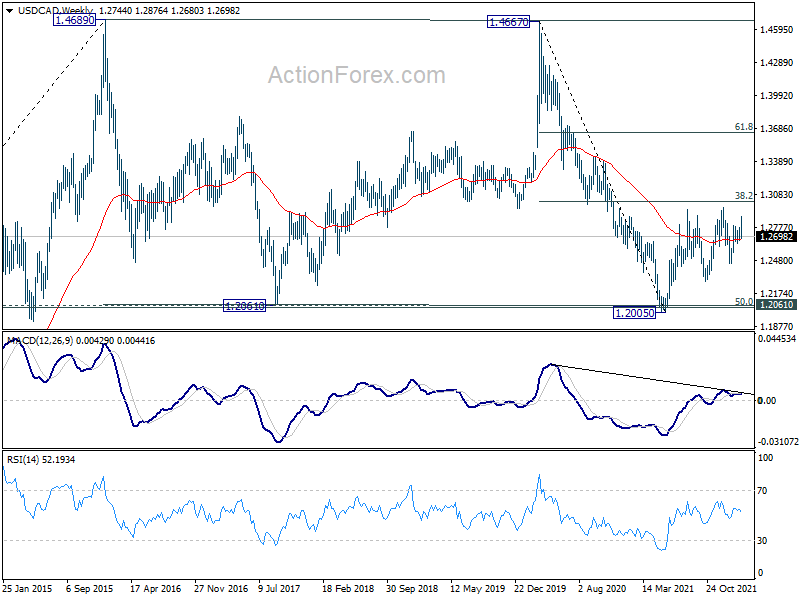
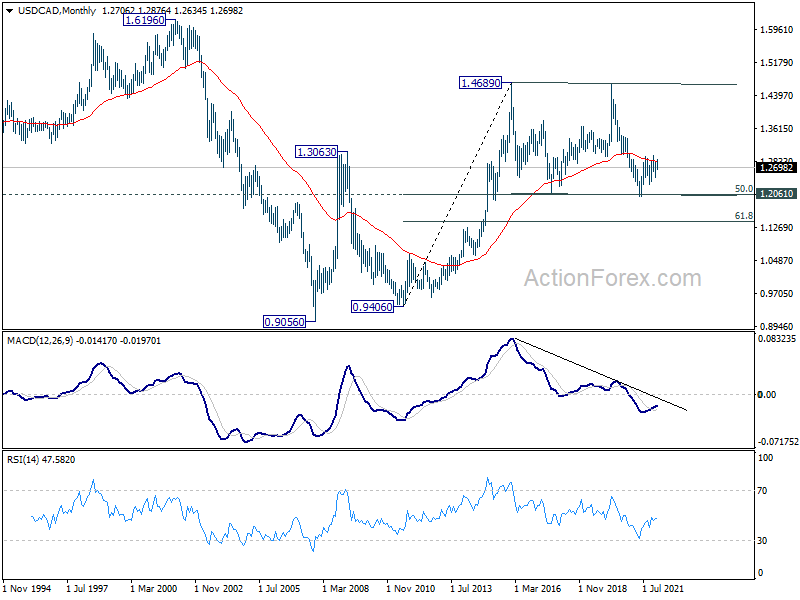
In the longer term picture, we're viewing price actions from 1.4689 as a consolidation pattern. Thus, up trend from 0.9506 (2007 low) is still expected to resume at a later stage. This will remain the favored case as long as 1.2061 support holds, which is close to 50% retracement of 0.9406 to 1.4689 at 1.2048. However, firm break of 1.2061 support will argue that USD/CAD has already started a long term down trend. Next target is 61.8% retracement of 0.9406 to 1.4689 at 1.1424.
EUR/GBP Weekly Outlook
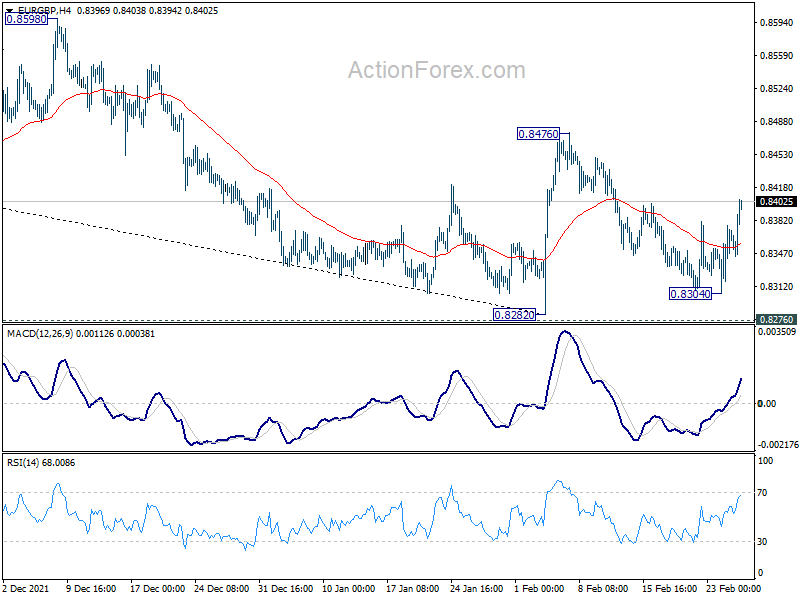
EUR/GBP's pull back from 0.8476 could have completed at 0.8304 last week. Initial bias is now mildly on the upside for 0.8476 resistance first. Break there will resume the rebound from 0.8282 to 0.8598 key resistance level. On the downside, though, break of 0.8304 will turn bias back to the downside for 0.8282 low again.
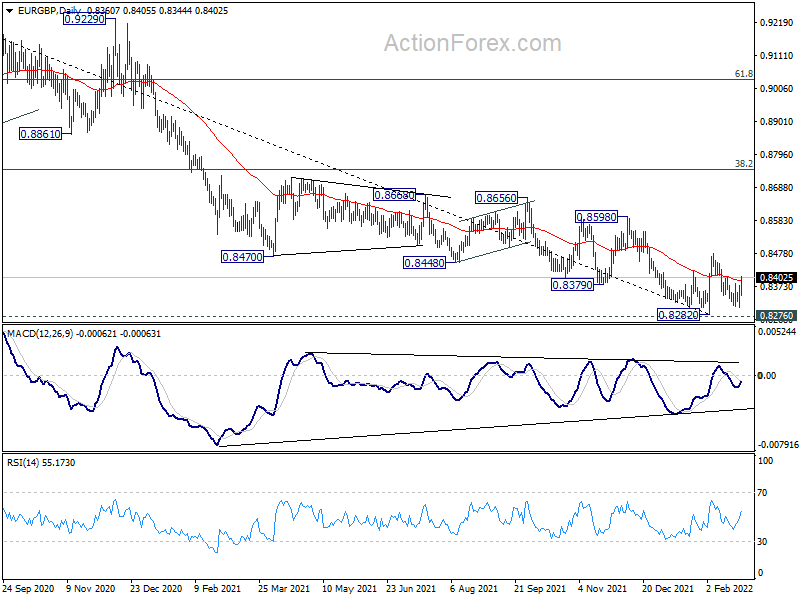
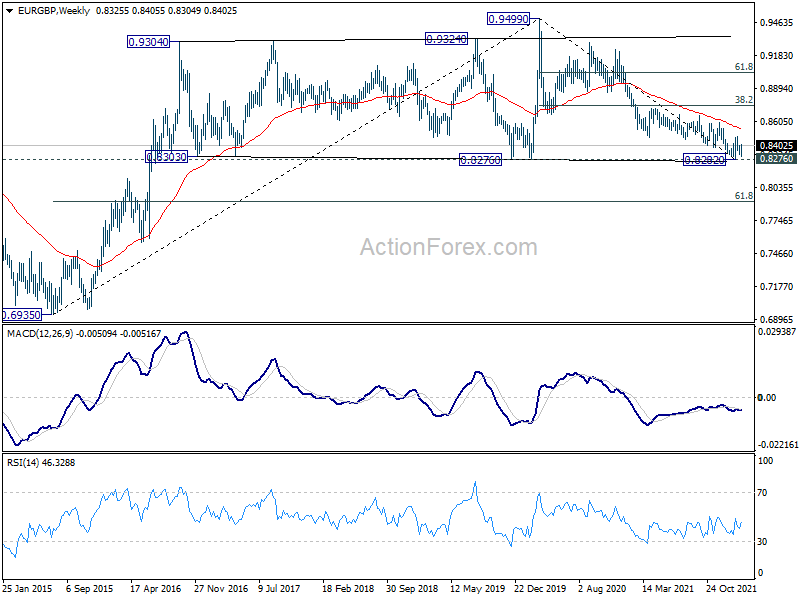
In the bigger picture, price actions from 0.9499 (2020 high) are still seen a corrective pattern that should be contained by 0.8276 long term support (2019 low). Sustained trading above 38.2% retracement of 0.9499 to 0.8282 at 0.8747 will affirm this bullish case. However, sustained break of 0.8276 will argue that the long term trend has reversed. Deeper decline would be seen to 61.8% retracement of 0.6935 to 0.9499 at 0.7917.
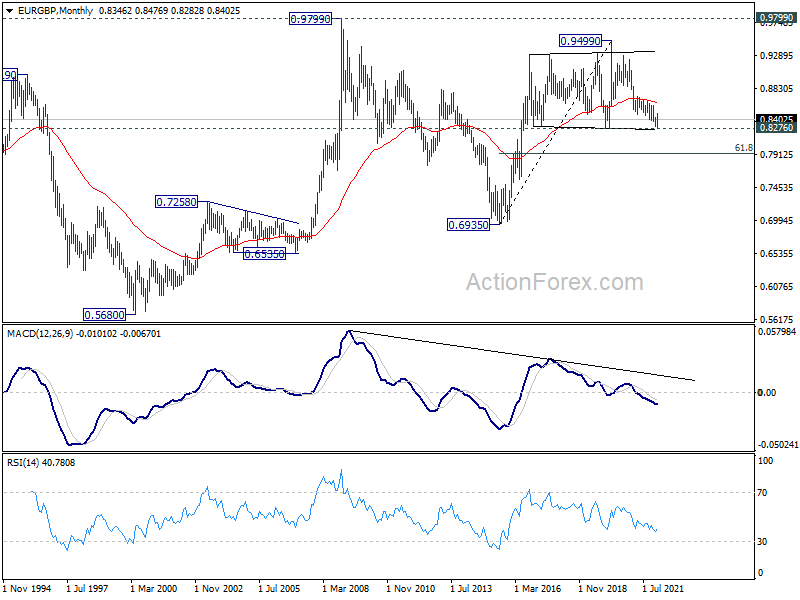
In the long term picture, outlook will stay bullish as long as 0.8276 support holds. Break of 0.9499 is in favor at a later stage, to resume the up trend from 0.6935 (2015 low). However, sustained break of 0.8276 will indicate long term trend reversal, and target 61.8% retracement of 0.6935 to 0.9499 at 0.7917, and possibly below.
EUR/AUD Weekly Outlook
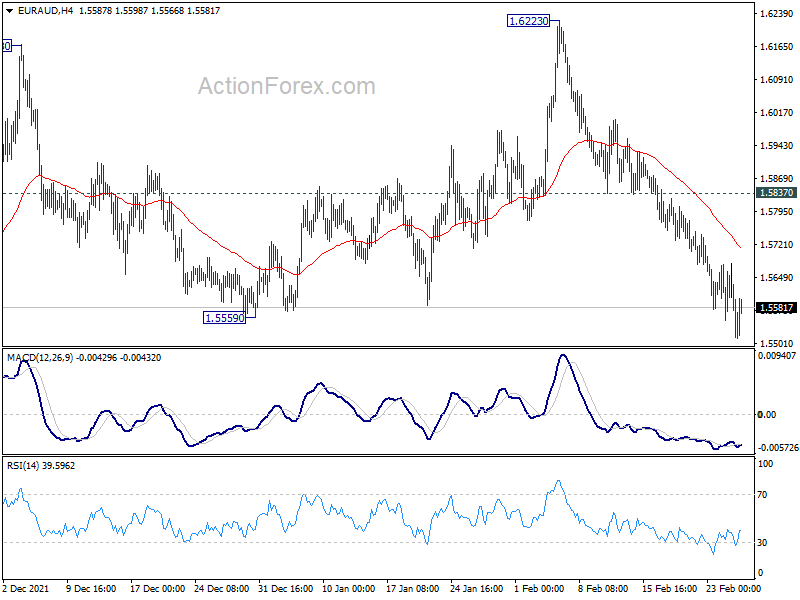
EUR/AUD's decline and break of 1.5559 support last week suggests that rebound from 1.5354 has completed with three waves up to 1.6223. Initial bias remains on the downside this week for 1.5250/5354 support zone. For now, risk will stay on the downside as long as 1.5837 resistance holds, in case of recovery.
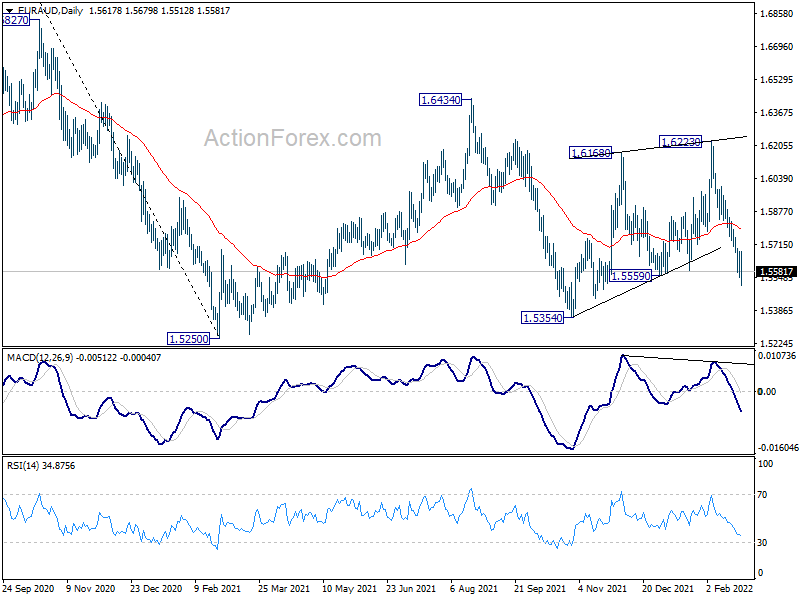
In the bigger picture, price actions from 1.5250 low are seen as a corrective pattern. Further extension could be seen and another rise cannot be ruled out. But strong resistance should be seen at 38.2% retracement of 1.9799 to 1.5250 at 1.6988. Larger down trend from 1.9799 is in favor to extend through 1.5250 at a later stage.
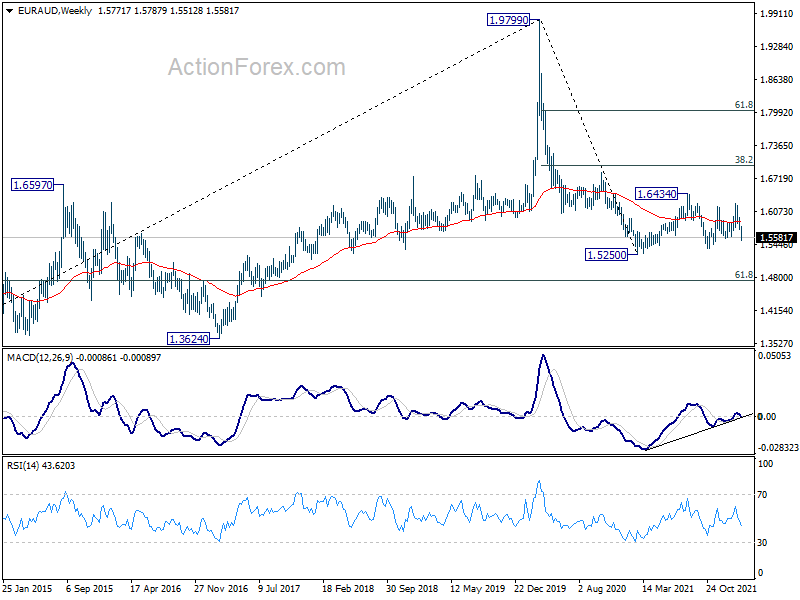
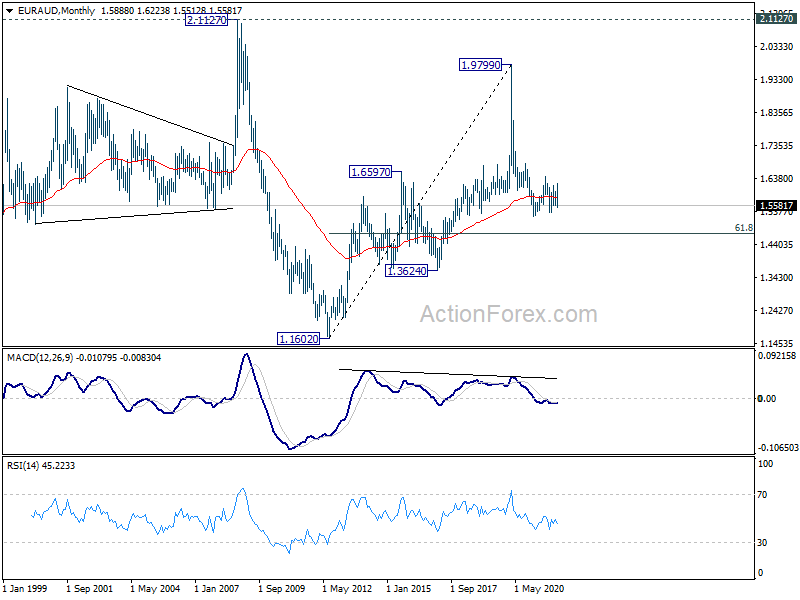
In the longer term picture, fall from 1.9799 (2020 high) is seen as a long term down trend. Further decline will remain in favor as long as 38.2% retracement of 1.9799 to 1.5250 at 1.6988 holds. Break of 1.5250 will target 61.8 retracement of 1.1602 (2012 low) to 1.9799 at 1.4733
EUR/CHF Weekly Outlook
EUR/CHF dropped sharply to 1.0277 last week but recovered since then. Initial bias is neutral this week first. Further decline is still expected as long as 1.0459 minor resistance holds. Sustained trading below 1.0298 will extend larger down trend target 61.8% projection of 1.0936 to 1.0298 from 1.0610 at 1.0216. However, strong break of 1.0459 will bring further rebound to 1.0610 resistance instead.
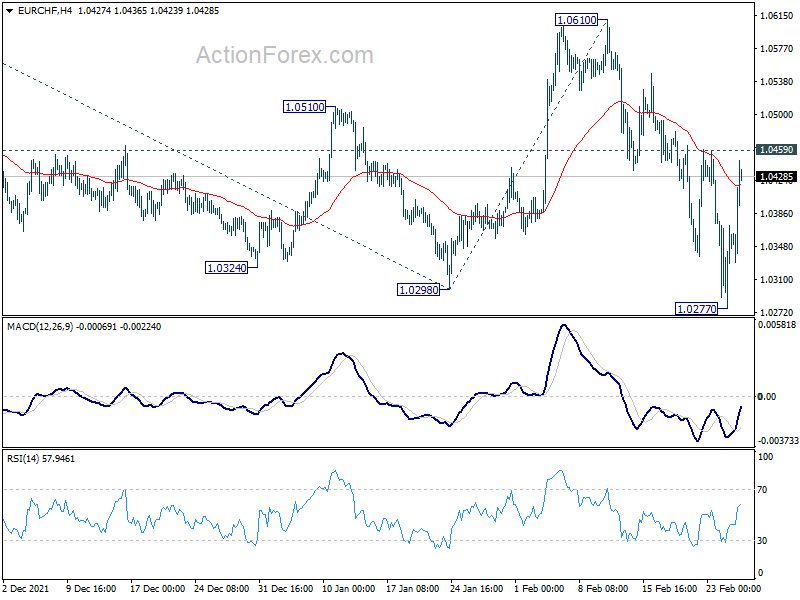
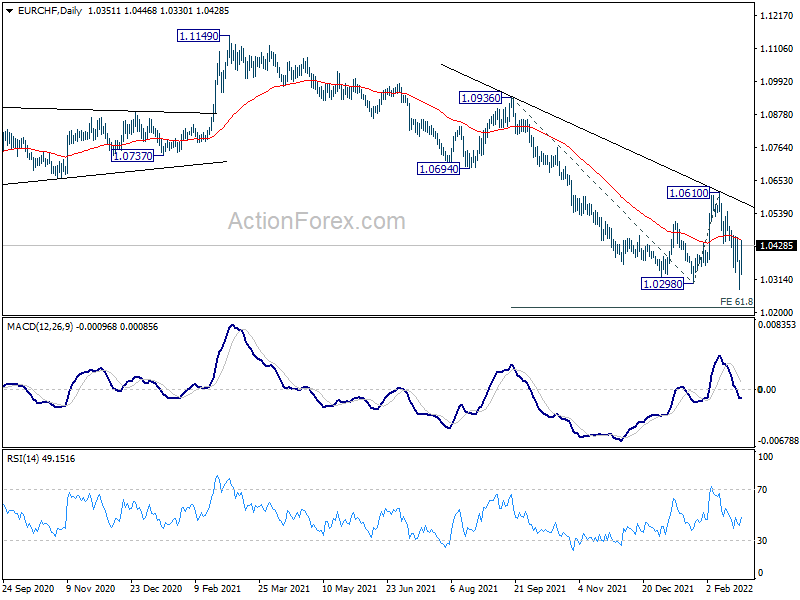
In the bigger picture, long term down trend from 1.2004 (2018 high) is still in progress. Next target is 61.8% projection of 1.2004 to 1.0505 to 1.1149 at 1.0223. Sustained break there will target 100% projection at 0.9650. In any case, break of 1.0610 resistance is needed to be the first sign of bottoming. Otherwise, outlook will remain bearish.
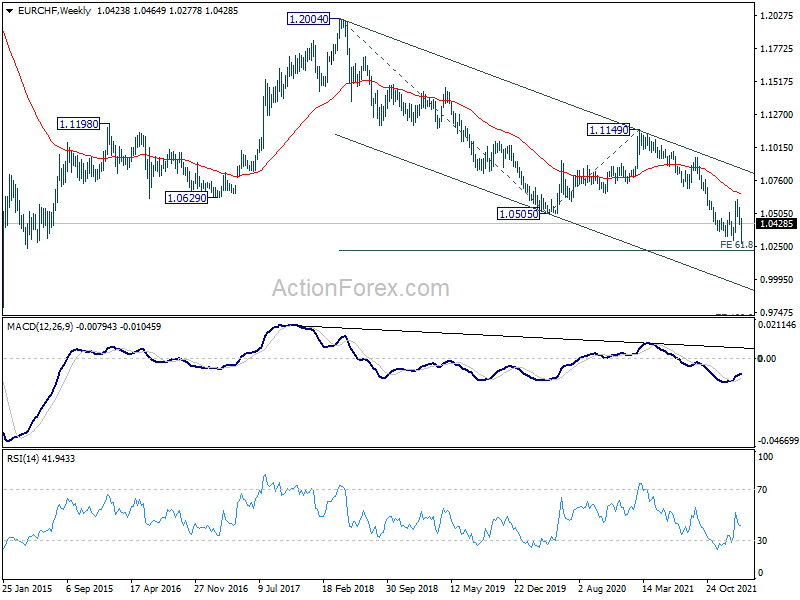
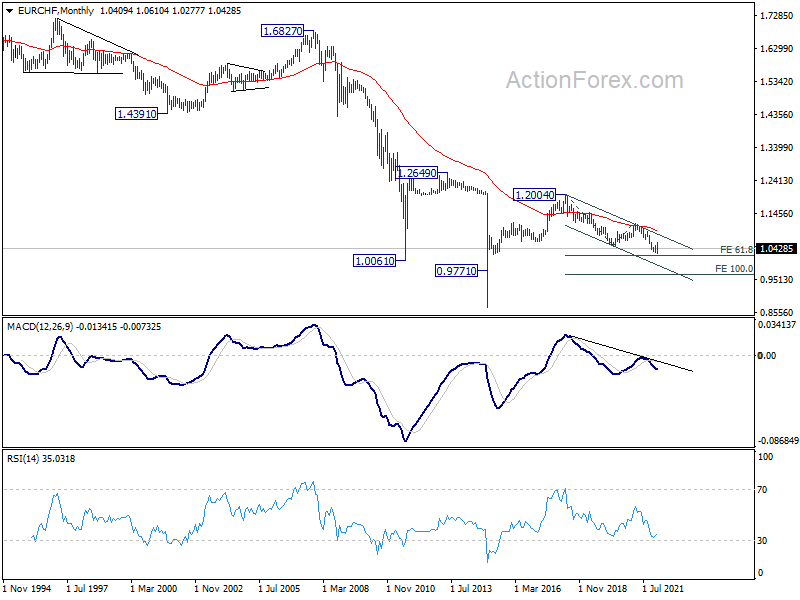
In the long term picture, prior rejection by 55 month EMA (now at 1.0947) maintains long term bearishness. Down trend from 1.2004 could still extend lower as long as 1.1149 resistance holds.
EUR/JPY Weekly Outlook
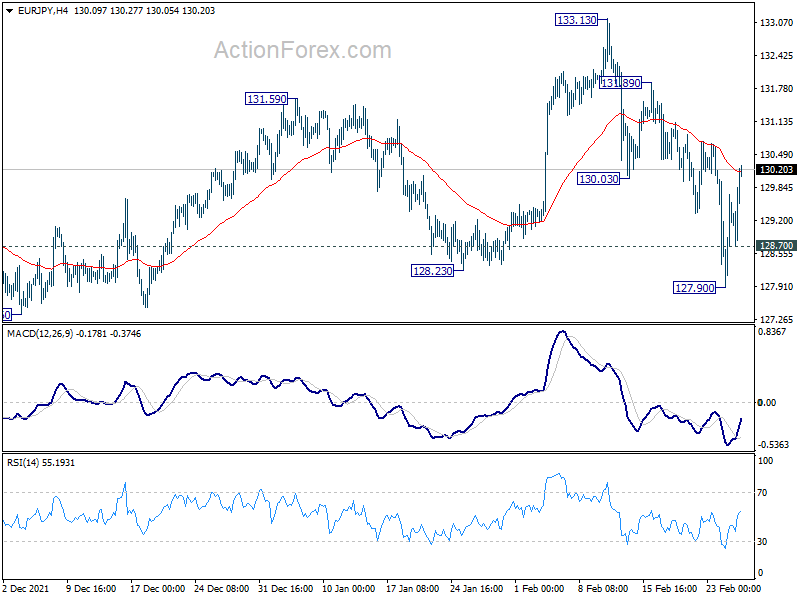
EUR/JPY dropped sharply to 127.90 last week but rebounded strongly to close at 130.20. The break of 130.03 support turned resistance argue that the fall from 133.13 might be completed with three waves down to 127.90 Initial bias is mildly on the upside this week first 131.89 resistance first. Break there will target 133.13. On the downside, though, break of 128.70 minor support will turn bias back to the downside, to resume the fall from 133.13 through 127.90.
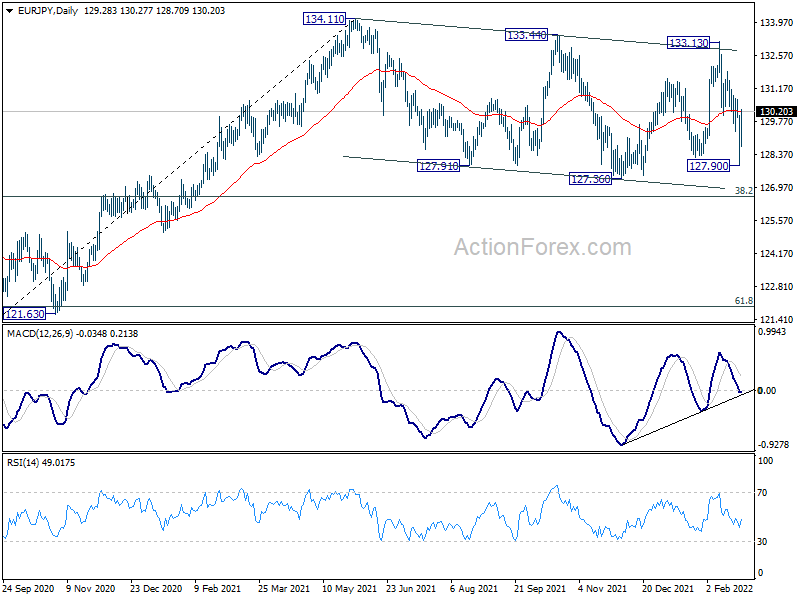
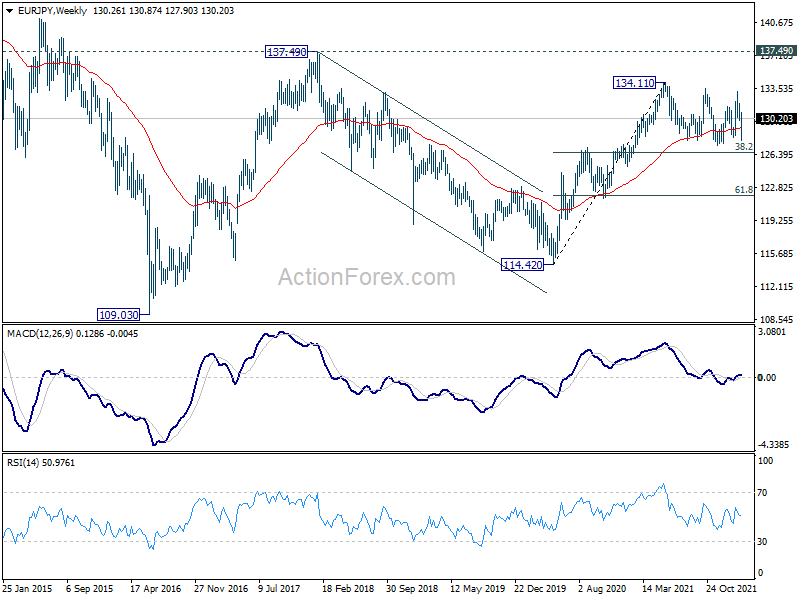
In the bigger picture, price actions from 134.11 are currently seen as a consolidation pattern only. As long as 38.2% retracement of 114.42 (2020 low) to 134.11 at 126.58 holds, up trend from 114.42 is still in favor to continue. Break of 134.11 will target long term resistance at 137.49 (2018 high). However, sustained break of 126.58 will raise the chance of bearish reversal. In this case, deeper decline would be seen to 61.8% retracement at 121.94, and possibly below.
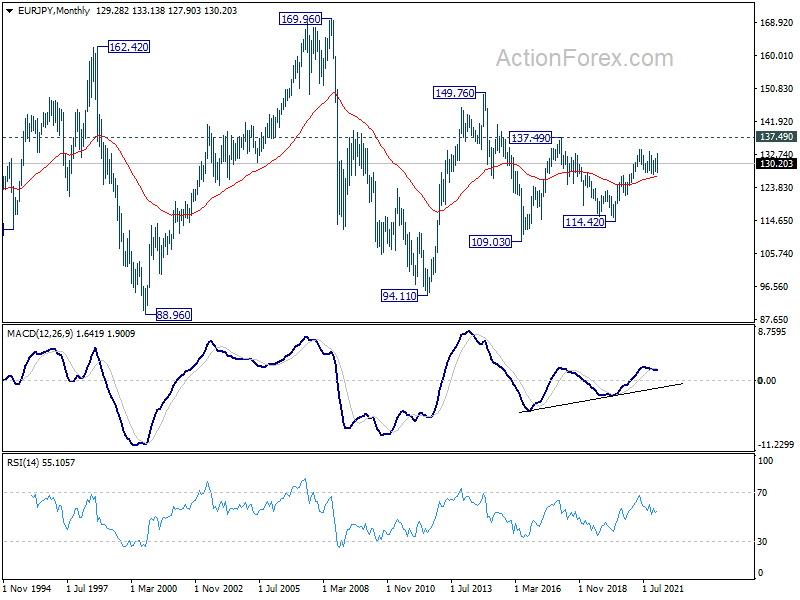
In the long term picture, EUR/JPY is staying in long term sideway pattern, established since 2000. Long term outlook will remain neutral until breakout from the range of 109.03/137.49.
GBP/JPY Weekly Outlook
GBP/JPY dropped sharply to 153.34 last week but recovered. Initial bias is neutral this week first. But further decline is expected with 155.48 resistance intact. Fall from 158.04 is seen as the third leg of the corrective pattern from 158.19. Break of 152.88 will target 148.94 support next. However, firm break of 155.48 will dampen this view and turn bias back to the upside for 158.04 resistance instead.
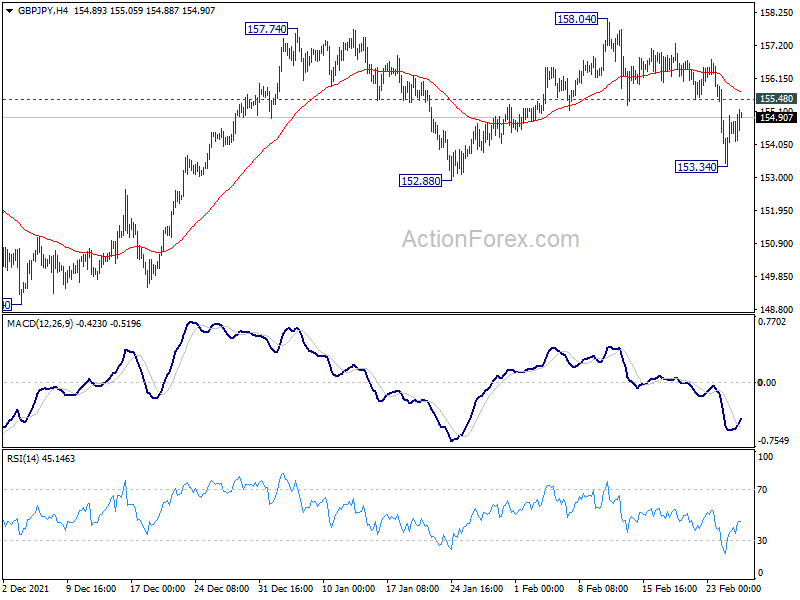
In the bigger picture, price actions from 158.19 are seen as developing into a consolidation pattern to up trend from 123.94 (2020 low). Downside should be contained by 38.2% retracement of 123.94 to 158.19 at 145.10 to bring rebound. Firm break of 158.19 will resume the up trend to long term fibonacci level at 167.93. However, sustained break of 145.10 will raise the chance of trend reversal and target 61.8% retracement at 137.02.
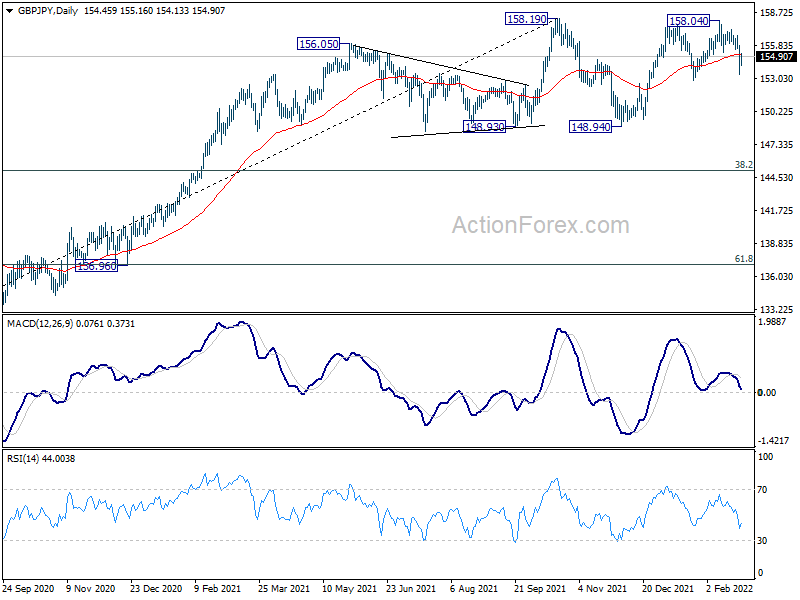
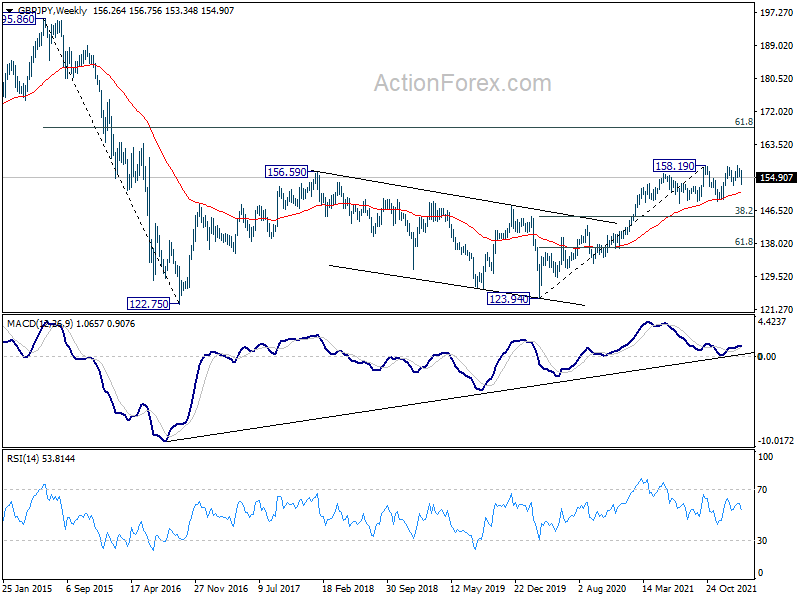
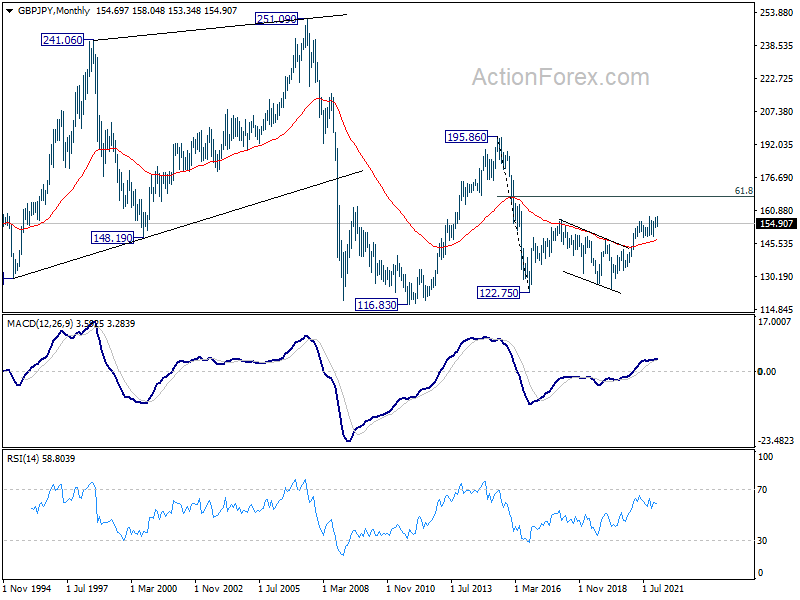
In the longer term picture, as long as 55 month EMA (now at 147.27) holds, we'd still favor more rally to 61.8% retracement of 195.86 to 122.75 at 167.93. But sustained trading below 55 month EMA will at least neutralize medium term bullishness and re-open the chance of revisiting 122.75 low (2016 low).
Roller Coaster Rides in Markets as Russia Invades Ukraine
The markets had a roller coaster ride on Russia's invasion of Ukraine last week. At the time of writing, Kyiv remains in Ukrainian hands after three days of brutal attack by Russia. Wave of European leaders have start delivering supplies Ukraine while packages of sanctions were imposed, up to Russian President Vladmir Putin. It's also reported that cutting of Russia from SWIFT payment system would be taken in a matter of days.
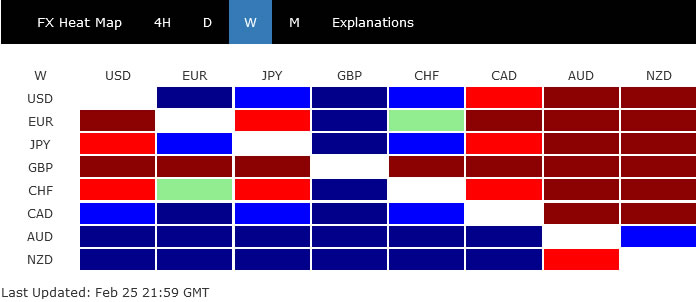
Global stocks took a strong U-turn after initial dive during the week. But risks will remain on the downside for the near term at least. Gold and oil prices spiked higher but quickly retreated. More upside is still in favor in both risk sentiment commodity. In the currency markets, Aussie and Kiwi ended as the strongest ones for the week, followed by Canadian. European majors were also hammed, with Sterling as the worst. Dollar and Yen just ended mixed.
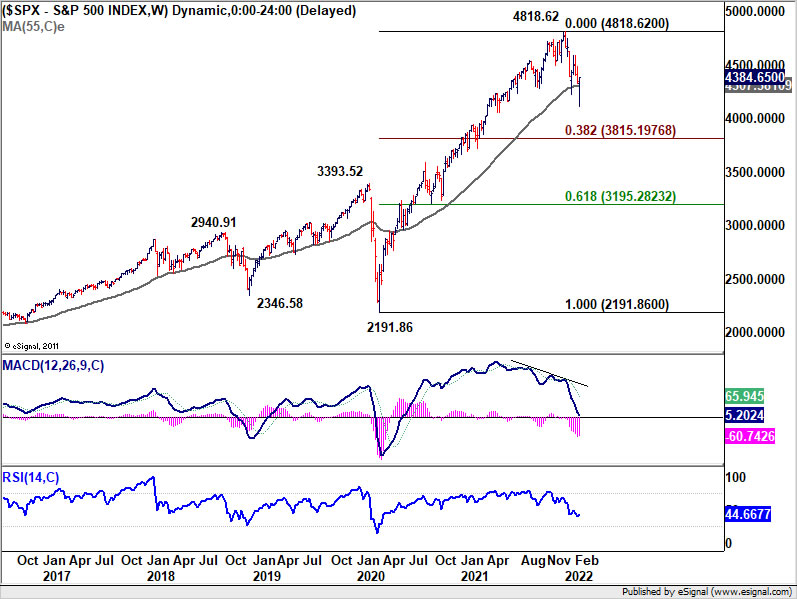
S&P closed the week up, but still more downside expected
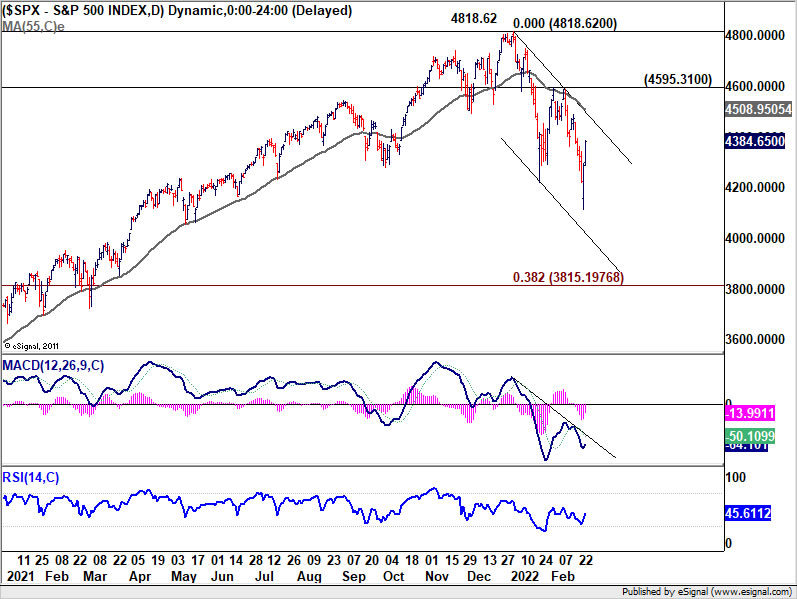
S&P 500 staged a strong U-turn after diving to as low as 4114.65 and closed at 4384.65, added 35 pts for the week. 55 week EMA (now at 4307.38) was defended for now. But overall, price actions from 4818.62 is seen as developing into a correction to whole up trend from 2191.86.
Deeper fall is expected as long as 4595.31 resistance holds. SPX would target 38.2% retracement of 2191.86 to 4818.62 at 3815.19. Break of 4595.31 might bring stronger rebound. But even in this case, upside should be rejected by 4818.62 to bring at least one more falling leg.
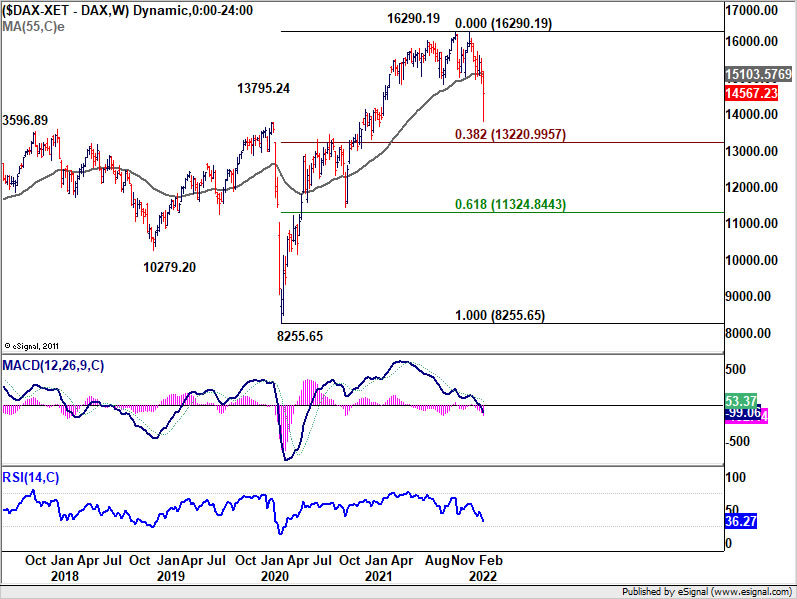
The picture DAX is similar. Price actions from 16290.19 are developing into a correction to whole rise from 8255.65. Deeper decline is expected to 38.2% retracement of 8255.65 to 16290.19 at 13220.99.
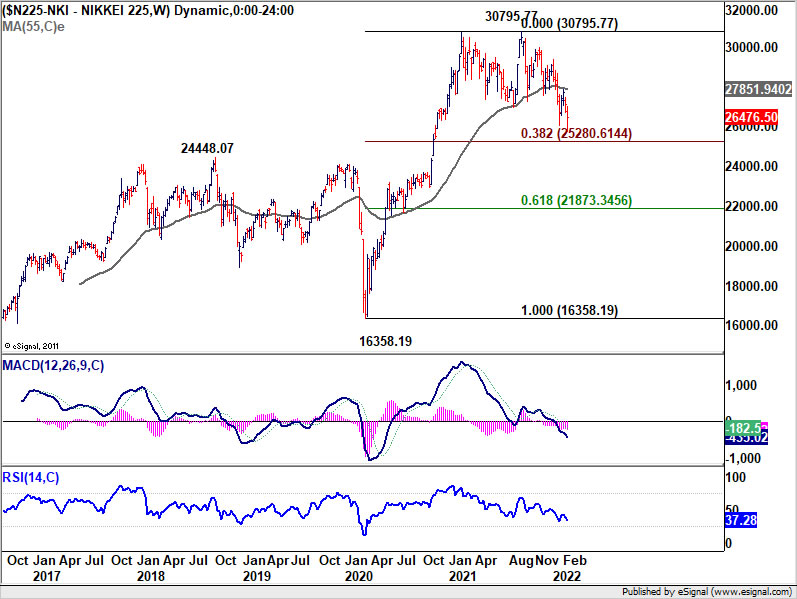
Nikkei is also in correction to the up trend from 16358.19 to 370795.77. Deeper fall should be seen to 38.2% retracement oat 25280.61.
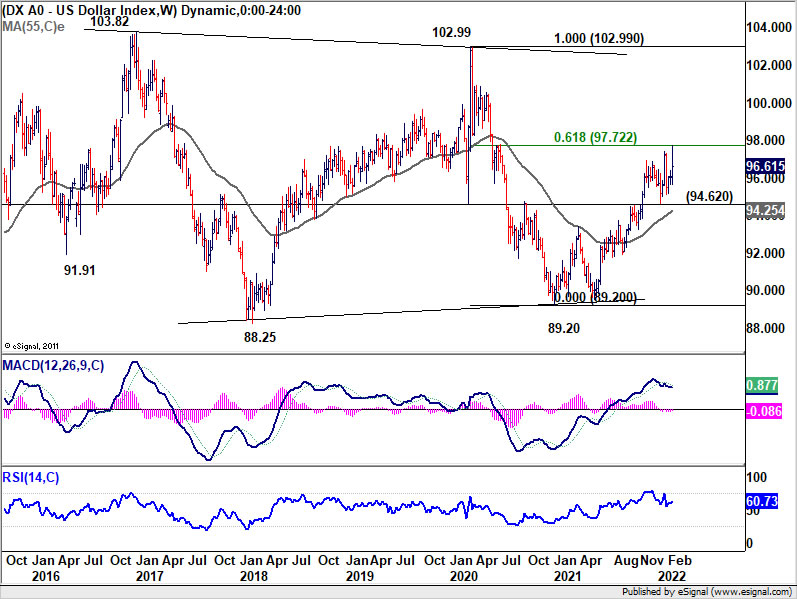
Dollar index struggled to break through 97.72 fibonacci level
Dollar index edged higher to 97.73 last week, but couldn't break through 61.8% retracement of 102.99 to 89.20 at 97.72. Upside momentum is also relatively weak as seen in weekly MACD. Still, further rise is in favor as long as 94.62 support holds. Sustained break of 97.72 could bring upside acceleration towards 102.99 high. However, break of 94.62 support will now suggest medium term topping and bring deeper pull back.
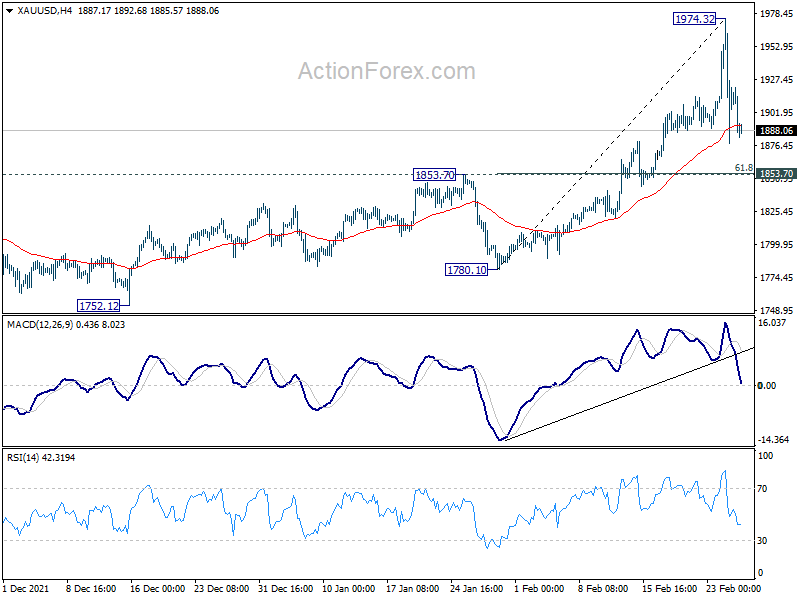
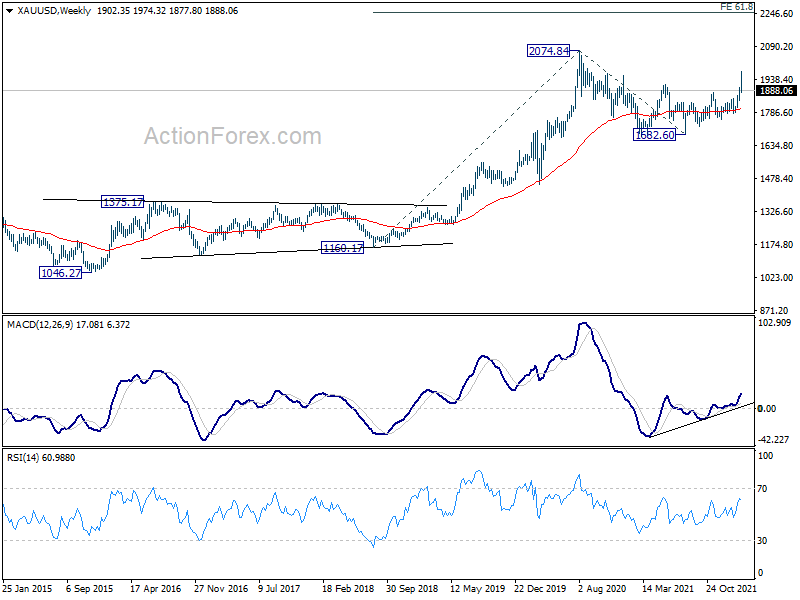
Gold, another rally to retest 2074 still expected after volatile week
Gold had an extremely volatile week, spiking higher to 1974.32 but close the week down at 1888.06. Some range trading should be seen for the near term. But downside should be contained above 1853.70 cluster support (61.8% retracement of 1780.10 to 1974.32 at 1854.29) to bring rebound.
At this point, the correction from 2074.84 is seen as completed at 1682.60. Another rise is expected, at a later stage, through 1974.32 to retest 2074.84 high. Nevertheless, firm break of 1853.70 will dampen this week and extend the correction with another falling leg.
WTI oil to consolidate after spiking to 102.19
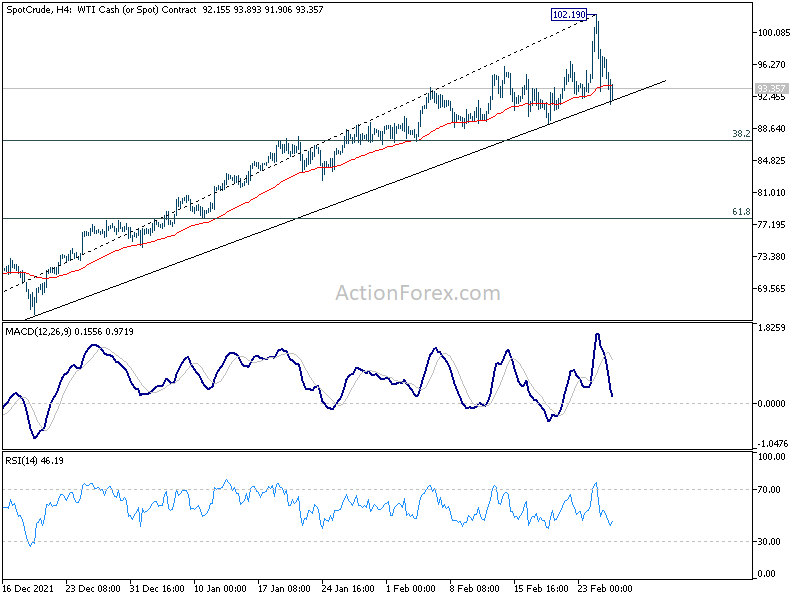
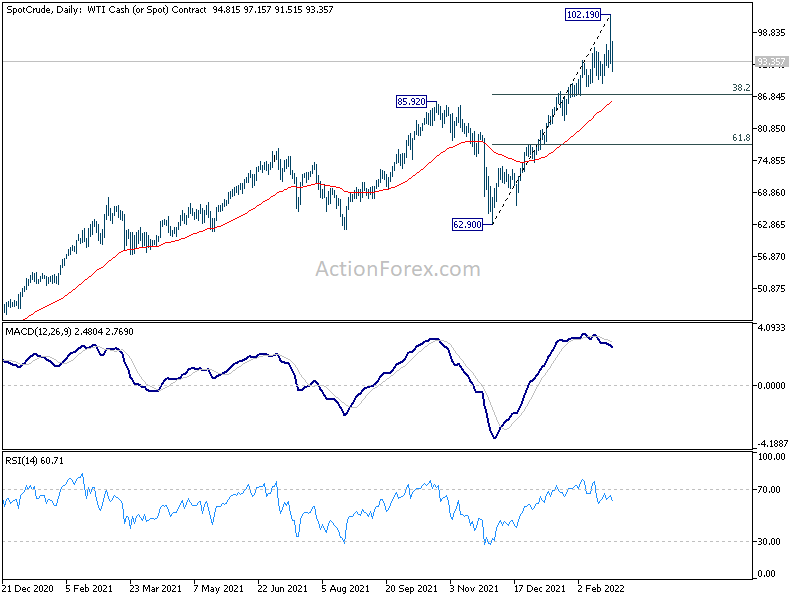
WTI crude oil spiked higher to 102.19 last week but quickly retreated to close at 93.35. Some consolidation below 102.19 is likely for the near term. But downside should be contained by 38.2% retracement of 62.90 to 102.19 at 87.18 to bring rebound. Recent up trend is still expected to continue after the consolidation completes. Next target level will depend on the eventual depth of the correction.
GBP/AUD building up medium term bearishness with sharp decline
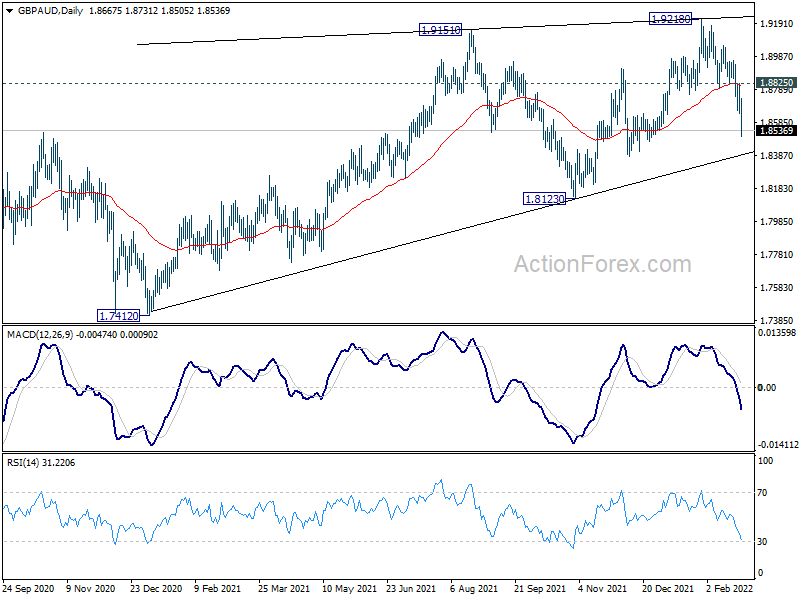
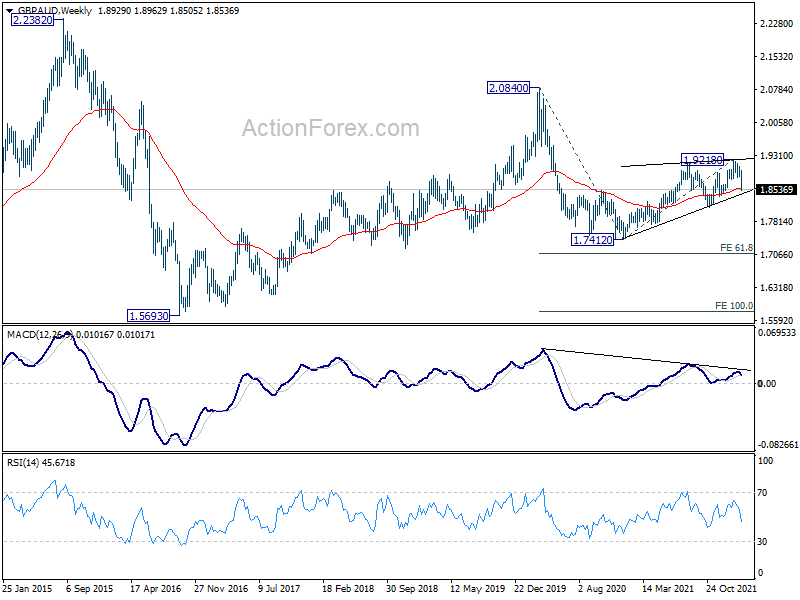
GBP/AUD was the biggest mover last week, losing -2.14%. For now, further decline will be expected as long as 1.8825 resistance holds, to 1.8123 support. Decisive break there will confirm that whole rise from 1.7412 has completed already. The three wave structure suggests that it's just a corrective move. In this case, the larger down trend from 2.0840 could be ready to resume through 1.7412 low in the medium term .
GBP/JPY Weekly Outlook
GBP/JPY dropped sharply to 153.34 last week but recovered. Initial bias is neutral this week first. But further decline is expected with 155.48 resistance intact. Fall from 158.04 is seen as the third leg of the corrective pattern from 158.19. Break of 152.88 will target 148.94 support next. However, firm break of 155.48 will dampen this view and turn bias back to the upside for 158.04 resistance instead.
In the bigger picture, price actions from 158.19 are seen as developing into a consolidation pattern to up trend from 123.94 (2020 low). Downside should be contained by 38.2% retracement of 123.94 to 158.19 at 145.10 to bring rebound. Firm break of 158.19 will resume the up trend to long term fibonacci level at 167.93. However, sustained break of 145.10 will raise the chance of trend reversal and target 61.8% retracement at 137.02.
In the longer term picture, as long as 55 month EMA (now at 147.27) holds, we'd still favor more rally to 61.8% retracement of 195.86 to 122.75 at 167.93. But sustained trading below 55 month EMA will at least neutralize medium term bullishness and re-open the chance of revisiting 122.75 low (2016 low).
Weekly Economic & Financial Commentary: Some Economic Implications of the War Between Russia and Ukraine
Summary
United States: Russia-Ukraine Conflict May Push Up Prices, but Inflation Has Yet to Slow Spending
- The Russian invasion of Ukraine dominated news headlines this week, and we cover the economic and financial implications of the conflict in a number of sections. One of the initial implications of the Russia-Ukraine conflict domestically is that higher oil prices will likely keep inflation higher for longer. That said, while consumers continue to contend with higher prices we haven't yet seen inflation meaningfully weigh on spending.
- Next week: ISM Manufacturing (Tue), ISM Services (Thur), Nonfarm Payrolls (Fri)
International: Risk Assets Came Under Pressure This Week
- The military conflict sent risk-assets prices, particularly within the emerging markets, sharply lower. Sovereign bond yields jumped, while Russian credit default swap spreads spiked to the highest on record. Other risk-sensitive currencies and asset prices within the emerging markets fell sharply lower as well.
- Next week: India GDP (Mon), Bank of Canada Rate Decision (Wed), Brazil GDP (Fri)
Interest Rate Watch: Russia Roils the Rates Market
- Russia's invasion of Ukraine this week rocked financial markets and added additional uncertainty to the interest rate outlook. Initially, Treasury yields plunged across the entire curve, but yields have shaken off the initial shock.
Credit Market Insights: Small Businesses Are on the Mend, but Full Recovery May Be a Marathon
- Small Business Credit Survey data show small businesses' circumstances improved last year, but there remains a long road to pre-pandemic standards. But future growth expectations rose, and signal there's ample runway for small businesses' recovery to take off.
Topic of the Week: Some Economic Implications of the War Between Russia and Ukraine
- Parsing out the precise economic implications of the war is essentially impossible, but we lay out some data and scenarios in our column and report. While we are not necessarily forecasting that oil prices will remain well above recent averages, we use a macroeconometric model to analyze the potential economic implications of higher oil prices as a result of the recent hostilities.
The Weekly Bottom Line: Commodity Prices Rise Ahead of Key BoC Meeting
U.S. Highlights
- The Russian invasion of Ukraine shook markets this week with the S&P 500 entering correction territory before making gains Friday. Given Russia’s role as a key global energy producer, market concerns about supplies have driven prices for oil and natural gas higher.
- For the U.S., the most immediate impact will come from higher oil prices, which will keep inflation elevated and weigh on growth. The impact will depend on how long the conflict lasts.
- Barring severe market disruption, we still expect the Fed to hike rates in March. The core PCE deflator reached 5.2% year-on-year in January, underscoring that the Fed is behind the curve on inflation and can’t wait for the perfect time to hike.
Canadian Highlights
- The Russian invasion of Ukraine has exacerbated financial market volatility, with commodity prices front and center.
- Higher prices for energy and food are a boon to Canadian producers and government budgets, but they also act as a tax on consumers who are already dealing with high inflation.
- The Bank of Canada is likely to note the downside risk to economic growth caused by the conflict, but it is unlikely to stay its hand in lifting the overnight rate next week, as it focuses on bringing inflation back to target.
U.S. -Russian Invasion Shakes Markets
Regrettably, Russia made risk reality this week, launching an all-out invasion of Ukraine. The threat of Russian military aggression had been souring market sentiment for several weeks now, and the invasion worsened declines in equity markets and sent energy prices higher (Chart 1). The S&P 500 entered correction territory this week, relative to its early January highs, and was down 0.2% at time of writing versus a week ago. With Russia’s role as a key global energy supplier, worries about energy supply have driven prices for oil and natural gas higher. The Brent crude benchmark crossed the $100 per barrel threshold for the first time since 2014.
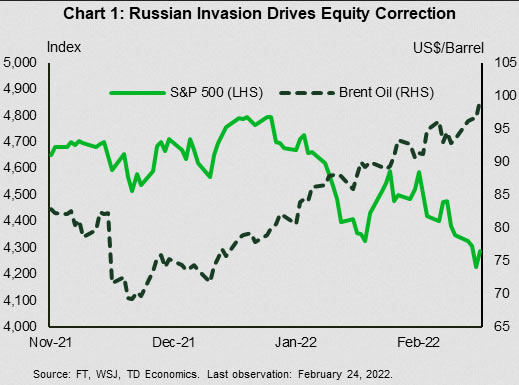
Market selloffs at the outset of wars have historically been short and reversed quickly. That said, there is still likely to be an economic toll on global growth from the conflict, with Europe likely to take the biggest hit. The outcome depends on how long the conflict goes on, and market reaction. We outlined some potential scenarios in our recent report Questions? We’ve Got Answers.
For the U.S., the most immediate impact will come from higher oil prices. These will keep inflation elevated and weigh on purchasing power longer than previously expected. We expect prices to ease as the conflict does, but how long it lasts is highly uncertain. The West Texas Intermediate oil price is around $92 per barrel at time of writing, up over 20% from the start of the year. If it were to remain above $90 per barrel for the remained of the year, it would shave a few tenths off of real GDP growth in 2022. We are currently tracking real GDP to grow of 2.8% in 2022 (Q4/Q4), so a slightly softer pace would still be a solid pace for growth.
The conflict in Europe comes just three weeks ahead of what is widely expected to be the Federal Reserve’s first interest rate hike. The war is unlikely to prevent the Fed from taking its policy rate off the floor. At 0.5%, the federal funds rate will remain highly stimulative. The Fed is behind the curve on inflation and can no longer wait for the perfect moment to begin normalizing policy.
On that front, the core personal consumption expenditure (PCE) deflator – the Fed’s preferred indicator – was up 5.2% in January, the fastest rate in nearly 40 years. While a bit lower than the 6% increase in the core CPI, it is still a lot higher than the Fed would like. Monetary policy works with a lag and rate hikes this year will not do much to reduce inflation until next year. In the meantime, a lot has to go right to slow inflation’s roll. This increases the urgency to raise rates now or risk unmouring expectations and having to hurt the economy more later in order to rein them back in.
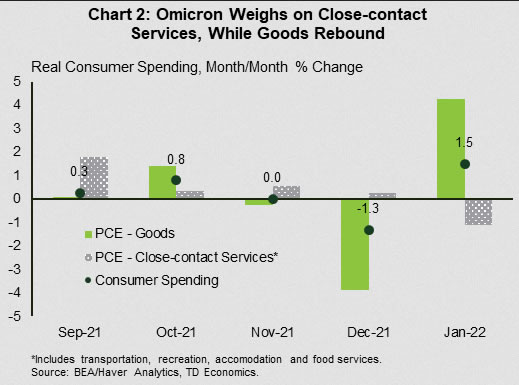
One piece of good news this week was a solid rebound in consumer spending in January (Chart 2). The rebound was driven by durable goods, led by spending on vehicles. Spending on close contact services weakened, showing the impact of consumer caution as Covid cases rose. We expect these categories to rebound in February and March, with the high-frequency data already showing that consumers are returning to restaurants and air travel.
Canada - Commodity Prices Rise Ahead of Key BoC Meeting
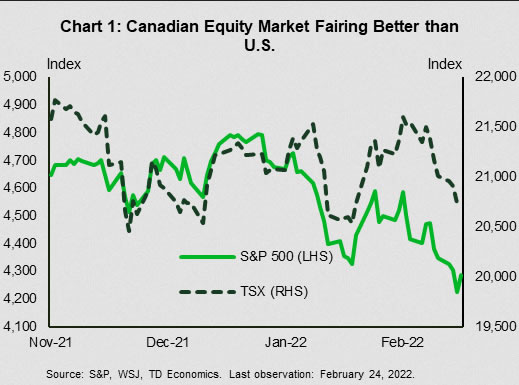
The Russian invasion of Ukraine drove financial market developments this week. Equity indexes have been volatile, but generally dour, with the S&P 500 and the TSX down more than 10% and 4% from their 2022 peaks, respectively (Chart 1).
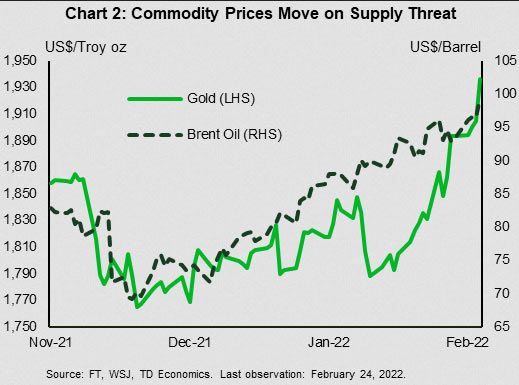
The biggest moves, however, have been in commodity markets, where sanctions are expected to tighten already strained supplies. Brent and WTI oil prices rose aggressively on Thursday morning, briefly exceeding $100 a barrel (Chart 2). Prices have since come down from their peaks.
Higher energy prices are a nuanced issue in Canada. On the one hand, they benefit producers and aid government finances (as we just saw with the Alberta budget yesterday). On the other hand, higher prices are akin to a tax on Canadian consumers who have already seen gasoline prices jump over 30% since last year. Prices at the pump have continued to hit consumers' wallets through February, having risen more than 10 cents a liter in less than a month.
It is not just energy prices. Russia is a major producer of metals, such as gold and nickel, as well as lumber and agricultural products, such as wheat and potash. Canada is not much of an importer of Russian goods, but the potential for less supply is pressuring global commodity prices. This helps Canadian producers, but worsens inflation. Like energy, food price inflation is already a pain point. The price of food purchased at grocery stores was up around 6% year-on-year in January.
Chart 2 shows the price of WTI oil and gold from Nov. 2021 to Feb. 2022. Both oil and gold have been increasing from late-2021.
This sets up for an interesting Bank of Canada (BoC) meeting next week. It is still widely expected that the Bank will hike its policy rate on Wednesday by 25 basis points. Though we don't know the magnitude or duration of the geopolitical strife, the BoC is unlikely to waver on its mission of bringing down inflation. As such, we have the Bank continuing with rate hikes over 2022, with the policy rate reaching 1.75% over the next year. So far, markets are thinking the same, with the Canada 2-year and 10-year yield still sitting above 1.5% and 1.9%, respectively.
The Bank of Canada will also have some solid economic data to look to before it makes its decision next week. On Tuesday, Statistics Canada will publish GDP data for the fourth quarter of 2021. We are expecting this to come in at a robust 6.8% (q/q annualized). This would confirm the Bank's view that the Canadian economy has fully eliminated the excess slack caused by the pandemic.
Unfortunately, the first quarter of 2022 isn't fairing as well. Strict lockdowns curtailed economic momentum. Our tracking for first quarter real GDP growth is barely above zero. The invasion of Ukraine complicates things further, as any forthcoming hit to sentiment could add to the current quarter's weakness. Here's hoping for a rapid and peaceful resolution to the conflict.