Sample Category Title
Bank of Canada Rate Hike Expected Despite Geopolitical Turbulence
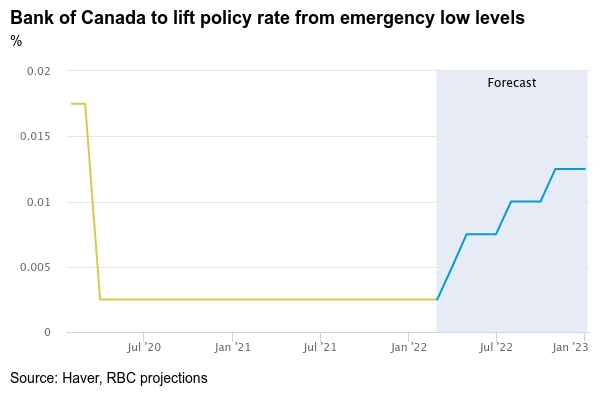
Russia’s invasion of Ukraine is not expected to keep the Bank of Canada from hiking interest rates next Wednesday. Though added disruptions to global supply chains would eventually filter into Canadian trade flows, and higher commodity prices will boost costs for energy and food products, Canada’s direct trade exposure to Russia and Ukraine is small. The domestic economy is also too strong—and inflation pressures too firm—to justify the current emergency levels of interest rates. The BoC in January expected the Omicron wave would be "less severe than previous waves" and current conditions look to be playing out that way. Both employment and the number of hours worked declined sharply in January, but spending appears to have already surged back into February as COVID case counts and restrictions eased.
We expect next week’s Q4 GDP report to come in at 6%. That’s in line with the BoC’s 5.8% forecast from the January monetary policy report and supported by further growth in consumer spending and business investment, as well as a rebuild in inventories following a decline in Q3. We share the Bank of Canada’s view that virus spread will have capped GDP in December and January. Statistics Canada already reported a preliminary estimate that December output was flat from November, and we expect a decline in output in January after hours worked fell due to large numbers of workers self-isolating or off with illnesses. But early data is pointing to a rapid recovery into February. Further gains in household spending will likely be backstopped by improving labour markets and a large stockpile of savings. And capacity pressures, including acute labour shortages, are pushing businesses to invest more. Overall, tight labour markets and higher inflation rates all suggest the economy is running close to longer run capacity limits. We look for the Bank of Canada to follow next week’s expected rate hike with 3 more this year, the next coming as soon as April.
Week ahead data watch:
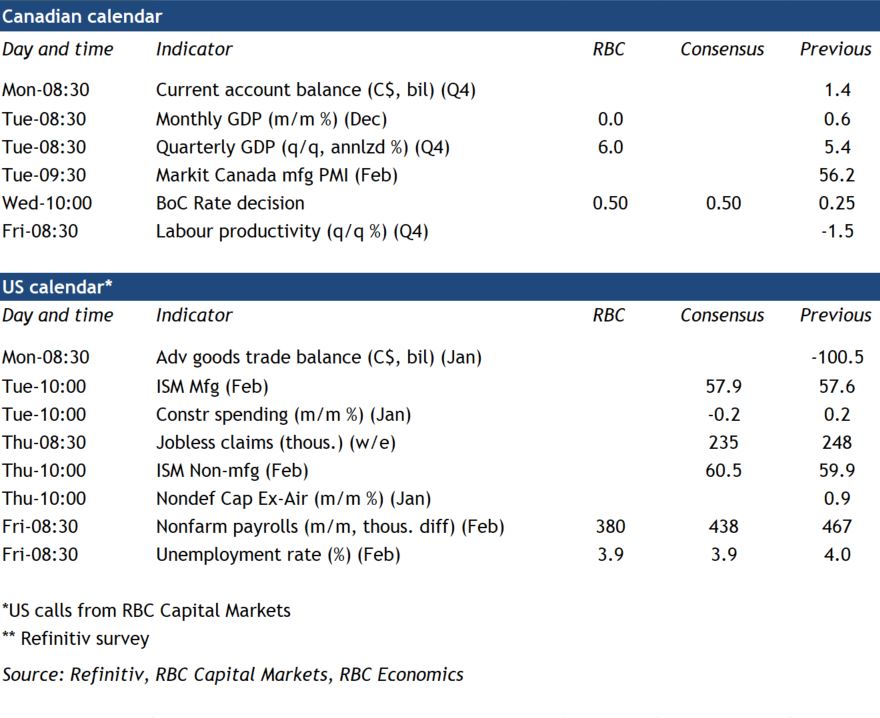
US February payrolls next week are expected to once again point to rising tension in the labor market. Employment likely increased again. And no meaningful changes to the labour force are expected to drive the unemployment rate lower and push wages higher. Average hourly earnings for private sector industries were already 12% above pre-pandemic as of January this year.
Week Ahead: 28 February 2022
It has been one hell of a week for volatility as investors responded to events unfolding in Ukraine and the response from the West in terms of sanctions on Russia. Stocks dropped on Monday, rallied on Tuesday, plunged again on Wednesday and then surged sharply higher on Thursday, before extending those gains on Friday. The end result? A roller-coaster ride to nowhere: at the time of writing on Friday afternoon, all major US indices were trading around the flat line. Crude oil also behaved in a similar fashion after surging through $100 before sliding back below that hurdle later in the week. Safe-have gold got very close to $2K, before sliding at the back end of the week as investors bought equities.
Ukraine: Glimmer of hope, but situation perilous
As we transition to the new week, the situation in Ukraine and war of words between Russia and the West will continue to dictate sentiment in the short term, lessening the impact of the upcoming economic data releases (see below). Judging by the big recovery in risk assets at the back end of the week, investor sentiment appears much calmer about the situation. There is hope for some sort of peace after Kremlin said Putin had agreed to organize negotiations with Ukraine's Zelensky. But the situation remains perilous and there are no guarantees.
Away from geopolitics: Fed’s policy response to inflation
Meanwhile, investors’ attention may slowly turn away from geopolitics as we approach March, which is going to be another significant month in the markets as the Fed will finally hike interest rates, potentially starting a major tightening cycle this year as it tries to tackle surging inflationary pressures. St Louis Fed President James Bullard has again repeated that he supports 100 basis points rise by the end of June, adding that there is limited connection between events unfolding in Ukraine and the US economy, where inflation is getting very hot. The latest data continue to point to higher prices. The Fed’s favourite inflation measure came out ahead of expectations on Friday as the core PCE price index rose to its highest level since 1982, well before I was born. It climbed to 5.2% year-over-year in January, up from 4.9% in December.
Data highlights for the week ahead
In the week ahead, we will get one last snapshot of the US non-farm jobs report and wages, while the latest CPI measure of inflation will come out the following week, before the FOMC meets on March 16. These figures might be deciding factor between a 25- or 50-basis-point rate hike. Here is what’s on the agenda in the week ahead:
Monday
- Month-end
- No major data
After what has been a very volatile month, window dressing by fund managers in the first day of the week, and further Ukraine-related volatility, could see the markets move sharply.
Tuesday
- Chinese PMIs
- RBA rate decision
- German CPI and retail sales
- US ISM Manufacturing PMI
Due to the prolonged lockdowns in Australia and somewhat subdued 2.3% wage growth in the last quarter, the RBA is likely to keep policy unchanged 0.1% at this meeting. The focus will be on the language it uses to prepare the market for a hike around August. If it indicates an earlier rate rise, then the Aussie could rally.
Wednesday
- Aussie GDP
- BOC policy decision
- Eurozone CPI
- Powell testimony
Unlike the RBA, the BOC is expected to hike by 25 basis points, especially in light of the upsurge in oil prices and the improvement in Canadian economic data of late.
Eurozone CPI is expected to hit a fresh record high of 5.3% and this will surely put pressure on the ECB to tighten its policy sooner. Will the euro finally stage a rally?
Thursday
- Powell testimony
- ISM services PMI
- Non-farm payrolls report
Week Ahead – Shock Waves
Massive uncertainty remains
It’s been another week of significant volatility in financial markets and there’s little reason to expect next week will be any different. The Russian invasion of Ukraine sent shock waves around the world and the ripple effects were felt throughout the markets as investors were forced to consider what the consequences would be for everything from commodity prices to interest rates.
The tragic events in Ukraine will continue to have a big impact on the markets in the coming weeks as it becomes clear what Vladimir Putin’s ultimate ambition is and how the West will respond.
Next week also offers a packed schedule of economic data – including US non-farm payrolls – central bank speakers and interest rate decisions which will generate additional interest, in light of recent events.
US
The focus for the US will be on both President Biden’s State of the Union address and Fed Chair Powell’s two days of testimony to both the House Financial Services Committee and the Senate Banking Committee. Investors will closely watch to see how geopolitical turmoil starts to weigh on inflation and growth prospects and how Fed members Powell, Bostic, Evans, Bullard, Logan, and Williams pivot their stances on how to start tightening monetary policy.
A selection of economic data will provide updates on manufacturing and service activity in February. The nonfarm payroll report will confirm that large parts of the economy remain on sound footing. The consensus estimate for jobs created in February is 400,000 which would be a decrease from the 467,000 gain in January. The unemployment rate is expected to tick lower to 3.9%, while average hourly earnings could rise 0.5%, a softer pace than the 0.7% seen a month ago.
EU
The Russian invasion of Ukraine has naturally dominated this week and that’s unlikely to change over the coming days as investors get to grips with how bad the situation is going to get and what the knock-on effects will be, particularly in regard to Russian exports of oil and gas, which Europe is so reliant on. Prices rebounded on Friday but volatility is likely to continue.
There’s a lot of economic data coming from Europe next week as well as the ECB minutes on Thursday. While this will play second fiddle to events in Ukraine, there remains a heavy focus on inflation and how central banks will respond. A lot has changed since the last meeting but the minutes will still hold clues, while inflation data on Wednesday, and PMIs on Tuesday and Thursday will be of significant interest.
UK
It’s a little quiet on the UK data front next week with PMIs on Tuesday, Thursday and Friday the only notable releases. There’s plenty of BoE speak throughout the week though which will be of interest, particularly in light on the recent events in Ukraine.
Russia
The Russian invasion of Ukraine has caused turbulence throughout the financial markets, with the rouble hitting an all-time low as troops crossed the border. As they close in on Kyiv, the currency has rebounded off the lows, aided by interventions from the central bank which has reportedly been using its vast reserves. Volatility is expected to continue as sanctions are imposed by the West, although the view so far is that they haven’t been particularly hard-hitting. Further measures are likely to be announced in the coming days, with Russia being cut off from SWIFT the target for many countries.
Against this backdrop, it’s a bit hard to get too excited about the PMIs and unemployment data.
South Africa
The PMI data on Thursday is the only event of note next week. Volatility in the rand picked up in the aftermath of the Russian invasion, as it did across the emerging market space.
Turkey
Next week’s inflation data is probably the highlight given the actions taken by the central bank late last year. Finance Minister Nureddin Nebati recently claimed he thought inflation would stay below 50% and he’s expected to be quickly proven wrong when the data is released on Thursday, alongside PPI numbers.
GDP data on Monday is also expected to show the economy grew 9% in the fourth quarter.
The lira rebounded on Friday after slipping following the Russian invasion of Ukraine, alongside other EM currencies.
China
China’s Two Sessions report is released at the end of the week and markets will be watching to see if China reinstates a GDP target for 2022. Expectations are for a 6% target; a lower number could be a short-term headwind for equities.
China releases official and Markit manufacturing and non-manufacturing PMIs which are likely to be on the weak side as Ukraine schisms sweep EM and property markets nerves continue to hit sentiment. Alibaba produced a weak result this week and rumours of further tech crackdowns just won’t go away. In totality China’s equities still face some serious headwinds, not least, a slowing economy.
The CNY, by contrast, has risen to 6.3150, as basket currencies weaken despite US Dollar strength. The onshore and offshore CNY also appears to be attracting haven inflows as Eastern Europe rolls on. Authorities seem comfortable with the Yuan strength and it should remain firm in the week ahead.
India
India releases Q4 GDP on Tuesday which is expected to print around 6.0%. The headline figure has upside potential as real-time indicators in India suggest that growth is accelerating which should be positive for equities and the INR. PMIs later in the week could reinforce this.
In the near term, the INR could get buffeted like the rest of Asia FX by developments in Ukraine. The worst may be over though as the limits of Western sanctions are already apparent. Only another large spike in oil prices may change that narrative.
Australia
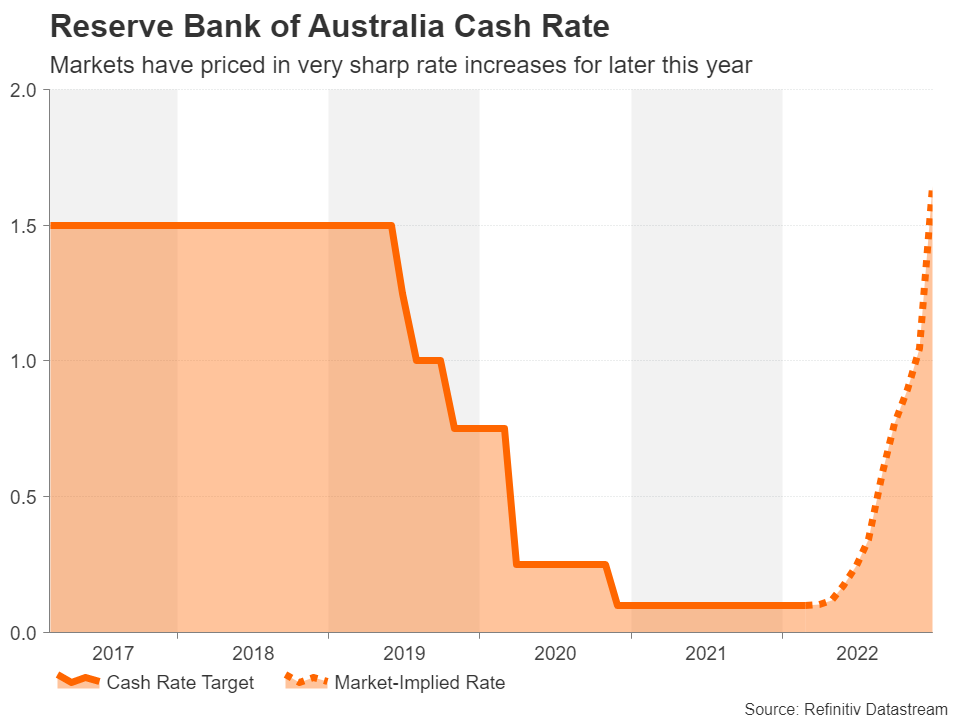
This week’s highlight in Australia is the RBA Cash Rate decision on Tuesday. Comments from RBA officials suggest they will maintain rates at 0.10% despite soaring inflation and strong growth. The last piece of the puzzle remains wage growth which is just under target at 2.30%. We will have to wait until the end of the quarter for more visibility and whether the great about-face from the RBA will begin.
A hike would be a huge surprise and could send local equities lower and the AUD higher. AUD remains at the mercy of events in Eastern Europe, as do local equities.
New Zealand
The RBNZ hiked as expected this week but the impact on the NZD was non-existent as risk aversion related to Eastern Europe crushed sentiment indicator currencies. The RBNZ signalled that many more hikes were ahead this year and that inflation, employment, and growth were above theoretical maximums. NZD is being held back by worries that the RBNZ is so far behind the ball a hard landing may occur.
Elsewhere, the NZD will continue to be buffeted by headlines from the Ukraine situation.
Japan
Japan releases industrial production, retail sales, and manufacturing and services PMIs this week. The data is expected to show that omicron is still constraining the economy although it will have improved from last week. The BOJ reiterated its dovish stance on monetary policy.
With Tokyo CPI benign, inflation worries are low in Japan compared to the rest of the world. With yields set to remain near zero, pressure on the yen will continue next week as investors head for better yields offshore. Only further negative Ukraine evolutions will change that narrative.
Singapore
Singapore releases PPI on Monday and retail sales on Friday. The data will show elevated PPI due to imported inflation, and potentially another hit to consumer demand due to omicron sweeping the city-state. None of this is likely to unnerve the MAS which remains on course to tighten policy at its next 6-monthly meeting
Economic Calendar
Saturday, Feb. 26
Economic Data/Events:
- Berkshire Hathaway Q4 earnings results and CEO Warren Buffett will release an annual letter
Sunday, Feb. 27
- None
Monday, Feb. 28
Economic Data/Events
- US wholesale inventories
- Atlanta Fed President Bostic speaks
- ECB’s Panetta speaks on monetary policy and eurozone economic outlook
- Canada industrial product price
- Finland GDP
- India GDP, fiscal deficit, eight infrastructure industries
- Mexico unemployment
- South Africa trade balance
- Spain CPI
- Japan industrial production, retail sales, housing starts
- New Zealand ANZ activity outlook, business confidence
- Australia inflation gauge, private sector credit, retail sales, companies’ operating profit, inventories
- Singapore money supply
- Thailand trade, capacity utilization, BoP
- Sweden GDP
- Switzerland GDP
- Turkey GDP
Tuesday, March 1
Economic Data/Events
- President Biden delivers State of the Union address
- OPEC+ meets to discuss geopolitical risks to output
- US construction spending, ISM Manufacturing, light vehicle sales
- Atlanta Fed’s Bostic speaks on business uncertainty during an Atlanta Fed briefing
- European manufacturing PMIs: France, Germany, Eurozone, UK
- RBA rate decision: Expected to keep Cash Target Rate unchanged at 0.10%
- BOE’s Mann and Saunders speak
- Australia Manufacturing PMI, BoP, current account balance, rate decision, consumer confidence, CoreLogic house prices, home loans
- Canada GDP
- China Caixin manufacturing PMI, non-manufacturing PMI
- Czech Republic GDP
- Germany CPI
- Italy CPI
- Japan vehicle sales, PMI
- Mexico international reserves
- New Zealand CoreLogic house prices
- South Africa unemployment
Wednesday, March 2
Economic Data/Events
- Fed Chair Powell delivers congressional semi-annual testimony before the House Financial Services Committee
- OPEC+ meeting on output
- Chicago Fed President Evans discusses the economy and monetary policy at an event hosted by the Lake Forest-Lake Bluff Rotary Club
- St. Louis Fed President Bullard speaks on the outlook for the economy and monetary policy
- New York Fed Executive Vice President Logan discusses Fed asset purchases at an event hosted by NYU’s Stern Center for the Global Economy
- US Fed Beige Book
- BOJ’s Nakagawa speaks in Kyoto
- ECB chief economist speaks
- BOE’s Tenreyo speaks about the UK economic outlook
- BOE’s Jon Cunliffe speaks on the “Current financial stability environment” at the Oxford Union
- Australia GDP
- BOC rate decision: Expected to raise interest rates by 25bps to 0.50%
- China Caixin services PMI
- Eurozone CPI
- Germany unemployment
- Hungary GDP
- Japan capital spending, company profits, monetary base
- Mexico central bank quarterly inflation report
- New Zealand building permits
- India Markit PMI
- Singapore PMI, electronics sector index
- Russia unemployment
- EIA Crude Oil Inventory Report
Thursday, March 3
Economic Data/Events
- Fed Chair Powell’s semi-annual testimony before Senate Banking Committee
- US factory orders, initial jobless claims, durable goods
- New York Fed President Williams speaks on the economy
- ECB publishes the account of its February policy meeting
- Norway’s sovereign wealth releases annual report
- Eurozone services PMI, PPI, unemployment
- Italy unemployment
- Australia trade, building approvals, Markit PMI composite and services
- Japan services PMI, composite, consumer confidence index
- Singapore services PMI
- China Caixin PMI composite and services
- New Zealand commodity prices
- Thailand CPI
Friday, March 4
Economic Data/Events
- US Nonfarm Payroll Report: US Feb Change in Nonfarm Payrolls: 400ke v 467K prior; Unemployment Rate: 3.9%e v 4.0% prior
- Eurozone retail sales
- France industrial production
- Germany trade
- Greece GDP
- New Zealand consumer confidence
- Hong Kong retail sales
- India Markit PMI composite and services
- Japan unemployment
- Thailand CPI, consumer confidence, foreign reserves, forward contracts
- Taiwan foreign reserves
- Italy GDP
- Singapore retail sales
- Apple annual meeting
Sovereign Rating Updates
- Finland (S&P)
- Spain (DBRS)
Week Ahead – NFP Report, BoC Meeting, Eurozone Inflation Might Detract from Ukraine Turmoil
With a full-blown conflict in Ukraine now underway, there will be plenty of distractions for the markets in the upcoming week in the form of the latest jobs report out of the United States, Eurozone inflation numbers and a policy meeting by the Bank of Canada. Australian and Canadian GDP figures will be on investors’ radar too, while the scheduled monthly gathering of OPEC and non-OPEC countries could make for an awkward gathering amid international anger at key partner Russia’s incursions into Ukraine.
Aussie eyes RBA and GDP as it pushes against risk tide
The Australian dollar’s steady upward path since late January has come under threat from the heightened geopolitical tensions. But the currency still has substantial support from higher commodity prices as well as strengthening expectations that the Reserve Bank of Australia will raise interest rates later this year, even as traders scale back rate hike bets for the Fed.
The RBA meets on Tuesday and following the February decision to end bond purchases, no action is anticipated this time. However, investors will be hoping to find clues in the RBA statement about the timing of a rate hike. Wages in Australia grew by a paltry 2.3% year-on-year in Q4, so policymakers aren’t about to suddenly turn hawkish. However, other indicators due next week might not be quite so soft.
Australia’s GDP likely bounced back strongly in the final three months of 2021, data out on Wednesday is expected to show. Ahead of the GDP print, quarterly business inventories are out on Monday along with retail sales and private sector credit for January. Net exports contribution for Q4 will follow on Tuesday. January building approvals on Thursday might attract some attention too.
Aside from the domestic data and the military escalation in Ukraine, the official and Caixin/Markit manufacturing PMIs out of China on Tuesday and Thursday, respectively, could sway the aussie as well.
The New Zealand dollar is another currency whose fortunes are closely tied to the risk currents as a more hawkish RBNZ was unable to stem Ukraine driven losses. The ANZ business outlook out Monday and fourth quarter terms of trade reading on Wednesday are unlikely to do so either unless broader risk appetite improves.
BoC expected to join rate hike club
Across the Pacific, the Bank of Canada probably won’t be beating around the bush any longer and will raise interest rates on Wednesday. A 25-basis points increase is fully priced in, and with inflation heating up more than expected in January, a surprise double hike cannot be ruled out.
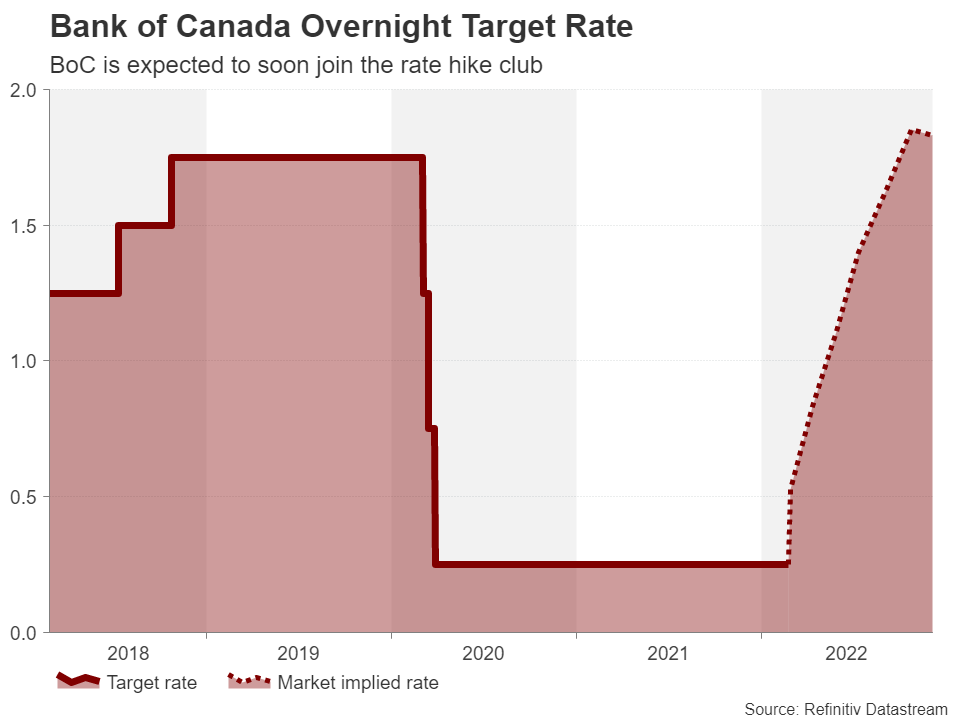
Though, the chances of a 50-bps move are slim given the recent somewhat disappointing employment report and the ongoing truckers protest that could be having a dampening effect on the economy, not to mention the Ukraine fallout.
The Canadian dollar has slid to two-month lows against its US counterpart so a more hawkish-than-anticipated tone could provide a notable boost. Traders will also be watching January producer prices on Monday, the Q3 GDP print on Tuesday and the Ivey PMI on Friday.
Don’t count on OPEC to ease supply pressure
Also important for the loonie will be the outcome of the OPEC+ meeting on Wednesday. The OPEC-led alliance of major producers that includes Russia is not expected to accelerate its plan of gradually undoing the 2020 supply cuts despite oil prices shooting higher.
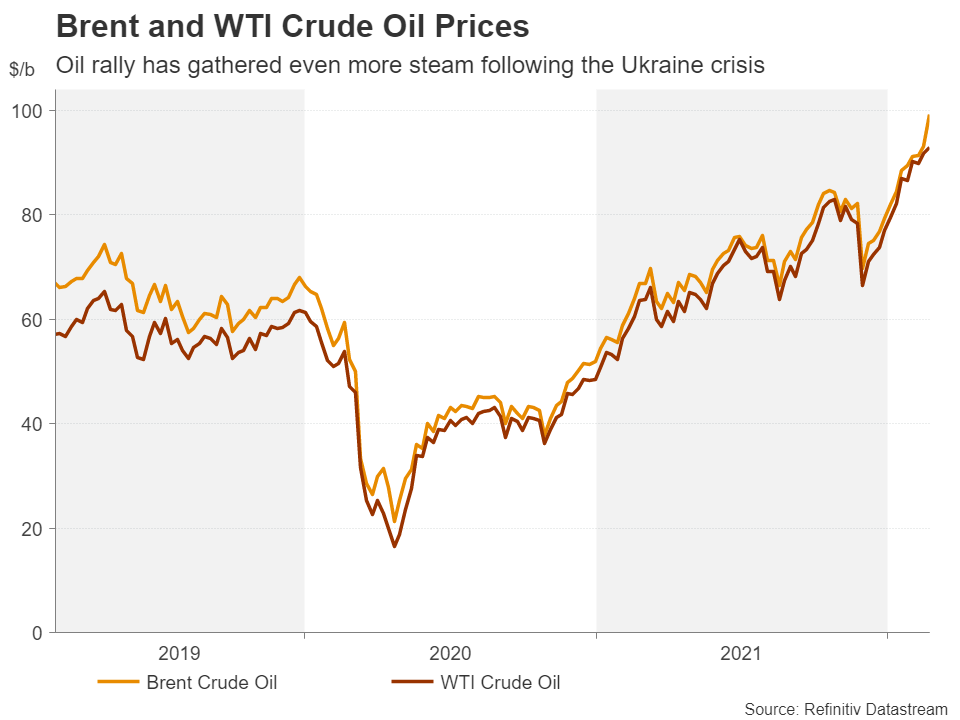
Oil futures hit $100 a barrel after Russian forces began to invade Ukraine, worsening the energy crisis. But this is unlikely to change leading producer Saudi Arabia’s mind about heeding calls from Washington to pump more oil, at least not yet.
US data may add to dollar’s upside
The US dollar skyrocketed to near 20-month highs as investors sought safety from the eruption of war in Ukraine. Safe-haven demand has more than offset dimming expectations of the Fed raising interest rates aggressively over the coming months.
Futures markets are now pricing in six rate hikes versus 6.5 only a few says ago. However, it’s not certain if the incoming data can make much of a difference to Fed policy speculation now that geopolitical risks have entered the equation.
Nevertheless, with another solid jobs report and upbeat ISM PMIs predicted, a further dollar boost is possible.
Starting the week, though, is the Chicago PMI on Monday, with the ISM equivalent coming up on Tuesday. The ISM non-manufacturing PMI and factory orders will follow on Thursday before the focus turns to the NFP numbers on Friday.
Both ISM PMIs are forecast to edge slightly higher in February, but nonfarm payrolls are expected to have risen at a slightly lower pace, moderating to a gain of 438k versus 467k in January.
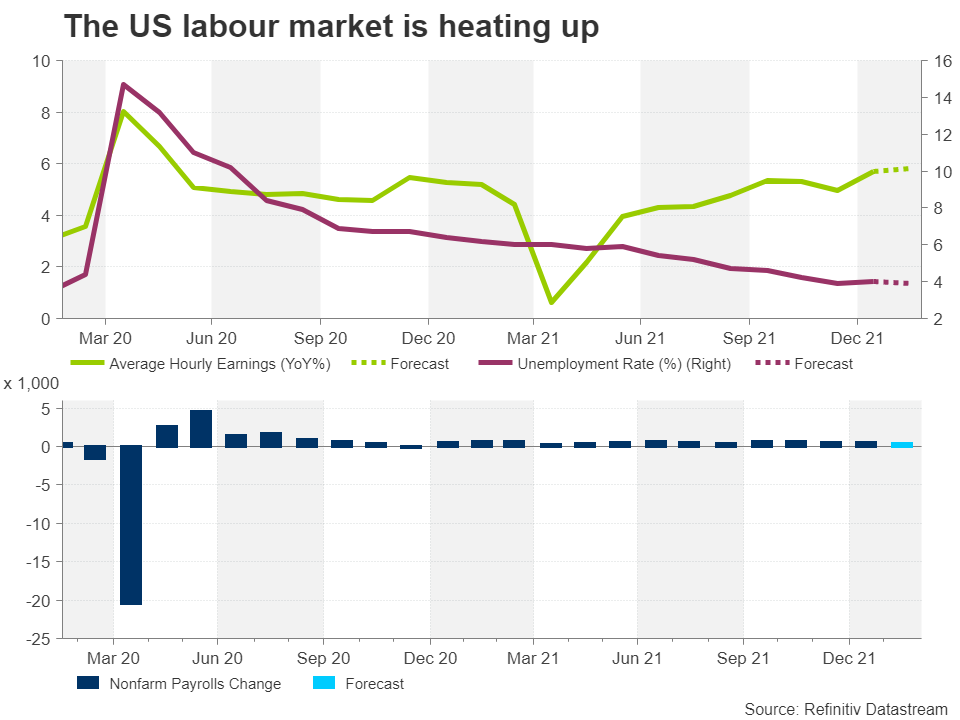
The unemployment rate is projected to tick lower by 0.1 percentage points to 3.9% and average hourly earnings are forecast to pick up slightly to 5.8% year-on-year.
Hotter-than-expected readings could push bets of Fed rate hikes higher, but ultimately, investors will mainly be paying attention to whether the Ukraine crisis is prompting any change in tone among Fed policymakers.
Can Eurozone inflation shore up sinking euro?
The flash estimate of euro area inflation for February is due on Wednesday. The harmonized index of consumer prices is forecast to rise to another record, reaching 5.3% y/y, adding pressure on the European Central Bank to withdraw monetary stimulus more quickly.
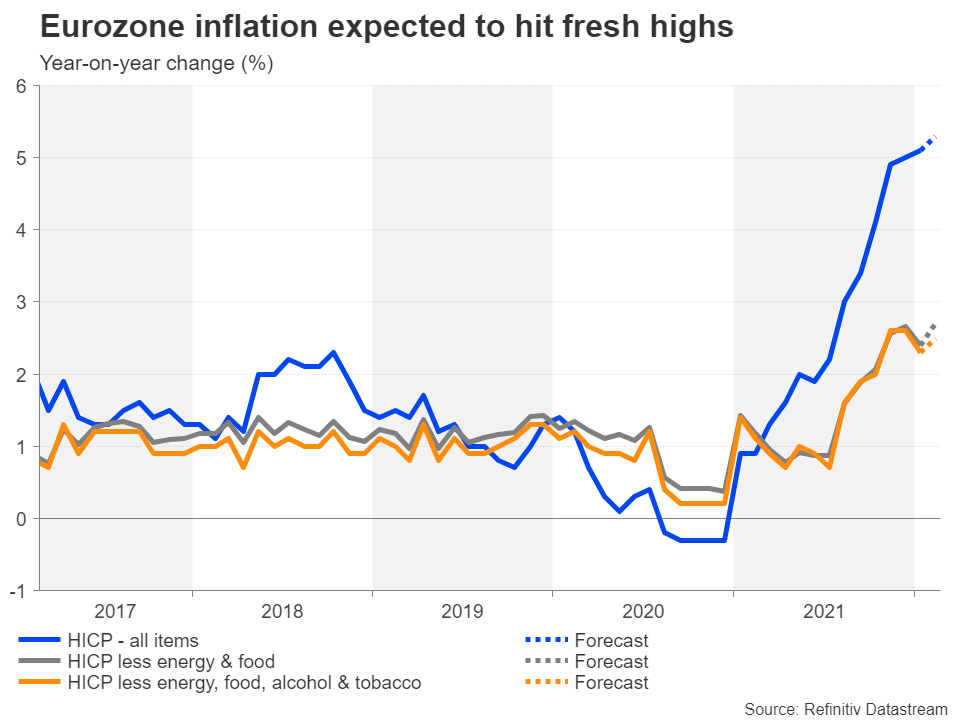
But like the Fed, the new focus in the run up to the March meeting is whether the ECB will tread more cautiously now that dark clouds are forming over Europe.
Other releases will include the final PMI prints on Tuesday and Thursday, producer prices and the jobless rate for January on Thursday, as well as retail sales on Friday.
The euro has nosedived, testing the $1.11 level, on mounting worries that the Eurozone economy will take a significant hit from sanctions against Russia that could potentially hurt oil and gas flows to Europe. Given that Russian President Vladimir Putin is unlikely to go down the path of diplomacy, the euro is at risk for further slides.
In contrast, the elevated tensions have been positive for the safe-haven favourite, the Japanese yen. Economic data have minimal impact on the yen at the best of times so next week’s releases out of Japan are bound to go unnoticed. Still, the preliminary numbers for industrial output for January on Monday and capital expenditure reading for the fourth quarter on Wednesday might be worth keeping an eye on.
Weekly Focus – Russia Attack on Ukraine Hits Risk Sentiment
The most important market theme right now is Russia's invasion of Ukraine. Security analysts increasingly suggest that Putin's aim is to replace the Ukrainian government with a Russia-friendly government, which will secure that Ukraine will not become member of NATO, see FT. As expected, the invasion was met by relatively harsh sanctions by the West but the sanctions were not as tough as one could have imagined. Russia was not excluded from SWIFT and energy was overall excluded. After the sharp risk sell-off early morning Thursday, markets rebounded late Thursday and early Friday due to softer-than-anticipated sanctions. The situation is still uncertain and hard to predict and we cannot rule out tougher restrictions down the road, which means upside risks for both oil and gas prices as well as some metal and wheat prices. Oil prices rose to nearly 106 dollar per barrel but is now trading below 102. In FX space, RUB and Eastern European currencies like PLN have weakened while USD and CHF have benefitted. EUR/USD is trading below 1.12 at the time of writing. We will continue to monitor the situation closely. We discussed further in Research Russia - Russia launches a full attack on Ukraine, 24 February.
Besides the Ukraine-Russia conflict, the key driver for markets is tighter monetary policy, not least in the US. Investors have reduced their bets for a 50bp rate hike from 80% probability on 10 February to now around 25%, as investors believe the Fed will be more hesitant to tighten monetary policy under the current circumstances with elevated uncertainty. We would like to emphasise, however, that the Fed does not have a lot of room to manoeuvre, as inflation is already at the highest level in 40 years and commodity prices have risen further since the attack, adding on top of already high underlying inflation pressure. There is a lot of uncertainty about the economic impact from the war but we know it is inflationary from rising commodity prices.
We get one of the most important US data releases next week when the February jobs report is due out on Friday, although it is now of secondary importance. Jobs growth was very strong in January, as labour force participation picked up. We believe it is more important to look at the unemployment rate (as headline jobs growth depends on how many people are flowing into the labour force) and another move lower would mean a higher probability of the Fed hiking by 50bp in March despite the Russia-Ukraine war. Also look out for the Fed's beige book.
In the euro area, we expect HICP inflation in February accelerated further to 5.9% y/y (HICP core inflation to 2.4% y/y). We discussed the euro area inflation outlook in Euro inflation notes: Cost-push inflation - the genie is out of the bottle, 23 February.
We expect the Reserve Bank of Australia to continue pushing against the very hawkish market pricing, especially following modest Q4 wage growth data.
There is still a lot of focus on global supply chain issues. We argue that they will slowly ease up over the summer, see Big Picture: Global Supply Chain issues to slowly ease up in summer, 21 February. Near-term there are risks of increasing pressure with factories closing down in Russia and Ukraine.
US: Consumption Bounces Back, Income Stronger Than Expected
Personal income was flat month-on-month (m/m) in January, better than the consensus call for a decline of 0.3% m/m. December growth was revised up from 0.3% m/m to 0.4% m/m. Compensation of employees (+0.6% m/m) continue to be the driving force of higher income, with both private and government wages rising.
Removing the effect of price changes and taxes, real personal disposable income was down 0.5% m/m in January, while December's decline was revised down to -0.3% m/m (from -0.2% reported earlier).
Nominal personal spending rose by 2.1% m/m in January, slightly above the consensus estimate (1.6% m/m). The December reading was revised down from -0.6% to -0.8% m/m.
- Goods spending gained 4.3% m/m from a downwardly revised decline of 3.2% in December (originally -2.6%). The strength was widespread, led by motor vehicles and parts, "other" nondurable goods, and recreational goods and vehicles.
- Services spending rose by 0.5% m/m growth in January, while the December reading remained unadjusted at +0.5% m/m. The gain was largely attributed to spending on housing and utilities.
In real terms, spending growth was up 1.5%, slightly stronger than market expectations (1.2% m/m).
The PCE price deflator rose by 0.6% m/m in January (as expected), which translated into 6.1% in year-over-year (y/y) terms (vs. 6.0% expected). Excluding food and energy, core PCE inflation was up 0.5% m/m (as expected) and 5.2% y/y (vs. 5.1% expected).
The personal saving fell to 6.4% from 7.9% in December.
Key Implications
The acceleration in spending is encouraging to start of the year and quarter. The strength in goods spending was anticipated in the retail sales report, but spending on services was a wild card amid Omicron-related uncertainty. Today's report suggests that COVID impact on services spending was milder than during the previous waves.
High frequency indicators for most vulnerable high contact service activities – OpenTable seated diners and TSA checkpoint travel numbers – are now back to their pre-Omicron levels, which points to services gaining momentum in February. For Q1 2022, we are tracking real growth of 2.0%.
Today's inflation reading leaves no doubt about the first rate hike in March. The Fed's preferred inflation measure – the core PCE deflator – marks the eleventh month "above target." The fog of war in Ukraine adds uncertainty to future rate hikes, especially if higher energy and commodity prices start impacting growth. The monetary policy path will remain data dependent and, as Governor Waller stated, whether "a more modest tightening" is appropriate "remains to be seen."
Sunset Market Commentary
Markets:
Yesterday’s US price action already suggested that markets were preparing for some kind of ‘post-Ukraine normalcy’. US equities more than reversed initial losses. Yields returned to well-known territory. Fed officials held the line that, at this stage, geopolitical developments don’t change the Fed policy roadmap. This morning’s first reaction on European markets understandably was more guarded as headlines indicated that a battle for the Ukraine capital Kyiv could start any time. The impact of the conflict for neighboring Europe also will be deeper and more persisting (cf infra comments Lane). However, as trading developed sentiment in Europe also improved markedly. Comments that Russian president Putin might be prepared to hold talks with Kyiv on a neutral status of the country maybe supported sentiment further. European equities are building out gains of up to 3%. Even so, the EuroStoxx 50 remains below 4000 reference. EMU interest rates finally also joined the (geopolitical) normalization trade. Eco data were no major focus for trading. Still, higher than expected French and Belgian CPI’s were a reminder that the debate on inflation will only intensify. German yields are rising 2.0 bps (2-y) to 5.5 bps (5-y). The German 10-y yield regained the 0.20% mark. The EMU 10-y swap (0.85%) even nears the cycle top of 0.90%. Despite the rise in core yields, the risk-on caused a corrective narrowing in EMU peripheral spreads (10-y), Greece (-8 bps) and Italy (-4 bps) outperforming. US spending and income data were close to expectations. The PCE deflators, closely watched at the Fed, rose as expected (general 0.6% M/M and 6.1%Y/Y; core 5.2% Y/Y from 4.9%) but didn’t accelerate the market dynamics. This also applies for solid January durable goods orders (1.6% M/M). Still, US yields are also rebounding further, rising between 1.0 bp (30-y) and 2 bps (5-y). The US 10-y yield tries to regain the 2% handle. Oil eases back below $97/b and wheat also eases about 7% off this morning’s multi-year peak levels. However, much more is needed to ease the inflationary threat from this week’s broad-based jump in commodity prices.
As was often the case of late, the repositioning on the FX market again was far less dynamic that in other markets. The TW dollar (DXY) is losing a few ticks (96.85). The presumed safe havens also are only losing modest ground. USD/JPY is going in the 115.50 area. EUR/CHF tries to regain the 1.04 level. The EUR/USD performance (1.1225) remains unconvincing. It doesn’t look easy to regain the previous neckline support at 1.1286. Sterling suffers from a further decline in (ST) yields. EUR/GBP trades near 0.8390 (from 0.837). In the CE region, the Czech koruna (EUR/CZK 24.7) regained a big part of this week’s Ukraine driven losses The zloty (EUR/PLN 4.627) and the forint (EUR/HUF 365.7) have some more work to do.
News Headlines:
Belgian inflation accelerated again in February, rising by 0.63% M/M to 8.04% Y/Y (from 7.59% Y/Y in January). It’s the highest inflation level since March 1983. Energy prices rise by 60.99% Y/Y and contribute 5.03 percentage points to the total inflation. Nevertheless, core inflation accelerated as well in February, from 2.98% Y/Y to 3.28% Y/Y. Food inflation increased from 2.26% Y/Y to 3.84% Y/Y with inflation for rents accelerating from 2.15% Y/Y to 2.49% Y/Y. Services inflation slowed from 3.35% Y/Y to 3.2% Y/Y. Inflation based on the national health index rose from 7.12% Y/Y to 7.56% Y/Y in February. French inflation rose by 0.8% M/% to 4.1% Y/Y (from 3.3% and vs 3.7% forecast). Both inflation prints already suggest upward risks to next week’s EMU print. Consensus currently expects a rise from 2.3% Y/Y to 2.5% Y/Y for core inflation and from 5.1% Y/Y to 5.3% Y/Y for the headline reading.
Sources close to the matter told Reuters that ECB chief economist Lane told fellow policymakers that the Ukraine conflict may reduce EMU growth by 0.3%-0.4% this year in the base scenario (currently 4.2% expected). In a downside risk scenario, the hit could be as large as 1, in a relatively mild one there would hardly be any impact. Lane didn’t update inflation prognosis yet, but warned for a significant upgrade to the December projections. Inflation could possibly be above the ECB’s 2% inflation target over the complete policy horizon. The current inflation trajectory is 3.2%, 1.8%, 1.8% for 2022-2024.
USD/JPY Mid-Day Outlook
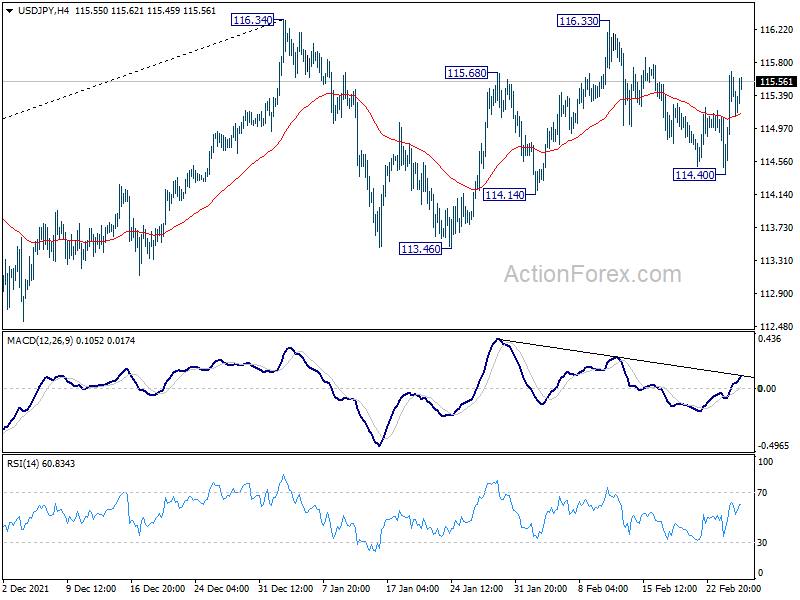
Daily Pivots: (S1) 114.73; (P) 115.21; (R1) 116.01; More...
Intraday bias in USD/JPY stays neutral at this point. On the upside, firm break of 116.34 will resume larger up trend from 102.58 to 118.65 long term resistance next. On the downside, though, break of 114.40 will continue the corrective pattern from 116.34 with another fall to 113.46 support.
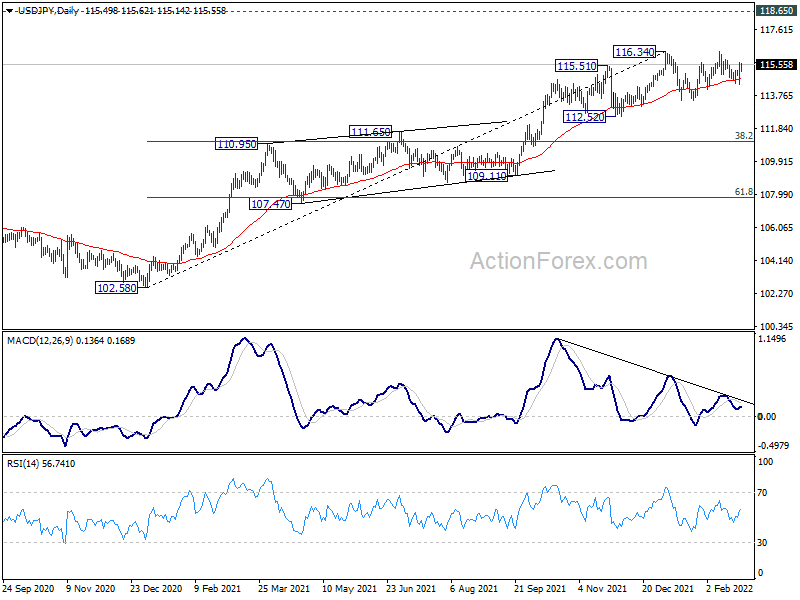
In the bigger picture, no change in the view that rise from 102.58 is the third leg of the up trend from 101.18 (2020 low). Such rally should target a test on 118.65 (2016 high). Sustained break there will pave the way to 120.85 (2015 high) and raise the chance of long term up trend resumption. This will remain the favored case as long as 55 week EMA (now at 111.61) holds.
USD/CHF Mid-Day Outlook
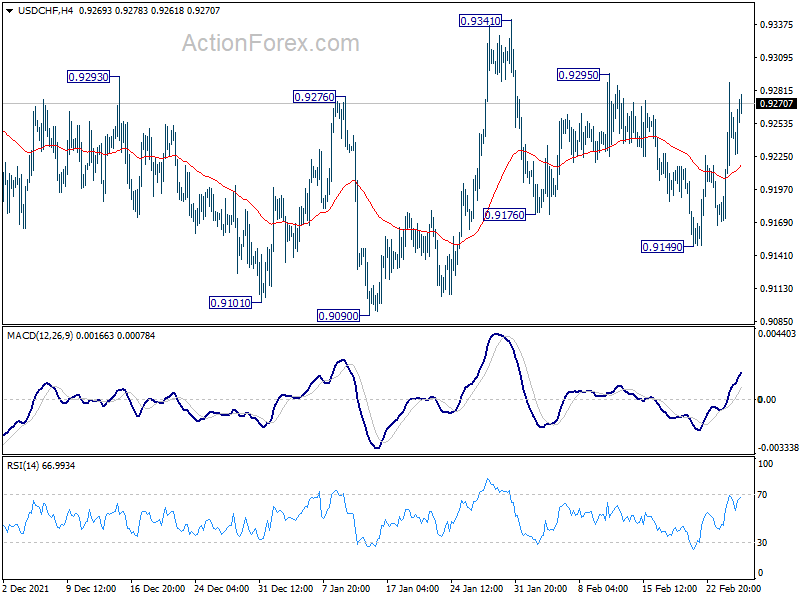
Daily Pivots: (S1) 0.9189; (P) 0.9239; (R1) 0.9305; More....
Range trading continues in USD/CHF and intraday bias remains neutral. Choppy rise from 0.8925 would still be in favor to extend higher as long as 0.9090 support holds. Break of 0.9341 will target 0.9372 resistance and then 0.9471. On the downside, however, break of 0.9090 will bring deeper fall back to 0.8925 support.
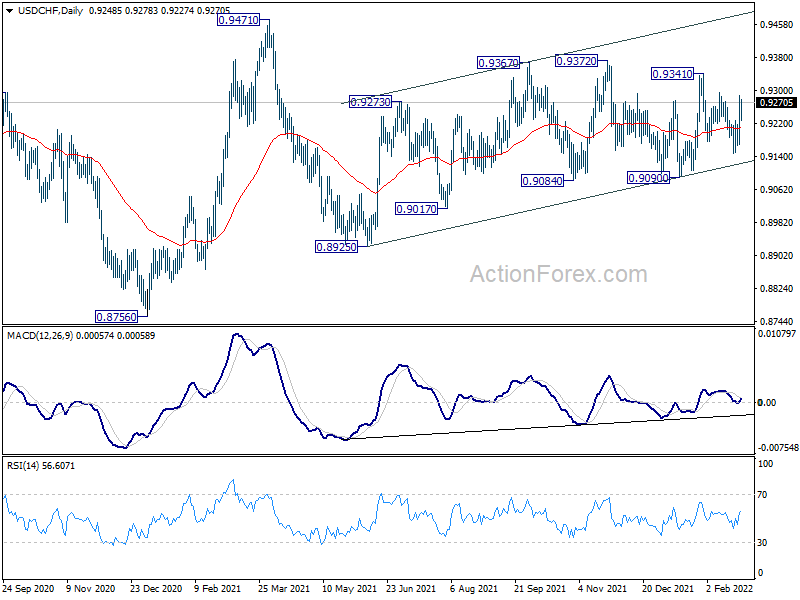
In the bigger picture, medium term outlook will be neutral at best as long as 0.9471 resistance holds. Larger down trend could still extend through 0.8756 (2021 low). However, firm break of 0.9471 will argue that the trend has already reversed and rebound the rally from 0.8756 with another impulsive move.
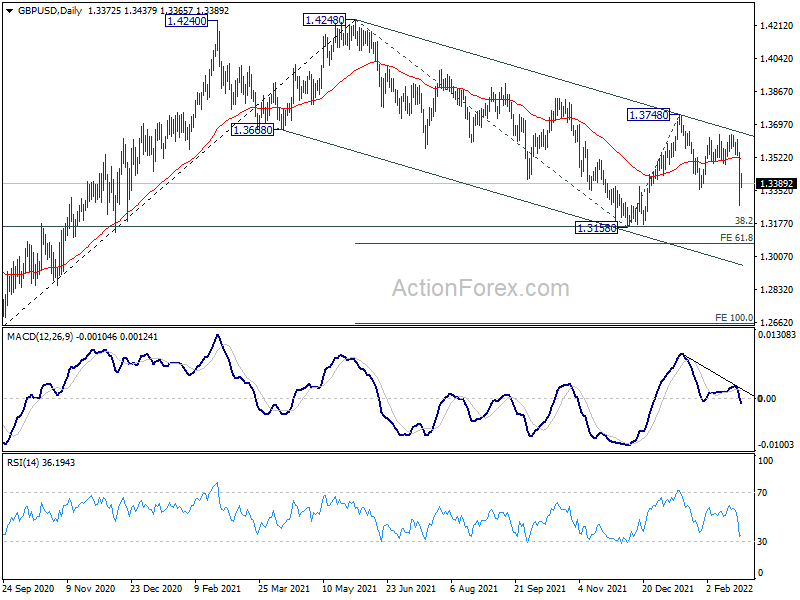
GBP/USD Mid-Day Outlook
Daily Pivots: (S1) 1.3247; (P) 1.3399; (R1) 1.3524; More...
Intraday bias in GBP/USD is turned neutral for consolidation above 1.3272 temporary low. But further fall is still expected with 1.3485 support turned resistance intact. Current development suggest larger decline from 1.4240 is still in progress. Firm break of 1.3158 will target 61.8% projection of 1.4248 to 1.3158 from 1.3748 at 1.3074 next. However, firm break of 1.3485 will dampen this bearish view and turn bias back to the upside for 1.3641 resistance.
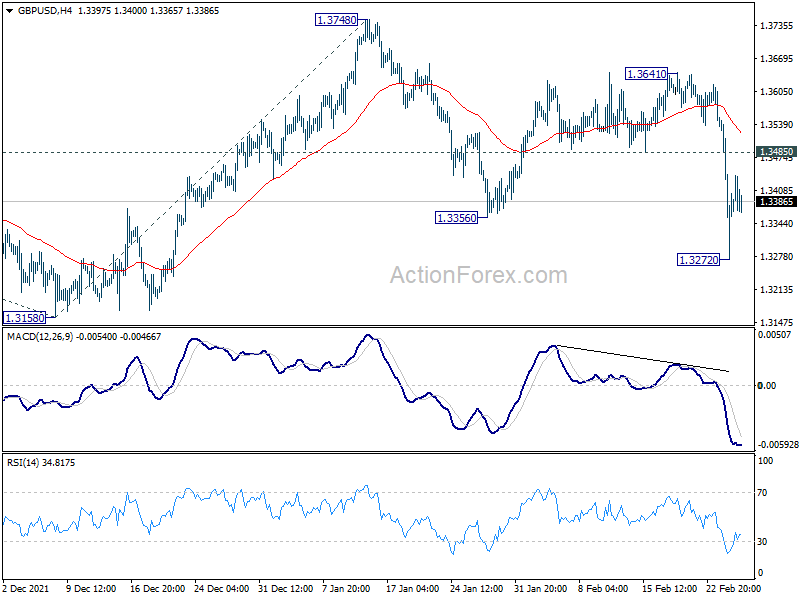
In the bigger picture, as long as 38.2% retracement of 1.1409 to 1.4248 at 1.3164 holds, up trend from 1.1409 (2020 low) is still in progress. On resumption, next target will be 38.2% retracement of 2.1161 to 1.1409 at 1.5134. Nevertheless sustained break of 1.3164 will argue that whole rise from 1.1409 has completed and bring deeper fall to 61.8% retracement at 1.2493.