Sample Category Title
ECB Stournaras: Asset purchases should continue until end of the year
ECB Governing Council member Yannis Stournaras said in a Reuters interview that the asset purchase program should continue until at least the end of the year, to cushion the fallout from the Ukraine crisis.
He said, "judging the situation from today's point of view, I would rather favour a continuation of the APP at least until the end of the year, beyond September, rather than bringing the end closer... I wouldn't be in favour of announcing the end of APP in March."
Stournaras added that the crisis was bound to depress prices "in the medium to long term" after an initial spike."In my view it is going to have a short-term inflationary effect – that is prices will increase due to higher energy costs," he said. "But in the medium to long term I think that the consequences will be deflationary through adverse trade effects and of course through the rise in energy prices."
Markets React as Russia Invades Ukraine
The situation in Ukraine has deteriorated unfortunately after Russian armed forces attacked the country at around 4am UK time, and markets have reacted in the way we had expected. Russian stock markets have suffered their worst day on record, with the RTS Index plunging by more than 40 per cent today. The USD/RUB has rallied to a fresh record high of 90.00, before easing back as oil prices surged with Brent crude going through the $100 barrier to reach a high so far of nearly $105 per barrel. Global markets have also been shaken, with European stocks and US futures slumping, while safe-haven gold has rallied to $1950. The key question is where will the markets head from here and how and how traders could take advantage of all this volatility.
How severe will the economic sanctions be?
Western nations are promising to roll out further sanctions against Russia following the invasion. So far, the sanctions haven’t been too severe, but following the Russian invasion, surely, they will now respond more profoundly in an effort to really hurt the Russian economy. And that’s precisely why we have seen Russian stocks suffer a huge sell-off today. We simple do not yet know exactly how severe these sanctions will be or for how long, and what kind of a response we will get from Russia.
How to trade the volatility?
So, expect the markets to remain highly volatile and in an overall defensive mode. That said and given the gigantic moves in Russian and global assets, traders should be careful chasing the moves here as it could be that the markets have overreacted, and the worst-case scenario might be avoided after all. So, rather than chasing, conservative traders may wish to wait for pullbacks to potentially enter trades in the prevailing directions of the recent trends. More aggressive speculators may consider zooming into smaller time frames to find short-term, quick, opportunities. In any case, traders must be nimble as the markets are headline-driven and highly volatile. Investors, meanwhile, may also consider “bargain hunting” strategies to take advantage of downbeat prices of stocks that might be able to regain their poise quickly – perhaps energy names, miners and others that are not directly linked to Russia.
Gold heading to $2K?
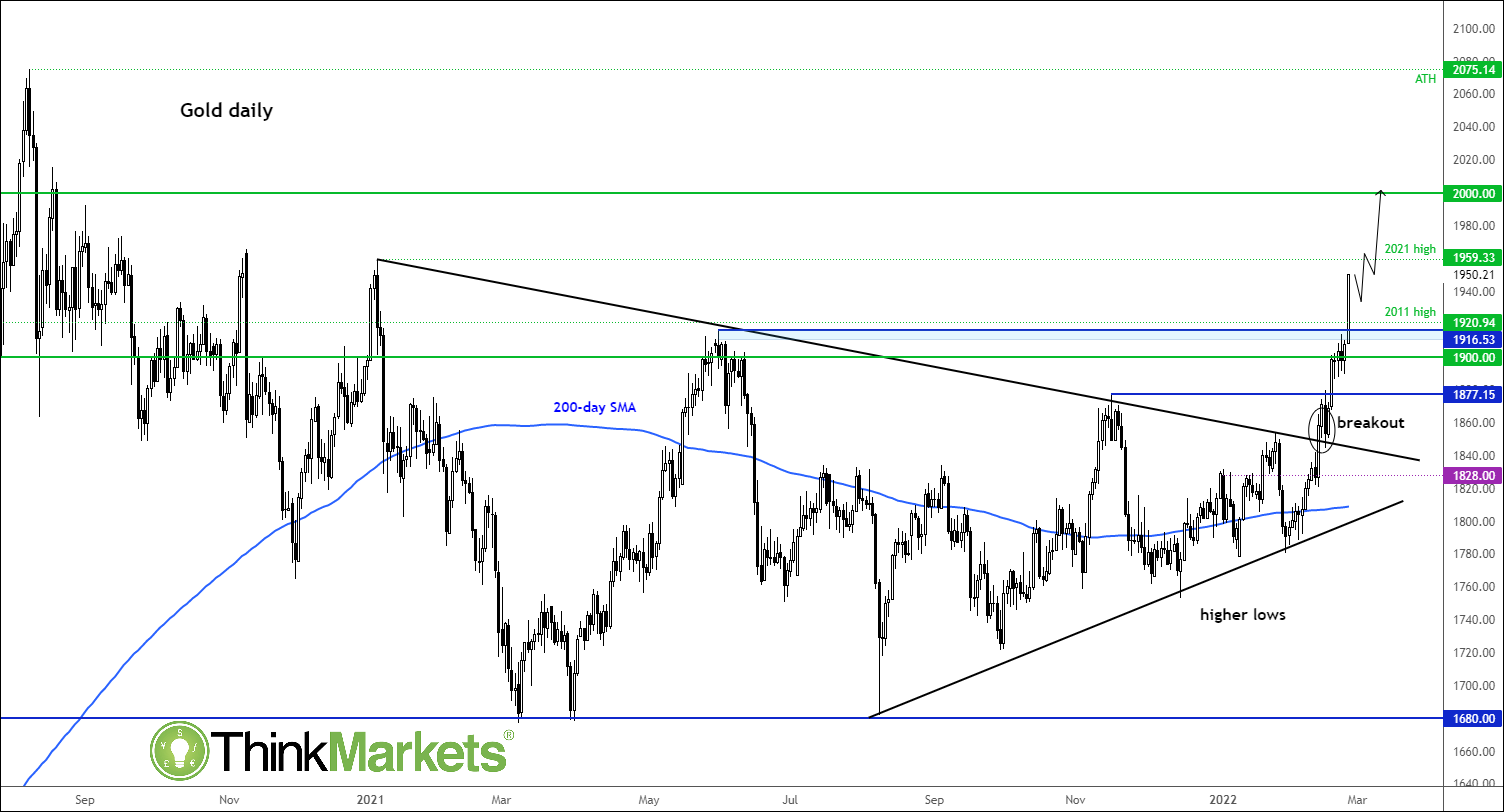
Gold has been an obvious choice for investors of late amid heightened geopolitical risks concerning Ukraine, a struggling global stock market and soaring inflation. Inflation is also helping to keep real bond yields in the negative territory, making the non-interest-bearing gold and silver attractive on a relative basis for yield-seekers. Given gold’s breakout had already started several days ago in anticipation of a potential Russian invasion. With several key levels broken, there is not much in the way of resistance until just shy of $1960, the high from 2021, followed by the psychologically-important $2,000 level. The all-time high comes in at $2,075, hit in 2020. Key support is at around the $1900-$1920 range, which was previously resistance.
Crude oil breaks $100 barrier
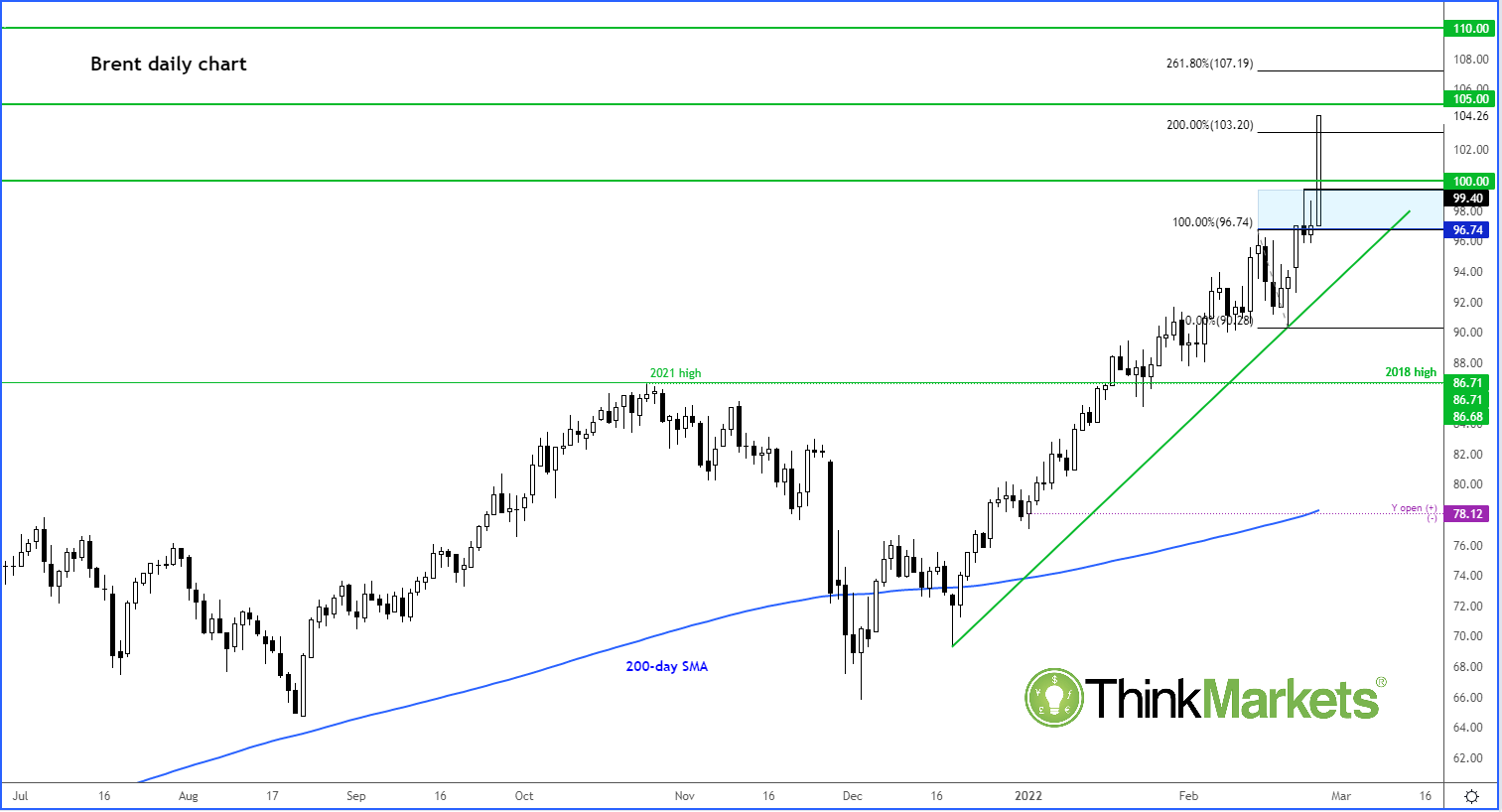
Fears over supply disruptions have sent crude oil prices surging further higher. The Brent contract has paved the way for $105 after breaking through the $100 per-barrel-barrier with little effort. Dips back to support should hold until something changes fundamentally. But prices do appear severely overbought and there is a risk of a pullback in the not-too-distant future. Once source of support could come in from expectations of higher Iranian exports. Iran’s foreign minister, Hossein Amirabdollahian, earlier this week said that he hopes outstanding issues in negotiations with world powers to restore the 2015 nuclear deal will be resolved in the “next few days.”
DAX breaks down amid global stock market rout
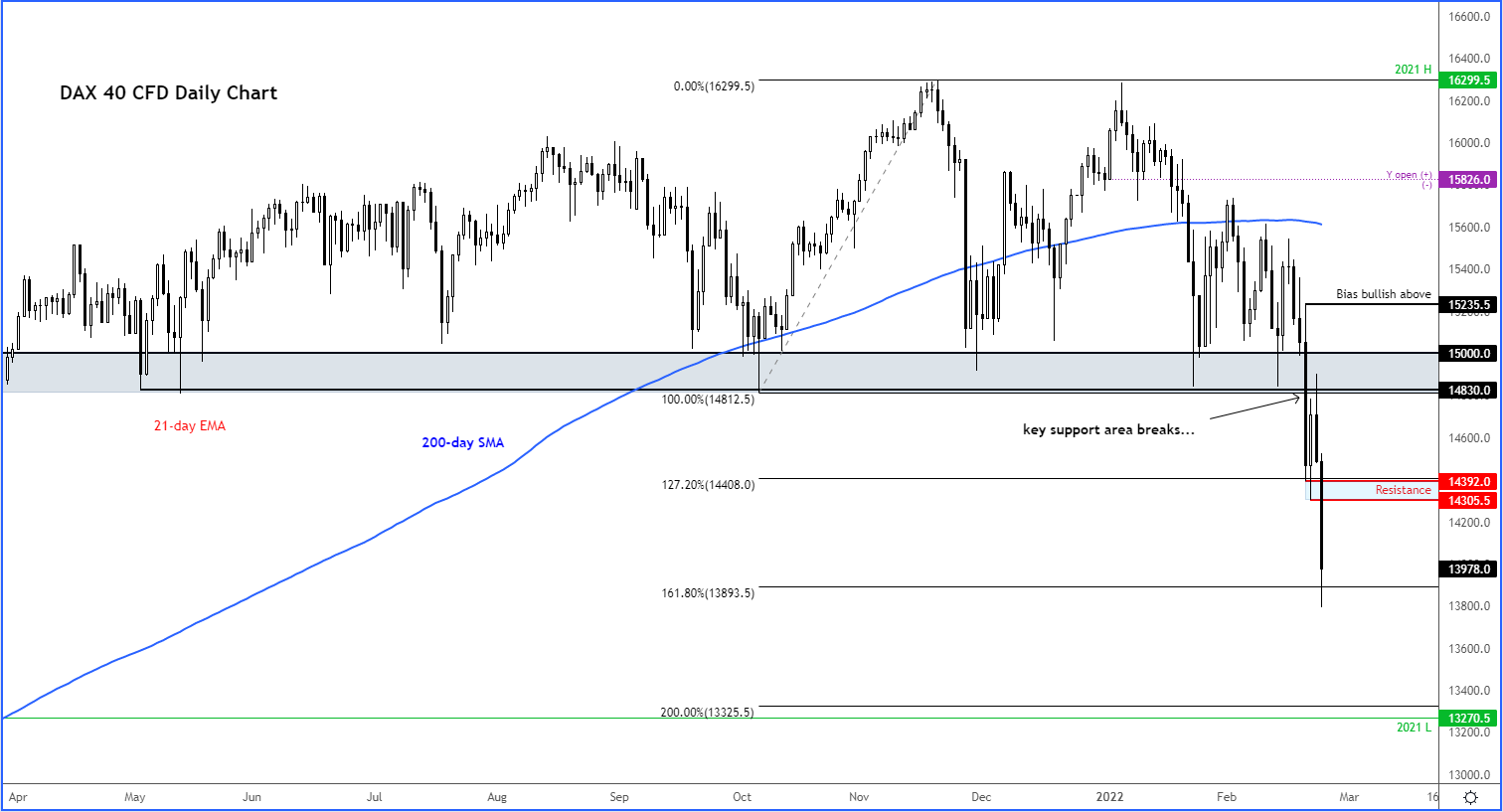
Thanks to the surging price of crude and gas prices, concerns over inflation has surged further higher. On top of this, there are fears of retaliation from Russia to western sanctions. Russia’s credit default swaps (CDS) have widened sharply, raising fears of contagion to other regions. Global stock markets have therefore slumped. Keep an eye on the German DAX index, for it has broken several support levels, which could turn into resistance upon re-test – as per the chart:
Aussie Slides on Russian Invasion
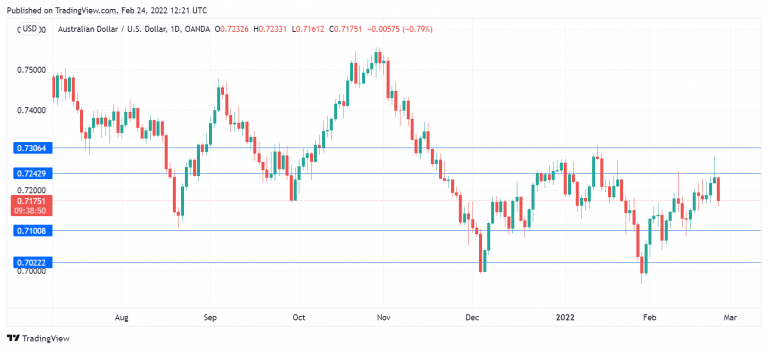
The Australian dollar has reversed directions on Thursday, as AUD/USD is trading at 0.7172, down 0.86% on the day.
Ukraine invasion sends Aussie tumbling
The tense standoff between Russia and Ukraine which had been building for days exploded earlier today, as Russian forces launched an invasion of Ukraine. Details are still sketchy, but there are reports of Russian troops advancing on a number of fronts and there has been fighting around the capital Kyiv. There had been hopes that diplomatic moves could avert a military response, but these hopes were shattered as the Russians attacked while the UN Security Council was meeting on the Ukraine crisis.
The US and western European countries have promised to impose tougher sanctions on Russia, after slapping Moscow with limited sanctions barely 24 hours ago. The West could target Russian banks and cut them off the global financial network, and also impose export control rules which would prevent Russia from importing smart phones and other key products.
The spectre of the biggest war on European soil since 1945 has sent the financial markets sharply lower, as investors flee risk and look for safety. This has also weighed on the Australian dollar, which is sensitive to risk sentiment.
Australia CAPEX underperforms
Australian business investment for Q4 rebounded with a gain of 1.1%, after a reading of -1.1% in Q3. This was well short of the consensus of 2.5%, suggesting that Q4 GDP will be smaller than expected. The economy continues to improve, as consumer spending and employment have been pointing upwards.
Australian wage growth edged higher in the fourth quarter, rising 2.3% YoY, just shy of the consensus of 2.4%. With the pace of wage growth lagging behind inflation, which is around 3.5%, the RBA can continue to preach patience, although the markets are more hawkish and have priced in five rate hikes this year.
AUD/USD Technical
- With AUD/USD falling sharply, 0.7242 has strengthened in resistance. Above, there is resistance at 0.7306
- There is support at 0.7100 and 0.7022
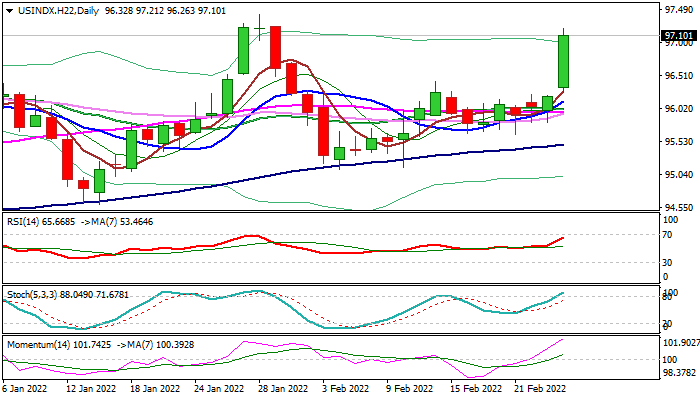
US Dollar Index Outlook: Dollar Rises Across the Board as Investors Flee to Safety
The dollar index was significantly higher on Thursday as Russian launches a military attack against Ukraine and investors flee to safety.
The greenback’s fate is pinned to the biggest components of the index, which are in defensive, with expectations for further fall that would continue to lift the US currency.
The index was up almost one percent on Thursday morning and hit the highest in three weeks, eyeing key barrier at 97.42 (2022 peak, posted on Jan 28).
Break higher (under the current conditions is seen very likely) would signal continuation of an uptrend from 89.15 (Jan 6 2021 low) and unmask pivotal Fibo resistance at 98.20 (61.8% of 103.80/89.15) fall, violation of which would expose targets at 100.00/100.35 (psychological / Fibo 76.4%).
Bullish technical studies on all larger timeframes add to dollar’s positive outlook, driven by negative geopolitical situation.
Res: 97.21; 97.42; 97.78; 98.20.
Sup: 96.70; 96.41; 96.12; 96.00.
The Crypto market lost 10% today on the Russia-Ukraine crisis
The cryptocurrency market has lost 11% in the past 24 hours, and as the situation develops and investors from Europe and America join the trading, the focus of the decline shifts from Bitcoin to altcoins. At the time of writing, losses of the former cryptocurrency are close to 10%, while ETH, XRP are down 13-14%. Cardano, Avalanche, Dogecoin have even bigger losses, with declines of more than 17%.
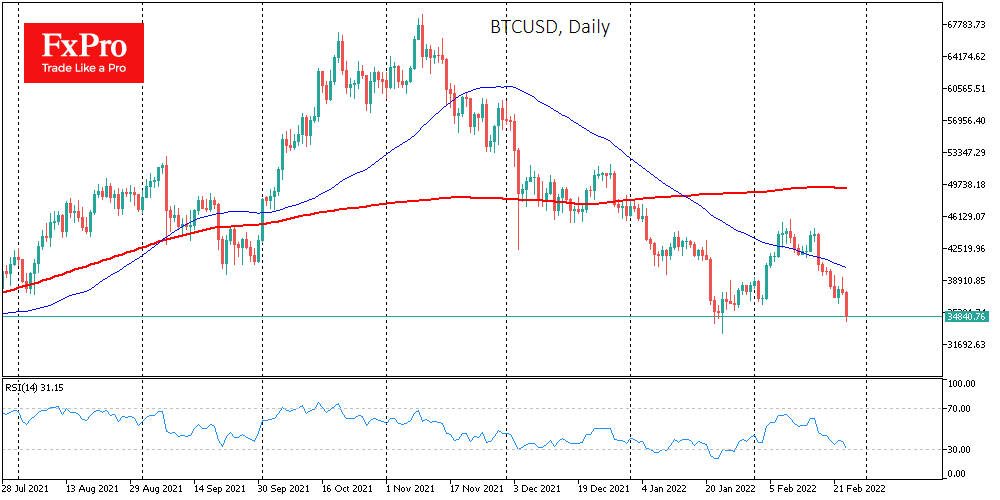
Right now, the markets have the highest demand for liquid instruments, making Bitcoin slightly less of a risk than altcoins. It is likely that a further deterioration in the financial situation could benefit the first cryptocurrency as a means of capital savings for investors from Ukraine, Russia, and some nearby countries, mainly CIS.
At the same time, the continued flight from risky assets, including equities, could temporarily destabilise altcoins, so it is possible that we will see double-digit losses in altcoins more than once in the coming days. When the dust settles, prices may prove attractive for long-term investments, but for now, the risks are excessive.
According to Glassnode, the wallets of long-term investors (hodlers) hold record volumes of BTC (76.5%). The volume of bitcoins, which have been without movement for more than 10 years, is also growing (12.6%). Thus, almost 90% of all currently available coins are out of the market.
Now another country besides El Salvador may accept bitcoin as a means of payment. Senator Indira Kempis is developing a bill on cryptocurrencies and intends to convince the Mexican government to follow the “Salvadorian scenario” by recognizing BTC as a means of payment.
Former SEC official Joseph Hall called the department’s chances of losing the lawsuit against Ripple high. The regulator accuses the company of selling unregistered securities under the guise of XRP tokens.
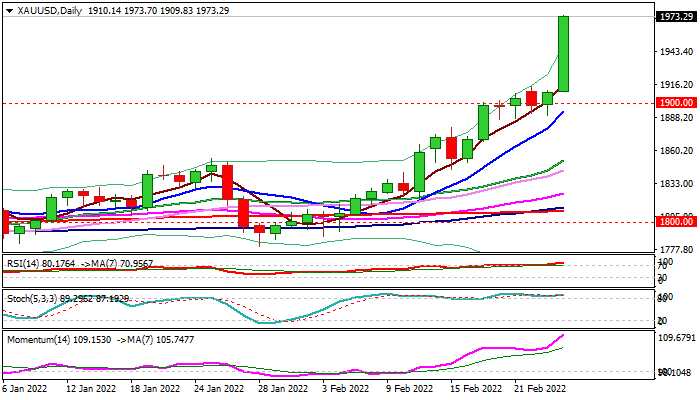
XAU/USD outlook: Gold Surges Towards $2000 on Safe-Haven Buying as War in Ukraine Starts
Spot gold advanced over 3% this morning, hitting the highest since September 2020, as traders massively run into safety after Russia launched military action against Ukraine.
Strong bullish acceleration rose well above $1950, with Fibo barrier at $1980 (76.4% of $2074/$1676) to likely easily surrender and open way for renewed test of psychological $2000 level, which was dented in August 2020, during coronavirus pandemic, but break proved to be false and followed by strong pullback to $1676.
Rising uncertainty on fears that current conflict, which is still limited, could escalate, strongly inflates gold price, which is on track for a record monthly gains in February.
Renewed probe through $2000 level looks very likely now, with break higher to face targets at $2015 and $2049, ahead of a record high at $2074, posted on August 2020.
The metal’s performance will directly depend on the development of the situation in Ukraine, with dips so far seen as good buying opportunities.
Supports lay at $1950 (round-figure/upper 20-d Bollinger band); $1914 (former high of Feb 22) and psychological $1900 level.
Res: 1980; 2000; 2015; 2049.
Sup: 1950; 1924; 1914; 1900.
EURUSD Plunges Below 1.1200, Posting 3-Week Low
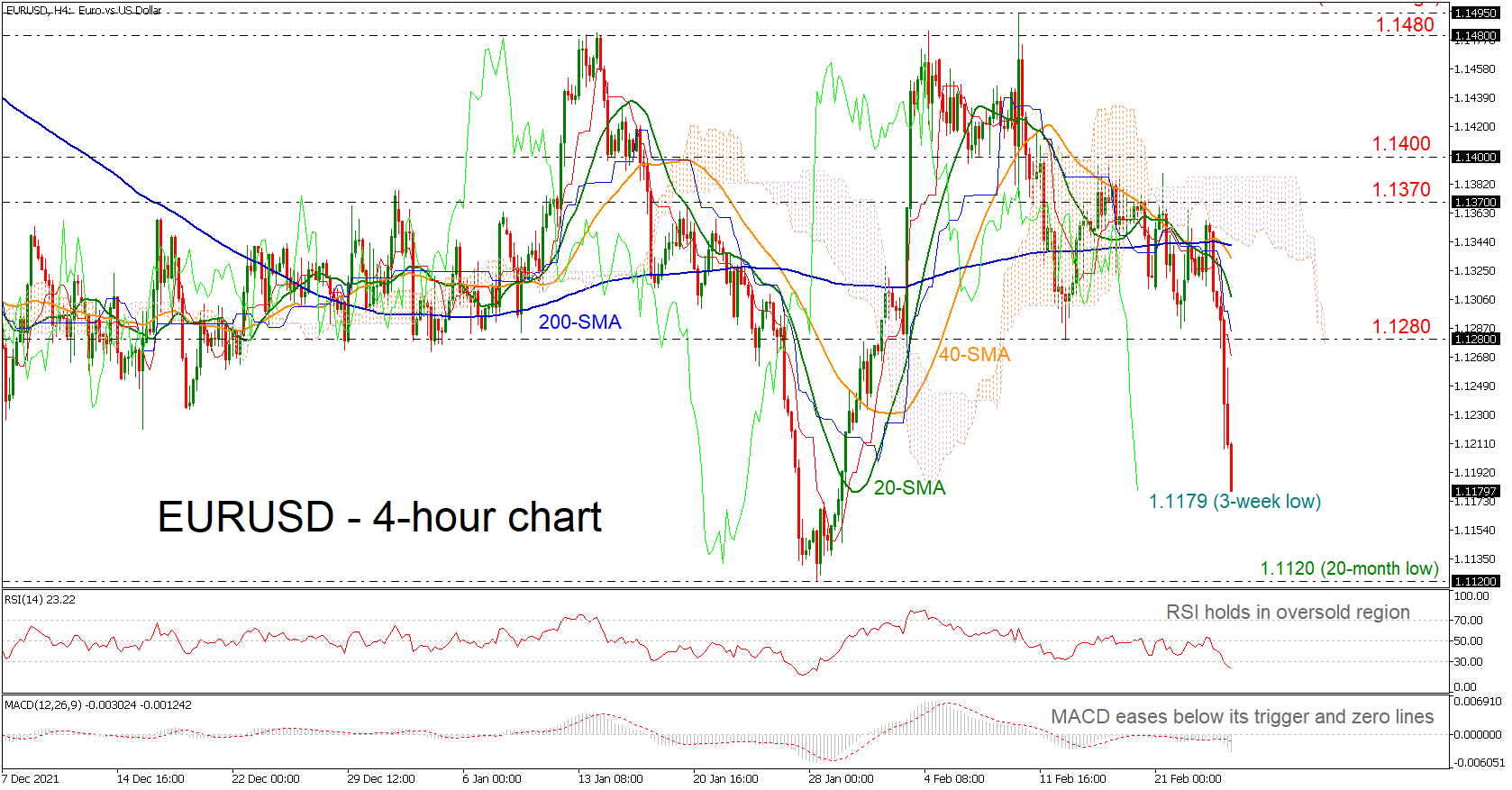
EURUSD is tumbling below the 1.1200 psychological level, reaching a new three-week low. The price pulled back off the simple moving averages (SMAs) creating a strong selling interest. The RSI indicator is reaching the oversold territory, while the MACD is strengthening its negative momentum below its trigger and zero lines.
If the price plunges further, the next stop could be around the 20-month low of 1.1120. Steeper decreases in the market could meet the inside swing high of April 2020 at 1.1016.
On the other side, a recovery to the upside could hit the 1.1280 resistance ahead of the 20-period SMA at 1.1308. More bullish actions could find the next barrier at the 40- and 200-period SMAs at 1.1333 and 1.1343 correspondingly.
All in all, EURUSD is posting a strong negative move in the short-term and this outlook may change only if there is a significant jump above the 200-period SMA.
WTI Futures Surge Past 100 Mark Sparked by Russia’s Attacks on Ukraine
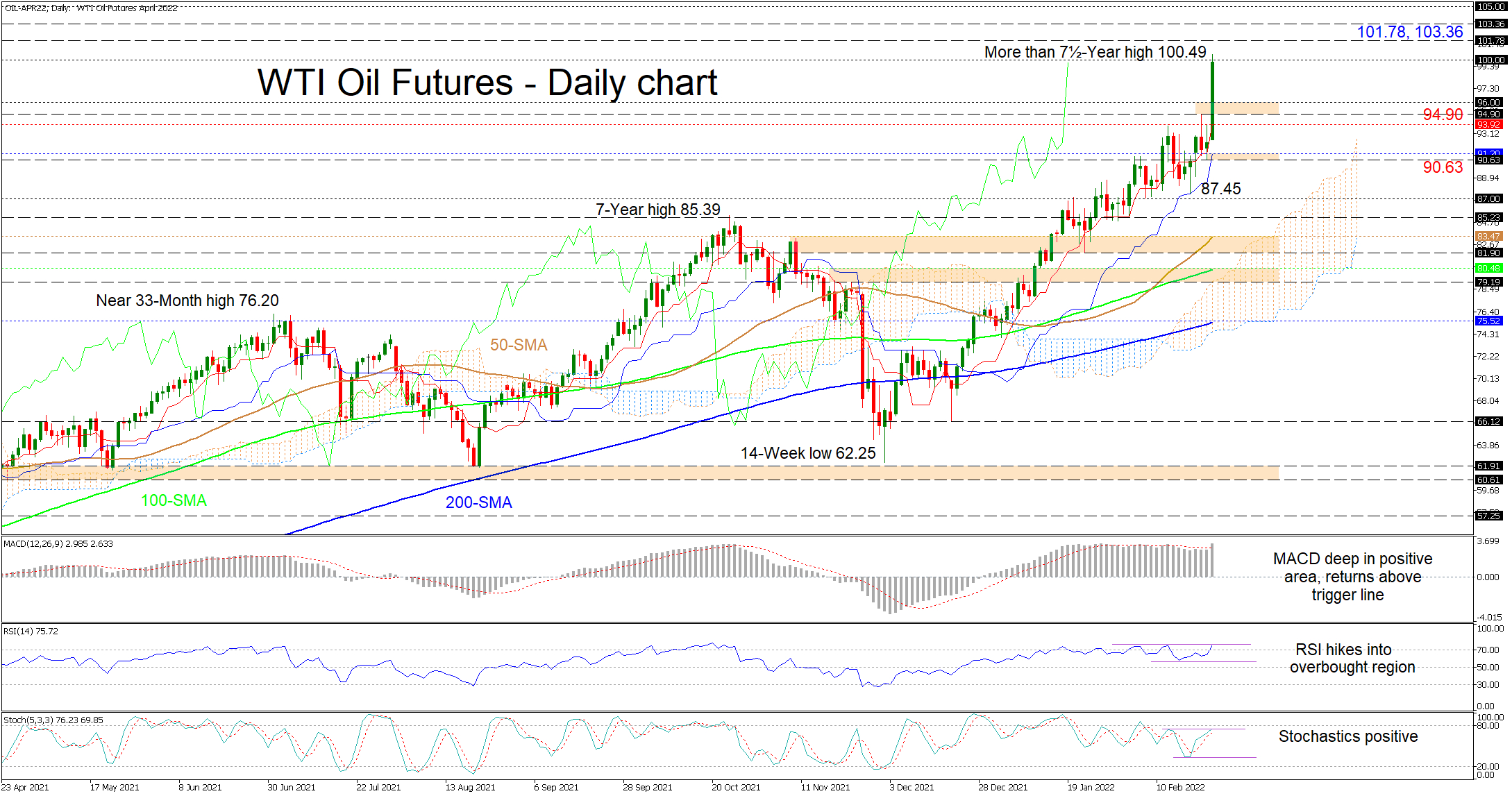
WTI oil futures have pierced above the 100 dollar per parrel mark after starting the day with a quarter of a dollar gap higher, before rocketing past the previous multi-year high of 95.00. The ascending simple moving averages (SMAs) are endorsing the uptrend from the 14-week low of 62.25, reinforcing the broader positive structure.
The soaring Ichimoku lines are indicating that bullish forces continue to remain fired up, while the short-term oscillators reveal no signs of vulnerability in positive momentum. The MACD is some distance north of the zero mark and has thrusted back above its flattened red trigger line, while the RSI is improving above the 80 level. The positively charged stochastic oscillator is promoting additional gains in the black liquid.
If buying pressures persist, the 100.00 psychological mark, even though having been slightly breached, could somewhat weigh on the price. In the event this critical border is clearly overthrown, the price of the commodity may then aim for the 101.78 obstacle and the 103.36 high, identified back in the later part of July 2014. Surpassing these barriers could then open the door for the bulls to pursue the 105.00 level.
In the event upside pressures subside and the price retreats below the 100.00 mark, a more profound withdrawal beneath would be needed to reveal where the next support currently stands, which is at 94.90-96.00. If a deeper correction develops, the red Tenkan-sen at 93.92 may provide some downside friction ahead of the 90.63-91.20 support band, existing between the latest trough and the blue Kijun-sen line respectively. Sinking further, the 87.45 low and the 87.00 handle could provide some footing for the commodity.
Summarizing, WTI oil futures are exhibiting a powerful bullish bias above the 90.63 trough and the SMAs. For negative forces to gain an advantage, the price would need to sink below the 87.45 trough.
Gold to target 2074 high on upside acceleration
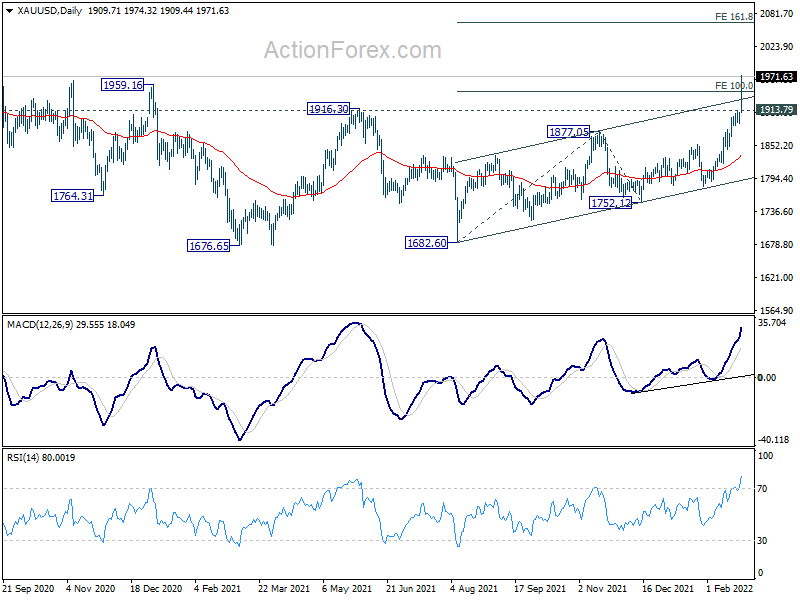
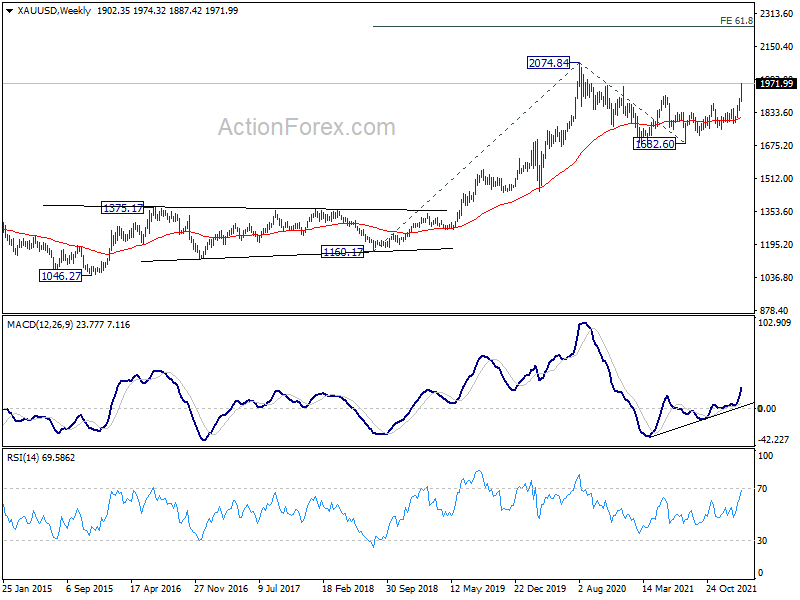
Gold's rally continues further today and powers through, 100% projection of 1682.60 to 1877.05 from 1752.12 at 1946.57. This is a clear sign of upside acceleration. In any case, outlook will stay bullish as long as 1913.79 resistance turned support holds. Next target is 161.8% projection at 2066.74, which is close to 2074.84 high.
Also, the chance of long term up trend resumption is increasing with current rally. On break of 2074.84, next medium term target will be 61.8% projection of 1160.17 to 2074.84 from 1682.60 at 2247.86.
WTI oil breaks 100 with upside acceleration, 107.4 next
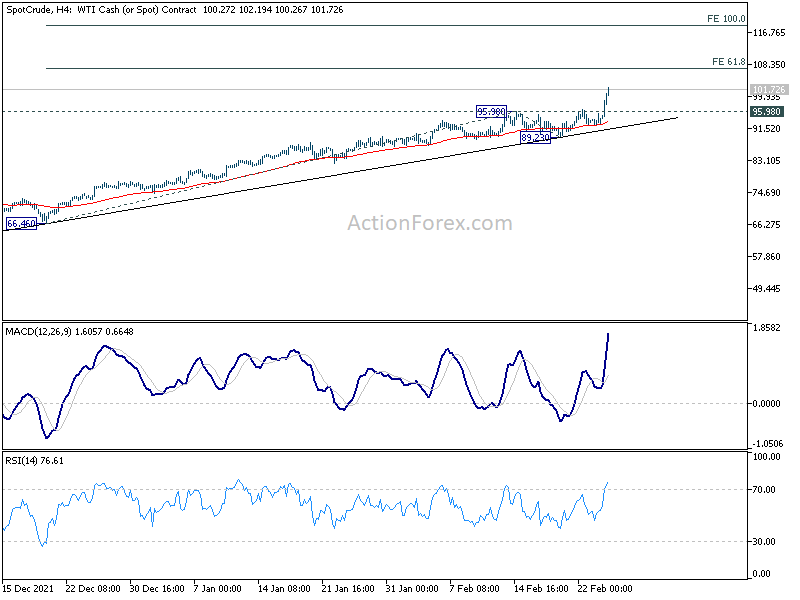
WTI crude oil surges sharply as Russia started invading Ukraine, and it's now above 100 handle. For the near term, outlook will stay bullish as long as 95.98 resistance turned support holds. Next target is 61.8% projection of 66.46 to 95.98 from 89.23 at 107.43.
Note that 4 hour MACD clearly indicates that it's in upside acceleration. Firm break of 107.43 could prompt further acceleration to 100% projection at 118.75.