

Sample Category Title
Sunset market Commentary
Markets
Financial markets were more or less prepared for Russian military presence in the Donbas region earlier this week, but not so much for the current demilitarization on the rest of Ukrainian soil, probably with the aim of quickly installing a pro-Russian regime in Kyiv. The main moves occurred during Asian trading, but persisted during European hours. The jury remains out on the direction during the US session, but early indications suggest temporary relief at best. We start the market wrap-up on stock markets. Since the start of the year, they’ve experienced a bumpy road. First and foremost because of global monetary policy normalization. Second as geopolitics came into play. Apart from energy markets and Russian assets, stock markets so far proved to be most vulnerable to the conflict. Main European benchmarks currently lose 3% to 5%. The EuroStoxx 50 dropped below the 3867 pre-Covid high. A confirmed break in this week’s close suggests a return to 3608 (38% retracement on 2020-2021 rally). US stock markets open around 2% weaker. The S&P 500 extends a sell-on-upticks pattern while also dropping below the neckline of a bearish head-and-shoulders formation (<4140). Turning to commodity markets, Brent crude rallies impressively from $97/b to nearly $106/b, the highest level since August 2014. European gas prices rise nearly 50% intraday. The Dutch TTF Natural gas future trades around €125/Mwh from around €75 at the start of the week. Soft commodities like corn or wheat add around 5%. Both will aggravate the European/global inflation spiral and toughen policy dilemma’s for central banks. Metal prices add 3%-5%. The gold price surges from $1912/ounce to $1965/ounce. The 2020 top stands at $2063. Core bonds remained rather weak overall despite this year’s fragile risk climate. It tells a lot about the strength of the underlying trend. Also today, we think that gains actually could have been bigger. US Treasuries outperform German Bunds. European assets face some additional risk premium today. The US yield curve bull steepens with yields sliding 8.1 bps (30-yr) to 10.9 bps (2-yr). The US 10-yr yield tested this week’s low at 1.84%, but a break lower didn’t occur. German yields lose 3.6 bps (2-yr) to 6.4 (10-yr) in more of a bull flattening move. Bunds outperform swaps. Yield declines on the European swap curve are limited between 2.3 bps and 4 bps with the belly of the curve doing better than the wings. Peripheral yield spreads widen by up to 4 bps vs Germany with Greece (+8 bps) underperforming. The US dollar and Japanese yen keep a fine balance on FX markets after an early attempt of JPY to outperform. USD/JPY currently changes hands around the 115 big figure. EUR/USD dives from the 1.13 area to 1.1150 currently. The YTD-low at 1.1121 remains the line in the sand. EUR/GBP initially followed EUR/USD lower, but eventually the safe haven logic prevailed. EUR/GBP couldn’t force a test of EUR/GBP 0.8282 support and rebounded higher in the direction of 0.8360. EUR/CHF trades below 1.03 for the first time since the Summer of 2015.
Central European markets evidently facing the largest economic and monetary consequences of the conflict between Russia and Ukraine. They will sharply feel the dilemma between negative growth risks and the risk of a further acceleration of inflation that central banks are fiercely fighting since H2 2021. Since the start of the year, it looked that the Czech central bank, but also the Hungarian central bank and the Polish central bank finally could enjoy support from a strengthening currency as their policy tightening gained market credibility. This help from the FX-channel evaporated in no time with the Czech koruna this week losing 3.5% (against the euro), the Polish zloty ceding 3.5% and the Hungarian forint even declining 4.75%. Looking at pricing in short-term interest rate contracts, markets apparently conclude that especially the MNB and the NBP will come under pressure to raise rates even further to avoid the spiral of a weaking currency and rising inflation to reaccelerate. Hungarian and polish money market rates are rising about 35 bps and 20 bps respectively. The rise in Czech rates is much more limited even as markets again take into account a rise of the policy rate to the 4.75% or even 5.0% area. Markets are in the eye of the storm and will look for a new equilibrium in the next days. Even so, especially for the MNB and the NBP which finally gained some market credence in the anti-inflation crusade today’s developments are an ‘unwelcome reset’.
USD/CAD Mid-Day Outlook
Daily Pivots: (S1) 1.2688; (P) 1.2729; (R1) 1.2777; More...
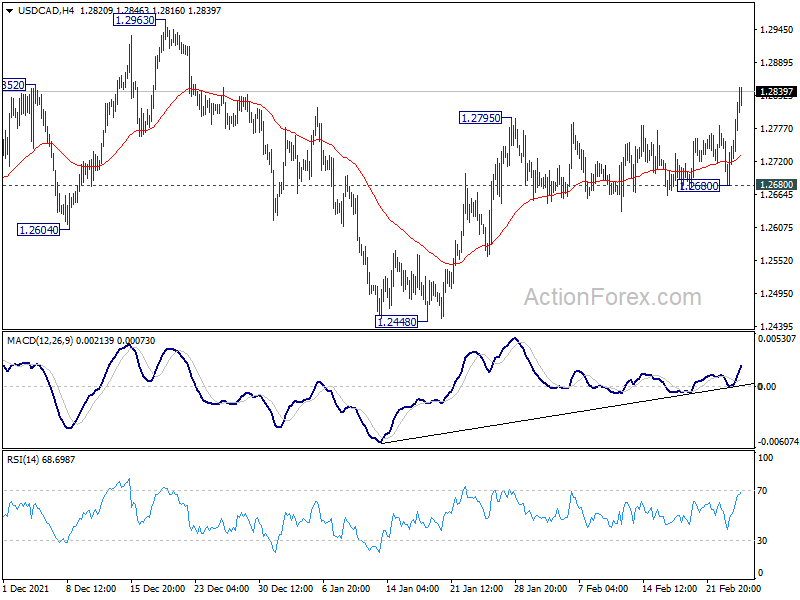
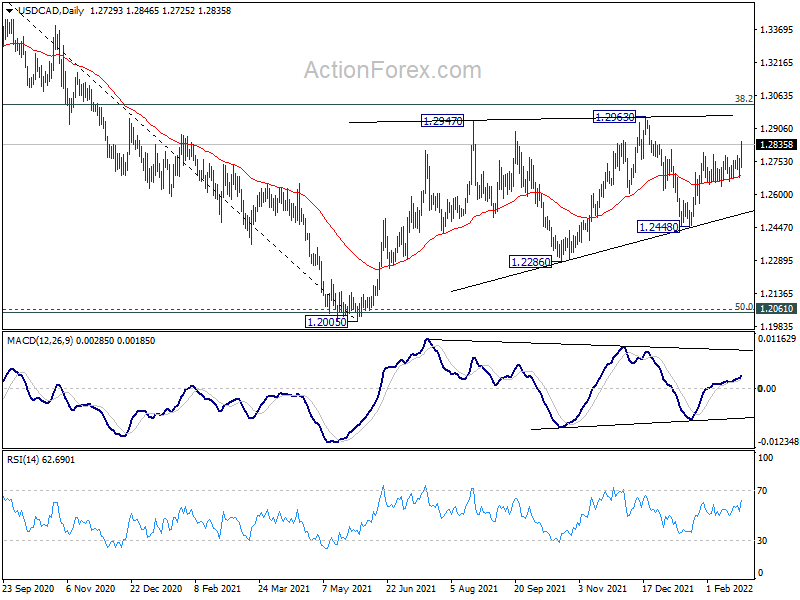
USD/CAD's rise from 1.2448 resumed by breaking 1.2795 resistance. Intraday bias is back on the upside for 1.2963 resistance first. Break there will target 1.3022 long term fibonacci level next. For now, outlook will remain bullish as long as 1.2680 support holds, in case of retreat.
In the bigger picture, focus stays on 38.2% retracement of 1.4667 (2020 high) to 1.2005 (2021 low) at 1.3022. Sustained break there should confirm that the down trend from 1.4667 has completed after defending 1.2061 long term cluster support. Further rise would then be seen towards 61.8% retracement at 1.3650. However, rejection by 1.3022 will maintain medium term bearishness. Break of 1.2005 will resume the down trend from 1.4667 and that carries larger bearish implications too.
USD/JPY Mid-Day Outlook
Daily Pivots: (S1) 114.91; (P) 115.05; (R1) 115.18; More...
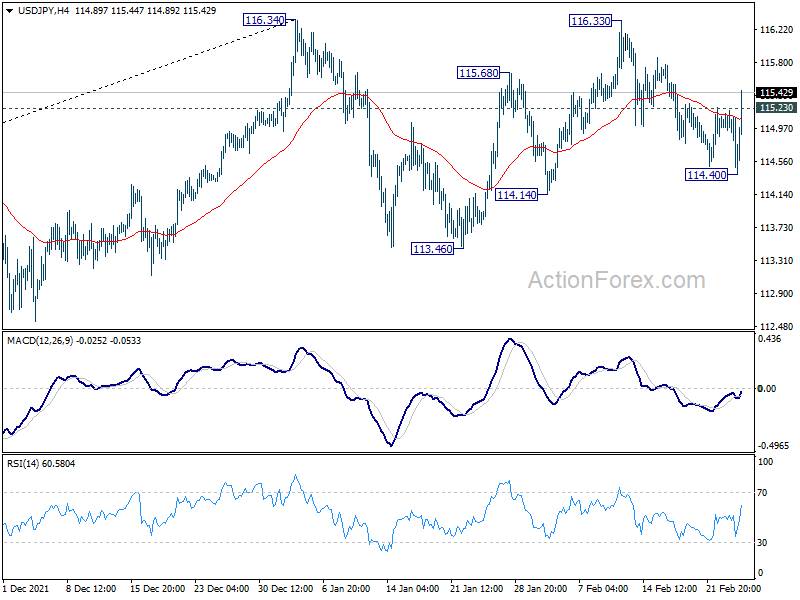
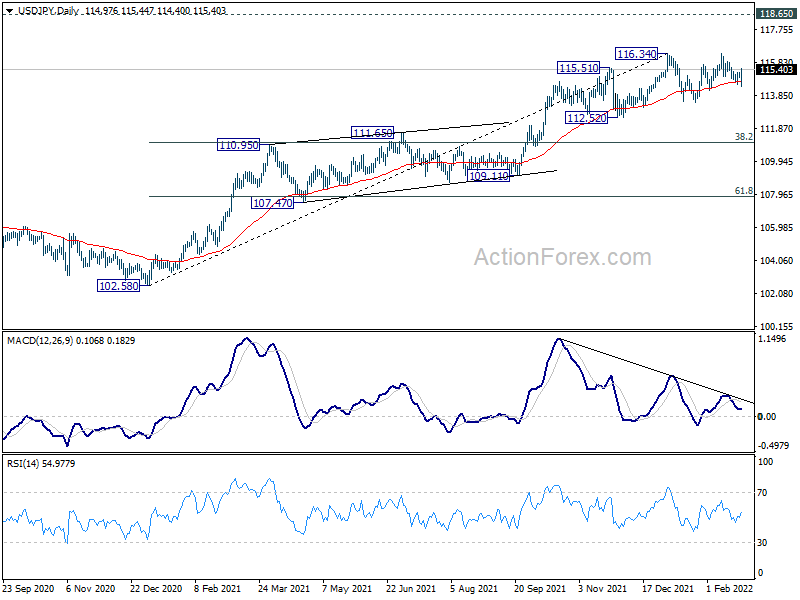
USD/JPY's break of 115.23 minor resistance mixes up the near term outlook. Intraday bias is turned neutral first. On the upside, firm break of 116.34 will resume larger up trend from 102.58 to 118.65 long term resistance next. On the downside, though, break of 114.40 will continue the corrective pattern from 116.34 with another fall to 113.46 support.
In the bigger picture, no change in the view that rise from 102.58 is the third leg of the up trend from 101.18 (2020 low). Such rally should target a test on 118.65 (2016 high). Sustained break there will pave the way to 120.85 (2015 high) and raise the chance of long term up trend resumption. This will remain the favored case as long as 55 week EMA (now at 111.61) holds.
USD/CHF Mid-Day Outlook
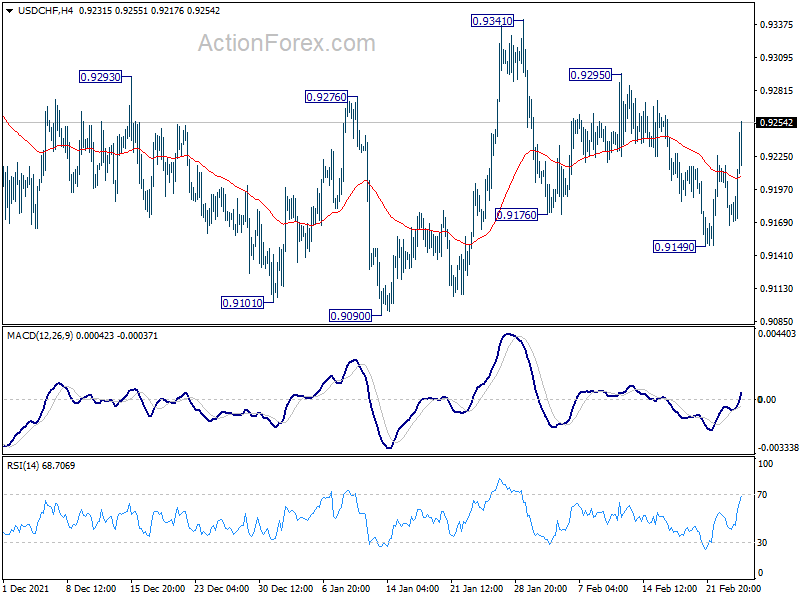
Daily Pivots: (S1) 0.9162; (P) 0.9191; (R1) 0.9212; More....
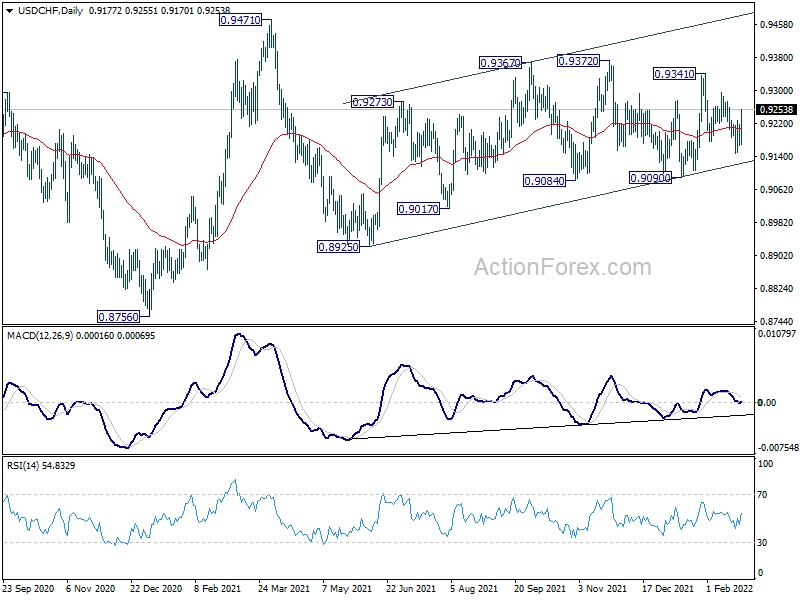
Range trading continues in USD/CHF and intraday bias stays neutral first. Choppy rise from 0.8925 would still be in favor to extend higher as long as 0.9090 support holds. Break of 0.9341 will target 0.9372 resistance and then 0.9471. On the downside, however, break of 0.9090 will bring deeper fall back to 0.8925 support.
In the bigger picture, medium term outlook will be neutral at best as long as 0.9471 resistance holds. Larger down trend could still extend through 0.8756 (2021 low). However, firm break of 0.9471 will argue that the trend has already reversed and rebound the rally from 0.8756 with another impulsive move.
GBP/USD Mid-Day Outlook
Daily Pivots: (S1) 1.3514; (P) 1.3567; (R1) 1.3599; More...
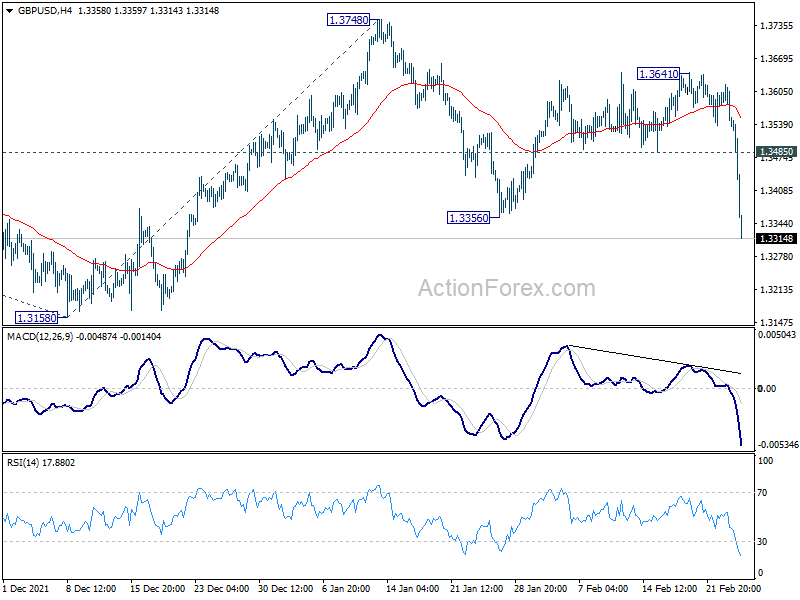
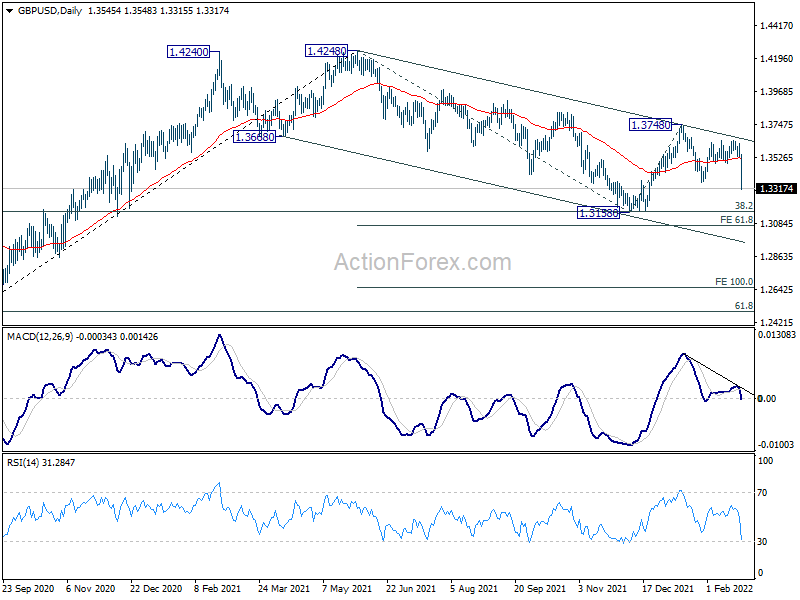
GBP/USD falls to as low as 1.3317 so far and broke 1.3356 support. Intraday bias stays on the downside for retesting 1.3158 low. Current development suggest larger decline from 1.4240 is still in progress. Firm break of 1.3158 will target 61.8% projection of 1.4248 to 1.3158 from 1.3748 at 1.3074 next. For now, risk will stay on the downside as long as 1.3485 support turned resistance holds, in case of recovery.
In the bigger picture, as long as 38.2% retracement of 1.1409 to 1.4248 at 1.3164 holds, up trend from 1.1409 (2020 low) is still in progress. On resumption, next target will be 38.2% retracement of 2.1161 to 1.1409 at 1.5134. Nevertheless sustained break of 1.3164 will argue that whole rise from 1.1409 has completed and bring deeper fall to 61.8% retracement at 1.2493.
EUR/USD Mid-Day Outlook
Daily Pivots: (S1) 1.1283; (P) 1.1321; (R1) 1.1341; More...
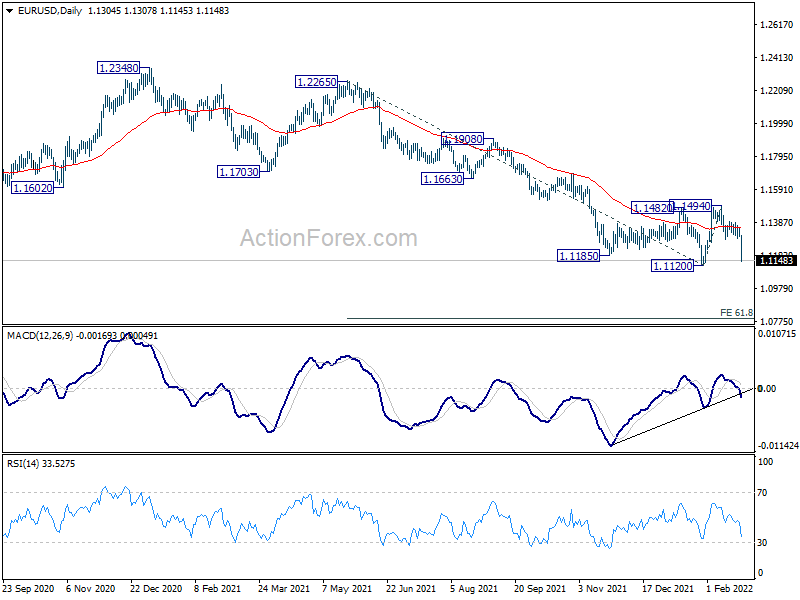
EUR/USD falls to as low as 1.1147 so far today and intraday bias stays on the downside for 1.1120 low. Decisive break there will confirm resumption of larger down trend from 1.2348. Next target is 61.8% projection of 1.2265 to 1.1120 from 1.1494 at 1.0786. For now, risk will stay on the downside as long as 1.1287 support turned resistance holds, in case of recovery.
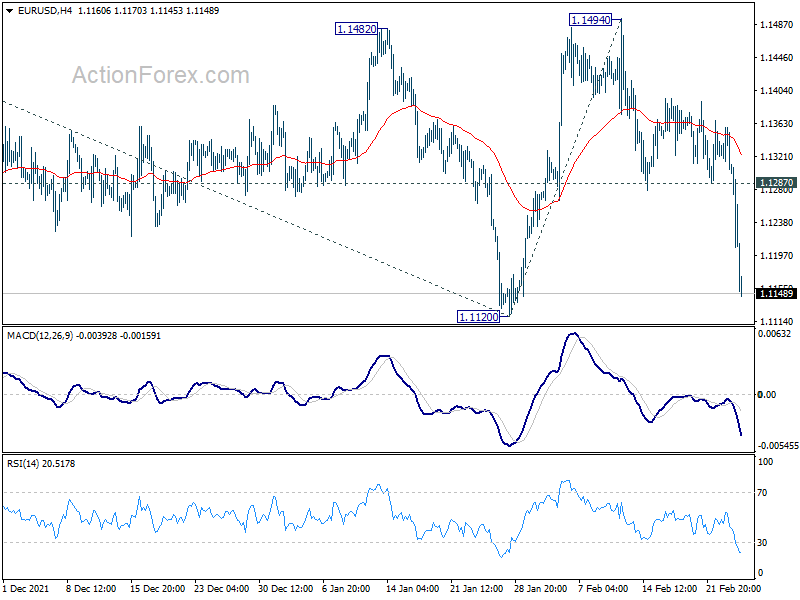
In the bigger picture, the decline from 1.2348 (2021 high) is seen as a leg inside the range pattern from 1.2555 (2018 high). Sustained trading above 55 week EMA (now at 1.1593) will argue that it has completed and stronger rise would be seen back towards top of the range between 1.2348 and 1.2555. However, firm break of 1.0635 (2020 low) will raise the chance of long term down trend resumption and target a retest on 1.0339 (2017 low) next.
Gold and Oil Surge on Russian Invasion, Stocks and Euro Dive
Russia invasion of Ukraine remains the dominant theme in the markets today. Safe haven flow pushes gold to highest level in more than a year, marching towards 2k handle. WTI crude oil also surges pass 100 level, rising as it does in geopolitical tensions. In the currency markets, Yen and Dollar are overwhelmingly the strongest ones, followed by Swiss Franc. Euro and Sterling are the weakest together with Kiwi. Aussie and Loonie are weak too, but not as bad as Euro and the Pound.
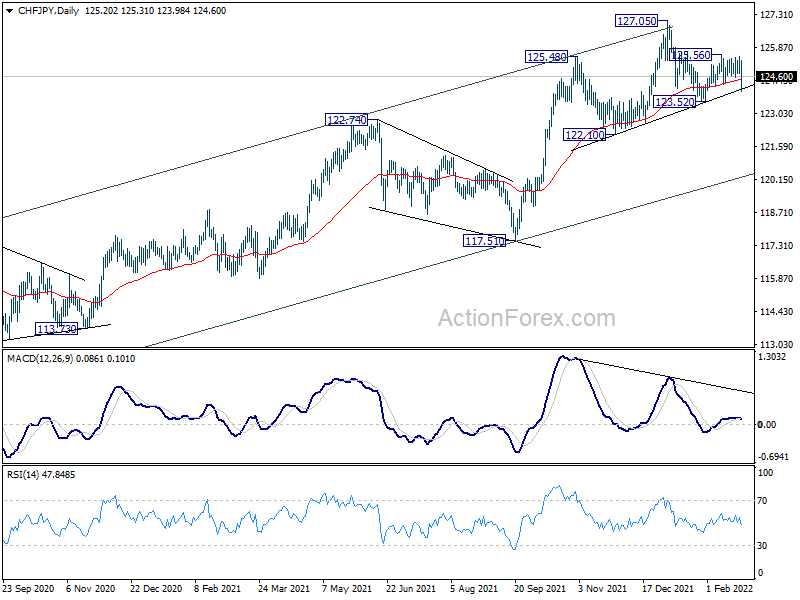
Technically, Yen appears to have a slight upper hand against Swiss Franc in current risk aversion trade, with CHF/JPY dipping notably today. Immediate focus will be on near term trend line (now at 124.01), and 123.52 support. Firm break of this zone will complete a head and shoulder top pattern (ls: 125.48; h: 127.05; rs: 125.56). In this case, CHF/JPY would likely dive further to long term channel support (now at 120.23), before finding a bottom.
In Europe, at the time of writing, FTSE is down -2.84%. DAX is down -4.54%. CAC is down -3.90%. Germany 10-year yield is down -0.0843 at 0.145. Earlier in Asia, Nikkei dropped -1.81%. Hong Kong HSI dropped -3.21%. China Shanghai SSE dropped -1.70%. Singapore Strait Times dropped -3.45%. Japan 10-year JGB yield dropped -0.0110 to 0.187.
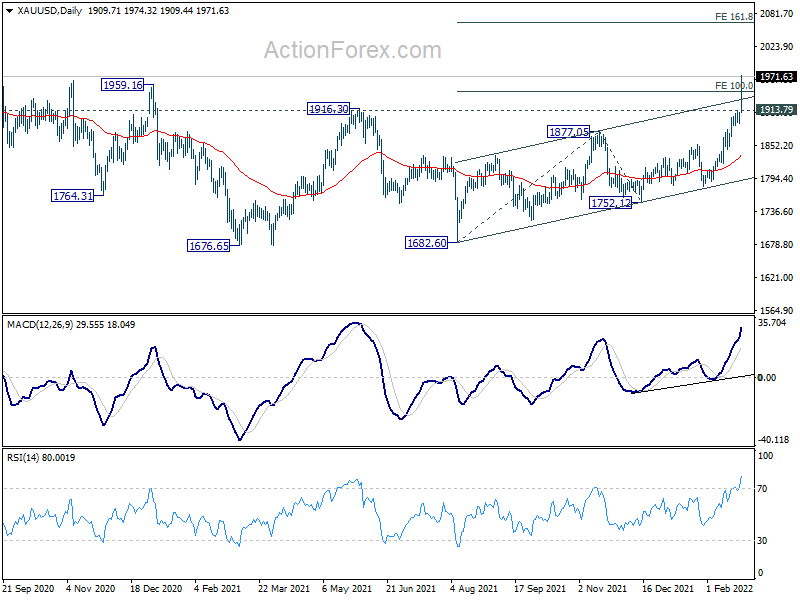
Gold to target 2074 high on upside acceleration
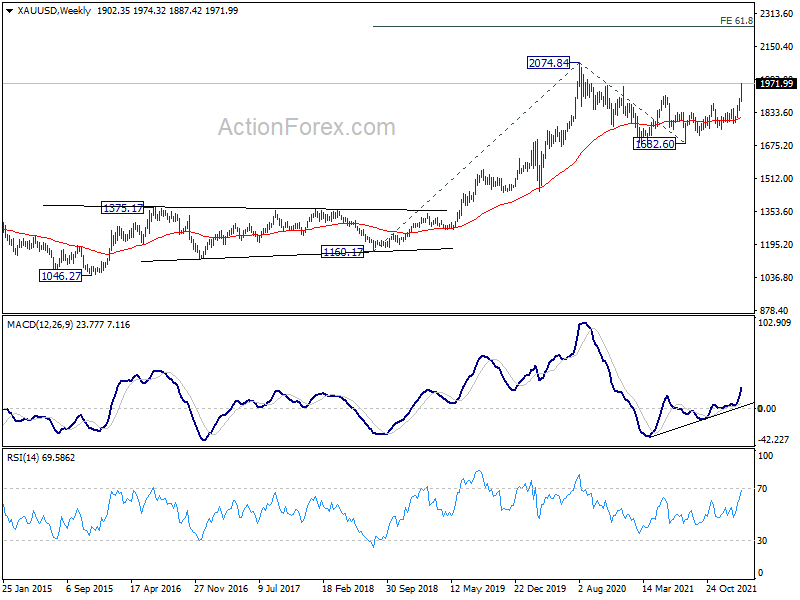
Gold's rally continues further today and powers through, 100% projection of 1682.60 to 1877.05 from 1752.12 at 1946.57. This is a clear sign of upside acceleration. In any case, outlook will stay bullish as long as 1913.79 resistance turned support holds. Next target is 161.8% projection at 2066.74, which is close to 2074.84 high.
Also, the chance of long term up trend resumption is increasing with current rally. On break of 2074.84, next medium term target will be 61.8% projection of 1160.17 to 2074.84 from 1682.60 at 2247.86.
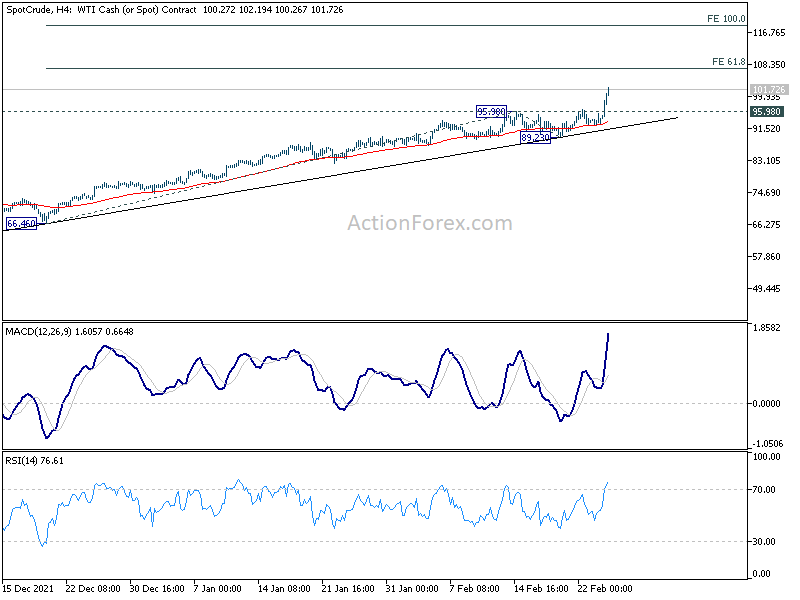
WTI oil breaks 100 with upside acceleration, 107.4 next
WTI crude oil surges sharply as Russia started invading Ukraine, and it's now above 100 handle. For the near term, outlook will stay bullish as long as 95.98 resistance turned support holds. Next target is 61.8% projection of 66.46 to 95.98 from 89.23 at 107.43.
Note that 4 hour MACD clearly indicates that it's in upside acceleration. Firm break of 107.43 could prompt further acceleration to 100% projection at 118.75.
US initial jobless claims dropped to 232k, continuing claims dropped to 1.476m
US initial jobless claims dropped -17k to 232k in the week ending February 19, slightly below expectation of 239k. Four-week moving average of initial claims dropped -7k to 236k.
Continuing claims dropped -112k to 1476k in the week ending February 12, lowest since March 14, 1970. Four-week moving average of continuing claims dropped -49k to 1576k, lowest since June 30, 1973.
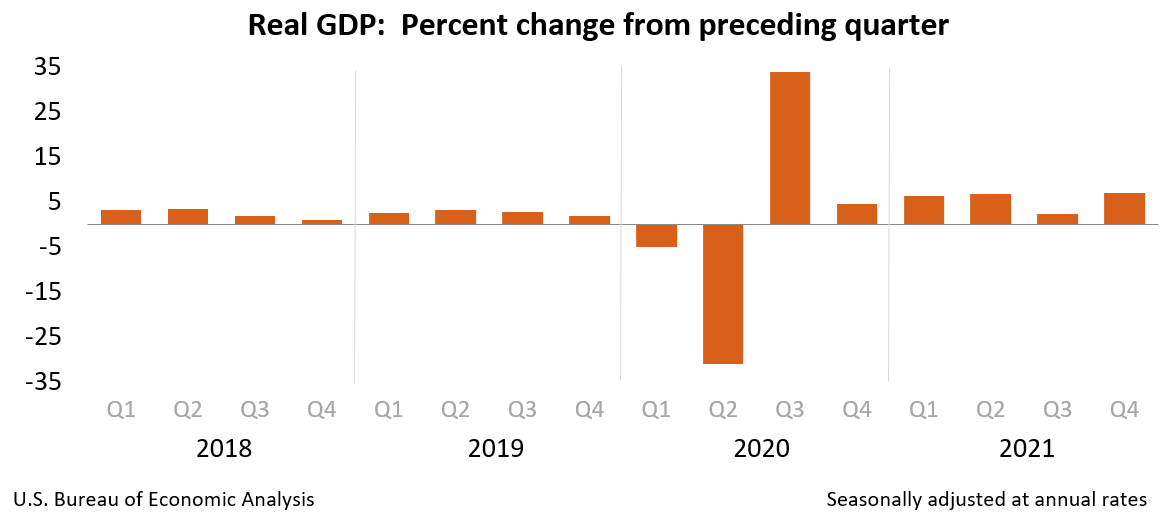
US GDP grew 7% annualized in Q4
According to second estimate, US GDP grew 7.0% annualized in Q4. The increase in real GDP primarily reflected increases in private inventory investment, exports, PCE, and nonresidential fixed investment that were partly offset by decreases in both federal and state and local government spending. Imports, which are a subtraction in the calculation of GDP, increased.
ECB Stournaras: Asset purchases should continue until end of the year
ECB Governing Council member Yannis Stournaras said in a Reuters interview that the asset purchase program should continue until at least the end of the year, to cushion the fallout from the Ukraine crisis.
He said, "judging the situation from today's point of view, I would rather favour a continuation of the APP at least until the end of the year, beyond September, rather than bringing the end closer... I wouldn't be in favour of announcing the end of APP in March."
Stournaras added that the crisis
was bound to depress prices "in the medium to long term" after an initial spike."In my view it is going to have a short-term inflationary effect – that is prices will increase due to higher energy costs," he said. "But in the medium to long term I think that the consequences will be deflationary through adverse trade effects and of course through the rise in energy prices."
BoJ Kuroda: No immediate plans to scale back stimulus
BoJ Governor Haruhiko Kuroda told the parliament, "unlike Western countries, we have no immediate plans to scale back our monetary stimulus." But the central bank will continue to look at inflation expectations. "We will look not just at price indicators, but also surveys showing how the public feels about price moves," he added.
On exchange rate, Kuroda said, "if the yen weakens further, that could push up import costs. But the recent rise in import costs is driven mostly by an increase in dollar-denominated raw material prices, rather than a weak yen."
"It's desirable for currency rates to move stably reflecting economic fundamentals. I think recent (yen) moves are in line with this trend," Kuroda added.
EUR/USD Mid-Day Outlook
Daily Pivots: (S1) 1.1283; (P) 1.1321; (R1) 1.1341; More...
EUR/USD falls to as low as 1.1147 so far today and intraday bias stays on the downside for 1.1120 low. Decisive break there will confirm resumption of larger down trend from 1.2348. Next target is 61.8% projection of 1.2265 to 1.1120 from 1.1494 at 1.0786. For now, risk will stay on the downside as long as 1.1287 support turned resistance holds, in case of recovery.
In the bigger picture, the decline from 1.2348 (2021 high) is seen as a leg inside the range pattern from 1.2555 (2018 high). Sustained trading above 55 week EMA (now at 1.1593) will argue that it has completed and stronger rise would be seen back towards top of the range between 1.2348 and 1.2555. However, firm break of 1.0635 (2020 low) will raise the chance of long term down trend resumption and target a retest on 1.0339 (2017 low) next.
Economic Indicators Update
| GMT | Ccy | Events | Actual | Forecast | Previous | Revised |
|---|---|---|---|---|---|---|
| 00:30 | AUD | Private Capital Expenditure Q4 | 1.10% | 2.90% | -2.20% | -1.10% |
| 13:30 | USD | Initial Jobless Claims (Feb 18) | 232K | 239K | 248K | 249K |
| 13:30 | USD | GDP Annualized Q4 P | 7.00% | 7.10% | 6.90% | |
| 13:30 | USD | GDP Price Index Q4 P | 7.10% | 6.90% | 6.90% | |
| 15:00 | USD | New Home Sales M/M Jan | 803K | 811K | ||
| 15:30 | USD | Natural Gas Storage | -137B | -190B | ||
| 16:00 | USD | Crude Oil Inventories | -1.0M | 1.1M |
US GDP grew 7% annualized in Q4
According to second estimate, US GDP grew 7.0% annualized in Q4. The increase in real GDP primarily reflected increases in private inventory investment, exports, PCE, and nonresidential fixed investment that were partly offset by decreases in both federal and state and local government spending. Imports, which are a subtraction in the calculation of GDP, increased.
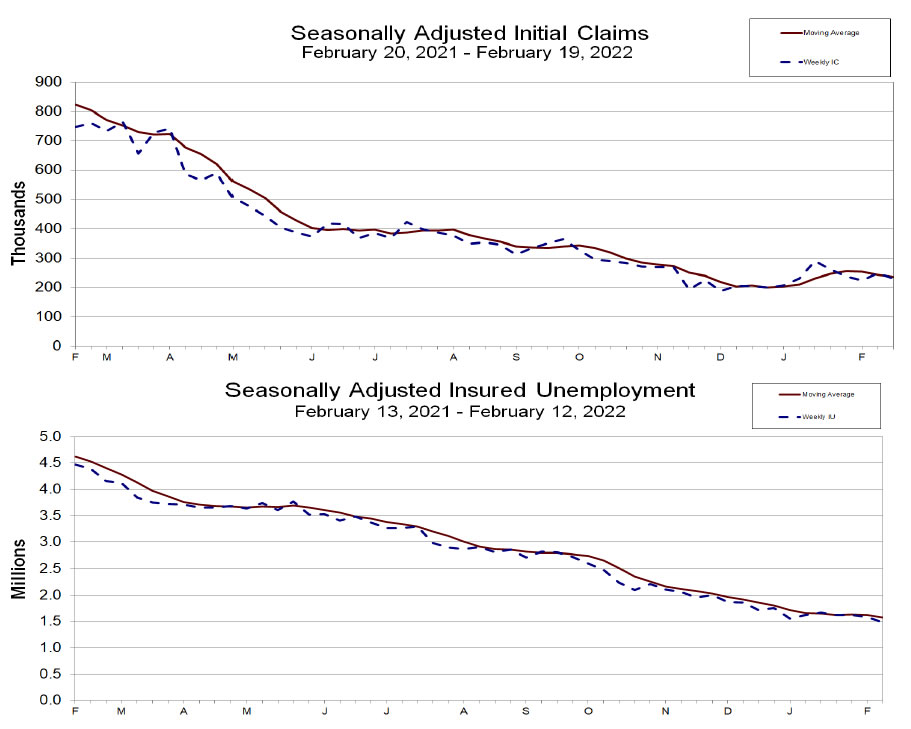
US initial jobless claims dropped to 232k, continuing claims dropped to 1.476m
US initial jobless claims dropped -17k to 232k in the week ending February 19, slightly below expectation of 239k. Four-week moving average of initial claims dropped -7k to 236k.
Continuing claims dropped -112k to 1476k in the week ending February 12, lowest since March 14, 1970. Four-week moving average of continuing claims dropped -49k to 1576k, lowest since June 30, 1973.
ECB Stournaras: Asset purchases should continue until end of the year
ECB Governing Council member Yannis Stournaras said in a Reuters interview that the asset purchase program should continue until at least the end of the year, to cushion the fallout from the Ukraine crisis.
He said, "judging the situation from today's point of view, I would rather favour a continuation of the APP at least until the end of the year, beyond September, rather than bringing the end closer... I wouldn't be in favour of announcing the end of APP in March."
Stournaras added that the crisis was bound to depress prices "in the medium to long term" after an initial spike."In my view it is going to have a short-term inflationary effect – that is prices will increase due to higher energy costs," he said. "But in the medium to long term I think that the consequences will be deflationary through adverse trade effects and of course through the rise in energy prices."