Sample Category Title
RBNZ Orr: Raising rates sooner prevents the need for even higher rates
RBNZ Governor Adrian Orr said in a speech, "amongst many of our central bank peers, we were one of the first to begin removing monetary stimulus and start the tightening cycle".
"Financial market pricing for future interest rate levels have been very responsive to our signalling," he added. "Market pricing of future central bank policy rates continue to indicate that New Zealand is expected to tighten policy sooner than many other comparable economies."
"By getting on top of inflation pressures quickly, by raising interest rates sooner, we aim to prevent the need for even higher rates in the future," he said. "In other words, we are taking our foot off the accelerator now to minimise having to use the brakes harder in future."
Fed Waller prefers increasing rate by 100bps by middle of this year
Fed Governor Christopher Waller said in a speech that his preference is to "increase the target range 100 basis points by the middle of this year... appropriate interest rate policy brings the target range up to 1 to 1.25 percent early in the summer." That would be "a bit below" pre-pandemic level when inflation was "considerably lower" and Fed's balance sheet less than halved.
Nevertheless, he added, "of course, it is possible that the state of the world will be different in the wake of the Ukraine attack, and that may mean that a more modest tightening is appropriate."
"I will continue to monitor the geopolitical situation to assess the appropriate timing of this near-term monetary policy tightening," Waller said. "These actions will get us into the second half of the year, when we will have six months of inflation data, and we can assess what the appropriate path will be for the rest of 2022."
Ukraine Tragedy Unlikely to Affect RBA Policy
The tragic developments in the Ukraine have not triggered any significant changes in our views on Australian financial markets.
While the shock of aggressive military action in Europe has rattled equity and commodity markets, the keys to assessing any lasting effects are the direct impact that Ukraine and Russia have on global economic activity and Russia's special role in energy markets.
Apart from energy, Russia has limited global significance – its economic not much larger than Australia's; with a limited role in global supply chains; and, as one US bank points out, representing around 0.1% of all sales across US S&P500 companies.
US President Biden clearly pointed out that sanctions on Russian financial activities would not include energy payments – his argument is that given Russia's significance in energy markets, banning energy exports would place a huge burden on global consumers.
While the US is energy independent, Russia controls around 8% of global oil production, including 25% of the European market and 35% of European gas.
Eliminating such supply in energy markets that are already stretched with perilously low inventory levels would surely put enormous upward pressure on crude prices.
While there is certain to be significant short term volatility, comfort that the crisis is unlikely to severely affect global supplies of energy and therefore add further upward pressure on inflation is likely to see equity markets settle back – as has been the case with previous geopolitical disruptions that do not have lasting effects of global inflation or economic activity.
With this background, our assessment of Thursday's release of the Wage Price Index (WPI) is that while the Index printed in line with our expectations there was evidence of some intensifying wage pressures, ableit insufficient at this stage to justify the RBA raising rates before our schedule of the August meeting.
The headline increase for the quarter was 0.7%, following 0.6% and 0.4% in the previous two quarters.
We expect the March quarter Index to print 0.8% lifting the six month annualised pace to 3% – enough to justify the first rate hike given an expected lift in the other measures of wage pressures that the RBA will also be considering. These include turnover in the labour market; pressure on bonuses and overtime; average wages in the national accounts; job vacancies and job ads; surveys of businesses and the higher frequency components of the WPI covering individual agreements.
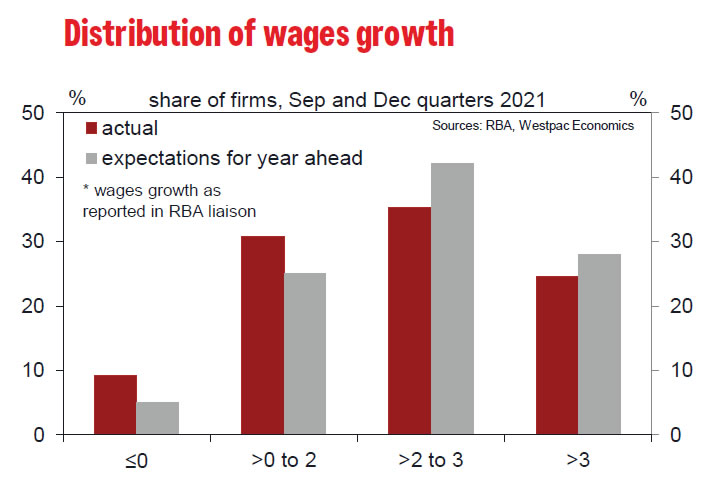
Already the RBA's own liaison work points to the clear movement towards stronger wage pressures, (see figure from RBA's February Statement on Monetary Policy) where there is a clear increase in the number of businesses expecting faster increases in wages.
The components of the latest WPI are difficult to assess given the high seasonality of individual agreements and that these figures are not seasonally adjusted. However, the sectors receiving the highest increases the quarter – hospitality; retail; manufacturing; construction; real estate; and professional services – point to the out-performance of sectors that are more heavily influence by individual agreements.
We do not think it will be necessary for the RBA to wait to see a 3% print for annual growth in the WPI before it can act given that it has already highlighted that the Index only measures base rates.
That 3% print is likely to arrive on August 24 when the June quarter WPI is released. The June quarter 2021 printed a COVIDaffected 0.4%. Once that drops out of the annual numbers the Index will lift significantly.
If, as we expect, the next two WPI prints are 0.8% then the annual growth rate will lift to around 3% in June from 2.5% in March.
But we believe that given the likely prints on headline and underlying inflation for the March and June quarters, which will be printing on on April 27 and July 27, the RBA will have enough information to move in August.
The Governor indicated recently to the Economics Committee of the House of Representatives that he would like to see two more inflation prints – not two more WPI prints.
Remember that central banks favour adopting some form of tightening bias before they actually start the tightening process. By the June Board meeting the March quarter CPI will be known as well as the March quarter WPI.
The March quarter CPI is going to see a very substantial lift in both headline and underlying inflation. Annual headline inflation is forecast to lift from 3.5% to 4.2% and underlying inflation to lift from 2.6% to 3.1%.
That is based on the crude oil price holding in the 'high 90s' implying no significant relief but as discussed above no surge above the US$100/bbl level that would result from disruptions to Russian oil supplies.
In fact we see more upside risk from housing in the March release although we do not expect a significant impact on the underlying measure.
That type of inflation lift combined with the ongoing evidence of a tightening labour market, including the 3% 'momentum' in the WPI will be sufficient for the RBA to begin the process of preparing the market for a rate hike at the June and July meetings.
At the August meeting the Board will have received further evidence of these rising inflationary pressures with the June inflation report where we expect underlying inflation to lift to 3.5% – the final piece to the puzzle to justify the Board delivering on its bias at the August meeting.
Because we are expecting some moderate easing in the oil price by the June quarter, we only expect headline inflation to have lifted to 4.3% from 4.2%.
And, as discussed, these views on the oil price are based on Russia being allowed to maintain its flow of oil.
USD/JPY Eyes Upside Break As Russia-Ukraine Tension Escalates
Key Highlights
- Russia-Ukraine crisis sparked sharp moves in the market.
- Gold and oil prices rallied and broke many important hurdles.
- EUR/USD declined heavily below 1.1280, and GBP/USD tumbled below 1.3450.
- The US GDP increased 7% in Q4 2021 (Preliminary), up from 6.9%.
USD/JPY Technical Analysis
The US Dollar failed to surpass 116.40 against the Japanese Yen. USD/JPY corrected lower, but it remained stable above the 114.40 support.
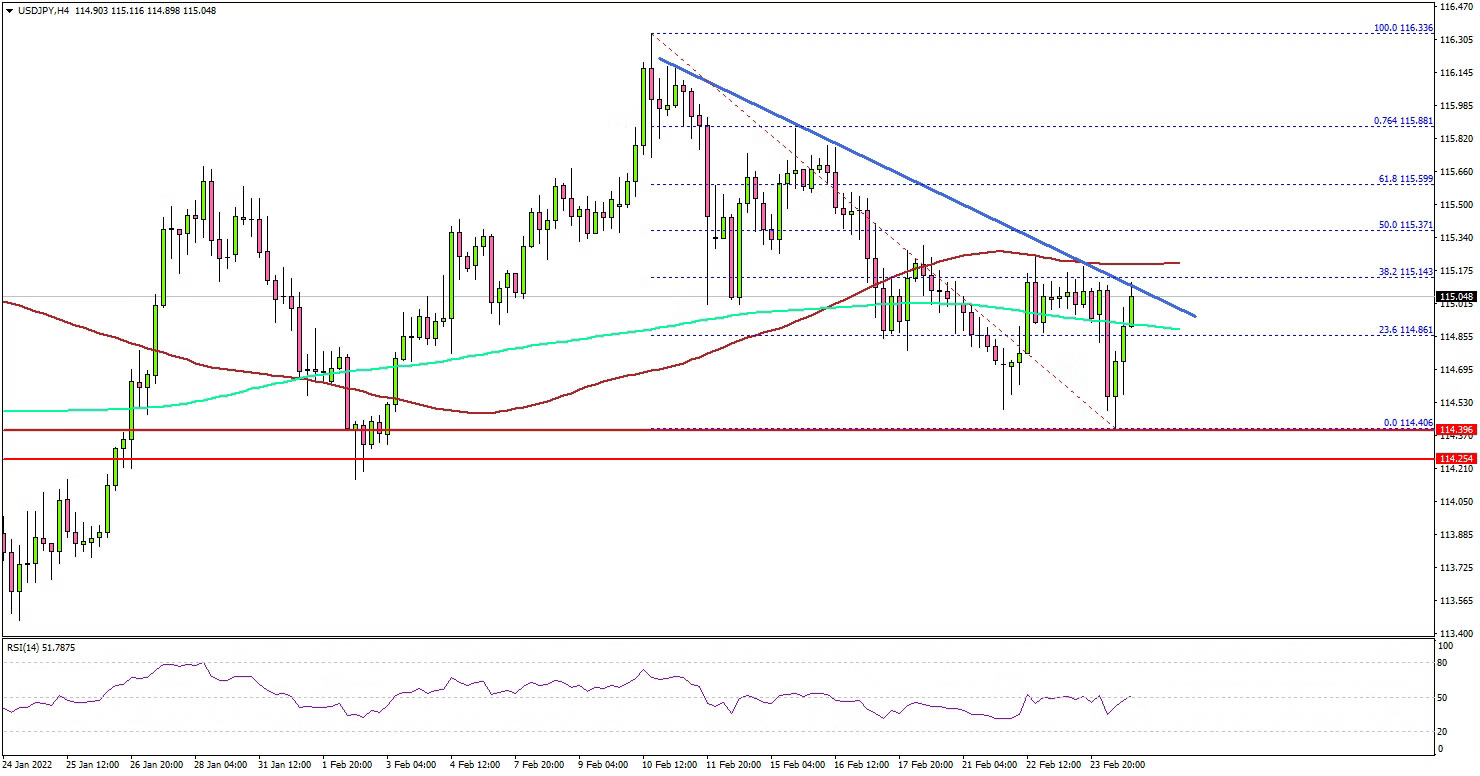
Looking at the 4-hours chart, the pair traded as low as 114.40 and recently corrected higher. There was a move above the 23.6% Fib retracement level of the downward move from the 116.33 swing high to 114.40 low.
It is now attempting an upside break above the 115.20 resistance and the 100 simple moving average (red, 4-hours). There is also a major bearish trend line forming with resistance near 115.20 on the same chart.
The next major resistance is near the 115.50 level. Any more gains might send the pair towards the 116.20 level. If there is no upside break, the pair could decline below the 114.65 level. The next key support is near 114.40.
If there is a downside break, the pair could decline towards the 114.25 level. Any more losses might send the pair towards the 113.50 level.
Fundamentally, the US Gross Domestic Product for Q4 2021 (Prelim) was released yesterday by the US Bureau of Economic Analysis. The market was looking for a 7% growth.
The actual result was similar to the market forecast, as the US Gross Domestic Product grew 7% in Q4 2021. Besides, the GDP Price Index climbed 7.3%, up from the last 7%.
Looking at EUR/USD, the pair declined heavily after Russia’s attack on Ukraine. Similarly, GBP/USD declined over 200 pips.
Economic Releases
- German GDP for Q4 2021 (YoY) (Preliminary) – Forecast 1.4%, versus 1.4% previous.
- German GDP for Q4 2021 (QoQ) (Preliminary) – Forecast -0.7%, versus -0.7% previous.
- Euro Zone Consumer Confidence for Feb 2022 – Forecast -8.8, versus -8.8 previous.
- US Durable Goods Orders for Jan 2022 – Forecast +0.8% versus -0.7% previous.
Eco Data 2/25/22
[php_everywhere instance="1"]
Fed Bostic: Events today in the Ukraine are on all of our minds
Atlanta Fed bank President Raphael Bostic said, "events today in the Ukraine are on all of our minds. We'll be watching this closely here in Atlanta and across the Federal Reserve system to assess the economic and financial impacts,"
He still thinks may need to hikes four or more times this year if high inflation persists. However, "I am really open to adjusting this as we get more clarity on how the economy is evolving...the data may come in perhaps more pessimistic in terms of how well we are doing on inflation and if it does I'm going to move my view, maybe 4 (hikes), and depending on how things go it may be more than that."
Euro in a Free Fall on Strong Risk Aversion; Key Levels Under Pressure
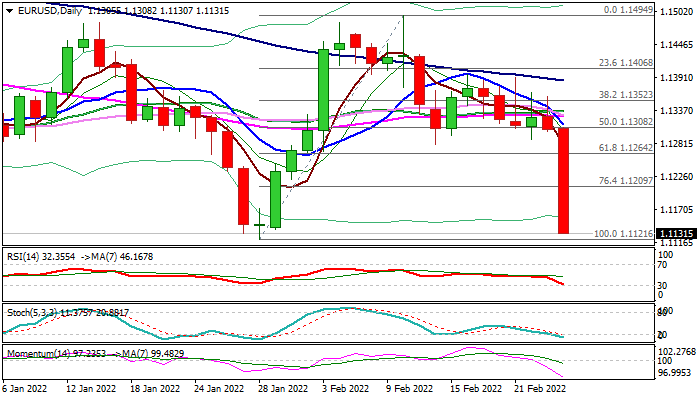
The Euro fell sharply on Thursday, losing 1.5% and hitting the lowest in more than three weeks against the dollar, as global uncertainty over Russian invasion on Ukraine dampened risk sentiment and prompted investors into safer assets.
Strong acceleration lower is on track to fully retrace 1.1121/1.1494 upleg that would signal A continuation of larger fall from 1.2349 (Jan 2021 peak).
Strong bearish signal was generated on break of pivotal Fibo support at 1.1186 (61.8% of 1.0340, 2017 low/1.2555, 2018 high) which looks for a confirmation on close below this level.
Bears eye next targets at 1.1040/1.1000 (Fibo 76.4% of 1.0635/1.2349 / psychological) violation of which would risk fresh bearish acceleration and open way towards 1.0635 (2020 low).
Bears may take a breather on strongly oversold daily studies but upticks are likely to be limited and to offer better levels to re-enter firmly bearish market.
Res: 1.1186; 1.1209; 1.1280; 1.1308
Sup: 1.1121; 1.1040; 1.1000; 1.0979
ECB Schnabel: Shock of war has clouded the global outlook
ECB Executive Board member Isabel Schnabel said in a speech, "how today's attack on Ukraine changes the euro area outlook is highly uncertain at this stage. We are monitoring the situation closely and will carefully evaluate the consequences for our policies."
But "predating the war", however, inflationary pressures will likely prove stronger and more persistent over both the near and the medium term". "policy optionality" is there fore needed.
The "calibration and the time of adjustment of our policy instruments are data-dependent", but the "sequence... is not". The forward guidance has provided the conditions for policy rates to be raised. Net purchases under the APP will stop "shortly before" rate hikes. Reinvestment will continue for an "extended period of time" past rate hikes.
Balance sheet adjustments may not be well-suited as the main instrument for controlling the overall stance. Hence "policy lift-off will predate with some distance a reduction of our balance sheet."
Overall, she concluded, the "shock of war hanging over Europe has clouded the global outlook". The "uncertainty speaks in favour of a gradual and data-dependent normalisation that respects the sequence that we have communicated, with a view to reducing uncertainty about our actions and intentions."
Research Russia: The SWIFT Sanction Option
- Due to the situation in Ukraine there are speculations about a possible blocking of Russia on the SWIFT network.
- This note explains briefly what SWIFT is and what blocking of Russia would mean.
In the wake of the Russian invasion of the Ukraine, western governments are contemplating a response toward Russia. Among the options being considered is excluding Russia from the SWIFT system and imposing sanctions on big Russian banks. We see a high likelihood that such actions will be adopted as they will be one of the most effective ways to hit the Russian economy.
SWIFT (Society for Worldwide Interbank Financial Telecommunication) is an industry owned organisation based in Belgium that offers software and a secure resilient network for exchanging financial messages.
SWIFT was founded in 1973 and today more than 11.000 financial institutions in over 200 countries are reachable on the SWIFT network. Also large corporate customers, central banks and financial market infrastructures such as clearing houses, central counter parties securities exchanges etc. are connected to the SWIFT network.
The SWIFT network supports a wide range of financial messages such as customer payments, financial institution transfers, treasury markets, collection and cash letters, securities markets, trade-finance and cash management. In short, all types of financial transaction messages.
SWIFT as a company does not have the authority to make sanction decisions. These decisions rest solely with government bodies and applicable legislators.
Today there are already sanctions on two Russian banks and a number of individuals, these sanctions are not specific to SWIFT but SWIFT messages to/from these banks or banks where the sanctioned individuals are customers are stopped by the relevant banks.
In case the relevant authorities impose additional sanctions on Russia (i.e. blocking Russia from SWIFT) it would mean that all messages transported by the SWIFT network sent/received directly from a Russian entity would be blocked. This means that customers will not be able to receive funds or send funds to Russian banks and companies.
This morning we published Research Russia – Russia launches a full attack on Ukraine, 24 February, in which we go into more details on markets movements and what to follow from here.
Japanese Yen Rises as Russia Launches Invasion
Hopes that diplomatic moves could avert a Russian invasion of Ukraine were shattered early Thursday, as Russia launched a full-scale attack. The move was not all that surprising, given the massive Russian buildup on the border with Ukraine during the past few weeks. Still, the fighting in the heart of Europe has weighed heavily on the financial markets, as risk appetite has fallen sharply. The safe-haven Japanese yen has gained ground and is trading at 3-week highs.
Western leaders have strongly condemned the Russian military operation, with NATO’s secretary-general calling it ‘a brutal act of war’. There will clearly be more sanctions headed Moscow’s way, but it’s doubtful that this will dissuade Russian President Putin from his aim to force Ukraine back into the Russian orbit. Western Europe is dependent on Russian natural gas and with the US showing no appetite for military intervention, things are looking extremely bleak for pro-Western Ukrainian President Zelensky.
Japan’s CPI expected to rise
On the economic calendar, Japan releases Tokyo Core CPI for February later today. CPI is expected to rise to 0.4%, up from 0.2% in January. Earlier in the week, BoJ Core CPI, the central bank’s preferred inflation gauge, rose 0.8%, lower than the 0.9% gain beforehand. Japan’s inflation has been moving higher, although nowhere near the clip we’ve seen in the US and the UK. Still, with the Russian invasion in Ukraine likely to push energy prices even higher, inflation in Japan should continue on an upswing.
Brent crude pushed above USD 100 for the first time since 2014, as the Ukraine conflict threatens to disrupt oil deliveries from Russia, a major producer. The timing couldn’t be worse for the central banks of the major economies, which are struggling to contain red-hot inflation. The Fed is still expected to hike rates in March, but it may have to put a pause on additional hikes if economic conditions deteriorate.
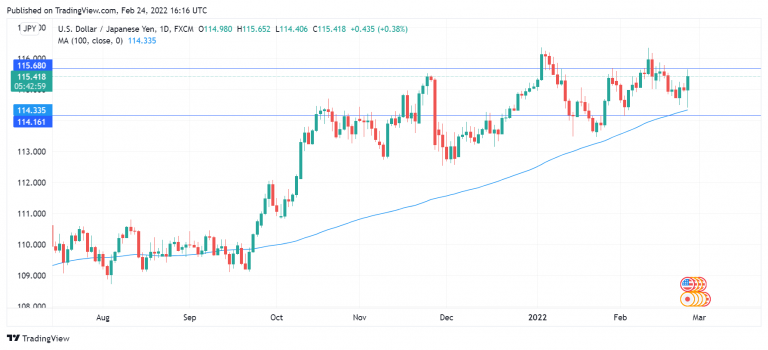
USD/JPY Technical
- The 100-DMA at 114.35 is a major support level. Close by, there is support at 114.16
- 115.68 is under pressure as resistance. Above, there is resistance at 116.30