

Sample Category Title
Weekly Focus – Fed to Step Hard on the Brakes?
Inflation and central banks continue to set the tone in global financial markets. US inflation for January rose by more than consensus reaching 7.5%, which is the highest level in 40 years. The core inflation measure also surprised on the upside, reaching 6% y/y. After the inflation print, Fed governor James Bullard argued that the Fed should increase the Fed funds target range by 100bp no later than July and that it may be necessary to hold an emergency meeting to get started before. However, some of the more centrists Fed members cautioned at moving too fast through an emergency hike or a 50bp rate hike as the first move. Markets are now pricing in 6.5 rate hikes by year-end and even a 5-6bp rate hike here in February, i.e. a non-negligible probability of an emergency rate hike. In addition, the markets are very close to fully price in a 50bp rate hike by March. We expect the Fed funds target range is raised by at least 50bp in March with the possibility of an emergency meeting move in the form of a rate hike or early end to QE. We are currently reviewing our Fed call of five rate hikes (125bp) this year.
The ECB seems more split on its tightening policy. President Christine Lagarde said that she favours a gradual approach. In an interview with Redaktionsnetzwerk Deutschland, she warned ECB could harm the economy's rebound from the pandemic if it were to rush to tighten monetary policy. Raising interest rates "would not solve any of the current problems," she stated "On the contrary: if we acted too hastily now, the recovery of our economies could be considerably weaker and jobs would be jeopardized." This was echoed by Banque De France governor, Francois Villeroy. In contrast, the more hawkish members of the governing council like Dutch central bank governor Klaas Knot said this week that he sees the first rate hike in 2022
In contrast, Riksbank seems even more relaxed about inflation pressures and the need to tighten policies and China central bank is easing policies. At its policy meeting this week, Riksbank (as expected) revised the inflation forecast higher, but stressed that there were not yet any second round effects into core inflation. As for the repo rate path there were only minor changes made in comparison to the November meeting, lifting it slightly signalling a first full hike in H2 2024. Chinese credit growth gained speed in January following easing of monetary policy in recent months.
Next week, central bank speakers both from the US and Europe will be in focus. Furthermore, In the US, we are looking forward to retail sales on Wednesday, especially in the light of the still skewed consumption pattern and high inflation. Besides that we receive FOMC minutes, where we will look for details about quantitative tightening and the 25bp or 50bp hike question.
This week the bond market sell-off continued. The US 2 year treasury yield increased by 30 bps while the 10 year US yield breached 2%. We now expect that 10Y US Treasury yields will rise to 2.45% (from 2.25%) in the course of the next 12 months. We also raised our 12M target for 10Y German Bunds to 0.60%, see our Yield Outlook: Upcoming ECB and Fed rate hikes pushing long yields higher, 10 February. Equity markets remained relatively resilient during the week.
Sunset Market Commentary
Markets
European stocks gapped lower today. They had some catching up to do with Wall Street, where Fed governor Bullard pounded equities with his aggressive policy comments in European after-market hours. Losses in the EuroStoxx50 at some point mounted to 1.5% but were trimmed to 0.7% currently. US stock futures momentum improved throughout the European session, resulting into minor gains at the cash open. The S&P 500 is still only 6% away from its all-time high in early January. The equity resilience is striking given the increasingly hawkish Fed and recent surge by core bond yields, although that last part reversed a bit today. US yields shed 1.9-3.8 bps in the 2y and 5y after skyrocketing 21 bps and 13 bps respectively after yesterday’s 7.5% inflation shocker. Bets for a 50 bps rate hike in March have eased slightly as well but that’s more of a kneejerk counterreaction rather than the scenario actually being priced out. Yields at the long end are 1.6-2.1 bps down in the 30y and 10y respectively. The latter holds the psychologically important 2% though. The German curve flattens with yields changing -0.2 bps (2y) to -2.5 bps (30y). European swap yields fall 2-5 bps. While core bonds gain today, the genie is really out of the bottle in Europe’s peripheral markets. Italian, Spanish and Portuguese spreads over Germany’s 10y yield advance another 4 bps, bringing the total since the ECB’s pivot within a 18-24 bps range. Greece is worse off, seeing spreads rise 8 bps today and bringing the sum to almost 50 bps.
FX markets are trading in the background. The Swedish krone outperforms G10 peers but received a heavy blow yesterday after the Riksbank shattered all hopes on interest rate support any time soon. The yen takes second place, benefiting from declining core bond yields and the (though improving) negative climate. The euro trades on the backfoot against a mixed dollar. EUR/USD is fighting to retain the 1.138 support. The early break lower at the height of risk-off in any case proved false for now. USD/JPY failed to push through 116 resistance and DXY is unable to strengthen beyond 96. UK Q4 GDP growth was strong though largely in line with expectations. EUR/GBP was meandering in the low 0.84 area and initially didn’t do much with the figures. But sterling had to push just once to move the pair sub 0.84 and it did. 0.838 acts as support (Nov 2021 low).
News Headlines
The Hungarian central statistical office published January inflation numbers today. Inflation unexpectedly surged by 1.4% M/M to 7.9% Y/Y, the highest level since August 2007. Core inflation rose to 7.4% Y/Y, the highest in 20 years. Both are significantly above the central bank’s 3% (+-1ppt) inflation target. Details showed food prices rising by 10.1% Y/Y, consumer durables up 7.9% Y/Y and service prices 5.2% Y/Y higher. Hungarian price pressure remains despite caps imposed on staple food items last month and on fuel & energy earlier on. Other popular pre-election spending measures probably more than countered the impact on inflation. The Hungarian swap curve inverts further today with yields adding up to 22 bps at the front end in anticipation of a more aggressive Hungarian central bank stance. The MNB meets next on Feb 22. Its base rate currently stands at 2.9% and is playing catch-up with the one week deposit rate (4.3%). The forint trades slightly stronger at EUR/HUF 353.50.
The central bank of Russia raised its policy rate as expected from 8.5% to 9.5%, the highest level since Q1 2017. The Russian real policy rate now turned slightly positive again. CBR-governor Nabiullina suggested that more rate hikes are coming and didn’t exclude a move by the same magnitude. The new range for the average key rate this year is 9%-11%, coming from 7.3%-8.3% previously. Nabiullina says that the only way to bring inflation down is by a (central bank triggered?!) recession. Upgraded inflation forecasts show end-2022 inflation at 5%-6% with inflation expected to return to the 4% inflation target by mid-2023. The worsening labor shortage gets top billing as a source of inflation pressure, right after supply constraints. The Russian ruble cedes ground today with USD/RUB rising from 75 to 75.50.
EUR/USD Outlook: Different Fed-ECB Policy Outlook May Weigh on Euro
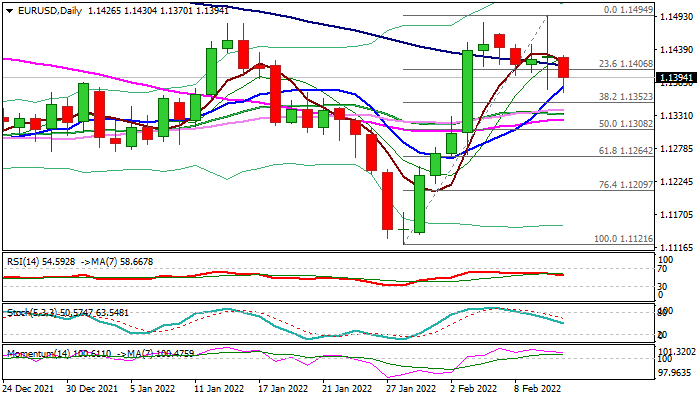
The Euro stands at the back foot on Friday following a bumpy ride after US inflation data on Thursday, but the action ended in a long-legged Doji candle, signaling strong indecision.
Although Friday’s action is in red, the downside remains limited by rising 10DMA (today’s attempts lower stalled near yesterday’s low).
Stronger than expected rise in US inflation fueled expectations for more aggressive action from Fed (the central bank announced it will start hiking from the next month) with analysts being divided over the size of the rate increase, as many now expect 0.5% hike, while some does not expect the Fed to diverge from expected first post-pandemic hike by 25 basis points.
While Fed remains hawkish, the European central bank is more cautious and not in hurry to start raising interest rates.
The ECB President Lagarde said today that rate hike would not bring down the record high EU inflation and would not affect high oil prices and supply problems that have boosted inflation, but would hurt the economy.
Lagarde said that fast reaction from the central bank won’t solve the problem, but would slow the recovery of the bloc’s economies, suggesting that the ECB should gradually withdraw a massive stimulus and adjust monetary policy instruments when conditions allowed.
Different outlooks from two central banks, in which the Fed is aggressive while ECB remains dovish, would weigh on the single currency in the short-term.
Technical studies on the daily chart are weakening, after the action on Thursday failed to clearly break above daily cloud top, as bullish momentum is fading and RSI turned south.
Fresh weakness probes again through 100DMA (1.1413) with eventual close below the indicator to generate initial bearish signal, which would look for confirmation on extension through 1.1352 (Fibo 38.2% of 1.1121/1.1494 rally).
On the other side, repeated failure to close below 100DMA would keep near-term price action in extended consolidation.
Res: 1.1439; 1.1494; 1.1558; 1.1600.
Sup: 1.1370; 1.1352; 1.1333; 1.1316.
AUDJPY Keeps Bullish Mood Intact with Bounce off 200-MA
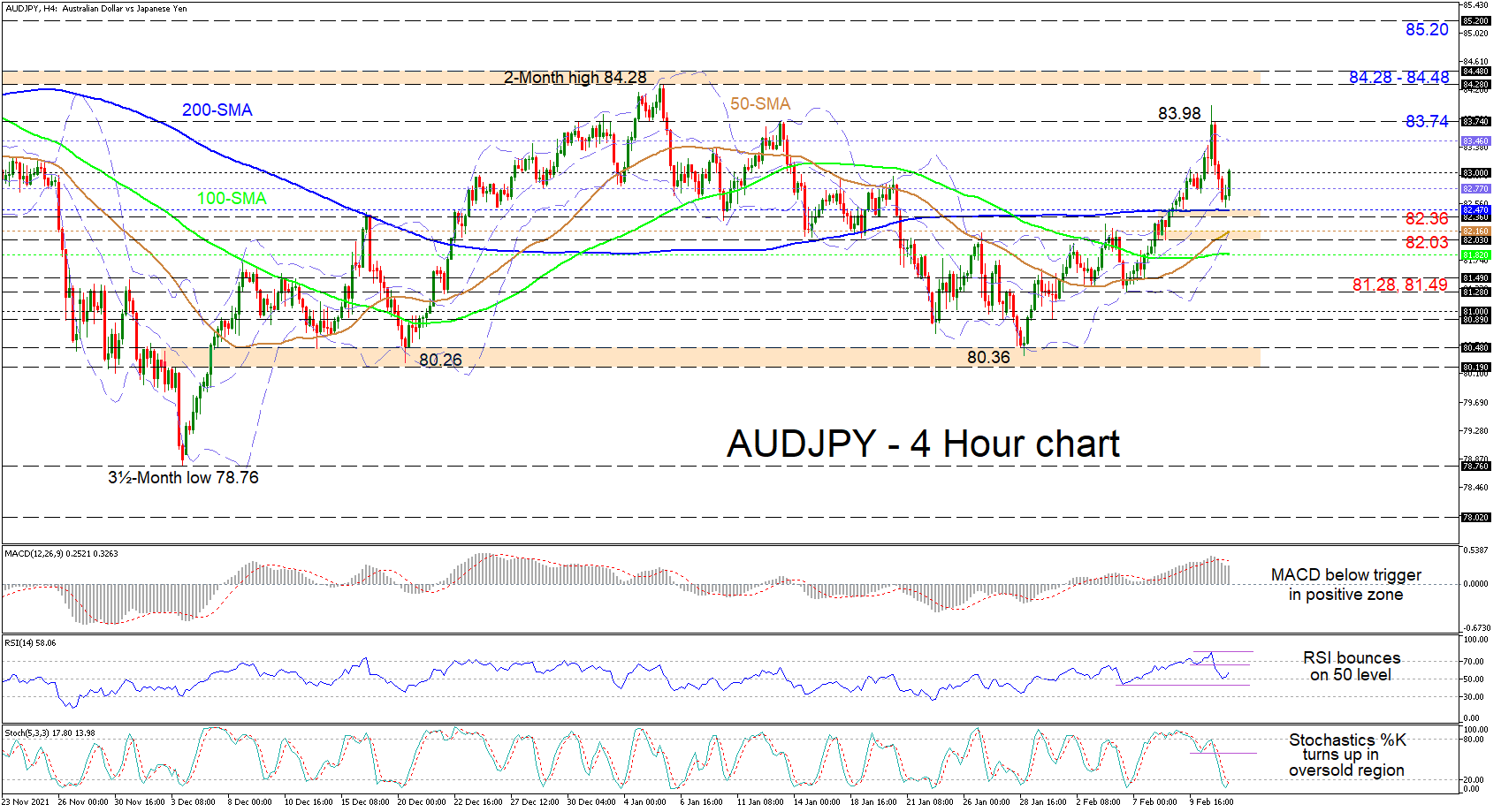
AUDJPY has pushed over the mid-Bollinger band and is confronting the 83.00 handle after gaining some traction from the 200-period simple moving average (SMA). The longer-term horizontal SMAs are endorsing the broader neutral picture, while the climbing 50-period SMA, which is nearing a bullish crossover of the 200-period SMA as well, suggests that the recent upside trend from the 80.36 trough remains active.
The short-term oscillators are reflecting that positive momentum is regaining strength. The MACD, in the positive zone and below its red trigger line, is starting to turn higher, while the RSI has bounced off the 50 neutral threshold. Furthermore, the %K line has made a U-turn and overstepped the %D line in the oversold territory.
If bullish price action develops past the 83.00 mark, the next resistance could emerge at the upper Bollinger band at 83.46. If the price nudges past this barrier too, the tough neighbouring 83.74 border and the 83.98 fresh peak may try to curb advances from acquiring pace. Failing to do so, buyers may have the chance to reinforce a bullish bias should they conquer the 84.28-84.48 resistance ceiling that has held since November 2021. Succeeding could then encourage the bulls to target the 85.20 high, identified at the beginning of November 2021.
If positive powers fade and the price slips back beneath the mid-Bollinger band, a prompt floor may act between the 200-period SMA at 82.47 and the 82.36 obstacle. If this upside defence breaks down, the support band from the 50-period SMA at 82.16 until the 82.03 low could then step into the spotlight. However, if a deeper retreat in the pair evolves, the 100-period SMA at 81.82 may delay the test of the congested lows of 81.49 and 81.28.
Summarizing, AUDJPY’s neutral-to-bullish tone is amping up after finding footing off the 200-period SMA, and a definitive close above the 83.00 hurdle could accelerate it. Yet, for the bias to become bullish, the price would need to propel north of the 84.28-84.48 barricade, while a drop in the pair beneath the 100-period SMA at 81.82 may bolster negative pressures.
UK Posts Mixed Data, But Not Bad for Pound
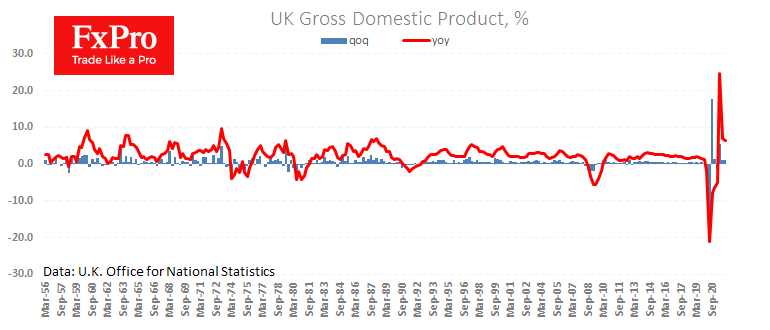
The UK economy added 1% in the fourth quarter last year and is 6.5% higher than a year ago. The annual growth rate is declining as the low base effect fades away.
In December, industrial production added 0.3% and moved into growth territory compared to the same month a year earlier. These are signs that the Bank of England’s interest rate hike cycle has met the UK economy in pretty good shape.
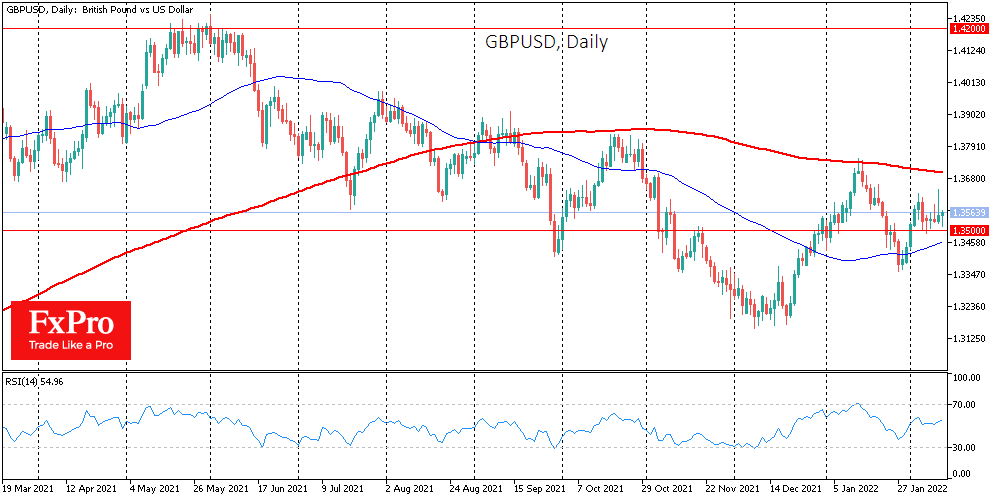
The British pound has been gaining support in the last two days on the declines in the area of 1.35 GBPUSD despite the impressive upward thrust of the dollar. This dynamic is explained by the fact that the Bank of England has as much potential to tighten policy. Locally the pound looks like a decent competitor to the dollar.
The markets are pricing in that the Bank of England may raise the rate by 50 points at one of the following meetings, keeping the policy tightening gap with the Fed. And this is good news for the pound, which could also help reduce inflationary pressures.
EUR/USD Mid-Day Outlook
Daily Pivots: (S1) 1.1371; (P) 1.1433; (R1) 1.1491; More...
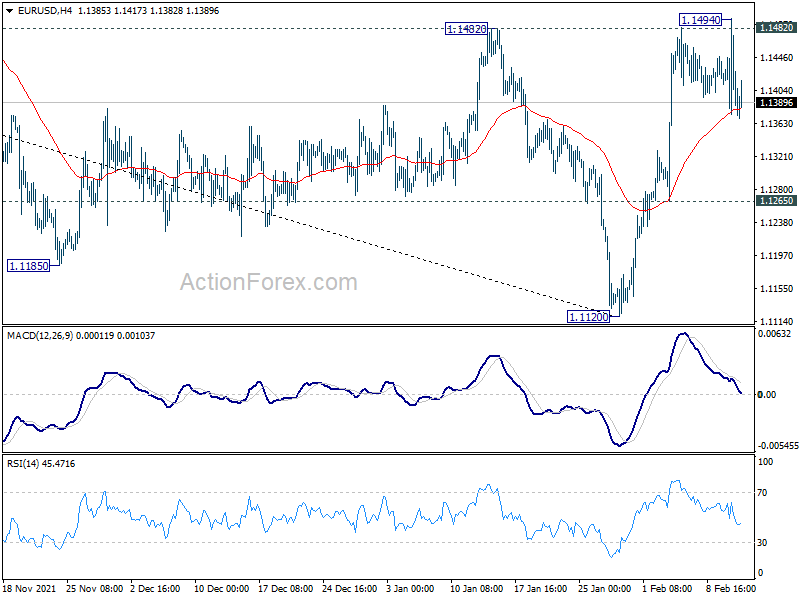
Intraday bias in EUR/USD remains neutral at this point. Further rise is still in favor as long as 1.1265 minor support holds. Sustained break of 1.1482 will target 38.2% retracement of 1.2348 to 1.1120 at 1.1589 next. Sustained break there will argue that whole fall from 1.2348 has completed too and target 61.8% retracement at 1.1879. On the down, however, break of 1.1265 support will dampen this bullish view and bring retest of 1.1120 low instead.
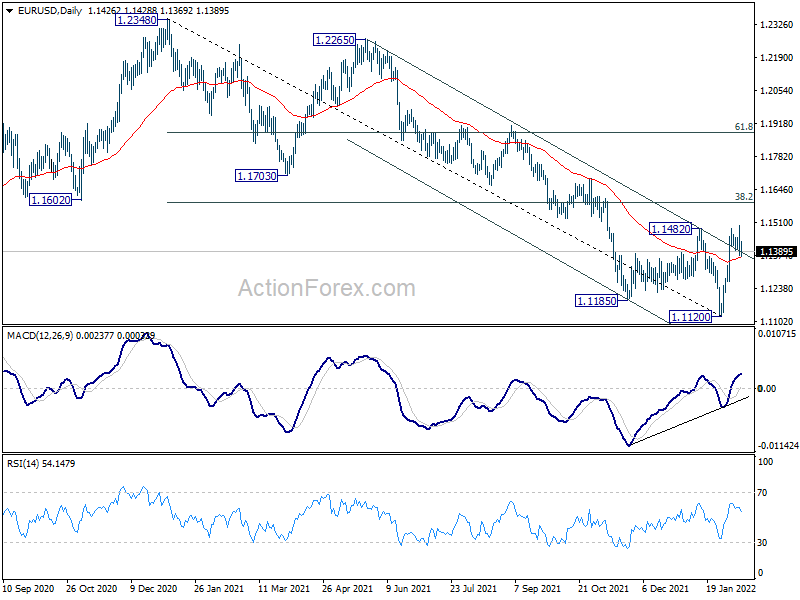
In the bigger picture, the decline from 1.2348 (2021 high) is seen as a leg inside the range pattern from 1.2555 (2018 high). Sustained trading above 55 week EMA (now at 1.1613) will argue that it has completed and stronger rise would be seen back towards top of the range between 1.2348 and 1.2555. However, firm break of 1.0635 (2020 low) will raise the chance of long term down trend resumption and target a retest on 1.0339 (2017 low) next.
USD/CHF Mid-Day Outlook
Daily Pivots: (S1) 0.9221; (P) 0.9259; (R1) 0.9291; More....
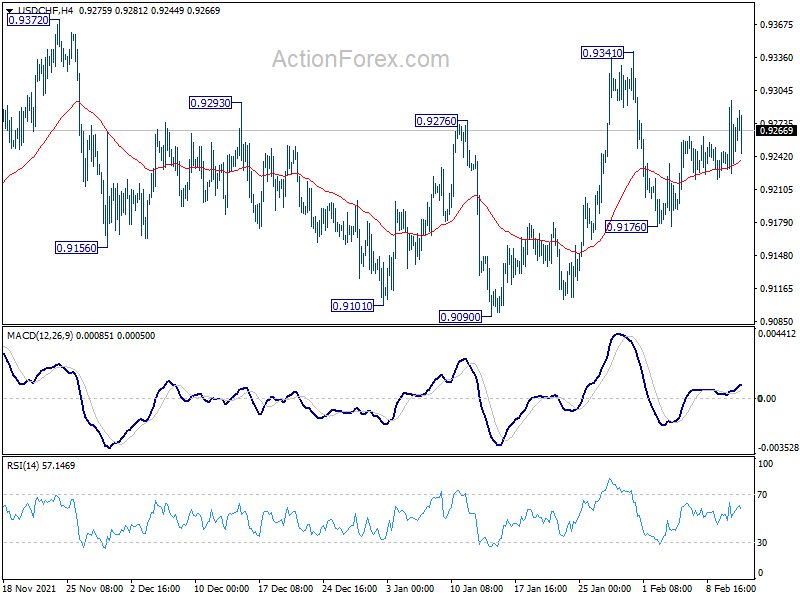
Intraday bias in USD/CHF remains neutral at this point. Further rise will remain mildly in favor as long as 0.9090 support holds. break of 0.9372 will resume the choppy rally from 0.8925 to 0.9471 high. However, break of 0.9090 will turn bias back to the downside for 0.8925 support instead.
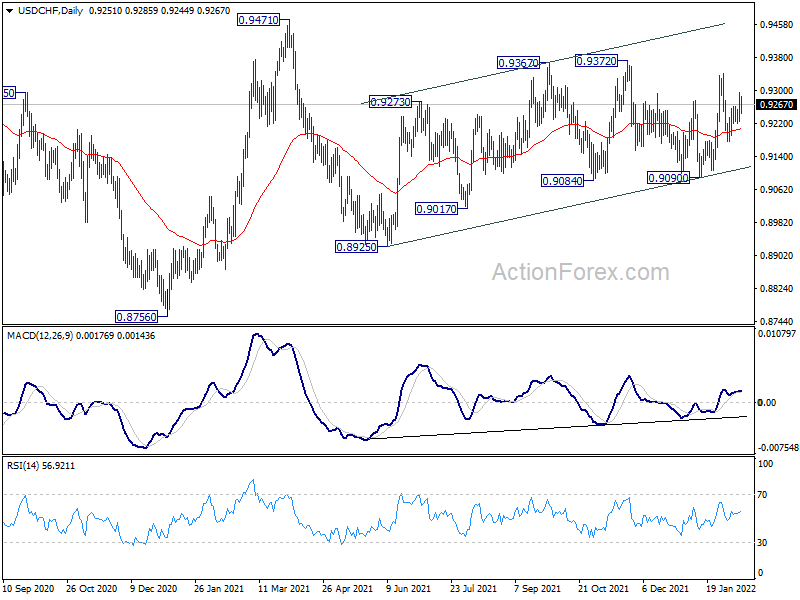
In the bigger picture, medium term outlook will be neutral at best as long as 0.9471 resistance holds. Larger down trend could still extend through 0.8756 (2021 low). However, firm break of 0.9471 will argue that the trend has already reversed and rebound the rally from 0.8756 with another impulsive move.
USD/JPY Mid-Day Outlook
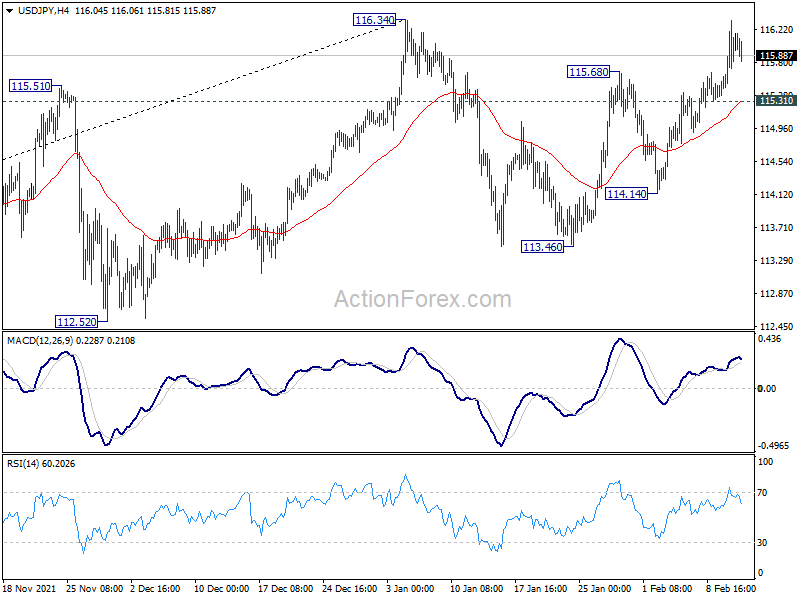
Daily Pivots: (S1) 115.54; (P) 115.94; (R1) 116.40; More...
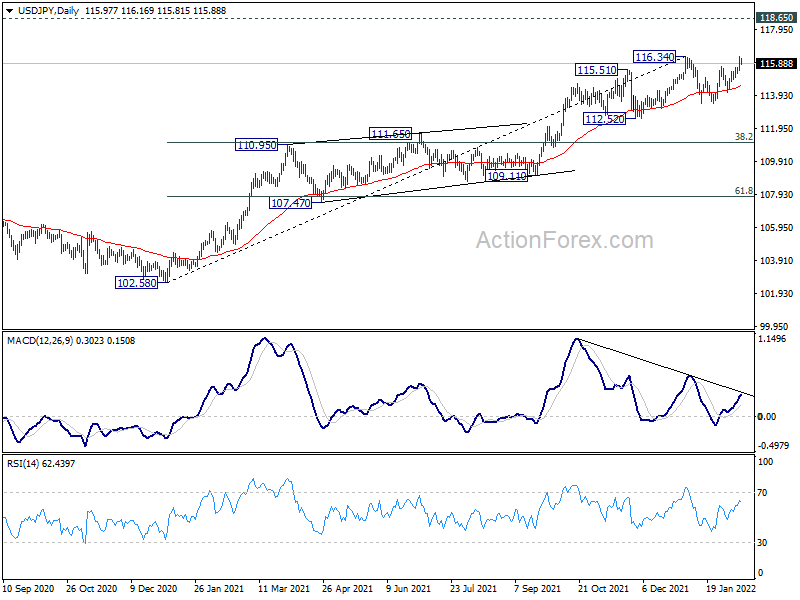
Intraday bias stays on the upside and focus remains on 116.34 resistance. Firm break there will resume larger up trend from 102.58. Next target is 118.65 long term resistance. On the downside, though, break of 115.31 minor support will extend the corrective pattern from 116.34 with another falling leg, and turn bias back to the downside for 114.14 support and possibly below.
In the bigger picture, no change in the view that rise from 102.58 is the third leg of the up trend from 101.18 (2020 low). Such rally should target a test on 118.65 (2016 high). Sustained break there will pave the way to 120.85 (2015 high) and raise the chance of long term up trend resumption. This will remain the favored case as long as 55 week EMA (now at 111.21) holds.
GBP/USD Mid-Day Outlook
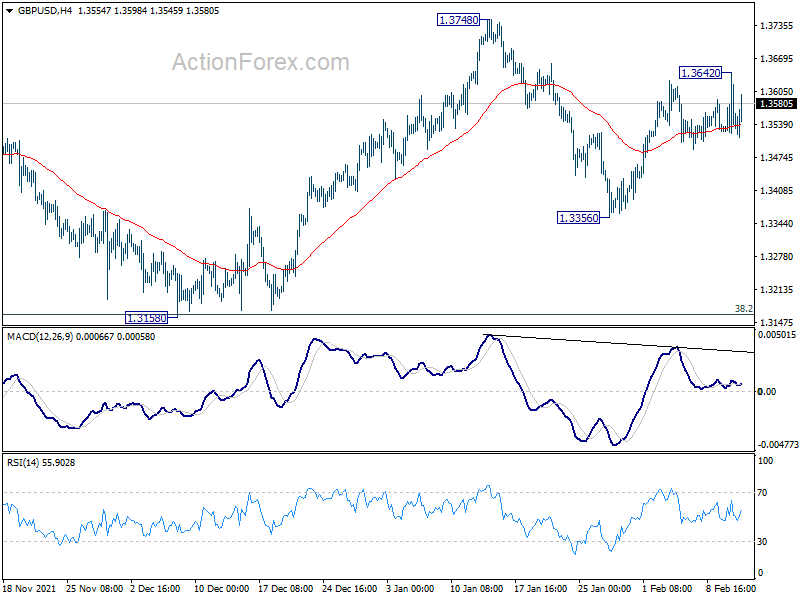
Daily Pivots: (S1) 1.3508; (P) 1.3576; (R1) 1.3628; More...
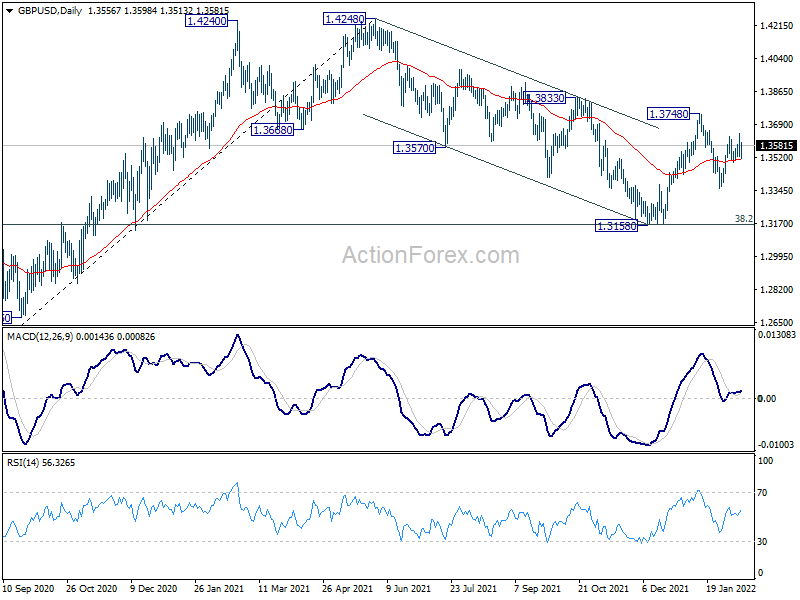
GBP/USD is still bounded in range and intraday bias remains neutral. On the upside, break of 1.3642 will resume the rebound to 1.3748 resistance. Firm break there will revive the bullish case that correction from 1.4248 has completed with three waves down to 1.3158. Further rally should then be seen to retest 1.4248 high. On the downside, however, break of 1.3356 will bring retest of 1.3158 low.
In the bigger picture, as long as 38.2% retracement of 1.1409 to 1.4248 at 1.3164 holds, up trend from 1.1409 (2020 low) is still in progress. On resumption, next target will be 38.2% retracement of 2.1161 to 1.1409 at 1.5134. Nevertheless sustained break of 1.3164 will argue that whole rise from 1.1409 has completed and bring deeper fall to 61.8% retracement at 1.2493.
Sterling Rises after GDP, Dollar Turning Soft Again
Sterling rises broadly today after better than expected GDP data, even though upside momentum is weak so far. Dollar is paring some of the post-CPI gains as over sentiment, while weak, seems to be stabilizing. As for the week, Yen is the worst performing one, followed by Euro and Dollar. Aussie is the strongest one, followed by Kiwi and the Pound. There are still rooms to swap some places, depending on how US stock and bond markets end.
In Europe, at the time of writing, FTSE is down -0.67. DAX is down -0.27%. CAC is down -1.10%. Germany 10-year yield is down -0.025 at 0.260. Earlier in Asia, Hong Kong HSI dropped -0.07%. China Shanghai SSE dropped -0.66%. Singapore Strait Times rose 0.03%. Japan was on holiday.
NIESR forecasts 1.0% growth in UK GDP in Q1
NIESR forecast growth of 1.0% in UK GDP in Q1. It said that economic impact of Omicron was "far smaller than" previous two waves. The -0.2% fall in December GDP was also better than consensus forecasts, suggesting the "possibility of a positive reading in January.
"The economic impact of Omicron was far smaller than that of either of the two previous major waves of Covid-19: a mere 0.2 per cent fall in December was even stronger than consensus forecasts, but in line with NIESR's January GDP tracker, suggesting the possibility of a positive reading in January. Unsurprisingly, retail and hospitality contributed the most to December's fall, with the healthcare sector providing the largest positive contribution." - Rory Macqueen Principal Economist, NIESR
UK GDP contracted -0.2% mom in Dec, up 1.0% qoq in Q4
UK GDP contracted -0.2% mom in December, better than expectation of -0.5% mom. Services output dropped -0.5% mom. Production rose 0.3% mom while construction rose 2.0% mom. Services and construction were both above pre-coronavirus levels, by 0.5% and 0.3% respectively, but production remained -2.6% below.
Q4 GDP grew 1.0% qoq, slightly below expectation of 1.0% qoq. The level of GDP in Q4 remained below -0.4% below its pre-coronavirus level in Q4 2019. Nevertheless, monthly GDP was already at its pre-coronavirus level in February 2020.
Also published, manufacturing production rose 0.2% mom, 1.3% yoy in December versus expectation of 0.2% mom, 1.7% yoy. Industrial production rose 0.3% mom, 0.4% yoy, versus expectation of 0.1% mom, 0.6% yoy. Goods trade surplus came in at GBP -12.4B, versus expectation of GBP -13.0B.
DIHK downgrades Germany growth forecasts to 3.0% in 2022
Germany's Chambers of Industry and Commerce (DIHK) lowed 2022 growth forecasts from 3.6% to 3.0%. That is, the economy will probably not reach the pre-crisis level until middle of the year.
"The economy is holding its breath. There is still a cautiously optimistic mood in the companies. However, many do not know how things will continue due to great uncertainty," said DIHK Managing Director Martin Wansleben.
"In addition to the Corona crisis and delivery bottlenecks, the biggest stress factors are above all the sharp rise in energy and raw material prices and the shortage of skilled workers. In addition, there are further expected cost increases due to the transformation in climate protection. It is still an open question, especially for companies that are in international competition how such a compensation should work. Many fear a deterioration of their position on the world markets."
RBA Lowe: We have scope to wait and see
RBA Governor Philip Lowe told a parliamentary committee that it is "too early" to conclude that inflation is "sustainably in the target range". He added, "in underlying terms, inflation has just reached the midpoint of the target band for the first time in over seven years".
The board is "prepared to be patient" and "we have scope to wait and see how the data develop and how some of the uncertainties are resolved. Countries with higher inflation rates have less scope here."
RBNZ survey: Another rate hike expected in Q1, 4-5 hikes in a year
In the latest Survey of Expectations of RBNZ, OCR expectations continued to rise in the short, medium and long term. OCR is expected to rise from current 0.75% to 1.05% by the end of Q1. Mean estimate for OCR for one year ahead was 2.11%, indicating four to five 25bps hikes. Mean two-year ahead OCR expectations were at 2.47%
One-year inflation expectations rose from 3.70% to 4.4%, highest since November 1900. Two-year ahead inflation expectations rose from 2.96% to 3.27%, highest since 1991. Five-year inflation expectations also rose slightly from 2.17% to 2.30%, highest since 20-17.
GBP/USD Mid-Day Outlook
Daily Pivots: (S1) 1.3508; (P) 1.3576; (R1) 1.3628; More...
GBP/USD is still bounded in range and intraday bias remains neutral. On the upside, break of 1.3642 will resume the rebound to 1.3748 resistance. Firm break there will revive the bullish case that correction from 1.4248 has completed with three waves down to 1.3158. Further rally should then be seen to retest 1.4248 high. On the downside, however, break of 1.3356 will bring retest of 1.3158 low.
In the bigger picture, as long as 38.2% retracement of 1.1409 to 1.4248 at 1.3164 holds, up trend from 1.1409 (2020 low) is still in progress. On resumption, next target will be 38.2% retracement of 2.1161 to 1.1409 at 1.5134. Nevertheless sustained break of 1.3164 will argue that whole rise from 1.1409 has completed and bring deeper fall to 61.8% retracement at 1.2493
Economic Indicators Update
| GMT | Ccy | Events | Actual | Forecast | Previous | Revised |
|---|---|---|---|---|---|---|
| 21:30 | NZD | Business NZ PMI Jan | 52.1 | 53.7 | 53.8 | |
| 02:00 | NZD | RBNZ Inflation Expectations Q1 | 3.27% | 2.96% | ||
| 07:00 | EUR | Germany CPI M/M Jan F | 0.40% | 0.40% | 0.40% | |
| 07:00 | EUR | Germany CPI Y/Y Jan F | 4.90% | 4.90% | 4.90% | |
| 07:00 | GBP | GDP M/M Dec | -0.20% | -0.50% | 0.90% | |
| 07:00 | GBP | GDP Q/Q Q4 P | 1.00% | 1.10% | 1.10% | |
| 07:00 | GBP | Index of Services 3M/3M Dec | 1.20% | 1.20% | 1.30% | |
| 07:00 | GBP | Manufacturing Production M/M Dec | 0.20% | 0.20% | 1.10% | 0.70% |
| 07:00 | GBP | Manufacturing Production Y/Y Dec | 1.30% | 1.70% | 0.40% | -0.10% |
| 07:00 | GBP | Industrial Production M/M Dec | 0.30% | 0.10% | 1.00% | 0.70% |
| 07:00 | GBP | Industrial Production Y/Y Dec | 0.40% | 0.60% | 0.10% | -0.20% |
| 07:00 | GBP | Goods Trade Balance (GBP) Dec | -12.4B | -13.0B | -11.3B | -12.701B |
| 07:30 | CHF | CPI M/M Jan | 0.20% | 0.10% | -0.10% | |
| 07:30 | CHF | CPI Y/Y Jan | 1.60% | 1.60% | 1.50% | |
| 15:00 | USD | Michigan Consumer Sentiment Index Feb P | 67.6 | 67.2 |