

Sample Category Title
Elliott Wave View: Oil (CL) Wave 5 Near Complete
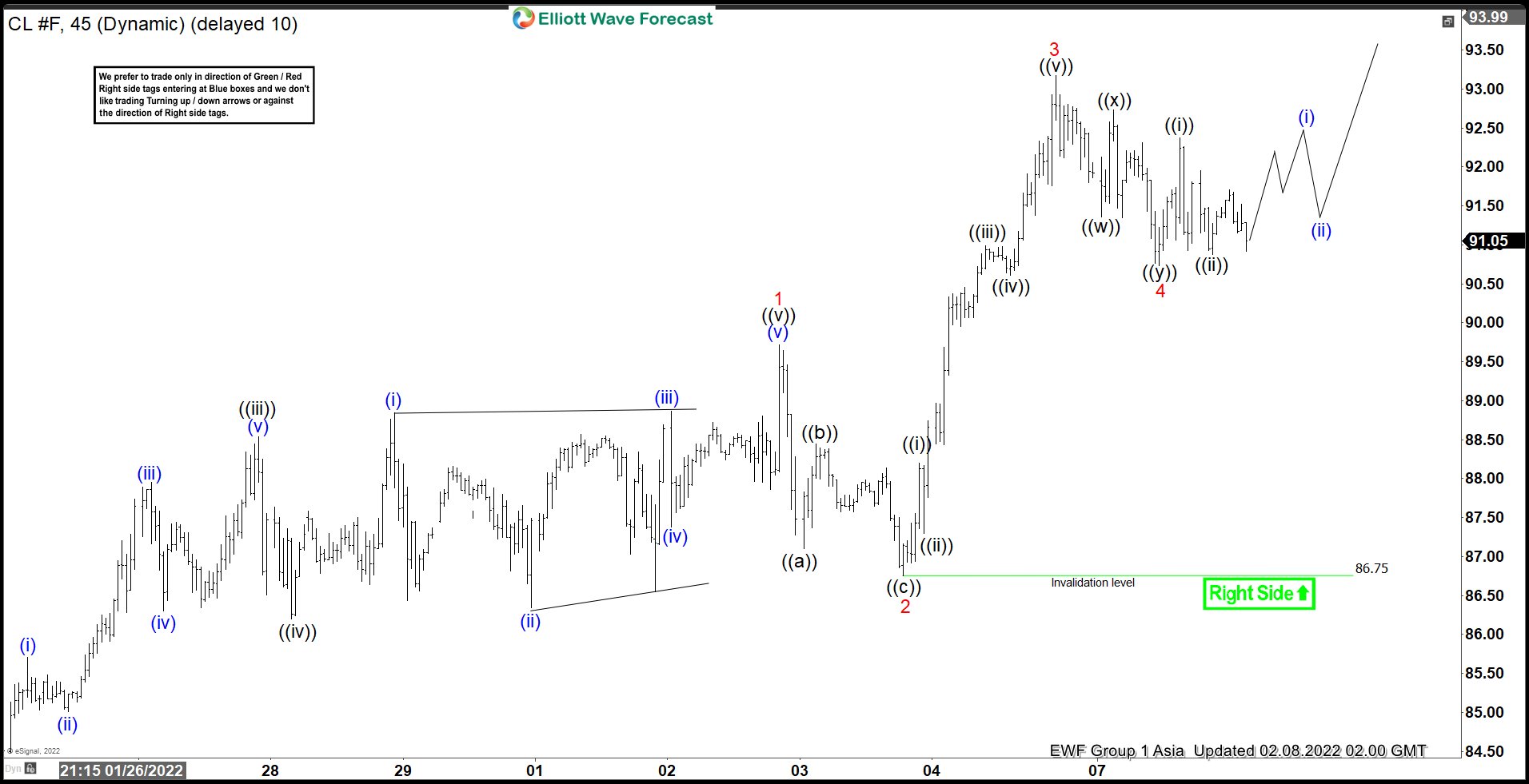
The short-term Elliott wave view in WTI (CL) shows that we are looking for more upside to complete a 5 waves impulse structure, before a 3 swings pullback at least. The impulse move started from 81.90 low to end wave 1 at 89.72 and pullback in wave 2 ended at 86.75. Oil then resumes higher in wave 3 with internal subdivision as another impulse in lesser degree. Up from wave 2, wave ((i)) ended at 88.20, dips in wave ((ii)) ended at 87.30, wave ((iii)) rallied to 90.99 and a short pullback appeared as wave ((iv)) ended at 90.61. The last push higher to finish wave ((v)) ended at 93.17. This completed wave 3 in higher degree.
Wave 4 pullback ended in a double correction at 90.73 and Oil started the last wave 5 higher to finish an impulse. We are looking an extension in this wave. In lesser degree, wave ((i)) of wave 5 has ended at 92.37 then wave ((ii)) correction completed at 90.88 and Oil has continued to the upside. Expect CL to extend higher and break wave 3 peak to complete wave 5. A possible area to complete this structure comes in 93.76 – 94.69 zone calculated using Fibonacci inverse retracement tool, where Oil could find seller to begin at least a correction or an important new cycle.
CL 1 Hour Elliott Wave Chart
GBP/USD Retreats From Key Resistance
Key Highlights
- GBP/USD started a downside correction from the 1.3635 resistance zone.
- Earlier, it surpassed a major bearish trend line at 1.3525 on the 4-hours chart.
- EUR/USD is consolidating gains below the 1.1480 resistance.
- Gold price could gain pace if it clears the $1,825 resistance.
GBP/USD Technical Analysis
The British Pound started a decent increase from the 1.3360 zone against the US Dollar. GBP/USD climbed above the 1.3450 and 1.3500 resistance levels to move into a positive zone.
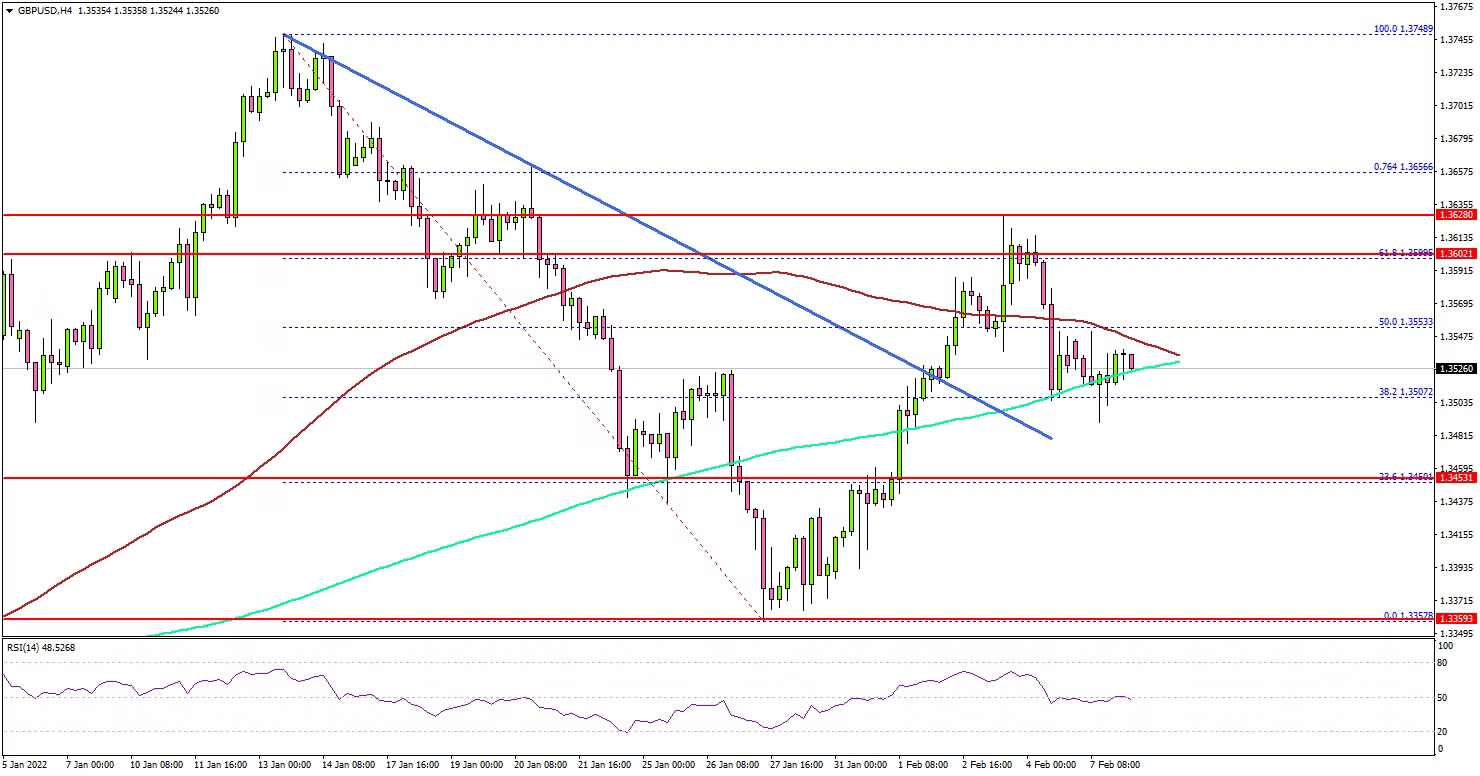
Looking at the 4-hours chart, the pair was able to settle above the 1.3500 level and surpassed the 100 simple moving average (red, 4-hours). The pair also climbed above the 50% Fib retracement level of the key decline from the 1.3748 high to 1.3357 low.
Besides, there was a break above a major bearish trend line at 1.3525 on the same chart. However, the pair struggled to gain pace above the 1.3620 and 1.3635 levels.
It faced sellers near the 61.8% Fib retracement level of the key decline from the 1.3748 high to 1.3357 low. GBP/USD corrected gains and traded below 1.3550. An initial support is near the 1.3480 level.
The next major support is near the 1.3450 level. If there is a downside break below the 1.3450 support, the pair could decline towards the 1.3360 support zone. On the upside, an immediate resistance is near the 1.3550 level.
The first major resistance is near the 1.3620 zone. A clear move above the 1.3620 level might start a major increase in the coming sessions.
Looking at EUR/USD, the pair surged above the 1.1420 and 1.1450 levels. It is now consolidating gains and facing resistance near the 1.1480 level.
Economic Releases
- US Goods and Services Trade Balance for Dec 2021 - Forecast $-83.0B, versus $-80.2B previous.
Global Bond Yields Extend Gains
The key takeaway point from a rather busy last week was this: interest rates are going to rise quicker than previously thought. At the start of this week, investors have continued to offload government bonds, sending their yields higher:
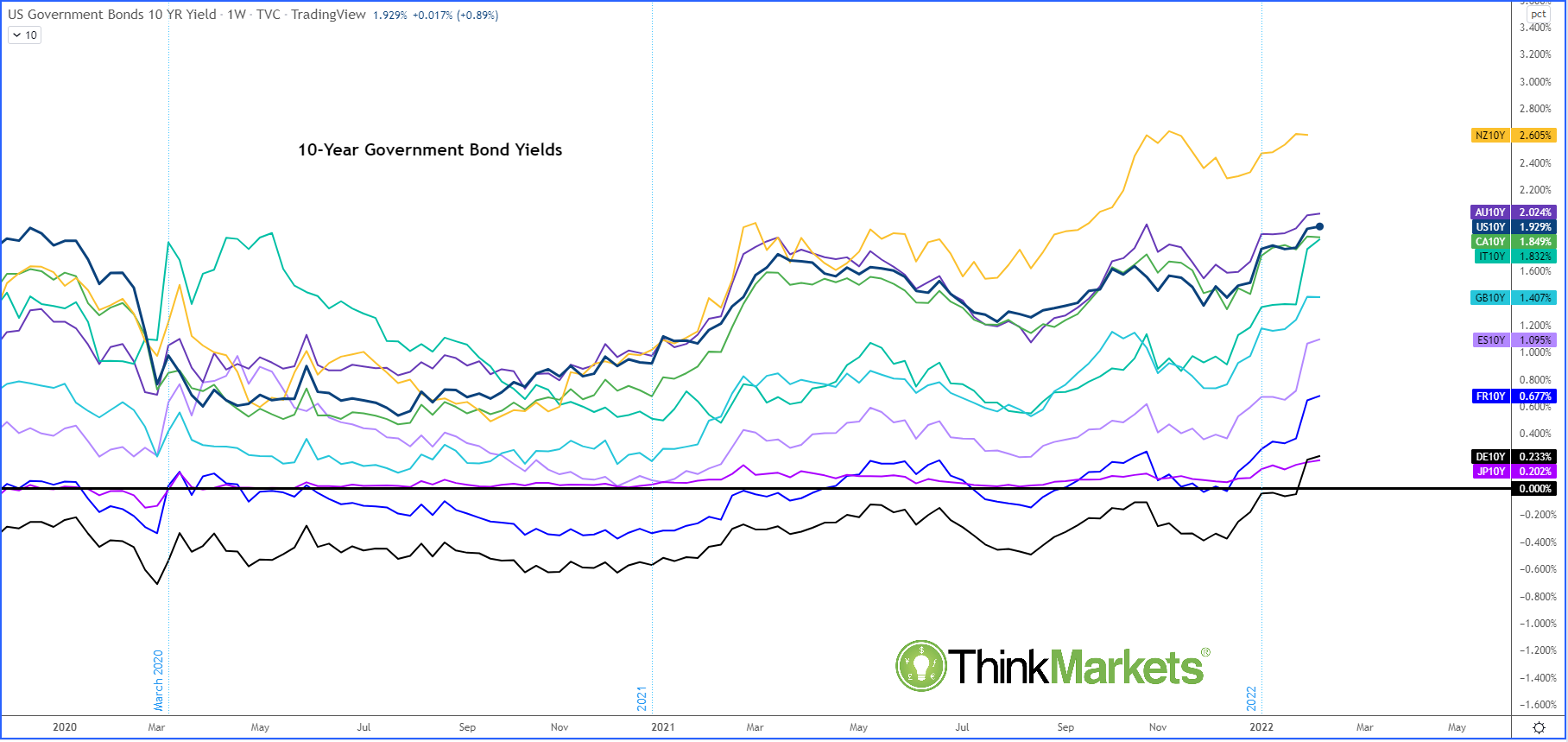
The BoE and ECB were more hawkish than expected, with a bigger split in the former in deciding how much to raise rates by. In the US, the much stronger non-farm payrolls report, plus more signs of rising inflationary pressures, cemented expectations of a faster rate hiking cycle over there. While yields have extended their gains, the equity markets have started the new week on a stronger footing – except in some peripheral European countries.
The bond selling has been more profound for European peripheries, with Greek and Italian yields sharply widening their gaps against German bunds.
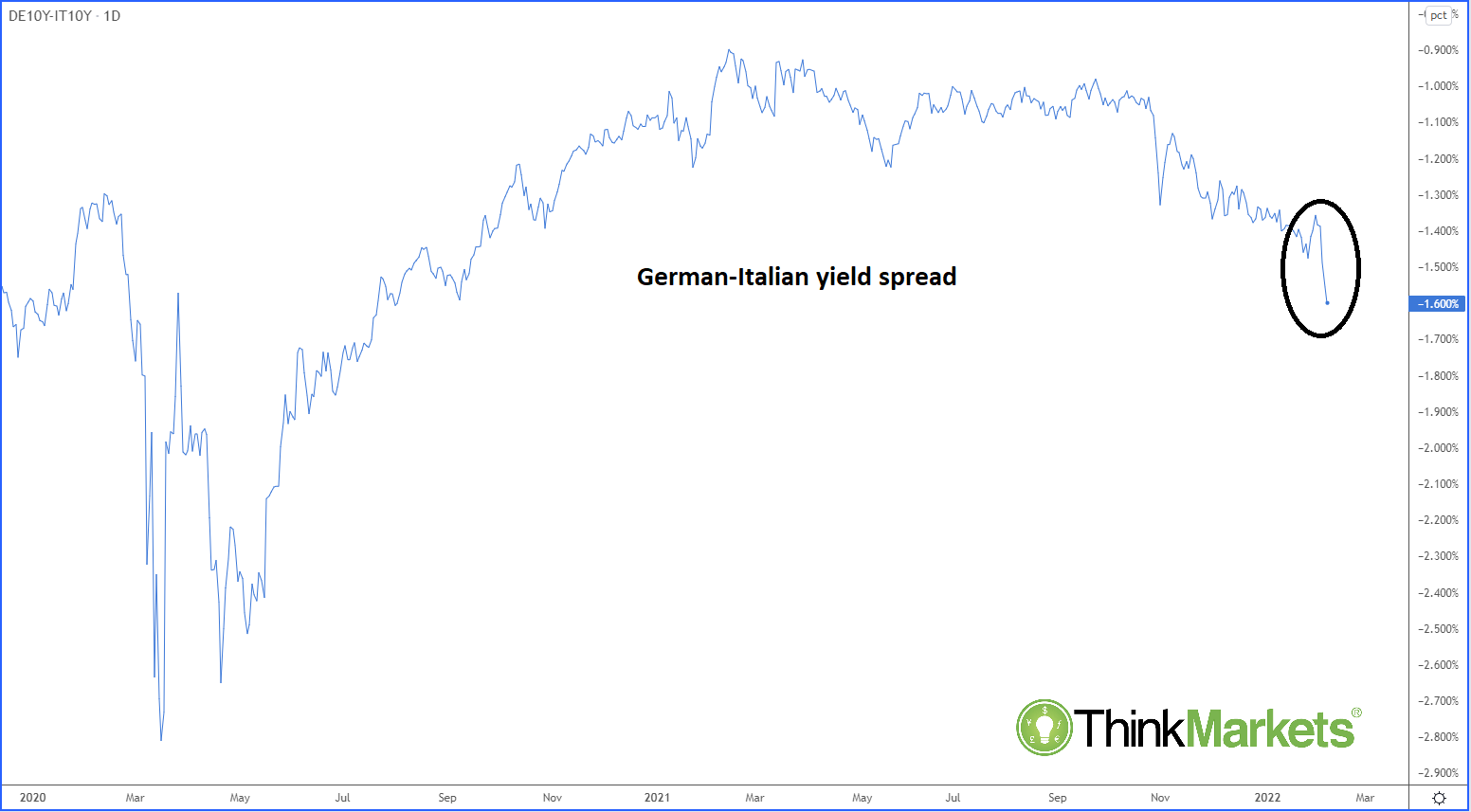
This is because peripheral Europe has been the major beneficiary from ECB’s emergency stimulus measures. With investors now pricing in a faster removal of QE by the ECB, they are taking no chances. The Italian benchmark stock index was down around 1.5% today, sharply under-performing the likes of the UK’s FTSE and the German DAX indices.
Still, the wider European equity markets are holding their own well and for those that have fallen the losses have been very mild relative to how much they have gained. It remains to be seen whether stock investors will panic more if yields rise further, and yield spreads widen even more.
NZDJPY Selling The Rallies After Elliott Wave Double Three Pattern
Hello fellow traders. Another instrument that has given us nice trading opportunity recently is NZDJPY . In this technical article we’re going to take a look at the past charts of NZDJPY presented in members area of the of our website. The pair is showing incomplete bearish sequences in the cycle from the 10/21 peak. Consequently we expect to see further decline within October cycle. Recently we got a short term recovery that has given us opportunity to enter short trades again. Recovery has unfolded as Elliott Wave Double Three Pattern. In further text we’re going to explain the Elliott Wave pattern and trading strategy.
Before we take a look at the real market example, let’s explain Elliott Wave Double Three pattern.
Elliott Wave Double Three Pattern
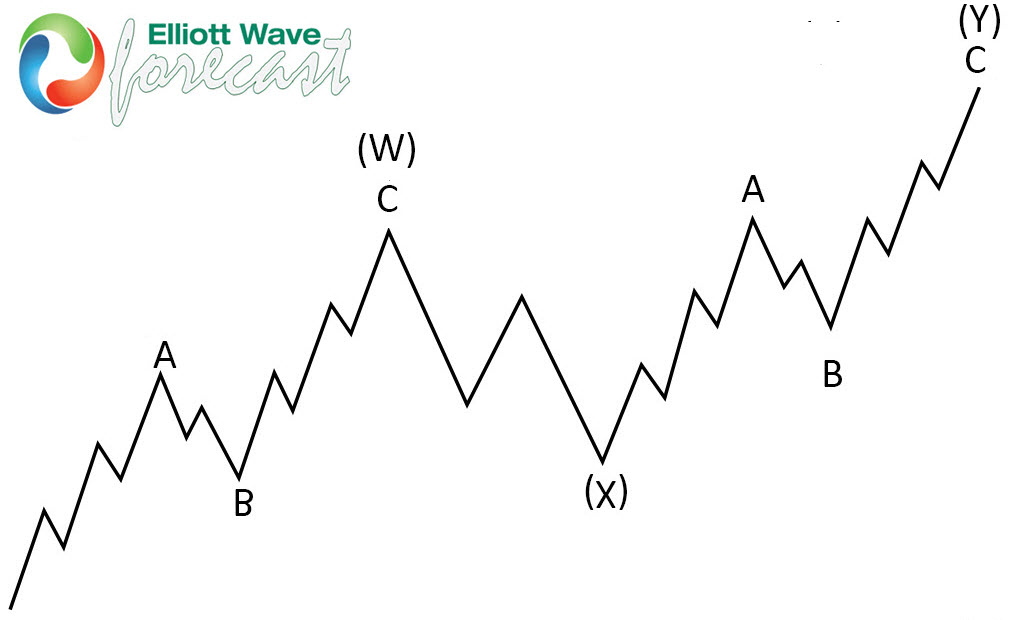
Double three is the common pattern in the market , also known as 7 swing structure. It’s a reliable pattern which is giving us good trading entries with clearly defined invalidation levels.
The picture below presents what Elliott Wave Double Three pattern looks like. It has (W),(X),(Y) labeling and 3,3,3 inner structure, which means all of these 3 legs are corrective sequences. Each (W) and (Y) are made of 3 swings , they’re having A,B,C structure in lower degree, or alternatively they can have W,X,Y labeling.
NZDJPY 1 Hour Elliott Wave Analysis 02.03.2021
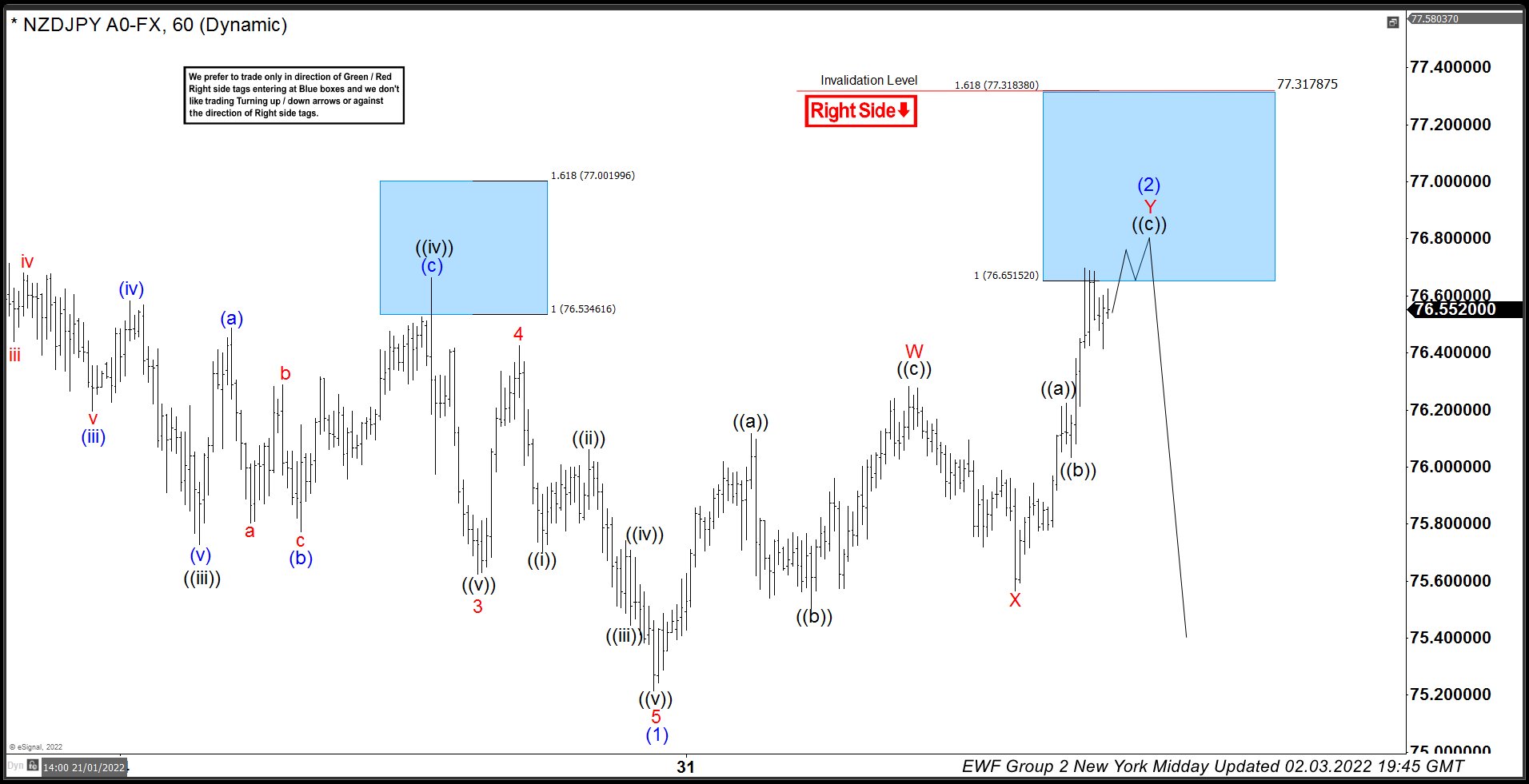
NZDJPY is giving us (2) blue recovery that is unfolding as Elliott Wave Double Three Pattern. It’s having WXY inner labeling. We can see 3 waves up in W red leg. Then we got 3 waves bounce in X connector. Last leg up Y red is also counted as corrective structure – ((a)) ((b)) ((c)) Zig Zag pattern, when ((b)) was shallow pull back. Recovery has already reached the extremes at 76.65-77.31 , blue box area. At the marked blue box area, we expect sellers to appear and to pull price lower toward new lows ideally. As the main trend is bearish we expect to get at least 3 waves pull back from the selling zone. Once pull back reaches 50 Fibs against the X red connector, we will make short position risk free ( put SL at BE). Invalidation level for the trade is break above 1.618 fib extension (77.317).
NZDJPY 1 Hour Elliott Wave Analysis 02.07.2021
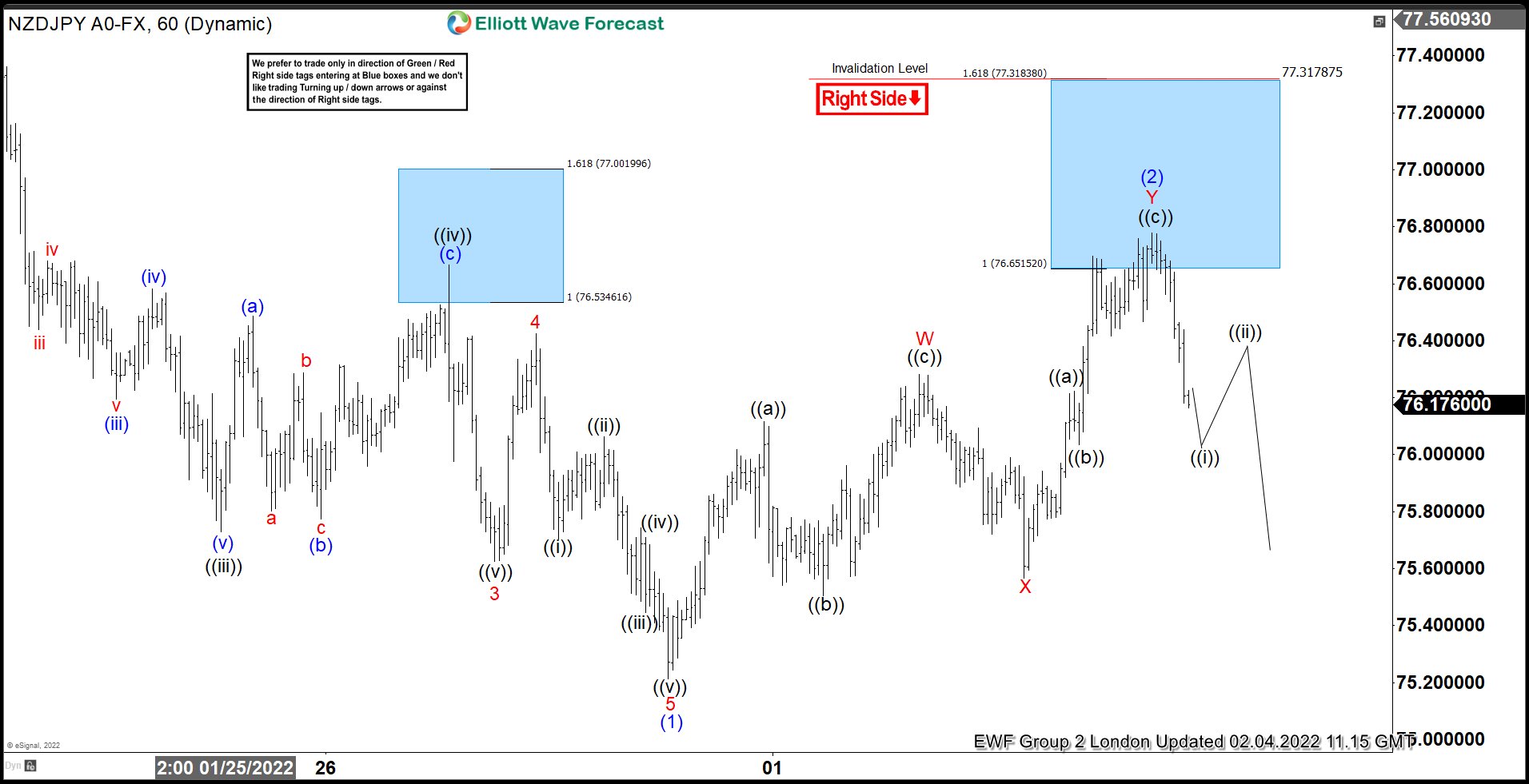
Sellers appeared at the blue box area : 76.65-77.31 and we got good reaction from there. The decline from the blue box reached 50 fibs against the X connector, as a result members who took short positions should be enjoying profits in a Risk Free positions. At the moment we see wave (2) blue recovery completed at 76.78 high. Decline from that high high looks like unfolding as 5 waves – ((i)) and we expected to see bounce in ((ii)) before further decline ideally resumes .
NZDJPY 1 Hour Elliott Wave Analysis 02.07.2021
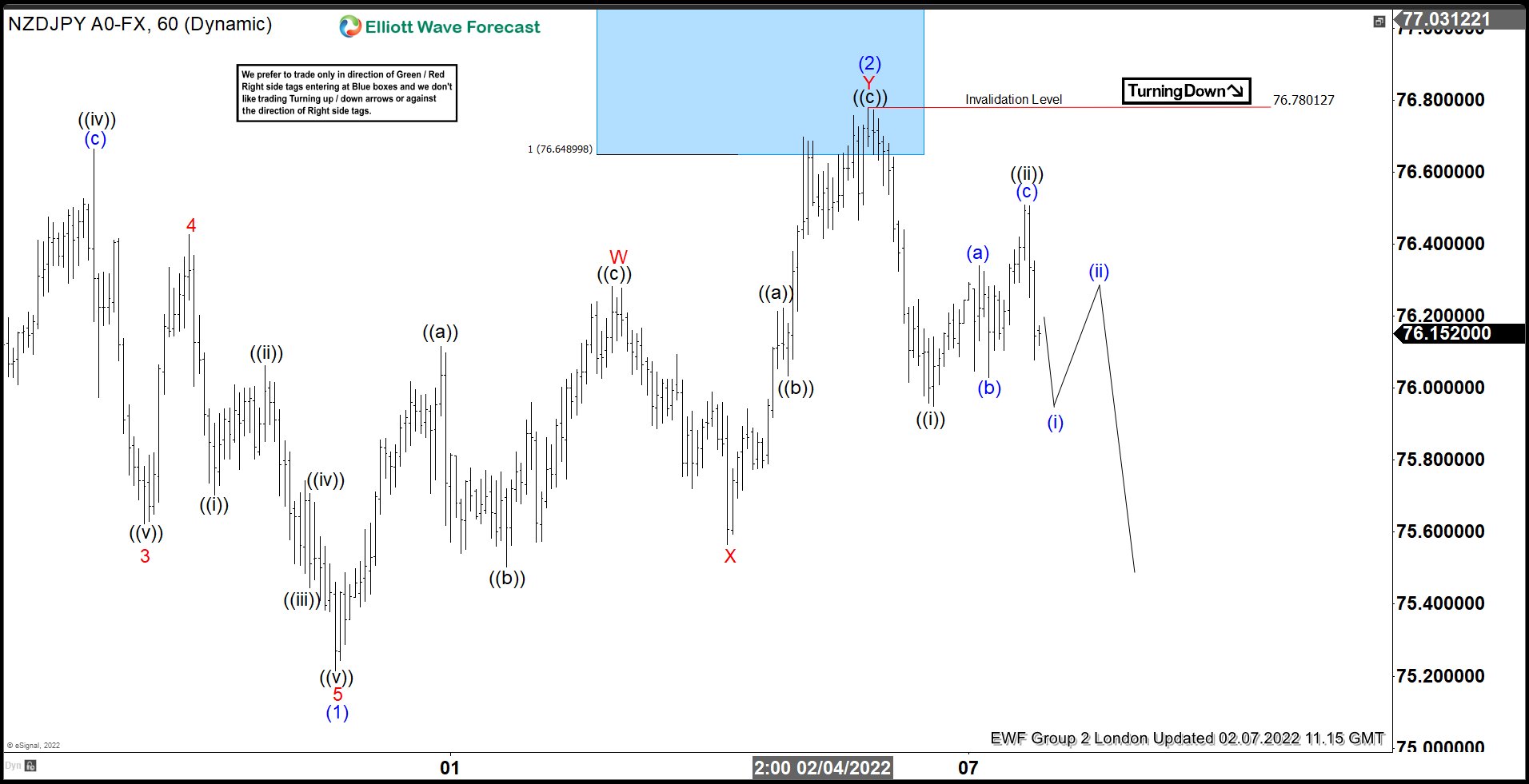
We got short term bounce ((ii)) as expected. As far as the price stays below 76.49 , next short term tech zone to the downside comes at 75.67-75.47. Key level for this view is at 76.78 peak. If that level gives up , the pair will make another 3 waves up within correction (2) blue.
Keep in mind that market is dynamic and presented view could have changed in the mean time. Not every chart is trading recommendation. You can check most recent charts and new trading setups in the membership area of the site. Best instruments to trade are those having incomplete bullish or bearish swings sequences. We put them in Sequence Report and best among them are shown in the Live Trading Room.
EURCAD Wave Analysis
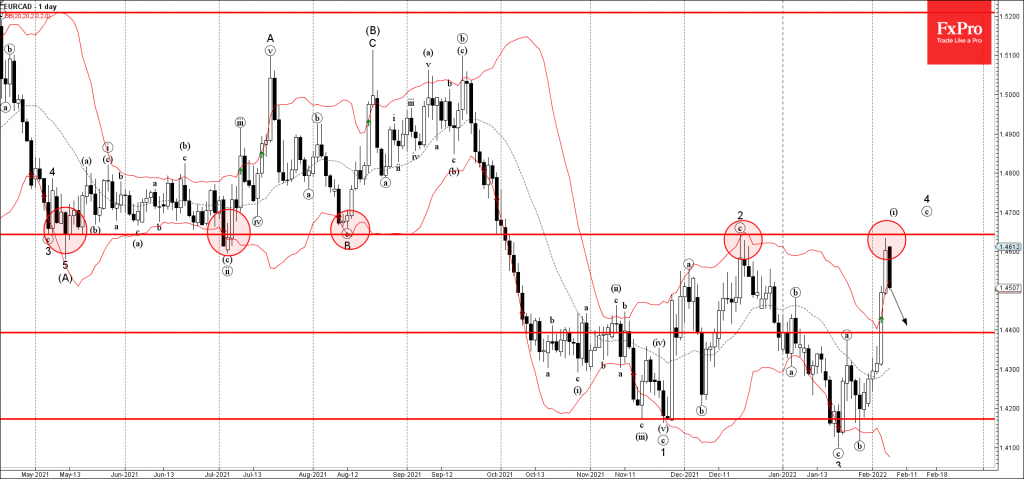
- EURCAD reversed from resistance level 1.4645
- Likely to fall to support level 1.4400
EURCAD currency pair recently reversed down strongly from the key resistance level 1.4645 (which has been reversing the price from May of 2021).
The resistance zone near the resistance level 1.4645 was strengthened by the upper daily Bollinger Band.
EURCAD currency pair can be expected to fall further toward the next support level 1.4400 (former resistance from the end of January, top of wave (a)).
Eco Data 2/8/22
[php_everywhere instance="1"]
Bank of England Update: More Rate Hikes Incoming
Key takeaways
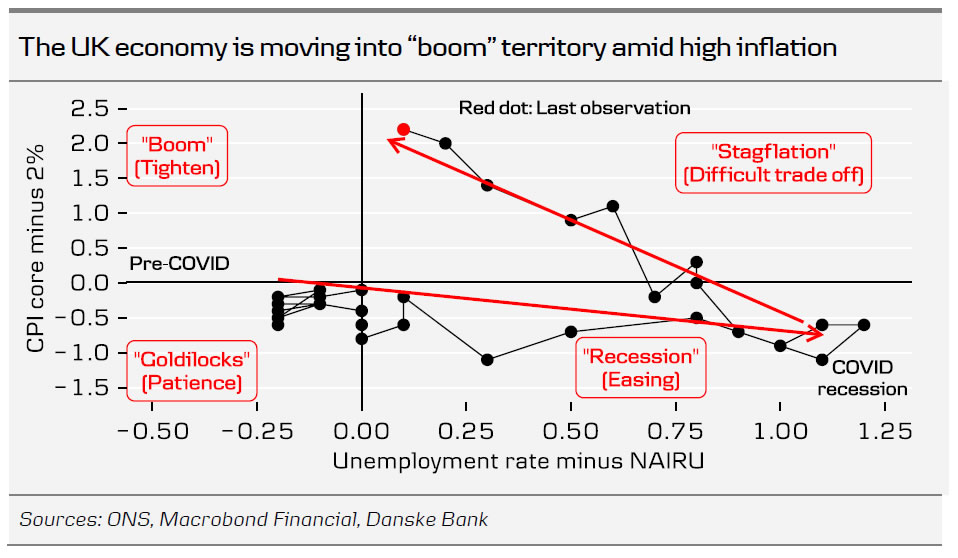
As expected, the Bank of England (BoE) raised the Bank Rate by 25bp to 0.50% and announced the beginning of "passive QT" (ceasing reinvestments of maturing bonds) last week. A major surprise was that four out of nine policymakers voted for a 50bp rate hike sending a hawkish signal to markets that the BoE is very concerned about high inflation.
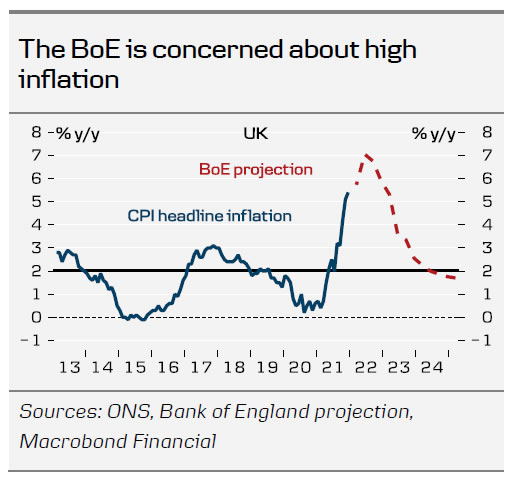
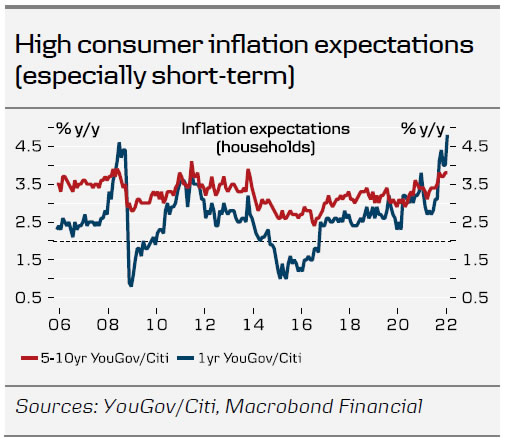
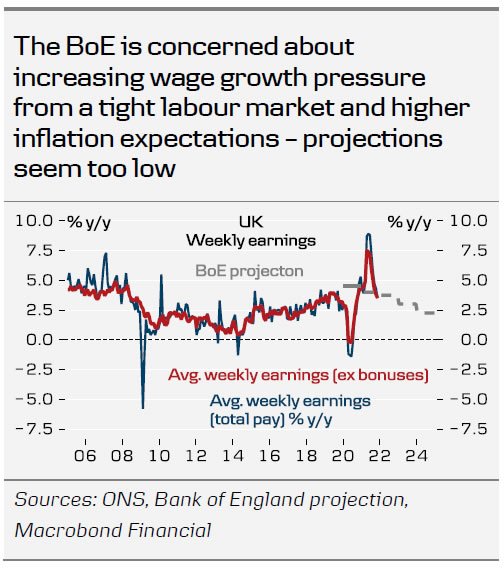
In the Monetary Policy Report, the BoE notices that both short- and long-term inflation expectations are increasing and above past averages. While the BoE said it cannot do much about supply shocks to prices, policymakers are worried that inflation will become more persistent through e.g. higher wage growth. We believe the BoE's wage growth projection is to the low side.
BoE Governor Andrew Bailey, however, pushed slightly against market pricing by saying that it would be a mistake to assume rates are on an inevitable long march up. Also the BoE repeated that "some modest tightening" is needed.
The BoE reaffirmed that it will consider "active QT" (selling government bonds) when the Bank Rate reaches 1.00%. The stock of purchased government bonds is GBP875bn. The BoE also announced it ceases reinvestment of maturing corporate bonds and that it should initiate outright sales, so the stock of purchased corporate bonds is zero no earlier than the end of 2023.The stock of purchased corporate bonds is GBP20bn.
It is noteworthy, however, that the BoE now projects inflation below the 2% target based on market pricing ahead of the meeting. Uncertainty is obviously high forecasting inflation three years from now but it may explain why BoE Governor Andrew Bailey said there is a limit to how much the BoE will hike. Markets are, however, not listening so much to central banks these days, as central banks have underestimated the underlying inflation pressure for quite some time.
Taking everything into account, we now expect the BoE to deliver four additional 25bp rate hikes this year (March, May, August and November) versus two additional hikes previously. Our new BoE call remains slightly less aggressive than markets pricing, where five rate hikes are priced in. We continue to believe that risk is skewed towards more rate hikes (and also a probability of a 50bp rate hike). BoE is now likely to announce some details on "active QT" in connection with the May meeting.
Initially, EUR/GBP fell slightly below 0.83 on the hawkish signal but EUR/GBP is now trading closer to 0.85 supported by the ECB. We are still of the view that the level of around 0.83 was the bottom in the cross, as relative rates now seem more supportive for EUR than GBP, as BoE rate hikes are already priced in and the ECB is turning more hawkish. Overall, we still see the 2022 investment environment as USD-positive, which is usually benefitting GBP relative to EUR, which we believe will dominate slightly. Hence, we continue targeting EUR/GBP at 0.84 in 12M.
Our Bank of England call summarised
We now expect the Bank of England to hike four more times this year (March, May, August and November) versus two previously. Markets are pricing in five rate hikes.
We expect the Bank of England to announce "active QT" (selling government bonds to markets) in May when the Bank Rate reaches 1.00%.
Risks are still skewed towards the Bank of England hiking faster (for instance we cannot rule out a 50bp rate hike in March).
Sunset Market Commentary
Markets
Both European and US bonds took a serious punch end of last week. In Europe it resulted from ECB’s Lagarde stopping short of formally announcing a policy U-turn. The stellar January labour report was responsible for a sharp sell-off wave in the US on Friday. Investors continue selling after the weekend in a fairly uneventful trading session. Moves are more limited though, especially at the short end, and it doesn’t end up in a flattening of the curve anymore. The German Bund still underperforms the US. Changes vary from -2 bps (2y) over 2.2 bps (10y) to 4.5 bps (30y) with real yields still in the driver’s seat. European swap yields add 0.6 bps (2y) to 8 bps (30y). Peripheral spreads continue to widen on the prospect of less monetary stimulus, in some cases very aggressively. Italy adds another 9 bps, bringing the total to 24 bps since the ECB pivot. Greece soars a whopping 25 bps, hitting a cumulative 43 bps since Thursday. US yields decline 1.5 bps at the front end (2y) while adding 1.4-2.1 bps at the other side of the aisle (10y/30y). This week’s focal point will be US CPI inflation on Thursday. A further increase towards 7.3% headline and 5.9% y/y core inflation is expected. Judging today’s US bond moves and taking into account that already more than five hikes are discounted for this year, it’ll probably take a significant beat to keep yields going strongly. We also mention the start of the US Treasury’s mid-month refinancing operation in the new funding quarter, featuring a 3-year, 10-year and 30-year auction tomorrow, Wednesday and Thursday respectively. We expect them to enjoy investor interest after the recent steep rise in yields.
It’s relatively quiet on other financial markets. European stocks eke out a gain of a little over 0.5%. Wall Street opens virtually unchanged (+0.2%). The euro on currency markets is slightly losing out against all majors. EUR/USD eases from 1.145 to 1.1422 but keeps it flat against sterling (EUR/GBP going nowhere at 0.845). The Aussie dollar tops the scoreboard, profiting from a fourth quarter with record retail sales as well as Australia’s PM announcing to reopen borders for tourists after two years. The Polish zloty outperforms peers in the Central European region. EUR/PLN falls through 4.55 to 4.53. The central bank meets tomorrow. Consensus expects another 50 bps rate hike. It would be the absolute minimum not to upset markets given run-away inflation (8.6% headline in December). At EUR/CZK 24.31, the Czech koruna is nearing the strongest level in a decade again. Hungary’s forint trades stable at 353.
News Headlines
Czech industrial output increased by 6.4% in 2021 after having decreased by over 7% in 2020. The production volume increased in an overall majority of economic activities of industry in a virtually even manner. However, due to difficulties in production of motor vehicles, the pre-covid level has not been attained. Car production plants at the end of 2021 continued to struggle with issues in supply chains and increasing prices of materials and energy. The Czech trade balance ended the year with a CZK 1.5bn deficit, coming from a CZK 179.9bn surplus in 2020. Since the beginning of the year, Y/Y exports and imports have grown by 13.0% and 19.2%, respectively.
French President Macron will meet Russian President Putin in Moscow today in an effort to de-escalate the Ukraine crisis. The FT cites advisors that Macron’s approach is to persevere with “Normandy format” talks between Russia, Ukraine, France and Germany over the Russian-backed separatists in eastern Ukraine, to try to persuade Moscow to pull back its forces and tone down its efforts to destabilize Ukraine, and finally to forge a new long-term security arrangement for Europe.
Euro Records Monster Week
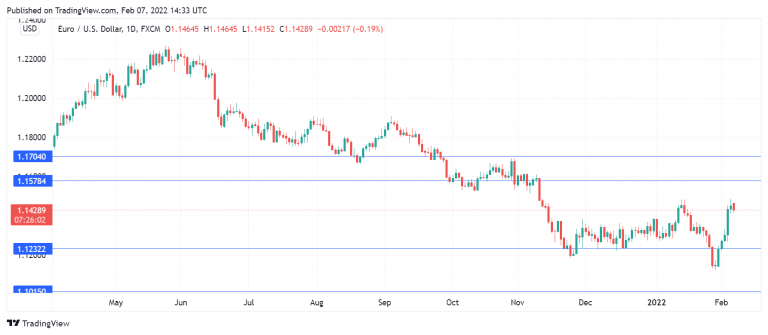
The euro is slightly lower in Monday trading, after an outstanding week of gains. EUR/USD surged 2.71% last week, its best weekly performance since March 2020.
The US nonfarm payrolls for January was a massive surprise to the upside, with a gain of 467 thousand jobs in January. Many analysts had projected a negative print, and the consensus of 125 thousand showed that expectations were quite low. With inflation at 40-year highs, wage pressures are rising. Average hourly earnings climbed 5.7% in January y/y, as workers seek higher wages due to the rise in the cost of living. The strong NFP report supports the argument that the Fed will have to do more in order to stamp out high inflation, which could mean a second rate hike shortly after the expected hike in March.
Eurozone data ended the week on a mixed note. German Factory Orders for December posted a strong gain of 2.8% m/m, easily exceeding the consensus of 0.5%. Eurozone Retail Sales for December slowed to 2.0% y/y, down from 8.2% in November and shy of the forecast of 5.1%. Retail Sales declined by 3.0% m/m, as many consumers did their Christmas shopping early due to shortages stemming from supply disruptions.
The ECB didn’t have to make any huge changes to policy to send the euro rocketing higher last week. All it took was some subtle tweaks in the policy statement, such as omitting the phrasing from previous statements that a rate hike in 2022 was “very unlikely”. The Societe Generale bank stated in a note today that it expected the ECB to wrap up QE in mid-year and projected a rate hike in the second half.
Christine Lagarde’s sharp pivot clearly caught the markets by surprise, as one of the most dovish major central banks has become hawkish in a hurry.
- EUR/USD faces resistance at 1.1510 and 1.1640
- There is support at 1.1233 and 1.1014
Market Sentiment Muted, and Dollar Holds Firm
Markets prepare for ECB Lagarde as calmer tone overshadows prior rollercoaster week
Moving past the previous heavy week of data, this one looks to be much quieter. The market mood is suggesting that the right boxes are getting ticketed for the Fed to move ahead with tightening and a rate hike in March, especially after the huge win in the US labour sector, where the US jobs report improved by 467k, more than quadrupling expectations of 110k in January.
More jobs were created in the hospitality, transportation, professional services and retail trade, despite Omicron pressures and average hourly earnings in January also heated up to 0.7%, beating expectations, and last month’s figure of 0.5%, hinting that wage growth could maybe start to play a major part in inflation.
The US economy is firing on all cylinders with stronger US manufacturing and services PMIs, which now makes Thursday’s US inflation data at 13:30 GMT that more significant for those policymakers that seek aggressive hikes to curtail growing inflationary pressures.
Nonetheless, with interest rate global rhetoric from central banks gaining more fans as the world starts to look at the coronavirus pandemic in its rear mirror, it will be interesting to see which economies start to outperform.
US stock futures are flat, and the greenback remains on the back foot in the forex arena at the beginning of this week. The dollar index has stabilized, finding its feet around the 95.40 level after a decline that began at the end of January from 97.41. Gold is faring well at $1,815/oz given the rise in the 10-year yield to 1.92% following Friday’s US payroll report shock. Keep in mind the 2-year yield also remains elevated at 1.33%. The elevated rates have kept the pound on the back foot but not so much the euro, especially after the BoE and ECB hawkish stances.
The yen is sustaining its broader neutral-to-bullish tone but has slipped just beneath the 115.00 per dollar mark intraday wise, with the swiss franc strengthening a tad, driving the USD/CHF pair lower to 0.9230.
Sterling resilience and ECB President Lagarde at centre stage
The euro has returned to Asian session levels of $1.1460, consolidating slightly below its mid-January high of $1.1480 after ECB President Lagarde commented last week on a possible hike this year, which has nudged market tightening expectations higher. The pair is consolidating in this region ahead of the scheduled hearing where madame Lagarde will speak before the European Parliament Economic and Monetary Affairs Committee at 13:45 GMT. So given her previous comments there could be some movements in the euro today.
The pound has recouped 50% of its 60 pip intraday losses and is standing at $1.3520 after a large miss in the Halifax house price index (HPI), which came in at 0.3%, compared to January expectations of 0.9%.
Despite highest inflation in 30 years, the UK’s employment is strong, and the economy has dealt well with the Omicron variant, shown in the UK retail sales. The first back-to-back hikes since 2004 to 0.50% from the Bank of England has failed to underpin the pound for now, with rising cost pressures weighing on households.
The EURGBP cross stretched to the 0.8470 level.
Oil and the antipodeans ahead
The antipodean currencies were the best performers today with the aussie up 0.61% just above 0.7100 per dollar, and the kiwi up 0.31% at 0.6623 per dollar at time of writing. WTI oil futures at $92.40 per barrel have returned near Asian trading session levels.
ECB President Lagarde is scheduled to speak at 15:45 GMT.