Sample Category Title
Sunset Market Commentary
Markets
The day after. Markets are still digesting the Fed’s determination to kill off high inflation. The rate kickoff is in March and we assume the central bank wants to move fast by hiking at least four times consecutively. This process will soon (June?) be accompanied by a natural roll-off of the balance sheet. Testament to the strong economy chair Powell referred to justifying the Fed’s tough approach, US Q4 GDP growth came in at 6.9% q/q annualized, topping a 5.5% consensus. A huge inventory build-up added 4.9 percentage points to the figure. It’s a consequence of companies restocking after burning through their inventories amid supply shortages to keep up with high demand. Personal consumption added a solid 2.25 ppt. Meanwhile, investors keep raising bets for a bigger than usual (>25 bps) hike on March 16 (30 bps priced in). Short-term US yields advance further today, adding almost 5 bps in the 2y-maturity before paring some gains in early US dealings. The long end of the curve rebounds after selling off yesterday, with yields declining 5 to 6.9 bps in the 10y and 30y. Aggressive Fed repositioning spills over into Europe with money markets pricing in almost 20 bps of rate hikes by end this year. Investors assume the ECB is unable to keep looking the other way after the Fed put its cards on the table. We fear they might be in for a disappointment next week. For now however, it helps the German yield curve bear flatten. Changes range from 3.3 bps (2y) over 4.1 bps (5y) to 2.3 bps (10y). European swap yields rise in similar fashion. Peripheral yields narrow several bps. Italy (-5 bps) and Greece (-4 bps) outperform.
European equity markets gapped lower following WS’s intraday setback but recovered during the day to trade about 0.6% higher (EuroStoxx50). Active dip-buyers push indices in the US >1% higher. Currency markets, the euro in particular, have long been and still are reluctant to anticipate central bank action as long as there’s no clear commitment to do so. That’s why the euro today fails to bank on euro area money markets piling up pressure on the ECB while the USD builds on yesterday’s Fed-driven gains. The trade-weighted greenback jumps beyond resistance of 96.94 (previous recovery high) to trade at 97.23 currently. It paves the way towards 97.72 (61.8% retr. of the 03/20 high - 01/21 low, June 2020 correction high) from a technical point of view. EUR/USD broke parallel support by the November 21 low (1.1186) and immediately slipped below next, intermediate, support at 1.1163 to trade at 1.1152. UK yields also advance several bps across the curve in the wake of the Fed. The short end underperforms as a March BoE rate hike is almost considered a done deal (95% chance discounted). Sterling is not flourishing per se but it does have the upper hand vs the euro with technical breaks in EUR/USD obviously not helping. EUR/GBP eases from 0.835 to 0.833. The pound is no match for the dollar. Cable (GBP/USD) tests the 1.34 big figure (1.3378).
News Headlines
The Hungarian central bank (MNB) followed up on this week’s 50 bps rate hike of the base rate (2.4% to 2.9%) with a 30 bps hike of the 1-week deposit rate (4% to 4.3%). The MNB clearly stated its intention to close the gap between the two in coming months and reinstall its base rate as the prime rate. It’s the most effective tool to tackle inflationary pressures while the deposit rate is better suited to stem financial stability issues and help stabilize the currency. The forint enjoyed the MNB boost today. In combination with rebounding risk sentiment, EUR/HUF declines from 360 towards 357. The Hungarian unemployment rate stabilized at expected at 3.7% in December, the lowest level since March 2020.
The fourth attempt to elect a new Italian president failed as well even if the threshold dropped from a two-thirds to a simple majority. The right-wing block abstained while the centre-left one cast blank ballots. Italian political leaders agreed to buy time in their search of an alternative candidate to current PM Draghi. They fear political instability if Draghi gets “promoted” from PM to president.
US GDP: Growth Jumps 6.9% as Businesses Rebuild Inventories
The U.S. economy surged ahead 6.9% (annualized) in the fourth quarter, slightly above consensus expectations. Overall, the economy rebounded 5.7% in 2021, more than recouping 2020's 3.4% contraction.
Inventory rebuilding accounted for 71% of growth, contributing an impressive 4.9 percentage points to the headline tally. The increase was led by retail and wholesale trade industries, with retail inventories of motor vehicle dealers leading the way.
Consumer spending grew at a solid 3.3% annualized, up from a 2% pace in Q3. Spending on durable goods gained ground, rising 1.6% in Q4,after a sizeable 25% giveback in Q3. Services grew at a healthy 4.7%, lead by health care, recreation and transportation. Spending growth on areas sensitive to rising Covid-19 cases slowed, but we will see more details on the monthly pattern when that data is released tomorrow.
Business investment rose 2.0% annualized, weighed down by an 11.4% drop in nonresidential structures. Spending on equipment was up modestly (0.8%), while outlays on intellectual property products did the heavy lifting, up 10.6% in Q4. Investment has been shifting from tangible to intangible for some time, with investment in structures falling in eight of the last nine quarters.
Residential investment was down slightly in the fourth quarter (-0.8%). Like spending on consumer durables and business equipment, residential investment grew at an unsustainable pace earlier in the pandemic and is 13% higher than pre-pandemic levels.
Government spending fell back 2.9% driven by lower spending at both the federal and state and local levels.
Exports rebound sharply in Q4 (+24.5%) from a decline in Q3. Imports were also up strongly (+17.7%). On net, trade neither added to nor subtracted from growth. Export gains were widespread, with the gain in services exports led by travel. The increase in imports was led by goods (non-food and non-automotive consumer goods, as well as capital goods).
No surprise, price pressures were up strongly in Q4. The core PCE deflator rose 4.3% on an annualized quarter-over-quarter basis (versus 4.3% in Q2).
Key Implications
The impressive headline growth tally was boosted by inventory restocking, which while necessary, is not likely to be repeated to the same pace next quarter. Growth in final domestic demand was a more modest 1.9%. Overall growth in 2021 was impressive, but that masked a year that had two very different halves. The first half of the year was dominated by post-vaccine re-opening and fiscal stimulus, where two rounds of direct payments to Americans and newfound confidence with vaccination boosted domestic demand to ~9% annualized pace. In the second half of the year, domestic demand slowed to 1.6% as capacity constraints increasingly dampened activity.
The surge in infections due to the Omicron variant played a role in the softening in consumer spending towards the end of Q4. We await the details on that in tomorrow's monthly PCE data, which will set the stage for what kind of momentum the economy had heading into 2022. The first quarter of the year is likely to see some consumer weakness due to Omicron, but demand is likely to pick up through the quarter.
Abstracting from the inventory swings, final domestic demand is likely to be stronger in the first half of 2022 than it was in the latter half of 2021, underscoring an economy that no longer requires emergency levels of monetary stimulus.
Euro Rattled as Fed Sends Hawkish Message
What started off as a calm week has turned into a rout. The euro is down 0.83% in the North American session and has fallen into 1.11 territory for the first time since June 2020. The currency has taken a nasty spill this week, falling a massive 1.73%.
US GDP outperforms
The markets are still buzzing over the hawkish Fed meeting, which has overshadowed today’s stellar US GDP report. GDP for Q4 expanded by 6.9%, exceeding the consensus of 5.5% and up from 2.3% in Q3. The GDP Price Index came in at 7.0%, beating the forecast of 6.0%. The stellar data points to a strong US economy despite the Omicron wave and has contributed to the US dollar’s rally.
The Fed had a hawkish message for the markets, sending equities lower but boosting the US dollar. Fed Chair Powell was careful not to get pinned down on a timeline for rate hikes, although the markets are betting on a March lift-off. According to CME FedWatch, the likelihood of a 25-bps hike stands at 83%, with a 50-bps move increasing to 16%. The Fed was also vague about a date for reducing the balance sheet, with the FOMC statement noting that the reduction would start after the benchmark rate is increased.
Powell sounded hawkish during his press conference after the meeting, and as a result, equities were falling and US Treasury yields were rising as he was talking. Powell said that inflation risks remain to the upside in his view, and there is a risk that high inflation will be prolonged and could move even higher. The 10-year yield rose to 1.83% and moved slightly higher today before retreating.
Powell has been walking a tightrope, trying to assure markets that the Fed will bring inflation back below 2%, without being overly aggressive in tightening, which could cause a recession. Based on the panicky reaction from the financial markets after the Fed meeting, the Fed Chair has more work to do in reassuring the markets that the Fed is on the right path.
EUR/USD Technical
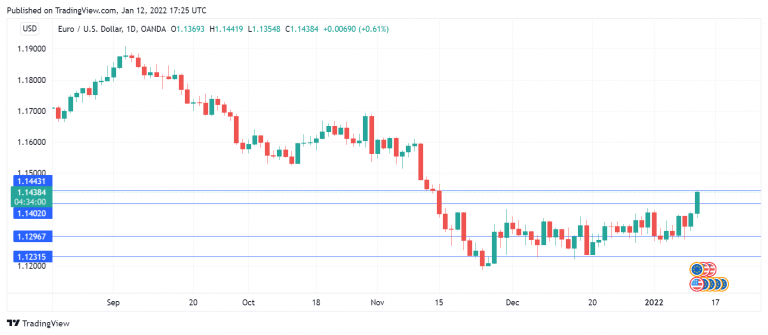
- EUR/USD continues to break below support lines and is testing below 1.1226. Below, there is support at 1.1152
- There is resistance at 1.1359 and 1.1418
Fed’s ‘Hawkish’ Tone Sends Dollar Surging
Powell signals a rate hike in March
The first FOMC meeting of 2022 was concluded on Wednesday, with the Fed Chair Jerome Powell setting the stage for a March rate hike, declining to rule out more frequent and larger rate increases. Powell also struck a pessimistic tone regarding the recovery of supply chain disruptions, which are currently driving inflation. However, even if supply bottlenecks subside, the ongoing wage-price spiral could keep inflation elevated throughout 2022, keeping monetary tightening pressures high.
The US dollar jumped in the aftermath of the FOMC meeting, reaching an 18-month high against a basket of currencies on Thursday. The move was mainly boosted by the increase of short-dated Treasury yields. Earlier today, the advance US GDP print for the fourth quarter clocked in at 6.9% beating consensus estimates of 5.5%, reflecting the strong stance of the US economic growth outlook.
No rate hike for BoC
The Bank of Canada announced on Wednesday that it will keep its interest rates at rock-bottom levels, despite the market’s expectations for an early rate hike. However, the Canadian dollar managed to hold relatively steady against the greenback as commentary pointed to a March rate hike and set the stage for multiple rate increases throughout 2022.
In the rest of the FX arena, the kiwi witnessed significant losses against the US dollar, failing to capitalize on New Zealand's stronger-than-expected CPI figures. The euro also took a heavy beating against the dollar, reaching an 18-month low at the time of writing.
US stocks headed for opening gains
On Wednesday, US stocks finished mostly lower in a volatile trading session as investors digested Powell’s late comments. The S&P 500 index erased an early advance of over 2%, closing the day lower by 0.2%, while the Nasdaq Composite remained little changed. Looking ahead, the tightening pace should not spread further fear over the markets as the US economic expansion remains strong and the market's anticipated interest rate of 1.25% by the end of 2022 is still considered an accommodating monetary policy rate.
Futures for the major US indices are expected to witness opening gains, recovering from an early day slump of 2.2%, indicating that after a volatile week, buy-the-dip sentiment remains strong. In Europe, the Stoxx 600 index is in positive territory erasing early losses, while Hong Kong’s Hang Seng index closed 2% lower. Meanwhile, oil continued its advance on Thursday reaching a seven-year high at the time of writing as geopolitical tensions in Eastern Europe escalated.
Microsoft tops expectations
Microsoft’s stock added 2.9% on Wednesday after the tech giant topped analyst’s expectations and offered a positive growth outlook for its cloud service segment. Meanwhile, Intel fell by almost 3% in pre-market trade as the company’s earnings guidance disappointed investors. In today's earnings, Apple and Visa will take center stage announcing their results after Wall Street’s closing bell.
USD/JPY Mid-Day Outlook
Daily Pivots: (S1) 114.07; (P) 114.38; (R1) 114.99; More...
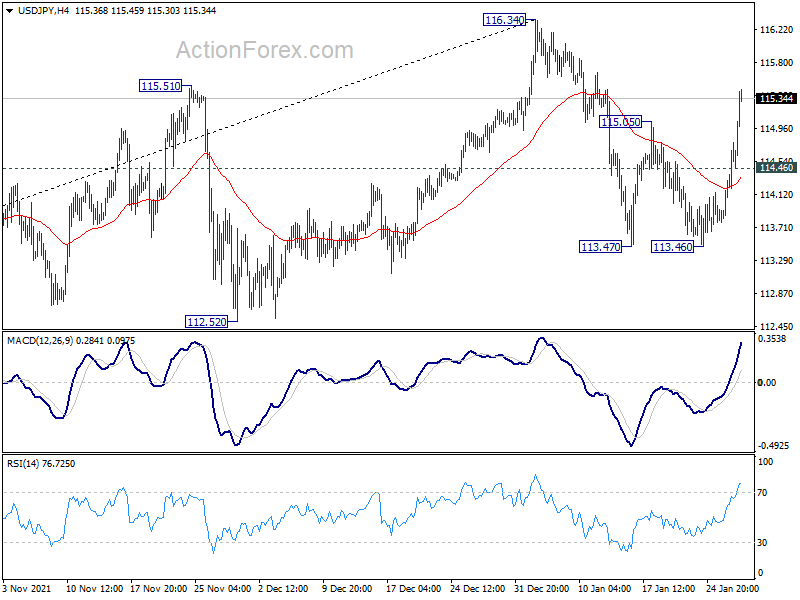
USD/JPY's break of 115.05 resistance suggests that pull back from 116.34 has already completed. The development also revives near term bullishness. Intraday bias is back on the upside for retesting 116.34 high first. Firm break there will resume larger up trend for 118.65 long term resistance next. On the downside, below 114.46 minor support will mix up the near term outlook and turn intraday bias neutral again.
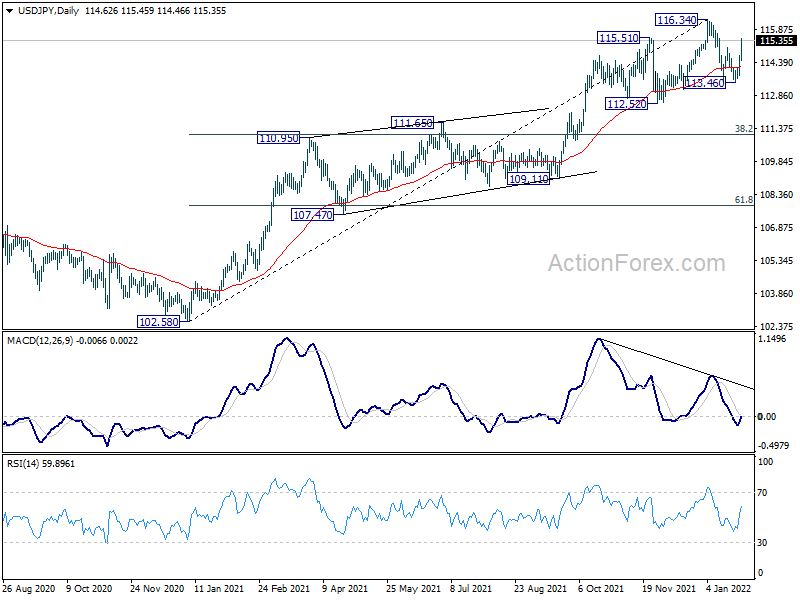
In the bigger picture, no change in the view that rise from 102.58 is the third leg of the up trend from 101.18 (2020 low). Such rally should target a test on 118.65 (2016 high). Sustained break there will pave the way to 120.85 (2015 high) and raise the chance of long term up trend resumption. This will remain the favored case as long as 55 week EMA (now at 110.91) holds.
USD/CHF Mid-Day Outlook
Daily Pivots: (S1) 0.9194; (P) 0.9220; (R1) 0.9268; More....
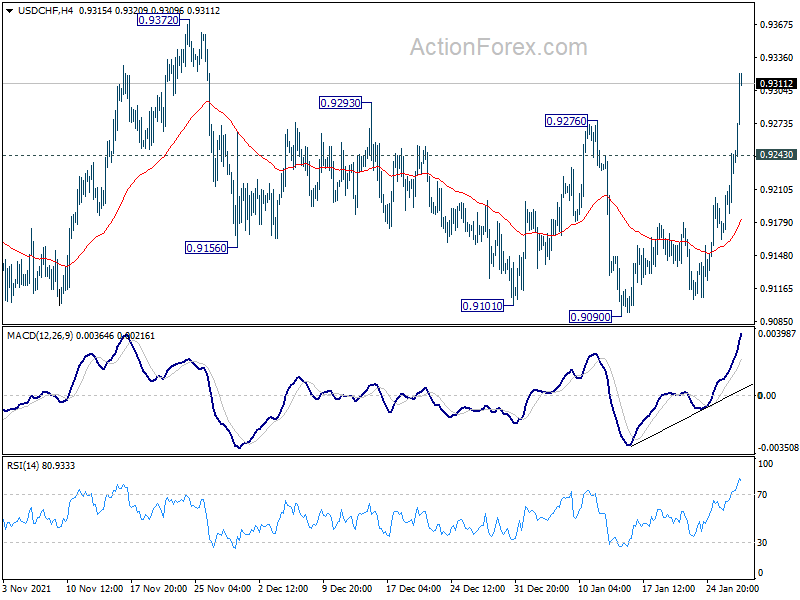
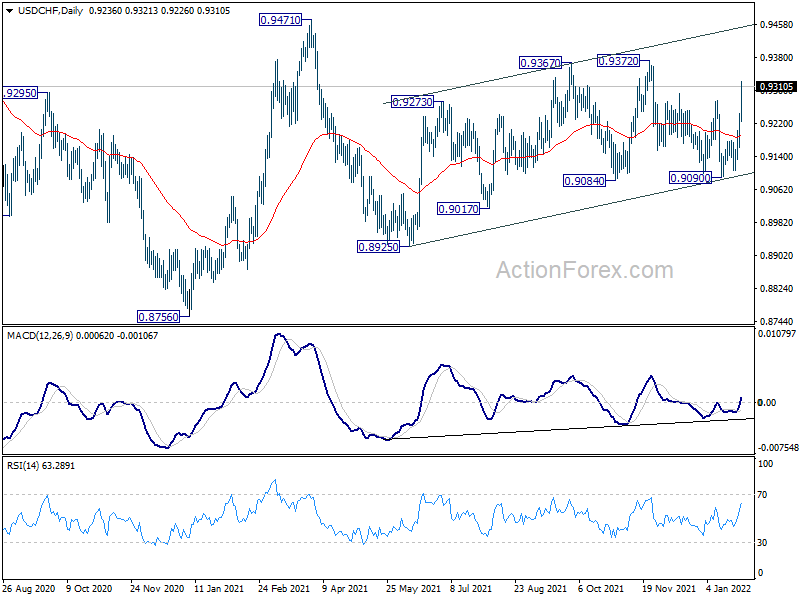
USD/CHF's break of 0.9276 resistance suggests that pull back from 0.8925 has completed already. Intraday bias is on the upside for 0.9372 first. Firm break there will target 0.9471 resistance next. On the downside, below 0.9243 minor support will turn intraday bias neutral first.
In the bigger picture, the corrective structure of the rebound from 0.8925 argues that fall from 0.9471 is not complete yet. It could either be the second leg of pattern from 0.8756 (2021 low), or resuming larger down trend from 1.0237 (2018 high). We'd pay attention to the downside momentum and assess the odds later. But for now, medium term outlook will be neutral at best as long as 0.9471 resistance holds.
GBP/USD Mid-Day Outlook
Daily Pivots: (S1) 1.3431; (P) 1.3478; (R1) 1.3511; More...
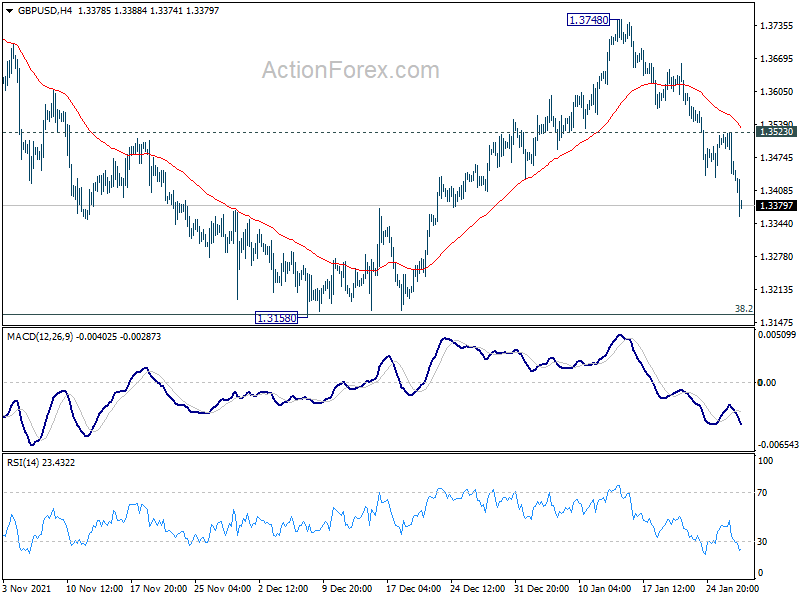
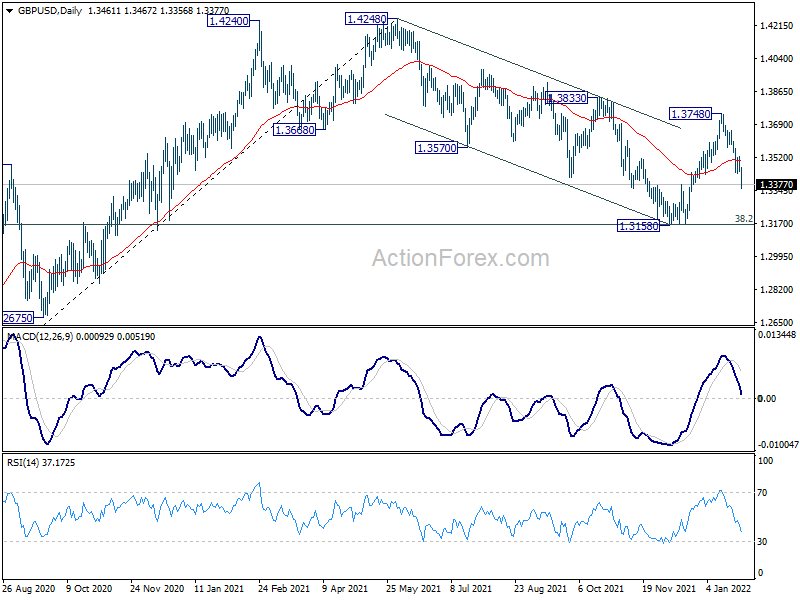
Intraday bias in GBP/USD remains on the downside at this point. As noted before, rebound from 1.3158 could have completed at 1.3748 already. More importantly, larger fall from 1.4282 is probably not over yet. Intraday bias is back on the downside for retesting 1.3158 first. On the upside, though, above 1.3523 minor resistance will turn bias back to the upside for retesting 1.3748.
In the bigger picture, strong support was seen from 38.2% retracement of 1.1409 to 1.4248 at 1.3164. The development suggests that up trend from 1.1409 (2020 low) is still in progress. On resumption, next target will be 38.2% retracement of 2.1161 to 1.1409 at 1.5134. Nevertheless sustained break of 1.3164 will argue that whole rise from 1.1409 has completed and bring deeper fall to 61.8% retracement at 1.2493.
EUR/USD Mid-Day Outlook
Daily Pivots: (S1) 1.1216; (P) 1.1263; (R1) 1.1291; More...
EUR/USD's break of 1.1185 support confirms resumption of whole down trend from 1.2348. Intraday bias stays on the downside for 61.8% projection of 1.1908 to 1.1185 from 1.1482 at 1.1035. Break will target 100% projection at 1.0759. On the upside, above 1.1243 minor resistance will turn intraday bias neutral first. but recovery should be limited well below 1.1482 resistance to bring down trend resumption.
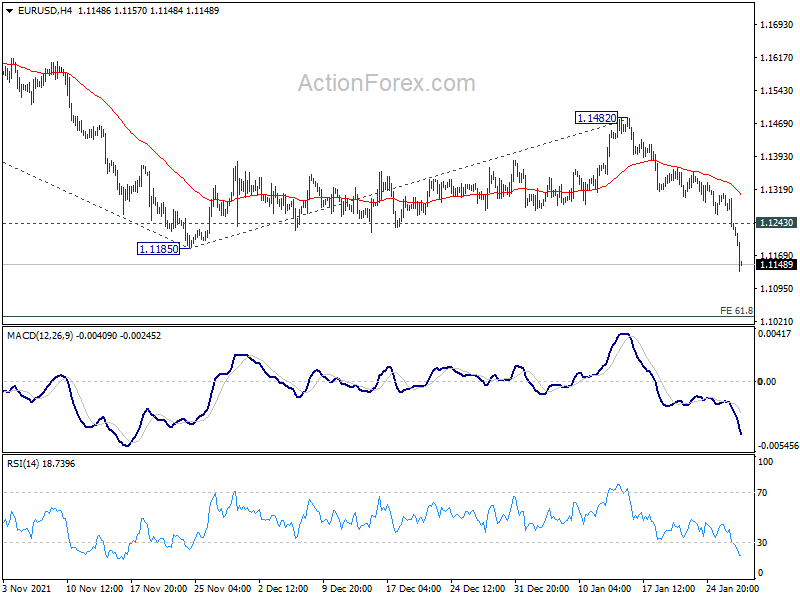
In the bigger picture, there are various ways of interpreting the fall from 1.2348 (2021 high). It could be a correction to rise from 1.0635 (2020 low), the fourth leg of a sideway pattern from 1.0339 (2017 low), or resuming long term down trend. In any case, outlook will now stay bearish as long as 1.1482 resistance holds. Next target would be 1.0635 low.
Dollar Extends Strong Rally after GDP, Euro Downside Breakout
Dollar's strong post-FOMC rally is given another boost in early US session by much better than expected Q4 GDP data. Latest jobless claims figures also suggest stabilization from the impact of Omicron. But for now, the strength is mainly centered against European majors and Yen. Canadian Dollar is indeed lifted slightly as oil prices extend recent up trend. In other markets, US future bent upward from earlier slump and now point to recovery. Gold is pressing 1800 handle while WTI oil at around 88.8.
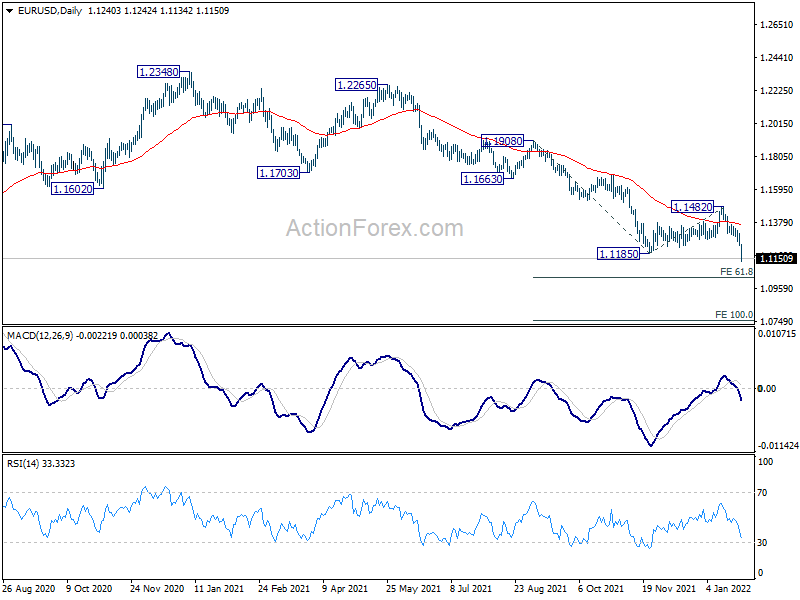
Technically, EUR/USD's break of 1.1185 support confirms resumption of down trend from 1.2348. USD/JPY's break of 115.05 minor resistance revives near term bullishness. Focuses are now on 1.3158 low in GBP/USD, 0.6692 low in AUD/USD and 115.05 high in USD/JPY to further confirm Dollar's underlying bullishness.
In Europe, at the time of writing, FTSE is up 0.88%. DAX is up 0.04%. CAC is up 0.15%. Germany 10-year yield i up 0.025 at -0.048. Earlier in Asia, Nikkei dropped -3.11%. Hong Kong HSI dropped -1.99%. China Shanghai SSE dropped -1.78.% Singapore Strait Times dropped -0.35%. Japan 10-year JGB yield rose 0.0192 to 0.159.
US GDP grew 6.9% annualized in Q4, well above expectations
US GDP grew at 6.9% annualized rate in Q4, faster than Q3's 2.3%, well above expectation of 5.6%. The increase in real GDP primarily reflected increases in private inventory investment, exports, personal consumption expenditures (PCE), and nonresidential fixed investment that were partly offset by decreases in both federal and state and local government spending. Imports, which are a subtraction in the calculation of GDP, increased.
For 2021 as a whole, real GDP grew 5.8% The increase in real GDP in 2021 reflected increases in all major subcomponents, led by PCE, nonresidential fixed investment, exports, residential fixed investment, and private inventory investment. Imports increased.
US durable goods orders dropped -0.9% mom in Dec, led by transportation equipment
US durable goods orders dropped -0.9% mom, or USD -2.4B to USD 267.6B in December, worse than expectation of -0.5%. Ex-transport orders rose 0.4% mom, above expectation of 0.5% mom. Ex-defense orders rose 0.1%. Transportation equipment dropped USD -3.3B, or -3.9% mom to USD -80.1B.
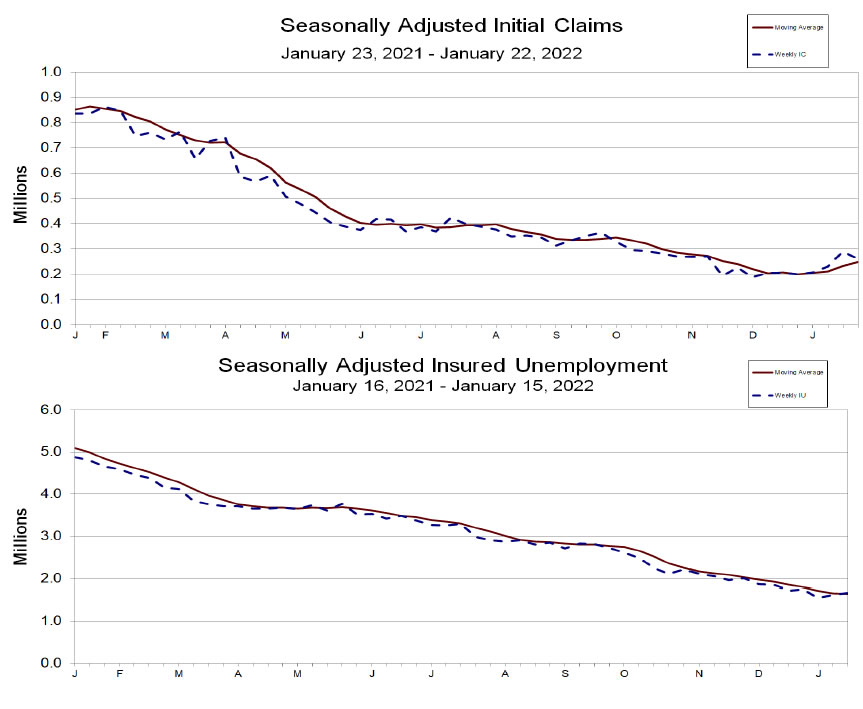
US initial jobless claims dropped to 260k, matched expectations
US initial jobless claims dropped -30k to 260k in the week ending January 22, matched expectations. Four-week moving average of initial claims rose 15k to 247k.
Continuing claims rose 51k to 1675k in the week ending January 15. Four-week moving average of continuing claims dropped -11k to 1652k, lowest since August 18, 1973.
Swiss exports rose to record in 2021, US became largest buyer
Swiss trade surplus came in at CHF 3.69B in December, below expectation of CHF 5.23B. For 2021 as a whole, exports rose 15.2% to a new record high at CHF 259.5B. Imports rose 10.1% to CHF 200.8B. Trade surplus swelled to CHF 58.7B.
Also, the FOCBS said US became Switzerland's largest buyer in 2021. Foreign trade with China rose to new high. Double-digit growth rates were observed in deliveries to Europe (+18.1%, or +21.9B) and North America (+17.0%, or +7.4B). Shipments to Asia were also up by 9.0%, or CHF 4.4B.
Germany Gfk consumer sentiment rose to -6.7, assuming pandemic to ease in spring
Germany Gfk Consumer Sentiment for February rose 0.2 pts to -6.7, better than expectation of -8.0. In January, economic expectations rose from 17.1 to 22.8. Income expectations rose from 6.9 to 16.9. Propensity to buy rose from 0.8 to 5.2.
"Despite rising incidences and inflation, consumers are once again showing some optimism at the beginning of the year. In particular, they are hoping for a slight alleviation in price trends, as in January 2022 the base effect resulting from the January 2021 reversal of the VAT cut will mitigate the inflation rate to some degree. Nevertheless, consumers price expectations remain significantly higher than in recent years.", explains Rolf Bürkl, GfK consumer expert. "In addition, experts assume that the pandemic situation would ease in the spring, which will lead to a number of restrictions being removed."
New Zealand CPI surges to 5.9% yoy, NZD/USD dives on risk aversion
New Zealand CPI rose 1.4% qoq in Q4, above expectation of 1.2% yoy. Annual rate accelerated from 4.9% yoy to 5.9% yoy, above expectation of 5.6% yoy. That's the highest level in three decades since 1990.
"New Zealand is not alone, with many other OECD countries experiencing higher inflation than in recent decades," consumers prices senior manager Aaron Beck said. "Price increases were widespread with 10 out of 11 main groups in the CPI basket increasing in the year, with only the communications group decreasing."
EUR/USD Mid-Day Outlook
Daily Pivots: (S1) 1.1216; (P) 1.1263; (R1) 1.1291; More...
EUR/USD's break of 1.1185 support confirms resumption of whole down trend from 1.2348. Intraday bias stays on the downside for 61.8% projection of 1.1908 to 1.1185 from 1.1482 at 1.1035. Break will target 100% projection at 1.0759. On the upside, above 1.1243 minor resistance will turn intraday bias neutral first. but recovery should be limited well below 1.1482 resistance to bring down trend resumption.
In the bigger picture, there are various ways of interpreting the fall from 1.2348 (2021 high). It could be a correction to rise from 1.0635 (2020 low), the fourth leg of a sideway pattern from 1.0339 (2017 low), or resuming long term down trend. In any case, outlook will now stay bearish as long as 1.1482 resistance holds. Next target would be 1.0635 low.
Economic Indicators Update
| GMT | Ccy | Events | Actual | Forecast | Previous | Revised |
|---|---|---|---|---|---|---|
| 21:45 | NZD | CPI Q/Q Q4 | 1.40% | 1.20% | 2.20% | |
| 21:45 | NZD | CPI Y/Y Q4 | 5.90% | 5.60% | 4.90% | |
| 23:30 | AUD | Westpac Leading Index M/M Dec | 0.00% | 0.10% | 0.20% | |
| 00:30 | AUD | Import Price Index Q/Q Q4 | 5.80% | 1.40% | 5.40% | |
| 07:00 | EUR | Germany Gfk Consumer Confidence Feb | -6.7 | -8 | -6.8 | -6.9 |
| 07:00 | CHF | Trade Balance (CHF) Dec | 3.69B | 5.23B | 6.16B | 6.10B |
| 13:30 | USD | Initial Jobless Claims (Jan 21) | 260K | 260K | 286K | 290K |
| 13:30 | USD | GDP Annualized Q4 P | 6.90% | 5.60% | 2.30% | |
| 13:30 | USD | GDP Price Index Q4 P | 6.90% | 6.00% | 6.00% | |
| 13:30 | USD | Durable Goods Orders Dec | -0.90% | -0.50% | 2.60% | |
| 13:30 | USD | Durable Goods Orders ex Transportation Dec | 0.40% | 0.50% | 0.90% | |
| 15:00 | USD | Pending Home Sales M/M Dec | -0.20% | -2.20% | ||
| 15:30 | USD | Natural Gas Storage | -205B | -206B |
US initial jobless claims dropped to 260k, matched expectations
US initial jobless claims dropped -30k to 260k in the week ending January 22, matched expectations. Four-week moving average of initial claims rose 15k to 247k.
Continuing claims rose 51k to 1675k in the week ending January 15. Four-week moving average of continuing claims dropped -11k to 1652k, lowest since August 18, 1973.