Sample Category Title
Fed Fallout Set to Run Further
- Fed Chair Powell open to raising rates faster
- S&P 500 is likely to confirm technical correction
- Growth stocks and gold susceptible to more aggressive Fed
- Rising policy error risk could spur safe havens
Market screens worldwide are bathed in red as investors and traders worldwide come to terms with the Fed’s willingness to be more aggressive in getting inflation under control.
Asian stocks are falling alongside European and US futures, which should see the S&P 500 re-enter correction territory. Yields on the 10-year US Treasury are cooling slightly after yesterday’s spike towards the 1.90% mark, although the benchmark dollar index (DXY) is still pushing higher at the time of writing. The buck’s surge has already contributed to spot gold’s largest single-day drop since November, as the precious metal gets dragged closer to the $1800 mark.
Markets ramp up Fed tightening timeline
The jitters in equity markets were already on show at the start of the week when the VIX spiked to its highest level since October 2020. Fed Chair Jerome Powell’s latest hawkish pivot has coerced markets into believing that looming rate hikes could happen more frequently and the Fed balance sheet reduction will happen sooner-than-expected. Such a scenario may have well jarred the trapdoor below risk assets wider.
Since the start of the week, markets have now fully priced in an extra Fed rate hike by February 2023, bringing the tally to five over the next 12 months. The tightening cycle is expected to kick off in March, with Chair Powell implying as much at his press conference. There’s even the chance that the FOMC raises rates by 50-basis points at the next meeting, double the customary 25-basis point moves, if elevated inflation continues. The central bank will then commence its quantitative tightening after raising rates. The earlier-than-expected withdrawal of the Fed’s supportive polices and potentially faster pace of rate hikes suggests there’s more room for equities to fall.
Fed speak, inflation data might trigger even more volatility
In between FOMC meetings, policymakers and market participants are set to be data-dependent, keeping a watchful eye on the latest signals on consumer prices and adjusting their US monetary policy outlooks accordingly. The commentary out of Fed officials will also be gleamed for clues for policymakers’ biases towards monetary policy tightening.
Notable shifts in this hawkish narrative are set to trigger further bouts of volatility until markets can come to terms with higher rates. More aggressive revisions to the Fed policy outlook would leave tech and growth stocks susceptible to further declines while the greenback could advance to new cycle highs on the back of rising Treasury yields, at the expense of gold prices.
However, with key yield curves flattening further on the back of the latest FOMC meeting, markets are increasingly wary on the prospects of a Fed policy mistake that curtails growth in the world’s largest economy. If these concerns are taken up a notch, that could spur demand for safe haven assets.
Daily Technical Analysis
EUR/USD
During the last session, the pair overcame the support at 1.1287, while after the Fed meeting it tested the key area at around 1.1235. In the early hours of today, the area is breached and a daily closing below this level would open the possibility for deeper declines towards 1.1000. The support at 1.1235 is the foundation of a range that lasted for about two months, which implies a large volume of positions and a correspondingly strong movement upon leaving the area. A potential support for the bulls may be the area at around 1.1180, but the expectations for an interest rate hike in the U.S. are in favour of the bears. The forecasts for new declines remain and the reaction of prices around the zone at 1.1235 will be key for the development of the next directional movement. Today, an increase in activity can be expected around the announcement of the GDP data for the United States at 13:30 GMT.
USD/JPY
The dollar rose in the past session and the pair managed to break the structure formed at around 114.00. The bulls seem to be trying to reverse the trend as the market is currently in a complex pullback. It is possible that the resistance at 114.68 will also be beached. The next zones at 115.00 and 115.63 are controlled by the bears and both levels have been tested and confirmed. With a breach of 114.68, prices could form a small range above 115.00, the exiting of which would decide the next impulse movement for the pair. If the bears prevail, then a breach of 113.48 is possible. Alternatively, if the bulls end up dominating the market, then new highs above 116.16 can be expected.
GBP/USD
The retracement of the Cable was limited by the resistance at 1.3520 and at the end of yesterday's session, a wave of sell-offs took prices towards a test of the support at 1.1344. The expectations are that the zone will be breached following several attempted tests and that the declines may deepen towards the support at 1.3370. Any attack by the bulls should be limited to the level of 1.3520 or of 1.3570.
EUGERMANY40
The German index ended yesterday's session in the green, but in the early hours of today, prices corrected almost all of the gains. Key support is the area at around 15000, and a daily close below it would provoke new declines towards 14800 and even 14400. If the bulls manage to keep prices above 15273, then they may be able to attack the next resistance at 15587 as well. The expectations are for volatility to remain high in the upcoming days.
US30
The U.S. blue chips also sank at the end of yesterday's session. The Fed meeting failed to calm the markets and the expectations of feeble growth did not attract the bulls to buy the dip. The first support is the zone at 33420, followed by the weekly low at 33144. Hopes for a relief rally seem to be waning, as for this to happen, prices would first have to stay above 34000. The downtrend seems strong and its integrity would be breached if prices jump over 34800.
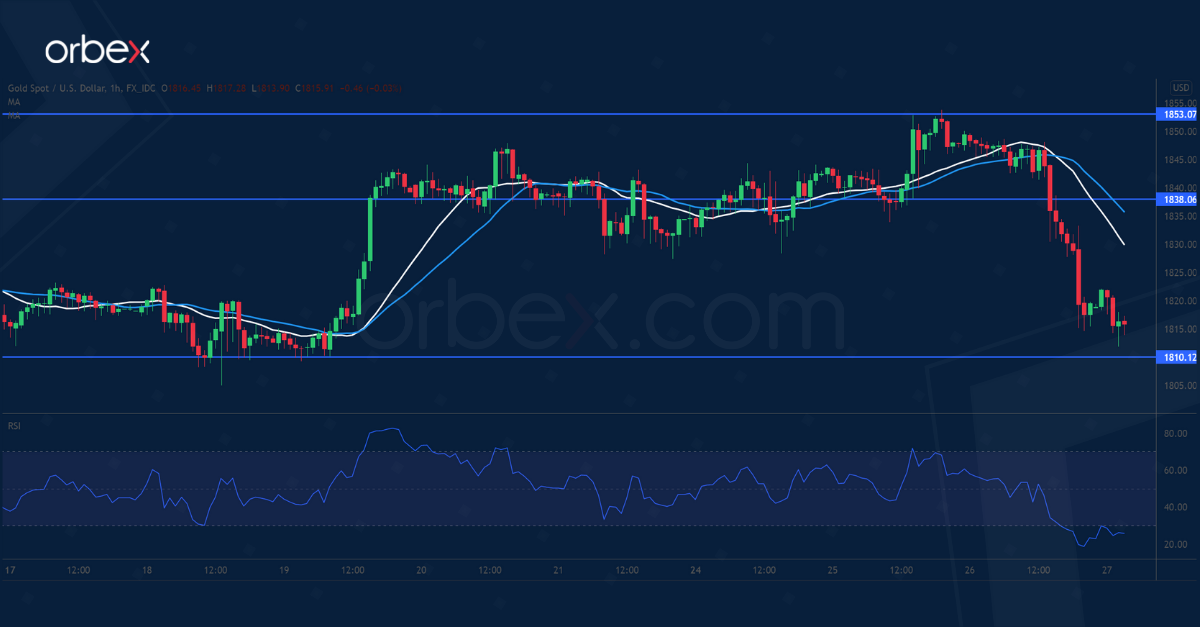
XAU/USD Pulls Back for Support
Gold tumbled after the US Fed signaled it may raise interest rates in March. The rally stalled at 1853 and a break below the resistance-turned-support at 1830 flushed some buyers out.
1810 at the base of the previous bullish breakout is a second line of defense. The short-term uptrend may still be intact as long as the metal stays above this key support.
A deeper correction would drive the price down to the daily support at 1785. The bulls need a rebound above 1838 to regain control of price action.
NZD/USD Continues Lower
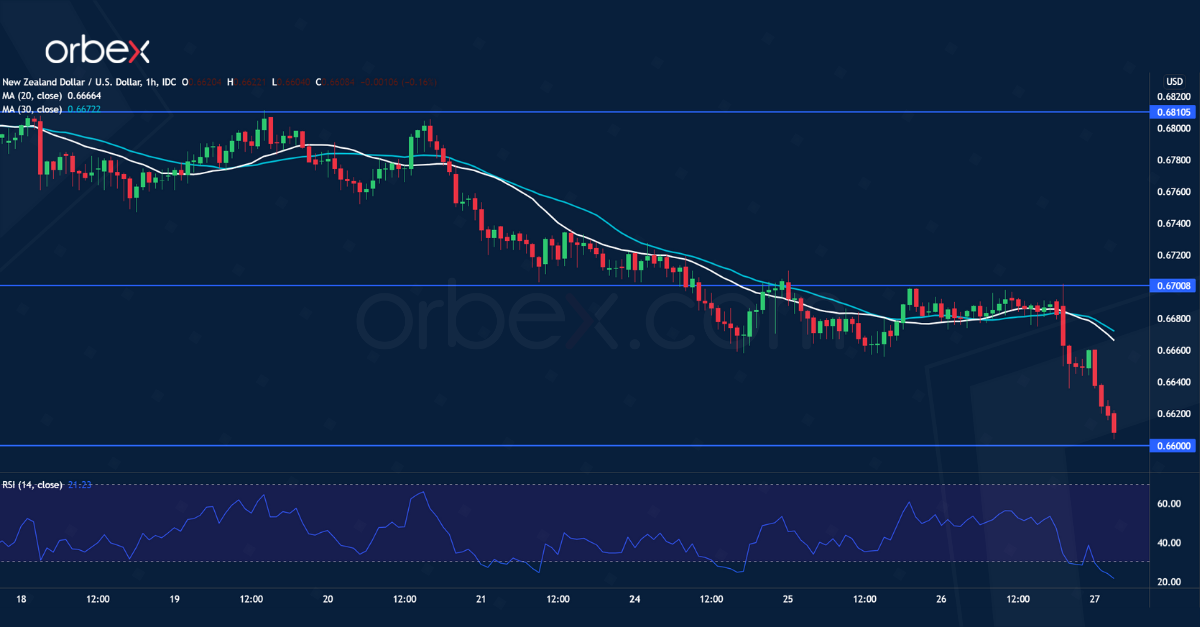
The New Zealand dollar steadied after the Q4 CPI beat expectations.
However, the pair is still in bearish territory after it broke below the lower end (0.6750) of the flag consolidation from the daily time frame. The RSI’s oversold situation brought in a buying-the-dips crowd around 0.6660 but its breach indicates a lack of buying interest.
The kiwi is now testing November 2020’s low at 0.6600. The bears could be waiting to fade the next bounce with 0.6700 as a fresh resistance.
USD/CAD Breaks Higher
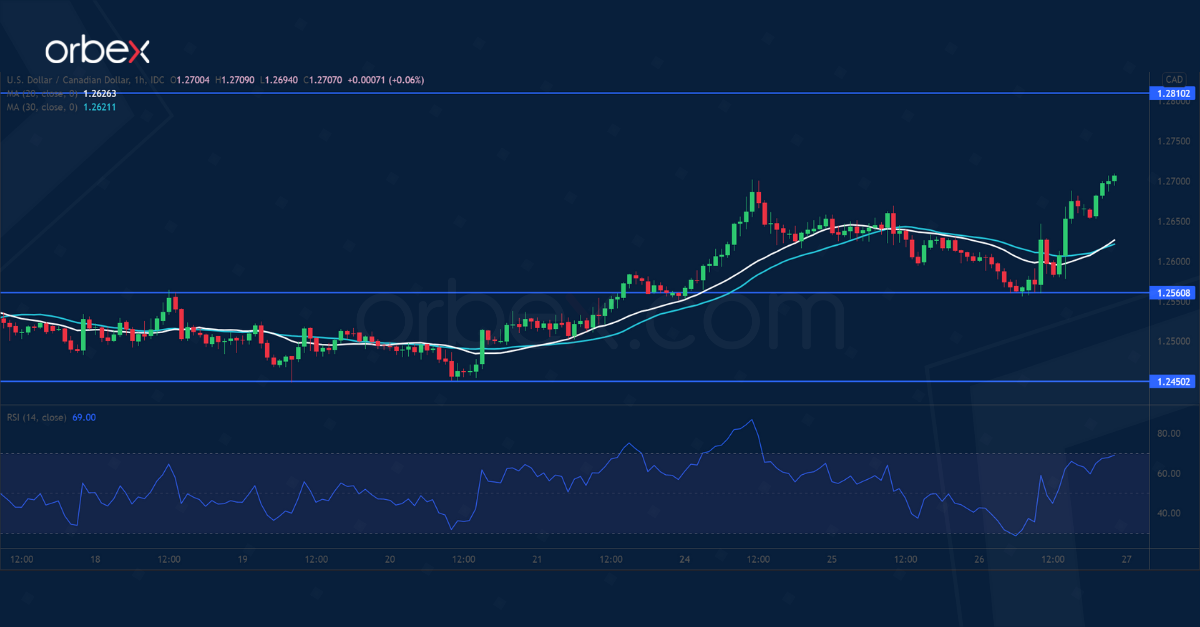
The Canadian dollar slipped after the BOC kept interest rates unchanged. Its US counterpart found support at 1.2560 after a brief pullback.
An oversold RSI attracted some bargain hunters. The current rebound is a sign that there is a strong interest in pushing for a bullish reversal. 1.2700 is a key supply zone as it coincides with the 30-day moving average.
A breakout would definitely turn sentiment around and trigger a runaway rally. In turn, this sets the daily resistance at 1.2810 as the next target.
US Equities Bounce Back as the Fed Points to More Tightening
The price of crude oil jumped in the overnight session as investors continued focusing on the ongoing tensions between the US and Russia. The US accuses Russia of attempting to invade Ukraine again. The last invasion happened in 2014 when the country annexed Crimea. The events are positive for oil prices because Russia is the third-biggest oil producer in the world and the US is considering adding sanctions to the oil industry. Brent, the global benchmark, rose above $90 for the first time in over seven years even after the rising US inventories. According to the Energy Information Administration, inventories rose to over 2.37 million barrels in the previous week.
The Canadian dollar declined against key currencies after a surprise interest rate decision by the Bank of Canada (BOC). The bank caught investors off-guard as it decided to leave interest rates unchanged at 0.25%. Before the meeting, most analysts were expecting the bank to hike interest rates by about 25 basis points. Recent data by Statistics Canada showed that the country’s inflation surged to a 30-year high of 4.8%. In its statement, the BOC said that it expects inflation will remain at the current range this year.
The US dollar rose slightly after the Federal Reserve decision. Like the Bank of Canada, the Fed decided to leave its interest rate unchanged between 0% and 0.25% in its first meeting of the year. It also hinted that it would end its quantitative easing program in March and then immediately start a period of tightening. Analysts expect that the bank will implement about three rate hikes this year considering that the American economy is doing well. For example, data published on Wednesday showed that he country’s new home sales jumped to 811k in December. Last week, data revealed that building permits and housing starts also rose.
EURCAD
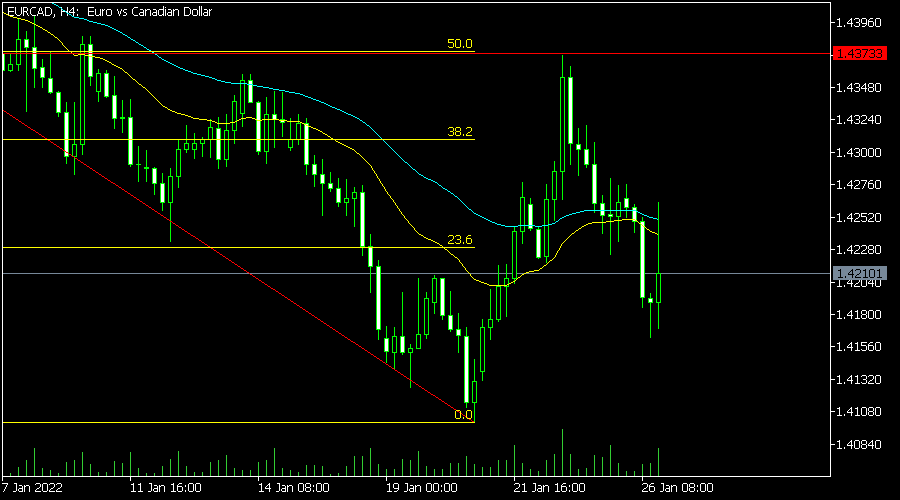
The EURCAD pair has been in a downward trend in the past few days. The pair has managed to drop from a high of 1.4373 to a low of 1.4165. It tilted upwards after the latest interest rate decision by the Bank of Canada. On the four-hour chart, it is slightly below the 25-day and 50-day exponential moving averages and the 23.6% Fibonacci retracement level. Therefore, the cross will likely keep falling as bears product that the BOC will be more hawkish than the ECB.
XBRUSD
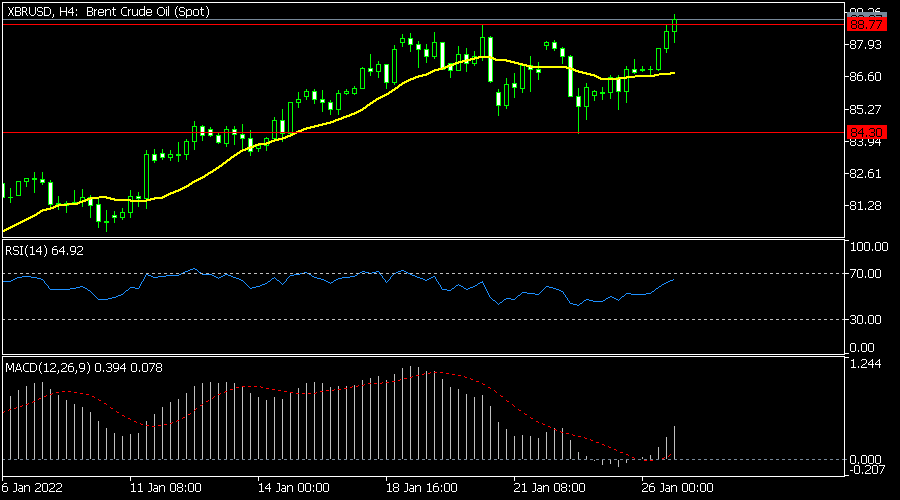
The XBRUSD pair has been in a strong bullish trend in the past few months. The pair managed to cross the key resistance level at 90. It also crossed the important resistance level at 88.77, which was the highest level this year. It is above the 25-day and 50-day moving averages while oscillators have continued rising. Therefore, the pair will likely keep rising as geopolitical risks remain.
EURUSD
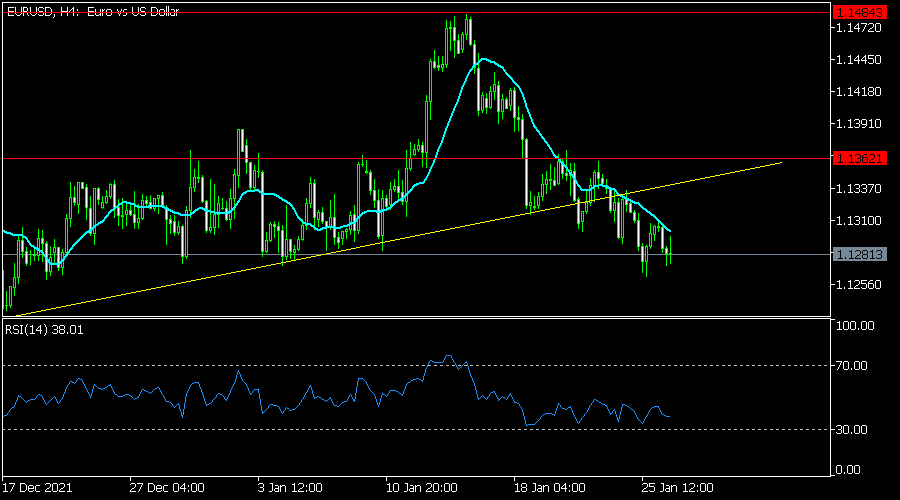
The EURUSD pair continued its downward trend after the Fed decision. The pair declined to a low of 1.1282, which is significantly below this month’s high of 1.1485. It is below the 25-day and 50-day moving averages while the Relative Strength Index (RSI) is hovering above the oversold level. Therefore, the pair will likely continue retreating as bears target the key support at 1.1400.
Fed Will Raise Rates on Consecutive Policy Meetings
Markets
This time really is different. Fed Chair Powell couldn’t make it more clear to all remaining doubters. The economy is stronger than at the start of the previous tightening cycle, inflation is running way hotter and the labour market is much more tighter. Even in the sense that most FOMC participants agree that labour market conditions are consistent with maximum employment. These differences will have important implications for the appropriate pace of policy adjustment. Say goodbye to quarterly guided 25 bps rate hikes and welcome a more volatile rate path. Forward guidance is officially buried. It strengthens our call that the Fed will raise rates on consecutive policy meetings, starting in March. It simultaneously makes our call of 4 consecutive 25 bps rate hikes look conservative. Powell refused to rule out more and stronger (>25 bps) rate moves. Embedded in our outdated scenario of a rate pause after Summer was the start of the Fed’s balance sheet roll-off. The Fed already published some high profile guidelines, but didn’t commit to a specific timing our pace yet. We now expect those principles and the effective start of the run-off to start in June while it won’t derail the tightening cycle. Especially in the early months, It’s a process running in the background which has little to do with the Fed’s inflation crusade via higher policy rates.
Markets didn’t take Powell’s message well. They struggle to make peace with the idea of the Fed taking the punchbowl away. US stocks and bonds sold off in lockstep when Powell indicated that there’s quite a bit of room to raise interest rates without threatening the labour market. Main US equity indices closed flat compared to Tuesday’s closing levels, but this hides a 5% drop from intraday high to intraday low. The Fed’s focus on the interest rate path instead of the balance sheet run-off, caused the US yield curve to bear flatten. US yields added 13.4 bps (2-yr) to 5.3 bps (30-yr) with new cycle highs for tenors of up to 5 years. The US 10-yr yield (1.84%) closes in on that reference (1.9%). Real yields were obviously responsible with the US 10-yr real yield moving to its highest level since June 2020 (-0.55%). Heavy risk-off and higher real yields benefited the dollar, though gains could have been stronger. The trade-weighted greenback (DXY) closed at 96.48 from a 95.96 open. A test of the recovery high at 96.94 is imminent. Risks of a short term break clearly increased. EUR/USD drifted from 1.1301 to 1.124 and is currently lured by the November low at 1.1186. Again, we think a break could follow especially should the ECB continue its ostrich policy at next week’s policy meeting, which is our base case. Post-FOMC dynamics will remain dominant near-term.
News Headline
Q4 CPI inflation in New Zealand rose 1.4%Q/Q bringing the Y/Y measure to 5.9% (from 4.9% in Q3). The latter was the fastest yearly rise since 1990 and beat both market and RBNZ (5.7%) forecasts. Price rises were widespread apart from telecommunications. Prices for construction of new dwellings rose 16% Y/Y. Petrol prices went up 30% Y/Y. Housing rents rose 3.8% Y/Y. The rise in domestic non-tradeable inflation was slightly more modest at 5.3% . The RBNZ is expected to extend its tightening cycle at the Feb 23 meeting following rate hikes in October and November. The Kiwi dollar didn’t profit even as short term rates rose further. The post-Fed rise of the dollar even triggered further kiwi losses with NZD/USD declining to 0.6605, the lowest level since early November 2020.
The Bank of Canada yesterday left its policy rate unchanged at 0.25%. BoC Governor Macklem indicated that the lift-off might come soon as the economy doesn’t need the support that was put in place to cope with the Covid crisis. According to the BoC statement, the overall economic slack has been absorbed. The economy entered 2022 with a considerable momentum and the labour market has tightened significantly. Inflation is expected close to 5.0% in H1 2022. As the slack is absorbed, the BoC removed its extraordinary guidance to keep interest rates at the effective lower bound. Interest rates will need to be increased, but the BoC wasn’t specific on the pace of rate hikes. Markets are discounting about six 25 bps rate hikes for this year. The loonie lost modest ground immediately after the decision and USD/CAD rose further post-Fed currently trading north of 1.27.
GBP/JPY Daily Outlook
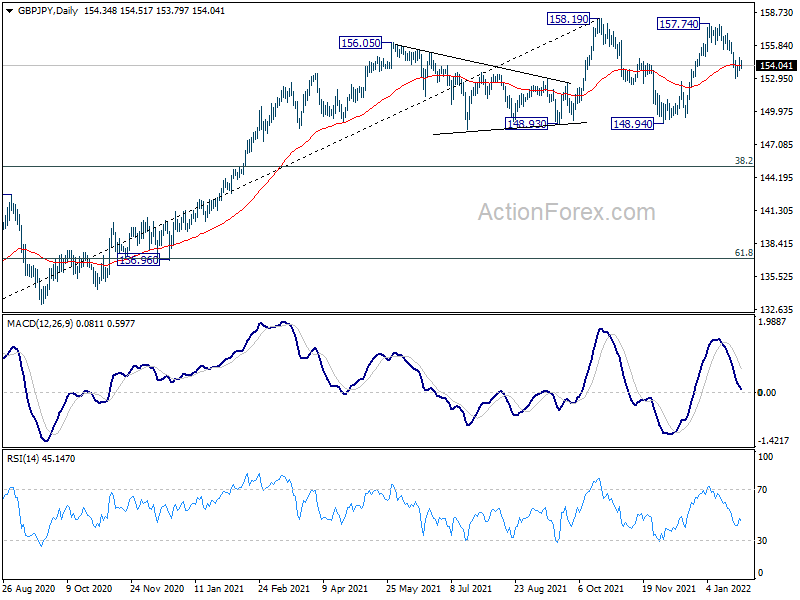
Daily Pivots: (S1) 153.81; (P) 154.27; (R1) 154.87; More...
Intraday bias in GBP/JPY remains neutral at this point. Outlook is unchanged that fall from 157.74 is seen as the third leg of the consolidative pattern from 158.19. Deeper decline is expected as long as 155.38 minor resistance holds. Below 152.88 will target 148.94 support next. On the upside, above 155.38 minor resistance will flip bias back to the upside for 157.74/158.19 resistance zone instead.
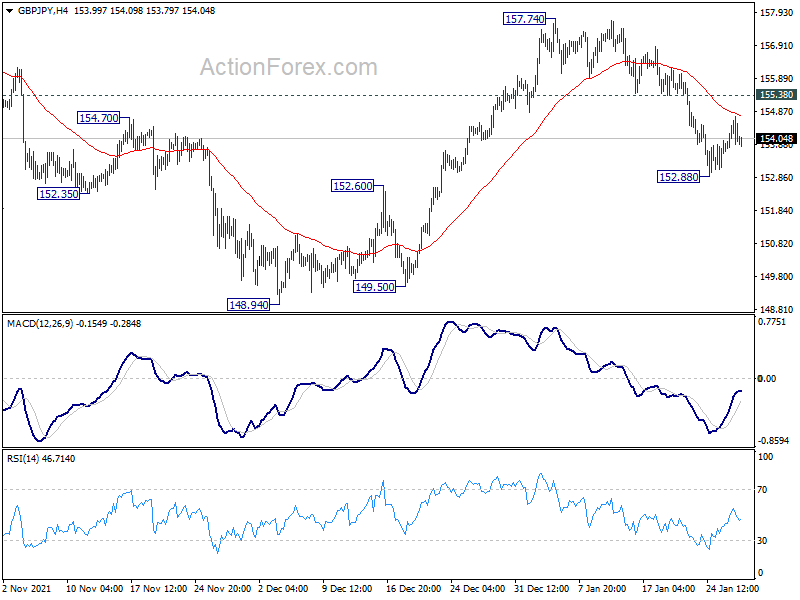
In the bigger picture, price actions from 158.19 are currently seen as developing into a consolidation pattern to up trend from 123.94 (2020 low). Downside should be contained by 123.94 to 158.19 at 145.10 to bring rebound. Firm break of 158.19 will resume the up trend to long term fibonacci level at 167.93. However, sustained break of 145.10 will raise the chance of trend reversal and target 61.8% retracement at 137.02.
EUR/JPY Daily Outlook
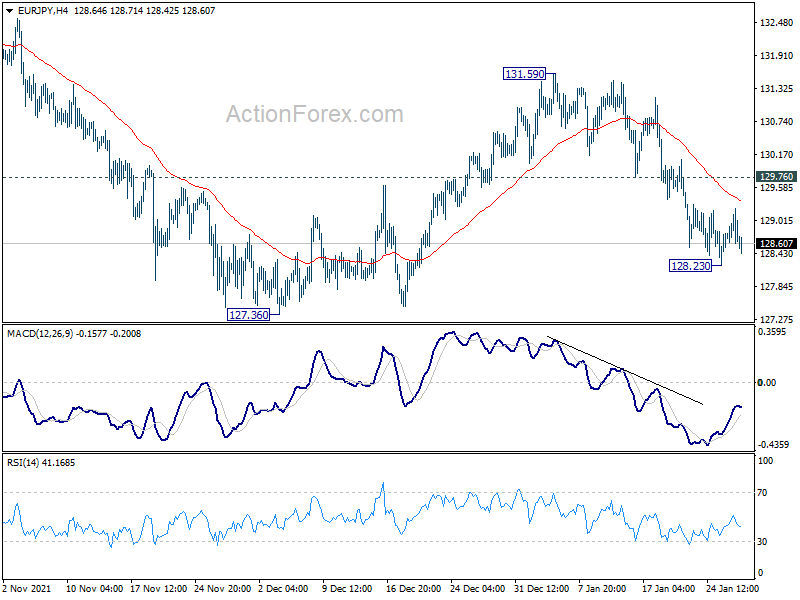
Daily Pivots: (S1) 128.60; (P) 128.92; (R1) 129.24; More....
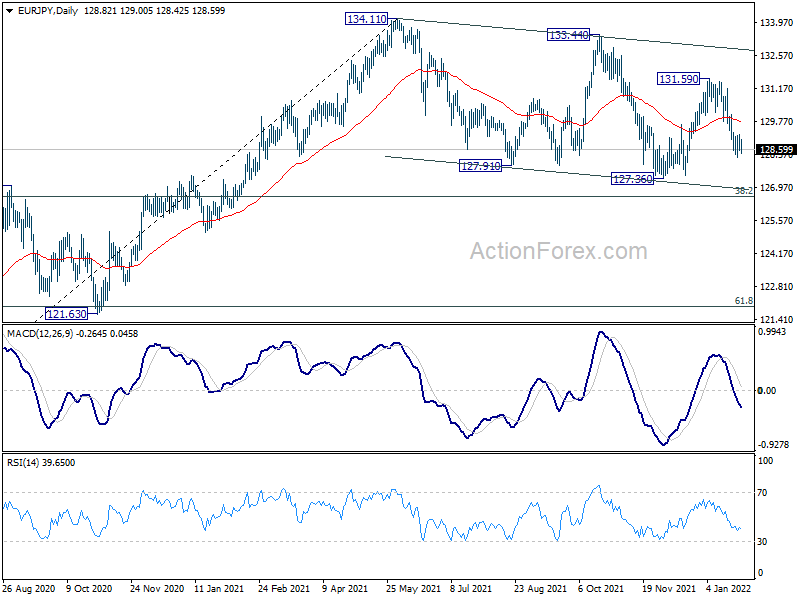
Intraday bias in EUR/JPY remains neutral for some consolidations above 128.23 temporary low. Outlook is unchanged that consolidation pattern from 134.11 is extending with another falling leg. Further decline is expected as long as 129.76 resistance holds. Below 128.23 will target 127.36, and possibly further to 126.58 fibonacci level. On the upside, above 129.76 minor resistance will turn bias back to the upside to 131.59 resistance instead.
In the bigger picture, price actions from 134.11 are currently seen as a consolidation pattern only. As long as 38.2% retracement of 114.42 (2020 low) to 134.11 at 126.58 holds, up trend from 114.42 is still in favor to continue. Break of 134.11 will target long term resistance at 137.49 (2018 high). However, sustained break of 126.58 will raise the chance of medium term bearish reversal. In this case, deeper decline would be seen to 61.8% retracement at 121.94, and possibly below.
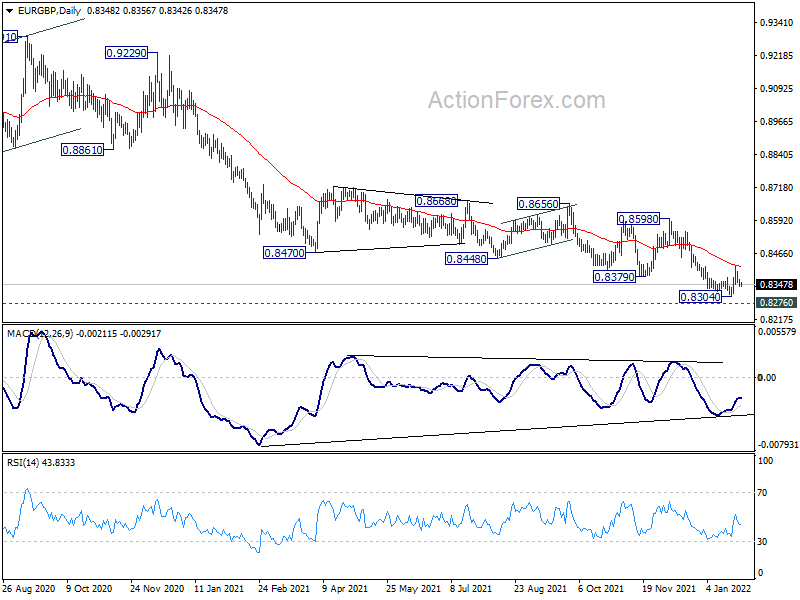
EUR/GBP Daily Outlook
Daily Pivots: (S1) 0.8338; (P) 0.8354; (R1) 0.8367; More...
Break of 0.8349 minor support suggests that rebound from 0.8304 has completed at 0.8421, after rejection by 55 day EMA. Intraday bias is back on the downside for 0.8304 first. Break will resume larger down trend towards 0.8276 low. On the upside, break of 0.8421 will resume the rebound towards 0.8598 key structural resistance.
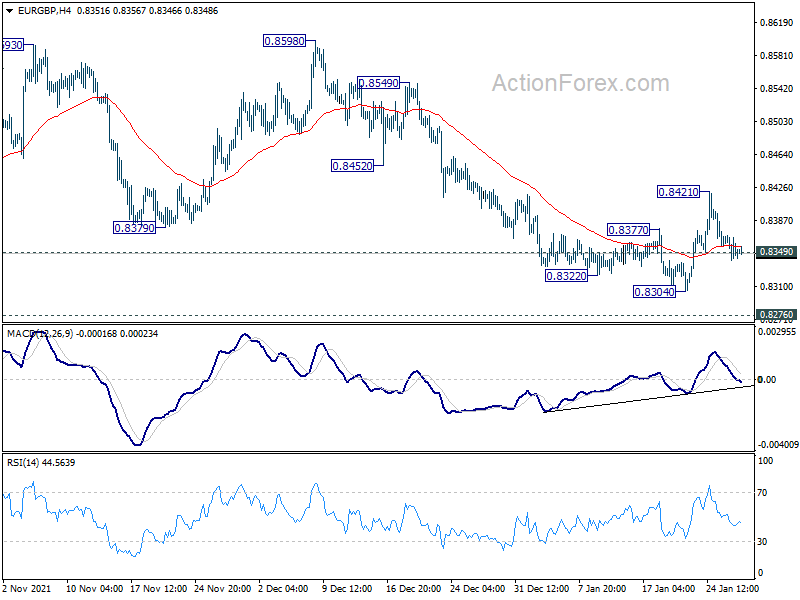
In the bigger picture, price actions from 0.9499 (2020 high) are still seen as developing into a corrective pattern. Deeper fall could be seen as long as 0.8598 resistance holds, towards long term support at 0.8276. We'd look for bottoming signal around there to bring reversal. Meanwhile, firm break of 0.8598 will now be an early sign of medium term bottoming and bring stronger rebound. However, sustained break of 0.8276 will argue that the long term trend has reversed.