

Sample Category Title
Oil Prices top $90: What’s Next for Crude?
Crude oil prices have extended their upsurge and Brent has breached the psychologically-important barrier of $90 per barrel. The latest gains came despite an unexpected build in US oil stocks, suggesting the upward pressure is continuing to come from elsewhere. There is definitely an element of geopolitical risks being baked into energy prices right now, as tensions concerning Russia and Ukraine intensify. Additionally, the easing of travel restrictions across Europe has helped to boost demand expectations for crude oil. More to the point, the OPEC+ has continued to provide less oil than called on for, creating a tighter market than would have otherwise been the case.
But with inflation continuing to eat into consumers’ disposable incomes, further rises in fuel and energy prices may not become sustainable in the longer-term outlook. Crude prices will have to correct themselves because of demand concerns, if consumer incomes, already stretched due to inflation, are squeezed even further. The OPEC+ may also respond by releasing more oil back to the market as they have clearly met – and exceeded – their main objective: higher crude prices.
However, before turning bearish on oil, we need to see a major technical reversal sign, ideally around that $90 handle. So far, prices are continuing to make higher high and higher lows, however…
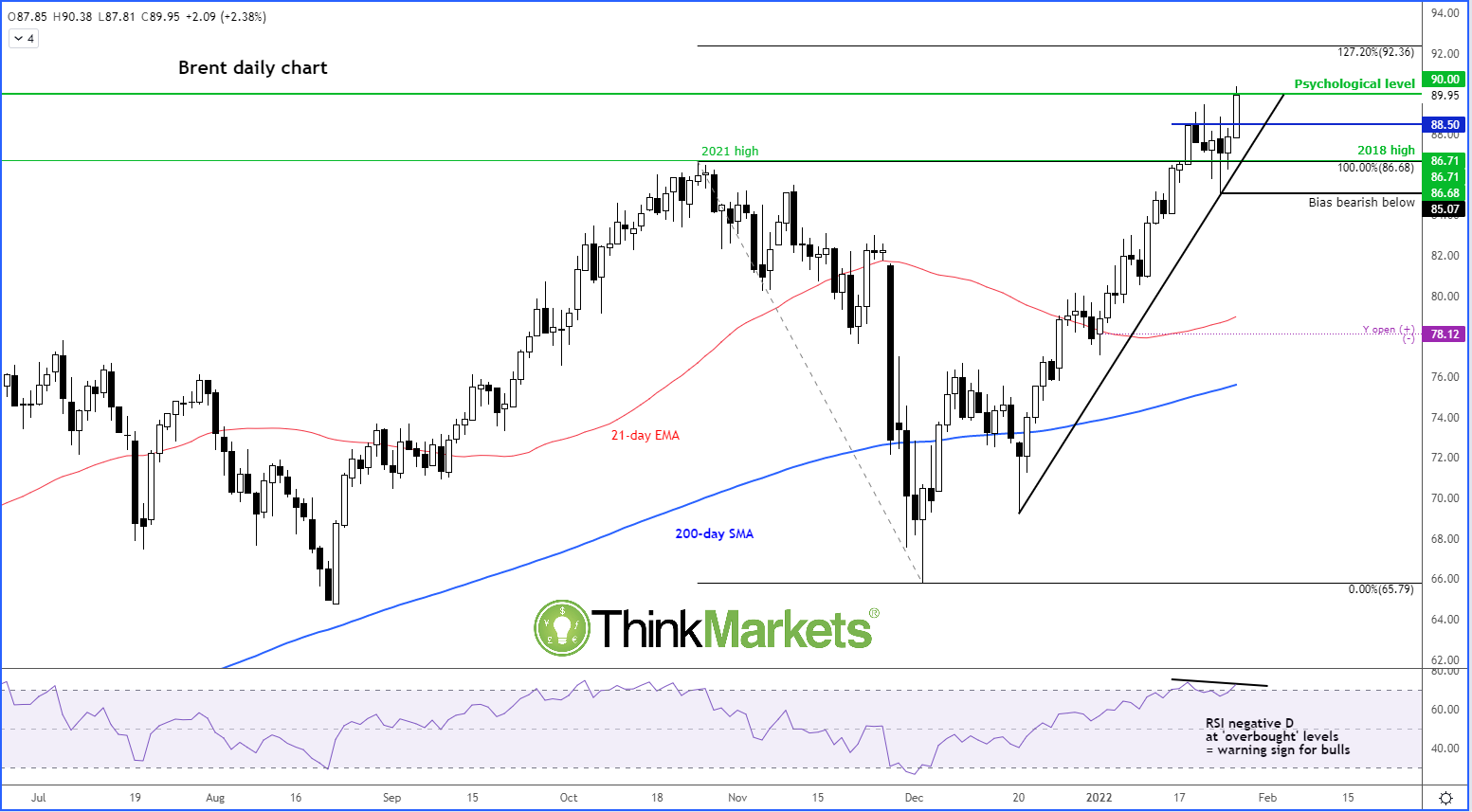
brent crude oil $90Source: ThinkMarkets and TradingView.com
Fed Review: Every Meeting is “Live” – We Now Expect Five Hikes This Year
Key takeaways
- Fed Chair Jerome Powell sounded hawkish during the press conference emphasising that labour demand and inflation are very high ("both mandates" are p ulling in the direction of tighter monetary policy). Powell spent a lot of time discussing the risks that inflation will remain elevated.
- The Fed now says that "it will soon be appropriate to raise the target range", i.e. to make the first rate hike in March. It was one of the interim meetings without updated 'dots'.
- Powell indicated that every meeting is "live" and refused to rule out 50bp rate hikes.
- We now expect five rate hikes this year (in March, May, June, September and December) from four previously.
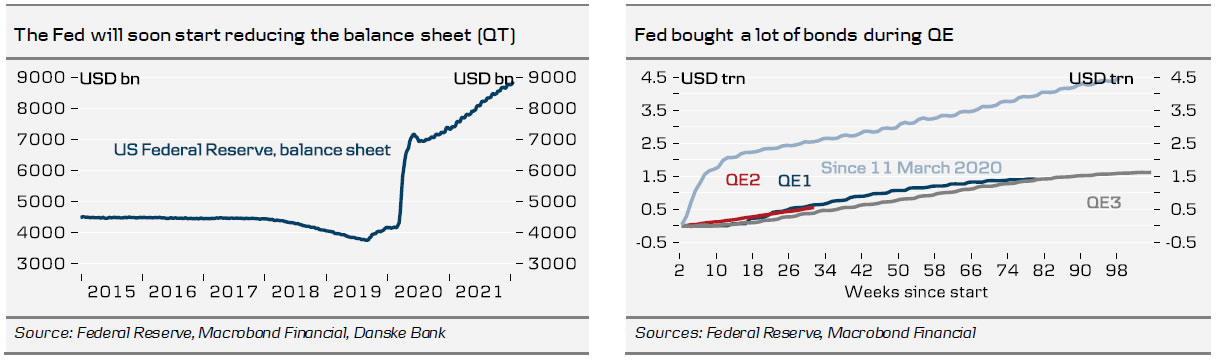
- The Fed did not provide any details on QT timing or pace, but Powell said the Fed will discuss it at the upcoming two meetings, hinting that QT is likely to start in June, which is now our base case (from September previously).
- FX: Hawkish Fed supports USD. We still target EUR/USD at 1.08 in 12M.
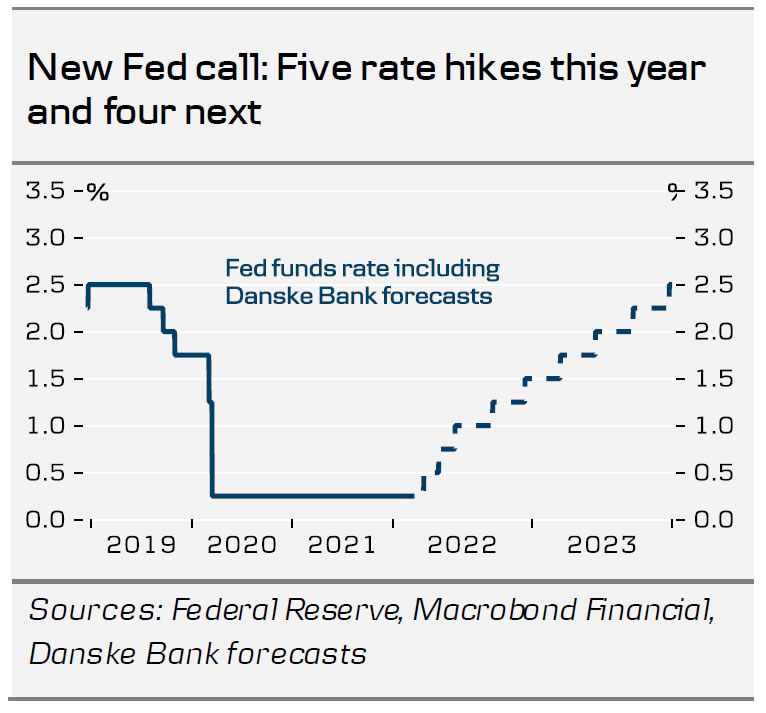
Fed: High inflation is a real concern
The Fed has turned more and more hawkish over the past 6-9 months and this meeting was no different. The FOMC statement was as expected with the Fed strongly indicating the first rate hike will arrive at the March meeting. Market reaction was quite muted until Fed Chair Jerome Powell started his press conference at 20:30 CET. Powell sounded more hawkish than expected emphasising the risks that inflation stays elevated, not ruling out 50bp rate hikes and indicating that every meeting is "live" (among other things). It was one of the interim meetings, so there were no up dated 'dots'.
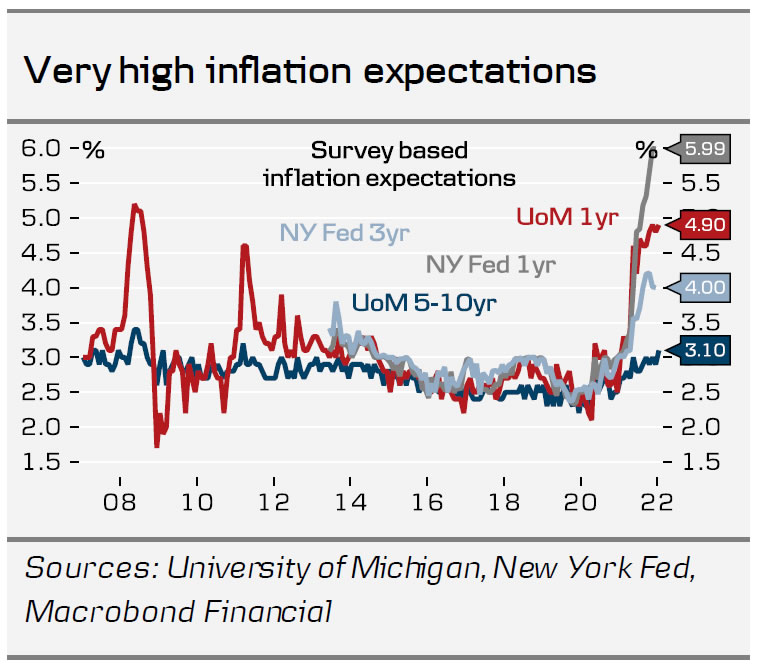
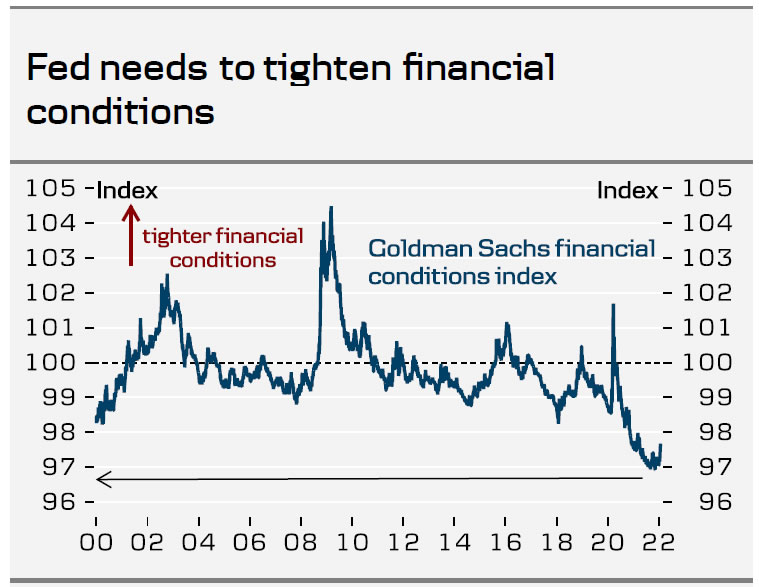
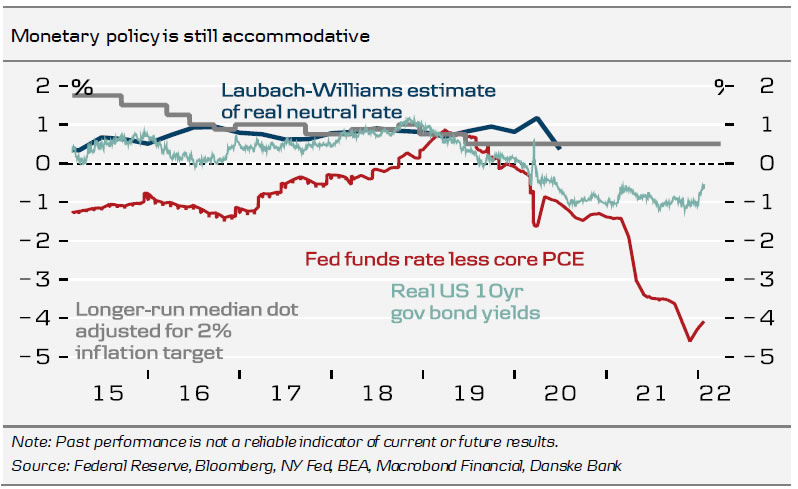
Overall, what the Fed needs to do is to tighten monetary/financial conditions to put an end to the very strong inflation narrative among consumers, businesses, investors and in the media. It sounded like the Federal Reserve may follow the "emerging market central banks" p lay book, where central bank sin Hungary , Poland and Czech Rep ublic have tightened more than expected. Admittedly, the Fed likes to manage expectations in between meetings but financial conditions are still very easy despite markets are already pricing in more than four rate hikes this year, so the Fed likely needs to do more than currently priced to tighten financial conditions.
This also means that speeches in between meetings are going to be extremely important for markets over the course of the year, like we saw with Fed Governor Chris Waller's recent comments. Noteworthy , Powell did not rule out that the Fed may hike by 50bp instead of the "usual" 25bp .
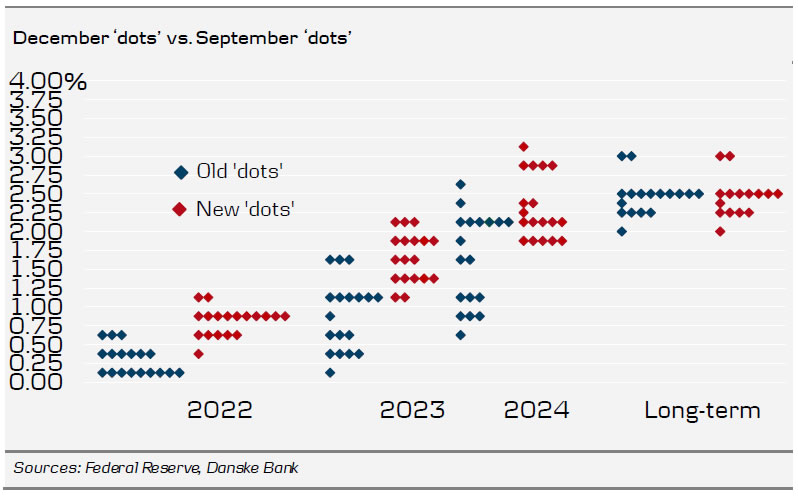
Based on today's meeting, we modify our Fed call, as Fed Chair Powell sounded a lot more serious about fighting high inflation now that the US economy has reached full emp loyment. Based on today 's information, we now expect five rate hikes this year from four previously. We expect the hikes to arrive in March, May, June, September and December. We still see risks tilted towards more rate hikes. We still expect the Fed to hike four times in 2023.
We now expect the Fed to start QT in June (from September previously), as Powell hinted the Fed would need 1-2 meetings to discuss QT principles in further details. We still expect the run-off caps to be in the range USD75-100bn.
So what is the trigger for the Fed tightening more? Unsurprisingly, inflation is key. Both we and the Fed expect inflation to peak here in Q1. If that is not the case (because we once again underestimate underlying inflation pressure), the Fed is likely to hike more aggressively. The Fed is also likely to follow long-term inflation expectations from the University of Michigan closely. Right now they are running at 3.1% y/y and it did not move above 3.2% y/y before the financial crisis.
FX: Fed supports a stronger USD
For FX, it is of course not ground breaking that Fed is moving towards hiking but the formulations employed by Powell were quite vocal. If Fed is a super tanker, then it surely has turned now. These things are well in line with our EUR/USD view: 1) the investment environment is changing, 2) European data will likely disappoint and 3) EUR is too strong vs fundamentals. All three and incoming data (this week, e.g. hawkish Fed and IMF downgrading global growth outlook) keep suggesting a lower EUR/USD. We remain of the view that EUR/USD spot will be headed even lower over the coming quarters and target 1.08 in 12M.
One of the few asset classes that have stayed afloat amid the latest sell -off is commodities. It will be of particular interest for the FX narrative to see for how long commodities will remain resilient amid a very sharp change in direction of monetary policy and with an already slowing economy. Real rates are rising sharply and the USD is strengthening. Hence, commodity/cyclical-sensitive currencies are trading on the back-foot post Fed and our strategic (broad USD positive) narrative is for this to extend into H1.
Our Fed call summarised
The Fed continues to move in a more hawkish direction, as inflation in general continues to surprise to the upside and labour demand is quite high. The Fed needs to tighten financial conditions to put an end to the strong inflation narrative among consumers, businesses, investors and in the media. Financial conditions have tightened lately but remains very easy in a historical perspective, despite markets are pricing in a lot of rate hikes. This means that the Fed may have to get "ahead of the curve" to change current exp ectations.
We expect the Fed to hike five times this year (in March, May, June, September and in December) and four times in 2023. We still see risks skewed towards the Fed hiking more than what we are pencilling in.
We expect the Fed to start QT in connection with the June meeting. We still expect the run-off caps to be in the range USD75-100bn.
FOMC Tees Up a Rate Hike for March
Summary
- As was widely expected, the FOMC made no major policy changes at its meeting today. Specifically, the Committee unanimously agreed to keep its target range for the federal funds rate unchanged at 0.00% to 0.25%.
- But the Committee also teed up a rate hike in March when it stated that "it will soon be appropriate to raise the target range for the federal funds rate."
- We look for the FOMC to hike rates by 25 bps per quarter between Q1-22 and Q3-23—a total of 175 bps—but acknowledge that the risks seem skewed toward the FOMC moving at a faster pace and/or by more than we currently forecast if inflation remains uncomfortably high.
- The FOMC also released a document entitled "Principles for Reducing the Size of the Federal Reserve's Balance Sheet." These principles, in conjunction with statements that Chair Powell made in his post-meeting press conference, suggest that the Committee will not rush headlong into shrinking its balance sheet, but that it is moving closer.
- We expect that the FOMC will announce at the September policy meeting that it will begin balance sheet reduction in the fourth quarter, and that the amount of run-off will accelerate over the subsequent few months.
As was widely expected, the Federal Open Market Committee (FOMC) made no major policy changes at its meeting today. Not only did the Committee unanimously decide to keep its target range for the federal funds rate unchanged at 0.00% to 0.25%, but it also will continue to "taper" its purchases of Treasury securities and mortgage-backed securities (MBS) by $20 billion and $10 billion respectively per month. At this pace of tapering, the Federal Reserve is set to end its asset purchases in March.
But if there were any questions about when the FOMC may begin to tighten policy, they were answered by today's statement. For starters, the Committee dropped its opening paragraph in which it has previously said that it was "committed to using its full range of tools to support the U.S. economy in this challenging time, thereby promoting its maximum employment and price stability goals." In other words, it appears that the FOMC does not think the economy is being "challenged" anymore. More tellingly, the statement said "with inflation well above 2 percent and a strong labor market, the Committee expects it will soon be appropriate to raise the target range for the federal funds rate." And in his post-meeting press conference, Chair Powell said that there was "very strong support" on the Committee for moving soon.
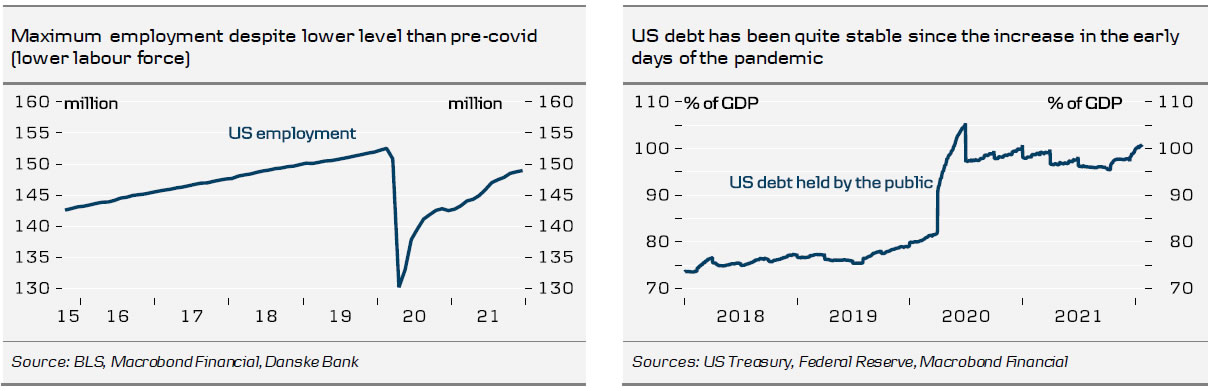
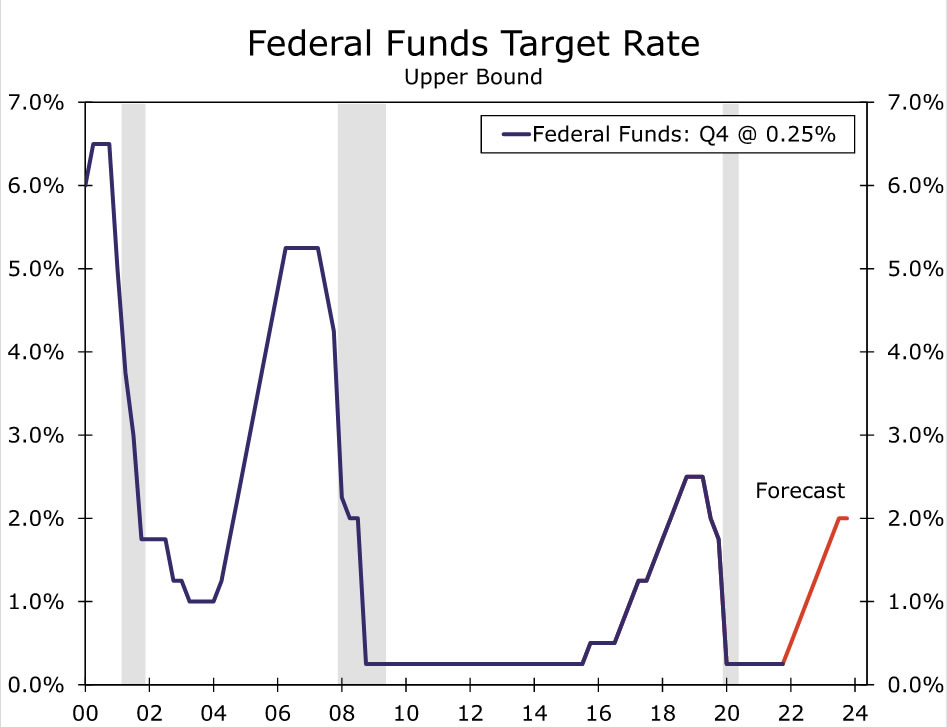
The statement also noted that "risks to the economic outlook remain, including from new variants of the virus." The Committee also said it "would be prepared to adjust the stance of monetary policy as appropriate if risks emerge that could impede the attainment of the Committee's goals." But unless the economy comes completely off the rails between now and the next FOMC meeting on March 16, we think the Committee will announce a 25 bp hike in its target range for the fed fund rate at that meeting (Figure 1). Furthermore, we look for the FOMC to hike rates by 25 bps per quarter through the second half of next year. In sum, we forecast that the FOMC will lift its target range for the fed funds rate to 1.75% to 2.00% by Q3-2023. That said, the risks seem skewed toward the FOMC moving at a faster pace (i.e. more than 25 bps per quarter) and/or by more than we currently forecast if inflation remains uncomfortably high.
The FOMC also released a document entitled "Principles for Reducing the Size of the Federal Reserve's Balance Sheet." The Committee continues to see "changes in the target range for the federal funds rate as its primary means of adjusting the stance of monetary policy," and that it "intends to reduce the Federal Reserve's securities holdings over time in a predictable manner." Chair Powell also indicated in his press conference that discussions about how and when to reduce its balance sheet are just beginning.
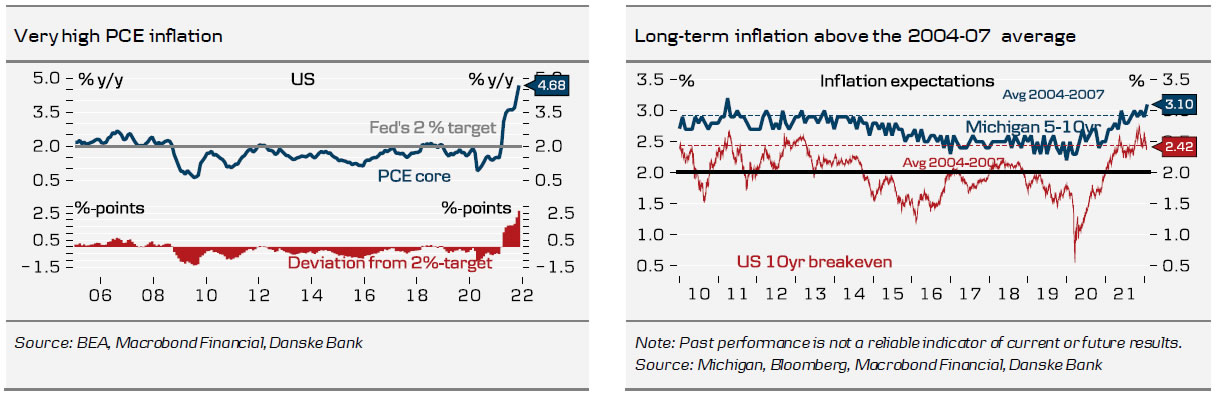
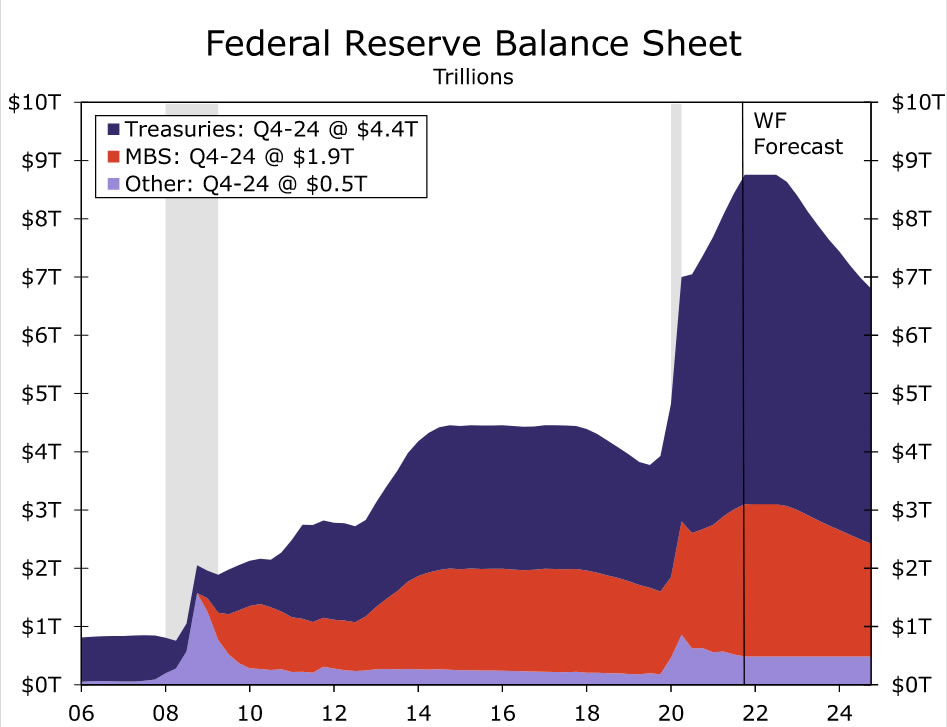
To us, this all means that the FOMC will not rush headlong into reducing the size of its balance sheet and once it does, it intends to be more or less on autopilot. As we discussed in a recent report, we forecast that the FOMC will announce at the September policy meeting that it will begin balance sheet reduction in the fourth quarter, and that the amount of run-off will accelerate over the subsequent few months (Figure 2).
Fed Signals Rate Hikes are Imminent
- No changes to policy rate or pace of QE tapering
- All eyes on March meeting as statement notes “it will soon be appropriate” to raise rates
- Fed to start shrinking its balance sheet after rate hikes begin
The Fed continued to set the stage for interest rate liftoff by clearly signaling rate hikes will “soon be appropriate” in light of high inflation and a strong labour market. Recall that at its December meeting, the Fed accelerated its QE tapering timeline to wind down net purchases by early March, opening the door to a mid-March rate hike. Subsequent comments from a number of FOMC members increased the odds of such a move, and today’s statement adds to the risk of an earlier rate hike than our Q2 call. A below-4% unemployment rate, a sluggish rebound in labour supply, accelerating wage growth and persistently high inflation all argue for the Fed to begin removing accommodation sooner rather than later.
An earlier start would also mean upside risk to our forecast (and the Fed’s dot plot median) for three rate increases in 2022, with markets now pricing in four hikes. Whether tightening begins in March or Q2, we expect a measured pace of rate increases with quantitative tightening (QT) also set to begin in the coming months. The Fed indicated today that it expects to begin shrinking its balance sheet after the process of raising rates has begun. We expect that process will be accelerated relative to 2017-19 (starting sooner and with a higher cap on maturities not reinvested) given a stronger starting point for the economy and a larger Fed balance sheet. Indeed, Chair Powell indicated in his press conference that the Fed is "willing to move sooner than we did the last time and also perhaps faster" when it comes to shrinking the balance sheet.
FOMC Preps Markets for a Hike in March
The Federal Reserve Open Market Committee (FOMC) kept the federal funds rate at the current 0% to 0.25% range and will continue to taper its asset purchases so that its Quantitative Easing (QE) program ends in March.
The Fed reiterated its language on the strength of the economy, stating that "job gains have been solid in recent months, and the unemployment rate has declined substantially."
On inflation, the statement noted that "supply and demand imbalances related to the pandemic and the reopening of the economy have continued to contribute to elevated levels of inflation."
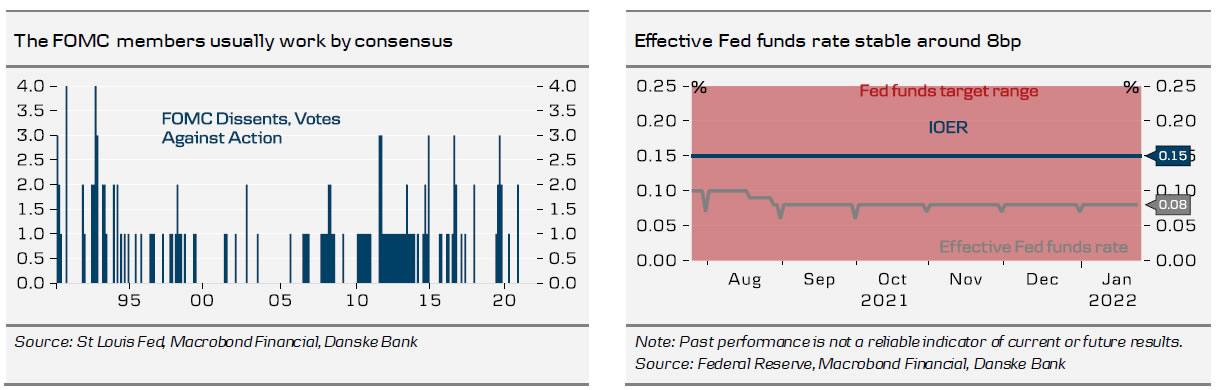
All of the members of the FOMC voted in favor of the decision.
Key Implications
As expected, the Fed kicked the can to March 16th. Though the pressure to end emergency-levels of monetary support has risen considerably in recent months, the Fed decided to wait just a little longer to pull the trigger on rate hikes.
With consumer prices rising at 7% and the unemployment rate at 3.9%, bringing down inflation should be the primary concern of the Fed. Hiking rates has become necessary to regain price stability.
The Fed is all but guaranteed to hike its policy rate in March. From there we have the Fed hiking every three months until the policy rate gets to 2%. Clear communication to this end will help lift bond yields and slow demand, easing some of the supply/demand imbalances that are responsible for the high inflation environment that we have now.
Eco Data 1/27/22
[php_everywhere instance="1"]
Fed keeps rate at 0-0.25%, soon appropriate to hike
Fed keeps federal funds rate target unchanged at 0-0.25%. It added, "with inflation well above 2 percent and a strong labor market, the Committee expects it will soon be appropriate to raise the target range for the federal funds rate." The monthly pace of net asset purchases will continued to be reduced to "bring them to an end in March". The decision was unanimous.
Press conference live stream below.
https://www.youtube.com/watch?v=TRkZ0P3ZnAM
(FED) Federal Reserve Issues FOMC Statement
Indicators of economic activity and employment have continued to strengthen. The sectors most adversely affected by the pandemic have improved in recent months but are being affected by the recent sharp rise in COVID-19 cases. Job gains have been solid in recent months, and the unemployment rate has declined substantially. Supply and demand imbalances related to the pandemic and the reopening of the economy have continued to contribute to elevated levels of inflation. Overall financial conditions remain accommodative, in part reflecting policy measures to support the economy and the flow of credit to U.S. households and businesses.
The path of the economy continues to depend on the course of the virus. Progress on vaccinations and an easing of supply constraints are expected to support continued gains in economic activity and employment as well as a reduction in inflation. Risks to the economic outlook remain, including from new variants of the virus.
The Committee seeks to achieve maximum employment and inflation at the rate of 2 percent over the longer run. In support of these goals, the Committee decided to keep the target range for the federal funds rate at 0 to 1/4 percent. With inflation well above 2 percent and a strong labor market, the Committee expects it will soon be appropriate to raise the target range for the federal funds rate. The Committee decided to continue to reduce the monthly pace of its net asset purchases, bringing them to an end in early March. Beginning in February, the Committee will increase its holdings of Treasury securities by at least $20 billion per month and of agency mortgage‑backed securities by at least $10 billion per month. The Federal Reserve's ongoing purchases and holdings of securities will continue to foster smooth market functioning and accommodative financial conditions, thereby supporting the flow of credit to households and businesses.
In assessing the appropriate stance of monetary policy, the Committee will continue to monitor the implications of incoming information for the economic outlook. The Committee would be prepared to adjust the stance of monetary policy as appropriate if risks emerge that could impede the attainment of the Committee's goals. The Committee's assessments will take into account a wide range of information, including readings on public health, labor market conditions, inflation pressures and inflation expectations, and financial and international developments.
Voting for the monetary policy action were Jerome H. Powell, Chair; John C. Williams, Vice Chair; Michelle W. Bowman; Lael Brainard; James Bullard; Esther L. George; Patrick Harker; Loretta J. Mester; and Christopher J. Waller. Patrick Harker voted as an alternate member at this meeting.
U.K.: Slower Growth, Faster Inflation, Gradual Tightening
Summary
- The U.K. economy is displaying increasingly divergent trends. CPI inflation has continued to trend higher, reaching 5.4% year-over-year in December, and could peak as high as 6.5% to 7.0% before inflation begins to recede. In contrast, U.K. activity growth is likely to experience temporary softness around the turn of the year related to a surge in COVID cases, and face headwinds from reduced consumer purchasing power later in 2022.
- While elevated inflation will clearly warrant further Bank of England tightening in our view, subdued growth suggests those rate increases will be delivered at only a gradual pace from the U.K. central bank. Specifically, we expect the Bank of England to hold its policy rate steady at 0.25% at its early February monetary policy announcement. More broadly, we forecast a cumulative 50 bps of Bank of England rate hikes over the next year, well below that currently expected by market participants.
- This more gradual view of Bank of England tightening is an important influence behind our view of a weaker pound over time. We forecast for a softening in the GBP/USD exchange rate towards $1.2900 by the end of 2022, and to $1.2700 by the middle of 2023.
You Take the High Road...
U.K. data releases since the start of this year have offered further insight into increasingly divergent economic trends. On the price front, the December CPI showed that inflation continues to quicken and, indeed, surprise to the upside. Headline inflation firmed more than expected to 5.4% year-over-year, while the core CPI unexpectedly quickened to 4.2%. Survey data indicate that price pressures will persist for the time being, with the input and output price components of the PMI surveys remaining near record highs. However, in the manufacturing sector, an improvement in supplier delivery times at least hints at some easing in supply disruptions.
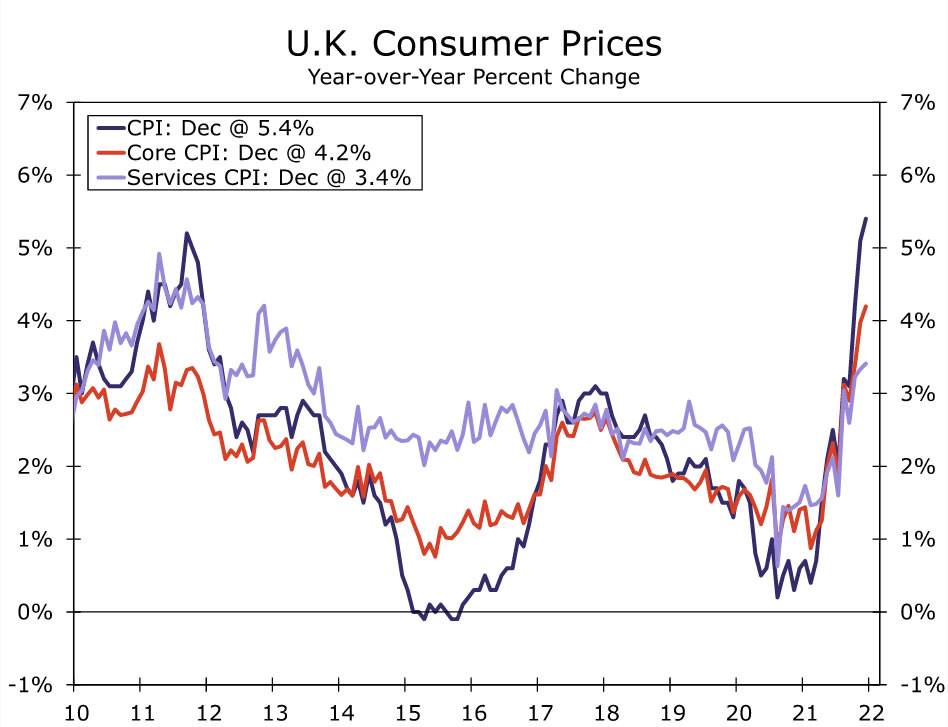
Another factor which points to elevated inflation continuing in the near-term is another increase in electricity prices scheduled for April this year. Higher prices for gas and electricity have been important drivers of faster U.K. inflation, with December year-over-year increases of 28.1% and 18.8%, respectively. In contrast, services CPI inflation, while not exactly tame, rose a lesser 3.4% in December. Still with the looming April electricity price rise, the overall rate of U.K. CPI inflation is likely to climb into a 6.5% to 7% range. Even if a significant portion of the spike of U.K. inflation is energy-driven, overall price increases of that magnitude will clearly warrant and necessitate further policy rate increases from the Bank of England, with the main question being the timing and speed of those central bank rate hikes.
...And I'll Take the Low Road
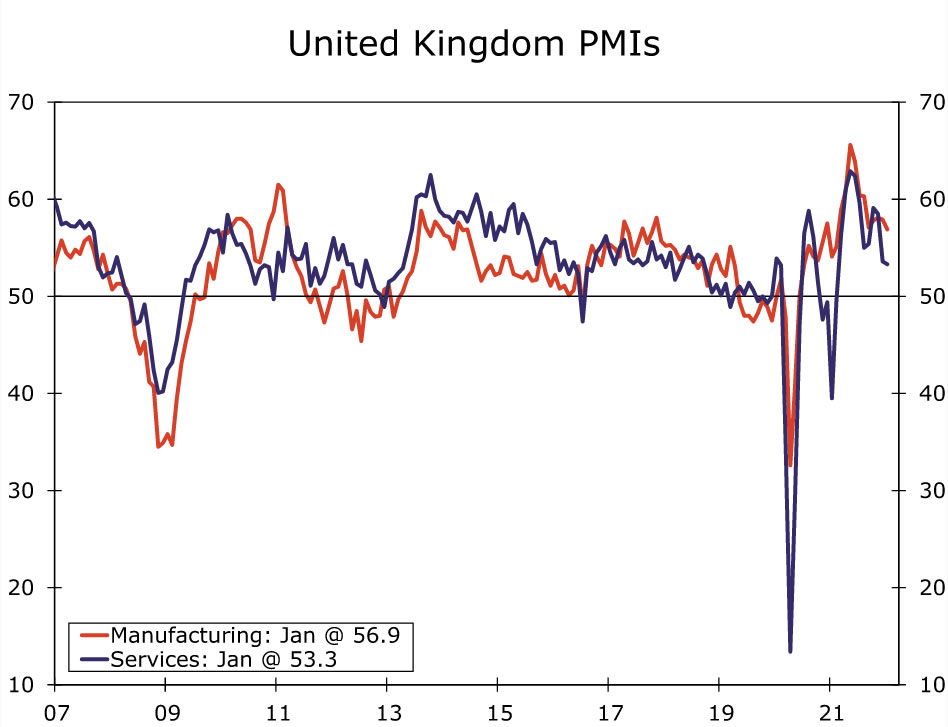
With respect to the pace of monetary tightening, we believe the other significant U.K. trend—that of slower activity growth—will be consequential in seeing the Bank of England deliver only a gradual pace of interest rate increases during 2022. The U.K. economy had displayed decent momentum until late last year, with November GDP for example rising by 0.9% month-over-month. However, as COVID cases surged during December, prompting the imposition of some modest restrictions and voluntary caution on the part of consumers, activity softened markedly around the turn of the year. Most notably, retail sales slumped 3.7% month-over-month in December. Early this year the January manufacturing and service sector PMIs fell further, to 56.9 and 53.3, respectively.
While it is true any COVID induced slowdown in the economy will likely be short-lived, with cases having receded in recent weeks, the looming increase in electricity prices will also weigh on consumer purchasing power, and should also be a headwind for the economy in the months ahead. As a result, we believe the outlook remains for somewhat uneven and relatively moderate U.K. economic growth in 2022. We forecast GDP growth of 4.1% for 2022, down from an estimated 7.1% in 2021, though we believe the risks around that growth outlook remain tilted to the downside.
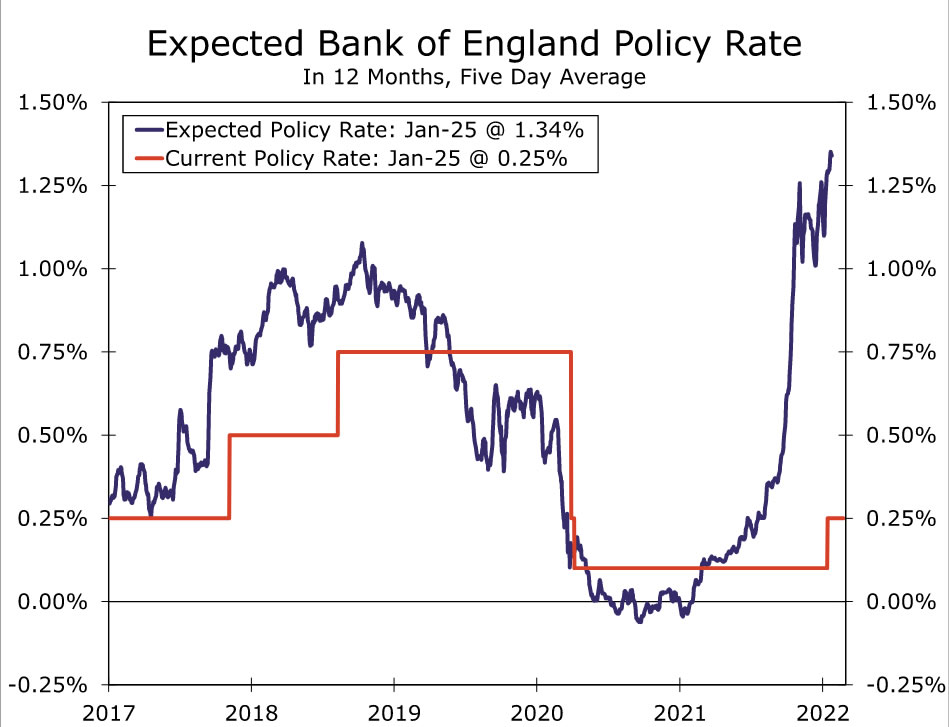
It is against this backdrop that we expect the Bank of England will thread the growth and inflation needle by delivering only a gradual pace of interest rate increases during 2022. Specifically, we expect the Bank of England to hold interest rates steady at 0.25% at its February 3 monetary policy announcement. More broadly, we forecast only two 25 bps rate increases this year, at the May and November announcements, and two more 25 bps rate increases in 2023. We also expect the Bank of England will wait until 2023 before it starts to reduce the size of balance sheet.
Should the Bank of England follow the gradual path we suggest, it should see the GBP/USD exchange rate come under pressure over time. An "on hold" decision from the Bank of England in February would disappoint relative to expectations from market participants, which have almost fully priced in a 25 bps rate hike for February. Moreover, the 50 bps of policy rate increase we forecast from the Bank of England over the next 12 months compares to market expectations for 113 bps of policy rate increase over that period. This more gradual view of Bank of England tightening is an important influence behind our forecast for a softening in the GBP/USD exchange rate towards $1.2900 by the end of 2022, and to $1.2700 by the middle of 2023.
GBPCAD – Jumps as BoC Resists Raising Rates
No breakout yet, though
The pound has been range-bound against the Canadian dollar for the last week and that remains the case so far today, despite the Bank of Canada holding off on raising interest rates.
It had been expected to start the tightening cycle today, with the market’s pricing in up to five more over the course of the year after inflation hit a 30-year high and the labour market improved.
But with the central bank taking a more patient approach and instead laying the foundations to raise rates in March, once it has a better idea of the Fed’s plans, no doubt, the currency has come under some pressure.
And expectations for that sixth hike in 2022 have dipped, with it now deemed a coin toss in December. Still a very aggressive start to monetary tightening, of course.
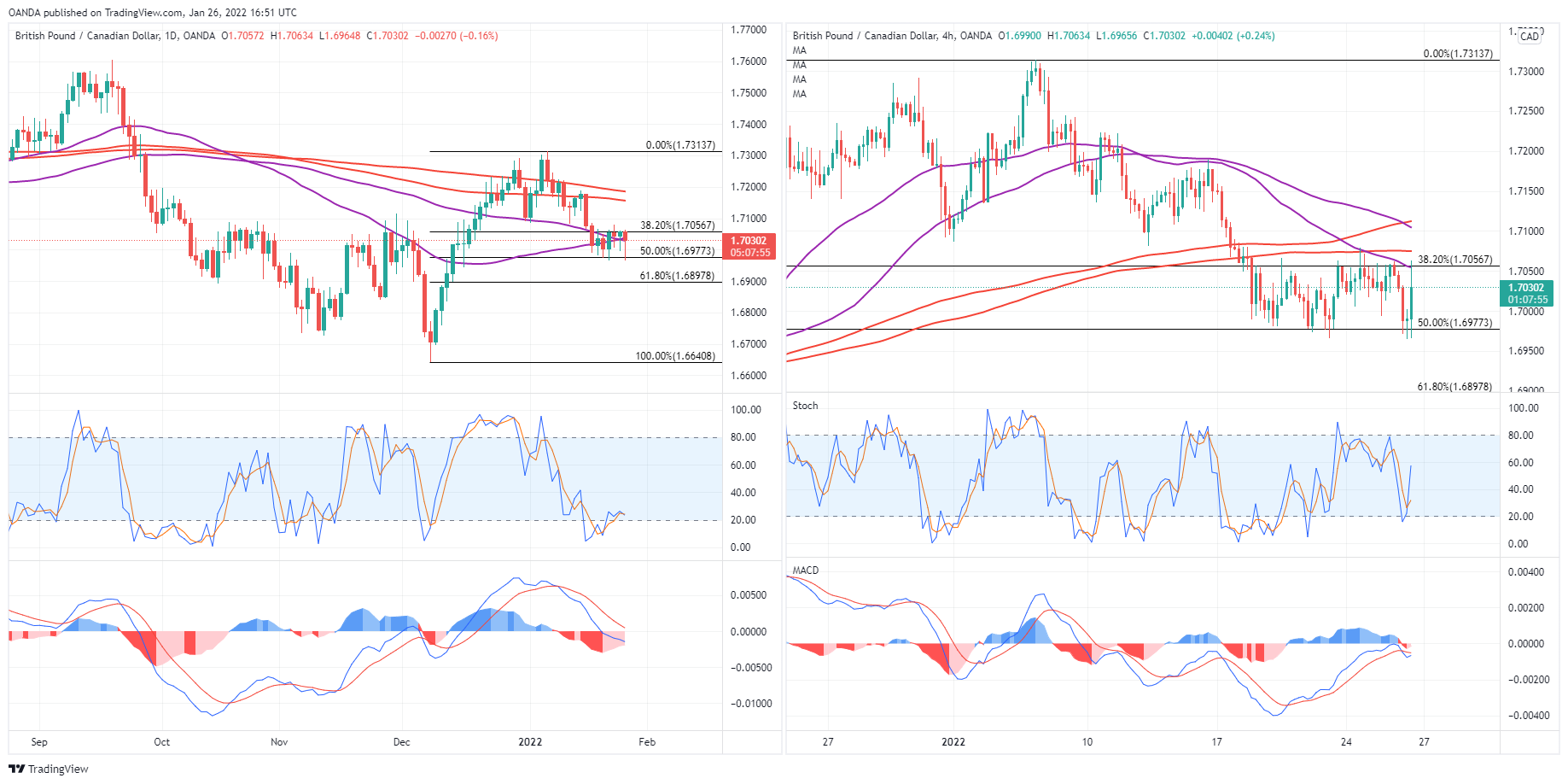
As far as the chart is concerned, this still leaves the pair range-bound for now, with the upper end holding firm after the decision. It will now be interesting to see which end fails first, with the BoE also in the business of raising rates, after getting underway in December, with another widely expected next week.
A move higher could see the pair quickly run into some resistance around 1.71, where prior support and resistance coincides with the upper end of the SMA bands on the 4-hour chart.
A move below the 50 fib, and the range support, could be quite bearish, with support perhaps being seen around 1.6850 and 1.6725-1.6735.