

Sample Category Title
Fed: Hawkish Despite a Severe Selloff Threat
Jerome Powell didn’t really sooth investors’ nerves at yesterday’s policy statement. He said that the Federal Reserve (Fed) won’t refrain from back-to-back rate hikes to get the inflation situation straight. His words sent the US stocks lower, and the US dollar higher.
Apparently, the recent market rout hasn’t given cold feet to Powell and the Fed members, meaning that they are ready to take on more losses on the equities front to get inflation under control. After all, one leg of their dual mandate goal is price stability - and the other is a healthy labour market. The mandate is not to offer the market a sustained and a powerful rally, although a full-blast financial crisis is an undesired side-effect.
Plus, the rising oil prices will likely continue pressuring the consumer prices higher in the coming months. Crude oil prices continue rising partially due to the OPEC’s inability to increase supply against its will, and partially due to the mounting tensions at the Ukrainian border. The price of a barrel of US crude is now flirting with the $89 mark, and it’s just a matter of time before we see the price of a barrel test and eventually surpass the $90 mark.
Today, the US will reveal its latest GDP data, and the expectation is that the US may have grown some 5.5% in the Q4. Any positive surprise could further revive the Fed hawks, while any negative surprise would barely tickle the doves, unless the numbers are real ugly, which I doubt.
In the FX, the US dollar had a strong session on the back of a decidedly hawkish Fed. The US dollar index rallied to 96.70. As such, the dollar index rebounded 2% since the mid-January dip and is clearly on a rising path for the next couple of months. A further rally to the 98-100 region is certainly on the cards in the actual environment of tightening Fed, and a bit less hawkish others.
The Bank of Canada removed its exceptional forward guidance, but kept its rates unchanged at yesterday’s meeting, and no one really expects the Europeans to do anything more hawkish than buying less bonds to stop inflation from rising. So, the EURUSD is now preparing to test the November lows, and this time, the support will likely give in to the bears.
Hawkish Fed Supports USD
Market movers today
Markets will continue to digest yesterday's FOMC message and watch out for Russia-Ukraine headlines, amid a light data calendar in Europe.
US Q4 21 GDP figures are released and we expect them to show that the economic recovery continued at the end of 2021, despite the new COVID-19 wave. The weekly initial jobless claims will also be monitored for COVID-19 effects on the labour market, after claims had increased in recent weeks.
The 60 second overview
Hawkish message from Powell: As expected, the Fed hinted that it will hike for the first time at the next meeting in March. Fed Chair Jerome Powell was quite hawkish during the press conference, which drove US yields higher, EUR/USD lower and US equities lower. Powell spent a lot of time discussing upside risks to inflation and simultaneously arguing that the Fed is now at maximum employment. The Fed needs to tighten financial conditions further to put an end to the very strong inflation narrative among consumers, businesses, investors and in the media and hence we modify our Fed call now expect five rate hikes this year, up from four previously. We still see risks tilted towards even more rate hikes. We discuss in details in Fed Research: Review - Every meeting is "live" - we now expect five hikes this year, 26 January.
Russia-Ukraine standoff: US delivered the written response to Russian security demands yesterday, but unsurprisingly, it did not commit to Russia's key demand of stopping NATO's expansion towards east. NATO maintains its 'open-doors' policy, but US Secretary of State Blinken noted that west is ready to discuss other options, such as arms control, to find a diplomatic solution to the crisis. On the positive side of news, Russia held talks together with Ukraine, France and Germany yesterday, signalling willingness to negotiate. Market sentiment remains cautious as sanction risks loom, with USD/RUB rising just below 80 and Brent oil briefly touching USD90/bbl before the hawkish FOMC yesterday.
Denmark lifts all restrictions: As expected, the Danish government announced that restrictions are not extended beyond Tuesday 1 February so all restrictions are removed next week (except a few for international travellers and nursing home). Normally, it would not be a major story but Denmark is definitely one of the frontrunners globally and we expect more countries to follow suit soon, as many countries seem to be looking towards Denmark (as data quality is quite good due to a lot of testing and sequencing). This supports our view that we are moving towards normalisation in many countries despite record-high new cases. We are shifting from the pandemic phase to the endemic phase due to vaccines, better treatments, better know-how and the milder omicron variant. We are still of the view that governments will avoid re-imposing restrictions next season.
Bank of Canada: In contrast to the Fed hawkishness, Bank of Canada decided to maintain rates unchanged yesterday despite market expecting a 25bp hike. That being said, BoC assessed that the economic slack has now been mostly absorbed, and we continue to expect the first rate hike in March.
Equities: Equities went from rebound to declines as Powell reiterated the hawkish message. S&P 500 closed down -0.2%, Nasdaq unchanged, Dow -0.4% and small cap Russell 2000 continues to underperform, down -1.4%. Very varied sector performance between value and growth, with both tech and banks among the better groups. Similarly, no clear direction between defensives or cyclicals, but both industrials, staples and real estate sold off in a tight range. So, risk appetite seems appeared mixed, however VIX continuing higher (south of 30) suggest that risk off continue to build in markets. Similarly, Asian markets are in broad declines this morning with Japan and China correcting -3%. US futures suggest markets will open 1-2% lower.
FI: There was a solid negative market reaction on the back of the FOMC meeting as 2Y Treasury yields rose 16bp and 10Y Treasury yields rose a 6bp. Hence, the flattening of the US curve continues as we have seen so many times in the past when the Federal Reserve are about to embark on a hiking cycle. There is plenty of room for a further flattening, and given the comments from Powell that he could hike at every meeting, then the Federal Reserve step up even more compared to what is priced in currently (some 100bp), and this will maintain the curve flattening.
FX: Fed Chair Jerome Powell was quite hawkish during the press conference, which drove US yields higher, EUR/USD lower and US equities lower. We continue to see EUR/USD at 1.08 and expect dollar strength to broaden against other currencies during H1.
Credit: Credit markets were in a positive mood yesterday where iTraxx Xover tightened 6bp (to 271bp) and Main 1.3bp (to 55.8bp). HY bonds tightened 6bp and IG 0.5bp.
EUR/USD Daily Outlook
Daily Pivots: (S1) 1.1216; (P) 1.1263; (R1) 1.1291; More...
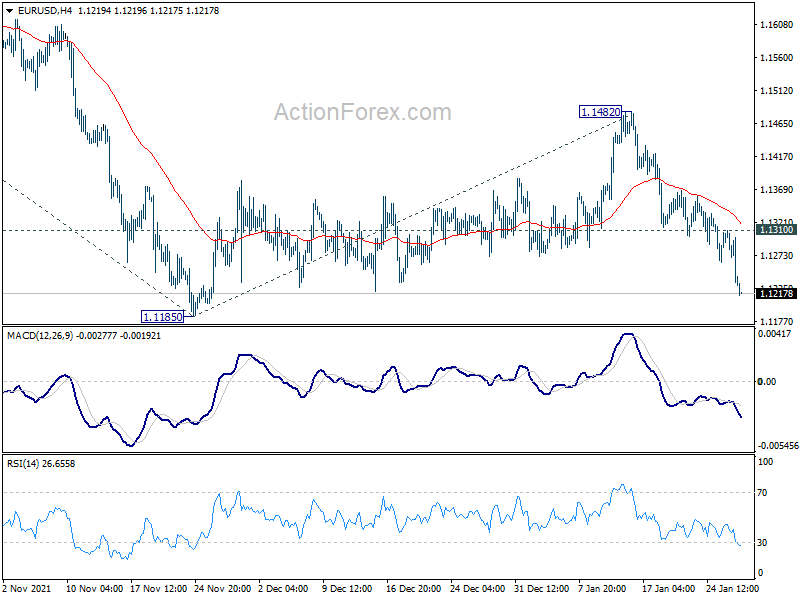
EUR/USD's fall from 1.1482 accelerates lower today and intraday bias remains on the downside. Firm break of 1.1185 support will resume larger down trend from 1.2348. Next target is 61.8% projection of 1.1908 to 1.1185 from 1.1482 at 1.1035. On the upside, above 1.1310 minor resistance will turn intraday bias back to the upside, and extend the consolidation from 1.1185 with another rise.
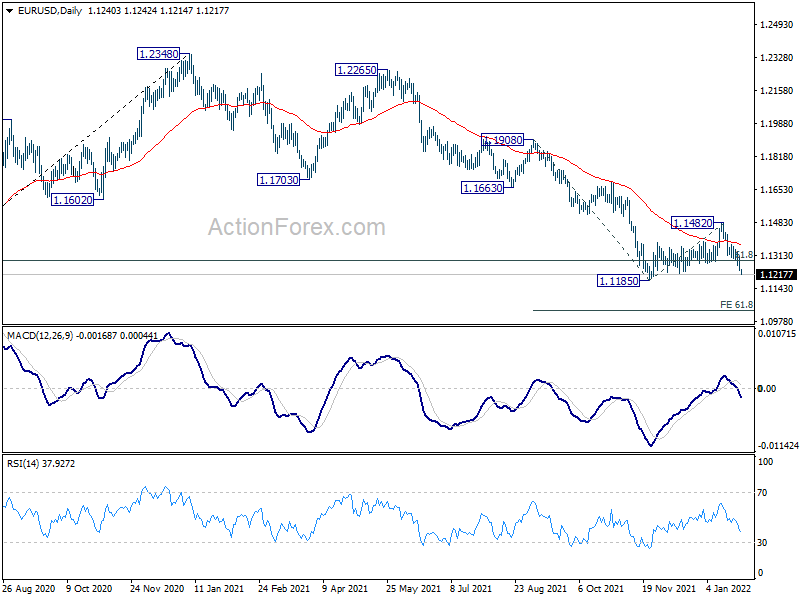
In the bigger picture, there are various ways of interpreting the fall from 1.2348 (2021 high). It could be a correction to rise from 1.0635 (2020 low), the fourth leg of a sideway pattern from 1.0339 (2017 low), or resuming long term down trend. In any case, outlook will now stay bearish as long as 1.1703 support turned resistance holds. Sustained break of 61.8% retracement of 1.0635 to 1.2348 at 1.1289 would pave the way back to 1.0635.
Dollar Surges in Full Risk-Off Markets, Sentiment Destroyed by Fed Powell
Investor sentiment was basically destroyed by more hawkish than expected Fed Chair Jerome Powell. US stocks reversed earlier gains and closed mixed. But futures are already pointing to a gap down open today. Major Asia indexes are trading in deep red. Markets are now expecting as many as five rate hikes this year starting March.
In the currency markets, Dollar is currently the strongest one for the week, followed by Yen. New Zealand Dollar is the worst, followed by Aussie. Canadian Dollar is just mixed as partly support by BoC hike expectations and rally in oil prices. European majors are mixed for now.
Technically, focus is quickly back on 1.1185 low in EUR/USD. Firm break there will confirm resumption of larger down trend from 1.2348. At the same time, we'll monitor the momentum of some Dollar pairs towards corresponding level. They 1.3158 low in GBP/USD, 0.6992 low in AUD/USD, and 1.2963 high in USD/CAD. By the way, NZD/USD has broken equivalent level of 0.6700 earlier this week already.
In Asia, at the time of writing, Nikkei is down -3.02%. Hong Kong HSI is down -2.54%. China Shanghai SSE is down -1.20%. Singapore Strait Times is down -0.36%. Japan 10-year JGB yield is up 0.0162 at 0.156. Overnight, DOW dropped -0.38%. S&P 500 dropped -0.15%. NASDAQ rose 0.02%. 10-year yield rose 0.065 to 1.848.
Suggested readings on Fed:
- FOMC Meeting Recap: Flexible Statement But Hawkish Powell Has Risk Appetite Reeling
- Fed Review: Every Meeting is "Live" – We Now Expect Five Hikes This Year
- FOMC Tees Up a Rate Hike for March
- Fed Signals Rate Hikes are Imminent
- FOMC Preps Markets for a Hike in March
- (FED) Federal Reserve Issues FOMC Statement
NASDAQ rejected by 14k after hawkish Fed, risks heavily on the downside
US stock markets tumbled sharply overnight and futures dive further in Asian session. Fed Chair Jerome Powell sounded very hawkish during the post meeting press conference. The indication that rate hikes would start in March wasn't much of a surprise. But Powell indicated that every meeting in "live" and refused to rule out 50bps hikes. Some economists are now forecasting as many as five hikes this year.
On inflation, Powell also warned "are still to the upside in the views of most FOMC participants, and certainly in my view as well". And, "there's a risk that the high inflation we are seeing will be prolonged. There's a risk that it will move even higher. So, we don't think that's the base case, but, you asked what the risks are, and we have to be in a position with our monetary policy to address all of the plausible outcomes,"
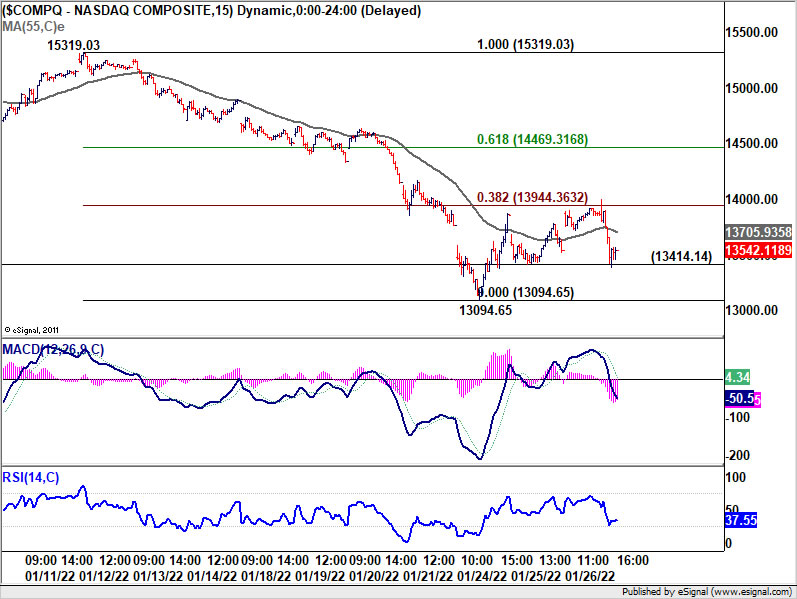
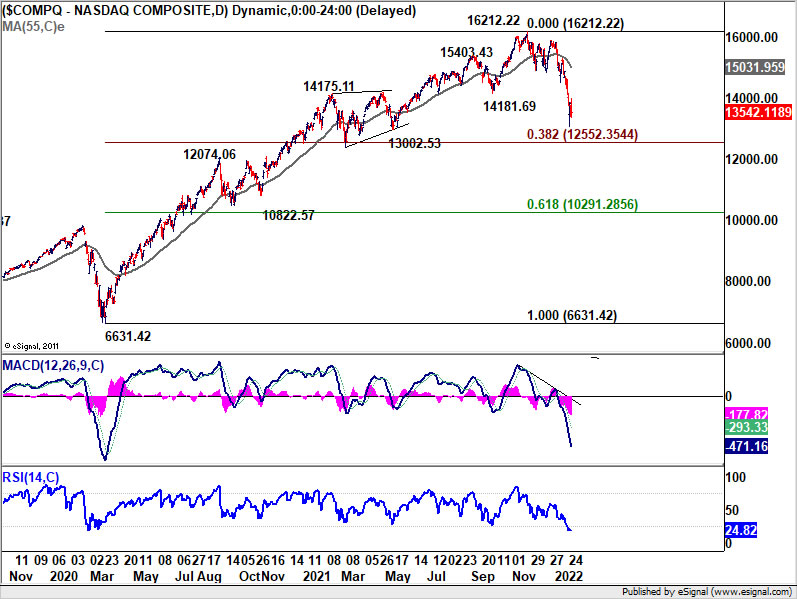
NASDAQ was rejected by 14k psychological level and 38.2% retracement 15319.03 to 13094.65 at 13944.36 to close flat. The development keeps near term risks heavily on the downside. Immediate focus is back on 13414.14 support. Break firm break there will argue that the free fall from 16212.22 is resuming. Next target will be 38.2% retracement of 6631.42 to 16212.22 at 12552.35.
Gold dives on strong Dollar, 1805 support in focus
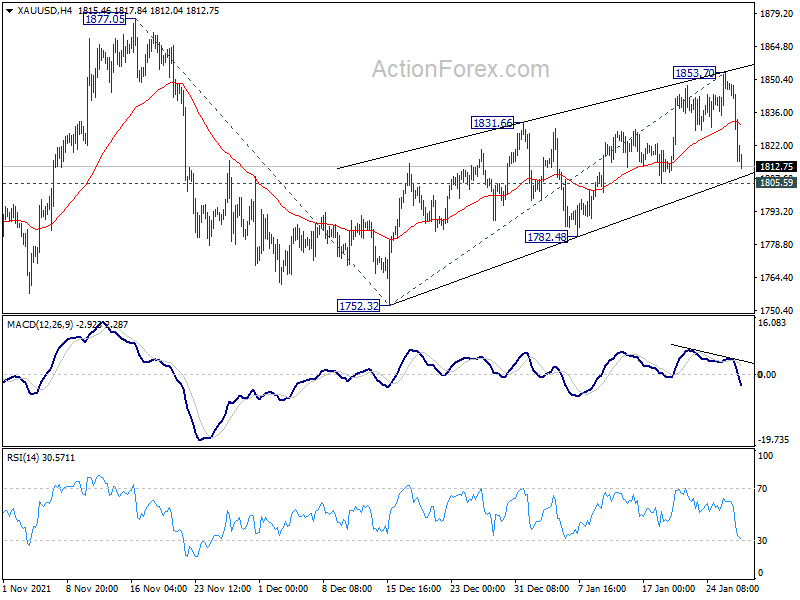
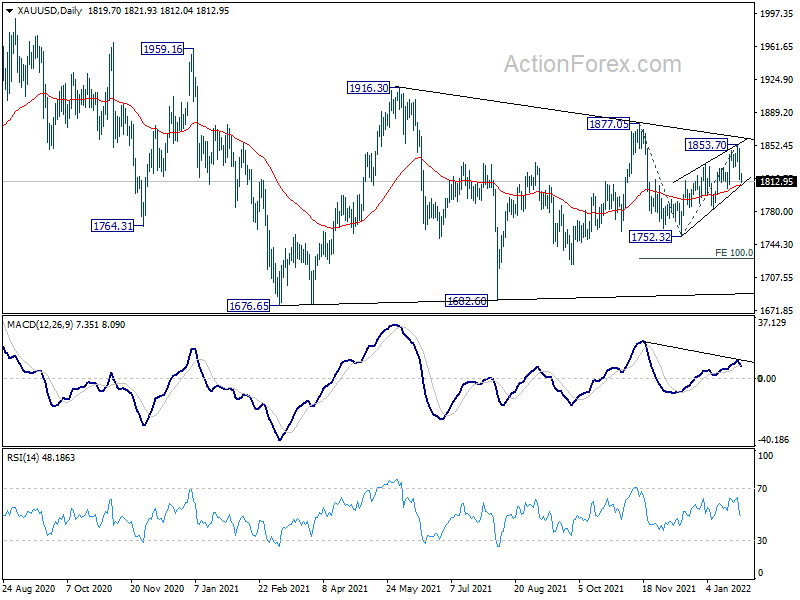
Gold dropped sharply overnight following broad based Dollar strength. The development now raises the chance that rebound from 1752.32 has completed with three waves up to 1853.70 Immediate focus is now on 1805.59 support. Firm break there should add more credence to this bearish case and send Gold through 1782.48 to 1752.32 support.
More importantly, rejection by medium term trend line resistance, together with the corrective structure of the rise from 1752.32 to 1853.70, suggests that medium term sideway pattern is extending with another falling leg. Break of 1782.48 support will open up the case for deeper decline to 100% projection of 1877.05 to 1752.32 from 1853.70 at 1728.97 eventually.
New Zealand CPI surges to 5.9% yoy, NZD/USD dives on risk aversion
New Zealand CPI rose 1.4% qoq in Q4, above expectation of 1.2% yoy. Annual rate accelerated from 4.9% yoy to 5.9% yoy, above expectation of 5.6% yoy. That's the highest level in three decades since 1990.
"New Zealand is not alone, with many other OECD countries experiencing higher inflation than in recent decades," consumers prices senior manager Aaron Beck said. "Price increases were widespread with 10 out of 11 main groups in the CPI basket increasing in the year, with only the communications group decreasing."
The data reinforces the case for RBNZ to raise interest rate in February. Westpac is forecasting a series of OCR hikes over the coming year with cash rat peaking at 3% in 2023. But New Zealand Dollar tumbles broadly following deep risk-off sentiment.
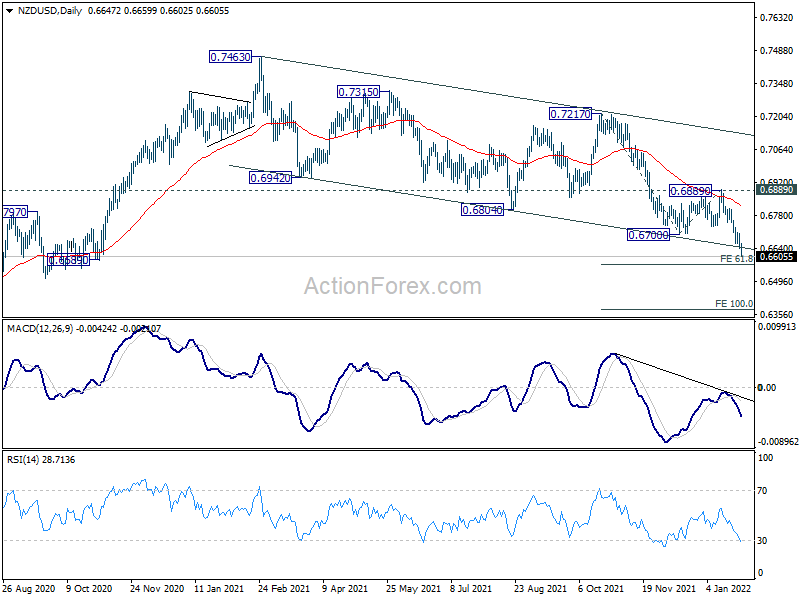
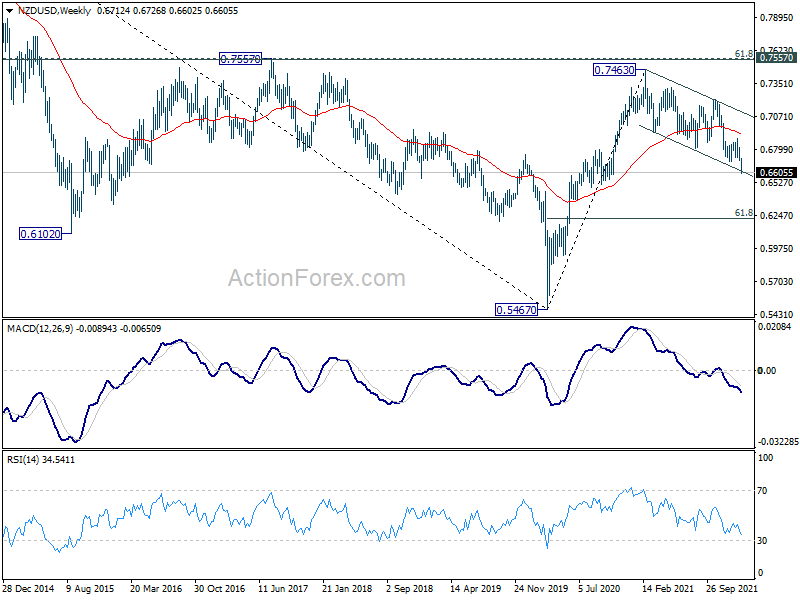
NZD/USD dives to as low as 0.6602 so far today as down trend continues. Next target is 61.8% projection of 0.7217 to 0.6700 from 0.6889 at 0.6569 and then 100% projection at 0.6372.
The strong break of medium term falling channel support indicates downside acceleration. Fall from 0.7463 could be a correction to up trend from 0.5467, or a impulsive down trend itself. In either case, NZD/USD would target 61.8% retracement of 0.5467 to 0.7463 at 0.6229 before making a bottom.
Elsewhere
Australia Westpac leading index rose 0.0% mom in December. Import prices rose 5.8% qoq in Q4, above expectation of 1.4% qoq.
Germany Gfk consumer confidence and Swiss trade balance will be released in European session. US will release jobless claims, GDP, durable goods orders and pending homes sales later in the day.
EUR/USD Daily Outlook
Daily Pivots: (S1) 1.1216; (P) 1.1263; (R1) 1.1291; More...
EUR/USD's fall from 1.1482 accelerates lower today and intraday bias remains on the downside. Firm break of 1.1185 support will resume larger down trend from 1.2348. Next target is 61.8% projection of 1.1908 to 1.1185 from 1.1482 at 1.1035. On the upside, above 1.1310 minor resistance will turn intraday bias back to the upside, and extend the consolidation from 1.1185 with another rise.
In the bigger picture, there are various ways of interpreting the fall from 1.2348 (2021 high). It could be a correction to rise from 1.0635 (2020 low), the fourth leg of a sideway pattern from 1.0339 (2017 low), or resuming long term down trend. In any case, outlook will now stay bearish as long as 1.1703 support turned resistance holds. Sustained break of 61.8% retracement of 1.0635 to 1.2348 at 1.1289 would pave the way back to 1.0635.
Economic Indicators Update
| GMT | Ccy | Events | Actual | Forecast | Previous | Revised |
|---|---|---|---|---|---|---|
| 21:45 | NZD | CPI Q/Q Q4 | 1.40% | 1.20% | 2.20% | |
| 21:45 | NZD | CPI Y/Y Q4 | 5.90% | 5.60% | 4.90% | |
| 23:30 | AUD | Westpac Leading Index M/M Dec | 0.00% | 0.10% | 0.20% | |
| 00:30 | AUD | Import Price Index Q/Q Q4 | 5.80% | 1.40% | 5.40% | |
| 07:00 | EUR | Germany Gfk Consumer Confidence Feb | -8 | -6.8 | ||
| 07:00 | CHF | Trade Balance (CHF) Dec | 5.23B | 6.16B | ||
| 13:30 | USD | Initial Jobless Claims (Jan 21) | 260K | 286K | ||
| 13:30 | USD | GDP Annualized Q4 P | 5.60% | 2.30% | ||
| 13:30 | USD | GDP Price Index Q4 P | 6.00% | 6.00% | ||
| 13:30 | USD | Durable Goods Orders Dec | -0.50% | 2.60% | ||
| 13:30 | USD | Durable Goods Orders ex Transportation Dec | 0.50% | 0.90% | ||
| 15:00 | USD | Pending Home Sales M/M Dec | -0.20% | -2.20% | ||
| 15:30 | USD | Natural Gas Storage | -205B | -206B |
Gold dives on strong Dollar, 1805 support in focus
Gold dropped sharply overnight following broad based Dollar strength. The development now raises the chance that rebound from 1752.32 has completed with three waves up to 1853.70 Immediate focus is now on 1805.59 support. Firm break there should add more credence to this bearish case and send Gold through 1782.48 to 1752.32 support.
More importantly, rejection by medium term trend line resistance, together with the corrective structure of the rise from 1752.32 to 1853.70, suggests that medium term sideway pattern is extending with another falling leg. Break of 1782.48 support will open up the case for deeper decline to 100% projection of 1877.05 to 1752.32 from 1853.70 at 1728.97 eventually.
New Zealand CPI surges to 5.9% yoy, NZD/USD dives on risk aversion
New Zealand CPI rose 1.4% qoq in Q4, above expectation of 1.2% yoy. Annual rate accelerated from 4.9% yoy to 5.9% yoy, above expectation of 5.6% yoy. That's the highest level in three decades since 1990.
"New Zealand is not alone, with many other OECD countries experiencing higher inflation than in recent decades," consumers prices senior manager Aaron Beck said. "Price increases were widespread with 10 out of 11 main groups in the CPI basket increasing in the year, with only the communications group decreasing."
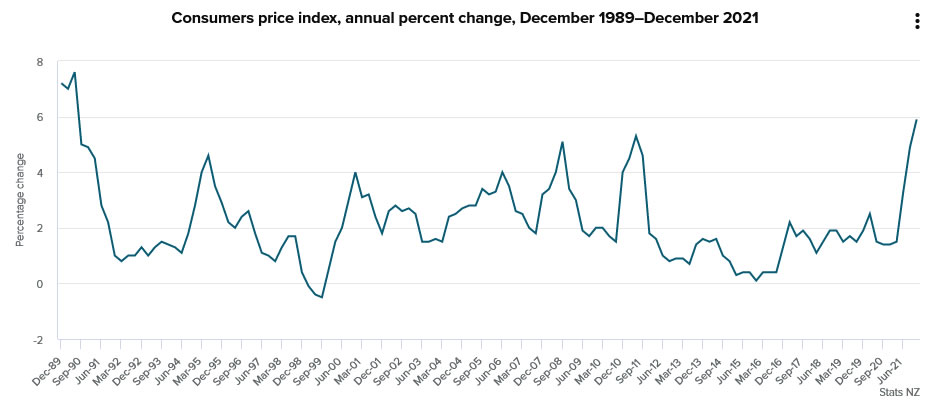
The data reinforces the case for RBNZ to raise interest rate in February. Westpac is forecasting a series of OCR hikes over the coming year with cash rat peaking at 3% in 2023. But New Zealand Dollar tumbles broadly following deep risk-off sentiment.
NZD/USD dives to as low as 0.6602 so far today as down trend continues. Next target is 61.8% projection of 0.7217 to 0.6700 from 0.6889 at 0.6569 and then 100% projection at 0.6372.
The strong break of medium term falling channel support indicates downside acceleration. Fall from 0.7463 could be a correction to up trend from 0.5467, or a impulsive down trend itself. In either case, NZD/USD would target 61.8% retracement of 0.5467 to 0.7463 at 0.6229 before making a bottom.
NASDAQ rejected by 14k after hawkish Fed, risks heavily on the downside
US stock markets tumbled sharply overnight and futures dive further in Asian session. Fed Chair Jerome Powell sounded very hawkish during the post meeting press conference. The indication that rate hikes would start in March wasn't much of a surprise. But Powell indicated that every meeting in "live" and refused to rule out 50bps hikes. Some economists are now forecasting as many as five hikes this year.
On inflation, Powell also warned "are still to the upside in the views of most FOMC participants, and certainly in my view as well". And, "there's a risk that the high inflation we are seeing will be prolonged. There's a risk that it will move even higher. So, we don't think that's the base case, but, you asked what the risks are, and we have to be in a position with our monetary policy to address all of the plausible outcomes,"
NASDAQ was rejected by 14k psychological level and 38.2% retracement 15319.03 to 13094.65 at 13944.36 to close flat. The development keeps near term risks heavily on the downside. Immediate focus is back on 13414.14 support. Break firm break there will argue that the free fall from 16212.22 is resuming. Next target will be 38.2% retracement of 6631.42 to 16212.22 at 12552.35.
Technical Outlook and Review
DXY:
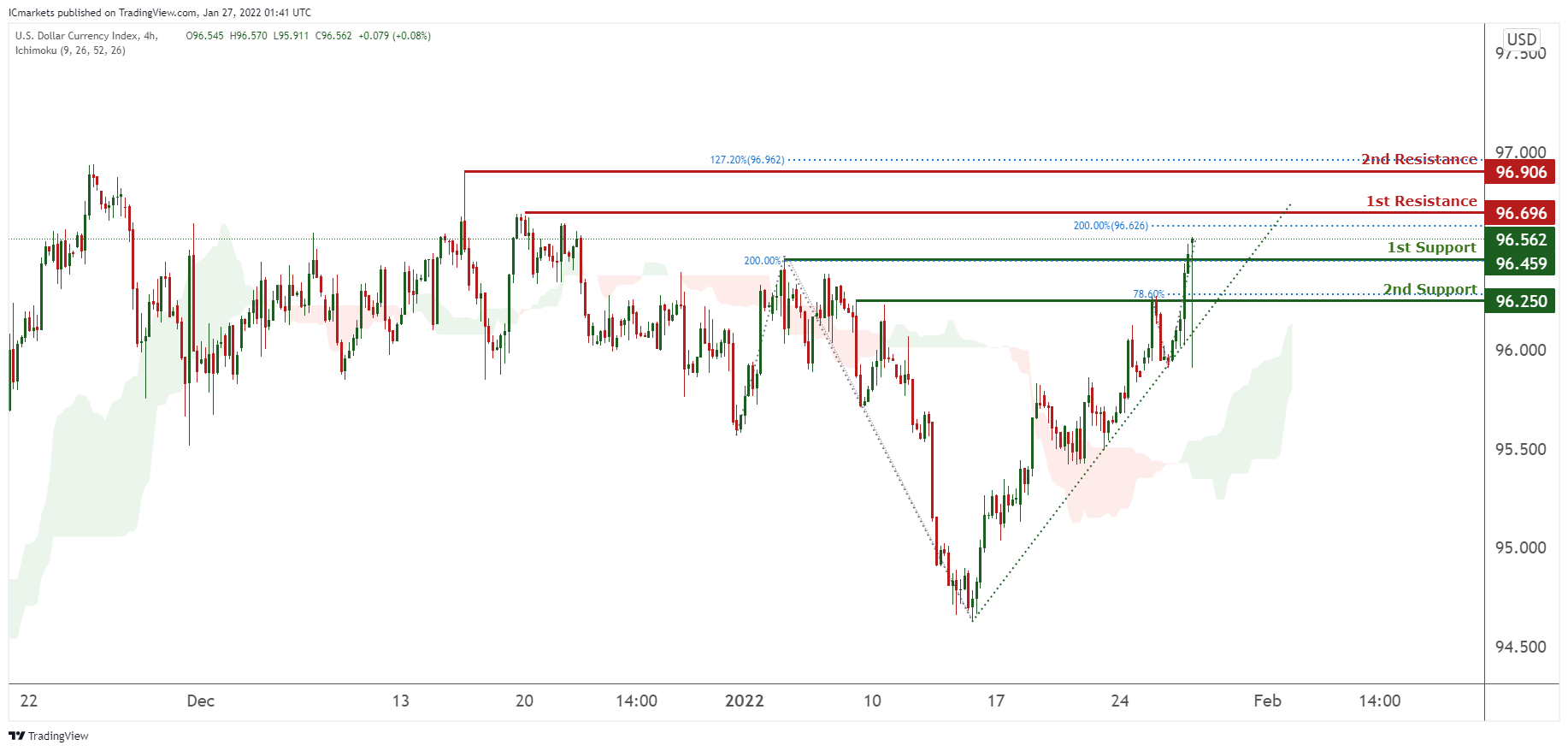
On the H4 timeframe, prices are on bullish momentum and abiding to our ascending trendline. We would expect potentially a bounce from our 1st support at 96.459 in line with 200% Fibonacci projection and 127.2% towards our 1st resistance at 96.696 in line with 200% Fibonacci projection. Prices are trading above our ichimoku support and also ascending trendline, further supporting our bullish bias.
Areas of consideration:
- H4 time frame, 1st resistance at 96.696
- H4 time frame, 1st support at 96.459
XAU/USD (GOLD):
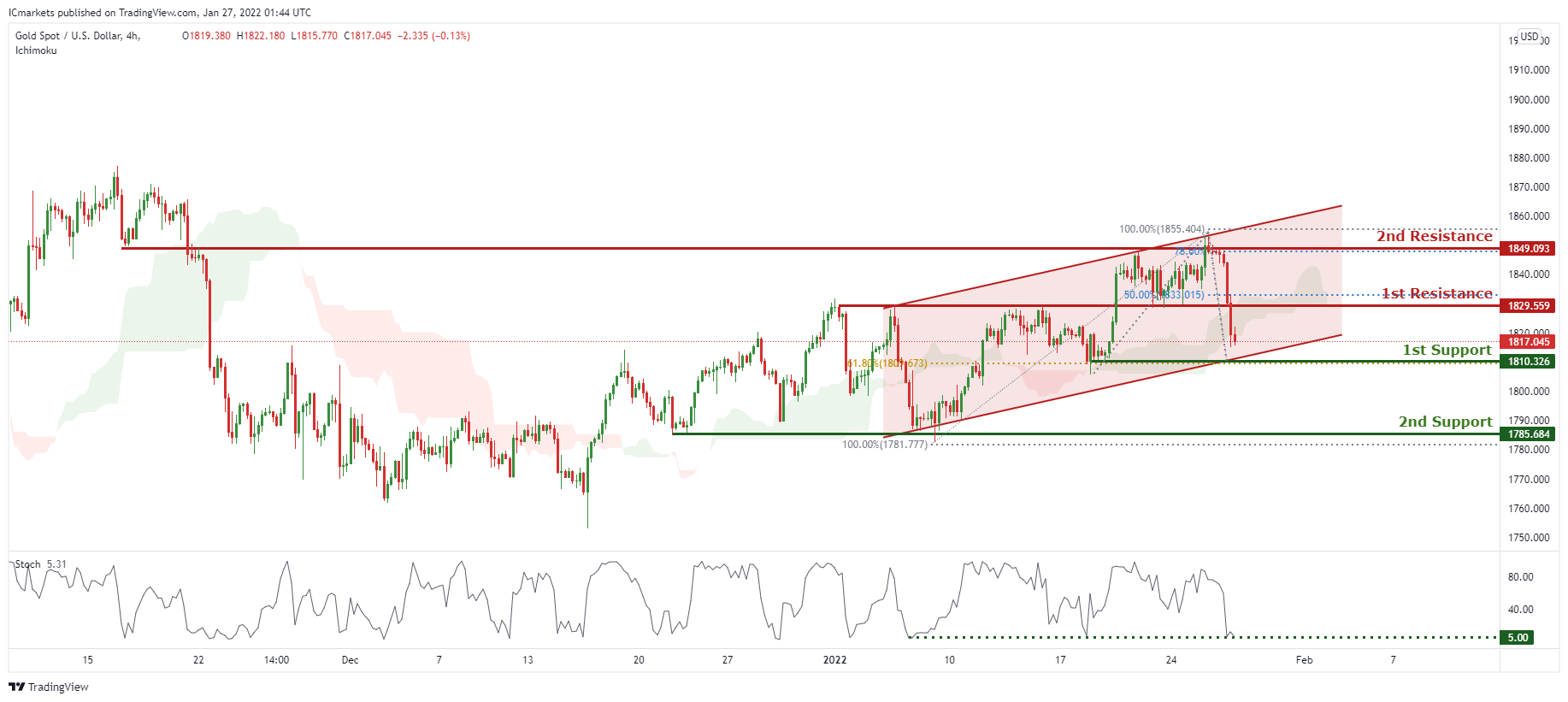
On the H4 chart, prices are on bullish momentum and consolidating in a parallel channel. We see a potential for a dip from our 1st support in line with 61.8% Fibonacci retracement at 1810.326 in line with 61.8% Fibonacci retracement towards our 1st resistance at 1829.559 in line with 50% Fibonacci retracement. RSI are close to a level where bounces previously occurred.
Areas of consideration:
- 4h 1st support at 1810.326
- 4h 1st resistance at 1829.559
GBP/USD:
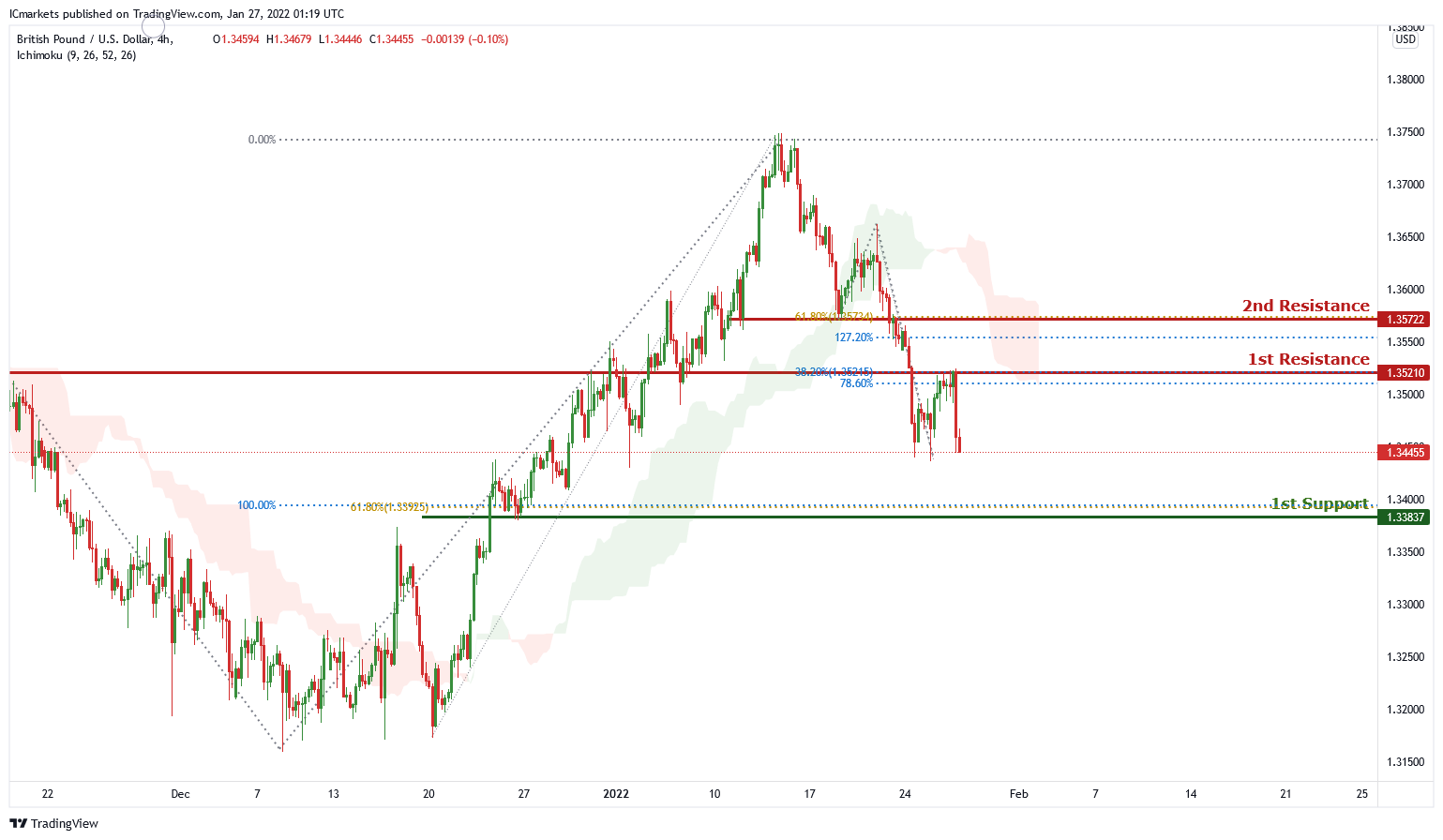
On the H4 chart price is between the 1st resistance level of 1.35210 which is also 38.2% Fibonacci retracement, 78.6% Fibonacci projection and 1st support level of 1.33837 which is also 100% Fibonacci projection and 61.8% Fibonacci retracement. Price can potentially continue to dip to the 1st support level. Our bearish bias is supported by the ichimoku cloud indicator as price is trading below it.
Areas of consideration
- H4 1st support at 1.33837
- H4 1st resistance at 1.35210
USD/CHF:
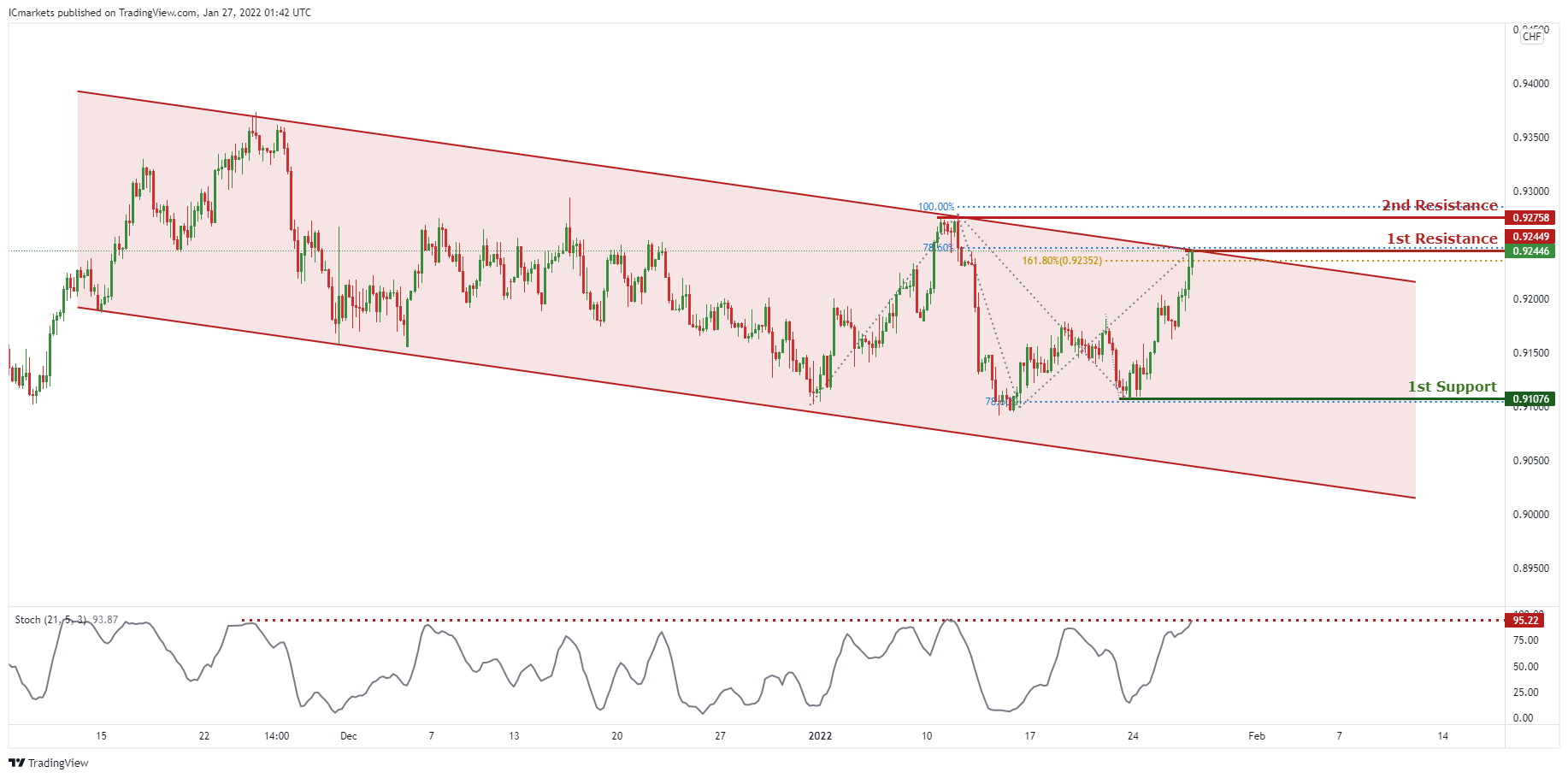
On the H4 timeframe, price is abiding to a descending channel, signifying a bearish momentum. Price is reacting at 1st Resistance, we can expect price to drop from 1st Resistance in line with 161.8% Fibonacci extension and 78.6% Fibonacci projection towards 1st Support in line with 78.6% Fibonacci projection. Our bearish bias is further supported by the stochastic indicator where the %K line is approaching the resistance level.
Areas of consideration:
- Watch 1st Support at 0.90961
- Watch 1st Resistance at 0.91967
EUR/USD :
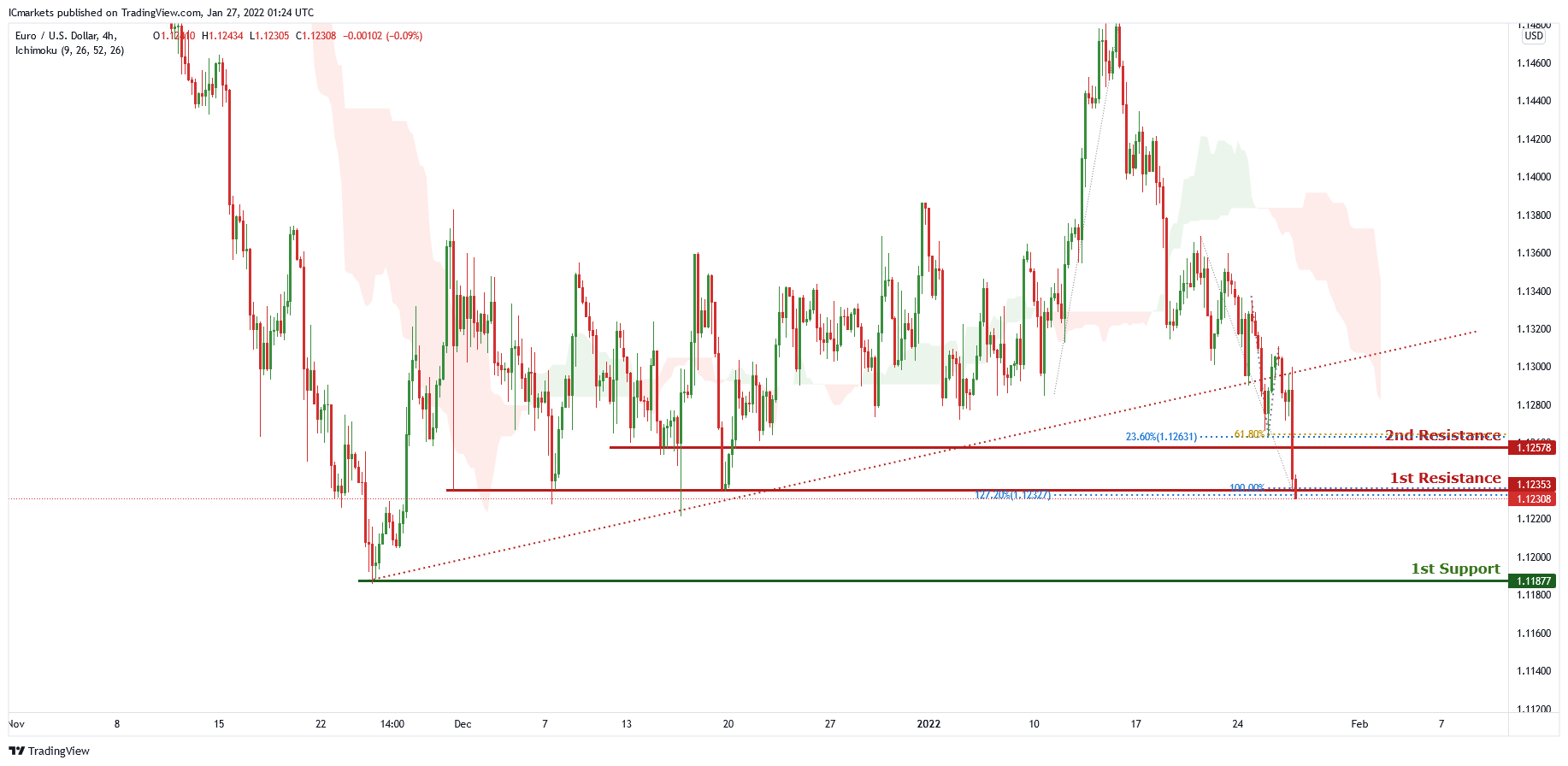
On the H4 chart , price has recently broken out of the ascending trendline and is near 1st resistance level of 1.12353 which is also 100% Fibonacci projection and 127.2% Fibonacci retracement. Price can potentially dip to the 1st support level of 1.11877 which is also the graphical swing low support. Our bearish bias is supported by the ichimoku cloud indicator as price is trading below it.
Areas of consideration
- H4 1st support at 1.11877
- H4 1st resistance at 1.12353
USD/JPY:
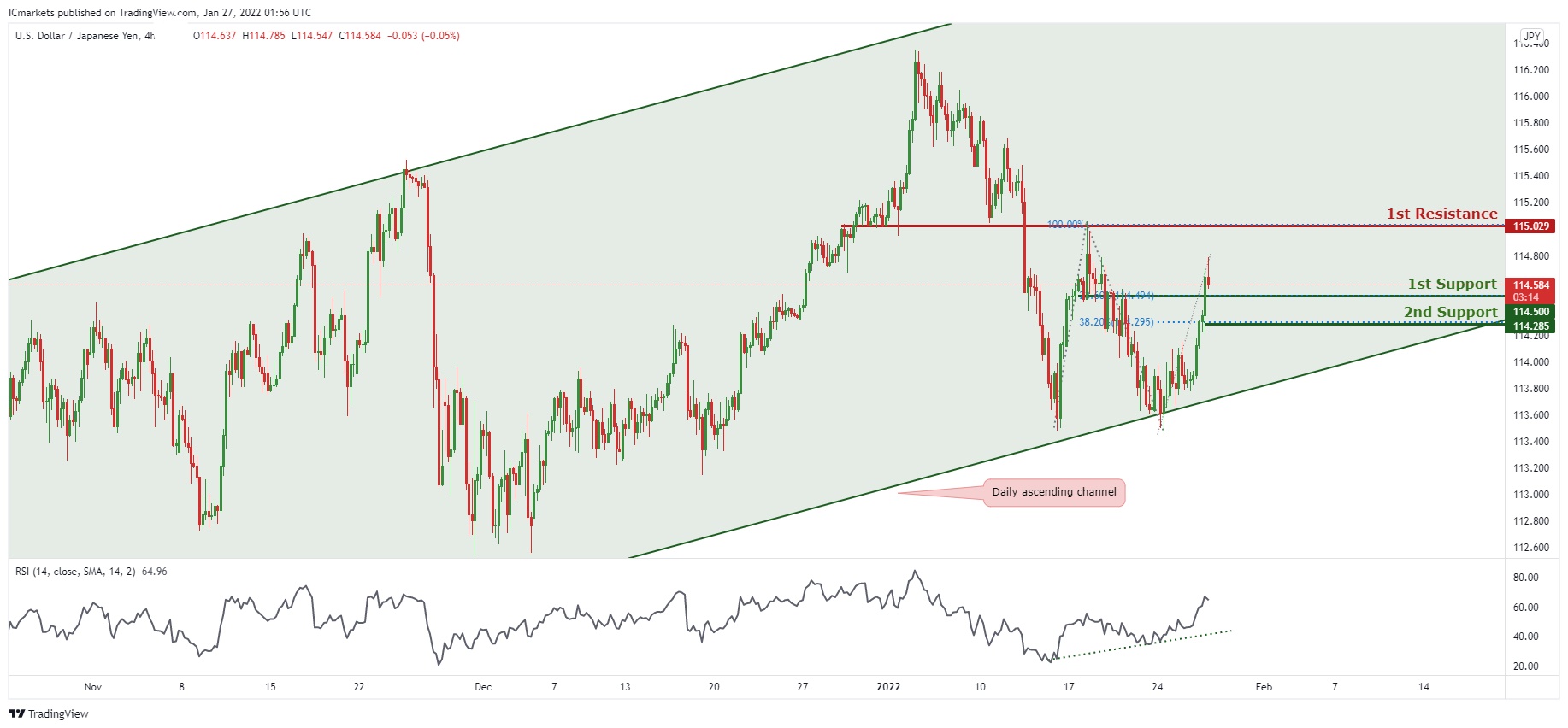
In reference to yesterday’s analysis, we can see that price indeed bounced to 1st Resistance @ 114.813. On the H4 timeframe, is abiding to the ascending channel on the daily, signifying an overall bullish momentum. We can now expect the price to bounce from 1st Support in line with 23.6% Fibonacci retracement towards 1st Resistance in line with 100% Fibonacci projection. Our bullish bias is further supported by the RSI indicator abiding to the ascending trendline support.
Areas of consideration:
- H4 1st resistance level 115.029
- H4 1st support level 114.500
AUD/USD:
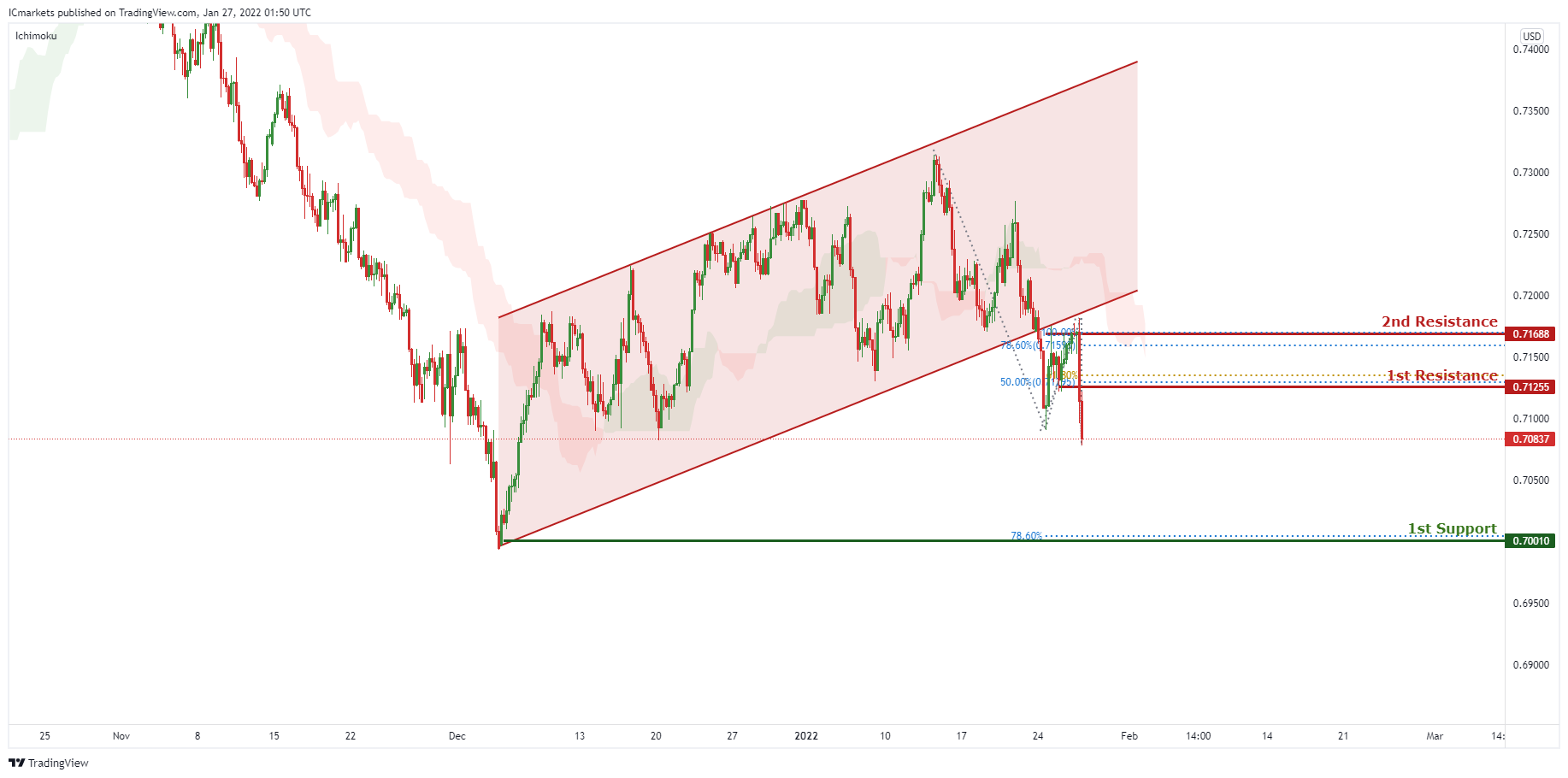
In reference to yesterday’s analysis, price indeed dropped to 1st Support @ 0.70883. On the H4, price broke out of the ascending channel, signifying an overall bearish momentum. We can expect price to drop from 1st Resistance in line with 61.8% Fibonacci projection and 50% Fibonacci retracement towards 1st Support in line with graphical support level and 78.6% Fibonacci projection. Our bearish bias is further supported by the Ichimoku cloud indicator where the price is holding below it.
Areas of consideration:
- H4 1st Support level 0.70010
- H4 1st resistance level 0.71255
NZD/USD:
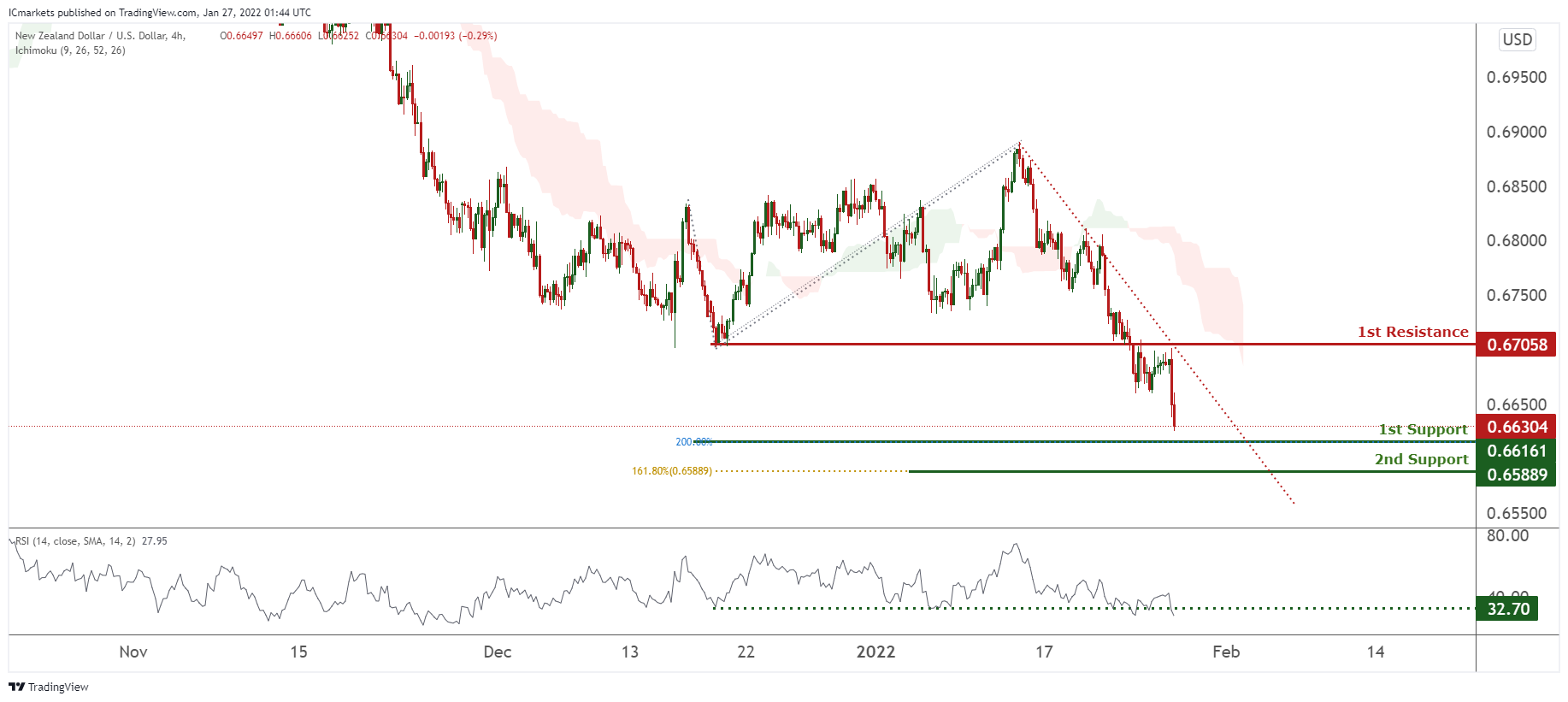
On the H4, prices are on bearish momentum and abiding to our bearish trendline. We see the potential for a short bounce from our 1st support at 200% FIbonacci projection towards our descending trendline at 1st resistance at 0.67058 which is a graphical overlap. RSI is at a level where bounces occurred previously. Alternatively, our stop loss will be placed at our 2nd support at 0.65889 in line with 161.8% Fibonacci Projection.
Areas of consideration:
- H4 time frame, 1st resistance at 0.67058
- H4 time frame, 1st support at 0.66161
USD/CAD:
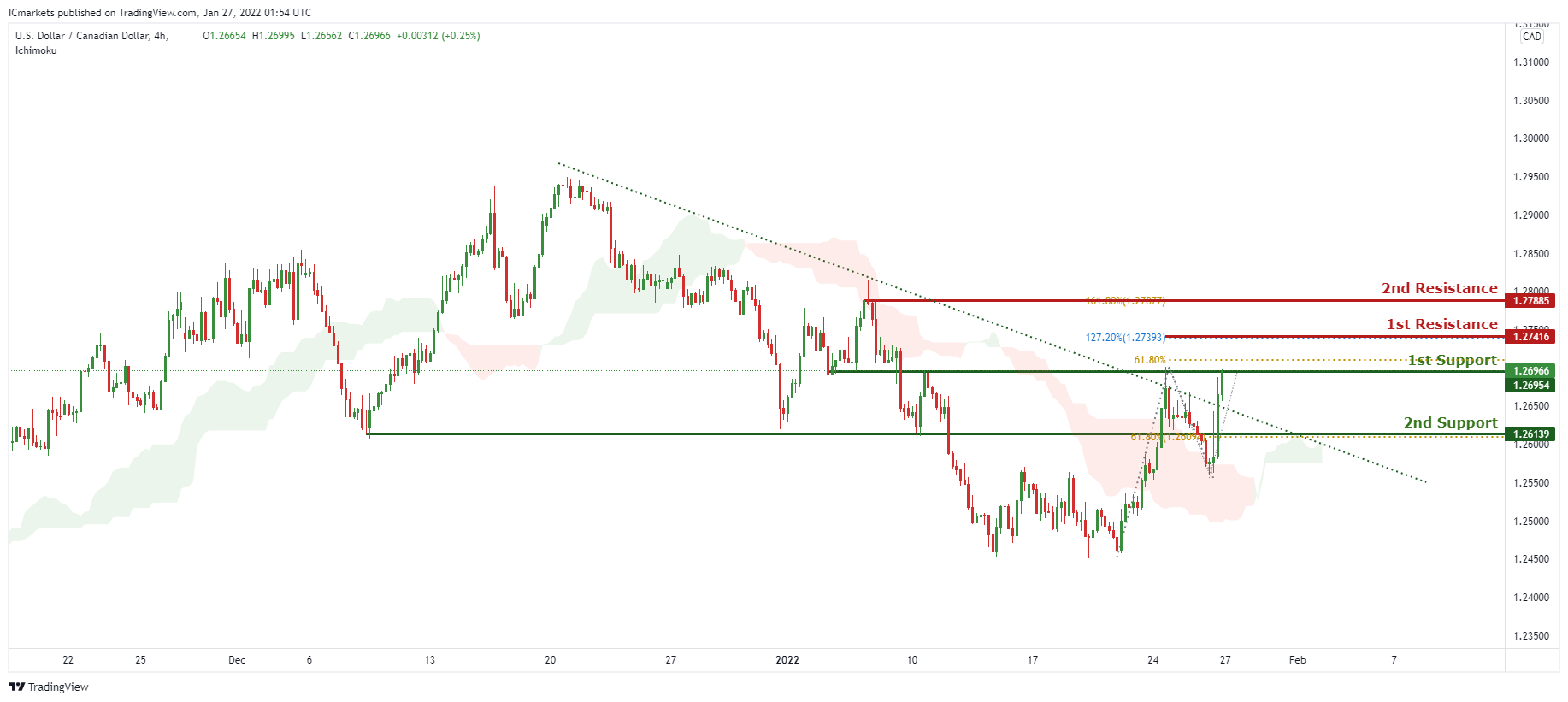
On the H4, prices have broken out of our descending trendline and are on bullish momentum. We see the potential for a bounce from our 1st support at 1.26954 in line with 61.8% Fibonacci extension towards our 1st resistance at 1.27416 in line with 127.2% Fibonacci extension. Alternatively, price may break 1st support structure and head for 2nd support at 1.26139, in line with 61.8% Fibonacci projection and horizontal swing low support. Prices are trading above our ichimoku cloud support, further supporting our bullish bias.
Areas of consideration:
- H4 time frame, 1st support at 1.26966
- H4 time frame, 1st resistance at 1.27416
OIL:
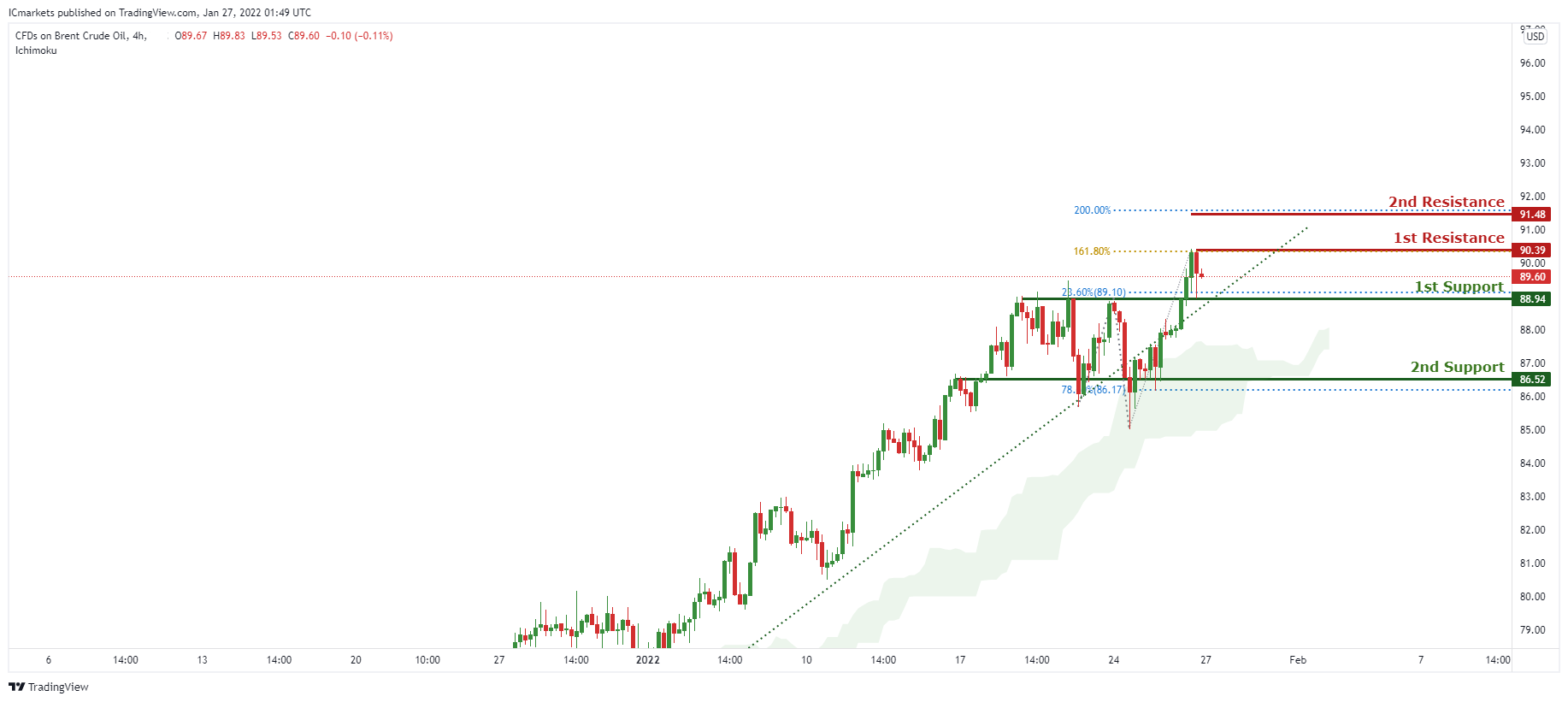
On the H4, are on bullish momentum and abiding to our ascending trendline support. We expect a potential bounce from our 1st support at 88.94 in line with 23.6% Fibonacci retracement towards our 1st resistance at 90.39 in line with 161.8% Fibonacci projection. Prices are trading above our ichimoku clouds, further supporting our bullish bias.
Areas of consideration:
- H4 time frame, 1st resistance of 90.39
- H4 time frame, 1st support of 88.52
Dow Jones Industrial Average:
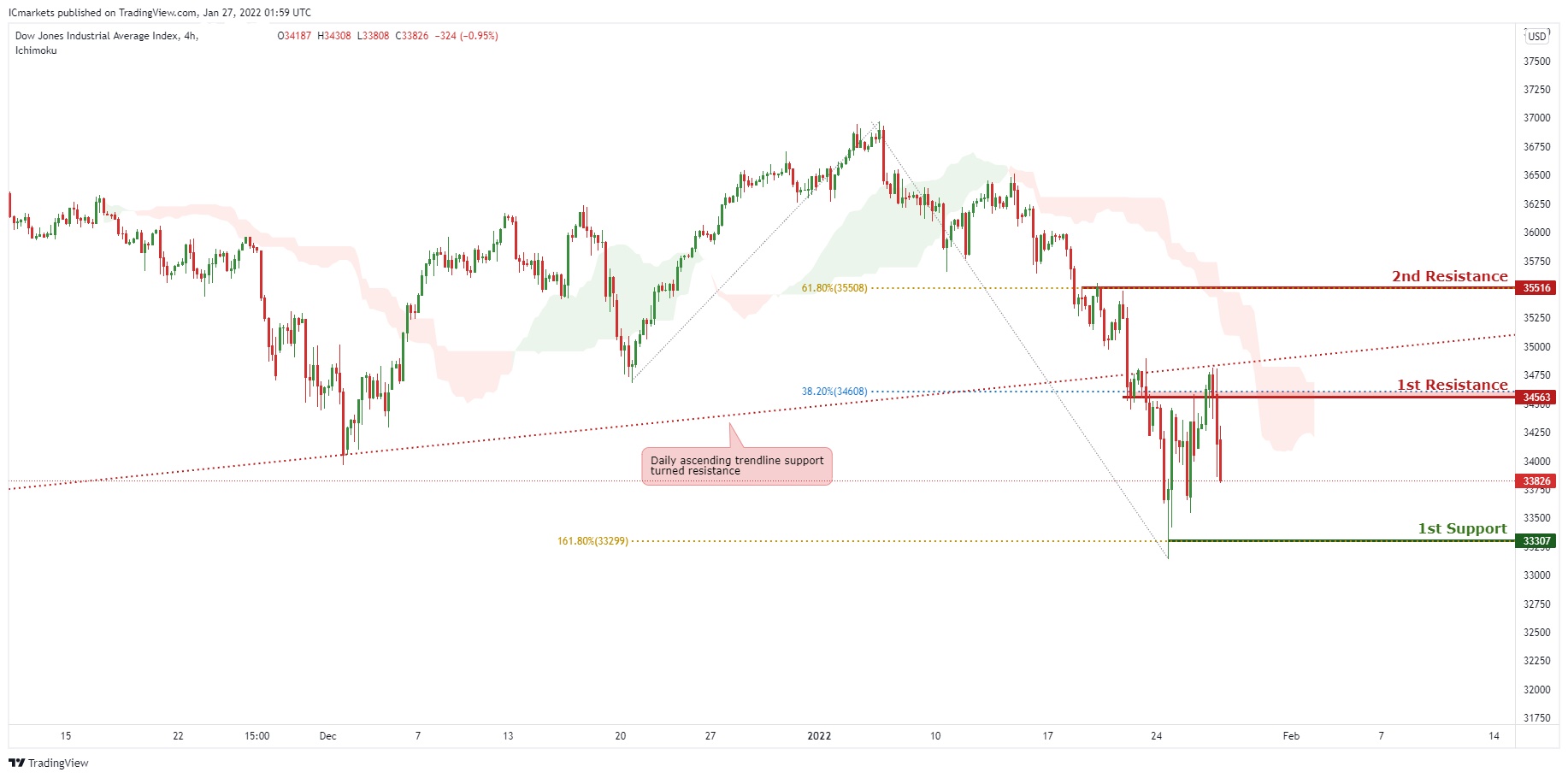
On the H4, with price moving below the ichimoku cloud, signifying an overall bearish momentum. We can expect price to drop from our 1st resistance at 34563 in line horizontal graphical overlap and 38.2% Fibonacci retracement towards 1st support in line with horizontal overlap support ,161.8% Fibonacci extension level at 33307. Alternatively, price may break 1st resistance structure and head for 2nd resistance, which coincides with 61.8% Fibonacci retracement at 35516. Traders should wait for price to swing higher or lower before entering.
Areas of consideration:
- H4 time frame, 1st resistance of 34563
- H4 time frame, 1st support of 33307
New Zealand CPI: To Infinity and Beyond
- Consumer prices rose 1.4% in the December quarter. That took the annual inflation rate to 5.9%, its highest level since 1990.
- Inflation pressures are broad based, boosted by a potent cocktail of strong demand and rising cost pressures. Those factors point to ongoing high levels of inflation over 2022.
- Today's result reinforces our expectation for a series of OCR hikes over the coming year.
Annual consumer price inflation hit a 31-year high at the end of 2021.
Consumer prices rose 1.4% in the December quarter. That took the annual inflation rate to 5.9%, up from 4.9% last quarter. That is the highest annual rate of inflation since the GST-related spike in 1990.
The December quarter increase was a little above our own forecast for a 1.2% rise and the average market forecast of 1.3%. It was also a little higher than the RBNZ's last published forecast from November for a 1.2% rise.
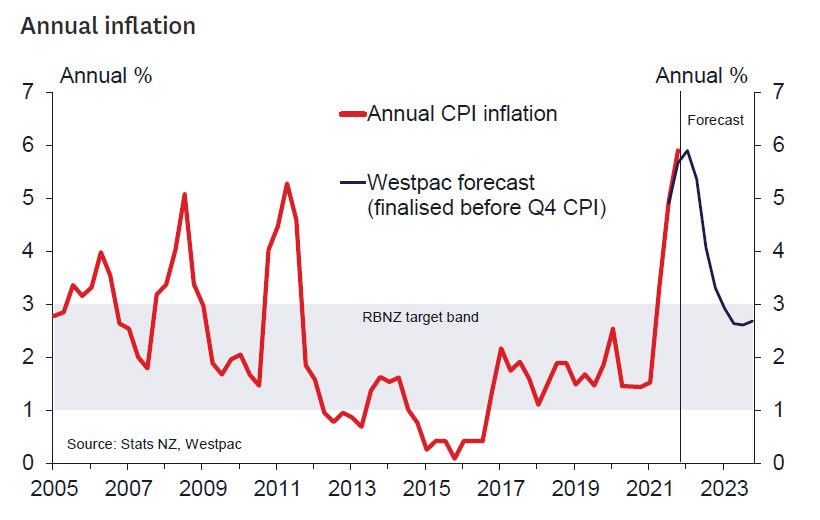
There has been a dramatic turnaround in New Zealand consumer prices over the past year. For most of the past decade, inflation struggled to crack the RBNZ's 2% target. Now that picture has gone into reverse. Inflation is well outside the RBNZ's target band, and it's set to remain so for at least the next year.
Much of this turn around in inflation is a result of offshore factors. Disruptions to global manufacturing chains in the wake of Covid-19 have resulted in shortages of many consumer goods and production inputs. The resulting upward pressure on prices has been compounded by increases in international transport costs, with both shipping rates and oil prices rising rapidly over the past year. The combination of those factors has seen the price of tradables items (mainly imported goods) rising by a huge 6.9% over the past year. Even excluding fuel costs, tradable prices are up a hefty 4.4%.
But it's not just imported prices are that charging higher. Domestic inflation has also been running hot. In fact, nontradables inflation – which is closely watched by the RBNZ – is now running at a multi-decade high of 5.9%. In part, that's due to pressure on domestic supply chains and shortages of staff that have seen businesses operating costs pushing higher.
Compounding the rise in cost pressures, demand has also been running hot in some key parts of the domestic economy. Most notably, residential construction is booming, with build costs a major contributor to the lift in overall inflation. Households are also spending up on a range of domestic and imported items, like furnishings and recreational equipment. This strength in demand has meant that businesses have greater scope to pass on cost increases into final prices, rather than taking a hit on margins.
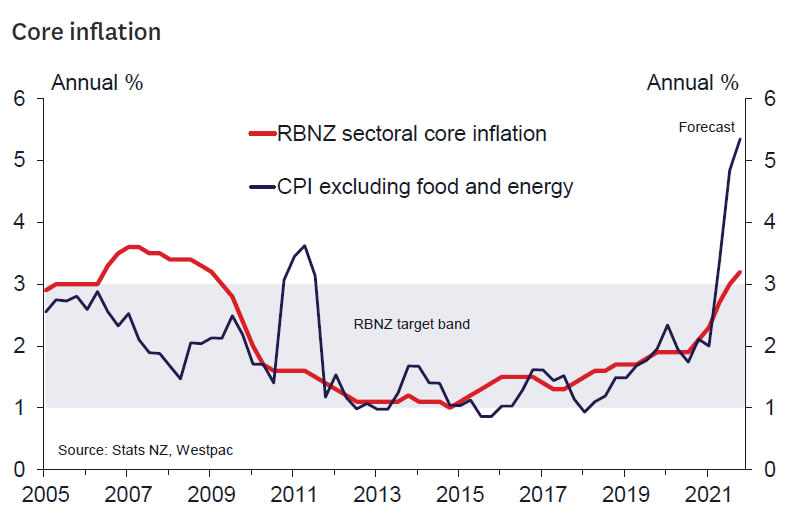
This potent cocktail of supply chain pressures and firm domestic demand has resulted in strong and widespread price increases across the New Zealand economy. That was reflected in the suite of core inflation measures released by Stats NZ today, which smooth through sharp quarter-to-quarter swings in prices and track the underlying trend in inflation. Most core inflation measures (including the RBNZ's own estimate) are now running above 3%, and in many cases they are running above 4%. This underlying strength in pricing pressures indicates that inflation is likely to remain elevated for at least the next year.
Inflation and the RBNZ.
Today's result supports our expectation for a series of rate hikes from the RBNZ over the coming months.
Inflation is set to remain above the RBNZ's target band through 2022, and it is likely to remain firm into 2023 (though there could be some quarter-to-quarter volatility associated with Covid). And although much of the strength in inflation is due to overseas cost pressures, domestic demand has also been a major factor pushing prices higher. That's particularly important for the RBNZ. There's not much the central bank can do to offset cost shocks from abroad that have already occurred. However, strong domestic demand means that price pressures could remain elevated even when the current overseas supply disruptions ease. And low interest rates are a key reason for the strength in households' spending appetites.
Reinforcing the strong inflation outlook and of particular concern for the RBNZ, inflation expectations are now running well above 2% and are likely to feed into higher wages and prices over time.
With inflation bubbling away, Westpac is expecting a 25bp increase in the OCR at the upcoming February policy decision. We expect that will be followed by a series of OCR hikes over the coming year, with the cash rate peaking at 3% in 2023.
While the direction for interest rates is up, the economic landscape remains rocky and changing. Most notably, the continuing spread of Covid and its variants will challenge economic conditions here and abroad. We doubt that will prevent rate hikes altogether, but it does mean that the RBNZ is more likely to raise the OCR in measured steps of 25bps. In contrast, markets are pricing in some chance of a 50bp move from the RBNZ. We think that sort of large move is unlikely.
Detail of the December quarter inflation result.
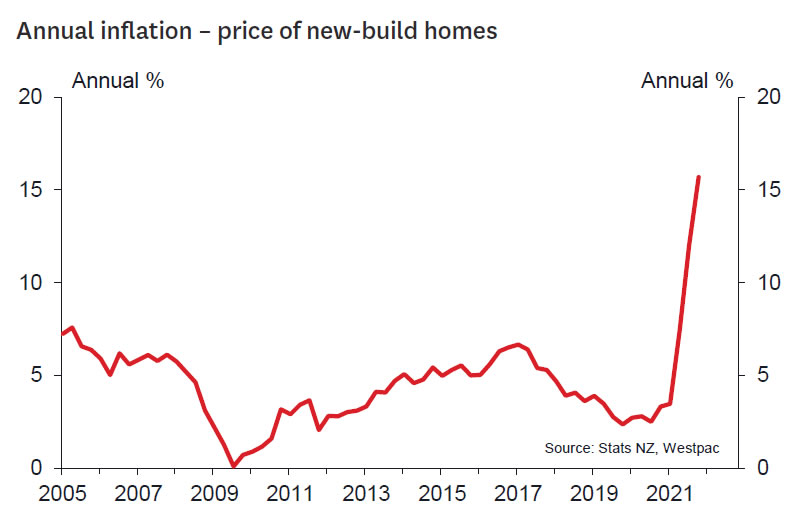
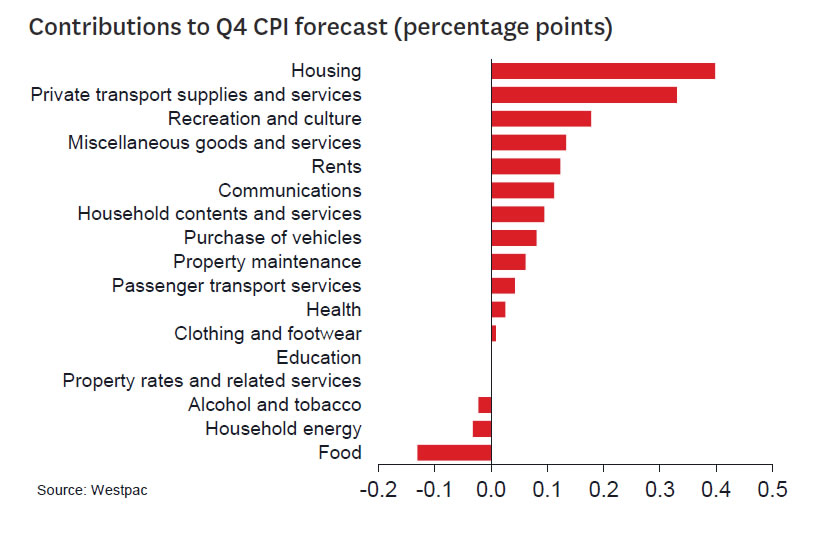
Looking into the detail of the December quarter inflation report, the major contributor to the rise in consumer prices was a further significant increase in construction costs. The cost of building a new home rose 4.5% over the December quarter. That follows similarly large increases in recent quarters, with construction costs up a massive 15.7% over the past year (as a comparison, over the past decade build costs tended to rise by around 4% per annum). Building activity has been charging higher over the past year, with low interest rates and the strong housing market encouraging development activity. At the same time, acute shortages of materials and staff have seen input costs rocketing higher. With a large pipeline of planned work over the coming year, we expect build costs will continue to rise at a brisk pace for some time yet.
Other housing costs also saw solid rises this quarter. That include strong gains in property maintenance costs. We also saw rents rising by 1.2% this quarter to be up 3.8% over the past year. Anecdotes are pointing to growing pressure on rents as we've moved into 2022.
Petrol prices have also risen strongly in recent months, with local pump prices up 7.7%. Global oil prices rose strongly through the final months of 2021, and the related increase in transport costs is also boosting prices in the economy more generally.
While increases in housing and transport costs accounted for the lion's share of this quarter's rise, inflation pressures are widespread. Recent months saw firmness in the prices for a range of goods, including prices for many durable household items like furnishings and recreational equipment. Retailers continue to report difficulties sourcing stocks, as well as rising import costs in the face of strong demand.
Providing a partial offset to the strong rises in other categories, food prices fell 0.7% in the December quarter due to the usual seasonal decline in the prices of fresh vegetables. However, that's actually a fairly modest fall in overall food prices for this time of year, with prices for groceries and takeaways/dining out pushing higher in recent months. Looking at 2021 as a whole, food prices rose by 4.7% over the past year. That's the fastest rise we've seen in a decade.
AUD/USD Struggles Below 0.7200, Oil Rallies
Key Highlights
- AUD/USD started a fresh decline from well above 0.7280.
- It traded below a key contracting triangle with support near 0.7185 on the 4-hours chart.
- EUR/USD is struggling below 1.1300, and GBP/USD declined below 1.3500.
- Crude oil price gained pace above the $85.00 resistance level.
AUD/USD Technical Analysis
The Aussie Dollar struggled to clear 0.7300 against the US Dollar. AUD/USD started a fresh decline below the 0.7250 and 0.7220 support levels.
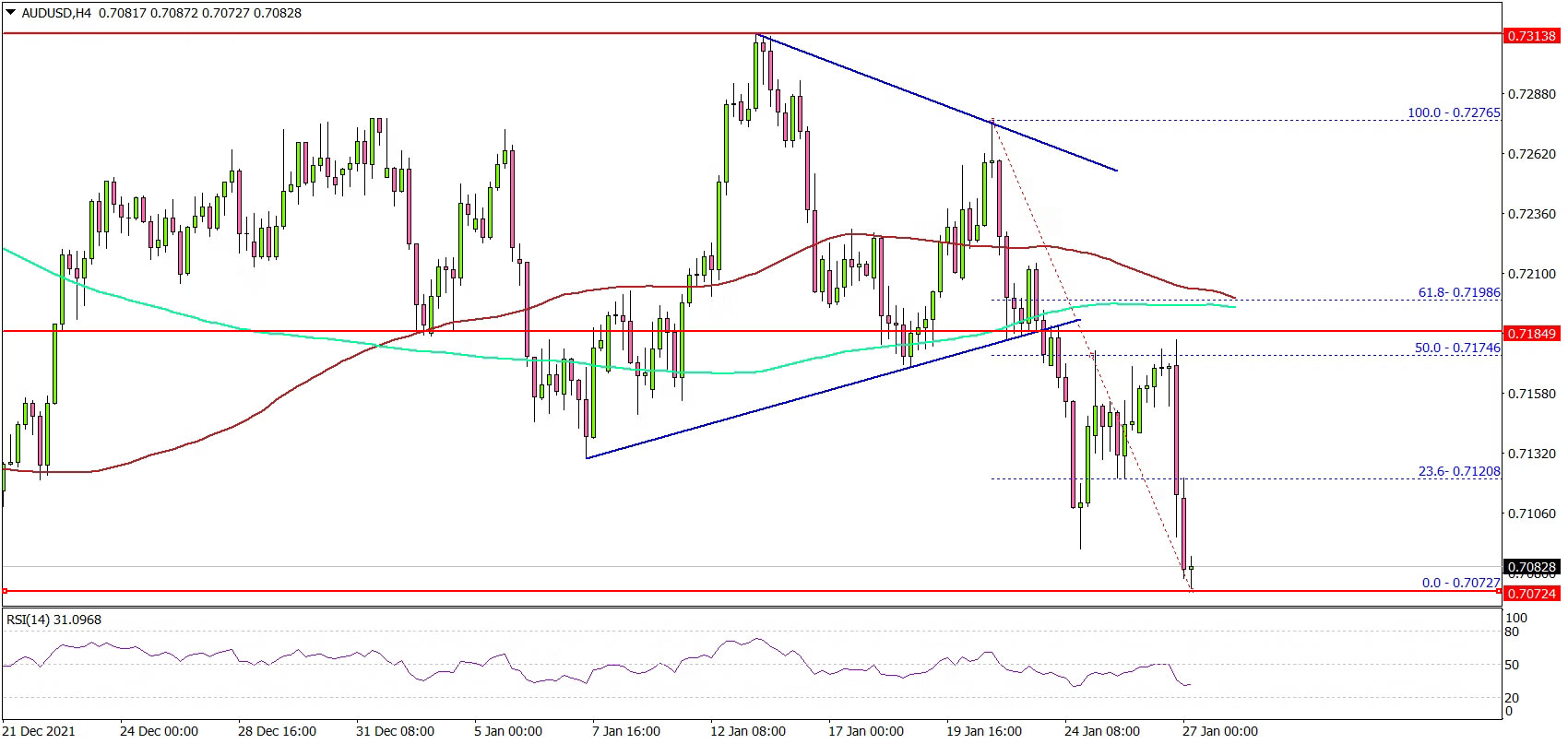
Looking at the 4-hours chart, the pair settled below the 0.7200 level, the 100 simple moving average (red, 4-hours), and the 200 simple moving average (green, 4-hours). Finally, there was a spike below the 0.7120 level.
Earlier, a low was formed near 0.7091 and the pair corrected losses. There was a move above 0.7120 and 0.7125, but upsides were capped. It remained below the 0.7180 and 0.7190 levels. Besides, there was no test of the 50% Fib retracement level of the downward move from the 0.7276 swing high to 0.7091 low.
The pair started a fresh decline below 0.7120 and even broke the 0.7091 low. The next major support sits near the 0.7065 level, below which it could test 0.7000. If there is a fresh increase above 0.7120, the pair could rise towards 0.7200.
Looking at EUR/USD, the pair is showing bearish signs below 1.1300, and GBP/USD extended decline below the 1.3500 support zone.
Economic Releases
- US Initial Jobless Claims - Forecast 260K, versus 286K previous.
- US Pending Home Sales for Dec 2021 (YoY) - Forecast -0.2%, versus -2.2% previous.
- US Durable Goods Orders for Dec 2021 – Forecast -0.5% versus +2.6% previous.