

Sample Category Title
BoC Macklem press conference live stream and statement
https://www.youtube.com/watch?v=9qB7XoGBgHo
Monetary Policy Report Press Conference Opening Statement
Good morning. I’m pleased to be here with you to discuss today’s policy announcement and the Bank of Canada’s Monetary Policy Report (MPR). I am especially pleased to have Senior Deputy Governor Carolyn Rogers here for her first press conference. She has joined the Governing Council at an important time.
Our message today is threefold.
First, the emergency monetary measures needed to support the economy through the pandemic are no longer required and they have ended.
Second, interest rates will need to increase to control inflation. Canadians should expect a rising path for interest rates.
Third, while reopening our economy after repeated waves of the COVID-19 pandemic is complicated, Canadians can be confident that the Bank of Canada will control inflation. We are committed to bringing inflation back to target.
Let me take each of these in turn.
The Bank’s response to the pandemic has been forceful. Throughout, our actions have been guided by our mandate. We have been resolute and deliberate, communicating clearly with Canadians on our extraordinary measures to support the economy and on the conditions for their exit. When we introduced emergency liquidity measures to support core funding markets, we said they would end when market functioning was restored. And they did. When we launched quantitative easing (QE), we said it would continue until the recovery was well underway. As the recovery progressed, we began tapering QE and ended it in October. Today marks the final step in exiting from emergency policies. We said exceptional forward guidance would continue until economic slack was absorbed. With the strength of the recovery through the second half of 2021, the Governing Council now judges this condition has been met. As such, we are removing our commitment to hold our policy rate at its floor of 0.25%.
Second, we want to clearly signal that we expect interest rates will need to increase. A lot of factors are contributing to the uncomfortably high inflation we are experiencing today, and many of them are global and reflect the unique circumstances of the pandemic. As the pandemic fades, conditions will normalize, and inflation will come down. However, with Canadian labour markets tightening and evidence of capacity pressures increasing, the Governing Council expects higher interest rates will be needed to bring inflation back to the 2% target.
Finally, Canadians can be assured that the Bank of Canada will control inflation. Prices for many goods and services are rising quickly, and this is making it harder for Canadians to make ends meet—particularly those with low incomes. Prices for food, gasoline and housing have all risen faster than usual. We expect inflation will remain close to 5% through the first half of 2022 and then move lower. There is some uncertainty about how quickly inflation will come down because we’ve never experienced a pandemic like this before. But Canadians can be assured that we will use our monetary policy tools to control inflation.
Let me turn to the economic outlook that we’ve outlined in our MPR.
Globally, the pandemic recovery is strong but uneven and continues to be marked by supply chain disruptions. Robust demand for goods combined with these supply problems and higher energy prices have pushed up global inflation. With this rise in inflation, expectations that monetary stimulus will be reduced have been pulled forward and financial conditions have tightened from very accommodative levels.
In Canada, growth in the second half of 2021 was even stronger than we had projected, and a wide range of measures now suggest economic slack is absorbed. With the rapid spread of the Omicron variant, first-quarter growth is likely to be modest, but we expect the impact on our economy to be less severe than previous waves. We forecast annual growth in economic activity will be 4% this year and about 3½% in 2023 as consumer spending on services rebounds and business investment and exports show solid growth.
CPI inflation is currently well above our target range and core measures have edged up. Global supply chain disruptions, weather-related increases in agricultural prices and high energy prices have put upward pressure on inflation in Canada, and that is expected to continue in the months ahead. These pressures should ease in the second half of 2022, and inflation should decline relatively quickly to around 3% by year end. Further out, we expect demand will moderate and supply will increase as productivity improves. This will ease price pressures and bring inflation gradually back close to the 2% target over 2023 and 2024.
Let me now say a few words about the Governing Council’s deliberations.
Of course, we discussed the impact of Omicron. Renewed restrictions and household caution about this highly infectious variant have temporarily slowed economic activity. Once again, high-contact services sectors have been hardest hit. But with many more Canadians getting infected in this wave, worker absences have been more widespread. Our high rates of vaccination and adaptability to restrictions should limit the downside economic risks of this wave.
The Governing Council also spent considerable time assessing the overall balance of demand and supply in the economy. In October, we projected the output gap would close sometime in the middle quarters of this year. While measuring the output gap is always uncertain and pandemic-related distortions make assessing supply more complicated, a broad range of indicators clearly suggest economic slack has been absorbed more quickly than expected. Employment is above pre-pandemic levels, businesses are having a hard time filling job openings, and wage increases are picking up. Unevenness across sectors remains, but taking all the evidence together, the Governing Council judges the economy is now operating close to its capacity.
We debated the most likely path for inflation. The resolution of global supply bottlenecks has important implications for inflation in Canada. There is some evidence that supply disruptions may have peaked, but the spread of Omicron is a new wildcard that could further disrupt global supply chains. We also considered the potential for some reversal of the large price increases for goods. This would pull inflation down more quickly than we forecast. Overall, we judged the risks around our inflation projection are reasonably balanced.
We also assessed more domestic sources of inflationary pressures. While global goods price inflation is expected to ease, the tightness in Canadian labour markets, rising house prices and evident capacity pressures suggest that if demand continues to grow faster than supply this will put upward pressure on inflation.
We noted that measures of inflation expectations are broadly in line with our own forecast, with longer-term expectations remaining well anchored on the 2% target. We agreed it is paramount to ensure that higher near-term inflation expectations don’t migrate into higher long-term expectations and become embedded in ongoing inflation.
Putting all this together, we concluded that, consistent with our forecast, a rising path for interest rates will be required to moderate spending growth and bring inflation back to target.
Of course, we discussed when to begin increasing our policy interest rate. Our approach to monetary policy throughout the pandemic has been deliberate, and we were mindful that the rapid spread of Omicron will dampen spending in the first quarter. So we decided to keep our policy rate unchanged today, remove our commitment to hold it at its floor, and signal that rates can be expected to increase going forward. As we indicated in our press release this morning, the timing and pace of those increases will be guided by the Bank’s commitment to achieving the 2% inflation target.
We take our communication with Canadians very seriously. For almost two years now we have told Canadians we would keep our policy rate pinned at its floor until economic slack is absorbed. With slack absorbed more quickly than expected, it is time to remove our extraordinary forward guidance. This ends our emergency policy setting and signals that interest rates will now be on a rising path. This is a significant shift in monetary policy, and we judged that it is appropriate to move forward in a deliberate series of steps.
Let me say a final word about another important monetary policy tool—our balance sheet. The Bank will keep the holdings of Government of Canada bonds on our balance sheet roughly constant at least until we begin to raise the policy interest rate. At that time, we will consider exiting the reinvestment phase and reducing the size of our balance sheet by allowing maturing Government of Canada bonds to roll off. As we have done in the past, before implementing changes to our balance sheet management, we will provide more information on our plans.
With that, Senior Deputy Governor Rogers and I will be happy to take your questions.
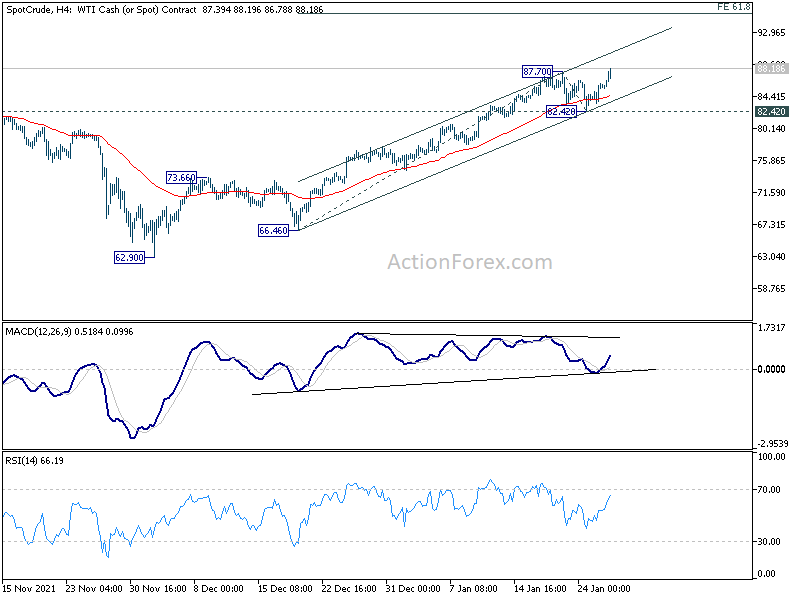
WTI crude oil heading to 90, then 95.5?
US commercial crude oil inventories rose 2.4m barrels in the week ending January 21. At 416.2m barrels, oil inventories are about 8% below the five year average for this time of year. Gasoline inventories rose 1.3m barrels. Distillate dropped -2.8m barrels. Propane/propylene dropped -4.6m barrels. Commercial petroleum rose 4.1m barrels.
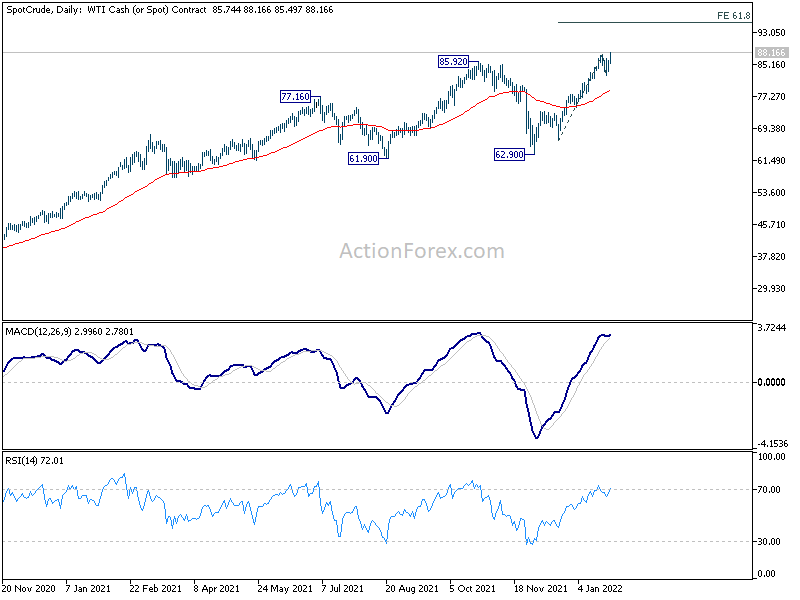
WTI crude oil resumes recent up trend today and hits as high as 88.16 so far. Next target will be 90, which is a psychological level to overall. Sustained break there would pave the way to 61.8% projection of 66.46 to 87.70 from 82.42 at 95.54. In any case, outlook will now stays bullish as long as 82.42 support holds, in case of retreat.
BoC Holds Policy Rate at 0.25%, Removes Exceptional Forward Guidance
The Bank of Canada kept the overnight rate at 0.25% and stated that it will continue the reinvestment phase of its balance sheet by maintaining its holdings of Government of Canada bonds.
On the economic outlook, the Bank noted that "GDP growth in the second half of 2021 now looks to have been even stronger than expected. The economy entered 2022 with considerable momentum, and a broad set of measures are now indicating that economic slack is absorbed. With strong employment growth, the labour market has tightened significantly. Job vacancies are elevated, hiring intentions are strong, and wage gains are picking up."
On the impact of omicron, the BoC stated, "it is expected to be less severe than previous waves. Economic growth is then expected to bounce back and remain robust over the projection horizon, led by consumer spending on services, and supported by strength in exports and business investment."
The Bank acknowledged the high level of consumer price inflation, stating that "persistent supply constraints are feeding through to a broader range of goods prices and, combined with higher food and energy prices, are expected to keep CPI inflation close to 5% in the first half of 2022. As supply shortages diminish, inflation is expected to decline reasonably quickly to about 3% by the end of this year and then gradually ease towards the target over the projection period."
Key Implications
This was always going to be a close call. Markets were priced for a hike, but the BoC decided it needed to move in a methodical fashion. It did this by stating that overall slack caused by the pandemic has now been absorbed and that it would end its exceptional level of forward guidance. In other words, it is now ready to hike.
Even with growth being impacted by omicron, inflation should be the main concern for the Bank. Consumer prices are growing at 5% and financial imbalances (housing) continue to rise on the back of low interest rates. From our lens, the BoC needs to move quick. We expect a rate hike in March and three more in 2022. This should lift government bond yields and mortgage rates. Hopefully this will cool some of the froth.
Canada 2-year and 10-year yields are down 7 basis points and 10 basis points, to 1.17% and 1.77%, respectively. The loonie is flat at 79 U.S. cents. With the Fed on deck to make its interest rate announcement at 2pm today, we could see some spillover into Canadian markets.
Sunset Market Commentary
Markets
European stock markets rebounded in today’s countdown session to the FOMC meeting. Main indices gain around 2%. US benchmarks open up to 1.5% stronger (Nasdaq), but doesn’t seem to build on opening momentum. Core bonds lack direction. US yields add around 1 bp across the curve. The German yield curve bear steepens slightly with yields adding 0.6 bps (2-yr) to 1.8 bps (30-yr). 10-yr yield spread changes vs Germany widen by up to 2 bps (Italy). The third round of the Italian presidential election ballot failed to produce a winner. Tomorrow could be D-day as the necessary majority drops from 2/3rd to 50+1. EUR/USD treads water in the high 1.12-zone.
The first FOMC meeting of 2022 is today’s main event. We expect the Fed to lay the groundwork for a 25 bps March rate hike/lift-off. Abruptly ending net asset purchases (normally tapered down to zero in March) is a wildcard. The Fed in December accelerated the monthly taper pace from $15bn/month to $30bn/month. Based on that decision, net asset purchases come to a halt in March. We currently take into account a scenario of four consecutive 25 bps rate hikes in the US central bank’s inflation battle (March-May-June-July), before allowing for a pause once the central bank puts in motion pillar two of its normalization process: shrinking the balance sheet at stealth pace. US money markets currently discount a path of quarterly 25 bps rate hikes, but we think that the current environment doesn’t warrant the gradual quarterly tightening pace. Rapidly deteriorating inflation dynamics probably imply that risks surrounding this scenario are tilted to the hawkish side. This means potentially more and/or bigger rate hikes and a sooner start to winding down the balance sheet. Investors will also be looking for clues on how the balance sheet run-off will proceed. Atlanta Fed Bostic is the only one so far to give any guidance, saying he’d favor a monthly reduction of around $100bn, totaling at least $1.5tn. The current balance sheet total of the Fed amounts nearly $9tn. From a market point of view, we hold our downward bias for US Treasuries via higher US real rates. (Lack of) specific guidance on the balance sheet will be decisive in determining the curve’s move: flatter (no guidance) or steeper. We expect more turbulence on risk markets. The combination of both could benefit the dollar short term. First support in EUR/USD stands at the 2021 low of 1.1186.
News Headlines
The Central Bank of Ireland sharply raised its inflation forecast for this year to 4.5%. In a previous update three months ago, it only estimated 2022 HICP inflation at 2.9%. HICP reached 5.7% in December. It is expected to peak in Q1 but the central bank expects it to stay north of 5.0% in the second quarter. Higher energy prices are expected to persist for longer while supply chain issues and labour shortages might raise costs of businesses. Forecasts for 2023 and 2024 are also higher than previously expected at 2.4% and 2.1% respectively, especially due to higher services prices. The central bank anticipates wage growth to rise to 5.0% in 2024 from 3.3.% this year. The Irish central bank also substantially revised this year’s unemployment rate forecast from 7.2% to 5.8% and expects it to return to 4.9% in 2024.
The Swiss government today announced it will reactivate a countercyclical capital buffer to address risks related to the property market. From September 30 banks will have to put aside 2.5% of the risk-weighted exposures secured by residential property in Switzerland. A 2% capital buffer was suspended in March 2020. The volume of mortgage lending and prices for residential property have risen more strongly than can be explained by fundamental factors such as rents and income.
USD/CAD Mid-Day Outlook
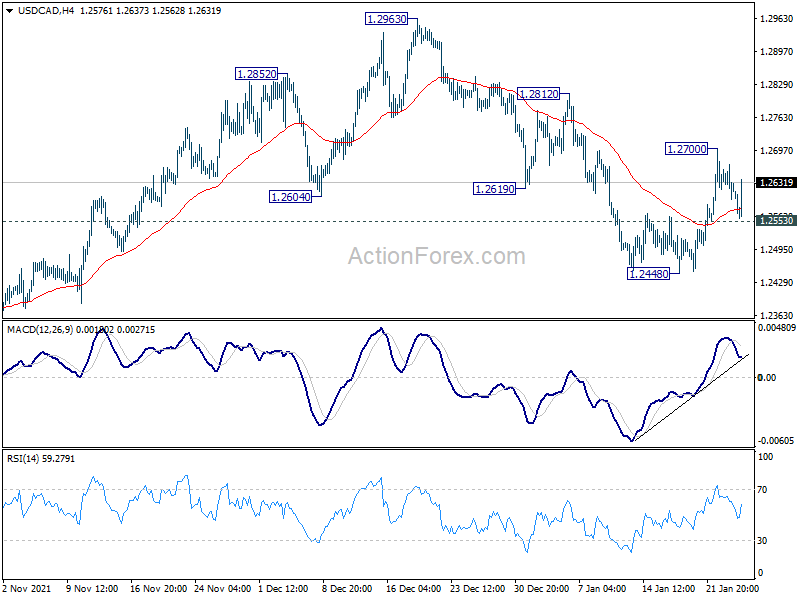
Daily Pivots: (S1) 1.2595; (P) 1.2632; (R1) 1.2666; More...
Intraday bias in USD/CAD remains neutral and further rise is mildly in favor with 1.2553 minor support intact. Pull back from 1.2964 should have completed with three waves down to 1.2448. Above 1.2700 will target 1.2812 resistance first, and then 1.2963. On the downside, below 1.2553 minor support will turn bias back to the downside for 1.2448 instead.
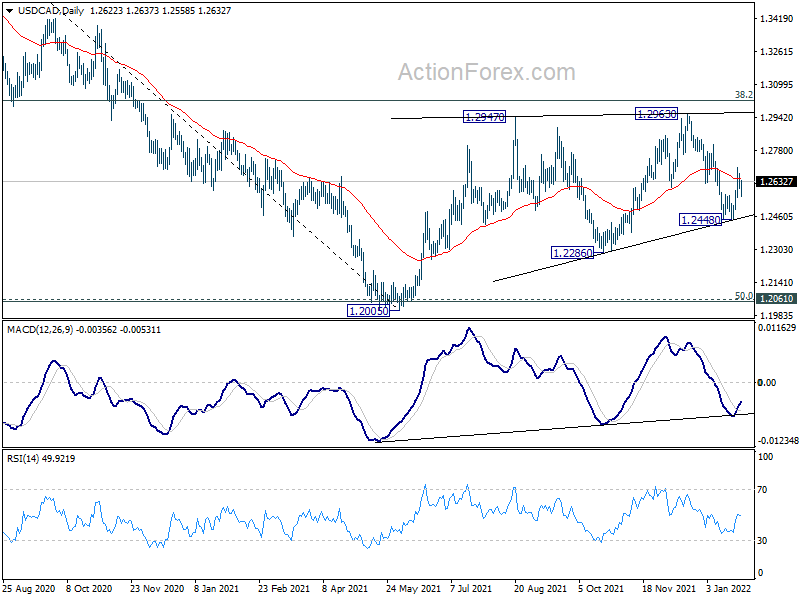
In the bigger picture, focus stays on 38.2% retracement of 1.4667 (2020 high) to 1.2005 (2021 low) at 1.3022. Sustained break there should confirm that the down trend from 1.4667 has completed after defending 1.2061 long term cluster support. Further rise would then be seen towards 61.8% retracement at 1.3650. However, rejection by 1.3022 will maintain medium term bearishness. Break of 1.2005 will resume the down trend form 1.4667 and that carries larger bearish implications too.
CAD Dives after No So Hawkish BoC, Stocks Rebounding
Canadian Dollar tumbles notably in early US session after much less hawkish then expected BoC rate decision. The central bank stands pat while lowering both inflation and growth forecasts. Elsewhere in the currency markets, Yen is trading broadly lower with Swiss Franc as stock markets are staging a strong rebound. Meanwhile, Aussie is also trying to extend recovery. But then, the next moves will firstly depend on FOMC later in the day and development surrounding Ukraine.
Technically, we're maintain that some resistance levels in Yen crosses should be taken out with conviction if sentiment is truly turning risk-on again. The levels include 115.05 minor resistance in USD/JPY, 130.07 minor resistance in EUR/JPY, 155.38 minor resistance in GBP/JPY, 82.07 minor resistance in AUD/JPY.
At the time of writing, DOW is up 1.11%. S&P 500 is up 1.61%. NADSAQ is up 2.19%. 10 year yield is flat at 1.776. In Europe, FTSE is up 2.01%. DAX is up 2.63%. CAC is up 2.63%. Germany 10-year yield is up 0.0086 at -0.068. Earlier in Asia, Nikkei dropped -0.44%. Hong Kong HSI rose 0.19%. China Shanghai SSE rose 0.66%. Singapore Strait Times rose 0.73%. Japan 10-year JGB yield dropped -0.0009 to 0.140.
Some previews on Fed:
- FOMC Meeting Preview: Is There Still a "Fed Put"?
- Fed meeting: Will Asset Purchases End Early?
- January Flashlight for the FOMC Blackout Period
- Fed: End of Money Printing Brrrrr – (At Least) Four 25bp Rate Hikes this Year and QT in September
BoC keeps overnight rate at 0.25%, lowers GDP and CPI forecasts
BoC left overnight rate unchanged at effective lower bound of 0.25% today. Bank rate is held at 0.50% while deposit rate is kept at 0.25%. The central bank also said, "with overall economic slack now absorbed, the Bank has removed its exceptional forward guidance on its policy interest rate".
The central bank adopts a hawkish bias and said "the Governing Council expects interest rates will need to increase, with the timing and pace of those increases guided by the Bank's commitment to achieving the 2% inflation target."
The reinvestment phase of bond holdings will continue. Holdings of government bonds will be "roughly constant at least until it begins to raise the policy interest rate."
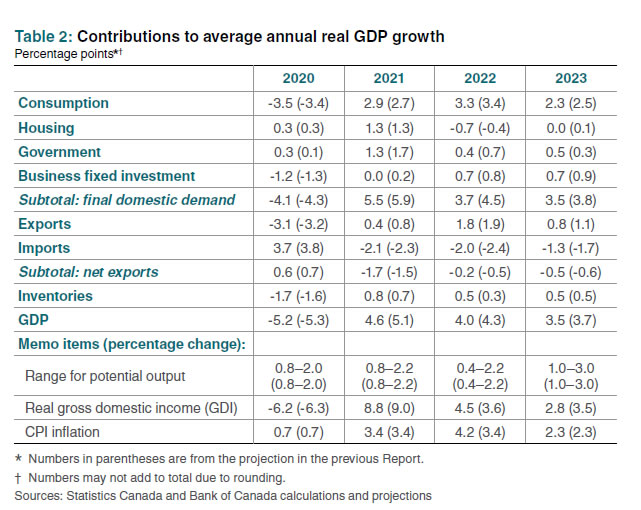
In the new economic projections, BoC lowered 2022 GDP growth forecasts from 4.3% to 4.0%, and 2023 from 3.7% to 3.5%. BoC said economic impact of Omicron is expected to be less severe than previous waves. "Economic growth is then expected to bounce back and remain robust over the projection horizon, led by consumer spending on services, and supported by strength in exports and business investment."
CPI forecasts was lowered for 2022 from 4.2% to 3.4%, but kept unchanged at 2.3% for 2023. BoC said, "as supply shortages diminish, inflation is expected to decline reasonably quickly to about 3% by the end of this year and then gradually ease towards the target over the projection period."
US goods trade deficit widened to USD 101B in Dec
US exports of goods rose USD 2.2B to USD 157.3B in December. Imports of goods rose USD 5.1B to 258.3B. Goods trade deficit widened to USD -101.0B, versus expectation of USD -96.1B.
Whole sale inventories rose 2.1% mom to USD 789.4B. Retail inventories rose 4.4% mom to USD 643.8B.
German government slashes 2022 growth forecast to 3.6%
The German government lowered 2022 growth forecast to 3.6%, down from October's projection of 4.1%. That's still notably higher that 2021's preliminary figure of 2.7%.
"The consequences of the corona pandemic are still noticeable and many companies still have to struggle with them," Economy Minister Robert Habeck said . "Nevertheless, our economy is still robust."
"During the still-difficult economic rebound phase, we will continue aid programs for companies and furlough policies," he noted. "With an increasing vaccination rate, it should soon be possible to contain the pandemic in a sustainable manner and to reduce crisis aid. Then the economic recovery will accelerate noticeably."
BoJ: Economy to grow well above potential in 2022
In the Summary of Opinions at the January 17-18 meeting, BoJ said, "a pick-up in Japan's economy has become evident" and the economy is "likely to continue recovering moderately". In fiscal 2022, it's "highly likely to grow at a pace that is well above its potential growth rate".
Though, attentions should be paid to risk of COVID-19 spread in China and that could have a "negative impact on Japan's economy through downward pressure on external demand and amplification of supply-side constraints."
CPI is expected to "exceed 1 percent" and may "momentarily rise to a level close to 2 percent" from April 2022 onward. It will then be "important to analyze what lies behind this inflation and whether it turns out to be sustainable."
A member noted "the key factor in assessing the underlying trend in the CPI is developments in wages. In order for the CPI to increase as a trend, it is necessary that services prices rise along with wage increases.
Also from Japan, corporate service price index rose 1.1% yoy in December, matched expectations.
USD/CAD Mid-Day Outlook
Daily Pivots: (S1) 1.2595; (P) 1.2632; (R1) 1.2666; More...
Intraday bias in USD/CAD remains neutral and further rise is mildly in favor with 1.2553 minor support intact. Pull back from 1.2964 should have completed with three waves down to 1.2448. Above 1.2700 will target 1.2812 resistance first, and then 1.2963. On the downside, below 1.2553 minor support will turn bias back to the downside for 1.2448 instead.
In the bigger picture, focus stays on 38.2% retracement of 1.4667 (2020 high) to 1.2005 (2021 low) at 1.3022. Sustained break there should confirm that the down trend from 1.4667 has completed after defending 1.2061 long term cluster support. Further rise would then be seen towards 61.8% retracement at 1.3650. However, rejection by 1.3022 will maintain medium term bearishness. Break of 1.2005 will resume the down trend form 1.4667 and that carries larger bearish implications too.
Economic Indicators Update
| GMT | Ccy | Events | Actual | Forecast | Previous | Revised |
|---|---|---|---|---|---|---|
| 23:50 | JPY | Corporate Service Price Index Y/Y Dec | 1.10% | 1.10% | 1.10% | |
| 23:50 | JPY | BoJ Summary of Opinions | ||||
| 09:00 | CHF | Credit Suisse Economic Expectations (Jan) | 9.5 | 0 | ||
| 13:30 | USD | Wholesale Inventories Dec P | 2.10% | 1.30% | 1.40% | |
| 13:30 | USD | Goods Trade Balance (USD) Dec P | -101.0B | -96.1B | -98.0B | |
| 15:00 | USD | New Home Sales Dec | 811K | 766K | 744K | |
| 15:00 | CAD | BoC Interest Rate Decision | 0.25% | 0.25% | 0.25% | |
| 15:30 | USD | Crude Oil Inventories | 1.0M | 0.5M | ||
| 19:00 | USD | FOMC Rate Decision | 0.25% | 0.25% | ||
| 19:30 | USD | FOMC Press Conference |
BoC keeps overnight rate at 0.25%, lowers GDP and CPI forecasts
The central bank adopts a hawkish bias and said "the Governing Council expects interest rates will need to increase, with the timing and pace of those increases guided by the Bank's commitment to achieving the 2% inflation target."
The reinvestment phase of bond holdings will continue. Holdings of government bonds will be "roughly constant at least until it begins to raise the policy interest rate."
In the new economic projections, BoC lowered 2022 GDP growth forecasts from 4.3% to 4.0%, and 2023 from 3.7% to 3.5%. BoC said economic impact of Omicron is expected to be less severe than previous waves. "Economic growth is then expected to bounce back and remain robust over the projection horizon, led by consumer spending on services, and supported by strength in exports and business investment."
CPI forecasts was lowered for 2022 from 4.2% to 3.4%, but kept unchanged at 2.3% for 2023. BoC said, "as supply shortages diminish, inflation is expected to decline reasonably quickly to about 3% by the end of this year and then gradually ease towards the target over the projection period."
(BOC) Bank of Canada maintains policy rate, removes exceptional forward guidance
The Bank of Canada today held its target for the overnight rate at the effective lower bound of ¼ %, with the Bank Rate at ½ % and the deposit rate at ¼ %. With overall economic slack now absorbed, the Bank has removed its exceptional forward guidance on its policy interest rate. The Bank is continuing its reinvestment phase, keeping its overall holdings of Government of Canada bonds roughly constant.
The global recovery from the COVID-19 pandemic is strong but uneven. The US economy is growing robustly while growth in some other regions appears more moderate, especially in China due to current weakness in its property sector. Strong global demand for goods combined with supply bottlenecks that hinder production and transportation are pushing up inflation in most regions. As well, oil prices have rebounded to well above pre-pandemic levels following a decline at the onset of the Omicron variant of COVID-19. Financial conditions remain broadly accommodative but have tightened with growing expectations that monetary policy will normalize sooner than was anticipated, and with rising geopolitical tensions. Overall, the Bank projects global GDP growth to moderate from 6¾ % in 2021 to about 3½ % in 2022 and 2023.
In Canada, GDP growth in the second half of 2021 now looks to have been even stronger than expected. The economy entered 2022 with considerable momentum, and a broad set of measures are now indicating that economic slack is absorbed. With strong employment growth, the labour market has tightened significantly. Job vacancies are elevated, hiring intentions are strong, and wage gains are picking up. Elevated housing market activity continues to put upward pressure on house prices.
The Omicron variant is weighing on activity in the first quarter. While its economic impact will depend on how quickly this wave passes, it is expected to be less severe than previous waves. Economic growth is then expected to bounce back and remain robust over the projection horizon, led by consumer spending on services, and supported by strength in exports and business investment. After GDP growth of 4½ % in 2021, the Bank expects Canada's economy to grow by 4% in 2022 and about 3½ % in 2023.
CPI inflation remains well above the target range and core measures of inflation have edged up since October. Persistent supply constraints are feeding through to a broader range of goods prices and, combined with higher food and energy prices, are expected to keep CPI inflation close to 5% in the first half of 2022. As supply shortages diminish, inflation is expected to decline reasonably quickly to about 3% by the end of this year and then gradually ease towards the target over the projection period. Near-term inflation expectations have moved up, but longer-run expectations remain anchored on the 2% target. The Bank will use its monetary policy tools to ensure that higher near-term inflation expectations do not become embedded in ongoing inflation.
While COVID-19 continues to affect economic activity unevenly across sectors, the Governing Council judges that overall slack in the economy is absorbed, thus satisfying the condition outlined in the Bank's forward guidance on its policy interest rate. The Governing Council therefore decided to end its extraordinary commitment to hold its policy rate at the effective lower bound. Looking ahead, the Governing Council expects interest rates will need to increase, with the timing and pace of those increases guided by the Bank's commitment to achieving the 2% inflation target.
The Bank will keep its holdings of Government of Canada bonds on its balance sheet roughly constant at least until it begins to raise the policy interest rate. At that time, the Governing Council will consider exiting the reinvestment phase and reducing the size of its balance sheet by allowing roll-off of maturing Government of Canada bonds.
Information note
The next scheduled date for announcing the overnight rate target is March 2, 2022. The Bank will publish its next full outlook for the economy and inflation, including risks to the projection, in the Monetary Policy Report on April 13, 2022.
NZ Dollar Flat ahead of CPI and the Fed
It has been a quiet week for the New Zealand dollar, but that could change later in the day, with two key releases. The Federal Reserve holds a policy meeting and New Zealand releases CPI for the fourth quarter.
The currency markets have been steady this week, in contrast to the equity markets, which have seen sharp drops ahead of today’s FOMC meeting, the first in 2022. Investors are nervous as the Fed is poised to embark on a series of rate hikes, which could boost the US dollar at the expense of equities. The Fed will not be making any moves at the upcoming meeting but is widely expected to signal a rate hike in March, which has been priced in at 94%, according to FedWatch. If Fed Chair Powell signals a lift-off in March, that should give the US dollar a boost.
The baseline assumption is that the Fed will tighten four times this year, raising rates to 1%. The risk of further hikes is tilted to the upside, primarily because of surging inflation, which hit 7% in December and shows no signs of easing.
New Zealand CPI could hit 6%
Following the FOMC decision, New Zealand releases the quarterly CPI report. CPI rose 4.9% y/y in Q3 and is expected to accelerate to 5.7% in the fourth quarter, with some forecasts projecting a print above 6%. The markets have priced in a sharp gain, but if the reading is above expectations, the New Zealand dollar could get a boost. The RBNZ will be keeping a close eye on how hot inflation is, ahead of its policy meeting in late February. A reading above the expected will provide support for a rate hike at that meeting.
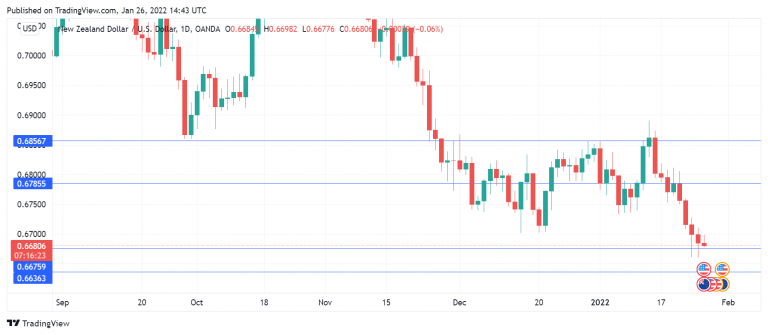
NZD/USD Technical
- NZD/USD is putting strong pressure on support at 0.6675. Close by, there is support at 0.6636
- There is resistance at 0.6785 and 0.6856
Stocks on Firm Footing ahead of FOMC, Tech Earnings
As we discussed the potential for a rebound in our report yesterday, the markets have in fact gone up from oversold levels. Europe was doing particularly well this morning, with the major indices being up more than 2% each, as travel stocks and banks rallied. The positive sentiment also helped cryptos come off their recent lows, while crude oil extended its rally for a second day after its recent pause. The key question remains though as to whether this is the start of another major rally, or just a short-squeeze bounce, before we see further volatility. Either way, I am continuing to expect outperformance from European markets – whether that means they will rise faster or fall slower than their US counterparts in the short-term outlook.
Over to you, Powell
Investors’ attention will now turn to on one of the main sources behind all this the volatility: The US Federal Reserve. At 19:00 GMT, we will get to hear exactly how hawkish the Fed and its chairman are in their determination to rein in on surging inflation. There has been some speculation that Jay Powell could tone down his hawkishness in light of the big stock market sell-off. But how likely is that? I certainly don’t expect to see too much of a walk back from Powell on the Fed’s hawkish intentions. My feeling is that Powell is not going to change its tone in the slightest, despite the recent volatility observed in US stock markets. He has a job of managing expectations and there is no point in talking down the prospects of three or four rate hikes this year if they then end up having to tighten policy aggressively anyway. Indeed, if a March hike is on the cards, it is better to prepare investors for such a move now rather than later. Mind you, this on its own won’t come as much of a surprise. But should the fed go a step or two further – for example, by providing hints on shrinking its huge $8.87 trillion balance sheet – then that could spook the market.
More tech earnings to come: Tesla tonight and the Apple
Microsoft’s upbeat forecast for the current quarter saw its shares reverse a 5% drop in after-hours trading last night to turn higher, after its fourth quarter results failed to impress investors initially. Tesla and Intel will enlighten us with their results tonight, while bellwether Apple is set to release its results on Thursday. These companies better deliver some positive surprises to provide confidence that the latest rebound is not on a shaky footing.
Indeed, expectations are sky-high for Tesla. The electric carmaker saw its share jump to $1200 at the start of the year after it delivered more than 308,000 vehicles in the fourth quarter, well past the 270,000 units that were expected. Subsequently, analysts have boosted their earnings and sales expectations in recent weeks. For the fourth quarter, Wall Street is now expecting earnings of about $2.33 a share and sales of $17.10 billion. TSLA has come back down in recent weeks along with the tech sector. But following this week’s rebound, the stocks is set to open around $957 today.
European markets could cheer stock market bulls
Providing boost to the stock markets is optimism that the economic recovery is going to speed up in the months ahead. Travel restrictions continue to ease across Europe as omicron cases decline and more people get double or tripled vaccinated. There is a lot of pent up demand for holidays within Europe. Hopefully, we will see confidence returns and people start going on holidays more often this year. So, I certainly am feeling positive towards the European stock markets compared to Wall Street. Indeed, European markets are more likely to suffer smaller setbacks going forward because unlike the Fed, the ECB is going to keep printing more QE money for longer.
