Sample Category Title
Gold breaks 1800, more downside ahead with Silver
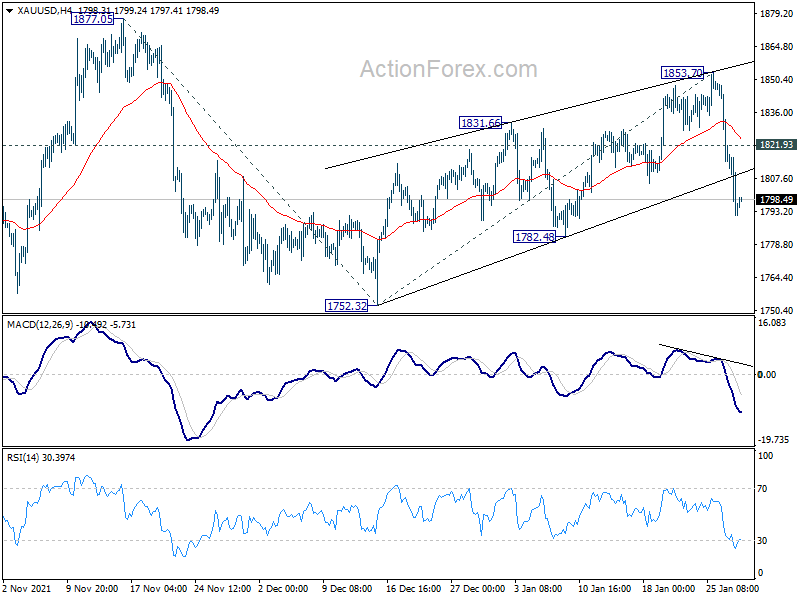
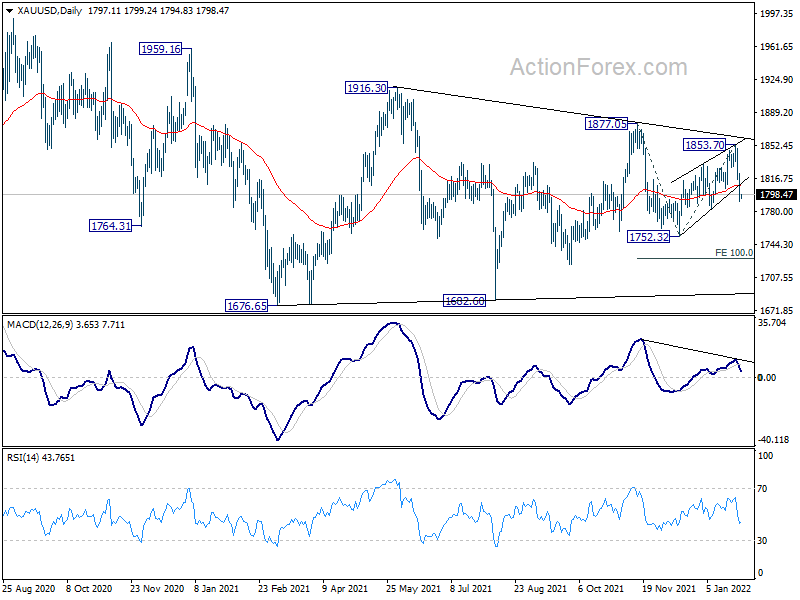
Gold is now back below 1800 handle as fall from 1853.70 extends. The development further affirms the case that rebound from 1752.32 has completed with three waves up to 1853.70. Deeper decline is expected as long as 1821.93 minor resistance holds. Current fall from 1853.70 is see as part of the pattern from 1877.05, which is a down leg inside the medium term range pattern from 1676.65. Break of 1782.48 support will add further credence to this case, and would set the stage for deeper decline through 1752.32 low to 100% projection of 1877.05 to 1752.32 from 1853.70 at 1728.97 eventually.
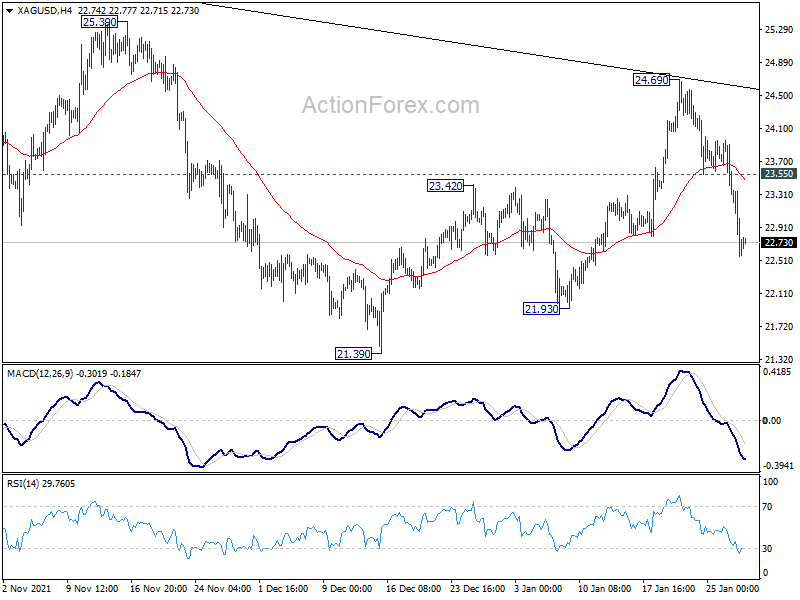
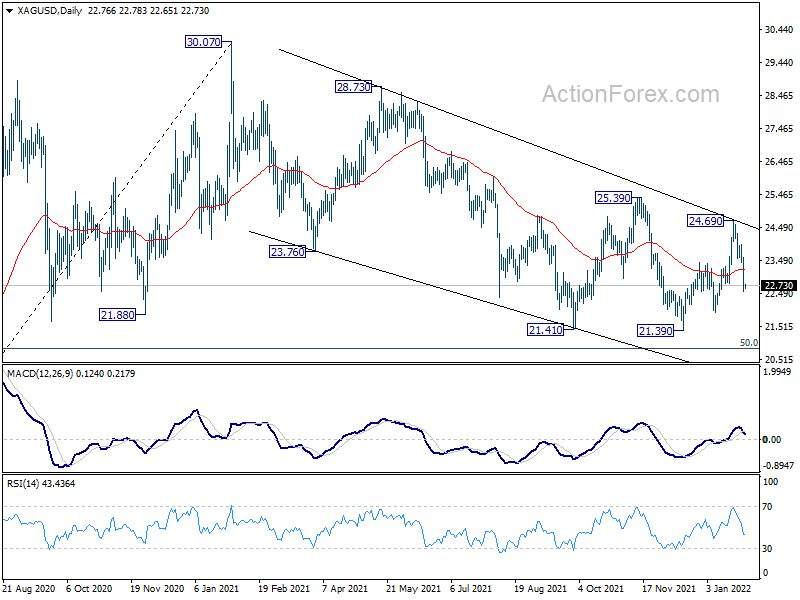
Silver's development is also inline with gold. Rebound from 21.39 should have completed with three waves up to 84.69. Deeper decline is expected as long as 23.55 minor resistance holds, to 21.93 support first. Such fall from 24.69 is seen as a leg inside the medium term falling wedge pattern from 30.07. Break of 24.69 would send silver through 21.39 low, to 50% retracement of 11.67 to 30.7 at 20.87 next.
IMF: BoJ’s commitment to prolonged monetary accommodation appropriate
IMF said in a report that BoJ's commitment to maintaining prolonged monetary accommodation remains "appropriate". It expects that a "prolonged period of monetary policy accommodation, flexible fiscal policy, and inclusive growth-oriented reforms will be required to durably lift inflation expectations and inflation to the target."
Further measures could be considered for making monetary support "more sustainable". On option could be to "steepen the yield curve by shifting the yield target from the 10-year to a shorter maturity". This could help "mitigate the impact of prolonged monetary accommodation on financial institutions' profitability". If underlying inflation momentum remains weak, "cutting the policy rate should be the first option".
USD/JPY Starts Fresh Rally, Majors Drop
Key Highlights
- USD/JPY gained pace after it broke the 114.50 resistance.
- It traded above a major bearish trend line near 114.20 on the 4-hours chart.
- EUR/USD declined heavily below the 1.1220 support.
- GBP/USD extended decline below the 1.3400 support.
USD/JPY Technical Analysis
The US Dollar formed a double bottom near 113.50 against the Japanese Yen. USD/JPY started a fresh increase and cleared the 114.00 resistance zone.
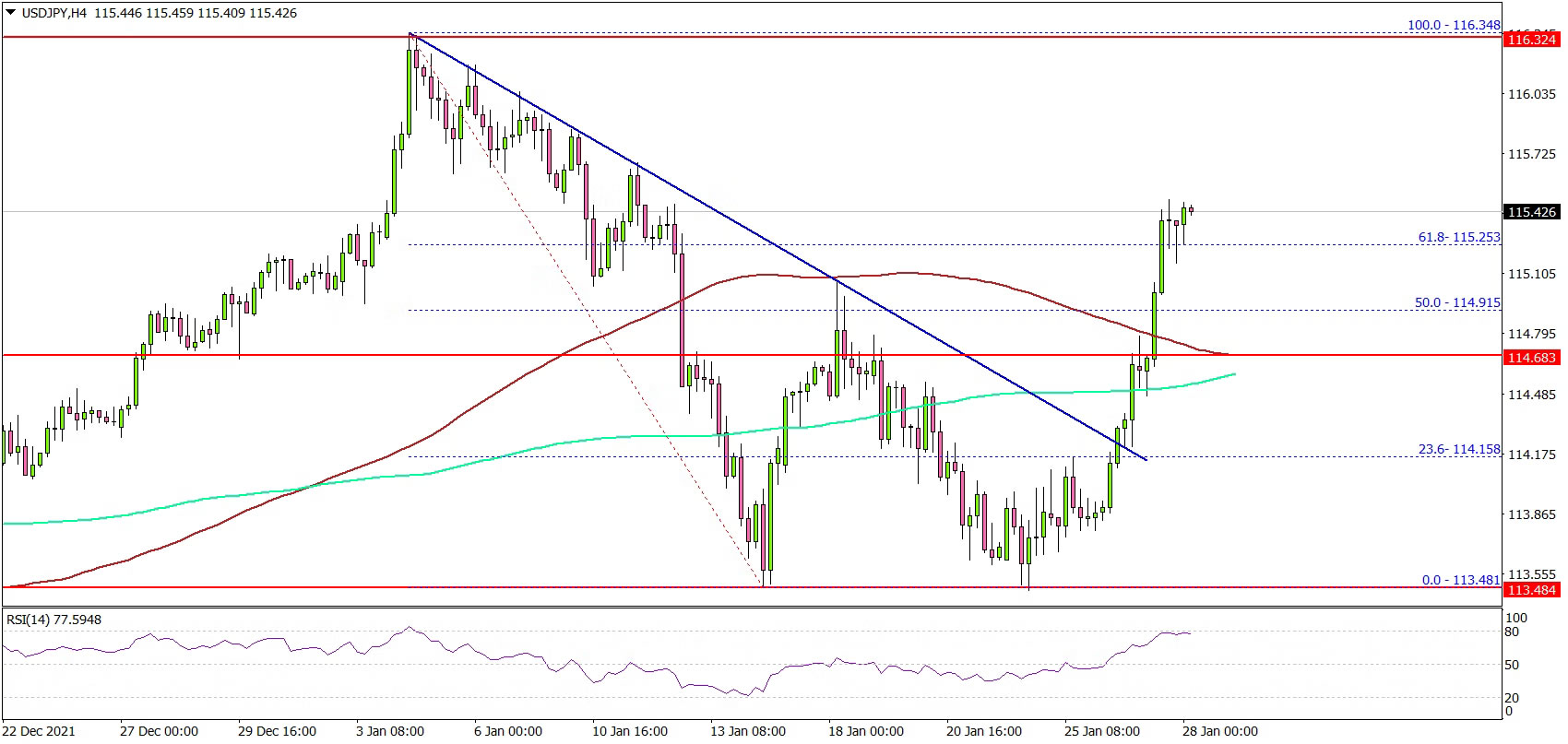
Looking at the 4-hours chart, the pair gained pace above the 114.20 level, the 100 simple moving average (red, 4-hours), and the 200 simple moving average (green, 4-hours).
Besides, there was a break above a major bearish trend line near 114.20 on the same chart. The pair climbed above the 50% Fib retracement level of the downward move from the 116.34 swing high to 113.48 low.
An immediate resistance is near the 115.80 level. It is near the 76.4% Fib retracement level of the downward move from the 116.34 swing high to 113.48 low.
Any more gains could send the pair towards the 116.30 level. The next major resistance is near the 116.80 level. If there is a downside correction, the pair could visit the 115.00 support. The next major support sits near the 114.80 level, below which it could test 114.50.
Looking at EUR/USD, the pair started a strong decline below the 1.1300 support zone. Similarly, GBP/USD nosedived below the 1.3500 level.
Economic Releases
- German Gross Domestic Product for Q4 2021 (YoY) (Preliminary) – Forecast 1.8%, versus 2.5% previous.
- German Gross Domestic Product for Q4 2021 (QoQ) (Preliminary) – Forecast -0.3%, versus 1.7% previous.
- Euro Zone Consumer Confidence for Jan 2022 – Forecast -8.4, versus -8.5 previous.
- US Personal Income for Dec 2021 (MoM) - Forecast +0.5%, versus +0.4% previous.
After Hawkish Fed and Strong GDP, Can PCE Inflation Add More Fuel to Dollar Rally?
PCE inflation data will wrap up a very busy week for the US dollar on Friday. The Fed’s favourite inflation metric will be accompanied by personal income and spending numbers when released at 13:30 GMT.
No peak in sight for US inflation
The core PCE price index jumped to 4.7% year-on-year in November. It is projected to have inched up to 4.8% year-on-year in December. The monthly pace is expected to have stayed at a somewhat elevated level of 0.5%. Although this particular price measure remains some way below the broader consumer price index, which has skyrocketed to 7%, it would still reach the highest rate in nearly 39 years if the forecast is met, underscoring just how badly inflationary pressures have spiralled out of control.
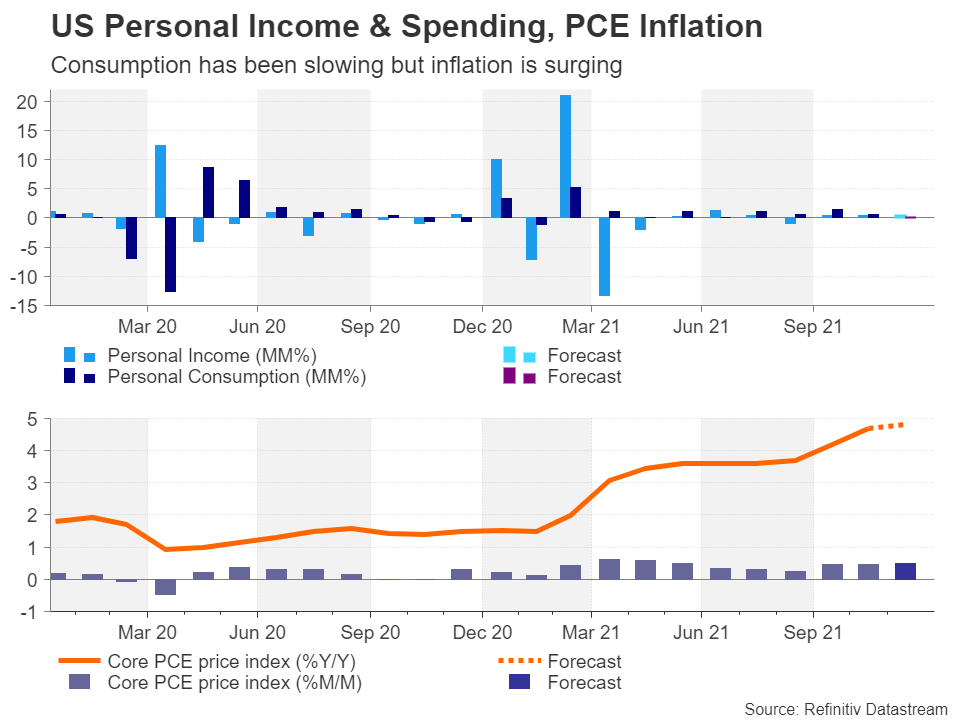
The other data in the upcoming report are expected to be more mixed. Personal income likely rose by 0.5% month-on-month, but personal consumption is forecast to have declined by 0.6% m/m. The drop is unlikely to alarm the Fed or investors, however, as consumption has generally been strong lately and the advance GDP readings just confirmed this.
Economy is booming
Consumer spending rose by 3.3% in the fourth quarter, helping the economy to grow at an annualized rate of 6.9%, well above expectations of 5.5%.
All this reinforces the view that the Fed no longer has an excuse to bide its time and needs to act quickly to bring inflation closer to its 2% goal. And that was the message from Chair Powell on Wednesday, who signalled that multiple rate hikes are on the way, starting in March.
Can the dollar extend its bull run?
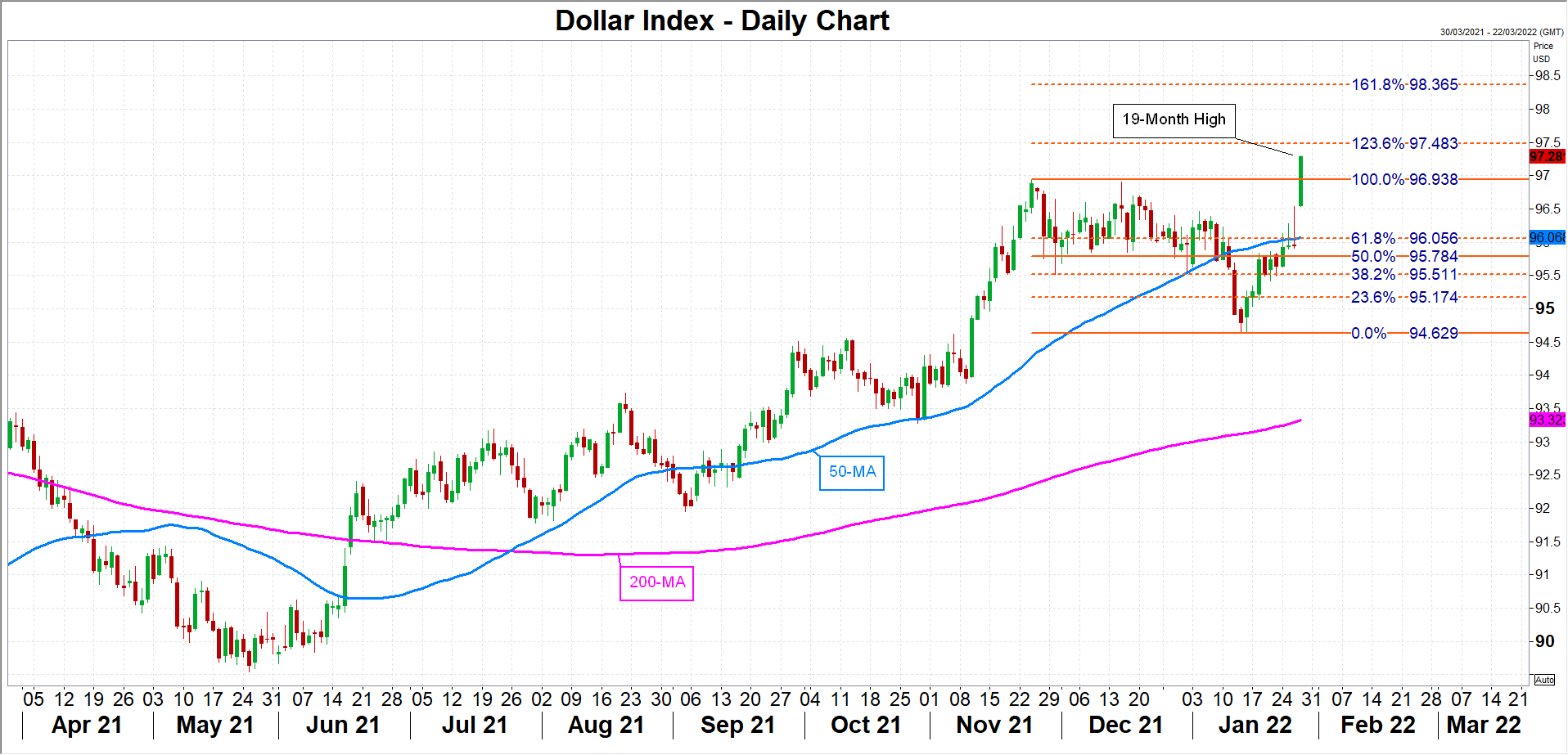
Unsurprisingly, the dollar is flying, backed by soaring short-term yields. The dollar index just hit a 19-month high. If the upsurge continues, the 123.6% Fibonacci extension of the November-January down leg at 97.48 is a realistic target.
In the event, however, that the rally runs out of steam and profit-takers enter, the index could hit a bump at the 50-day moving average, just above 96.0, which is also the 61.8% Fibonacci retracement.
New Forecasts in RBA SOMP to Be Consistent with Rate Hike in 2022
The Reserve Bank Board meets next week on February 1.
The Governor will be addressing the National Press Club on February 2 and the Bank will release its February Statement on Monetary Policy on February 4.
On January 20 Westpac surprised most analysts by forecasting that the first rate hike by the RBA will be announced at the August Board meeting.
The AFR released a "poll" of bank forecasters on the day of that announcement which showed: Westpac (August); CBA (November); ANZ (early 2023); NAB (mid 2023); and HSBC (late 2023) as the forecast dates for the first move by the various banks.
Westpac has also forecast that it is "almost certain" that the Board will announce it has decided to cease its $350 billion bond buying program at the February Board meeting.
The most significant part of the Statement on Monetary Policy will be the Bank's revised forecasts, including GDP; the unemployment rate; inflation and wages.
In November, the Bank forecast that underlying inflation would be 2.25% in 2021 and hold at that level in 2022.
Wages growth was forecast at 2.25% by end 2021; 2.5% by end 2022; and 3% by end 2023.
It forecast that the unemployment rate would be 4.75% by end 2021; fall to 4.25% by end 2022 and 4% by end 2023.
As we discussed in our note on January 20 these forecasts are entirely consistent with the Bank's "guidance" that it will not achieve its objectives of full employment (around a 4% unemployment rate); and "actual inflation sustainably within the 2–3% target range" until late 2023/early 2024.
The Governor has noted that wages growth around 3% will be necessary to sustain inflation within that band.
But, as we now know, the data flow is no longer consistent with the forecasts in the November Statement on Monetary Policy. Last week, after Westpac published its revised cash rate view, the unemployment rate printed at 4.2% for December (down from 4.6%).
And, of course, on Tuesday annual underlying inflation (trimmed mean) printed 2.6% for 2021, including a 1% rise in the December quarter. That result means that the Bank has achieved its inflation target for underlying inflation for the first time since 2014.
Global policy adjustments have also surprised. Back in November the general consensus was that the first rate increase from the FOMC would be late in the second half of 2022. This morning the US Fed Chairman confirmed that the first move can now be expected in March.
So, how might the RBA respond to these rapidly changing developments?
The Governor might feel somewhat uncomfortable with the rigid guidance he has stuck with throughout 2021.
As recently as December 16, in his last speech of the year, he noted that "In our central scenario the condition for an increase in the cash rate will not be met next year. It is likely to take time for that condition to be met and the Board is prepared to be patient".
But it is unnecessary for him to feel this way.
After all, the Bank has not achieved its inflation target since June 2014 – more than two years before Governor Lowe was appointed.
We are currently experiencing the lowest unemployment rate since 2007!
And we expect that the GDP growth forecast for 2022 (which was 5.5% at the November forecast) will only be "shaved" by 0.5% (due to omicron uncertainties) to a very strong 5.0% in the February update. (Westpac agrees with such a strong GDP outlook – we are forecasting 5.5% growth in 2022).
The Bank should welcome reaching its objectives earlier than expected and forecast that this success can now be sustained in 2022 and 2023.
The first step should be to move the "trimmed mean" inflation forecast of 2.25% for 2022 to 2.5% and hold the 2.5% forecast for 2023 – essentially recognising that the key objective has now been achieved and can be expected to hold for the next two years.
Secondly, while the sharp fall in the unemployment rate to 4.2% might be seen to be subject to some statistical correction in the early months of 2022 we expect the RBA should be prepared to make a 4% unemployment rate forecast for the second half of 2022.
The area where we have not seen any recent data update is wages growth where the 2.1% growth rate for the Wage Price Index for the September quarter is still well below the Governor's desired pace of 3%. Although, note that the 3% that has often been referred to in the Governor's speeches is not a "hard" number as is the case with the inflation target.
Arguably ,the underemployment rate is the best measure of slack in the labour market.
In December we saw a sharp fall in the underemployment rate to 6.6% – a 13 year low (the lowest since the impact of the GFC) while business surveys and anecdotal evidence are pointing to rising wage pressures.
The 2022 forecast for growth in the Wage Price Index should be lifted from 2.5% to 3.0% although there is a risk that a cautious Governor might opt for 2.75% to discourage markets from sensing a degree of urgency in raising rates.
He could also point to ongoing COVID risks, with the recent omicron wave, seen to be a source of uncertainty around wages growth.
And to guard against any commitment to respond quickly to an unexpectedly strong print on the Wage Price Index for December (to be released late February) he could point out that considerable further evidence will be required before he would be convinced that Australia's long period of wages underperformance has passed.
A Complication with the Forecasts
The key policy issue of our day is whether central banks have the tools and commitment to settle inflation back to their target ranges while holding the labour market near that full employment target.
As discussed we think that the RBA will forecast just such an outcome in 2023 and 2024 (in February the forecasts will be extended to June 2024).
But that key policy issue will be largely unresolved.
That is because the RBA adopts the convention of using market pricing for the interest rate path under-pinning the forecasting process.
While the current cash rate is 10 basis points markets are forecasting a terminal cash rate in 2024 of 2.25%. The profile largely assumes around 100 basis points of hikes in 2022; around 90 basis points in 2023; and 25 in 2024.
What we do not know from the RBA's forecasts is whether the achievement of the policy targets over the forecasting period is CONTINGENT on the rate profile that is used in the analysis.
It may be that the RBA agrees with the markets' target terminal rate and the issue at point is really only the urgency of the timing of the start of the tightening cycle. The RBA may be thinking that once the process begins it will be necessary to adopt some profile similar to the market's current estimate to achieve stability in inflation while maximising employment.
If, for instance, the RBA's forecasts showed inflation under shooting the target in 2023 and the unemployment rate rising then the implication would be that RBA believes current market pricing is too "heavy handed" to achieve the objective.
In many ways these issues are much more intriguing than the forecast path the Bank is likely to set out next week.
Conclusion
The RBA is likely to revise its forecasts to make them consistent with a rate hike later in 2022 rather than the current "late 2023/ 2004". That will entail forecasting 2.5% underlying inflation and 4% unemployment rate in 2022.
Some "insurance" could be taken out by only going to 2.75% in the forecast for wages growth in 2022. But, remember, the official wages target is "a labour market to be tight enough to generate wages growth that is materially tighter than it is currently"- not a hard number so not quite reaching 3% in 2022 may not be enough to preclude a policy response.
Westpac is unlikely to see a reason to change its own forecasts on the basis of the deliberations next week.
Because the forecasts assume market pricing for the cash rate the real issue is whether the Bank , by implication, believes that the rate profile in the market will be necessary to settle the economy back at an equilibrium where inflation sits around target and the economy enjoys full employment.
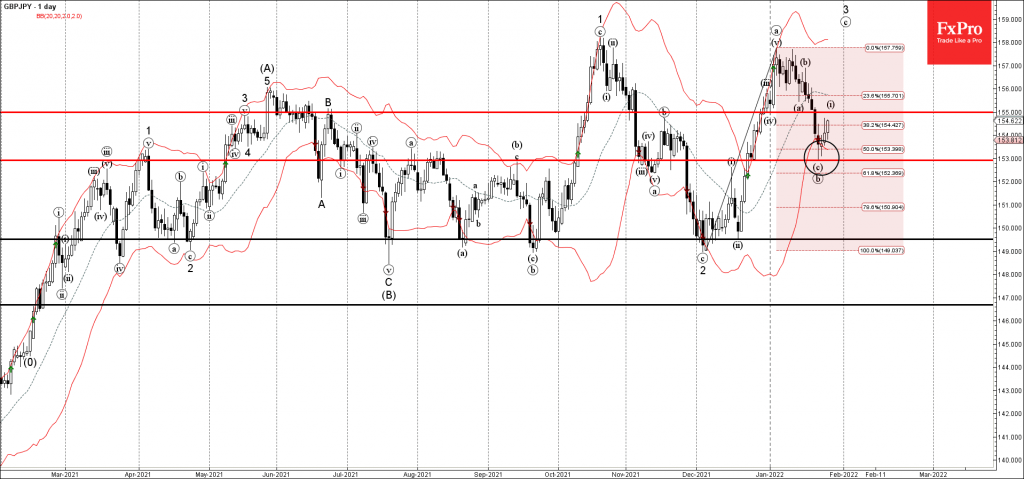
GBPJPY Wave Analysis
- GBPJPY reversed from support level 153.00
- Likely to rise to resistance level 155.00
GBPJPY currency pair recently reversed up from the key support level 153.00 standing near the lower daily Bollinger Band and the 50% Fibonacci correction of the upward impulse from December.
The upward reversal from the support level 153.00 stopped he previous short-term correction (b).
GBPJPY currency pair can be expected to rise further toward the next resistance level 155.00 (former minor support from the end of December).
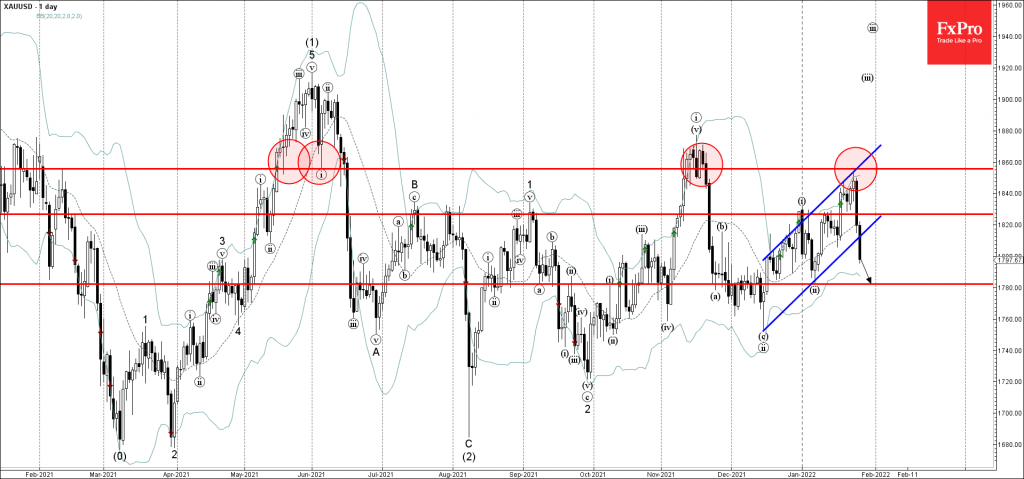
Gold Wave Analysis
- Gold broke daily up channel
- Likely to fall to support level 1780.00
Gold continues to fall after the breakout of the support trendline of the daily up channel from the middle of December.
The breakout of this up channel accelerated the active short-term correction – which started earlier from the key resistance level 1860.00.
Given the widespread risk sentiment improvement -Gold can be expected to fall further toward the next support level 1780.00 (low of the previous correction (ii) from the start of this month).
Eco Data 1/28/22
[php_everywhere instance="1"]
RBA Meeting: Managing Rate Hike Expectations
The Reserve Bank of Australia announces its first policy decision of the year on Tuesday at 3:30 GMT. The last time the Bank’s governor, Philip Lowe, spoke in mid-December, he told investors he didn’t think conditions for a rate hike would be met in 2022. Since then, the labour market has tightened further, while underlying measures of inflation have crept up to their highest levels since 2014. Will the RBA update its forward guidance to bring it more in line with market expectations, and would that offer much support to the sluggish Australian dollar?
Learning to live with the virus
The Omicron wave finally seems to be subsiding in Australia, which after ditching its zero-Covid policy, the nation is learning to live with the virus. Having gotten much of its adult population fully vaccinated, Australia has followed the UK approach, keeping much of the economy open while reimposing some modest curbs as the Omicron variant swept across the country.
The change in the government’s response to fighting the virus has been good news for the Australian economy. Overall employment is now bigger than what it was before the pandemic, consumer spending has strengthened notably in recent months and inflationary pressures have started to build. Although Omicron is expected to have dented growth in January, the impact will likely be short-lived.
Is it the end of the road for QE?
There’s a strong case therefore for the RBA to scrap its bond purchase programme early, possibly as soon as the February meeting. Policymakers had always set this meeting as the one where they would review the programme, but rather than further reducing its pace before ending it in May as previously signalled, there’s a good deal of pressure to wrap up QE now.
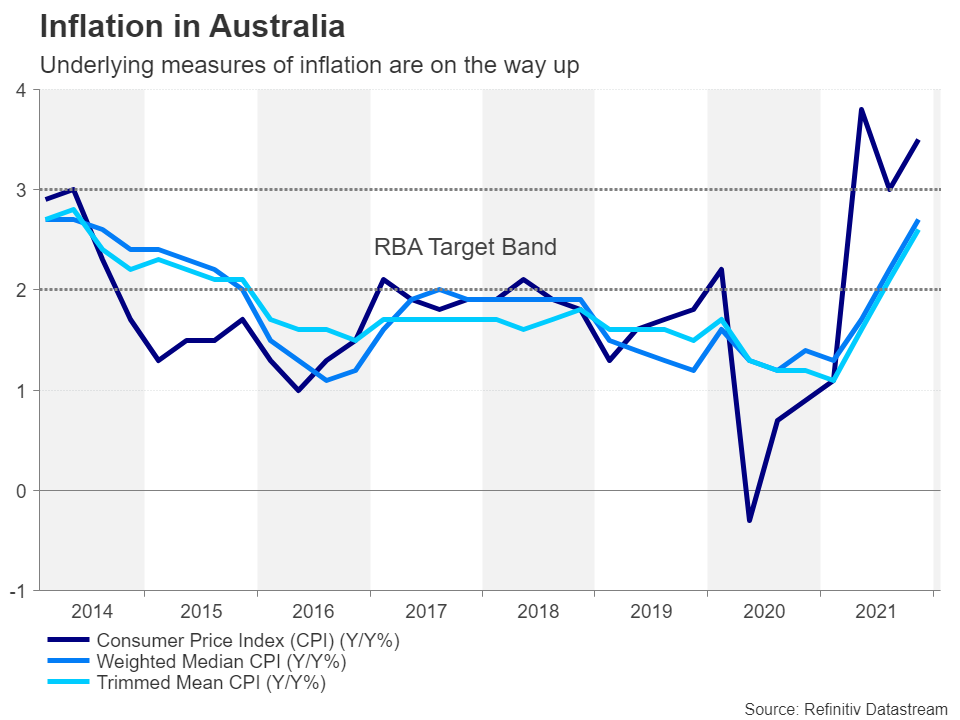
Australia’s consumer price index jumped by a stronger-than-expected 1.3% between the third and fourth quarters and although the annual rate was comparatively low at 3.2%, the RBA’s two closely watched gauges of underlying inflation climbed to the highest in more than seven years in Q4.
Markets unaligned with the RBA
While ending QE abruptly would definitely be seen as a hawkish tilt, what investors will be paying more attention to is the Bank’s forecasts for the cash rate, as well as for inflation and GDP growth in the quarterly Monetary Policy Statement due the following Friday. Governor Lowe had previously signalled that rates are unlikely to be lifted before late 2023 at the earliest. But markets not only think that the RBA will start to raise rates in 2022, they have fully priced in five increases.
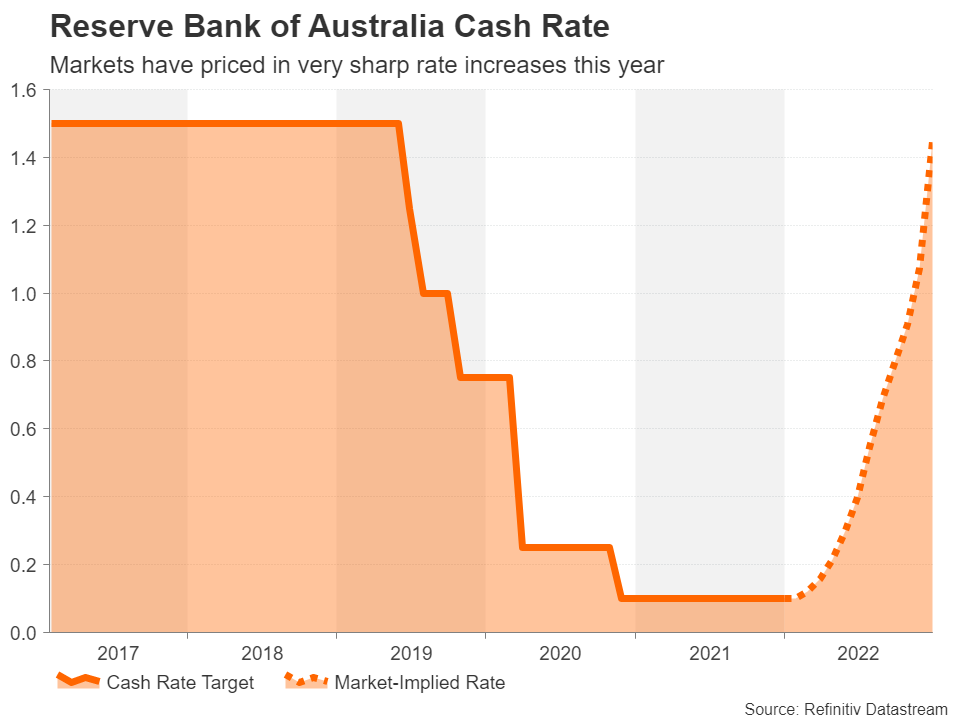
This leaves a lot of room for disappointment. Yet, the intensifying rate hike bets have done little to boost the local dollar. The dimming global growth outlook due to Omicron and tightening monetary policy around the world, and more specifically for Australia, the economic slowdown in China, have been weighing on the aussie lately.
Aussie bulls hoping for hawkish surprise
Against the US dollar, the aussie is currently testing the $0.71 level after being unable to overcome resistance at its 50-day moving average (MA). If the RBA doesn’t bring forward its rate hike timeline, a move back towards December’s more than one-year low of $0.6991 is very possible.
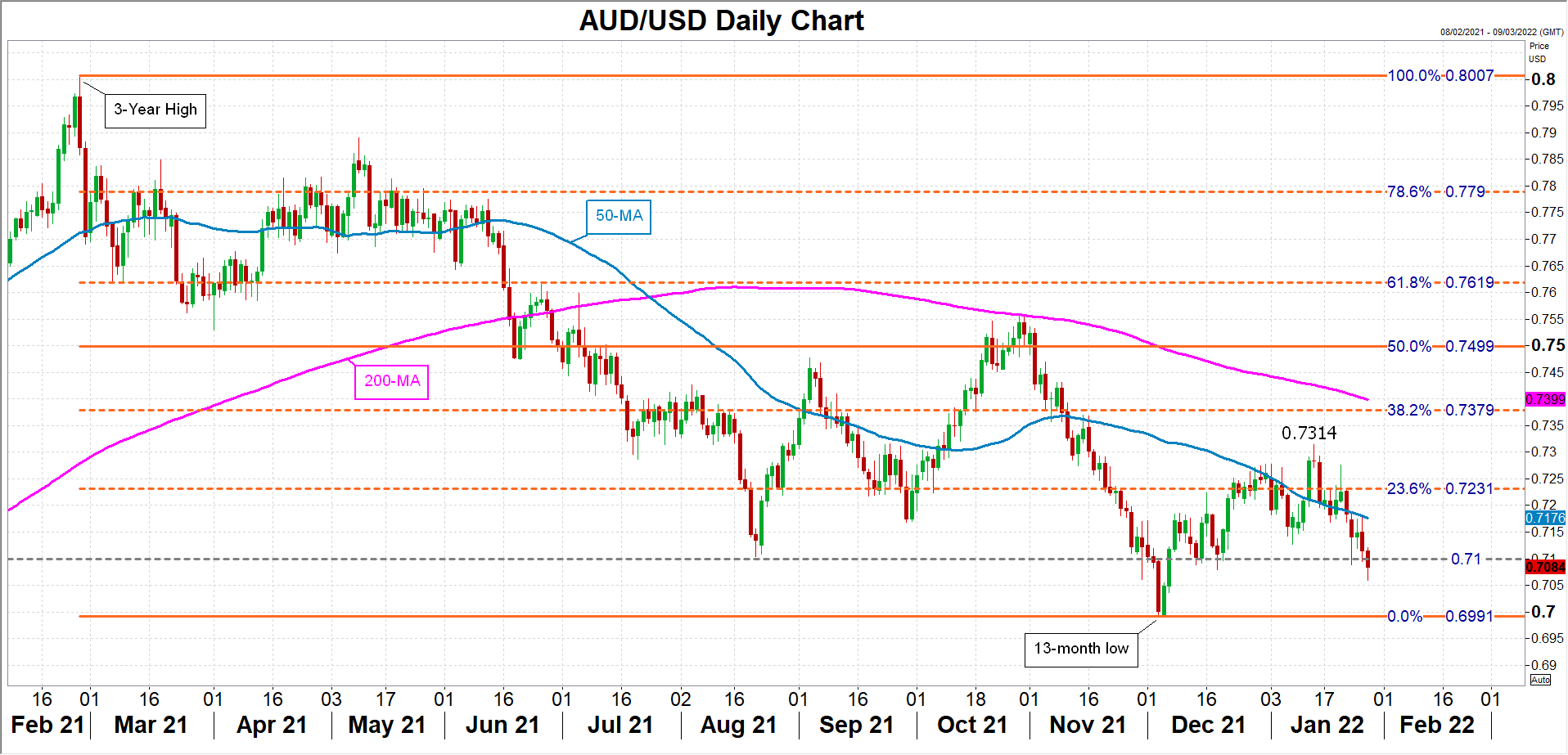
In the bullish scenario, if Lowe flags a rate increase this year, aussie/dollar could make a push up towards the January peak of $0.7314 initially, before attempting to reach the 200-day MA just beneath the $0.74 level.
However, it remains to be seen whether the RBA is ready yet to make such a dramatic shift to its predicted rate path. Early 2023 might be seen as a more realistic timetable and policymakers will probably want to wait a while longer before committing to liftoff in 2022. Even if they were to surprise with a very hawkish forward guidance, it would likely come attached with conditions, such as wanting to see a significant pickup in wage growth.
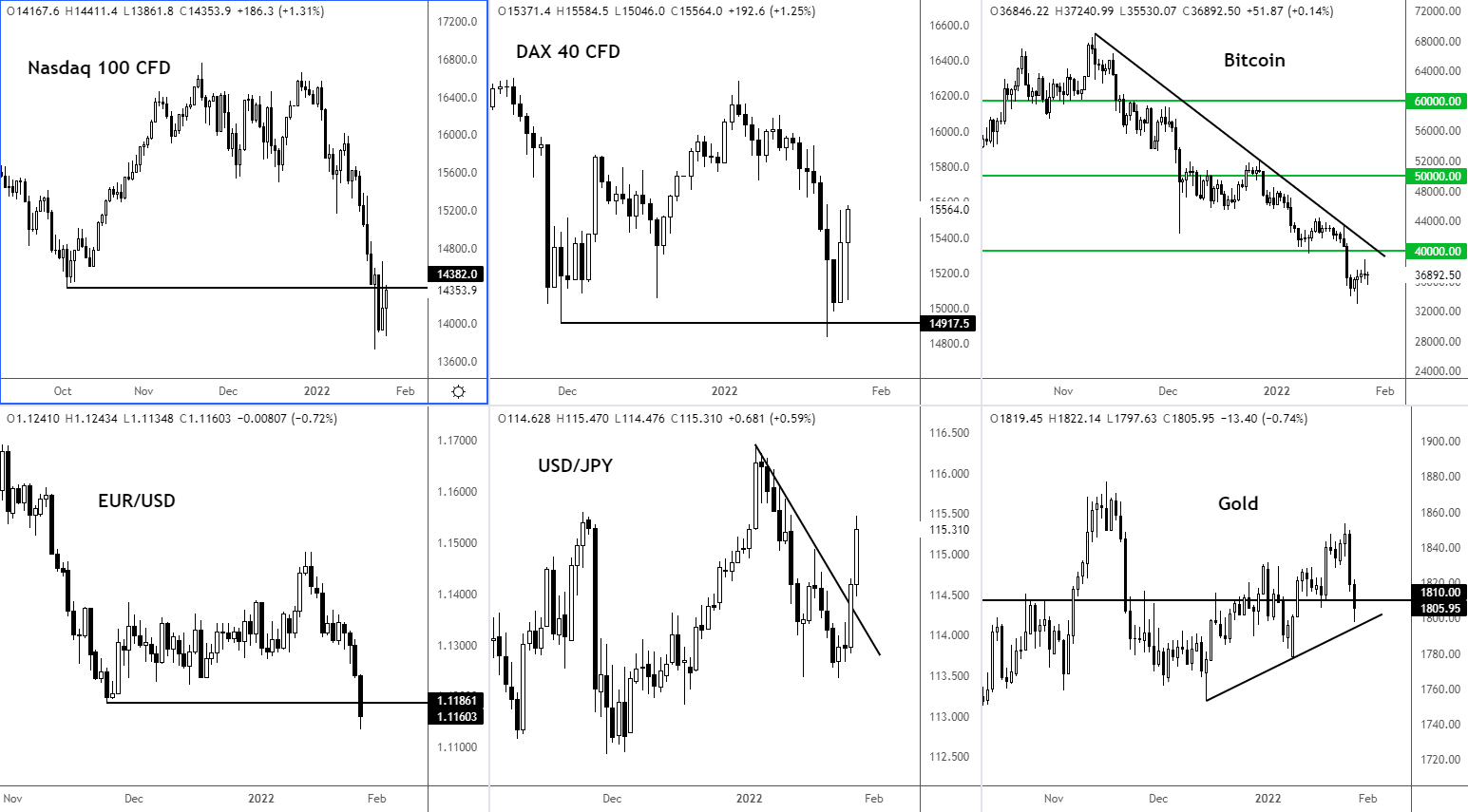
What’s Next for US Dollar and Stocks?
The main takeaway from Jerome Powell’s press conference last night was that the Fed was even more hawkish than expected, causing even more volatility in the markets and further underpinning the US dollar against foreign currencies and gold. Powell effectively admitted the Fed has been behind the curve and now must get its act together to get inflation to more acceptable levels. If that means upsetting financial markets, then so be it. The fact that US futures have been able to regain some of their losses from last night is impressive, but will it be a repeat of the day before?
US economic growth trounced expectations
Today’s main data releases piled further pressure on gold as the dollar and stock index futures extended their gains. It was a simple maths equation for traders: Stronger US economy in Q4 + more hawkish Fed than expected = stronger US dollar. Economic output in the fourth quarter was 6.9% in an annualised format, rising sharply from an upwardly 2.3% in Q3 and easily beating expectations of 5.3% growth. The spread of Omicron in start of Q1 means growth likely slowed down a bit, but there are no signs of inflation easing. Against this backdrop, at least four rate hikes in 2022 is likely.
What does that mean for US stocks?
Well, if we assume that stimulus and low rates were among the major reasons behind the protracted bull run, then that support is no longer there or at least not in the same way. Value stocks – those in the financial sector and industrials – must now do the heavy lifting. But if those big tech stocks struggle, then it is hard to imagine the S&P 500 remaining at current levels for too long. The correction could extend further, and we might be in for more volatile price action in Q2.
Investors are also keeping an eye on company earnings, with Apple set to post its results after the closing bell. Tesla saw its shares drop after the company issued cautious comments on supply-chain troubles. Intel fell on the back of disappointing profit forecast.
What about the dollar?
Clearly, the Fed is going to hike rates multiple times this year and investors have boosted their expectations, with the probability of five 25 basis rate hikes climbing to a very high 94%. Meanwhile, it is difficult to see any other major central bank being nearly as hawkish. This should keep the USD/JPY and USD/CHF underpinned, when stocks are not selling off. But during times of heightened stock market volatility, the US dollar could perform better against commodity dollars like the Aussie, kiwi and loonie. So, FX traders need to be wary of the ever-changing risk sentiment when it comes to choosing which currency to short against the dollar.
Looking ahead, we will get policy updates from the likes of the RBA, BoE and ECB next week. In addition, there will be plenty o key data releases to look forward to as well, starting with the release of the Fed’s favourite inflation measure this Friday: Core PCE Price Index. Next week, we will have the latest monthly employment reports from the US, Canada and NZ. So, lots to look forward to for FX traders.