Sample Category Title
Eco Data 1/21/22
[php_everywhere instance="1"]
Euro Drifting as CPI Hits 5%
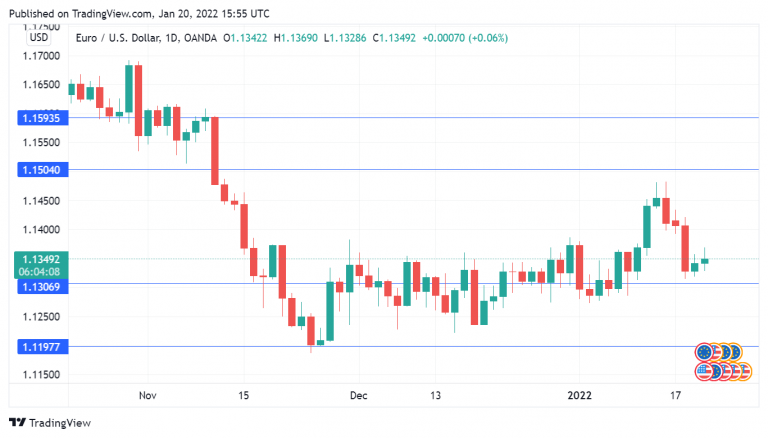
The euro is steady on Thursday, as EUR/USD trades at 1.1330 in the North American session.
Eurozone CPI hits 5.0%
Inflation has been the buzzword across the major economies, boosted by soaring energy costs and supply bottlenecks which have resulted in shortages in some products. In the eurozone, inflation ticked up from 4.9% to 5.0% y/y in December. Core CPI remained at 2.6% y/y. Both of these readings matched the consensus.
With inflation in the bloc rising, albeit not at the same clip as in the US or the UK, the markets have priced in a rate hike in October, but only a small move of 10 basis points. The ECB, however, has not given any signals of shifting from its ultra-accommodative policy and continues to insist that high inflation is “transitory”. Readers will recall that Fed Chair Powell adhered to this phrase for months in the face of surging inflation, but grudgingly “retired” it from the Fed lexicon in late November.
Will Christine Lagarde follow suit? The ECB President has been dismissive of inflationary pressures, and even though eurozone inflation is rising, she has argued that the ECB will not follow the lead of the Fed, because the economic situation in the eurozone is different. Lagarde doubled down on this stance in a radio interview today, insisting that inflation will slowly decrease in 2022, as high energy prices and supply bottlenecks will ease.
The markets are betting that despite Lagarde’s rhetoric, the ECB will have no choice but to reduce asset purchases and raise rates, following in the footsteps of the Federal Reserve. This hawkish view has led to the recent rise in German bund yields. On Wednesday, the 10-year rate moved into positive territory for the first time since 2019.
EUR/USD Technical
- EUR/USD has support at 1.1306 and 1.1197
- There is resistance at 1.1504 and 1.1593
Inflation Driving Up Rate Hike Bets Globally, So Why Does Dollar Remain King?
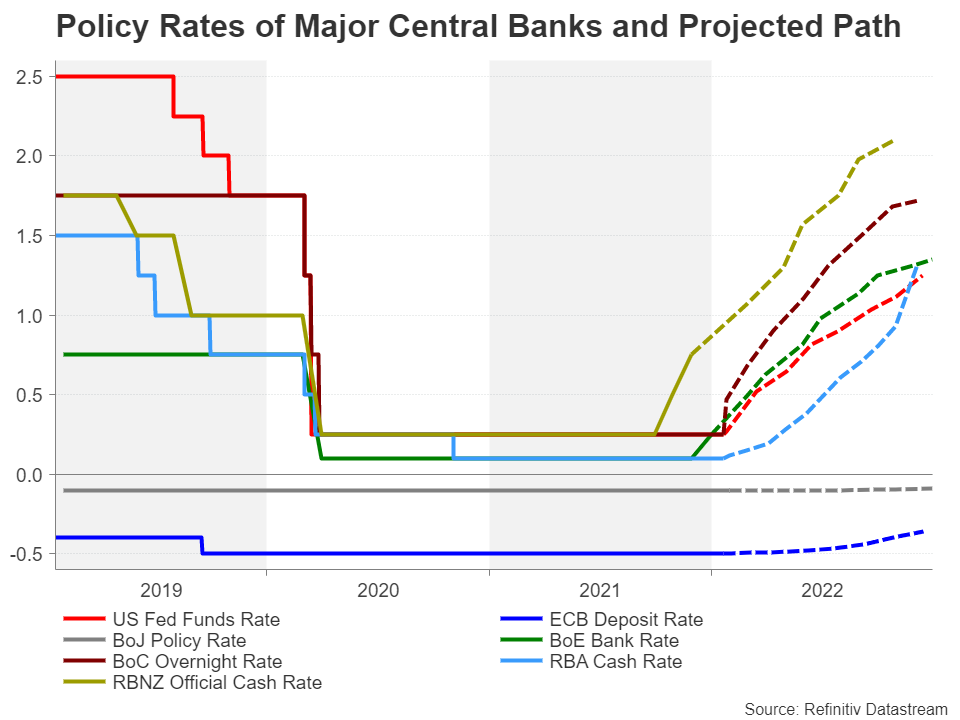
It is now universally accepted that the pandemic-induced surge in inflation is no longer looking very transitory and central banks around the world are starting to hit the panic button. The US Federal Reserve is not only talking about rate hikes but wants to begin quantitative tightening soon. The Bank of England and Reserve Bank of New Zealand have already lifted rates at least once. Even the ultra-dovish European Central Bank is keeping its options open in terms of possibly having to speed up its normalization plans. There are some exceptions, but these aside, the global tightening race has yet to provide much competition to the mighty US dollar.
The great inflation scare
Policymakers have pinned the high inflation problem on a number of factors. Everything from the initial economic reopening effect to the low base effect of 2020 to the rally in energy prices has been blamed for the unexpected spiral in inflationary pressures. However, almost one year on after inflation first started to explode higher, not only is it more evident that the main root of this price surge is the breakdown in global supply chains, which has simultaneously exposed how complex and interdependent they had become from years of globalization, but that the supply bottlenecks are unlikely to clear very quickly.
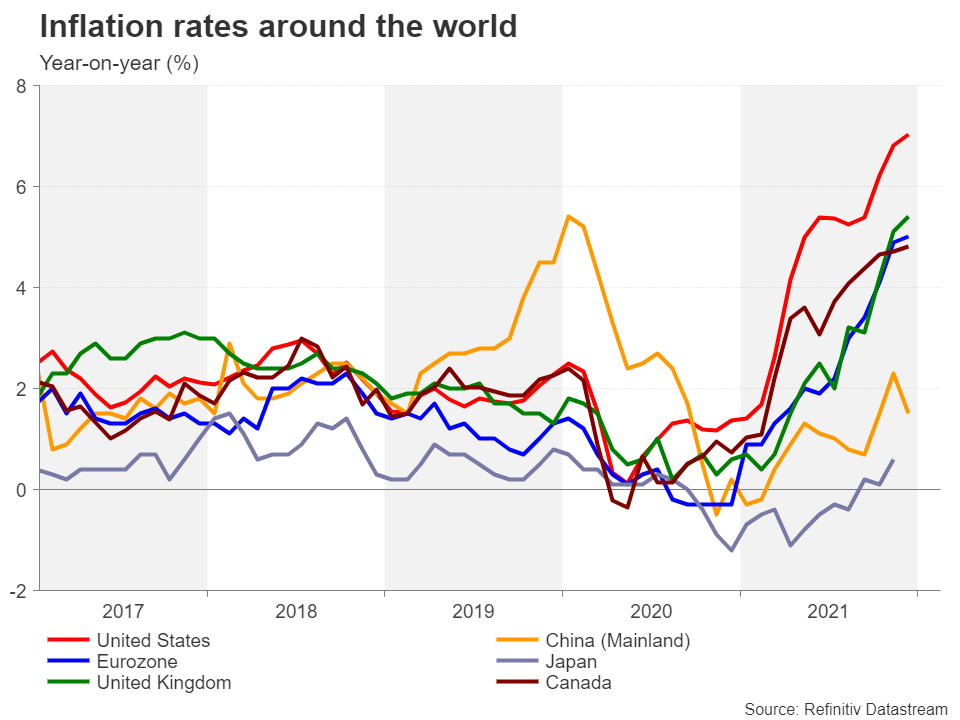
Central banks – whose biggest fear is inflation expectations becoming entrenched – are finally waking up to this realization. The Fed has made several hawkish pivots over the last six months. Yet, it probably remains the most behind the inflation curve as the United States is seeing the biggest and broadest price spikes on a wide range of goods and services. Combined with the worker shortages that are pushing up labour costs, the risk of a vicious cycle of higher inflation is growing. There is now a danger that the Fed may consequently be forced to step on the brakes much harder, tipping the economy into recession.
Dollar and US yields stand tall
Treasury yields on both the short- and long-end of the curve have been rallying lately as the bond market is bracing for an imminent rate hike as well as the unwinding of the Fed’s $9 trillion balance sheet at some later point in the year. All this bodes well for the greenback as the Fed is moving to normalize policy at a much faster pace than many of its peers.
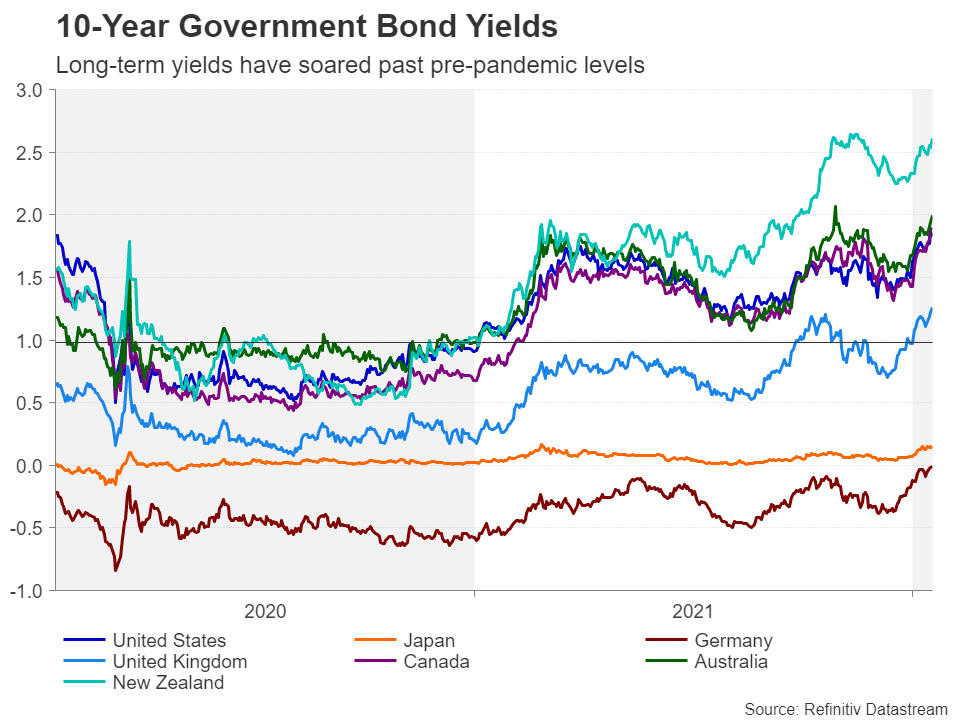
But perhaps what separates Fed tightening expectations from other central banks more is the view that the US economy is in a stronger position than rival economies to withstand interest rate increases. This doesn’t just imply a higher terminal rate, which is the level that the policy rate is anticipated to peak in the current cycle, but that there’s also less of a risk of a policy mistake.
Hence, although it might be difficult for the dollar to resume its uptrend when yield differentials with some countries are set to narrow soon, or at the very least, not widen further, it’s hard to see investors turning bearish on the currency when many of the other big economies are still lagging in the recovery and when the pandemic fog has yet to fully clear.
Europe’s stagflation worries
The lingering dark clouds over the outlook is one reason why investors aren’t as optimistic about the Eurozone, where the recovery has been weaker. Fundamentally though, even if growth in the euro area proves resilient amidst the supply constraints and energy crisis, a wage-price spiral is less likely due to the region’s high unemployment rate, and this should act as a hindrance to rising inflation, which currently stands at an all-time high of 5.0%.
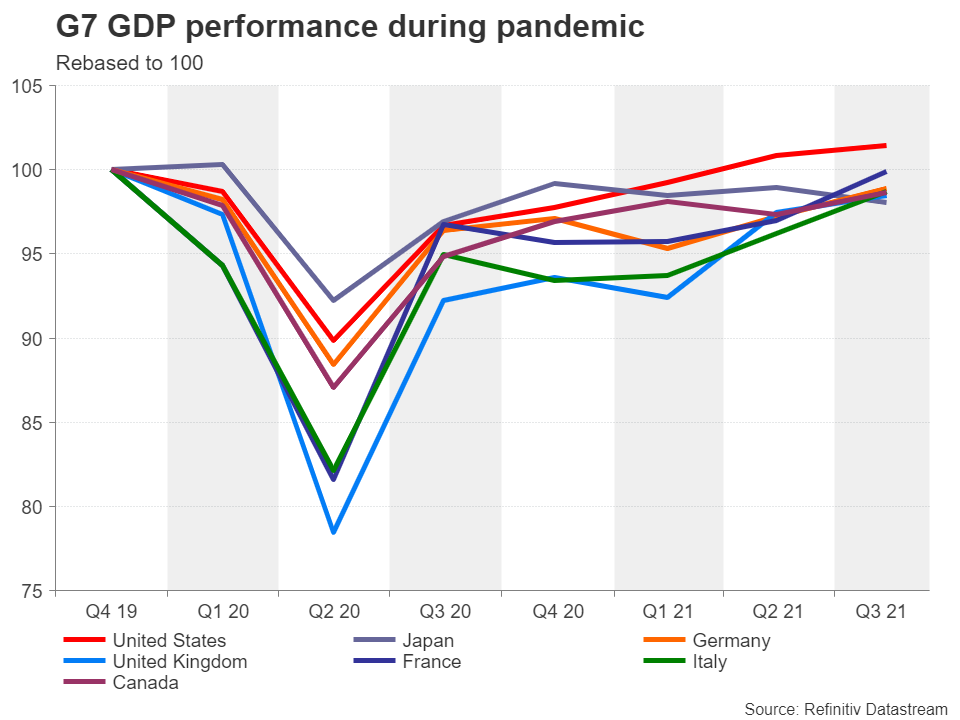
However, Europe is facing a severe energy crunch, which apart from causing fuel bills to soar, it is also squeezing households’ disposable incomes, potentially weighing on consumption. Unless energy prices start to ease soon, the ECB will be compelled to act. Money markets have fully priced in one 10 basis point rate hike in 2022. The odds are rising for a second one but that may be too much of a stretch. In the worst case scenario that Eurozone inflation doesn’t come down on its own accord like the ECB is hoping it will, the risk of stagflation is quite high.
The gloomy predictions probably explain why traders remain quite bearish on the euro. It’s latest charge against the dollar turned out to be a false breakout from its sideways range and it has since slipped back below $1.14. The pound has had better luck against the greenback, managing to crack above its seven-month-old descending trendline to briefly top the $1.37 level.
UK: Cause for optimism, and caution
Inflation in the UK jumped to a near 30-year high of 5.4% in December and the jobs market is tightening fast. The Bank of England is almost certain to hike interest rates for a second time since the pandemic to 0.50% in February. More hikes are on the cards, and with UK growth expected to beat other advanced economies in 2022, there could be more gains in store for the pound.
Nevertheless, there are still some significant uncertainties for the UK outlook. Brexit is exacerbating Britain’s supply-chain crisis and energy bills are set to skyrocket in April when the price cap is lifted by the country’s regulator. While these pose upside risks to inflation, they pose downside risks to growth, raising the prospect of stagflation and holding back sterling’s advances.
Things are looking up for the loonie
Another country where the growth outlook is very positive is Canada. Like in most regions, growth is expected to take a small hit in the short term from the Omicron wave. However, higher oil prices and the strong labour market should help the economy to bounce back quickly from the latest restrictions. More importantly, Canada’s consumer price index edged up to 4.8% in December, and with the Fed readying to pull the rate hike trigger, the Bank of Canada might be emboldened to take the lead.
The odds of the BoC lifting rates as early as its January 26 meeting have soared lately, fuelling a rally in the Canadian dollar. Unusually, the New Zealand dollar has been unable to capitalize on similarly bullish rate hike bets. The RBNZ has raised the official cash rate twice already and will likely repeat the 25bps increases at each of its scheduled meetings this year.
Antipodean currencies are the surprise laggards
However, those expectations were baked in months ago and not a lot has changed since. If anything, the fresh uncertainties from Omicron and the slowdown in China have somewhat dampened the previously optimistic forecasts. The same risks are weighing on the Australian dollar too, even though the Reserve Bank of Australia is highly likely to make a hawkish shift at its next meeting.
Market pundits think the RBA, which has yet to announce an end to its QE programme, will be able to catch up in the rate hike race before the year end. But the RBA could disappoint as wage growth remains quite sluggish in Australia.
China is cutting rates
As for China, monetary policy is headed in the opposite direction as the government responded quickly to the jump in commodity and component prices, taking measures to contain the fallout – something only possible in a centralized economy. China’s CPI rate fell to 1.5% in December, giving the country’s central bank room to cut borrowing costs. Should authorities continue to ease financial conditions and micromanage the deleveraging of the troubled property sector, that could pay dividends for the rest of the world if growth starts to pick up later this year.
In the meantime, however, the weak domestic consumption is a drag on the global economy, though not so much on the yuan, which is being boosted by the record trade surplus.
Will there be an inflation shock in Japan?
Finally, in Japan, inflation may be creeping higher, but the Bank of Japan’s own forecasts don’t see it peaking much above 1% over the next couple of years. Even if inflation were to climb a lot higher, by that point, yield differentials with the US would probably have widened even further, giving the yen little scope for a rebound.
That’s not to say that inflation cannot surprise to the upside in Japan, especially if the supply-chain bottlenecks and rally in energy commodities don’t ease soon. Inflationary episodes are difficult to control and predict. Should Japanese producers decide they can no longer absorb the surging input costs, there is no telling how far they would go in passing the price burden onto consumers.
The guessing game of when inflation will peak
And it is a similar predicament for all countries. Despite most central banks now moving swiftly in removing liquidity from the financial system, inflation is hard to tame once it’s been let loose. If inflationary pressures do begin to moderate sometime in the next few months as most policymakers expect, US yields are likely to suffer the biggest correction, hurting the dollar.
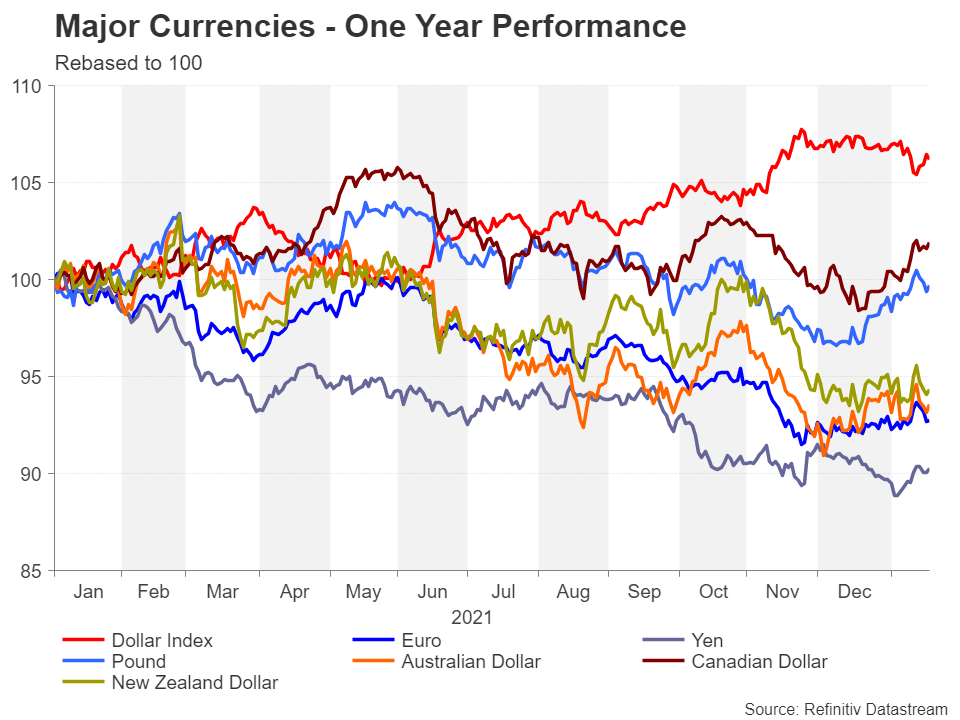
However, the longer it takes for inflation to peak, the better the greenback’s chances of resuming its bullish path. Mainly because as the world’s reserve currency, the dollar stands to benefit from any risk aversion brought on by an inflation panic, while the risk of growth faltering in the US from aggressive monetary tightening would be less than in other countries.
Sunset Market Commentary
Markets
Developments in Asia raised hopes that (equity) markets could enter calmer waters after recent setback. Chinese banks passing through recent PBOC easing and hope for more to come to some extent might mitigate the impact of (accelerated) Fed normalization for the region. However, European indices initially hovered around unchanged levels and currently gain a meagre 0.25%. The oil price easing (Brent S87.9) after recent sharp rise should be a positive for the region, but weighed on regional indices (correction in energy shares).
Geopolitical risks probably also hampered regional sentiment as the EU Ministers meet with US Secretary of State Blinken ahead of his key meeting with Russian Minister Lavrov tomorrow. US equities outperform Europe rising up to 1.4% (Nasdaq).
Eco data were few. German December PPI inflation jumped an astonishing 5.0% M/M and 24.2 Y/Y.
The ECB published the accounts of the December meeting when it raised the 2022 inflation forecast and set out the roadmap for its policy post PEPP ending in March. Contrary to the Fed Minutes, the accounts didn’t show a similar lively debate on alternative paths policy normalization. (Some) ECB members cautioned that inflation staying higher for longer can’t be ruled out and that it can easily stay above 2% in 2023/24. Some members didn’t agree with the policy proposal as they made reservations on the recalibration of APP bond buying, the extension of reinvestments under a pandemic emergency scheme and the increased flexibility of bond buys beyond the pandemic. Even so, this wasn’t the trigger for a further rise in European yields.
Earlier today ECB’s Lagarde in an interview already indicated that the ECB is in a different position compared to the Fed. The German yield curve bull flattens with yields declining between 1.2 bps (2-y) and 2.8 bps (30-y) (rise in 5-yield was benchmark change). The 10-y yield (-0.035%) again trades well in negative territory). US Treasuries outperform with yields declining between 1.8 bps (2-y) and 4.25 bps (5 & 10-y).
US eco data were mixed with the Philly Fed outlook improving from 15.4 to 23.2. However, US jobless claims unexpectedly jumped from 231k to 286K as omicron disturbs activity in several parts of the country.
The correction on core interest rate markets and a more benign equity sentiment aren’t able to provide clear guidance for the dollar. The DXY index trades marginally weaker (95.5) compared to yesterday’s close. At the same time the euro also hardly profits (EUR/USD 1.1345). Sterling maintains recent strength after yesterday’s CPI data and anti-inflation comments from BoE governor Bailey. EUR/USD is changing hands in the 0.8330.News Headlines
The Turkish central bank as expected kept policy rates stable at 14% today. The CBRT in December cut rates a last time, saying it wanted to assess the impact of all monetary easing throughout the second half of 2021 first. Earlier this week, president Erdogan implicitly gave his blessing for a status quo. He said future rate cuts would come “gradually and without any rush”, which was seen as a shift vs. an aggressive push for lower rates before. This however does not change the fact that real (policy) rates with an inflation of 36% (December) remain extremely negative and are a drag for the Turkish lira, especially in an environment of rising core bond yields. For today though, the Turkish currency marginally strengthens vs the euro to EUR/TRY 15.16.
The Norges Bank stuck to a policy rate of 0.50% but reiterated it expects to continue its hiking cycle in March, citing the ongoing economic swing. Containment measures due to recently higher infection rates have held back activity but that should reverse soon and quickly when they are being relaxed again. Unemployment edged up slightly in December yet is probably still lower than projected in the NB’s latest projections. Underlying inflation on the other hand has accelerated more than expected and is close to the 2% target (1.8% in December). The NB Committee added it was concerned with the risk of a “potential rise domestic price and wage inflation due to capacity constraints and persistent global price pressures”. Gains for the Norwegian krone are minimal with a March rate hike being flagged for quite some time now. EUR/NOK eases slightly to EUR/NOK 9.94.
Market Sentiment Freezes, Dollar Largely Unchanged
Markets digest US jobless claims and Philly manufacturing
US stock futures correction deepens as risk sentiment has remained sparse, while the 10-year yield at 1.88% seems to be keeping the dollar buoyant. It appears the hawkish tone from the Fed has saturated markets and they have become less sensitive lately.
The US economy is nearing full employment and today’s rise in jobless claims has managed to only nudge the dollar index slightly lower, which has stabilized around the 95.40 level. The United States saw an increase of 55 k new claims for unemployment benefits to 286 k in the week that ended January 15, rising off the previous period at 230 k. It was the largest weekly increase since mid-July after the Omicron variant hindered employers retaining workers.
On another note, the factory activity in Philadelphia beat January 2022 forecasts of 18.9, improving from a one-year low of 15.4 in December 2021. The resulting optimism from firms for growth over the next six months remains positive.
ECB messages versus stronger sterling
The euro remains sluggish around $1.1340, back to levels in the Asian session. The ECB policymakers’ rhetoric regarding recent inflation, is supposedly attributed to temporary factors that were assumed would lessen in 2022. Nonetheless, should elevated levels for an extended period haunt the eurozone, the ECB will likely have to take appropriate action to aid growth. That said, the ECB echoed that the net purchases under the PEPP program may be decreased and may end by the end of March but balanced this, with the fact that monetary support remained a necessity, dampening expectations of a rate hike this year.
The pound is faring better against the greenback and the euro and has mended the one-and-a-half base point damage over the last week against the reserve currency, forming traction off the $1.3600 handle, after minor weakness in the greenback unfolded due to the rise in jobless claims. EURGBP is firm around 0.8330 but maintains a negative bias.
The yen has not capitalized on the muted strength in the dollar, whose recent pullback from 116.40 per dollar is hovering around 114.25 per dollar mark, while gold is currently flat around $1,840/oz - after yesterday’s rally from $1,817.
Employment fires up down under
Australia is faring well at the start of 2022 with its seasonally adjusted unemployment rate falling to 4.2% in December 2021, down from 4.6% a month earlier, recording the lowest number since August 2008 as the lockdowns were removed. More jobs were created in Australia during December, increasing employment by 64.8 k to a fresh record of 13.24 million, overshooting market forecasts of a 43.3 k rise. This occurred even though the participation rate missed the December estimate by a fraction, remaining pat with the previous month at an elevated 66.1%, as monthly hours worked in jobs increased by 1%.
The aussie is creeping higher, currently at $0.7240, keeping the ascent from 0.7000 active. Although the Reserve Bank of Australia has claimed that they are unlikely to move ahead with hikes until 2023, a stronger economy has markets now pricing in a 70% chance by May for lift-off. Furthermore, markets are expecting the RBA to somewhat update its forward guidance in May’s meeting to acknowledge that an earlier hike could be on the cards, while the RBA will have to review its QE policy in its February meeting.
Oil and loonie momentum dry up
WTI futures have consolidated around $85.55 per barrel level, while strength in the Canadian dollar has paused with the dollar/loonie pair flatlining slightly below the C$1.2500 barrier.
At 15:00 GMT, US existing home sales are due, while natural gas storage and crude oil inventories will follow at 15:30 and 16:00 GMT respectively.
A Mixed Day as Earnings Season Continues
It's turned into a mixed session across Europe with indices giving up earlier gains initially before reversing course once more to tread water as we near the open on Wall Street.
It appeared we could have been heading for a second consecutive positive session when Europe got things underway this morning, something we haven't been treated to much so far this year. But it wasn't long until we were back in the red; a further sign of the angst in the markets right now that is proving hard to shake off. Perhaps there's still hope yet but given what we've seen, it won't be cause for optimism.
The Nasdaq dropping into correction territory won't be helping lift the mood, and that will turn more downbeat again if it breaks below the 200-day simple moving average for the first time since April 2020 when the unbelievable tech rally started. It would also take it below 15,000 for the first time since the middle of October. Not a great signal for the markets just as Netflix kicks off earnings season for big tech.
The flipside of that is that earnings could be what helps tech find some form again. There'll no doubt be some interest around these levels and we're already seeing futures pointing more than half a percentage point higher ahead of the open. A strong report from Netflix could see dip buyers flood back in.
The key question on investors' minds though will be whether the tech rout is already behind us after a 10% drop. That will depend on more than just a few stellar earnings reports. The key thing will be whether we see a pause in market interest rate expectations after weeks of aggressively pricing in more hikes and balance sheet reduction.
While there are calls for more than four hikes this year, even a kickstart 50 basis point increase from the Fed in March for the first time in more than 20 years, is that going to be priced in this early? Or could we see a period of relief that could benefit stock markets if earnings season takes a turn for the better? We'll soon see as big tech dominates the next week on the earnings calendar.
ECB remains in camp transitory
Christine Lagarde launched a strong defence of the ECB's response to higher inflation on Thursday, warning that markets should not expect a similar approach to that taken by the Fed as the situation doesn't warrant it. Lagarde pointed to lower inflation, which was confirmed today at 5% in December, and a weaker recovery. While that may be true, markets have been pricing in the possibility of a similar u-turn to that we've seen in the US and UK, with a 10 basis point increase expected in October.
The minutes reflected Lagarde's comments, as we would expect, but that's unlikely to change investors' minds. Central banks have repeatedly pushed back against market expectations over the last six months before eventually aligning with them. With the German 10-year moving into positive territory for the first time since mid-2019 on Wednesday, it seems a familiar pattern may be unfolding.
New year, new CBRT?
The CBRT appears to be turning over a new leaf in 2022 after resisting the urge to cut interest rates for a fifth consecutive meeting. The central bank has cut rates from 19% to 14% in that time which has come at great expense in terms of the currency, reserves, and inflation. But it would appear that the easing cycle has run its course, for now.
That said, the explanation for current levels of high inflation and the disregard for it, and in effect its impact on households and businesses, don't offer much assurance that the CBRT won't at some point revert back to the damaging approach of recent months. But it may wait until inflation does ease again after reaching 36% last month.
Oil rally finally losing momentum
Oil has been on a remarkable run in recent weeks driven by very bullish fundamentals as disrupted supply struggled to keep up with strong demand. OPEC and the IEA have referenced the resilience of demand since the emergence of omicron in recent weeks and the inability of OPEC+ to hit their production targets, or even come close, has led to the kind of one way price action we've been witnessing.
While the fundamentals haven't changed, it does appear that we're finally starting to see momentum wane after a more than 30% rally from the omicron lows. That's coming around $90 where oil has peaked at a seven-year high, seemingly triggering some profit-taking. While I don't think it's done there, we could see a minor correction to take some of the frothiness out of the market. That said, I can't imagine it will be too large unless we see a shift, either in OPEC+ production or slowing demand from a major consumer like China as a result of its zero-Covid policy.
Gold breaks key resistance
Gold has been pushing for a breakout above $1,833 since the start of the year and it finally achieved it on Wednesday, which could potentially help propel it higher in the coming weeks. The move has been building despite yields rising, which may be a sign that traders don't believe enough is being priced in to counter soaring inflation.
The yellow metal has recovered earlier losses to trade higher today, just as the dollar has lost earlier gains to trade flat. It started to struggle a little shy of $1,850 which may be the next area of resistance, with the November highs around $1,875 above here being the next test. A move lower will see $1,833 tested as support after putting up such a barrier of resistance in recent months.
A big move coming in Bitcoin?
Bitcoin remains in consolidation on Thursday, with ranges tighening as the cryptocurrency struggles for any direction. It doesn't feel like we'll have to wait long for an aggressive breakout one way or another but at this point, it's hard to say in which direction that will come. If interest rates are its kryptonite then it could still be in for a rough ride as anxiety around monetary tightening remains heightened. But I'm not convinced that will remain the case and it may just be a case of the cryptocurrency biding its time. I'm sure we'll soon see which way that will come but once it breaks out of that tight range, the move could be quite substantial.
EUR/USD Mid-Day Outlook
Daily Pivots: (S1) 1.1323; (P) 1.1340; (R1) 1.1361; More...
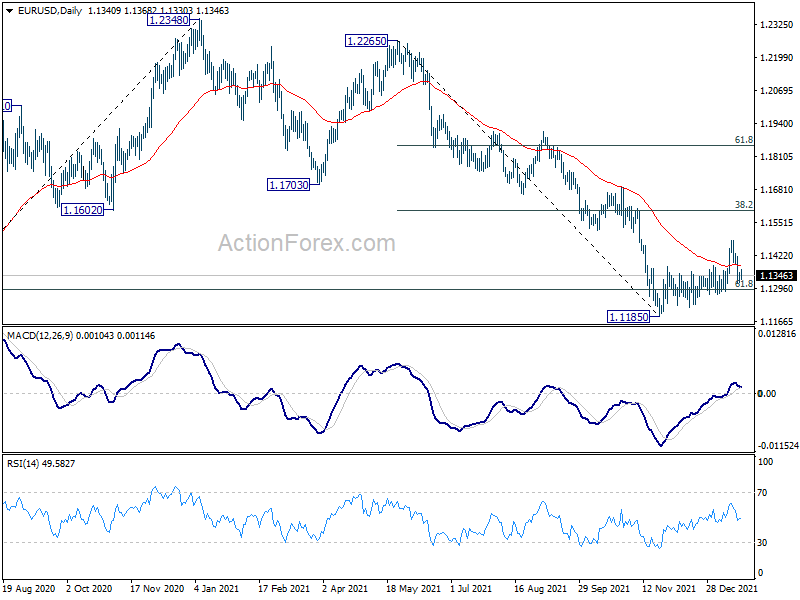
Intraday bias in EUR/USD remains neutral and outlook is unchanged. Rebound from 1.1185 is seen as corrective move. Break of 1.1284 will argue that larger down trend from 1.2348 is ready to resume. Intraday bias will be back on the downside for retesting 1.1185 low first. Also, in case of another rise, upside should be limited by 38.2% retracement of 1.2265 to 1.1185 at 1.1598 eventually.
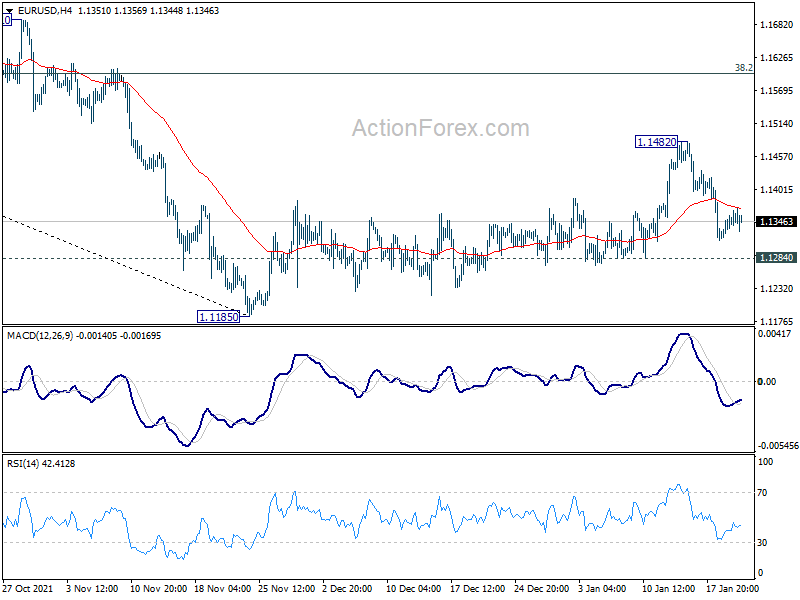
In the bigger picture, there are various ways of interpreting the fall from 1.2348 (2021 high). It could be a correction to rise from 1.0635 (2020 low), the fourth leg of a sideway pattern from 1.0339 (2017 low), or resuming long term down trend. In any case, outlook will now stay bearish as long as 1.1703 support turned resistance holds. Sustained break of 61.8% retracement of 1.0635 to 1.2348 at 1.1289 would pave the way back to 1.0635.
GBP/USD Mid-Day Outlook
Daily Pivots: (S1) 1.3585; (P) 1.3617; (R1) 1.3646; More...
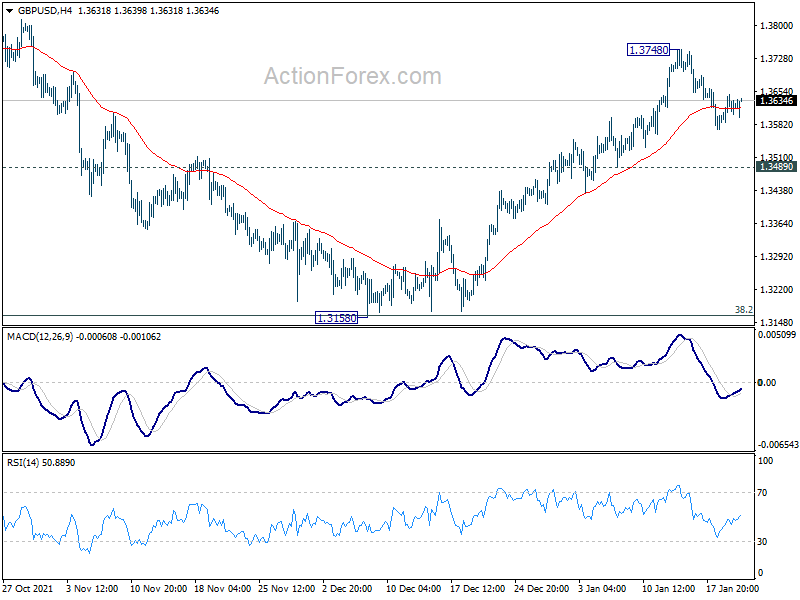
Sideway consolidation continues in GBP/USD and intraday bias remains neutral. While deeper fall cannot be ruled out, downside of retreat should be contained by 1.3489 support to bring another rally. As noted before, corrective fall from 1.4282 should have completed with three waves down to 1.3158, after hitting 1.3164 medium term fibonacci level. Above 1.3748 will target 1.3833 first. Sustained break of 1.3833 will pave the way back to retest 1.4248 high.
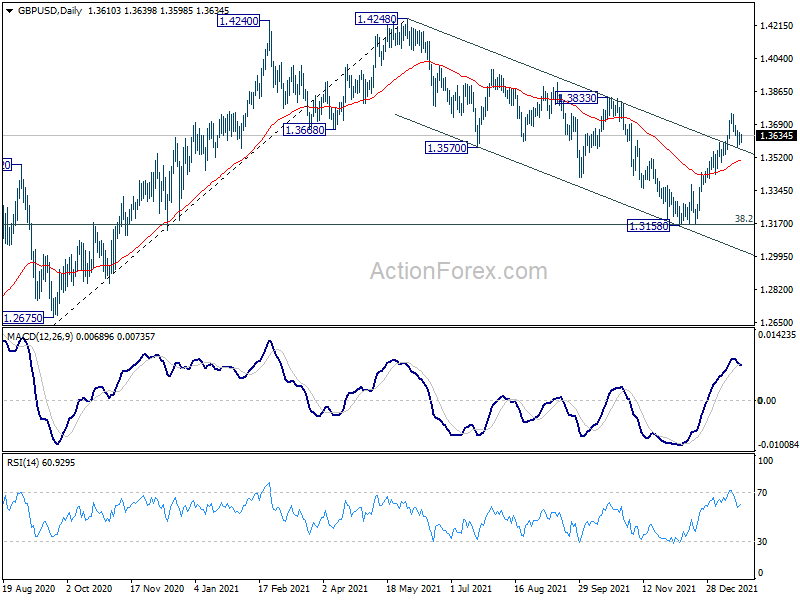
In the bigger picture, strong support was seen from 38.2% retracement of 1.1409 to 1.4248 at 1.3164. The development suggests that up trend from 1.1409 (2020 low) is still in progress. On resumption, next target will be 38.2% retracement of 2.1161 to 1.1409 at 1.5134. Nevertheless sustained break of 1.3164 will argue that whole rise from 1.1409 has completed and bring deeper fall to 61.8% retracement at 1.2493.
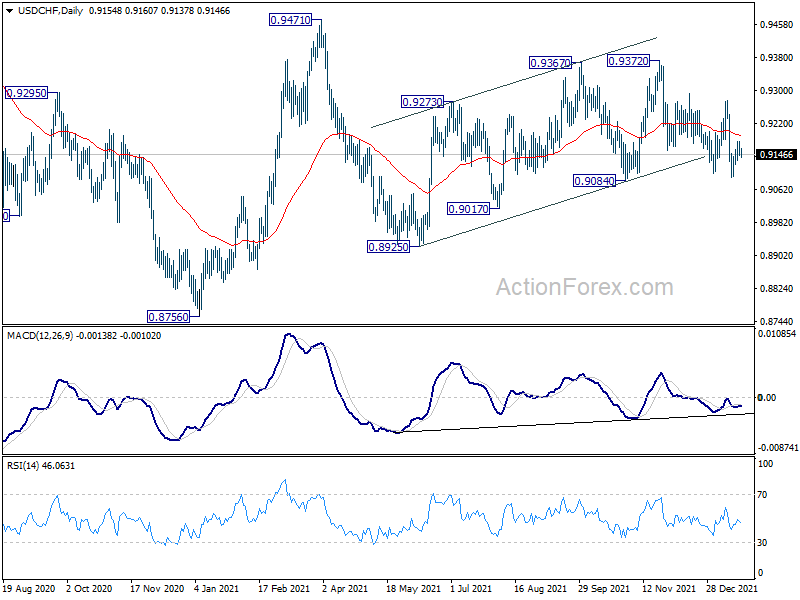
USD/CHF Mid-Day Outlook
Daily Pivots: (S1) 0.9142; (P) 0.9160; (R1) 0.9175; More....
Sideway corrective trading continues in USD/CHF and intraday bias remains neutral. On the downside, firm break of 0.9084 support will argue that choppy rise from 0.8925 has completed. Fall from 0.9471 might be ready to resuming. Further decline would be seen back to 0.8925 support first. On the upside, above 0.9276 will target 0.9372 resistance instead.
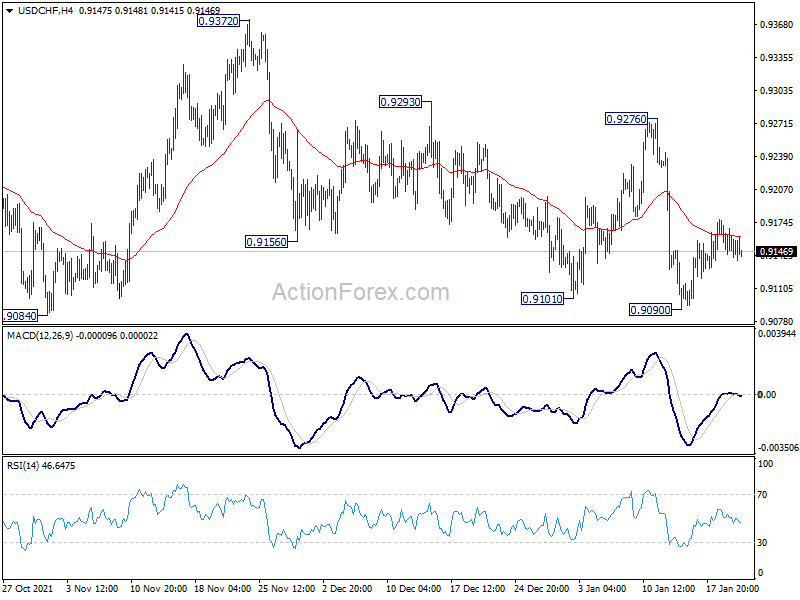
In the bigger picture, the corrective structure of the rebound from 0.8925 argues that fall from 0.9471 is not complete yet. It could either be the second leg of pattern from 0.8756 (2021 low), or resuming larger down trend from 1.0237 (2018 high). We'd pay attention to the downside momentum and assess the odds later. But for now, medium term outlook will be neutral at best as long as 0.9471 resistance holds.
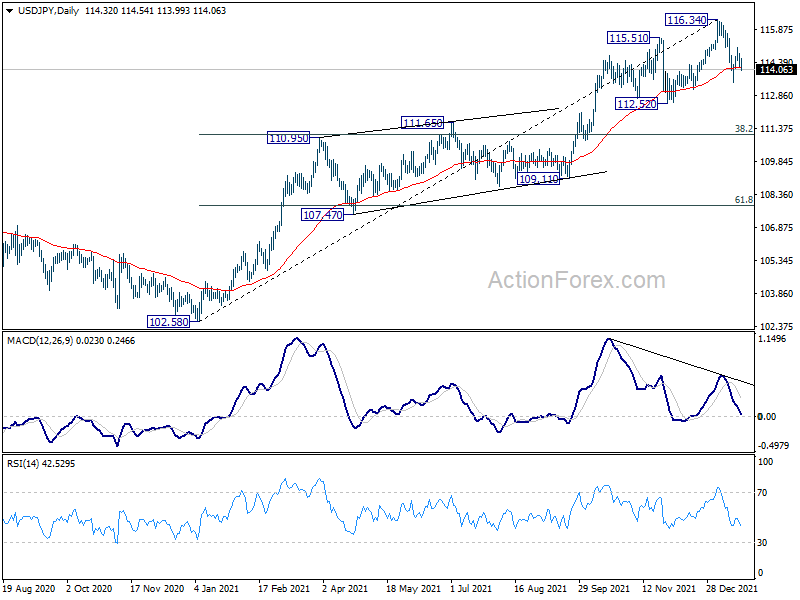
USD/JPY Mid-Day Outlook
Daily Pivots: (S1) 114.09; (P) 114.44; (R1) 114.67; More...
Intraday bias in USD/JPY stays mildly on the downside for the moment, for 113.47 support. Break there will resume the fall from 112.52 structural support. Considering bearish divergence condition in in daily MACD, further break of 112.52 will confirm that it's already in correction to the up trend from 102.58. Deeper decline would be seen to 38.2% retracement of 102.58 to 116.34 at 111.08. On the upside, break of 115.05 will resume the rebound from 113.47. But a break of 116.34 high is not expected even in this case.
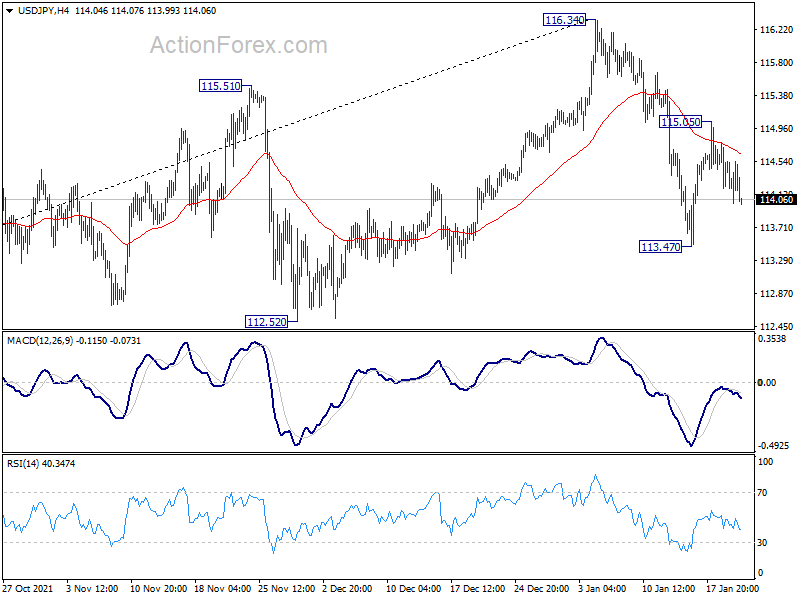
In the bigger picture, no change in the view that rise from 102.58 is the third leg of the up trend from 101.18 (2020 low). Such rally should target a test on 118.65 (2016 high). Sustained break there will pave the way to 120.85 (2015 high) and raise the chance of long term up trend resumption. However, firm break of 112.52 support will dampen this bullish case and we'll assess the outlook based on subsequent price actions later.