

Sample Category Title
EURGBP Buyers Offset Fresh Dip, But Downside Risks Remain
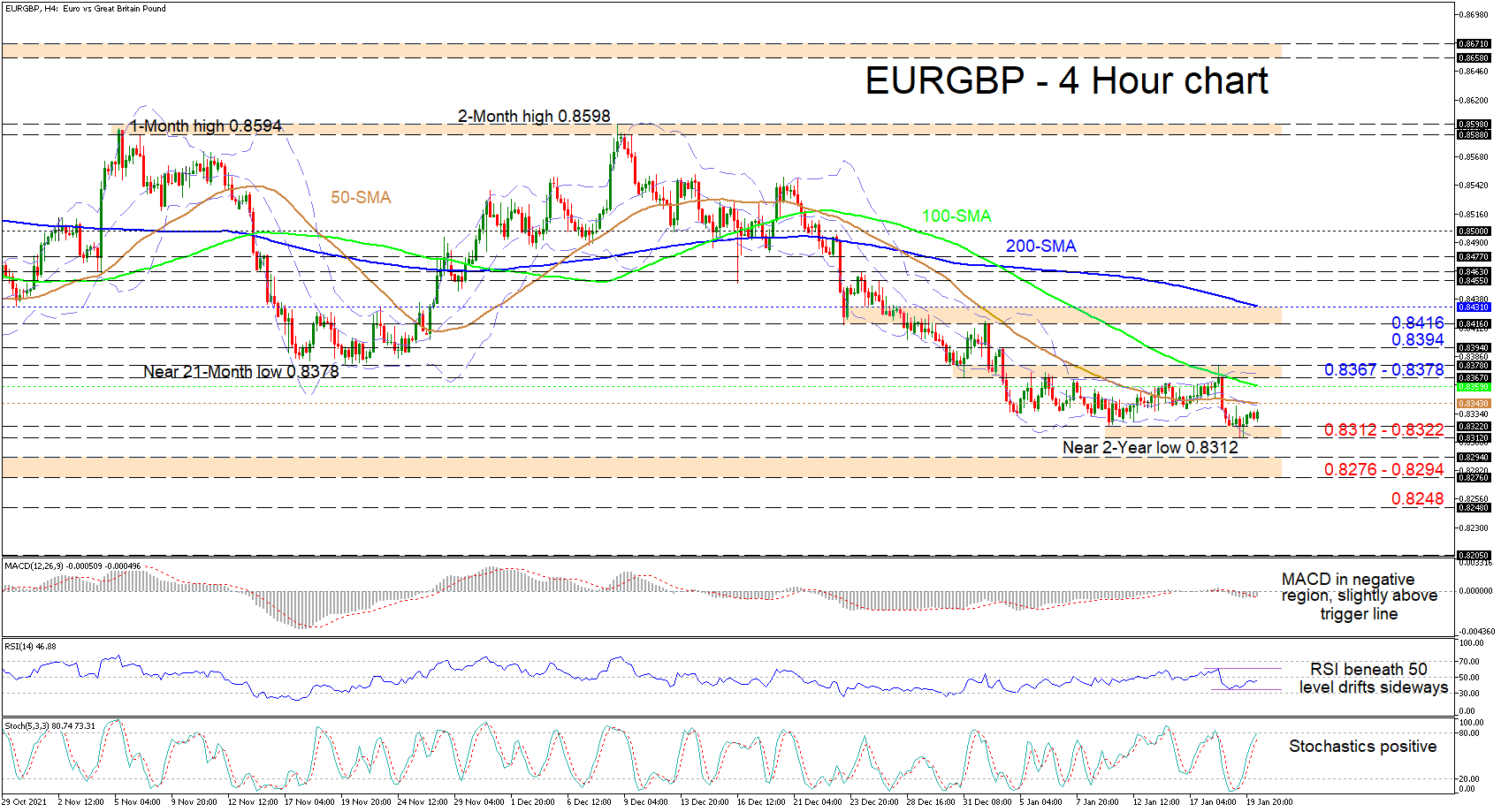
EURGBP has adopted a softer negative trajectory since January 5, something also being reflected in the calmed slope of the 50-period simple moving average (SMA). Nonetheless, the longer-term SMAs continue to defend the bearish trend in the pair.
The short-term oscillators are indicating a minor increase in positive momentum, which could prolong the consolidation in the pair from the beginning of the year. The MACD, not too far beneath the zero threshold, has overstepped the red trigger line, while the RSI is hovering a tad below the 50 level, making attempts to creep higher. Furthermore, the positively charged stochastic oscillator is promoting more positive price action.
In addition, the Bollinger bands remain relatively squeezed and are hinting that a surge in volatility is expected, which suggests a larger directional move may unfold.
Attempts in the pair to improve could encounter prompt upside constraints at the mid-Bollinger band and adjoining 50-period SMA around 0.8343. If buyers push higher, resistance may then arise at the 100-period SMA at 0.8359 before the bulls face the 0.8367-0.8378 ceiling of the two-week sideways market. Successfully conquering this, bullish impetus could meet the 0.8394 high, just shy of the 0.8500 mark, prior to buyers challenging a resistance border between the 0.8416 barrier and the 200-period SMA at 0.8431.
If negative pressures gain strength again, initial deterrence to the pair running lower is the 0.8312-0.8322 recently formed base. In the event the fresh near 2-year low of 0.8312 is broken, traders’ focus could then shift toward the critical 0.8276-0.8281 support section. This key barrier is linked to a double bottom formation involving the sell-off troughs from December 2019 and February 2020, from where an ascent in the pair began, which recorded an 11-year high of 0.9497. Sinking past this, the bears could target the 0.8248 trough, identified in mid-July 2016.
Summarizing, EURGBP is sustaining a neutral-to-bearish tone. That said, a break below the 0.8312-0.8322 floor or above the 0.8367-0.8378 ceiling of the minor consolidation would need to occur to establish a clearer short-term direction.
WTI Oil Futures Overbought But 90 Level Still in Focus
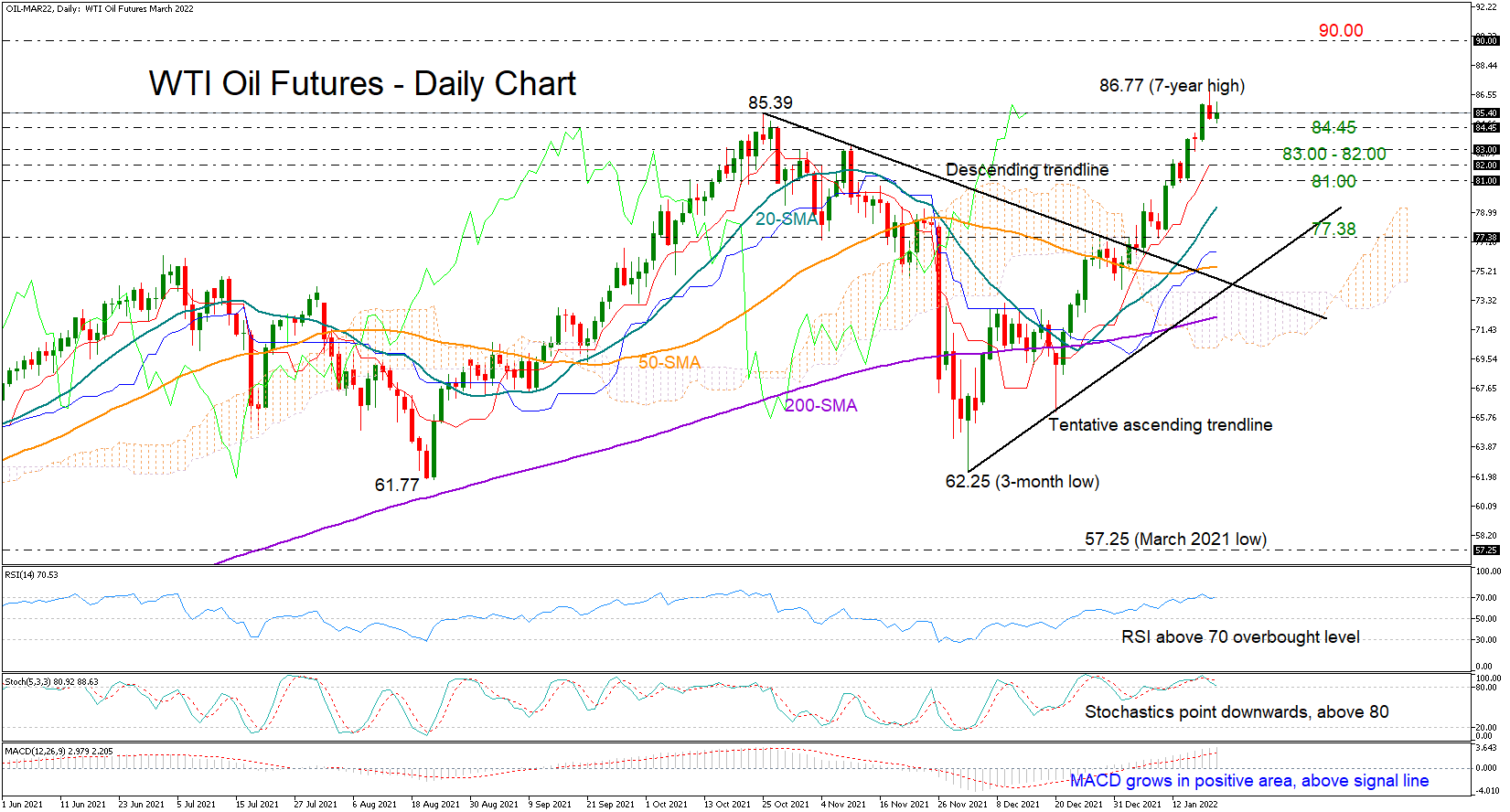
WTI oil futures (March delivery) are marking their fifth consecutive bullish week. Having fully recovered from November's sell-off, the price managed to print a new seven-year high at 86.77 on Wednesday but a close above the previous peak of 85.39 seems to be a tough job for now.
The RSI and the Stochastics are warning that the prolonged rally is overstretched and a downside reversal should not be a big surprise in the short term. Yet, the indicators are still fluctuating above their 70 and 80 overbought levels respectively and have yet to show any convincing signs of weakness. Hence, upside pressures could persist for a bit longer before the next bearish correction occurs.
On the upside, there is no major obstacle until the 90.00 round-level, last seen in September 2014. Additional gains from here could test the 94.00 – 96.00 region before all attention shifts to the 100.00 key psychological number.
Otherwise, a backward move below the nearby former resistance of 84.45 could immediately pause within the 83.00 – 82.00 zone, where the supportive red Tenkan-sen line is positioned. Then, a step beneath the 81.00 handle could produce a more aggressive decline, potentially towards the 77.38 restrictive region, unless the 20-day simple moving average (SMA) at 79. 38 comes to the rescue.
Summarizing, the five-week rally in WTI oil futures could slow pace in the coming sessions as overbought signals flash red, but the price may first push for some extra gains.
USOIL SeeksSupport
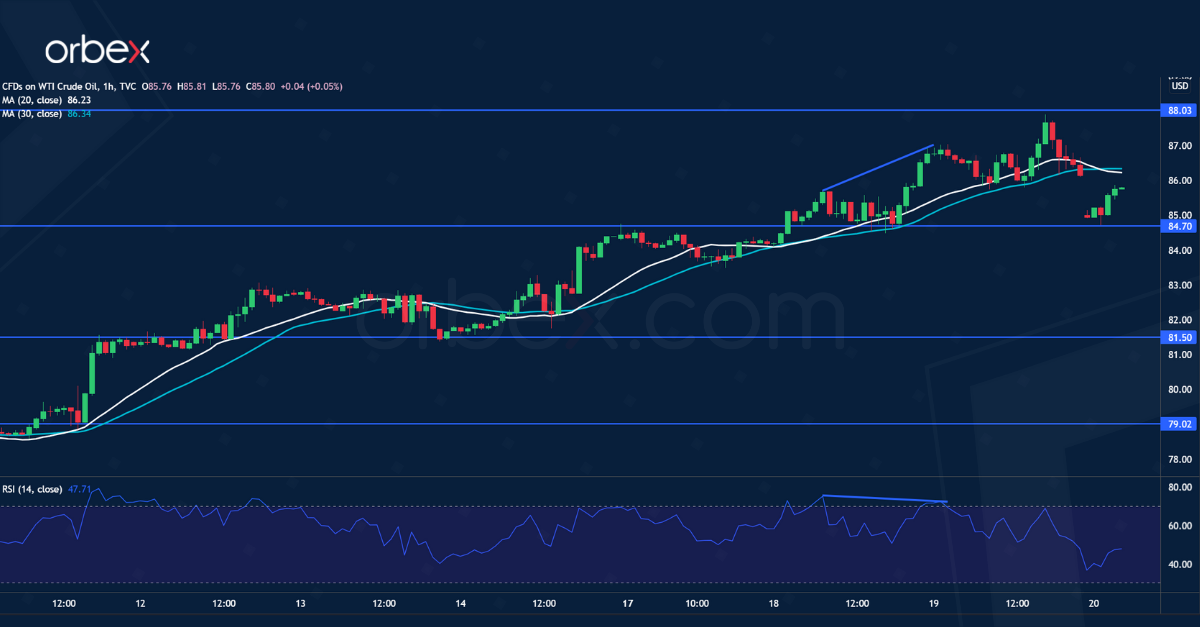
WTI crude continued upward after the IEA warned inventories in OECD countries were at their lowest levels.
The rally may accelerate in the medium-term after the bulls clear last October’s high at 85.00. However, the RSI has shot into the overbought area on the daily chart.
Bearish divergence on the hourly time frame suggests a slowdown in the short-term momentum. Price action could be due for a pullback. 84.70 is the first support and 88.00 is the resistance when the price bounces back.
EUR/GBP Slips to 12-Month Lows
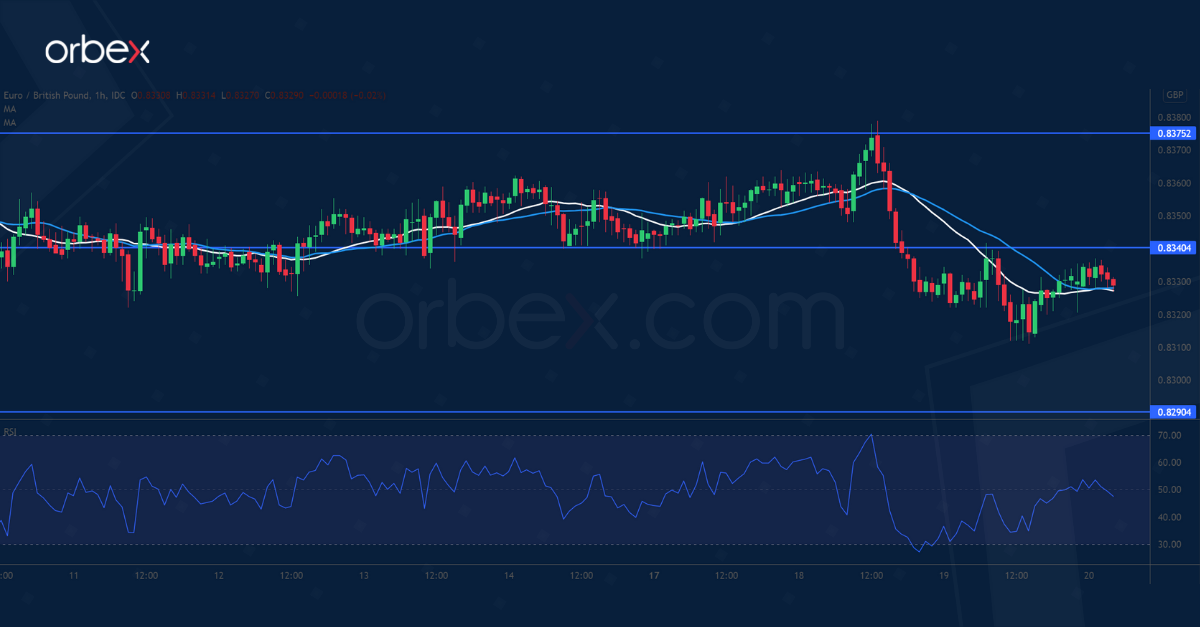
The sterling edged higher after Britain’s December CPI exceeded expectations.
The euro has struggled to lift offers around 0.8375 after a two-week-long consolidation. The subsequent break below 0.8340 has forced buyers to bail out, exacerbating the bearish mood. This former support has turned into a fresh resistance.
A bearish MA cross indicates an acceleration to the downside. The pair is now heading towards February 2020’s lows near 0.8290. An oversold RSI may cause a limited rebound.
USD/CAD Grinds Lower
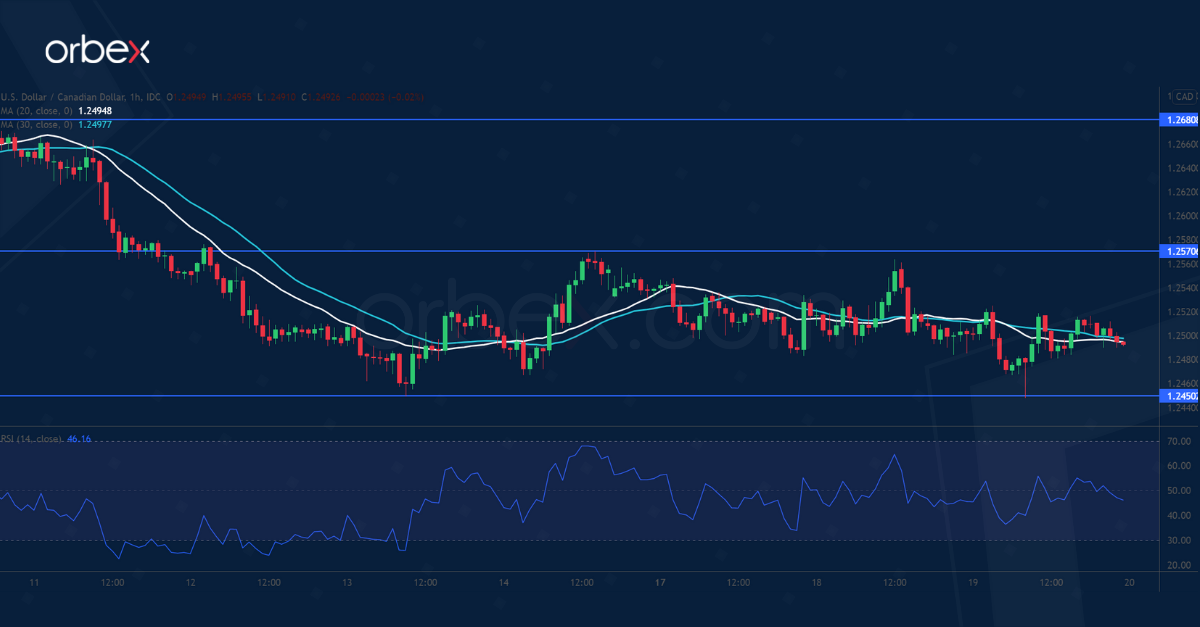
The Canadian dollar finds support from hotter-than-expected inflation. The US counterpart remained under pressure after it failed to hold onto 1.2500.
The RSI’s repeatedly oversold situation has attracted some buying interest. But timid rebounds have rather been opportunities for trend-followers to sell into strength.
1.2570 is a key resistance to lift if the bulls look for another chance. On the downside, a drop below 1.2450 would trigger a new round of sell-off towards the daily support at 1.2390.
AUDUSD Rises in Ascending Channel; Bullish Bias
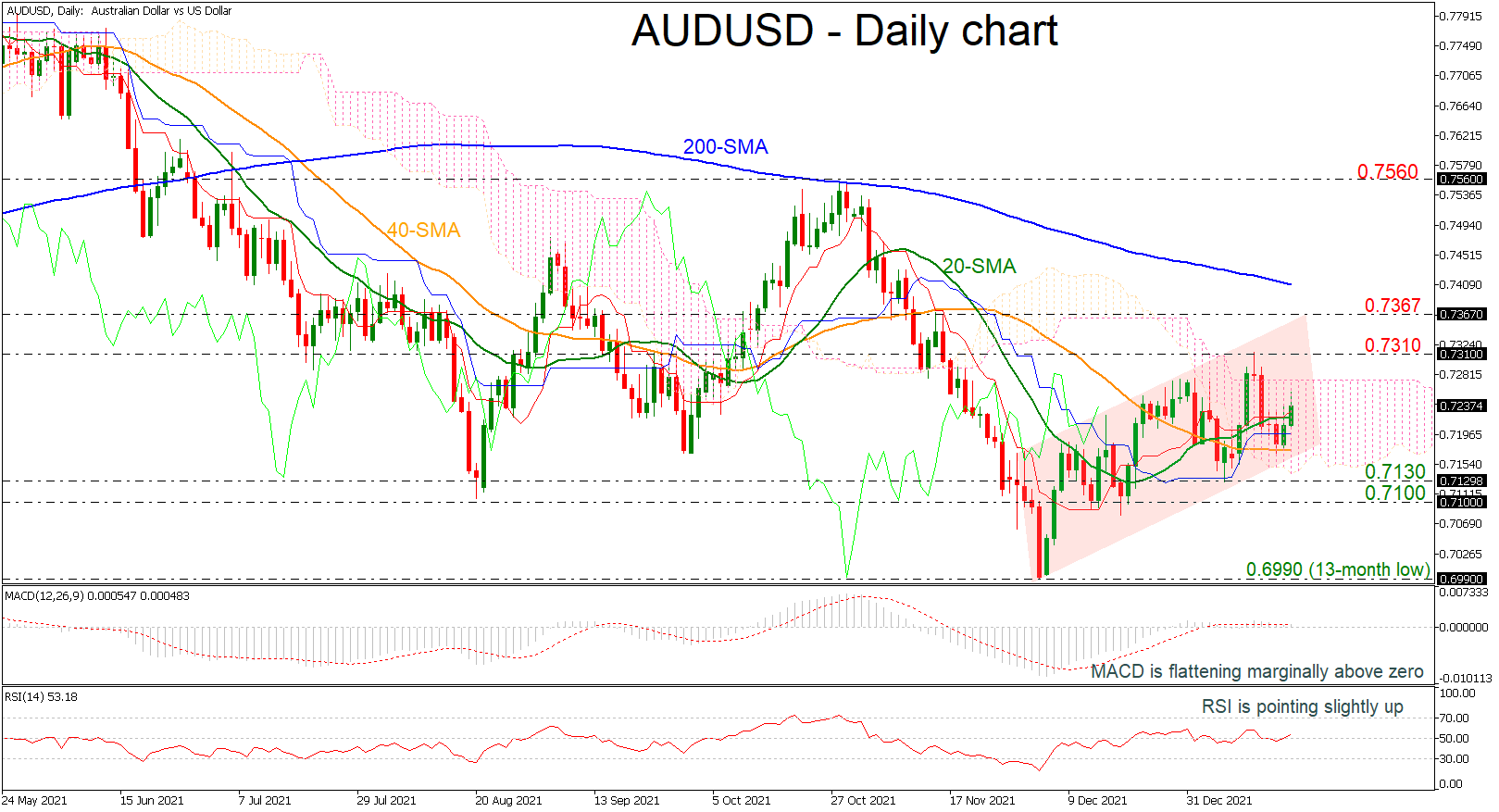
AUDUSD is moving within the Ichimoku cloud and the short-term simple moving averages (SMAs), while in the bigger picture the price has been in an ascending channel since December 2021. The MACD oscillator is flattening around its trigger and zero lines, unable to improve the bullish bias. However, the RSI indicator is sloping upwards in the positive region.
If the price gains more ground, immediate resistance could come from the 0.7310 barrier and the 0.7367 resistance. Above these obstacles, the 200-day SMA at 0.7410 could attract traders’ attention ahead of the high of 0.7560, registered in October 2020.
Alternatively, a drop below the Ichimoku cloud could meet the 0.7130 support, which holds near the return line of the channel before hitting the 0.7100 psychological number. Steeper decreases may send the sellers until the 13-month low of 0.6990.
All in all, AUDUSD is in a positive bias and only a dive below the upward sloping channel and more importantly below the 13-month low will endorse the long-term bearish view again.
ECB Lagarde: We have every reason not to act like Fed on inflation
ECB President Christine Lagarde told France Inter radio inflation will "stabilize" and "ease gradually in the course of 2022. ".
"The cycle of the economic recovery in the U.S. is ahead of that in Europe. We thus have every reason not to act as rapidly and as brutally that one can imagine the Fed would do," she said.
Nevertheless, she added, "we have started to react and we obviously are standing ready, to react by monetary policy measures if the figures, the data, the facts demand it."
Daily Technical Analysis
EUR/USD
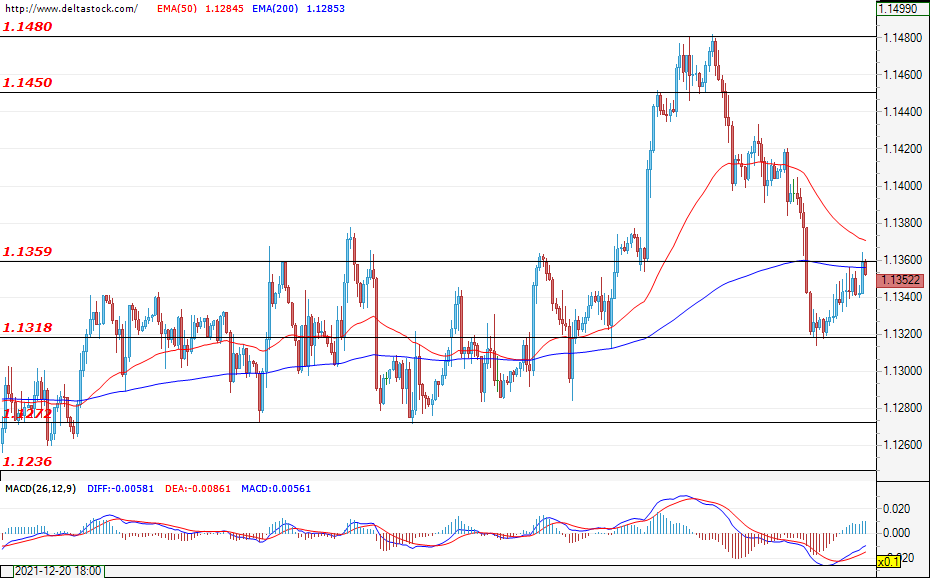
Following the unsuccessful test of the support level at 1.1320, the currency pair continued to trade in the range of 1.1320 – 1.1360, but in the early hours of today's trading session, it is headed towards a test of the resistance at 1.1360. If the EUR/USD manages to breach this level, then it would further rise towards the psychological level of 1.1400. In case the resistance at 1.1360 withholds the bullish pressure, then the most likely scenario would be for the pair to continue trading in the range of 1.1320 – 1.1360. Today, increased activity can be expected around the release of the CPI data for the EU (10:00 GMT) and the initial jobless claims data for the U.S. (13:30 GMT).
USD/JPY
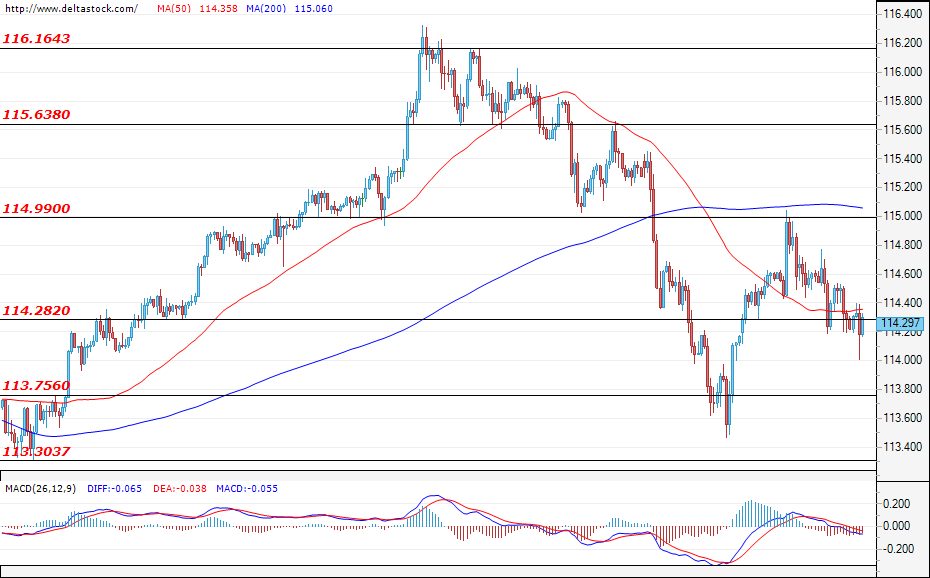
After the unsuccessful test of the resistance level at 115.00, the dollar depreciated against the yen and, at the time of writing, the currency pair is headed towards a test of the important support at 114.28. A confirmed breach of this level would let the bears attack the main support at 113.75. In case the support at 114.28 resists, then the bears would likely regain their control and test the resistance levels of 115.00 and 115.63.
GBP/USD
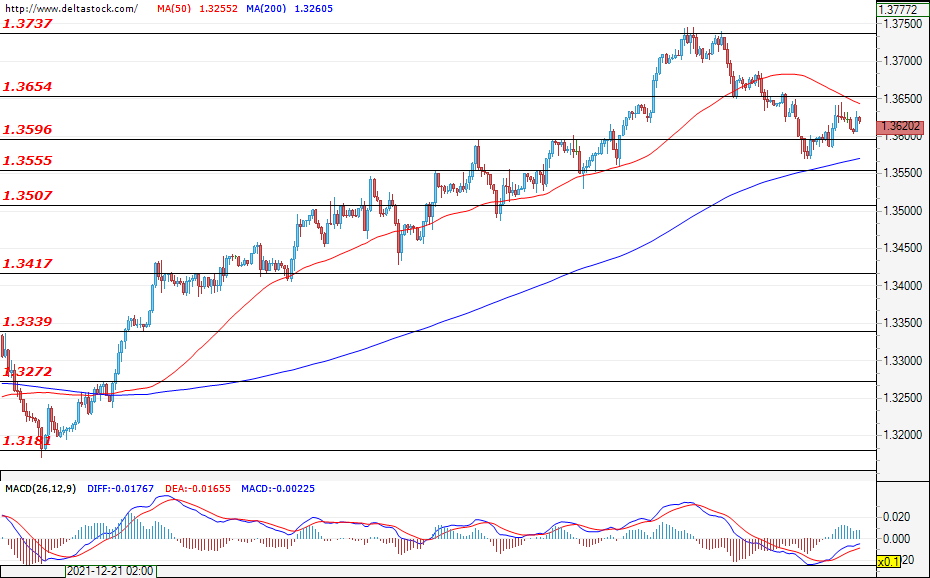
The Cable is consolidating in the range between 1.3596 and 1.3654 and the forecast is for another test of the support level at 1.3596. In case the pair breaches this support, then the negative sentiment would grow stronger and the decline would continue towards the next support levels of 1.3555 and 1.3507. In the positive direction, the mentioned level of 1.3654 is the first resistance for the pair.
EUGERMANY40
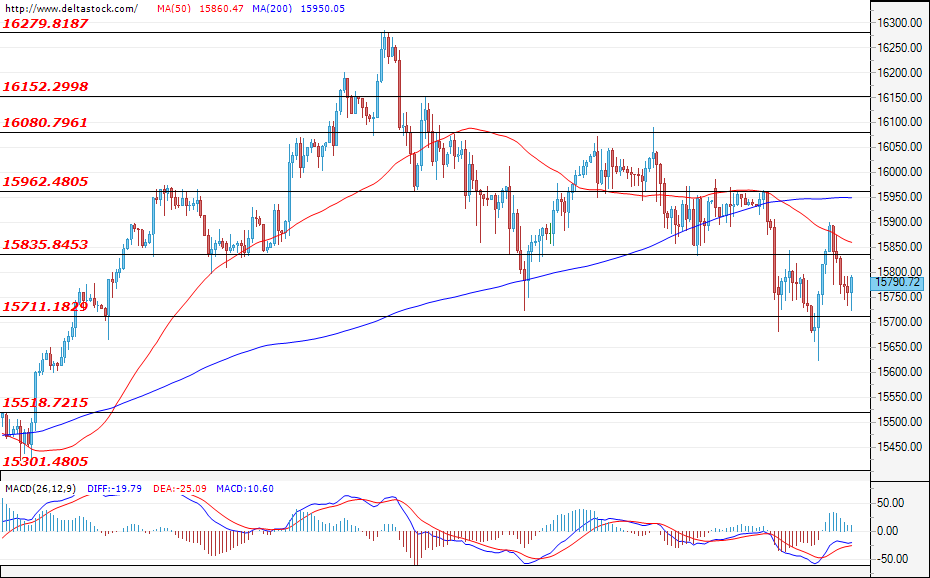
Yesterday, the German index was trading in the narrow range between 15711 and 15835 after a couple of volatile trading sessions. A confirmed breach of any of the borders of the range would determine the future direction of the index. In case of a confirmed breach of 15711, the decline should continue and we might witness a test of the support at 15300 that is coming from the higher time frames. If the bulls violate the upper border of the range, then the index would most likely head towards the zone at around 16080.
US30
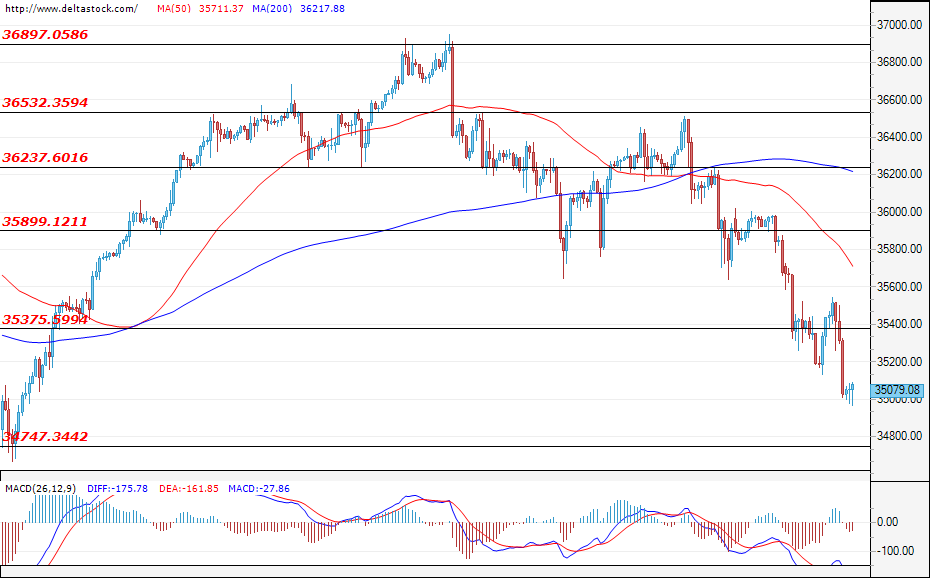
The sell-off for the U.S. blue-chip index continues as it breached the support level of 35375 during yesterday's trading session. The negative sentiment remains intact and the expectations are for the index to test the next support level of 34750. In the positive direction, the first important resistance sits at 35900. Today, increased activity can be expected around the release of the initial jobless claims data for the U.S. (13:30 GMT) and the existing home sales data for the U.S. (15:00 GMT).
Crude Oil Price Maintains Bullish Momentum
US equities turned positive on Wednesday after strong quarterly earnings by Morgan Stanley, Bank of America, and Procter & Gamble. The two banks published better-than-expected results, which were helped by the rising loan growth and investment banking revenues. P&G, on the other hand, reported strong revenues, helped by rising demand and prices. The company expects most of its costs will remain elevated in the first half of the year. The earnings season will continue later today, with the key companies to watch being Union Pacific, Fifth Third, Northern Trust, and Netflix.
The US dollar index retreated in the overnight session after the slight decline of bond yields. After soaring to a two-year high, the 10-year bond yield declined to 1.84% while the 30-year dropped to about 2.17%. The index declined even after relatively strong US housing starts and building permits data. The housing department said that housing starts rose from 1.678 million in November to 1.70 million. In the same period, the number of building permits increased from 1.71 million to 1.87 million. These numbers mean that the important housing sector is doing well.
The economic calendar will have some key events later today. Earlier on, the Australian Bureau of Statistics (ABS) reported strong jobs numbers. The country’s unemployment rate declined from 4.6% in November to 4.5% in December. Later today, Eurostat will publish the latest consumer inflation data. Economists expect the data to show that the headline CPI rose to 5.0% in December. These numbers will not have a major impact on the euro because in most months, they are in line with the first estimate.
Elsewhere, the Turkish central bank will deliver its interest rate decision later today. Analysts expect that the bank will leave its main interest rate unchanged at 14.0%. The decision comes a day after the country received a $5 billion loan from the United Arab Emirates. Other key numbers to watch will be the American initial jobless claims and the Philadelphia Fed manufacturing index.
EURUSD
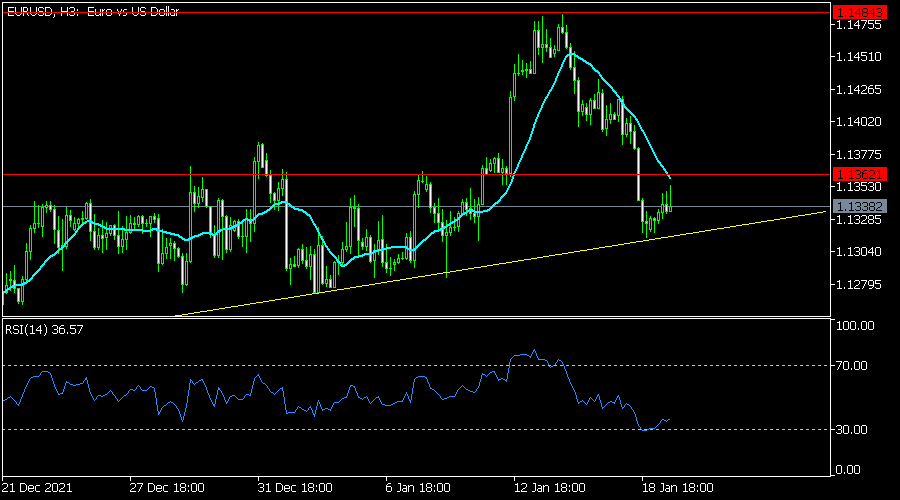
The EURUSD pair crawled back during the American and Asian sessions. The pair is trading at 1.1335, which is slightly above the ascending trendline shown in yellow. It has also moved slightly below the important resistance at 1.1362. The pair is slightly below the 25-day moving average. It has also formed a small bearish flag pattern. Therefore, there is a possibility that it will have a bearish breakout later today.
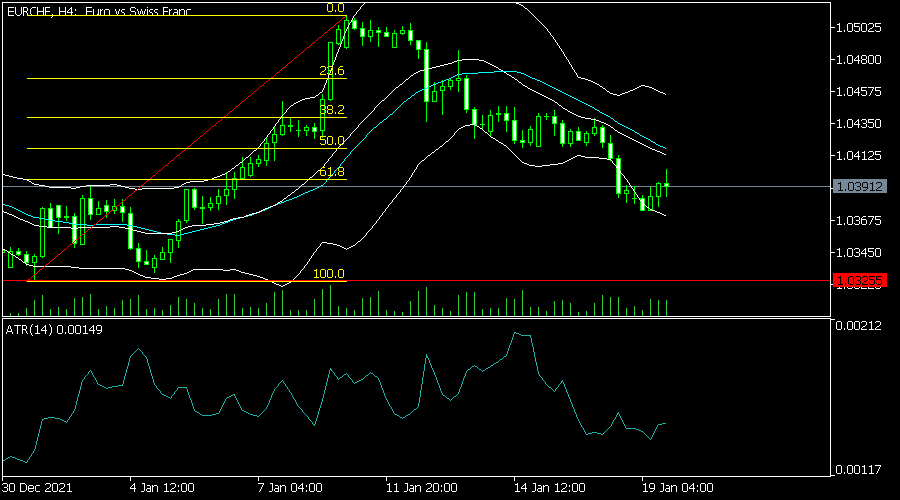
EURCHF
The EURCHF pair moved sideways in the overnight session. It is trading at 1.0395, which is a few points above yesterday’s low of 1.0373. On the four-hour chart, the pair has moved to the 61.8% Fibonacci retracement level. It is also between the lower and middle lines of the Bollinger Bands while the Average True Range (ATR) has been falling. Therefore, the pair will likely have a bearish breakout also.
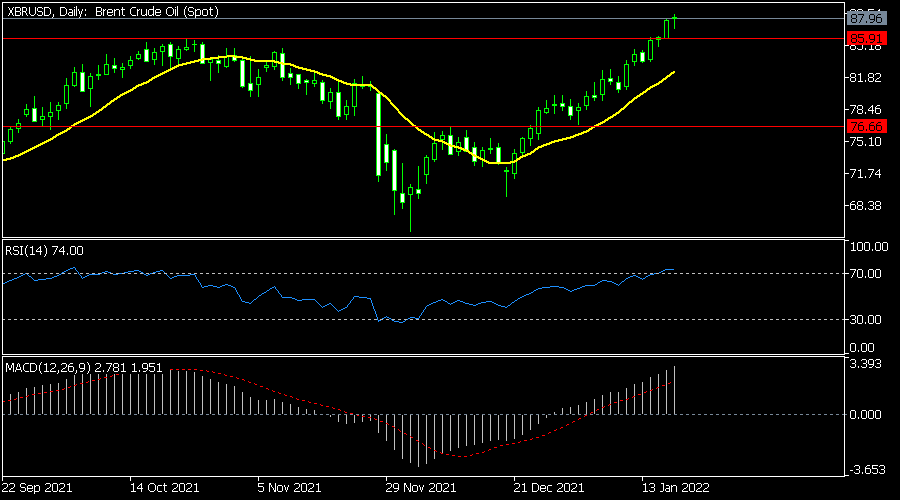
XBRUSD
The XBRUSD pair continued its bullish trend ahead of the upcoming EIA inventories numbers. The pair is trading at 87.95, which is the highest it has been in seven years. It has moved above the 25-day and 50-day moving averages. Most importantly, it has risen above the key resistance level at 85.90, which was the highest level in October. Therefore, the pair will likely keep rising as investors eye 90.
Will ECB Minutes be Trigger for German 10-y Yield to Sustainably Return in Positive Territory?
Markets
Yesterday morning it looked that EMU/German yields would catch up in the wake of the recent strong rise in US yields. The German 10-y yield moved temporarily into positive temporary for the first time since April 2019. However, the there was no immediate follow-through price action and/or high profile news to sustain further gains. The move petered out.
The strong uptrend in US yields also ran into resistance. At the end of the day, the US yield curve flattened. The 2y- yield still rose 1.5 bps, but longer maturities eased with the 30-y declining 1.2 bps. A 20-y US bond sale met decent interest, but a dip in yields at longer maturities was partially reversed later in the session.
The combination of geopolitical risk, persistent high oil prices (Brent testing $89 p/b) and a risk-off sentiment was a mixed bag for core bonds. President Biden also highlighted that inflation is becoming a political issue/priority ‘guiding’ the Fed to recalibrate its policy support.
US equities again underperformed with the Dow & S&P losing slightly less than 1.0%. The Nasdaq lost 1.15%. The index trades more than 10% off the all-time top (correction territory).
German bonds underperformed with the 2-y unchanged but the 30-y rising (1.4 bps).
The dollar met resistance after Tuesday’s sharp rebound. DXY corrected to the 95.50 area. EUR/USD closed slightly higher at 1.134. USD/JPY followed the broader dollar setback (114.3 from 114.6).
Sterling still wasn’t affected by persistent turmoil in the UK government as higher than expected December inflation cemented markets’ expectations for a February BoE rate hike. BoE’s Bailey in a hearing also warned on the risk for more persistent inflation. EUR/GBP touched a minor correction low intra-day, but closed little changed at 0.833.
This morning, risk sentiment in Asia turns for the better. Chinese markets are drawing comfort as banks reduce borrowing costs, passing through recent PBOC policy easing, with more expected to come. Asian equities are rebounding up to 2.9% (Hang Seng). The Nikkei gains 1.1%. PBOC policy easing still fails to weaken the yuan. At USD/CNY 6.3445, the Chinese currency is holding near strongest levels since May 2018.
Later today, US jobless claims and the Philly Fed Business outlook deserve attention. The Central bank of Turkey and the Norges Bank are both expected to keep rates on hold, at least for now.
Early afternoon, the ECB will publish the accounts of the December policy meeting. As was the case for the Minutes of the December Fed meeting, the report might provide some insight how the debate on policy normalization develops intra-ECB. Interesting will be to see to what extent less hawkish governors are prepared to envisage faster ‘normalization’ as inflation stays higher for longer and as the topic becomes a political issue. Any hints that the ECB might shift to a ‘plan B’ might support a further rise in German /EMU yields.
Will the minutes be the trigger for the German 10-y yield to sustainably return in positive territory? In theory, it could also facilitate a euro bottoming, as does a better risk sentiment. EUR/USD short term support comes in at 1.1315 and 1.1272. For EUR/GBP, 0.8282/77 remain key support on the charts.
News Headlines
Australian employment grew 64.8k in the final month of 2021, a little more than the 60k expected and follows a 366.1k surge in November. Hours worked rose 1% m/m , with some states including New South Wales and Victoria boosting the figure as they came out of lockdowns. The unemployment rate dropped from 4.6% to 4.2%, the lowest since 2008. The participation rate stabilized at 66.1%. The Australian labour market is normalizing again after pandemic-related measures were eased in September and October. The spread of omicron however poses risks to that process. The Australian dollar marginally gains from AUD/USD 0.7211 to 0.7225 currently.
The European Commission plans an extension to regulatory “equivalence” with the UK for another three years. This allows European banks and fund managers to use UK clearing houses until June 2025. The current post-Brexit extension period was set to end in June. However, without a solid European alternative in place to pull clearing of all euro-denominated derivates (some €83tn), a major threat to financial stability was looming. Brussels in coming weeks will begin consultations on ways of making the EU a more attractive clearing destination in order to “reduce in the medium term our over-reliance” on the UK, European commissioner for financial services McGuinness said.