

Sample Category Title
Upward Pressure on Yields Ease – For now
Market movers today
The ECB releases minutes from the latest meeting where focus will be on the governing council's deliberations on the policy announcements and the inflation outlook.
Little news expected from the Norges Bank interim policy meeting. See the Nordic and FX sections below.
The US releases the Philadelphia Fed business survey. New York released the Empire index on Tuesday, which dropped sharply, so it will be interesting to see if the Philadelphia survey mirrors that or not.
Turkey's central bank is due today, with market consensus expecting unchanged rates. With the rate cut last month and inflation running above 30%, even President Erdogan probably do not want to push for lower rates and even bigger underlying pressure on the Turkish Lira. No doubts Turkish markets will go havoc if the central bank makes a surprise cut.
The 60 second overview
Yields: US yields have eased slightly to 1.85% this morning after 10Y US treasury yield touched 1.90% yesterday mid-day and 10Y Bund yields traded in positive for the first time since 2019. The market has now priced in roughly four rate hikes this year of 25bp each, which is in line with our expectations, though we still see the market underestimating the amount of tightening that will be needed next year. Together with higher real rates and a higher term-premium we still see 10Y UST moving higher and we have a 2.25% target for this year. For more see Yield Outlook: Market rates and yields set to continue rising that we published yesterday.
China: As expected, the one-year and five-year loan prime rates were cut overnight by 10bp to 3.70% and 4.6%, respectively. The move mirrors the 10bp policy-cut earlier in the week. The rate cut together with the global easing in yields and stories that Chinese regulators are considering measures to support struggling developers have supported Asian equity sentiment this morning.
Russia-Ukraine crisis: Biden said overnight that Putin does not want a full-blown war. He also said that Russia will be held accountable if he moves in. However, importantly he said that he does expect Putin to 'move in' and he said that a 'minor incursion' might yield a lighter retaliation. The White House later tried to clarify and said that a renewed invasion would be met with a swift, severe and united response. However, Biden did face strong political critique after his comments being accused of basically giving Putin a green light.
Natural gas prices: So far this year - after last year's spike - gas prices in the EU have reacted with calm to the tensions between Russia and Ukraine. The Dutch benchmark TFF natural gas future fell by 9 % yesterday and prices are now back to levels seen in September last year though prices are still three to four times the level a year ago. Currently, a lot of LNG ships are arriving in the EU and also Norwegian supplies are picking up. The Biden comments could ease prices further today as the risk of US led sanctions cutting of gas to Europe now looks smaller. For more about the financial impact including natural gas prices of the Russian-Ukraine crisis see our Research Russia paper that we published January 14.
Oil: Oil prices continue to rally along with the rest of the commodities space including grains that can be used for biofuels. Brent touched USD 89 per barrel last night, which is the highest level since 2014 and there is no clear signs that momentum will stop in the short-term and several analysts now argue that triple digit prices are returning. In our view, it is a sign of stronger demand as the world gets ready to move beyond the pandemic. There is also growing concern that low oil investments due to the pandemic and the green transition will keep supply restrained. That said, we do in the medium-term expect a normalisation down to around USD75/bbl, once tighter monetary conditions and a stronger USD start to take a toll on demand.
Equities: Equities were a mixed bag yesterday with European markets mostly higher while US dragging the world down and Japan showing huge drop. Part of this regional difference driven by big dispersion within sectors, tech and consumer discretionary sharply lower while defensive consumer staples and utilities higher together with late cycle energy and materials. In the US, Dow -1.0%, S&P 500 -1.0%, Nasdaq -1.2% and Russell 2000 -1.60%. Sentiment much more positive this morning with Asian markets higher, Hang Seng showing strong gains for a change. Futures in Europe and US also higher.
FI: Yields across the EUR curves saw only marginal changes and mainly with 0-1.5bp higher yields. 10Y German government yields rose during the above 0% for the first time since spring 2019, but ended the day just in negative territory. US yields are taking a drop after the long and large rise in yields since mid-December last year.
FX: Yesterday's session was characterised by a part reversal of Tuesday's price action as the USD rally faded and inflation/commodity sensitive currencies gained.
Credit: With a slight retraction in rates and also a modest improvement around the sentiment surrounding the Russia - NATO stand-off, credit had a decent day yesterday. Itraxx Main was tighter by 0.2bp to 53.5bp while Xover tightened 1.9 to 262.2bp.
Nordic macro
We think it is too soon after the December rate-setting meeting for Norges Bank to put out any new signals at today's "interim" meeting (no press conference or monetary policy report, only a press release). The bank raised its policy rate to 0.50% in December, saying that it will most likely go up again in March. Information since would support that: omicron seems to be milder than feared, unemployment has gone up less than expected, inflation has surprised to the upside, and global interest rates have risen. We therefore expect the bank to repeat its signal of a March hike.
AUD/USD Daily Report
Daily Pivots: (S1) 0.7180; (P) 0.7209; (R1) 0.7241; More...
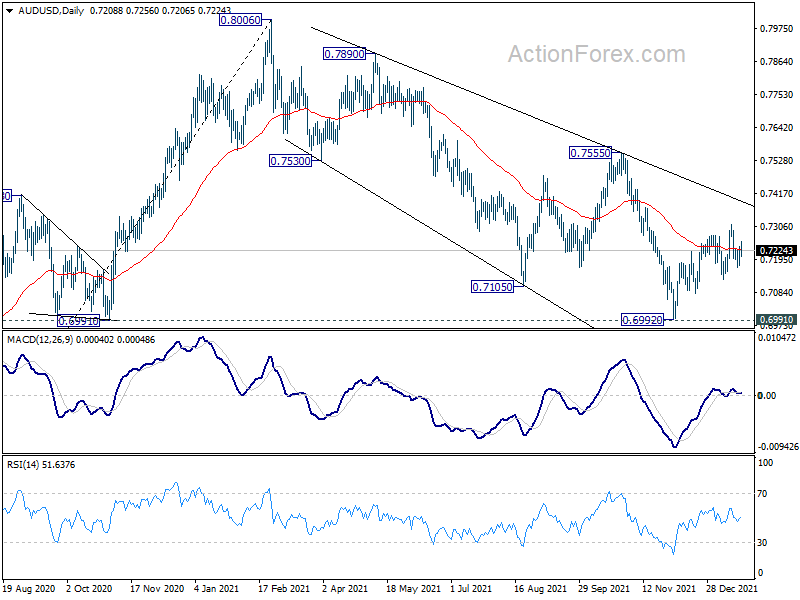
AUD/USD recovers ahead of near term channel support, but stays well below 0.7313 resistance. Intraday bias remains neutral first. We're still slightly favoring the case that correction from 0.8006 is complete after defending 0.6991. Above 0.7313 will extend the rise from 0.6992 to 0.7555 resistance. However, break of 0.7128 support will dampen this bullish case and bring retest of 0.6991/2 instead.
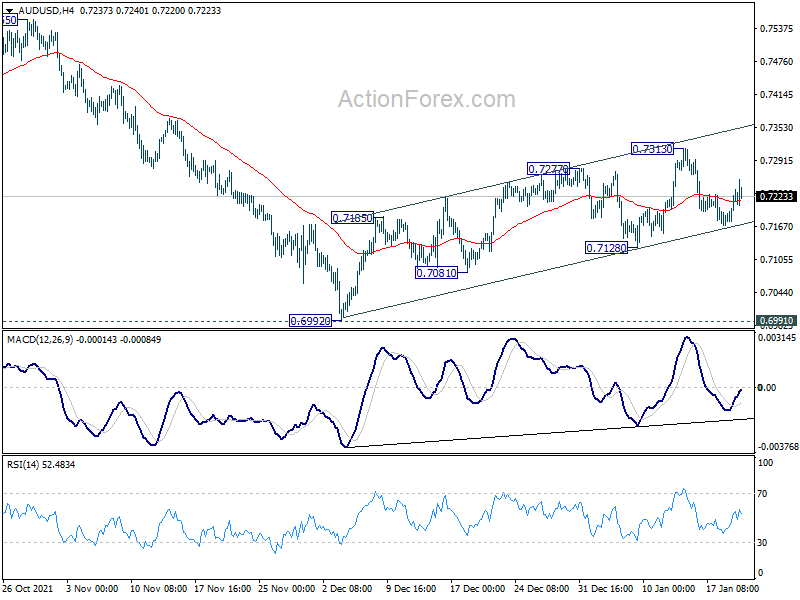
In the bigger picture, strong rebound from 0.6991 key structural support will retain medium term bullishness. That is, whole up trend from 0.5506 is still in progress. Firm break of 0.7555 resistance will target 0.8006 high and above. However, sustained break of 0.6991 will argue that the whole up trend from 0.5506 might be finished at 0.8006, after rejection by 0.8135 long term resistance. Deeper decline would then be seen back to 61.8% retracement of 0.5506 to 0.8006 at 0.6461.
Aussie Jumps on Strong Job Data, Euro Staying Weak
Australian Dollar rises broadly in Asian session today following much stronger than expected job data. Expectation for RBA tightening is increasing with calls for a hike as soon as in August. Canadian Dollar is also firm together with bullish strength in oil prices. As China's rate cut is lifting sentiment, Yen and Dollar are turning softer. Euro is also weak in particular against other European majors.
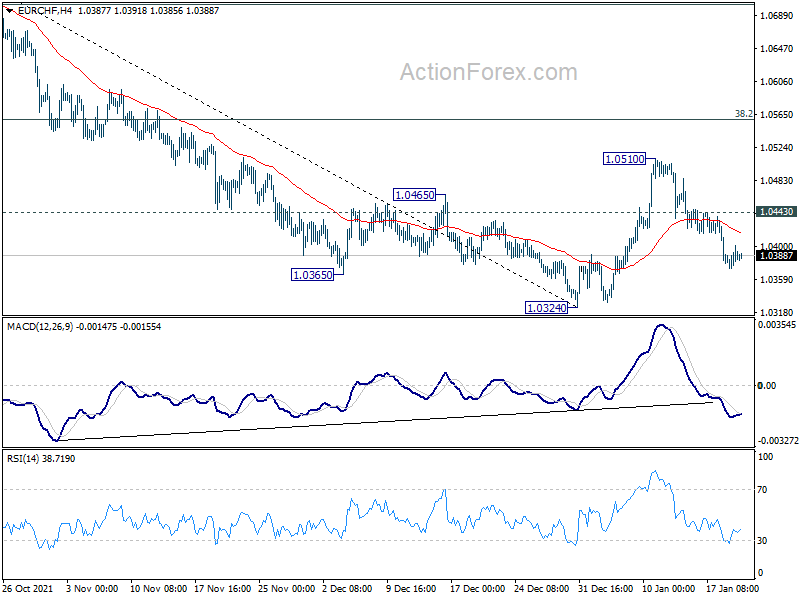
Technically, while Euro is one of the worst performers for the week, sellers are not too committed yet. EUR/GBP is leading the way down by breaking 0.8322 temporary low. We'll now first see when EUR/CHF would break through 1.0324 low to resume medium term down trend. Also, break of 1.1284 support in EUR/USD would very likely resume the medium term down trend through 1.1185 low too. These two developments, if happen together, would be rather bearish for Euro.
In Asia, at the time of writing, Nikkei is trading up 1.48%. Hong Kong HSI is up 2.57%. China Shanghai SSE is up 0.25%. Singapore Strait Times is up 0.26%. Japan 10-year JGB yield is up 0.0036 at 0.140. Overnight, DOW dropped -0.96%. S&P 500 dropped -0.97%. NASDAQ dropped -1.15%. 10-year yield dropped -0.038 to 1.827.
Australia unemployment rate dropped to 4.2%, lowest since 2008
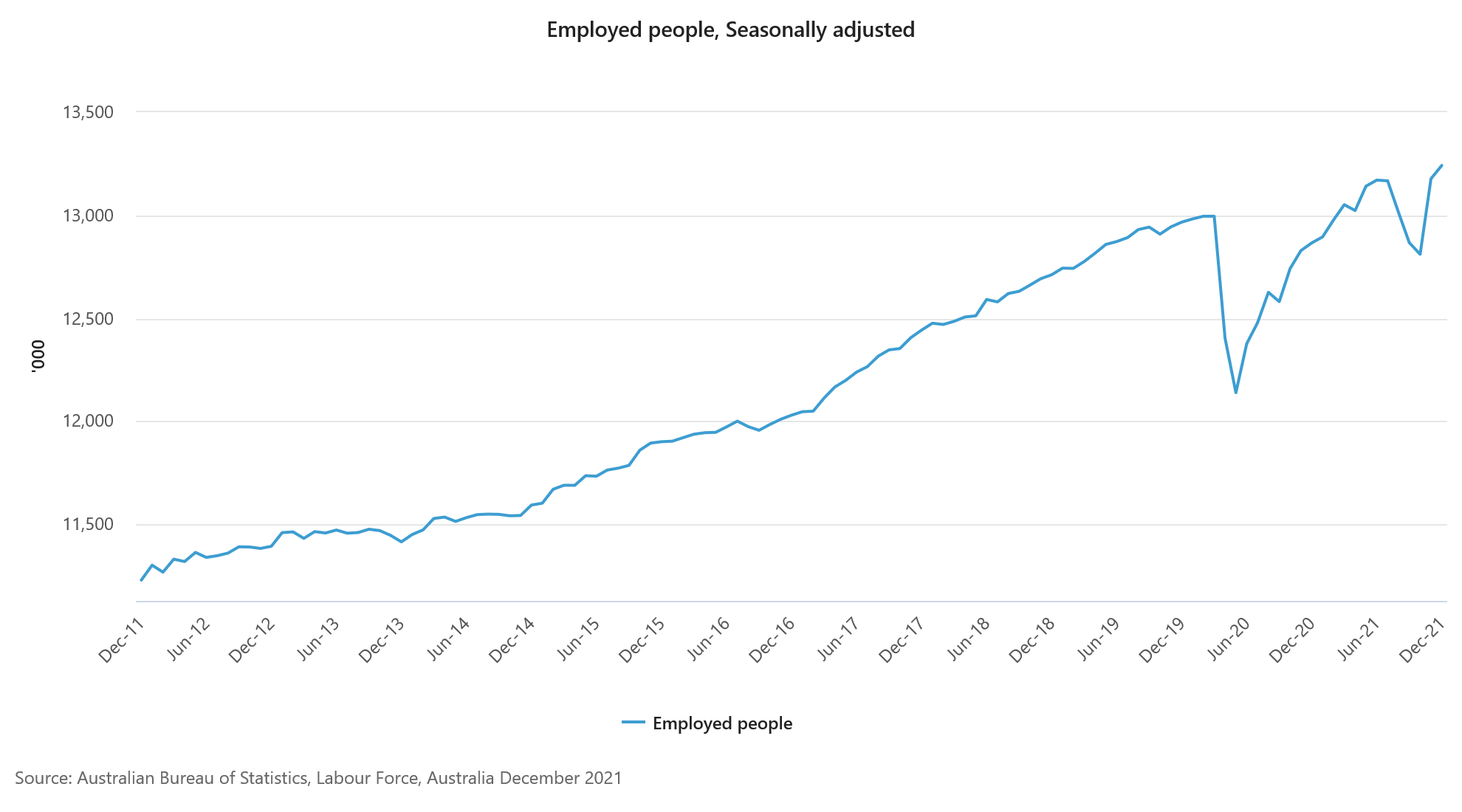
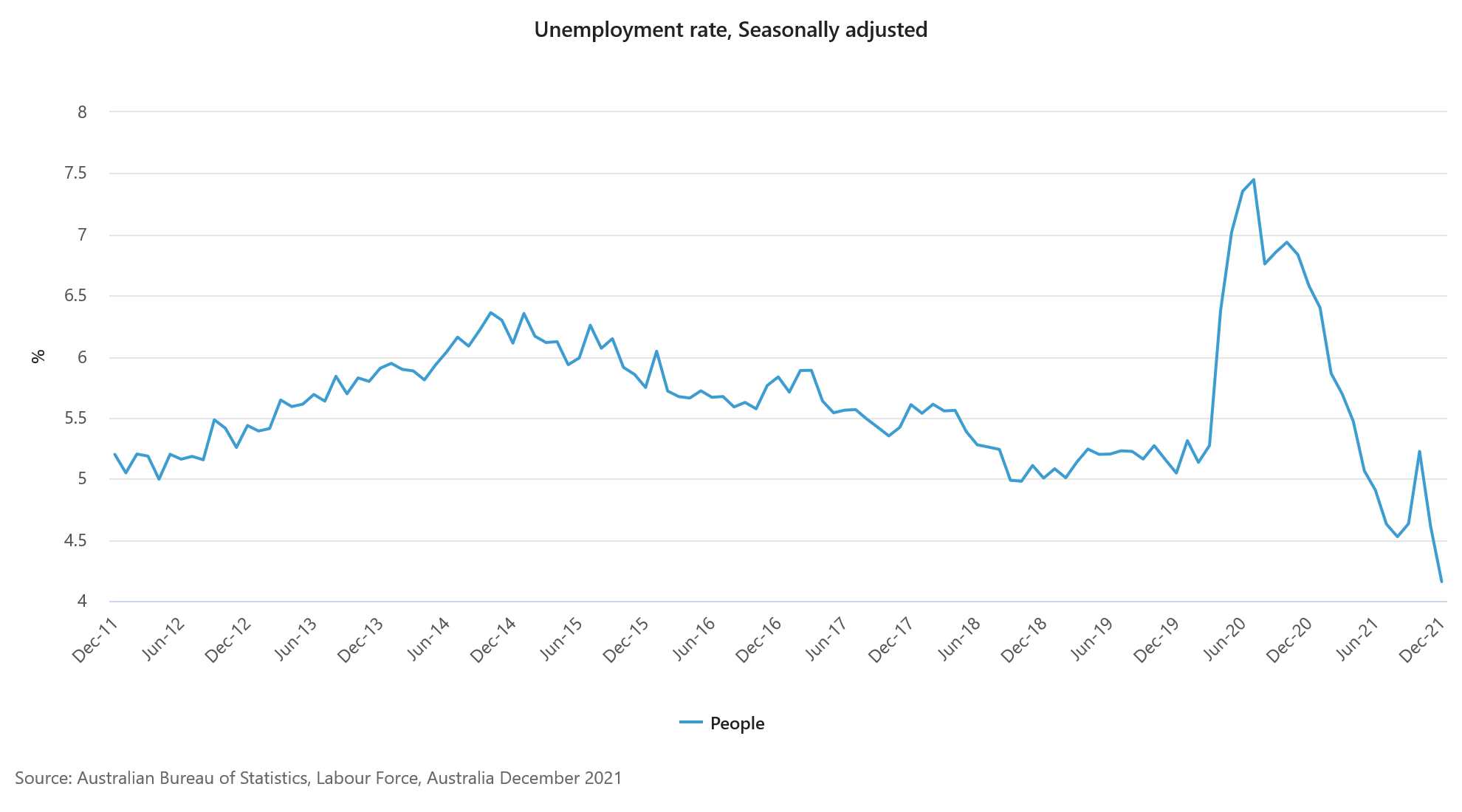
Australia employment grew 64.8k in December to 13.242m, well above expectation of 30.0k. Full time jobs rose 41.5k while part-time jobs rose 23.3k. Unemployment rate dropped from 4.6% to 4.2%, better than expectation of 4.5%. That's also the lowest rate since August 2008. Participation rate was unchanged at 66.1%. Hours worked rose 1.0% or 18.2m hours.
Bjorn Jarvis, head of labour statistics at the ABS, said: "The latest data shows further recovery in employment following the large 366,000 increase in November. This provides an indication of the state of the labour market in the first two weeks of December, before the large increase in COVID cases later in the month."
"This is the lowest unemployment rate since August 2008, just before the start of the Global Financial Crisis and Lehman Brothers collapse, when it was 4.0 per cent. This is also close to the lowest unemployment rate in the monthly series – February 2008 – and for a rate below 4.0 we need to look back to the 1970's when the survey was quarterly," Javis added.
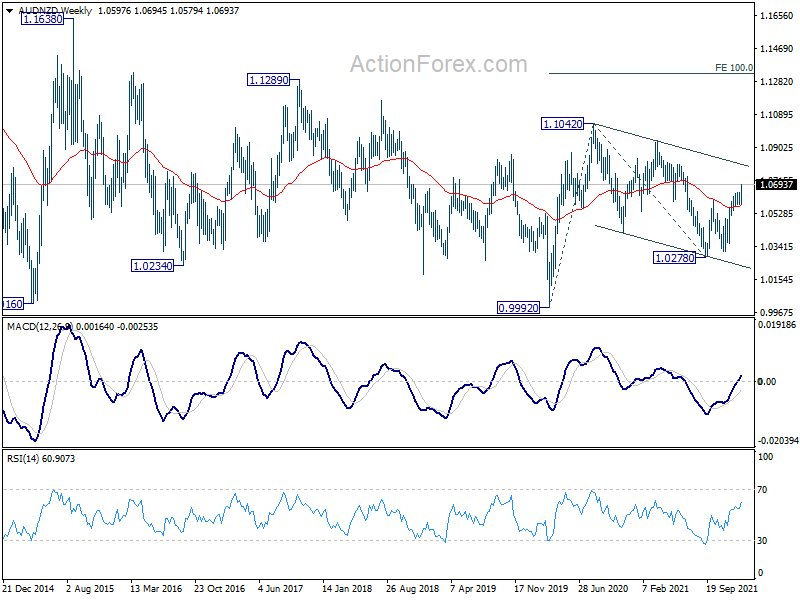
AUD/NZD soars, setting up long term up trend?
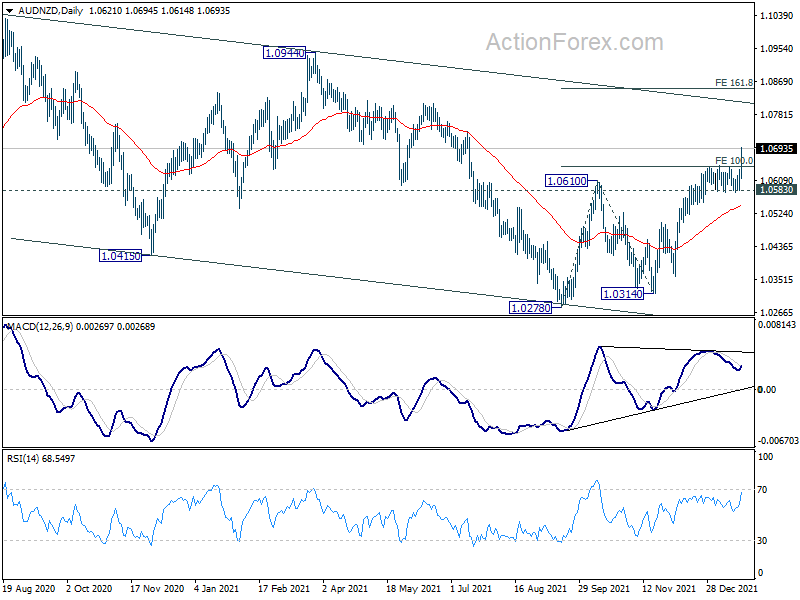
AUD/NZD soars in response to much better than expected Australia job data, and heightened expectation of RBA rate hike this year. The strong break of 100% projection of 1.0278 to 1.0610 from 1.0314 at 1.0646 is seen as a sign of upside acceleration. Further rally is now expected as long as 1.0583 support holds. Next target is 161.8% projection at 1.0851.
The bigger question now is whether the medium term fall from 1.1042 has completed as a corrective pattern, with three waves down to 1.0278. Break above above mentioned 1.0851 resistance will add credence to this bullish case. That would also argue that rise from 1.2078 is developing into a long term up trend, resuming the move from 2019 low at 0.9992 through 1.1042.
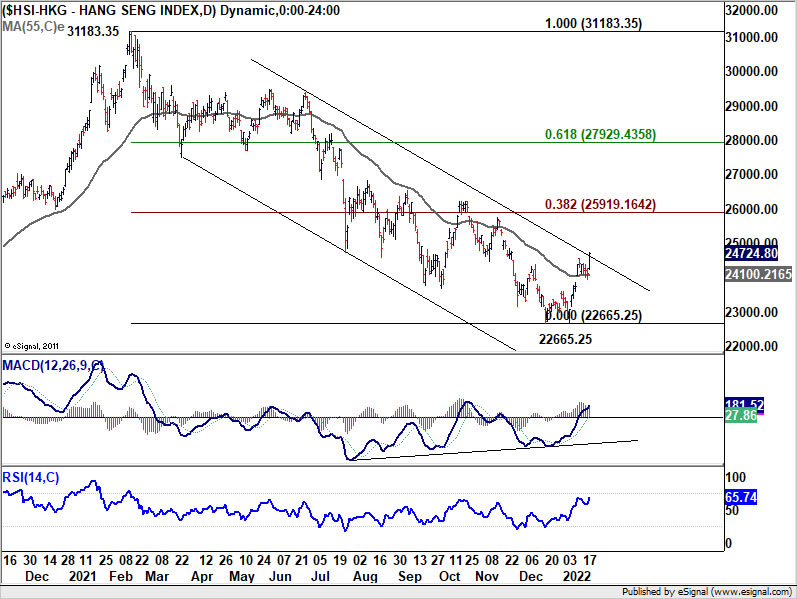
HK HSI jumps after PBoC rate cut, heading back to 26k
China's PBoC cut the one year loan prime rate by 10 bps to 3.70%. The second rate cut since April 2020 following December's. Five-year loan prime rate was lowered by 5bps to 4.60%, first cut since April 2020. Along with the rate cuts, PBoC also injected more liquidity to the markets by offering CNY 700B of one-year loans, exceeding the CNY 500B maturing.
Hong Kong HSI responds positively to the news and it's trading up 2.5% at the time of writing. Resumption of the rise from 22655.25 after notably support from 55 day EMA is a bullish sign, along with bullish convergence condition in daily MACD. Current rise should at least be correcting the down trend from 31183.35, with prospect of even reversing it. Further rally is now in favor back to 38.2% retracement of 31183.35 to 22665.25 at 25919.16, which is close to 26k handle.
Japan export rose 17.5% yoy in Dec, imports rose 41.1% yoy
Japan's export rose 17.5% yoy to record JPY 7881B in December, slowing from November's 20.5% yoy, but beat expectation of 15.9% yoy. Exports to China grew 10.8% yoy while shipments to US rose 22.1% yoy.
Imports rose 41.1% yoy to record JPY 8463B, the second month with rate above 40% following November's 43.8% yoy, but missed expectation of 42.8% yoy. Trade deficit came in at JPY -582B.
In seasonally adjusted term, exports dropped -0.2% mom to JPY 7363B while imports dropped -0.7% mom to JPY 7799B. Trade deficit narrowed to JPY -435B.
Looking ahead
Germany PPI and Eurozone CPI final will be released in European session. ECB will publish monetary meeting accounts. Later in the day, US will release jobless claims, Philly Fed survey and existing home sales.
AUD/USD Daily Report
Daily Pivots: (S1) 0.7180; (P) 0.7209; (R1) 0.7241; More...
AUD/USD recovers ahead of near term channel support, but stays well below 0.7313 resistance. Intraday bias remains neutral first. We're still slightly favoring the case that correction from 0.8006 is complete after defending 0.6991. Above 0.7313 will extend the rise from 0.6992 to 0.7555 resistance. However, break of 0.7128 support will dampen this bullish case and bring retest of 0.6991/2 instead.
In the bigger picture, strong rebound from 0.6991 key structural support will retain medium term bullishness. That is, whole up trend from 0.5506 is still in progress. Firm break of 0.7555 resistance will target 0.8006 high and above. However, sustained break of 0.6991 will argue that the whole up trend from 0.5506 might be finished at 0.8006, after rejection by 0.8135 long term resistance. Deeper decline would then be seen back to 61.8% retracement of 0.5506 to 0.8006 at 0.6461.
Economic Indicators Update
| GMT | Ccy | Events | Actual | Forecast | Previous | Revised |
|---|---|---|---|---|---|---|
| 23:50 | JPY | Trade Balance (JPY) Dec | -0.44T | -0.73T | -0.49T | -0.47T |
| 00:00 | AUD | Consumer Inflation Expectations Jan | 4.40% | 4.80% | ||
| 00:01 | GBP | RICS Housing Price Balance Dec | 69% | 69% | 71% | |
| 00:30 | AUD | Employment Change Dec | 64.8K | 30.0K | 366.1K | |
| 00:30 | AUD | Unemployment Rate Dec | 4.20% | 4.50% | 4.60% | |
| 07:00 | EUR | Germany PPI M/M Dec | 0.90% | 0.80% | ||
| 07:00 | EUR | Germany PPI Y/Y Dec | 19.40% | 19.20% | ||
| 10:00 | EUR | Eurozone CPI Y/Y Dec F | 5.00% | 5.00% | ||
| 10:00 | EUR | Eurozone CPI Core Y/Y Dec F | 2.60% | 2.60% | ||
| 12:30 | EUR | ECB Monetary Policy Meeting Accounts | ||||
| 13:30 | USD | Initial Jobless Claims (Jan 14) | 215K | 230K | ||
| 13:30 | USD | Philadelphia Fed Manufacturing Jan | 19.9 | 15.4 | ||
| 15:00 | USD | Existing Home Sales Dec | 6.49M | 6.46M | ||
| 15:30 | USD | Natural Gas Storage | -190B | -179B | ||
| 16:00 | USD | Crude Oil Inventories | -2.1M | -4.6M |
Technical Outlook and Review
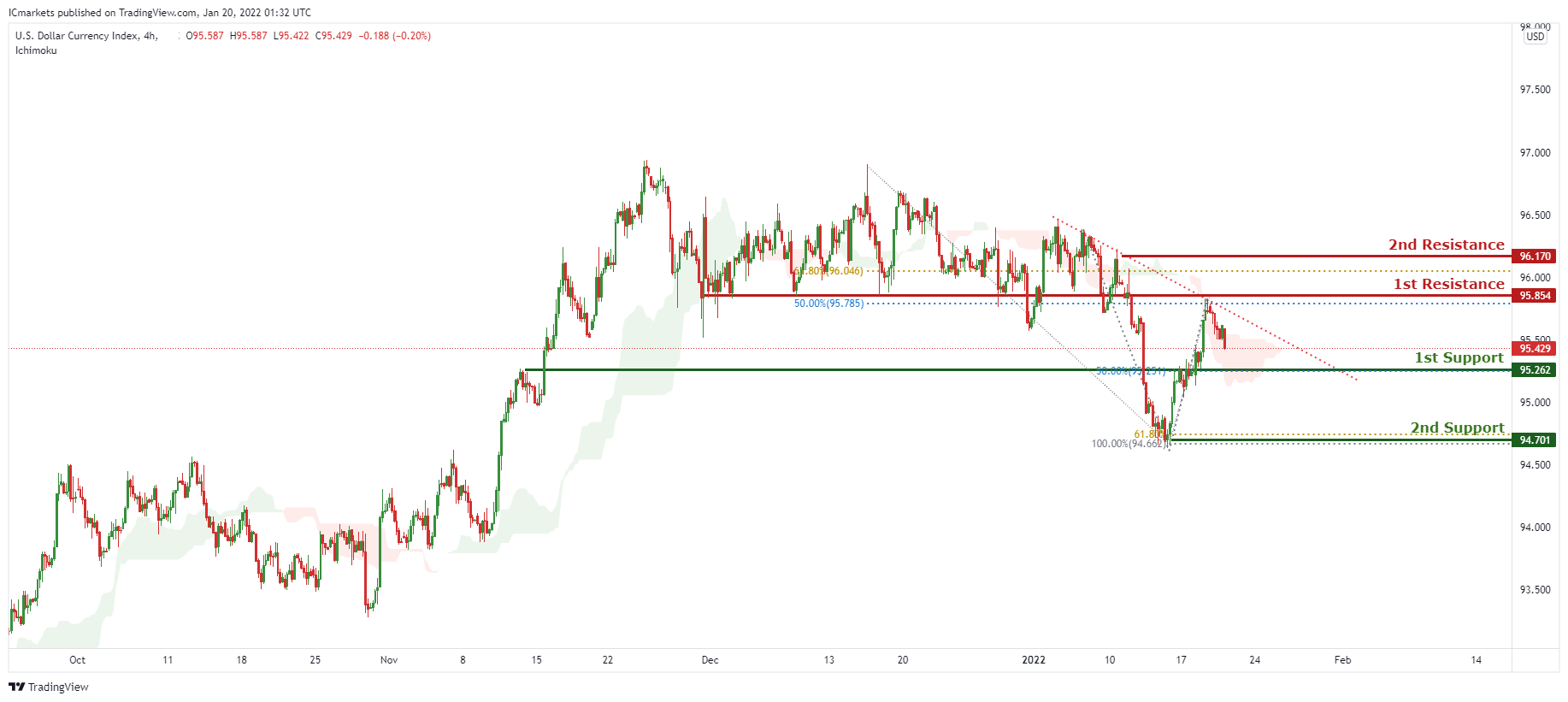
DXY:
On the H4 timeframe, prices are abiding to a bearish trendline and are on bearish momentum. We further bearish momentum from our 1st resistance at 95.854 in line with 50% Fibonacci retracement towards our 1st support at 95.262 in line 50% Fibonacci retracement towards our 2nd support at 94.701 in line with 61.8% Fibonacci extension and 100% Fibonacci retracement. Prices are passing through our red ichimoku cloud support, further supporting our bearish bias.
Areas of consideration:
- H4 time frame, 1st resistance at 95.895
- H4 time frame, 1st support at 95.262
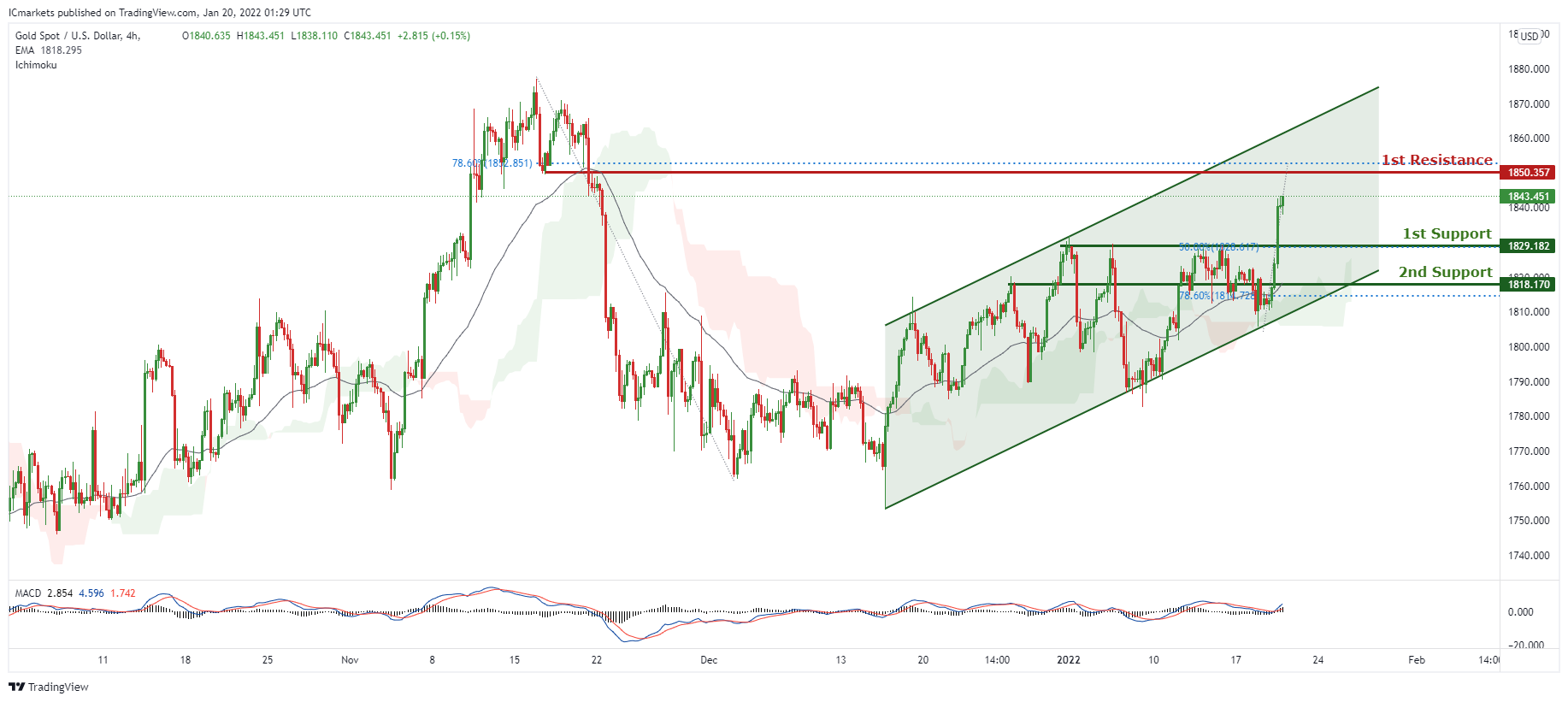
XAU/USD (GOLD):
On the H4, prices are consolidating in a parallel ascending channel and bullish momentum. We see the potential for further bullish momentum from our 1st support at 1829.182 in line with 50% Fibonacci retracement towards our 1st resistance at 1850.357 in line with 78.6% Fibonacci retracement. Prices are trading above ichimoku clouds, our MA and RSI are at levels where bounces occurred previously, further supporting our bullish bias.
Areas of consideration:
- 4h 1st support at 1829.182
- 4h 1st resistance at 1818.170
GBP/USD
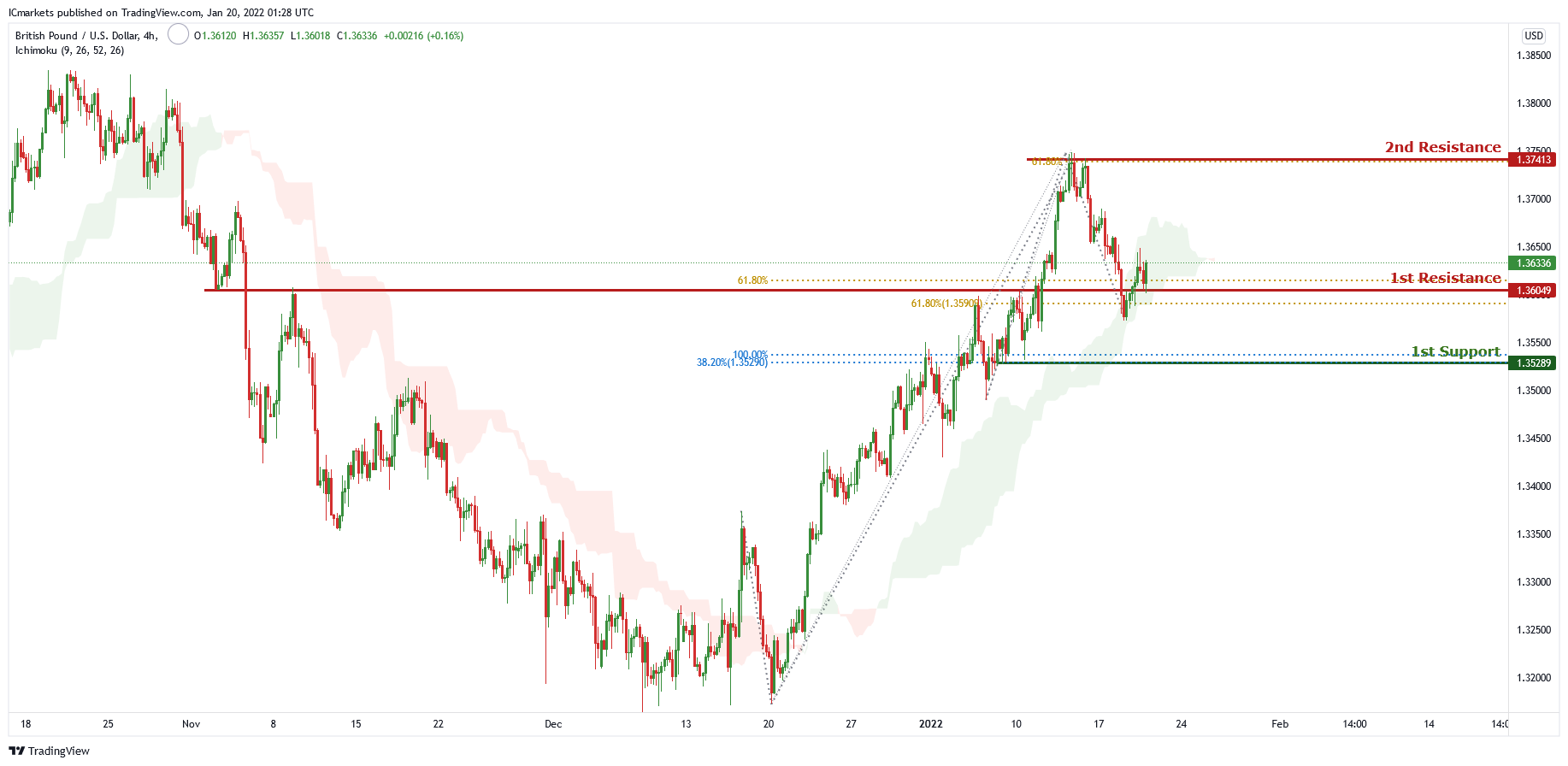
On the H4 chart, price is near 1st resistance level of 1.36049 which is also 61.8% Fibonacci retracement and 61.8% Fibonacci projection. Price can potentially go to the 2nd resistance level of 1.37413 which is also 61.8% Fibonacci projection and graphical swing high level. Our bullish bias is supported by the ichimoku cloud indicator as price is trading above it.
Areas of consideration
- 1st resistance at 1.36049
- 1st support at 1.35289
USD/CHF:
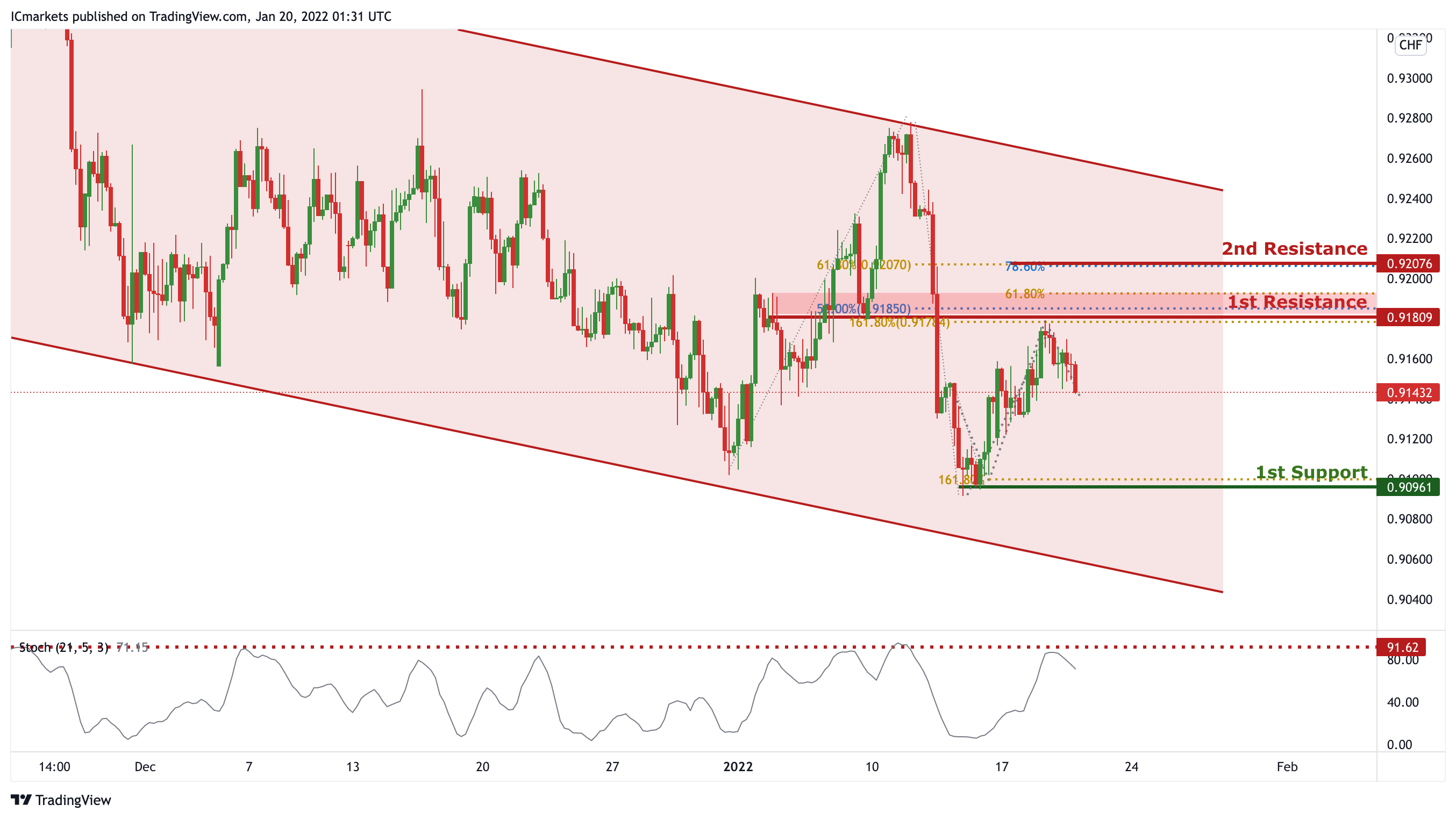
On the H4 timeframe, price is abiding to a descending channel, signifying a bearish momentum. Price dropped from the 1st Resistance in line with 50% Fibonacci retracement, 161.8% Fibonacci extension and graphical overlap resistance. We can expect the price to drop to 1st Support in line with the previous swing low and 161.8% Fibonacci projection. Our bearish bias is further supported by the stochastic indicator where the %K Line dropped from the resistance level.
Areas of consideration:
- Watch 1st Support at 0.90961
- Watch 1st Resistance at 0.91809
EUR/USD :
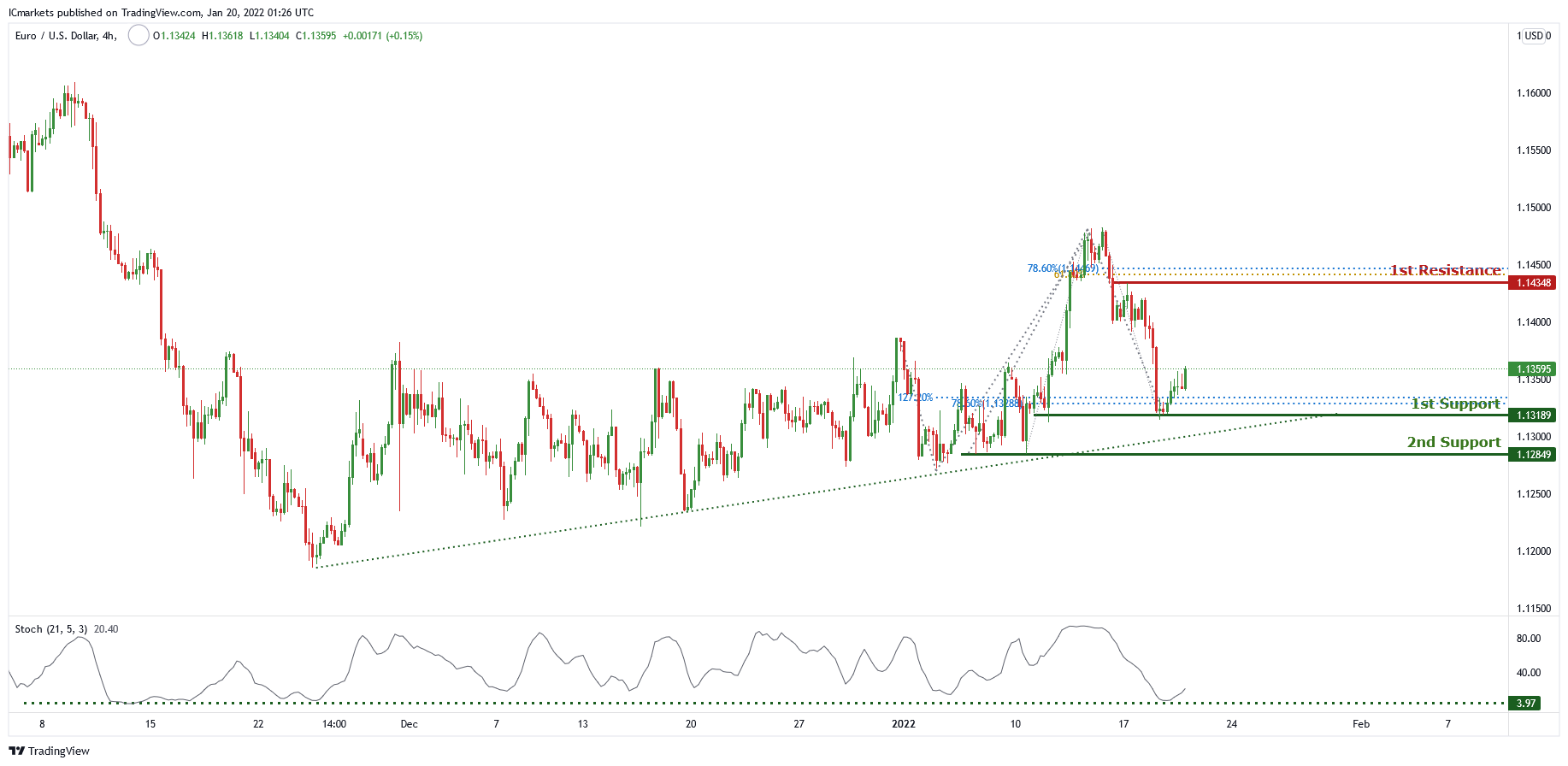
On the H4 chart , price is abiding by an ascending trendline and is near 1st support level of 1.13189 which is also 78.6% Fibonacci retracement and 127.2% Fibonacci projection. Price can potentially go to the 1st resistance level of 1.14348 which is also 61.8% Fibonacci retracement and 78.6% Fibonacci projection. Our bullish bias is supported by the stochastic indicator as it is at support level
Areas of consideration:
- H4 1st resistance at 1.14348
- H4 1st support at 1.13189
USD/JPY:
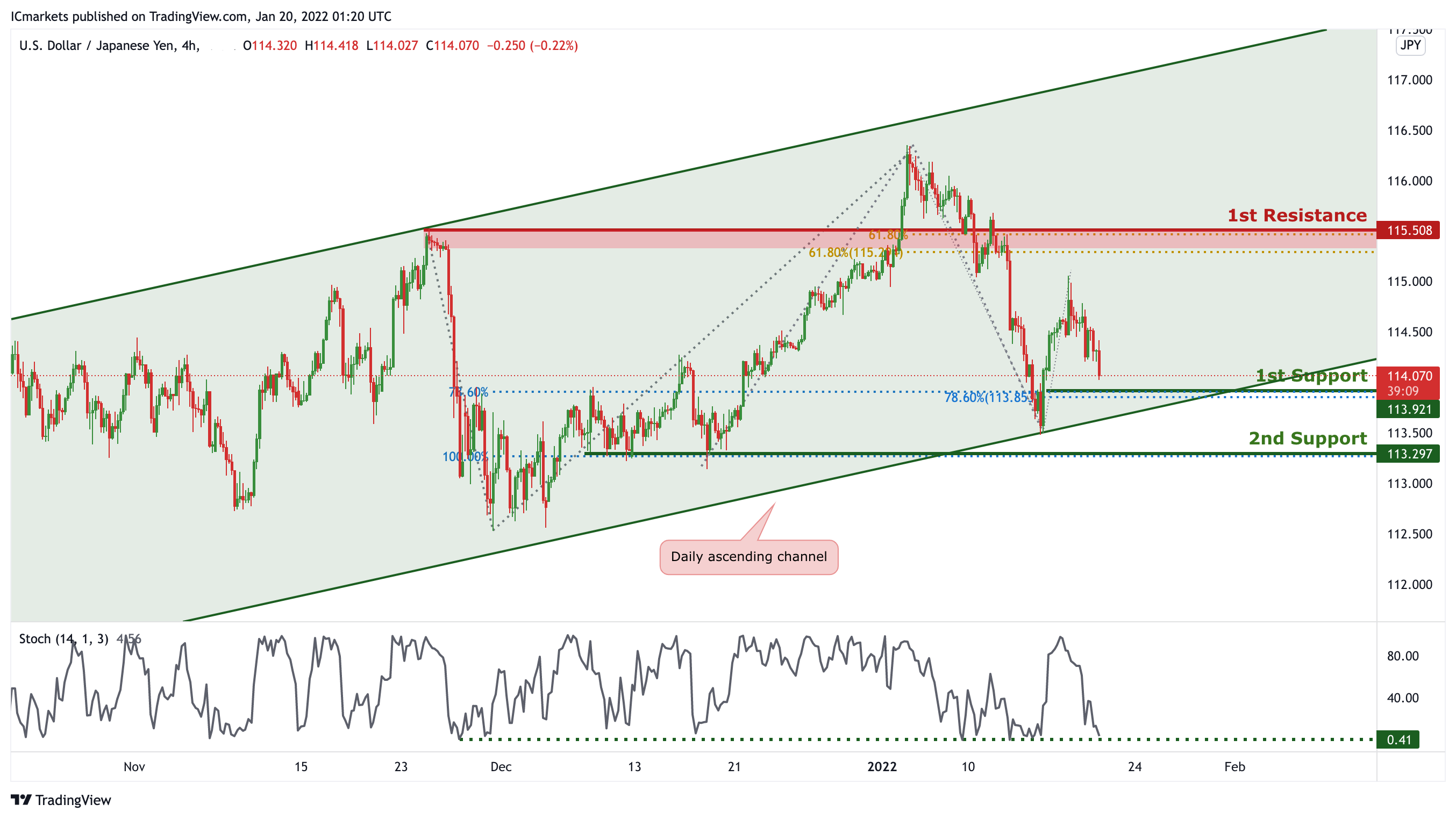
On the H4 timeframe, is abiding to the ascending channel on the daily, signifying an overall bullish momentum. We can now expect price to bounce from 1st Support in line with 78.6% Fibonacci retracement and 78.6% Fibonacci projection towards 1st Resistance in line with 61.8% Fibonacci projection and 61.8% Fibonacci retracement. Our bullish bias is further supported by the stochastic indicator where the %K line is at the support level.
Areas of consideration:
- H4 1st resistance level 115.508
- H4 1st support level 113.921
AUD/USD:
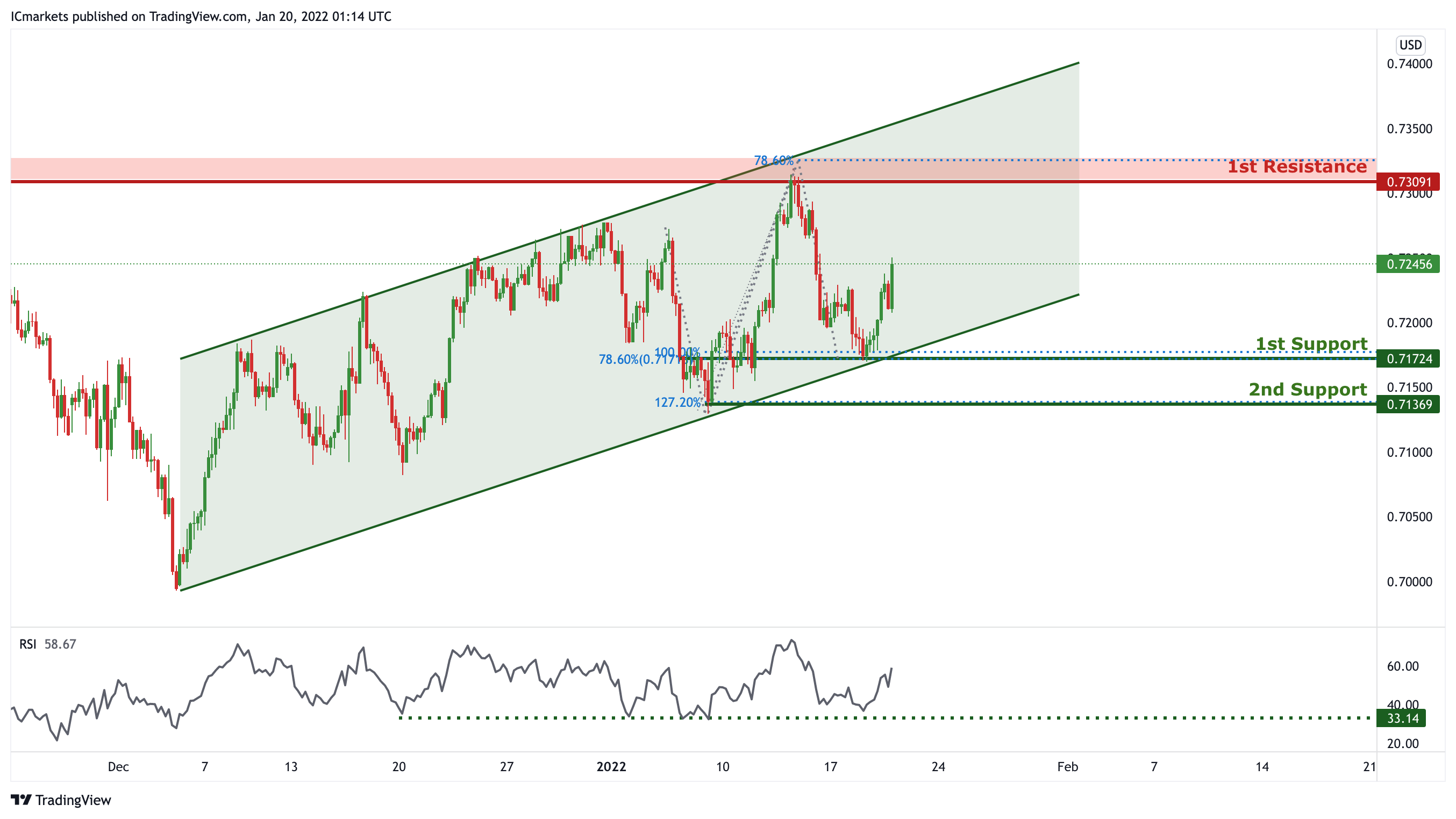
In reference to this week’s analysis, price indeed bounced nicely at 1st Support.. On the H4, price is reacting within the ascending channel, signifying an overall bullish momentum. Price is approaching the 1st Support, we can expect to see price make a bullish bounce from 1st Support in line with 100% Fibonacci projection, 78.6% Fibonacci retracement and ascending channel support towards 1st Resistance in line with previous swing high and 78.6% Fibonacci projection. Our short-term bearish bias is further supported by the RSI indicator where it is approaching the support level. Traders should wait for prices to swing higher or lower before entering.
Areas of consideration:
- H4 1st Support level 0.71724
- H4 1st resistance level 0.73091
NZD/USD:
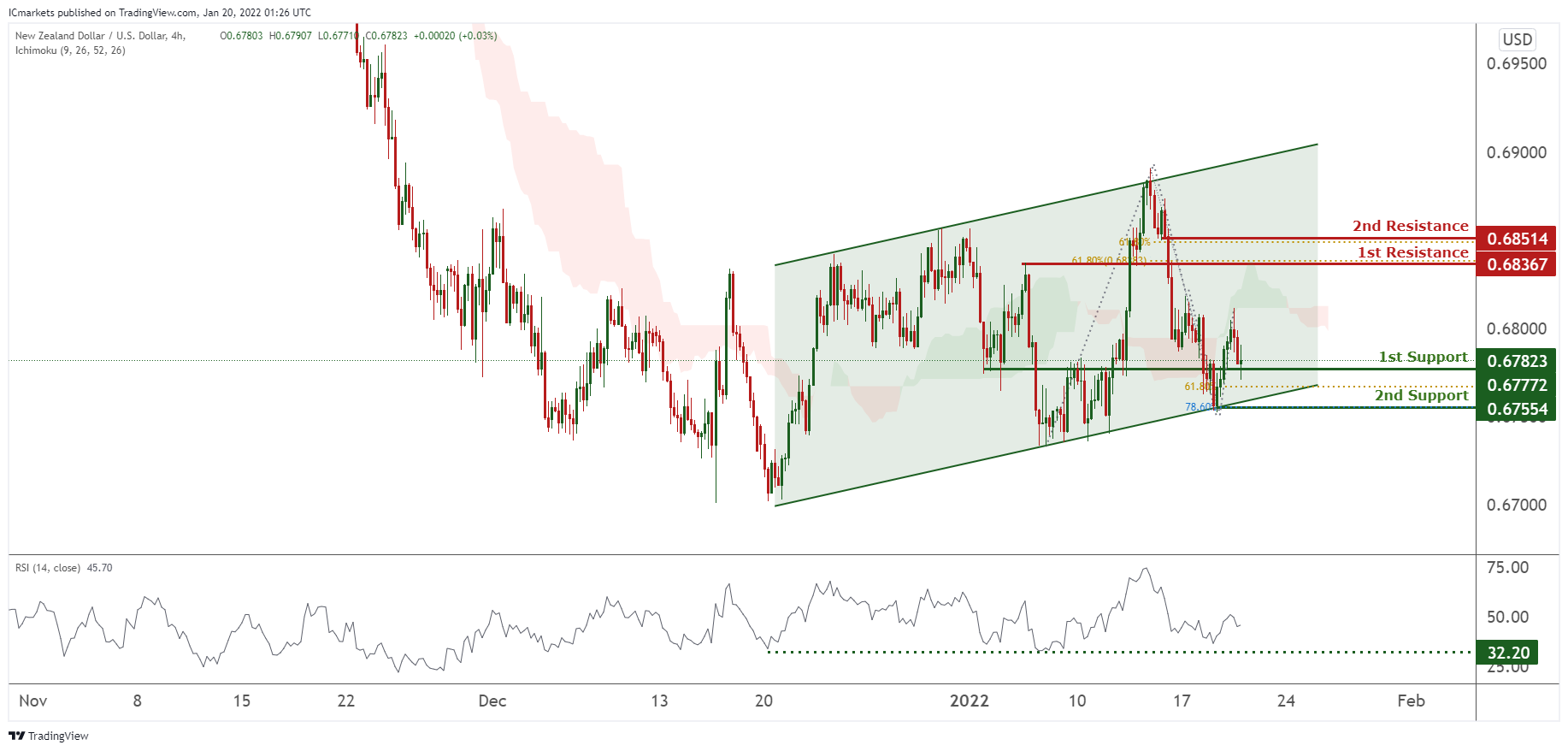
On the H4, prices are consolidating in an ascending channel and are on bullish momentum. We see the potential for further bullish continuation from our 1st support at 0.67823 towards our 1st resistance at 0.68367 in line with 61.8% Fibonacci extension. RSI is at levels where bounces occurred previously, further supporting our bullish bias.
Areas of consideration:
- H4 time frame, 1st resistance at 0.68367
- H4 time frame, 1st support at 0.67823
USD/CAD:
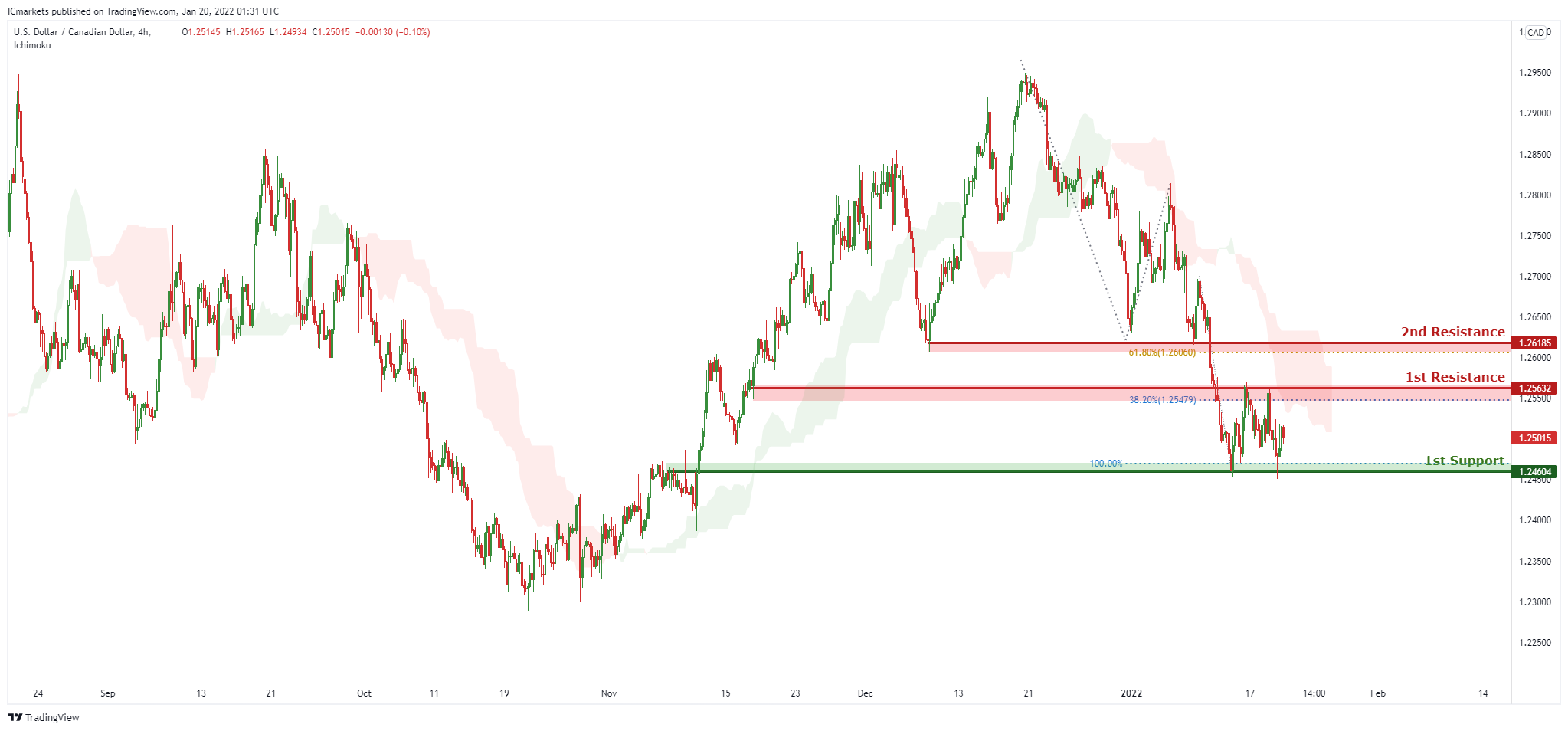
On the H4, with price moving below the ichimoku cloud, we have a bearish bias that price will from from our 1st resistance at 1.25632 which is in line with horizontal overlap resistance and 38.2% Fibonacci retracement to 1st support at 1.24604, which is in line with horizontal overlap support and 100% Fibonacci projection level. Alternatively, price may break 1st resistance structure and head for 2nd resistance at 1.26185, which coincides with horizontal overlap resistance and 61.8% Fibonacci retracement.
Areas of consideration:
- H4 time frame, 1st support at 1.24604
- H4 time frame, 1st resistance at 1.25479
OIL:
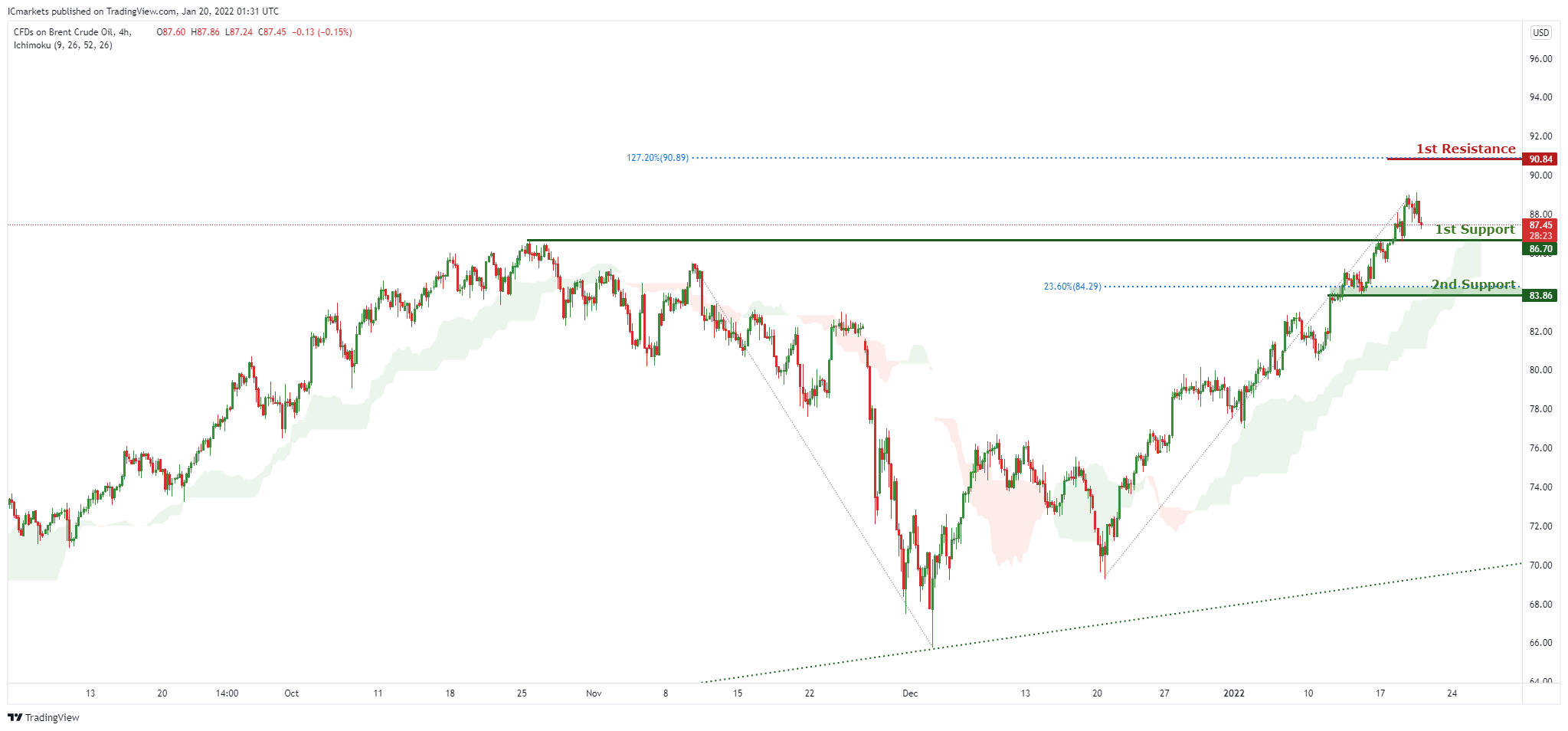
On the H4, with price moving above the ichimoku cloud, we have a bullish bias that price will rise to our 1st resistance at 90.84 which is in line with horizontal swing high resistance and 127.2% Fibonacci extension level from 1st support at 86.7, which is in line with horizontal overlap support. Alternatively, price may break 1st support structure and head for 2nd support at 83.86, which coincides with horizontal overlap support and 23.6% Fibonacci retracement.
Areas of consideration:
- H4 time frame, 1st resistance of 90.84
- H4 time frame, 1st support of 86.7
Dow Jones Industrial Average:
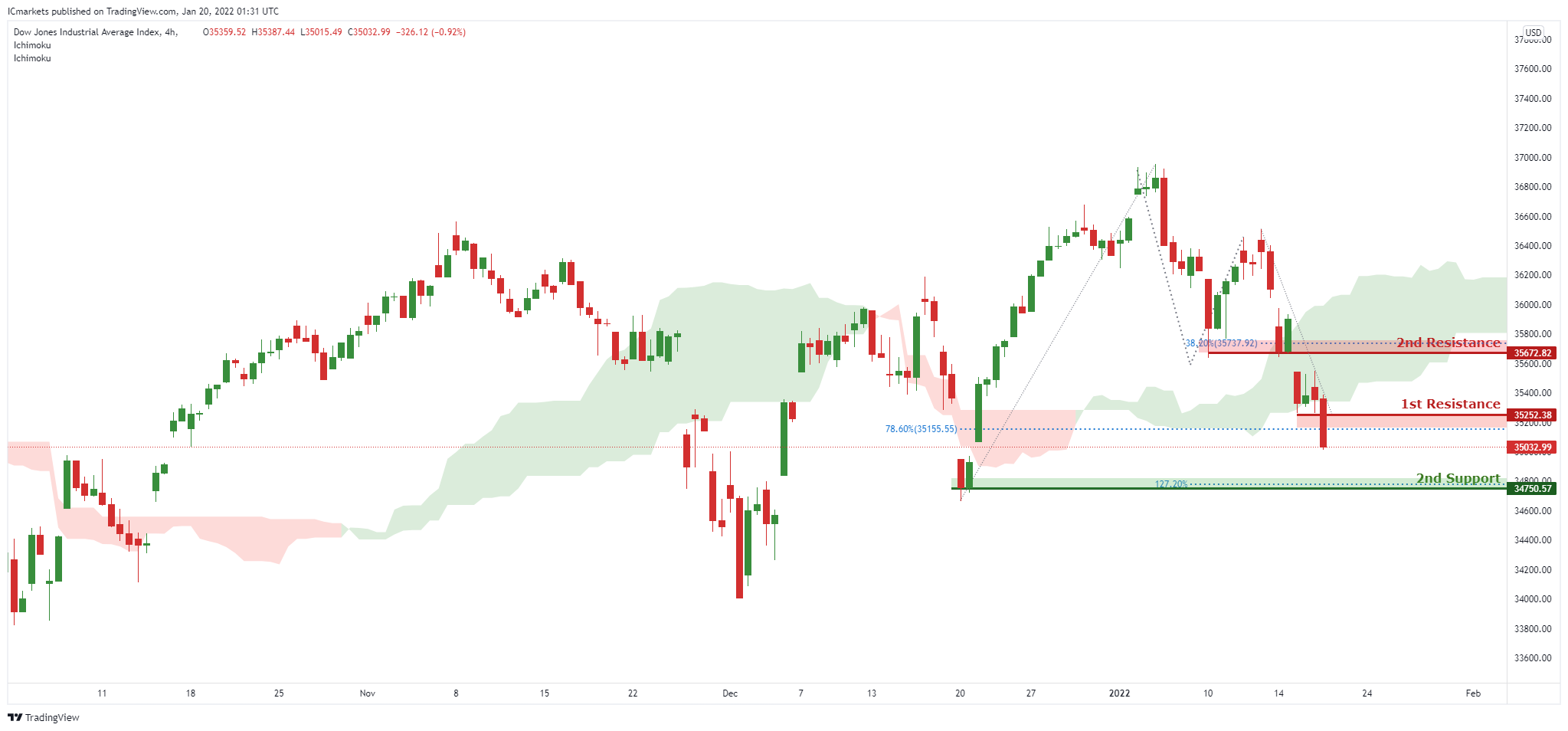
On the H4, with price moving below the ichimoku cloud, we have a bearish bias that price will from from our 1st resistance at 35252 which is in line with horizontal overlap resistance and 78.6% Fibonacci retracement to 1st support at 34750, which is in line with horizontal swing low support and 127.2% Fibonacci extension level. Alternatively, price may break 1st resistance structure and head for 2nd resistance at 35672, which coincides with horizontal overlap resistance and 38.2% Fibonacci retracement.
Areas of consideration:
- H4 time frame, 1st resistance of 35252
- H4 time frame, 1st support of 34750
Japan export rose 17.5% yoy in Dec, imports rose 41.1% yoy
Japan's export rose 17.5% yoy to record JPY 7881B in December, slowing from November's 20.5% yoy, but beat expectation of 15.9% yoy. Exports to China grew 10.8% yoy while shipments to US rose 22.1% yoy.
Imports rose 41.1% yoy to record JPY 8463B, the second month with rate above 40% following November's 43.8% yoy, but missed expectation of 42.8% yoy. Trade deficit came in at JPY -582B.
In seasonally adjusted term, exports dropped -0.2% mom to JPY 7363B while imports dropped -0.7% mom to JPY 7799B. Trade deficit narrowed to JPY -435B.
HK HSI jumps after PBoC rate cut, heading back to 26k
China's PBoC cut the one year loan prime rate by 10 bps to 3.70%. The second rate cut since April 2020 following December's. Five-year loan prime rate was lowered by 5bps to 4.60%, first cut since April 2020. Along with the rate cuts, PBoC also injected more liquidity to the markets by offering CNY 700B of one-year loans, exceeding the CNY 500B maturing.
Hong Kong HSI responds positively to the news and it's trading up 2.5% at the time of writing. Resumption of the rise from 22655.25 after notably support from 55 day EMA is a bullish sign, along with bullish convergence condition in daily MACD. Current rise should at least be correcting the down trend from 31183.35, with prospect of even reversing it. Further rally is now in favor back to 38.2% retracement of 31183.35 to 22665.25 at 25919.16, which is close to 26k handle.
AUD/NZD soars, setting up long term up trend?
AUD/NZD soars in response to much better than expected Australia job data, and heightened expectation of RBA rate hike this year. The strong break of 100% projection of 1.0278 to 1.0610 from 1.0314 at 1.0646 is seen as a sign of upside acceleration. Further rally is now expected as long as 1.0583 support holds. Next target is 161.8% projection at 1.0851.
The bigger question now is whether the medium term fall from 1.1042 has completed as a corrective pattern, with three waves down to 1.0278. Break above above mentioned 1.0851 resistance will add credence to this bullish case. That would also argue that rise from 1.2078 is developing into a long term up trend, resuming the move from 2019 low at 0.9992 through 1.1042.
Australia unemployment rate dropped to 4.2%, lowest since 2008
Australia employment grew 64.8k in December to 13.242m, well above expectation of 30.0k. Full time jobs rose 41.5k while part-time jobs rose 23.3k. Unemployment rate dropped from 4.6% to 4.2%, better than expectation of 4.5%. That's also the lowest rate since August 2008. Participation rate was unchanged at 66.1%. Hours worked rose 1.0% or 18.2m hours.
Bjorn Jarvis, head of labour statistics at the ABS, said: "The latest data shows further recovery in employment following the large 366,000 increase in November. This provides an indication of the state of the labour market in the first two weeks of December, before the large increase in COVID cases later in the month."
"This is the lowest unemployment rate since August 2008, just before the start of the Global Financial Crisis and Lehman Brothers collapse, when it was 4.0 per cent. This is also close to the lowest unemployment rate in the monthly series – February 2008 – and for a rate below 4.0 we need to look back to the 1970's when the survey was quarterly," Javis added.
Canada: Rate Hikes Close, But Not Quite Yet
Summary
- The Canadian economy enjoyed a solid rebound in late 2021, though with the Omicron variant leading to a renewed increase in COVID cases, some uncertainties have re-emerged. A temporary soft patch seems likely in early 2022, especially with Ontario and some other Canadian provinces having re-imposed some COVID-related restrictions over the past several weeks.
- Thus even as Canadian inflation remains elevated, we do not expect an imminent Bank of Canada rate hike at the January monetary policy meeting. Instead, our view remains for an initial 25 bps rate hike increase in April, and a cumulative 75 bps of rate increases this year.
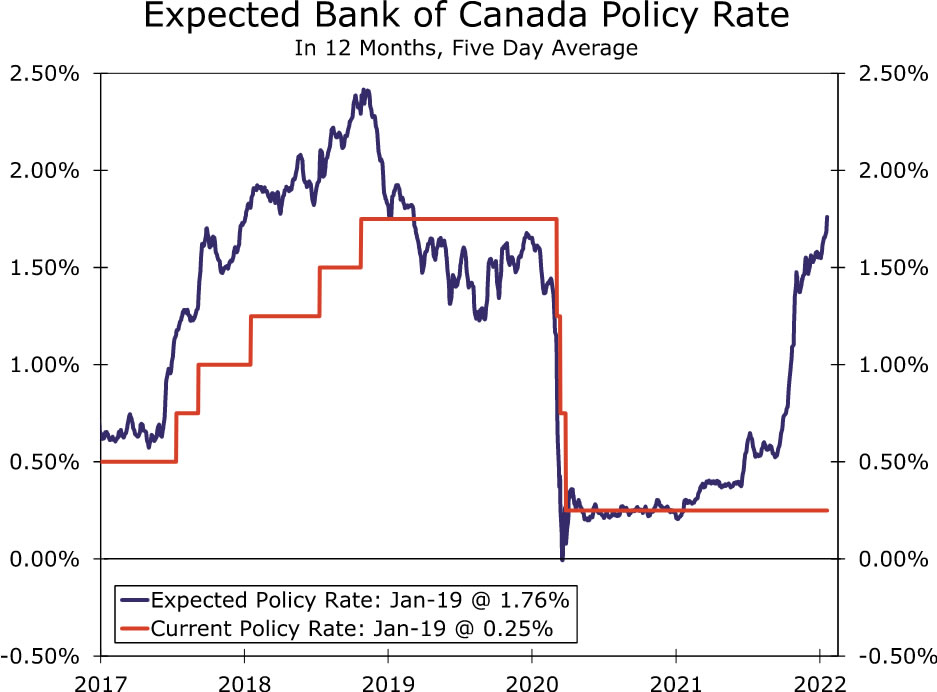
- Our outlook for Bank of Canada rate hikes over the next 12 months is more conservative than priced in by market participants, which envisage a cumulative 152 bps of rate increase over that period. Considering the aggressive market expectations for Bank of Canada policy, and the prospect of relatively rapid tightening (at least by international standards) from the Federal Reserve in 2022, we still expect the Canadian dollar to show renewed weakness versus the greenback as the year progresses.
Canadian Economy Solid in Late 2021, Could be Softer in Early 2022
After a bumpy path earlier in 2021, the Canadian economy enjoyed a solid rebound late last year. The recovery was highlighted by strong labor market trends, with seven consecutive months of job gains, including a 54,700 increase in employment for December. The unemployment rate fell almost two percentage points over the second half of last year, to 5.9%.
However, it was not just the labor market that showed sturdy trends, with retail sales, manufacturing sales, and overall GDP registering solid gains. In terms of the most recent figures, October GDP rose 0.8% month-over-month, October retail sales rose 1.6%, and manufacturing sales rose 2.6%. With respect to the overall economy, Q3 GDP grew 5.4% quarter-over-quarter annualized in Q3, and the consensus forecast is for a similar sized gain in Q4.
Still even with Canada's rebound, it's not clear that will lead to immediate rate hikes from the Bank of Canada (BoC). At the December monetary policy announcement, after the sizable Q3 GDP increase was already known, the central bank said:
"The Governing Council judges that in view of ongoing excess capacity, the economy continues to require considerable monetary policy support. We remain committed to holding the policy interest rate at the effective lower bound until economic slack is absorbed so that the 2 percent inflation target is sustainably achieved. In the Bank's October projection, this happens sometime in the middle quarters of 2022."
The Bank of Canada also point to some uncertainties surrounding the Omicron variant. From a global perspective, the central bank said the "..new Omicron COVID-19 variant has prompted a tightening of travel restrictions in many countries...and has injected renewed uncertainty", while with respect to Canadian specific developments the BoC said the "devastating floods in British Columbia and uncertainties arising from the Omicron variant could weigh on growth by compounding supply chain disruptions and reducing demand for some services."
Rising Inflation to Prompt Rising Interest Rates by April
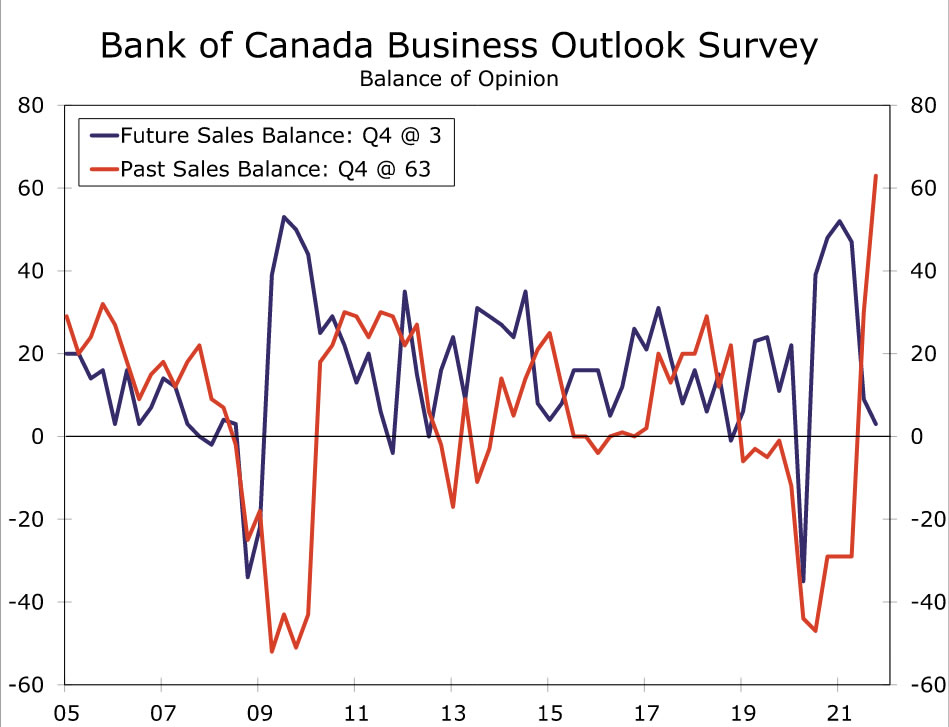
Some of these concerns or uncertainties are perhaps borne out by the Bank of Canada's latest Business Outlook Survey. Within that survey the Past Sales Balance rose to +63 in Q4, reflecting the strength seen late last year. However, the Future Sales Balance fell further to +3, highlighting the possibility of a soft patch for the economy early in 2022. We would also note that some COVID-related restrictions went back into place in Ontario in early January, including a work-from-home order, stricter limit on indoor gatherings, a shift to remote learning for schools, and closure for some businesses including gyms, theaters and restaurants. Restrictions have been imposed in some other provinces as well.
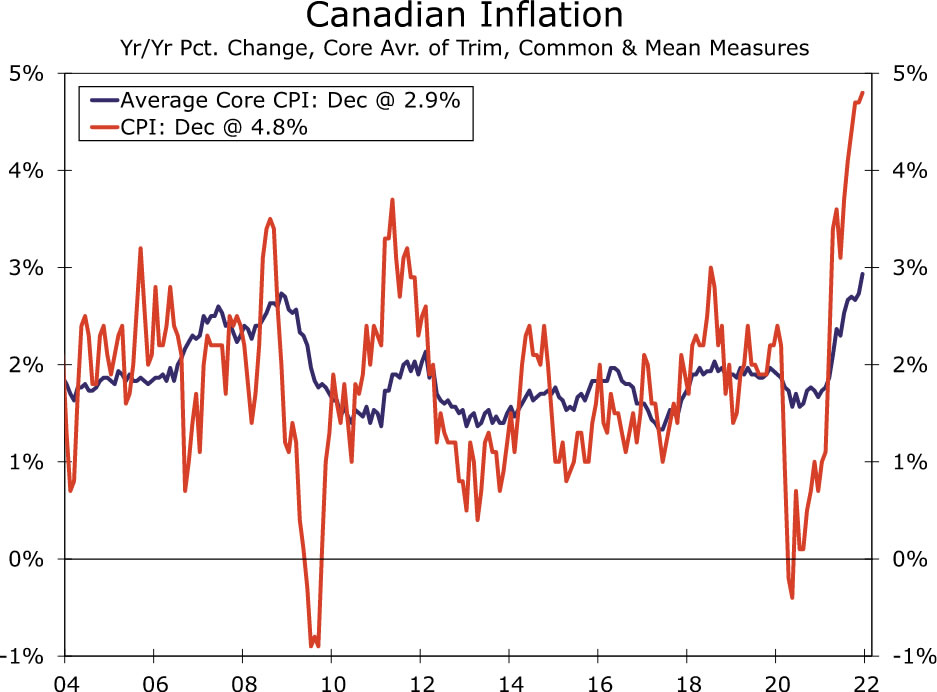
Thus even as inflation continues to move higher, with the December CPI edging up to 4.7% year-over-year and the average of the core inflation measures firming to 2.9%, we do not expect an imminent rate increase at the Bank of Canada January monetary policy announcement. Indeed, with the central bank perhaps wanting to monitor the impact (or perhaps lack of impact) from the Omicron variant in the coming months, our view remains the Bank of Canada will deliver an initial rate increase at its April monetary policy meeting, which would also be broadly consistent with the timing for which it anticipates slack within the economy will be absorbed. Our outlook for a 25 bps rate hike by April is more conservative than current market pricing, which anticipates 52 bps of rate increase during the next three months. Indeed, more broadly we forecast 75 bps of rate increase from the Bank of Canada over the next 12 months, compared to the 152 bps of rate increase anticipated by market participants. Thus even though there are some positive factors for the Canadian dollar, including a recent rise in oil prices, considering the aggressive market expectations for Bank of Canada policy, and the prospect of relatively rapid tightening (at least by international standards) from the Federal Reserve in 2022, we still expect the Canadian dollar to show renewed weakness versus the greenback as the year progresses.
RBA to Begin Tightening in August Despite Omicron Shaving Growth in 2022 from 6.4% to 5.5%
In this note we set out some changes to our interest rate forecasts.
In addition, we also assess the impact on economic growth of the omicron variant.
Omicron is forecast to have its major impact on the economy in January through a contraction in consumer spending. Thereafter we expect a solid bounce back in the later stages of the March quarter and in the June and September quarters.
Westpac Economics is now forecasting growth for 2021 and 2022 of 3.2% and 5.5%, respectively. That is revised from the pre-omicron profile of 2.8% and 6.4%, with a net reduction of 0.5%.
We do not see that correction as having a significant impact on jobs growth or wages/inflation.
Changes to the outlook for interest rates
We have not changed our call for the first hike in the overnight cash rate by the RBA since June 2021 when we were early to challenge the "not till 2024" consensus.
Our "target" then was a first hike at the February Board meeting in 2023.
Developments since then have now prompted us to bring forward that tightening date to the meeting on August 2, 2022.
We now expect one hike of 15 basis points in August to be followed by a further hike of 25 basis points in October.
The full extent of the cycle and expected timing of subsequent moves is discussed below.
This revised timing for the first move is still well short of market pricing which is for the first hike to occur in June.
We understand that the Governor has firmly indicated that he does not expect to be raising rates until very late 2023 or 2024 and that this expectation is entirely consistent with the Bank's current economic forecasts.
Those forecasts, which will be refreshed and possibly changed for the February 1 Board meeting, indicate that underlying inflation will print 2.25% by the end of 2022 and 2.5% by the end of 2023.
Wages growth is expected to reach 2.5% in 2022 lifting to 3% in 2023.
If these forecasts prove to be accurate then the "late 2023/2024" guidance will be appropriate.
But we have quite different forecasts for: inflation; wages growth and the unemployment rate.
We expect that underlying inflation (trimmed mean) will reach 2.4% in 2021 and lift to 2.6% in March 2022 and 2.9% in June 2022.
This will mean that by the time of the August meeting the Board will have observed three consecutive quarters in which annual underlying inflation has achieved or exceeded its target (around the mid-point of the 2-3% range).
Wages growth will be slower to reach the RBA's "target" of 3% but whereas achieving the inflation target is a hard condition for any policy change, acceptance that wage growth has consistently lifted towards a speed we have not seen since 2014 should be sufficient to satisfy the Bank that the necessary conditions for a rate increase have been achieved.
We expect quarterly growth in the Wage Price Index to increase from 0.6% in the September quarter to 0.7% in the December quarter, to be followed by 0.8% in the March quarter.
The very low 0.4% result in the June quarter of 2021 means the actual Wage Price Index will still show annual growth of 2.75% for the year to March (the most recent dt available for the August meeting) but the increasing momentum will be clear once the six- month annualised pace reaches the 3% target.
If the Board sees the 3% wages growth as a hard target it may opt to delay the hike until the September Board meeting when the low 0.4% will drop out of the annual rate allowing it to reach the annual pace of 3%.
When assessing the outlook for wages, the Board will also rely on its own liaison work and high frequency measures of wage pressures. Even though the most recent reports from the Bank on its liaison points to a 2.5% pace for wages growth, we expect the picture to change quickly by the middle of 2022.
An example of the emerging evidence in the higher frequency data is the weekly payrolls report which shows a 9% lift in the total wage bill over the year to 19 December 2021 – with payrolls rising 3.2% over the same period this means average wage rose by 5.6%yr. This measure is impacted by bonuses paid, hours worked and changes in the composition of the work force, all of which are excluded from the Wage Price Index measure, but the sharp increase in this annual growth measure in recent months certainly bears consideration.
We accept that there is high inertia in the enterprise agreements (around 38% weighting in the Wage Price Index) and minimum wages/awards (around 21%) but expect that there will be a number of aspects of the WPI that will indicate stronger pressures than the headline print – the individual agreement component (around 37%) should be seeing gains running at around 0.9% a quarter and should be seen as a reliable lead indicator for enterprise agreements (note that the individual agreement component lifted by 1.1% in the September quarter partly boosted by seasonality and some 'catch up' from the very weak June quarter).
We expect that the National Wage case in April, a month before the likely date of the federal election, will also result in the government supporting a more generous settlement than has been the case in the recent past, potentially boosting award and the minimum wages by around 3%.
We are more optimistic about the unemployment rate than the Bank's latest forecasts. Currently the Bank expects the unemployment rate to reach 4.25% by end 2022 and 4.5% by the month of June 2022 – our same forecasts are 3.8% and 4.1% respectively.
The Board would probably view around 4% as full employment – an objective the Bank does not expect to achieve until end 2023 but which we expect by June 2022.
The path of the tightening cycle
Back in June last year we targeted a terminal RBA cash rate of 1.25%.
That related to the peak debt servicing ratio for the household sector we observed in previous cycles in 2009-10 and in 2018 (the latter stemming from macro-prudential measures rather than official rate tightening). But that forecast last June was in the context of a more benign inflation profile than we now expect. We now think the RBA will need to venture into mildly contractionary policy settings to address any inflation/wages risks.
While the concept of the household debt servicing ratio as a constraint to rates is attractive it is by no means an exact measure – the income distribution of those holding the debt; the exact mix between fixed and floating rate terms and between interest only and amortising loans complicates estimates.
There is also the likelihood that, over the long run, interest rates in Australia and the US are unlikely to settle too far out of alignment.
For these reasons we have lifted the terminal rate to 1.75% from the 1.25% we estimated back in June.
The exact profile for rate rises would be 40 basis points in 2022; 100 basis points in 2023; with one final move of 25 basis points in early 2024.
The last example of an RBA tightening cycle was in 2009 /10 and saw six 25 basis point moves over the course of seven meetings between November 2009 and May 2010.
That was at a time when the RBA assessed neutral as being well above the 3% starting point and argued that it was important to move quickly away from the emergency settings associated with the GFC.
While the motive to move away from emergency settings will be the same, it is likely that there is more uncertainty around the exact level of neutral and the moves will be somewhat more cautious than we saw in 2009/10.
That said, central banks are also cautious about getting too far 'behind the curve' since that only increases the risks that policy will have to move further into contractionary territory than would be the case if policy had been tightened in a timely fashion.
For example, there is one view amongst some analysts that despite achieving its objectives, the RBA would remain on hold for an extended period, unnecessarily getting behind the curve and probably having to eventually move much more quickly risking an overshoot.
International issues
The FOMC has signalled that it is likely to begin tightening at its March meeting – ahead of our previous call that the tightening would begin in June – due to the rapid improvement in conditions in the labour market and a more sustained rise in inflation than had been assessed earlier in 2021.
The intention of the FOMC now appears to be to move more quickly to rein in an inflation rate that is now running a touch above 7%.
That would imply four rather than three hikes by the FOMC in 2022 – effectively adding the March move to our already expected three moves from June.
Th key for global markets is whether inflation in the US can be brought back to the 2-2.5% range during 2023 to allow the FOMC to settle rates at around neutral rather than be obliged to push heavily into contractionary territory.
That remains our call and is consistent with a 1.875% terminal rate in this cycle (up from 1.625%)
After four moves in 2022 the three additional 0.25% moves are likely to occur in 2023, providing the RBA with the comforting signal that the federal funds rate can settle around, or slightly above, the neutral level.
The risk for markets globally is that inflation does not settle back in 2023 into the 2-2.5% range forcing the FOMC to push into contractionary policy settings and precluding the FOMC from easing policy rates in the event of a major market meltdown.
The AUD and Bond rates
Our key near term AUD forecast is for a low point in the AUD of USD0.70 by mid-2022.
While we have a more urgent tightening cycle from the RBA we have also lifted the pace of rate hikes by the FOMC.
From the end 2022 we are expecting a further five RBA hikes through 2023 and 2024 compared to only three from the FOMC. That will support our call for a rising AUD through the second half of 2022 and 2023.
Note that relative to our earlier forecasts, the negative margin between the terminal cash rates for RBA and FOMC has narrowed from 40 basis points to 12.5 basis points, providing further support for our rising AUD view from mid- 2022.
We maintain our call that due to the sensitivity of the Australian economy to excessive levels of household debt the terminal rate can settle slightly below the FOMC rate.
All last year our forecasts for the long bond rates in both Australia and the US (key targets of 2.3% by end 2022) were heavily 'out of the money' as markets priced in a benign outlook for bond rates.
That has recently changed significantly with the AUD bond rate around 2%.( up from 1.5% in late 2021).
The higher terminal rates for RBA and FOMC now support slightly higher bond rate peaks, reaching 2.5% rather than the previous 2.3% by end 2022.
These relatively benign rates are consistent with our current expectations that inflation can settle around central banks' targets allowing terminal rates to hold near neutral.
Omicron and economic growth
The omicron wave is denting economic activity in the opening quarter of 2022, centred largely on the consumer. The dramatic surge in cases locally looks to be driving a pull- back in consumer spending with widespread reports of disruptions to production and distribution networks as employees required to isolate are unable to work. We expect this to result in a hit to hours worked and a run-down of inventories, which is a drag on growth. A temporary soft spot in business confidence is also likely to see some delays to business investment, largely around equipment spending.
Westpac Economics is now forecasting growth for 2021 and 2022 of 3.2% and 5.5%, respectively. That is revised from the pre-omicron profile of 2.8% and 6.4%, with a net reduction of 0.5%.
It is worth noting that in the lead-up to the omicron outbreak, the economy was rebounding during the December quarter 2021 more quickly than previously anticipated. Retail sales were particularly strong in the month of November, surging 7.3% and building on a strong 4.9% gain in October. This has led to an upgrade to our Q4 GDP growth forecast, from 2.2% to 2.6%, led by a 1ppt upward revision to consumer spending.
More recent data from our Westpac Card Tracker, based on weekly credit and debit card activity to January 15, points to a material weakening in spending since late December. Indeed, the tracker data suggests total consumer spending is likely to be down close to 3% for the January month. While some improvement on the COVID front is likely to see activity improve, particularly as we move into February, this is now expected to leave total consumer spending flat for the March quarter. This is compared to what would otherwise have been a continuation of the strong gains seen in the December quarter. The resilience of consumer sentiment in January is one promising sign that the consumer may revive quickly once the COVID situation stabilises.
With consumer spending stalled in the March quarter, and inventories subtracting an expected 0.3ppts in the period, overall GDP is also expected to be flat in the opening quarter of 2022. At this stage, we anticipate that disruptions to construction activity for the quarter will be minimal – with the sector largely on summer holiday early in January, and with some normalisation in movement and activity envisaged over the remainder of the quarter.
The quarterly GDP profile for 2022 is now expected to be: 0.0%; 2.6%; 2.0% and 0.8%.
For the 2022, consumer spending is expected to expand by 7.6%, lowered from 9.4% previously. This comes from both the upward revision to 2021 and the omicron disruptions in 2022.
Business investment gains have been pared back somewhat in 2022, but to a still strong pace, at a revised 7.8%, lowered from 8.5% pre omicron. This factors in equipment spending growth of 10.5%, trimmed from 12% previously. The hit to business confidence from omicron is likely to be short lived, as was the case with delta, with firms quickly refocusing on strong underlying demand and tight capacity, as well as generous tax concessions.
As noted above, inventories are run-down in the March quarter, due to labour shortages disrupting production and distribution. A stabilisation of inventories is anticipated in the June quarter, followed by some rebuilding of stock levels in the September quarter.
On the trade side, import growth for 2022 is pared back to reflect the downward revisions to demand, lowered by 1.3ppts to a still brisk 12.6%. Note that as much of the disruption to consumer spending is around domestic services, which limits the hit to imports. Export growth has also been trimmed, at the margin, by around 0.5% to 8.3%, to reflect those supply disruptions in the March quarter, with a partial catch-up over the following quarters.
The risks
One important risk to this rate and growth view is a further rise in COVID infections and hospitalisations near term or further out as the effectiveness of boosters and post-infection immunity wears off – the latter likely to be around mid-2022 when winter will be upon us and the virus tends to spread more freely (although evidence from the severe northern winters is not entirely relevant for Australia's mild winters).
Importantly, the RBA along with other central banks, has come to look through COVID disruptions.
The line the RBA used around the delta lockdowns was that it would "delay but not derail" the recovery. That may mean that our timing for the first move turns out to be too early but the cycle would not be abandoned.
Further complicating this issue is that while another wave will impact activity as we are now seeing in January its implication for the nominal economy is less clear and we know that the RBA's concern in recent cycles has been the weakness in the nominal economy.
Despite the sudden shift to lock downs last year, the RBA continued its tapering program, although it did delay consideration of a further taper by three months.
Increasing wage pressures and tightening labour markets are important preconditions for these forecasts. The opening of international borders will ease some of the labour shortages but is unlikely to be a smooth process.
Inflation and wage pressures result from an imbalance between demand and supply. The opening of borders will lift demand as well as increasing supply while the demand offset from Australians travelling abroad is likely to be minimal as Australian travellers remain cautious about overseas health risks, including the quality of overseas health systems.
Conclusion
Our forecast revisions reflect a much faster lift in inflation and wages growth than envisaged last June.
While we have shaved our growth rate in 2022 due to the omicron-related contraction in consumer spending in January we do not see that as being significant for our wages/inflation/ employment profile.
The FOMC has now acknowledged that the conditions for a tightening of policy have arrived and, while less urgent, we think the RBA will do the same by August.
The approach we have used in this process is to recognize when our forecasts are different to the RBA; assume our forecasts will be correct; and predict how the central bank will react to a new reality.