Sample Category Title
The Fed Taking A More Decisive Approach On Inflation
Markets
An unexpected acceleration in US PPI inflation (0.8% M/M and 9.6% Y/Y) yesterday triggered a temporary rise in US bond yields, reinforcing the case for decisive Fed action at today’s policy decision. Part of the move was reversed (in a risk-off context). US yields finally finished the session 2.5 bps/3.0bps higher across the curve, with rise solely due to a higher real yield. German yields, also closed 1.0/1.5 bp higher in a technical rebound. The mix of persistent inflation risk and uncertainty on the impact of omicron for (global) growth weighed on risky assets. US equities lost between 0.3% (Dow) and 1.14% (Nasdaq). The dollar gained modestly (DXY close at 96.57, EUR/USD at 1.126). The yen didn’t profit from save haven flows (USD/JPY close 113.70).
Today’s US eco calendar is well filled with data that usually are supposed to have market-moving potential including US retail sales, the Empire manufacturing survey, import prices and NAHB housing confidence. However, any market reaction will be restrained by investors awaiting the final verdict of the FOMC policy decision. The Fed since November reduced asset purchases by $15 bln p/m. Persistent upward inflation surprises ‘forced’ Fed Chair Powell (and other high profile MPC members) to bury the narrative on the transitory nature of inflation and pre-announcing accelerated tapering of asset purchases, probably to $30 bln p/m from January. Net buying might finish at the end of Q1. This gives the Fed ample room of maneuver to asses the start and pace of rate hikes. In this respect, the new Fed dots will be very instructive on how MPC members intend to use the room to start more aggressive anti-inflationary action. Anything less than three projected 2022 rate hikes probably will be a disappointment for markets as frontloading is seen necessary to avoid more aggressive action further out. In this respect, it is also interesting to see the MPC’s insights on the expected length of the cycle and whether it will come close the neutral Fed rate. A favorable employment outlook could put the Fed path well beyond what markets are currently expecting. The Fed confirming to step up its anti-inflationary narrative still should put the onus at the short end of the curve. However, LT real yields recently showed more convincing signs of bottoming (10-y real yield returned >-1.0%). Is this an indication of a bottoming for the aggressive flattening at the long end of the curve? The Fed taking a more decisive approach on inflation and a bottoming in real yields in theory still put the dollar in pole-position. The zone 96.64/94 remains first topside reference for the DXY TW USD index. In EUR/USD 1.1228 marks minor interim support ahead of the key 1.1186 year low. A break of the latter evidently is also conditional to tomorrow’s ECB (re)assessment on inflation.
This morning, UK November CPI inflation is reported at 0.7% M/M and 5.1% Y/Y for the headline and 4.0% Y/Y for the core, both above market expectations. EUR/GBP declines a few ticks. The 0.8500 barrier is within reach.
News headlines
The Chilean central bank as expected raised the policy rate from 2.75% to 4% yesterday. The second hike straight comes amid rising inflation (6.7% y/y in November) and inflation expectations as the economy is expected to expand more than a record 11% this year alone. However, expectations for households and businesses have recently taken a turn for the worse due to spiraling prices, the bank said. The central bank stated clearly the rate “will be further increased in the short term, to exceed its nominal neutral level”. Chile’s peso strengthened vs the USD to USD/CLP 840 yesterday but still trades weak from a historical perspective. Political uncertainty ahead of highly-contested presidential elections batters the currency.
The House of Representatives voted early Wednesday to raise the US’s debt ceiling by $2.5tn to over $31tn. It is expected to extend the government’s borrowing capacity into early 2023, ending months of uncertainty. The 221-209 vote sends the bill to president Biden. The resolution was approved earlier by the evenly split Senate after new legislation approved a one-time process that shields the debt ceiling discussions from a potential Republican filibuster while also allowing it to pass with a simple majority.
GBP/JPY Daily Outlook
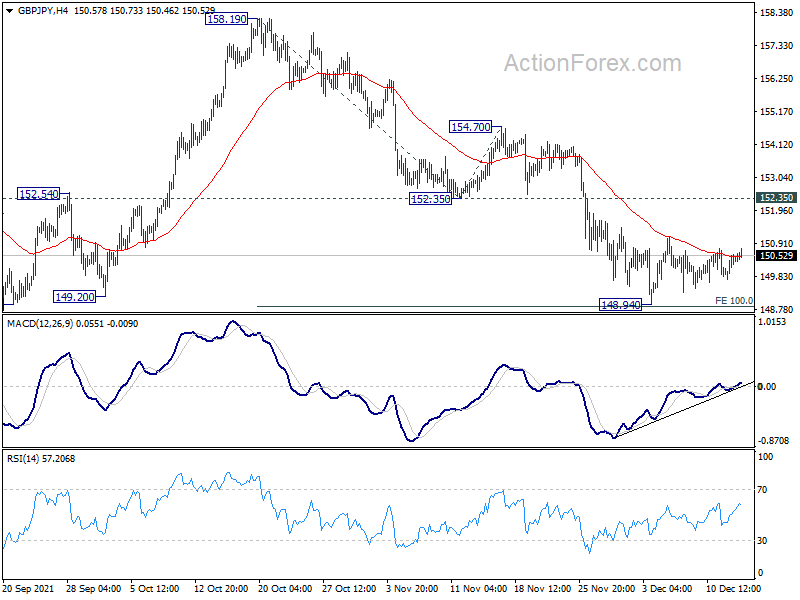
Daily Pivots: (S1) 149.97; (P) 150.27; (R1) 150.77; More...
Range trading continues in GBP/JPY and intraday bias remains neutral first. On the downside, firm break of 148.93 key structural support will carry larger bearish implications. Next target is 161.8% projection of 158.19 to 152.35 from 154.70 at 145.25. On the upside, however, break of 152.35 support turned resistance will argue that the pull back from 158.19 is complete. Intraday bias will be turned back to the upside for retesting 158.19 high.
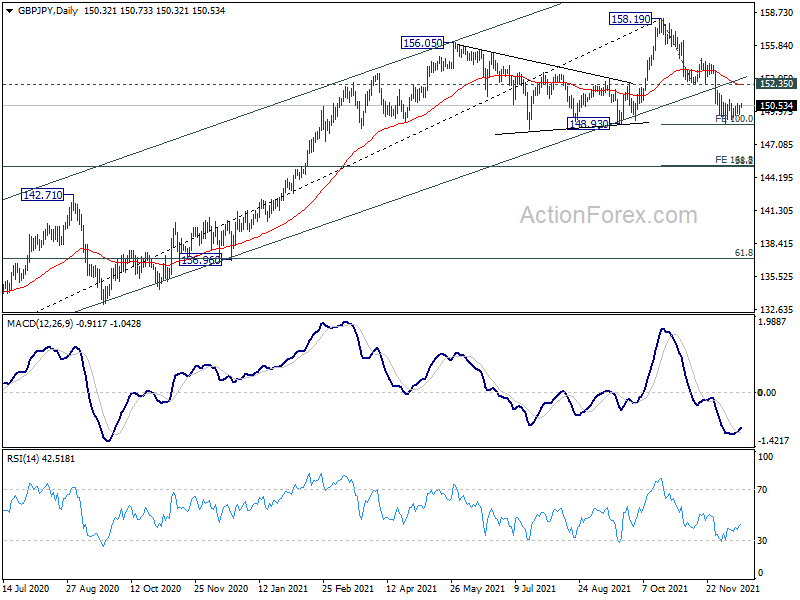
In the bigger picture, the break of medium term channel support, and bearish divergence condition in week MACD are raising the chance of medium term topping at 158.19. Firm break of 148.93 support will argue that GBP/JPY is at least correcting the whole rise from 123.94 (2020 low). In this case, deeper fall would be seen to 38.2% retracement of 123.94 to 158.19 at 145.10. Nevertheless, strong rebound from 148.93 will retain medium term bullishness for another rise through 158.19 at a later stage.
EUR/GBP Daily Outlook
Daily Pivots: (S1) 0.8494; (P) 0.8524; (R1) 0.8539; More...
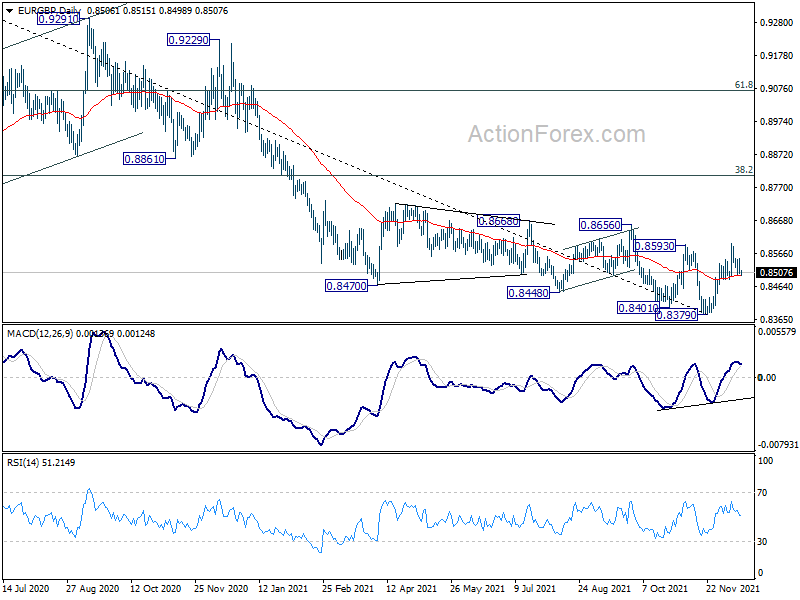
Intraday bias in EUR/GBP remains neutral first and with 0.8387 minor support intact, further rally is in favor. On the upside, firm break of 0.8593 resistance will be the first sign of larger bullish reversal and target 0.8656 resistance next. On the downside, however, break of 0.8487 will turn bias back to the downside to retest 0.8379 low instead.
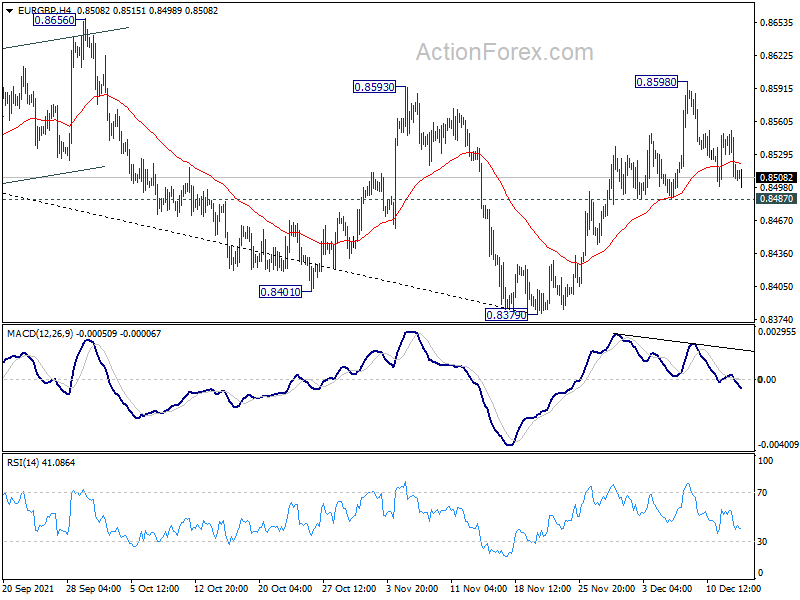
In the bigger picture, price actions from 0.9499 (2020 high) are still seen as developing into a corrective pattern. Deeper fall could be seen as long as 0.8593 resistance holds, towards long term support at 0.8276. We'd look for bottoming signal around there to bring reversal. Meanwhile, firm break of 0.8593 will now be an early sign of medium term bottoming. Further break of 0.8656 will pave the way to 38.2% retracement of 0.9499 to 0.8379 at 0.8807.
EUR/AUD Daily Outlook
Daily Pivots: (S1) 1.5792; (P) 1.5850; (R1) 1.5898; More...
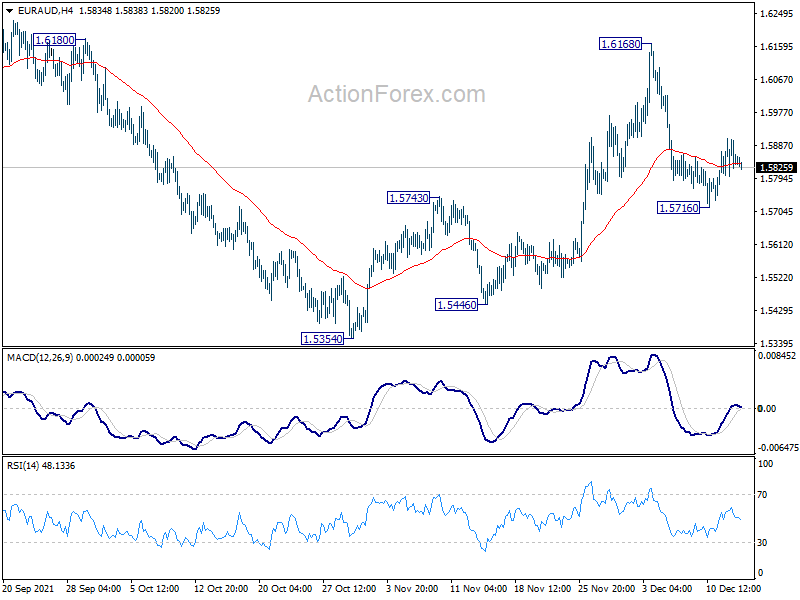
Intraday bias in EUR/AUD is turned neutral again as recovery from 1.5761 quickly lost momentum. On the upside, break of 1.6168will resume the rise from 1.5354 to 1.6434 resistance. On the downside, though, break of 1.5716 will revive the case that rebound from 1.5354 has completed, and bring retest of this support.
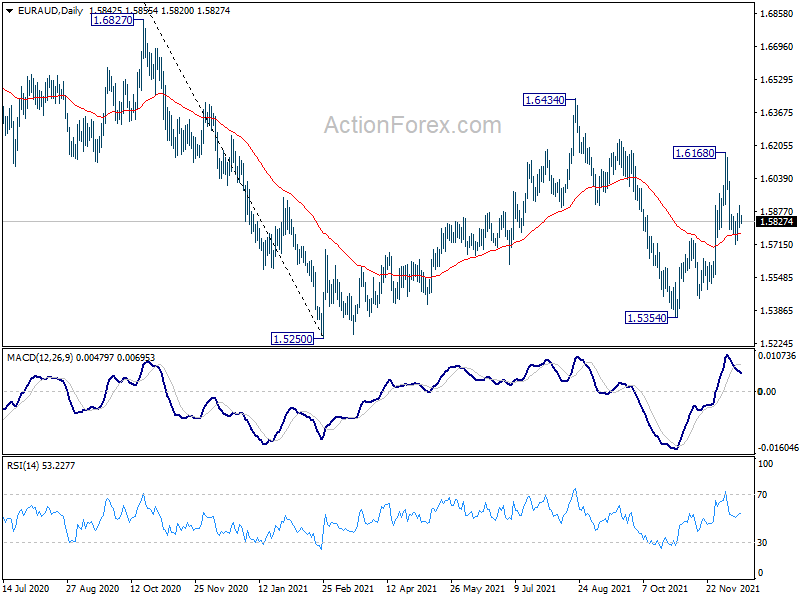
In the bigger picture, medium term outlook is neutral for the moment. Rise from 1.5354 is seen as the third leg of the corrective pattern from 1.5250 low. Further rise cannot be ruled out, but even in that case, strong resistance should be seen at 38.2% retracement of 1.9799 to 1.5250 at 1.6988. Larger down trend from 1.9799 is in favor to extend through 1.5250 at a later stage.
EUR/CHF Daily Outlook
Daily Pivots: (S1) 1.0390; (P) 1.0404; (R1) 1.0418; More....
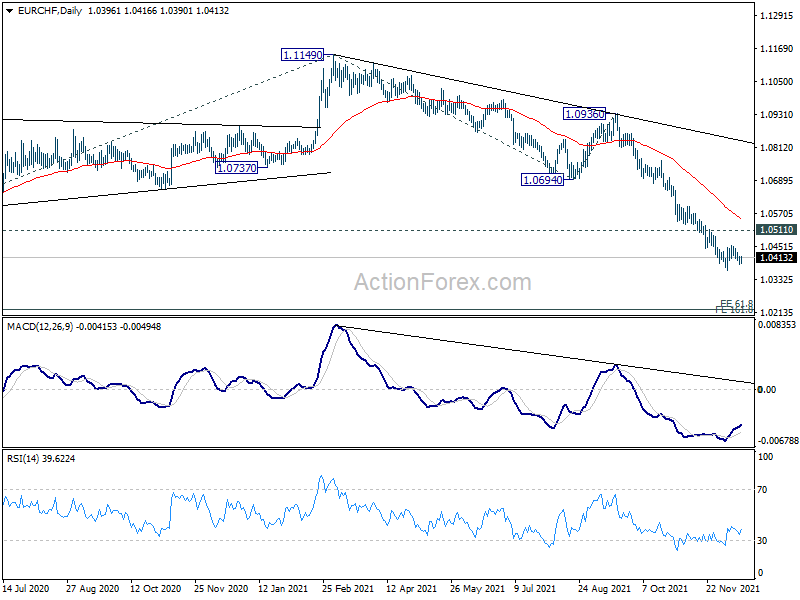
EUR/CHF's consolidation from 1.3065 is still in progress and intraday bias stays neutral. Further decline is expected as long as 1.0511 resistance holds. On the downside, break of 1.0365 will resume larger down trend from 1.1149 to 161.8% projection of 1.1149 to 1.0694 from 1.0936 at 1.0200 next.
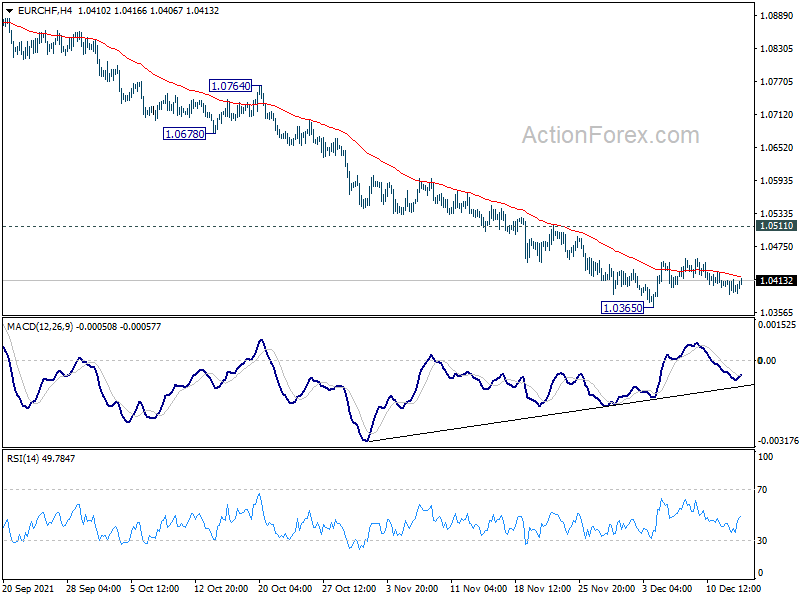
In the bigger picture, long term down trend from 1.2004 (2018 high) is now extending. Next target is 61.8% projection of 1.2004 to 1.0505 to 1.1149 at 1.0223. On the upside, break of 1.0694 support turned resistance is needed to be the first sign of medium term bottoming. Otherwise, outlook will remain bearish even in case of rebound.
FOMC: How Hawkish?
Yesterday’s US producer price index came as a slap in the market’s face, as the latest data showed that goods costed close to 10% more at the factory gate in November, a terribly high number for the US that the Federal Reserve (Fed) must deal with ASAP.
Investors’ eyes popped out of their heads when they saw the 9.6% PPI figure, and the hawkish expectations topped sending Nasdaq more than 2% lower during the session. The technology-heavy index still recovered to the close, but ended the session more than 1% lower. The S&P500 slid 0.75% and the Dow dropped some 0.30%.
The kneejerk reaction to the US PPI data is reasonable, but it may be more fear than harm when it comes to how strong the Fed will react to it. Walking in today’s decision, we already know that the most important take of this year’s last FOMC meeting is inflation being no more ‘transitory’. We already know that the Fed is preparing to announce a faster QE taper, and to hint at perhaps sooner and faster rate hikes to cool down the inflationary pressures. And that’s already mostly priced in. The US 2-year yield is up from 0.10% to 0.70% since May.
At this point, no one at the FOMC board is willing to destroy the stability that has been achieved in the stock markets during what was supposed to be tough pandemic times. No one at the Fed wants to trigger a market rout, a financial crisis nor panic across the market to rush to tame inflation. On the contrary, the Fed will need to have a subtle strategy in place when it pulls the rug from under the market’s feet, without wreaking havoc in asset prices, because asset prices do matter for the Fed and the Fed will be in a better position to fight inflation with the support of healthy financial markets, or at least without the urge to deal with a renewed financial calamity.
Therefore, no matter how late the Fed realizes that inflation’s gone ahead of itself, and no matter how loud the economy is calling for help, the Fed can move only so fast.
Also, we know by fact that, as much as the Fed likes doing dovish surprises, which please investors, they hate the hawkish surprises which would destabilize the financial place. Because a hawkish surprise, and a market selloff would only delay the Fed action and get things worse even in terms of inflation. And this is exactly why we have forward guidance. And the forward guidance for this week’s meeting is faster QE and a possible revision of the timing of the first rate hike. And that hawkish shift is already priced in. Therefore, it would be surprising to see a significantly more hawkish FOMC announcement. Hence, there is hope for a relief rally in risk assets following today’s FOMC decision. All three major indices have come close to their 50-dma levels, which could be an interesting dip buying opportunity for investors if the mood after the FOMC improves. If the fear of missing out a further rally, so the so-called FOMO remains tight, there is no reason we won’t see new records even with Fed pulling away support faster.
Plus, there is one development that could help the Fed maintain hope that inflation may come close to a peak: the stagnant oil prices. The barrel of US crude remains under pressure near the $70 level, as the International Energy Agency now says that the oil market has returned to a supply surplus and faces a bigger overhang in 2022 with the new travel restrictions thanks to an endless pandemic and higher supply with the release of strategic oil reserves from the US and other countries, and higher OPEC output. For now, the ‘risk’ of seeing the Iranian oil hit the market has reduced however, as the talks on the nuclear front don’t progress much.
But it looks like, even if the impact of omicron is seen limited thanks to vaccination, it makes it harder to get the oil rally going above the $70 mark. As a result, there is a stronger case for a further pullback in oil prices toward the $60 mark, rather than a further rally toward the $80 level.
Will Fed Eattle The Markets?
Market movers today
- The main event of today is the Fed decision tonight. We expect the Fed to increase the tapering pace to USD25bn per month starting from January, which would imply an end to QE bond buying from April. It seems, however, that since our updated Fed call consensus has emerged around a double of the tapering pace to USD30bn per month. We expect the Fed to signal two rate hikes next year (up from fifty-fifty chance of a rate hike in 2022 in the September projections), which, however, is below our call for three rate hikes. We expect the Fed will continue to turn gradually more hawkish in 2022.
- In the US, we also get numbers for retail sales in November, which are expected to lose momentum compared with October amid eroding purchasing power due to higher inflation.
- In Sweden, Prospera publishes its final, quarterly inflation survey.
The 60 second overview
Chinese activity data point to slowing economy: Retail sales and investment in November were somewhat weaker than expected, growing 3.9% and 5.2%, respectively compared with a year earlier. Stripping out inflation, retail sales grew only 0.2% compared with October. The slowing economic activity reflects headwinds from COVID-19 outbreaks and spill-over effects from troubles in the property sector (where a faster drop in new home prices in November signals further trouble). We expect the Chinese authorities to step up stimulus in early parts of 2022, which should support the economy.
High inflation challenges central banks: This morning we published our Global Inflation Watch - US inflation at 39-year high, euro inflation boosted by electricity and gas prices, 15 December. Labour shortages, new highs in inflation and continued bottle necks keep challenging central banks. A few bright spots, though, are stabilisation in oil, metal and foods stuff prices and freight rates also seem to have peaked. This should drive inflation somewhat lower in 2022 but wage pressures are likely to remain high, especially in the US. We look for core inflation in the euro area to peak now, while we project US core inflation to peak in February 2022 above 5%.
Equities: Tuesday continued on the risk-off theme, with equities lower and defensives outperforming. Although yields were roughly unchanged the value-vs-growth trade remerged. Probably as a reflection of investors positioning themselves for tonight's FOMC meeting. Financials, staples and materials ranked among the best sectors, while rate sensitive tech and real estate sold off. US equities lower with Dow -0.3%, S&P 500 -0.8%, Nasdaq -1.1% and Russell 2000 -0.1%. Asian markets are roughly unchanged this morning, and the same goes for US futures.
FI: Inflation markets underperforming nominals, leading to the rise in global real yields are probably the most characteristic moves of yesterday's trading session, which was otherwise mainly a waiting game for the coming central bank showdown in the coming days. 10y German Bunds rose 1bp to -0.37%.
FX: It was a fairly quiet session in FX markets yesterday which was primarily characterised by a rise in global real yields, a drop in gold and ZAR trading heavy. Most G10 pairs range traded albeit commodity FX in NOK, RUB and AUD were modest underperformers.
Credit: Credit markets sold slightly off yesterday with iTraxx Xover widening 2.6bp and Main 0.5bp. HY bonds tightened 1bp while IG widened 0.5bp.
Nordic macro
In Sweden, Prospera publishes its final, quarterly inflation survey (08:00). Since expectations tend to be adaptive and since headline inflation has continued to rise on the back of surging energy prices, it would not be a surprise if especially 1-2 years pick up slightly. However, in the Q3 survey expectations dropped 0.1 p.p. on all horizons leaving 1- and 2-year at 1.8% and 5-year at 1.9% and, notably, energy-adjusted inflation still runs below target at 1.9%. Hence, if they would pick up 1-2 tenths they would still be described as well-anchored and support a cautious stance from the Riksbank. Also keep an eye on employers and employees wage growth expectations, which so far run close to actual wage growth around or just above 2.5% - the Riksbank expects wage growth to pick up to 2.9% in 2023.
EUR/USD Daily Outlook
Daily Pivots: (S1) 1.1233; (P) 1.1278; (R1) 1.1303; More...
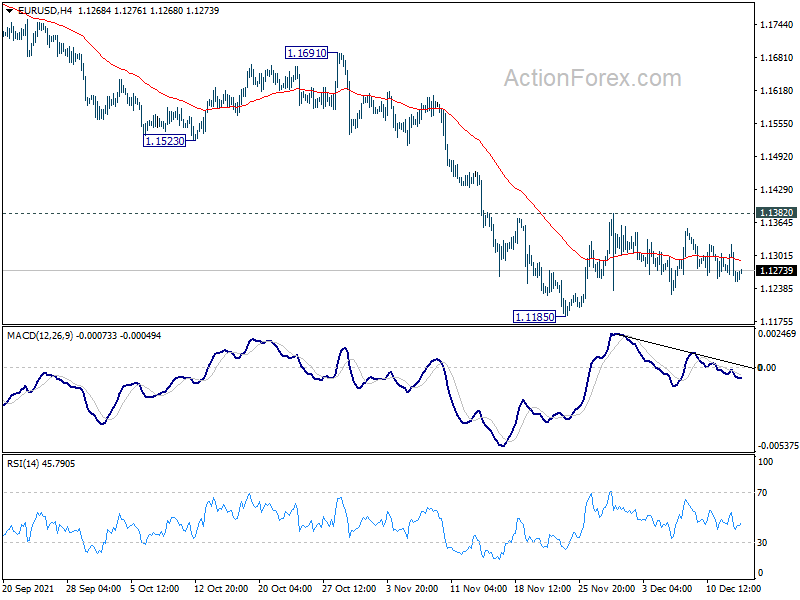
Range trading continues in EUR/USD and intraday bias remains neutral. Downside breakout is mildly in favor with 1.1382 minor resistance intact. On the downside, break of 1.1185 will resume larger fall from 1.2348. Next target is 161.8% projection of 1.2265 to 1.1663 from 1.1908 at 1.0934. On the upside, however, firm break of 1.1382 resistance should confirm short term bottoming at 1.1186. Intraday bias will be turned back to the upside for 55 day EMA (now at 1.1443).
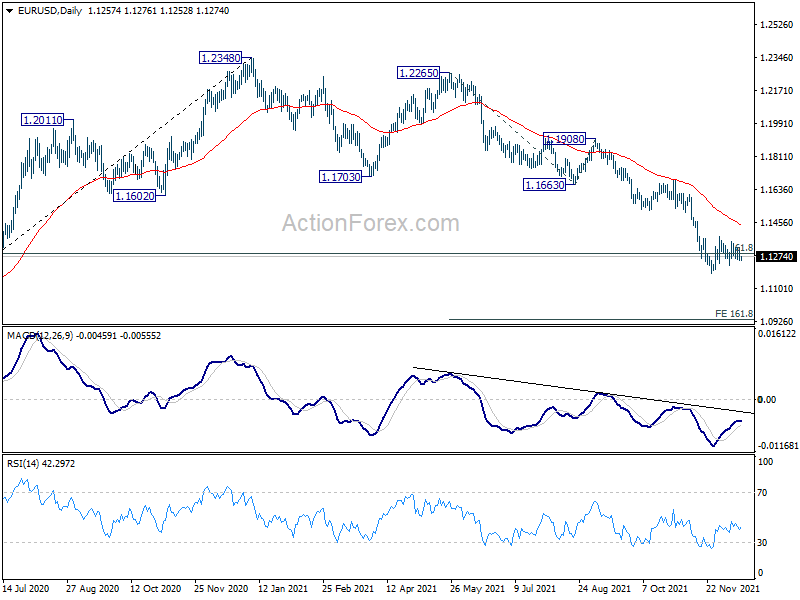
In the bigger picture, there are various ways of interpreting the fall from 1.2348 (2021 high). It could be a correction to rise from 1.0635 (2020 low), the fourth leg of a sideway pattern from 1.0339 (2017 low), or resuming long term down trend. In any case, outlook will now stay bearish as long as 1.1703 support turned resistance holds. Sustained break of 61.8% retracement of 1.0635 to 1.2348 at 1.1289 would pave the way back to 1.0635.
GBP/USD Daily Outlook
Daily Pivots: (S1) 1.3193; (P) 1.3225; (R1) 1.3259; More...
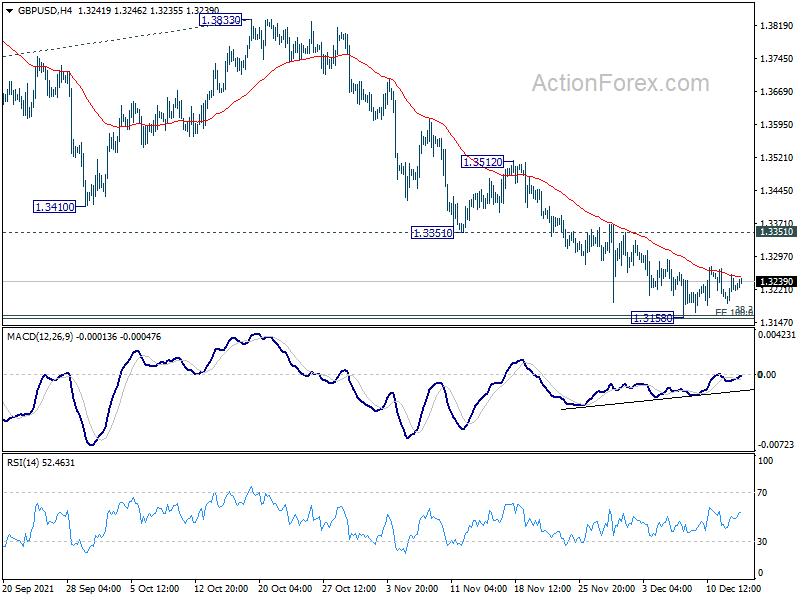
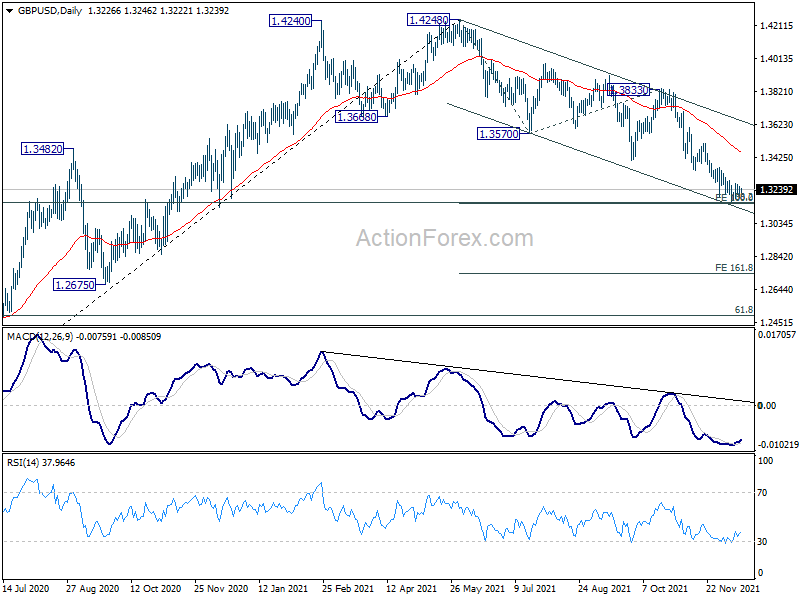
Range trading continues in GBP/USD and intraday bias remains neutral. Focus stays on 1.3164 medium term fibonacci level. Sustained break there will carry larger bearish implication, and target 161.8% projection of 1.4248 to 1.3570 from 1.3833 at 1.2736. On the upside, though, break of 1.3351 support turned resistance will indicate short term bottoming, and turn bias back to the upside for 1.3512 resistance next.
In the bigger picture, immediate focus is now on 38.2% retracement of 1.1409 to 1.4248 at 1.3164. Sustained break there will argue that whole rise from 1.1409 has completed at 1.4248, after rejection by 1.4376 long term resistance. That will revive some medium term bearishness and and target 61.8% retracement at 1.2493. However, strong rebound from current level will revive that case and up trend from 1.1409 is still in progress, and probably ready to resume.
USD/CHF Daily Outlook
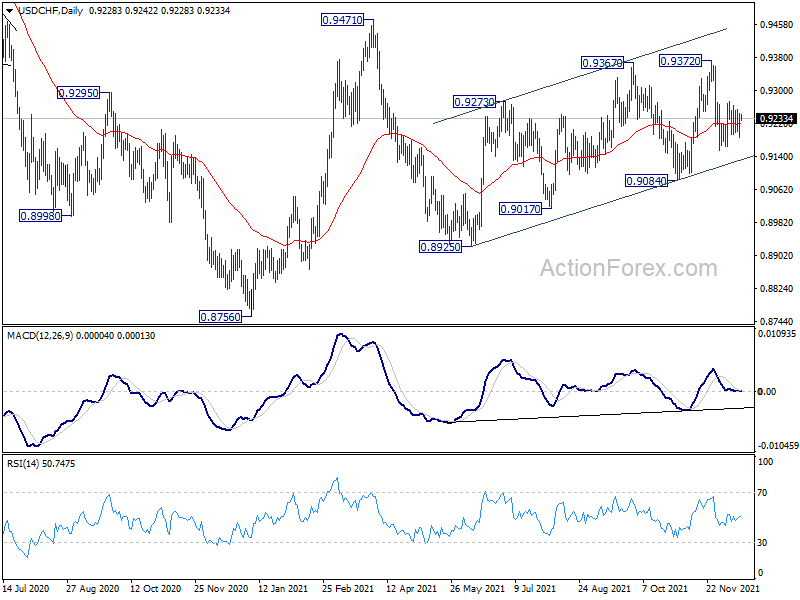
Daily Pivots: (S1) 0.9206; (P) 0.9225; (R1) 0.9262; More....
Intraday bias in USD/CHF remains neutral as sideway trading continues. On the upside, break of 0.9274 will suggest that the pull back from 0.9372 is finished. Intraday bias will be turned back to the upside for 0.9372. On the downside, below 0.9156 will target 0.9084 support. Firm break there should confirm that choppy rise from 0.8925 has completed, and suggests that fall from 0.9471 is resuming. Deeper decline would be seen through 0.8925.
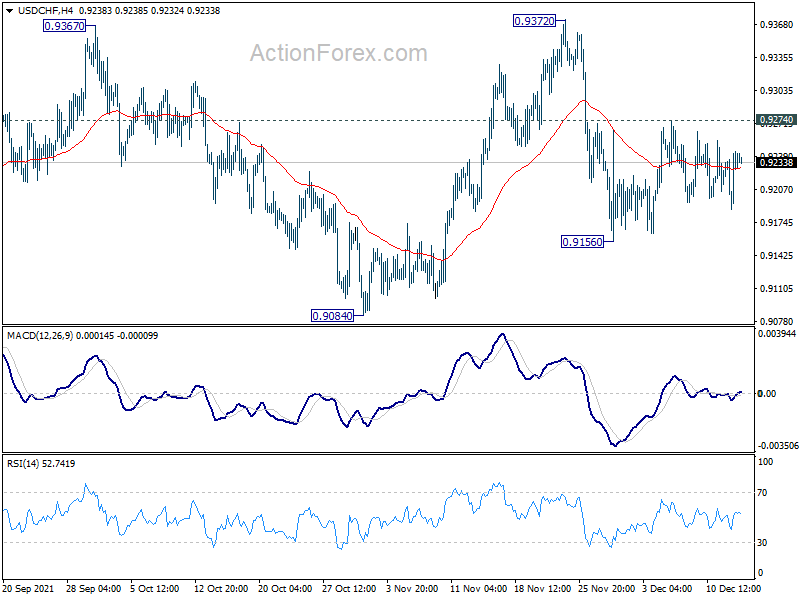
In the bigger picture, the corrective structure of the rebound from 0.8925 argues that fall from 0.9471 is not complete yet. It could either be the second leg of pattern from 0.8756 (2021 low), or resuming larger down trend from 1.0237 (2018 high). We'd pay attention to the downside momentum and assess the odds later. But for now, medium term outlook will be neutral at best as long as 0.9471 resistance holds.