Sample Category Title
Market Morning Briefing: EURJPY Is Holding Well Below 128.50
STOCKS
Most indices have fallen globally. Dow can test 35250-35000 while Dax can test 15300-15200/100 before bouncing back in the medium term. Nikkei and shanghai have fallen too and can test 27750 and 3600 respectively in the near term. Sensex can test 58000 and bounce from there else can fall to deeper levels of 57000. Nifty is likely to be stuck within 17000-17800 for now. Overall indices look weak for the next few sessions.
Dow (35544.18, -106.77, -0.30%) has come down sharply again from 36000 contrary to our expectation of a rise towards 36500-36750 on the upside. The view is bearish while below 36000 to see a fall towards 35250-35000 before we see a bounce again.
DAX (15453.56, -168.16, -1.08%) has declined sharply from 15800, falling below the range of 15500-15800. If the fall sustains, we may expect a further fall towards 15300-15200/100 on the downside before a bounce is seen.
Nikkei (28409.40, -23.24, -0.082%) has come down below 28500. The view is now bearish towards trend support near 27750 before we see a bounce from there towards 28500 again.
Shanghai (3661.31, -0.22, -0.0060%) is heading towards 3600 slowly. While below 3700 a fall towards 3625-3600 looks possible.
Nifty (17324.90, -43.35, -0.25%) saw an intraday high of 17376.20 before coming down to close around 17300. View is bearish to see a fall towards 17200/17000 before we see rise again. Broad range of 17000-17800 might hold for the next couple of weeks.
Sensex (58117.09, -166.33, -0.29%) has come down further yesterday. A range of 58000-59000 is possible while above 58000. A sharp break below 58000, if seen can take the index down towards 57000 before the expected bounce is seen.
COMMODITIES
Crude prices trade lower but have immediate supports to bounce from which if fails can lead to further fall in the near term. We need to keep a close watch at current levels. Gold seems to be slowly inching lower but can be bullish while above 1770/60. A break on the downside can take it down to 1740. Silver has broken below 22 and can fall to 21 before bouncing back from there. Copper is stuck within 4.45-4.25 and needs t break on either side to give further directional clarity.
Brent (73.07) and WTI (70.03) both trade lower and can possibly bounce back from 73 and 70 respectively to head higher towards 77/78 and 74 again on the upside. Failure to bounce from immediate supports can take it lower towards 70 and 68/67 respectively. Watch price action near current levels.
Gold (1772.20) trades just at immediate support zone of 1760/1770 and needs to bounce back immediately towards 1790-1800 else a fall towards 1740 and lower can come into the picture soon. Silver (21.94) on the other hand has brken below 22 showing near term weakness and has scope to fall towards 21.00 on the downside before bouncing back from there. Note that 21 is a crucial support which needs to hold to keep bullish possibilities alive. Else a break below 21 would be strongly bearish in the longer run.
Copper (4.2695) needs to break on either side of the 4.25-4.45 region to indicate further directional clarity. Till then we expect the narrow range to hold for now.
FOREX
Dollar Index seems to be rising slowly towards 97 before falling from there. That may take the Dollar Yen higher towards 114 before a decline is seen. Euro may head towards 1.1250-1.1200 before a bounce is seen again. EURJPY is stuck below 128. USDCNY can fall while below 6.34. USDINR has scope to rise towards 76.0-76.20. Aussie and Pound are stable just now and can be ranged for the near term. Markets may see some volatility after the FOMC statement due tonight.
Dollar Index (96.535) has scope to rise towards 97 on the upside but thereafter we need to see if it moves up further to test 98 or comes off to fall to 96-95.50 again. We continue to look at the 95.50-97/98 range to hold for now unless a break on either side is seen.
Euro (1.1261) has been in a narrow range for the past couple of weeks, stuck within 1.14-1.12 region. The Euro is falling from 1.1350 and is likely to test 1.1250-1.1200 on the downside before again bouncing back from there in the medium term. Watch price action near 1.1250-1.1200 in the near term.
EURJPY (128.06) is holding well below 128.50 and can fall towards 127.50-127 on the downside before again bouncing back from there.
Aussie (0.7107) is likely to trade within 0.72-0.70 in the next few sessions. A break below 0.71, if seen can drag it lower towards 0.68. Overall immediate view is bearish while below 0.72.
Pound (1.3230) is rising slowly from 1.3190 and can test 1.3250-1.33 on the upside before deciding further direction from there. Immediate range of 1.3250-1.3150 may hold for the next few sessions.
Dollar-Yen (113.72) has risen from levels seen yesterday and can test 114.A break above 114 will then be needed for the pair to rise further towards 114.50 or higher else a fall from 114 would again take the pair down to 113-112.50. Immediate range of 114-112.50 may hold for the next few weeks unless a break above 114 is seen.
USDCNY (6.3646) is ranged below 6.37 and may slowly fall towards 6.35/34 in the medium term. View is bearish while below 6.37.
{USDINR (75.87) closed higher yesterday and has scope to rise towards 76.0-76.20 on the upside. View is bullish for the pair while above 75.80/85.
INTEREST RATES
The US Treasury yields have inched up slightly and would now wait for the US Federal Reserve meeting outcome tonight. Broadly we expect the yields to remain in a sideways range for now and move up within it in the coming days. While an increase in stimulus taper has already been factored in, what the Fed has to say on the interest rate front will be interesting to watch tonight. The German yields remain lower and keep our bearish view intact. The European Central Bank meeting is due tomorrow. The Indian 10Yr and 5Yr GoI remain stable within their broad sideways range.
The US 2Yr (0.65%), 5Yr (1.23%), 10Yr (1.44%) and the 30Yr (1.82%) yields have inched up slightly after having fallen sharply on Monday. We expect the yields to oscillate in the range of 1.35%-1.65% (10Yr) and 1.7%-2% (30Yr) in the coming weeks. Within this range, the chances are high now for the yields to move up towards 1.65% (10Yr) and 2% (30Yr) while they sustain above 1.35% (10Yr) and 1.7% (30Yr).
The German 2Yr (-0.70%), 5Yr (-0.60%), 10Yr (-0.37%) and 30Yr (-0.07%) yields have inched up slightly but broadly remains lower. Bearish view remains intact. We expect the yields to fall further towards -0.45% / -0.5% (10Yr) and -0.1% / -0.2% (30Yr) from here in the coming days.
The Indian 10Yr (6.3558%) and 5Yr (5.6798%) GoI remains stable within their respective range of 6.3%-6.4% and 5.62%-5.73%. The broad sideways range is likely to remain intact. The price action over the last couple of days indicate that the 10Yr and 5Yr can dip within this range in the near-term.
Gold Price At Risk Of Additional Losses, Fed Next
Key Highlights
- Gold price is struggling to recover above the $1,780 resistance.
- A key bearish trend line is forming with resistance near $1,790 on the 4-hours chart.
- EUR/USD is consolidating below the 1.1350 and 1.1400 resistance levels.
- GBP/USD could aim a steady recovery above 1.3280 and 1.3300.
Gold Price Technical Analysis
This past week, gold saw a bearish reaction below the $1,800 support against the US Dollar. The price traded below the $1,780 support level to move into a bearish zone.
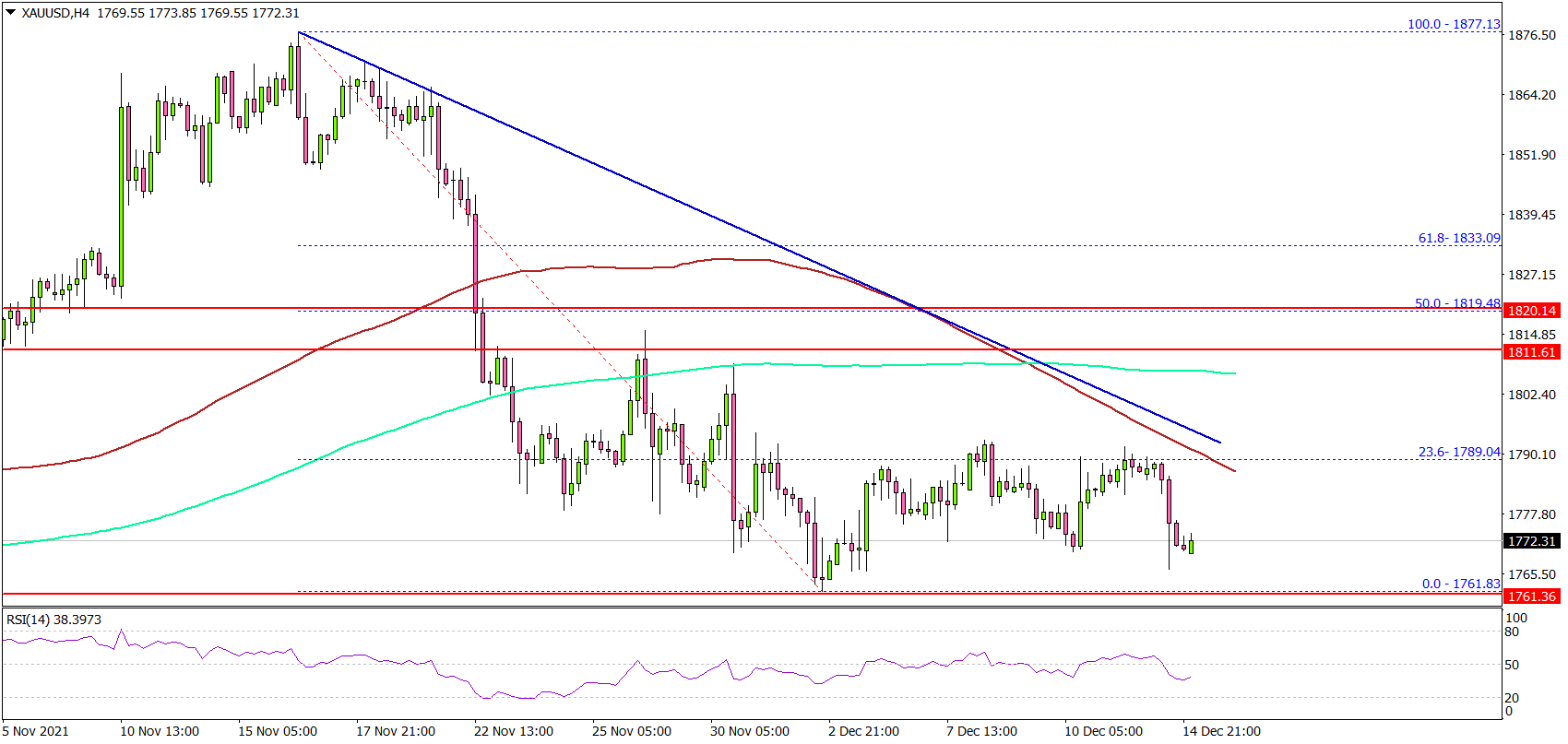
The 4-hours chart of XAU/USD indicates that the price even traded below the $1,775 support level. There was a close below the $1,800 level, the 200 simple moving average (green, 4-hours), and the 100 simple moving average (red, 4-hours).
A low was formed near $1,761 and is currently consolidating. An immediate resistance is near the $1,780 level.
The next major resistance is near the $1,790 level and the 100 SMA. There is also a key bearish trend line forming with resistance near $1,790 on the same chart. The trend line is also close to the 23.6% Fib retracement level of the downward move from the $1,877 swing high to $1,761 low.
A clear break above $1,790 could send the price toward the $1,820 resistance zone in the near term. The next key resistance is near the $1,835 level.
On the downside, the price might remain supported near $1,760. The main support is near $1,750, below which there is a risk of a break below $1,720.
Looking at EUR/USD, the pair is consolidating below the 1.1350 resistance level. Besides, GBP/USD could also recover if it settles above 1.3250.
Economic Releases to Watch Today
- UK Consumer Price Index for Nov 2021 (YoY) – Forecast +4.7%, versus +4.2% previous.
- UK Core Consumer Price Index for Nov 2021 (YoY) – Forecast +3.7%, versus +3.4% previous.
- Canadian Consumer Price Index for Nov 2021 (MoM) – Forecast +0.2%, versus +0.7% previous.
- Canadian Consumer Price Index for Nov 2021 (YoY) – Forecast +4.7%, versus +4.7% previous.
- Fed Interest Rate Decision – Forecast 0.25%, versus 0.25% previous.
Eco Data 12/15/21
[php_everywhere instance="1"]
ECB Meeting: Shadow Tapering
The European Central Bank (ECB) will have to decide by how much to slash its asset purchases when it concludes its meeting at 12:45 GMT Thursday. It will probably be another battle between hawks and doves, with the most likely compromise being to cut quantitative easing in about half. As for the euro, the bigger picture remains gloomy.
Inflation strikes back
The ECB has a difficult balancing act to pull off this week. Inflation has accelerated dramatically, mostly thanks to surging energy prices and the storm in supply chains, making the most hawkish members of the Governing Council nervous that it could stick around.
Yet, the outlook for growth remains daunting with covid restrictions making a comeback in several countries and the labor market still far away from a full recovery. This implies wage growth is likely to remain muted for a while longer, so ‘organic’ inflationary pressures are not so powerful.
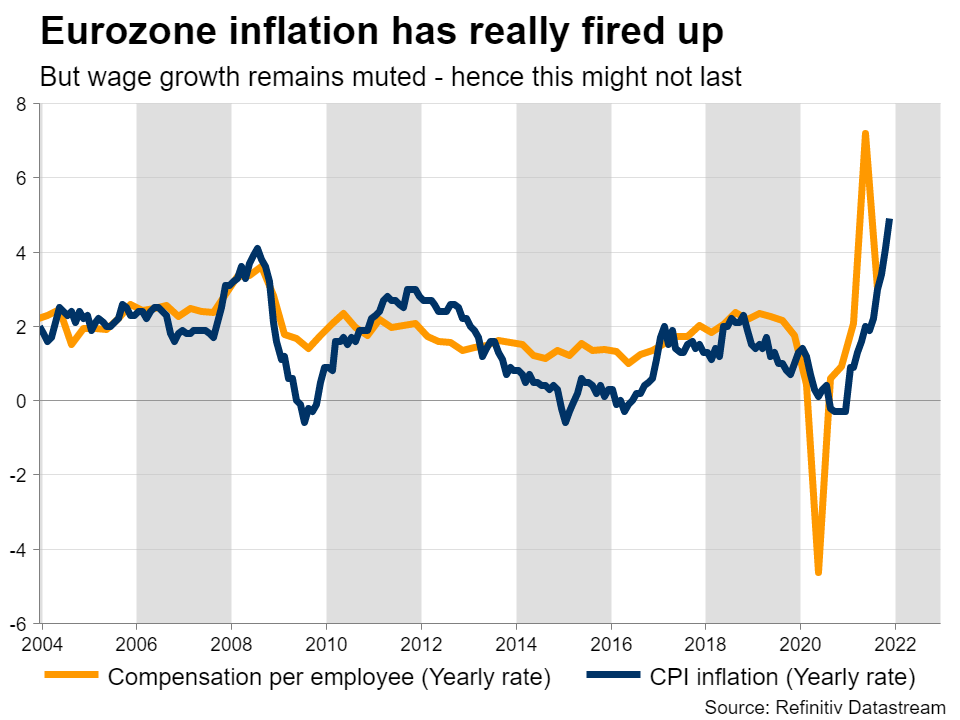
Against this backdrop, the ECB will have to decide whether and by how much to reduce its asset purchases. Admittedly, it’s a tough spot. Do nothing and you risk pouring more fuel on the inflationary bonfire. Cut back too much and you might shock the bond market, risking a minor replay of the debt crisis.
Walking a fine line
As such, the most likely conclusion is a compromise whereby the ECB ends the emergency asset purchase program completely but expands its regular program to make up for some of the shortfall. Overall, the pace of QE purchases could be slashed in about half, from EUR 80 billion per month currently to roughly 40 billion after March.
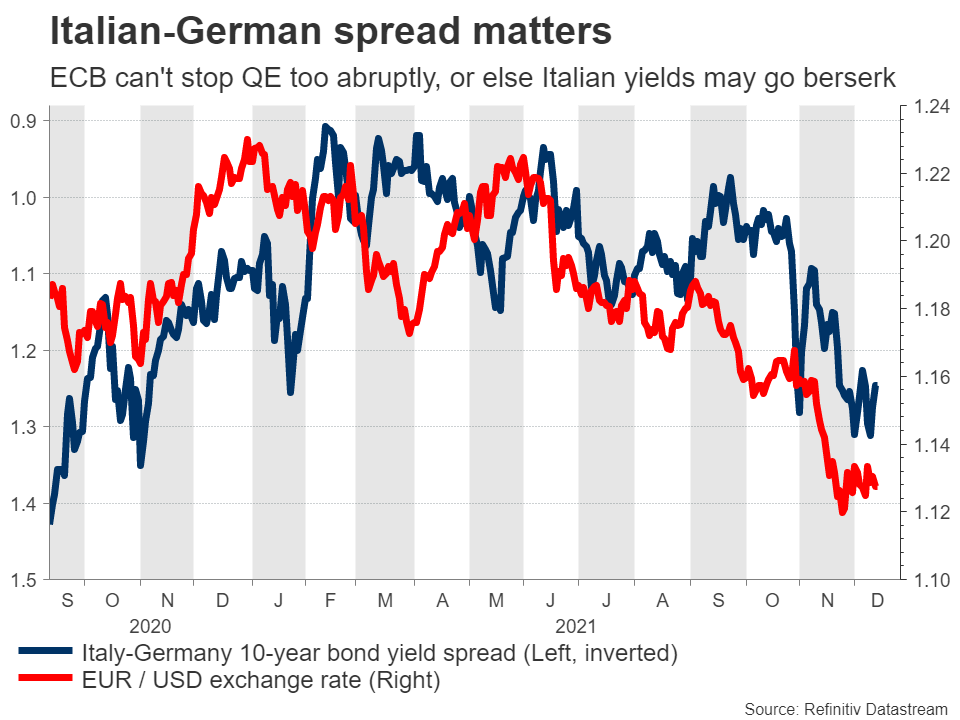
That would likely appease the hawks that are terrified of persistent inflation, as well as the doves that are worried a sudden withdrawal might spark havoc in the bond market. This is particularly a risk for economies like Italy that have high debt levels, so any spike in bond yields could hamstring the entire recovery.
Euro remains besieged
As for the euro, the initial reaction will depend on how deeply asset purchases are slashed, how much higher the new inflation forecasts are revised, and any signals around future rate increases. Everything essentially revolves around whether the ECB is still relaxed or is growing concerned about inflation.
Ultimately, even if the market decides the central bank was on the hawkish side of expectations and the euro spikes higher, there isn’t much to like about the currency in the bigger picture. The European recovery is still anemic and in contrast to the Fed, the ECB will continue with asset purchases and is not even considering rate increases.
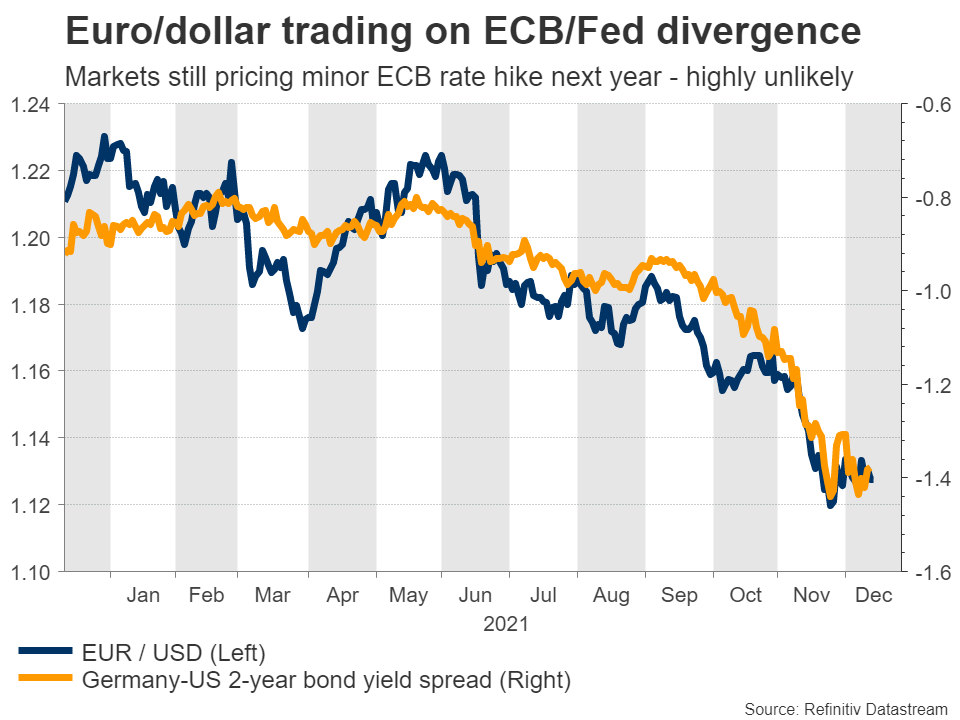
Markets are still pricing in a decent probability for a small rate hike next year, so there is scope for more losses in the euro as the ECB pushes back against this. Political risks are also on the radar, with a contentious election in France next year and the possibility that far-right forces take control in Italy if snap elections are called.
Global risk sentiment is another variable. The euro tends to underperform during periods of market stress, and with global central banks tightening while asset valuations are so ‘pricey’, this is something to watch closely.
Taking a technical look at euro/dollar, if the bears retake the reins and manage to pierce below the recent low of 1.1185, the next target could be the March 2020 peak of 1.1140.
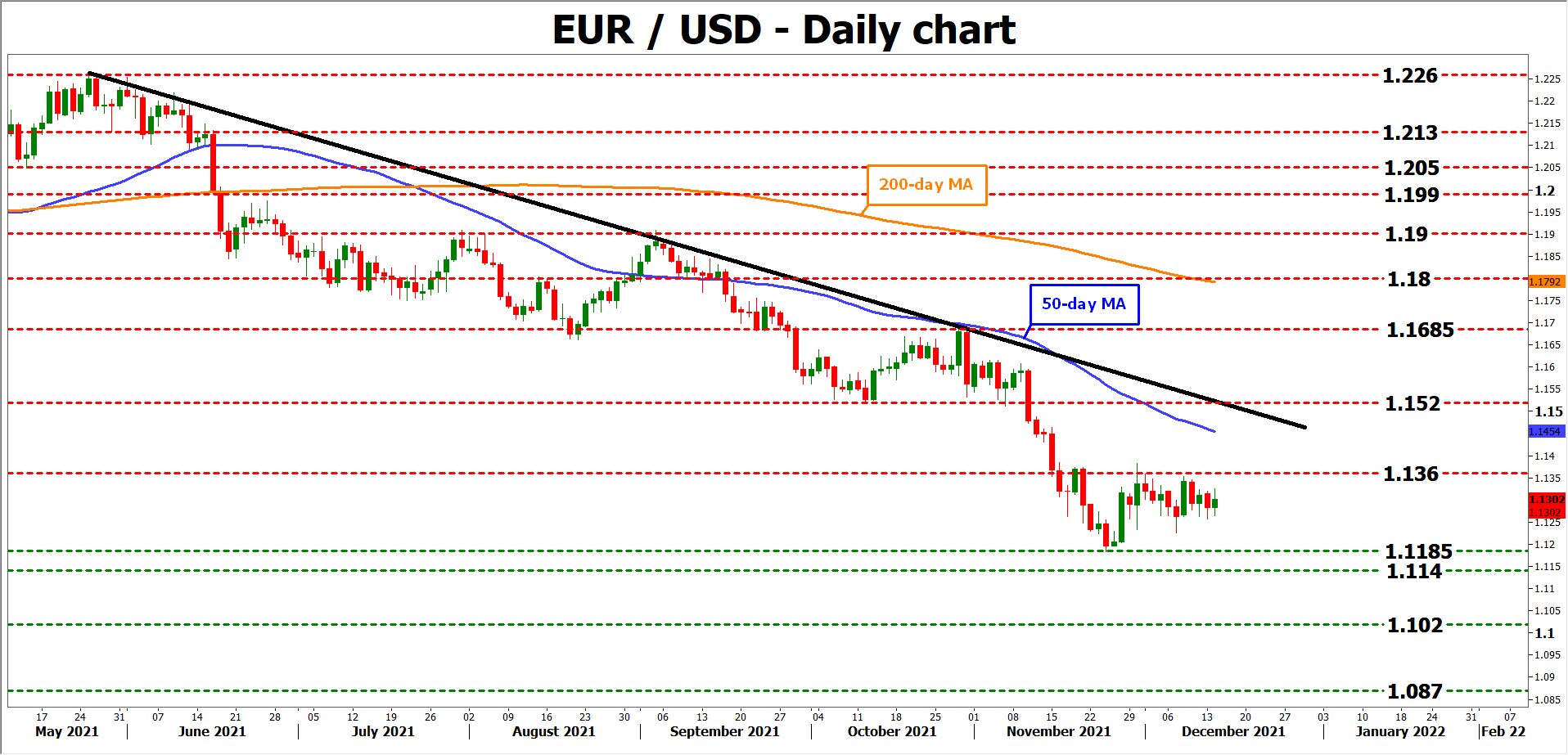
On the upside, the bulls could encounter their first test at 1.1360, a violation of which could open the door for a congested area that encompasses the 50-day moving average, the downtrend line drawn from the May peak, and the 1.1520 region.
Finally, the latest PMI business surveys for December will also be released ahead of the ECB decision, at 08:00 GMT on Thursday.
GBP/USD Outlook: Strong UK Jobs Data Underpin Pound But Upticks Were Limited
Cable edged higher in European trading on Tuesday, underpinned by strong UK jobs data for October, but upticks were so far limited as near-term action remains weighed by thick weekly cloud.
Also, fragile political situation in the UK, on signals that PM Johnson is going to face strong opposition in the parliament over the latest Covid measures, would also sour the sentiment.
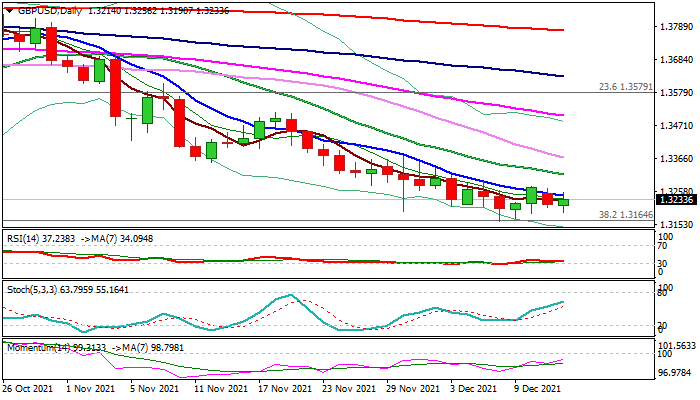
Studies on daily chart remain overall bearish, with north-heading momentum, although still in the negative territory, seen as supportive factor.
Fresh strength needs close above falling 10DMA (which caps the action since Nov 22) to ease downside pressure, but minimum requirement to sideline larger bears will be a sustained break above 1.3300 zones (Fibo 38.2% of 1.3513/1.3161 bear-leg / falling 20DMA).
Res: 1.3232; 1.3250; 1.3300; 1.3328.
Sup: 1.3161; 1.3100; 1.3046; 1.3000.
NZ Dollar Steadies, Orr Testifies
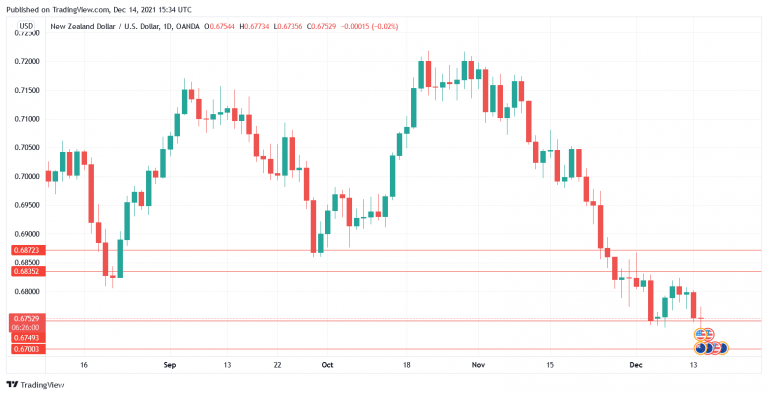
The New Zealand dollar has stabilized after starting the week with sharp losses. In the North American session, NZD/USD is trading at 0.6754, unchanged on the day. The currency remains close to a 12-month low.
Fed expected to accelerate taper
All eyes are on the FOMC policy meeting on Wednesday. Now that the Powell & Co. have officially retreated from the ‘transitory inflation’ label, there are strong expectations that the Fed will follow up by accelerating its taper and raising rates sometime in mid-2022. The Fed is likely to double the pace of the taper, from USD 15 billion/mth to USD 30 billion/mth, starting in January. This means that the bond purchase scheme will wind up in March and the Fed will be in a position to hike rates. The dot plot at the upcoming meeting is expected to show that policymakers have become much more hawkish than in previous meetings.
RBNZ Governor Frank Orr testifies today before a parliamentary committee, and this event could be a market-mover for the New Zealand dollar. The bank had planned a series of rate hikes extending into 2022, but the Omicron variant has become a significant wild card which could upend the plans of the RBNZ to raise rates. If Orr hints at a suspension of rate hikes due to Omicron, the New Zealand dollar could lose ground.
New Zealand will release GDP for Q3 on Thursday. We are likely to see negative growth during this period, since Auckland, the country’s largest city was under lockdown in August and September. There were dire predictions of a huge decline in growth, including the RBNZ, which projected a -7% reading in November. However, recent economic data has been solid, which has resulted in a consensus of around -4%. If the forecast is within expectations, it remains to be seen if investors give the economy a thumbs down, or will they be relieved that the economy didn’t slide by -7%. It will be interesting to see how the New Zealand dollar responds to the GDP report.
NZD/USD Technical
- There is resistance at 0.6835. Closely above is resistance at 0.6875
- NZD/USD has support at 0.6749. Below, there is support at the round number of 0.6700
Sunset Market Commentary
Markets
Investors remain in (a defensive) wait-and-see mode ahead of policy decisions by the Fed, the ECB, the BoE and the BoJ. There were no important EMU data. US NFIB small business confidence improved slightly from 98.2 to 98.4, but the report shows no euphoria, on the contrary. NFIB Chief economist Dunkelberg as quoted: ‘As the end of the year nears, the outlook for business conditions is not encouraging to small business owners as lawmakers propose additional mandates and tax increases’. Rampant inflation and supply chain disruptions, was also mentioned as hampering small business activity. The net percentage of businesses expecting a better economy falls to -38%, the lowest since 2012. The content and the tone of the report shows a different picture compared to strong ISM’s. Contrary to last week’s at-consensus US CPI, PPI inflation unexpectedly accelerated further (0.8% M/M and 9.6% Y/Y headline). After a hesitant first reaction, US yields are rising between 3 bps (2-y) and 5.2 bps (30-y). German yields also show a ‘technical’ rebound (+ 2.5 bps across the curve). Changes in 10-y peripheral spreads show no big moves, but tentative tightening in Italy (-2 bp), and Greece (-4bp) suggests that markets still hope for persistent ECB backing even in the post PEPP era. The rise/tentative steepening in US yields hardly removed ‘uncertainty’ for equity investors (EuroStoxx 50 currently -0.25%; US indices also opened again in red).
In FX, the rise US yields annex risk-off, this time doesn’t help the dollar. EUR/USD before the US open already enjoyed a short-squeeze lifting the pair from 1.127 to the 1.1320 area. Again, no technically important levels were touched. At EUR/USD 1.13, the lethargy pre-Fed/ECB persists. This also applies to EUR/GBP trading. Data this morning showed employment continued to growth even as the furlough scheme ended. November jobless claims also declined faster than expected. Even so, with uncertainty on the impact of omicron building, it won’t be evident for the BoE to find the appropriate timing for reducing interest rate support. The IMF advocates that the UK is in a good position to reduce monetary and fiscal support as inflation is expected to hit 5.5% in spring. Action now would create policy space in a longer term horizon. Question is how much weight BoE members will give to the IMF’s assessment on Thursday. EUR/GBP trades little changed near 0.854, with the 0.85/0.86 corridor still intact.
News Headlines
The German Ifo Institute published its Winter forecast. Compared with the Autumn release, they kept this year’s GDP forecast unchanged at 2.5%, but the fourth wave of the coronavirus and production difficulties in manufacturing explains the downward revision to the 2022 GDP prognosis (3.7% from 5.1%) and the upward change for 2023 (2.9% from 1.5%). The German Economy Ministry also warned for a tough winter and increased short term economic risks. Consumer prices are likely to continue to rise noticeably over the coming year. The cost increases associated with supply bottlenecks and delayed adjustments to higher energy and commodity prices will play a driving role. Ifo expects average inflation to rise from 3.1% this year to 3.3% next year before falling back to 1.8% in 2023.
The Hungarian central bank raised the base rate with 30 bps to 2.40%. It stepped up the overnight deposit rate to the same level (+80 bps) while raising the overnight lending rate with 30 bps to 4.40%. Doing so, the MNB turns the interest rate corridor asymmetric with upside scope only. The move highlights the central bank’s determinacy to fight inflation and second-round effects as inflation rose to 7.4% in November. While the MNB expects headline prices to have peaked last month, it sees core inflation rising further to 6% mid-2022. The MNB’s current preferred tool, the one-week deposit rate to suck up HUF liquidity, on Thursday will be raised by at least as much as today’s base rate increase, it said (ie. from 3.3% to 3.6%). Additionally, the central bank will stop the reinvestment phase of maturing government bonds, allowing its balance sheet to roll off. The Hungarian forint in a first reaction was disappointment but recovered after the additional measures in the press release went public. That said, EUR/HUF still trades historically high north of 365/366.
US: NFIB Small Business Optimism Index Largely Unchanged in November
The National Federation of Independent Business' (NFIB) small business optimism index ticked up 0.2 points to 98.4 in November from 98.2 in the month prior, making for a mostly flat trend. November's headline print was in line with market expectations.
Four of the ten subcomponents fell on the month, four improved and two remained unchanged. Leading the charge was a six point increase in the share of businesses that view current inventory as being 'too low'. At 15%, the latter is at a record-high level. Improvements in plans to increase inventories (+2 points to 10%) and expectations for higher real sales (+2 points to 2%) also helped lift the headline.
Weighing on the headline index was a four point decline in capital outlay plans (27%) and a one point decline in expectations about an improvement in the economy (-38%). The latter is tied with November 2012 for the lowest reading on record.
Most of the survey's labor market indicators eased on the month. The share of firms with unfilled job openings and the share of firms planning to increase employment fell one point a piece to 48% and 25% respectively. At the same time, the share of firms reporting 'few or no qualified' applicants to their job postings fell two points to 56%. 'Quality of labor' concerns, however, remained top of mind, rising five points to 29% – a new record high in the survey's 48-year history. Concerns regarding inflation increased further, rising two points to 18%.
Businesses continued to place a heavy focus on wage increases in order to attract and retain workers. Both the share of firms increasing worker compensation and those planning to do so held steady at record high levels of respectively 44% and 32%. This was accompanied by an elevated share of firms raising average selling prices (+6 points to 59%) and those planning to do so (+3 points to 54%).
Key Implications
Optimism among American small businesses remained largely unchanged in November, putting a pause to the downward trend that has characterized the second half of 2021. Businesses remain downbeat about an improvement in the economy and continue to struggle with finding qualified workers. In fact, 'labor quality' is the single-most important problem for 29% of businesses – the highest level on record in nearly half a century. Worsening epidemiological trends in many parts of the country may weigh on optimism further as the year draws to a close.
Concerns regarding inflation have shot higher in recent months, with an elevated 18% of businesses in November singling out inflation as their top business problem from just 1-3% between 2016 and the start of 2021. Businesses continue to raise employee compensation in order to attract and retain talent, with compensation metrics holding at all-time highs in November. Many of these added costs, including those incurred from supply chain disruptions, continue to be unloaded onto consumers, with price metrics also near the highest levels since the 1970s. Taken together, these indicators point to continued inflationary pressure in the near-term.
Market Sentiment Remains Tentative ahead of Central Bank Meetings
Dollar slips ahead of FOMC; euro and pound hold firm; safe havens shine
The dollar is softer on the day despite surging Treasury yields and soaring risk-off sentiment in global markets triggered by the resurgence of Omicron jitters. However, the driving force behind this pullback might be a report published earlier in the session, which suggests that two doses of the Pfizer vaccine provide 70% protection against the new Omicron variant. The US producers pricing index is reported later today, but it is unlikely to have any impact on the dollar.
Although the ECB is expected to stick to the dovish rhetoric at its Thursday meeting, the euro is trading higher in the current session. In addition, the British pound is in the green, with the solid UK jobs report that came out earlier today underpinning the currency’s prospects. Nevertheless, the upside potential is limited as the BoE is anticipated to delay its upcoming rate hike to February 2022 due to the Omicron variant outbreak in the UK.
The Swiss franc is appreciating today, capitalizing on surging risk aversion, while the Japanese yen paired part of its early-session gains. Moreover, the commodity-linked currencies are flat in the current trading session.
Stock markets grapple with Omicron fears
The outlook for equity markets is relatively mixed today. Wall Street is set to open lower today as e-mini futures for the major US indices are taking a hit in premarket trade. More specifically, Nasdaq and S&P 500 futures are down 0.5% and 0.2% respectively, while Dow Jones futures are flat.
On the other hand, major European indices kept a slightly more positive tone but have not yet managed to recover yesterday’s losses.
In individual equity news, Elon Musk has accelerated his disposal of Tesla shares to cover taxes on the exercise of 2.1 million options, according to regulatory filings.
Gold and oil dip
Gold is trading lower today despite the prevailing risk-off sentiment and the weaker dollar, heavily pressured by soaring Treasury yields. Furthermore, oil prices are also plummeting in the current session as fears over the Omicron variant are posing a threat to the demand side.
EUR/USD Mid-Day Outlook
Daily Pivots: (S1) 1.1259; (P) 1.1289; (R1) 1.1317; More...
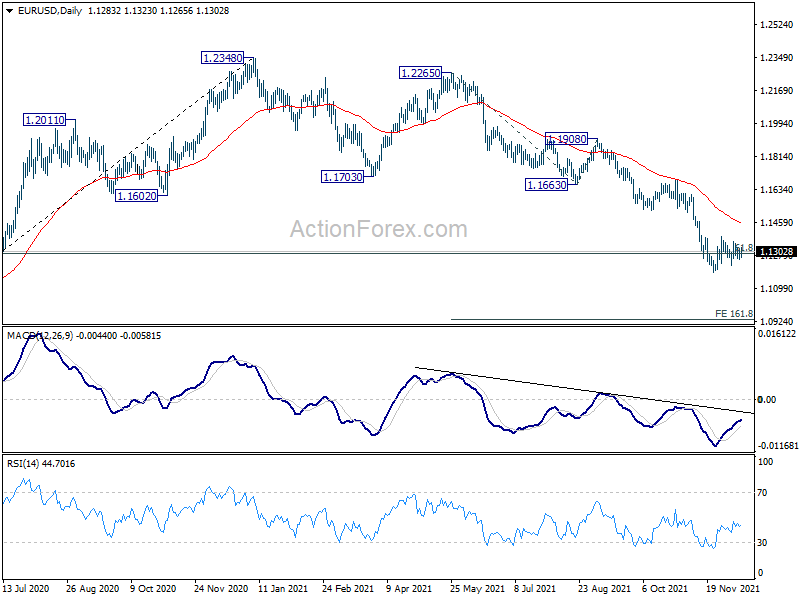
Intraday bias in EUR/USD remains neutral as range trading continues. Downside breakout is mildly in favor with 1.1382 minor resistance intact. On the downside, break of 1.1185 will resume larger fall from 1.2348. Next target is 161.8% projection of 1.2265 to 1.1663 from 1.1908 at 1.0934. On the upside, however, firm break of 1.1382 resistance should confirm short term bottoming at 1.1186. Intraday bias will be turned back to the upside for 55 day EMA (now at 1.1450).
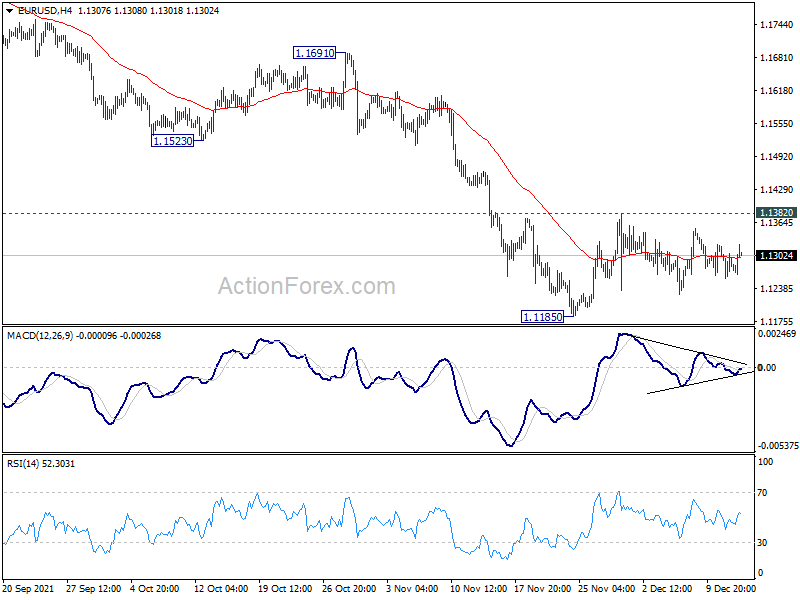
In the bigger picture, there are various ways of interpreting the fall from 1.2348 (2021 high). It could be a correction to rise from 1.0635 (2020 low), the fourth leg of a sideway pattern from 1.0339 (2017 low), or resuming long term down trend. In any case, outlook will now stay bearish as long as 1.1703 support turned resistance holds. Sustained break of 61.8% retracement of 1.0635 to 1.2348 at 1.1289 would pave the way back to 1.0635.