

Sample Category Title
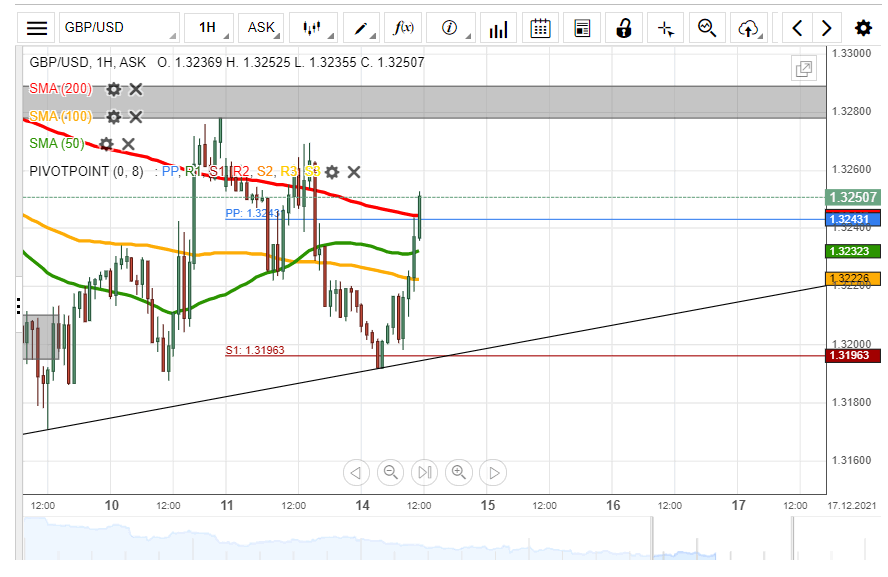
GBP/USD Finds Support In Trend Line
On Tuesday, the GBP/USD found support in the trend line, which connects the December 8 and 9 low levels. By the middle of the day, the rate had reached and pierced the resistance of the 200-hour simple moving average and the weekly simple pivot point at 1.3245.
A continuation of the surge of the rate would most likely reach the resistance of the recent high levels at 1.3277/1.3289. A move above this zone could find resistance in the 1.3300 mark, before aiming at the weekly R1 simple pivot point at 1.3324.
Meanwhile, a decline of the rate could look for support in the 50 and 100-hour simple moving averages near 1.3230 and 1.3220. Below the SMAs, the low level trend line and the weekly S1 simple pivot point might stop the pair at 1.3196.
EUR/USD Breaks Resistance Levels
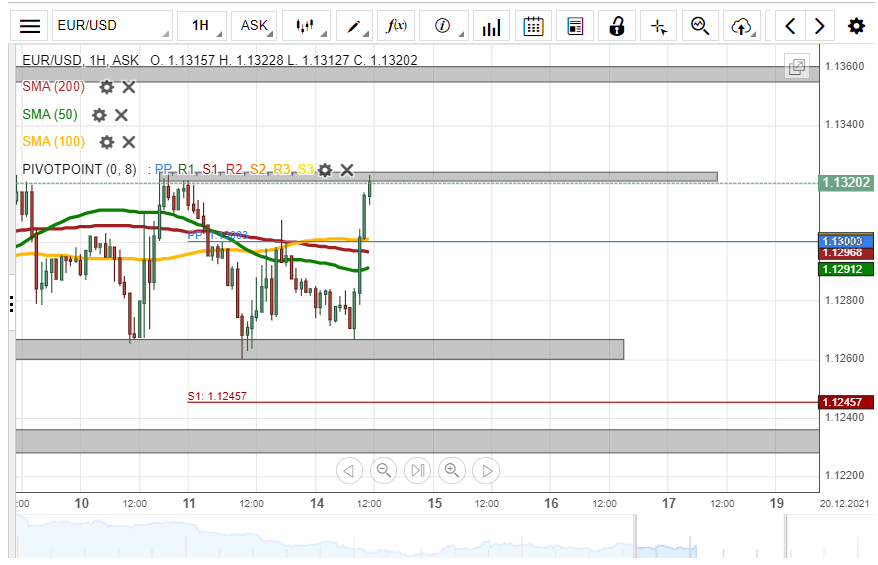
On Tuesday morning, the EUR/USD found support in the 1.1260/1.1267 zone, which has kept the rate up since December 8. By the middle of the day's GMT trading hours, the pair had almost reached the December 10 high levels above the 1.1320 mark.
If the rate would pass the resistance of the 1.1320 mark, the EUR/USD could reach for the December high level zone at 1.1355/1.1360. Above the zone, the weekly R1 simple moving average at 1.1373 might stop a potential surge.
On the other hand, a bounce off from the resistance could cause a decline. A potential decline might look for support in the technical levels at 1.1290/1.1300. In that range the 50, 100 and 200-hour simple moving averages were located together with the weekly simple pivot point. Below these levels, the support zone at 1.1260/1.1267 might stop a decline.
Virus Concerns And Upcoming Central Bank Meetings In Focus
Notes/Observations
- According to South African 3-week study based on >211K samples, 2 doses of Pfizer/BioNTech vaccine provide 70% protection against hospitalization, 33% protection against infection during current Omicron wave
- UK labour market continued to weathered the storm after the furlough scheme ended in September
- South Africa study has markets concern of an upward wave of new infections
- Focus remains on upcoming central bank rate decisions (Fed on Wed; SNB, BOE, and ECB on Thurs; BOJ on Fri)
Asia
- BOJ again buys ¥2.0T in bonds via repurchase agreements for its 2nd consecutive operation. (*8Note: move follows rise in Japanese repo rates)
Coronavirus
- South African 3-week study noted that 2-doses Pfizer/BioNTech vaccine provided 70% against hospitalization, 33% protection against infection during current Omicron wave
Europe
- BOE Gov Bailey stated that corporate debt vulnerability had only increased moderately during pandemic. Did not think we are in a situation where there is stress around the corner for markets due to Omicron. Scrapping the affordability requirement for mortgages should not be seen as relaxation of lending standards
- UK House of Commons to vote on new Covid measures on Tuesday, Dec 14th. Recent press articles noted that approx. 70 Tory MPs were expected to vote against, however the measures are likely to pass after the labour Party said they would support them
- Chancellor of the Exchequer Sunak (Fin Min) said to have been asked by the head of the CBI to scrap plans to raise taxes after the BOE warned about risks to the economy from Omicron variant
Americas
- US Senate to vote Tuesday (Dec 14th) on a bill lifting the debt ceiling
- White House said President Biden had a constructive phone call with Senator Manchin (D-WV), and to follow up in next few days. Manchin had cited concerns with the proposal’s reliance on temporary programs and inflation. (earlier Manchin said that he still wanted a package of about $1.7T)
Speakers/Fixed income/FX/Commodities/Erratum
Equities
- Indices [Stoxx600 -0.08% at 473.12, FTSE +0.26% at 7,250.40, DAX -0.10% at 15,606.72, CAC-40 -0.05% at 6,939.78, IBEX-35 +0.48% at 8,362.50, FTSE MIB 0.00% at 26,550.00, SMI -0.04% at 12,546.26, S&P 500 Futures -0.38%]
- Market Focal Points/Key Themes: European indices open generally higher but started to trend lower as the session wore on; turn in sentiment blamed on report about omicron out of South Africa; sectors among those leading the way higher are materials and financials; while industrials and real estate sectors lag; oil and gas subsector moving higher following OPEC and IEA monthly reports; Vifor confirms to be acquired by CSL; Terminix to be acquired by Rentokil; National Express and Stagecoach confirm their merger; focus on upcoming FOMC meeting later in the day; earnings expected during the upcoming US session include OVS
Equities
- Consumer discretionary: Ocado [OCDO.UK] +8% (trading update)
- Energy: Rosneft [ROSN.RU] +2% (puts out fire at its largest oilfield)
- Healthcare: Vifor Pharma [VIFN.CH] +15% (confirms to be acquired)
- Industrials: Ceconomy [CEC.DE] +8% (earnings), Stagecoach [SGC.UK] +8% (to be acquired), Rentokil Initial [RTO.UK] -4% (acquires US firm Terminix)
- Telecom: BT Group [BT.A.UK] -6% (stake sale)
Speakers
- Germany IFO Institute updated its economic outlook which saw Q4 domestic GDP at -0.5%. It raised the 2022 GDP growth forecast from 5.1% to 3.7% and also raised the 2023 GDP growth forecast from 1.5% to 2.9%.
- Norway govt to reintroduce govt guarantee scheme for corporate loans.
- UK Dep PM Raab Noted that no further restrictions were planned for this Christmas and Plan B rules were likely to be sufficient to stem the spread of Omicron.
- Sweden Central Bank (Riksbank) Dep Gov Breman noted that Nov CPI data showing that electricity prices were having a big effect and supported view that could be reasonable to taper more in 2022.
- Czech Central Bank Gov Rusnuk stated that he saw interest rate closer to 4.0% in 2022 than to 3.0%. Expected a debate on a larger rate hike of over 50bps in Dec.
- German VDMA Engineering association updated it production outlook for 2021 and 2022. Cut its 2021 production from 10.0% to 7.0% while raising the 2022 production outlook from 5.0% to 7.0%. It saw supply bottlenecks remaining until Q2 2022 nut was not seeing any cancellation in orders at this point.
- Bank of Korea (BOK) Nov Minutes noted that one member (Joo) saw it being difficult to expect a strong economic recovery unless the pandemic eased. Did added that recovery in job market and household income meant it was time to discuss adjusting policy rates. One member noted that inflation might last for a considerable time.
- BOJ said to be considering extending the covid measures beyond Mar 2022.
- IEA Monthly Oil Report (OMR) noted that gobal oil supply was poised to overtake demand starting from Dec 2021. IEA cut its 2021 global oil demand growth from 5.5M bpd to 5.4M bpd and cut the 2022 global oil demand growth from 3.4M bpd to 3.3M bpd. New containment measures put in place to halt the spread of the virus were likely to have a more muted impact on the economy versus previous COVID waves.
Currencies/Fixed income
- USD remained supported on expectations of an upbeat Fed announcement which would be complemented with accelerate tapering of its bond-purchase program. Greenback did drift lower towards the mid-part of the session as equity markets gave back their initial gains. Virus concerns continue to percolate as more studies were presented on vaccine efficacy.
- EUR/USD moved back above the 1.13area. Dealers noted that the Omicron virus variant puts some uncertainty whether the ECB’s Pandemic Emergency Purchase Program would end as scheduled in in March 2022.
- GBP/USD moved off the 1.32 level ahead of the UK Parliament debate and vote on new covid measures. Recent press articles noted that approx. 70 Tory MPs were expected to vote against, however the measures are likely to pass after the labour Party said they would support them.
Economic data
- (SE) Sweden Nov PES Unemployment Rate: 3.5 v 3.6% prior.
- (FI) Finland Nov CPI M/M: 0.4% v 0.8% prior; Y/Y: 3.7% v 3.2% prior.
- (IN) India Nov Wholesale Prices (WPI) Y/Y: 14.2% v 12.0%e.
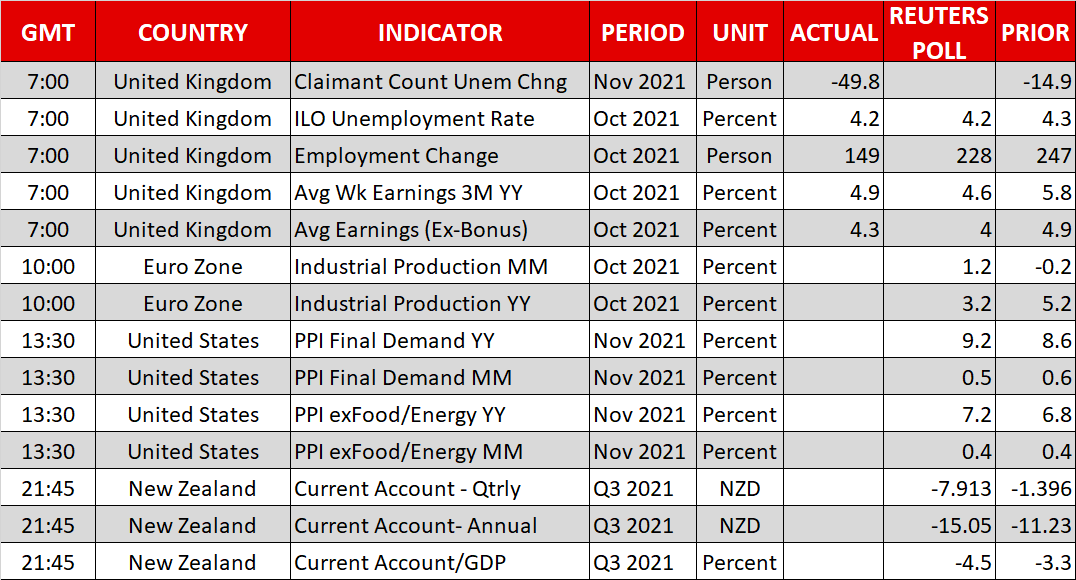
- (UK) Nov Jobless Claims Change: -49.7K v -58.5K prior; Claimant Count Rate: 4.9% v 5.0% prior.
- (UK) Oct Average Weekly Earnings 3M/Y: 4.9% v 4.6%e; Weekly Earnings (ex-bonus) 3M/Y: 4.3% v 4.0%e.
- (UK) Oct ILO Unemployment Rate: 4.2% v 4.2%e; Employment Change 3M/3M: +149K v +225Ke.
- (CH) Swiss Nov Producer & Import Prices M/M: 0.5% v 0.6% prior; Y/Y: 5.8% v 5.1% prior.
- (ZA) South Africa Q3 BER Consumer Confidence: -9 v -10 prior.
- (SE) Sweden Nov CPI M/M: 0.5% v 0.4%e; Y/Y: 3.3% v 3.2%e; CPI Level: 348.03 v 347.86e.
- (SE) Sweden Nov CPIF M/M: 0.5% v 0.4%e; Y/Y: 3.6% v 3.5%e.
- (SE) Sweden Nov CPIF (ex-energy) M/M: 0.1% v 0.1%e; Y/Y: 1.9% v 1.9%e.
- (IS) Iceland Nov International Reserves (ISK): 918B v 925B prior.
- (EU) Euro Zone Oct Industrial Production M/M: 1.1% v 1.2%e; Y/Y: 3.3% v 3.0%e.
Fixed income issuance
- (ZA) South Africa sold total ZAR3.9B vs. ZAR3.9B indicated in 2032, 2037 and 2048 bonds.
- (ES) Spain Debt Agency (Tesoro) sold total €1.66B vs. €1.0-2.0B indicated range in 3-month and 9-month bills.
- (AT) Austria Debt Agency (AFFA) sold €805M vs. €805M indicated in 0% Feb 2031 RAGB Bonds; Avg Yield: -0.156% v -0.031% prior; bid-to-cover: 2.20x v 2.90x prior (Oct 5th 2021).
- (IT) Italy Debt Agency (Tesoro) sold €3.5B vs. €3.0-3.5B indicated range in new 0.00% Dec 2024 BTP Bonds; Avg Yield: -0.10% v -0.27% prior; bid-to-cover: 1.21x v 1.65x prior.
Looking ahead
- UK House of Commons to vote on new Covid measures.
- (PT) Bank of Portugal on ECB financing to Portuguese Banks.
- 05:15 (CH) Switzerland to sell 3-month Bills.
- 05:25 (EU) Daily ECB Liquidity Stats.
- 05:30 (HU) Hungary Debt Agency (AKK) to sell 3-Month Bills.
- 05:30 (BE) Belgium Debt Agency (BDA) to sell 3-month and 12-month bills.
- 05:30 (EU) ECB allotment in 7-Day Main Refinancing Tender (MRO).
- 06:00 (US) Nov NFIB Small Business Optimism Index: 98.4e v 98.2 prior.
- 06:00 (PT) Portugal Nov Final CPI M/M: No est v 0.5% prelim; Y/Y: No est v 2.6% prelim.
- 06:00 (PT) Portugal Nov Final CPI EU Harmonized M/M: No est v 0.3% prelim; Y/Y: No est v 2.7% prelim.
- 06:00 (BR) Brazil Central Bank (BCB) Dec Minutes.
- 06:30 (EU) ESM to sell €1.1B in 12-month Bills.
- 06:45 (US) Daily Libor Fixing.
- 07:00 (TR) Turkey to sell Bonds.
- 07:00 (MX) Mexico Oct Gold Production: No est v 7.6K kilograms prior; Silver Production: No est v 353.9K kilograms prior; Copper Production: No est v 41.2K tons prior.
- 07:00 (BR) Brazil Oct IBGE Services Volume Y/Y: No est v 11.4% prior.
- 08:00 (HU) Hungary Central Bank (MNB) Interest Rate Decision: Expected to raise Base Rate by 40bps to 2.50%.
- 08:00 (PL) Poland Oct Current Account Balance: -€1.2Be v -€1.3B prior; Trade Balance: +€0.1Bev -€0.1B prior; Exports: €25.6Be v €24.5B prior; Imports: €25.5Be v €24.7B prior.
- 08:00 (UK) Daily Baltic Dry Bulk Index.
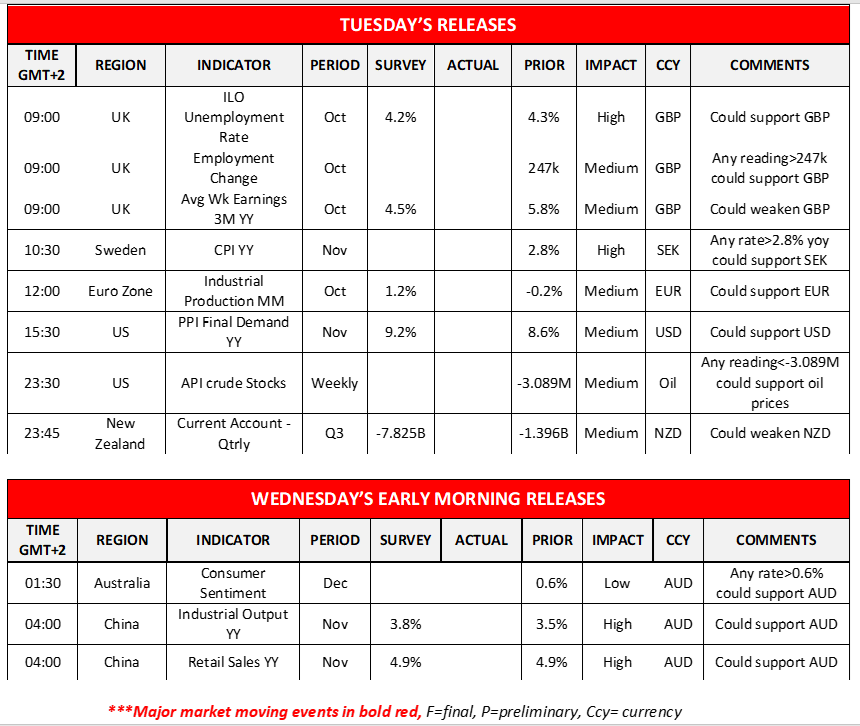
- 08:30 (US) Nov PPI Final Demand M/M: 0.5%e v 0.6% prior; Y/Y: 9.2%e v 8.6% prior.
- 08:30 (US) Nov PPI (ex-food/energy) M/M: 0.4%e v 0.4% prior; Y/Y: 7.2%e v 6.8% prior.
- 08:30 (US) Nov PPI (ex-food/energy/trade) M/M: 0.4%e v 0.4% prior; Y/Y: No est v 6.2% prior.
- 08:55 (US) Weekly Redbook LFL Sales data.
- 09:00 (EU) Weekly ECB QE purchases announcement.
- 09:00 (EU) Weekly ECB Forex Reserves.
- 09:00 (HU) Hungary Central Bank Gov Matolcsy post rate decision statement.
- 09:45 (UK) BOE to buy £1.47B in APF Gilt purchase operation (20+ years).
- 10:00 (MX) Mexico Weekly International Reserves.
- 14:00 (AR) Argentina Nov National CPI M/M: 3.2%e v 3.5% prior; Y/Y: 52.1%e v 52.1% prior.
- 16:00 (CL) Chile Central Bank (BCCh) Interest Rate Decision: Expected to raise Overnight Rate Target by 125bps to 4.00%.
- 14:00 (NZ) RBNZ Gov Orr in Parliament.
- 16:30 (US) Weekly API Oil Inventories.
- 16:45 (NZ) New Zealand Q3 Current Account Balance (NZD): -7.8Be v -1.4B prior; Current Account to GDP Ratio: -4.5%e v -3.3% prior.
- 18:00 (KR) South Korea Nov Unemployment Rate: 3.3%e v 3.2% prior.
- 18:30 (AU) Australia Dec Consumer Confidence Index: No est v 105.3 prior.
- 20:30 (CN) China Nov New Home Prices M/M: No est v -0.3% prior; Y/Y: No est v 3.4% prior.
- 20:30 (CN) China Nov Retail Sales Y/Y: 4.7%e v 4.9% prior; Retail Sales YTD Y/Y: 13.8%e v 14.9% prior.
- 20:30 (CN) China Nov Industrial Production Y/Y: 3.7%e v 3.5% prior; Industrial Production YTD Y/Y: 10.4%e v 10.9% prior.
- 20:30 (CN) China Nov YTD Fixed Urban Assets Y/Y: 5.4%e v 6.1% prior.
- 20:30 (CN) China Nov YTD Property Investment Y/Y: 6.1%e v 7.2% prior.
- 20:30 (CN) China Nov Surveyed Jobless Rate: 4.9%e v 4.9% prior.
- 22:00 (KR) South Korea Oct M2 Money Supply M/M: No est v 0.5% prior; “L” Money Supply M/M: No est v 0.2% prior.
- 22:00 (CN) China to sell 1-year and 10-year Upsize Bond.
- 23:00 (ID) Indonesia Nov Trade Balance: $4.4Be v $5.7B prior; Exports Y/Y: 45.2%e v 53.4% prior; Imports Y/Y: 38.2%e v 51.1% prior.
- 23:30 (JP) Japan Oct Tertiary Industry Index M/M: 1.2%e v 0.5% prior.
EURUSD Is Possibly Bearish
Technical analysis
The RSI is at the overbought zone.
The Stochastics left the overbought zone and headed downwards to level 50.
Most likely scenario – SELL
Target prices: 1.12998 1.12815
Alternative scenario – BUY
Target prices: 1.13174 1.13257
Key levels
Support 1.12998 1.12815
Resistance 1.13174 1.13257

WTI Futures’ Advances Struggle Around 73 Handle
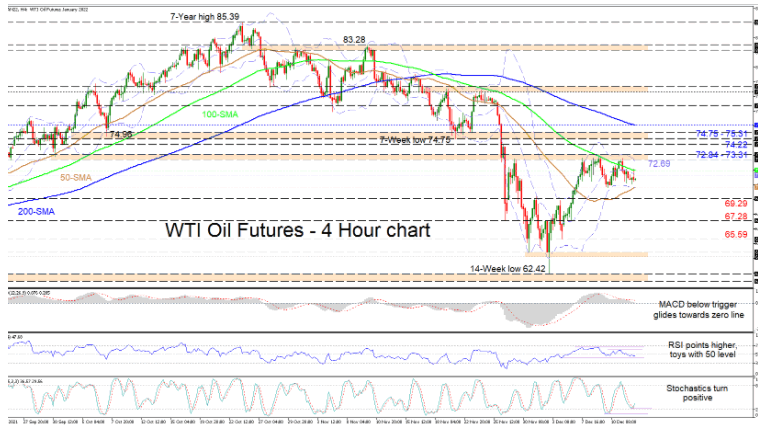
WTI oil futures are consolidating between the squeezed Bollinger bands at 70.35 and 72.69 after failing to surpass the 73.00 hurdle in the previous trading sessions. The longer-term simple moving averages (SMAs) are defending the descent from the 7-year high of 85.39, while the 50-period SMA is suggesting that the recent rally from the 14-week low of 62.42 may still have some power.
The short-term oscillators are indicating that momentum is weak and are transmitting uncorrelated signals in directional momentum. The MACD is slightly beneath its red trigger line and is approaching its zero threshold, while the rising RSI is trying to improve into the bullish territory. The positively charged stochastic oscillator is promoting upside price action in the pair.
Nonetheless, the squeeze in the Bollinger bands is hinting that a surge in volatility is expected, which suggests a larger directional move may unfold.
Immediate hindrance to price advances could emanate from the mid-Bollinger band at 71.44 and the nearby 100-period SMA at 71.85. Slightly higher, the upper Bollinger band coupled with the 72.84-73.31 resistance boundary could cap the recent rally from extending further. However, if buying interest increases, the bulls may stumble around the 74.22 region before challenging the 74.75-75.31 resistance border.
Alternatively, if selling interest intensifies, initial support could stem from the 50-period SMA at 70.35. If the price drops beneath the lower Bollinger band, the price could stall around the 69.29 border before testing the 67.28 low. If negative pressures bolster, the price may then target the December 3 trough of 65.59.
Summarizing, WTI oil futures are currently consolidating and a near-term direction may evolve with a break above the 72.84-73.31 resistance or with a break below the 50-period SMA at 70.35.
USDTRY Heads To Record Highs, Broad Bullish Dynamics Fizzle Out
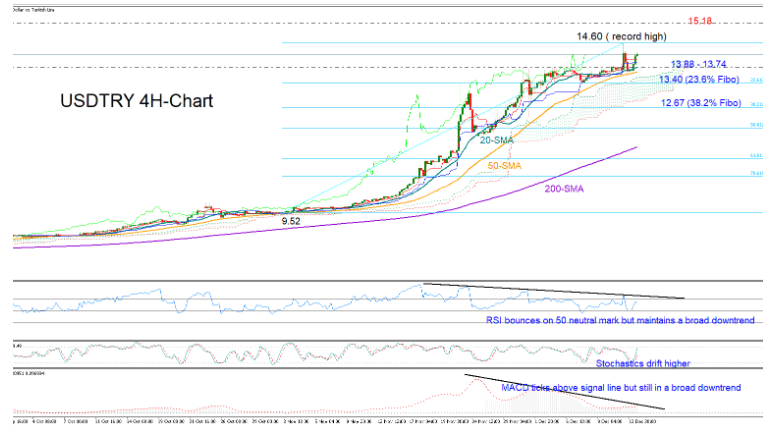
USDTRY has been rising exponentially for almost a month amid the inflation storm in Turkey, with the pair recently topping its rally at a new record high of 14.60.
Currently, there is little evidence to argue that the bullish trend in the four-hour chart could collapse in the near term. The price is gaining fresh momentum after setting another strong foothold around the 50-period simple moving average (SMA), helping the RSI to bounce on its 50 neutral mark and the Stochastics reverse near its 20 oversold mark.
In the big picture though, the RSI and the MACD have been moving against the market action, showing a bearish divergence. Hence, the broad upward pattern in the market is not completely out of risk.
Nevertheless, if the rally surges beyond the 14.60 peak in the next couple of sessions, the door would open for the 15.00 – 15.18 area, where the 161.8% Fibonacci extension of yesterday’s downfall is placed.
Otherwise, should the bears take control, the price could seek shelter somewhere between its 20- and 50-period SMAs seen between 13.88 and 13.74. The 23.6% Fibonacci retracement of November’s steep upleg could immediately catch the fall at 13.40 if selling pressures persist, delaying a freefall towards the 38.2% Fibonacci level of 12.67.
Overall, USDTRY is expected to push for more gains in the coming sessions, though in the big picture, the technical indicators are suggesting bullish dynamics are losing power.
USDCAD Falters Ahead of 2½-Month Resistance Barrier
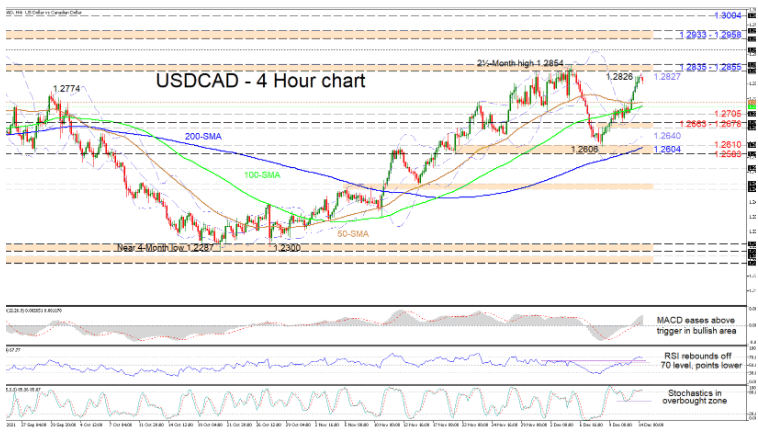
USDCAD’s dictating upside momentum has lost steam around the upper Bollinger band at 1.2827, just shy of reaching the 1.2835-1.2855 resistance boundary, stalling the minor rally from the 1.2606 mark. That said, the simple moving averages (SMAs) are still endorsing bullish sentiment.
The short-term oscillators are reflecting the slight waning in bullish momentum. The MACD, some distance above zero, is decelerating above its red trigger line, while the RSI is fading from the 70 level. The stochastic lines are in overbought territory, but the %K line has yet to confirm an increase in selling pressures.
If the price starts to surrender ground from the vicinity of the upper Bollinger band, sellers could encounter an initial zone of support existing between the 50- and 100-period SMAs at 1.2740 and 1.2727 respectively. Retracting beneath this area, the price may meet the 1.2705 low ahead of the 1.2663-1.2678 border. From here, downside constraints could then develop at the lower Bollinger band at 1.2640 before the price sinks to test the reinforced support base of 1.2583-1.2610.
Otherwise, if buyers regain control, immediate upside friction may stem from the upper Bollinger band around 1.2827 ahead of the 1.2835-1.2855 resistance band. Overshooting this two-and-a-half-month ceiling, the pair may steer for the September rally peak of 1.2895, which is just short of the 1.2900 hurdle. Should bullish momentum endure, the bulls could then aim for the 1.2933-1.2958 resistance boundary, which encompasses the August rally peak of 1.2948. If this obstruction breaks down, buyers may then pilot for the 1.3004 high.
Summarizing, USDCAD is exhibiting some weakness approaching the 1.2854 high. Yet, breaking above the 1.2835-1.2855 resistance belt could reinforce the short-term bullish bias, while a dive past the 1.2583-1.2610 support could feed negative pressures. On another note, overcoming the 1.2933-1.2958 barricade could boost the long-term bullish outlook.
US Stock Markets Slip On Omicron Variant
US Stock markets tended to be on the retreat yesterday and during today's Asian session as the Omicron variant continues to spread at a fast pace and seems to create some worries among investors. On the other hand, the USD remained relatively stable against its counterparts yesterday as the markets zoom in the Fed's interest rate decision which is due out tomorrow given that the bank's meeting starts today. Inflationary pressures were reaffirmed on Friday tilting the market's expectations for the Fed towards a more hawkish direction. Yet today, we would like to also note the release of November's US PPI rates which also are expected to accelerate and if so, could imply more pressure for CPI rates to accelerate further. Gold's price tended to remain stable as the USD presented little movement yet lower US yields could provide some support for the precious metal should they continue to drop.
Dow Jones was on the retreat yesterday breaking the 35965 (R1) support line, now turned to resistance. Despite the bearish tendencies the index seems to show some signs of stabilisation. Given also that the RSI indicator below our 4-hour chart is at the reading of 50, which could imply a rather indecisive market, we tend to maintain a bias for a sideways motion for the time being, yet the situation seems to remain volatile. Should the bears actually regain control over the index's direction we may see it breaking the 35600 (S1) support lien and aim for the 35340 (S2) support level. Should the bulls say enough is enough and take the initiative, we may see the pair breaking the 35965 (R1) resistance line and aim for the 36260 (R2) level.
AUD also slips on Omicron variant
AUD seems to have restarted its weakening against the USD as the market sentiment turned to be more cautious and the Aussie along with the Kiwi and the Loonie tend to reflect such shifts. The uncertainty for the Omicron variant tended to have an adverse effect for the commodity currency as the spreading of the disease could have a disruptive role for international trading conditions. In general we would also note the path of oil prices for CAD traders, while NZD traders should take a look at the current account balance for Q3 due out just as the Asian session is about to start. Aussie traders could be focusing also on the release of China's industrial output and retail sales growth rates for November, due out tomorrow as well as Australia's December Consumer sentiment. A possible acceleration of the Chinese production rate could provide some support for the AUD as it could imply a higher amount of exports of raw material from Australia to China while a healthy retail sales growth rate could imply strong demand side in the Chinese market.
AUD/USD seems to have restarted its bearish movement as it tests the 0.7100 (S1) support line. Please note that the RSI indicator below our 4-hour chart is between the readings of 50 and 30 also implying a rather bearish sentiment for the pair, yet the 0.7100 has proven its worth on the 30th of November as it withstood the downward pressure of the pair's price action and could do it again. Should the pair actually remain under the selling interest of the market, we may see it breaking the 0.7100 (S1) support line and take aim of the 0.7045 (S2) support level. Should the pair find extensive buying orders along its path we may see it reversing course and aiming if not breaking the 0.7170 (R1) resistance line.
Today's events and expectations
Today we note the release of UK's employment data, Sweden's CPI rates for November. Also, we would also like to highlight our worries for Turkey. TRY tumbled once again yesterday forcing the Central Bank of Turkey to intervene in the markets, buying the Lira and reducing its foreign exchange reserves for another time reversing the losses at least temporarily. Reports coming out of Turkey about the situation on the ground are particularly worrying with waiting lines for basic goods, while protests have erupted.
US 30 Cash H4 Chart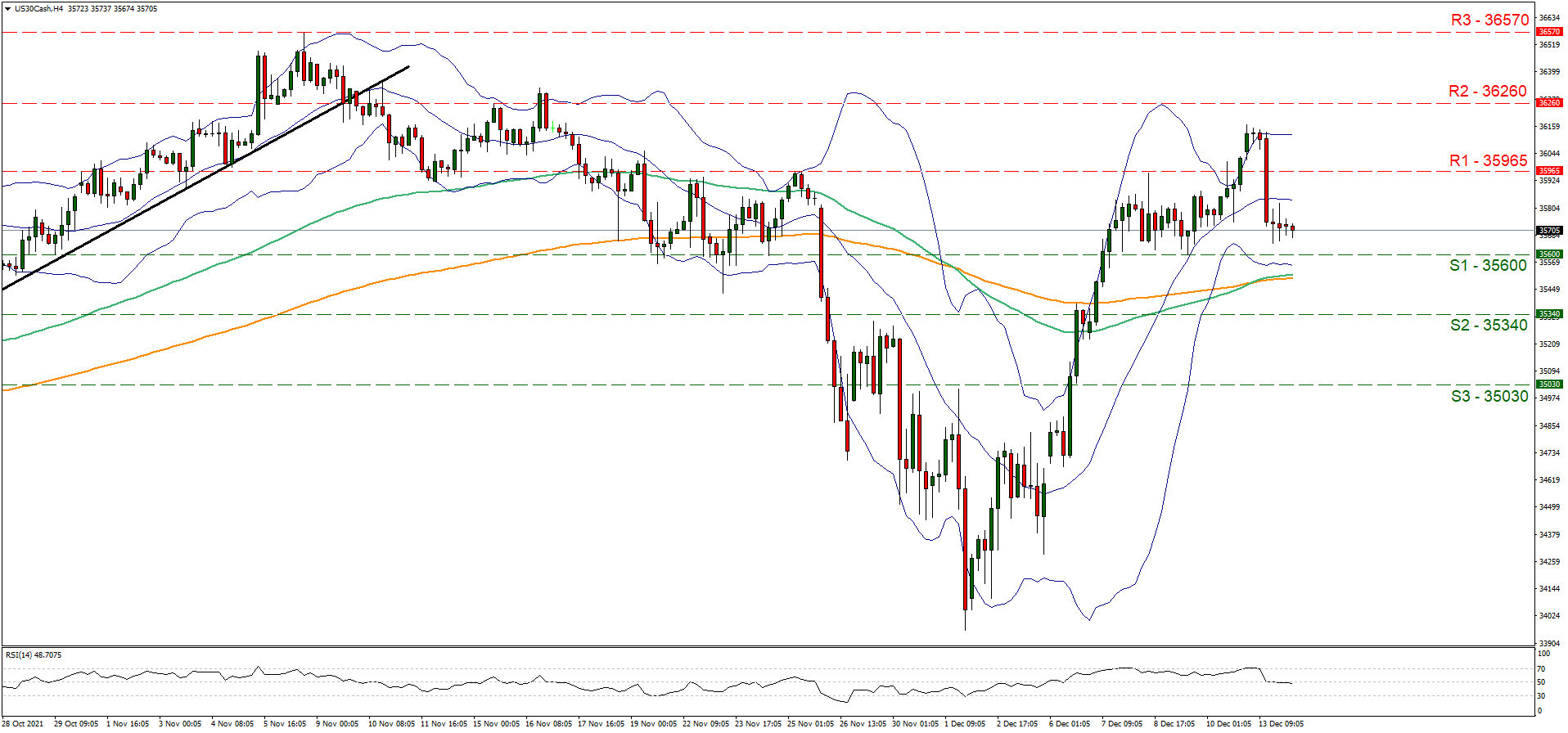
Support: 35600 (S1), 35340 (S2), 35030 (S3)
Resistance: 35965 (R1), 36260 (R2), 36570 (R3)
AUD/USD H4 Chart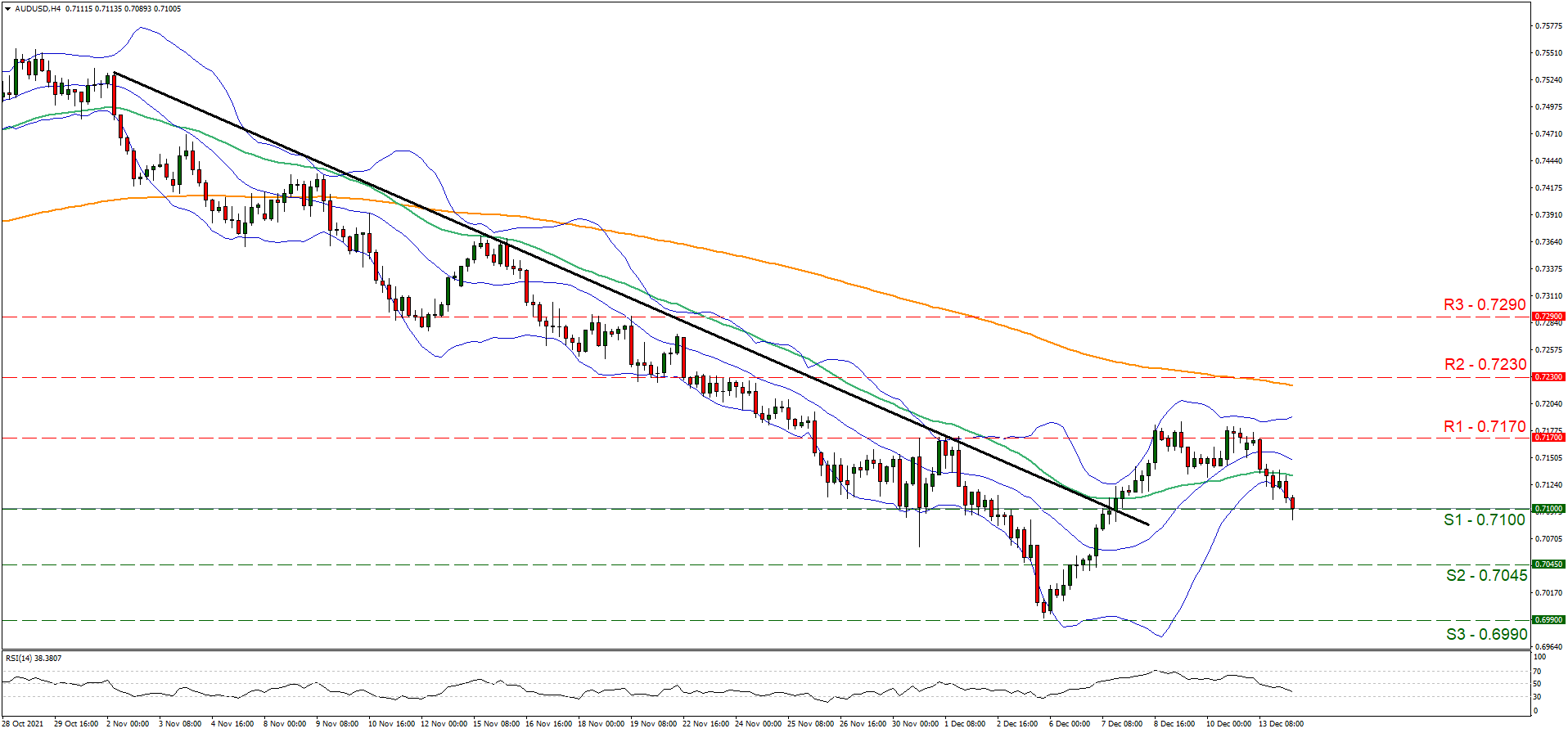
Support: 0.7100 (S1), 0.7045 (S2), 0.6990 (S3)
Resistance: 0.7170 (R1), 0.7230 (R2), 0.7290 (R3)
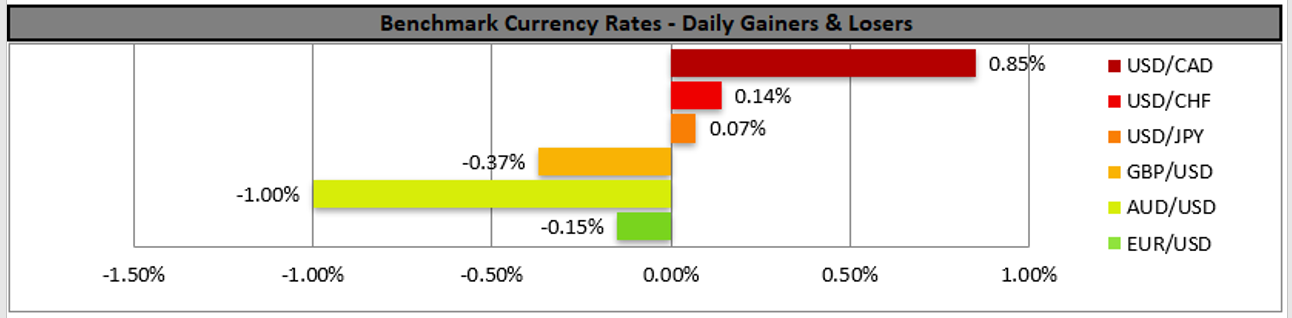
Omicron Woes Drag On Sentiment, Dollar Extends Gains
- Wall Street joins global rout as Omicron fears resurface but selloff eases today
- Dollar edges up to one-week highs as Omicron clouds outlook for central banks
- UK jobs numbers kick off busy week, US data eyed ahead of Fed
Optimism fades amid fresh Omicron gloom
Equity markets were feeling the pressure from renewed concerns about the global growth outlook as China imposed draconian restrictions after the detection of the country’s first Omicron case, while the UK’s announcement of its first death from the new variant further spooked investors.
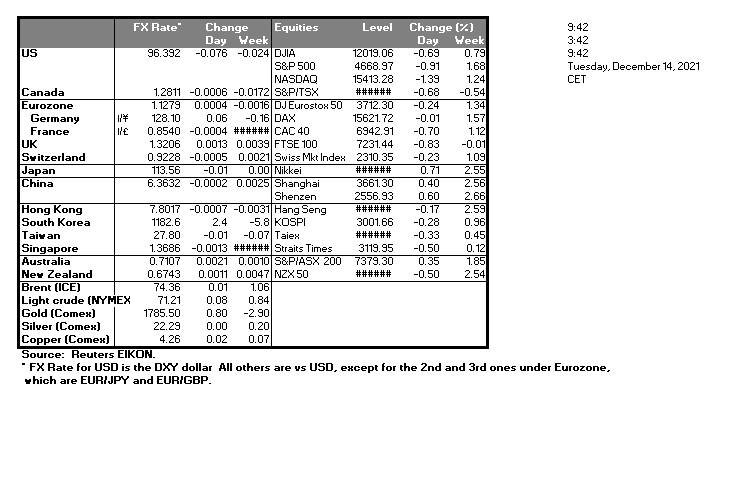
Last week’s relief rally is in danger of being pared back as optimism that the Omicron variant will not pose a major threat to the global economy appears to have been unfounded. Shares on Wall Street tumbled on Monday, with growth-oriented stocks taking a heavier beating. The Nasdaq Composite declined by 1.4%, while the S&P 500 and Dow Jones both closed down 0.9%.
Sentiment soured on Monday as the virus news pouring in was mostly bad for the economic outlook for the next few months. Fears that the supply shortages and bottlenecks that have been dogging industrial production and fuelling inflation will only get worse were heightened after businesses in a major Chinese manufacturing hub were forced to shut down due to a new cluster of virus cases. Although the latest outbreaks are unrelated to the one case of Omicron, China’s zero-Covid approach means more lockdowns could be on the way.
Meanwhile, lawmakers in the UK will today vote on whether to approve the government’s Plan B, which includes the introduction of a Covid pass for entry into nightclubs and big events. It comes after Boris Johnson confirmed the UK’s first death from Omicron.
The gloomy headlines are making investors nervous ahead of several key central bank decisions coming up over the next few days where tighter policy will be on the agenda for most of them.
Stocks in Asia were additionally pulled lower by worries that more Chinese property developers are heading towards default. China’s CSI 300 index slipped 0.7%.
European indices opened higher, recouping some of yesterday’s big losses, but later fell back as US stock futures also turned negative.
Markets on standby for central bank decisions
In the broader markets, the mood was also subdued as both the caution ahead of the Fed, ECB and Bank of England decisions as well as the fast-developing events with the Omicron variant kept investors on the sidelines. The Federal Reserve is widely expected to quicken its tapering process tomorrow, but the real focal point will be how many rate hikes policymakers will pencil in for 2022.
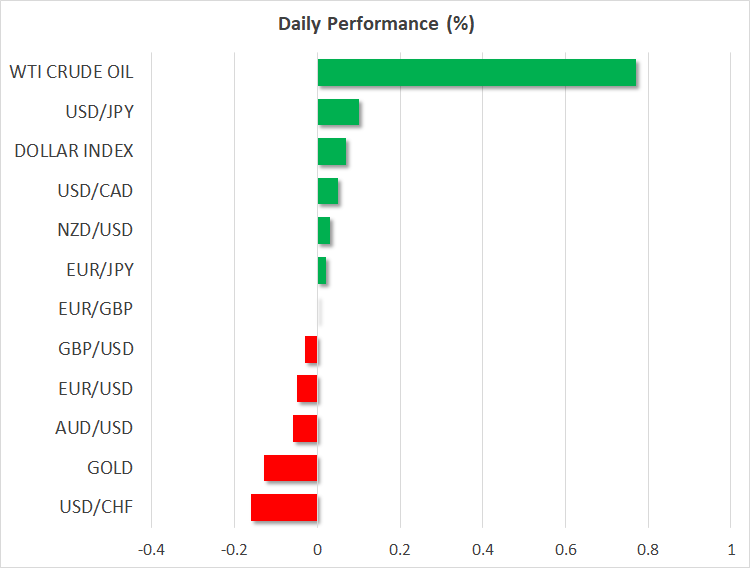
Treasury yields inched higher on Tuesday after slumping yesterday and the safe-haven favourite Japanese yen was mostly weaker. The US dollar, however, remained in demand, gaining marginally against a basket of currencies to hit a one-week top before easing slightly.
The European Central Bank will probably strike a dovish tone on Thursday but the Bank of England is anticipated to postpone its rate hike for next year as the UK faces fresh virus curbs and Johnson warns of a “tidal wave” of Omicron cases.
Euro and pound steady
However, the more pessimistic scenario for the British economy looks mostly priced in to the pound already as cable has steadied around $1.32 this week. Employment in the UK rose less than expected in the three months to October, though the drop in jobless claims accelerated in November, suggesting the labour market continues to tighten despite the sluggish growth.
The euro has also halted its decline for now, hovering around $1.13 since late October.
On the other hand, the riskier currencies have been under somewhat heavier selling pressure in the last few days, with the loonie hit particularly hard even though oil prices have been drifting sideways.
Later in the day, producer prices will be watched out of the United States, while RBNZ Governor Adrian Orr’s testimony before lawmakers could attract some attention too.
Cautiously Higher
Equity markets are moving cautiously higher on Tuesday, as investors await the plethora of central bank decisions in the coming days that could shape how we end the year.
Omicron has clearly added a huge cloud of uncertainty over the outlook for the economy in the coming months just as many countries were preparing for tighter monetary policy. Investors have appeared far more relaxed than politicians when it comes to the new variant which makes me a little nervous, as booster efforts are doubled in the run-up to Christmas.
The question this week is whether central banks perceive inflation or omicron to be the greater risk. The consensus view still appears to be that price pressures are driven by temporary factors that will largely correct over time but every month of inaction is a risk. This is why we will at least see some warn of impending action, while others will likely accelerate the process this week. And then there's the CBRT.
Jobs report highlights the problems facing the BoE
The BoE is one that was widely expected to raise rates this week and today's jobs report highlights why. The unemployment rate fell to 4.2% in the three months through to October, while wages rose by 4.9% in the same period and companies hired at a record pace last month. Clearly, the impact of the end of the furlough scheme was minimal which would have been the final box ticked for the MPC, had it not been for omicron.
While a rate hike could still happen this week, markets are not positioned for it and instead expect the central bank to hold out until February. With so much uncertainty over omicron, as it spreads rapidly throughout the UK, and whether more restrictions will be imposed, it makes little sense to act now without a clear picture.
Oil steady as we await omicron and central bank news
Oil prices are also stable ahead of the meetings this week. They've bounced back strongly on the back of the OPEC+ decision and reports of omicron symptoms being less severe, but a huge amount of uncertainty remains which has forced it into consolidation.
If risk appetite is given a boost by central banks this week we could see it push on higher but ultimately, the omicron data is going to be key. Politicians are clearly concerned and the rate of transmission is worrying. Further restrictions could weigh but traders will be all too aware that any drop in the price on this could trigger a sudden adjustment from OPEC+.
Gold consolidates ahead of the Fed
Gold prices remain in consolidation ahead of the Fed meeting tomorrow. It hasn't really progressed for a few weeks now although it has settled towards the upper end of its recent range which may be encouraging for gold bulls hoping for a slew of dovish central bank announcements this week.
The Fed is still expected to accelerate its tapering this week but how gold reacts may well depend on how dovish the language around it is. It will be tough as the dot plot will likely show policymakers have turned much more hawkish in recent months which could weigh on the yellow metal.
Bitcoin is still seeing support around $47,000
Bitcoin had a rough start to the week and looks a little flat today as it continues to look for support around $47,000. It has seen support around these levels over the last couple of weeks, barring the flash crash 10 days ago, so this could be a key level for the cryptocurrency as it looks to find its groove again. A dovish Fed could excite the crypto crowd but that may be a lot to ask given the levels of inflation we're seeing.