Sample Category Title
Russia Will Face Tough Economic Sanctions In Case Of An Attacck On Ukraine
The US stock indices continued to grow steadily for the second trading session in a row. By the close of the Stock Exchange, the Dow Jones Index (US30) gained 1.40%, the S&P 500 Index (US500) added 2.07%, and the NASDAQ Composite Index (US100) jumped by 3.03%. The growth of Nasdaq and S&P 500 indices has been the highest since early March. The optimism returned to the world markets due to a decrease in concerns about the influence of the new strain of coronavirus on the global economy. But there was also negative news. Studies have shown a 40-fold decrease in the neutralizing ability of Pfizer vaccines for the omicron strain. As a result, the Omicron COVID-19 strain is less serious, but the existing vaccines will not provide complete protection against it.
The US JOLTs Job Openings will be released today. Analysts expect that the number of vacancies is likely to fall again in October, which will increase investors' expectations of a faster reduction of the QE program at the next Fed meeting.
The White House revealed the content of the talks between the US and Russian presidents Vladimir Putin and Joe Biden. The American leader, in particular, warned Putin of the "tough economic" measures that await Russia in the event of an attack on Ukraine. It’s not only about stopping Nord Stream-2, but also the complete isolation of Russia from the global financial system, with all the ensuing consequences for business and the population. The presidents also discussed cybersecurity issues and joint work on problems in regions of the world, including Iran.
European stock indexes also finished Tuesday's trading with a steady rise. Germany's DAX (DE30) gained 2.8%, France's CAC 40 (FR 40) added 2.9%, Spain's IBEX 35 (ES35) increased by 1.4%, and the British FTSE 100 (UK 100) increased by 1.5% to its highest level in three weeks. Electricity prices are once again hitting new records in Europe. The estimated Eurozone GDP growth in the third quarter was left at 2.2%, as expected. But the forecast of the Eurozone GDP growth in annual terms was revised upward to 3.9% from 3.7%.
British pharmaceutical company GlaxoSmithKline announced the effectiveness of its COVID-19 drug, which is based on antibodies against a new strain of Omicron. The company reported that final test results showed 100% efficacy against Omicron.
Spain's Ministry of Health has approved vaccination against COVID-19 for children 5 and 11.
Flight bookings between the US and Europe decreased by 55% from the previous week. Bookings within Europe fell by 47%. Analysts believe the spread of the Omicron strain will increase the probability of lower oil demand in the short term. Oil prices increased by 4% yesterday.
Asia-Pacific stock indices were mostly positive, following solid gains in the US and European markets. Japan's Nikkei 225 Index (JP225) increased by 1.42% today, despite Japan's third-quarter GDP declining 0.9%. Australia's ASX 200 (AU200) added 1.25%, but Hong Kong's Hang Seng (HK50) decreased by 0.13% amid Evergrande risks. S&P strategists are confident that the default of Evergrande is inevitable; it is only a matter of time.
Main market quotes:
- S&P 500 (F) (US500) 4,686.75 +95.08 (+2.07%)
- Dow Jones (US30) 35,719.43 +492.40 (+1.40%)
- DAX (DE40) 15,813.94 +433.15 (+2.82%)
- FTSE 100 (UK100) 7,339.90 +107.62 (+1.49%)
- USD Index 96.32 +0.04 (+0.04%)
Important events for today:
- Japan GDP (q/q) at 01:50 (GMT+2);
- ECB President Lagarde’s Speech at 10:15 (GMT+2);
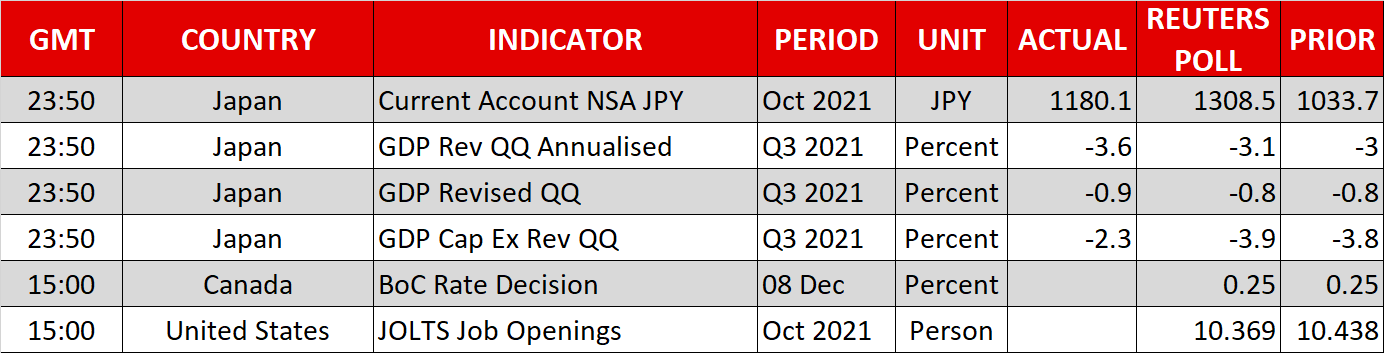
- US JOLTs Job Openings (m/m) at 17:00 (GMT+2);
- Canada BoC Interest Rate Decision (m/m) at 17:00 (GMT+2);
- Canada BoC Rate Statement (m/m) at 17:00 (GMT+2);
- US Crude Oil Reserves (w/w) at 17:30 (GMT+2).
ECB Kazaks: Don’t preempt policy decisions because of Omicron uncertainty
ECB Governing Council member Martins Kazaks said in an interview that the PEPP emergency asset purchase program would still end as scheduled in March, despite Omicron.
"At the current moment, we don't know how the omicron variant will develop," Kazaks said. "Unless it spills over into significant and large negative revisions to the outlook for growth, I don't see that March -- which the market has been expecting for some time and which we've been communicating in the past -- should be changed."
"At the moment we simply know too little about omicron," he said. "I see it important to remain data-driven and make our decisions step by step. So react to the data, rather than preempt decisions when uncertainty is way too high."
"If in February we see that it's painful then of course we can change our views and that's the issue of flexibility," he said. "In my view, it's possible both to restart PEPP or increase the envelope if it turns out to be necessary."
On inflation, Kazaks said, "to exactly what level will it land in 2023-24, of course, there's lots of uncertainty." Nevertheless, "my baseline remains that it slides to below 2%."
Olaf Scholz Formally Approved As Chancellor Of Germany
Notes/Observations
- EU session quiet (Note: public holiday in Austria, Italy, Malta, Portugal and Spain for Immaculate Conception but markets are open.
- German Parliament formally votes to approve Olaf Scholz as Chancellor.
- Risk appetite holding on to sentiment as indications of a milder course of Omicron virus infections coupled with hope of vaccine treatment offering a shield.
- No breakthrough was found in the Putin/Biden talks.
Asia
- Japan Q3 Final GDP Q/Q: -0.9% v -0.8% prelim; Y/Y: -3.6% v -3.0% prelim.
- BOJ Amamiya stated that saw no need to modify its massive monetary stimulus program with inflation well below 2.0% target.
- India Central Bank (RBI) leaves Repurchase Rate unchanged at 4.00% (as expected). Decision to keep rates steady was unanimous (6-0) and maintained its accommodative policy stance (vote was 5-1). Continued policy support warranted for durable recovery. Inflation broadly aligned with targets; prints likely to be higher for rest of year.
Coronavirus
- Africa Health Resource Institute noted that a study showed 40-fold reduction in neutralization capacity of Pfizer vaccines against Omicron variant; Some protection did remain. Vaccines still likely protected against severe disease.
- World Health Org Dr Mike Ryan noted that there was no sign Omicron would be better at evading vaccines than other variants. Initial data suggested Omicron did not make people sicker than the Delta and other strains. "If anything, the direction is towards less severity".
Europe
- UK Govt said to be considering a work from home plan (due to Omicron variant) for Christmas and New Years and any economic impact that may have.
- Bank of France (National Central Bank) saw Q4 q/q growth less than 0.75% as service sector staffing difficulties and supply chain issues worsened.
- Russian govt spokesperson noted that Putin told President Biden that he sought a reliable legally binding guarantee ruling out NATO's eastwards expansion.
Americas
- White House spokesperson noted that Biden imparted deep concerns over Russia's actions in Ukraine in meeting with President Putin. Reiterated stance that US would respond with strong economic measures if situation escalated. Biden and Putin also spoke about ransomware and Iran. White House also noted that it hads an understanding with Germany about shutting down the Nord Stream 2 natural gas pipeline if Russia invaded Ukraine.
- Senate Democrats, Republicans stated that they had reached deal to avert another debt ceiling crisis. Senate Min Leader McConnell stated that was confident with this particular procedure, coupled with the avoidance of Medicare cuts, would achieve enough Republican support to clear the 60-vote threshold.
- House of Representatives passed bill to make passing debt limit bill quicker; the final vote was 222 to 212.
Energy
- Weekly API Crude Oil Inventories: -3.1M v -0.7M prior.
Speakers/Fixed income/FX/Commodities/Erratum
Equities
- Indices [Stoxx600 +0.10% at 480.66, FTSE +0.29% at 7,361.38, DAX -0.37% at 15,755.69, CAC-40 -0.18% at 7,052.98, IBEX-35 -0.56% at 8,510.93, FTSE MIB -0.46% at 27,013.00, SMI +0.83% at 12,617.60, S&P 500 Futures +0.19%].
- Market Focal Points/Key Themes: European indices open mixed with a downward bias, failing to gain direction as the session wore on; better performing sectors include heath care and consumer discretionary; to the downside, among the leading sectors are technology and materials; oil and gas subsector weighed on by modest pullback in crude prices; travel subsector dragged by disappointing results from TUI; AF Gruppen to take majority stake in Stenseth; Securitas buys Stanley Blak & Decker’s security unit; Clinigen to be acquired by Triton; Sampo completes takeover of Hastings; Nestle cuts stake in L’Oreal; corporate events expected during the upcoming US session include earnings Campbell Soup and investor presentation by Brown-Forman.
Equities
- Consumer discretionary: Securitas AB [SECUB.SE] +2% (acquisition), HelloFresh [HFG.DE] -6% (outlook), TUI [TUI.UK] -4% (earnings).
- Consumer staples: Clas Ohlson [CLASB.SE] +14% (earnings).
- Financials: Berkeley Group Holdings [BKG.DE] +5% (earnings).
- Healthcare: Clinigen Group [CLIN.UK] +10% (recommends offer), Valneva [VLA.FR] +7% (vaccine order).
- Materials: Umicore [UMI.BE] -5% (JV with Volkswagen).
Speakers
- ECB's De Guindos (Spain) reiterated Council view that higher inflation could last longer than previously thought but saw no evidence of 2nd round effects. Did not believe that new Omicron virus variant will derail recovery.
- Bank of France Gov Villeroy raised 2021 GDP growth forecast from 6.3% to 6.7%. French inflation should fall below 2% by end-2022.
- ECB’s Rehn (Finland) stated that uncertainty was exceptionally high for policy normalization. Sometimes was best to exhibit patience in making decisions.
- ECB's Kazaks (Latvia) reiterated Council view that inflation seen moving back to the 2% target. Would need more stimulus only if Omicron variant really hurt growth. PEPP should end in March as planned.
- Sweden Central Bank (Riksbank) Jansson stated that division of roles between fiscal and monetary policy might need changing. Country had good prerequisites for allowing fiscal policy to play a more active role. Had hard time seeing a rate hike at the end of the forecast horizon due to inflation picture. Could believe inflation could rise to 4.0-4.5% but needed to see if such move could be long-lasting.
- Russia Central Bank Zabotkin (Monetary Policy Chief) stated that would consider a wide range of rate option on Dec meeting, but 25bps move was unlikely.
- Czech Central Bank's Holub (chief economist) stated that was prepared to continue with rate hikes.
- Turkey President Erdogan reiterated stance that he absolutely did not believe in high interest rates. Reiterated stance that would bring down both inflation and exchange rate via low interest rates. Claimed that stockpiling was to blame for high inflation; threatens more punishment for hoarders. To reverse the speculative attack on the TRY currency (Lira).
Currencies/Fixed Income
- USD hold on to most gains despite the recent pick-up in risk appetite. Dealers noted that safe-haven appeal being replaced on policy divergence factors. Th higher interest rates in the US and widening interest rate differentials with respect to the rest of the world in driving the FX market
- EUR/USD steady at 1.1280 area with USD/JPY holding above 113.50.
Economic data
- (SE) Sweden Oct Maklarstatistik Housing Prices Y/Y: 14% v 15% prior; Apartment Prices Y/Y: 6% v 7% prior.
- FR) France Q3 Final Private Sector Payrolls Q/Q: 0.5% v 0.5% prelim; Total Payrolls: 0.4% v 0.5%e.
- (FI) Finland Oct Preliminary Trade Balance: -€0.6B v +€0.1B prior.
- (HU) Hungary Nov CPI M/M: 0.7% v 0.6%e v 1.1% prior; Y/Y: 7.4% v 7.3%e (8th month above target range and highest in almost a decade).
- (CZ) Czech Nov Unemployment Rate: 3.3% v 3.4% prior.
- (CZ) Czech Nov International Reserves: $171.0B v $172.8B prior.
- (ZA) South Africa Nov Sacci Business Confidence: 92.8.
Fixed income Issuance
- (IN) India sold total INR200B vs. INR200B indicated in 3-month, 6-month and 12-month bills.
- (DK) Denmark sold total DKK2.14B in 2024 and 2031 DGB Bonds.
- (NO) Norway sold NOK2.0B vs. NOK2.0B indicated in 3% Mar 2024 bonds; Avg Yield: 1.17% v 0.85% prior; Bid-to-cover: 4.72x v 4.78x prior.
- (SE) Sweden sold total SEK20B vs. SEK20B indicated in 3-month and 12-month Bills.
Looking ahead
- (PL) Poland Central Bank (NBP) Interest Rate Decision: Expected to raise Base Rate by 50bps to 1.75%.
- 05:25 (EU) Daily ECB Liquidity Stats.
- 05:30 (DE) Germany to sell €3.0B in in 0.0% Aug 2031 Bunds.
- 05:30 (HU) Hungary Debt Agency (AKK) switch auction.
- 06:00 (RU) Russia to sell RUB30B in July 2031 OFZ Bond.
- 06:00 (ZA) South Africa Oct Retail Sales M/M: 0.8%e v 5.1% prior; Y/Y: 1.9%e v 2.1% prior.
- 06:30 (ES) ECB's De Guindos (Spain).
- 06:45 (US) Daily Libor Fixing.
- 07:00 (US) MBA Mortgage Applications w/e Dec 3rd: No est v -7.2% prior.
- 07:00 (BR) Brazil Oct Retail Sales M/M: +0.6%e v -1.3% prior; Y/Y: -6.2%e v -5.5% prior.
- 07:00 (BR) Brazil Oct Broad Retail Sales M/M: -0.2%e v -1.1% prior; Y/Y: -6.1%e v -4.2% prior.
- 07:00 (UK) Weekly PM Question time in House.
- 09:45 (UK) BOE to buy £1.47B in APF Gilt purchase operation (7-20 years).
- 10:00 (CA) Bank of Canada (BOC) interest Rate Decision: expected to leave Interest Rates unchanged at 0.25%.
- 10:00 (US) Oct JOLTS Job Openings: 10.469Me v 10.44M prior.
- 10:30 (US) Weekly DOE Oil Inventories.
- 11:00 (RU) Russia Nov CPI M/M: 1.0%e v 1.1% prior; Y/Y: 8.4%e v 8.1% prior.
- 11:00 (RU) Russia Nov CPI Core M/M: 0.9%e v 0.9% prior; Y/Y: 8.4%e v 8.0% prior.
- 13:00 (US) Treasury to sell 10-year note.
- 16:00 (NZ) New Zealand Nov Heavy Truckometer Index M/M: No est v 1.0% prior.
- 16:30 (BR) Brazil Central Bank (BCB) Interest Rate Decision: Expected to raise Selic Rate Target by 150bps to 9.25%.
- 16:45 (NZ) New Zealand Q3 Manufacturing Activity Q/Q: No est v 3.9% prior.
- 17:00 (AU) RBA Gov Lowe.
- 18:50 (JP) Japan Q4 BSI Large Manufacturing Q/Q: No est v 7 prior; Large All Industry Index Q/Q: 5.0e v 3.3 prior.
- 18:50 (JP) Japan Nov M2 Money Supply Y/Y: 4.1%e v 4.2% prior; M3 Money Supply Y/Y: 3.7%e v 3.7% prior.
- 19:01 (UK) Nov RICS House Price Balance: 70%e v 70% prior.
- 20:30 (CN) China Nov CPI Y/Y: 2.5%e v 1.5% prior; PPI Y/Y: 12.1%e v 13.5% prior.
- 22:00 (TH) Thailand Nov Consumer Confidence: No est v 43.9 prior; Economic Confidence: No est v 37.8 prior.
Stocks Soar As Markets Look Past Omicron, BoC Meeting Eyed
- Optimism prevails as investors see glass half full over Omicron threat
- Asia lifted by Wall Street jump but futures point to some easing in rally
- FX markets mostly steady, loonie at 2-week high ahead of BoC decision
Fading Omicron risks boost sentiment
Pre-Christmas cheer came early for equity markets as investors celebrated the growing view that the newly discovered Omicron variant is not more dangerous than the Delta strain. Early evidence suggests that Omicron causes less severe illness than the other variants even though it appears to be the most contagious form of Covid yet.
So far, traders have been embracing the slightest bit of positive news about Omicron, welcoming a preliminary study that shows the Pfizer-BioNTech vaccine offers some protection even though it is significantly less than for other variants. News that a new antibody-based treatment drug is effective against the Omicron strain further reinforced hopes that drastic virus restrictions won’t be necessary.
Stocks heading for more gains but momentum is easing
With investors optimistic that the Omicron outbreak won’t significantly dampen the festivities and lead to winter-long lockdowns, risk assets have bounced back from last week’s panic selloff. Even the tech-heavy Nasdaq posted an incredible rally on Tuesday, surging 3%, despite Treasury yields also rebounding quite strongly.
The S&P 500 closed up 2%, while the Dow Jones finished the session 1.4% higher. Asian shares extended the rally today as monetary easing in China lifted sentiment, offsetting the worrying trend of a lengthening list of local property developers missing their debt payment deadlines.
China has announced a series of measures in recent days aimed at reviving the property sector as well as boosting overall growth in the economy. China’s benchmark stock indices were up more than 1% today, though they’ve been lagging their Asian and global peers all year.
In contrast, the Chinese yuan has been steadily firming in recent months, hitting a 3½-year high versus the US dollar today.
In Europe, stocks opened mixed and US e-mini futures were also pointing to some moderation of the upside momentum.
Dollar mixed, loonie holds near highs ahead of BoC
There was a mixed mood in FX markets on Wednesday as the US dollar lacked a clear direction amid some caution ahead of Friday’s CPI data out of the US and the FOMC meeting next week.
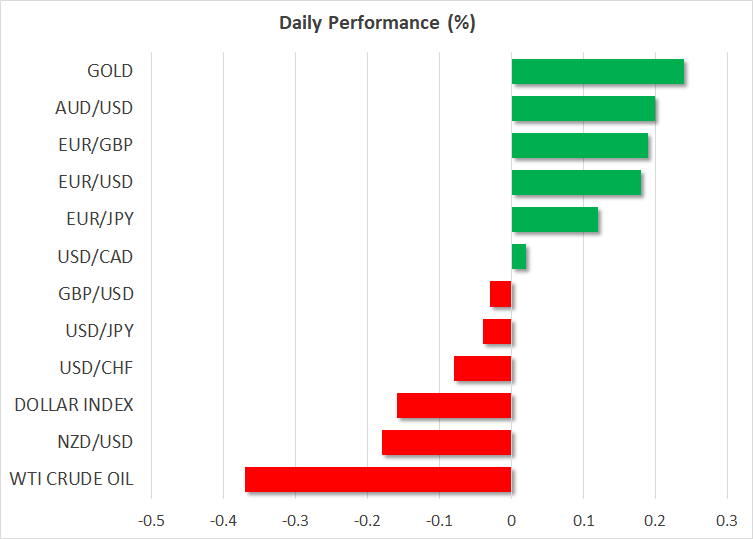
The Australian dollar was the only one from the commodity-linked currencies that was able to stretch its advances against the greenback, climbing to a one-week high of $0.7143.
Relief over the Omicron variant not being as dangerous as first feared has been driving the riskier currencies higher this week, with the aussie and loonie being the main beneficiaries of the improving mood.
The Canadian dollar brushed a fresh two-week high at the start of the session before pulling back slightly. The latest robust employment and trade data out of Canada, combined with waning worries about Omicron and soaring oil prices, have strengthened expectations that the Bank of Canada will sound upbeat at its policy meeting today.
The BoC announces its decision at 15:00 GMT and investors will be looking for clues that policymakers are considering bringing forward their rate hike timeline.
Euro and gold inch higher
The New Zealand dollar also turned lower after a positive open on Wednesday. The kiwi’s paltry rebound this week has been disappointing, but sterling’s performance has been even worse. The euro, however, found itself on a steadier footing after staging a surprise bounce-back on Tuesday.
In commodities, gold edged up for a second day, rising towards $1,790/oz amid some geopolitical tensions between the US and Russia over Ukraine. US President Biden held a two-hour video call with Russian president, Vladimir Putin, yesterday, though it’s unclear whether the meeting will lead to a de-escalation of the situation.
NZDUSD Bounces Off 76.4% Fibonacci But Negative Bias Prevails
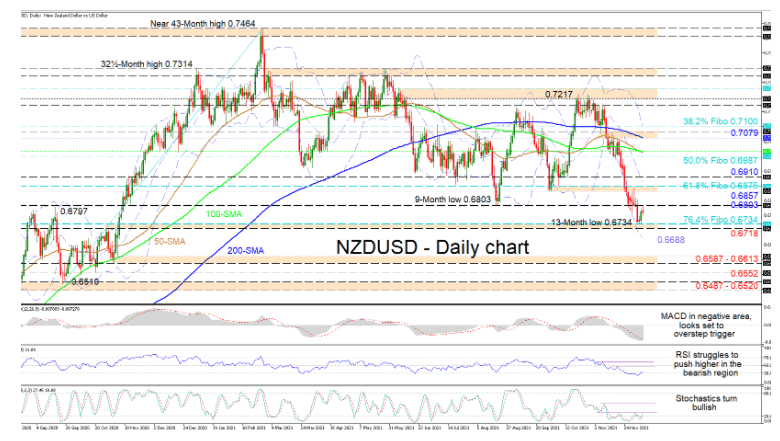
NZDUSD buyers have emerged around the 0.6734 level, which is the 76.4% Fibonacci retracement of the up leg from 0.6510 until the 0.7464 peak. That said, it appears that they are incapable of terminating the one-month decline from the 0.7217 high. The dipping simple moving averages (SMAs) are starting to confirm a growing downward trend in the pair.
The short-term oscillators are reflecting a slight increase in bullish momentum, but given the current overwhelming downward pressures, it looks unlikely that this may endure. The MACD, far beneath the zero mark, is attempting to climb above its red trigger line, while the RSI is finding difficulty improving in bearish territory. The bullish stochastic oscillator is hinting that upside forces have yet to fully evaporate.
If the 0.6803 level denies upward development in the pair, sellers could face an initial support band between the 76.4% Fibo of 0.6734 and the 0.6718 barrier. Should the descent in the pair resume, the lower Bollinger band at 0.6688 could delay the test of a limiting section among the 0.6613 and 0.6587 lows from the beginning of November 2020. If this gives way too, the broader uptrend could be at risk as the bears confront the 0.6552 obstacle and the support base of 0.6487-0.6520.
Otherwise, if the price surges over the 0.6803 level, resistance may originate from the 0.6857 inside swing low until the 61.8% Fibo of 0.6875. Overshooting this barrier, the approaching mid-Bollinger band and nearby 0.6910 obstacle could try to impede advances from challenging the resistance zone moulded between the 50.0% Fibo of 0.6987 and the 100-day SMA at 0.7006. From here, buyers would need to surpass the tough 0.7055-0.7079 resistance border and the upper Bollinger band at 0.7100 to reinstate confidence in the pair.
In conclusion, NZDUSD is sustaining a sturdy negative bearing below 0.6803 and the 0.6857-0.6875 barrier, which may endure for a little while longer.
Oil Jumps, Gold Steady On Omicron
Oil surges on lower omicron concerns
Oil prices rose overnight as omicron concerns continued to fade, and US API Crude Inventories showed a surprise draw of 3.1 million barrels. Assuming momentum remains positive in global markets, a fall in official US Crude Inventories (-1.7 mio exp), will probably be an excuse for oil prices to rally once again. Base metals are also rallying in Asia today, as is natural gas, ostensibly on expectations of much higher infrastructure spending in 2022. If that is so, then oil prices have also found another reason to be bullish in 2022.
Brent crude rose by 2.0% to USD 75.10 overnight where it remains in Asian trading. WTI leapt 2.45% higher to USD 71.70 a barrel, where it remains in Asia. Both contracts have recovered above their respective 100-day moving averages with initial resistance at USD 76.00 and WTI USD 73.00 respectively. I continue to believe that the lows of last week will be the lows for possibly all of next year.
Gold creeps higher
The wave of omicron-inspired growth optimism sweeping financial markets overnight appears to be tempting a few gold bulls back into the market in search of a bargain. Gold rose 0.30% to USD 1784.00 an ounce overnight, adding another 0.35% to USD 1790.00 an ounce in Asia today. Gold could well continue staging a modest recovery this week, as long as sentiment remains positive.
In the bigger picture, gold still looks confined to a USD 1770.00 to USD 1800.00 range this week, unable to sustain momentum above or below those levels. The 50,100 and 200-day moving averages (DMAs), clustered between USD 1790.60 and USD 1795.00 provides immediate resistance, followed by USD 1800.00, and then USD 1810.00. Support lies at USD 1770.00 and USD 1760.00.
Stocks Extend Relief Rally As Omicron Fears Ease
- US futures and Asian stocks climb while dollar dips.
- Investors may be too laid back about risks from new variant.
- Persistent US inflation pressures could hasten Fed tapering, rate hikes.
Risk assets are taking comfort from subsiding fears surrounding the Omicron variant, with stock markets extending this week’s relief rally. Asian indices are mostly in the green while US futures point to another day of gains, with the S&P 500 just 0.38% away from its record high. The benchmark US dollar index is easing slightly, while the VIX index is moving back closer to 20, the average reading for this year.
Omicron risks could pull rug from under relief rally
Of course, these are still early days and attempts to restore global equities to record highs could be on shaky ground. Recent gains are not yet fully assured as markets run the risk of being too complacent over the downside risks stemming from this latest variant, without yet knowing the true extent of Omicron’s potential impact on the global economy.
After all, Covid cases are still surging in major economies from Germany to South Korea. Also, an initial study out of South Africa showed that those vaccinated with Pfizer’s doses show a 40-fold drop in produced antibodies against the Omicron variant.
While investors can take heart from the fact that this isn’t the world’s first attempt in stemming Covid-19’s spread, one cannot rule out more abrupt selloffs from risk assets, especially if ongoing vaccination efforts and other virus-curbing measures are found wanting against Omicron or future variants. Even as optimism abounds for the time being, some measure of caution remains warranted.
Inflation and Fed policy remain major themes in 2022 outlook
Besides ongoing pandemic-related developments, global investors still have multiple risks to contend with going into the new year, including surging inflation that could lead to more aggressive policy tightening by major central banks. Such concerns will frame this Friday’s release of the US consumer price index.
Stubbornly elevated price pressures would justify Fed Chair Jerome Powell’s hawkish pivot last week and could pave the way for accelerated tapering by the Fed, a decision which could arrive at next week’s FOMC meeting. In the event that markets raise their expectations for US rate hikes in 2022, that could spell even more gains for the greenback, perhaps to the chagrin of commodities and the rest of the FX complex.
US Dollar Fades On Resurgent Growth Trade
Dollar dips as Omicron concerns ease
The US dollar faded overnight as fading omicron concerns saw hot money flooding back into the global recovery trade. The gains were mostly seen in the EM space, however, where even the Turkish lira managed to rally last night. In the major currency space, the US dollar held steady, likely due to the US yield curve modestly steepening overnight.
EUR/USD, GBP/USD and USD/JPY are holding steady at 1.1290,1.3255 and 113.50 in Asia, barely changed for the last 24 hours. The lack of strength versus the US dollar, even as the greenback fell elsewhere, suggests that all EUR, GBP and JPY remain highly correlated to the Fed taper-trade and that the balance of risks is still tilted towards the downside for all three.
AUD/USD, NZD/USD both rallied overnight as global investor sentiment sharply rebounded. AUD/USD has risen to 0.7130 and NZD/USD has risen to 0.6790. The 0.7000 and 0.6700 areas remain key support zones for both and although the sun is shining Downunder today, both are highly vulnerable to a swing in sentiment once again, or the reality of tighter US monetary policy next week. The rallies could extend into the end of the week but should be approached with a high degree of caution.
The same can be said about the strength in Asian currencies being seen overnight and today versus the US dollar. The swing in sentiment back to the global recovery has seen decent strength across the board in the Asia FX space, but once again, is subject to the whims of investor sentiment. It is clear that a lot of fast money rushed into the space overnight, but if anything, Asian currencies, even without China nerves, are more vulnerable than most to the reality of potentially tighter US monetary policy.
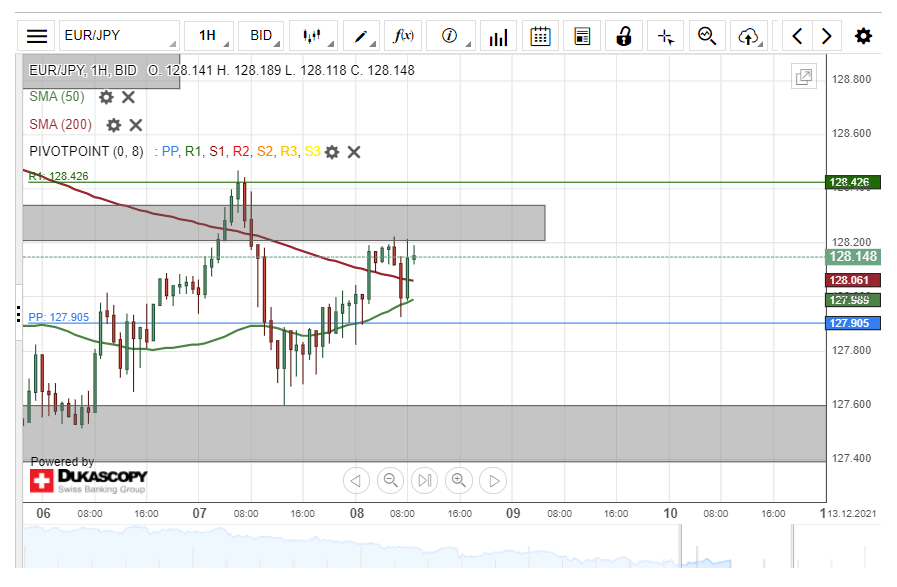
EUR/JPY Remains Below 128.50
The EUR/JPY rate approached the 128.50 mark on Tuesday morning, but failed to pass it. A following decline of the pair reached the 127.60 mark, which provided support for the rate to recover. By the start of Wednesday's European trading hours, the currency exchange rate had reached the 128.20 level where it encountered resistance.
In the case that the pair declines, it would most likely look for support in the 50-hour simple moving average near 128.00 and the weekly simple pivot point at 127.91. In addition, note that the 128.00 level has shown to be capable of impacting the currency pair. Below these levels, the 127.60 level might once again provide support.
On the other hand, a potential surge of the Euro against the Japanese Yen would first test the 128.20 level. Afterwards, the weekly R1 simple pivot point at 128.43 and the 128.50 mark might provide resistance.
AUD/USD Breaks Resistance Levels
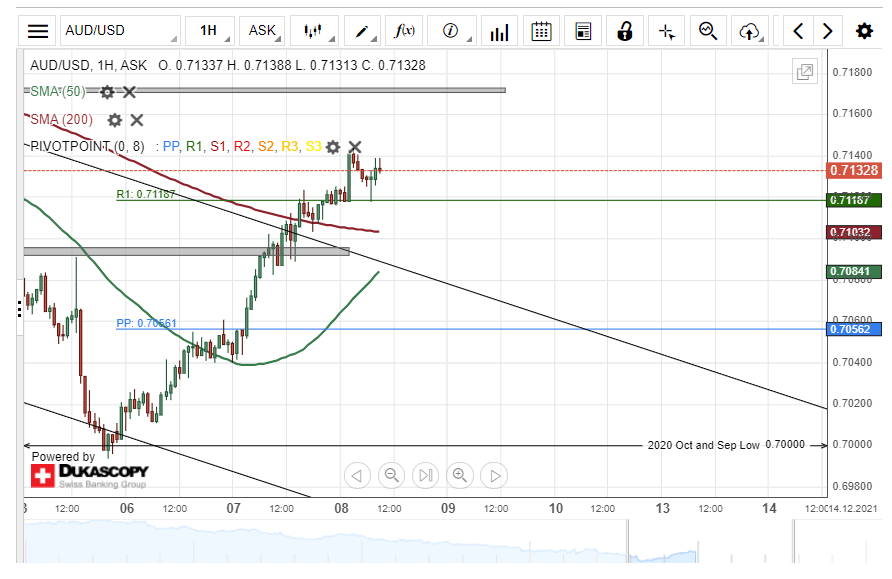
The surge, which was caused by the Reserve Bank of Australia rate statement, eventually broke previous high levels, the 200-hour simple moving average, the channel down pattern and the weekly R1 simple moving average. Namely, all resistance was broken by the adjustment to the news about the future of the monetary policy of the Australian central bank.
On Wednesday morning, the pair retraced back down and used the weekly R1 simple pivot point at 0.7119 as support. Meanwhile, the pair had no resistance as high as the November 30 and December 1 high levels near 0.7170.
In the case that the rate continues to surge, it would have to face the previous high levels at 0.7170/0.7173. Above the high level zone, the 0.7200 might provide resistance, before the pair reaches the weekly R2 simple pivot point at 0.7236.
However, a decline of the Australian Dollar against the US Dollar might look for support in the weekly R1 simple pivot point at 0.7119. Afterwards, the 200-hour simple moving average at 0.7100 might act as support.