Sample Category Title
GBP/JPY Passes Support Level
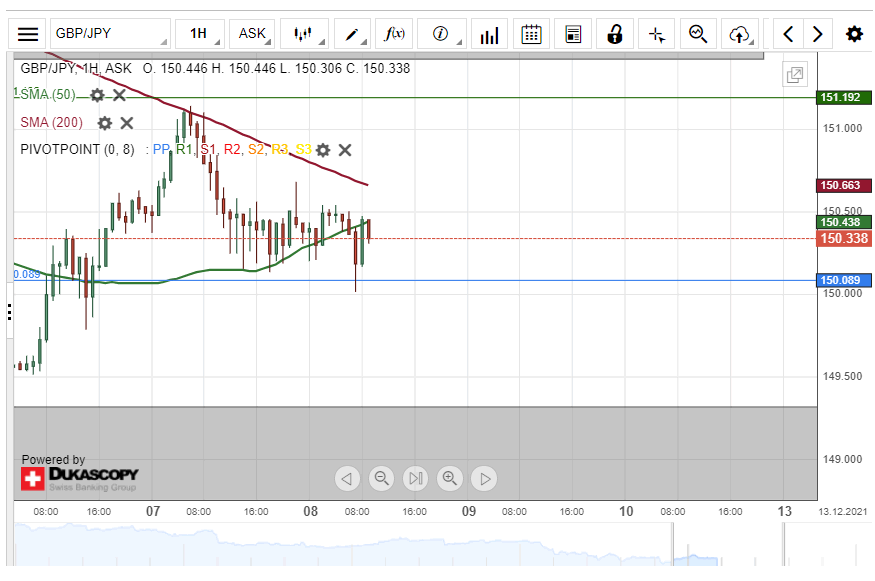
Previously, the resistance of the 200-hour simple moving average was enough for the GBP/JPY to decline to the support of the 50-hour simple moving average near 150.15. The SMA pushed the rate up into the resistance of the 150.50 mark up to 07:00 GMT on Wednesday. At that hour, the SMA failed, and the pair retreated to the support of the weekly simple pivot point and the 150.00 mark, which stopped the decline.
If the currency exchange rate passes the support of the weekly simple pivot point at and the 150.00 mark, a potential decline might first look for support in the 149.50 mark. Below the 149.50 level, support is being provided by the July, August, September and October low level zone at 148.46/149.30.
In the meantime, a recovery of the GBP against the JPY would most likely encounter resistance in the 200-hour simple moving average near 150.60. Above the 200-hour simple moving average, the weekly R1 simple pivot point at 151.19 is expected to act as resistance.
USD/CAD Decline Reaches Below 1.2650
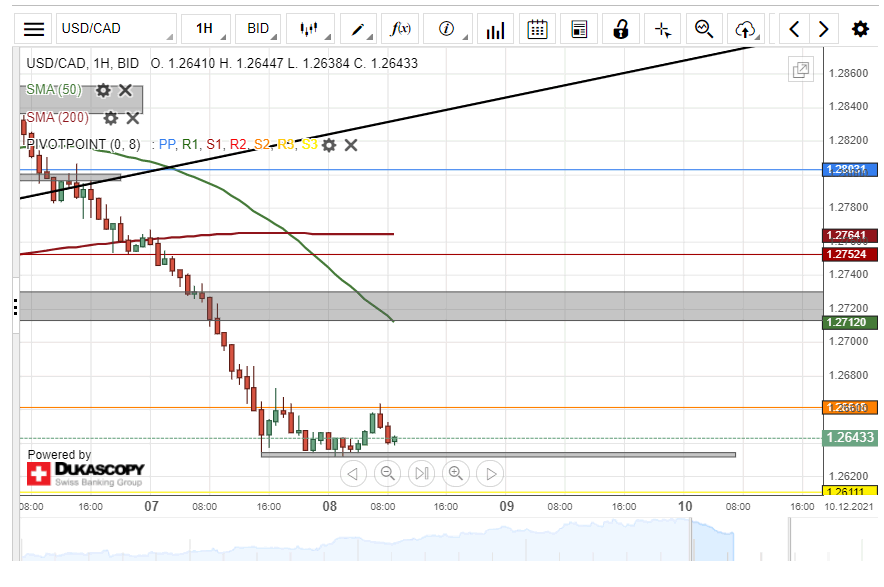
The USD/CAD currency exchange rate's decline eventually found and confirmed as support the 1.2632/1.2635 zone. On Wednesday morning, the currency pair retraced back up and found resistance in the weekly S2 simple pivot point at 1.2662.
If the currency pair breaks the resistance of the weekly S2 simple pivot point at 1.2662, the USD/CAD could reach the resistance of the 1.2700 mark. Note that the 1.2700 would most likely be strengthened by the 50-hour simple moving average. Above the 1.2700 mark, the last week's low level zone at 1.2713/1.2732 could act as resistance.
On the other hand, a move below the 1.2632/1.2635 support zone would look for support in the weekly S3 simple pivot point at 1.2611. Further below, the pair might be supported by the 1.2600 level.
USDJPY Moves Sideways Within SMAs And 112.70
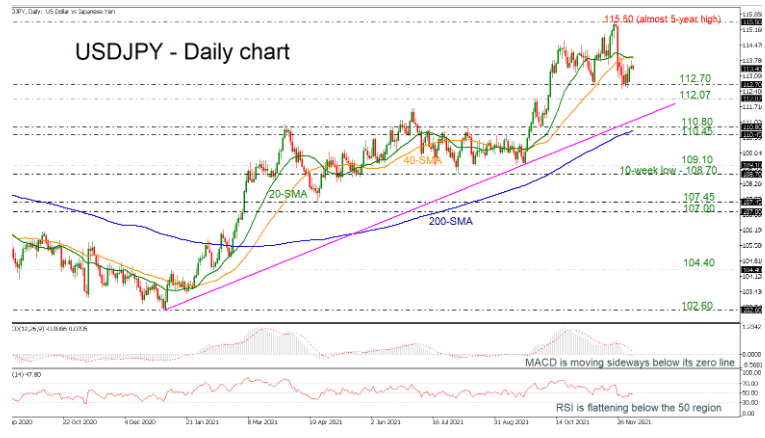
USDJPY has found strong support level at 112.70 over the last few days, remaining below the flat 20- and 40-day simple moving averages (SMAs). However, the pair is moving sideways within this range and is confirmed from the technical indicators as well. The MACD is moving sideways below zero level, while the RSI is flattening near its neutral threshold of 50.
In the case of a break beyond the short-term SMAs, the next stop could come from the almost five-year high of 115.50. A rally higher could send the market towards a key barrier, registered in December 2016 at 118.60.
Alternatively, a move beneath the 112.70 could take the price towards the 112.07, which is an inside swing high from September 30. Below these obstacles, the bears may challenge the long-term ascending trend line around 111.50 ahead of the start of a bearish structure, hitting 110.80.
All in all, USDJPY is neutral in the near-term but the broader outlook is strongly bullish. A decline below the uptrend line may shift the picture to neutral-to-bearish.
Renewed Market Optimism Captures Investors’ Attention
Investors enjoyed a rather optimistic session on Tuesday as hopes over a softer impact by the Omicron variant seem to surge within the media. Even though the impact of the new variant may require months to be fully investigated and determined, market participants tend to believe circumstances remain pretty much the same. Most of traders' confidence on Tuesday was displayed through the major US stock markets that were unanimously in green territory. All three major stock markets, the S&P500, the Nasdaq100 and the Dow Jones made notable movements to the upside gaining back most of the ground lost in the previous daily sessions.
However, on a more cautious note it should be noted that, as we are going through the final weeks of the current year, the markets may experience temporary abrupt or even exaggerated movements. Among the top stock gainers on Tuesday from our point of view was GlaxoSmithKline (#GSK) and its partner Vir Biotechnology Inc. that stood out as they stated that their new Sotrovimab Covid-19 antibody treatment is effective against the Omicron variant. More investigation maybe required as the treatment is still in the early stages of its laboratory studies. However, the results so far seem to be in favour of the treatment working against the variant. As the market is currently overflowing on information over the new variant GlaxoSmithKline's share price may continue to rise.
CAD in focus as BOC's Interest rate decision is expected
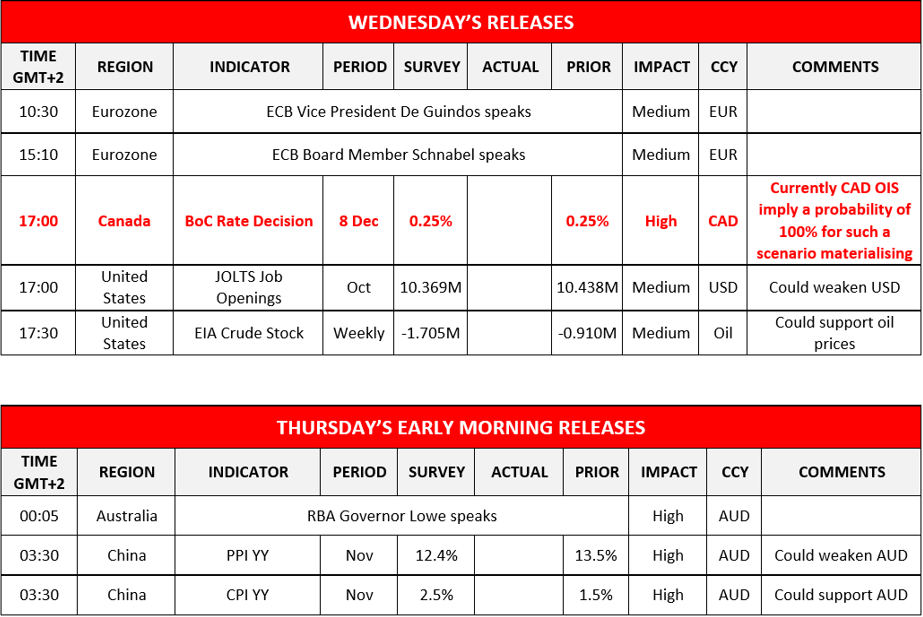
The star financial release for Wednesday is the Bank of Canadas' interest rate decision. The bank is widely expected to remain on hold at 0.25% and currently CAD OIS imply a 100% possibility for such a scenario to materialize. At the moment, the Canadian economy continues to display strength with the most recent employment report for November released during the previous Friday, showed the Unemployment rate dropping from previous 6.7% to 6.0% and the Employment change figure jumping from previous 31.2K to the impressive 153.7K. USD/CAD found itself in the downfall for the second consecutive day on Tuesday performing a considerable move to the downside. The CAD's dominance against the USD in the most recent daily sessions could be an indication that the market is preparing for the BOC's rate decision as well as its accompanying statement. All eyes will be fixed on BOC on Wednesday as the Employment market and Inflation data point to a strong position for the Canadian economy possibly granting for change of the central banks stance in the near future. On a separate note, the central bank's views on the ongoing pandemic and its impact on the Oil market can move traders interest towards the commodity's market. Oil price's moved higher in the past daily sessions but have not rebounded since the most recent selloff during late November.
Today's events and expectations
Today we note the two speakers from the ECB as a start. First ECB Vice President De Guindos in the European morning and ECB Board member Schnabel in the early US session. In the main US session we get BOC's interest rate decision while at the same time we receive the US JOLTS Job Opening for October and the weekly EIA Crude Stock piles. On Thursday early morning session we get a speech by RBA governor Lowe in the early Asian session. Later on the Chinese PPI and CPI rates for November will be released.
US30Cash H4 Chart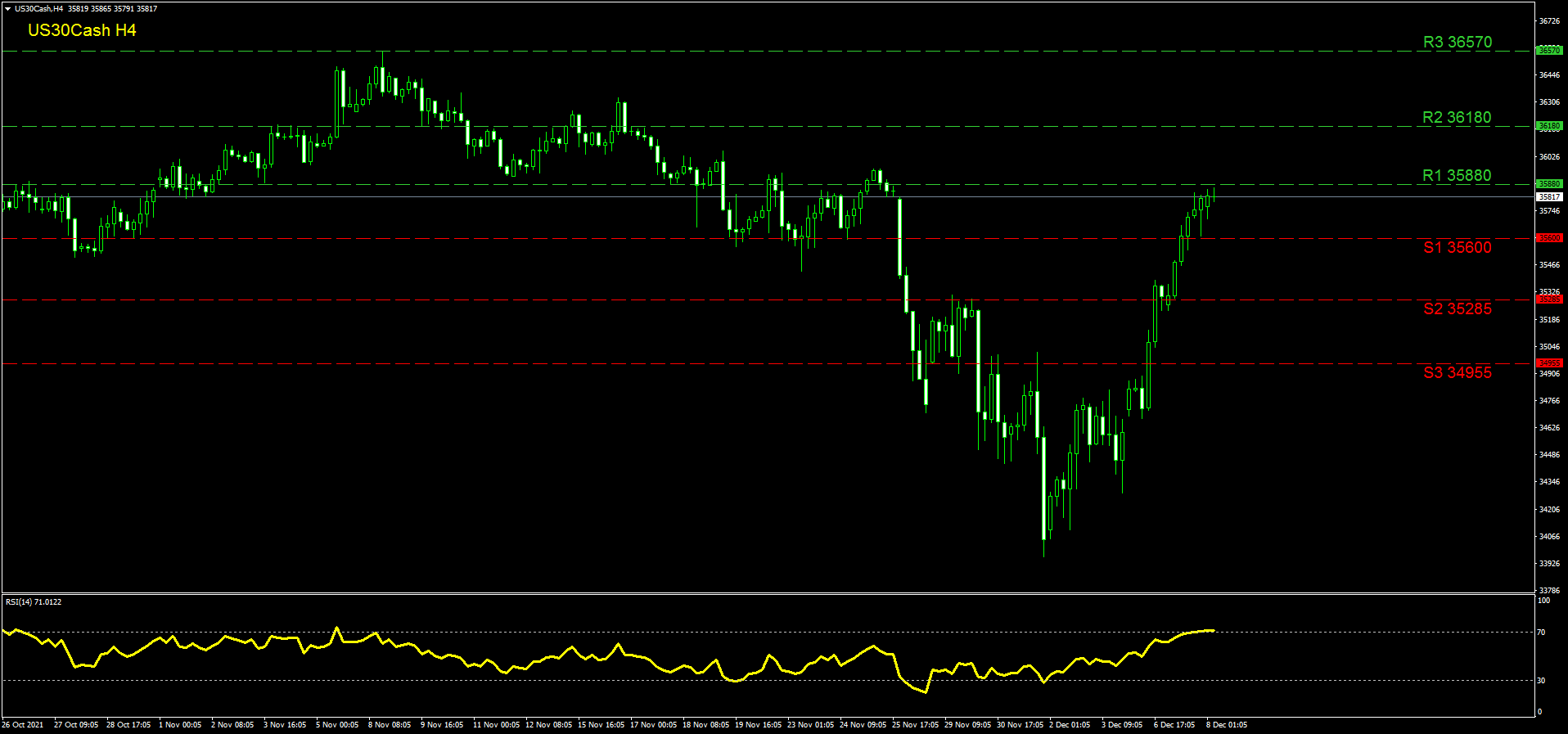
Support: 35600 (S1), 35285 (S2), 34955 (S3)
Resistance: 35880 (R1), 36180 (R2), 36570 (R3)
USD/CAD H4 Chart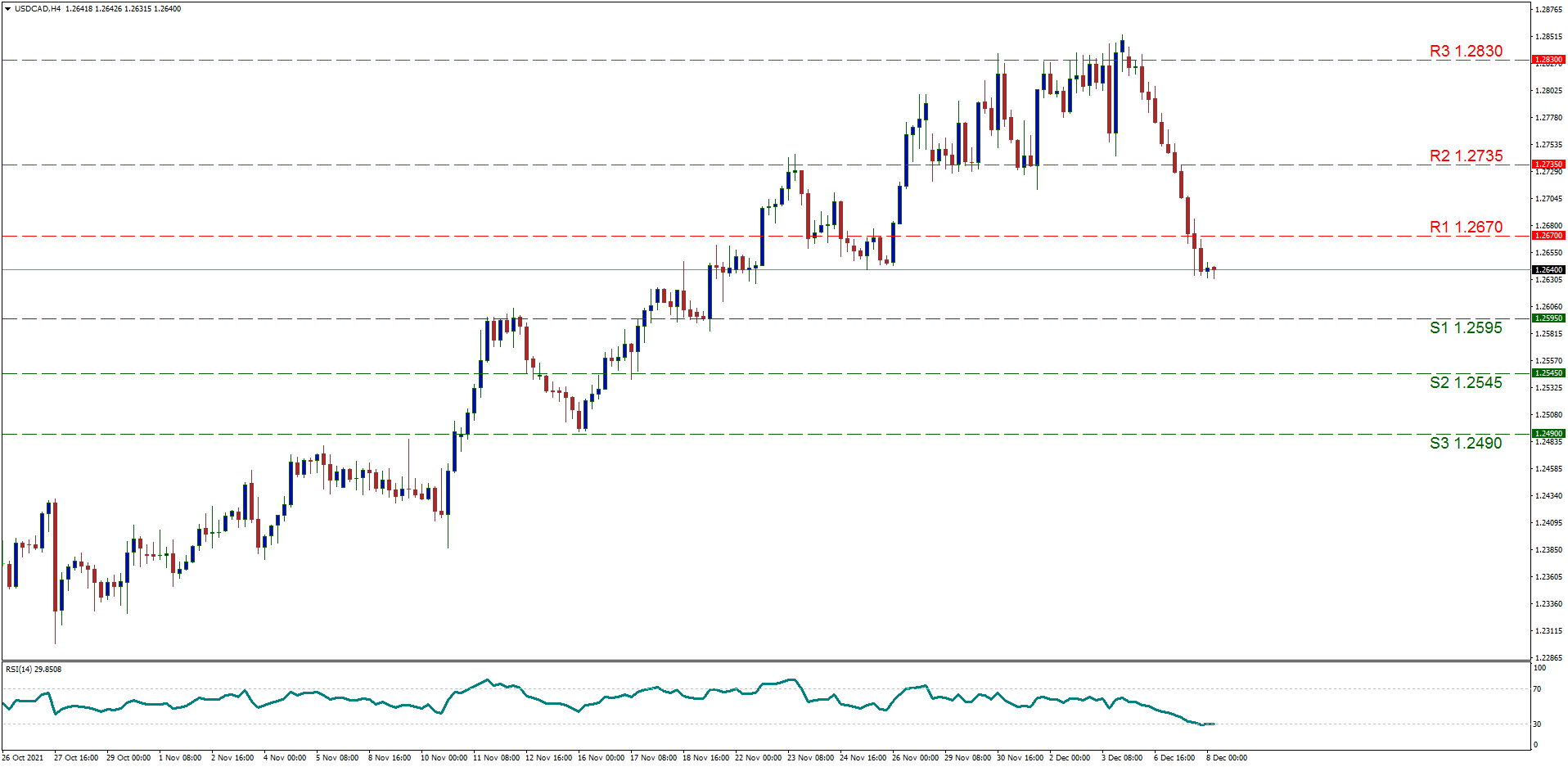
Support: 1.2595 (S1), 1.2545 (S2), 1.2490 (S3)
Resistance: 1.2670 (R1), 1.2735 (R2), 1.2830 (R3)
S&P 500 Index Eyes All-Time High As The Rebound Continues
US stocks jumped for the second straight day as investors reflected on new information about the Omicron variant. A report from South Africa said that the virus was moving fast but its symptoms were less severe than Delta. Therefore, investors believe that most developed countries will not order lockdowns again. Stocks also rose after GlaxoSmithKline (GSK) said that its new antibody-drug was working against the variant. Some of the biggest gainers were big technology companies like Microsoft and Apple. Intel’s stock jumped after the company revealed that it will take Mobileye public in a $15 billion deal.
The Canadian dollar jumped against the US dollar after the positive trade numbers from the country. Data by the Canadian statistics agency showed that exports and imports jumped sharply in November. This pushed the trade surplus to more than $2 billion. Further data showed that the country’s manufacturing and services PMI also rose sharply in November. Therefore, since inflation has risen and the labour market has tightened, analysts expect that the Bank of Canada will be hawkish later today. It will likely leave interest rates unchanged and hint at possible hikes in the first quarter.
The euro declined against the US dollar as Germany prepares for a leadership change. Olaf Scholz will today be sworn in to become the new chancellor of the country. It will be a notable step since Germany has only had one leader in the past 16 years. Still, since Scholz is the current finance minister, there is a likelihood that he will continue most policies championed by Angela Merkel. He becomes chancellor at a time when Germany is seeing unrest amongst citizens regarding the proposal of a mandatory vaccine. The euro will also react to a statement by Christine Lagarde today.
EURUSD
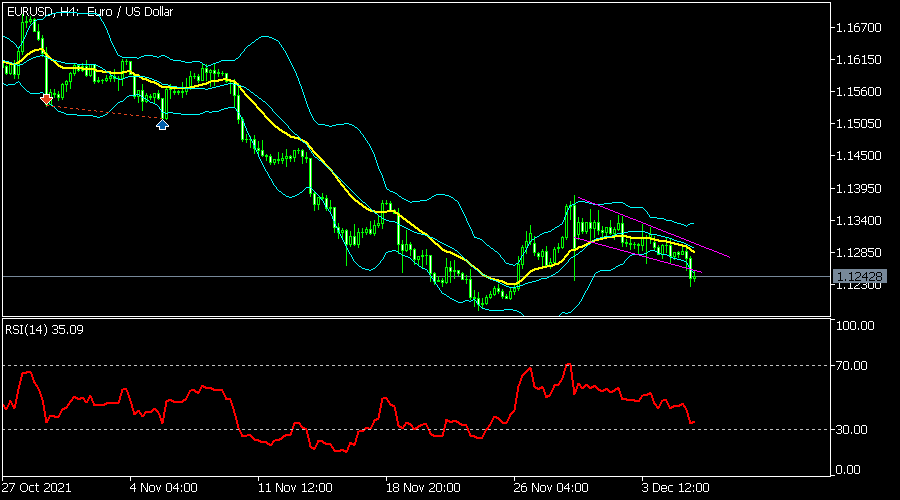
The EURUSD pair declined to a low of 1.1245, which was lower than last week’s high of 1.1380. On the four-hour chart, the pair managed to move below the lower side of the descending channel. It also moved below the 25-day moving average and to the lower side of the Bollinger Bands. The Relative Strength Index (RSI) is also approaching the oversold level. Therefore, the pair will likely resume the bullish trend as bulls target the upper side of the channel.
USDCAD
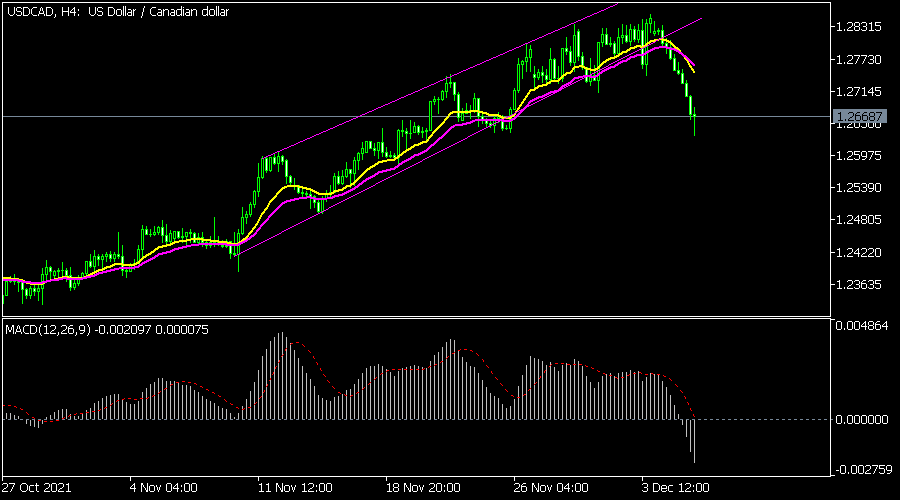
The USDCAD broke out lower on Tuesday as the market reflected on strong Canadian data. It declined to 1.2630, which was the lowest level since November. By doing so it moved below the lower side of the ascending channel. It also moved below the 25-day and 50-day moving averages while the MACD has moved below the neutral level. Therefore, the pair will likely keep falling ahead of the BOC decision.
SPX500
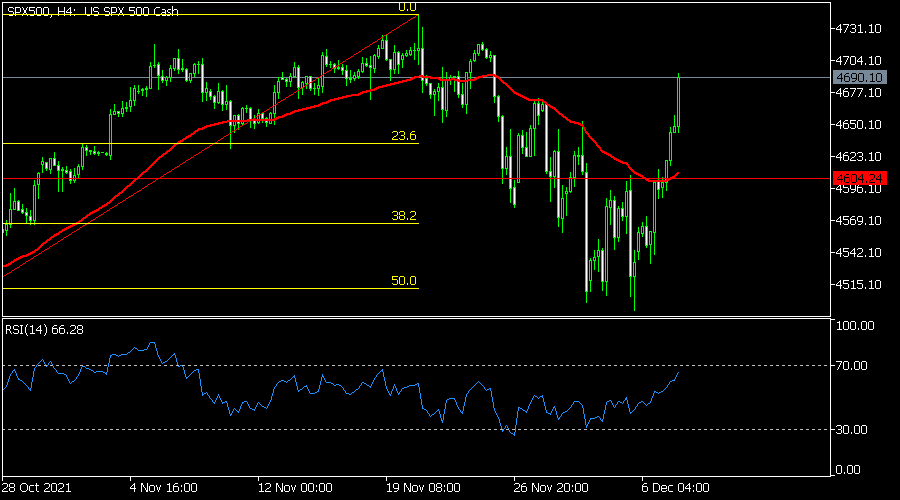
The S&P 500 index rose sharply on Tuesday. It is trading at $4,689, which was the highest level since November 26. It also moved slightly above the neckline of the inverted head and shoulders pattern at $4,600. The index also rose above the 25-day and 50-day moving averages while the Relative Strength Index is approaching its all-time high. Therefore, the index will likely keep rising as bulls aim for the all-time high.
China Caution Weighs On Asian Equities
China caution weighs on Asian equities
Wall Street enjoyed an outsized session of gains overnight as hot money flocked back into the global recovery trade on diminishing omicron fears. The S&P 500 rose 2.07% with the Nasdaq leaping 3.03% higher, while the Dow Jones added 1.42%. Futures on all three indexes have continued to rally in Asia, climbing by around 0.35%.
Asian markets are having an uneven day, with gains being lesser in scope or non-existent. The chief driver of caution is the deepening woes surrounding the China property sector and its potential impact on 2022 growth. That said, hopes of more stimulus measures from China and falling Covid-19 cases have seen mainland equities post solid gains.
The Nikkei 225 has jumped 1.50% higher today, with the Kospi adding 0.90%. In mainland China, the Shanghai Composite is also 0.90% higher and the CSI 300, more emerging and technology company facing, has added only 0.10%. The same theme is playing out in Hong Kong, home to many of the China tech and property developer heavyweights. The Hang Seng has eased lower by 0.10%. With the negative headlines streaming in still from those sectors, the Hang Seng will remain challenged even as mainland equities rise on stimulus hopes.
Singapore has fallen by 0.25% with Kuala Lumpur down by 0.10% and Jakarta rising just 0.25% today on China concerns. Bangkok has risen by 0.50% as easing omicron concerns boost sentiment in the tourism sector. Manila is 0.25% higher, while Taipei has climbed by 0.45%. Australian markets are all-in on the Wall Street rally, much like Tokyo. The ASX 200 has rallied by 1.45%, with the All Ordinaries leaping higher by 1.65%.
With the Putin/Biden meeting passing without incident, and with European equities ignoring the China property sector concerns, Eurozone equities should continue rallying this afternoon as omicron fears fade. The US Jolts data this evening is unlikely to derail the pent-up bullish momentum on Wall Street, which may have to wait until Friday’s US CPI data.
Omi-Whatever
US markets jump as Omicron concerns ease
Overnight, more data from South Africa suggesting omicron symptoms were mild gave a green light for the fast-money gnomes of Wall Street to pile back into the buy every-thing global recovery trade. Helping proceedings was news that a deal had been struck in the US Congress to raise the US debt ceiling, avoiding a potential December default.
US equity markets had a mighty session, with the S&P 500 and Nasdaq enjoying their best days since March. The US yield curve steepened once again while oil prices jumped, and the US dollar maintained its gains. Once again, buy-the-dip has triumphed and in the case of oil, last week was probably the lows for potentially the next 12 months.
I have stated that V for Volatility would be the winner in December, rather than directional momentum, and I believe that still holds true. While the buy everything trade will have its day in the sun for the rest of this week, some serious non-virus risk points are looming. Friday sees US CPI and a print at or above 7.0% is going to raise the heat at next week’s FOMC. We have a central bank policy frenzy next week, but all roads lead to the FOMC. And the odds of faster Fed taper and a signal of earlier rate hikes is rising. Markets continue ignoring this reality at their peril, and if reality bites next Wednesday (US time), the “growth” trade on equities could be in for some tough love.
Another “grey swan” is Russia and Ukraine. The Putin/Biden meeting appeared to be constructive, but the West continues to underestimate the Russian psyche regarding border security, as it does with China. A quick look at the history books will give readers all the answers they need. I will deal with the consequences of an invasion in later newsletters but think USD 150 oil, the mother of all dips to buy in US equities, and Europe paying the price for the strategic ineptitude of tying their energy security to Russia.
Apart from Japan, which slavishly follows the US equity market direction these days, Asia is once again, painting a more cautious picture. China’s property sector is the primary reason, with Evergrande failing to pay its Monday offshore obligations, Kaisa suspending its stock on the HKEX and another developer, China Aoyuan Group stating it cannot guarantee to be able to meet commitments due to liquidity constraints. As the saying goes, “there’s never just one cockroach,” and the list of distressed China developers seems to be growing daily.
Nerves over constrained China growth in 2022 due to an orderly, or disorderly, restructuring of the property developer sector are weighing on Asian markets. Nor has the China technology sector crackdown run its course either, despite plenty of press time that stocks in the sector look like a “bargain.” The light at the end of the tunnel continues to be the train coming the other way and the Financial Times lead story today is that China is preparing a blacklist to tighten restrictions on China tech companies seeking overseas listings.
It is increasingly clear that China is giving the option of Hong Kong or bust with regards to pseudo overseas listings, with the riches of US valuations being closed off. China tech may be trading at a “discount,” a situation I believe will become structurally embedded in their pricing under President Xi’s shared prosperity regime. As the saying goes, “the market can remain irrational, longer than you can stay solvent.” In the history of investing, never a truer word has been spoken. Thank you, Mr Keynes.
Today’s other risk point in Asia is this afternoon’s Reserve Bank of India policy decision. Despite stagflationary pressures rising once again, the RBI should stay unchanged on policy rates. However, it is the RBI Governor’s statement afterwards that will have markets on tenterhooks as there may be a signal that rate hikes are coming in 2022. That would temporarily boost the rupee, but India equities, bloated with hot money from offshore flooding into the tech-IPO space, may start running for the exit. Another choice saying is that “an emerging market is a market you can’t emerge from in an emergency.” Hints of hawkishness from the RBI could open unveil that reality to offshore investors.
Tonight sees the US Jolts Job Openings data released, expected to show some 10.4 million unfilled jobs in America. That will be another reason for next week’s FOMC to consider the t-word we can’t use to describe inflation now, as even less t-word than previously. US API Crude Inventories posted a surprise 3.1 million barrel drop overnight, and official US Inventory data tonight is expected to show a rise of 2.0 million barrels. A similar fall like the API data overnight will throw more fire on oil’s rally.
USD/CAD Pair Is Currently Consolidating Losses From The 1.2632 Low
The US Dollar started a major decline from well above the 1.2800 level against the Canadian Dollar. The USD/CAD pair traded below the 1.2720 support zone to move into a bearish zone.
There was a close below the 1.2700 level and the 50 hourly simple moving average. The pair traded as low as 1.2632 and is currently consolidating losses.
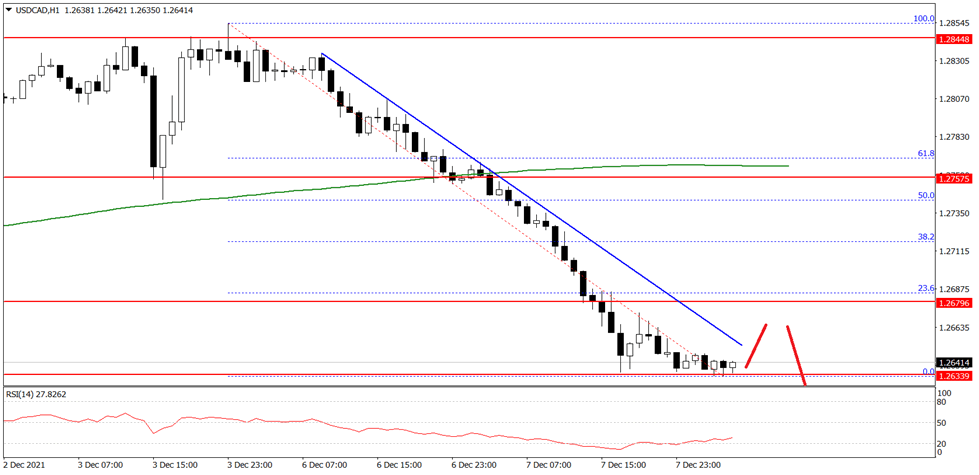
On the upside, an initial resistance is near the 1.2660 level. There is also a key bearish trend line forming with resistance near 1.2665 on the hourly chart. A clear break above the 1.2665 resistance could set the pace for a larger increase towards the 1.2720 level.
On the downside, the pair is finding bids near the 1.2635 level. Any more losses might lead USD/CAD towards 1.2600 on FXOpen. The next major support could be near the 1.2550 level.
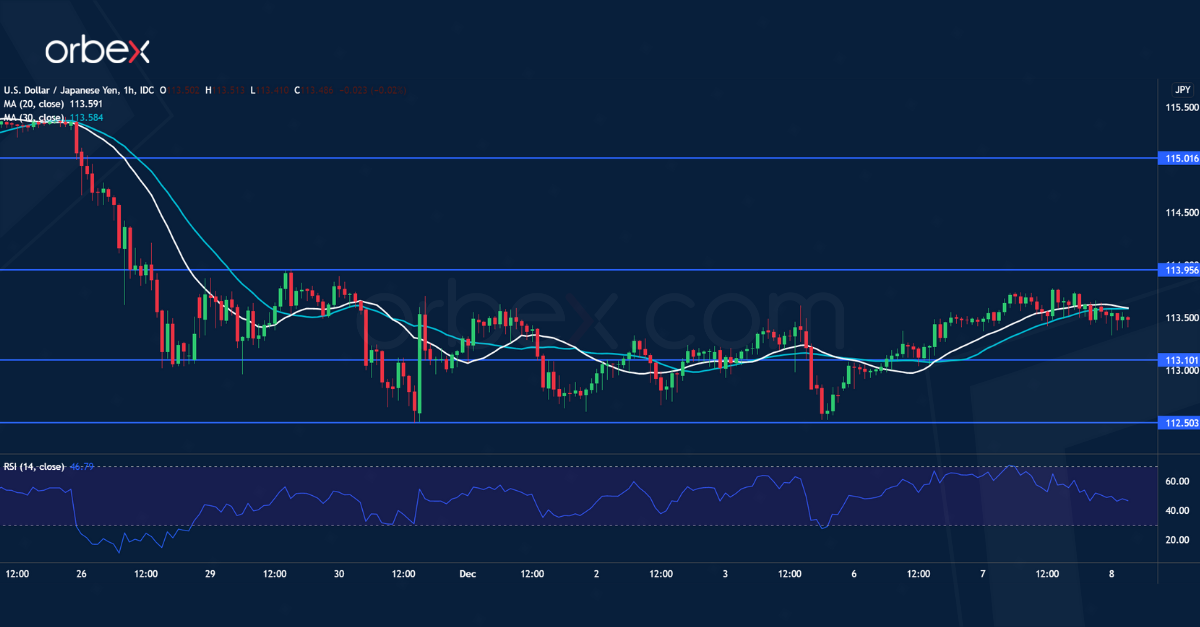
USDJPY Attempts To Rebound
The yen stalled after Japan’s GDP showed an unexpected contraction in Q3.
A break below the daily support at 112.70 has put the bulls on the defensive. The latest consolidation is a sign of indecision as to whether the correction would continue.
The greenback found support over 112.50 and a close above 113.95 could help the bulls regain the upper hand. Then the psychological level of 115.00 would be the next step before the uptrend could resume.
On the downside, a fall below 113.10 would retest the key support at 112.50.
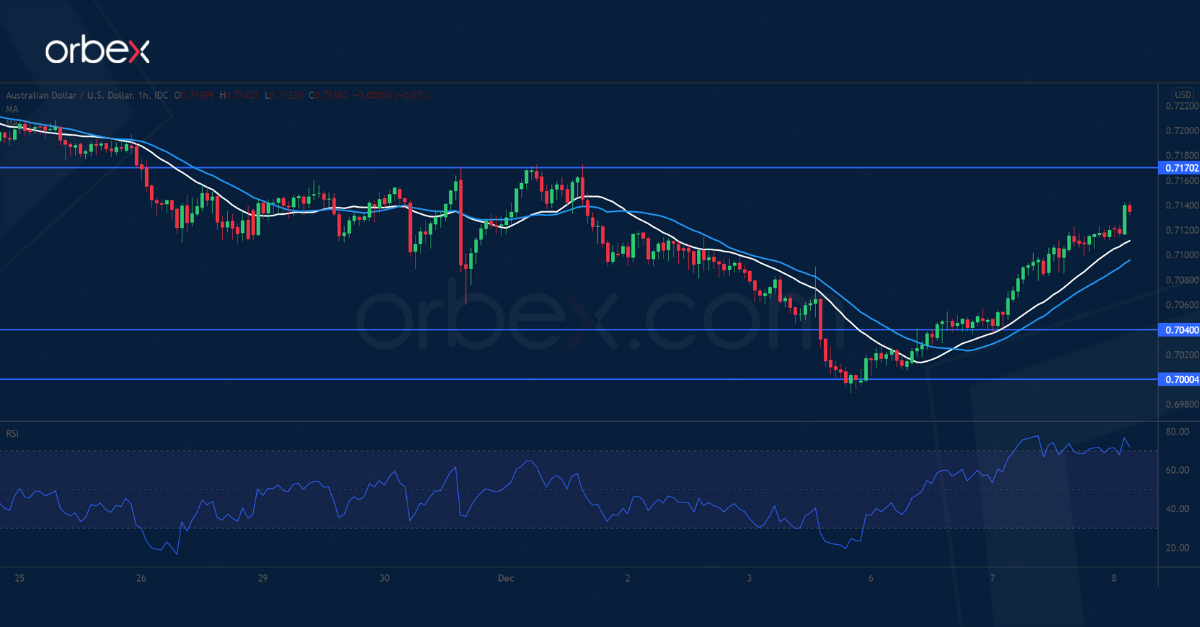
AUDUSD Breaks Higher
The Australian dollar soared after the RBA remained optimistic about the economic recovery. The pair saw strong buying interest at the psychological level of 0.7000, which also sits near November 2020’s lows.
An oversold RSI on the daily chart compounds the ‘buying-the-dips’ behavior. An initial pop above 0.7070 forced bearish trend followers to cover their latest bets.
0.7170 would be the next target though the RSI’s overbought situation may limit the surge. 0.7040 is the first support for buyers to regroup and accumulate.