Sample Category Title
Sunset Market Commentary
Markets
Markets this week enjoyed quite an impressive post-omicron risk-on repricing. Investors are growing ever more confident that the variant won’t affect the recovery in a profound way. The S&P 500 again trades only about 1.0% from the all time top. Other indices, especially in Europe, still have a longer journey to go. Even so, last week’s technical alert is called off. Maybe there is good reason to reverse part of last week’s panicky sell-off. Question now is: what’s next? With few eco data on the agenda, European equities initially showed some fatigue, gradually drifting south. Further losses/profit taking halted on headlines from Pfizer/BioNTech that a third dose of their vaccine raised antibodies in a way that materially reduces the impact of the omicron variant. Still European indices are trading with losses of about 0.5%. US indices again slightly outperform, opening little changed. The mild risk-off and some ‘soft’ comments from ECB members Villeroy (French inflation back below 2.0% end 2022) and Rehn (suggesting to wait for more clarity before considering policy normalization) even pushed EMU/German LT yields temporarily below recent lows. However, bond sentiment also made a sharp U-turn after the Pfizer headlines. German yields currently are gaining between 2.5 bps and 4.5/5 bps (5-10-y). German 10-y yield tries to regain the -0.35% resistance after testing -0.40% earlier today. A tentative break of the 0.10% area in the 10-y European swap was also rejected. Still the picture on European yield graphs looks much more fragile compared to the US. US yields today are rising 1-2.5 bps across the curve in a tentative steepening move. The intra-day reversal in EMU core markets clearly also wrongfooted investors in EMU peripheral bonds which performed rather well this week. 10-y spreads of Greece and Italy widen 7 bps and 6.bps respectively.
The intra-day swings on interest markets to some extent filtered through in FX, but as was often the case, price moves remained much more muted. EUR/USD rebounded from the 1.1270 area to currently trade in the 1.1310 area. Still, the technical picture remains fragile, with first resistance at 1.1383 still some distance away. The yen also pays the price of losing interest rate support against the euro and the dollar. EUR/JPY is testing minor resistance at 129. 79. USD/JPY develops a similar pattern nearing the 113.90 area. The Swiss franc again shows resilient among the safe havens (EUR/CHF 1.0435). Sterling also wasn’t in good shape today. The UK currency suffered from press reports (FT) that the UK government is preparing new restrictions affecting travel and including an order to work from home. This isn’t a comfortable context for the BoE to start a ‘hiking cycle’. Cable touched a new YTD low below well 1.32. EUR/GBP trades near 0.8560.
News Headlines
Hungarian inflation accelerated by 0.7% M/M to 7.4% Y/Y in November, slightly beating consensus (7.3% Y/Y). The contribution of demand-sensitive products and food increased. Core inflation and core inflation excluding indirect tax effects stood at 5.3% Y/Y. Industrial goods prices rose by 0.6% M/M to above 5% Y/Y. Higher commodity prices translate into consumer prices with the global semiconductor shortage also playing a role. Services prices rose by 0.6% M/M to 5% Y/Y. The new inflation acceleration adds pressure on the MNB which can not but accelerate its tightening cycle aiming for less negative real yields. The forint remains vulnerable near levels around EUR/HUF 368.
The Bank of Canada kept its policy rate as expected unchanged at 0.25%. In its policy statement, the BoC no longer refers to “temporary” forces pushing up prices. It is closely watching inflation expectations and labour costs to ensure that the forces pushing up prices do not become embedded in ongoing inflation. CPI is expected to remain elevated in H1 2022 before easing towards 2% in H2 2022. The BoC still expects economic slack being absorbed in the middle quarters of next year as projected in October. Floods and the omicron variant pose risks to growth. The loonie is a tad softer after the decision, trading at USD/CAD 1.2650.
BoC keeps interest rate at 0.25%, maintains forward guidance
BoC kept overnight rate target unchanged at effective lower bound of 0.25% as widely expected. Bank rate and deposit rate were held at 0.50% and 0.25% respectively.
Also, the forward guidance on interest rate is maintained. BoC is "committed to holding the policy interest rate at the effective lower bound until economic slack is absorbed so that the 2 percent inflation target is sustainably achieved". And, "this happens sometime in the middle quarters of 2022".
BoC said recent data suggested that economy had "considerable momentum" into Q4. But, "the devastating floods in British Columbia and uncertainties arising from the Omicron variant could weigh on growth by compounding supply chain disruptions and reducing demand for some service". BoC expected CPI inflation to remain elevated in the first half of 2022 and ease back towards 2 percent in the second half of the year.
(BOC) Bank of Canada maintains policy rate and forward guidance
The Bank of Canada today held its target for the overnight rate at the effective lower bound of ¼ percent, with the Bank Rate at ½ percent and the deposit rate at ¼ percent. The Bank's extraordinary forward guidance on the path for the overnight rate is being maintained. The Bank is continuing its reinvestment phase, keeping its overall holdings of Government of Canada bonds roughly constant.
The global economy continues to recover from the effects of the COVID-19 pandemic. Economic growth in the United States has accelerated, led by consumption, while growth in some other regions is moderating after a strong third quarter. Inflation has increased further in many countries, reflecting strong demand for goods amid ongoing supply disruptions. The new Omicron COVID-19 variant has prompted a tightening of travel restrictions in many countries and a decline in oil prices, and has injected renewed uncertainty. Accommodative financial conditions are still supporting economic activity.
Canada's economy grew by about 5½ percent in the third quarter, as expected. Together with a downward revision to the second quarter, this brings the level of GDP to about 1½ percent below its level in the last quarter of 2019, before the pandemic began. Third-quarter growth was led by a rebound in consumption, particularly services, as restrictions were further eased and higher vaccination rates improved confidence. Persistent supply bottlenecks continued to inhibit growth in other components of GDP, including non-commodity exports and business investment.
Recent economic indicators suggest the economy had considerable momentum into the fourth quarter. This includes broad-based job gains in recent months that have brought the employment rate essentially back to its pre-pandemic level. Job vacancies remain elevated and wage growth has also picked up. Housing activity had been moderating, but appears to be regaining strength, notably in resales. The devastating floods in British Columbia and uncertainties arising from the Omicron variant could weigh on growth by compounding supply chain disruptions and reducing demand for some services.
CPI inflation is elevated and the impact of global supply constraints is feeding through to a broader range of goods prices. The effects of these constraints on prices will likely take some time to work their way through, given existing supply backlogs. Gasoline prices, which had been a major factor pushing up CPI inflation, have recently declined. Meanwhile, core measures of inflation are little changed since September. The Bank continues to expect CPI inflation to remain elevated in the first half of 2022 and ease back towards 2 percent in the second half of the year. The Bank is closely watching inflation expectations and labour costs to ensure that the forces pushing up prices do not become embedded in ongoing inflation.
The Governing Council judges that in view of ongoing excess capacity, the economy continues to require considerable monetary policy support. We remain committed to holding the policy interest rate at the effective lower bound until economic slack is absorbed so that the 2 percent inflation target is sustainably achieved. In the Bank's October projection, this happens sometime in the middle quarters of 2022. We will provide the appropriate degree of monetary policy stimulus to support the recovery and achieve the inflation target.
Information note
The next scheduled date for announcing the overnight rate target is January 26, 2022. The Bank will publish its full outlook for the economy and inflation, including risks to the projection, in the Monetary Policy Report at the same time.
Australian Dollar Posts Slight Gains
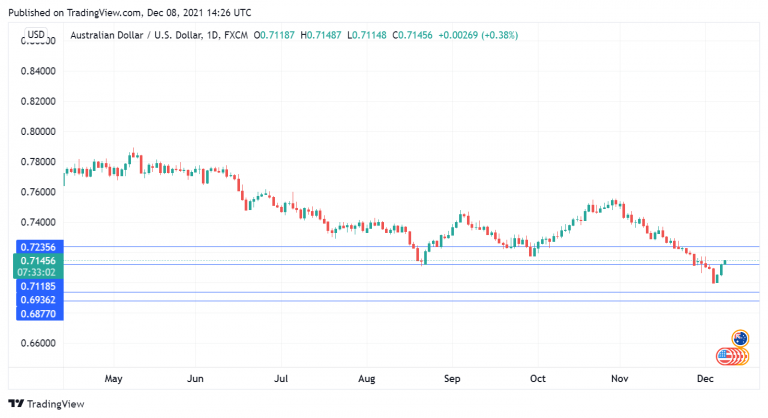
The Australian dollar is higher for a third straight day. AUD/USD is trading at 0.7145 in the North American session, up 0.37% on the day.
Aussie higher as Omicron jitters ease
The word ‘Omicron’ was causing fear and panic in the markets just two weeks ago, as the newest Covid variant raised fears of a new wave of Covid that might derail the tenous global recovery. Those fears have subsided to a great extent, as the market has suddenly taken a less frenzied view of Omicron, on the basis of data that shows that patients with Omicron have shown milder symptoms than with previous variants. Risk appetite has been on a roller-coaster track – falling sharply when panic set it, only to bounce back now that investors are no longer worried sick that Omicron will take down the global recovery.
Is Omicron really a mild event that we can put in the rearview mirror? It’s too early to tell, but the uncertainty over the newest Covid variant has resulted in significant volatility in the markets. The Australian dollar, a bellwether for risk sentiment, has shown strong volatility – the currency fell by 1.67% last week but has quickly recovered, with gains of 2.12% so far this week. Market participants should be prepared for the Aussie’s volatility to continue as more data is released and health officials learn more about the threat posed by Omicron.
At the RBA policy meeting, the bank cited Omicron as a new source of uncertainty but added that it should not derail the recovery. Omicron has emerged as a convenient crutch for the RBA, which has been looking to dampen market projections of a rate hike, which have been more hawkish than the bank’s guidance. I would expect other central banks that are under pressure to hike but have reservations, such as the BoE, to cite Omicron if they decide not to raise rates.
AUD/USD Technical
- There are support levels at 0.6938 and 0.6875
- AUD/USD is testing resistance at 0.7118. The next resistance line is 0.7235
GBPJPY’s Guiding Forces Fade but Bearish Bias Lingers
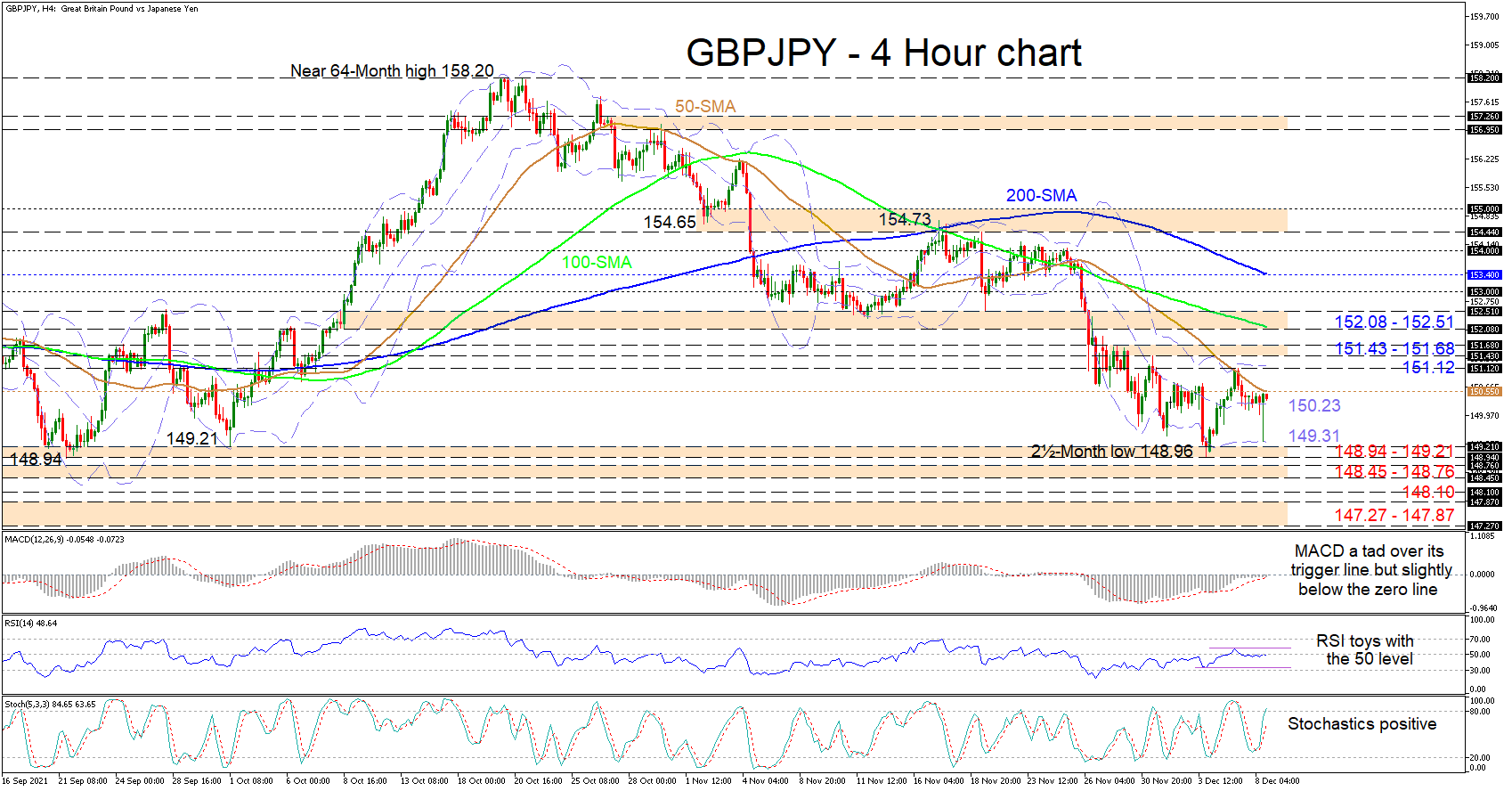
GBPJPY is trading around the mid-Bollinger band at 150.23, curbed by the 50-period simple moving average (SMA), which continues to hamper advances even after the bounce around the 149.00 mark. The falling SMAs continue to endorse the pair’s negative trajectory that recently softened on its approach towards key support bands, which are forming a congested base for the broader uptrend.
Currently, the short-term oscillators are not indicating a definitive direction in the pair. The MACD and its red trigger line are just beneath the zero threshold, while the RSI is flirting with the 50 neutral level. The positively charged stochastic oscillator is reflecting the latest surge in buying interest but additional gains in the price are questionable as upside momentum remains somewhat limited.
If the price oversteps the 50-period SMA at 150.55, the next upside constraints could commence at the 151.12 high and the adjoining upper Bollinger band. If the price manages to move higher, the nearby 151.43-151.68 resistance band may then attempt to discourage buyers from challenging the 152.08-152.51 resistance border. Should this barricade fail to suppress advances, the price may seek out the 153.00 handle and the 200-period SMA at 153.40.
If the 50-period SMA redirects the pair below the mid-Bollinger band at 150.23, the price could turn its focus to the lower Bollinger band and the 148.94-149.21 base. If the price dips past the September 9 trough of 148.94, the 148.45-148.76 support band could come into focus. Should selling interest persist, the 148.10 barrier could then step into the spotlight ahead of the 147.27-147.87 support foundation, which took shape throughout February 2021.
Summarizing, GBPJPY is sustaining a bearish bearing below the SMAs and the 152.08-152.51 barrier. If the price dives below the 147.27-147.87 border, this could trigger concerns for the broader uptrend.
US Futures Extend Gains, Dollar Retreats on Strong Risk-on Sentiment
US dollar and cable slip; Euro, loonie and aussie storm higher
The dollar is edging lower for a second consecutive day, pressured by the positive risk tone in the markets. However, attention is now shifting to the CPI reading on Friday, where a stronger-than-expected inflation figure might lock in the acceleration of the Fed’s tapering program, underpinning the greenback’s prospects.
The euro is marching higher today without any major headlines supporting its move, mainly benefiting from most major currencies’ setbacks. The Australian dollar is also appreciating as commodity prices climb.
The Canadian dollar is trading higher ahead of the BoC monetary policy decision later today, capitalizing on the recent solid Canadian data, surging oil prices and soaring risk appetite. Markets anticipate that the BoC will leave rates unchanged at 0.25%, but the meeting will be closely eyed on whether the BoC officials will signal an earlier rate hike than the latest guidance stated.
On the other hand, the Japanese yen and Swiss franc are inching lower today as the rebound in investor sentiment has curtailed their safe haven demand. Moreover, the British pound is plummeting in the current session after new emerged that the UK government is ready to impose stricter restriction measures to tackle the imminent Omicron variant spread.
Wall Street extends gains as Omicron fears diminish
Despite the weakness observed early in the current session, e-mini futures for the major US indexes recovered and powered ahead after Pfizer announced that three doses of its vaccine entirely neutralize the Omicron variant. Dow Jones, Nasdaq and S&P 500 futures are up 0.3% on the day, whereas major European indexes have slipped into the red after a positive start.
Oil surges; gold retreats
Oil prices are resuming their rally in the current week as markets and investors continue to downplay the impact of the Omicron variant on the global oil demand. Despite the softer dollar, and increasing geopolitical tensions, gold is experiencing a minor pullback in today’s session mainly due to the improving risk sentiment in global markets.
Canadian Dollar Surges, BoC Next
Bank of Canada likely to show caution
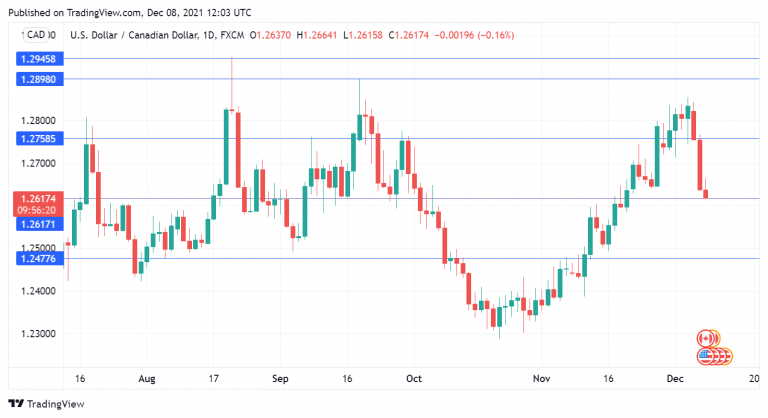
The spotlight will be on the Bank of Canada today, which holds its final policy meeting of this year. Lurking in the background is the Omicron variant, which caused a panic in the financial markets over fears of a new wave of Covid. These concerns have subsided and risk appetite has returned. The Canadian dollar has benefitted from higher risk appetite, as USD/CAD has fallen 1.52% this week.
The BoC is unlikely to deliver any surprises at today’s meeting. The bank will maintain the cash rate at 0.25%, and with QE all wound up, the next question is when will the bank press the rate trigger? The markets are projecting a rate hike early next year, perhaps as early as January. The markets have been more hawkish about a rate hike than the BoC, although the bank has brought forward its guidance to mid-2022, after admitting that inflation will be higher and last longer than the bank had expected.
Canada’s economy is improving, and there are a number of factors which support a rate hike sooner rather than later. The November jobs report was much stronger than expected, inflation has hit 30-year highs, and the red-hot housing market bubble could burst. If there is a good reason to be cautious, it is due to concerns over Omicron. Preliminary reports show that the variant is very contagious but appears less severe than previous Covid variants. The BoC won’t have the luxury of seeing additional data about Omicron before the meeting, and may try to dampen expectations about a rate hike by saying that more time is needed to assess the impact of Omicron. If the bank surprises and sends a hawkish message to the markets, the Canadian dollar should be able to extend this week’s impressive rally.
USD/CAD Technical
- USD/CAD continues to fall and break below support levels. The pair is testing support at 1.2618. Below, there is a monthly support line at 1.2477
- There is resistance at 1.2758 and 1.2898
EUR/USD Mid-Day Outlook
Daily Pivots: (S1) 1.1232; (P) 1.1265; (R1) 1.1302; More...
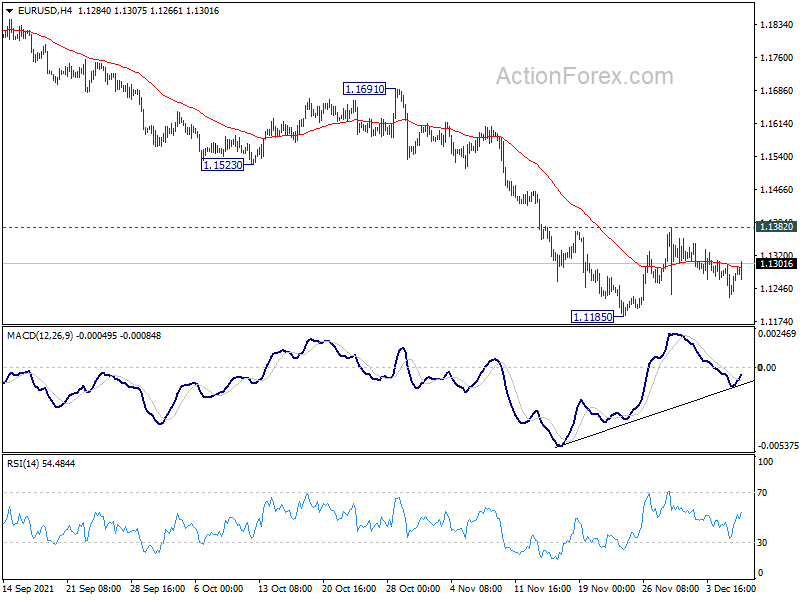
Intraday bias in EUR/USD remains neutral as range trading continues. On the upside, firm break of 1.1382 resistance should confirm short term bottoming at 1.1186. Intraday bias will be turned back to the upside for 55 day EMA (now at 1.1473). On the downside, break of 1.1185 will resume larger fall from 1.2348.
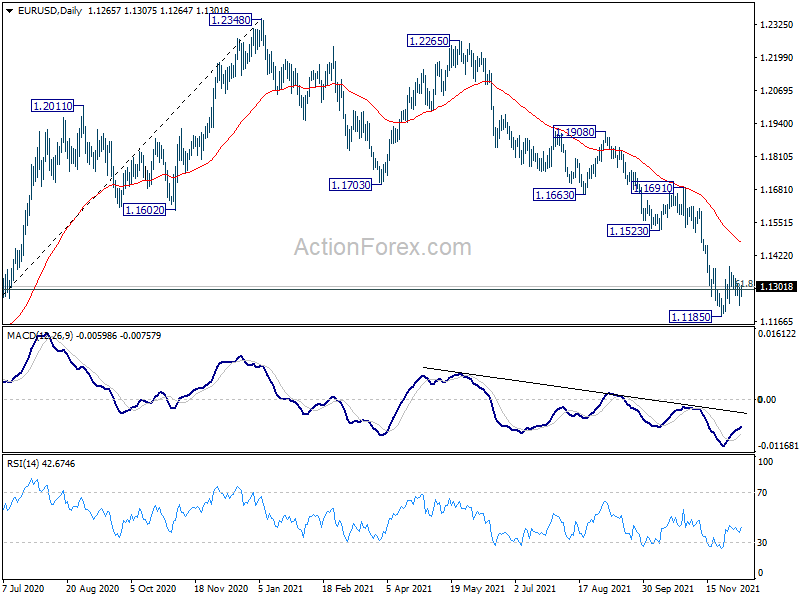
In the bigger picture, there are various ways of interpreting the fall from 1.2348 (2021 high). It could be a correction to rise from 1.0635 (2020 low), the fourth leg of a sideway pattern from 1.0339 (2017 low), or resuming long term down trend. In any case, outlook will now stay bearish as long as 1.1703 support turned resistance holds. Sustained break of 61.8% retracement of 1.0635 to 1.2348 at 1.1289 would pave the way back to 1.0635.
GBP/USD Mid-Day Outlook
Daily Pivots: (S1) 1.3204; (P) 1.3247; (R1) 1.3285; More...
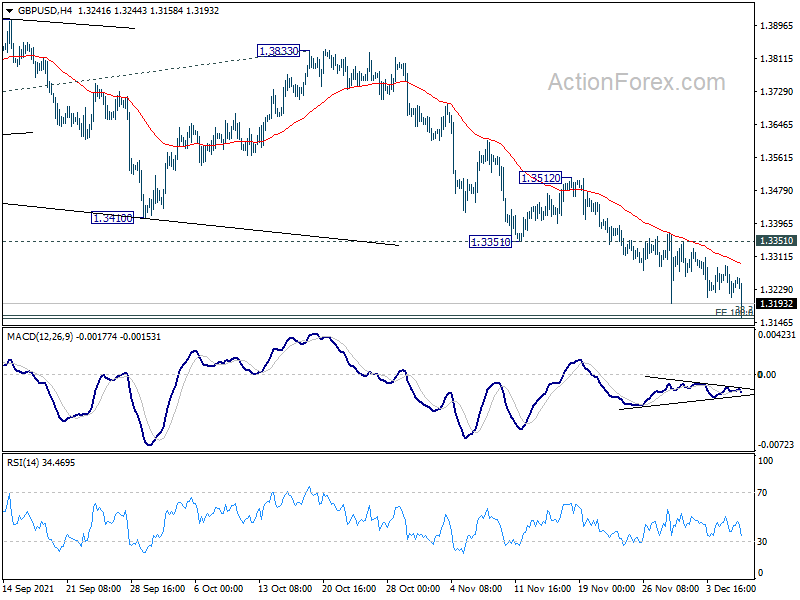
Focus is now on 1.3164 medium term fibonacci level as fall from 1.4248 resumes today. Sustained break there will carry larger bearish implication, and target 161.8% projection of 1.4248 to 1.3570 from 1.3833 at 1.2736. On the upside, though, break of 1.3351 support turned resistance will indicate short term bottoming, and turn bias back to the upside for 1.3512 resistance next.
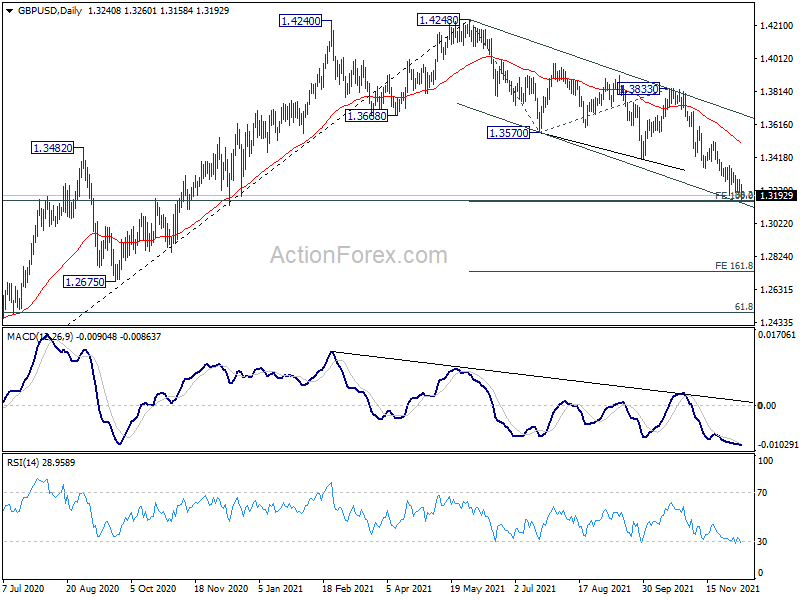
In the bigger picture, immediate focus is now on 38.2% retracement of 1.1409 to 1.4248 at 1.3164. Sustained break there will argue that whole rise from 1.1409 has completed at 1.4248, ahead rejection by 1.4376 long term resistance. That will revive some medium term bearishness and and target 61.8% retracement at 1.2493.
USD/CHF Mid-Day Outlook
Daily Pivots: (S1) 0.9228; (P) 0.9251; (R1) 0.9272; More....
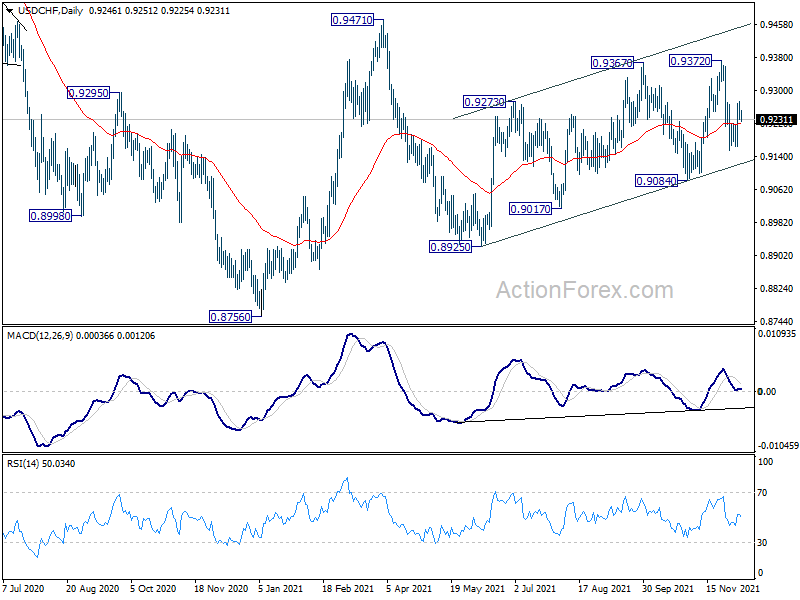
No change in USD/CHF's outlook as range trading continues. Intraday bias remains neutral at this point. On the upside, break of 0.9271 minor resistance will suggest that the pull back from 0.9372 is finished. Intraday bias will be turned back to the upside for 0.9372. On the downside, below 0.9156 will target 0.9084 support. Firm break there should confirm that choppy rise from 0.8925 has completed, and suggests that fall from 0.9471 is resuming. Deeper decline would be seen through 0.8925.
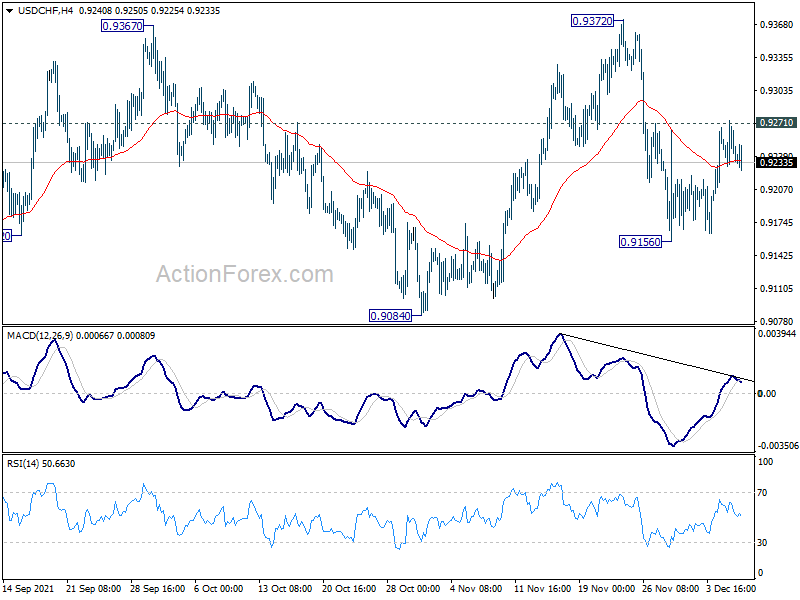
In the bigger picture, the corrective structure of the rebound from 0.8925 argues that fall from 0.9471 is not complete yet. It could either be the second leg of pattern from 0.8756 (2021 low), or resuming larger down trend from 1.0237 (2018 high). We'd pay attention to the downside momentum and assess the odds later. But for now, medium term outlook will be neutral at best as long as 0.9471 resistance holds.